




Abstract
The emission divide between large developed and developing cities is increasing, making it unlikely that the Paris Agreement will be met. Herein, we examine how the 424 largest cities globally, each with one million or more residents, contribute to the global emissions gap and examine the increasing emission divide between developed and developing cities. We find that 302 cities lack emissions data, and the overall emission rate has been increasing at an average of 7.9% per annum. Furthermore, only 31 cities have achieved reductions in the emissions gap, all of which are cities in the developed world. Even though cities are responsible for ∼75% of global CO2 emissions, science lacks practical policies for mitigation where resources are scarce. Accordingly, we propose new policy directions to lessen this divide, and we urge the development of city-oriented mitigation science and practical policies to help cities around the world develop specific mitigation policies based on their economic feasibility.
Introduction
Cities are responsible for approximately 70% of all energy-related greenhouse gas (GHG) emissions (ICLEI, 2018) and 75% of global CO2 emissions (United Nations Environnent Programme [UNEP], 2019) globally. Accordingly, cities are among the most significant considerations in efforts to reduce CO2 emissions, and urban policy is now considered a highly promising vehicle for tackling the challenges of climate change (Jabareen, 2018, Jabareen and Eizenberg, 2019; Leichenko, 2011; Rosenzweig and Solecki, 2018).
Recently, through coalitions such as the Global Covenant of Mayors for Climate and Energy (2022), which was signed by 11,077 city representatives, cities have pledged to reduce CO2 emissions 40% by 2030. The Covenant of Mayors was first launched in Europe in 2008 with the aim of connecting local governments voluntarily committed to achieving and/or exceeding the EU climate and energy objectives. Eight years later, the initiative was opened to include non-European cities and became a bottom-up governance, multi-level cooperation model that provides a context-driven framework for action (Global Covenant of Mayors for Climate and Energy, 2022).
However, the scale of effort required to reduce the emissions of cities worldwide is daunting. While many recent international reports suggest that global emission gaps are increasing at the country level, reporting on cities is still partial and inadequate. The Special Report on Global Warming of 1.5°C of the Intergovernmental Panel on Climate Change (IPCC, 2018) and the Emission Gap Report 2021: The Heat Is On – A World of Climate Promises Not Yet Delivered (UNEP, 2021), for instance, suggest that the ‘emissions gap’ at the country and global levels have increased in recent years and that global CO2 emissions, in general, have increased since 2017 (after three years of stabilisation). Clearly, the majority of countries are not yet on the right path to achieve their goal by 2030.
It appears that, at the city level, there is a significant lack of knowledge regarding emission-abatement rate, the type of mitigation measures applied, their cost and their effectiveness. Some recent studies suggest emissions data is scarce in many cities around the world, and that transparency, consistency and accuracy are lacking in many cases (Dodman, 2009; Guan et al., 2012; Jabareen, 2019; IPCC, 2015; Kennedy et al., 2014; Ramaswami et al., 2021). Huo et al. (2022) concluded that many city-level mitigation efforts are hampered by a lack of timely and high-quality emissions data. Other studies have found that more than half of Chinese cities lack publicly available CO2 emissions data, limiting the reliability of related studies (Chen et al., 2017). Overall, the literature lacks evidence detailing the results of cities’ climate strategies and actions and how these efforts translate into CO2-emission reduction (Croci et al., 2017; Khan et al., 2016; Milojevic-Dupont and Creutzig, 2021). For example, Hsu et al. (2020) reported limited evidence and little empirical support to link mitigation at global, national and urban levels with emission reductions.
Although emission mitigation at the city level has been a primary target of international and national organisations and states, this article reveals some pressing questions regarding the performance of cities in coping with climate change. Accordingly, this commentary addresses the differences between rich ‘developed’ cities in the Global North and poorer ‘developing’ cities of the Global South; what options are available for cities with scarce resources to apply mitigation measures and reduce emissions; and whether current mitigation measures to meet the global challenge of emission abatement are adequate.
Here, I advance a threefold argument and propose first, that the problem with the existing literature on urban climate mitigation modelling and measurement is that it is socially, administratively (politically) and economically Western-oriented in terms of context and conditions. As such, it dismisses the social, economic and political conditions of developing cities and specifically the capability of those in the Global South to promote mitigation and adaptation policies. Nevertheless, mitigation measures have been adopted in wealthy Western countries in recent decades and achieved incomparable progress compared with those elsewhere.
Second, at the city level, existing tools and modelling of mitigation measures are fragmented, non-inclusionary and focus on specific sectors and emission sources rather than assessing entire city performance. There is a lack of organised global data on the emission of cities around the world, and what does exist is poor and inconsistent.
Third, not only is there a divide between developed and developing cities (or wealthy and poor cities), but this divide is expected to increase in the years ahead, since less developed cities cannot afford the ‘luxury’ of treating climate change issues while facing severe poverty rates, unemployment and housing problems.
Therefore, the aim of this study was to analyse the emission gap between large developing and developed cities worldwide, and to suggest new mitigation policies for cities based on their economic feasibility.
In the next section, we outline the methods for collecting emission data for large cities, defined here as those cities with one million or more residents. We then describe the results for the large cities’ mitigation performance and discuss the emission performance gap between developed and developing cities. Finally, we identify the problem with existing mitigation policies and models and propose the idea of a city-oriented feasible mitigation policy.
Emission data collection for large cities
There are no existing inclusive databases cataloging the emissions rates of large cities around the world. Primarily, reporting is based on country rather than on city, which makes tracing the contributions of cities much more difficult.
Some global networks provide data regarding climate change and the emissions of cities. This study uses these networks to collect emission data for the world’s large cities. However, these networks mostly lack the required data. For example, Local Governments for Sustainability (ICLEI) (2018, 2022), a network of more than 2500 local and regional governments committed to promoting sustainable urban development, has a limited dataset that does not include most developing large cities. Another network of cities, the Disclosure Insight Action (CDP) (2022), has specific data for only 71 large cities (from 2021) that disclose publicly and have a city-wide emissions inventory. CDP (2022) Cities has a limited dataset collected in partnership by CDP and ICLEI – Local Governments for Sustainability.
C40 (2022) is a network of mayors from nearly 100 world-leading cities collaborating to deliver the urgent action needed to confront the climate crisis. It too has a limited dataset, which also lacks data regarding larger cities in the Global South.
Furthermore, the United Nations Framework Convention on Climate Change (UNFCCC’s) (2022) Global Climate Action has developed a global online platform that organises more than 11,250 cities worldwide that have pledged some measures of climate action. These measures range from setting emission reduction targets to adopting clean and efficient energy policies. However, like other networks, UNFCCC does not have the required data on the emission of most large cities, specifically those in the Global South.
Another significant source of emission data for cities is recent studies that examine their emission performances. However, these studies target developed cities where data is mostly available. For instance, Kona et al. (2021) built a dataset of GHG emissions for 6200 cities in Europe and the Southern Mediterranean. Moran et al. (2022) presented a new CO2 emissions inventory for all 116,572 municipal and local-government units in Europe, containing 108,000 cities at the smallest scale used. Hsu et al. (2022) assessed the mitigation performance of nearly 50,000 local and municipal actors in the European Union from 2001 to 2018.
Thus, given that there is a lack of a global organised datasets on the CO2 emissions of cities around the world, this study uses various sources to obtain the data, including (a) the World Bank, which does not provide emission data for cities but countries. Thus, we obtained data from the World Bank (2022) for countries only when comparing cities and their mother countries; (b) the global network of cities: CDP, ICLEI and C40; (c) individual city reporting; (d) state reporting; and (e) academic studies that focus on a limited number of cities (mainly in China). The study tried to collect the emissions data from formal sources that apply a similar and consistent methodology, which is adopted by the Intergovernmental Panel on Climate Change (IPCC) and reported in other studies (Kennedy et al., 2014). Eventually, after intensive work looking for the approved emission data for each of the 424 large cities worldwide, we built the database from scratch. We collected data for each city individually through different sources: emission reports by the city itself and the state, and data from the global networks mentioned.
For each city selected for this study, the data collected included the following main variables: (a) Benchmark (baseline) year, which is a reference year against which emission reductions in the future are measured, and which is decided by each individual city. Therefore, benchmark year varies among cities. Baseline emissions are critical to measuring whether emission reduction targets are being met. (b) Emissions in metric tons of CO2 in the benchmark year. In our study, the range of benchmark years is between 1990 and 2016. (c) Population in the baseline year. (d) Emission reduction target year. (e) Emission reduction target rate. (f) Emissions in in tonnes of CO2 in target year. Both emissions target rate and year are decided by cities individually. (g) Population in emission reduction target year.
It is important to note that the accuracy and consistency of the dataset are not high. That means the data provide us with general insights regarding the emission reduction of large cities worldwide. Data from cities in the Global North are generally more available, accurate and valid than those in the Global South. Although it is important not to homogenise countries and cities along with the category of developed and developing, the data and the findings show that in the context of climate change, resources and existing data emission, these categories are valid.
Results
Mitigation performances of large cities
This study revealed that there are 424 cities globally with populations of one million or more residents, constituting a total population of 1.346 billion residents. There are 302 cities (71.2%) with a total population of 701 million people that lack emissions data. Only 123 cities, which have a total population of 645 million, have emissions data for more than one year.
The average emissions per capita for the large cities that report annually is exceptionally high and reaches 10.2 (Std., 18.5) metric tons of CO2. China, with its 50 large cities, shows the highest emissions per capita. Overall, most cities in the Global North have higher emissions per capita than those in the Global South. Furthermore, as Figure 1 demonstrates, when we compare emissions per capita between nations in the Global South and their large cities, we find that large cities have much higher emissions per capita than the countries in which they are located. In contrast, large cities have lower emissions per capita than those of their countries in developed countries. Large cities in the Global South perform much better than their countries (Figures 2 and 3). Thus, cities worldwide perform differently than their countries in terms of mitigation and emissions.
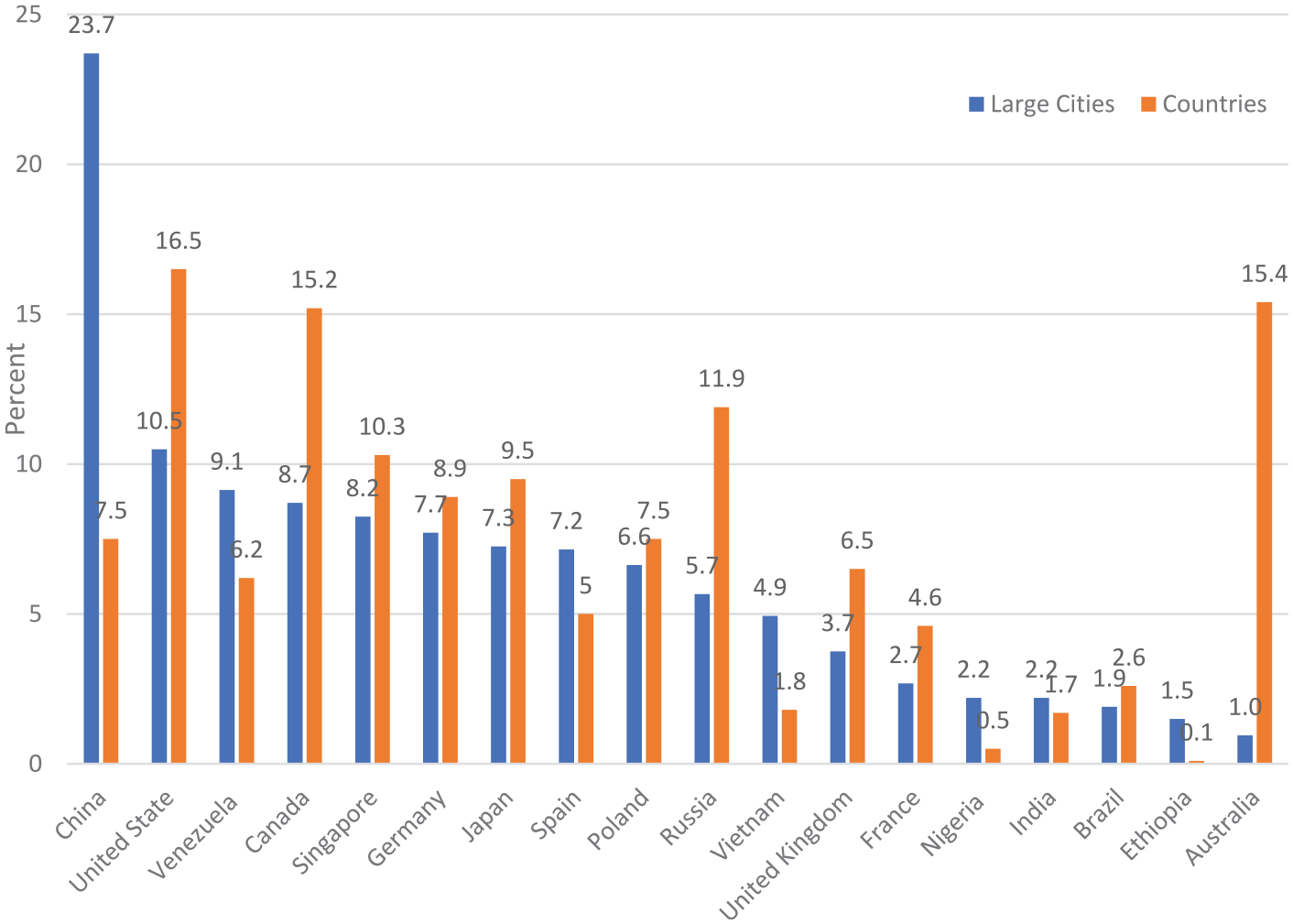
Emission per capita: comparison between nations and their large cities.
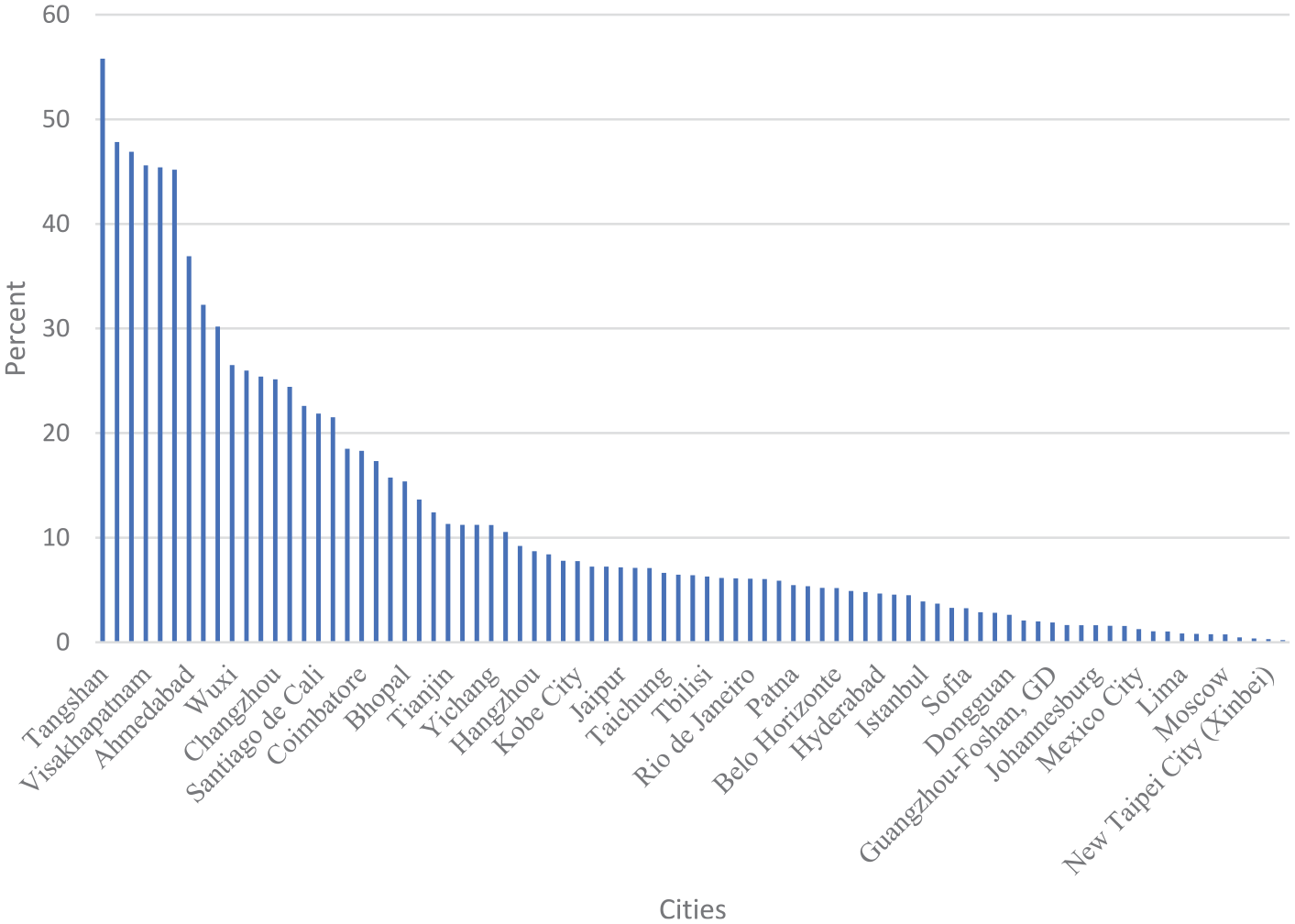
Cities with yearly increases in emission rates.
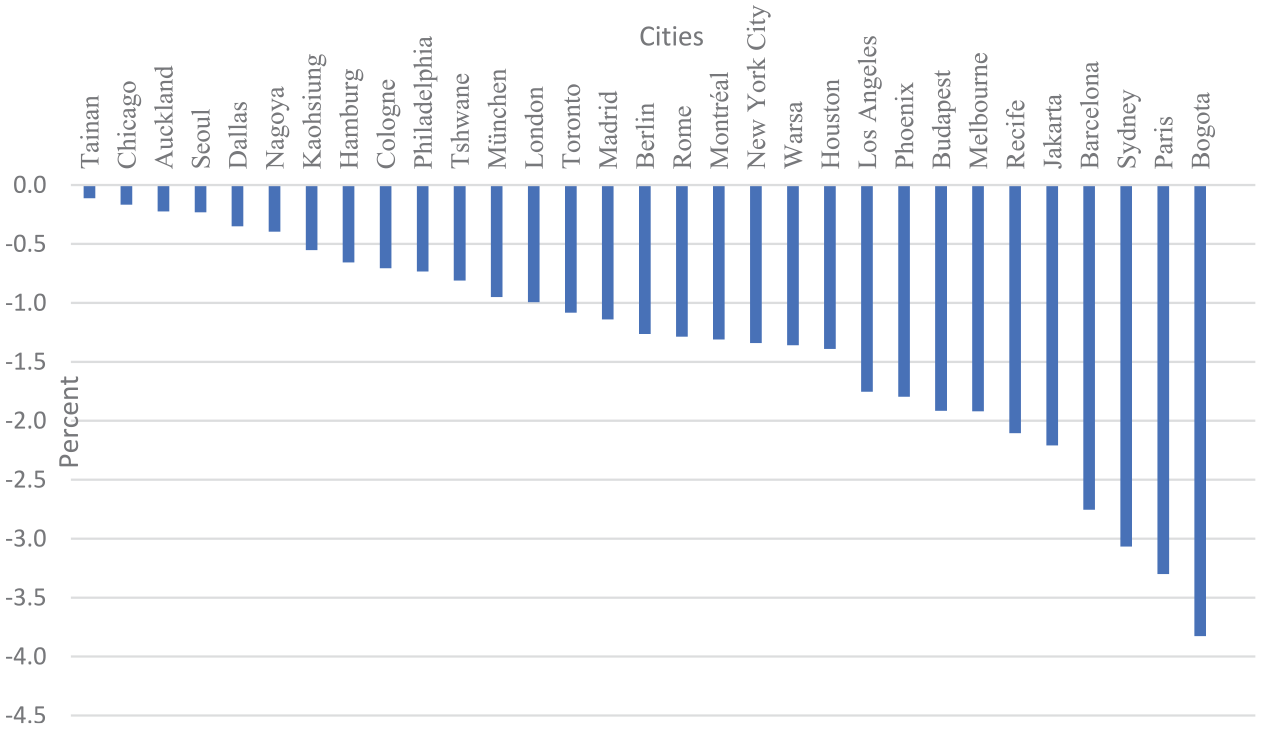
Cities with yearly decreases in emission rates.
The average emission rates in the reporting cities differed considerably between the benchmark year and the last report, and they were extremely high, reaching 45.0% in 121 cities. As mentioned, the benchmark years range between 1990 and 2016. The emission rate has been increasing at 7.9% per annum (Std, 12.5). This rate was calculated after revealing highly excessive rates. Only 31 cities achieved reductions in the emissions gap – all in the Global North – with an average change of −1.35% (Std, 0.95) annually. Among the remaining 86 cities, which had positive rates of change, the average annual rate was +11.2% (Std, 13.0).
Furthermore, the study found that only 66 cities (15.5%) among the 424 large cities that had planned and envisioned targets for emission reduction specified both the benchmark and target years. The emissions gap between the stated target and reality was too large at 47.9%. As Figure 4 demonstrates, only three cities have achieved their stated reduction goals.
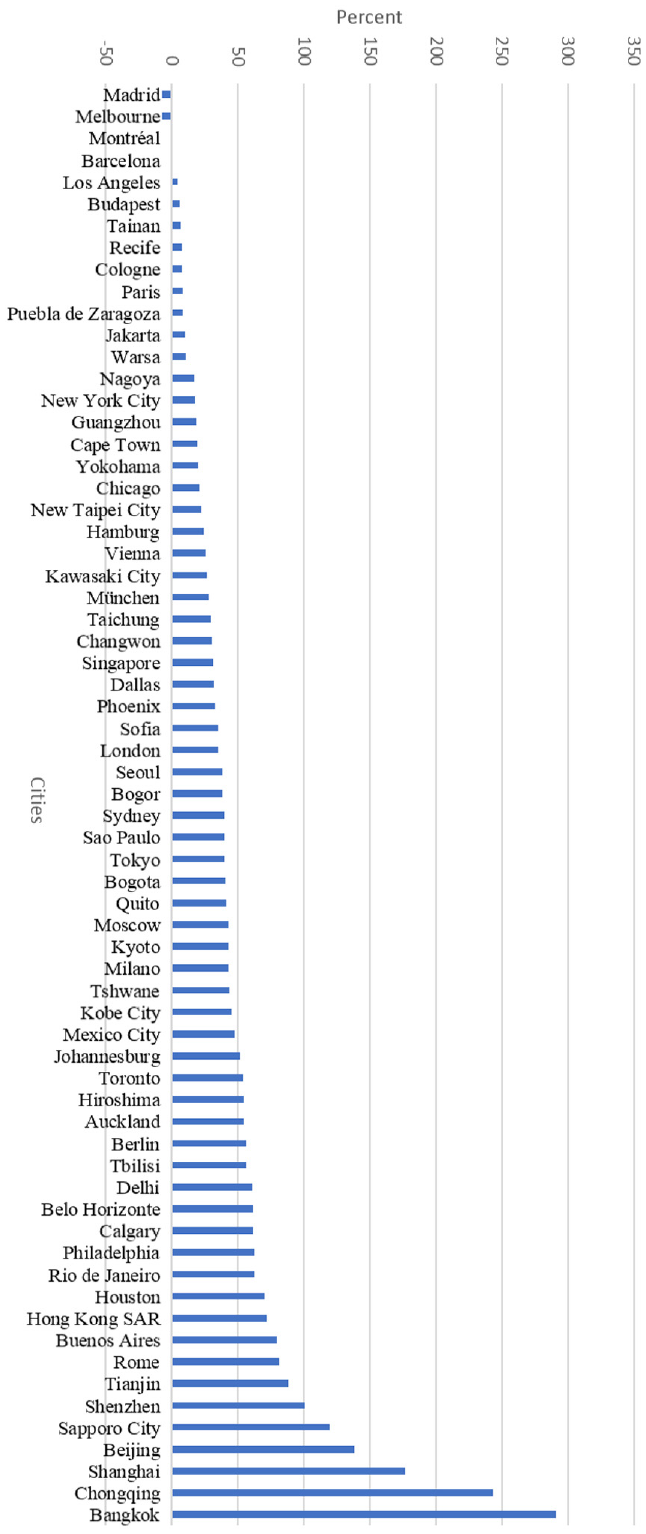
Emissions gap between stated target and actual performance for large cities.
Our analysis demonstrates the poor performance of large cities in both the North and South. Cities in the former have applied a broad range of mitigation measures to reduce GHG emissions, but most have not achieved their stated goal and have failed to close the emissions gap. Only three cities in the rich Global North have achieved their reduction targets. Furthermore, most cities in the Global South currently have increasing rather than decreasing emission rates. Lack of resources, poverty and social issues are their core concerns and mitigating climate change has been assigned a lower priority. Our major conclusion here is that the overall contribution of large cities worldwide to the emissions gap has been drastically increasing in recent years, and most of them will fail to close the emissions gap in the future, making the goals of the Paris Agreement unrealistic.
The large emission gap between Global North and Global South cities
The worrisome data on the increasing emissions from cities around the globe and the deep emission divide between cities in the Global North and South pose important questions about mitigation performance at the city level.
Previous studies have ignored the social, economic, cultural and political contexts of the developing nations, which constitute the majority of the global population. Thus, a significant challenge for future studies is to understand the reasons behind the failure of emission reduction in these cities and present feasible alternative mitigation measures.
Furthermore, to ensure an inclusive transition consistent with the Paris Agreement, developing countries require significant technology transfer, capacity-building, carbon pricing, fossil fuel subsidies reform, green budgeting systems and regulations for financial sector greening (UNEP, 2021). The cost of emission abatement is high, and existing technologies are expensive and mostly unaffordable for cities in developing countries (IIED, 2021). Implementing plans for adapting to climate change and reducing emissions in the least developed countries is estimated to cost $93.7 billion per year (IIED, 2015). Article 9 of the Paris Agreement proposes that ‘developed country Parties shall provide financial resources to assist developing country Parties with respect to both mitigation and adaptation in continuation of their existing obligations under the Convention’ (United Nations, 2015: 13). In 2010 in Cancun, 194 member countries of the United Nations Framework Convention on Climate Change set up the Green Climate Fund (GCF, 2019) as part of the Convention’s financial mechanism. It aims to provide funding for mitigation and adaptation policies in countries where it is needed. The member countries pledged $30 billion for 2010–2012 and $100 billion annually by 2020 for funding mitigation and adaptation measures. However, only half a billion dollars, about 5% of the pledge budget, has been disbursed, and the funds promised have only been partially provided (GCF, 2019). Furthermore, the reports of the GCF (2021) show that in 2020, ∼$2.1 billion was approved, and in 2021 ‘nearly $3 billion was approved for 32 climate projects around the world’ (p. 5). Thus, the more affluent nations failed to raise the required annual climate funding they had promised to vulnerable countries (Gabbatiss, 2021).
The global COVID-19 crisis has shown us that the divide between developed and developing countries differentially impacts economic recovery. The Emissions Gap Report 2021 (United Nations Environment Programme, 2022) on COVID-19 stated that economic recovery spending has been far lower in low-income economies (∼$60 per person) than in advanced economies (∼$11,800 per person). It concludes that vulnerable nations are being left behind in terms of COVID-19 recovery, an example that has many parallels with the global climate change crisis.
Cities and local authorities in the Global South often lack sufficient resources for developing critical infrastructure and public services. Furthermore, such ‘developing’ cities live under the massive pressures of profound inequality, poverty and high unemployment rates (Jabareen, 2013, 2015a, 2015b). Thus, national resources are directed towards basic needs and climate change issues have lower priorities.
However, mitigation measures have been adopted in wealthier Western countries in recent decades, and they have achieved incomparable progress compared with those elsewhere (Jabareen, 2015b). Hsu et al. (2022) assessed the mitigation performances of nearly 50,000 local and municipal actors in the European Union from 2001 to 2018, reporting that 84% of cities participating in transnational climate governance reduced emissions over that period. On average, participating cities reporting emissions data have higher annualised per capita reduction than cities without reported emissions.
Problems with existing mitigation modelling and measurement
Urban GHG emission modelling tools are necessary for a city to identify, assess and build scenarios for emission sources, informing decision making regarding future planning and mitigation policy. In recent years, several urban climate mitigation modelling tools were developed, mainly by international corporations and organisations of global city networks. For example, CURB: Climate Action for Urban Sustainability, was developed by the World Bank in partnership with AECOM Consulting, Bloomberg Philanthropies, Global Covenant of Mayors for Climate and Energy and the C40 Cities Climate Leadership Group in 2016 (CURB, 2022). This tool aims to help cities assess and prioritise climate action as well as evaluate the financial costs of actions related to buildings, transportation, solid waste, water and electricity generation. APEX: Advanced Practices for Environmental Excellence in Cities was developed by the International Finance Corporation, a World Bank Group. It evaluates various impacts of actions related to the built environment, transportation, solid waste and water management. The City Performance Tool (CyPT) was developed by Siemens. It evaluates various impacts of actions related to buildings, transportation and energy. RapidFire, developed by Calthorpe Analytics, evaluates the various impacts of actions related to spatial planning and transportation; and Urban Performance, developed by the World Bank and CAPSUS, evaluates various impacts related to spatial planning and transport (the World Bank City Climate Finance Gap Fund, 2021).
Furthermore, the City Climate Finance Gap Fund, established in 2020, is a collaboration of the World Bank, the European Investment Bank, C40, Global Covenant of Mayors for Climate and Energy, Local Governments for Sustainability and Cities Climate Finance Leadership Alliance. It aims to help cities in developing and emerging countries identify the sources of urban GHGs, design scenarios of future emissions, prioritise essential policies and infrastructure investments for cities and explore potential business models (Maria and Macagno, 2022). The urban GHG modelling tools of the Gap Fund are limited to only those that are ‘available for use in cities in low- and middle-income countries, and therefore excludes some of the more sophisticated urban modelling tools that are only available (or have only been used) in high-income countries’, and exclude many other urban measures that are designed for use in specific countries and that focus on just one sector or type of mitigation action (City Climate Finance Gap Fund, 2021: 3).
However, reviewing the literature on urban climate mitigation modelling and measurement, tools and mitigation measures, led to certain conclusions: First, the tools and modelling are fragmented, non-inclusionary and focus on specific sectors and emission sources rather than assessing entire city performance. Generally, existing models of emissions tend to largely overlook cities. For example, Integrated Assessment Models (IAMs), which provide complicated emission scenarios for estimating cost-efficient strategies for carbon removal, focus mostly on the national, regional and global levels and dismiss cities (IPCC, 2015, 2018; Rogelj et al., 2018; Zhang et al., 2018; Zhao et al., 2021). Nevertheless, these models are not formulated for cities, so the ‘city’ is not their unit of inquiry, and they have limited applicability for cities as they do not incorporate or provide necessary city-level resolution details or knowledge regarding emission scenarios.
Second, these tools divide cities into categories of developed/developing, rich/poor and who can afford and cannot afford sophisticated and expensive technologies. For example, the tools of the World Bank initiative, which comprises many organisations, does not include sophisticated and expensive measures since they are not ‘high-income countries’ (City Climate Finance Gap Fund, 2021: 3). Thus, these models have limited use for determining city performance and its contribution to climate change, while poor and less developed countries are left without sophisticated measures or models.
Third, it is international financing organisations, large corporations and global city networks that are taking the lead in developing these tools, so measures for assessing the performance of cities and building future scenarios are skewed towards Western political and governance contexts, dismissing the social conditions and contexts of other cities around the world. The Western domination in the sphere of mitigation policies is clear. As the European Council President Charles Michel said at the UN Climate Change Conference (COP27), ‘we [Europeans] are and will remain champions of climate action. We are determined to protect nature, the oceans and the forests, which make up our lungs and are guarantors of human life on earth and of biodiversity’ (European Council: Council of the European Union, 2022).
However, there are fundamental differences between developed and developing cities concerning GHG emission mitigation capabilities, including the availability of resources and knowledge, and there are of course differences even among cities in the same country. Hsu et al. (2020) reported that 60% of the more than 1000 EU Covenant of Mayors’ cities, which is among the largest movement for local climate and energy action, are on track to achieve their 2030 emission reduction targets (Global Covenant of Mayors for Climate and Energy, 2022). However, such achievements are rare among developing cities. Moreover, a study on the emissions of Chinese cities showed that city-level emissions differ significantly depending on the city’s economic structure, urban form and location (Wang et al., 2019). Capacity, challenges and requirements differ among cities in the Global North and South (Solecki et al., 2018). Indeed, science needs to be more involved in urban policy and practice in the context of climate change (Bai et al., 2018). Mitigation measures and modelling at the city level remain vague, fragmented and inadequate.
Fourth, existing tools usually do not consider the power or cost of specific mitigation measures. The power of reduction and the cost of each mitigation measure is fundamental for understanding and assessing how cities are performing and even more so for predicting how to improve performance.
To conclude, there is a lack of theoretical approaches and modelling for mitigation policies under different economic conditions at the city level; specifically, there is a lack of mitigation theory under a scarcity of resources. Thus, mitigation literature currently leaves cities helpless, and therefore, city-level modelling techniques and ideas need to be developed.
Directions for future research: A city-oriented feasible mitigation policy
There is clearly a pressing need to address the gap in science concerning our understanding of projected GHG emissions at the city level in the different economic contexts of the Global North and South. Scholars addressing the challenging task of research on climate actions and emission reductions at the city level (Croci et al., 2017; Eizenberg and Jabareen, 2017; Hsu et al., 2020; Kona et al., 2021; Zhao et al., 2021). Zhao et al. (2021) conclude that even climate projections are absent because of a near-universal lack of urban representation in global-scale Earth system models.
Thus, the main challenges facing the subject are related to the lack of data and modelling for mitigation measures at the city level, which makes a difference between national mitigation measures and mitigation measures that cities can plan, endorse, provide and control as a local government under their territorial jurisdiction. Furthermore, there is a lack of cost analysis for each mitigation measure, and the data regarding cost is either spread out in various studies and national document policies or does not exist. The cost of measures varies among cities and countries. The current modelling efforts are too focused on international and regional scales to apply to the city level, despite cities’ notable contribution to global emissions. There is a lack of modelling for the mitigation measures that a given city can apply, which provides us with the overall mitigation power of reduction and cost.
Furthermore, since the literature on modelling and measurements is Western-oriented, there is a hidden assumption in the literature that cities should apply the same mitigation measurements to abate emissions regardless of the different economic and political conditions of different cities, which will necessarily vary according to their diverse circumstances. This challenge is both urgent and vital given the lack of emissions data at the local level for many cities and the growing rate of GHG emissions at the urban level, particularly in cities in developing countries. The central hypothesis is that because emissions reduction measures are costly, better information on how to reduce emissions in an economically efficient way is required to ensure action. Therefore, there is a critical need for a systematic understanding of mitigation policies at the city level.
One direction of future research is developing a new modelling approach to study the overall reduction power (impact), cost, the combination of applied mitigation measures in developing and developed cities and to adjust a specific set of mitigation measures to cities based on their economic feasibility. Then, we will know systematically how much a set of mitigation measures will cost and how they will reduce emissions in a given city, and we will be able to investigate the feasibility of GHG reduction in cities of different economic levels and adjust a specific set of mitigation measures according to the economic status of the city. The aim is to yield the highest possible performance while maintaining a reasonable or low cost. Thus, even cities with a weak economic base will have adjustable scenarios for emission reduction. This will allow us to compare cities in terms of mitigation measures and cost. Therefore, future research should review and identify mitigation measures and policies for assessing a city’s power of reduction and costs. Thus, each city should be assigned major attributes related to its reduction power and cost of mitigation measures. For any given city, the modelling should provide a set of different scenarios based on the city’s economic feasibility.
Future research should also develop models for emission scenarios at the city level, providing crucial knowledge about the effectiveness of currently applied mitigation measures and the cost of achieving them. Moreover, it will provide a tool to examine the feasibility of applying specific mitigation measures with zero or low cost. To achieve this, future research should address these four issues at the city level:
The power of reduction of each mitigation measure.
The cost of a single mitigation measure.
The overall power of reduction and cost of various combinations of mitigation measures.
Developing adjustable scenarios of emission reduction for cities based on their economic feasibility and the mitigation measures that it can afford.
Conclusions
An emission performance comparison between cities in the Global South and North, considered in the light of existing scholarship, led us to conclude that developing cities have been left without a realistic approach to improving mitigation measures and coping with climate change. Thus, there is a critical need for new alternative concepts regarding the feasibility of mitigation policies for developing cities based on their economic conditions, particularly those with scarce resources. The figures for large cities around the world provide a bleak picture regarding international emission targets and Paris Agreement objectives. We need an international climate change action plan at the micro level, not only donations.
Some cities in the Global South have applied a limited range of mitigation measures aimed at GHG emission reduction due to their priorities and limited financing. Poverty and social issues are at the core of their concerns, so mitigating climate change is assigned a lower priority. This leads to the conclusion that cities are not achieving their potential for emission reduction and that the ability of developed and underdeveloped cities to apply mitigation policies is fundamentally different. Cities are, after all, responsible for spatial, environmental, social and economic programmes and planning in their territorial jurisdiction. They have the power to endorse and approve local regulations for buildings, land use, transportation and more, which are significant in the context of emissions. Research can help cities use their legal and planning power to reduce emissions, promote adaptation measures and enhance urban resilience, thus developing city-oriented mitigation models and scenarios that will assist cities in developing specific mitigation policies based on their economic feasibility in each city, with low-cost mitigation scenarios being applicable in cities of the Global South and also some in the Global North.
In recent years, international climate change summits have continued to address international disagreement around the financing and assisting of poor countries, a significant issue that lies at the core of these summits. However, international assistance for developing countries is still lacking and remains far behind that required to achieve global emission targets. Furthermore, while financing concerns dominate these global summits, we must also discuss the ways mitigation measures should be applied in poorer cities around the world.
Footnotes
Declaration of conflicting interests
The author declared no potential conflicts of interest with respect to the research, authorship, and/or publication of this article.
Funding
The author received no financial support for the research, authorship, and/or publication of this article.
