



Abstract
This paper makes the case for net zero (or, more broadly, green) growth. It argues that net zero green growth is the most realistic strategy for halting global warming and meeting the objectives of the Paris Agreement. Net zero growth is feasible technologically, economically and behaviourally. Credible decarbonisation paths have been modelled and the leading countries have already broken the link between emissions and gross domestic product. Green growth, which emphasises economic opportunities, is the best way to mobilise the clean innovation and investment that net zero requires, and it is the best strategy to secure public support for rapid decarbonisation.
Introduction
Net zero emissions have become a matter of industrial strategy, as well as environmental policy. Most countries with an explicit net zero target express their ambitions not just in terms of reduced carbon emissions, but also in terms of new economic opportunities.
The European Union wants to achieve net zero through economic growth that is decoupled from resource use. China's current Five-year Plan, like its precursors, contains ambitious growth targets for net zero technologies. The flagship climate law of the United States, the Inflation Reduction Act, is overtly about boosting US industry. The implementation strategy for reaching net zero in the United Kingdom is called the Net Zero Growth Plan. Countries as diverse as Rwanda and South Korea have passed explicit green growth laws (see https://climate-laws.org/ for data on climate policies and laws).
While the policy mainstream has coalesced around net zero growth, the notion has come under attack from two very different quarters. Proponents of faster, more aggressive climate action question whether net zero growth strategies will reduce emissions in time. They see degrowth as the only credible way to secure the 1.5°C temperature target of the Paris Agreement (e.g. Hickel and Kallis, 2020). Right-wing climate sceptics, meanwhile, argue that rapid climate action of all kinds will result in detrimental degrowth (Paterson et al., 2023). For them, net zero growth is an oxymoron.
In the face of such many-sided criticism, this paper reviews the evidence on net zero green growth and reiterates the intellectual and practical case for net zero policies that emphasise innovation, investment and opportunity.
Net zero and (de)growth
Before looking at the empirical evidence, it is worth recapitulating the conceptual links between carbon emissions and economic activity and the philosophical differences between green growth and degrowth.
Focusing on the 80% of emissions that emanate from energy use, an instructive way to depict the relationship between emissions, energy use and economic activity is the Kaya identity. (Economic activity, usually measured through gross domestic product, GDP, is a poor measure of human prosperity, although it is correlated with many relevant metrics. I leave this important debate aside and accept the interest of policymakers in GDP).
Named after Japanese economist Yoichi Kaya, the Kaya identity maintains that energy-related carbon emissions are the product of three factors (Figure 1):
the carbon intensity of energy use (carbon/energy); the energy intensity of economic activity (energy/GDP); and economic activity (GDP).
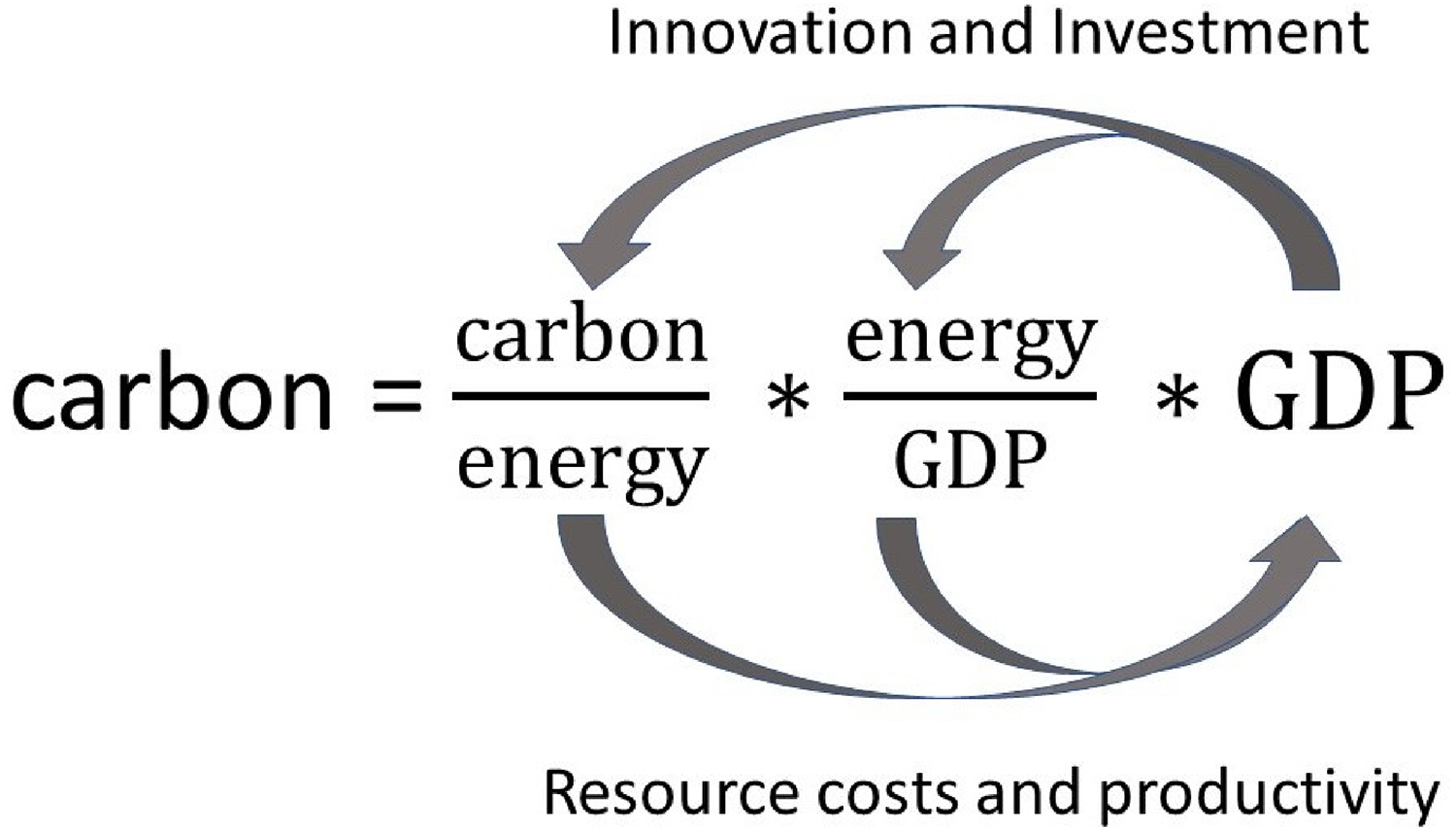
Carbon emissions, energy use and gross domestic product (GDP). Source: Author.
Because it is an identity, this relationship holds by definition. There are exactly three ways, and only three ways, through which carbon emissions can change.
Experts disagree about the relative importance of the three options. Proponents of green growth put much store in reducing the carbon intensity of energy, through technologies like renewable energy, electric vehicles, green hydrogen and carbon capture and storage (the first factor of the Kaya identity). Degrowth advocates stress the need to reduce economic activity (the third factor). Both sides agree on the importance of reducing energy intensity (the middle factor), and indeed resource intensity in general. However, they have different strategies for achieving it. Green growth economists see room for technical efficiency improvements on the way to a ‘weightless economy’ (Quah, 2019), while degrowth scholars emphasise less resource-intensive consumption (Hickel, 2020).
The Kaya identity provides a static picture that holds true at any given time. In addition, there is also a dynamic relationship between the three components. Changes in one component may affect, or be affected by, the others. Two dynamic links in particular are worth noting (Figure 1).
The first dynamic link concerns the role of economic pursuit in bringing about net zero. Carbon and energy intensity improvements require innovation and investment to build an effective zero-carbon infrastructure (Songwe et al., 2022). This will have to emerge from economic activity, including private entrepreneurship. Promoting innovation and mobilising investment is easier in a thriving economy than a stagnating one – a key argument in favour of net zero growth.
The second dynamic link runs in the opposite direction. If decarbonisation imposes resource costs, they will have to be absorbed by the economy and may reduce productivity. Conversely, if net zero investment results in cost savings (as argued by Sudmant et al., 2024 and Way et al., 2022) or fewer market distortions (as suggested by Stern, 2015), the economy will get a boost. This more optimistic scenario is sometimes called strong green growth, as opposed to standard green growth, which merely maintains that GDP will not fall (Jacobs, 2013).
Decoupling emissions and GDP
We know it is possible to break the link between carbon emissions and economic output. Over 20 countries have already done so. Their emissions have peaked, and their economies have continued to grow (Ritchie, 2021). The list includes many European countries, but also emerging markets like Mexico and other high-income countries like Singapore. Emissions have also peaked in the United States, highlighting the fact that decoupling is not always the result of deliberate climate policy. Market trends (in the US case, the advent of shale gas) can also play a role.
A key driver of falling emissions in these vanguard countries has been the decarbonisation of power generation, by phasing down coal and scaling up renewables. The resulting fall in the carbon intensity of energy, often aided by a reduction in energy use, has more than offset the growth in economic output (Le Quéré et al., 2019). Thanks to its virtually coal-free power sector, the UK now emits 3.6 times less carbon per unit of GDP than it did in 1990. GDP is up by 80% over the period, and emissions are down by 50% (CCC, 2024).
The decarbonisation strategies of vanguard countries closely resemble the recommendations of energy-economy models. Numerous decarbonisation pathways have been simulated, using different techno-economic assumptions and modelling approaches (Riahi et al., 2022). Despite their variety, they all follow a similar blueprint.
Decarbonisation starts in the power sector, where renewable energy is now the least-cost solution in most contexts. Cheap renewables can then be used to decarbonise other high-emissions sectors, including surface transport (through electric vehicles), buildings (heat pumps) and parts of the industry (green hydrogen). There is a balance between technological and behavioural interventions. About 40% of decarbonisation solutions entail clean technology (such as renewables), 20% require behavioural shifts (e.g. on diet) and 40% include both (e.g. on mobility, which features both electric vehicles and changes in travel behaviour) (CCC, 2020). Resource efficiency is critical to minimise the broader environmental footprint of the transition (e.g. Walter et al., 2024 on battery minerals).
These paths are feasible in the sense that they do not rely on solutions that have not at least been tested in pilot situations.
The impact of net zero on the economy
Building a net zero economy requires deep changes to the goods we consume and the way we produce them. The impact this structural change will have on aggregate output depends on the ease with which production factors (capital and labour) can be redeployed. The net zero economy offers new areas of comparative advantage for all countries (Andres et al., 2023), but the transition could be hampered by structural rigidities in capital and labour markets.
The risks of stranded capital assets are by now well documented, both in fossil fuel extraction (van der Ploeg and Rezai, 2020) and fossil fuel use (Pfeiffer et al., 2018). While asset stranding could be costly for individual investors, concerns about systemic risks to the economy are abating. Investors have had time to adjust, and the zero-carbon economy provides abundant new investment opportunities.
The impact of net zero on labour markets is more complex. Degrowth scholars put much store in working time reductions as a safe way to curtail economic activity and carbon emissions (e.g. Knight et al., 2013). Shorter working hours may well be welfare-enhancing, but their impact on emissions will be small (Collett, 2024). Net zero requires deeper changes than a small, uniform reduction in activity levels. It calls for the wholesale redeployment of workers from high-carbon into zero-carbon jobs. In the short term, this may create a skills mismatch, which will require policy attention. The net zero economy poses higher demands on cognitive abilities and problem-solving skills (Consoli et al., 2016), and the geographic alignment between high-carbon and zero-carbon jobs may not be perfect (Saussay et al., 2022). However, there is no evidence that in the long run, net zero is associated with fewer jobs or lower wages (Valero, 2024).
Environmental economists are excited about the multiple ways in which net zero could enhance economic productivity. Zero-carbon investment can give a boost to an anaemic economy (O’Callaghan et al., 2022). There may be fewer distortive subsidies (Coady et al., 2018). Clean innovation may unleash a virtuous cycle of ‘creative destruction’, investment and renewal (Aghion et al., 2019). Cleaner, more liveable cities may boost physical and mental health (Avila-Uribe et al., 2024). We are starting to see some of these effects materialise, particularly in transport and power generation.
The need for speed
The key requirement of a successful net zero strategy is that it reduces emissions rapidly and comprehensively (Fankhauser et al., 2022). Progress so far has been much too slow. Global emissions have fallen by <15%, relative to a no-policy counterfactual (Eskander and Fankhauser, 2020). This is easily the most fundamental criticism that can be levelled at current net zero policies.
Energy systems experts will counter that we are only now reaching the steep part of the S-shaped logistics curve that characterises technology adoption (Way et al., 2022) and societal tipping points (Farmer et al., 2019). Things will speed up. The remarkable progress in clean technology is indeed a cause for optimism. The transition to renewable energy and electric transport now seems irreversible.
However, rapid and comprehensive decarbonisation will not happen autonomously. It has to be driven by leadership and public support. Leadership and public support, in turn, require a compelling narrative that can generate momentum. This is something net zero green growth strategies can uniquely provide.
Climate policies that credibly offer net-zero prosperity, economic opportunities and green jobs are much more likely to garner political support than a narrative of economic stagnation and degrowth. Misleading claims about the detrimental impact of net zero on living standards have been a popular argument deployed by net zero sceptics (Paterson et al., 2023). A degrowth strategy would dangerously play into their hands.
Conclusions
The impact that net zero will have on the economy is ultimately an empirical question. It is imperative that emissions come down, and the effect this has on the economy will either be positive or negative, notable or small. Time will tell.
What is clear today is that a green growth strategy that combines investment in clean technology with behaviour change, public policy with private initiative, and emissions cuts with economic opportunities offers the best chance we have of achieving net zero in time. It is the most realistic option economically and the most compelling choice politically.
Footnotes
Acknowledgements
My thinking on net zero and economic growth has benefitted greatly from conversations with Alex Bowen, Max Collett, Cameron Hepburn, Ralf Martin, François Lafond and Emilien Ravigné and my respectful disagreements with Kate Raworth. However, the views expressed here are mine.
Declaration of conflicting interests
The author declared no potential conflicts of interest with respect to the research, authorship, and/or publication of this article.
Funding
The author disclosed receipt of the following financial support for the research, authorship, and/or publication of this article: This work was supported by the UK Economic and Social Research Council (ESRC) through the project Productive and Inclusive Net Zero (PRINZ; grant number ES/W010356/1). Additional support was provided by the University of Oxford's Strategic Research Fund.
