



Abstract
Many policy-makers and commentators propose that technological change alone will solve climate change. In this commentary, we argue that this techno-optimism is unrealistic, risky, and misses opportunities to improve well-being: radical behavioural change is essential for tackling climate change. While some behaviour change involves adopting green technologies, some are about changing how (much) we consume. Change is needed in our travel and dietary habits, material, energy and water use, in how we work and play. But not everyone needs to make radical lifestyle changes – the wealthiest need to change most. Achieving this will require policies that make low-carbon behaviours easier, cheaper, and more attractive. Tackling climate change requires a shift to a more equitable society and one in which happiness is prioritised over consumption.
Much mainstream policy and societal discourse suggests technological change alone will solve climate change (Barrett et al., 2023). The foreword to the UK's Net Zero Strategy, for example, states: For years, going green was inextricably bound up with a sense that we have to sacrifice the things we love. But this strategy shows how we can build back greener, without so much as a hair shirt in sight. In 2050, we will still be driving cars, flying planes and heating our homes, but our cars will be electric gliding silently around our cities, our planes will be zero emission allowing us to fly guilt-free, and our homes will be heated by cheap reliable power drawn from the winds of the North Sea. (UK Government, 2021)
Scientific assessments show this techno-optimism is wishful thinking. We need systemic change in societies and economies if we are to keep global warming at safe levels (IPCC, 2023). The latest UN Emissions Gap report (UNEP, 2023) shows that while some progress has been made in slowing the rise in carbon emissions, the world is on track for a temperature rise of at least 2.9°C. Where progress has been made, this has largely been on energy supply (shifting from fossil fuels to renewables) with far less attention given to tackling demand – how we use energy and resources – and this directly relates to people's lifestyles and values (Verfuerth et al., 2023). Making progress on demand requires engaging with people in both decision-making (about the future of society and climate policies; Willis et al., 2022) and in action (i.e. behaviour change; Demski, 2021). Indeed, two-thirds of emissions can be attributed to households (IPCC, 2023) and most measures needed to reach our carbon targets in the UK will require behaviour change by consumers (CCC, 2020). The remainder will require behaviour change within businesses and government to create and support a low-carbon society (see Figure 1; adapted from CCC, 2020).
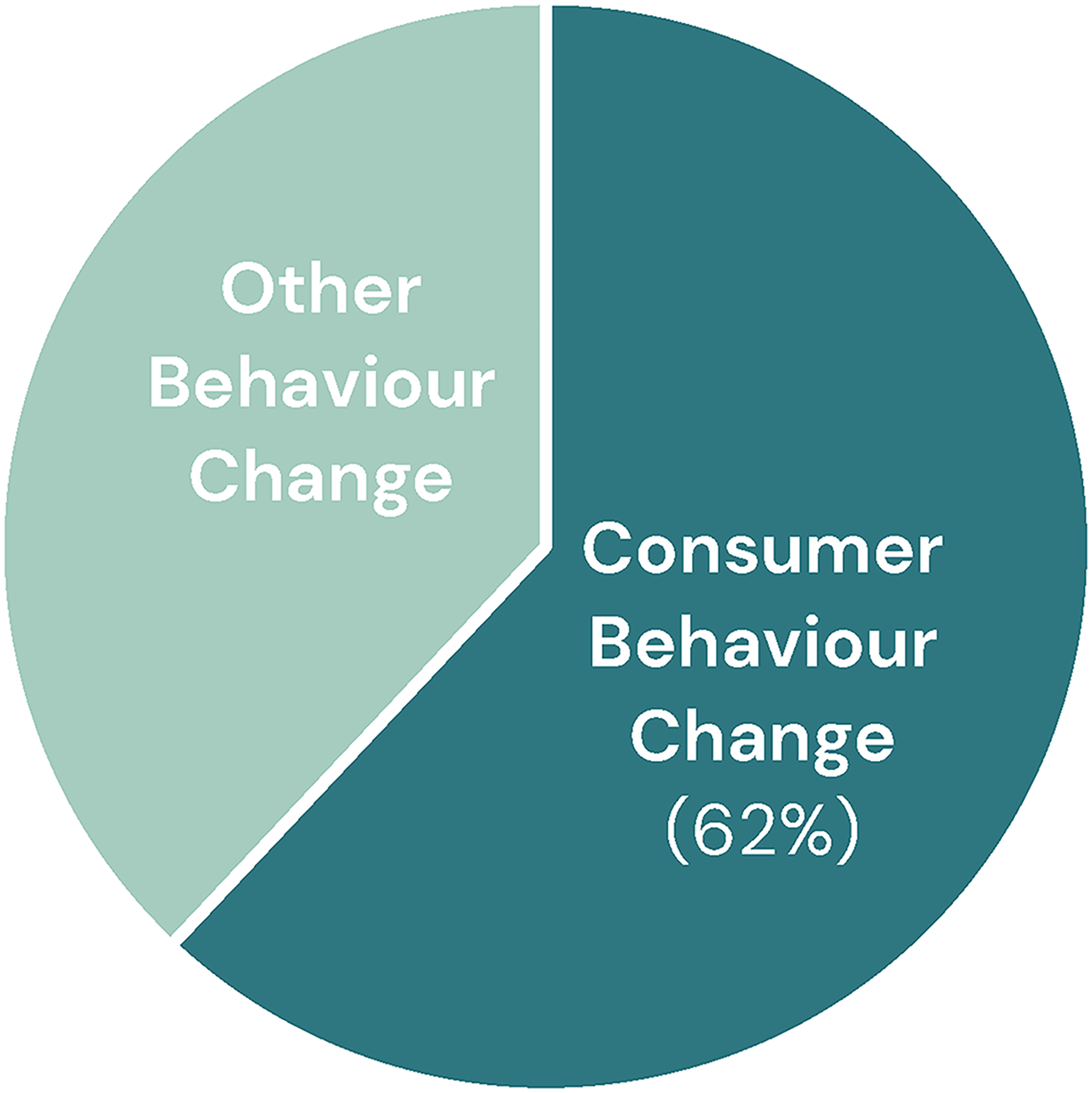
Contribution of behaviour change to achieving net zero by 2050 (original figure; based on data from CCC, 2020).
The scale of behaviour change is startling: the average UK carbon footprint must reduce from 8.5 to 2.5 t CO2e by 2030 to stay within the emissions budget consistent with 1.5°C warming (Akenji et al., 2021). This aspirational limit to global warming has now been all but breached (C3S, 2024). Impactful actions to achieve this include flying less, eating more plant-based foods, adopting electric vehicles and heat pumps, wasting less, and investing in sustainable funds (Aviva, 2021; Ivanova et al., 2020). For example, living car-free would reduce the average carbon footprint by 2 t CO2e; this compares to recycling which only saves 0.01 t CO2e. So, reducing carbon footprints from over 8 to 2.5 t CO2e will really take radical, not incremental, lifestyle changes.
While some behaviour change involves adopting green technologies, some are about changing how (much) we consume. Take road transport – reaching net zero in this sector involves people buying zero-emission vehicles, and promoting the uptake of electric vehicles attracts significant policy attention. However, there is clear evidence that the transition to sustainable transport systems will involve driving less, for example, by working from home, ride-sharing, and driving more economically (Shah et al., 2021; also see Figure 2).
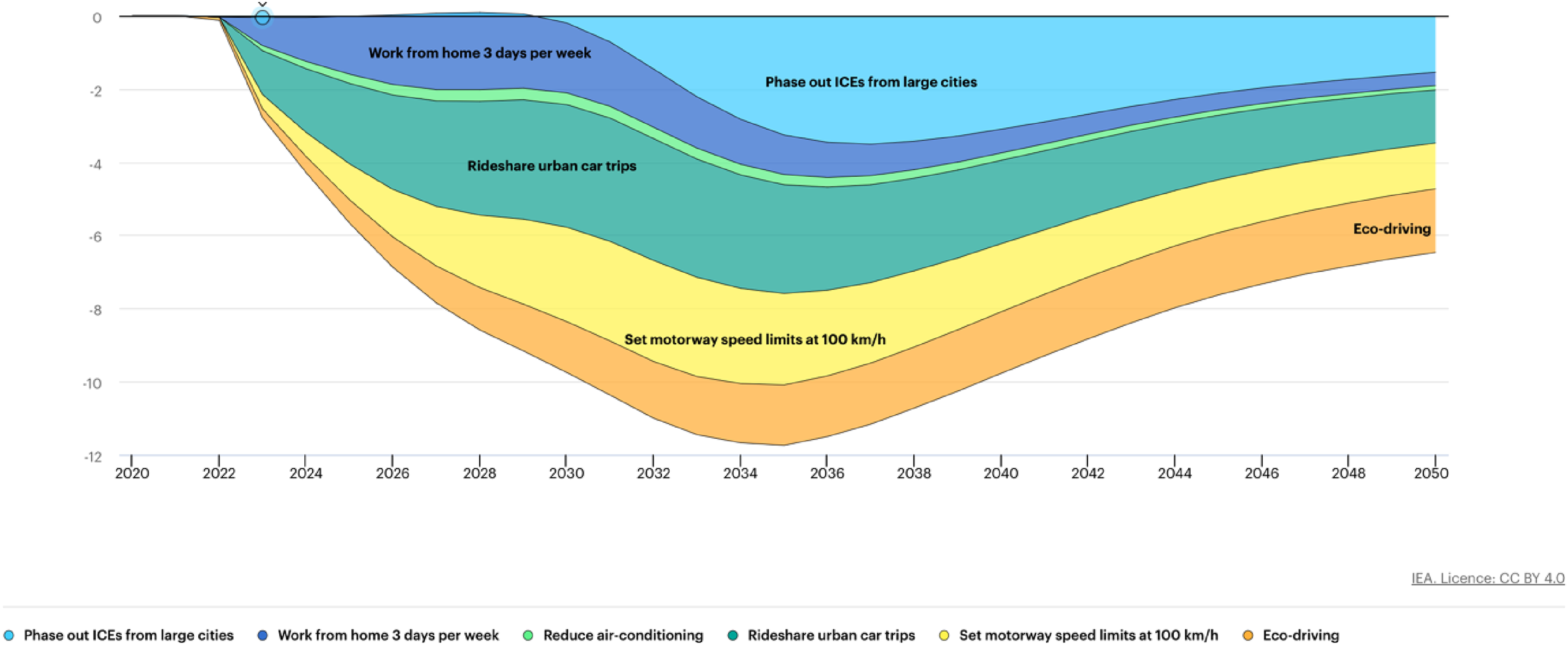
Impacts of behavioural changes on road transport energy consumption in the net zero scenario, 2020–2050 (CC-BY license; IEA, 2021).
The case for dietary change is equally strong. Food systems contribute 26% of global emissions, most of which are associated with animal products (Poore and Nemecek, 2018). In the UK, nearly 60% of all land is used to rear livestock, but dairy and meat products only provide 32% of calories consumed (Dimbleby, 2021). Shifting towards plant-based diets would reduce emissions, make land available for nature recovery and reforestation, improve water and soil quality, and deliver health benefits (Willett et al., 2019; Figure 3). While technological innovations such as lab-grown meat are attracting increasing interest and investment, their potential to significantly reduce emissions from food systems is limited (Letti et al., 2021). Making environmentally friendly food choices affordable and desirable is an essential component of climate action.
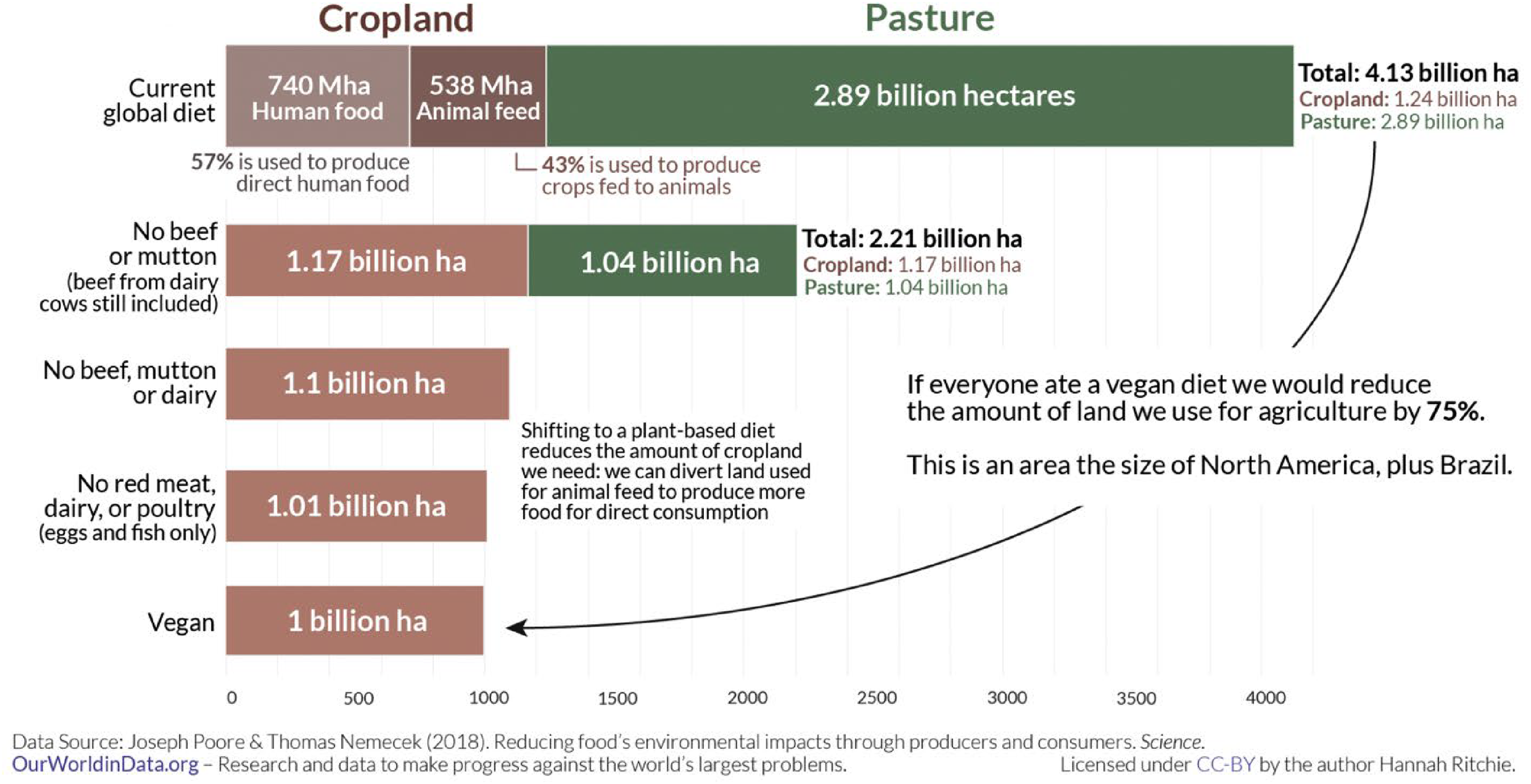
Global land use for agriculture for different diets (CC-BY licensed by ourworldindata.org; data source: Poore and Nemecek, 2018).
Change is not only needed in our travel and dietary habits; it is also needed in material, energy and water use, in how we work and how we play (CAUK, 2020). In fact, if we don’t change our behaviour in all areas of our lives, we will not cut emissions rapidly or substantially enough to avoid the worst climate impacts (IEA, 2021).
So yes, radical lifestyle change is necessary to mitigate climate change. But it is also more desirable than relying on technological change alone. Demand-side approaches deliver wide-ranging well-being benefits, particularly to health (Creutzig et al., 2022). There is overwhelming evidence that climate action improves health due to reduced air pollution, eating more fruit and vegetables, and walking or cycling instead of driving (Whitmee et al., 2023). Moreover, people with greener lifestyles tend to be happier; our analysis across diverse countries found people taking more environmental action have higher subjective well-being (Capstick et al., 2022). On the other hand, materialism negatively affects well-being (Dittmar et al., 2014). Demand-side solutions enable people to play an active role in addressing climate change – and taking action, particularly with other people, can help people manage climate anxiety (Whitmarsh et al., 2022). Taken together, this evidence suggests going green is not about sacrifice – far from it; it more likely to improve quality of life.
There is an important caveat, though. Not everyone needs to change their lifestyle to the same extent. Radical change is needed for those with the largest carbon footprints; those with lower emissions need to make fewer changes, or even increase their emissions to get to an equitable and safe level within ecological limits (Raworth, 2017). Those living in Indonesia, for example, currently have an average carbon footprint of 2.2 t CO2e, so there is scope to increase this to 2.5 t CO2e by 2030 to reach a globally unified lifestyle target (Akenji et al., 2021). But inequality is even greater within, than between, countries. In the US, for example, the wealthiest 10% have a carbon footprint more than 16 times that of the poorest 10% (see Figure 4).

Energy-related CO2 emissions (tCO2 per capita) by income decile, showing inequality within and between countries (original figure; based on data from IEA, 2021).
As well as having a moral responsibility to act, wealthy people also have a greater capacity to do so, as early adopters of technologies such as electric vehicles, solar panels and heat pumps (Moorcroft et al., 2024). They also hold greater potential to influence behavioural and systemic change, as organisational leaders and investors (Nielsen et al., 2021).
How do we achieve this radical lifestyle and system change? The good news is that the appetite for radical change is high amongst populations across the world. This includes not only wanting governments and businesses to do more to address climate change (CAST, 2021) but also a willingness to make personal sacrifices. In a survey across 125 countries, 69% of people said they would be willing to contribute 1% of their personal income to climate action (Andre et al., 2024). However, the same survey also demonstrated that people tend to underestimate others’ willingness to act. This ‘pluralistic ignorance’ demonstrates a need for climate change to become a more prominent topic in public and political discourse.
This will require more than information provision and public communications campaigns, which have been common features of climate policy to date (House of Lords, 2022). These ‘downstream’ approaches focus on persuading or educating individuals, but do not change the availability or attractiveness of choices. While popular amongst governments, they are typically only 2% to 3% effective (Nisa et al., 2019), and tend to exacerbate inequality (White et al., 2009). Nor do they remove the barriers to behaviour change. These barriers include high-consumption social norms, financial and physical constraints, and limited opportunities to influence political or organisational decisions (Hampton and Whitmarsh, 2023; Lorenzoni et al., 2007). Removing these barriers involves using ‘upstream’ approaches to generate policies that make low-carbon behaviours easier, cheaper, and more attractive (BIT, 2023; Whitmarsh et al., 2021). Implementing these requires public support for action, which can be achieved through clearer communication of policy objectives and co-benefits, and more public involvement in policy design (Mitev et al., 2023; Willis et al., 2022). The good news is that – as well as being willing to make personal sacrifices – the public is supportive of most of the sorts of upstream measures that would effectively cut emissions through lifestyle change (Poortinga et al., 2023).
In sum, radical behavioural change is essential for tackling climate change. Technology alone won’t save us. Much climate policy focuses on technological solutions to climate change – but this is unrealistic, risky, and misses opportunities to improve well-being. But not everyone needs to make radical lifestyle changes – the wealthiest need to change most. And there is scope for the poorest to increase emissions to reach a basic standard of living. Tackling climate change requires a shift to a more equitable society and one in which happiness is prioritised over consumption.
Footnotes
Consent for publication
Images used in this article are original or permitted to be reproduced (under CC-BY license).
Credit statement
LW and SH contributed to the conceptualisation and writing – original draft.
Declaration of conflicting interests
The authors declared no potential conflicts of interest with respect to the research, authorship, and/or publication of this article.
Ethical approval
No ethical approval was required for this commentary article.
Funding
The authors disclosed receipt of the following financial support for the research, authorship, and/or publication of this article: Funding to support the authors has been received from the Economic and Social Research Council (ESRC) grant refs. ES/V015133/1 and ES/S012257/1.