



Abstract
Kenya is in the midst of an information revolution and has recently unveiled a set of digitisation initiatives to become the Silicon Savannah of East Africa. While the African state is often examined through the notion of absence or failure, we argue that we need to pay more attention to timing as a mode of statecraft in a digital era. Drawing upon a Deleuzian conceptualisation of ‘time-images', we argue that the Kenyan state operates as an ‘auteur’ to give meaning and significance to a seemingly asynchronous set of disconnected digitisation initiatives across spaces, scales and institutions. Timing as a form of state power determines which initiatives are prioritised, what gets executed, in what sequence and at what pace. As an auteur, the state presents a linear narrative from the past to the future, but in the end, as with all auteurs, the state's identity and authority are defined in part through the actions of its actors and the experience of citizens.
Why now?
The Kenyan state for some time now has been fashioning itself as Africa's ‘Silicon Savannah’. This builds upon two decades of Kenya's e-government strategy that sought to integrate Information Communication and Technology (ICT) in its operations and public service provisions (Republic of Kenya, 2004). Since 2000, Kenya has experienced a digital revolution of sorts, underpinned by the development of an ICT policy and legal framework, public investment in connectivity infrastructure (e.g., laying of national fibre optic cables and mobile technologies, a key component being mobile money services such as MPesa offered by Kenya's leading telecommunication company, Safaricom). In 2015, the Kenyan state initiated an ICT transformation roadmap with the goal to ‘start a journey to being automated’ (Republic of Kenya, 2020). Crucially, Kenya's President Ruto recently announced that ‘5000 of the country's 7000 government services have been digitized so far, as the country races toward digitizing all essential services’ (Makong, 2023).
One of the key areas in this initiative is the aspiration to establish an automated national land information management system. This push has come from the expectation that this will lead to transparent transactions, enabling more efficient land management services and increased revenue. Funded by both the national government as well as international agencies such as the World Bank and UN-FAO, digitisation imperatives have defined the current transformations in land administration and in the government offices of peripheral counties outside of Nairobi, which are seen to be ‘lagging behind’ in Kenya's aspiration to become fully automated in the land sector. Different departments at the county and national levels are conducting large-scale digitisation of paper documents, maps, and files in preparation for achieving full digitalisation and automation in the future.
The reality on the ground though, is far more challenging. Digitising a land administration system that is built upon a long history of unwieldy paper documents, vast repositories of paper files, memos, land titles, missing and misfiled documents involves a long-term commitment of labour and resources. The State Department of Planning noted that by the end of 2022, the government had only digitised the two registries in the Nairobi metropolitan region (Nairobi and Murang’a) against a target of 39 land registries (Republic of Kenya, 2022). Across various government departments and spaces, the land digitisation process has begun to unravel as time-intensive, labour-intensive, fragmented and incomplete (Datta and Muthama, 2024). Nonetheless, the urgency and increased activities around digitisation in Kenya's land administration sector presents a burning question: Why has this process acquired increased expedience now? Why now?
One way to answer this is to understand how the legacy of colonial land management (Boone et al., 2019), rampant ‘land mischiefs’ (Manji, 2014) and shifts towards land assetisation for value extraction have shaped state aspirations for digitisation of Kenya's land sector. That could explain how a technologically leading state in Eastern Africa aspires to become Africa's Silicon Savannah, a state that seeks to attract a whole host of global and regional tech companies to make it the epicentre of Africa's information revolution (World Bank Group, 2019). The so far unsuccessful efforts to automate the land sector might suggest that this is a sign of the ‘illegible state’ (Das and Poole, 2004) which actively produces informality in land transactions as the modus operandi of power (Singh and Jackson, 2021). For example, Lutzoni (2016) and Lesutis (2022) both argue that in Kenya, keeping people and places delegitimate or informal can be seen as part of, rather than outside of, state planning practices. This could also explain how, even with the development of digital mapping technologies, the state keeps marginalised people unaccounted for and under-serviced (Hoefsloot et al., 2022).
In this paper, we suggest another way of understanding these challenges through the lens of timing. We argue that ‘timing’ is a political strategy and crucial to statecraft as it is generative of a need for intervention at a key moment. Timing brings together a seemingly asynchronous set of disconnected events occurring in multiple places to give them a singular meaning for those experiencing the impact of these events. For example, digital revolution, Silicon Savannah, full automation – these storylines are totalising and singular, but they capture a dispersed set of state and non-state initiatives towards digitalisation. We present timing (or an intervention in time) as a modality of governance that is enacted by the ‘digitalising state’ (Datta, 2023). Following on the work of Barbara Adam (Adam, 2008, 2004, 2018) who describes timing as answering the question of ‘when?’ and thereby emphasising events and moments instead of processes, we argue that timing is crucial to governing in the digital moment as the demand for speedy information flows keep rapidly increasing. Timing is political as state initiatives seize the moment to connect to financial incentives for digitalisation from – UN organisations, global ICT corporations, and private sector investors. Rather than understanding these as discrete events, institutions and actors, we see these as interconnected series of temporalities that set the tempo, speed, duration and timeline of the digitalising Kenyan state. Timing the state means to understand how the digitisation of paper, digitalisation of services and automation of governance are interactive sequences that convey temporal information about why, how and when things happen in different places.
Mbembe et al. (2023: ix) in their discussion on the politics of time in Africa, note that ‘it is not only a question of acceleration and runaway systems but also of times moving at multiple speeds, of times composed at different momentums, continuities, ruptures, to say nothing of different regressions, dispersions and bifurcations’. For Mbembe et al. (2023), African time is ridden with multiple temporalities of the past, present and future that are entangled with the legacy of colonisation, the project of decolonisation, as well as the transmission of different ways of knowing. Africa here is taken as a point of departure rather than an exceptional case, which indicates the complexity of time in terms of its inability to be fixed or determined in any kind of way. Time is not just a measure or schedule of events, rather as Tilly (1984) wrote four decades ago – ‘timing matters’. The ordering of actions and choices structure our understanding of the past, present and future options, i.e. ‘when things happen within a sequence affects how they happen’ (Tilly, 1984: 14).
We take ‘timing’ as an entry point to understand how the Kenyan state initiates a shift towards digitalising the land sector as part of a storyline of Silicon Savannah. Adam argues that a ‘timescapes perspective involves a quest to understand the dynamics of relationships, interdependencies, and embeddedness’ (Adam, 2008: 4). Following Adam's conceptualisation of timing as a part of timescape, we argue that timing is also a form of temporal power that demarcates past, present and future temporalities while loading the present with promises of the future. The temporal power of the state emerges as it orchestrates a multiplicity of actors and actions (e.g. waiting their turn, involved for the right duration, participating in unfolding events, and anticipating what might occur in the near or long-term future). Hence, while digitalisation seems to point to the ‘simultaneous presence of many temporalities’ or a ‘melody played at different registers’ (Simone, 2019: 65), the state emerges as a powerful force directing harmonisation and interoperability within the ensemble of relations. As Ekman (2024: 125) writes, the ‘question then became one of timing: when and how fast to make advances towards the horizon’.
To understand the temporal power of the digitalising state, we draw upon a Deleuzian conceptualisation of an ‘auteur’ piecing together ‘time-images’ into a storyline (Deleuze, 2005). We see temporal power as simultaneously symbolic, discursive, material and geographical – as a technology of statecraft. We are interested in how the temporalities of an information age, its movement and signature across different spaces, are produced unevenly and asynchronously by different actors, yet subservient to a sequence determined by the state. Timing works as a form of state power as it determines what gets defined as a priority, what proceeds, in what sequence and at what pace. A lens of timing enables us to understand lags in analogue mapping and survey tools, laborious processes of transferring paper information onto digital imagery, and an imagined future of automated land governance, as asynchronous actions of the state at different scales and across diverse institutions. A clear sequence is implicit in the storyline of ‘Silicon Savannah’, – digitisation of paper is the first step, followed by platformisation of digital documents, interoperability and automation leading to full system change or ‘digitalisation’. While this linearity may hold in specific workflows of state departments, this is certainly not a coordinated transition across state spaces and scales. Indeed, even under full digitalisation in some state departments, paper documents still hold value and circulate as authentic proof of bureaucratic transactions. In many state departments digitisation (i.e. scanning of paper documents to digital formats) and digitalisation (full system change and interoperability) co-exist simultaneously.
These asynchronicities resonate with Deleuze's conceptualisation of ‘time-images’ – seemingly disconnected moments that connect memory and present, imagination and experience, aspiration and reality across spaces and scales. For Deleuze, ‘time-images’ show the precedence of time over image, i.e., they defy a linear narrative and instead suggest an unstructured, asynchronous unfolding of initiatives directed by the state. The state orchestrates these time-images, much like the auteur of films that Deleuze refers to; however unlike in films, the state as auteur also has to accede to the multiple temporalities of its actors and institutions across spaces and scales. To explain this further, we will first elaborate on our conceptualisation of the digitalising state as an auteur. Afterwards, we will explain how we see timing as a form of statecraft.
The digitalising state as auteur
Writing about something as diverse and amorphous as the state is a challenge in itself. The rich scholarship on the state suggests that the state exists in various forms of sovereign power, it is embodied in the practices of political elite and street level bureaucrats, and its image is shaped by the various institutions and scales of governance. Mitchell argues that the form and content of the state emerges through intersections between a constructed binary between state and society (Mitchell, 1991). The state according to Mitchell needs to be seen as ‘as an effect of mundane processes of spatial organization, temporal arrangement, functional specification, supervision and surveillance, and representation that create the appearance of a world fundamentally divided into state and society or state and economy’ (Mitchell, 1999: 95). However, Mitchell argues that there still is a ‘state-effect’ – the simultaneous ‘real and illusory’ nature of the state where it exists both as ‘a material force and ideological construct’ (Mitchell, 1991). Mitchell's analysis resonates with several other scholars of the state. For example, Taussig notes that the state has reached a point where its actions as primary political power has acquired a magical status (Taussig, 2013). Taussig notes that trying to define what the state is can be dauntingly difficult, since the state has seeped into all aspects of everyday temporalities to the point where we have stopped seeing it.
While the state has always been hard to define, and there are fundamental differences between states in Africa, the ‘African State’ has long been a focus of research on state absence or failure. Notions of ‘soft state’ (Scott, 1988), state decay, quasi-states, neo-patrimonial states (Wai, 2012) were in the past (and sometimes still) developed and deployed to capture the purported pathological nature of state formation in the continent, that has since enabled the influx of global policy initiatives in Africa. This problematic literature on the African state has been challenged by recent scholarship which has questioned the boundary between state and non-state practices (Goodfellow, 2022), particularly by examining the role of cartels or corporations or even commerce (Bierschenk and Olivier de Sardan, 2014; Hagmann and Stepputat, 2023). The question of how to define the contemporary Kenyan state is even more complex as it has transitioned from a one-party, neo-patrimonial, developmental state heavily benefitting from the presence of global donor agencies, to one that now occupies a significant node in the crossroads of capital, infrastructure and technology in East Africa.
African states and in particular the Kenyan state, is currently facing what Braman has called a ‘change of state’ (Braman, 2006) in pivoting towards an information era. Noting that we are seeing the emergence of a ‘digitalising state’, Datta (2023) argues that aspirations of ubiquitous computing and algorithmic governance are taking hold at a time when ideas of developmental, neoliberal and entrepreneurial states are on the wane. For Datta (2023: 153), the digitalising state ‘represents a fundamental reorganisation of state institutions, information infrastructures and metropolitan peripheries through and for digitalisation’. Digitalisation, nonetheless, is an incomplete project of the state whereby earlier paper information infrastructures continue to operate alongside digital information systems.
To conceptualise what the state does in this digitalising moment, we need to move away from a purely structuralist understanding of the economic and cultural foundations of the state, or a modernist approach which assume that the state contains an encyclopaedic knowledge of what is to be governed (Scott, 1999) – or even a neoliberal understanding of the state as being constructed through infrastructure for capital growth (Bosworth, 2023; Easterling, 2016). The state is both singular and multiple, it is objective as well as subjective, real and hyperreal, hierarchical and networked, bureaucratic and mundane. The state can appear as a singular entity in the image of a nation or as an ideological construct; and simultaneously appear as multiple assemblages through its actors, institutions, organisations, policies and temporalities. When we write about the state in this paper, we are evoking all of these complex notions of the state.
Conceptualising the state through timing acknowledges these multiplicities while also suggesting that the state is constantly changing as it engages in a sequence of actions across a multitude of temporalities. Drawing from film and media studies, we conceptualise the digitalising state as an ‘auteur’ which not only sets the timing for a digitalised future, but also gives meaning and significance to this timing through a seemingly synchronised set of actions. Since its introduction into the vernacular critiques of cinema in the 50's, the figure of the auteur has been contested due to its crediting of the individual director (Taylor, 2022). However, informed by a Foucauldian understanding of the auteur as a discursive function, operating within the limits of regulation and a capitalistic market and constructed out of many voices that do not, by definition, act in harmony with each other (Foucault, 1998; Taylor, 2022), we can start unpacking the power of the state across its multiple temporalities.
To do so, we first need to distinguish between the image of the state and the actions of the state. Bierschenk and Olivier de Sardan (2014) argue that, particularly when theorising African states, a more intensive dialogue is necessary around the routinised, day-to-day functioning of the state as a ‘cobbled-together’, heterogeneous assemblage. They call for paying attention to how states work, which includes a broad definition of public service provision, the employment and actions of civil servants, and the institutional arrangements through which they operate. By putting the ‘state at work’ at the centre of their analysis, they define the state as under construction, a building site where materiality, labour, and ideas are brought together to create the space and rules which we inhabit. This conceptualisation of the state at work is in dialogue with, and sometimes in opposition to, the images of the state as Weberian bureaucratic machines, or ‘failed states’, a moniker often too loosely ascribed to African states (Bierschenk and Olivier de Sardan, 2014).
Bierschenk and Olivier de Sardan (2014) draw on Migdal and Schlichte (2005) in explaining the ‘contradictory core’ of the models of bureaucratic state-making as the difference between ‘seeing the state’ and ‘doing the state’. They quote: The state […] is a field of power marked by the use and threat of violence and shaped by 1) the image of a coherent, controlling organization in a territory, which is a representation of the people bounded by that territory, and 2) the actual practices involving those staffing its multiple parts and those they engage in their roles as state officials. (Migdal and Schlichte, 2005, as quoted by (Bierschenk and Olivier de Sardan, 2014: 14)
This conceptualisation of the state as emergent out of the many actions and actors that reproduce, negotiate or contest statehood, while accepting that ‘the state’ also exists as an image of power is inherent to how we interpret the state as auteur. As Seung-Hoon Jeong and Jeremi Szaniawski (2016: 23) write, in contemporary auteur theory, there is a ‘disconnect between person and function’. Implicit and inferred rather than expressive and embodied, the auteur is the result of the projection and interpretation of the spectator. As Foucault (1998) emphasises, the authoritative position of the auteur is constructed through the unitary identity that the audience – the critics, the readers, the citizens – project upon it. This entails an ontological separation of the auteur from ‘the auteur’, similarly as we separate the state at work from ‘the state’, the former being the administrative, material, and institutional bodies and the latter being the sum of the discursive actions of these bodies that are often ascribed to the image of the state.
We employ the concept of the auteur critically to understand how the state at work directs the experience and measure of time through digitalisation and automation to craft the image of ‘the state’. As Ndung’u (2019) notes, digitisation is dependent on state capacity, as the state can either stifle innovation with overregulation or provide an enabling policy and legal framework that evolves with the rapid changes in the ICT sector. This does not mean the state has complete control, and neither is it capable of getting things done on its own – indeed, it must act through several spaces, organisations, actors, stakeholders, intermediaries, professionals and so on. Conceptualising the state as an auteur nonetheless means that the state's timing and sequencing carry increased weight in shaping the actions of a multitude of actors and spaces. When it comes to digitalisation and the use of smart technologies, time is often mobilised as a dimension that sets the parameters for action. For example, temporal measures are used by the state to establish the timeframe for initiatives and programmes. In this context, deadlines serve as the quintessential measurement for state officials and political elites as the scheduling of initiates often follows election cycles. As an auteur, the state establishes different timelines of action with different stakeholders. The signature of the auteur here is to produce a narrative of a digital revolution in governance, but the experience across a number of spaces is often one of illegibility, disorientation and frustration among those who experience it.
Timing the state
Timing has had an intermittent interest in geographic scholarship since the 1970s, when Parkes and Thrift observed that, Timing space requires determination of the spatial and temporal location of events, their duration and sequence. It also requires an awareness of the impact of decisions to introduce new structures … on the existing and future patterns and processes of spatial behaviour, which are, to a large extent time dependent. In various forms, then, time is locked into every space. (Parkes and Thrift, 1975: 656)
Barbara Adam (2008), the prolific sociologist of time, also offers a similar understanding of timing as social synchronisation and the sequencing of change. As Adam notes, timing is based on how fast/slow change is desired and how these different events are compatible to initiate change. This gives us an event-based approach to time. The temporal element of ‘timing’ where we focus on social synchronisation, co-ordination and on questions about good and bad times for action. Here it matters greatly what kind of time is used as a timing and synchronising medium and whether or not the times to be synchronised are compatible to achieve good timing. Equally important is the social, political, economic, environmental, religious and socio-technical context of timing. And the latter is in turn intimately connected to the speed of change. (Adam, 2008: 3)
Following this, Addie et al. (2024: 275) remind us that it is ‘possible to view the timing of infrastructural creation, maintenance, and repair less as acts of resilience and more as part of the performative, choreographed interaction between governance and the governed
To understand the power of timing in crafting the image of the state as an auteur, we draw on Deleuze and his philosophy of time. The figure of the auteur is significant in Deleuze's two-part books – Cinema 1 and Cinema 2 (Deleuze, 2005, 1986). For Deleuze, ‘Cinema does not present images, it surrounds them with a world’ (Deleuze, 2005). Cinema is the slicing of the world, the real, into fragmented images and putting them back together again in a montage. This montage can depict a linear narrative through the moments in the fragmented images. While Deleuze's ‘movement-images’ in Cinema 1 refer to the linear progression of a narrative through the cinematic movement of the protagonist in space, Deleuze understands ‘time-image’ in Cinema 2 as the domination of time over image. Through erratic cuts in the montage, time-images connect memory and present, imagination and being, reel and reality in each sweeping operation across spaces and scales. Deleuze thus presents modern time as a set of disjunctive moments that are spatially experienced, that do not necessarily follow a sense of order but come together as a deeply disjunctive commentary on present times. These time-images could be images of duration or interval, or even a rupture from a linear narrative. The time-image, rather than mapping movement within a certain time, opens up all the dimensions of time – linear, cyclical, disruptive, asynchronous and a multitude of others.
We have to see these conceptualisations of time in the tradition of mid-century French theory of information systems, which started conceptualising language, data and images not as a functionalist transfer of information but as the technological codification and de-codification of meaning, to be revealed by theoretical analysis patterns and systems (Geoghegan, 2022). In this tradition, as Geoghegan (2022: 143) writes, ‘modernity and technology revealed or produced a body in pieces, […] mangled that only strange supplements - mirrors, images, projections - could lend an illusion of integrity’. Seeing information this way upset the schematic and apolitical understandings of information theory and drew attention to how knowledge and codes are produced through a cacophony of technologies. This gave way to understanding the situatedness and technical mediation of information. Or, as Deleuze shows in his theoretical analysis of cinema, montages can be put together in asynchronous ways to depict more than a linear movement, to evoke time through the images of the state, and as a montage of time-images that unfolds in front of us. Time-images produce the state in its multiple, fragmented and disoriented form, while timing as a practice of power presents an illusion of a seamlessly coordinated set of events in time. Following a Deleuzian approach, the digitalising state as an auteur wraps up a montage of actions within a singular storyline. The image of the state as an ‘auteur’ is the director of timing, sequencing and duration of actions related to – laws, policies, documents, information flows across departments and so on. The state is more than the sum of these events; it assembles the past, present and future by giving meaning to the duration and speed of the transition from analogue to digital futures. The storyline of Silicon Savannah then captures this image of the state in which a aspirational future is presented to give force and coherence to the seeming asynchronicity of digitisation drives across state departments.
The work done to assemble a multitude of time-images into a larger narrative therefore is a political act that as Crockett argues, unpacks the ‘speed-body’ of the state and ‘opens up techniques of thinking and living beyond the power of movement and its control’ (Crockett, 2005: 186). It is in the cut, the time-image, that time turns on itself and provides a moment of stillness and reflection within the frantic montage created through the digital. With the constant surging, the incompleteness of digitisation, and slowing down with the burden of paper, the state still directs a storyline, opening and closing the possibilities for what might have been in the past or for what might come in the future. In Kenya, the state acts as an ‘auteur’ of time-images as it seeks to tell a story of full digitalisation in the near future.
Using this concept of time-image, we analyse timing as a mode of state power, technique and governmentality. By timing, we mean a juxtaposition of multiple and seemingly disconnected events that drive the temporalities of bureaucracy, policy and its implementation in state offices. This timing is also dynamic and forceful – it drives change through slices of duration and sequencing, producing moments of disorientation, creating a sense of long duration, interval production, and coordination across space-times. Timing, then, emerges through the image of the digitalising state as an auteur acting at various scales – driving both the ordering and instructing of a set of actions in time. If time is simply what happens in space, then timing is the exertion of state power to steer these happenings – events – towards an outcome. Through timing, we can see how the state orchestrates these fragmented events and aligns them, and through timing we can also see what happens when uncoordinated events break down the idea of the state itself as a singular entity, and a digitalised future as a singular outcome.
Asynchronous temporalities of researching the state
This research is part of a larger project titled Regional Futures, in which we unpack the digitalisation of urbanisation Nairobi, Guadalajara and Mumbai. Our research methodology deploys ‘ethnographies of municipal digitalisation’ in which, as a team, we conduct interviews with state and non-state actors, ethnographic observations of the state spaces in which digitalisation is executed, and archival research (Reyes Carranza et al., forthcoming). Within Nairobi, we specifically conduct our research in Kajiado, a peripheral county within the Nairobi metropolitan region.
While temporality has always been central to our research project – futures is in the project title says it all – we did not set out to research time, or temporal power, in itself. Instead, much as described by Kitchin (2023), the importance of time emerged through the conversations with our interlocuters and within the team. Visits to the Kajiado record rooms of the municipal land administration departments pointed us to the importance of time past and the durability and disintegration of information through time (Datta and Muthama, 2024). Researching the platformisation of land administration on the national scale gave insight into the endurance of time, never entirely passing and keeping digital technology in a state of liminality (Hoefsloot and Gateri, 2024). Time came up in discussions about waiting while doing fieldwork, the importance of the sequence of steps for registering documents, or in learning how paper maps can turn into dust as well as pixels. These prompts propelled us to start considering time itself and how it seems to dictate the actions of the state officials and land sector professionals we were conversing with.
As part of thinking about the digitalisation of the state, our project team conducted 45 interviews with county and national government officials, private land sector actors, GIS experts, and civil society organisations between November 2022 and February 2024. In addition, we organised a roundtable-style workshop with regional policymakers and civil society actors to discuss the future of land governance in Kenya. The interviews and the workshop have been transcribed and thematically analysed. The semi-structured interviews focussed on the generation, circulation, storage, and digitalisation of information within land administration departments, the coordination and collaboration between state and non-state actors within the land sector, and the implementation of digital technologies for urban administration.
In some conversations, we discussed time and temporality explicitly when talking about the legacy of past systems on those to come, the information lost in time, or the importance of digital technologies for future governance. In other conversations, time came up in more implicit ways, pointing to the relationality and subjectivity of time experienced as delayed, elongated, speeding up, or being out of pace. But most importantly, these different moments in which time emerged point us to paradoxical experiences where digitalisation unfolds in many spaces at different paces, yet all at once.
Together with the archival research and extensive fieldnotes from observations at the land administration offices and the GIS Lab of Kajiado County, these interviews and workshops provide the foundation for thinking about timing as the state's strategy and power to create coherence within these asynchronous and dispersed processes of digitalisation. As London-based researchers within this larger research project, we hold an outsider position and work on the overarching theorisation of what we observe in close conversation with our colleagues in Nairobi, who have an insider perspective on the digitalisation of Kenya's bureaucratic processes. As outsiders, we have been forced to scale a steep learning curve, trying to keep up with all the different actors and parallel digitalisation processes at various levels, prompting the reoccurring question of why now, and why this?
Timing the Kenyan state
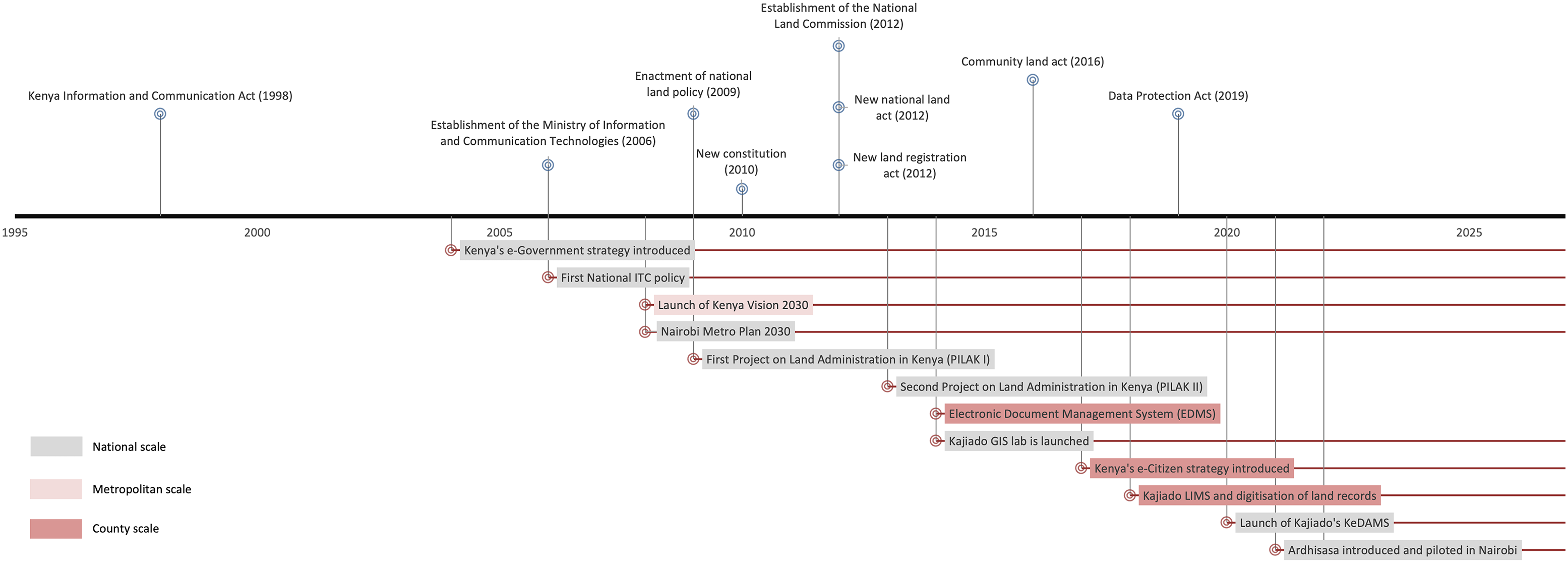
Figure 1 shows the timeline of the digitalising state across three scales – the national, the metropolitan, and the county. The introduction of country-wide land administration schemes, the electronic document management system, Kenya's e-citizen strategy, and the initiation of the Kajiado GIS lad and Kajiado electronic development application management system, paints a picture of a set of a/synchronous processes working towards a governable digital future.
Timeline of the digitalising state in Kenya.
Upon first sight, there is a logic in the sequence of actions. A smooth roll-out of the digitalising state. In 2004, Kenya introduced its first e-government strategy. This was a far-reaching and ambitious plan to digitalise bureaucratic processes and government information systems. This policy defines e-government as ‘the use of a range information technologies such as Wide Area Networks, Internet and Mobile computing, by government agencies to transform government operations in order to improve effectiveness, efficiency, service delivery, and to promote democracy’ (Republic of Kenya, 2004: 1) and spurred investments in fundamental digital infrastructure and initiated the digitalisation of various government domains, such as citizenship registration, land and property administration, and the online delivery and payment of government services. Together with first national ICT policy and the launch of the Kenya Vision 2030 and the Nairobi Metro Plan 2030 in 2008, these policies articulate the ambitions of Kenya and Nairobi to become a leading technological hub within the continent.
The second sequence of actions relates to the jurisdictional and legislative reforms with lay the legal foundation for the implementation of digital technologies in land administration and governance. Within the land sector, the most important instigator for digitalisation has been the enactment of Kenya's new constitution in 2010 and the therefrom following reforms in the land legislation between 2012 and 2016 (see Figure 1). It is also here where we see the power of the state as auteur. With the introduction of the National Land Commission and the repealing of the county land management boards, the Kenyan state introduced an independent oversight and monitoring body which is responsible for coordinating land administration between counties. Simultaneously, the legislative reforms allow for the paper as well as electronic registration of land. Together, these reforms opened the path for the development of a national land information management system, a goal pursued in various consecutive attempts, currently embodied by Ardhisasa (Hoefsloot and Gateri, 2024) at a national scale, and LIMS at a county scale.
In short, it follows a linear sequence of actions from articulated ambitions through strategies, visions, and plans, to institutional and legislative reform and, finally, the implementation of digital technologies for governance. Yet, closer inspection shows the inconsistencies in this linear narrative. Particularly, we see that the state as auteur is impatient. The pursuit of digitalisation by both state and county governments and the implementation of parallel but non-interoperable systems in different geographical regions (e.g. Kajiado LIMS and Ardhisasa) speaks to the state's haste in bringing the anticipated digital future closer.
Nyabola (2018) places this haste in a context of increasing importance of social media and digital spaces for political discourse in Kenya, the geopolitical pressure to ‘keep up’ with other countries on the continent and maintain a competitive advantage as an African tech-innovation hub, and the power of ‘digital governance’ as buzzword within the development sector. International donors and development organisations such as the World Bank, the UNFAO and UN-Habitat invest heavily in digitalisation efforts in land governance and public service delivery. As Nyabola says, ‘the illusion of digital government is good for a narrative of modernity that they [the Kenyan state] are desperately courting’ (Nyabola, 2018: 11).
In the meantime, in the peripheries of Nairobi Metropolitan Region (NMR), Kajiado County straddles the tension between national and county-level governance, as well as the different directions taken by the various departments implementing digitalisation. While the national government actively shapes guidelines, the county level proceeds in implementing digital land information management systems and digitising its planning apparatus without clear reference to nationally established systems standards, posing challenges for system unification. Referring to the procurement of geo-information systems for land administration, with funding from international donors, the head of the Kajiado ICT directorate noted the complications of streamlining systems across government scales. He explained that, at the moment, the county government has a GIS but is ‘not fully rolled out’ as they are ‘waiting for the spatial plan to be written’. This GIS system in-waiting is itself also a placeholder for the county government as they wait ‘for the national government to roll out the other system for register management’ (NA230620I025). Waiting at two sides for the ‘roll out’ of information and information infrastructure, the county government is forced to adhere to the sequencing of actions in time by the national state, waiting for the right timing to digitalise.
This decentralised approach results in a fragmented temporality of digital public infrastructure, raising concerns for potential future integration efforts. The apparent lack of synchronisation between national and county levels regarding standards, protocols, and regulations for digitisation exacerbates the issue. The historical dynamics and culture of suspicion between national and county governments permeated the attempts to standardise information infrastructures between scales. Both state levels try to time digitalisation efforts but create fragmentation in the process.
Time-images of digitisation
The digitalising state in Kenya at various levels of implementation appears to present an asynchronised disarranged montage of actions. However, if we follow Adam's temporal framing, the state as a disconnected sequence of events is a misconception. Adam notes that ‘first, temporal frames are not given but chosen and, secondly, that the temporal framework we impose determines what we can and do see’ (Adam, 2008: 2). In particular, Adam notes that synchronising the work of timing is difficult and complex since different temporalities and spaces must be coordinated. This is where the image of the state as an auteur becomes significant.
Most state officials we spoke to would note that even though complete digitalisation of land administration was a time- and resource-intensive task, it was possible if there was political will, i.e. if the state coordinated their actions across scales and institutions to make this happen. They also suggested that it was easier to imagine a future of complete digitalisation after the outbreak of COVID-19 in 2020–21 when both state institutions and actors became more receptive towards a digital society. One official noted ‘regimes come and go, but political and bureaucratic knowhow might lag behind’. They noted that while they might become paperless in a few years, it will take another 10–20 years before all of land administration could fully digitalised. The timing of electoral cycles that needed to match with promises and delivery of outcomes vis-a-vis the timing of digitalisation was not always in sync to enable a smooth transition towards a digital future in land governance.
In the following, we present a montage of time-images, which show how past, present, and future are connected and called upon in non-linear ways in different scales of the state. These time-images illustrate the digitalisation of land governance as a complex coordination of temporalities across spaces, actors and scales. Yet, we see the image of the state as auteur emerge in the moments of organisation that connect and create coherence within this series of events.
Mapping at national scale: ‘Garbage in, Garbage out’
The National Survey of Kenya (NSK) is ‘where the rubber hits the road’ to digitisation as one of their officials explained to us. Surveying land and verifying ownership is an ongoing project of the NSK and their Department of Cartography is a large and well-resourced space with multiple computers and staff working on various aspects of land digitisation. The NSK is responsible for the survey of the entire country since individual counties do not produce maps outside their jurisdictional boundaries. Most of the NSK maps date back to 1903 when the first-hand survey was undertaken in Kenya by the colonial government. Post-independence, mapping and surveying activities often happened under the banner of development assistance and capacity development. Detailed maps were created in 1970s and 80s by JICA (Japanese International Cooperation Agency). More recently, KICA (Korean International Cooperation Agency) has also begun to support the Kenyan government in creating and updating maps.
However, digitisation of land is not a simple straightforward process – it is tedious, time consuming, labour-intensive and prone to errors. The only way to do this is with any level of accuracy is to physically visit the land parcels, check coordinates, confirm documentation with owners who are required to be present at the site and validate each ownership manually. For officers in the NSK therefore, digitisation is an ongoing and often never-ending loop of verification, validation, surveying and updating. Although digitisation in the NSK started since the early 2000s the challenges they face are related to the temporalities of changing boundaries depending on the timing of the maps they refer to. Boundaries are based on the 1932 Land Act but not all boundaries have been gazetted so the verifiability and validity of boundaries are related to the timing of their creation. To start with, older paper maps were drawn in unit of acres, while now the unit of land is measured in hectares. Further, as map projection systems have changed – the older paper maps have to be read using the Cassini coordinate system of 1858, which was updated in 1880. However, all analogue and digital maps since 1963 use the Universal Mercator System (UMS). This system however does not overlap with the Google Earth projection, which has a delay of a few years in Kenya.
Validation of land parcels is therefore all about negotiating the different temporal ontologies of maps produced under different technological regimes of measuring and surveying. Hence referring to any system of mapping is essentially about timing their knowledge of maps to the information infrastructures of that time. However, reconciling these temporal regimes in the digitised map remains an asynchronous process caught between the pace of physical verifications and digitisation. As described by the official in charge of the geospatial data management and digitisation division, it means ‘harmonising’ between the changes on the ground, the temporalities of the information infrastructures, and the international cartographic standards ‘defining the shape of the Earth’. If officials are not vigilant, it could be a case of ‘garbage in, garbage out’ (NA231103I041) leading to erroneous information on the geospatial system.
Here we observe changing temporalities of mapping across time, while the timing of digitisation by the NSK officials attempts to deal with the differential ontologies of mapping on paper and geospatial media. The approach to digitisation of maps also follows the timelines of earlier events such as funding from JICA and KICA, as well as review of land laws from 2012–2020 to make land transactions more transparent for citizens. Mapping as a practice is necessarily about timing, as the sequencing and duration of actions will determine the relevance and accuracy of the data. But here the time-image is not just about the stratification of geospatial temporalities; rather it is also reliant on a linear movement of information from paper maps to digital platforms, and therefore the temporalities of these specific information infrastructures. To exert this form of temporal power, means to mobilise the state machinery, coordinating and synchronising different knowledge systems from different spatio-temporalities, making the action of mapping as the constant un/doing of time, space and infrastructures.
County land information platform: ‘Keeping your house in order’
Kajiado County has very recently developed a Land Information Management System (LIMS) which is expected to replace the tedious, complicated and labour-intensive process of paper-based land titling. The private software developer of this system calls it ‘keeping your house in order’. The director of the County land administration department recruited them with the brief that the land administration system was dilapidated and was a ‘kangaroo’ style management. It was allegedly controlled by land cartels and was a porous system with little control by the state.
This was timed simultaneously with the County digitisation programme where civil servants had managed to digitise information related to about 100,000 plots of land. This was a tedious time-intensive process of scanning the paper titles related to Kajiado County's vast land records into digital formats (Datta and Muthama, 2024). Hired through multilateral funding, their assignment was to digitise all existing territorial information. However, while property cards were digitised, the corresponding maps of the land plot were not, resulting in lack of coordination between territorial and land revenue information. Where maps were scanned into a digital format, they were not always geo-referenced. And while the current technology owned by the land administration offices allows for mapping of the territory at a centimetre precision, these measurements do not correspond to the points on the hand-drawn maps where boundaries are relational rather than fixed on a GPS-coordinate system.
The computer programmers brought in to design the LIMS platform therefore started off by proposing a plot validation exercise to be carried out by the County officials, to conduct tribunals when there was found to be more than one owner to a plot, and issuance of new digital land titles with special security features. They created the platform through algorithms which ‘mimicked real-life complex scenarios’ such as land disputes and overlaps in plot boundaries. The platform itself is heavily securitised with clear access trails and issuance of documents by staff. However, the only authentic proof of ownership remains the original land title which is generated by the platform and printed on special tamperproof paper and thus cannot be duplicated. For the developers and the staff officials who commissioned them the rational was that digital platforms can be manipulated, so paper remains the only authentic proof of ownership. Referring to a recent outage of the national e-citizen platform, keeping it out of service for a week, a government official doubled down on how digitalised records are more vulnerable to cyber security threats and data breaches. In addition, he added, ‘the lack of access to the internet and limited connectivity can hinder the widespread use and accessibility of digital land records’. (Workshop 9 October 2023).
As paper titles continue to remain as authentic proof of ownership, maintaining the security of these documents is imperative. The county therefore stores paper documents in strong rooms with secure access control. Their less trusted digital copies are circulated and used for initial applications, so the paper documents are only needed to verify and finalise an application or transaction in the final stages of the processes. Thus, the temporalities of digitisation and paper are simultaneous – one does not replace the other. Paper-based information systems are not being phased out but actively created, used, circulated and stored. The timing of paper flows and the timing of platformisation actively coproduces the other.
Abend notes that ‘In comparison to the cinematic handling of time, the act of creation in digital geomedia happens in the real-time of use’ (Abend, 2018: 99). For example, Abend (2018) compares Deleuze's conceptualisation of the moving image with Google Earth imagery, and notes that structures of space-time in geomedia are more stratified than conventional cinematic media. Calling the Google Earth platform as a ‘motion picture technology’, Abend argues that unlike the moving image, geomedia would enable the user-spectator to create their own time-images through the platform – zooming in/out and panning, and thereby creating individualised montages that would construct for them the wider experience of the platform's performance.
In the Kajiado County land administration however, the LIMS platform relies on a carefully synchronised timing of past, present and anticipated future events. LIMS brings together a network of linear and parallel set of actions – the historic production of land titles in Kenya, the tedious digitisation of paper, the physical verification of land titles, the maintenance of transparency through audit trails on the platform, and the increased securitisation and authenticity of paper. The narrative of platformisation relies on state coordination across several spaces and institutions as well as the actions of individual officials in timing digitisation over a course of events unrolling across various levels of the state.
User-spectator: indigenous citizen
Conceptualising the state as auteur which acts in time, requires us to account for the ‘spectators’ of this temporal statecraft. Who is the spectator, or the public, and how are they drawn into this network of temporal events. How does state timing draw the gaze of the citizen towards itself? How is timing as statecraft ignored, subverted, and challenged in the face of different temporalities of human experiences and economic production?
While we have argued so far that the state is directing a diversity of actors, actions and events through time and space, this temporal power and authority is only realised through its impact in regulating temporalities of its citizens. While the state might force citizens to wait until its bureaucratic apparatus is ready to act, citizens can also use time to bargain with the state. Aware of the importance of the ‘right timing’ for the state, citizens can suspend time, sometimes literally sitting it out as they have nothing but time as power (Nguyen, 2017). For example, the state requires of citizens to act in time – to submit tax returns before the end of the book year, to register a new life within days after birth, to work productively for eight hours every day – which can be resisted through non-compliance.
In Kenya, we also see the opposite happening. For communities living within Nairobi's informal settlements, the digitalising state is not acting fast enough. This has motivated them to flip the script and take initiative. Through innovative registration methods focussed on communal ownership and community mapping exercises, civil society actors and activists are laying the foundation for the digitalising state to reset its timing. Also, in Nyabola's account of the digitalisation of politics in Kenya, the spectator citizens, through the use of social media and digital platforms, have had an accelerating role in creating the digitalising state. Facing the increasing prominence and power of online political discourse and organisation, the state was urged to act (Nyabola, 2018). One civil society representative commented that in the absence of state action in regulating land titles and ownership, they have had to take measures in their own hands and innovate. ‘It's a full-end push, but then now you see the question is you can't delay this process for a long period of time because evictions still come […] So, at a specific point, a community still has to find a way to regularise its land’ (NA230317I011). Now, the next step was trying to get the state to get up to speed: We find that majority of the people in the conventional administration think its either this way or that way, there is no in-between. Yeah. So, getting to that place of negotiating with them, changing their mindsets, it takes a long period of time. So, you can start a discussion maybe in this year and then the time that you get to what you anticipated to get is after probably 10 years. (NA230317I011)
As Bourdieu (1977: 163, quoted by Harvey, 1995: 214), writes, ‘The reason why submission to the collective rhythms is so rigorously demanded is that the temporal forms or the spatial structures frame not only the group's representation of the world but the group itself, which orders itself in accordance with this representation’. While currently outside of the regime of the state, the goal for many informal settlements is to become regularised within digital platforms of state land administration. While being told to be patient, to wait their turn, these organisations are exercising temporal power in digitising their own territories and try to compel the state to respond and integrate them into the fold.
Yet, the spectator is not homogenous. For the indigenous Maasai people living in the peripheries of Nairobi –, ‘land is a plate of food’ as one of their community leaders explained to us. This land has historically been owned as group ranches which was introduced by the Kenyan state in the 1960s to protect the Maasai's traditional nomadic lifestyles. With land pressures from urbanising Nairobi since the 1980s, group ranches began to be subdivided into individual parcels and sold off in the land market (Kimani and Pickard, 1998). The Maasai community leaders are experiencing the timing of state's land digitisation initiatives in the context of their lack of digital capacity, as they are unable to negotiate a better outcome for themselves in the future. Land is traditionally inherited by male members, but Maasai men often lack the education and the capacity to access the digital platforms and information databases that are required for legitimate transactions and, thus, fall prey to middlemen and brokers who do not pay fair price on their property. As one Maasai woman said to us, ‘the community is now selling an asset [land], and buying a liability [cars and other consumer goods]’. Reducing group ranches to smaller individual land parcels also impact on local ecologies, by increasing overgrazing, illegal timber logging and sand mining in the local rivers, thus reducing traditional livelihoods to more precarious uncertain futures.
The digitalising state as an auteur directs the uncertain futures of both informal settlements and Maasai communities through the timing of their actions that are set in policies, initiatives and direct acts of exclusion. In the former, digitisation of land does not include informal settlements as they are seen outside the temporal framework of land administration. In the latter, the incorporation of communally owned land within the capitalist land market began with the timing of land reform acts since the 1960s that has reached a pinnacle in the digitalisation of land administration recently, thus making land subdivision more feasible, viable and legible to the state and to private investors. The citizen here straddles both aspects of timing, where to digitalise is the immediate imperative in order to participate and gain in the digital economy, yet the timing of state digitalisation often disenfranchises them of earlier customary rights to land and property.
Conclusions
Timing is a mode of statecraft. The state acts temporally as an auteur across a diversity of spaces and scales. This moves away from a static vision of the state as what it is, to one where the state is understood temporally through the timing, sequencing and speed of change. The state's signature across different temporalities is produced through a sequencing of actions across different actors, scales and spaces. The image of ‘the state’ aims to weave these together to constitute ‘a structure for synchronization’ (Adam, 2004) while the state in practice becomes asynchronous and unstructured, thus reflecting the temporalities of governance on the ground.
Through a set of time-images of digitalisation across different scales of the state and citizens, we have argued in this paper that we need to expand the idea of statecraft to see it as a network of actions across multiple diverse temporalities in different scales. As an auteur, the state assembles several time-images of past, present and future in order to give meaning and experience to a wider narrative of imminent transition. The simultaneity of multiple time-images is not just about change; it is also how timing this change becomes ultimately an act of statecraft.
We have also argued that the digitalising state is made up of events across time, but it is more than the assemblage of these events. Thinking through a lens of timing, we can see how these events come together through the everyday work of state officials. Temporal statecraft is not a centralised seamless outcome of digitisation, rather a series of actions overseeing information flows from paper to digital infrastructures. As an auteur of time-images the state then is not only representational or performative but also a paradigm of temporal governance that transitions from paper to digital information systems. It means that the urgency and imperative of timing this transition precedes the rationale or quality of change, and the impact it has in creating asynchronous temporalities elsewhere.
For example, the urgency of becoming a ‘Silicon Savannah’ in East Africa has produced an imperative to move from paper to digital information infrastructures across the state, without considering the continuing relevance and significance of paper in all scales of bureaucracy, particularly the land administration sector. If anything, we find that paper has become even more significant and authentic, as it provides the only possible verifiability of land records and, therefore, needs a separate securitised system of surveillance and maintenance. This means that while the state as auteur attempts to construct a larger imaginary of future time as automated, the time-images of digitisation across scales challenge its movement to automated information systems. Instead, they present the actions of digitisation (survey mapping, land information systems) as subordinated to the capacity and experiences of state officials. These multiple stories and plotlines of digitisation and platformisation are simultaneous time-images of the state – they are there as they ought to be in the scheme of things. The aim of the auteur here is to present a linear narrative from the past to the future, but in the end, as with all auteurs, the state's identity and authority are defined in part through the actions of the actors and the gaze of the spectator-citizens. In these time-images, and through their interpretation, the spectator can either, in the phrasing of Migdal and Schlichte (2005) contribute to fortifying or weakening the image of the state.
Understanding the problem of governance as fundamentally a problem of timing might change the ways we understand the work of governance, policy and planning altogether. Opening up technological change to the question of timing means understanding how and why and when particular modes of digital governmentality gets sanctified as inevitable and the possibilities of intervening to produce more progressive modalities of change. We might then unpack our emotions of disorientation, frustration, hopelessness within the digitalising state through the temporalities of the actions that are initiated to achieve certain ends.
Footnotes
Acknowledgements
Funding for this work was supported by the H2020 European Research Council (ERC) Advanced Grant (ref: 101019318) ‘Regional Futures: The territorial politics of digitalisation-as-urbanisation in the global south’ awarded to Ayona Datta (PI). Ayona Datta presented early versions of this paper in the 2023 Annual Lecture of the British Institute of Eastern Africa (BIEA) in London and keynote in the 2024 ‘Urban Futures in the Making’ Workshop of Georg-Simmel Center for Urban Studies in Humboldt-Universität, Berlin, and is grateful for the valuable feedback she received there. The authors would also like to thank land administration officials based in Nairobi and Kajiado Counties for their cooperation and support of this research and for patiently answering our questions. Finally, we gratefully acknowledge the feedback from anonymous reviewers on the previous version of this paper and editorial guidance from Rob Kitchin that have substantially improved this paper.
Declaration of conflicting interests
The authors declared no potential conflicts of interest with respect to the research, authorship, and/or publication of this article.
Funding
The authors disclosed receipt of the following financial support for the research, authorship, and/or publication of this article: This work was supported by the H2020 European Research Council (grant number 101019318).