



Abstract
In this paper we seek to extend Bakhtin’s reading of the folk carnival and apply it to help understand the carnivalesque, performative aspects of state power. Drawing on the work of Agamben, Foucault, Lacan and Žižek and recent scholarship on the role of laughter in the Stalinist totalitarian culture, we argue that the state can also laugh and that it has its own carnival tradition as well. To explore what we propose to call the carnival of power, we examine three iterations of this tradition: the festive exercise of state violence, state carnivalisers, and the carnivalesque style in governance.
Introduction
In Rabelais and his World (Bakhtin, 1984), Bakhtin developed a theory of carnival understood as a festive performance of resistance on the part of the people. In carnival, he argued, people came together to dramatise and symbolically reclaim their freedom in the face of an officialdom that conspired to enact their subjugation in everyday life. In the grotesquery of carnival, in its ritual inversion of the dominant order, people mocked the authorities who controlled their lives. In the joyful laughter of carnival, they upended all hierarchies and broke free, at least for a period, from all externally imposed constraints. In acts of provocation, exaggeration and profanation, they turned the world metaphorically ‘upside down’. Not only did they mock the world of officialdom whose rules they were expected to conform to, in the drama of carnival they entered into a utopian free realm.
Bakhtin’s theory of carnival has proved highly influential in fields like cultural studies and cultural criminology (see Ferrell et al., 2015; Lachmann et al., 1988; Presdee, 2000). His thesis offered an important account of subaltern resistance. Following Bakhtin, carnival is typically understood as an alternative reality, a festive space ‘where truth can be told against the cold-hearted lies of rational, scientific modernity’ (Presdee, 2000: 9). In his agenda for cultural criminology, Mike Presdee called for an exploration of how the oppressive structures of the modern capitalist system functioned to produce a desire for illicit and subversive pleasures that can also manifest itself through crime and violence. Presdee’s carnival of crime was conceived, like Bakhtin’s, as an anti-authoritarian, anti-hegemonic cultural form. But what if a reversal is also possible? What if the state, far from relinquishing carnival to the people, enacts its own carnival tradition? What if the practices we associate with the folk carnival, its characteristic reversals and up-endings, are also reproduced in state practice and culture?
In this paper, we intend to demonstrate that this reading of carnival also has merit. More specifically, we will show that Bakhtin’s analysis of the folk carnival can also be applied to help us understand the carnivalesque performances of the state and its actors – a position, we might note, at odds with Bakhtin’s perception of the carnival as a cultural form owned only by the masses. Adopting a cultural criminological perspective, we will show that the suspension and subversion of the moral and normative order is not the prerogative of the common people alone, but is also practiced by states and politicians. We will argue that the experience of pleasure attendant on the transgression of established rules is as much embraced by state actors as the common people, and that the subversive laughter which Bakhtin situates at the heart of carnival is also reproduced in political practice. As we shall see, the state can also laugh and its agents have their own carnival tradition.
In what follows, we will begin by briefly considering Bakhtin’s approach to the carnival. We will then explore the darker, more sacrilegious aspects of the folk carnival tradition. This sets the stage for the substantive body of this paper, which explores the carnival of power where we find this darkness reproduced in terrifying ways.
Bakhtin’s carnival
Carnival, Bakhtin argued, expresses folk consciousness in its purest form, and he traces its roots back to the ancient world, although carnival itself would only properly assume its characteristic and completed cultural form by the Middle Ages. Its beginning lies in an archaic, premodern world in which, Bakhtin (1984) argued, the more serious and comic aspects of human expression were accorded equality, in the sense that both were designated ‘equally official’, and ‘equally sacred’ in the life of the people (p. 16). Bakhtin’s position is that, at a certain point in history, officialdom and carnival were part of an undifferentiated realm in human affairs.
As we moved towards the Middle Ages, Bakhtin argues, these two realms became increasingly divorced and differentiated. In this process, the world of officialdom became denoted and would increasingly denote itself through its high seriousness, while the comic aspect of life, the world that laughter claimed as its own, became increasingly related to the status of the non-official where it became a property of the people. The carnival assumed its distinctive form through this long historical process.
All the comic forms were transferred, some earlier and others later, to a nonofficial level. There they acquired a new meaning, were deepened and rendered more complex, until they became the expression of folk consciousness, of folk culture. Such were the carnival festivities of the ancient world, especially the Roman Saturnalias, and such were medieval carnivals. (Bakhtin, 1984: 17)
The carnival, as it evolved, came to express the unrestrained voice of the people. They, in turn, lived carnival in opposition to the hierarchical, pleasureless world of officialdom that otherwise claimed and moulded their lives.
[The carnival] offered a completely different, nonofficial, extra-ecclesiastical and extra-political aspect of the world, of man, and of human relations; it built a second world and a second life outside officialdom, a world in which all medieval people participated more or less, in which they lived during a given time of the year. (Bakhtin, 1984: 16)
Carnival was not something people visited or simply participated in. It was, Bakhtin argued, a world they lived and dwelt within for the period during which it lasted. More than that, carnival conferred that which was otherwise denied to them in everyday life – the utopian promise of freedom. To evoke the language of Freud, the carnival expressed in a powerful and condensed form the true spirit of Eros, the life force. Carnival, Bakhtin argued,
. . .is not a spectacle seen by the people; they live in it, and everyone participates because its very idea embraces all the people. While carnival lasts, there is no other life outside it. During carnival time life is subject only to its laws, that is, the laws of its own freedom. It has a universal spirit; it is a special condition of the entire world, of the world’s revival and renewal, in which all take part. Such is the essence of carnival, vividly felt by all its participants. (Bakhtin, 1984: 7).
For the period carnival lasted, people consequently entered into a utopian realm characterised by the promise of ‘community, freedom, equality and abundance’ (9). To understand carnival then, to make sense of its characteristic forms, its ‘grotesque realism’ (18), required an attempt to understand to what extent its defining tropes worked to both contest the efficacious serious world that officialdom made its own and celebrate in opposition to it, a world of laughter which Bakhtin unconditionally equates with joyful procreation and the eternal cycle of life, death and rebirth.
The darkness of the carnival
The idea of a repressed people coming together as one, unified in their laughter, celebrating life and its eternal renewal, is intuitively appealing. But it is a romantic if not idealised account of the carnival that is being produced, one that reads carnival as, in effect, an egalitarian utopia. While not disputing that carnival is a rich, complex and an ambivalent cultural form, and whilst not denying its joyful, playful and life affirming aspects, there is nevertheless a darker, more sacrilegious and violent aspect to carnival, and it is this side we want to highlight here. As Averintsev (1992: 11), commenting on Bakhtin’s carnival, insightfully notes: ‘At the origin of any “carnivalisation” there is also blood’.
Let us return to the characteristic features of carnival as Bakhtin defined them. In carnival, the rules of the dominant order are temporarily suspended and actively subverted. In carnival, people are invited to do things otherwise prohibited in normal life. People are certainly invited to laugh but at who precisely and at what?
Far from considering the laughter, the turnabouts and subversions of carnival a utopian expression of joyful exuberance on the part of the masses, what we can also observe at play within its performance is a much darker and more anarchic impulse: the desire to desecrate someone or something. This unifying thread, we contend, is significant.
Desecration is a primal act of defacement. It entails profaning that considered holy or sacred within any society; treating things and people otherwise valued, venerated and revered, disrespectfully, irreverently, or outrageously; and engaging in performances contrary and opposed to those otherwise revered or valued. This may involve, for example, violating prohibitions, breaking and subverting conventions; or exhibiting emotions and behaviours otherwise suppressed in everyday life. Desecration, it should be emphasised, is always a violent, destructive and transgressive undertaking. It is always predicated on the violation of an otherwise imposed and observed normative and moral code. Carnival, we contend, is orchestrated around this impulse.
What is also unique to carnival is the way in which these practices of subversion and transgression are tied to what, following Lacan (1991, 1992, 1998), we might characterise as jouissance, the intense, intoxicating experience of pleasure attendant on gaining entry into the realm of the forbidden. It is this deeply transgressive pleasure that defines the dividend carnival also delivers to its participants – the pleasures attained through the act of mocking and disrespecting things and people otherwise respected and venerated in everyday ‘normal’ life. The ‘seductions of evil’, as Katz would define them, attendant in the violation of a prohibition (Katz, 1988). Carnival laughter, we contend, is never innocent but always freighted with cruelty (see also Bernstein, 1992; Testa, 2021: ch. 4). It is always already tinged with the pleasures attendant on the transgression of otherwise accepted borders. Indeed, as historical research into the medieval carnival makes very clear, carnival was an inherently disorderly moment and sex, intoxication and violence were always key thematic elements in its performance (Burke, 1978: 186; Zemon Davis, 1975: ch. 4). Carnival laughter, we contend, is never innocent, often cruel and it doesn’t necessarily stand on the side of Eros.
In making these points, our aim is not to refute Bakhtin but to draw out more clearly what is underplayed in his utopian analysis. In relation to the question of who or what is being desecrated, as Bakhtin notes, the primary object of carnival’s sacrilegious tendencies is the political and ecclesiastical authorities who exercise power. In carnival it is not only the masters’ world that is being profaned but the cold, sober world of bureaucratic officialdom through which their rule is practically enacted. But carnival’s sacrilegious sensibilities are not only directed at those in power; more than anything they are directed at profaning the moral and normative order they impose. Carnival suspends (albeit for a temporary period) the moral and normative order while also licensing, in the act of its suspension, behaviours, emotions and drives otherwise socially condemned and suppressed. Against restraint and probity, carnival valorises excess. Against the world of routine, efficacious behaviour, carnival celebrates idleness. Against a moral order characterised by prohibitions, carnival sanctifies transgression. It consciously aspires to violate social taboos, not least of the sexual kind. Indeed, against the world of sexual repression, carnival sanctifies the libidinal economy. This can be seen, for example, in the phallic evocations of the maypole.
Carnival is also a staged performance. To create a space where it becomes possible to overthrow the constraints imposed by the pre-given normative and moral codes, carnival makes use of various props to propel people on their pathway to excess. Thus, people traditionally wore masks and engaged in masquerades. In medieval Europe the use of animal masks and costumes was common (Testa, 2021: ch. 5). In wearing them people are invited to become ‘feral’. Intoxicants are taken to excess and raucous percussive music is performed. Importantly, a Lord of Misrule steps forward or is appointed to act as a master of ceremonies (Barber, 1958; Strutt, 1802). Carnival, in short, also requires carnivalisers.
Carnival’s celebration of transgression and sacrilege is also reproduced and reinforced in its visual and auditory aesthetic. In carnival, beauty is repudiated in favour of ugliness in a tradition where the grotesque is venerated instead. Instead of celebrating harmony and attempting to evoke the sublime, carnival elevates and celebrates that which is considered monstrous, in other words, that which is ugly, misshapen, ad-hoc or wrongly arranged. Instead of venerating reason and the mind, the carnival celebrates that which is base, abject and of the body.
Against the normative injunction to find order and meaning in the world, carnival reduces the world instead to pointless absurdity. It revels in that which is considered ridiculous and outlandish. Goya’s painting ‘The burial of the sardine’ (see Figure 1) captures this thematic element, portraying a funeral procession staged outside Madrid to bury a diminutive fish.
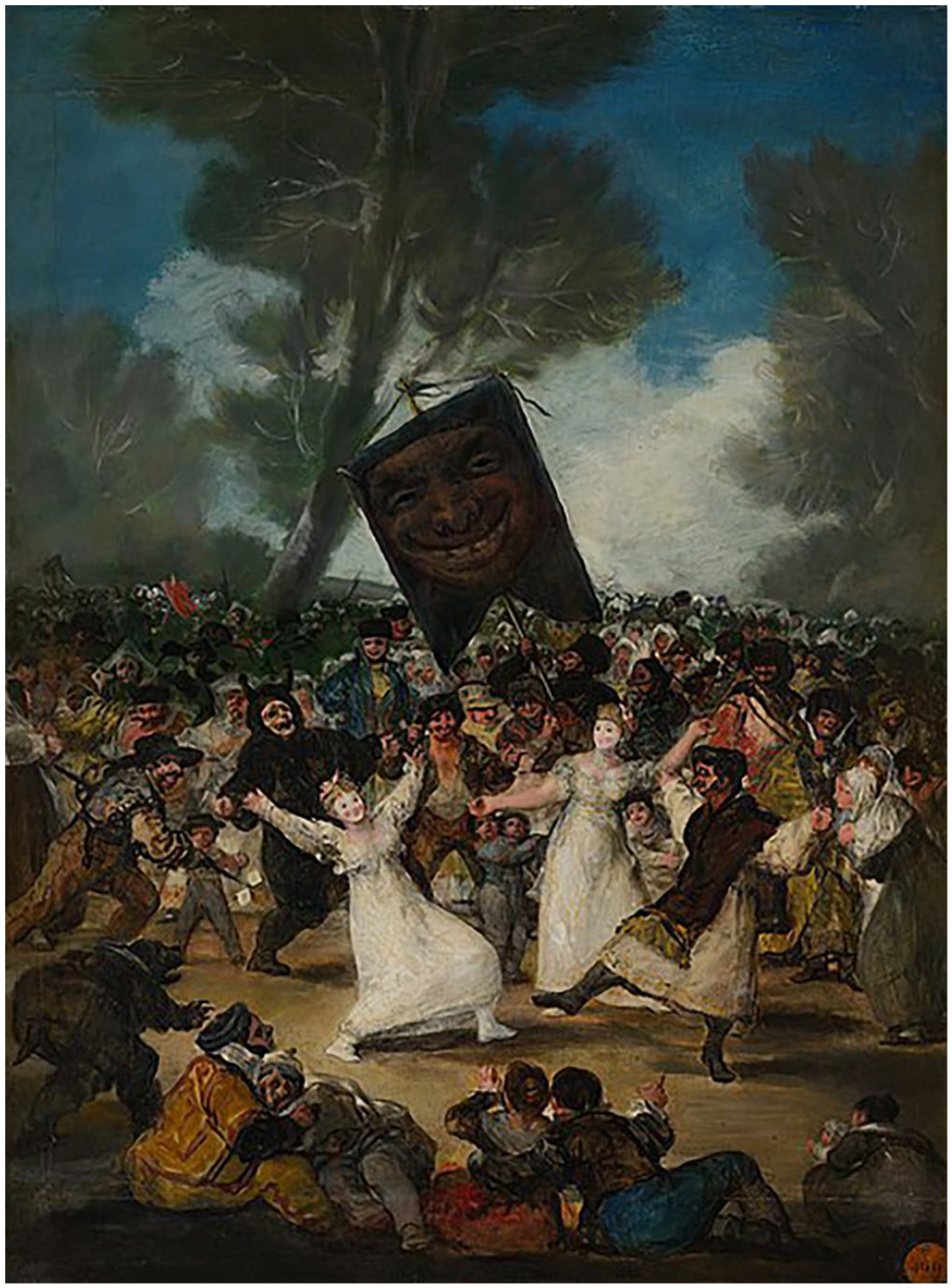
Francisco Goya, “The Burial of the Sardine”, 1812–19.
To repeat, our reading of carnival is not contrary to Bakhtin. Rather it is intended to highlight its darker, violent and more sacrilegious side, as opposed to what he saw as its utopian promise. Read this way it constitutes an often violent performance: one directed against a ruling regime whose moral and normative order is ritually suspended and subverted for the period the carnival lasts – a fact, it should be observed, not lost on the governing regimes and the ecclesiastical authorities who for centuries condemned the folk carnival and actively attempted to suppress and tame it.
The carnival of power
As we have seen, the key to understanding Bakhtin’s approach to carnival lies in the radical separation he draws between the festive, irreverent spirit of the folk carnival and the cold mechanics of official dogmatism and oppression. This approach was deeply political. Bakhtin’s theory and his vision of carnival as an archaic utopia emerged during a particular era in Russian twentieth-century history, the period of totalitarianism. Bakhtin was at pains to affirm the indestructible vitality of the masses and their potential for emancipatory transformative praxis, and to do so, he wanted to distinguish this absolutely from the ‘official, formalistic and deadening authoritarianism’ whose unspoken name, as Eagleton (1981: 144) pointed out, was Stalinism.
And yet, and here we come to our major point of departure from Bakhtin, in affirming the absolute separation of carnival from officialdom Bakhtin remained blind to what we would assert to be the carnivalesque performances also intrinsic to the practices of the state. As Dobrenko and Jonsson-Skradol (2022: 21) note, writing about Stalinist culture:
The Bakhtinian theory does not allow for a ‘carnival’ the main goal of which was a strengthening of the social hierarchy, upholding social distances and class barriers, legitimizing existing laws, prohibitions, and restrictions—a ‘carnival’ at the core of which was fear as well as jubilation.
1
Consequently, Bakhtin remained oblivious to the ambivalent, heterogeneous and subversive performances of the powerful at a time where the carnivalesque laughter he celebrates could also be heard in the show trials of the Stalinist regime, in denunciatory public meetings, or in the cruel mockery of previously elevated cultural figures in the party press (Averintsev, 1992; Fitzpatrick, 1993; Groys, 2017; Halfin, 2009: 425, note 49). What Bakhtin did not countenance but we want to affirm here is that the essence of carnival as he defined it, ‘its parodies and travesties, humiliations, profanations, comic crownings and uncrownings’ (Bakhtin, 1984: 11), were never only monopolised by ‘the people’. These very same motifs were also present in the practices of the state and its political actors. How then, might we begin to make sense of what we propose to call the carnival of power?
Agamben helps us comprehend the basis of this alternative carnival through the parallel he draws between a folk carnival where law is ritually suspended and subverted and the state of exception where the state suspends and subverts its own law. Carnival’s ‘anomic feasts’, he argues, ‘point to a zone in which life’s maximum subjection to the law is reversed into freedom and license’ (Agamben, 2005: 72), which, as he observes, symmetrically parodies the state of exception within the law. Which in turn raises an important question: can the state of exception also be carnivalesque?
The capacity to suspend the legal order is, according to Agamben (2005), and prior to him Schmitt (1996), the ultimate paradigm of state power. In a state of exception, law is suspended and in its place a new regime is created that negates this law. Here the state’s capacity to override the very legal regime it is supposed to guarantee becomes an expression of its unbridled sovereignty.
There is, we would contend, a carnivalesque possibility in the state of exception that mirrors the folk carnival. This is revealed when the reversal of legal norms evoked by the declaration of the exception is accompanied by the festive celebration of the capacity of power to upend the previous order, dismantle its hierarchies and its everyday conventions, and ultimately unleash violence. In other words, the ritual subversion of the normative order and the festive performance of transgression that characterise the carnival of the masses can also be reproduced, and with spectacular rhetorical or physical violence, in the zone where state power gives itself license to remove and transgress its own limits. The state of exception within the law can thus also become carnivalesque.
The jouissance of the folk carnival also finds parallels in the jouissance of the state carnivalesque. Adopting a Lacanian psychoanalytic perspective on the suspension of taboos and prohibitions, Žižek observes that political violence frequently takes festive forms. The lynching parties in the American South of the 1920s, as Žižek points out, were carnivalesque, as were the Nazi night pogroms and beatings of political opponents in the 1930s. Žižek explains that in the performance of this sadistic carnival, people enjoyed the jouissance of transgressing the Law, while acting together as a unified body purging the community of those who did not belong to it. Discussing these events, Žižek (1994) notes that ‘What holds together a community most deeply is not so much identification with the Law that regulates the community’s ‘normal’ everyday circuit, but rather identification with a specific form of transgression of the Law, of the Law’s suspension (in psychoanalytic terms, with a specific form of enjoyment)’ (p. 55). What holds for these expressions of extrajudicial violence also holds, we contend, for the transgressive aspects of state violence.
While carnivalesque possibilities are clearly abundant in the state of exception, where the state and its agents openly suspend the legal order, carnivalesque, transgressive and obscene performances are often implicated in the more systemic operation of power, and their presence can be observed in its ceremonies and rituals. This finds particular expression in political culture and operation of state propaganda machines where things may be said and done that not only reproduce the grotesquery and absurdity of the folk carnival but which overturn the normal conventions and rules of civility. As we shall see, the ‘carnivalesque’ as a category of performative political style, also involves a temporary inversion or subversion of social norms and taboos, mandating extra-ordinary behaviours that are at times festive and violent, and which often involve the suspension of hierarchies.
Foucault helps us further comprehend the carnivalesque aspect of state power in his reflections on what he termed ‘arbitrary sovereignty’. Reflecting on the abnormal, deviant and grotesque in the operation of power, Foucault (2004) observed that state sovereignty, far from manifesting itself in a coherent (rational) legible form, often assumed instead a far more ‘arbitrary’ and ‘ridiculous’ manner (p. 12).
Political power, at least in some societies, and anyway in our society, can give itself, and has actually given itself, the possibility of conveying its effects and, even more, of finding their source, in a place that is manifestly, explicitly and readily discredited as odious, despicable or ridiculous. This grotesque mechanism of power, or this grotesque cog in the mechanisms of power, has a long history in the structures and political functioning of our societies. (Foucault, 2004: 12)
Foucault illustrates his argument by evoking the figure of the ‘vile sovereign’. This is a figure dating from the Roman Empire, who expressed through his person ‘a mode, if not of governing exactly, at least of domination’ (Foucault, 2004: 12). To illustrate his point, Foucault points to the comically grotesque character of Mussolini, a dictator whose public persona ‘was absolutely inherent to the mechanism of power’. In Mussolini ‘power provided itself with an image derived from someone theatrically made up and depicted as a clown or a buffoon’. (Foucault, 2004: 13) 2
But who is this vile sovereign? Surely, we would contend, the state variant of what, in the folk carnival, would be defined as the Lord of Misrule, the carnivaliser par excellence. On this point it is worth remembering that carnivals do not just happen, they are also performances that are orchestrated and staged. To be carnivalesque requires, as a precondition of its existence, those who carnivalise – those capable, in other words, of masterly performances of outsized, irreverent, transgressive spectacles in which the legal and moral norms of an established regime are subverted and inverted. In the behaviour of the powerful, in the true spirit of Bakhtinian carnival, carnivalesque grotesquery is employed to establish exception outside of order. The masters of such performances often masquerade as outsiders, claiming to articulate the voice of a suppressed and disempowered people, acting, as it were, on their behalf. Masks, gestures and body attire, symbolising playfulness and irreverence, often feature as a common prop in their theatre. As we shall see, a number of contemporary populist leaders fit well within this category.
Finally, to return to the subject of the laughter which Bakhtin situates at the heart of the folk carnival, this too can also be considered a fundamental principle at play in the carnival of power. In their book, State Laughter: Stalinism, Populism and the Origins of Soviet Culture, Dobrenko and Jonsson-Skradol (2022) explore how Stalin’s regime, far from being humourless, deployed a range of comic forms to mock, ridicule and ‘render external’ party comrades and ideological enemies. Political meetings where previously respected party members and venerated leaders were subjected to spectacular humiliation were mediated by state propaganda as joyful celebrations of the people’s power, while informal trials that followed no legal procedure acquired the force of law. In Dobrenko and Jonsson-Skradol’s interpretation, Stalinism always had a carnivalesque dimension.
In summary, what are often seen as the key defining features of the folk carnival also find themselves reproduced in the way ruling regimes behave and project their power through the apparatus of the state. What these reflections on state power have in common is that they allow us to rethink carnival in a way that Bakhtin never envisioned, namely as a cultural form that also belongs to the powerful as much as it does to the people. It is our conjecture and the organising conceit of this paper that the power-holders never relinquished carnival to the people. They always maintained their own carnival tradition.
Let us now, by way of summary, map out the similarities between these two carnival traditions before attending to the differences that distinguish them.
Both conspire at the (temporary) suspension and subversion of the moral and normative (legal) order and establish a state of exception outside of its normative and moral code.
In doing this, both traditions invoke excess and license transgressive performative practices. In both carnival traditions there is festive jouissance at play, a pleasure enacted in the wilful transgression of established borders and prohibitions.
Carnivals, as we have noted, are less spontaneous and tend to be orchestrated. They are often led and also shaped by key carnivalisers, Lords of Misrule who take a lead role in choreographing transgressive practices. This applies as much to the carnival of power as it does the folk carnival.
In both traditions people are invited to come together as a unified body to laugh at a world reconstructed as absurd and ridiculous. Both traditions trade in the obscene and the grotesque.
What, then, separates these two carnival traditions? The insurrection of the folk carnival and its de-sacralising impulses can be defined as a form of resistance on the part of the common people, one that subverts ruling regimes while not conspiring at their overthrow. Conversely the carnival of power is born out of the exception and/or subversion of order that the rulers can initiate and exercise. The masters not only make the rules they expect others to conform to, but they can also suspend and override the normative and legal order they are ultimately expected to uphold and guarantee. It is out of their own ability to transgress this order and assert their capacity to unleash destruction and death, coupled with the jouissance attendant on this transgression, that the carnival of power is born. If in the folk carnival the people affirm their sovereignty, the same applies in the case of the masters – only, as we shall see, in a more terrifying way.
In the remainder of this paper, we will put some empirical flesh on these theoretical bones. To accomplish this, we will begin by exploring the festive and carnivalesque aspects of state violence. In the second section we will examine the world of the state carnivalisers, the political Lords of Misrule. Finally, we will examine aspects of the carnivalesque style in governance, using modern-day Russia as our case study.
State violence and the sovereign exception
State violence becomes carnivalesque when its exercise transgresses legal and moral norms; where the exercise of violence is festive, spectacular and often excessive; and, where an element of exuberant pleasure is also present. It is beyond the scope of this paper to produce a historical genealogy of the carnival of power, but were one to be written we would suggest this carnival can be observed in premodern as well as modern political regimes and features as much in democratic as in more authoritarian ones. As such, it constitutes a perennial feature of political life and statecraft. That said, concrete analysis would no doubt reveal considerable variations in the way different political regimes materialise this carnival. Here we will restrict our analysis of state carnivalesque performances to that enacted in the name of the war against terror by the US government, as it was spectacularly revealed in the grotesque and exuberant cruelty unleashed at Abu Ghraib (and later Guantanamo)
This was a violence that found concrete expression in perverse sadistic brutality, and was characterised by the wholesale eviction and carnivalesque inversion of the norms that otherwise define the Western judicial order (which explicitly preclude torture). In Abu Ghraib prison in Iraq, Iraqi prisoners were stripped and tortured by their American guards. Many were subject to sexual humiliation, with several Iraqi men being forced to perform sexual acts on each other. Other prisoners were attacked by dogs, others forced into stress positions, while others were electrocuted (Greenberg and Dratel, 2005). All, meanwhile, photographed with their torturers in attendance, happily smiling for the benefit of the cameras that recorded these atrocities. Though the American State eventually tried to dissociate itself from these acts undertaken in it its name, these horrors, while nominally extra juridical, do not stand, we contend, external to the carnival of power, this is a direct manifestation of it.
What the perpetrators responsible for this grotesque performance accomplished was to bind together the exercise of absolute power with transgression and perverse enjoyment. They came together as a unitary body, bound by the collective subversion of every norm. In their transgression, these low-ranking officials entered into a space of spectacular and violent excess, freed from the burdens of morality, customs and everyday codes of behaviour. Though subversive of the normative order, it could be observed that the spectacular degradation of the Iraqi prisoners nevertheless also reasserted wider hierarchical and racialised power structures. Like the folk carnival the carnival of power also annihilates while simultaneously re-confirming the hegemony of the established order (Eagleton, 1981).
State carnivalisers
The ability to suspend the legal order a political regime is otherwise mandated to uphold, and the jouissance attendant on declaring the state of exception, defines one key manifestation of the carnival of power. But political leaders do not need to declare a state of exception to open up the space of a carnival. Their capacity to subvert and disrupt a political order can take other forms, and there are clear carnivalesque dimensions to those as well. To study this we need to return to what, following Averintsev (1992: 11–12), we would define as the world of the ‘carnivalisers’, in our terminology the political Lords of Misrule.
In modern societies these figures are typically populists, larger-than-life politicians, who often come across and masquerade as buffoons and clowns, and who present themselves as outsiders – men of destiny who claim to speak for and on behalf of a suppressed, excluded and disempowered people. These are political disrupters who upend conventional norms as they will not be bound by any limits.
Donald Trump assumed power in the US with a background as a reality TV star whose catchline was ‘You’re fired’ (itself an inversion of the norms of civility). He presented himself from the outset as a larger-than-life political outsider, a perma-tanned politician who, despite being a product of the American elite, positioned himself as the friend and defender of a constituency of disenfranchised, predominantly white working-class voters. 3 It is the caustic, often playful and irreverent way in which he encoded their anti-establishment animus, transforming it into a subversive political programme, that makes him the consummate disruptive carnivaliser.
During his first term in office Trump effectively transformed politics into an extension of warfare, reversing the very idea of a deliberative democracy. He did not seek to reason with political opponents, or try to find consensus with them. Instead, he castigated his opponents as members of an ‘establishment swamp’ and spent his political life ridiculing and baiting them. During the presidential election in 2017, for example, he routinely attacked his political opponent Hillary Clinton, supported by followers who would respond to his personal attacks by chanting ‘lock her up’ – political displays not entirely different from the carnivalesque figure of Punch, violently dispatching his enemies with the punchline ‘That’s the way to do it’. His response to the Democratic politician Elizabeth Warren’s revelation that she had Native American heritage was to revert to racism and call her ‘Pocahontas’ (Chiacu, 2018).
Another key feature of Trump’s reign was his ability to simply lie or produce inflammatory statements devoid of evidence, while simultaneously castigating people and organisations that fact-checked him as ‘fake news’ (Kelly et al., 2018). This deliberate inversion of the conventional rules of public discourse is particularly evident in his jubilant rejection of all sources of authoritative knowledge, be these scientific bodies, academic experts or respected media organisations. Prior to his election in 2017 he had been instrumental in drawing attention to what he alleged was Obama’s ‘false’ claim to be an American citizen. Trump went on to speculate he had been born in Kenya (Burns, 2016). Even after Obama produced his birth certificate Trump continued to publicly dispute his American identity (NBC News, 2016). His response to global warming was to deny it, claiming it was all a ‘hoax’ (Parker and Davenport, 2016). While his response to the Covid pandemic was to deny its seriousness, resist calls to limit its spread through lock-down, and cast doubt on the scientists and science that contested his world view.
Since his failed second election attempt, this carnivalesque style has continued to be his performative trademark. Upending political conventions and norms, during a filmed CNN town hall meeting in 2023, Trump snapped at a CNN presenter, calling her a ‘nasty person’, and claimed his arraignment for sexual abuse would help him win in 2024 during a primetime appearance before Republican voters. The audience laughed (The Telegraph, 2023). However, it can be noted that his intuition that indictment would not dent but reinforce his popularity appeared well-grounded.
The British ex-Prime Minister Boris Johnson may also be considered a carnivaliser and shares many characteristics in common with Trump. Like Trump, his persona was also larger than life. In Johnson’s case it revealed itself in a dramaturgical ‘presentation of self’ (Goffman, 1959) that was consciously buffoonish. He looked permanently dishevelled and was noted for his blustering manner. He was also charismatic, in the Weberian sense of the term, and a cult of personality surrounded him as much as it did Trump. In terms of their political standpoint, both men (products of the ruling elites) presented themselves as outsiders fighting what they claimed were ‘cosmopolitan elites’ on behalf of disempowered ordinary people.
Johnson indulged, sometimes openly, sometimes in the privacy of his own circle, in outrageous pronouncements, revelling in his ability to bring disruption and even death. Johnson’s response to corporate concerns over his project to leave the European Union was to say ‘Fuck business’ (BBC News, 2018); while his response to concerns about rising mortality rates during the Covid pandemic was to say ‘let the bodies pile high’ (Reuters, 2023). Both statements attest to what we might term the jouissance of power as it can finally, without hindrance, act in its foundational capacity – the sovereign capacity to exterminate life (Agamben, 1998).
In terms of political style, Johnson was also a transgressive disrupter, capable of breaking, subverting and reversing established political norms precisely because he was not bound by them. This would be spectacularly revealed in his (subsequently rendered illegal) attempt to suspend the British Parliament in order to prevent scrutiny of his plans for leaving the EU. His contempt and subversion of the normative code was also in evidence in what became known as Partygate, the scandal that would eventually see him expelled from office by his own party. While imposing a harsh lockdown upon the British people in the wake of Covid, one which prevented them from attending the funerals of their loved ones, Johnson oversaw a permissive culture at Downing Street where drinking was rampant and parties were commonplace.
Most politicians lie, but what is notable about carnivalisers like Johnson and Trump is not so much that they lied repeatedly. It is the barefaced scale of their lies and their unapologetic nature that define their performances as carnivalesque. Both men functioned in what can be considered a post-truth political regime, inasmuch as it constituted a regime in which the reality principle became subordinate to the disturbing fantasy life they sought to project (see also Mount, 2021). Johnson fronted a Brexit campaign promising that £350 million would be saved each week if the UK withdrew from the EU, to be invested in the National Health Service, a ludicrous statement which could never be materialised into policy because it was untrue from the beginning. 4 Despite eyewitness testimony and photographs showing that Johnson attended many parties at Downing Street, he denied any breach of the lockdown regulations his own regime had created. More than that, he did so to Parliament. Eventually this cost him his political career. His response to the MPs mandated to investigate his behaviour (the Privileges Committee), despite the Committee’s being dominated by members of his own party, was to describe them as a ‘kangaroo court’ and their finding that he had lied as ‘deranged’ (Devlin and Forest, 2023).
The carnivalesque style in governance
Just as the folk carnival celebrates an aesthetic and imaginary of the grotesque in which the monstrous finds spectacular and joyful validation and affirmation, this aesthetic and imaginary can also be reproduced in political behaviour. In what follows, we explore what we consider to be a particular mode or style of governing, which we term the carnivalesque style. To do so, we consider Putin’s Russia. In its propaganda and in the words and speeches of the carnivalisers who shape it, core features of the folk carnival are also reproduced in its carnival of power. In common with the folk carnival we find in their pronouncements the world reduced to an outrageous and absurd parody of itself. This grotesquery is typically performed through the medium of a political discourse that strays beyond the borders of accepted conventions, moral norms and customs. This is a discourse that consciously transgresses and destabilises what Edwards and Graulund (2013: 75) define as ‘what is ‘acceptable’ and ‘normal’ through an overdose, an excess, of the abnormal, the deviant, abject’. which, as these authors also note, constitute trademark features of the grotesque genre venerated in carnival.
The post-Soviet and current Russian political landscape has produced several carnivalising figures specialising in political grotesquery of this kind, all directly or indirectly associated with the state, and licensed by it to express, in an outrageous and festive form, the arbitrary nature of its sovereignty. One of these was Vladimir Zhirinovsky, the leader of the ultra-nationalist and government-supporting Liberal-Democratic Party (LDPR). In his long career (over 30 years) in the Russian parliament, he cultivated the image of a nasty and brutish court jester who could openly display xenophobic, racist and sexist prejudices. Dressing extravagantly in bright colours, often with a top shirt button undone, with lopsided ties, or on occasion wearing a Soviet military uniform covered in medals, he was always an outlandish performer. Setting the mould for the later carnivalesque performances of Putin’s war propagandists, he deployed exaggeration and excess while threatening Ukrainian politicians, including the former Georgian president Mikhail Saakashvili, who, for a time, was governor of Odessa. In his own words:
We will shoot all of their governors, starting with Saakashvili, then they will be afraid. And there will be a different situation in Europe and Ukraine . . . Let’s aim at Berlin, Brussels, London and Washington (TSN, 2015).
Vladimir Putin, while generally lacking the ebullient, ludic expressive style typical of carnivalisers, has at times also been given to grotesque fun-making. He once made a playful threat to amputate a Western journalist’s genitals so that ‘nothing will grow again’ after the journalist asked him a question he did not like (Artemiev, 2015). Transgressive laughter can be heard in his admiring words for the then-Israeli President Katsav,
Give my greetings to your president! He turned out to be a really powerful guy. Raped ten women! I never would have expected it of him. He has surprised us all. We all envy him! (Artemiev, 2015).
Such jokes exemplify the carnivalesque grotesque, which Bakhtin (1984) defined as ‘a lowering of all that is high, spiritual, ideal, abstract’, the crude reduction of life to sexuality and the body (p. 20). In Putin’s carnivalesque ‘sovereign’ laughter, he joyfully upends the moral and legal order, celebrating power’s capacity to transgress its own borders while indulging in a necro-political performance where taboos can be violated without apology. The jouissance of power that accompanies this journey into the realm of the illegal, amoral and forbidden can also be heard in Putin’s evocation of a crude Russian folk rhyme, made shortly before he unleashed his war against Ukraine. Commenting on Ukraine’s unwillingness to abide by the unfavourable conditions of the Minsk accords, he remarked: ‘Whether you like it or not, bear this, my beauty’. In the folk rhyme these words are uttered by a man who is violating his dead ‘beauty’, having climbed into her coffin to rape her (Lenta.ru, 2022).
Under Putin, the carnivalesque style has gradually become the hallmark of the Russian Ministry of Foreign Affairs. Foreign Minister Sergei Lavrov, the ministry’s spokeswoman Maria Zakharova, and the Russian representative to the UN Vasily Nebenzya, all freely indulge in the use of obscene language, in the mockery and denigration of foreign journalists and officials, overturning established diplomatic conventions and protocols. In these irreverent and grotesque performances they represent Russia’s ‘insurrection’ against what they perceive as the Western hegemonic powers, and affirm the sovereign nature of its regime.
The grotesque way in which Putin’s secret services assassinated ‘traitors’ and political opponents, often by poisoning them, was also carnivalesque. The bizarre and medieval way chosen by the regime to rid itself of its enemies (when, surely, it would have been easier and more efficient to use conventional weapons) reveals an enjoyment of the law’s suspension. Such extra-legal assassinations, while demonstrating the state’s capacity to kill without judicial process (which marked a continuation of Stalinist traditions), also act to cement the ‘band of brothers’, the security services corps which shares, to use Žižek’s expression, an ‘unwritten, obscene secret code’ (Žižek, 1994). Though publicly denying its involvement in the poisonings, in a context where the evidence available attested to their culpability was overwhelming, Putin’s regime nevertheless displayed to the world a sardonic smile, in effect, proudly acknowledging that it was indeed responsible. Soon after the murder of Litvinenko, one of the suspected killers, Andrey Lugovoy, was elected as a State Duma member for the LDPR party. After Alexei Navalny’s poisoning, the state both denied its involvement and refused to launch a criminal investigation. Nor was any investigation initiated following his sudden death in prison in February 2024.
With the advent of the war in Ukraine, the grotesque carnivalesque style has become the key genre of public political statecraft in Russia. In the Schmittian ‘state of emergency’ (Schmitt, 1996) that the war represents, all previous prohibitions can be cast aside.
State propagandists deliberately put the power of their masters ‘beyond the pale’ as they enthusiastically talk about the destruction of Ukrainian cities or the use of nuclear weapons against Russia’s enemies. Upending the moral order to which official authorities still rhetorically subscribe (‘we do not bomb civilians’; ‘this is not a war but a ‘special military operation’’), many TV propagandists revel in the jouissance of violence. When Russian journalist Anton Krasovsky gleefully suggested live on Russian TV that ‘Ukrainian children should be burned and drowned’ (something that, as he said later, was done in jest), he exposed the limits of what is morally possible and went well beyond them (Rodionov, 2022). 5
Transgressive rhetorical violence is often displayed by Vladimir Soloviev, a star of political TV shows. Exhibiting deliberately excessive behaviour, he routinely denounces and ridicules political enemies and traitors, while also making pronouncements on matters of life and more importantly death. After the Ukrainian attack on the Russian town of Shebekino, for example, Soloviev declared that he had warned the public that:
. . .we should erase Lviv, Ivano-Frankovsk, Kiev, Odessa, Nikolaev, Kharkov, and then rebuild – just erase area by area. I was told, no, how can you say that? Now you can see. What other reasons should there be to deal a destructive blow against these Nazi bastards with all weapons, using all we have? (Kolezev, 2023).
Since the start of Russia’s war against Ukraine, Dmitry Medvedev, Russian ex-President and now Deputy Head of the Security Council, has also made his own contribution to the State carnival, issuing extravagant pronouncements, threatening the world with a nuclear apocalypse and using eschatological language in a way starkly at odds with his previous image of an emotionally restrained, rational politician. He frequently accuses the West of ‘satanism’, and warns the world that ‘the horsemen of the apocalypse are already on their way and we can only now put faith in God’ (Williams, 2022). Moving into the realm of sovereign exception, Medvedev gleefully talks about the power of the state to unleash chaos and death. At a public talk in April 2023, after warning his young audience that he was going to say the unsayable, Medvedev offered his opinion about the real threat to their future, which was apparently not global warming. Given the frequent threats to unleash a nuclear war made by Russian state actors, this warning sounded particularly ominous but Medvedev issued this threat in a provocative, even cheerful tone:
Enough of complaining about the temperature rising by 1 degree a year. . . In my opinion, this is nothing compared to being in the epicentre of an explosion with a temperature of 5,000 Kelvins, a shock wave of 350 metres per second, and a pressure of 3,000 kilograms per square metre. (RIA Novosti, 2023)
In their transgressive celebration of death and destruction, in their capacity to say the unsayable, these propagandists freely revel in a jouissance of power, unburdened by any sense of restraint or limit. In their collective journey into a world of unbridled excess we bear witness not only to the performance of the carnivalesque grotesque as a political style but the ecstatic and exuberant performance of unbridled despotism. This is the carnival of power.
Conclusion
In conclusion, the transgressive, obscene and grotesque performances that Bakhtin associated with the folk carnival are also mirrored and reproduced in the practices of the state and its actors. In this, the carnival of the masters, power incorporates its own transgression, breaks free of limits and moves into the space of excess where previously unthinkable things can not only be said but materialised. In the carnival of power, state actors are empowered to transgress every normative constraint and, as we have argued, there is festive jouissance to this as well. Just as the folk carnival consciously aspires to profane and desacralise a world reduced to absurdity, the same practices are reproduced in the carnival of power. This is nowhere better evidenced than in the capacity of state actors to exceed all limits, in the performance of a politics where excess, violence and death are openly celebrated. As we have also seen, like the folk carnival, the state’s exercise of power can also adopt a grotesque and monstrous form, and like the folk carnival, it can have an absurd and ridiculous aspect as well.
In summary the carnival of power binds together power, transgression and enjoyment. It is spectacular and vital. Like the folk carnival, its actors come together as one in a body unified by their collective subversion of the law. The sensual pleasures attendant on the theatrical, rhetorical and interpersonal violation of the moral code, safe in the knowledge of one’s impunity, brings, we contend, a whole new dimension to Mike Presdee’s ‘carnival of crime’.
Like the folk carnival the carnival of power is also staged. The state has its own carnivalisers, who deliberately and openly display grotesque, outrageous and seemingly anti-systemic behaviours. In modern politics, these are often populist leaders who employ transgression as a performative political style, overturning established moral norms and conventions by adopting the role of outsiders (Aiolfi, 2022). And yet, just as we see in the folk carnival, whose performances were permitted by the hegemonic authority (Eagleton, 1981), the carnival of power only ever functions to reaffirm the existing order.
There is much to explore in the carnival of power, including its phenomenological properties and the experiences, emotions and performative strategies of its participants. On a structural level, the carnival’s role in reinforcing existing hierarchies of race, gender and class is also worthy of exploration. Not least, in relation to the treatment of populations under conditions of western colonial occupation and under postcolonial governance. As Mbembe (2001) attests, these forms of domination have incorporated many carnavaleque elements.
In making the case that power has its own carnival tradition we have sought not only to question the Bakhtinian orthodoxy which considers carnival a progressive counter-cultural form; we have also sought to contribute to what might be considered a cultural criminological analysis of state power, taking it in a direction it has so far noticeably failed to embrace: the study of the state and its culture. In so doing, we have sought to challenge an assumption widely prevalent in criminology which holds that state power is rational and bureaucratic by drawing attention to its grotesque, arbitrary, excessive and transgressive features.
Footnotes
Acknowledgements
We are grateful to Gordon Hughes for his comments on the previous version of this paper.
Funding
The author(s) received no financial support for the research, authorship, and/or publication of this article.
