




Abstract
Social media platforms evolve rapidly. While platform studies have often analyzed specific policy or feature changes, there remains a lack of shared language to conceptualize how platforms themselves represent such changes. In this article, we analyze public communications from Meta, YouTube, X, and TikTok to examine how platforms construct and justify change. We explicate platform evolution as a technical but also deeply discursive process. Platforms frame their transformations in interesting ways, especially if these shifts consolidate power or deepen user dependence. We introduce the concept of changecraft: the strategic discursive practices through which platforms manage, legitimize, and normalize change. Changecraft encompasses the rendering of infrastructural shifts as visible, the framing of ideological pivots as continuity, and the deployment of patchworked updates to subtly reorient platform futures. This framework provides scholars a way to interrogate platform change not just by what changes but by how platforms seek to make change meaningful and acceptable to their publics.
Keywords
Introduction
As social media platforms evolve, they generate new affordances that reshape user experiences and policies, in turn, altering societal dynamics and redefining how individuals interact, communicate, and even organize within various social, political, and economic contexts (van Dijck et al., 2018). It is challenging to study the social implications of platforms without considering how they change. While scholars have studied technological change broadly from organizational and innovation perspectives (Anderson and Tushman, 1991), platforms exhibit unique business models, systems, and logics that warrant a more specific framework. Research has primarily focused on policy and feature changes, often on a case-by-case basis (see, e.g., Barrett and Kreiss, 2019; de Keulenaar et al., 2023; DeVito et al., 2017; Katzenbach, 2021). However, as platforms play an increasingly integral role in society (Nielsen and Ganter, 2022; van Dijck et al., 2018), it becomes important to develop language for documenting and analyzing their changes. In this work, we present an analysis of communications (n = 301) from Meta, YouTube, X, and TikTok, focusing on their discursive positioning of platform change and their rationales justifying changes.
While technological change has historically been slow and materially grounded (Roser, 2022), the current pace of platform evolution is rapid and characterized by shifts in interface, features, and governance. These changes are communicated and framed in particular ways because platforms remain technologies embedded in sociotechnical systems, and their evolution must be understood not only through infrastructural shifts but also through the narratives that justify and render those shifts meaningful.
Discursive framing enables platforms to present themselves as open, neutral, and responsive, even when the changes they enact consolidate power or increase user dependency (Gillespie, 2010; Plantin, 2018). For example, Meta's public communications around content moderation and misinformation rely on a discourse of authenticity and innovation, positioning the company as responsible while avoiding structural accountability (Hurcombe et al., 2025). Likewise, TikTok emphasizes AI-based moderation as both transparent and effective, framing algorithmic governance as trustworthy despite its opacity (Grandinetti, 2023; Chan et al., 2023). Such discourse actively shapes how platforms are perceived and regulated.
Therefore, studying platform discourse provides a necessary lens to understand platform change. Rather than treating change as an objective process, a discursive approach highlights how platforms construct and manage instability and strategically shape their public identities (Gillespie, 2018; Helmond et al., 2019; Barrett and Kreiss, 2019). Studying discourse allows us to unpack how platforms narrate their transformations in ways that obscure power asymmetries and legitimize their evolving roles within digital ecosystems (Hoffmann et al., 2016; van Dijck et al., 2018).
In this article, we (1) investigate and explicate platform change, (2) provide language and context for platform studies and related disciplines to discuss the implications of this change, and (3) document the discursive rationales of change as framed by the platforms. We do so through content analyses of documents from Meta, YouTube, X, and TikTok to develop and introduce the concept of changecraft. Changecraft highlights the discursive flexibility that manifests as strategic practices through which platforms manage, legitimize, and normalize transformation. This manifestation occurs by making changes and shaping how change is perceived. We discuss, how it primarily involves rendering infrastructural shifts visible, framing ideological pivots as continuity, and implementing small, cumulative updates (patchworking) to subtly govern users and reorient platform futures.
Background
Situating platform change
Historically, technological progress has been slow, with innovations remaining unchanged for generations (Roser, 2022). However, today, rapid advancements integrate once-unimaginable developments into daily life at an unprecedented rate, highlighting an accelerating pace of innovation (Roser, 2022). Scholarly conceptions of technology have evolved, shifting from an early emphasis on physical objects such as tools, machines, and artifacts to more expansive definitions. This early material focus was criticized for its narrow scope (Latour, 1993), particularly as digitization and computerization reshaped notions of materiality and broadened understandings of what counted as technology (Thrift, 2005). Likewise, recognizing technological systems as embedded in social relations became relevant, giving rise to the idea of sociotechnical systems rather than viewing technology as discrete objects deterministically exerting a shaping force on the social world (Bijker, 1997). Organizational scholars have also examined technological change, highlighting how it can disrupt existing workflows and continue to be mutually shaped by workplace constraints, often increasing workers’ mental load (Ellis, 2013). Similarly, innovation scholars have traced technological change using concepts such as the diffusion of innovation, among others (Godin, 2017). Within these discussions, technology is increasingly recognized as being inherently political (Rip and Kemp, 1998) and thus also being shaped by and shaping powers that make it more suitable and more comfortable for some over others.
Our work focuses on platform change, specifically among social media platforms. Platform change has been studied in terms of how users and other stakeholders respond to and make sense of it. Scholars have explored how users adapt to, interpret, and navigate evolving platform infrastructures. DeVito (2021) defined adaptive folk theorization when describing the frustrations and ideations of different users in understanding and working through evolving platforms. Likewise, De (2025) found that communities using platforms for their empowerment experienced feelings of frustration and helplessness, and other scholarship has found that changes disproportionately create inequalities for already underprivileged users (De and Cotter, 2025). Additionally, Arriagada and Ibáñez (2020) showed that platform evolution drives ongoing adaptation in content creators’ branding and practices, illustrating how changing features and algorithms continuously reshape their identities and economic roles. van Dijck (2012) theorized the co-evolutionary nature of platforms and social practices. Meanwhile, Helmond and colleagues’ (2019) work examining Facebook's evolution illustrated how platforms grow incrementally by adapting to changing user needs and external environments, embedding themselves within sectors such as advertising, marketing, and publishing through shifts in architecture and governance. Yet, as Barrett and Kreiss (2019) note, this evolution is not always linear; platforms also undergo moments of rapid, reactive change—what they term platform transience—in response to external pressures from journalists, policymakers, or public scrutiny. These periods of instability highlight the contingent and fragile nature of platform infrastructures, complicating efforts to hold them accountable. Expanding on this, Poell et al. (2021) frame platform evolution as a continuous, contingent process shaped by shifting strategies, user adoption, and institutional relations. Such a dynamic trajectory affects the opportunities and constraints faced by platform-dependent actors, particularly as platforms transition through different lifecycle phases (Helmond et al., 2019; Rietveld et al., 2020).
Our work contributes to platform studies by focusing on how platforms communicate and position change. In doing so, we follow Helmond et al.'s (2019) emphasis on the value of attending to “self-description histories” or key archival resources that capture how platforms narrate their own transitions. Through a content analysis of platform-authored texts such as blog posts, announcements, and policy updates, we examine how platforms frame, justify, and make sense of their own evolution. This discursive layer is crucial: it reveals how platforms manage public perception, preempt criticism, and shape dominant understandings of technological progress. By attending to these communicative acts, our work addresses a critical gap in the literature and offers a framework for studying platform change not only as a technical or social process but also as a discursive and political one.
Platform discourses
Platform discourse refers to the strategic use of language by technology companies to shape their public identity and regulatory positioning (Plantin, 2018). It often functions as a tool used to present platforms as neutral and open infrastructures, particularly when such portrayals align with corporate interests. At the same time, these narratives obscure the power platforms exert over content, policy, and user behavior. This dynamic is especially evident in companies such as Facebook, now Meta, where scholars have shown that discourse is used to manage public perception and deflect criticism regarding content moderation, data commodification, and a lack of accountability, among others (Gillespie, 2010).
Over time, scholarship has observed that platform discourse often emphasizes narratives of openness, innovation, and empowerment. For example, Maddox and Malson (2020) shared that US social media platforms use the “marketplace of ideas,” a free speech ideal where truth is believed to emerge through open debate, to justify global enforcement of US-centric expression norms. However, closer scrutiny has exposed the opaque operational structures of platforms (Gillespie, 2018; Pasquale, 2015). These critiques foreground concerns such as the commodification of user data, the politics of content moderation, and the disproportionate influence platforms exert over public discourse, often without meaningful accountability (Gillespie, 2018; Plantin, 2018; van Dijck et al., 2018). Platform discourses often function as disciplinary devices, projecting ideological and self-interested visions of how users ought to use their sites or understand their policies (DeCook et al., 2022; Divon et al., 2025; Petre et al., 2019). Through narratives of connection, virtue, and empowerment, they also obscure deeper forms of labor and governance (Proferes et al., 2025).
Meta has been a central focus in such analyses. Scholars have shown how the company strategically frames challenges around harmful content, particularly misinformation, through narratives centered on authenticity and technological solutions (Hoffmann, 2021). This framing positions the platform as proactive and responsible, while deflecting blame and limiting scrutiny. Meta Newsroom, initially a space for corporate announcements, has evolved into a key tool for shaping both public and policy perceptions of contentious issues such as misinformation (Hurcombe et al., 2025).
Platform discourse also shapes regulatory expectations. Facebook, for instance, was found to have invoked the language of self-regulation to legitimize its authority while projecting an image of accountability, even when its actions contradict these claims (Medzini, 2021). Zuckerberg's public statements consistently frame the company as a visionary force grounded in Silicon Valley ideals of global connectivity and community. This rhetoric masks the structural imbalances between the platform, its users, and commercial interests (Haupt, 2021).
Other platforms, including TikTok, deploy similar rhetorical strategies. Both Facebook and TikTok emphasize transparency and AI-driven solutions to harmful content as part of their discursive toolkit. These narratives frame AI as both innovative and trustworthy, shaping public understanding while obscuring the complexity and opacity of algorithmic systems (Grandinetti, 2023). For example, TikTok presents its use of AI in content moderation as a responsible and effective approach, deflecting deeper inquiry into how decisions are made and enforced (Chan et al., 2023). Studying discourses of change is thus key to understanding how platforms shape public perception, deflect accountability, and influence regulation, often masking persistent structural and governance issues. Analyzing these narratives allows us to critically unpack the gap between what platforms say, what they mean, and most importantly, what they do not say.
Methods
This study applies qualitative methods to the analysis of communications from Meta, X, YouTube, and TikTok. Our analysis follows an iterative approach, guided by sensitizing concepts derived from literature.
Data collection
We manually collected data from official company communications, which were published as news, communications, or other forms of public-facing discourse. We outline the key data source for each platform in Table 1, along with details regarding the data analyzed.
Data sources and their descriptions.
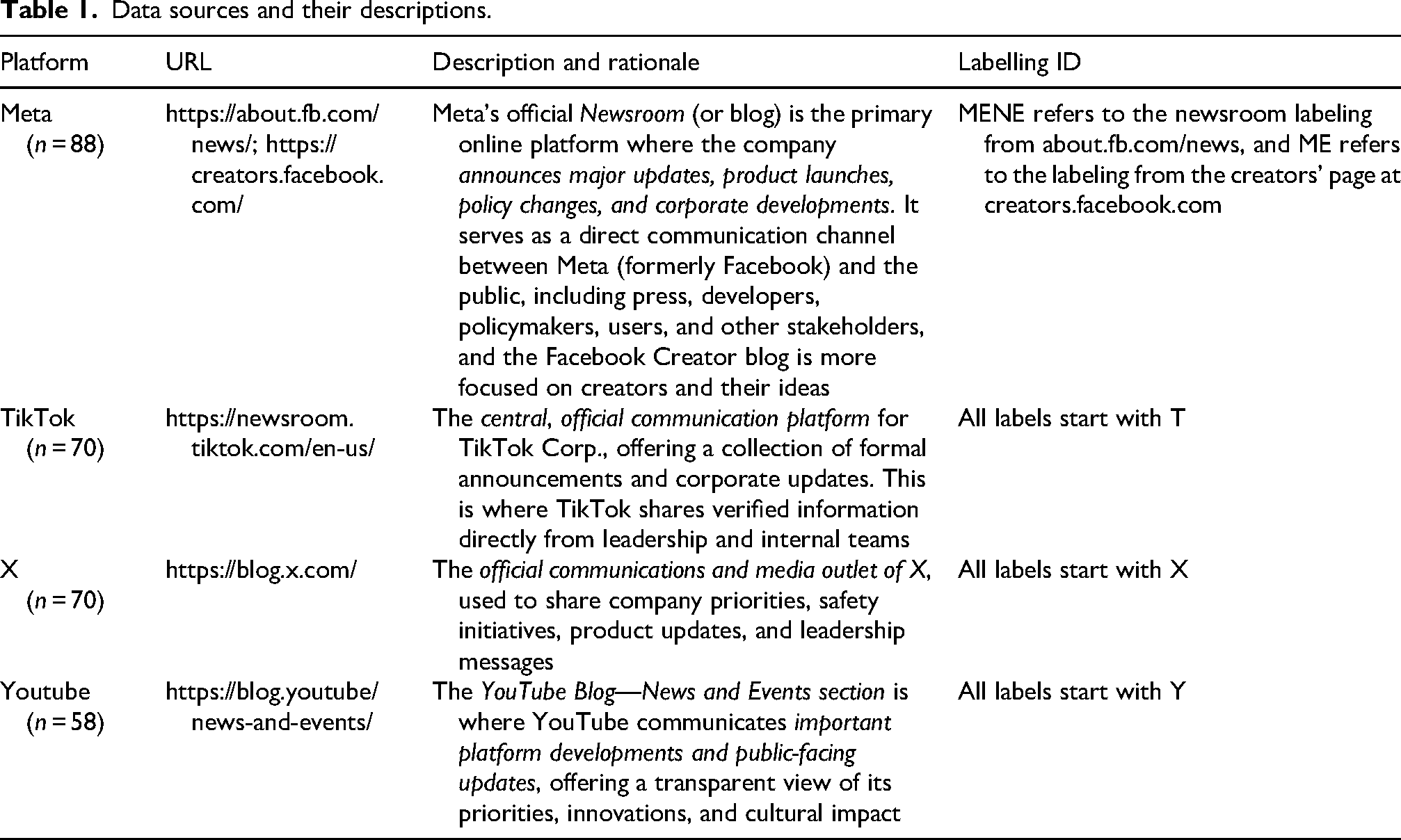
Documents from April 2022 to January 2025 were collected. These timeframes were selected to provide a focused yet sufficiently broad view of recent platform discourse. It captures a period during which many companies introduced key updates such as AI features, privacy revisions, and moderation policy changes—without extending so far back as to preclude a close analysis or obscure more recent trends. Our goal was not to showcase the sheer volume of change but rather to examine how platforms articulated and framed significant developments over a defined and relevant period.
Given the varying publication frequencies across platforms, we ensured that the data were representative of key updates, ideas, and innovations shared by each company over time. To further refine the data, we conducted a round of data reduction to ensure that the documents accurately reflected meaningful shifts. During this process, we removed any documents that did not align with one of the following categories: platform updates (e.g., feature announcements), company communications (e.g., press releases), user-directed messages (e.g., privacy updates), or statements from platform management (e.g., executive comments on policy changes).
Data analyses
The analysis was conducted using ATLAS.ti. Initially, the first author performed inductive thematic analyses (Braun and Clarke, 2021) on five randomly selected documents from each platform to develop a preliminary set of categories for classifying types of platform change. This iterative process aimed to comprehensively capture the diverse ways in which platform changes were described. These initial categories were then systematically applied to five other random documents across all platforms to assess their coverage and guide further refinement. To gain a broader perspective on how changes manifested, the codes were subsequently grouped to identify overarching themes across the corpus. Throughout this phase, the research team maintained analytic memos and engaged in collaborative discussions, paying particular attention to how platforms framed and justified changes. The categories were revised multiple times during this process, ultimately resulting in two major themes: material changes and ideological changes. These themes were then used to analyze the entire corpus of documentation.
During the iterative rounds of inductive coding, rationales for change emerged as a distinct and analytically significant category. To explore this further, the first author conducted several additional rounds of open coding on new documents, specifically targeting how platforms constructed and communicated their justifications for change. This process was followed by deliberations to develop a separate set of rationale codes, which were iteratively refined through memoing and team discussions.
While our overall approach was grounded in qualitative thematic content analysis, we drew on select facets of discourse analysis as described by Wood and Kroger (2000), particularly their emphasis on how language shapes meaning and social actions, including what is left unspoken. By carefully examining small segments of data multiple times, we interpreted not just what was said but how it was said and the positions the platforms took. This flexible approach helped us uncover patterns, including subtle implications and framing strategies. Likewise, our findings present the resulting analyses.
Findings
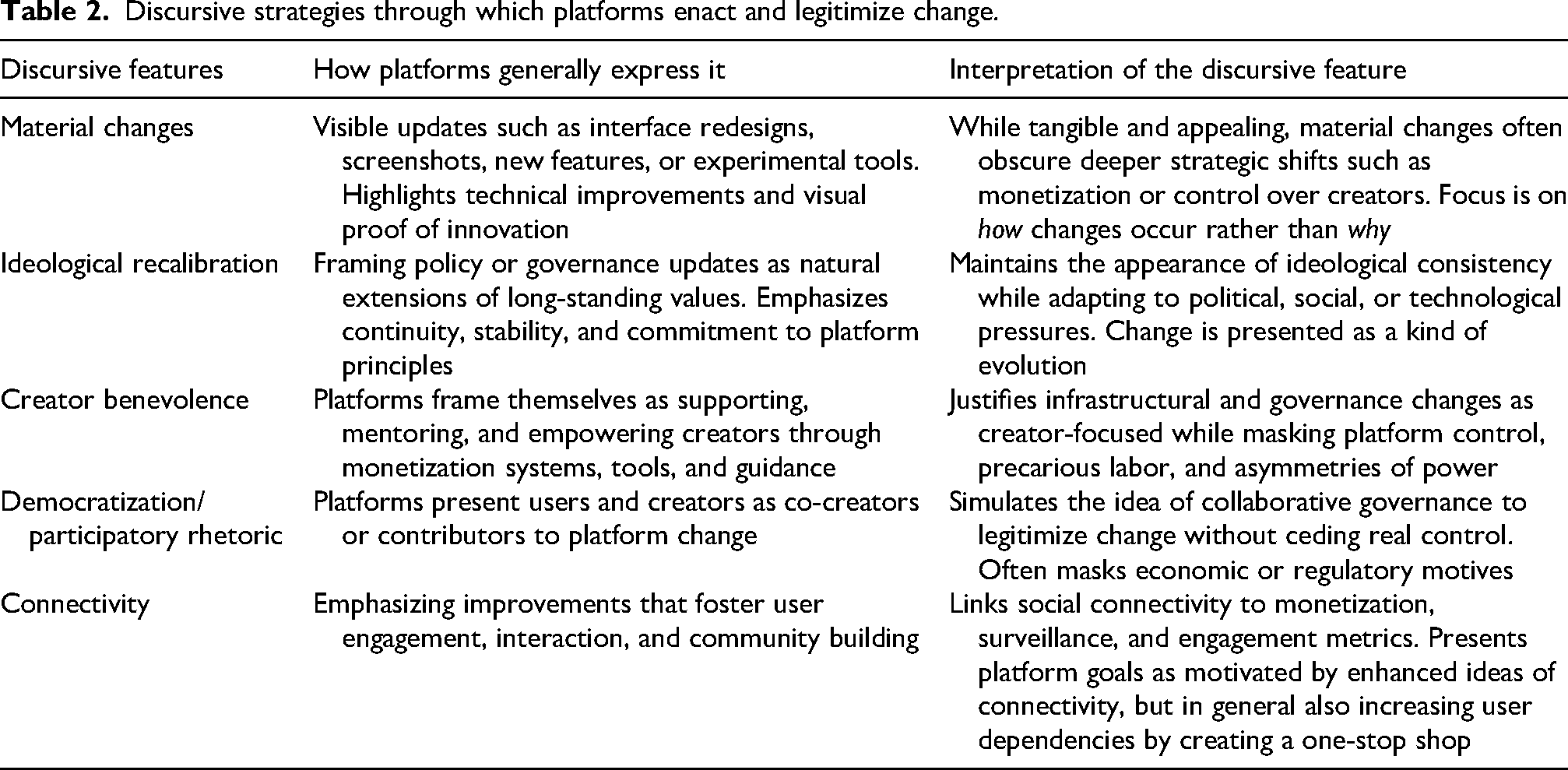
We found that social media platforms strategically deployed material and ideological changes to shape user behavior and perception. Material changes were often presented as simple, tangible improvements. Ideological changes consisted of subtly expressed modulations of the values of structuring platform ideologies. These changes were consistently rationalized through narratives of creator benevolence, democratization, and connectivity, effectively masking deeper commercial objectives and the consolidation of platform power. In the next section, we first describe the changes and their manifestations and then contextualize and discuss their rationales, as summarized in Table 2.
Discursive strategies through which platforms enact and legitimize change.
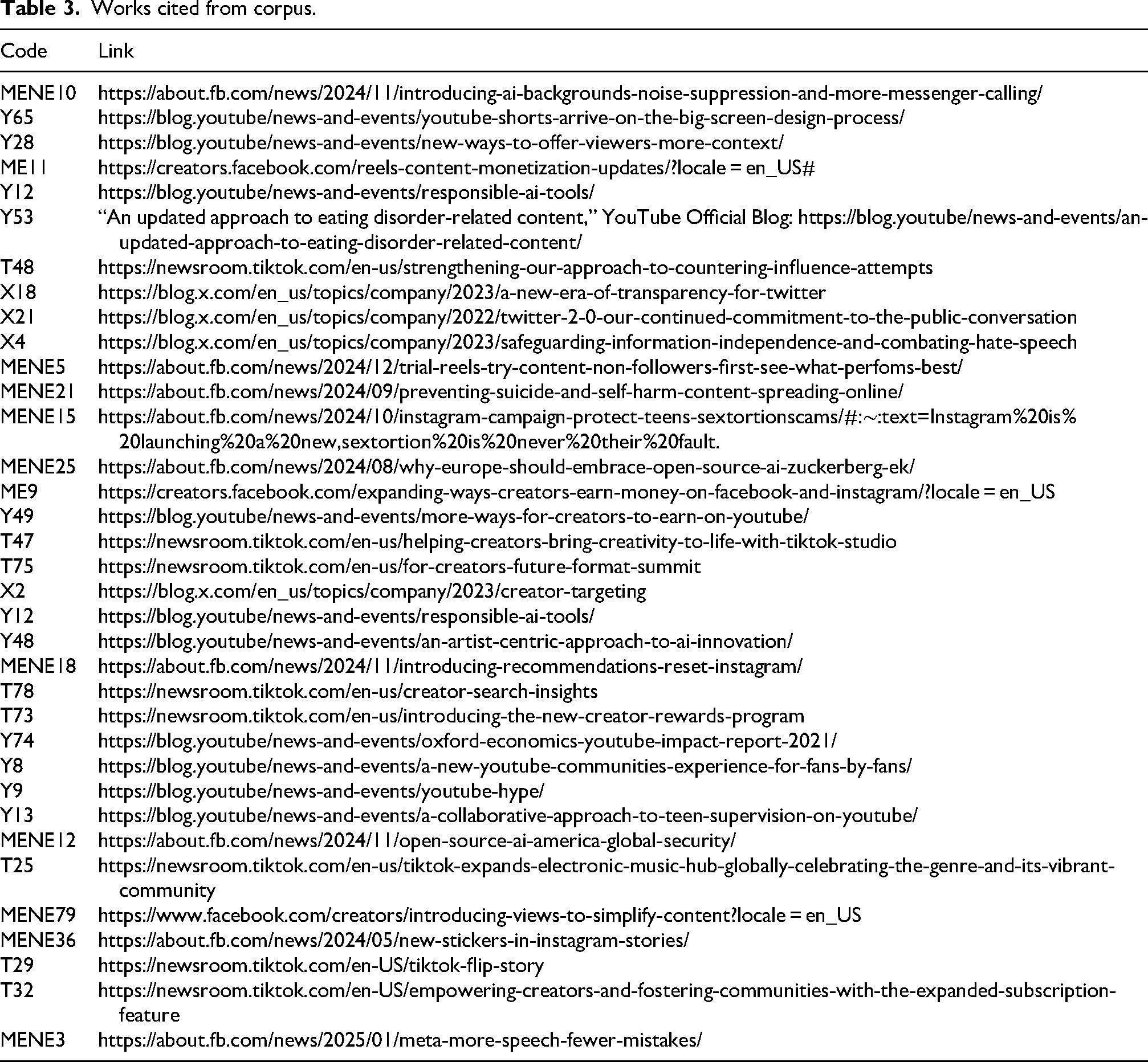
Works cited from corpus.
The discourse and manifestation of change
We first report on how platforms manifest change through material updates or visible, tangible feature improvements, and interface redesigns that highlight innovation and ease of use, creating an engaging aesthetic of progress. We find that material changes often conceal deeper strategic shifts toward monetization and increased platform control. Simultaneously, platforms enact ideological recalibration by framing policy and governance changes as natural extensions of long-standing values, emphasizing continuity and stability despite significant underlying transformations. All documents that have been quoted, are linked in table 3.
Material changes
Material changes functioned as a primary discourse through which platforms communicated evolution, making shifts both visible and tangible to users. This emphasis on visual proof positioned change as something immediate, recognizable, and inherently positive. Platforms frequently introduced new features with explicit, observable improvements creating an alluring aesthetic of innovation that showcased technical prowess and design.
For example, Meta's announcement, “Introducing AI Backgrounds, HD Video Calls, Noise Suppression and More for Messenger Calling” (MENE10), provided clear, tangible images (see Figure 1) that showed exactly how new features would manifest in practice. This enabled users to immediately recognize and appreciate the benefits of the update. Similarly, YouTube's “A design journey from mobile to TV: Shorts arrive on the big screen” (Y65) documented the implementation process through detailed research and design iterations. Yet, while visually engaging and process-focused, the article notably omitted any rationale for why the feature was necessary. Instead, the rationale was presented as self-evident, shifting the narrative toward the how of design decisions rather than why the change was needed: We wanted to know if the unique feel of Shorts could be conveyed in our conventional video player (Option A) or if it should be customized to better fill the blank spaces on either side of the video (Option B). We also considered a divergent option—the ‘Jukebox’ style (Option C)—where multiple Shorts would fill the screen at the same time, taking full advantage of the TV screen’s additional space (see Figure 2).

Visual display of how AI backgrounds work (MENE10). Source: https://about.fb.com/news/2024/11/introducing-ai-backgrounds-noise-suppression-and-more-messenger-calling/.

Visual display of reels on a TV (Y65). Source: https://blog.youtube/news-and-events/youtube-shorts-arrive-on-the-big-screen-design-process/.
This focus on process and visual display conveyed a sense of forward-looking creativity and optimization, yet it also obscured meaningful reflection on the necessity and broader implications of the change. Such an aesthetic implied that adaptation and iteration were inherently beneficial and unproblematic, reinforcing the assumption that ongoing technical tinkering equates to progress.
More complex algorithmic changes were similarly framed in terms of simplicity and seamless integration. For instance, YouTube's “experimental feature to allow people to add notes to provide relevant, timely, and easy-to-understand context on videos” (Y28) was presented with an intuitive explanation of the underlying algorithm: “If many people who had rated notes differently in the past now rated the same note as helpful, then our system was more likely to show that note under a video.”
This explanation made the change appear straightforward and accessible, glossing over potential risks such as the historical limitations of crowdsourced content moderation (Saeed et al., 2022). The framing aimed to assure users that these updates were user-friendly improvements, encouraging adoption while eliding broader complexities.
Yet beyond functional benefits, material changes often concealed deeper ideological and business shifts within platform governance. Updates that appeared discrete and technical frequently served to advance monetization strategies and reshape control over content and creators. Meta's “Reels update and monetization opportunities” (ME11), for example, introduced ranking changes prioritizing original content while simultaneously rolling out new advertising formats and payout structures. The framing of these shifts as “a few changes” and “opportunities” positioned them as creator-friendly, subtly encouraging alignment with monetizable content types.
YouTube's introduction of likeness management technology in “New tools to protect creators and artists” (Y12) was similarly framed as empowering creators to control their identity: This means equipping [creators] with the tools they need to harness AI's creative potential while maintaining control over how their likeness, including their face and voice, is represented.
While presented as protection, this infrastructure arguably enables YouTube to formalize identity-based content claims, positioning the platform to monetize AI-generated media and regulate identity at scale. This raises concerns about how platforms might operationalize identity claims in ways that circumvent legal frameworks such as the US First Amendment, creating parallel governance regimes that prioritize monetization and content takedown over expressive freedom.
Thus, platforms foregrounded changes as beneficial and creator-focused, thereby obscuring their deeper role in expanding monetization, consolidating control, and redefining norms around digital expression and visibility. By emphasizing visible updates such as interface redesigns, screenshots, and clear demonstrations of new features, they distracted attention from less visible yet more consequential infrastructural changes that reshaped platform economics and governance. This aesthetic of platform change—marked by a constant stream of updates, visually driven narratives, and a focus on immediate user or creator benefits—performed multiple functions, including masking the redefinition of monetization pathways, intensifying platform control, and deepening user dependence. Ultimately, platforms not only managed transformation discursively but also aestheticized it, rendering change itself as a form of engagement while deflecting scrutiny from its structural consequences.
Ideological changes
Across our corpus, platforms rarely introduced ideological change as an outright transformation. Instead, ideological changes manifested as recalibration of platforms’ commitments through subtle yet strategic shifts in emphasis, framing change as continuity. These recalibrations were achieved through several discursive strategies: reframing policy updates as clarifications of long-standing commitments; emphasizing continuity and stability even when facing external pressure; (re)invoking original intentions to legitimize redirections; and selectively foregrounding certain values such as safety, free expression, or transparency depending on social, political, or technological contexts. Together, these moves allowed platforms to reconcile shifts in their approach with the image of stable ideological foundations.
YouTube and TikTok both engaged in recalibration through updates to their policy and framing to emphasize continuity. In Y53, YouTube announced, “We’ll be updating our approach… in a way that we believe creates space for community, recovery and resources, while continuing to protect viewers.” TikTok, in T48, stated that “These changes build on our long-standing efforts to foster authenticity.” By using phrases such as “updating our approach” and “long-standing efforts,” both platforms presented potentially significant changes as extensions of existing values, signaling stability while responding to new pressures. In this way, the platforms framed these recalibrations not as reactions to new developments but as refinements of principles that had always guided their platforms.
Recalibration was also apparent in responses to political change. At the time of Elon Musk's acquisition of Twitter and its rebranding as X, the company published a series of updates emphasizing transparency and experimentation. In X18, it declared: “We believe that we have a responsibility, as the town square of the internet, to make our platform transparent […] opening much of our source code to the global community.” While such moves might signal ideological transformation, X's messaging cast them as a return to its first and original principles. In X21, the company stated: We’ve always understood that our business and revenue are interconnected with our mission; they rely on each other […] All of this remains true today. What has changed, however, is our approach to experimentation.
This shifted the focus on experimentation and openness, while explicitly reiterating the idea of continuity with past values and ideals. In X4, it added: “Our mandate at X is clear: we must protect free speech and safeguard information independence while tackling antisemitism and hate speech.” This discursive move recalibrated its content moderation stance to accommodate both regulatory pressure and its new leadership's ideological bent, without conceding that its underlying commitments had shifted. Rather than depict itself responding to controversy or altering its stance, the platform emphasized consistency while redefining execution.
A similar move appeared in Meta's response to criticism from conservative lawmakers and users around its fact-checking practices. In MENE5, the company explained a major shift away from third-party fact-checking: “We think this could be a better way of achieving our original intention of providing people with information about what they’re seeing.” Here, the phrase “original intention” performed discursive work, casting a substantive change in content moderation as a recalibration of long-standing principles rather than a departure from them. Although the mechanisms of moderation changed significantly, the ideological frame remained: the company claimed it was merely seeking a better way to do what it had always tried to do.
Recalibrations were also prompted by social changes and growing public concern over issues such as mental health, teen safety, and sextortion. In response to mounting pressure from lawmakers and grieving families, Meta launched Thrive, which it described as “the first signal sharing program” (MENE21) aimed at curbing the spread of graphic suicide and self-harm content. The company noted that it had acted on more than 12 million pieces of such content across Facebook and Instagram, alongside new controls to limit exposure for teens. In response to increased media and public attention to sextortion scams, Meta implemented features such as blocking screenshots of sensitive images and hiding follower lists. “We’re expanding the availability of a nudity protection feature in Instagram DMs to more people,” (MENE15) it stated. These announcements framed the company's evolving safety features not as reactive crisis management, but as a deepening of its existing commitments. By emphasizing expansion, firsts, and new implementations, the company projected a sense of momentum while maintaining that safety and protection had always been at the heart of its ideology.
Finally, technological change, particularly the rise of generative AI, prompted another set of recalibrations. Meta, in their 2025 statements, positioned themselves as leaders in promoting equitable access to AI tools, especially in the context of the European market. As Meta put it, “Some are better positioned than others to benefit… That is why a key opportunity for European organisations is through open-source AI” (MENE25). In this reframing, openness was not just a technical decision but a values-based commitment to fairness and shared innovation. TikTok took a similar approach, linking AI to user empowerment. In T54, the company explained that “AI enables incredible creative opportunities… which is why we label AIGC made with TikTok AI effects… over 37 million creators have used [our tool] since last fall.” Even amid regulatory scrutiny around AI use, the platform presented its labeling and education efforts as consistent with long-standing commitments to creativity and transparency. These examples showed how technological disruption became an opportunity for platforms to reassert existing values while adapting to new risks and expectations.
Across these examples, recalibration functioned as a central discursive technique—one that enabled platforms to manage change without appearing inconsistent. What drove these recalibrations varied: political shifts necessitated redefinitions of free speech and moderation; social crises prompted intensified protections; and technological transformations demanded renewed commitments to openness and creativity. Yet in each case, platforms presented themselves as ideologically continuous. Recalibration allowed them to adapt to a changing world while retaining the image of coherent, principled actors.
Rationalization of change
While material and ideological strategies enacted change, rationalization supported these strategies by shaping how change was interpreted and received. Rationalizations were discursive moves that framed changes as benevolent, inevitable, or unquestionably positive. They offered affectively persuasive, commonsense appeals—positioning platforms as trustworthy actors, their interventions as reasonable, and the resulting transformations as beneficial. It made change feel natural, welcome, or even overdue, smoothing resistance and helping users assimilate new systems or policies, often by presenting each change as a discrete fix or upgrade. Platforms framed themselves as merely patching existing issues. In what follows, we trace several dominant rationalization strategies that platforms used to legitimize change: appealing to creator benevolence, invoking democratization, and emphasizing enhanced connectivity. Across each domain, rationalizations helped render platform interventions legitimate and even desirable.
Creator benevolence
In recent years, digital platforms have rapidly introduced new tools, infrastructures, and monetization pathways in response to the rise of the “creator economy.” But more than just a response to market shifts, these moves were framed as part of a broader narrative, one that positioned platforms as benevolent stewards of creator livelihoods. Platforms told a story in which creators were central, valuable, and in need of support, and used this story to rationalize sweeping changes to monetization, content governance, and infrastructural design.
This creator-first framing was used to justify the introduction of new monetization systems. Meta, for instance, claimed it was “helping creators build a business now — and for the metaverse” (ME9), tying present-day revenue tools to a long-term vision of digital success. YouTube emphasized a shift “from fan funding to shopping” (Y49), presenting commerce integrations as opportunities to stabilize and scale creator income. These initiatives were thus presented as corporate expansion or strategic market capture, while appealing as thoughtful, creator-centric solutions to the challenges of making a living online.
In parallel, platforms described their increasing intervention into content production and distribution as efforts to empower creators. TikTok, for example, claimed its Creator Studio would “help creators bring their creativity to life” (T47) and framed new monetization programs as ways to “empower creators to succeed […] with enhanced resources” (T75). X similarly described “creator targeting” as a way for brands to “select and connect” with creators (X2), recasting precision marketing infrastructure as a form of creative matchmaking. Across these initiatives, platforms positioned themselves as facilitators or institutions working to ensure creators were seen, supported, and compensated.
This narrative extended to platform-led efforts to protect creators’ rights. Meta emphasized the introduction of “new tools to protect creators and artists” (Y12), while YouTube claimed to take an “artist-centric approach to AI innovation” (Y48), portraying automation and copyright enforcement systems as creator-friendly safeguards. Such rhetoric invoked care, fairness, and responsibility, masking how platforms continued to dictate the terms of visibility, algorithmic engagement, and ownership. The story was that platforms were on the creators’ side making the expansion of surveillance, moderation, and monetization mechanisms to be reinterpreted as acts of protection rather than control.
Platforms also framed themselves as educators and mentors. Instagram's “Best Practices” hub promised to “help creators learn and grow” (MENE18), while TikTok's “Creator Search Insights” tool encouraged creators to “get inspired” and adapt to emerging trends (T78). Through these tools, platforms offered guidance on how to succeed but also defined what success should look such as within platformized systems constrained by algorithmic logics. Programs such as TikTok's “Creator Rewards Program” (T73) further codified desirable behaviors, gamifying creativity and rewarding those who followed platform incentives. These pedagogical tools, wrapped in aspirational language, also contributed to inculcating logics of conformity toward certain kinds of practices for career advancement.
This vision, as one YouTube release put it, of “the creator economy — where passions become businesses” (Y74) was powerful, but not neutral. Platforms deployed it to often justify deep infrastructural changes and growing asymmetries of power. Yet this paternalistic discourse also served to obscure the dependencies these systems created dependencies on algorithmic visibility, evolving monetization rules, and opaque moderation policies. As others have noted, such narratives often reflect a kind of platform paternalism (Cotter, 2023; Petre et al., 2019), in which governance and control are cloaked in the language of care. Ultimately, these rationalizations also helped render platform control legitimate, desirable, and even benevolent. By centering creators in their narratives, platforms made their interventions appear not only justified but also necessary.
Democratization
Platforms also justified change through the rhetoric of participatory design, invoking a discourse that echoed democratic ideals. They framed their decisions as the product of collaborative processes, where users and creators are not simply governed but actively involved in governance. In doing so, platforms mimicked the structure and discourse of democratic deliberation, seeking input, demonstrating responsiveness, and signaling accountability to their stakeholders (Caplan, 2023. But this performance also often served to legitimate change rather than to redistribute power.
Platforms commonly framed users as co-creators or originators of innovation, thereby urging a vision of user control over the platform's direction. For instance, YouTube introduced a new feature as “A new YouTube Communities experience for fans, by fans” (Y8), suggesting that the feature was driven by user input. YouTube further stated, “To start this journey, we talked to the people who matter most: creators and their fans. We wanted the inside scoop: what they loved, what they didn’t, and what was missing” (Y8). This rhetoric positions users as the source of innovation, implying that the feature emerged from community feedback. While this framing allows for a perceived flexibility between top-down platform development and bottom-up user engagement, the actual decision-making and design processes remained under the control of the platform itself. Even if the change met users’ expressed needs, YouTube's emphasis on “deeper conversations and the formation of lasting connections” ultimately served the platform's business model, reinforcing its goals and benefiting its broader commercial interests. Yet, the document did not offer this as justification for the change.
At times, the language of democratic governance obscured deeper economic motives. When launching the Hype program, YouTube framed monetization shifts as enhancing creator-audience relations, stating, “Giving fans a stake in the success of their favorite emerging creators” (Y9). While this rhetoric encouraged fans and creators to have a say in certain aspects of their interactions, YouTube recast commodification as inclusion, a move in which participation and visibility were granted not as ends in themselves but as means of generating economic value. Inclusion, in this framing, was conditional on one's ability to contribute to platform revenue streams. By presenting monetization as a form of empowerment and audience connection, YouTube foregrounded users’ capacity to voice their interests while obscuring how these democratic ideals often served to legitimate deeper forms of market expansion, datafication, and platform control.
Even when discussing domains of the platform's centralized authority, such as content moderation, platforms invoked a democratic logic. YouTube, for instance, introduced new parental control features as part of “A Our partnership with the U.S. State Department, which includes leading industry voices, promotes safe, secure and reliable AI systems that address societal challenges like expanding access to safe water and reliable electricity, and helping support small businesses.
TikTok similarly employed participatory rhetoric in cultural and commercial domains, whether “celebrating the genre and its vibrant community” through its #ElectronicMusic hub (T25). Such efforts were framed as inclusive and creative, and rendered as community-driven milestones rather than corporate initiatives.
Across these examples, participatory discourse functions as a legitimizing frame. It enables platforms to present themselves as democratic-responsive, inclusive, and accountable—without ceding meaningful control or subjecting themselves to external structures of accountability. In effect, they simulate the practices of democratic governance to resist actual regulation, presenting transformation as community-driven while retaining institutional authority over what change looks like, and for whom.
Connectivity
A final rationalization strategy revolved around connectivity in presenting change as a way to bring people closer together. While enhancing user connection is a long-standing goal of social media, platforms increasingly link connectivity to monetization, surveillance, and growth metrics. Rationalizations in this domain rendered complex infrastructural overhauls or interface changes as simple efforts to improve user experience and community interaction.
Platforms have transformed connectivity into a structured, monetized practice shaped by corporate and ideological imperatives (van Dijck, 2012). Meta, for instance, introduced “Views” as a simplified metric, aiming to streamline understanding of content distribution and, by extension, the connection between creators and audiences (MENE79). Similarly, the development of features such as new stickers in Instagram Stories (MENE36) and various updates to Direct Messaging across platforms are presented as direct efforts to improve how users connect and communicate with one another. Even the reorganization of content through new tabs such as Facebook's “Local” and “Explore” is justified by the promise of helping users discover and connect with content and communities aligned with their interests.
YouTube echoed this focus on connectivity, announcing “New ways to engage your audience and build your community” (Y8). This framing suggested that platform updates are intrinsically linked to fostering stronger relationships between creators and viewers. TikTok similarly emphasizes features designed to deepen user interaction, such as “Flip Stories” (T29) and enhanced Direct Messaging capabilities. These announcements consistently employ language that positions platform changes as direct responses to the desire for more seamless and meaningful connections among users, according to their own definitions of connectivity and treating connectivity as an unquestionable good.
Likewise, TikTok explicitly tied connectivity to creator growth in its statement about the now more widely available subscription feature: Subscription allows creators to offer their most engaged followers special access to exclusive perks, unique experiences, and a members-only community for a monthly fee. Building on the strong, authentic connections they've already established through their content, creators can use the feature to provide an exclusive space to enhance these relationships and encourage more meaningful engagement. By offering premium experiences, creators can strengthen their community while also enhancing their growth on TikTok to increase their monthly revenue. (T32; emphasis added)
This rationalization reflects a platform logic that commodifies social connectivity by linking it to monetization, with affective engagement optimized for revenue and growth. While changes are framed as user-centric improvements, they also serve platforms’ broader objectives by increasing time spent on sites and apps through engaging content formats, streamlined metrics, and, indeed, stronger connections to creators. Enhanced connectivity thus serves a dual purpose: ostensibly benefiting users while advancing platform goals of engagement and data collection. By emphasizing community building and audience interaction, platforms reinforce user dependence on their sites as central hubs.
Changecraft
In this article, we have documented how social media platforms strategically narrativize continuous change. We find that they communicated material changes, such as new features and design updates, with visual proof to emphasize tangible improvements, often promoting enhanced connectivity between services to increase user engagement and dependency. Concurrently, ideological shifts rearticulate and recalibrate their stated values, framing initiatives as contributions to social good, such as supporting diverse creators, improving safety features, or advocating for responsible AI, while also solidifying their market position. These changes are consistently rationalized through discourses of benevolence, positioning platforms as supportive partners to their users, and democratization, implying user participation in design (see Table 2). Ultimately, this multilayered approach allows platforms to appear innovative and user-centric, deflecting questions and explanations from the deeper control-oriented motivations behind their evolving structures.
Platform rationales for change often functioned not just as explanations but as commentaries on what platforms were and what they aspired to be. In invoking the language of benevolence, democracy, social good, and connectivity, platforms construct a self-image that exceeds a corporate identity, positioning themselves as facilitators of creativity, stewards of model forms of governance, and engines of social progress (Gillespie, 2010). These rationalizations perform a kind of narrative labor to reframe expansion, intervention, and control as natural, even necessary, responses to user needs and societal imperatives. This way, rather than acknowledging change as top-down or commercially driven, platforms tell stories that legitimate power by rendering it relational, moral, and mutually beneficial—almost similar to a discursive veil that obscures extractive data relations under the banner of connectivity (Gjerde, 2019).
Building on past work that highlights explicit, continual shifts in platform governance (Poell et al., 2021), we complicate these accounts by drawing attention to the discursive flexibility through which change is often managed. Rather than always signaling rupture, platform change frequently unfolds through narratives that maintain a sense of continuity—producing inertia even amid transformation. Importantly, reprogrammability defines platforms, as they build software and hardware to enable third-party partners to build on top of their services (Andreessen, 2007a, 2007b; Nielsen and Ganter, 2022; van Dijck et al., 2018). Thus, platforms can be adapted to mean and be useful for different things, and this flexibility allows platforms to selectively implement, manage, and stage changes to their features, design, and policies.
Our analyses illustrate how change is not simply enacted on platforms but by platforms through what we term changecraft. Changecraft refers to the discursive, material, and ideological practices platforms implement to normalize and manage change. While these practices serve a public relations function, one historically tied to image management and soft forms of manipulation (Bakir et al., 2018), they may also be obliged in large part by regulatory initiatives such as Germany's NetzDG, which urge companies to communicate such decisions and make them visible (Gorwa, 2021, 2024), although platforms often find ways to limit disclosure and evade full transparency (Leerssen, 2023). Indeed, such regulation often seeks to prevent the concealment of infrastructural changes that past scholarship has criticized (e.g., Barrett and Kreiss, 2019). For example, Gillespie (2018) showed how platforms expand through identity architectures and interconnected systems in ways that remain largely invisible to users and come with little or no announcements or prior discussions. Although we agree with past work suggesting platforms are generally not transparent about their workings and decisions, by specifically seeking to explicate the change aspect, we observed that platforms do mention new ideas and decisions, but they remain largely strategic, aimed at managing change rather than revealing it. Thus, in contrast to past work, our conceptualization of changecraft shifts the focus from concealment—or even strategic disclosure—to strategic discursive control. Likewise, they also appear to be drawing from public relations practices that rely on deception through omission, presenting information selectively to influence audiences while hiding key facts (Bakir et al., 2018). We suggest that platforms do not simply hide change but actively manage it. This management may also be enabled by platforms’ existing reprogrammability, through APIs, plug-ins, and other technical infrastructures, platforms can directly enact, shape, and normalize changes rather than relying solely on announcements or rhetoric (Helmond, 2015). Related work on Facebook's long-term evolution highlights how processes of platformization and infrastructuralization—particularly through shifts in programmability and corporate partnerships—reflect the platform's strategic balancing of expansion and stability (Helmond et al., 2019). Thus, we see changecraft as a
First, our analysis suggests that platforms tend to foreground material changes, such as visual redesigns, added features, and UI adjustments, to make change recognizable and intuitive, thereby securing user buy-in. While infrastructure is often understood as receding into the background and becoming visible only upon failure (Star, 1999), platforms invert this logic. They make infrastructural changes intentionally visible through blog posts, animations, and interface cues. This visibility is not incidental but strategic: it frames minor changes as signs of responsiveness and innovation. Rather than undermining the concept of infrastructure, such practices remind us of its complexity and critical importance. Platforms visibilize interface tweaks as a tool of governance, shaping user expectations and legitimizing ongoing transformation. In doing so, platforms tactically sidestep questions of why a change is needed, instead centering on how it will be implemented. The infrastructural visibility of change marries aesthetic and procedural logics to direct attention to pragmatism and away from governance. Here, change is partial and curated, offering a vision of tightly controlled dynamism. This echoes Larkin's (2013) argument that infrastructures are affective in producing attachments, beliefs, and ideologies with people. By continuously staging change as visible and desirable as part of the platform superstructure, platforms embed themselves deeper into users’ routines and sociotechnical imaginaries. In this way, the infrastructural visibility of change becomes a means through which platforms naturalize their evolution, rendering contingent decisions as inevitable progress and masking the broader political and economic logics driving them.
Although platforms foreground material change, their changecraft involves granting a sense of steadfastness. They accomplish this by reframing ideological shifts as continuity, even when they reflect substantial changes in platform values, governance, or orientation. Platforms rarely announce ideological pivots directly; instead, they present carefully crafted narratives that invoke long-standing values to characterize new priorities, allowing them to reposition themselves without appearing capricious or contradictory. Drawing from Gillespie (2010) and Plantin et al. (2018), we argue that platforms adopt discursive elasticity, adapting their public-facing commitments to strategically align with shifting political, economic, and cultural climates. This aligns with what Ames (2015) refers to as charismatic technology—forward-facing, ideologically charged, and aimed at smoothing away uncertainties. For instance, when Meta removed fact-checking labels on political content, it framed the decision as a return to its foundational commitment, “We think this could be a better way of achieving our original intention of providing people with information about what they’re seeing – and one that's less prone to bias” (MENE3), despite the significant governance implications. In doing so, it cast the shift not as a break, but as a reaffirmation of enduring platform values. Likewise, commitments to supporting marginalized creators were presented as extensions of existing platform principles, showing benevolence through systems that maintained dependency. Even more explicit changes were framed as consistent with the core principles that had always guided the platform, masking reorientation as refinement. These rhetorical strategies (Suddaby and Greenwood, 2005) are especially highlighted during crises or leadership transitions, when legitimacy is in flux. Thus, platforms seek to shape the conditions under which ideological change may be recognized, accepted, or resisted.
Our analysis also shows how platforms deploy patchworking as a deliberate obscuring strategy: rather than announcing wholesale or radical transformations, they break down broader shifts into small, piecemeal changes. These changes are then accompanied by carefully crafted rationales that serve not to clarify but to obscure the true extent and nature of the transformation. The rationales almost invariably frame changes as minor, necessary, or even benevolent, appealing to ideals such as “improving user experience,” “enhancing fairness,” or “supporting creators.” This discourse masks the substantive power dynamics at play by presenting the changes as routine adjustments rather than significant structural shifts. For example, a new monetization model may be justified as “offering more ways for creators to monetize,” which distracts from how this deepens platform control over creator labor and revenue. By legitimizing these small, incremental changes through reassuring rationales, platforms avoid triggering resistance or scrutiny. The rationales thus function as a smokescreen, making each patchwork adjustment appear isolated and ideologically stable, while cumulatively these adjustments reshape long-term platform logics, embedding increased surveillance, algorithmic control, and new monetization regimes. This patchworked presentation creates a temporal obscurity: the full impact of the changes only becomes clear in hindsight, once dependencies and frictions are entrenched and users have been acclimated to the platform's “new normal” (Nawaz et al., 2024). The rationales, then, are a critical component of patchworking's obscuring function—discursively disguising significant shifts as benign, incremental progress. Thus, patchworking operates as a subtle technique of soft control, where obscuration through fragmented changes and legitimizing rationales disciplines users under the guise of routine improvement.
Conclusions, limitations, and future work
This study introduces changecraft, a framework for understanding the strategic discursive practices platforms employ to manage, legitimize, and normalize their continuous transformations. Our analysis of public communications from Meta, YouTube, X, and TikTok reveals that platform evolution is not merely technical but profoundly discursive. Platforms actively frame their changes as neutral, responsive, and ongoing, even when these shifts serve to consolidate power or deepen user dependence. By introducing changecraft, we provide scholars with a critical lens to interrogate platform change not solely by what changes but by how platforms strategically construct and communicate these transformations to publics, regulators, and users. This framework underscores the crucial role of discourse in shaping perceptions of technological progress, managing accountability, and influencing the governance of digital spaces.
This study has limitations that suggest avenues for future research. Our analysis focused on public communications from a limited number of major platforms, meaning future work could explore internal documents or a wider range of platforms for a broader understanding. The qualitative nature of our analysis provides deep insights into discursive patterns, but quantitative approaches such as large-scale text analysis could complement these findings by revealing statistical trends across vast datasets. Finally, while we infer the impact of changecraft, direct measurement of user responses or the actual societal effects of these communication strategies remains a promising area for future empirical investigation.
Footnotes
Funding
The authors received no financial support for the research, authorship, and/or publication of this article.
Declaration of conflicting interests
The authors declared no potential conflicts of interest with respect to the research, authorship, and/or publication of this article.
