




Abstract
Antifat bias engenders systemic harms for fat people ranging from bullying and harassment to discrimination and social inequities. Social media platforms have afforded the fat liberation movement essential tools for their efforts to ensure the rights, freedoms, and respect for people of all sizes. Yet, platforms also tend to reinforce and exacerbate longstanding structural inequities, rendering them both sites of empowerment and ongoing struggle. We conducted a qualitative study to understand the challenges social media poses for fat users aligned with the fat liberation movement, particularly focusing on TikTok. We conducted interviews (n = 16) with creators and consumers of fat liberation content online and analyzed TikTok videos in this genre (n = 204). We found experiences suggestive of an antifat bias embedded in and coproduced by TikTok's user culture, algorithmic systems, and policies. Interviewees and TikTok videos highlighted an unevenness in the visibility of fat liberation content relative to other content, antifat bullying and harassment, algorithmic recommendation of antifat content, and stifling expectations for fat creators. Informed by what fat activists and scholars call the “good fatty,” we suggest this ingrained antifat bias urges socially sanctioned performances of fatness on TikTok. Our findings corroborate existing work that casts doubts on the capacity for policy and design tweaks to rectify platformized systemic inequities. We affirm the need for a more radical rethinking of platform governance.
For more than 50 years, the fat liberation movement in the United States has fought to raise awareness about antifat bias and organized to ensure rights, freedoms, and respect for people of all sizes (Cooper, 2016; Rothblum and Solovay, 2009; Wann, 2009). This movement has worked to highlight the systemic challenges fat people face: harmful stereotypes and associated abuse (Bacon et al., 2016; Gordon, 2020; Kwan, 2010; NAAFA, 2020; Prohaska and Gailey, 2019; Strings, 2019; Wann, 2009), discrimination in work and education (Bacon et al., 2016; Giel et al., 2012; Kungu et al., 2019; NAAFA, 2020), and poorer medical care and outcomes (Bacon et al., 2016; Freeman, 2020; Phelan et al., 2015), among others. Fat people regularly encounter weight stigma in everyday interactions with loved ones, medical professionals, and strangers (Gordon, 2020; Kwan, 2010). Dealing with ubiquitous antifat prejudice has harmful impacts on fat individuals like internalized antifatness, eating disorders, low self-esteem, stress, and depression (Bacon et al., 2016; Giel et al., 2012; Kwan, 2010). The structural components of antifat bias, from the lack of protection against size-based discrimination in law (Puhl, 2022; Sabharwal et al., 2020) to medical fatphobia enacted in many healthcare contexts (Freeman, 2020; NAAFA, n.d.; Phelan et al., 2015), results in tangible consequences for fat people's quality of life, such as lower pay and misdiagnosis of debilitating health conditions.
The fat liberation movement has developed an online community where fat activists find solidarity and work together to advocate for their cause (Pausé, 2015, 2016). The emergence of the “fatosphere” online, particularly via social media platforms, has had a “transformative effect” on the fat liberation movement (Cooper, 2008), both in expanding its reach and contributing to its growing heterogeneity of causes, frames, and factions (Bronstein, 2015; Darwin and Miller, 2021; Dickins et al., 2011; Pausé, 2014, 2015, 2016). In general, the constant, real-time streams of news reports, commentary, and documentary media on social media can help draw attention to political issues and events that may otherwise go unnoticed (De Choudhury et al., 2016; Eltantawy and Wiest, 2011), as well as support collective deliberation among activists to identify and frame core grievances into a networked narrative (Dimond et al., 2013; Jackson and Foucault Welles, 2015; Semaan et al., 2014). Further, social media offers activists a potent means of mobilizing their networks (Bennett and Segerberg, 2012; Eltantawy and Wiest, 2011; Kow et al., 2016; Mercea, 2013).
While fat studies research has documented the productive appropriation of social media by fat activists, the sociotechnical challenges of this appropriation remain underexplored. Existing research and media reports have provided accounts of problems like censorship, hate, and harassment online (Chaney, 2022; Jones and Pausé, 2022; Pausé, 2016; Payne et al., 2025; Russo, 2020; Webb et al., 2017). These accounts mirror research documenting inequities social media platforms perpetuate, with impacts on safety, representation, and belonging (DeVito, 2022; Duffy and Meisner, 2023; Haimson et al., 2021; Karizat et al., 2021; Lawson, 2018; Maris and Monier, 2025; Simpson and Semaan, 2021).
In this study, we examine the experiences of those aligned with the fat liberation community on TikTok—a key vector of fat liberation content online in recent years (Russo, 2020). Here, TikTok's unique features like duets and voiceover function have transformed the work of social movements (Lee and Abidin, 2023), particularly facilitating challenges to dominant narratives (Hautea et al., 2021). Our goal was to understand the challenges TikTok and other social media pose for those aligned with the fat liberation movement, with implications for sustaining safe, inclusive online spaces for fat people. Our study draws on semistructured interviews with TikTok users (n = 16) consumers and creators of fat liberation content and TikTok videos (n = 204) identified via targeted keyword searches. Most interviewees and creators represented in the TikTok dataset were from the United States, shaping the cultural and political context of the analysis.
We found experiences suggestive of an antifat bias embedded in and co-produced by TikTok's user culture, algorithmic systems, and policies. Interviewees and TikTok videos highlighted an unevenness in the visibility of fat liberation content relative to other content, antifat bullying and harassment, algorithmic recommendation of anti-fat content, and stifling expectations for fat creators. Informed by what fat activists and scholars call the “good fatty” (Bias, 2014; Gibson, 2022), we suggest this embedded antifat bias urges socially sanctioned performances of fatness on TikTok. Our findings corroborate existing work that casts doubts on the capacity for policy and design tweaks to rectify platformized systemic inequities. We affirm the need for a more radical rethinking of platform governance, especially in light of recent policy shifts by major platform companies like X and Meta (Duffy, 2025; Kopps, 2024).
The fat liberation movement
The fat liberation movement seeks to rectify the systemic pathologization of fat bodies, which constrains access to opportunities, engenders unequal social outcomes, and provokes physical and psychological harm (Prohaska and Gailey, 2019). The movement has roots in the fat acceptance and fat liberation movements in the United States during the late 1960s and 1970s, with the founding of organizations like the National Association to Advance Fat Acceptance and Fat Underground (Prohaska and Gailey, 2019; Rothblum and Solovay, 2009; Wann, 2009). Within the fat liberation movement, “fat” is not taken in a derogatory sense. As Marilyn Wann explains, [T]here is respect for the political project of reclaiming the word fat, both as the preferred neutral adjective (i.e., short/ tall, young/old, fat/thin) and also as a preferred term of political identity. There is nothing negative or rude in the word fat unless someone makes the effort to put it there; using the word fat as a descriptor (not a discriminator) can help dispel prejudice. (2009, p. xii)
Antifatness began to develop in the 18th century as a way to delineate class and racial hierarchies, as informed by European ideals of beauty, health, and morality (Strings, 2019; Wann, 2009). Fat oppression intersects with other forms of oppression, including racism, misogyny, classism, colonialism, homophobia, transphobia, and ableism (Friedman et al., 2020; Harrison, 2021; Strings, 2019). Antifatness gained force historically through the rise of healthism and the medicalization of fatness, particularly through 1990s U.S. discourse around the widely critiqued, so-called “obesity epidemic,” which further pathologized fatness (Friedman et al., 2020; Gibson, 2022; Strings, 2019; Wann, 2009).
The rendering of fat embodiment as deviant has normalized antifat stereotypes of fat embodiment as synonymous with laziness, poor health, lack of intelligence, and immorality (Cooper, 2008; Gordon, 2020; Kwan, 2010; NAAFA, 2020; Prohaska and Gailey, 2019; Strings, 2019; Wann, 2009). These stereotypes have given rise to what fat activists and scholars call the “good fatty,” the idea that there are certain socially acceptable performances of fat embodiment (Bias, 2014; Chastain, 2016; Gibson, 2022; Pausé, 2015). Cat Pausé explains: A good fatty is an apologetic fat person who takes “care” of themselves (read: is well groomed, fashionable, and active) and acknowledges that they could and should be pursuing lifestyle choices that are socially palatable (2015, para. 11)
Even when presenting as a good fatty, fat people face discrimination in their personal, professional, and public lives (Gordon, 2020; NAAFA, 2020; Prohaska and Gailey, 2019; Strings, 2019). Fat people face employment discrimination in hiring, pay, and promotion (Giel et al., 2012; Kungu et al., 2019; NAAFA, 2020). They also often experience delays and inappropriate diagnoses or treatment plans in health care settings (Bacon, 2010; NAAFA, n.d.; Phelan et al., 2015). Moreover, weight-based bullying has increased over the last three decades, with fat children now 63% more likely to be bullied than their nonfat counterparts (NAAFA, 2020). Antifatness also affects fat people's day-to-day lives. For example, restaurants, airplanes, public transportation, schools, and doctors’ offices, among so many others, do not offer suitable seating for larger bodies. Likewise, most retailers offer fewer or no “plus size” clothing options (Gordon, 2020; Nittle, 2019).
Weight-based activism encompasses a multiplicity of goals, beliefs, and ideologies (Cooper, 2016; Darwin and Miller, 2021; Gordon, 2020) under a variety of labels including “fat liberation,” but also “body acceptance,” “body diversity,” “fat positivity,” “fat acceptance,” and “Health at Every Size®,” to name a few. In this article, we use “fat liberation” as an umbrella term for the spectrum of ideological stances that find common ground in dismantling systemic harms rooted in normative constructions of the ideal body as thin. However, we recognize that “body positivity,” “fat positivity,” “fat acceptance,” and other designations may differ in their specific interpretations of the issues at hand and how to address them. We use “fat liberation” to center fat people and recognize fatness as one of many intersecting axes of oppression. This label implies the varying degrees of impact antifatness has on all people (Lupton, 2018), but underscores its significant material consequences for fat people.
The role of the “fatosphere” in fat liberation
Social media has offered a critical tool for the fat liberation movement in raising awareness about antifatness and promoting understanding of fat positivity and liberation (Dickins et al., 2016; Jones and Pausé, 2022; Lupton, 2018; Payne et al., 2025; Webb et al., 2017). Social media has further offered tools for crowdsourcing information on fat-friendly spaces, goods and services, as well as for other exchanges of tips and advice for navigating antifatness offline (Dickins et al., 2016; Gurrieri and Cherrier, 2013; Jonas et al., 2024; Pausé, 2014; Payne et al., 2025).
The fatosphere represents a counterpublic (Jackson and Foucault Welles, 2015; Kuo, 2018), wherein marginalized, stigmatized, and countering perspectives cohere and reach audiences in ways they often do not offline and in mainstream media discussions (Gallagher et al., 2019; Kuo, 2018; Mundt et al., 2018; Papacharissi, 2002). For fat activists, normalizing fat bodies and increasing awareness of body diversity can help instill a sense of self-love and -acceptance and reclaim fatness as a neutral quality (Dickins et al., 2016; Gurrieri and Cherrier, 2013). Further, connections forged online within the fatosphere constitute valuable “third places” and routinely translate into offline friendships and community building with events like “fatshion swaps” (Gurrieri and Cherrier, 2013; Payne et al., 2025).
The platformization of oppression
Despite early efforts to appear as neutral intermediaries (Gillespie, 2010), a breadth of work has attested to systematic inequities platforms reinforce and instantiate. Platforms reproduce historical systems of oppression through the entanglement of technical infrastructure, policies, and user behavior (Duguay et al., 2020; Matamoros-Fernández, 2017). Platforms’ datafication of identities and algorithmic processes embed dominant worldviews as a result of developer and user biases (Bishop, 2018; Bivens and Haimson, 2016; DeVito, 2022; Duguay et al., 2020; Gillespie, 2014; Glatt, 2022; Gorwa et al., 2020; Karizat et al., 2021; Noble, 2018; Simpson and Semaan, 2021). Existing work has theorized algorithmic privilege (Karizat et al., 2021) and algorithmic discrimination (Glatt, 2022) to capture how platform algorithms (de)prioritize certain kinds of content and identities, often along lines of historical inequalities. These concepts build on Noble's (2018) conceptualization of algorithmic oppression, which also highlighted representational harms caused by racist and sexist stereotypes embedded in search results.
Beyond algorithms, platforms routinely enact moderation policies and practices that disadvantage marginalized users (Caplan and Gillespie, 2020; Duffy and Meisner, 2023; Duguay et al., 2020; Gorwa et al., 2020; Haimson et al., 2021) or neglect to meaningfully respond to their ongoing concerns (Maris and Monier, 2025). Platform governance tends to protect users considered “high value” in terms of celebrity and audience size (Caplan and Gillespie, 2020), who disproportionately hold greater social privilege.
Platforms also often produce toxic technocultures, where subsets of users coalesce around the “othering of those perceived as outside the [toxic] culture,” usually in a networked, leaderless fashion (Maris and Monier, 2025; Massanari, 2017: 333). These toxic technocultures often propagate targeted harassment campaigns against women, especially women of color, and other marginalized groups (Lawson, 2018; Marwick, 2021; Massanari, 2017). Although certain users or user communities may become the public face of these cultures, they emerge from an assemblage of human and nonhuman elements (Duguay et al., 2020; Massanari, 2017; Matamoros-Fernández and Farkas, 2021). This assemblage includes elements like algorithms, platform interfaces, users, norms, regulations, and platforms as commercial organizations.
Glimpses of these challenges have been observed in the fat liberation movement on TikTok. Like other marginalized groups, fat positive users’ visibility both helps promote the movement and opens them up to abuse, trolling, and harassment (Chaney, 2022; Jones and Pausé, 2022; Payne et al., 2025; Russo, 2020). Trolls and bullies also often repost fat positive content to denigrate and shame fat users (Hall, 2022; Strapagiel, 2019). Meanwhile, eating disorder communities repost fat positive content as “fatspo,” or images used to motivate weight loss (Pausé, 2016), and diet and fitness advertizers steal fat positive content for “before” photos (Chaney, 2022).
Recent reporting further revealed that TikTok intentionally suppressed content by fat creators (Biddle et al., 2020; Botella, 2019). Documents revealed as part of a lawsuit indicated that TikTok had included explicit guidance to moderators to suppress content and creators with “unattractive” features from appearing in users’ For You Page (FYP; main landing page), which included “abnormal body shape, chubby, have obvious beer belly, obese, or too thin (not limited to: dwarf, acromegaly)” (Allyn, 2024; Biddle et al., 2020, n.p.). TikTok claimed these guidelines aimed to protect those “susceptible to cyberbullying.” However, a leaked document stated that these features would mean that a video “will be much less attractive, not worthing [sic] to be recommended to new users” (Biddle et al., 2020, n.p.). Though eventually overturned, TikTok's decision to demote fat content on the platform exemplifies how anti-fatness can shape platform governance and culture.
Methods
This study relies on two principal data sources: TikTok videos and interviews with those aligned with the fat liberation movement on social media, primarily TikTok, either as content creators or consumers. We focused on TikTok as a rapidly expanding venue for the fat liberation movement, given its “real, raw” esthetic that fosters “more honest conversation and creation by all subcultures, but particularly the fat community” (Richards, 2023, n.p.).
TikTok videos
Between January and August 2022, we implemented 24 targeted keyword searches to identify TikTok videos addressing the intersection of weight-based activism and algorithms. We conducted monthly searches combining the term “algorithm” and phrases such as “fat liberation,” “fat positivity,” and “body positivity,” alternating between these phrases each time.
Searches per month ranged from one to six, as constrained by the first author's availability. Although many studies rely on data collected at a single point in time, we opted for monthly searches to augment variety in subject matter discussed, as creators published new content in line with current events and platform trends. Each search yielded videos spanning a broad timeline. For instance, the top 50 results from a February 2022 search included videos published as early as April 2020 and as recently as two days before the search. Varying search terms also contributed to the texture of our sample, particularly as those advocating fat rights and opposing antifatness use multiple labels. Duplicate videos frequently appeared across different search terms and within repeated searches using the same terms. For each search, we reviewed the first 50 videos returned for relevant entries. Videos were deemed relevant if they included fat-positive commentary about fat users’ experiences on TikTok. This procedure resulted in a review of 1200 videos, with a final sample of 204 videos from 129 creators after removing duplicates and irrelevant videos.
To protect the privacy of these TikTok creators and limit the possibility of their content reaching an audience beyond that for which it was intended, we do not include any personally identifying information. We also opted to minimize the use of quotes from TikTok videos we collected, instead prioritizing quotes from interviews that capture similar sentiments when possible. These choices conform to existing guidance for ensuring the safety of vulnerable populations in internet research (e.g. Franzke et al., 2020).
Interviews
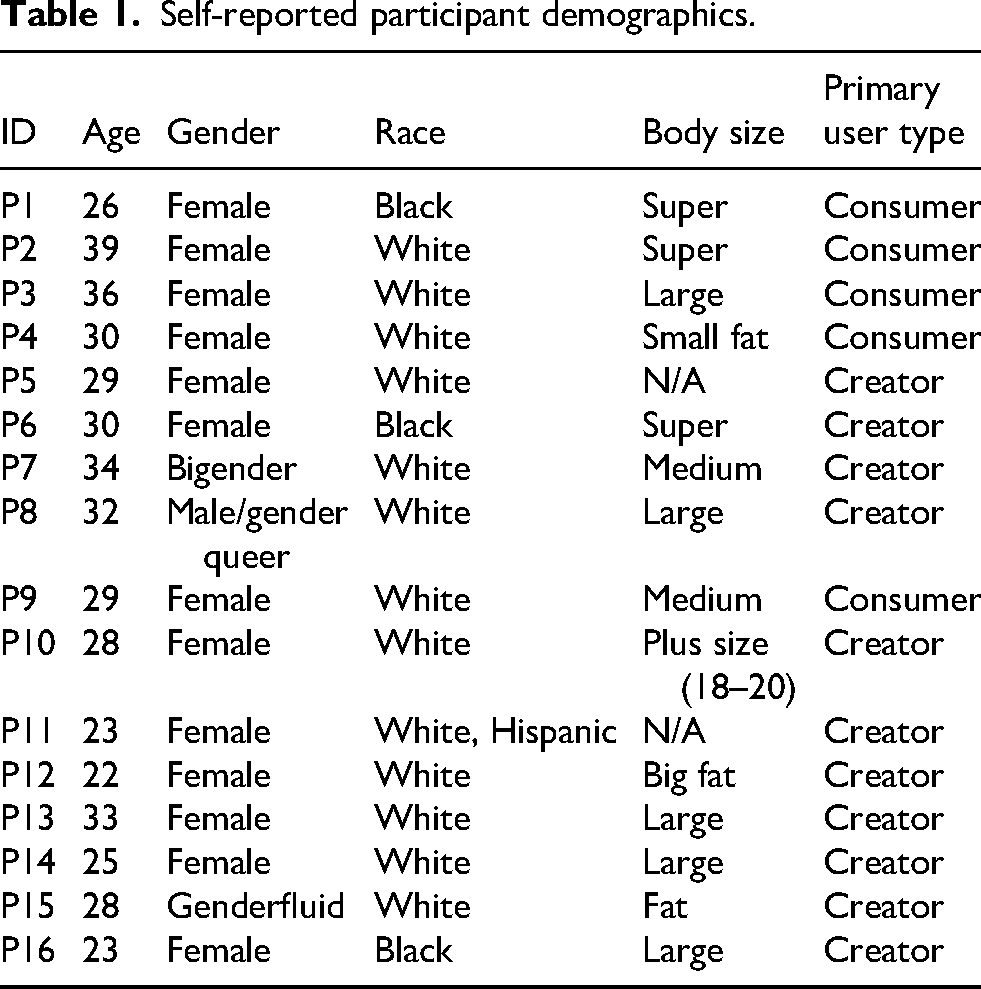
We recruited participants via posts in Reddit communities aligned with fat liberation and by contacting fat liberation content creators directly, as identified through the collection of TikTok videos and via snowball sampling. We interviewed 16 people in total. We ceased recruitment when we reached saturation (Charmaz, 2014). Of these, 11 were content creators. Participants ranged in age from 22 to 39 and self-reported body sizes of “medium” to “super” fat. Choices for reporting body size followed the fat spectrum, or “fategories,” popularized within the online fat community (Linda, 2021): small, medium, large, super, or other (specify). Twelve interviewees self-identified as white, one as white/Hispanic, and three as Black. One participant identified as male/genderqueer, one as bigender, one as genderfluid, and the rest as women or female. All but two Canadian participants were from the United States. See Table 1 for additional information.
Self-reported participant demographics.
Procedure
We conducted semistructured interviews via Zoom. One interview was conducted via email. Interviews lasted on average 70 min. In exchange for their time, we offered participants a $30 Visa gift card. Interviews examined how participants found their way to fat liberation, offline and online; perceived benefits and barriers to using social media to create, consume, and promote fat liberation content; and ideas about how social media might better support fat liberation.
Data analysis
Data collection and analysis occurred simultaneously. We analyzed both datasets via an inductive, iterative approach informed by constructivist grounded theory (Charmaz, 2014). We began by open coding TikTok videos as we collected them, focusing on similarities and differences in creators’ experiences, practices, attitudes, and beliefs, as reflected in verbal and textual communications. We did not analyze visual or esthetic features, nor did we include comments in our analysis. For example, some preliminary codes included Ending up on the “wrong side” of TikTok, Finding community, Being recommended diet content, and Experiences with content moderation. Initial coding of TikTok videos informed the development of the interview guide. However, given the semistructured nature of interviews, conversations were diverse and followed different threads. We followed the same procedure for initial coding of interview transcripts as interviews were conducted. Interview data helped clarify and hone initial coding with additional context from participants, which fed back into the analysis of additional TikTok videos collected.
In a second coding cycle, we conducted focused coding (Charmaz, 2014; Saldaña, 2009). First, we identified and organized codes into benefits and challenges of using social media for fat liberation. Then, we grouped codes within both broader categories according to more granular themes. From these codes, we synthesized a smaller set of higher-level themes, as informed by additional reflection and discussion. Here, the previously mentioned concept of the “good fatty” (Bias, 2014; Chastain, 2016; Gibson, 2022) informed our interpretation of challenges, which we elaborate on in the next section.
TikTok data and interview data complemented each other, providing a more nuanced, multifaceted view of experiences. While all the themes we share below appeared across TikTok and interview data, the medium likely shaped expression. For example, the theme of viewer expectations around the performance of fatness appeared more prominently in interviews than TikTok content. This may reflect creator concerns around branding, audience reception, and algorithmic visibility. Alternatively, content expressing anxiety about performing fatness may not have garnered enough engagement to surface among the top 50 videos in search results. In contrast, the interview setting may have provided a space for more candid reflection, unfiltered by platform dynamics.
We note that our findings should be understood as reflecting situated experiences within particular material (online and offline) realities. The algorithmic tailoring of content on TikTok means there is no single, static reality accessible to individual users or researchers. Following Lee and Swan, (2024), we see empirical accounts of TikTok like ours “as situated in multiple entangled layers: content creators’ identities and contexts, researchers’ positionalities, and the transnational context of digital production” (p. 532). Moreover, acknowledging that all researchers bring certain values and worldviews to the research they conduct, we include a positionality statement and discussion of fat epistemology in Supplemental Materials.
Limitations
Our findings should be understood as bounded by the particularities of our dataset. Our dataset primarily consisted of interviews with and content created by individuals in the United States, thus skewing toward American perspectives. To account for the specificity of intersectional experiences of fatness, we sought interviewees and TikTok videos that represented a range of identities. While our sample was diverse in some ways, more than half of our participants were white women. Our data also predominantly feature fat creators, rather than average users and was shaped by the keywords we chose to use in searches. We primarily used keywords with a strong-positive focus such as “body positivity” and “fat liberation” rather than those with a more neutral tone such as “fat acceptance” or “body neutrality.” Though content is often tagged with multiple labels representing these different subsets of the greater movement, using different keywords for searches may return content representing different ideas, experiences, and beliefs.
Constructing the “good fatty” on TikTok
Our data reflect a vision of TikTok as reproducing and legitimating normative perceptions of “right” and “wrong” ways of being fat that nudges fat creators to present themselves as “good fatties” (Bias, 2014; Gibson, 2022). The notion of the good fatty entails adhering to lifestyle choices like maintaining “good” health, “healthy” eating, and “the will (and ability) to exercise” (Gibson, 2022: 27). Presumed to be associated with weight loss, these choices position a fat person as on the verge of no longer being fat (Bias, 2014). Other characteristics of the good fatty include projecting asexual, nonthreatening maternalness; and embodying privileged social identities (Bias, 2014; Pausé, 2015). These characteristics likewise redeem a fat person's perceived value in society via alternative currencies of social capital. In short, the good fatty is respected not for her fatness, but in spite of it.
In the following sections, through insights from interviewees and creators of TikTok videos collected, we illustrate how the entanglement of user behavior, algorithms, and policies establishes conditions that reproduce dominant (antifat) ideas about fatness on the platform.
The (in)visibility of fat content
We heard from interviewees and creators in videos about the relative invisibility of fat creators on TikTok. Most linked this pattern to users’ preferences, which were then learned by algorithms. Several people noted that society holds explicitly antifat attitudes, which they believed makes users less likely to follow or engage with fat creators’ content. Interviewees and TikTok creators also noted that those on the higher end of the fat spectrum and multiply oppressed creators (e.g. Black fat creators, disabled fat creators) have an even harder time reaching a broad audience. For example, in one TikTok video, a creator explained via overlaid text: Did you know that some people have to work relatively harder to be seen on the FYP (for you page)? Because society has biases towards: women, disabled people, black people, indigenous people, asian people, LGBTQs people, low income people, fat people.
This sentiment aligns with Karizat et al.'s (2021) finding of similar beliefs among TikTok users about the suppression of other marginalized social identities. It also highlights the corresponding belief that fat creators need to work harder than straight-size (or, nonfat) users, particularly those embodying multiple privileged identities. For example, of dance videos created by thin white creators, P6, a fat Black creator, observed: [They] kind of like half do it. And then everyone's like, ‘You’re amazing!’ Meanwhile, me, I take like 50 takes just try to get it perfect and only get like a thousand views. And it's just like, “I did so much work. I’m over here out of breath.”
For many fat creators, the message seemed clear: antifat attitudes among average TikTok users generally meant less engagement with their content, though excepting occasional virality for exceptional content or “gawking,” as P7 put it.
Several interviewees and TikTok creators noted that algorithmic processes had learned antifatness from such biased responses to fat creators’ content and that “it's just hard to separate like what is the algorithm doing versus what the users are doing” (P1). Elaborating on this idea, P9 explained: It's like the picture of the skinny woman in the bikini is going to get six million likes, so the algorithm says, “Oh, well, even more people will like this image.” Where someone like the fat woman in the bikini maybe gets 3000 likes, so it doesn’t get promoted. So it is an algorithm problem, but algorithms are also reflection of society and what groups of people choose to engage with.
With statements like this, interviewees and TikTok creators acknowledged that the logic of algorithmic recommendation on TikTok would exacerbate, rather than obviate, hateful attitudes about fatness.
Some interviewees and TikTok creators found the relative invisibility of fat creators especially troubling, as weight-related activism hashtags appeared to be overrun by straight-size creators focusing only on personal transformation and acceptance of one's own body rather than destigmatizing fatness. For example, P8 talked about the glorification of weight loss under the body positive hashtag: I think body positivity is celebrated when weight loss is achieved, and not in the actual being positive in the body that you’re in. I think the body positive hashtag is often co-opted by people who are in the process of changing the body and when you search body positivity, that's often what you find is people on a weight loss journey, so I think even our hashtag doesn’t exist to us. We’re [fat creators] not visible on it.
In the same vein, P12 noted that content displayed most prominently under the body positive hashtag was “pretty superficial,” featuring animals above fat people, as well as an overrepresentation of thin white women. She affirmed that the body positivity movement is “an intersectional movement for all marginalized identities,” but shared: “What bothers me is that a lot of it is just people reassuring themselves that they’re not fat and it drowns out our message.”
Antifat bullying and harassment and policy failures
Interviewees and TikTok creators shared how societal norms of antifatness manifest on TikTok through user interactions and noted the platform's failure to protect fat creators. Nearly all interviewees remarked, as P4 did, that it felt “impossible to avoid” antifat bullying and harassment on their content. As P3 said, “putting yourself out there in your true full form, you are opening yourself up for attack simply by existing” and, as P10 said, “there is this idea that just because I am online, that I am an open target.” Fat creators further spoke about antifatness as a feature of TikTok's user culture, as average users generally seemed to view antifatness as mundane and unproblematic.
Multiple participants talked about “concern trolling,” in which harassment resembles well-meaning care or concern, but is rooted in healthism and antifat attitudes (Gordon, 2020). P3 described her experience with concern trolling, saying: “…it's like, ‘Well, but it's really your health that we care about,’ and it's like, do you know anything about health?.” Interviewees described concern trolling as a form of antifat harassment even more socially acceptable than explicitly hateful insults and ridicule. Yet, concern trolling equates fatness with poor health and positions fat people as a problem that must be fixed.
Beyond user culture, many interviewees and TikTok creators said TikTok failed to proactively prevent harassment in the way that its algorithm promoted fat positive content to unwelcome audiences. They said when those audiences respond to fat positive content in hateful ways, TikTok indiscriminately rewarded engagement by promoting content further to similar audiences, exacerbating the hate, harassment, and bullying that fat creators received. For example, P12 discussed the impact of her content ending up in “cringe compilations,” which consist of a collection of images and videos presented with the intent of mocking behavior deemed “cringeworthy” (Strapagiel, 2019). I get a lot of people from those cringe compilations, they see that cringe compilation and then they come onto my video and then comment. And the more trolls that interact with my videos, the more TikTok shows my videos to other trolls. So, in addition to just the emotional labor that occurs from seeing hurtful messages, it's also a lot of emotional labor to try to make sure that my videos are going to the people they need to go to.
Elaborating on the latter kind of emotional labor, P12 said, “[I]f I wasn’t sort of on top of monitoring the people commenting on my videos, I would get too many [trolls] and my video would end up on the wrong side of TikTok.” Rather than TikTok implementing design choices that could reduce users’ vulnerability to hate, bullying, and harassment, creators felt obliged to assume the responsibility for determining why their content was recommended to nonreceptive audiences and taking action to protect themselves. After ending up on “angry Russian gym bro TikTok,” P8 analyzed the hashtags he was using to understand how they might be shaping the distribution of his content in undesired ways, “[T]he algorithm is very strong and it really helps you find the right people, but it also gives people who are nefarious on the internet the ability to find the things they want to target, I think.” Indeed, networked campaigns of coordinated reporting and harassment by antifat bullies occasionally led to fat creators having their accounts deleted or sanctioned.
Several creators also noted how TikTok's policies do not include fat people as a protected group or recognize antifat bullying as a form of hate speech, thereby permitting antifat hate to flourish on the platform. P11 discussed her experience receiving harassment that TikTok determined did not violate its community guidelines: Some of them ranged from somewhat benign, such as “go gym” or “lose weight”, to blatantly violent such as “k word [kill] yourself” or “the world would be better if you didn’t exist.” Even the most blatant were rarely found to have violations.
P11's examples paint a vivid picture of TikTok's moderation policies quietly allowing hateful, antifat comments reported by fat users. Similarly, some creators acknowledged an irony in content moderation that not only failed to protect them, but, in addition, punished them for trying to fight back against the hate they received. As one TikTok creator said: “[I]t's just funny to me that fatphobic and hateful videos can stay up, no problem, and my video talking about fatphobia and hate gets taken down.”
Antifat algorithmic recommendations
Interviewees and TikTok creators talked about routinely seeing antifat content in their social media feeds, despite their engagement with fat positive content. One TikTok creator laid out the problem, asking in a video, “Does anyone else consistently engage with fat positive, anti-fatphobic content but still get dieting content, eating disorder related content, and weight loss content on their For You pages?.” For those aligned with fat liberation like this creator, being recommended antifat content raised concerns based on their understanding that the TikTok FYP algorithm was designed to recommend personally relevant content based largely on patterns of engagement. Thus, some interpreted this experience as the platform's algorithmic favoring of antifat attitudes.
This interpretation stemmed from the observation that the FYP algorithm seemed to too easily interpret platform activity as indicative of interest in weight loss, even amid strongly signaled disinterest in such content. As P5 shared: I get a lot of gym TikToks and nutrition TikToks and dieting TikToks. […] And that's even after I have hit the “Not Interested” button in that type of content. […] it almost makes me angry because we’re just people trying to live life and do the best that we can and be as happy as humanly possible. And they’re doing everything that they can to give us the opposite experience.
As P5's reflections suggest, from experiences like this, interviewees and TikTok creators often intuited an implicit normative valuing of weight loss by the platform. Some even interpreted this situation as the platform urging users to aspire to lose weight, even if that meant engaging in unhealthy behaviors. After noticing the appearance of eating disorder content in her FYP, another TikTok creator asked in a video: “Why has TikTok suddenly decided to stop giving me body positive messages and suddenly change it to trying to get me to get my eating disorder back?.” While some speculated that the design of the FYP algorithm played a role in the recommendation of antifat content, conflicting opinions existed as to how. A moderator of one of the subreddits from which we recruited noted in a direct message that they commonly saw discussions in subreddits aligned with fat liberation about “how the algorithms ‘notice’ your searches for [eating disorder] recovery-oriented content, and then give you diet-related content instead.” The moderator explained that they saw two prominent theories: (1) algorithms are too “dumb” to distinguish between the context behind keywords related to weight loss and fatness, and (2) algorithms are so “smart” that they deliberately target vulnerable users with weight loss content and advertising. Exemplifying the former belief, one TikTok creator discussed in a video a harmful comment on a post from an eating disorder recovery account: “I think it's the algorithms’ fault because they put weight loss, body positivity and eating disorders in the same category. They don’t go together. I don’t want to see all three of those things.” Here, this TikTok creator posited that, while the algorithm “understood” that both body positivity content and weight loss content share an interest in weight, it could not differentiate between the divergent valences.
On the other hand, P9 expressed cynicism toward the algorithm's failure to differentiate between antifat content and fat positive content: You can do your best to try to change your personal algorithm and the content that you […] get fed, but you only get a certain amount of control. My computer probably knows all of my demographics and knows, like, ‘Oh, you’re probably insecure about your body. Let's pump weight loss content to you because you’re more likely to engage in it.’
As P9's comments illustrate, some fat activists interpreted TikTok's algorithm as supporting the diet industry's interest in drawing in more consumers.
While interviewees and TikTok creators differed on the cause of these algorithmic failures, they agreed on the impact: TikTok reinforced the idea that fatness should be eradicated, whether by accident or design. As P2 put it: “Even when I try to be careful about things, [videos about dieting] are the messages that still pop up and it's a reminder [that] this is what society still thinks.”
Expectations for fatness
TikTok creators noted how their content was policed on the platform by users, algorithmic moderation, and policies to nudge them toward performing fatness in specific ways. Interviewees noted a perception of being rewarded with engagement and reach when presenting themselves in ways that conformed to user expectations for fat embodiment and being penalized for content deemed less palatable to nonfat viewers.
Some participants noted how they were hypersexualized against their wishes by users, aligning with similar offline experiences interviewees also described. For example, in a TikTok video, a creator lamented “be[ing] used as a thirst trap,” saying “I am constantly sexualized on this app and that's so far from what I want.” Similarly, P10 commented, I’m talking about body positivity and “Wear the bikini, […] It's okay if you want to wear something that we were told is not appropriate.” And people take that as being overly sexual. But I’m not doing anything else that anyone else has been doing that isn’t public, but because there is this huge issue with bigger bodies being sexualized when we show a little bit more when– I’m not saying more than we’re being super risqué, but just like, the same level as everyone else, it's deemed as inappropriate.
In addition to this overt hypersexualization by users, some fat creators saw TikTok's algorithmic moderation as doing the same, flagging nonsexual content under sexual content policies. Half of our interviewees reported experiencing or witnessing such moderation. Many interviewees also pointed out a perceived double-standard where people in smaller bodies can wear much less without receiving content violations, with P11 noting, “It is blatant hypocrisy, and creates a very unfair and unsafe environment for fat people.” Some interviewees like P7 speculated that this double standard resulted from the algorithm “calculating how much skin is showing.”
These experiences of being sexualized by users and algorithms left fat creators feeling simultaneously fetishized and punished for their perceived hypersexuality, despite not intending for their bodies to be sexualized. Consequently, they felt unable to present their bodies or sexuality in a neutral way on the platform. As some fat creators recognized, this poses issues for the fat liberation movement, as a movement in which displaying one's body is an inherently political act. As P7 shared, fetishization can conflict with some of the political goals of the fat liberation movement—to humanize fat people and educate about fat oppression: I’ve also noticed, just in general, that the fat creators who make BBW [Big Beautiful Women] content, which is more under the fetish category, also have an easier time than creators who do that but also talk about fat oppression or creators who do that and also want to talk about their own experience, that anytime that it's moving from objectification to humanization that it just seems that there becomes more and more roadblocks between those two places to be.
Here, P7 notes how content discussing the political dimensions of weight does not perform as well as content simply celebrating fat bodies. She continued: If I wear colorful clothing or if I’m smiling more […] those videos definitely pick up in views. […] which I think kind of stinks because we’re not always happy […] And I want to talk about real things. […] and help other people figure out their situation the same way that I have. And that's the kind of content that doesn’t do well.
These reflections demonstrate a perception that lighter, apolitical performances of fatness will be rewarded with higher engagement. Apolitical performances of fatness may be more palatable because they do not challenge internalized antifatness, aligning with the body positivity movement's emphasis on self-love, rather than liberation from goals of “health” and “well-being,” which often act as euphemisms for dieting and weight loss.
Conversely, some felt that fat creators were expected to create content about their struggles and trauma, as this was seen as more congruent with societal expectations for fatness.
As P6 explained: [W]hen people see you in a bigger body just being carefree and happy and loving yourself in life, some people don’t like that, and I think they gravitate more towards fat people or bigger people who are struggling, who are depressed, anxious because that's what society is telling them that they shouldn’t be– if you’re bigger, you shouldn’t be happy, you should be miserable, you’re fat, what do you have to be happy for?
P6's insights invoke the societal expectation that fat people should feel ashamed of their weight and not want to be fat (Pausé, 2015). Therefore, content where fat people express satisfaction with their bodies creates discomfort, challenging the notion that fatness is inherently bad and requires change.
Similarly, other creators like P12 noted how their fatness was expected to be central to their content, with other facets of their identity treated secondarily. [A] lot of people don’t want to have anything to do with fat creators if their content isn’t related to their fatness. So it's hard for a fat makeup artist to just be a makeup artist. She has to be a fat makeup artist. There's a lot of objectification based on size and other marginalized identity on TikTok.
This echoes research on YouTube creators with disabilities who felt compelled to focus primarily on disability-related content (Choi et al., 2022). According to some interviewees, many nonfat or antifat viewers see fatness as the most central aspect of a fat person's identity. When fat creators center fatness in their content, it enables outsiders to judge whether a fat person fits the profile of a “good” or “bad” fatty, which shapes how they respond to the content.
Expectations can be compounded when creators have multiple marginalized identities. Some interviewees felt they had to downplay parts of their identities to perform as fat activists. P16, a Black fat woman, explained that she received the most interaction when she “put on my activist hat and […] wave around my fat liberation flag.” However, she said this was not the role she always wanted to play: I would say the box that the Internet particularly wants me to be in is it wants me to be an activist. It wants me to be loud and outspoken and as brash as possible to get people to listen. […] And it's like, why can’t I just be fat and exist on the Internet? Why do I have to be the savior? […] And it feels tenfold because people on the fat liberation side want me to be an activist, but like, you know, I’m also a Black woman, and somehow that automatically translates to me needing to hold the flag and be at the front line.
Like P16, a few creators expressed the desire to create non-activist content but felt compelled to create “fat content.” While P16 discussed resisting this pressure, she noted the toll this took on her engagement and reach.
Discussion
This study illustrates how anti-fatness shapes experiences on TikTok. Our findings suggest that interplay between users, algorithms, and policies on TikTok precludes the formation of a safe space free from the encroachment of antifat bias and, rather, engenders expectations for the “right” way to exist as a fat person on the platform. They further suggest the ongoing surveillance of fat bodies (Pausé, 2015) as extended by social media platforms, which exacerbates the imperative for fat people to “develop, maintain, and revise identities in the shadow of internalised oppression” (Pausé, 2015). Below we summarize these dynamics and argue that they reproduce the notion of a “good fatty.” We conclude by suggesting that these findings underscore the need for a new paradigm of platform governance.
Interviewees and creators of TikTok videos analyzed flagged patterns of uneven visibility on TikTok suggestive of antifatness, echoing past work on algorithmic privilege and discrimination (Glatt, 2022; Karizat et al., 2021). They noted that thin, conventionally attractive, white, cis, able-bodied creators, as well as fat creators on the smaller end of the fat spectrum, tend to be most visible in fat liberation spaces. Likewise, they said that fat creators who outwardly accepted and celebrated their bodies or spoke out against fat oppression were less visible on TikTok. They linked these patterns to antifat attitudes among users, which many recognized TikTok's recommendation algorithm had learned—a point that fits with critical algorithm studies scholarship (e.g. Gillespie, 2014; Noble, 2018). Some suggested that this situation allowed antifatness to “drown out” the message of fat liberation on the platform. These observations suggest a platform environment that tolerates fatness only when fat creators can “prove” their worth above and beyond negative perceptions and stereotypes of fatness or when they focus inward on physical or psychological change, rather than dismantling fat oppression. In this, visibility acts as a reward that reproduces the antifat expectations of the “good fatty.” When weight loss journeys and thin creators promoting self-love overshadow fat liberation content by fat creators, the platform reinforces the idea of a good fatty as one who presents herself as a “work-in-progress” where the endpoint is no longer being fat (Bias, 2014).
While those aligned with fat liberation valued visibility for advancing the movement, like other marginalized or stigmatized groups, their experiences exemplify how visibility acts as a double-edged sword. Creators reported frequently being made visible to hostile audiences who bullied and harassed them with seemingly few repercussions, reminiscent of past work documenting toxic technocultures (e.g. Lawson, 2018; Maris and Monier, 2025; Marwick, 2021; Massanari, 2017). They further wished to see fat-positive content but instead were recommended diet and exercise content, suggesting TikTok's FYP algorithm may be shaped by a normative association in user data between fatness and weight loss. These experiences implicate the deeply ingrained nature of anti-fatness on TikTok through user culture and algorithm design. Hateful users’ comments repeatedly reminded interviewees and creators that embracing fatness was not socially acceptable. Meanwhile, they reported that TikTok's policies and moderation decisions failed to recognize comments like “go gym” as “real” bullying or hate speech. Yet, when creators took matters into their own hands to confront bullies, they said they received content violations citing bullying policies. Inaction and misaction by the platform resulted in a perceived tacit acceptance and legitimation of antifatness. Further, interviewees and creators described TikTok as amplifying antifatness through its algorithmic design, which they said allowed antifat bullies and trolls frictionless access to their targets. When paired with the prevalence of weight loss content in their FYPs, the platform assemblage seemed configured to discipline fat creators and users into alignment with the good fatty's aspiration for thinness.
Many fat creators we spoke to or observed in TikTok videos wanted to celebrate their bodies as a liberatory act but said in doing so they were hypersexualized and punished for “sexual content,” even when fully dressed and not intending to be sexual. This adds an antifat dimension to past work documenting platforms’ puritanical moderation of nudity and sexuality (e.g. Are, 2021). Interviewees and creators shared that other users expected fat creators to project levity and cheerfulness, but not too much, lest they provoke those who believe fat people should not be happy. Fat creators’ experiences and reflections highlighted nudges from TikTok's users, often as mediated by algorithmic processes that regulate visibility, to perform their fatness in ways that would meet dominant expectations of how a fat person should be. Whether this meant depoliticizing their fatness or centering fatness and activism, fat creators felt obliged to present themselves in ways that did not always align with how they saw themselves or wanted to be seen. They communicated a feeling of constant surveillance, wherein they might alternately be punished at any time for stepping outside of the boundaries of “acceptable” fatness or rewarded for conforming to societal beliefs about “good” fat embodiment. Feeling obliged to meet a series of conflicting, elusive, and invisible standards, fat creators reported struggling to grow their audiences as successfully as their straight-size counterparts. This struggle affects fat creators on an individual level but also presents an existential challenge to the fat liberation movement.
Our findings illustrate the reproduction of normative expectations for fatness, encapsulated in the idea of the good fatty, resulting in repeated reminders of a broader system and history of fat oppression. We argue that TikTok's users, algorithms, and policies coproduce this effect through mutually shaping relations. Users reenact antifat biases in their actions, algorithms learn from user behavior how to treat fat users, and platform policies uphold users’ and algorithms’ moral judgments. Here, we take interviewees’ and TikTok creators’ shared experiences as valid and consider them in relation to material affordances and structures of the platform, as well as past scholarship documenting the platformization of oppression. At the same time, we recognize that the algorithmically tailored, ever-changing nature of platforms means there is no single, stable reality accessible to all users or researchers. Yet, the fact that even those who actively sought a fat positive experience identified various vectors of antifatness suggests this is not an isolated or idiosyncratic experience.
Just as users, algorithms, and the platform work in concert to reassert a conditional acceptance of fatness, each may contribute to its undoing. For example, TikTok can and should include weight as a protected attribute under community guidelines, as many participants desired, and educate developers and trust and safety teams on antifatness. The platform could also prohibit weight-loss advertising on the platform. A few participants noted that Pinterest had already implemented this measure, which resulted in an increase of body-positive searches and a decrease in searches for weight-loss content (Tovar, 2022). Such changes can contribute to a more fat positive platform environment. So too may shifts in user behavior resulting from a growing consciousness of antifatness and algorithmic processes that reproduce it. We observed fat liberation creators are already playing an important role here in calling out antifat rhetoric, celebrating fat beauty, advocating for material changes, and explaining the role of platform algorithms in realizing fat positive spaces online. While these creators remain a critical force in the dismantling antifatness, this work remains risky when executed on a platform that actively opposes it in its design, governance, and user culture.
Our findings suggest that antifatness cannot simply be designed or activisted away. Platformized systemic injustice requires broadscale change across the assemblage of contributing actors. The embeddedness of antifatness on TikTok demonstrates the myriad ways universalist approaches to platform governance fail on a metric of justice. Alternate approaches like subsidiarity (Hasinoff and Schneider, 2022), algorithmic reparations (Peterson-Salahuddin, 2024), and representative moderation (Vaccaro et al., 2021) that shift in control from platforms to communities offer a promising path forward. We heard from members of the fat liberation community a desire for greater control over their own visibility, recommended content, and the rules that structure interactions. Decentralized, participatory approaches to governance have the potential to support the fat liberation movement in achieving these ends.
With TikTok's future in jeopardy, fat positive users may be in search of a new platform. Yet, major competitors like Instagram have demonstrated a lack of support for marginalized users through recent changes to hate speech policies (Duffy, 2025, Kopps, 2024). This further underscores that platforms cannot be relied upon to make choices aligned with the interests and values of their users, especially marginalized communities. Rather, we suggest user communities should be afforded greater agency and self-determination in platform governance.
Supplemental Material
sj-docx-1-pns-10.1177_29768624251377163 - Supplemental material for “Why can’t I just be fat and exist on the internet?”: The embeddedness of antifatness on TikTok
Supplemental material, sj-docx-1-pns-10.1177_29768624251377163 for “Why can’t I just be fat and exist on the internet?”: The embeddedness of antifatness on TikTok by Kelley Cotter, Rebecca Jonas and Ankolika De in Platforms & Society
Footnotes
Acknowledgments
The authors extend their deepest gratitude to the anonymous reviewers across each iteration of this article, whose thoughtful feedback has significantly enhanced its clarity, depth, and integrity. They also send their admiration and solidarity to those illuminating the realities of fat oppression, cultivating fat positive community, fighting for fat liberation, and spreading fat joy on TikTok and other platforms.

Ethical considerations
This study was determined to be exempt by the Pennsylvania State University's Institutional Review Board on September 1, 2021 (Approval No. STUDY00018636). All participants received copies of a consent document, which they were instructed to keep or print a copy of. The document informed participants that their participation implied their voluntary consent to participate in the research.
Funding
The authors received no financial support for the research, authorship, and/or publication of this article.
Declaration of conflicting interest
The authors declared no potential conflicts of interest with respect to the research, authorship, and/or publication of this article.
Data availability statement
The data that support the findings of this study are not publicly available due to privacy and ethical restrictions.
Supplemental material
Supplemental material for this article is available online.
References
Supplementary Material
Please find the following supplemental material available below.
For Open Access articles published under a Creative Commons License, all supplemental material carries the same license as the article it is associated with.
For non-Open Access articles published, all supplemental material carries a non-exclusive license, and permission requests for re-use of supplemental material or any part of supplemental material shall be sent directly to the copyright owner as specified in the copyright notice associated with the article.
