




Abstract
This article proposes a framework for qualitatively investigating platforms by studying them in action, through their embeddedness and the everyday interactions with users. Grounded on two foundations – the research affordances of the General Data Protection Regulation (GDPR) and the approach of researching with care, two distinct visions emerge: the ability to see platforms (the dynamic and constantly evolving ecosystem of complementors, practices, and arrangements) and the ability to see like a platform (the classifications generated through inferential analytics and affinity profiling). These visions, understood as ways of seeing and knowing, emerge from the repurposing of the GDPR's Right of Access (Article 15), no longer as a legal right but as a research tool. As part of a larger empirical study, 47 participants underwent a four-month autoethnographic process of acquiring, inspecting and analysing their personal data, while keeping a diary to record their emotions, observations and responses. The research framework consists of (a) using data rights as a research tool, (b) researching with care and (c) employing diaries as a data collection and reflexivity tool. Besides introducing a new approach for studying platforms, this framework also facilitates critical and interpretative co-research, enabling the creation of critical knowledge and the acquisition of empowering skills for participants. Although total vision is impossible and every perspective has its limitations and blind spots, even partial visions allow for a state of platform observability and the production of valid and valuable knowledge.
Keywords
Introduction
This paper, and the methodological framework it proposes, addresses two interrelated research challenges and questions. First, how can we study platforms, considering their multsidedness and technical and definitional complexity? Second, how can we study platforms while simultaneously allowing for an engaged, reflexive and participatory research with non-expert individuals? The aim of this paper is not to offer a new definition of what platforms are but to propose a framework for qualitatively investigating a challenging object. This methodology differs from existing platform research in two ways: first, it is grounded in the research affordances of the General Data Protection Regulation (GDPR 2 ) (European Commission, 2016); and second, it applies the approach of researching with care. In the implementation of the GDPR, we recognized significant methodological potential for studying platforms by repurposing this legal tool and the data rights it grants, particularly the Right of Access under Article 15. We complement this with the approach of researching with care by first transforming platforms from a matter of fact (Latour, 2004) into a matter of concern (Bellacasa, 2011; Latour, 2004) and then into a matter of care (Bellacasa, 2012). An approach like this enables reflexive sense- and knowledge-making processes and facilitates knowledge acquisition and empowerment for our participants. The approaches of critical pedagogy (Freire, 2000; Markham, 2019) and critical companionship (Ziewitz and Singh, 2021) are part of our -with care research arrangements. Having experimented with data rights on a small scale (Pop Stefanija and Pierson, 2020), we developed a more elaborate and complex research framework to further explore the GDPR's research potential. We study platforms in action – through the daily interactions between the platforms and their users and the outputs that emerge from these interactions. The research framework we developed thus consists of (a) using data rights as a research tool, (b) adopting the approach of researching and thinking with care, and (c) using the medium of (data) diaries as both a data collection and a reflexivity tool.
Designed as a participatory research and part of a larger empirical study (Pop Stefanija and Pierson, 2023), 47 participants underwent a four- month autoethnographic process of acquiring, inspecting and analysing their personal data obtained from a platform of their choice. For the entire duration of this process, the participants kept a diary to record their emotions, observations, responses and analysis. We derive our insights from these two sources: the participants’ diaries and the personal data they shared with us, obtained through the Right of Access. From the study, two distinct visions (Haraway, 1988) regarding platforms emerged, yielding two types of insights and knowledge about platforms: the ability to see a platform and the ability to see like a platform. We employ the concept of vision as understood in Haraway's Situated Knowledges (1988), where she uses it as a metaphor for knowledge production processes, highlighting the various ways of seeing and knowing. Vision, according to Haraway, is always embodied, contextual, partial and ‘a question of the power to see’ (p. 585). To be able to see a platform means being able to observe the inside of the particular platform, including its dynamic and ever-changing ecosystem of complementors, practices, technical arrangements and infrastructure. It also reveals the multidirectional relations between the different complementors and the governance mechanisms in place. This type of seeing is beneficial for both researchers and participants alike. For example, it exposes the types of complementors 3 , understood as ‘those individuals or organisations who create and provide complementary tools, products, or services’ (van der Vlist and Helmond, 2021: 3), and the specific complementors (e.g. Oracle as a data broker, Procter & Gamble as an advertiser). For the researchers, this provides a different avenue for investigating platforms without relying on ‘opening the platform's black box’. For the users, it surfaces the specific and unique network of complementors that forms around them as a particular user.
Seeing like a platform, on the other hand, reveals a different vision – how a platform sees its subjects, its users. This seeing refers to the inferences the platform produces about each particular user, the categories and attributes they are assigned, based on classifications produced through inferential analytics (Wachter and Mittelstadt, 2018) and affinity profiling (Wachter, 2020). As the quote above indicates, it refers to ‘how Facebook sees me’ (R17). This type of vision is important because it reveals the internal logic and the classification systems that influence the personalized algorithmic outputs for each particular user (e.g. inferences such as political interests, socioeconomic status, health issues). Accessing the platform's vision enables researchers to uncover the computational processes underlying algorithmic operations. Both visions represent partial but valid ways of knowing platforms for both researchers and participants.
Our research focuses on platforms built on what are known as platform algorithms (Cotter, 2020) or interface algorithms (Fisher, 2022), such as social media, recommender and personalization systems (e.g. Facebook, Twitter, Spotify, Netflix, TikTok, Google). These platforms personalize interactions and algorithmic outputs for each user and are ‘geared predominantly toward rendering user data into knowledge about them and creating a personalized interface’ (Fisher, 2022: 21). The platforms we examine are ‘a programmable digital architecture designed to organize interactions between users – not just end users but also corporate entities and public bodies’ (Van Dijck et al., 2018: 4; also Plantin et al., 2018; Poell et al., 2019).
To summarize, this paper advances platform studies by proposing a framework based on the research affordances of the GDPR and the approach of researching with care. The analysis shows how such a framework can be beneficial for both researchers and individual users. Based on the findings, we highlight some implications for future research, emphasizing potential limitations and shortcomings. Before introducing our framework, we first define its boundaries in terms of both definitions and methodology.
The challenges of knowing and studying platforms
How we come to know things shapes how we come to act
McQuillan, 2022: 103)
Several factors influence how we study platforms. Our theoretical understanding of platforms, including how we define them, the definitional frameworks we apply and the conceptual boundaries we draw, will impact how we approach them. On the other hand, the research affordances of the platforms themselves will constrain or support different research avenues. In that sense, how we come to know things and how we (can) acquire knowledge also shape how we come to (do) research. The research method and the object of research are mutually co-constituting, and the research method always follows the object of study (Marres and Gerlitz, 2016; Venturini and Rogers, 2019). We could say that the theoretical is always methodological and the methodological is always theoretical.
When discussing the affordances for conducting digital research, Venturini et al. (2018) noted that ‘when all you have is a Twitter feed, everything looks like a hashtag’ (p. 12). We can transpose this quote to make two points about studying platforms. The first relates to understanding and defining platforms. We can paraphrase the above statement as ‘when all you have are algorithmically processed and datafied interactions, everything looks like a platform’. This is particularly true for non-expert, everyday users of platforms, but to a degree also for expert researchers, considering the definitional murkiness of the notion ‘platform’. The second one is related to the research affordances – as researchers, we are inevitably constrained by what and how our object of study allows, permits or refuses to be studied (Marres and Gerlitz, 2016; Pop Stefanija and Pierson, 2020). When it comes to platforms as proprietary technologies that limit our insights to only parts of the system, we can say that ‘when all you have is a (front-end) interface, whatever you see seems like (the totality of) a platform’. This means that each distinct ‘side’ of a platform has, and provides, a unique but partial vision and insights into that platform. Users can view the front end, the algorithmically curated part of the platform. Advertisers access a back-end interface that enables different interactions with the platform. Third parties building on top of them (e.g. third-party developers) have a separate view of the platform and access to the platform's programmable infrastructure. Researchers are constrained by what the platforms make available (e.g. Twitter API or Facebook Ad Library) and the platforms’ research affordances (e.g. via scraping, dummy accounts, data donations) and must find ways to overcome these limitations and develop innovative ways to study platforms (e.g. using data rights).
In response to these limitations, researchers have developed various methods to address the challenges of platform research. These approaches involve using different tools like API research (Bruns, 2019; Venturini and Rogers, 2019), auditing (Sandvig et al., 2014), walkthrough methods (Dieter and Tkacz, 2020), technography (Bucher, 2018), making and letting the software speak (Pop Stefanija and Pierson, 2020), platform historiography (Helmond and van der Vlist, 2019) and hyper-functionality (Seberger & Bowker, 2021). As a subject of study across many disciplines 4 , platform research focuses on specific aspects like business models, governance models, affordances, design choices, societal effects, labour relations, network effects, ownership structures and use practices.
Before we elaborate in detail on the methodological choices we made and the framework we developed, it is essential to delineate the object of our research. As mentioned, we do not aim to propose new definitions of platforms. For an overview of different understandings and conceptualizations of platforms, Cristofari (2024) is a comprehensive source, as well as Gillespie (2010), Srnicek (2016), Nieborg et al. (2022), Poell et al. (2019) and van Dijck et al. (2019), including the manuscripts published in this journal. However, it is crucial to explain how we approach platforms. We understand platforms as sociotechnical systems, assemblages of human and non-human actors, including users, complementors, business interests, technical infrastructures, software components, data, algorithms as well as use practices, governance regimes, communities of practice (e.g. developers), business interests, sociotechnical imaginaries and normativities. Digital platforms are both a technological system, a market organization, a type of business model, an economic process and cultural intermediaries (Chen et al., 2024). They are infrastructures that enable technological interactions and data transactions, acting as central points that connect different market sides (Chen et al., 2024; Nieborg and Helmond, 2019). We also understand digital platforms as ecosystems. As van der Vlist and Helmond (2021) point out, digital ecosystems can be conceptualized in both technological and organizational sense. In a technological sense, ecosystems are understood as ‘the collection of software apps and services “on top of” a platform using its development tools, and, in an organisational sense, as the collection of firms and organisations that create and interact with those software apps and services’ (ibid., 2). A common feature of all digital platforms, regardless of their type (see Srnicek, 2016 and Nieborg et al., 2022, for different platform classifications), is their ‘programmability to decentralize data production and recentralize data collection’ (Helmond, 2015: 5). Platforms, in this sense, are ‘re-programmable digital infrastructures that facilitate and shape personalized interactions among end-users and complementors, organized through the systematic collection, algorithmic processing, monetization, and circulation of data’ (Poell et al., 2019: 2). For our definitional purposes, we also view platforms as relational – while they can be formalized, defined and described in theory, their real embodiment occurs in practice, through their enactments. As embedded in wider sociotechnical systems and contexts of use, platforms and their workings ‘unfold contextually and contingently’ (Kitchin, 2017: 16), in everyday use.
It is the platform-specific feature of data centrality, along with the programmatic and programmable nature of platforms and their orchestration functions, that we recognize as specific research affordances and use as entry points for studying platforms. The Right of Access (RoA) grants access to the platform as a central entity where all sides (complementors) meet and where all data flow in and out. In this way, RoA provides an overview of all the data that a platform has on a particular data subject and identifies the specific complementors who have access to, process and contribute data. Repurposing legal data rights and using them as mechanisms for opening (Weiskopf and Hansen, 2022) involves finding ways to learn about the technological artefact without relying on ‘opening’ it or on the research affordances provided by the platforms themselves.
In our approach, we build upon existing research and methods, as well as our previous experiments with various approaches such as: API access (Pop Stefanija and Pierson, 2020), scraping tools (e.g. Rogers, 2013; Venturini et al., 2018), infrastructural inversion (Bowker, 1994), implosion (Dumit, 2014; Mattern, 2022; Pop Stefanija and Pierson, 2024), repair manuals (Pop Stefanija and Pierson, 2024) and similar approaches. However, our method differs from these existing approaches in several ways. First, many of these approaches, like those relying on API access (e.g. Helmond and van der Vlist, 2019; Pop Stefanija and Pierson, 2020) or scraping tools (van der Vlist et al., 2024; Andreou et al., 2018), those employing the walkthrough method (Dieter and Tkacz, 2020; Weltevrede and Jansen, 2019) or technography (Pop Stefanija and Pierson, 2020; van der Vlist and Helmond, 2021) including historiography (Helmond and van der Vlist, 2019) provide often only a global, macro overview of the platform ecosystem and relations. By this, we mean that they either capture the potential complementors (e.g. Dieter and Tkacz, 2020; Pop Stefanija and Pierson, 2020; van der Vlist and Helmond, 2021) or rely on research personas (Weltevrede and Jansen, 2019) and clean browsers/apps or dummy accounts that capture how platforms could/should work and the potential relations between them. While these are all valuable insights, our approach is user-centric, highly individualized and personalized, based on actual user–platform interactions; we collect data from real users, with an existing history of platform use and an established profile created by the platform. This provides a local overview of the platform arrangements and ecosystem through real-life interactions and observations, seeing platforms in action. Unlike API-based or documentation-based approaches that offer a general (global) view of the ecosystem, we can observe how the platform ecosystem unfolds and surfaces contextually in practice. This is a non-lab, non-abstract and context-aware investigation based on observations of real platform–user interactions.
In the following sections, we elaborate in detail on how to solve the two main questions of our research, as elaborated in the Introduction. The methodological question concerns how to study and make the largely invisible and complex platform ecosystems and their underlying processes and relations more observable. The epistemological focuses on studying platforms in a manner that enables an engaged, reflexive and co-researching process, facilitating knowledge acquisition and empowerment for our participants.
Researching with care
Observing platforms in action through real-world user interactions would require methodological inventiveness (Tkacz et al., 2021; Venturini and Rogers, 2019), especially when working with individuals. We prefer to investigate platforms through situated practice (Haraway, 1988, 2016), focusing on their functioning within their embedded context and the daily human–platform entanglements. Our goal is to gain qualitative insights based on lived experiences and to surface participants’ personal understanding of how platforms operate through purposeful engagement with the platforms. This will allow for the capture of ‘the situated, affective, lived experiences and practically informed assessments’ (Zakharova and Jarke, 2024: 656). These processes should transform the human–platform interactions into a matter of concern (Latour, 2004) and a matter of care (Bellacasa, 2011, 2012) for our participants, as they experience the platform and its workings through their own devices and situatedness. Building on Latour's (2004) matters of fact and concern, and on Haraway's (1988) situated knowledge, Bellacasa (2011, 2012) calls for treating matters of fact and sociotechnical systems as matters of care, emphasizing that care plays a significant role in the construction of knowledge (2011: 85). Engaging in research and thinking with care should facilitate processes of sense-making and knowledge-making, through a ‘situated, practice-informed, and affective knowledge about technologies’ (Zakharova and Jarke, 2024: 656), thereby contributing to the formation of critical knowledge and skills for (self)empowerment. We understand empowerment as a series of processes: acquiring essential and critical skills to understand the platform systems with which individuals are entangled, applying this knowledge and these skills in practice and being able to meaningfully influence the systems, environments and their outputs (Pierson, 2012). Empowerment also includes the capacity to use newly acquired tools to exercise power over these systems and their outcomes, in alignment with an individual's own wishes and needs.
From this methodological setup, two crucial elements emerged – the need to provide critical companionship (Ziewitz and Singh, 2021) and the need for critical pedagogy (Freire, 2000; Markham, 2019). Critical companionship can be defined as an approach where an experienced practitioner guides and accompanies less experienced individuals. However, critical companionship in its ideal form blurs the boundaries between experts and non-experts: it is a joint learning journey where both parties undergo learning and transformative processes of investigation, knowledge creation and skill acquisition, ultimately leading to empowerment. By the end of the participatory research, researchers and participants become co-researchers (Lupton and Watson, 2021), and the participants essentially become (non-expert) researchers (Ziewitz and Singh, 2021). Critical pedagogy, on the other hand, involves developing and applying teaching methods that foster critical awareness about a subject, with knowledge creation grounded in personal experience (Markham, 2019). This type of ‘problem-solving’ pedagogy requires participants to recognize the issues themselves – through dialogue, support and guidance – so they can identify their own ‘objects of their consideration’ (Freire, 2000: 56), making them matters of concern that become matters of care.
Making matters of fact matters of concern with data rights
However, perceiving something as a matter of concern is not enough. According to Bellacasa (2011), we need to turn matters of concern into matters of care. While being concerned about something ‘denotes worry and thoughtfulness about an issue’ (Bellacasa, 2011: 89), caring can be seen as a praxis – it means ‘commitment to something’ and ‘involves a notion of doing and intervening’ (ibid.; Loukissas, 2019). Action is impossible without care, and one of our goals in this research was to empower participants, through knowledge acquisition and skills development, to meaningfully influence systems, environments and their outputs based on their newly acquired knowledge, capacities and skills. The transformation of platforms from matters of fact to matters of concern is facilitated by the Right of Access, which enables participants to see inside the platform and reveal all data about themselves and the surrounding network of complementors that forms around them. Once these new insights are gathered, we further facilitate the transformation of platforms into matters of care. We use the affordances of the diary as a tool to facilitate reflexivity on specific issues and develop new perspectives, visions and knowledge.
‘In total, my data amounted to 8.59 GB, including 20.580 files in 2865 folders’, reports one of our participants in their diary (R8, Facebook). The Article 15, better known as the Right of Access, allows data subjects 5 to access the personal data held about them by a particular company or service by filing a Subject Access Request (SAR). SAR is just one of the transparency rights 6 , and as such, it is specific in detail (relating to a particular individual and their data), occurs after data collection and processing (ex-post) and is initiated upon request (Naudts et al., 2022). It is considered an empowerment mechanism (ibid., p. 13) and has both an intrinsic (transparency as an end) and instrumental goal (transparency as a means) (ibid., p. 8). As such, it is also a data-rich source, with most participants receiving data in gigabytes 7 . Although it is a legal tool, in our research, we repurposed the SAR as an entry point for participants to uncover their entanglement with the platform and its complementors. The data obtained through the GDPR's Article 15 (GDPR Info, 2018) contains the personal data about individuals held by the platform, information on how it is collected and by whom, how it is used and what inferences are made about the individual (Table 1 provides an overview of all the data and information that must be provided to the data subject when submitting a SAR per Article 15).
Information requirements under Article15, GDPR (Ausloos and Veale, 2020).
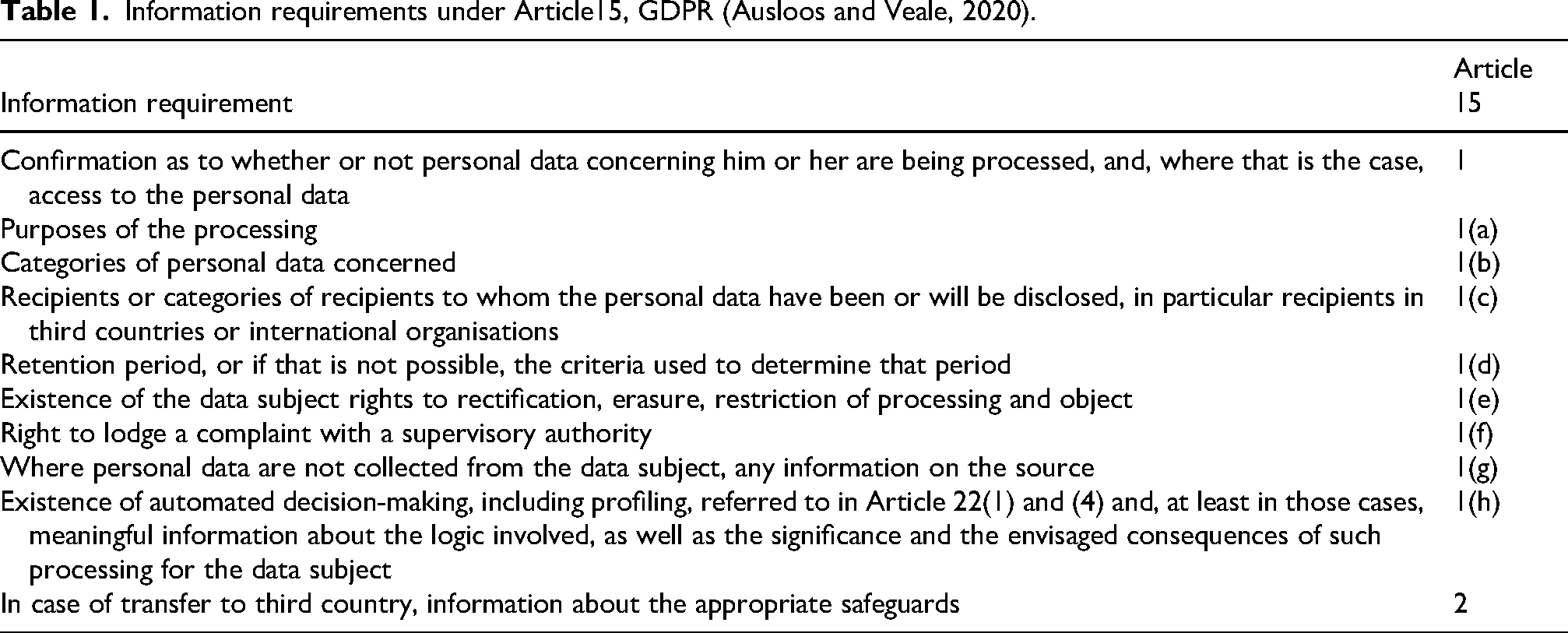
Using Article 15 as a research tool is feasible due to the orchestration function of platforms (Cristofari, 2024). This orchestration involves coordinating different complementors across the platform ecosystem, as well as organizing, managing, governing and ordering the relationships, affordances and constraints among complementors. This is occurring through technical infrastructure and protocols such as Software Development Kits (SDKs) and Application Programming Interfaces (APIs) available to various ‘sides’. If we view platforms as ‘centrally controllable’ multisided markets (Cristofari, 2024) and as ‘centralized infrastructures’ (Rieder and Hofmann, 2020), then requesting data from the platform grants access not only to the network of complementors assembled around it but also to the relationships between (a) the platform and its complementors, (b) the complementors among themselves and (c) between all these third parties and the individual. Platforms are increasingly becoming obligatory passage points, ‘gateways to all internet traffic, data circulation and content distribution’ (Van Dijck, 2021: 2802). As shown in Table 1, the SAR should provide specific information about the recipients of the data (1(c)) and the sources of the data (1(g)). This will provide insights into the network of complementors in which the user is entangled.
Additionally, it is precisely the programmatic and programmable nature of platforms (van der Vlist and Helmond, 2021) that makes data rights suitable, as it requires and compels complementors to follow the same data structuring. The programmatic nature defines and formalizes the interactions between the complementors (ibid.), and the programmability imposes the obligation to comply with the programmable interfaces (e.g. APIs, SDKs) (ibid.). Since platforms hold and enforce infrastructural and governance control, these relations are consistent and detectable across complementors. When accessed via a SAR, these characteristics enable a detailed examination of the networks and data flows between platforms, complements and users. Used in this manner, SAR becomes a research tool for researchers and a knowledge-making tool for individuals.
While there is a small number of studies that exploit the opportunities of the GDPR, particularly Article 15 8 , they are almost entirely conducted by legal scholars (Pop Stefanija and Pierson, 2020 is an exception) from a legal idealistic perspective, focusing on compliance research. There is also a disciplinary difference – we use data rights as a tool in the context of critical platform, algorithm and data studies, from a media and communication studies perspective, employing qualitative methods and on-the-ground research.
From matters of concern to matters of care
We wanted our participants first to be able to understand and see themselves as ‘data subjects’ entangled in platform ecosystems. Our strategy is similar to Milan's (2017) – individuals first need critical consciousness and understanding, which are crucial for taking action in the world based on that knowledge (Kennedy, 2018). By acquiring, inspecting and spending time with their own platform data, participants can gain a deeper understanding of their entanglement within platform systems and how these systems impact them. Once they have the necessary information to comprehend the practices and processes involved, participants begin a sense-making process, which is essential for imagining alternative futures. This is what Milan (2017) refers to as critical imagination, the ability to envision and demand alternative and better practices and systems that meet individuals’ needs. We find the medium of diary the most suitable for capturing, in great detail and extent, the experience of interacting with platform ecosystems, for two reasons. First, diaries enable participants to undergo processes of reflection and sense-making. Through ‘first-person’ evaluations (Kennedy, 2018), diaries facilitate situated, reflexive and contextual knowledge (Bates et al., 2016). Second, diaries are a valuable source of data for researchers since they provide rich observations, descriptions and insights. We repurposed it to serve both as an autoethnographic medium for the participants and as a data collection tool for the researchers. In this sense, the diary is both a process and a product (Tkacz et al., 2021).
The diary as a reflexivity tool
(R10, Facebook)
As a form of critical pedagogy research, this process encourages and empowers participants to become ‘autoethnographers of their own lived experiences’ (Pronzato and Markham, 2023: 101). It also enables a knowledge-making process focused on subjectivity, emotionality and reflexivity (ibid.; Risi et al., 2020; Tkacz et al., 2021). Consequently, it transforms matters of concern into matters of care, helping participants see, observe, orient and position themselves within the broader context of platform embeddedness. This facilitates sense-making, which is crucial because it enables ‘the emergence of a new type of knowledge’ (Fisher, 2020: 2). The diary template we provided to our participants is a solicited (Bartlett & Milligan, 2015), in-depth semi-structured diary to gather rich and detailed insights and recordings of participants’ behaviours, feelings, experiences and beliefs, as well as the events that triggered them, ‘in an unobtrusive way and over a period of time’ (ibid., p. 5) (the diary template is available as Supplementary material 2). The advantage of the diary is that it captures these processes in ways that more traditional methods (e.g. interviews, surveys) cannot (Bolger et al., 2003), offering a ‘deeper understanding of a person's actions, experiences, thoughts, and emotion around a particular topic’ 9 (Bartlett & Milligan, 2015).
Researching and empowering with care in practice
Now, I care more’ (R28, Twitter)
Following the tenets of critical pedagogy, our role as researchers and facilitators of knowledge was essential. Critical companionship aims to accompany an individual (as a data subject) over a specific period, where an experienced practitioner guides and accompanies a less experienced one on a learning journey with the goal of experientially acquiring critical knowledge and skills through experience. This benefits both the participants and the researchers. It allows researchers to pay ‘critical attention to how the participant's and the researcher's inquiries complicate and constitute each other’ (Ziewitz and Singh, 2021: 1). As one participant noted in their diary: ‘And who knows, if I had initiated this project on my own and hadn’t had a Teaching Assistant to guide, I might even have provided them with my snack-eating habits if they had requested that as important ‘identity-verification-information’…? Because what could I have done: Refused?’ (R37, Instagram). In this way, as researchers, we were prepared and skilled to offer support and knowledge, but we also embarked on a joint ‘learning journey’ (Ziewitz and Singh, 2021) with our participants. Both the participants and we, the researchers, were trying to make sense. Our participants became not just our research companions but also researchers themselves. They start with a research question and goal, develop a (research) plan, gather and analyse data and try to make sense of it. The clear hierarchy between researchers and participants disappears (Ziewitz and Singh, 2021), thus creating an interlocked learning journey.
A study setup like this yielded several significant insights and outcomes for both our participants and us as researchers. We believe – and the diary data shows – that this approach of thinking and researching with care had a powerful and empowering impact on our participants. We identify two main outcomes: (a) the formation of critical knowledge, and as a result, (b) the empowerment of our participants. These are closely linked, but we discuss them separately in the following sections.
Critical knowledge acquisition
Gaining valuable, though incomplete, critical knowledge about how these platforms work and how they personally impact them is the epistemic component and goal of our research. However, there is also an ontological component. The knowledge gained through encounters with the data and the inferences made about them helped facilitate sense-making, leading to a transformation from data subjects to data subjecthood. As one respondent wrote: ‘The SAR, however, gave me a whole new perspective on what platforms use our data for. For example, I would have never imagined that Instagram collects data about the devices I use to log in, whether a computer or phone. They collect data about my operating system, hardware and software versions, battery level, signal strength, available storage space, browser type, app and file names, types, and plugins… That is the kind of information I would never know but for the SAR’ (R26, Instagram). ‘I would like to know why my data is of interest to certain companies I have never heard about. I did not know these companies existed and now they know a lot of things about me and about the things that interest me. This is a very strange feeling and I would like to know what they are planning to do with this information.’ (R42, Google) ‘After gazing into my data for too long, I got tired of my digital double, especially looking at this face, being at the same time the exact representation of my identity but also a distant, meaningless image. I believe that intrusions into someone's privacy affects their identity, personal development and even the process of becoming, being and remaining a person. Slowly, while working with my data I felt like I am dissolving in categories and labels…’ (R10, Facebook). ‘For some parts of my behaviour the categories do describe that. But I don’t feel they describe what kind of a person I am, what I really want, love or hate. They know the things I searched for, but for example they don’t state that I’m curious, or a know it all, because of the different things I searched for, just the things itself… So, I find it or believe it to be a bleak representation of myself, and I think that just some binary decisions an algorithmic code can’t really comprehend a person’ (R31, Spotify).
But some of them were content that this knowledge is flawed and artificial: ‘Twitter must never know who I am in real life…So it is fine for me if I am an anime-loving, Oprah-watching 40-year-old Chinese-speaking male’ (R28). This could also lead to a kind of ‘radicalization’ of some participants, where they try to take specific actions related to the platforms –‘Then I felt angry with Facebook for bringing up such a mono-dimensional and empty image of myself. I felt that my face is disappearing into categories and old out-of-context words’ (R10, Facebook).
This transformation of the participants also represents a shift from being research subjects to becoming non-expert researchers. Navigating the complexities of accessing and understanding one's data requires ‘learning as you go’. Similar to academic researchers, they underwent tedious processes (‘I had to perform five steps’ (R38, Netflix)) of finding data (‘It took me about 40 days to find the correct SAR’ (R33, Facebook)), navigating through data (‘I didn’t expect the file to be this big, but I’ve downloaded 7.76GB… I definitely didn’t think that I would have to download 21,995 items’ (R8, Facebook), understanding it and drawing conclusions. The processes of observation and inquiry also enable power shifts by acquiring expertise but also involve doing ‘guesswork’ when necessary to fill in the gaps between what is technically not understandable or inscrutable or what platforms intentionally gatekeep as knowledge and insights. However, as we will discuss below, this study has also given our participants valuable skills and toolkits. This relates to the element of empowerment to exercise their rights and engage meaningfully with platforms.
Empowerment
‘In regard to Facebook, I received a diary of 12 years of my life, a big part of my conscious life for sure… At the beginning, I was partly ashamed of my young self as I did not agree with her views, taste, social circle, and habits. Firstly, I imagined Facebook as a huge, distorted mirror that exposes some not very pretty features of my identity. I think it is a self-reflective exercise, kind of therapy, to meet your younger self and probably forgive her for some mistakes and make peace with her… social media has been tightly connected to my identity-building process but I cannot help but wonder what the self is after all.’ (R10, Facebook).
The study design enabled our participants to reflect on their sense of agency and their ability to control the platform's ecosystem. By exposing the network of complementors that feeds data to and sources data from the platforms, as well as the inferences made about them, the participants gained an understanding of an otherwise opaque system, which encouraged them to rethink and redefine themselves and take specific actions. We observed this determination in several participants. While some said, ‘I have decided to completely delete my account at the end of the year’ (R8, Facebook) and ‘I am absolutely deleting the application after this assignment is submitted’ (R20, Tinder), others chose to ‘get even’ with the platforms –‘Since there's no way of stopping them for now I would love to continue messing with their little list’ (R44, Instagram), even if this decision requires significant effort.
For others, these actions might not be very drastic, but they will still alter their behaviour. This ranges from minor adjustments in their online behaviour –‘After finishing this exercise, I will definitely change many things in my privacy protection behavior’ (R1, Facebook) – to changing the way they behave overall –‘I used to always register for third-party applications through Google or Facebook, but I will not do this anymore’ (R33, Facebook) – and ‘Since starting this course and therefore this assignment, I stopped accepting privacy settings by default. I now always try to personalize them’ (R21, Facebook).
The research process facilitated and made empowerment more achievable – ‘I felt very empowered to exercise my rights and after being part of this project’ (R10, Facebook), although it came with no disillusionment that it is not always possible: ‘This sense of empowerment was accompanied by other mixed feelings as I was trying to imagine how many other people, not enrolled in an MA in communication, will care about their data, their levels of digital literacy and their will to fight for their privacy’ (R10, Facebook).
These actions and practices of resistance, refusal and opposition were made possible by the practical knowledge the study provided. By fostering a critical understanding of these systems, we facilitated a shift in power imbalances between them and the platforms. We taught the participants how to exercise their data rights, how to critically approach and engage with platforms in their daily encounters and interactions, but also to reimagine ‘how a datafied world could be otherwise’ (Zakharova and Jarke, 2024: 661).
Partial visions and temporary observability
This paper proposes a framework for the participatory study of platforms, using the research affordances of the GDPR and adopting the approach of researching with care. We hope to have demonstrated the suitability of this approach by highlighting its specific affordances and the particular types of vision it enables – to see a platform and to see like a platform. These visions, as Haraway (1988) describes, will always be partial. We do not claim to play ‘“god tricks” promising vision from everywhere and nowhere’ (ibid., p. 584). However, even partial and situated visions allow for knowledge production processes (Haraway, 1988). While total vision is impossible, what can be achieved is a state of (temporal) observability (Rieder and Hofmann, 2020), which ‘emphasizes the conditions for the practice of observing in a given domain’ (p.3) and ‘seeks to address the conditions, means, and processes of knowledge production about large-scale socio-technical systems’ (p. 4).
In this regard, while the research presented here was initially designed to provide insights into a specific research question (Pop Stefanija and Pierson, 2023), the methodological tools and design can also be useful for platform research and other types of studies. As such, they can serve as standalone analytical frameworks or complement other established approaches, such as API-based ones, technographic approaches or traditional techniques like interviews and surveys. When evaluating the suitability of this approach, it is essential to acknowledge that the proposed framework is grounded and dependent on two interconnected factors. On the one hand, it stems from the particular research question we had in mind and the specifics of the approach of researching with care that we aimed to implement. On the other hand, the method follows the research question and is influenced by it. Finally, the method also follows the research affordances imposed by the object of study itself – platforms.
When it comes to platform studies, data rights can serve as an opening tool for both seeing platforms and seeing like platforms. Relying on the central role of platforms and their programmatic and programmable features, data rights provide different insights into the platform ecosystem, including complementors, infrastructure, governance practices, data structuring, inference-making processes and classifications. This stems from the affordances of GDPR's Article 15, which mandates that all platforms, as ecosystems that collect and process data, must comply with.
However, it is essential to emphasize that this does not imply that the regulation is consistently followed in practice. A careful examination of the diary entries and responses to QI.3 of the diary (Supplementary material 2) demonstrates that platforms predominantly engage in a liberal interpretation of Art. 15 1(c) and Art. 15 1(g). These articles relate to the recipients or categories of recipients to whom personal data has been disclosed, as well as to providing information about the data source. Most platforms, especially Facebook, only specify the categories of recipients (e.g. advertisers) but not the individual recipients. As one participant noted: ‘I asked for a list of third parties to whom my data was disclosed (with contact details). They only came back with a list of third-party types they might share my data with. Obvious partners like law enforcement, research, and other Facebook products were mentioned, alongside generalized third parties such as advertisers. No specification was given to me on who and what data they have on me’ (R8). Tinder, by contrast, provided a list of data recipients: ‘What made the picture clearer for me, was seeing “who or where” that data was being shared with… by listing more than 30 companies that had access to that kind of data in order to 1) tailor ads according to my preferences but in addition 2) track and record my responses’ (R20). This impacts the use of data rights for platform research and for mapping the ecosystem of complementors – what can be seen and known might be intentionally hidden by the platforms themselves. If that is the case, researchers might need to use additional tools, such as the ad explanations and data disclosures provided by platforms (see Pop Stefanija and Pierson, 2020).
We recognize the contribution of our research and approach in another crucial aspect – researching with care, by using carefully established protocols for data collection centred on informed consent, respect for participants’ integrity and well-being and their agency both in terms of participation and their own (digital) subjecthood. Our study design also provides best practices for sharing potentially sensitive personal data with researchers, ensuring secure and privacy-preserving data collection and storage (see Supplementary material 1). By providing support throughout the process and critical companionship, we, as researchers, created a safe space and a trust-building environment.
The potential insights for researchers extend beyond the specific research questions addressed in this study. For example, we gained insights into how the GDPR is implemented and enforced in practice. We observed and identified the unfolding of the knowledge gatekeeping practices of platforms in action (Pop Stefanija, 2023). We also revealed the platforms’ epistemological ordering – how algorithmic knowledge is generated, protected and performed, by examining the algorithmically generated inferences about our participants that they shared with us. These allowed us to explore further how subjectivity is automated through affinity profiling and simplistic categorizations, and how this, in turn, is experienced by our participants. An approach like this could also be beneficial for legal scholars, as it provides valuable insights into the practical implementation of the GDPR. It can be valuable for compliance research by regulators and can help inform necessary changes or for the platforms themselves (if willing) to improve their compliance, transparency and accountability processes. Although we did not pursue it in this article, analysing data from all participants in a comprehensive way could help map a broader network of collaborators both around a single platform and across multiple platforms (cf. platform partnerships in van der Vlist and Helmond, 2021). Additionally, SAR can also serve as a data donation tool – we used it to collect platform inferences from our participants (see Jurg et al., 2025).
When applying the framework to platforms beyond social media platforms, further investigation is needed. Based on our previous research (Pop Stefanija and Pierson, 2020), where we used the Right of Access to investigate the data broker Oracle and uncovered the platform relations with a network of other actors (other data brokers, advertisers, tracking companies), we believe that the Right of Access could be applicable for all instances where the platforms in question rely on collecting and processing personal data of natural persons (e.g. Microsoft, Uber) or to investigate specific types of complementors (e.g. advertisers, media publishers).
One potential limitation to using data rights for platform research is their regional specificity, which may not be feasible in areas where the GDPR or similar regulations are not in effect. However, as Boeschoten et al. (2022) explain, most large social media platforms that operate globally offer the same or similar data access opportunities to users outside the European Union. This is primarily achieved through the ‘takeaway’ option, which allows users to download their data via the platform (the so-called takeaway transparency tools). Although more limited compared to the SAR, these tools are a data-rich and insight-significant source that is easily accessible. Because these tools are consistent across the same platform regardless of the participant's location, the study can be easily replicated with additional platforms and more participants. A further limitation might be the use of local computation, as we did, because reproducibility ‘may only be feasible on the level of the transformed data received by the researchers’ (Boeschoten et al., 2022: 409), particularly in cases where explicit consent from participants to share the data is not obtained or possible. In our case, our data is not open-access since we are handling personal and potentially sensitive data.
In conclusion, although research like this may offer only partial visions and ways of knowing and seeing platforms, we find the approach valuable for studying and researching platforms. It provides insights not accessible through other methods and tools, and it promotes participants’ empowerment through knowledge and sense-making.
Supplemental Material
sj-pdf-1-pns-10.1177_29768624251383736 - Supplemental material for Seeing (like) a platform: Using data rights for participatory study of platforms
Supplemental material, sj-pdf-1-pns-10.1177_29768624251383736 for Seeing (like) a platform: Using data rights for participatory study of platforms by Ana Pop Stefanija and Jo Pierson in Platforms & Society
Supplemental Material
sj-pdf-2-pns-10.1177_29768624251383736 - Supplemental material for Seeing (like) a platform: Using data rights for participatory study of platforms
Supplemental material, sj-pdf-2-pns-10.1177_29768624251383736 for Seeing (like) a platform: Using data rights for participatory study of platforms by Ana Pop Stefanija and Jo Pierson in Platforms & Society
Supplemental Material
sj-jpg-3-pns-10.1177_29768624251383736 - Supplemental material for Seeing (like) a platform: Using data rights for participatory study of platforms
Supplemental material, sj-jpg-3-pns-10.1177_29768624251383736 for Seeing (like) a platform: Using data rights for participatory study of platforms by Ana Pop Stefanija and Jo Pierson in Platforms & Society
Footnotes
Acknowledgements
The authors would like to express their gratitude to the editor of Platforms & Society for his patient guidance during the entire process, from submission to publication. We would like to thank the two anonymous reviewers, whose valuable suggestions and thoughtful, thorough feedback significantly improved this complex article.

Ethical approval and informed consent statements
The study received Ethical Approval from the Ethical Committee for Human Sciences from Vrije Universiteit Brussel, under number ECHW_236.02, in September 2020. All participants were briefed and informed (in written and oral form) before consenting to participate in the study and signing an Informed Consent Form.
Funding
The authors disclosed receipt of the following financial support for the research, authorship, and/or publication of this article: The research was done as part of the project DELICIOS ‘An integrated approach to study the delegation of conflict-of-interest decisions to autonomous agents’, funded by the Fonds voor Wetenschappelijk Onderzoek–Vlaanderen (FWO) grant number G054919N.
Declaration of conflicting interests
The authors declared no potential conflicts of interest with respect to the research, authorship and/or publication of this article.
Data availability
Data collected as part of the study research is not made available, considering the nature of the data (personal and sensitive data) and the possibility for de-anonymization of the participants.
Supplemental material
Supplemental material for this article is available online.
Notes
References
Supplementary Material
Please find the following supplemental material available below.
For Open Access articles published under a Creative Commons License, all supplemental material carries the same license as the article it is associated with.
For non-Open Access articles published, all supplemental material carries a non-exclusive license, and permission requests for re-use of supplemental material or any part of supplemental material shall be sent directly to the copyright owner as specified in the copyright notice associated with the article.

