




Abstract
This article examines the mobilising and organising practices of ride-hailing drivers in Africa. It draws on the labour process and power resources approaches to foreground the role of socio-political contexts in understanding how platform workers, who are normally understood to be atomised and fragmented, build independent self-organised solidarity networks to exert their power with variable outcomes. It argues that platform workers’ self-organised networks are an important outlet for worker power outside the domains of established unions. In the context of the platform economy, worker power rarely materialises into a meaningful front for resistance and instead their actions can be understood as resilience and reworking of the system to extract material and non-material rewards. This is particularly relevant for workers in some of the most marginalised parts of the world, such as Africa. Drawing on multi-country and multi-year study utilising in-depth interviews with African Uber drivers and leaders of driver groups and digital ethnography of worker communication channels, the paper outlines several socio-economic and political constraints faced by ride-hailing drivers which can inhibit collective resistance.
Keywords
Introduction
In early 2015, an Uber driver was murdered near the OR Tambo Airport Johannesburg, South Africa, while waiting to pick up a customer. Within two weeks, fellow Uber drivers raised ZAR 14,000 (£700) for the funeral and his family. They organised to meet up at the Zoo Lake, a popular public park in the city, and decided to set up a WhatsApp group for drivers. From there on, meetings became regular, and drivers organised demonstrations against Uber, primarily over pricing but also their security. Similar movements also emerged in other African cities such as Nairobi and these are well documented in the media (Prinsloo et al., 2021; Wadekar, 2016). The unique thing is that these movements were led by self-organised drivers (i.e. unrecognised groups of workers outside the organisational domain of trade unions).
Such self-organised groups offer a unique entry point into solidarity and collective action in the platform economy. Solidarity is understood as the basis on which collective action emerges (see Atzeni, 2010; Tassinari and Maccarrone, 2020). Collective action is considered crucial to improve livelihoods and labour standards in the face of poor working conditions and a lack of effective regulation in contemporary workplaces such as digital labour platforms (henceforth platforms) (Woodcock, 2021). Due to the fragmented nature of work and the algorithmic management of the labour process, platform workers’ ability to mobilise and organise is expected to be limited (see Woodcock, 2021; Anwar and Graham, 2020). However, the frequency of platform worker protests has increased since 2017 (Bessa et al., 2022). Bessa et al. (2022) identified over 1268 protests across 57 countries between 2017 and mid-2020 (i.e. roughly one every day), with a vast majority of these being either strikes or demonstrations.
Not surprisingly, research on worker actions in the platform economy has also grown recently taking up labour process analysis to explain conflicts on platforms and strategies in the form of strikes and demonstrations (e.g. Joyce et al., 2023; Mendonça and Kougiannou, 2022). Platforms employ a mix of technological infrastructures to maximise efficiency and lower the operational costs, also often referred as the algorithmic management of the labour process (Gandini, 2019). Tassinari and Maccarrone (2020) note that this algorithmic management generates antagonism towards the employer and solidarity among platform workers.
Drawing on qualitative approaches with multi-sited fieldwork in Africa, this article showcases the drivers’ effort to self-organise and deploy worker power largely built around embryonic solidarity against the labour process on platforms. It argues that the potential of the emerging solidarity among the self-organised workers is dependent on the local socio-political contexts in which workers are embedded. Existing research has already begun to pay attention to the contextual factors in shaping the emergence of solidarity among platforms workers (e.g. Tassinari and Maccarrone, 2020) and how they mobilise and organise (Cini, 2023; Joyce et al., 2023). The article extends this body of work by demonstrating potential and limits to the variety of ways through which workers organise themselves and exert power, and the platform and labour scholarship would be richer to pay more attention to those at the margins. The paper's overall objective is to identify self-organised workers’ novel organising strategies, mobilising structures, and worker power that sustain them. Particularly, how platform workers, who are normally understood to be precarious, atomised, and fragmented resist platforms. It also pinpoints the motivations and strategies used by drivers to build solidarity by leveraging digital communication channels (e.g. WhatsApp and Facebook) to exert their power and what are the challenges they face.
Understanding workers actions on platforms
Labour process refers to the way work and workers get organised in the production process (Thompson and Smith, 2024). Employers attempt to control the labour process through various means (including technological infrastructures), monitor workers, and regulate their behaviours at work to improve efficiency and maximise productivity. This deprives workers autonomy to some extent and likely to generate antagonism (Edwards and Scullion, 1982).
Platforms adopt sociotechnical infrastructures (commonly referred as the algorithmic management) for economic transactions, instituting employment relationships, and to control the indeterminacy of labour (Vallas and Schor, 2020) . Platforms, like Uber, treat drivers as self-employed or independent contractors, though there exists a false employment relationship which set the ground for conflicts. They decide how much a trip costs, which route is the best to take, and which areas of the city have high demand. 1 They also evaluate worker performance in the form of ratings and rankings, based on criteria that remains opaque (Rosenblat and Stark, 2016). Drivers could also be removed from platforms if their ratings fall too low. In essence, platforms retain much of the control over the labour process. Broadly, the algorithmic management of the labour process (a) deprives workers of their autonomy and freedom over work and (b) subject them to surveillance and monitoring (Anwar and Graham, 2020, 2021). 2 This triggers antagonism among platform workers (Wood and Lehdonvirta, 2021). New platform labour conflicts are emerging globally (see Joyce et al., 2023; Woodcock, 2021), though their forms and functions vary geographically (Vandaele, 2021). It is critical to consider a few points here.
Firstly, a key strand of this literature focusses on the injustice-leadership-action process where trade unions are main actors (see Kelly, 1998). Though, this does not account for the spontaneous mobilisation (Atzeni, 2009), described in the opening paragraph of this paper. As such, the paper moves away from the linear model (the notion that organisation leads to mobilisation) of collective action and instead highlight the complex interplay of interconnected and varied set of socio-political and cultural ecosystem which shape worker actions. In many cases, African platform workers have mobilised first against platforms and later self-organised (Anwar et al., 2022, 2023). These alternative forms of mobilisation and self-organisation have gained prominence within platform studies both from the Global North (e.g. Cini et al., 2021, Tassinari and Maccarrone, 2020) and the Global South perspective (in Chile see Muñoz and Martinez, 2022; in Indonesia see Frey, 2020; in Kenya see Zollman, 2024). This paper extends this debate by examining self-organisation among platform workers in multiple countries in Africa.
Second important consideration is the relevance of history and culture of protests, network of activists, and tradition of mobilisation and unionism to influence wider movements (see della Porta and Diani, 2020). By way of example, rank and file unions were able to organise delivery drivers in the UK, Germany and Spain, while in Italy workers self-organised themselves in informal collectives (Cini et al., 2021). Cini (2023) notes protest culture also had a bearing on differential mobilisation and organisation processes among delivery drivers. There has always been a strong tradition of protest movements and trade union activism on the African continent (e.g. resistance against colonialism and the Apartheid regimes) (Beckman et al., 2010). So, it is odd to see the total number of platform labour protests in Africa to be the second lowest in the world (Bessa et al., 2022).
Thirdly, while the algorithmic control of the labour process on platforms might generate antagonism, it does not capture the differential forms in which solidarity among platform workers is used to exert worker power. Atzeni (2010: 28) notes a form of solidarity exist within a workplace and is built into the labour process. He calls this feeling of community, shared purpose and responsibility towards fellow workers as embryonic form of solidarity (i.e. solidarity not yet activated). Social networks, groups or class are not essential or prerequisite for embryonic solidarity, but act as a facilitator to mobilise and activate embryonic solidarity. For Atzeni, embryonic solidarity is the basis for the development of active solidarity (i.e. prepare to act). However, the development of solidarity is a dynamic process that is historically and geographically specific, whereby different factors can explain its emergence but do not necessarily guarantee future mobilisation and actions by workers (also see Tassinari and Maccarrone, 2020). Here, it is important to recognise that strikes and demonstrations are not the only ways workers take actions to exert power. Ackroyd and Thompson (1999) argue acts including misbehaviour, demonstrations and sabotage are equally important.
As the paper shows later, workers in Africa combine strikes and demonstrations with other forms of everyday survival strategies. These experiences can be a function of the heterogenous nature of the platform labour. Workers on platform are migrants and heavily represented in ride-hailing (Katta et al., 2024). In ride-hailing, not everyone owns their cars to drive, particularly in the African contexts where poverty is rampant (Anwar et al., 2022). Licensed car owners often register it on platforms and add a rental driver to the account. These rental drivers pay weekly or monthly rent to the owners (i.e. driver partner). These differences in drivers’ characteristics and identity can shape the ways in which workers act. But beyond workers individual identities, social political context of where African workers are embedded has some bearings on collective actions taken by workers (see Beckman, 2002). Put simply, to fully understand labour movements in the platform economy, there is a need to examine how self-organised networks are leveraged by workers to exert their power in contextually specific ways.
Worker power on platforms
The power resource approach (PRA) emerged in the 1960s with a focus on class as an analytical category (Schmalz et al. 2018). An important influence on PRA came in the 1970s with the emergence of new forms of worker militancy referred as social movement unionism. It blurred the distinction between formal unions and structured networks of actions engaging in socio-political issues (Webster, 2015). However, it was not until the early 2000s that Wright (2000) and Silver (2003) introduced two key forms of worker power which form the core conceptualisation of the PRA. 3 These are structural power and associational power. Structural power, according to Wright (2000: 962) comes from the workers’ unique position in the economic system. In the platform economy, this relates to workers’ reputation and ratings which enable them to achieve better working conditions (e.g. higher wages) and in some cases resist unscrupulous clients (Anwar and Graham, 2020). The associational power comes from the collective organisation of workers. Drivers have leveraged their ability to meet in physical spaces to exercise associational power (Cant, 2019). There are also other forms of power that workers draw on such as symbolic power, whereby workers engage in culture and public debate about values (Chun, 2009). Platform workers, activists and scholars around the world have generated international debate around the precarious working conditions in the global platform economy (e.g. Grohmann et al., 2022; Woodcock, 2021; Anwar et al., 2024; Wood and Lehdonvirta, 2021).
Workers block streets and roads, junctions, and public spaces to deploy their logistical power (Webster, 2015). This can help develop shared notions of identity, injustices and exploitation, which can lead to mobilisation (Darlington, 2002), and choke points (Aslam and Woodcock, 2020). Workers also draw on institutional power through labour rights enshrined legally (Dörre et al., 2009). But institutional powers have been utilised by drivers somewhat unevenly, successfully in some cases (e.g. the court case against Uber in the UK in 2021) and unsuccessfully in others (e.g. in Kenya and South Africa) (Kayihura, 2018; NICN, 2018).
The argument here is that workers rarely have all forms of power at their disposal at all times and these may not be effective for workers everywhere. As Nowak (2022: 1680) argues ‘workers may command a high amount of power resources and the strategic capability to use them, but structural or economic constraints and/or the political orientation of workers’ organisations might prevent the successful exercise of class power by these workers’. Associational power exercised by drivers based in the UK and EU is different to those workers in South Africa and Kenya. Drivers in the European countries have a relatively well-established welfare system to fall back on in case platforms threaten to remove them or drivers themselves decide to log off the platform. Workers in many African countries do not enjoy such luxuries. On the African continent, a few international ride-hailing platforms such as Uber and Bolt have enjoyed market dominance for some years. Platforms have abused this power both to deactivate workers and influenced government regulations around worker rights in the platform economy, which was exposed in the ‘Uber Files’ (see Acosta, 2023). Basically, power available to workers on ride-hailing platforms is shaped by a complex interplay of legal, cultural, economic and political factors that vary geographically.
It is equally important to recognise that workers also employ a variety of tactics to exert their power. Strikes are considered ultimate form of resistance. Some activities may not be confrontational or direct such as misbehaviour and counterproductive practices towards work itself such as the use of work material for non-work purposes (Ackroyd and Thompson, 1999). The point is that not every act by labour can be classified as resistance. Cindy Katz (2004) made a useful distinction between resistance, resilience and reworking which is a useful way to capture a variety of worker tactics for exerting their power.
Resilience refers to small acts of ‘getting by’ or coping with everyday realities without necessarily changing the existing social relations (Katz, 2004: 244). Reworking efforts are pragmatic attempts to recalibrate unequal power relations to improve their material conditions. Sharing of cars and having profiles on multiple platforms to subvert getting blocked by platforms are some of these strategies (Anwar and Graham, 2022; Anwar et al., 2023). Drivers also engage in off-app trips to avoid paying commission to the platforms (Iazzolino, 2023; Anwar et al., 2023). Workers develop links beyond their localities for regional and global outreach by leveraging new digital communication tools (Wood et al., 2018). Essentially, worker power is geographically contingent, and the ways workers deploy those depend on socio-political as well individual contexts. Cataloguing the strategies of how drivers deploy power will helps us better understand how the platform economy is negotiated, challenged, and rejected by workers. Before moving to discuss those strategies, the paper outlines methodology.
Methodology
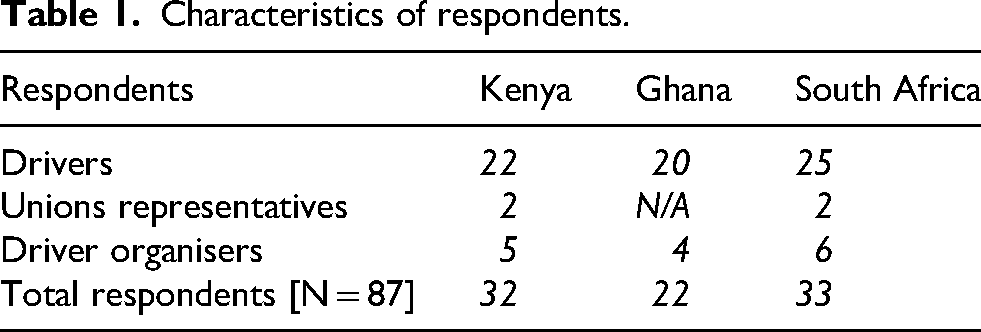
The project triangulates in-depth interviews with ethnographic data generated from digital communication channels such as Facebook and WhatsApp to explore the unique strategies and practices employed by African drivers to resist the platform economy. In-depth interviews were conducted with drivers, organisers and trade union representatives. Respondents were based in four cities across three different countries: South Africa (Johannesburg and Cape Town), Kenya (Nairobi) and Ghana (Accra). Drivers used Uber as their main platform and some had a Bolt account, along with several local platforms such as Little Cab and Hava. A total of 87 respondents were interviewed (Table1). The interviews lasted between 25 and 150 min.
Interviews were conducted over four different phases between April 2020 and May 2024. In depth interviews in 2020 were conducted over the telephone due to Covid-related social distancing measures. In 2021, 2023 and 2024, further interviews were conducted in person. Several rounds of follow-up telephonic interviews were conducted in between as well. Some of the drivers and organisers were interviewed several times due to time limitations. We used WhatsApp to keep in touch with drivers and regular exchange of messages allowed us to develop a better picture of driver activism and changing platform economy landscape (e.g. new groups and partnerships emerging between drivers and existing trade unions) in respective countries.
Interviews were transcribed and coded on NVivo for key themes such as discontent towards platforms, the state, local trade unions, and fellow drivers, mobilisation and organising efforts and strategies, new local driver networks, and their role in exerting worker power.
Characteristics of respondents.
Interview data was combined with digital ethnography, that is, understanding data as objects of ethnographic inquiry (Wang and Liu, 2021). It involved collecting information on workers’ communications on both the Facebook and WhatsApp groups. Digital communications channels are important tool for workers’ solidarities and mitigation strategies against adverse working conditions found on platforms (e.g. Anwar and Graham, 2020; Hau and Savage, 2022).
The author was invited to join a WhatsApp group of drivers in South Africa in 2020. These groups present an ethical challenge for researchers. It is not feasible to obtain the consent of every participant in such groups. Therefore, a different approach was adopted to gain consent through ongoing negotiation, transparency and full anonymisation (see Barbosa and Milan, 2019). Practically, it meant informing the group administrators about the nature of study who sent a message in the group. This ensured trust building with group members, allowed the researcher to engage with drivers regularly and stay in the group. We would also send regular reminders to the group and reiterate privacy attributes including complete anonymity. WhatsApp messages between January and August 2021 were exported into Excel spreadsheets monthly. This period coincided with widespread regional strikes not just in Kenya but also in Ghana (Marfo, 2021), South Africa (Thukwana, 2021) and Nigeria (The Irish Times, 2021).
Dozens of Facebook groups of drivers exist in Africa and the author joined some of them. Facebook does not allow automated web-scrapping. Hence, the posts were manually extracted between the months of January and August 2021 from two of the biggest groups for Kenyan and South Africa drivers in terms of members. There are certain advantages of this approach. Observing communications on a regular basis helps researcher develop a deeper understanding of a particular phenomenon as it emerges. Nemer's (2019) work on Brazilian elections examined the use of WhatsApp among favelas residents. Nemer collected daily posts to study populism and misinformation and show how social media afforded the marginalised to organise and protest. Studying drivers’ social media posts provided us an entry point to understand how they use these channels and for what purposes.
All identifying information such as names, mobile numbers and time stamps were removed to completely anonymise the data. In all, 3745 Facebook posts and 11,438 WhatsApp messages were collected and openly coded to identify a range of themes. No posts or its contents are quoted in the article for privacy reasons. This is a well-established research practice (Anwar et al., 2022, 2023). Names of the respondents are anonymised in the findings below.
Solidarity in self-organised groups
Motivation
Kelly (1998) notes the role of injustice and exploitation in mobilising and transforming individuals into collective actors as crucial. Injustice and exploitation are baked into the business models of platforms such as Uber and Bolt. By design, platforms shift the risk to drivers. Drivers face anything from low pay to wage theft to deactivation from platforms (Anwar et al., 2022, 2023). While these risks are present for most drivers, they get amplified in the poorer parts of the world (Amorim and Moda, 2020; Rosenblat and Stark, 2016).
In the high-income contexts (e.g. the EU), the main motivation for drivers’ mobilisation has been to demand not just better economic incentives (e.g. pay, pensions) but also gain recognition as employee instead of independent contractors (see Aslam and Woodcock, 2020; Cini et al., 2021; Tassinari and Maccarrone, 2020). Bessa et al. (2022) found that globally drivers’ main issue behind their protests remains pay (63%), with Asian (74.9%) and African (67.2%) remain particularly high compared to workers in North America (59.6%) and Europe (62.1%).
We found African drivers’ mobilisation was primarily driven to secure better pay and reduced commission. In the words of a driver organiser, Peter, in Nairobi, ‘since 2015 drivers have faced declining tariffs and an increase in commission. The number of drivers in the sector have steadily increased as platforms have consistently onboarded more and more drivers. This means less trips per driver and less earning. These companies feel that they are doing good. But they do not care much about the drivers, they exploit us’ (Interview Nairobi, August 2021). Drivers in our sample regularly said that ‘platforms broke the promises of constant income and flexible working hours’ (Interview Johannesburg, February 2023). To capture the urban transport sector, Uber started cutting tariffs across the continent. In April 2016, it cut the tariffs in South Africa from ZAR 7 per km to ZAR 6 per km and in Kenya the per kilometre rate was reduced from KSH 60 to KSH 35 per kilometre in July 2016. While it was attractive for customers or users but for drivers this meant low income (see Anwar et al., 2022; Carmody and Fortuin, 2019). In Nairobi, Peter, one of the driver organisers, informed us, their first demonstration in 2016 was against reduction of tariffs. Another driver organiser in Accra, Samuel, said ‘drivers were angry at platform due to low pay, high commission, onboarding of drivers and hence started forming their own unity groups’ (Interview Accra, October 2022). Here the argument is African drivers’ trigger towards mobilisation into self-organised groups was the feeling of exploitation and shared injustices , which helped developed solidaristic ties that later shaped their organisation strategies.
Strategies
Public places such as airports, train stations, shopping centres and central business districts are important locations for drivers’ mobilisation and organisation (a point already made by many, e.g. Tassinari and Maccarrone, 2020; Woodcock, 2021). A driver organiser, Zakhele, in Johannesburg told us, that ‘we would always hang around certain areas of the city. Gautrain station in Sandton and OR Tambo Airport were the usual spots. So, we would greet each other and chat. Because we are always busy with trips our communication was a bit sporadic’ (Interview Johannesburg, August 2020). But it is worth remembering here that drivers leverage both physical and digital spaces to self-organise.
Digital became one of the most crucial links in the self-organising process in Africa. The role of WhatsApp and Facebook groups among the platform economy workers is now widely documented in the organising process (Anwar et al., 2022, 2023; Wood et al., 2018). In Kenya and Ghana, drivers said they would often exchange numbers with each other and create WhatsApp groups. Digital communication channels provided voice to some who would not publicly speak up. As one of the female organisers in Johannesburg, Nancy, elaborated: Many drivers would dare not speak up during a face-to-face meeting, but by listening to other drivers’ experiences was a trigger for them to share their concerns via WhatsApp. For us, this was a major confidence booster as drivers recognised their individual experiences are collective experiences. Hence, it became easier to organise meetings. We would meet at my house and also at Chicken Licken.
4
(Interview Johannesburg, July 2020)
Similar strategies were also adopted by drivers in Nairobi and Accra, who leveraged urban physical and digital spaces to consolidate embryonic solidarity (Atzeni, 2010: 28) but with some variation in terms of strategies. Zollman (2024) notes in Mombasa, drivers built internal legitimacy for solidarity in close coordination and communication with each other. Drivers in Nairobi developed external legitimacy by tapping into the networks of national unions and lawmakers to exert their power (Zollman, 2024; also see Castel-Branco et al., 2023). 5 Tom, one of the driver organisers (who was a former campaigner and a member of the Public Transport Operators Union (PUTON)) told us in Nairobi together with some drivers they registered Drivers Taxi Association (DTA) back in 2016 which became Digital Taxi Forum (DTF) which later took the form of Digital Partner Society (DPS) with a view to help drivers in their respective localities (e.g. though inform saving groups) (Interview, Nairobi, 2020). Other organisations also emerged such as Digitech Drivers Association of Kenya and Online Drivers Association Kenya (ODAK). In Accra and Nairobi, drivers organised groups based on the neighbourhood they live such as CBD, Ngong Road, and Kilimani groups in Nairobi, and Osu, Cantonment and Airport groups in Accra.
Self-organised groups are also coordinated along ethnic lines as well with drivers’ distinct identities helping form networks. For example, migrants are heavily represented on platforms such as Uber in South Africa (Anwar et al., 2022). Xenophobia is a part of social and political life with politicians blaming migrants as the source of socio-economic ills in the country. This feeds into the violent attacks on migrant workers either by fellow Uber drivers or customers (a point confirmed to us by three drivers). There are groups (online and local) for Zimbabwean, Malawian, Nigerian, Ugandan and Somalian drivers in the country (also see Webster et al., 2021), though migrant drivers are also part of the other larger groups (with no ethnic identity) including SARIDEHA.
In Johannesburg, one of the early and short-lived groups formed in 2016 was ‘Momentum’, which emerged out of the Zoo Lake gathering mentioned earlier in the paper. Co-organisers of this group came from a variety of backgrounds with some who had been previously part of trade union movements, and others with no experience of organising. Some members of this group later registered an association called South African Ride-Hailing Association (SARIDEHA), to organise drivers. SARIDEHA and other self-organised groups across the Gauteng province later established E-hailing Partners Council (EPCO), an umbrella body with support from city government and trade unions to officially represent drivers. At the time of the fieldwork in May 2024, EPCO had about 5000 members (including migrant drivers), according to one of its leaders, Austin. Other self-organised groups also exist such as Uber Driver Partners South Africa (UDPSA) and South African-E-hailing Association. Similar groups also exist in other countries, for example, the National Union of Professional App-based Workers (NUPABW) (Nigeria) and Tanzania Online Drivers Association (Tanzania).
This kind of embryonic solidarity (built around physical and digital spaces and collective identities) is considered the foundation for the development of ‘active solidarity’ (Atzeni, 2010). There is some evidence. Since 2016, drivers’ protests and strikes have become frequent across Africa (examples from Kenya, Ghana and South Africa are here: Thukwana, 2021; Ghana Waves, 2022; IOL, 2018; Musalia, 2022; Nyawira, 2019; Prinsloo, 2016; Wahito, 2017; Waweru, 2018). Experiences of organising protest in large numbers can be empowering to workers and help facilitate collective identity and realisation that action is possible (see Tassinari and Maccarrone, 2020). However, in the following section, the paper shows that drivers rarely pursue active solidarity (i.e. towards traditional organising). Particularly, it expands on how certain contextual factors may inhibit active solidarity and how self-organised groups attempt to deploy various sources of power and what challenges remain.
Power in the self-organised networks
The algorithmic management of the labour process on platforms afford workers less structural power compared to associational power (Joyce et al., 2023), though this depends on the type of platform work. In remote work (e.g. design and web development), the structural power comes from workers’ reputation and ratings on platforms (such as Upwork) which enable them in some cases to resist unscrupulous clients and achieve higher wages (Anwar and Graham, 2020). Yet, in place-based work such as ride-hailing, the structural power of drivers remains relatively limited, but they can exert associational power in various forms.
One of the first memorandum of understanding (MoU) in Africa signed by Uber were with Nairobi drivers in 2016. A driver who was part of this discussion disclosed that though the MoU was non-binding, the efforts of DTA Nairobi were successful in pushing Uber to increase the tariffs. Uber increased the fare by 20% because of the strikes in March 2017 (KSH 42 per km), though it did not reduce the commission (25%) (Reuters, 2018).
The point is that drivers are not powerless per se. However, they are unable to disrupt the functions of platforms or resist in a way that brings long-term meaningful changes to their working conditions (Carmody and Fortuin, 2019). Drivers who have been with Uber and other platforms since 2015 told us that they are noticing declining returns in terms of average wage they take home due to the further reduction in tariffs and increasing cost of renting cars. As a result, drivers combine associational power with symbolic power.
Symbolic power of drivers comes from (a) ride-hailing's embeddedness in urban economies and socio-economic and political spaces (see Pollio, 2021) and (b) their use of digital communication channels. Ride-hailing, like many other forms of platform economy activities, is mainly concentrated in urban areas or capital cities. These are also the major economic and political centres in respective countries, making it easier for drivers to gain public attention, for example, via roadblocks. In some cases, African drivers have been creative. The co-founder of Momentum, Nancy, who has an advertising background told us she wanted to have branding or a logo for their group to achieve more visibility in the media. So, she designed black t-shirts with logo ‘The Movement’ on it. Drivers later blocked one of the major streets in Parktown North area of Johannesburg, where Uber's main offices were located. It is a busy junction. The strategy worked as ‘the word spread more drivers came to join us. The press loved it. We got the coverage on the national media’ (Interview Johannesburg, July 2020). Self-organised drivers also extensively use digital spaces to exert their power in a variety of ways.
Digital for power
Digital communication channels such as WhatsApp and Facebook offer excellent tools for the platform workers to mobilise and organise outside the domains of established trade unions (e.g. Grohmann et al., 2023; Anwar and Graham, 2020; Wood et al., 2018). We asked drivers why are online groups essential to them, how they use these and for what purposes?
Working on platforms can be atomising and make workers feel lonely (Anwar and Graham, 2021). Drivers face intense competition to accept as many rides as possible in a day. Thus, they rarely look to meet fellow drivers. But with WhatsApp and other online forums, workers can also engage with each other and develop a sense of community and identity, albeit virtually (a point also confirmed by Bonini et al., 2024). Almost every driver interviewed was a member of multiple WhatsApp and Facebook groups. One of the drivers, Paul, said knowing there are hundreds of others in this sector in similar conditions can be a relief and forces us to think about ways to challenge platforms and support each other (Interview Nairobi, July 2020).
For migrant drivers, having online groups offer protection from Xenophobic attacks both from other Uber drivers and meter taxi drivers. WhatsApp remains the most downloaded and used app in South Africa, according to data from SimilarWeb. It is also free to download, making it easier for migrants who are often relatively poor. Since its inception days in 2009, the use of WhatsApp among migrants and diasporic groups for developing community, activism and everyday life issues is a widely known phenomenon (e.g. Graziano, 2012; Postill and Pink, 2012). One of the migrant drivers in South Africa, Austin, explained that ‘ride-hailing is quite dangerous in this country for us migrants. Sometimes your car breaks down at night. You can text on WhatsApp, and someone from the group will come and assist you quickly’ (Interview Johannesburg, August 2020).
Similarly, other drivers reported using WhatsApp to find a car or report a fraud or notify dangerous areas of the city. This symbolises what Bonini et al. (2024) described as ‘cooperative affordances’, that is, workers’ use of chat groups affords them communities and mutual aid. Analysis of WhatsApp messages and posts on Facebook groups reveal that African drivers primarily use digital communication channels for developing resilience and reworking strategies for everyday survival issues (Table 2). One of the most common is the ownership of cars among drivers. A vast majority of the drivers in our sample do not own cars. Their principal use of online groups is to rent a car from someone. Others were looking to share a car between two drivers. Drivers who were already on Uber were using WhatsApp groups for advice on driving such as avoiding heavy traffic areas of the city, look for assistance in case of a break down (a common occurrence). Drivers would also alert others in case of surge pricing.
Worker communication and power strategies.
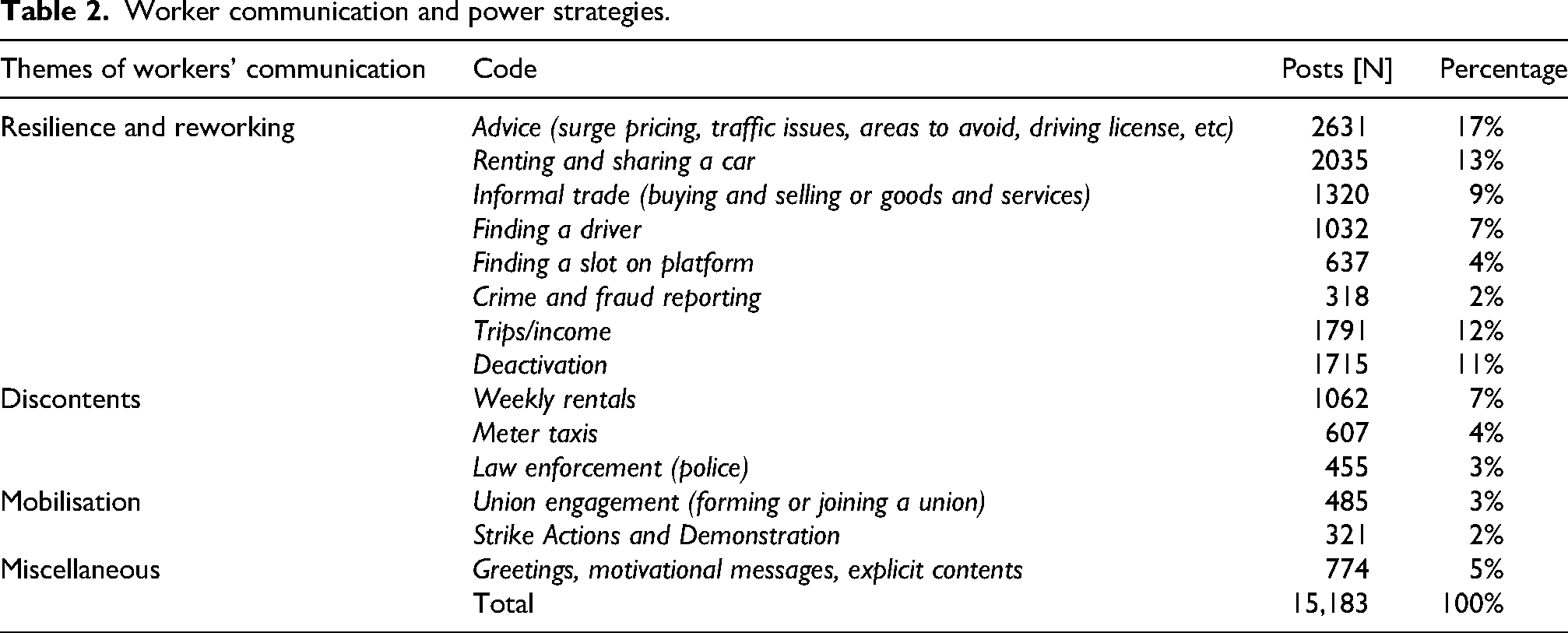
These actions suggest workers are keen to engage in resilience and reworking strategies. Platforms provide much needed income to the African continent's workforce, who face dysfunctional local labour markets (ILO, 2018.) and a dearth of well-paid work (e.g. Dinika, 2025; Anwar et al., 2022, 2023; Castel-Branco, et al. 2023). A survey by the ILO (2021) revealed that workers in low-income regions such as Ghana and Kenya join the platform economy primarily because they struggle to find meaningful work locally. African platform workers often combine other types of work with the platform economy activities to generate additional income (Anwar and Graham, 2022). Put differently, African drivers engage more in hustling rather than directly confronting or resisting platforms’ business model (Anwar et al., 2023) through traditional forms of organising. There are a couple of reasons.
Challenges towards active solidarity in self-organised groups
Workers consistently show discontent towards platforms about their pay, working hours and safety issues. As noted above, some of these discontents result in demonstration or strike actions, particularly when pricings are changed by platforms. But drivers and their self-organised networks rarely push towards active solidarity, that is, formalised labour organising (Atzeni, 2010). The author was invited to one of the induction meetings in May 2024 in the northern suburbs of Johannesburg. Even though the meeting hall was selected to host over a hundred of drivers, there were less than 20 drivers in the room. When the author asked the leadership of EPCO and some of the drivers present in that meeting why are so few in attendance, they told us that most drivers think they will be wasting time coming for these organising meetings and instead they go on the road to earn an income. The lack of engagement by drivers is also a reflection of the labour process unique to platforms.
Blocking or deactivation of drivers is a well-known strategy by platforms to maintain strict control over the labour process and workers (Iazzolino, 2023; Anwar et al., 2022, 2023). If a driver is a migrant, or someone renting a car (rental driver) then the risks get amplified. These groups of drivers often share cars on one account or rent a car from someone else and under tremendous financial pressure. Getting deactivated creates numerous legal and financial risks for them and hence many see organising a waste of time. Effectively, platforms’ ability to deploy this type of counter-action towards drivers means risk for workers remain high, irrespective of their nationality or immigration status.
Even though ride-hailing platforms depend on a constant supply of drivers, there is no shortage of the labour force on the continent. Some drivers interviewed for this study had been using Uber and other apps since 2014 and reported more and more drivers are joining the sector. Tom (driver organiser in Nairobi) perfectly captured this phenomenon. He said, ‘platforms use a business model I call the “conveyor belt model.” It is like a belt bringing in drivers. Platforms do whatever they want with them. Daily, there are new people joining and others are leaving’. He further explained why this creates a challenge for him as an organiser: ‘when you want to organize, you will have several hundred drivers interested. But by the end of the year half of them would leave the platform and there will be hundreds of new drivers. So, we have to start all over again building connections and developing solidarity networks’ (Interview Nairobi, June 2020). Ride-hailing companies also use draconian service level agreements to ban workers from forming a union or to give them space to collectively bargain. When we asked the executive of the TWU-K, Kamau, ‘what has been the biggest challenge to organize drivers in this sector’, he told us, In terms of organizing members of the ride–hailing, you realize that Uber in their service level agreements states that Uber does not work with unions. So, drivers who became affiliated with us, were either suspended or permanently deactivated from using the Uber app. (Interview Nairobi, June 2020)
It is worth noting here that the African trade union landscape historically has been quite varied (Freund, 1984). This is largely due to ways in which employment relations are regulated, including labour rights, and internal political economy and alliances (Beckman, 2002). In turn, this affects unions’ ability to mobilise workforce and the influence they have on political landscape. South Africa is often seen as outlier with one of the most extensively organised and large trade union movements on the continent. Trade unions federations are still very much present in the local party politics (Buhlungu et al., 2008). In Ghana, the TUC disengaged from party politics since 1992, but has found alternative ways of maintaining political influence including extensive training and independent research (Akwetey and Dorkenoo, 2010). Even though, trade unionism in Kenya went through a militant phase during late colonial period (Stichter, 1978), more recent decline of the membership base has seen unions shift their strategies for political clout by organising informal workers (Lindell, 2010; Riisgaard, 2022). Besides these differences, trade union movements in Africa have faced very similar set of challenges due to neoliberal globalisation, for example, falling wages, declining membership, casualisation etc. (Webster, 2015). Relatedly, there is also a growing lack of trust among workers towards trade unions in Africa, which result from cash-strapped union federations’ inability to engage and mobilise workers (Mwamadzingo et al., 2024). In the South African case, the level of trust in unions has been declining among workers since the end of the Apartheid (Gordon, 2015), primarily due to bad governance and history of co-optation of union leaders into party politics (Beckman et al., 2010). 6
Not surprisingly, most drivers expressed a level of mistrust towards those people who are trying to organise, despite acknowledging that organising is helpful. One driver, Antony, confessed that ‘most of us are not united to fight the common enemy, i.e. the app companies. Drivers do not trust their colleagues. Once you tell drivers, we are uniting, we want to stay in solidarity, they would not join because many of them think these are fake things and leaders are in there because of money’ (Interview Nairobi, June 2020). This may explain why in-person meetings do not necessarily attract large number of drivers.
Importantly, most of the self-organised groups do not have any formal affiliations to trade unions locally. Driver organisers told us that their networks have cautiously attempted to engage with respective local trade unions but have maintained some independence. In South Africa, EPCO has been in close contacts with SATAWU and SAFTU. In Kenya, TWU has been in consultation with drivers for awareness among members for the need to unionise. In Ghana, the main group is the Ghana Online Drivers Union (GODU). One of the leaders from GODU, Samuel, revealed that there were over 20 self-organised groups across the country, who have come together to form the National Alliance of Digital Drivers Unions Ghana (NADDU) and registered with Trade Union Congress Ghana (Interview Accra, August 2021; also Akorsu et al., 2023).
One would expect local unions to willingly engage with drivers and expand their membership base. Yet, they seem unprepared and under-resourced for the challenges of organising the platform economy workforce. Lack of effective regulation and the self-employed status of drivers also means the involvement of local unions remains ambivalent about the kind of support they offer to drivers, according to the trade union representatives in Nairobi and Johannesburg. In our case study cities, TWU-K, SATAWU and SAFTU have extended limited material and non-material support to drivers, for example, offering them a space for meetings and providing training for organising drivers.
Regulation has been the major source of contention among drivers, activists and the governments both in Africa and beyond (Aloisi and De-Stefano, 2022). The legal status of the ride-hailing (and most other platform economy activities) remains contentious and unclear. Platforms disembed themselves from local jurisdictions by deploying a mix of technological and legal manipulations to their advantage. Platforms like Uber identify themselves as technology companies instead of transportation company, making it difficult for law makers to properly regulate the sector. In the Kenyan case, one of the executives of TWU-K, Kamau which attempted to organise drivers, explained that, Uber has exploited local legislations. In Kenya, the transport sector is regulated by the Ministry of Transport and National Transport and Safety Authority Board (NTSA). Uber is registered as a service company and not as a transport company. So, this has presented a big challenge in terms of now recognizing what Uber really is? Is it a transport company? Is it a technology company? And then another challenge is that the drivers want regulations for the transport sector overall. But that falls under the jurisdiction of the Ministry of Transport. The drivers also want their labour issues addressed. Things like, decent pay, safe working conditions, and they are supposed to be addressed by the Ministry of Labour. (Interview Nairobi, June 2020)
African drivers’ efforts to bring ride-hailing platforms to courts have also suffered numerous setbacks. 7 There have been numerous court cases lodged by drivers and their representatives, most of them have been overturned. For example, in South Africa in 2018, the Labour Court overturned a ruling from the Commission for Conciliation, Mediation and Arbitration (CCMA) that the Uber drivers are employees (Kayihura, 2018). Similarly, in 2018, the National Industrial Court of Nigeria rejected a case from Uber drivers that they are to be classified as employees (NICN, 2018).
Consequently, many of the self-organised groups have become defunct or disbanded over the years. The DPS maintained a website until early 2023. Groups like EPCO and NADDU have limited their activities, due to the lack of finance. In Ghana and South Africa, groups asked drivers to register to become a paid member. It is hard to imagine having paid membership for these groups. Workers not only struggle to make end meets and hence rarely pay their dues. Because the churn of drivers (as mentioned above) is high, collecting membership fees is practically impossible. This limits the kinds of activities, including physical meeting spaces, information flyers, etc. During our last meeting in 2024, one of the leaders of EPCO said, ‘EPCO is as good as dead right now’. Some of the leaders of EPCO have focussed their efforts towards launching of a home-grown app. Two of the main South Africa's minibus drivers’ unions (e.g. the South Africa National Taxi Council (SANTACO) and the National Taxi Alliance (NTA)) in partnership with Gauteng Department of Transport have launched a ride-hailing app called Shesha earlier in 2024. The app has already opened the front for a new round of taxi wars (see Mwareya, 2024).
Conclusions
Workers on the platform economy are fragmented and dispersed making it difficult for labour for collective action to emerge. Yet, this paper has demonstrated that it is still possible for platform workers to mobilise and organise. The random and self-organised acts of platform workers have become increasingly relevant for collective action. This heeds to Atzeni's (2021) recent call to move away from ‘trade union fetishism’ in the contemporary era where ‘new class identities and social alliances’ are emerging. By examining drivers’ self-organised networks and their unique resistance strategies in several African countries, the paper made two key interventions.
Firstly, self-organised networks have become an important source of exercising worker power and collective action in the platform economy. But the solidarity in these self-organised networks remains geographically contingent and coordinated along the spatial and ethnic lines and hence workers deploy different types of actions (similar findings in the UK and Italy were reported by Tassinari and Maccarrone, 2020). Here drawing on the industrial relations (e.g. Ackroyd and Thompson, 1999) and labour geography literature (e.g. Katz, 2004), the paper examined workers everyday practices and strategies with a broader conceptual lens, particularly teasing out those acts that may not necessarily be classified as acts of resistance.
Indeed, strikes and logging off the platforms are still important aspects of collective resistance. But the paper shows that African workers exercise their associational power to build resilience and develop reworking strategies (e.g. through sharing cars, having multiple profiles, renting cars, etc). The argument is that workers deploy various sources of power first and foremost for survival. High levels of unemployment and widespread poverty meant African drivers’ prime motivation has been to preserve livelihood opportunities and building networks of support, rather than engaging in traditional forms of organising commonly seen in the EU and the UK (Aslam and Woodcock, 2020; Cini, 2023; Tassinari and Maccarrone, 2020, among others).
Essentially, the paper makes the case that the link between embryonic and active solidarity remain tenuous at best. While workers can mobilise embryonic solidarity towards different forms of collective action strategies, these remain contextually embedded. The presence of local trade unions has been considered an enabling factor in the development of active solidarity in the UK and Italy (Tassinari and Maccarrone, 2020). Today, trade unions in Africa lack the resources needed to engage platform economy workforce. Little efforts have been made by the African governments to regulate platforms in Africa, which might give workers some recognition and perhaps push towards active solidarity. Put simply, solidarity among platform workers in Africa is somewhat unique compared to those in the EU or the UK. By studying collective action strategies among platform workers in Africa, this paper adds unique empirical insights into how precarious workers build solidarity to challenge authority, when there are limited fall-back options. This brings us to the second important intervention.
The paper makes the case for exploring digital as a space for action against systemic exploitation of workers by platforms. New digital communication channels allow solidarity development by bringing workers together albeit virtually. This has been understood to be the starting point of mobilisation and self-organisation campaigns fostering shared solidarities and class consciousness. African drivers’ example highlights that avenues for worker resistance are possible even if work is becoming atomised. Nonetheless, this should not underestimate the potential challenges and bottlenecks that still exist (e.g. political, economic, structural), that technology alone cannot overcome. Drivers use digital spaces to conduct their work rather than engage in resistance strategies, which might explain why Africa have the lowest number of recorded platform labour protests (Bessa et al., 2022). The point here is that despite the diffusion of technological affordances in different parts of the world, workers socio-political contexts and individual circumstances still matter when it comes to who joins the picket line and who does not. Future research could pay a lot more attention to these challenges with a view to examine how platform workers in different parts of the world (including within the African continent) exercise power and why collective action on the platform economy remains elusive in some geographies.
Footnotes
Acknowledgements
The author would like to thank the UKRI (MR/Y017706/1) for funding author′s time and the British Academy (SRG20\200635), and the University of Edinburgh's Strategic Research Funds for funding three rounds of fieldwork (2021, 2023 and 2024). The paper was first presented at the International Labour Process Conference, Padua 2022 and then at the brown bag seminar at the Centre of African Studies, University of Edinburgh in early 2023. The paper greatly benefitted from the feedback and comments. The author would like to thank the diligent work of research assistants who did early rounds of interviews in 2020 and 2021: Elly Otieno, Jack Odeo, and Malte Stein, Eric Tei-Kumadoe and Sika Dewi.
Funding
The author disclosed receipt of the following financial support for the research, authorship, and/or publication of this article: This work was supported by the UKRI (grant number MR/Y017706/1) and the British Academy (grant number (SRG20\200635)).
Declaration of conflicting interests
The author declared no potential conflicts of interest with respect to the research, authorship, and/or publication of this article.