




Abstract
This article examines the emergence of platformised multi-level marketing (MLM) schemes as a significant, yet understudied, phenomenon in the ongoing transformation of work and labour on digital platforms. Promising wealth, freedom, and community, platformised MLMs organise individuals into cycles of value extraction by leveraging aspirational narratives of financial independence and entrepreneurial success. Through a case study of iGenius, a global MLM firm working through local recruiters, the article analyses the strategic and progressive embedding of individuals into the MLM. The article focuses on the cyclic character of recruitment operations, and identifies three stages of the process, namely recruitment of customers on social media platforms, the commodification of customers through complex and obfuscated brokerage relationships with affiliate trading platforms, and, finally, the embedding of individuals into the MLM organisation as recruiters seeking new prospects, starting the process over again. Throughout the analysis, we show how the nature of work, the value extraction methods, and the control mechanisms intensify as people move from merely subscribing to engaging in financial trading and in the end, turning to recruitment for the MLM. In the concluding discussion, we situate the analytical findings in the broader discussion of precarious work relations and atomisation of the workforce as well as the broader context of investment schemes and online scams. Thus, the article contributes to the study of labour relations and data extraction relationships on platforms and in the digital economy more generally.
On the internet, you have always been able to find promises of quick riches and a glamorous future waiting just round the corner. In a contemporary instantiation of this aspirational narrative, young people tell stories of how they have finally skipped school or quit their jobs to go all-in on their own online business. With catch phrases such as ‘earn six-figures from trading’, ‘work from anywhere’ and ‘travel with friends’, they promise to help you build a freedom-based business. The visual imagery of their posts on Instagram and TikTok is reminiscent of prominent influencers putting their lavish lifestyles on display, as they communicate incessantly and extensively about travelling the world with their newfound business friends, enjoying the freedom of being their own boss while they make money from financial transactions. They are independent, yet part of something bigger; a community of peers or, as some call it, ‘the best people’. The only thing you need to do to partake in this real-life fairytale is to sign up for a subscription service, an ‘investment universe’, where you learn how to trade in the markets and recruit others to do the same. When doing so you become part of a multi-level marketing (MLM) scheme, where you are encouraged to convert your newfound knowledge into financial speculating through unregulated trading platforms and for recruiting new members to the organisation on social media platforms. In the end, the promise of wealth and freedom turns out to be a cover for highly risky investment practices and precarious working conditions with no promise of pay and little prospect of ever turning a profit.
This article addresses MLM organisations as an under-researched empirical domain in platform studies and as an important case of the ongoing transformation of work and labour on digital platforms. MLMs operate through local recruiters who convince individuals to both buy the MLM products and recruit new individuals into the organisation. Individuals are ostensibly working on their own, but in practice, they are parts of a complex network of relationships between the MLM firm and digital platforms for communication, financial trading, and payment services that all extract value from the labour and activities of individuals within the network. In the process, individuals may turn from being mere victims of aggressive value extraction to taking part as recruiters and thus active perpetrators in this cycle.
We first outline the characteristics of platformised MLMs drawing on the literature on direct sales organisations. We then deploy scholarship on venture labour and platform labour to frame and analyse the kind of work people engage in. We apply this framework to a case study of a global MLM organisation operating through local recruiters focusing on the cyclic character of the recruitment operations. We identify three stages of the process, namely recruitment of customers on social media platforms, the commodification of customers through complex and obfuscated brokerage relationships with affiliate trading platforms, and, finally, the embedding of individuals into the MLM organisation as recruiters seeking new prospects. Throughout the analysis, we show how the nature of work, the value extraction methods, and the control mechanisms intensify as people move from merely subscribing to engaging in financial trading and, in the end, turn to recruitment for the MLM firm. In the concluding discussion, we address how the cycle of value extraction can reproduce the precarity of those involves and how MLMs control workers by community formation rather than atomisation of the workforce. We end by relating our analysis to the broader context of investment schemes and online scams globally.
Thus, the article contributes to existing research in three ways. First, the analysis gives insight into the structure and operations of the hitherto understudied phenomenon of platformised MLMs. Second, the article demonstrates how MLMs and likeminded operations facilitate data extraction of individuals to the benefit of themselves as well as affiliate platforms in the ecosystem (van Dijck et al., 2018). Lastly, the article develops a theoretical framework to analyse how MLMs and likeminded operations such as investment schemes and online scams perpetuate precarious work through elaborate cycles of value extraction. By combining an analysis of the nature of work, value extraction, and control mechanisms the framework is relevant to studies of labour relations on platforms and in the digital economy more generally.
The platformisation of MLM schemes
The origin of modern MLM schemes can be traced to direct sales organisations (DSOs) which organise salespeople as independent contractors. A key innovation in the history of DSOs was the development of the network DSO, or MLM organisation, which introduced a pyramid-like sponsorship structure to the organisation of the salesforce (Biggart, 1989; Huntington and Brooks, 2023). This organisational form emerged largely after the Second World War as an attractive offer for new members of the workforce, namely women (Biggart, 1989). MLMs have grown steadily with the diffusion of the internet and social media platforms (W. Keep and J. Vander Nat, 2014) and have surged in popularity in the aftermath of the COVID-19 pandemic largely due to the allure of working from home (Bradley and Oates, 2021).
MLMs fundamentally operate as tiered systems where individuals, henceforth called recruiters, receive remuneration from the MLM firm both for selling products to consumers and for recruiting those consumers into the organisation. The fundamental structure of the MLM organisation is hierarchical, and recruiters are situated above the people they have personally recruited as well as further recruits by these individuals; this recruitment-based tree structure is referred to as a personal downline. Conversely, all recruiters in an MLM also have an upline, which consists of the person who recruited the recruiter and the person who recruited that person, etc. The most important structural mechanism in MLMs is that financial compensation depends directly upon the downline structure, in that recruiters typically get a cut of all sales from everyone in their downline; this is the multilevel aspect in contrast to single-level operations such as traditional sales.
This structure means that MLMs operate with two main control mechanisms, ‘self-control’ and ‘network control’ (Biggart, 1989: 161). The main self-control mechanism of an MLM is the entrepreneurial identity offered by the organisation, whereas the main social network control mechanism is the enthusiastic management of the individuals’ upline manager who may become ‘obsessed with the success of their recruits’ (Biggart, 2010: 412) due to the hierarchical remuneration scheme.
In addition to self-control and network control, modern MLMs also control their employees through economic incentives. Recruiters must typically invest a substantial amount of money to acquire the products before reselling them. Because of the initial investment and the difficulty of turning a profit from sales, recruiters are fundamentally incentivized to recruit as many new sellers/recruiters as possible and to incentivize these to recruit further. While difficult to assess, research indicates that MLMs are profitable primarily for the company operating the MLM scheme; some empirical studies suggest that between 90% and 95% (DeLiema et al., 2021; Liu, 2018; Nat and Keep, 2002) of recruiters lose money in the endeavour. Despite this questionable financial viability, many engage in MLM schemes exactly with the aim of becoming financially independent or as a lucrative side hustle (Pearce, 2024). Since this involves recruiting others to sell products and further recruit prospects, MLM recruiters become fundamentally incentivized to see social relationships as potential transactional exchanges (Biggart, 1989; Wrenn, 2023). Traditionally, existing social networks have been a key resource for recruiters to identify and meet potential customers, and regions with strongly connected groups such as religious communities have been particularly ripe for the spread of MLMs (Lofthouse and Storr, 2021). MLMs have also had a distinct gendered appeal, where MLM firms have specifically targeted housewives as a way for them to earn their own money while tending to family obligations (Mastrangelo and Longo, 2024).
In recent years, digital platforms have transformed MLMs, whereas all contemporary MLMs arguably use platforms at least to some extent, notably for recruiting prospective sellers, a new type of MLM is emerging that is platformised at the core, fully integrated with digital platforms. As we show in the following, this process of platformisation alters both product offerings and operational structures. To demonstrate this transformation, we focus on a particular and prevalent type of platformised MLMs that sells finance education and access to trading platforms. Notable global players in this niche are iGenius (https://www.igeniusglobal.com/), BE (https://beclub.com/) and IM Academy/IYOVIA (https://iyovia.com/). These finance MLMs differ from traditional MLMs in three important ways:
They have shifted the focus from selling physical products to attracting subscribers to digital services. They cultivate an identity as a speculative trader rather than an independent salesperson as the road to personal development and enrichment. Rather than operating an integrated firm, finance MLMs have externalized key operations to affiliated actors such as social media and messaging platforms for recruitment and coordination, trading platforms for financial speculation, and payment platforms for operational infrastructure.
Thus, platformisation occurs on two levels. First, social media and messaging apps vastly extend the operational reach of recruiters to move beyond their interpersonal networks and physical settings to find and cultivate prospects across social media networks. Due to the reliance upon social media for dissemination, much like other content creators and community organisers, platformised MLMs come to depend upon the economic incentives and organisational structure of platform companies (Nieborg and Poell, 2018). Second, the very organisational form of the MLM is altered by the existence of digital platforms. The traditional MLM operates as an integrated firm that sells products directly to distributors, who then resells the products to customers and other recruiters (Biggart, 1989). In its platformised instantiation, there is no physical product but instead recurring subscriptions to a digital service, which again functions as a nexus of platforms that connects social media (e.g. Instagram and TikTok), messaging services (such as Telegram) financial trading (e.g. Bybit and VT Markets), and payment services (such as Revolut and crypto wallets). Members of the MLM move seamlessly from the subscription service to affiliated platforms and between platforms to recruit others, trade in the markets, and manage their finances (illustrated in Figure 1). Thus, platformised MLMs strategically use the ecosystems of sectoral and infrastructural platforms (van Dijck et al., 2018) to expand their operations and intensify and exploit relations between customers, recruiters, affiliate platforms, and the MLM firm itself. Finance MLMs are therefore a prime case of the platformisation of MLMs that speaks to the broader genres of get-rich-quick schemes on the internet.

The nexus of platforms connected by the multi-level marketing (MLM).
Venture labour on digital platforms
In this section, we set up the theoretical framework for our exposition of MLM operations, the organisation of labour, and its consequences for a cyclic reproduction of precarious work. We first outline the concepts of entrepreneurial, venture, and aspirational labour to describe the type of work mentality the MLM company seeks to leverage and exploit through the cultivation of entrepreneurial identity. We then give a summary of relevant work on platform labour to scaffold our analysis of the nature of the actual work involved in MLM operations and the key mechanisms for control and value extraction.
In an early article, Neff et al. (2005) use the term entrepreneurial labour to describe a type of work in the overlap between (what was at that time) a fledgling internet company sector and the fashion industries, arguing that these two sectors were attractive due to a combination of ‘coolness’ and ‘hotness’. Key alluring characteristics were promises of low barriers of entry, autonomy, and work as an outlet for individuality and creativity. This was coupled with insecure employment, a lack of stable payment, and a corresponding ‘glamorization’ of individual risk-taking and ‘compulsory networking’. Neff (2012) later coined the term venture labour to describe a similar phenomenon in Silicon Valley where individuals combine salaried employment inside organisations with entrepreneurial aspects of work, with workers ‘[thinking] of their jobs as an investment or as having a future payoff other than regular wages’ (p. 16).
Several scholars have built on the idea of venture labour, not just in relation to the cultural industries and media and communications sector but as a model of broader tendencies regarding relationships between work, risk, and reward (see e.g. IJOC special issue Robinson, 2017). In particular, Duffy (2017) and Duffy and Hund (2015) have drawn on this literature to develop the concept of aspirational labour to capture the working conditions of influencers and creators specifically, emphasising the complex nature of the work, the extensive work hours, and the lack of immediate compensation for ‘doing what you love’. They also emphasise the gendered elements of this work, arguing that aspirational labour is particularly attractive to women. Together, this body of scholarship paints a picture of contemporary work characterised by a generalised entrepreneurial individualist subjectivity, where risky and costly work may be carried out without immediate compensation but with an aspiration towards a more prosperous future with improved career opportunities. We will refer to this type of work and its corresponding mentality under the single term venture labour in the following, and we believe that this conceptualisation of venture labour, which both predates and overlaps with the rise of platforms, captures important aspects of the attraction of platformised MLMs for certain individuals.
To further scaffold our analysis of how work is organised and how value is extracted by the MLM firm, we will briefly outline relevant work from the literature on platform labour. We focus on the nature of work and its compensation, the contractual employment relationship between platform and worker, control mechanisms, and value extraction mechanisms in that order.
The dominant model for organising platform labour is through the operation of a matchmaking multi-sided market with the commodification of labour through piecework. Typical work consists of ‘tasks [that are] short, temporary, precarious, and unpredictable’, and these tasks must be digitally legible (Woodcock and Graham, 2020: 24) to allow processing and payment where gig workers are compensated only for legible work. Platforms themselves often refer to workers as independent contractors, but distinctions between types of contemporary employment relationships can be difficult to substantiate (Cappelli and Keller, 2012; Kuhn and Maleki, 2017) and terms can be contested. Critical literature on gig work tends towards seeing the notion of independent contracting in platform labour as a legislative loophole (Woodcock and Graham, 2020) and a misclassification that allow platforms to evade employment law obligations (Pei, 2023).
Control of work and workers is central to understanding the organisation of employment in general (Cappelli and Keller, 2012), and it is the main focus of labour process theory which has informed much of the work on platforms and control (for an introduction to its applications to platform labour, see Gandini, 2019). While control of the workforce varies across platforms (see Woodcock and Graham, 2020), the dominant mechanisms of worker control are control of pay rates, algorithmic management based on continuous tracking of workers, ubiquitous and public reputation metrics based on tracking, and individualisation-cum-atomisation of the workforce (Behind MLM, 2024; Gandini, 2019; Gregory and Sadowski, 2021; Kuhn and Maleki, 2017; Rosenblat and Stark, 2016; Van Doorn, 2024).
With regard to value creation and extraction, platforms tend towards centralisation of profit combined with cost-externalisation (Howson et al., 2022) and the most prominent value extraction mechanisms are, not surprisingly, connected to the three aforementioned aspects of work. There is often a notable gap between the actual amount of work and the piecework pay for legible work leading to large amounts of unpaid labour (Howson et al., 2022; Mangan et al., 2023; Pulignano et al., 2024); a tendency which can be seen as wage theft (Cole et al., 2024; Howson et al., 2023). The use of contracting as well as sub-contracting allows for avoiding traditional compensations. Platforms also extract rent in the form of fees (Howson et al., 2023), and the ubiquitous tracking of employees yields an additional value extraction mechanism specific to platforms, namely data extraction and data refinement (Sadowski, 2019; van Doorn and Badger, 2020).
As we will substantiate in our analysis below, the character of MLM work dovetails directly with aspirational venture labour. First and foremost is the investment in a future self, but also low barriers of entry, flat organisation, and autonomy coupled to an amalgamation of the ‘hotness’ of imagery of conspicuous consumption and desirable bodies and the most recent incarnation of ‘cool capitalism’ in the guise of the financial trader. The MLM firm leverages this to recruit young individuals into an organisational model which aligns with the established models of platform labour and gig work (see DeLiema et al., 2021), leading to working conditions that clearly fit with precarious work as defined by Kalleberg (2009). Individuals are thus lured into a network of platformised relationships designed for extraction of rent through fees, the commodification of customer relationships through ‘selling’ existing customers to external partners, outsourced and uncompensated social control of labour power, and cost-externalisation of labour power, and are subjected to wage theft through minimal compensation. The main differences from the dominant model of platform labour are the extensive amount of non-legible work – leading to a very high ratio of unpaid to paid work (Howson et al., 2023) – and a strong focus on control through social means as opposed to the atomisation of workers. The result is a complex and multi-layered network of individuals, organisations, and corresponding value extraction mechanisms. The underlying organisational setup is a simple but effective reproductive cycle that perpetuates precarious work through recruiting and gradual embedding of individuals into the operations of the modern platformised MLM.
Case study of a platformised MLM
To illustrate how platformised MLMs organise and extract value from the various activities of their customers and recruiters, we present a case study of iGenius, a finance MLM organisation operating globally and in Denmark. iGenius targets young Danish women through local recruiters on social media, primarily Instagram and TikTok, with the purpose of recruiting them to their subscription service and the MLM organisation. Danish news media have covered iGenius on several occasions and interviewed former members about the manipulative behaviour of the local recruiters, and the global platform (TV2, 2023, 2024). In addition, both Danish and US regulators have opened investigations into iGenius for constituting a pyramid scheme (Behind MLM, 2024; Spillemyndigheden, 2024) and several financial authorities warn against iGenius for ‘providing financial services or products without our authorization’ (FCA, 2023).
We use iGenius as a typical case (Flyvbjerg, 2006) to demonstrate the organisation of the platformised MLM across a multi-layered configuration of digital platforms (Tubaro, 2021). iGenius is part of a global trend of finance-related schemes proliferating on the internet (The Economist, 2025) and Denmark is no exception. In our case, the local recruiters tend to be female, and their main selling points speak to a distinctive commodified feminine identity (Petersson McIntyre, 2021). We attend to gender at several places in the analysis, but the overall focus in the following is on the operations of iGenius to foreground how the organisation exploits distinct affordances of digital platforms to recruit prospects, pass these prospects on to affiliate platforms, entice prospects to become recruiters, and lock recruiters into the organisational structure through increasing levels of platform dependency (Schor et al., 2020).
To grasp the progressive involvement of individuals in the MLM organisation, we draw on the concept of embeddedness. In economic sociology, embeddedness refers to economic actors being ‘embedded’ in social networks that affect their knowledge and actions (Granovetter, 1985; Polanyi, 1944). As such, it represents a core concept in organisational network studies, addressing the dynamic co-evolvement of social and organisational networks (Brailly et al., 2016). In the literature on gig work and platform labour, the concept of differential embeddedness has been deployed to address how the individual worker's life situation and social network matter for how dependent they come to be on platforms (Schor et al., 2023; Van Doorn, 2024). We adapt this concept to show how individuals are strategically and progressively embedded by recruiters into the social network and organisational structure of the platformised MLM, with the purpose of retaining them within the organisation and making them work for it. This progression happens through successive stages of embedding in the MLM organisation and its social network as subscribers, traders, and finally recruiters with increasing dependency on the organisation for trading, managing downlines, storing value, and receiving compensation.
Our empirical data consist of marketing and legal documents distributed by the local recruiters, the globally operating company iGenius, as well as several affiliated platform companies such as trading platforms. The primary material is a strategic manual, hereafter referred to as The Playbook, made available on an open website by the local recruiters (iGenius, n.d.). The Playbook outlines all stages of recruitment, from attracting prospective customers and onboarding them to retaining their commitment and converting them from customers to recruiters in the MLM organisation. This material is supplemented by social media posts from the local recruiters as well as field observation notes from a recruitment event in 2024 attended by one of the authors. In addition, we have consulted marketing material and legal documents, most notably the Terms of Service, distributed by iGenius and the affiliate platforms. As promotional and instructional materials, the documents represent intended strategies and tactics for recruitment and the structure of the MLM organisation.
The strategic and progressive embedding of individuals into the organisational setup and platform configuration
In the subsequent three sections, we analyse and describe the succeeding stages of embedding in the MLM and how the network of relationships fit with control and value extraction mechanisms. These stages (visualised in Figure 2) include the strategic attraction of prospects on social media platforms to convert them into paying customers on the MLM subscription service, the ensuing integration and commodification of such customers as traders on affiliated finance platforms, and finally, the conversion of customers into recruiters who work to attract new prospects on social media platforms. Although finance and financial success is the dominant narrative running through all the case material and a core sales point in the scripts for approaching new prospects, the affiliate trading platforms are not formally part of the MLM company. The compensation scheme and the emphasis on attracting prospects and onboarding customers indicate that the primary activities revolve around increasing the number of paying subscribers and convincing them to participate in the effort of attracting even more. Because of this ambiguity, we have connected the ‘trading stage’ with dotted arrows in Figure 2.
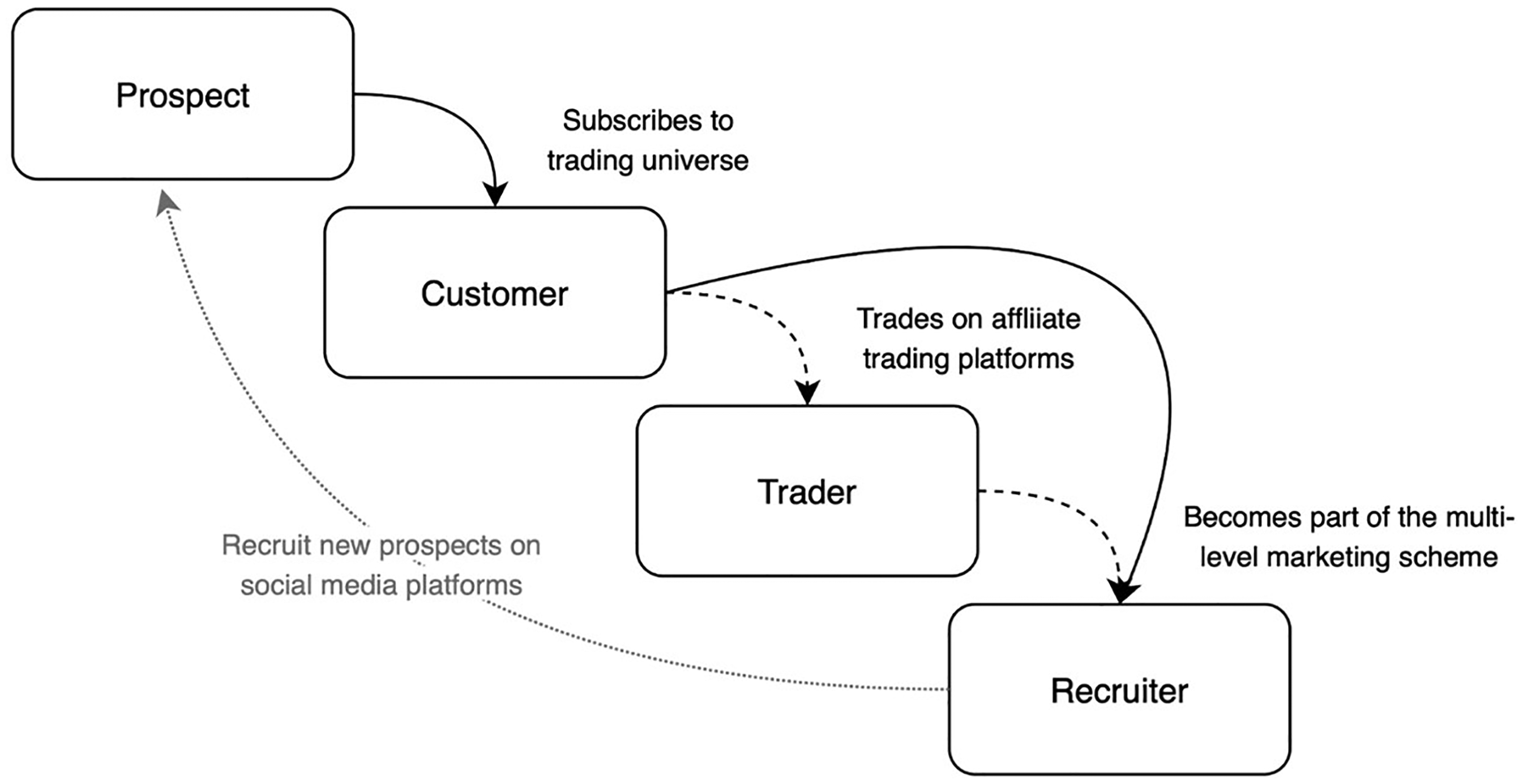
The progressive embedding in platformed multi-level marketing (MLMs). At each stage downwards, the individual becomes more and more involved with the operations of the MLM and is thus dependent on the organisational setup and platform infrastructure for economic and social resources.
Buying the dream: Paying upfront to make ‘six-figure earnings’
The first step in the recruitment process involves a potential customer encountering a recruiter in the form of social media posts, typically through content on TikTok. This content is oriented towards the consumerist trends of social media in general, and consumer verticals for women in particular (Duffy, 2017). The visual imagery blends in with stereotypical social media imagery of an aspirational lifestyle associated with affluent young women travelling the world, with a focus on tourist resorts (see Figure 3). This lifestyle-oriented content is combined with business-like and finance-affiliated hashtags such as #onlinebusiness, #moneymagnet and #rich, and the posts often include references to female empowerment such as #womenempowerment and #bossbabe aligning the content with a more general wave of commodified feminism (Goldman et al., 1991). Many social media posts tease some kind of business venture as an easy way to become ‘a 6-figure earner’ from passive income and working with ‘trading experts’ from home.

Examples of social media teaser posts from an iGenius recruiter.
The next step involves moving the prospective customer from public social media to group chats and personal communication. This step-by-step process is akin to that of deplatforming (Rogers, 2020), but with the core difference that individuals are not coerced out by social media platforms but led away by a recruiter. Thus, one might see this as a gradual process of re-platforming of communication away from public profiles and social media feeds to private messaging and closed Telegram groups. Prospective customers are directed to fill out a standardised form where they are asked questions like ‘Do you want to work with me?’, where they indicate how much money they are willing to spend on subscriptions as well as their interest in trading. They are invited to a closed call with the recruiter and possibly her (upline) mentor. Only at this moment will it be made clear to the prospective customer that the business venture involves signing up for a recurrent subscription to an ‘investment universe’ (comprised of the repertoire of videos, tips, and meet-ups). Thus, the goal of the MLM organisation in this stage is mainly to stoke an aspirational desire for a better future and offer an identity built around financial trading to make those aspirations come true.
When recruiters have ‘closed’ a prospect, that is, convinced them to sign up for the MLM subscription service, they are ‘onboarded’ as paying subscribers. This onboarding process of subscribers simultaneously introduces financial trading as a lucrative niche and the new identity as a trader poised to make millions in the marketplace. To sign up for the platform, customers must make a one-time payment, which at the highest level of membership, the Elite level, is $1,499, and sign up to pay for a subscription which, again at the highest level, is $174.99 monthly. To justify subscription costs and make good on the promises of financial success, iGenius provides two sets of resources. First, the company presents itself as a site for learning, where the main commodity being sold to the customer is a collection of static educational material and information about financial markets (foreign exchange, equity, and crypto) and trading expertise. iGenius also provides more dynamic information in the form of up-to-date communications about current market movements. This primarily happens through generic scopic regimes (Cetina, 2003) of finance-related information, but there are also references to a bespoke and specific commodity in the form of the ‘trading signal’, a kind of information packet about financial markets which, in theory, enables the receiver to make specific profitable trades. The second set of resources is a brokering of relations to financial trading platforms where traders can actually trade, and we describe this in the next section.
At this stage, the relationship between the customer and the MLM company is framed and treated as a simple transactional relationship between the customer and the learning platform – there is not yet any work to be done for iGenius, since work is predominantly framed as an investment of resources into building a new personal identity as a trader. Customers, however, get more than just subscription access to a learning platform: they are also embedded into a social network of other iGenius-affiliated individuals which serves to prop up the trader identity. New customers are treated as mentees with the recruiter occupying the role as their nearest mentor and higher-ups as higher-level mentors. The overall social network is framed and promoted as a community of aspiring entrepreneurs who are on their way to collectively make a fortune in trading. This community is sustained through group chats, weekly calls with mentors and more experienced members, and through travelling together, mixing business and leisure. As such, the organisation cultivates customers to see themselves not just as paying subscribers but as valuable and socially validated members of a community of self-employed entrepreneurs working as traders.
The main value extraction mechanism at this stage is the commodification of educational content of questionable quality – that is, a service that is sold for more than it is worth 1 – and the extraction of ongoing rent through subscription fees; this rentier relationship in the form of fees is also manifest in the next stage and becomes crucial at the last stage of the MLM cycle, where the relationship becomes a matter of direct economic control through infrastructural lock-in. At the customer stage, we also already see a combination of controls related to self, network, and economic means. The customer is in effect paying for a new venture labour-inflected identity as a financial trader and access to a social network which is structured to provide social validation of this identity. In practice, however, this is a hierarchical organisational structure where the responsible recruiter is incentivised to manage their downline and thus serve as the key driver of the social network control mechanism. In addition, the customer is already in the negative with regards to finances. To make a profit from their investments, customers will need to enact their new identity through actual financial trading.
Becoming a trader: Speculative labour on unregulated trading platforms
As already mentioned, subscribers cannot trade directly on iGenius’ subscription service. Instead, iGenius functions as a broker and facilitates connections to a larger network of affiliate trading platforms and receives referral compensation or other kind of revenue sharing in return from routing customers to them (Behind MLM, 2024). To incentivize subscribers to engage in what is often highly risky trading practices, the MLM offers proprietary trading signals and automated strategies through copy-trading platforms such as Coinrule and EndoTech, which can be executed on the affiliate platforms. By clicking a few buttons, the subscribers-turned-traders can expose themselves to high-risk leveraged forex trading as well as unregulated financial markets such as cryptocurrencies, options, and derivatives. This frictionless experience of trading masks a complex relationship between the individual trader who risks her own capital and the MLM and its affiliate platforms, where the latter will always extract commission fees without bearing any of the risks involved.
The work performed at this stage does not fit neatly into existing concepts of platform labour, primarily since the work is not solicited as remunerated labour. Yet, trading is an intensive endeavour, demanding hours of work paying constant attention to movements in the markets and resources devoted to analysing prospective positions. It also has clear elements of venture labour as traders take on great personal risk with uncertain profits, but the nature of trading makes the position different from both personal and professional investing as well as the types of aspirational work typically described in the literature. To capture this difference, we argue that retail traders engage in a form of platform work called speculative labour (Bear, 2020), which is highly individualised as it is largely self-directed rather than organised from above by human management or algorithmic systems. Moreover, it is deeply financialised as profits (if any) come from financial returns rather than productive activities. In this capacity, the position of the speculative, individual trader is not a job category in the finance industry and instead encapsulates a way of life where people work by and for themselves and without employers, colleagues, or customers (Roscoe, 2015). Despite or perhaps because of, these differences to platform labour, the work is precarious and with a high risk of economic losses.
While apparently working for and by themselves, subscribers-turned-traders are subject to numerous value extraction mechanisms. While long-term financial investing can be a lucrative endeavour for ordinary people, short-term trading in speculative assets such as stocks, crypto, or options is a very different matter. The odds are stacked against retail traders as they are subject to worse pricing and incur brokerage fees every time they trade, all of which adds up for every trading move made. Furthermore, the institutional investors that dominate financial speculation have the upper hand both in easier access to markets and reliable information about finance. Professional traders, who are often the counterparties to retail traders, thrive on the influx of inexperienced traders as the suppliers of ‘dumb money’ in the financial markets (Jakab, 2022). These disadvantages tend to matter less in the case of long-term investment, but they severely limit the potential for turning a profit in the short term. As a consequence, retail traders, on average, lose money on their investments (Barber et al., 2024).
In addition to these inequalities between individual and institutional investors, the affiliate platforms to which iGenius links represent a particularly risky and, in some cases, downright fraudulent segment of the investment market. Several of these such as www.bybit.com, and www.vtmarkets.com facilitate trading in highly volatile and unregulated markets (e.g. on crypto exchanges) and engage in complicated and gambling-like activities such as buying options and derivative products, for example, contracts-for-differences (CFDs), as well as trading with leverage, which essentially means trading with borrowed money (for an extensive discussion of this, see Gregersen and Ørmen, 2024). Other affiliate platforms, the so-called ‘prop firms’, emulate proprietary trading desks in investment companies, where traders use company funds to trade, rather than managing external client accounts. The marketing pitch of the prop firm, in this case, UWM Trading, is that customers can get to trade on a funded account with as much as $200,000 without pitching any of their own money in (for an example of this, see Figure 4). The catch is that the prospective traders must pass a series of challenges in a simulated environment, albeit based on real market movements. To successfully pass the challenges traders must earn a specific percentage of simulated profit without violating a set of rules related to risk and losses. They pay to get access to challenges and if they fail one, they must pay again to get a second chance.

Example of prop trading platform. Screenshot of the frontpage of UWM Trading.
Thus, engaging with any of these affiliate trading platforms leave customers exposed not only to inherently risky financial markets but also to potentially fraudulent activities where their speculative labour becomes the target of heavy monetization. As stated earlier, iGenius as well as the partner platforms are under investigation by several jurisdictions for engaging in prohibited trading practices and for distributing unlicensed financial advice (see Behind MLM, 2024). Several of the platforms operates from outside of EU or US jurisdictions; UWM Trading is solely regulated in the Seychelles, while Bybit as one of the world's largest crypto exchanges is only regulated by the authorities in Georgia, Dubai, and Kazakhstan. In addition, they offer products and services that are illegal in several jurisdictions, for example, CFDs in the US and options in the EU, without clearly stating this to their users. This element of regulatory arbitrage and obfuscated brokerage is not unique to the partner platforms of iGenius but is arguably a symptom of general predatory practices on retail trading platforms aimed at amateur investors (Gregersen and Ørmen, 2024).
In summary, iGenius routes customers to affiliate trading platforms that expose them to substantial financial risks without providing the security of funds and protection against scams offered by regulated brokers and exchanges. Meanwhile, these trading platforms extract value through high fees and/or expensive trading conditions while iGenius receive compensation for routing traffic. Notably, this part of the MLM activity is highly individualised as the members trade with their own funds. Every time the trader engages in a new type of activity (prop trading, copy-trading, etc.) they likely incur new costs that set them further back in their financial journey. This strengthens the economic control mechanism in the form of further sunk costs. As trading is likely to be a loss-making activity, especially for the inexperienced traders, upline mentors will seek to incentivize further trading to recuperate losses or at least offset the mounting costs of the recurring subscription fees. If traders become frustrated with their lack of success, the mentor in the upline will stand ready with a compelling offer: Traders can turn recruiters and earn money by signing up new subscribers in addition to, or in replacement of, financial speculation.
Turning recruiter: Paying to perform platform labour
At this final stage, individuals become further embedded into the MLM organisation as recruiters who work actively to both attract and retain new individuals. Once individuals enter this position the cycle of value extraction is complete, as they are simultaneously monetised as paying customers on the MLM subscription service, as precarious traders on trading platforms, as well as unsalaried marketing employees-cum-managers of their downline in the MLM organisation. There are neither wages nor piecemeal payments. Instead, recruiters are compensated through the opaque compensation scheme which privileges the top of the MLM pyramid – in combination with the promise of riches to come. The Playbook offers explicit advice on turning prospects directly into recruiters and skipping the trading stage, which indicates this stage represents the true purpose of the MLM: If they say ‘I wish to go full time’ the smart thing here is to say ‘I love that, and there are actually 2 ways to do so’. The first one is to go crazy in the financial markets and make a ton of money there, and then eventually make enough to cover your expenses. The thing about this way is that every time you withdraw money from your brokers, your profits become smaller because your account size becomes smaller. So another way to do it, and the way I'm doing it, is to start with the marketing side, make a lot of money through that and cover your expenses with the money from commissions, while you’re letting all your investments and trading money grow with no interruptions. (iGenius, n.d.: 64)
At this stage, the individual is fully embedded into the MLM and its value extraction scheme. While recruiters are free to decide whether they will continue trading on affiliate platforms, they have no choice but to remain subscribers to the MLM service while attracting and retaining new customers into the MLM. As the attraction and retention of new customers are concerned, a larger downline means qualifying for a higher placement in the compensation plan hierarchy, which in turn is rewarded with larger residual income in the form of higher percentages from sales and percentages from the downline. However, the exorbitant amounts of work leading to successful recruitment are compensated only indirectly to the recruiter, meaning that iGenius engages in extensive wage theft at this stage. Finally, social media platforms such as Instagram and TikTok are beneficiaries of substantial uncompensated platform labour, since the recruiters tend to produce vast amounts of content in congruence with their focus on aspirational consumption through its mimicry of influencer practices.
The control mechanisms at this stage consist in recruiters’ organisational and economic dependency on the MLM subscription service which at the same time requires them to constantly manage their own downline. Working as recruiters thus entail a high degree of lock-in within the organisational setup and services of the MLM. First, as the compensation scheme and payment structure are tied to subscriptions, recruiters must basically pay to get paid. At the recruiter stage, the subscription is much more important, as it yields access to the iGenius back office as well as a distinct placement in the hierarchical iGenius compensation plan. The recruiter receives compensation for sign-up bonuses, whenever they onboard a new customer, and for renewals, i.e., whenever a customer renews her iGenius subscription. iGenius gatekeeps access to the key resources involved in this compensation plan, the infrastructure that allows for the calculation and delivery of payouts. Furthermore, the practical handling of compensation is partly outsourced to payment service platforms, notably Revolut (https://www.revolut.com/) and CoinZoom (https://www.coinzoom.com/), which can handle cryptocurrency and convert them to fiat currencies. Payments in crypto make it easier for recruiters to sidestep local tax regulations but also entices recruiters to keep engaging in financial speculation as both platforms also offer trading services.
Second, the management of the downline as a community becomes a distinct control mechanism. Multi-homing is very limited as recruiters are not allowed to work for ‘network marketing companies that sell similar products and services to the Company's’ (iGenius, 2024: 27–28). If recruiters choose to leave iGenius, they lose their position in the hierarchy and thus their rights to compensation, and they will have to start over at the bottom level if they ever rejoin. To keep the downline engaged, recruiters cultivate individuals into seeing existing social connections as potential economic resources, and this involves recruiting others and embedding them in the hierarchical company structure to maximise the potential revenue stream. The recruiter is tasked with building intimate relationships with prospects, not with the goal of becoming friends but solely to add them in their downline. In the end, the social community becomes a monetary hierarchy and a control mechanism.
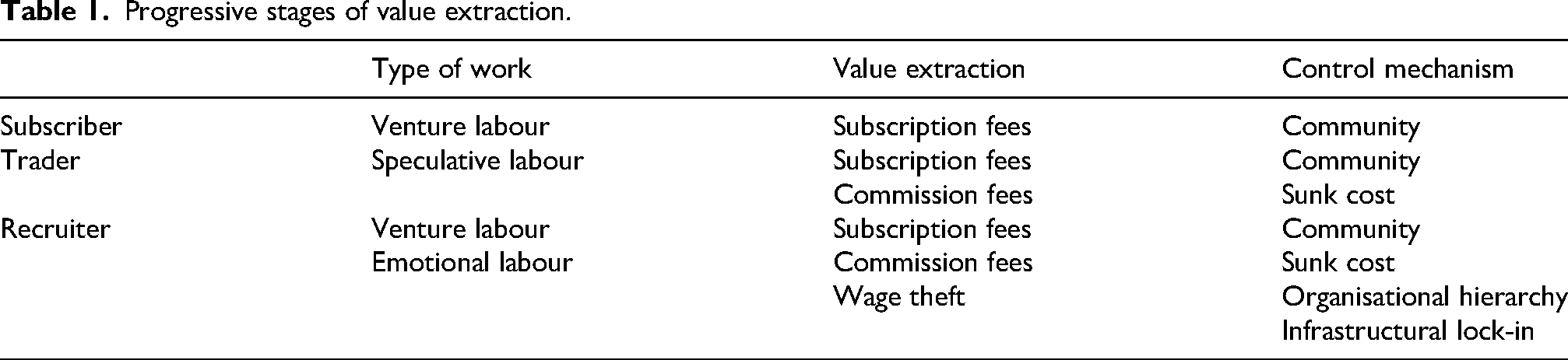
To sum up the analysis, Table 1 summarises the type of work, value extracted, and control mechanisms employed across stages in the cycle.
Progressive stages of value extraction.
Concluding discussion: The reproduction of precarity
We have outlined the operation of the platformised MLM as three progressive stages of embeddedness into its organisation, and we have described the type of work, value extraction schemes, and control mechanisms these stages involve. While the platformised MLM at first glance appears to be a community of independent business owners reaching out for new business partners on social media, this community in practice is the recruitment arm of an MLM organisation working across several platforms. In contrast to traditional MLM operations, the organisation analysed here operates across a multi-layered configuration of digital platforms (Tubaro, 2021), involving increasing stages of platform dependency (Schor et al., 2020). Building on traditional MLM organisations and their structure of operations, the platformised MLM augments and refines what was already at the outset a predatory business model. Recruiting prospects on social media platforms greatly extends the scope of targetable prospects as compared to housewives’ personal networks of family and friends. The local iGenius recruiters primarily aim for young Danish women that may consider their offer an opportunity to enter an otherwise male-dominated domain. The Finance MLM thus constitutes an interesting confluence of the ‘hot’ influencer lifestyle and ‘cool’ finance world, already noted by Neff et al. (2005), that can be strategically deployed to appeal to stereotypical masculine and feminine identities.
Moreover, through its affiliate trading platforms, additional layers of obfuscation (Gregersen and Ørmen, 2024) are added. While traditional MLMs are transparent about the product being sold but opaque in terms of the remuneration structure, the platformised MLMs operate across a complex configuration of social media platforms, trading platforms, and the learning platform, making it unclear to the individual exactly what is bought from whom and with which economic implications. The MLM controls individuals’ access to their organisational downline and, in the extension of this, their remuneration. In contrast to traditional MLMs, the platformised MLM thus controls all cash flows since all subscriptions are handled through the learning platform, and the only remuneration for work and sales is through payouts allocated through the opaque hierarchical compensation scheme. Entrepreneurs fully embedded in the MLM scheme are thus locked-in and dependent when it comes to both their social support structure and the remuneration structure, and the further up in the social hierarchy they are positioned, the more dependent upon the company they become. Indeed, the multi-layered configuration of platforms only reinforces this complex of platform dependency because individuals fully embedded in the MLM organisation also become increasingly dependent on social media platforms for recruiting new customers and trading platforms to recuperate subscription costs.
Recruiters in the platformised MLM are faced with a strong incentive to recoup their losses by attracting new individuals to the organisation. This leads to a platformised chain of value extraction where new members are embedded into and come to depend upon the MLM organisation and its platforms through the active participation of what appears to be a caring community. This view of the community contrasts with existing studies of gig work which tend to see platforms as technologies that atomize and individualise workers as a control mechanism (Gandini, 2019; Woodcock and Graham, 2020). In the case of the MLM, the community rather than algorithmic governance is the primary control mechanism. Through a range of economic incentives and a multi-layered configuration of platforms, the community is ‘reconfigured’ as a control mechanism that serves the core interests of the MLM firm. Much like schools in social reproduction theory have been addressed as mechanisms for perpetuating social inequality (Collins, 2009), the predatory community of the MLM is a mechanism for keeping individuals in the extractive cycle. This mechanism can also help answer the question raised by Van Doorn and Shapiro (2023), namely why some individuals engage with contemporary precarious work: because an attractive social identity is validated by peers and charismatic mentors.
In addition, there is a real risk that precarious work relations create precarity as a socio-economic life situation. In contrast to the promises of recruiters, the recurring subscription costs and inherent risks of financial speculation make it more likely that members lose rather than gain money, both in the short and the long run. While compensation through recruitment might make up for some of these losses, individuals are unlikely to turn a profit unless they are situated close to the top of the hierarchy, which, by definition, most will not be. In contrast to gig work more generally, involvement in MLMs likely incurs economic losses to the individual (DeLiema et al., 2021). Furthermore, the extensive recruitment work required to build a downline makes recruiters expose themselves to their wider social network of family, friends, and acquaintances. These recruitment drives are likely to damage, and perhaps sever existing social ties and, consequently, make recruiters more dependent on the MLM community as a primary source of social support. At the same time the MLM control mechanisms – particularly the predatory community dynamics noted above – function to keep individuals in economically vulnerable positions for as long as possible. This exacerbates risks of economic losses and emotional distress, which in turn may lead to sustained negative outcomes, such as financial ruin, social ostracisation, and mental health problems. How severely this affects individuals will depend both on how deeply they are involved in the MLM operations and their socioeconomic status more generally, as shown in work on gig workers (Schor et al., 2023; Van Doorn, 2024). The MLM cycle perpetuates precarity, especially for the already socially vulnerable.
Finally, it is worth noting a difference between the platformised MLM and one of the dominant value extraction mechanisms in the digital economy, namely the extraction, reselling, and refinement of personal data for proprietary or reselling purposes (Sadowski, 2019). In the platformised MLM, there is, as far as we can tell, almost no emphasis on such extraction – instead the platformised MLM opts for a much more traditional and low-tech mechanism where economic value is extracted directly from labour through wage theft, that is, unpaid labour directly benefitting the organisation. Working as a recruiter for MLMs, however, does involve a dependent relationship with social media platforms, and this makes the recruiter subject to data extraction and thus doubly exposed. Furthermore, as the data practices of trading platforms remain largely in the dark, it might be a more central part of the data extraction further away from the MLM core. But this is a topic for further research.
In the end, the MLM operations might be quite distinct in their operations, but they also exemplify an industry of online scams that has grown rapidly in recent years and is now estimated to be similar in size to illicit drug trade globally (The Economist, 2025). Whether or not MLMs can be classified as illegal pyramid schemes, immoral business operations, or just clever marketing approaches, the financial entrepreneurship ideal they sell and the recruitment strategies they employ mimic operations that target individuals to extract economic value from them under the guise of affection (such as love scams) or investment opportunities (such as the so-called ‘pig-butchering’ operations). Yet, it is important to be aware of the empirical particularities of our case here. We are well aware that the precarity of MLM subscribers and recruiters situated in a welfare state pales in comparison to the slave-like conditions scammers work under in compounds across the Global South (The Economist, 2025). Thus, it is the structure of their operations – the cycle of value extraction – rather than the practicalities of local organising that is of general relevance here. The degree to which this cycle works in similar or different ways for other investment schemes and scam operations is a research avenue to be explored.
Footnotes
Acknowledgements
The authors wish to thank the audiences at the ECREA 2024 conference as well as colleagues at the Center for Tracking and Society (CTS), University of Copenhagen, for their generous inputs to earlier versions of the article. Maia Ibsen provided generous help in the data collection process.
Funding
The author(s) disclosed receipt of the following financial support for the research, authorship, and/or publication of this article: The article has been made possible by funding from Queen Mary's Centre, University of Copenhagen (Finansiel Ungdomskultur), from Independent Research Fund Denmark (grant: FoMe DFF2/10.46540/2027-00037B), and from Velux Foundation (grant: 00067499).
Conflicting interests
The author(s) declared no potential conflicts of interest with respect to the research, authorship, and/or publication of this article.
