



Abstract
Background:
In an increasingly digital world, young people are becoming more vulnerable to an emerging form of intimate partner violence, termed digital dating abuse, where technology facilitates abusive behaviors. Though prior studies suggest that alcohol use/problems and emotion dysregulation are predictors of digital dating abuse, findings on whether these associations vary by gender are mixed.
Objective:
We explored associations among alcohol use/problems, emotion dysregulation, and gender on 3 types of digital dating abuse perpetration: digital coercion (eg, pressuring for explicit images), direct aggression (eg, sending threats online), and monitoring (eg, tracking a partner’s online activities). This study also examined the 3-way interaction among these 3 variables to assess their combined influence on digital dating abuse.
Design:
We aimed to answer the question: Does emotion dysregulation moderate the relationship between alcohol use/problems and types of digital dating abuse (ie, coercion, direct aggression, monitoring)? Is there a difference based on gender?
Methods:
Participants were (n = 1619) undergraduate students from a public university in the southeastern United States. Sociodemographic information and scores for alcohol use/problems, emotion dysregulation, and digital dating abuse were collected via an online survey. Regression analyses were conducted to evaluate independent and interactive effects among these variables.
Results:
Alcohol use/problems were consistently associated with all forms of digital dating abuse. While emotion dysregulation predicted digital direct aggression and digital monitoring, it did not predict digital coercion. Notably, alcohol use/problems and emotion dysregulation exhibited an interactive effect on digital monitoring, with higher emotion dysregulation amplifying the relationship between alcohol use/problems and controlling behaviors. When controlling for gender, no significant gender differences emerged across these associations.
Conclusion:
Findings suggest that interventions addressing alcohol misuse and emotion dysregulation may be effective in preventing digital dating abuse, particularly among young adults.
Introduction
Technological advancements have transformed the way young people engage in interpersonal relationships, while simultaneously creating new avenues for intimate partner violence (IPV).1,2 IPV is defined as any form of physical, sexual, or psychological harm toward an intimate partner, and is a phenomenon affecting approximately 27% of women aged 15 to 49 years worldwide. 3 Within the United States, IPV affects more than 12 million people every year, 4 consisting of 41% of women and 26% of men. 5 Among college students, this percentage increases to 65%. 6 Many survivors of IPV face long-term adverse health problems ranging from physical injuries (eg, chronic disability, brain trauma, death) to mental health problems such as depression, anxiety, posttraumatic stress disorder, suicidality, and substance misuse.7,8 These alarming prevalence rates and adverse consequences signal an urgent need for more research on IPV and its various forms.
Digital Dating Abuse and Associated Mental Health Problems
As digital communication becomes more prevalent, young people are becoming increasingly more vulnerable to an emerging form of IPV, termed digital dating abuse (DDA), where technology facilitates IPV perpetration.9-11 While the digital landscape helps maintain relationships by enabling constant communication, it also blurs personal boundaries between couples by granting individuals with continual access to their partners and their whereabouts, which can enable DDA behaviors. 10 These behaviors include digital sexual coercion (eg, pressuring for or sharing explicit images without consent), digital direct aggression or harassment (eg, insults, threats), and digital monitoring or control (eg, checking whereabouts and online activities, accessing accounts without consent.10,12 The anonymity, asynchronous communication, lack of authority, and spaceless nature of digital platforms make it challenging for victims to escape DDA, all the while emboldening perpetrators to escalate its severity while averting responsibility. 13
Given that young adults often utilize digital platforms more frequently and largely prefer digital interactions over face-to-face communication, 14 they are at disproportionately greater risk of experiencing and being affected by DDA than the general population.12,15 According to Erbiçer et al’s 12 recent systematic review of studies exploring DDA among youth and adolescents, risk factors of emotion dysregulation, younger age, and in-person IPV were identified as strong predictors of DDA perpetration. Notably, DDA perpetration also predicted in-person IPV in both cross-sectional and longitudinal studies,16,17 with individuals involved in DDA highly likely to experience bidirectional violence both in-person and offline. 12
Studies suggest that the reciprocal nature of DDA and in-person IPV puts victims at a compounded risk for a variety of mental and behavioral health problems including sleep problems, difficulties with concentration, anger and hostility, low self-esteem, anxiety, depression, posttraumatic stress disorder, suicidality, high-risk sexual behaviors, and substance use.9,12,15 In a recent study, Melander and Marganski 18 compared DDA with in-person IPV and found that DDA victimization poses equally severe risks for maladaptive outcomes of depression and substance use. These findings warrant a closer examination into the risk factors and underlying theories that elucidate how emotional experiences and substance use behaviors are associated with DDA.
Emotion Dysregulation as a Predictor of Digital Dating Abuse
The I3 Model provides a critical lens for understanding risk factors for DDA, by explaining how aggression arises from the interplay of 3 processes: instigation (ie, exposure to provocative cues), impellance (ie, factors increasing the likelihood of aggressive responses to provocation), and inhibition (ie, factors the override the effects of instigation and impellance). 19 Derived from this metatheory, the Perfect Storm Theory proposes that aggression is most likely to occur when instigation and impellance are strong and inhibition is weak. One key form of weak inhibition is emotion dysregulation—difficulties controlling or managing emotional responses—which has been consistently associated with IPV.20-22
Emerging evidence suggests that this mechanism is also relevant in online contexts, where digital aggression has been linked to heightened emotion dysregulation and vice versa.23,24 Regarding DDA specifically, Brem et al 25 have argued that emotion dysregulation independently predicts DDA perpetration. However, McMillan et al 26 reported no differences in emotion dysregulation between individuals with low versus high digital monitoring scores, indicating that the association between emotion dysregulation and DDA may vary across DDA subtypes. Overall, more nuanced investigations into the subtypes of DDA are necessary to understand how emotion dysregulation is associated with DDA perpetration.
Alcohol Problems as a Predictor of Digital Dating Abuse
Within the I3 framework, substance use functions as a form of impellance that interacts with inhibition to exacerbate aggressive behaviors. Indeed, numerous studies have demonstrated that substance use problems increase the likelihood of IPV perpetration in both men and women.27-32 Regarding DDA specifically, alcohol poses the greatest risk to DDA perpetration and subsequent in-person IPV compared to all other substances.12,26,33 The role of alcohol as an impellance factor is further elucidated by the Alcohol Myopia Theory, which proposes that the effects of alcohol restrict people’s attention, perception, and meaning processing, causing them to attend to only the most salient cues in a situation (eg, perceived provocations) while ignoring less salient inhibitory cues (eg, legal consequences). 34
Several studies have demonstrated that this phenomenon is associated with IPV and is particularly pronounced among individuals with higher levels of emotion dysregulation.33,35-38 The majority of studies examining alcohol and IPV focuses on in-person aggression, leaving the association between alcohol and DDA subtypes underexplored. For instance, while some researchers have examined the positive relationship between alcohol problems and digital monitoring, 39 other subtypes like digital sexual coercion have not yet been examined in relation to alcohol problems and emotion dysregulation. In fact, some researchers argue that emotion dysregulation independently predicts DDA perpetration, regardless of alcohol problems, 25 indicating that alcohol use may not have a significant role in DDA perpetration. Although findings regarding the role of alcohol use in DDA are mixed, applying the I3 Model provides a useful foundational framework for conceptualizing how emotion dysregulation and alcohol problems may interact and associate with DDA perpetration.
Gender and Digital Dating Abuse
Prior studies investigating gender differences in DDA have yielded mixed results as well.9,40,41 Brem et al 36 found that alcohol problems positively predicted DDA perpetration in women with high traits of romantic jealousy, but not in men. Brem et al 25 additionally found that women’s odds of DDA perpetration were greater than men’s odds of perpetration. In contrast, some studies found higher DDA perpetration prevalence in men compared to women.42,43 Several studies suggested no gender differences in DDA perpetration overall,33,44 whereas other studies noted differences in the type of DDA perpetrated based on gender: women more often engage in digital monitoring, 45 while men more often engage in digital sexual coercion. 10
Inconsistencies in previous findings may reflect research designs that inadequately capture the nuances of young people’s online interactions and participants’ uncertainty about what constitutes DDA. 40 Gender-related differences may also contribute to mixed findings in reporting. According to Brown and Hegarty, 41 men often perceive the impersonal nature of DDA as less harmful than in-person IPV, which may lead to underreporting, whereas women tend to view the persistent nature of DDA as more harmful and may either overreport due to perceived severity or underreport due to concerns about their communications being publicized. Notably, Bennett et al 46 found that although young women report more distress in reaction to hypothetical DDA victimization, young men were more likely to both perpetrate and experience more severe forms of DDA. Thus, it would be beneficial to further explore the role of gender in digital relationship behaviors and how it interacts with risk factors such as emotion dysregulation and alcohol problems to better understand the mechanisms driving DDA perpetration.
The Current Study
Given the mixed findings surrounding the role of alcohol use and problems, emotion dysregulation, and gender in DDA perpetration, this study aimed to investigate whether and to what degree emotion dysregulation moderates the relationship between alcohol use/problems and DDA perpetration in a sample of college students in romantic relationships. Furthermore, this study sought to clarify the potential influence of gender on these associations. While prior studies have examined the interaction of these factors on DDA between intimate partners, none to date has specifically investigated how these interactions may differ across distinct types of DDA.
Based on prior studies linking alcohol problems and emotion dysregulation to IPV, we hypothesized the following:
Although prior findings on the role of gender in DDA perpetration are mixed, we formulated H3 based on prevalence data indicating that women experience higher rates of IPV victimization than men. 5 Accordingly, this study had 3 primary aims: (a) assess the main effects of alcohol use/problems and emotion dysregulation on digital sexual coercion, digital direct aggression, and digital monitoring; (b) evaluate whether emotion dysregulation moderates the relationship between alcohol use/problems and DDA perpetration; and (c) examine whether these main and interactive effects differ by gender, including a 3-way interaction among alcohol use/problems, emotion dysregulation, and gender.
Method
Procedure
The current study was approved by the Institutional Review Board at the University of Tennessee, Knoxville. Participants were recruited from undergraduate psychology courses at a large, public university in the southeastern United States. All participants were informed that they could earn partial course credit for participating in the study. To be eligible for the study, participants were required to be at least 18 years old and currently in a romantic relationship for at least 1 month. Eligible participants who agreed to participate in the study provided written consent and completed an anonymous online survey administered on Qualtrics.
Participants
An a priori power analysis for a moderation regression was conducted in G*Power (version 3.1.9.6). Assuming a small effect size (f2 = 0.02), α = .05, power = 0.80, and 7 predictors (main effects and interactions), the required sample size was n = 725, which the final sample exceeds. The final sample consisted of 1619 participants. Participants were included if they were between 18 and 25 years old, could provide written informed consent, and completed the survey in English. Exclusion criteria were failure on attention checks, duplicate or invalid entries, or extensive missing data that could not be handled using mean imputation to retain cases in data analysis.
Measures
Demographics
Participants’ demographics (eg, age, gender, sexual orientation, race/ethnicity, income level) were obtained via self-report.
Digital Dating Abuse
DDA perpetration was assessed using a summed score of relevant perpetration-related survey items from the Digital Dating Abuse (DDA) scale. 10 A total of 18 items were used for this study comprising of 3 subscales of digital sexual coercion (M = 4.09, SD = 1.01), digital direct aggression (M = 7.13, SD = 1.58), and digital monitoring (M = 8.34, SD = 2.56). Each measure consisted of 6 items and evaluated participants’ experiences with digital media in the context of intimate relationships. Participants self-reported responses on a scale from 1 (never) to 4 (very often). The DDA demonstrated adequate reliability overall (α = .83) and has been supported in prior studies with college students. 1 Furthermore, each DDA subscale demonstrated adequate reliability: digital sexual coercion (α = .71), digital direct aggression (α = .74), and digital monitoring (α = .73).
Alcohol Use/Problems
Alcohol use and problems were measured using the Alcohol Use Disorders Identification Test (AUDIT), which consisted of ten items (M = 5.13, SD = 5.27). 47 This measure was designed to assess the intensity and frequency, tolerance and dependence, and negative consequences of alcohol consumption. Participants were asked to self-report their responses on a scale from 0 to 4, with higher scores indicating greater alcohol use and associated risks. The AUDIT demonstrated adequate reliability (α = .84) and has been used in prior studies with college students. 36
Emotion Dysregulation
Emotion dysregulation was assessed using the Difficulties in Emotion Regulation Scale (DERS), which consisted of 36 items (M = 88.61, SD = 22.45). 48 The DERS was used to specifically evaluate participants’ understanding, acceptance, and modulation of their emotions. Participants were asked to rate their responses on a 5-point Likert scale ranging from 1 (almost never) to 5 (almost always). The DERS demonstrated adequate reliability (α = .94) and has been used in examining behaviors in college students in prior research. 49
Data Analytic Strategy
All statistical analyses were conducted using R (version 4.1.2). Prior to hypothesis testing, data were screened for missing values, outliers, and violations of assumptions associated with general linear modeling. Missing data on continuous variables were revised using mean imputation to preserve the full sample, yielding a final analytic sample of 1619 participants.
Continuous predictor variables—specifically, alcohol use/problems and emotion dysregulation—were mean-centered to reduce multicollinearity (see Table 1). Multicollinearity was assessed using variance inflation factors (VIF) values (VIF range = 1.07-1.71; tolerance range = 0.58-0.93), all of which indicated no concerns with collinearity among predictors. For this study, gender was operationalized as a binary variable (woman = 0, man = 1) and included as a categorical moderator to assess whether alcohol use/problems, emotion dysregulation, and DDA perpetration differed by gender. Specifically, we tested all relevant 2-way interactions (alcohol use/problems × gender; alcohol use/problems × emotion dysregulation; emotion dysregulation × gender) as well as the 3-way interaction (alcohol use/problems × emotion dysregulation × gender). When significant interactions emerged, they were probed using simple slopes analyses.
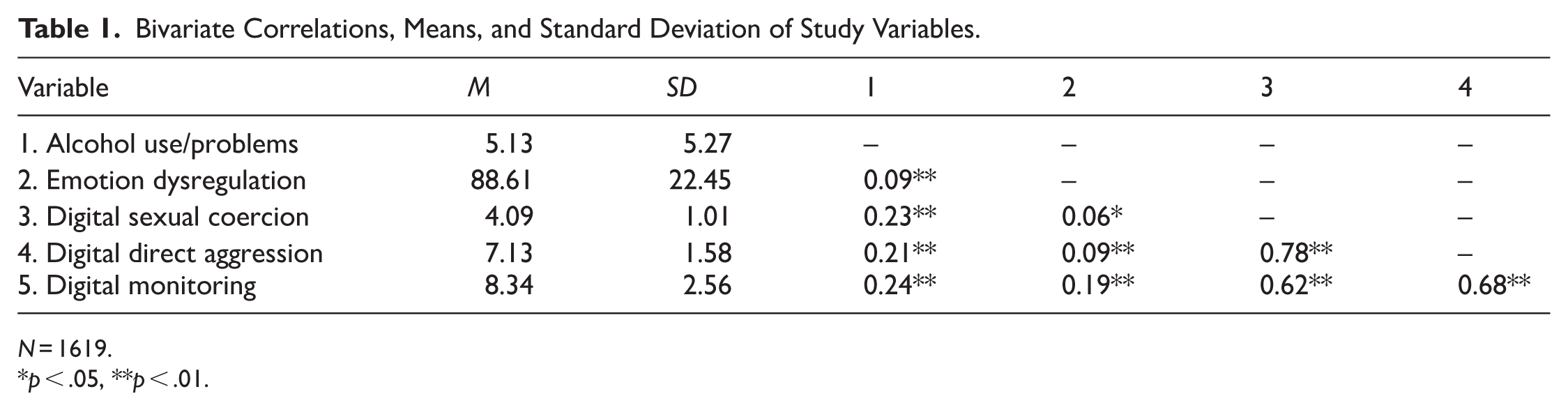
Bivariate Correlations, Means, and Standard Deviation of Study Variables.
N = 1619.
p < .05, **p < .01.
A generalized linear model (GLM) with a Gaussian distribution was used to examine the main and interactive effects of alcohol use/problems, emotion dysregulation, and gender on 3 types of DDA perpetration (sexual coercion, direct aggression, and monitoring). Separate GLMs were run for each DDA type, resulting in a total of 3 models. This approach was selected to accommodate right-skewed outcome distribution and heteroscedasticity, and the Gaussian distribution provided an adequate fit, yielding residual patterns sufficiently close to normality for analytic purposes. The Breusch-Pagan test indicated heteroscedasticity for all 3 outcomes of coercion, BP(1) = 128.94, p < .001; direct aggression, BP(1) = 58.64, p < .001; and monitoring, BP(1) = 44.94, p < .001. Dispersion parameters revealed good model fit for coercion (dispersion = 0.98) and overdispersion for direct aggression (dispersion = 2.43) and monitoring (dispersion = 6.05), which justified the use of GLMs with robust standard errors.
The model for digital sexual coercion exhibited a residual deviance of 1547.6 on 1611 degrees of freedom (df; null deviance = 1651.2 on 1618 df), with deviance residuals ranging from −4.56 to 7.57 (first quartile = −0.19; median = −0.01; third quartile = 0.14), and an Akaike Information Criterion (AIC) of 4539.5. For digital direct aggression, the residual deviance was 3810.9 on 1611 df (null deviance = 4035.9 on 1618 df), with deviance residuals ranging from −7.88 to 13.23 (first quartile = −0.24; median = 0.05; third quartile = 0.21), and an AIC of 5998.5. Finally, the model for digital monitoring showed a residual deviance of 9615 on 1611 df (null deviance = 10 617 on 1618 df), with deviance residuals ranging from −9.68 to 13.28 (first quartile = −1.12; median = −0.48; third quartile = 0.93), and an AIC of 7496.8. Across all 3 models, the reduction in residual deviance values relative to the null models, together with small residuals centered around zero, indicates improved model fit and that the predictors capture meaningful variance in DDA outcomes.
Results
GLMs were used to examine the main and interactive effects of alcohol use/problems (M = 5.13, SD = 5.27), emotion dysregulation (M = 88.61, SD = 22.45), and gender on digital sexual coercion (M = 4.09, SD = 1.01), digital direct aggression (M = 7.13, SD = 1.58), and digital monitoring (M = 8.34, SD = 2.56).
Descriptive Analyses and Bivariate Correlations
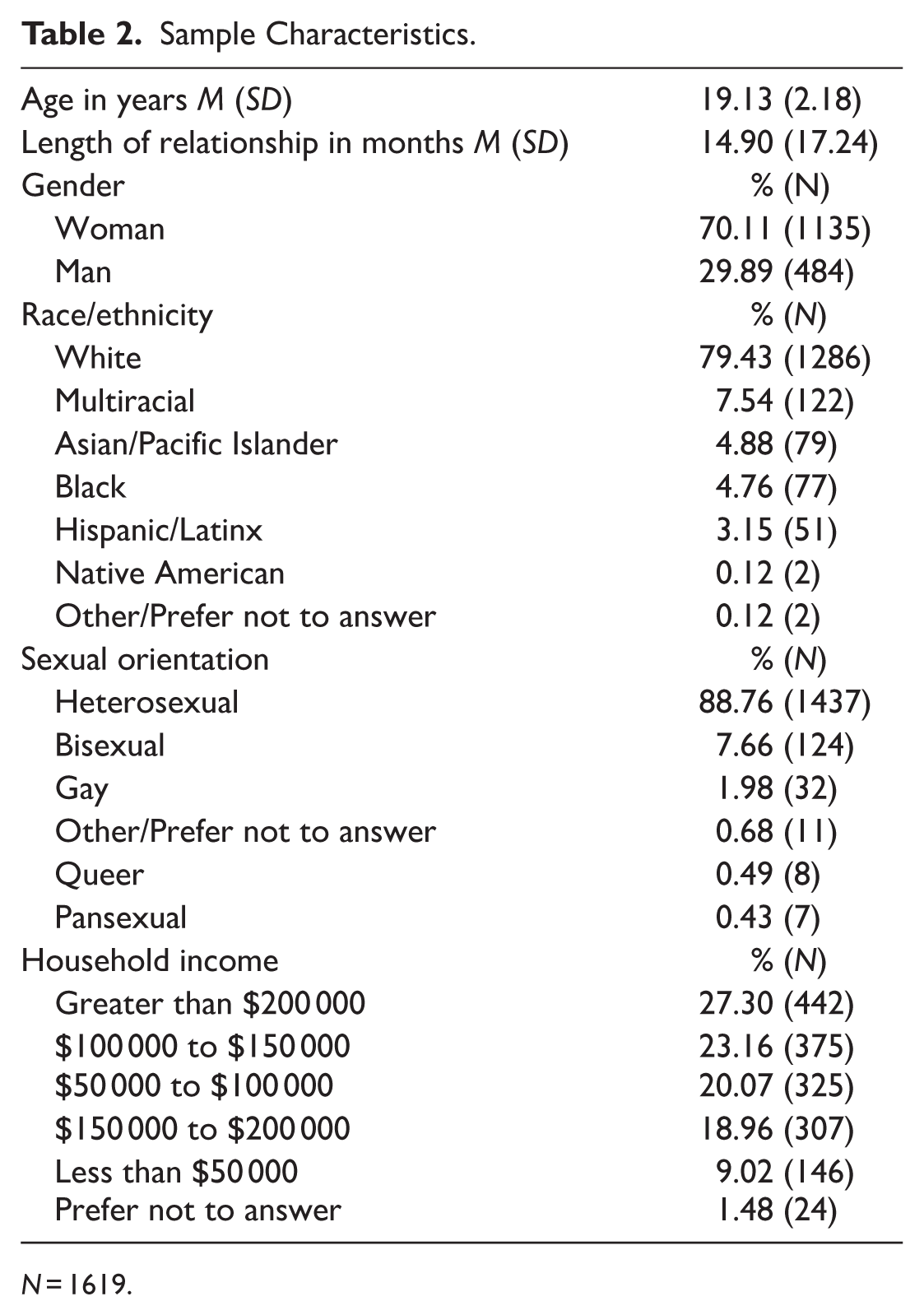
The sample was largely homogeneous, with the majority of participants identifying as women (n = 1135; 70.11%), White (n = 1286; 79.43%), and heterosexual (n = 1437; 88.76%; see Table 2 for descriptive statistics). The average age of participants was 19 (M = 19.13, SD = 2.18). Although relationship duration varied across this sample, the average length of relationships with a current partner was 14.90 months (SD = 17.24), or 1.24 years.
Sample Characteristics.
N = 1619.
To examine potential multicollinearity, bivariate correlation analyses were conducted (see Table 1). Alcohol use/problems was positively correlated with emotion dysregulation (r = .10, p < .001), digital sexual coercion (r = .23, p < .001), digital direct aggression (r = .21, p < .001), and digital monitoring (r = .24, p < .001). Emotion dysregulation was also positively correlated with each DDA type, albeit smaller: digital sexual coercion (r = .06, p = .013), digital direct aggression (r = .09, p < .001), and digital monitoring (r = .19, p < .001). These correlations support the role of alcohol use/problems and emotion dysregulation as independent risk factors of DDA perpetration. Potential multicollinearity was addressed by mean-centering predictors prior to analysis.
Main Effects
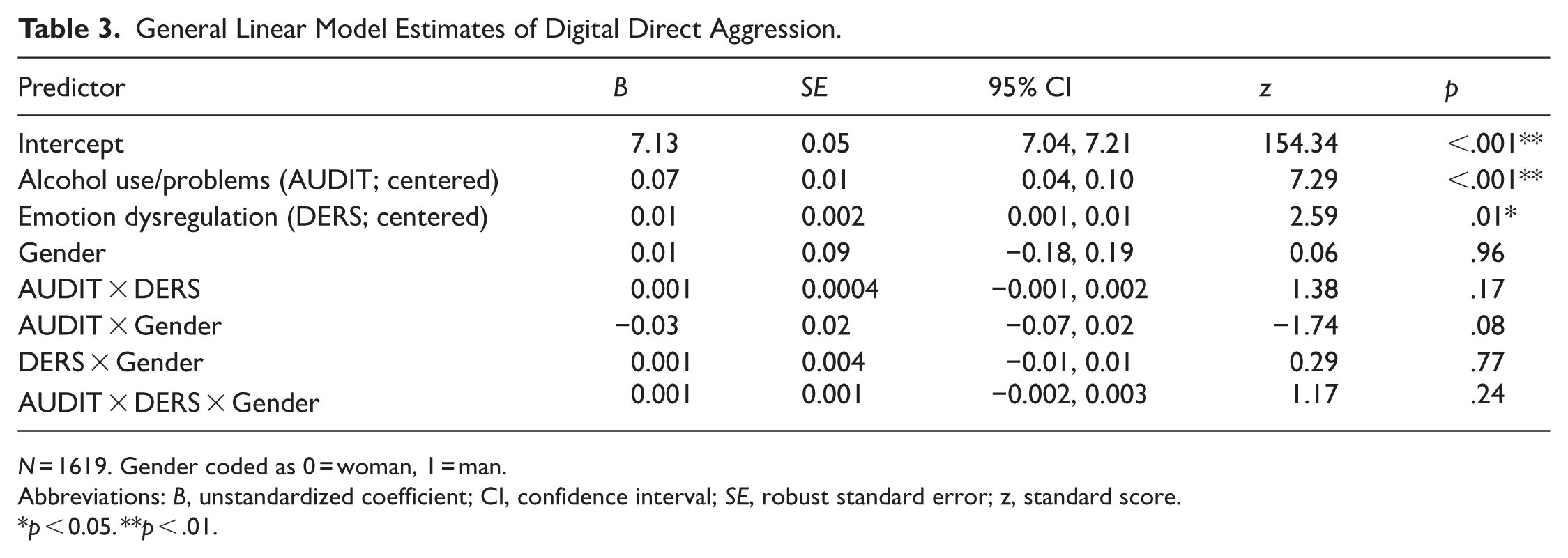
Largely supporting H1 that higher levels of alcohol use/problems and emotion dysregulation are associated with greater DDA perpetration, alcohol use/problems emerged as a significant positive predictor across all 3 subscales, whereas emotion dysregulation was significantly associated only with digital direct aggression and digital monitoring. These findings suggest that alcohol use/problems independently associate with digital sexual coercion (B = 0.05, SE = 0.03, z = 137.86, p < .001), digital direct aggression (B = 0.07, SE = 0.009, z = 7.29, p < .001; see Table 3), and digital monitoring (B = 0.12, SE = 0.02, z = 7.95, p < .001; see Table 4) regardless of emotion dysregulation levels. Similarly, emotion dysregulation independently associates with digital direct aggression (B = 0.005, SE = 0.002, z = 2.59, p = .01; see Table 3) and digital monitoring (B = 0.02, SE = 0.003, z = 6.64, p < .001; see Table 4) regardless of alcohol use/problems, however does not independently associate with digital sexual coercion (B = 0.002, SE = 0.001, z = 1.41, p = .16; see Table 5).
General Linear Model Estimates of Digital Direct Aggression.
N = 1619. Gender coded as 0 = woman, 1 = man.
Abbreviations: B, unstandardized coefficient; CI, confidence interval; SE, robust standard error; z, standard score.
p < 0.05. **p < .01.
General Linear Model Estimates of Digital Monitoring.

N = 1619. Gender coded as 0 = woman, 1 = man.
Abbreviations: B, unstandardized coefficient; CI, confidence interval; SE, robust standard error; z, standard score.
p < .05. **p < .01.
General Linear Model Estimates of Digital Sexual Coercion.

N = 1619. Gender coded as 0 = woman, 1 = man.
Abbreviations: B, unstandardized coefficient; CI, confidence interval; SE, robust standard error; z, standard score.
p < .01.
Interaction Effects
Consistent with H2, which posited that the positive association between alcohol use/problems and DDA perpetration subtypes would be stronger at higher levels of emotion dysregulation, a statistically significant 2-way interaction between alcohol use/problems and emotion dysregulation was observed for digital monitoring (see Figure 1). In contrast, 2-way interactions terms involving gender (ie, alcohol use/problems × gender; emotion dysregulation × gender) were nonsignificant predictors of digital sexual coercion and digital direct aggression. Furthermore, contrary to H3, which predicted a stronger alcohol use/problems × emotion dysregulation association for men, there was no significant 3-way interaction among alcohol use/problems, emotion dysregulation, and gender. Overall, findings suggest that gender did not significantly moderate any of the main or interactive effects across the 3 DDA subscales.

Alcohol use/problems × emotion dysregulation interaction effect on digital monitoring perpetration.
A simple slopes analysis of the significant alcohol use/problems × emotion dysregulation interaction revealed that emotion dysregulation moderates the relationship between alcohol use/problems and digital monitoring. Specifically, at lower levels of emotion dysregulation (DERS = 65.8), the slope was 0.117 (SE = 0.03, CI = [0.07, 0.17]), while at higher levels (DERS = 111.2), the slope increased to 0.158 (SE = 0.04, CI = [0.07, 0.24]).
Discussion
The present study examined the independent and interactive effects of alcohol use/problems, emotion dysregulation, and gender on DDA perpetration types among a sample of college students. The findings reinforce growing concerns about the use of digital platforms as a medium for IPV perpetration.1,2,9-11 Contrary to several studies reporting significant gender differences in DDA perpetration,25,36,42,43 gender did not emerge as a significant predictor or moderator in the current models. This finding contributes to the expanding body of literature suggesting that cyber forms of IPV may occur at similar rates across genders.33,44
Consistent with prior research, alcohol use/problems emerged as a significant predictor across all 3 DDA perpetration types (digital sexual coercion, digital direct aggression, and digital monitoring) regardless of gender.12,26,33 This finding highlights the risk of alcohol use/problems in increasing the likelihood of aggressive behavior,27-32 and counters Crane et al’s 39 finding that alcohol problems predict only digital monitoring and not direct aggression. Additionally, the findings specific to digital direct aggression and monitoring counter Brem et al’s 25 results that alcohol problems alone are insufficient to predict DDA perpetration. Prior studies that focused on only 1 or 2 DDA subtypes, rather than assessing all 3 subtypes simultaneously, may have underestimated the full impact of alcohol use/problems on DDA perpetration. Additionally, the growing integration of digital communication into young adults’ daily lives may have expanded opportunities for aggressive interactions, including forms of DDA that were previously less reported. This shift may have been further amplified by the social isolation, stress, and increased reliance on technology during and after the COVID-19 pandemic, 50 potentially heightening the visibility of alcohol problems across all DDA subtypes.
In alignment with prior research, emotion dysregulation emerged as a significant predictor for digital direct aggression and monitoring,23,24 suggesting that individuals reporting higher emotion dysregulation are more likely to perpetrate these forms of DDA. This finding aligns with broader research on the association between emotion dysregulation and aggressive behavior.20-22 Thus, individuals reporting greater alcohol use/problems or emotion dysregulation were more likely to engage in digital direct aggression and monitoring behaviors. Results indicated that emotion dysregulation did not independently associate with digital sexual coercion, corroborating McMillan et al’s 26 conclusion that the likelihood of DDA perpetration does not vary by emotion dysregulation. These findings may indicate that while digital direct aggression and monitoring are more likely to be reactive, emotionally driven responses, digital sexual coercion perpetration may be driven more by instrumental factors such as sexual narcissism, or dispositional risk factors such as hypersexuality rather than by emotional reactivity. 51
While emotion dysregulation did not moderate the relationship between alcohol use/problems and digital sexual coercion and direct aggression, there was a significant interactive effect on digital monitoring. These findings likely reflect how the persistent and compulsive nature of digital monitoring predisposes perpetrators to be particularly susceptible to the combined effects of emotion dysregulation and alcohol-induced disinhibition, given the habituality of this form of DDA. In contrast, digital direct aggression is inherently reactive and manifested as discrete episodes, making perpetrators less vulnerable to involuntary, habitual perpetration behaviors. Finally, consistent with the nonsignificant main effect of emotion dysregulation on digital sexual coercion, perpetrators of digital sexual coercion may be motivated by strategic, goal-directed interests rather than reactive emotional processes, which limits the influence of emotion dysregulation as a moderating factor. Overall, emotion dysregulation specifically influences the relationship between alcohol use/problems and digital monitoring perpetration (but not other forms of DDA perpetration), supporting prior studies on the interactive effects of alcohol problems and emotion dysregulation on perpetration patterns found in in-person IPV research.37,38
While the Alcohol Myopia Theory 34 and I3 Model 19 suggest that alcohol use may impair an individual’s perception and self-control, respectively, the results of this study suggest that this association is only reflected in digital monitoring, and that alcohol use/problems and associated emotion dysregulation may influence digital direct aggression independently rather than in a synergistic manner. Therefore, this study partially supported our hypothesis that emotion dysregulation moderates the relationship between alcohol use/problems and DDA perpetration, but only for digital monitoring. As such, this study fills the gap in the literature on how alcohol use/problems and emotion dysregulation predict certain types of DDA perpetration.
Clinical Implications
The findings of the current study support research showing that IPV perpetration occurs at comparable rates across genders, 52 highlighting the need for gender-inclusive IPV prevention and intervention strategies that address DDA perpetration among both men and women. Moreover, the results support the development of more targeted IPV interventions that address specific risk factors of alcohol use patterns and emotion dysregulation, particularly within young adult populations. While college campuses are federally required to implement alcohol prevention programs, evidence suggests that existing interventions have limited efficacy in reducing college drinking and associated harms. 53 A recent study analyzing national data from 4-year colleges found that institutions with a higher rates of binge drinking recorded more alcohol-related arrests and sexual assault incidents. 54 Emerging research suggests that alcohol prevention programs may be more effective by incorporating emotion regulation as a treatment target for problematic college drinking. 55 Thus, examining patterns of alcohol consumption alongside emotion dysregulation is critical for mitigating risk factors for DDA among college students, given that both factors independently and interactively are associated with DDA perpetration behaviors.
University counseling centers can also incorporate dialectical behavior therapy approaches–which have been used to improve emotion dysregulation (see Fassbinder et al 56 )–and questions regarding students’ intimate relationships on digital platforms. Integrating such approaches into mental health services may help reduce the incidence of DDA and promote healthier relationship dynamics among emerging adults. There is currently a paucity of DDA prevention programs targeted at young couples, with existing programs limited by small or unrepresentative sample sizes, exclusive use of self-reports in evaluations, low participant retention, lack of follow-up evaluation, and limited gender-inclusive approaches despite evidence of IPV perpetration symmetry between men and women. 57 Researchers should aim to develop and test intervention and prevention studies to examine their effectiveness, as cross-sectional research cannot inform success rates of intervention or prevention strategies.
Limitations and Future Directions
Several limitations must be addressed in the interpretation of this study’s findings. First, the cross-sectional data restrict interpretations of causality. Longitudinal studies are needed to determine the temporal sequence of alcohol use, emotion dysregulation, and DDA perpetration. Additionally, self-reported data gathered for this study may not accurately reflect participants’ actual behaviors. Given the severity of topics (ie, violence perpetration and substance use), participants may have underreported or modified their responses due to social desirability bias or concerns about judgment, despite assurances of confidentiality. Another limitation is that the sample was demographically homogenous, composed predominantly of White, heterosexual women who are college students. This limits the generalizability of the results to more diverse young populations. Furthermore, given that IPV and DDA occur within dyadic contexts, the absence of dyadic data (eg, partner-reported data) constrains conclusions about relational dynamics underlying these behaviors.
Future research should aim to include more culturally diverse samples to explore how DDA risk factors function across different identities and social contexts. Moreover, while this study addressed impelling alcohol problems and disinhibiting emotion dysregulation factors, an instigation component was not measured, thereby limiting a complete test of the “Perfect Storm Theory” as outlined in the I3 Model. While this omission did not impact the current findings, it limits our understanding of how alcohol problems and emotion dysregulation may be shaped or intensified by situational triggers in predicting DDA perpetration. Future research would benefit from incorporating real-time or ecological momentary assessments of instigation to fully capture how momentary provocation contributes to digital forms of aggression.
Conclusion
This study highlights the significant roles of alcohol use and problems and emotion dysregulation in independently associating with DDA perpetration among college students. Alcohol use/problems independently associated with digital sexual coercion, direct aggression, and monitoring behaviors. Emotion dysregulation independently associated with digital direct aggression and monitoring. Additionally, emotion dysregulation moderated the relationship between alcohol use/problems and digital monitoring, but not the other forms of DDA. When controlling for gender, gender neither emerged as a significant predictor of DDA perpetration nor did interactions of the main study variables differ by gender. This finding underscores the need for gender-neutral approaches for IPV prevention and intervention efforts. All in all, the findings point to the importance of addressing substance use and emotion dysregulation in IPV programing, particularly within campus settings, to better support the relationship health of young adults in an increasingly digital world.
Footnotes
Acknowledgements
We sincerely thank all participants for their time and contribution to this study, and the assistance of former and current lab members in data collection and management, the University of Tennessee for oversight and approval of the study through the Institutional Review Board.
ORCID iDs

Ethical Considerations
This study was approved by the Institutional Review Board at the University of Tennessee, Knoxville.
Consent to Participate
Informed consent was received by all participants.
Author Contributions
Jae Eun Kwak performed the statistical analyses, drafted the manuscript, and contributed to revision and editing for the current study. Evan J. Basting provided guidance on data analysis and contributed to revision and editing. Emma J. Poole managed Institutional Review Board compliance and contributed to revision and editing. Stella W. J. Son and Mary C. Jensen contributed to revision and editing. Gregory L. Stuart, as principal investigator, supervised study design and ongoing data collection.
Funding
The authors received no financial support for the research, authorship, and/or publication of this article.
Declaration of Conflicting Interests
The authors declared no potential conflicts of interest with respect to the research, authorship, and/or publication of this article.