




Abstract
Background:
Alcohol and cannabis use disorders are among the most prevalent substance use disorders in the United States. Both conditions are associated with mental health disorders. Most individuals with co-occurring mental health and substance use disorders who receive treatment encounter mental health treatment services.
Objectives:
This study examined national mental health treatment facility data over 10 years to describe persons with an alcohol or cannabis use disorder.
Design:
Annual cross-sectional data were used. Using a descriptive epidemiological approach, this study captured the “who,” “when,” and “where” regarding individuals with alcohol or cannabis use disorders receiving mental health treatment.
Methods:
Ten years of annual de-identified publicly available administrative data from the Mental Health Client-Level Data, a nationwide dataset based in the United States, were merged from 2013 to 2022. Sample selection criteria included having either an alcohol or cannabis use disorder diagnosis. These 2 samples were examined separately. Examined variables include year, region, treatment setting, age, sex, race and ethnicity, and co-occurring mental health disorder diagnoses.
Results:
The analytic sample was N = 3 947 802 cases, approximately 6.4% of the merged dataset before sample selection. This includes n = 2 315 686 cases with an alcohol use disorder and n = 1 632 116 cases with a cannabis use disorder. Both samples were majority male at 60%. Numerically, the year with the most alcohol use disorder cases in the dataset was 2020 (n = 278 550), and the year 2018 had the most cannabis use disorder cases in the dataset (n = 199 744). Depressive disorders were the most common co-occurring mental health disorder among the alcohol use disorder sample (n = 821 659; 35.5%) and the cannabis use disorder sample (n = 494 113; 30.3%).
Conclusion:
This descriptive study highlights the characteristics of individuals with alcohol and cannabis use disorders who received services from mental health treatment facilities during a 10-year period. Findings from this study provide a greater understanding of this population.
Introduction
In the United States (U.S.), alcohol use disorder and cannabis use disorder are among the most common substance use disorders. Data from the National Survey on Drug Use and Health suggests that 10% of individuals in the U.S. had an alcohol use disorder, and 7% of individuals had a cannabis use disorder in 2023. 1 National addiction treatment facility data identify alcohol and cannabis as some of the most common substances involved in addiction treatment admissions. In 2022, 38% of addiction treatment episodes involved alcohol, and 24% of addiction treatment episodes involved cannabis. 2 Overall, alcohol and cannabis use disorders are conditions that can have adverse biological, psychological, and social impacts.
Alcohol and cannabis use disorders are associated with medical issues and social problems, such as financial or legal issues. 3 These harms may be further exacerbated in the presence of co-occurring mental health disorders such as anorexia nervosa, generalized anxiety disorder, or posttraumatic stress disorder. Over 20 million adults in the U.S. have co-occurring substance use and mental health disorders. 4 Persons with mental health disorders have higher rates of co-occurring alcohol use disorder 5 and cannabis use disorder 6 compared to the general population. Further, having an alcohol or cannabis use disorder is associated with a suicide attempt compared to the general population. 3 Having co-occurring conditions, such as mental health and substance use disorders, is associated with increased harm, such as greater severity of the conditions.7,8 Indeed, alcohol and cannabis use disorders may co-occur with mental health disorders, which should raise clinical concern for individuals living with either of these conditions.
The mental health disorders and symptoms associated with both alcohol and cannabis use disorders underscore the importance of treatment. 9 Individuals with co-occurring conditions who are seeking treatment may navigate a bifurcated behavioral health system in which mental health and addiction treatment facilities are often separate, with few able to treat these conditions simultaneously. 10 However, most individuals with co-occurring mental health and substance use disorders who receive treatment encounter mental health treatment to the exclusion of substance use treatment.4,11 Considering the prevalence of both alcohol and cannabis use disorder in addiction facility treatment admissions and their associations with mental health disorders, it is imperative to describe national estimates of persons with these conditions receiving treatment in mental health facilities in the U.S.
One of the most extensive mental health treatment datasets in the U.S. is the Mental Health Client-Level Data (MH-CLD). 12 This dataset contains annual cross-sectional data about individuals who received mental health treatment. As alcohol use disorder and cannabis use disorder diagnoses are among the most common substance use disorders, it is imperative to describe individuals with these conditions who received mental health treatment. However, there is a gap in the literature regarding this description using the MH-CLD. Using the MH-CLD, this current study used real-world mental health treatment facility administrative data during a 10-year period from 2013 to 2022. The target population includes individuals who had an alcohol or cannabis use disorder diagnosis in mental health treatment. This study focused on national and regional level descriptions for both conditions. By using a descriptive epidemiological approach, this study answers the who, when, and where13,14 regarding individuals with an alcohol or cannabis use disorder receiving mental health treatment during a decade. Further, by using a descriptive epidemiology framework, this study aimed to identify the annual prevalence of reported alcohol and cannabis use disorder diagnoses in this real-world sample of individuals receiving treatment from mental health treatment facilities. 13 This paper used the STROBE items for cross-sectional studies.15,16
Materials and Methods
Dataset and Sample Selection
The Mental Health Client-Level Data (MH-CLD) annual data from 2013 to 2022 12 were downloaded on April 1, 2025. As of the download date, the 2022 data were the most recent. The administrative annual cross-sectional datasets, which include data from individuals who received mental health treatment in the U.S. as reported from state administrative systems to the Substance Abuse and Mental Health Services Administration, 12 were merged, providing a total of 61 589 330 cases. This study focused on persons with an alcohol or cannabis use disorder diagnosis in the MH-CLD.
A variable that specifies specific substance use disorder diagnoses was examined to identify cases with an alcohol abuse, alcohol dependence, cannabis abuse, or cannabis dependence diagnosis. This variable has mutually exclusive values, as only 1 specific substance use diagnosis can exist per case. The alcohol abuse and alcohol dependence diagnoses were combined to identify persons with an alcohol use disorder diagnosis. Similarly, the cannabis abuse and cannabis dependence diagnoses were combined to identify persons with a cannabis use disorder diagnosis. This was done to transition the diagnoses from the Diagnostic and Statistical Manual of Mental Disorders IV to the Diagnostic and Statistical Manual of Mental Disorders 5.17,18 After selecting cases with either an alcohol or cannabis use disorder diagnosis, the final analytic sample was N = 3 947 802 cases, accounting for approximately 6.4% of the merged dataset. This includes n = 2 315 686 cases with an alcohol use disorder diagnosis and n = 1 632 116 cases with a cannabis use disorder diagnosis. The University of North Carolina at Chapel Hill Institutional Review Board determined that this study is not considered human subjects research as all the data were de-identified and publicly available. Informed consent is not applicable for this study.
Analysis
Analyses were conducted separately based on whether the case had an alcohol use disorder diagnosis (n = 2 315 686) or a cannabis use disorder diagnosis (n = 1 632 116). This descriptive epidemiological study focused on examining the characteristics of persons diagnosed with these conditions who received mental health treatment. Descriptive variables that were examined include (1)
R version 4.3.3 Angel Food Cake 19 and IBM Statistical Package for the Social Sciences Version 29 20 were used. The R package ggplot2 was used to create figures. 21 Univariable statistics were used to describe both samples: (a) individuals with an alcohol use disorder diagnosis and (b) individuals with a cannabis use disorder diagnosis. This study had a descriptive epidemiology approach 13 to examine the who, when, and where 14 of these 2 specific substance use disorder diagnoses in mental health treatment. The “who” in this study refers to demographic characteristics and specific co-occurring mental health diagnoses. The “when” in this study relates to the year treatment was received. The “where” in this study refers to the regions of the U.S. and mental health treatment settings.
Results
Considering the larger dataset of 61 589 330 cases after merging the MH-CLD annual data from 2013 to 2022, individuals with an alcohol use disorder comprised 3.8% of the sample. With the larger dataset, the annual prevalence of alcohol use disorder diagnoses in the dataset from 2013 to 2022 was 3.7% in 2013 (n = 202 604), 3.8% in 2014 (n = 218 240), 3.7% in 2015 (n = 191 567), 3.1% in 2016 (n = 176 691), 3.7% in 2017 (n = 226 842), 3.9% in 2018 (n = 252 981), 3.8% in 2019 (n = 245 564), 4.0% in 2020 (n = 278 550), 4.1% in 2021 (n = 267 243), and 3.7% in 2022 (n = 255 404). Cannabis use disorder diagnoses comprised 2.6% of the larger dataset. With the larger dataset, the annual prevalence of cannabis use disorder diagnoses in the dataset from 2013 to 2022 was 2.5% in 2013 (n = 137 430), 2.3% in 2014 (n = 131 427), 2.5% in 2015 (n = 129 035), 2.3% in 2016 (n = 130 164), 2.8% in 2017 (n = 169 591), 3.1% in 2018 (n = 199 744), 3.0% in 2019 (n = 196 474), 2.8% in 2020 (n = 193 973), 2.6% in 2021 (n = 170 953), and 2.5% in 2022 (n = 173 325).
Table 1 presents descriptive characteristics of the 2 analytic samples of n = 2 315 686 cases with an alcohol use disorder diagnosis and n = 1 632 116 cases with a cannabis use disorder diagnosis. Figure 1 presents the annual counts of these diagnoses. Figure 2 presents the annual counts of these diagnoses based on the region of the U.S. in which treatment was received.
Characteristics of the Alcohol and Cannabis Use Disorder Samples.

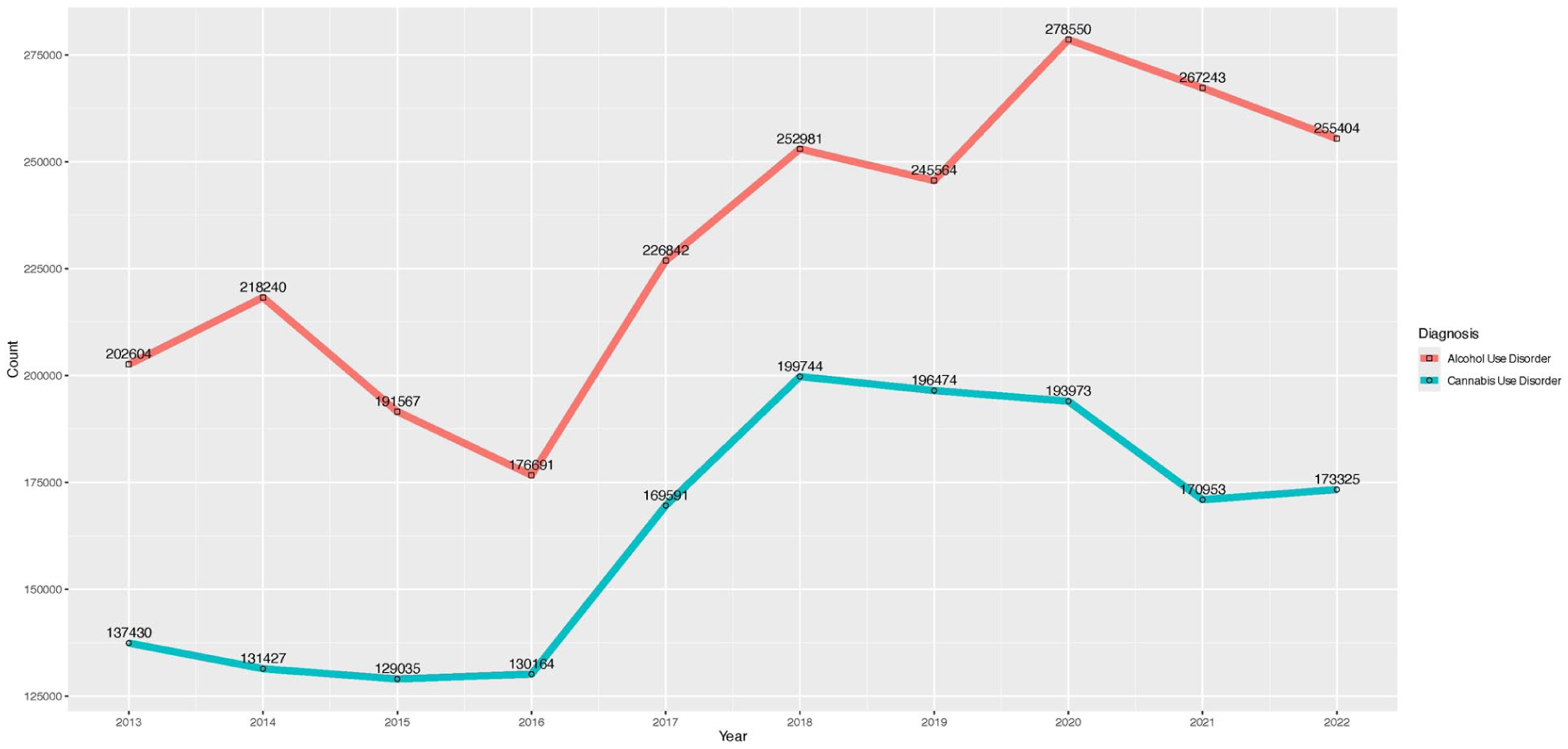
Annual total counts in alcohol and cannabis use disorder diagnoses in mental health treatment 2013 to 2022.

Annual regional counts in alcohol and cannabis use disorder diagnoses in mental health treatment 2013 to 2022.
Sample with an Alcohol Use Disorder Diagnosis
As seen in Figure 1, the year 2020 had the most alcohol use disorder diagnoses at 278 550. Regarding treatment setting in which care was received: 95.3% (n = 2 207 414) received treatment in a community mental health center, 6.4% (n = 149 112) received treatment in other psychiatric inpatient setting, 4.7% (n = 108 719) received treatment in a state psychiatric hospital, 3.7% (n = 84 953) received treatment in the criminal justice system, and 1.5% (n = 34 527) received treatment in a residential treatment center. Approximately 86% (n = 2 000 092) had a co-occurring mental health disorder. The most common co-occurring mental health disorder diagnoses include depressive disorders (n = 821 659; 35.5%), anxiety disorders (n = 491 334; 21.2%), bipolar disorders (n = 466 744; 20.0%), trauma- or stressor-related disorders (n = 380 679; 16.4%), and schizophrenia or other psychotic disorders (n = 378 034; 16.3%). Considering age, the most prevalent age group was 50 to 59 years old (n = 557 526; 24.1%). Males accounted for approximately 60.6% of the sample (n = 1 402 346) and Non-Hispanic White individuals accounted for slightly more than half of the sample (n = 1 267 178; 54.7%). Figure 3 shows annual counts of alcohol use disorder diagnoses based on age, sex, and race and ethnicity.

Annual demographic characteristics of alcohol use disorder diagnoses in mental health treatment 2013 to 2022.
Sample with a Cannabis Use Disorder Diagnosis
As seen in Figure 1, the year 2018 had the most cannabis use disorder diagnoses at 199 744. Regarding treatment setting in which care was received: 95.8% (n = 1 563 617) received treatment in a community mental health center, 6.5% (n = 105 761) received treatment in other psychiatric inpatient setting, 5.2% (n = 85 016) received treatment in a state psychiatric hospital, 3.7% (n = 59 578) received treatment in the criminal justice system, and 1.7% (n = 27 306) received treatment in a residential treatment center. Approximately 90% (n = 1 471 899) had a co-occurring mental health disorder. The most common co-occurring mental health disorder diagnoses include depressive disorders (n = 494 113; 30.3%), bipolar disorders (n = 359 505; 22.0%), anxiety disorders (n = 337 194; 20.7%), schizophrenia or other psychotic disorders (n = 316 849; 19.4%), and trauma- or stressor-related disorders (n = 298 469; 18.3%). Considering age, the most prevalent age group was 18 to 29 years old (n = 366 960; 22.5%). Males comprised the majority of the sample (n = 991 381; 60.7%). Figure 4 shows annual counts of cannabis use disorder diagnoses based on age, sex, and race and ethnicity.

Annual demographic characteristics of cannabis use disorder diagnoses in mental health treatment 2013 to 2022.
Supplemental Figures
Supplemental Figures 1 and 2 contain annual percentages of co-occurring mental health disorder diagnoses among cases with an alcohol use disorder diagnosis or with a cannabis use disorder diagnosis. Supplemental Tables 1 and 2 provide the raw percentages that were used to create the figures.
Discussion
This descriptive epidemiological study presents data on the who, when, and where13,14 regarding alcohol and cannabis use disorder diagnoses in mental health treatment. Specifically, this study examined the combined age, sex, and race ethnicity characteristics of persons with these diagnoses to identify the “who.” Further, co-occurring mental health diagnoses were captured to identify the “who.” This study examined 10 years of annual data from 2013 to 2022 to identify the “when.” Lastly, the “where” was identified by regions of the U.S. and specific settings in which mental health treatment was received.
The Who
In both samples, males were the most prevalent sex at approximately 60%. Data suggests that males are more likely to have a substance use disorder than females, although this gap is narrowing.22,23 Considering the variability in different substance use disorders, this gap has been identified for alcohol use disorders.24,25 However, a study adjusting for cannabis use frequency found no difference in the presence of cannabis use disorder between males and females. 26 While females often face prominent barriers to entering addiction treatment, 27 they have higher odds of engaging with mental health treatment services.28,29 More research is needed to examine the complex interplay of co-occurring diagnoses, sex, and mental health treatment receipt identified by this study.
Considering age groups, persons aged 50 to 59 years were the most prevalent group in the alcohol use disorder sample. Whereas persons aged 18 to 29 years were the most prevalent group in the cannabis use disorder sample. Data examining drug use patterns have identified younger age groups in the U.S. having lower alcohol consumption 30 and higher cannabis consumption 31 than older age groups. Different substance use disorders have variability among various age groups. 23 Monitoring this variability may assist clinicians and researchers in being prepared for different substance use disorder trends as populations age.
Across both samples, anxiety disorders, depressive disorders, schizophrenia or other psychotic disorders, and trauma- or stressor-related disorders were the most prevalent co-occurring conditions. Mental health disorders in each of these 4 categories can have a significant impact on an individual’s well-being. One systematic review found that individuals with mental health disorders, such as anxiety disorders and depressive disorders, have a twofold increase in odds of having an alcohol use disorder. 5 Similarly, mental health disorders can be associated with cannabis use.6,32,33 The increased likelihood of these conditions co-occurring highlights the importance of behavioral health services that can screen for and effectively treat them. Most individuals with co-occurring mental health and substance use disorders who receive treatment encounter mental health treatment to the exclusion of substance use treatment, further highlighting the potential of some conditions, especially substance use disorders, being untreated.4,11 Overall, findings from this study highlight the clinical importance of facilities being able to provide co-occurring mental health and substance use disorder treatment, as alcohol and cannabis use disorders are associated with mental health disorders and negative mental health symptoms.3,5,6
The When
As this study utilized a descriptive epidemiological approach, no statistical testing was conducted to identify potential trends. Future studies may warrant a trend analysis of the alcohol and cannabis use disorders among individuals receiving mental health treatment. However, it is interesting to note that the year 2016 had the lowest count of individuals with an alcohol use disorder diagnosis in this study, and 2020 had the highest. Further, it is also interesting to note that the year 2015 had the lowest count of individuals with a cannabis use disorder diagnosis in this study, and 2018 had the highest. Future studies are needed to identify whether there are trends in these annual counts and whether certain events or legislations are associated with admissions during this 10-year period.
The Where
Regarding the region in which treatment was received, the Midwest was the most prevalent among individuals with an alcohol use disorder in this sample, followed by the South, then the West. The South was the most prevalent among individuals with a cannabis use disorder in the sample, followed by the Midwest, then the West. While these data present treatment counts, future studies are needed to examine treatment rates based on the region’s total population, or more precisely, based on estimates of the number of people living with these conditions in each region. Considering treatment settings, approximately 95% of both samples received treatment in a community mental health center. In the larger dataset, that is, after the annual cross-sectional MH-CLD 2013 to 2022 data were initially combined, 97.5% of the sample received treatment from a community mental health center. Community mental health centers play an essential role in the treatment landscape as they provide specialized services for individuals who have mental health disorders, especially vulnerable populations.34-36
Limitations
While this study provides a critical description of individuals who had an alcohol use disorder or cannabis use disorder diagnosis in mental health treatment, there are some limitations to consider. Firstly, the MH-CLD does not contain all mental health treatment episodes, only mental health treatment data from state administrative systems. Although this sample includes individuals who received treatment from mental health facilities throughout the United States, this is not representative of all individuals living with mental health diagnoses. Many individuals may be unaware that they are living with a mental health disorder whose impact may be reduced if they receive treatment. Further, some individuals may only seek treatment when experiencing a prominent emotional or mental crisis. Another limitation is that the substance use disorder variable had mutually exclusive values, as only 1 specific substance use diagnosis can exist per case. This excludes the possibility of examining 2 or more specific co-occurring substance use disorders, such as persons who have co-occurring alcohol use disorder and cannabis use disorder. This current study examined data from 2013 to 2022; however, future studies that conduct trend analyses alongside noteworthy events such as the COVID-19 pandemic and implemented health policies. While this utilizes a descriptive epidemiological approach,13,14 some may view the lack of significance testing as a limitation. However, this study focused on disseminating descriptive information about individuals with alcohol or cannabis use disorders in mental health treatment to generate future research ideas. Since this is a descriptive study, no power analysis was conducted.
Conclusion
This descriptive epidemiological study presents data on the who, when, and where regarding alcohol and cannabis use disorders in mental health treatment. Other clinicians and/or researchers may use findings from this study to guide future interventions or research. It is crucial to screen for substance use disorders alongside screening for mental health disorders for individuals seeking treatment from mental health facilities. Detecting the presence of substance use disorders, such as alcohol and cannabis use disorders, can assist clinicians in developing treatment plans to improve the overall well-being of persons entering a mental health treatment setting. It is recommended to treat mental health and substance use disorders simultaneously instead of separately.37-39
Supplemental Material
sj-docx-3-sat-10.1177_29768357251384499 – Supplemental material for Alcohol and Cannabis Use Disorder Diagnoses in Mental Health Treatment 2013 to 2022: A Descriptive Epidemiological Study
Supplemental material, sj-docx-3-sat-10.1177_29768357251384499 for Alcohol and Cannabis Use Disorder Diagnoses in Mental Health Treatment 2013 to 2022: A Descriptive Epidemiological Study by Orrin D. Ware1 in Substance Use: Research and Treatment
Supplemental Material
sj-docx-4-sat-10.1177_29768357251384499 – Supplemental material for Alcohol and Cannabis Use Disorder Diagnoses in Mental Health Treatment 2013 to 2022: A Descriptive Epidemiological Study
Supplemental material, sj-docx-4-sat-10.1177_29768357251384499 for Alcohol and Cannabis Use Disorder Diagnoses in Mental Health Treatment 2013 to 2022: A Descriptive Epidemiological Study by Orrin D. Ware1 in Substance Use: Research and Treatment
Supplemental Material
sj-jpg-1-sat-10.1177_29768357251384499 – Supplemental material for Alcohol and Cannabis Use Disorder Diagnoses in Mental Health Treatment 2013 to 2022: A Descriptive Epidemiological Study
Supplemental material, sj-jpg-1-sat-10.1177_29768357251384499 for Alcohol and Cannabis Use Disorder Diagnoses in Mental Health Treatment 2013 to 2022: A Descriptive Epidemiological Study by Orrin D. Ware1 in Substance Use: Research and Treatment
Supplemental Material
sj-jpg-2-sat-10.1177_29768357251384499 – Supplemental material for Alcohol and Cannabis Use Disorder Diagnoses in Mental Health Treatment 2013 to 2022: A Descriptive Epidemiological Study
Supplemental material, sj-jpg-2-sat-10.1177_29768357251384499 for Alcohol and Cannabis Use Disorder Diagnoses in Mental Health Treatment 2013 to 2022: A Descriptive Epidemiological Study by Orrin D. Ware1 in Substance Use: Research and Treatment
Footnotes

Ethical Considerations
The University of North Carolina at Chapel Hill Institutional Review Board determined that this study is not considered human subjects research.
Consent to Participate
Informed consent is not applicable for this study.
Author Contributions
ODW: Conceptualization, Data curation, Formal analysis, Investigation, Methodology, Resources, Software, Validation, Visualization, Writing – original draft, Writing – review & editing
Funding
The author received no financial support for the research, authorship, and/or publication of this article.
Declaration of Conflicting Interests
The author declared no potential conflicts of interest with respect to the research, authorship, and/or publication of this article.
Data Availability Statement
Supplemental Material
Supplemental material for this article is available online.
References
Supplementary Material
Please find the following supplemental material available below.
For Open Access articles published under a Creative Commons License, all supplemental material carries the same license as the article it is associated with.
For non-Open Access articles published, all supplemental material carries a non-exclusive license, and permission requests for re-use of supplemental material or any part of supplemental material shall be sent directly to the copyright owner as specified in the copyright notice associated with the article.


