




Abstract
A behavioral quantum strategy is shown to replicate the payoff of a classical mixed strategy in an extensive-form game with imperfect recall, using only local measurements on a separable quantum state with nonzero discord. Classical behavioral strategies, constrained by memory loss, cannot achieve this coordination. When reinterpreted as a two-player game, the same construction yields a Nash equilibrium in behavioral quantum strategies. This result offers a quantum analogue of Kuhn’s Theorem: quantum discord substitutes for strategic memory, enabling coordination in settings where classical agents fail. These findings highlight discord as a minimal yet sufficient quantum resource for restoring equilibrium behavior under imperfect recall.
1. Introduction
Kuhn’s theorem (Kuhn, 1953) is a foundational result in classical game theory, demonstrating that in extensive-form games with perfect recall—where players remember all past choices and the information available at each point—mixed and behavioral strategies are outcome-equivalent (Osborne & Rubinstein, 1994). Mixed strategies involve committing in advance to a probability distribution over complete plans of action. In contrast, behavioral strategies specify independent random choices at each decision node, allowing players to act locally without preplanning. Given perfect recall, the two approaches yield the same strategic outcomes: long-term planning can be replaced by appropriate on-the-spot decisions. This structure aligns with the concept of bounded rationality, as introduced by Herbert Simon (Simon, 1955), which emphasizes that real-world agents often operate under cognitive constraints, including limited memory and foresight. Behavioral strategies also simplify computation and can serve as psychological tools, introducing unpredictability into a player’s actions. In this paper, I explore how tools from quantum information theory—specifically quantum discord—can extend the behavioral framework to settings where imperfect recall breaks the classical equivalence, offering a new model of bounded rational decision-making without memory.
In games with imperfect recall, however, Kuhn’s theorem no longer holds. Behavioral strategies may underperform relative to mixed strategies, revealing the limits of classical models of bounded rationality when recall is compromised. This breakdown is especially relevant in economic and financial environments, where agents often make sequential decisions under uncertainty and with limited cognitive resources—for example, in portfolio rebalancing, investment planning, or dynamic policy responses. Classical models typically assume ideal memory or forward-planning ability, assumptions that are difficult to justify in high-frequency, decentralized, or attention-constrained settings. These limitations invite consideration of alternative mechanisms for coordinating decisions across time without relying on recall or strategic precommitment. Quantum information theory (Wilde, 2017) offers one such mechanism.
While quantum entanglement is often cited as the source of quantum advantage in strategic contexts (Brandenburger & La Mura, 2016; Horodecki et al., 2009), recent work has shown that even separable states can exhibit non-classical correlations through a phenomenon known as quantum discord (Henderson & Vedral, 2001; Ollivier & Zurek, 2001). Quantum discord captures the disturbance induced by local measurement, independent of entanglement, and offers a more minimal form of quantum correlation. The behavioral quantum strategy constructed in this paper uses a separable, discordant quantum state and local measurements to achieve the same payoff as a classical mixed strategy in an imperfect recall game. This coordination is accomplished without strategic recall, entanglement, or communication. While not a formal extension of Kuhn’s Theorem, the result suggests a quantum analogue: discord enables a behavioral-style strategy to recover the coordination power of mixing in a context where classical behavioral strategies fail.
Several authors have investigated the role of discord in strategic settings, including Nawaz, Wei, and Lowe (Lowe, 2024; Nawaz & Toor, 2010; Wei & Zhang, 2017), though primarily in the context of normal-form games. This paper shifts the focus to extensive-form games with imperfect recall. The formalism of quantum extensive-form games introduced by Ikeda (2023) provides a structural basis for incorporating quantum transitions and interference into sequential decision-making, though it does not address discord. The present analysis demonstrates that quantum discord, unlike entanglement, can serve as a standalone operational resource for extending behavioral strategies beyond the limits imposed by classical information structures. This result opens the door to novel frameworks for modeling agent behavior in economic environments characterized by dynamic uncertainty and limited recall. These features—imperfect recall, myopic decision-making, and coordination failure—mirror challenges identified in behavioral economics, particularly in modeling dynamic choice under bounded rationality and limited attention (Barberis, 2013; Gabaix, 2014).
2. Classical and Quantum Strategies
To illustrate the core idea, we analyze a specific case: a constructed example in which a behavioral quantum strategy replicates the payoff of a classical mixed strategy in an imperfect recall game. Consider a single-agent, extensive-form game with two sequential decisions of Figure 1. At the first stage, the agent selects a1 ∈ {L, R}. At the second stage, the agent selects a2 ∈ {l, r}, but without recall of the first choice. Imperfect recall implies that the decision histories following L or R are indistinguishable at the second stage. The payoff function rewards alternating actions: An imperfect recall game with two stages where the agent takes actions of L versus R. The imperfect recall is depicted by the dashed box at decision node 2 where the player is unable to recall if they arrived at the one on the left or the one on the right.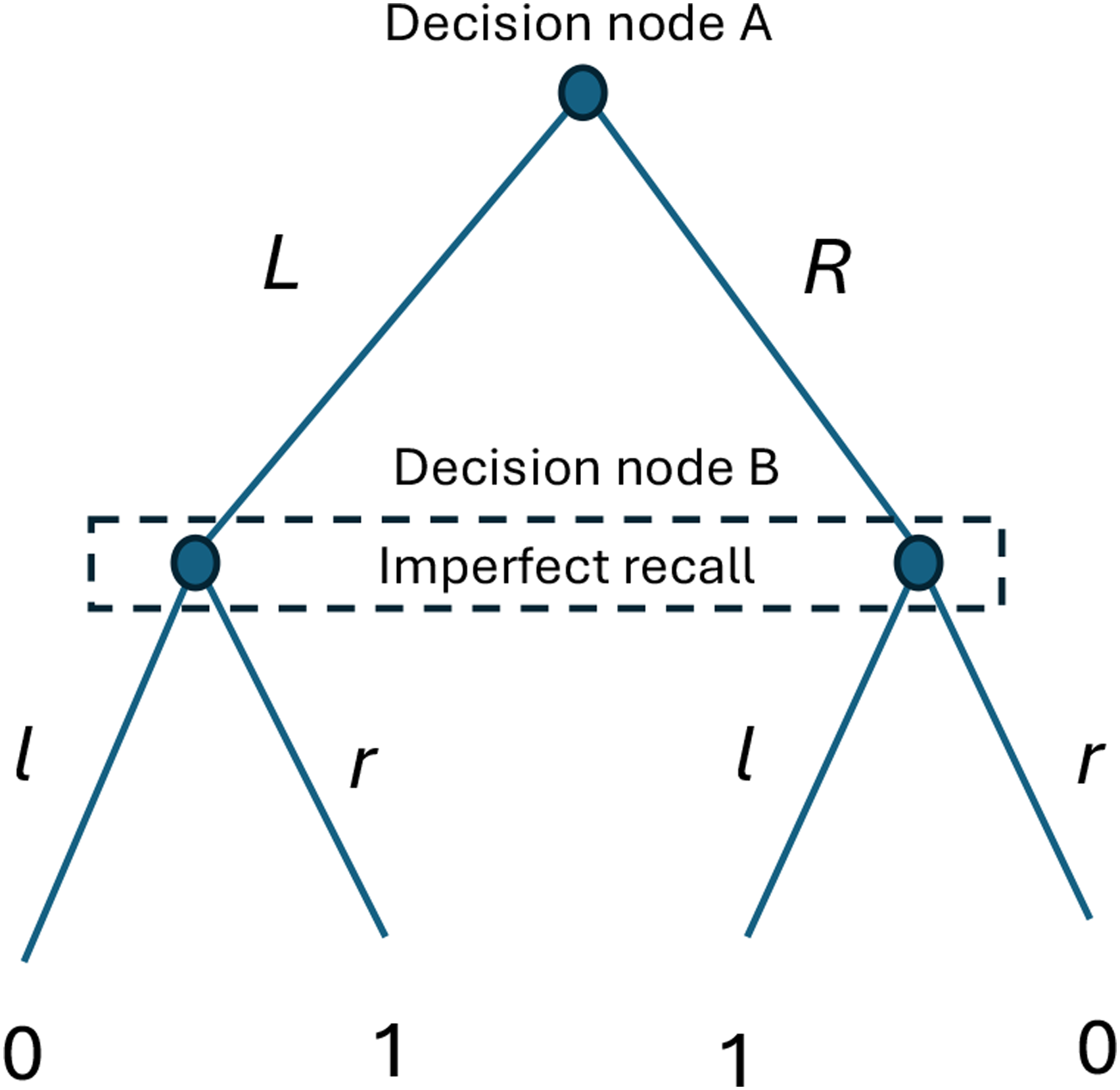

A behavioral strategy selects a1 and a2 independently. The best such strategy yields

In contrast, a mixed strategy can precommit to (L, r) and (R, l) with equal probability and produce a higher yield:

A behavioral quantum strategy achieving this optimal outcome without memory or communication uses the separable but discordant two-qubit quantum state:


as the X-basis states. The state ρAB can be understood as the outcome of a strategic preparation process in which the agent induces a separable but discordant correlation structure. This may involve probabilistically selecting between two product states—|0⟩
A
⊗| + ⟩
B
and |1⟩
A
⊗|−⟩
B
—or equivalently, applying local unitaries conditioned on an internal variable. Although Phoenix et al. (2020) does not explicitly address discord, it provides a game-theoretic perspective on state preparation that aligns with the broader motivation of the construction here: enabling optimal decision-making under informational constraints. The agent then implements the strategy by performing local measurements independently on each qubit: • Qubit A: measured in the computational basis {|0⟩, |1⟩}: • Qubit B: measured in the X-basis {| + ⟩, | − ⟩}:


Measurement on qubit A collapses the system into either |0⟩ or |1⟩, which in turn projects qubit B into | + ⟩ or | − ⟩. This procedure produces the outcomes (L, r) and (R, l) each with probability 0.5, resulting in alternating actions in both cases. The expected payoff is therefore:

Figure 2 illustrates the agent’s implementation of the behavioral quantum strategy via local measurements on a separable discordant state, with each measurement corresponding to a stage in the decision process. Quantum behavioral strategy implemented through local measurements on a separable discordant state. Qubit A is measured at the first decision node, and qubit B is measured at the second, enabling coordinated choices without recall or communication. The dashed ovals represent quantum discord: non-classical correlations that influence outcomes without requiring entanglement.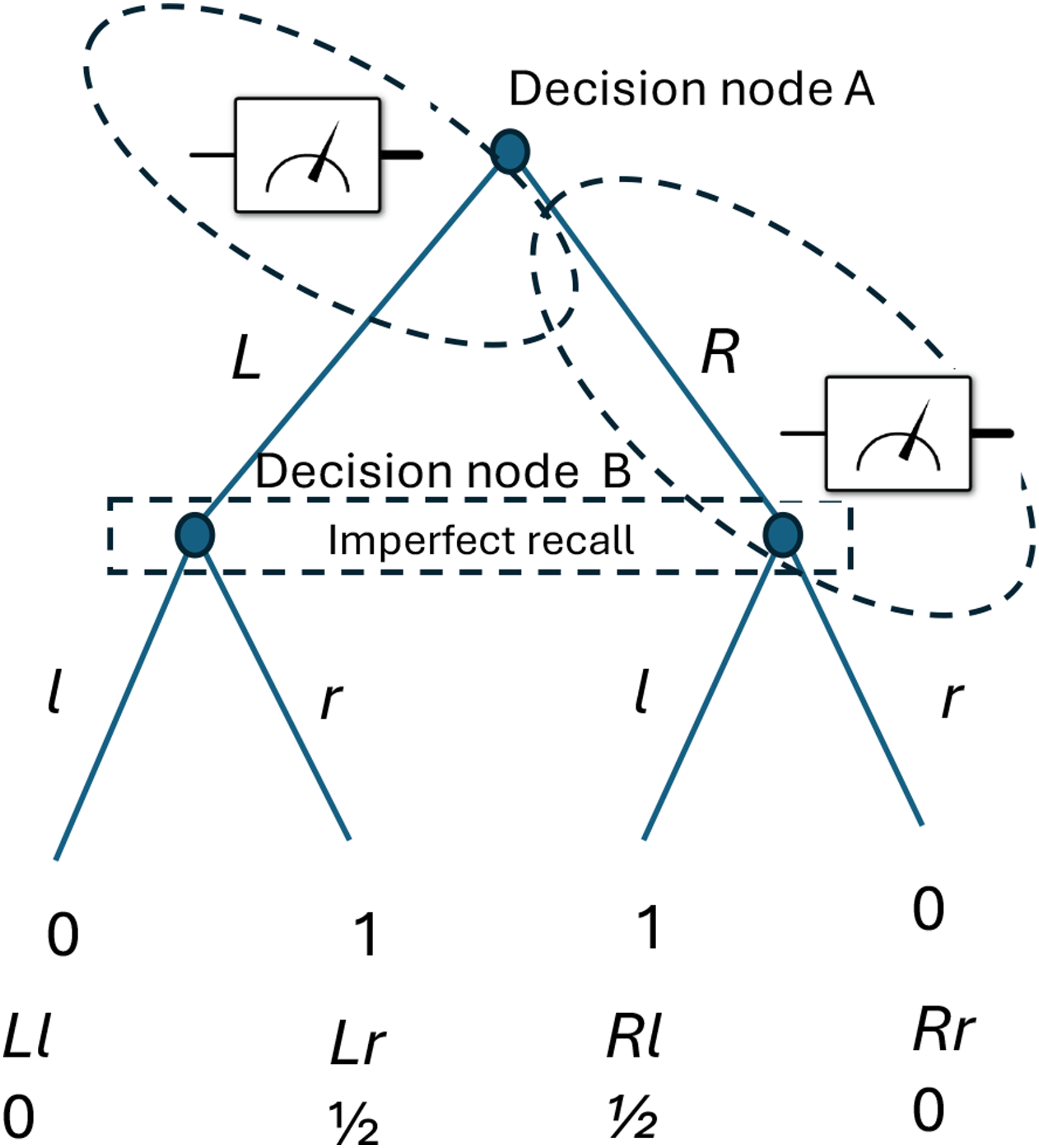
Although the agent’s measurements are local and memoryless, the resulting outcomes are correlated due to quantum discord in the constructed state. While structurally similar to a classical behavioral strategy in being locally implemented, this approach violates the classical assumption of independence across decision points. These quantum correlations—arising without entanglement—enable outcome-level coordination in the absence of memory, planning, or communication.
3. Quantum Discord in the Constructed Strategy
The state ρAB used in the agent’s behavioral quantum strategy


Despite the absence of entanglement, ρAB exhibits non-classical correlations, as captured by quantum mutual information. The reduced states are maximally mixed:


In contrast, a classical behavioral strategy implemented by independently tossing two fair coins produces a product distribution with zero mutual information: I behavioral (A: B) = 0. The presence of mutual information in ρAB therefore signals correlations that cannot arise in the classical setting without memory or planning.
These correlations are further characterized by quantum discord, which distinguishes classical from genuinely quantum correlations in separable states. Discord is defined as the difference between mutual information and the classical correlation obtained after optimal local measurement. It is generally asymmetric, and its value depends on which subsystem is measured.
When a projective measurement is performed on qubit A in the computational basis {|0⟩
A
, |1⟩
A
}, the post-measurement state of B becomes either | +⟩
B
or |−⟩
B
, both pure states. The conditional entropy is thus zero, and the classical correlation measure is given by


However, if qubit B is measured in the computational basis {|0⟩
B
, |1⟩
B
}, it disturbs the superposition states | +⟩
B
and |−⟩
B
, leading to mixed conditional states for A. The resulting conditional entropy is nonzero, implying

This correlation, where the outcome of measuring qubit A fully determines the post-measurement state of qubit B, mirrors the kind of dependence seen in entangled states, where measurement on one qubit instantaneously reveals the state of the other. However, in this case, the effect arises from quantum discord, not entanglement.
This confirms that ρAB possesses quantum discord: correlations that persist in separable states and resist classical explanation. In the agent’s strategy, this discord becomes operationally relevant under imperfect recall. After measuring qubit A, the agent does not retain memory of the outcome, yet the subsequent measurement of qubit B yields coordinated actions. The payoff-optimal behavior, unattainable via classical memoryless strategies, is achieved through local, memoryless measurements on a discordant state—demonstrating how discord substitutes for recall and enables effective coordination without entanglement or communication. In addition to its operational utility under imperfect recall, quantum discord is also more robust to environmental noise than entanglement (Werlang et al., 2010), making it a natural candidate for memory-free coordination in realistic settings.
3.1. Two-player Nash Equilibrium via Quantum Discord
While the quantum strategy above was introduced in the context of a single agent making two sequential decisions under imperfect recall, the structure of the game admits a natural reinterpretation. Each decision node can be viewed as belonging to a separate player—one choosing at the first stage and the other at the second—without changing the formal structure of the game tree. This two-player version allows us to analyze the strategy using standard equilibrium concepts. In particular, we now show that the quantum behavioral strategy previously described not only replicates mixed-strategy outcomes but also constitutes a Nash equilibrium when each stage is treated as an independent player’s move.
Reinterpret the two-stage imperfect-recall game as a genuine two-player extensive form: • •
They share the separable, discordant state

The payoff is 1 if and only if the players choose opposite labels, and 0 otherwise. Under these measurements they achieve perfect anticorrelation:

We use “anticorrelation” here to refer to the consistent alternation of actions that produces a payoff of 1, rather than to anticorrelation in a shared quantum measurement basis.
3.1.1. Best Responses
• If Player 1 deviates to any other measurement on A, the maximum achievable anticorrelation with Player 2’s fixed { +, − } measurement remains 100%, so she cannot improve beyond • Likewise, Player 2 cannot surpass perfect anticorrelation by changing her measurement on B when Player 1’s measurement is held fixed.
Therefore, neither player can unilaterally raise her payoff above 1, so this pair of local measurements is a Nash equilibrium in behavioral quantum strategies.
This two-player reinterpretation shows that quantum discord not only restores Kuhn’s equivalence of behavioral and mixed strategies under imperfect recall but also yields a genuine Nash equilibrium in the extensive form. In the discord-powered strategy pair, each player’s local measurement is a best response to the other’s, and together they achieve the maximum anticorrelation payoff. Thus, quantum discord acts as a “memory substitute” not only for subgame-perfect equilibrium arguments but also for the existence of Nash equilibria in extensive-form games with imperfect information. This highlights a novel role for separable quantum correlations in strategic settings, suggesting new avenues for equilibrium analysis in quantum game theory.
4. Discussion
Our results extend the reach of Kuhn’s theorem into settings where it classically fails. By reinterpreting the original imperfect-recall game as a two-player extensive-form interaction, we construct a local measurement profile that functions not only as a subgame-perfect strategy in the single-agent framing but also as a Nash equilibrium in behavioral quantum strategies. Each player’s measurement—applied independently to part of a separable, discordant quantum state—is a best response to the other’s. Together, they achieve the maximal anticorrelation payoff of 1. This equilibrium interpretation underscores the operational claim: discord does not merely approximate strategic memory—it supports equilibrium coordination in its absence.
Quantum discord can therefore be understood as a minimal but sufficient strategic resource in imperfect-recall settings. A separable discordant state, combined with local memoryless measurements, enables an agent to replicate the coordination payoff of a classical mixed strategy that would otherwise be unreachable via behavioral strategies alone. In this sense, the result offers a quantum analogue to Kuhn’s classical equivalence: quantum discord empowers behavioral-style strategies to recover the expressive power of mixing, even when classical behavioral strategies are constrained by memory loss.
Interpretive comparison of correlation types in economic and strategic contexts.
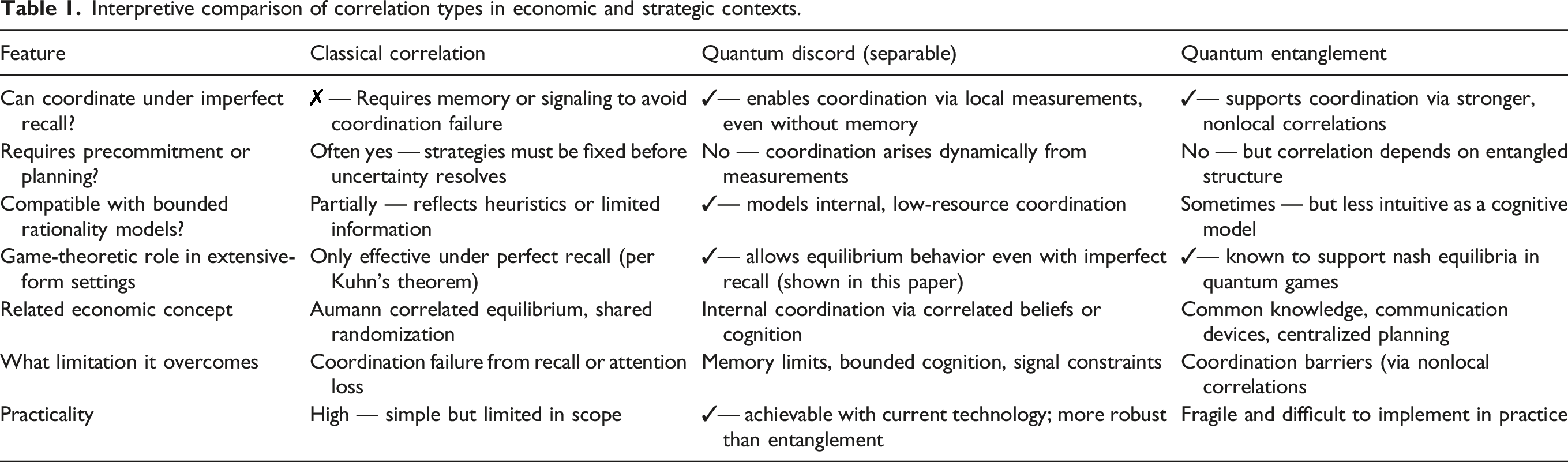
This raises the question of whether discord is not only sufficient, but also necessary for the observed coordination advantage. Our construction suggests that it is. There exist quantum states that are separable but also lack discord—that is, they exhibit no entanglement and no nonclassical measurement disturbance. These states cannot replicate the same behavioral quantum strategy, because they do not support outcome dependence on incompatible local measurements. As a result, they cannot enable coordination across decision stages without memory or signaling. Discord, by contrast, introduces just enough nonclassical structure to link local measurement outcomes across nodes. In this sense, it functions as a minimal resource for restoring coordination in memory-constrained settings.
While the analysis above focuses on ideal projective measurements on a separable discordant state, an important direction for future work is to model this behavioral quantum strategy under realistic experimental conditions. Specifically, the two-stage measurement process could be simulated as a sequential application of single-qubit gates followed by noisy measurements. For instance, each decision stage might be represented as a Bayesian estimation of a one-parameter unitary gate acting on a qubit, as explored in quantum tomography literature (Brivio et al., 2010). Such an approach would allow one to quantify the robustness of the discord-based strategy under amplitude damping, phase noise, or imperfect calibration, and to test its feasibility as a coordination protocol in near-term quantum devices. This phenomenon can be illustrated by imagining a robot navigating a two-stage maze. At each junction, it must choose left or right—but due to design constraints, it cannot recall its earlier choice. Classically, this robot is limited to independent randomization at each stage. But if its decision modules are initialized with a separable discordant state—each qubit guiding one stage—it can measure them locally and achieve coordinated behavior. Without any internal memory, the robot still conditions its second move on the first. Quantum discord, not planning or communication, enables this coordination.
The behavioral quantum strategy we construct thus reveals a deeper conceptual point: quantum discord encodes an irreducible informational asymmetry. Even in the absence of entanglement, separable states with discord restrict the information that can be extracted without disturbance. In our construction, this asymmetry is operational: the advantage of the quantum behavioral strategy using ρAB cannot be reproduced by any classical system without violating the assumption of imperfect recall. Although the state is separable, its discordant structure enables perfect outcome-level coordination through local, memoryless measurements. 1 Even without entanglement, discord enables local measurements to induce globally coordinated outcomes—what some have described as “spookier than spooky action at a distance”. 2
This perspective aligns with proposals in quantum economics, particularly Qadir’s early suggestion that the uncertainty principle may offer a more faithful model of strategic behavior than classical probability (Qadir, 1978). Qadir emphasized that in real-world economic processes—such as pricing, marketing, or investment—the order of valuation and exposure can influence outcomes, a principle mirrored in the directionality of quantum discord. In our construction, measuring qubit A first enables coordination; measuring B first disrupts it. This asymmetry underscores the explanatory potential of discord for modeling informational asymmetries in bounded rationality.
These findings carry broad implications for economic and financial modeling, especially in environments characterized by uncertainty, cognitive constraints, and imperfect recall. In behavioral economics, discord-based strategies offer a mechanism for internally coordinating decisions without memory, supporting models of bounded rationality, limited attention, and heuristic reasoning (Gabaix, 2014; Sims, 2003). In finance, sequential decision problems—such as portfolio rebalancing, algorithmic trading, or decentralized coordination—are often constrained by time and information availability. Classical behavioral strategies may underperform in such environments, but discord-based protocols could restore lost coordination. In macroeconomic modeling, particularly in dynamic stochastic general equilibrium and agent-based frameworks, discord offers a potential tool for representing dynamic agents who cannot retain or process full histories (Woodford, 2003). This opens a new line of inquiry into quantum-enhanced behavioral models that better reflect the structure of constrained decision-making across the economic landscape.
Footnotes
Declaration of Conflicting Interests
The author(s) declared no potential conflicts of interest with respect to the research, authorship, and/or publication of this article.
Funding
The author(s) received no financial support for the research, authorship, and/or publication of this article.
