




Abstract
Recent position papers have proposed that the traditional Business Process Management (BPM) lifecycle must be revisited considering generative AI advances, specifically by investigating how Large Language Models (LLMs) can assist various phases of the lifecycle. Inspired by that call to action, this paper reports on a series of experiments on how OpenAI's GPT-4 responds when querying the content of Business Process Model and Notation (BPMN) diagrams, as potential support for the Analysis phase of the BPM lifecycle. We are particularly interested in how BPMN content—typically available in enterprises that adopted the BPM lifecycle—should be exposed to LLM services, therefore we comparatively experiment with diagrams provided as XML serializations or as tool-specific RDF serializations. This is a comparison between a standard serialization characterized by intricate cross-referencing that compensates for the XML rigid hierarchical structure and the “semantic graph” view of RDF that is open-ended in terms of semantic annotation and can be serialized as sequences of statements that resemble natural language. The quality of the answers is assessed using the Retrieval Augmented Generation Assessment framework.
Introduction
The paper reports on continuous experimentation efforts with how selected Large Language Models (LLMs) services interpret Business Process Model and Notation (BPMN) models exposed in a variety formats—as standard XML serializations or as non-standard tool-specific RDF (Resource Description Framework) graphs. This work can inform how we engage with an AI-powered version of the Business Process Management (BPM) lifecycle (Dumas et al., 2018), leveraging augmentations made possible by LLM services for certain phases of the lifecycle. For the experiments reported in this paper, the GPT-4 model of OpenAI accessed via its API was the targeted service.
BPMN remains the dominant standard for documenting processes, predominantly relying on XML for diagram serializations, a variety of schemas being available for this—for example, XPDL, BPEL-WS, BPMN XML, ADOXML. A large diversity of process-aware systems or engines (Camunda, 2025) have been built on such XML schemas to parse process descriptions. However, in the context of semantics-driven engineering formulated by Buchmann et al. (2024), the requirement of process understandability becomes just as relevant as process instantiation and execution; moreover, process instantiation must sometimes be contextualized by a semantic layer available in the form of knowledge graphs. Towards such needs, the introduction of RDF encodings of BPMN content brings new semantics-oriented capabilities, although such representations are not yet widely adopted and are tool-specific: some examples are the Bee-Up modeling tool (OMILAB, 2024) and various demonstrators reported by the literature (Bachhofner et al., 2022).
Our research explores the use of XML and RDF serializations of BPMN with generative Artificial Intelligence (GenAI). The experiments harness the LLMs provided by OpenAI—in this report, GPT-4. By targeted prompts, we probe various aspects of selectively designed BPMN exemplars, to see how RDF compares with XML in facilitating interpretation of process descriptions, despite it not providing a standard vocabulary such as those available to the XML schemas for process descriptions. The adoption of knowledge graphs as process storage and BPMN knowledge structures is still an experimental proposition in artifact-oriented literature (Bachhofner et al., 2022; Uifălean et al., 2023), but it allows us to explore the potential of RDF to facilitate dialogue for process analysis via generative AI, beyond the XML export treatment of having BPMN as a closed world markup data structure. Consequently, we formulate the following research question pursued by the experimentation reported in this paper:
The LLM used for the experimentation reported in this paper is OpenAI's GPT-4, as our current focus is on varying the process description format. Future works will also vary the LLM services relevant for these research questions.
This research aligns with a current stream of investigation into the capability of AI to engage with conceptual models (Fill et al., 2023), thus also contributing to a meta-objective of refining an evaluation protocol on LLM suitability to model interpretation. The paper furthers the investigation into how LLM services can process serialized business process models, building upon initial prompting strategies that we have reported in a conference scope by Dolha and Buchmann (2024). The comparative analysis in this version extends across a more diverse set of scenarios, thereby expanding the representativeness and insights of the findings, based on a more refined experimentation design.
We focus on process serializations, rather than images, because most BPMS (Business Process Management Systems) or BPA (Business Process Automation) platforms and services rely on serializations for process repositories and model interchange, as they require deterministic interoperability or execution. The introduction of image recognition capabilities by the OpenAI's GPT-4 model significantly enhances the multi-modal interaction possibilities (Herwanto, 2023), enabling a more holistic approach to understanding and interacting with BPMN models. However, visualization cannot fully grasp a process description—many details relevant to process analysis do not manifest on a visual level (e.g., data attributes and links between diagrams).
The paper is organized as follows: in Section 2, we establish the problem scope in the context of the BPM lifecycle based on our reading of recent literature. Next, Section 3.1 explains the structural and syntactical differences between XML and RDF, Section 3.2 summarizes the model exemplars used in the experiments and Section 3.3 details the experimental setup. The core findings of our experimental study, along with our interpretation are reported in Sections 4.1 and 4.2, where the first analysis is on a full complex example and the latter focuses on minimalist BPMN patterns that are left unexplicit to force the LLM to develop its interpretation independently of the textual labeling found in diagrams. Section 5 synthesizes the results and connects them to broader implications. Concluding this study, Section 6 summarizes the findings and maps out directions for future exploration.
LLMs and the BPM Lifecycle
Motivated by the need to revisit the BPM lifecycle through the lens of the capabilities of LLMs (Vidgof et al., 2023), our investigation checks for the suitability of LLMs—in this paper OpenAI's GPT-4 model—for the semantic querying of procedural knowledge available in BPMN formats. The process analysis phase of the BPM lifecycle has traditionally relied on process queries by various means developed over the years: graph queries (Bachhofner et al., 2022; Uifălean et al., 2023), formal languages (BOC, 2025), visual grammars (Delfmann et al., 2015). Retrieval of information from BPMN models can of course be performed by visual analysis due to the diagrammatic nature of the content, however process queries are called to provide automatable mechanisms that can also be executed over process repositories. On the other hand, in our work we use smaller, even minimalist examples, to assess the LLM suitability as a replacement for process querying—therefore no repository scalability concerns are raised in this study, as we are focusing on isolating certain workflow patterns and commonly used BPMN constructs.
The phases of the BPM lifecycle revisited in relation to LLMs radically depart from the conventions of pre-GPT process analysis tools. Recent works (Vidgof et al., 2023) draw attention to how these models can redefine how we think about the phases of the BPM lifecycle: in the process identification phase, LLMs cut through the clutter of unstructured data: they do not just find information, they can gather workflow knowledge—moving into process discovery, the influence of GenAI can enhance process mining frameworks. Traditionally tethered to XML event logs, RDF can push graph-based process mining (Jalali, 2021). When it comes to querying processes, where this paper's focus lies, the traditional XML frameworks and XPath/XQuery-based retrieval are now over-hauled by multi-modal AI (OpenAI, 2024) with their computer vision capabilities. Yet, reliance on computer vision has its limits and must be complemented by a semantic serialization layer to also expose non-visual aspects that remain semantically relevant—for example, links between different models (such as RACI responsibilities on task level) or data attributes (e.g., task costs). In the redesign phase, AI can advocate changes, using code generation on serializations to apply workflow updates. As those updates are implemented, LLMs enrich user interactions with detailed explanations, shifting emphasis from static workflow sequences to dynamic conversational choreographies. During the monitoring phase, LLMs are not confined to data display, as they can interpret and analyze data.
The current report focuses on process querying and interpretation, crucial stages in process analysis, that require question-answering mechanisms and the capacity to draw inferences from the process semantics. As AI pushes the boundaries of BPM, recent technological proposals change the way processes can be analyzed. The BPMN2KG initiative (Bachhofner et al., 2022) illustrates the conversion of BPMN 2.0 models—typically expressed in XML—into RDF-based knowledge graphs and marks a different view on the instantiation of process models. Similarly, another conversion tool (Uifălean et al., 2023) allows BPMN XML formats to morph into Neo4J labeled property graphs, providing an alternative graph representation that adheres to the BPMN 2.0 vocabulary.
The work by Polyvyanyy (2021) laid an early foundation by exploring process querying methods and applications in BPM, establishing benchmarks that later studies would build upon. Furthermore, Grohs et al. (2023) ventured into the application of LLMs for textual analyses within BPM, demonstrating that GPT-4 can effectively derive both imperative and declarative process models from natural language descriptions—a significant advance for process querying. Analyzing the effectiveness of ChatGPT in generating and deciphering diverse conceptual models, Fill et al. (2023) suggested certain operational nuances that influence model interpretation. Building on these foundational insights, Kourani et al. (2024) extends earlier research by not only confirming the viability of LLMs for textual analysis in BPM, but also by operationalizing these capabilities into a comprehensive process modeling framework. It takes a step further by automating the transformation of textual descriptions into standardized process models, such as BPMN and Petri nets.
Another investigation, this time on prompt engineering for BPM (Busch et al., 2023), underscored the critical importance of prompt design for obtaining consistent and reliable outputs from LLMs. Similarly, Ayad and Alsayoud (2024) reinforces the idea that prompt customization is key for enhancing BPM outcomes and expanding domain knowledge coverage, with LLMs suggesting missing concepts from business process models (serialized using XML, XPDL, and XMI) and converted into CSV files for further processing. Complementing these developments, recent research (Gutschmidt & Nast, 2025) explores whether LLMs can substitute for domain experts by evaluating enterprise models and highlights that measuring certain quality aspects—such as completeness—remains challenging due to the inherent subjectivity and variability in certain models.
Expanding the scope further, Jasińska et al. (2023) scrutinized the intersection of GPT technology with RPA, drawing attention to potential security and compliance challenges as enterprises increasingly incorporate AI-driven process automation. The integration of GPT-3.5 Turbo with Lean Six Sigma 4.0 methodologies in Shahin et al. (2024) proposed upgrading customer service and enhancing real-time decision-making processes. Moreover, Yang et al. (2024) proposed a forward-thinking strategy that involves merging LLMs with knowledge graphs, an approach that is particularly promising when these graphs are designed around diagrammatic procedural knowledge effectively serialized as semantic networks.
While extensive research has concentrated on the performance of LLMs on unstructured text—such as generating and refining business process models from textual descriptions (Klievtsova et al., 2023) or extracting process information from text (Bellan et al., 2022)—, their ability to query structured serializations—specifically, RDF and XML serialization of BPMN process descriptions—remains largely underexplored.
This gap is significant, given the essential role that structured process representations play in BPM—traditionally, as storage format for process automation and analysis engines (hence the XML dominance) but now more relevant as semantically open-ended knowledge assets (hence our focus on RDF). Even though prior work (Sui et al., 2023) examined the performance of LLMs on structured formats such as tabular data, data-oriented scenarios differ significantly from those posed by structured BPMN representations (e.g., accurately parsing complex workflow patterns or managing intricate cross-references).
Experimental Setup
At the forefront of our study is Bee-Up 1.7 (OMILAB, 2024), a core component of the OMiLAB Digital Innovation environment (Karagiannis et al., 2022), known for its role in semantically enriching both standard-based and domain-specific models and languages, allowing the exploitation of inter-model links as semantic bridges between a diversity of modeling languages—e.g., BPMN, UML, DMN, EPC and Petri Nets.
SAP Signavio (2025) was used as a representative for the tools providing the standard BPMN 2.0 XML serialization.
Both tools provide image exports as PNG and other image formats, however the experimentation reported in this paper focuses on the XML versus RDF exports comparison, for the reasons already explained in the previous section.
Serialization Comparison
The structural differences between the XML and RDF serializations are briefly explained here based on the sample diagram in Figure 1, which shows a minimal subprocess linked to a main process with pool and lanes containment, as well as labeled connectors outgoing from a gateway.

BPMN exemplar that includes a subprocess link.
Figure 2 provides an overview of the hierarchical, DOM-based structure available in the standard serialization, conforming the standard BPMN 2.0 XML schema available in Signavio.

Cross-references in the DOM hierarchy of the standard BPMN XML serialization (based on the exemplar in Figure 1).
Because the hierarchical decomposition does not reflect the visually directed graph structure of the diagram, an intricate network of cross-references across XML tags must preserve all relevant relationships. Some of these are attribute-attribute matches (e.g., to specify containment between a pool and the process inside it), others are attribute-tag matches (e.g., to specify containment between a lane and its flow elements, but also visual connectors referencing their connector heads), one-to-one (e.g., an arrow can have one starting point and one ending point) or one-to-many matches (e.g., a gateway has multiple outgoing connectors). Only a few relationships are expressed by the implicit parent-child XML nesting that would be familiar to a basic parser reading such content sequentially: a process containing lanes and a subprocess containing its contents. XML parsers navigate such complex cross-references as prescribed by the governing XML schema, but process interpretation by a linear token-based parser reading it as textual content requires frequent back-and-forth jumps based on heterogeneous matching rules.
Comparatively, Figure 3 showcases the graph structure of an RDF serialization in Bee-Up, derived from transformation patterns initially formulated by Buchmann and Karagiannis (2015).
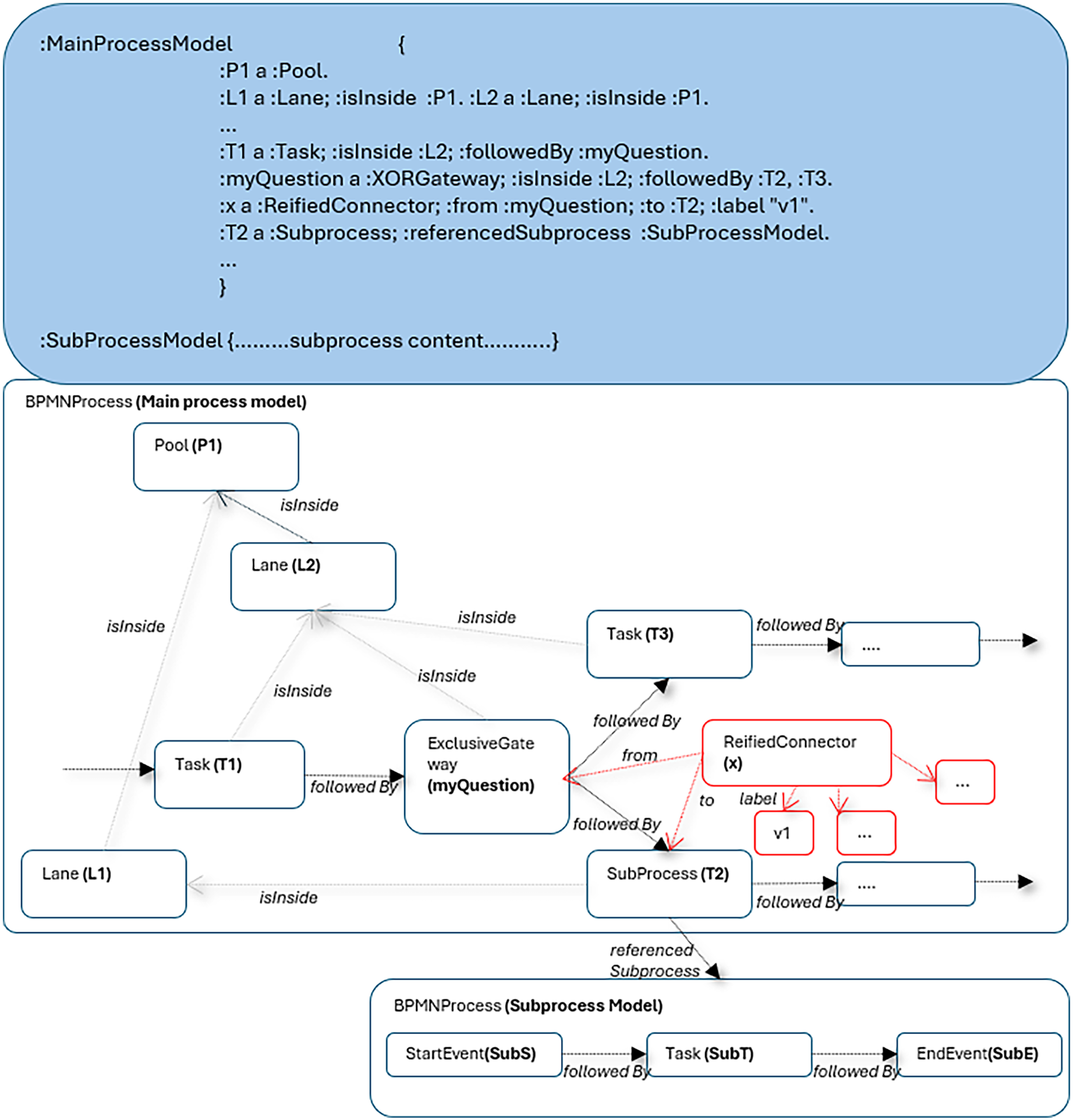
Graph structure for the RDF serialization (based on the exemplar in Figure 1).
The graph edges represent predicates that can be derived from various ways in which diagrammatic descriptions can express relationships: visual connectors (i.e., sequence flows, message flows), hyperlinks (e.g., links to subprocesses), containment relationships (to lanes, pools), data attributes editable in the tool (e.g., simulation attributes, connector annotations) and also open-ended properties that can be attached as annotations to any diagrammatic element (not used in this example).
Some visual connectors must emulate the “property graph” approach—i.e., graph edges having their own properties—therefore the outgoing arrows from the XOR gateway, which need to be labeled differently are highlighted as a reification pattern (the Bee-Up export does not currently employ RDF-star (W3C, 2023) which could simplify this further). The connector is reified to hold any attributes that are distinctively set for each instance of that connector. SPARQL rules and filters can be used to conveniently query the connectors in either the simple (non-annotated) form, or in the reified (annotated) form, depending on the process query requirements.
Subprocesses are isolated as separate named graphs, however, linked within the same RDF dataset. Leveraging such patterns, an RDF export is available in the Bee-Up modeling tool, with some terminological aspects not detailed here (tool-specific namespaces). On the top of the figure, TriG/Turtle statements show the process as it is serialized and grouped by the diagram graph where the statements belong. Many other attributes can be exported, not visible here as they are not relevant to semantically-oriented process queries (e.g., visual position) and are also filtered out by our component that delivers the graphs to GPT-4.
We focused our experiments on two kinds of BPMN models: (1) a realistic model of a main process linked to a subprocess, illustrated in Figure 4; (2) a set of minimalist process patterns (Figures 5 and 6) that are labeled non-explicitly to allow us to probe process structure interpretation while avoiding any chance of hallucinating a business scenario narrative out of textual labels. We only showcase in Figures 4 to 6 the Bee-Up variants, having equivalent elements to the Signavio variants.

BPMN diagrams depicting the main BPMN process (top) and the “Bot authentication microflow” subprocess (bottom) designed in Bee-Up 1.7.

Minimalist process modeling patterns in BPMN.

Collaborative and coordinated process patterns in BPMN.
The realistic process model in Figure 4 depicts the logic of an RPA bot planned to mimic the human actions for online shopping, as well as the data requirements for the bot to accomplish such a task and the “human in the loop” interactions—including credentials needed to perform some authentication steps on behalf of the human.
The examples in Figures 5 and 6 follow a different strategy: only generic labels are visible, forcing the LLM to look into the process structures instead of extrapolating scenario narratives inspired by labels, as this was detected as an occasional behavior on label-rich diagrams. This also helps us assess the structural and flow-based “reasoning” abilities that may manifest, driven by the different types of connectors and the semantics they carry—sequence flows, message flows, data associations.
The key feature leveraged in Bee-Up is the RDF export, which builds on previously introduced diagram-to-named graphs transformation patterns (Buchmann & Karagiannis, 2015). To parse and filter the RDF outputs as semantic graphs, we turned to Ontotext GraphDB 10.8 (Ontotext, 2025) after stripping away irrelevant attributes from the RDF metadata.
Ontotext GraphDB expands the standard SPARQL querying capabilities with OpenAI-oriented functions such as gpt:ask() 1 that engages directly with the selected GPT model (specifically for this work, GPT-4) while exposing to it a convenient subgraph extracted from the RDF repository. The structure of the utilized query is shown below, filtering specific types of nodes and edges that are relevant for the process description (and not for its visualization):

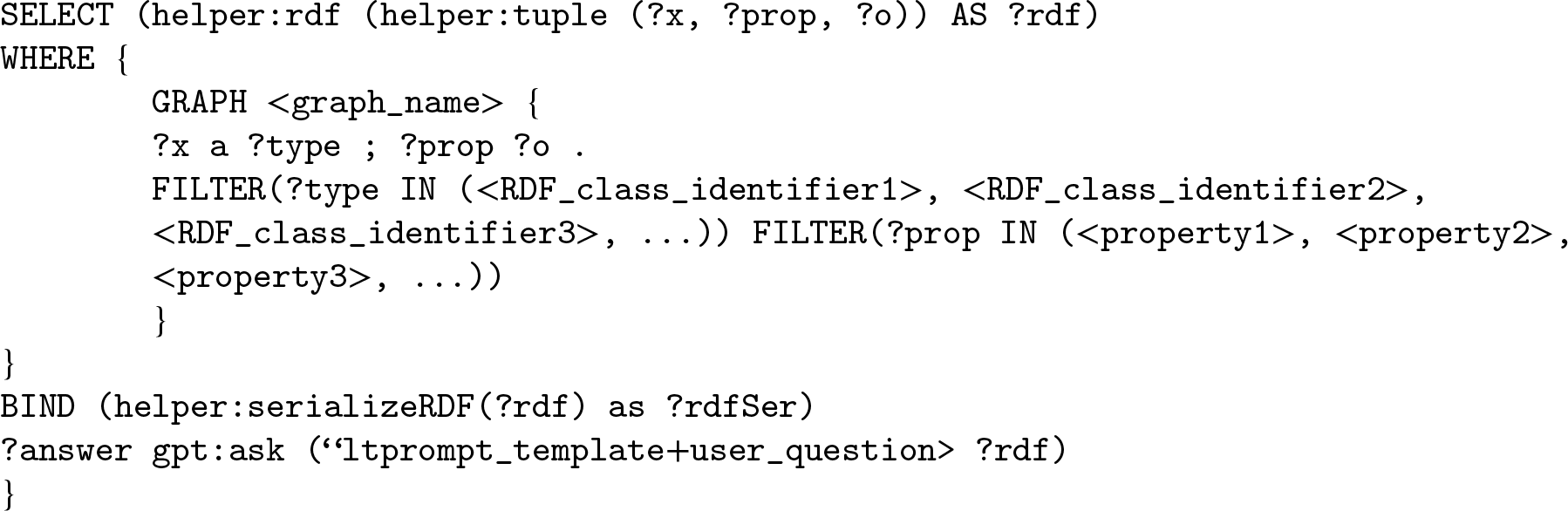
We use zero-shot learning out of the prompting techniques discussed by the literature (Iga & Silaghi, 2024; Schulhoff et al., 2024)—where the GPT model is prompted to perform a task without being provided any prior examples—and incorporate a “persona” prompt template. Specifically, in the SPARQL query, we pass this prompt template to the gpt:ask() function along with the actual question. This strategy defines GPT-4's role as a question-answering assistant and sets a strict format for its responses, keeping them brief and anchored in the provided content (namely, the semantic triples). This minimizes the ambiguity, possible hallucinations and variability in the generated outputs, so the evaluation of these responses is simplified. Importantly, while our instructions clearly define the style and format of the generated response, they refrain from any explanations of the retrieved content, allowing GPT-4 to independently derive its meaning.
In order to boost performance on knowledge-intensive tasks, Lewis et al. (2020) introduced a Retrieval Augmented Generation (RAG) framework that pairs a search component (called a retriever) with an LLM, allowing the system to first identify relevant contextual information and then generate context-aware responses—a concept we also leverage in order to request responses based on the BPMN content. We deployed a local environment (namely, a Weaviate 2 instance for vector storage) to serve as our vector database for the process information, which integrates smoothly with the LangChain 3 components we use to load the BPMN XML file. We utilize the same prompt template—used to query the RDF graph database—and integrate the retriever, the prompt, as well as the GPT model into a so-called RAG pipeline. Each user query is processed through a predefined prompt template and passed to the retriever, which extracts the process model content to be provided as context to GPT-4. Both the answers and the associated context retrieved for each prompt are stored for subsequent evaluation. Regarding GPT-4's configuration, we maintained a consistent setup across all platforms, including both GraphDB and our Python scripts 4 :
Evaluation and Experimental Outcomes
During April–July 2024, followed by revision refinements during October–December 2024, we examined responses produced by GPT-4 to a variety of prompts probing its BPMN-based process analysis capabilities. For clarity, we refer to the RDF variant by “Case I” and to SAP Signavio exports by “Case II.” This approach is not intended to highlight limitations within any specific tool, but to explore the differences and potential insights that different serialization formats may reveal.
In the preliminary stages of our experiments, the tools deployed in the aforementioned cases demonstrated adeptness in responding to straightforward inquiries, such as identifying participants or listing the sequence of steps in the provided processes. These queries, predominantly aiming at recognizing basic BPMN elements, established a baseline of competence.
Using the Retrieval Augmented Generation Assessment (RAGAs) framework (Es et al., 2024), we compare the answers generated by the LLM from both cases against a manually crafted reference/ground truth, focusing on four key metrics: Response Relevancy 5 , Factual Correctness 6 , Answer Semantic Similarity 7 , and a modified version of the Faithfulness 8 metric. Response Relevancy, initially known as “Answer Relevance,” measures how well the generated answer addresses the question posed in each experiment, independent of its factual accuracy, and imposes penalties for extraneous information. Factual Correctness (“Answer Correctness”) evaluates the factual consistency between the generated answer and the ground truth (which is the gold standard against which the generated answers are compared), by decomposing both into discrete claims and applying natural language inference techniques to measure their alignment. Within the experiments, we set the Factual Correctness's mode parameter to “precision,” atomicity to “low” and coverage to “high,” in order to apply an entity coverage that is both granular and extended over the full context. Answer Semantic Similarity, previously known as “Answer Similarity,” focuses on the extent to which the meaning of the generated answer matches the meaning of the reference, even if the wording is different. Unlike Factual Correctness, this metric first converts both the generated answer and the ground truth into vectors, then computes the cosine similarity between them to assess their shared semantic content rather than exact phrasing. On top of these metrics, we updated Faithfulness to get a better sense of how well the generated answer matches the retrieved context. Normally, Faithfulness measures the proportion of claims within the generated response that are substantiated—that is, inferable—based on claims present in the provided context. But since our contexts are structured (RDF triples and XML), while the generated answers are unstructured (textual descriptions)—each format organizing and representing information differently—comparing them directly can become challenging. To address this, we use OpenAI's text-embedding-ada-002 embedding model to convert both the answer and the retrieved structured context into vector embeddings, then compute the cosine similarity between them and average the results (rounded to two decimals)—much like how Answer Semantic Similarity is calculated. This new approach, which we call “Semantic Faithfulness,” offers a clearer evaluation on whether the semantic content of the claims in the generated answer is meaningfully supported by the retrieved contextual information.
In these comparative LLM experiments, automated metrics provide a “sensor” instrument to augment human interpretation of the response deviations, and also to distinguish between different types of deviations (e.g., question misinterpretation versus inference insufficiencies). This approach aligns with recent literature (Gutschmidt & Nast, 2025) in the field of model quality assessment using LLMs, where the authors advocate for the use of LLM-based evaluation patterns that integrate quality frameworks and emphasize that such techniques can aid human raters or serve as scaffolding in quality validation. As mentioned in the introduction, it is also a secondary (meta)goal of this work to refine such an evaluation protocol that can be reused for queries on larger scale content, where direct human interpretation is less feasible. Moreover, this opens opportunities and potential for instructional, corrective feedback loops automated based on the computed metrics.
The evaluation process for the BPMN models serialized in RDF began by loading the Turtle-serialized process description and filtering out triples that hold to no semantic relevance (visual properties). The context is paired with a specific question, its corresponding ground truth and GPT-4's answer. An evaluation dataset is thus constructed from these components. Subsequently, evaluation metrics from the RAGAs framework, along with a custom semantic faithfulness measure, were applied to assess the generated responses. The results were exported as a JSON file for further analysis.
Meanwhile, for BPMN XML, the generated answers are evaluated using the same metrics, with the retrieval process—explained in detail in Section 3.3—providing the necessary context for each query. Just as in the RDF case, these outputs are compiled into a dataset and exported as a JSON file containing the user input, retrieved contexts, response, reference and the four metrics.
The XML process serialization offers a standard vocabulary, not only a standard structure, XML being traditionally a data interchange format. The RDF export of BPMN is only standard in the structural sense—as a directed semantic graph standard—and not as a process description vocabulary, for which intuitive tool-specific terms are generated by Bee-Up, derived from the concept labeling that is prescribed on the metamodel level. Therefore, LLMs may treat the RDF variant as a semantic network that happens to contain edges whose labels describe workflows, while the XML variant can be recognized upfront as a standard interchange format that is widely available in training corpora and Web content.
We selected test queries to span a range of retrieval cases of different complexities: from simple element enumeration/type distinctions to navigating conditional branching and inter-pool communication, collecting data annotations (e.g., time, costs) and for the realistic example, also the navigation of the subprocess hyperlink.
The strategy was rooted in a perspective based on our metamodeling experience, which is common to both the XML and RDF serializations—in the sense that they explicitly distinguish node and relation types, containment and data annotation; human interpretation of any BPMN diagrams cognitively relies on grasping these distinctions and, based on them, navigating multi-hop relationships within directed graphs. Experiments are also guided by the BPMN usage trends reported by Compagnucci et al. (2023), where the most common constructs found in several large collections of BPMN diagrams were identified—our battery of examples does not yet cover all possible constructs, as we are prioritizing based on such usage rankings.
We also diversified prompts according to the BPM perspectives—that is, looking at control flows, communication/collaboration perspective and the data perspective, as well as subprocess navigation between different diagrams as expected in a realistic process repository where not all information is expressed by a single diagram. To avoid erroneous interpretations, we tried to formulate the queries as explicitly as possible, consistently using standard BPMN terminology—for instance, referring to process steps as tasks.
Our findings are presented in the following tables, with the highest metric value highlighted in bold, accompanied by a detailed discussion. Occasional explanations of how the metrics are calculated will be provided for certain scenarios; in some cases, the scores are sufficiently self-explanatory. Given the probabilistic nature of LLMs, multiple test iterations were conducted to identify the most consistently retrieved responses, regardless of variations in phrasing or style.
Sections 4.1 and 4.2 will discuss the most relevant prompts where meaningful differences can be highlighted, whereas less interesting prompts, with inconclusive results or minimal variation, can be consulted in the Appendix.
Prompts on the Explicit Realistic Example
Looking at the results in Table 1, Case I (RDF formatted data) and Case II (BPMN XML export) behave rather differently. In the first case, where we filter the RDF triples with the SPARQL query, GPT-4 provides the user with an almost complete and correct answer that also closely matches the ground truth—evidenced by high relevancy, correctness and semantic similarity scores. Most of the important details from the structured context are properly reflected within the generated response, except for the expanded subprocess labeled “Repeat for each desired product” —where the tasks “Add product to cart” and “Edit quantity” are displayed—revealing a certain limitation in coverage and a slightly lower score for semantic faithfulness.
Comparative Analysis of GPT-4's Responses on Task and Subprocess Enumeration in the “User Coordinated Bot (at Client)” Pool (Figure 4).

Comparative Analysis of GPT-4's Responses on Task and Subprocess Enumeration in the “User Coordinated Bot (at Client)” Pool (Figure 4).
In contrast, the second case yields a partial response, enumerating only the first few tasks following the task labeled “Add product to cart” within the requested pool. Since the utilized BPMN XML file is quite large—containing more than 20000 tokens—it exceeds the input size that GPT-4 can handle at once. To manage this, we automatically split the file into smaller, overlapping sections of text called chunks (using RecursiveCharacterTextSplitter 9 ). Each chunk includes a bit of content from the beginning and end of the neighboring chunks, so that important contextual information is not lost during the split. By default, the system retrieves 4 chunks when answering a question, which falls within a safe limit for the GPT-4's input. Nonetheless, for lengthy process descriptions, where tasks and subprocesses are distributed throughout, this default behavior can result in incomplete responses, which is one of the possible reasons that could explain the missing information in some of our test cases (see Table 1, Case II). To improve this, we note that it is possible to combine manual tag removal with automated text splitting or to increase the number of retrieved chunks to capture more context, while still staying within the input limits of the utilized model.
Another observation about Case II is that GPT-4 failed to capture the subprocesses embedded within the BPMN model, focusing solely on task-type elements and contributing to an incomplete representation even of this small portion of the process that the LLM retrieved.
Both responses in Table 2 address the prompt well and capture the overall meaning expected by the ground truth, given the high relevancy and semantic similarity values. Although the first part of the XML-based answer (Case II) is syntactically and semantically similar to the ground truth, it misses or misrepresents key factual details in the following parts of the response—specifically, it fails to fully capture the exclusive gateway mechanism, which is the true reason that prevents simultaneous execution and not the fact that the tasks are executed one after another. This is also supported by low factual correctness. Regarding Case I, most key details in the process are correctly captured, even though minor discrepancies exist. One such discrepancy emerges from how resources are named and represented in the RDF context. Particularly, process elements (subjects and objects) are identified using full Internationalized Resource Identifiers (IRIs)—long, unique web-like addresses. These IRIs are typically expanded from a shorthand prefix. For example, the prefix “:” refers to the namespace “http://www.omilab.org#.” Therefore, a snippet like:
Comparative Analysis of GPT-4's Responses on Simultaneous Task Execution (Figure 4).

which identifies the task “Provide delivery & invoicing data” as an instance of a BPMN task type, can slightly affect the vector representation, especially when compared to the more natural phrasing used in generated answers, leading to small mismatches in the cosine similarity (even if the answer is semantically correct) when calculating the semantic faithfulness. Case II reflects comparable alignment with its context, despite the variations in how the information is structured.
The part “inside the corresponding subprocess” from this prompt (Table 3) is designed to test whether the model can identify the correct subprocess—namely, “Bot authentication microflow”—based on a clear condition, without being explicitly told.
Comparative Analysis of GPT-4's Responses on “Bot Authentication Microflow” (Subprocess) Description Under a Condition (Figure 4).
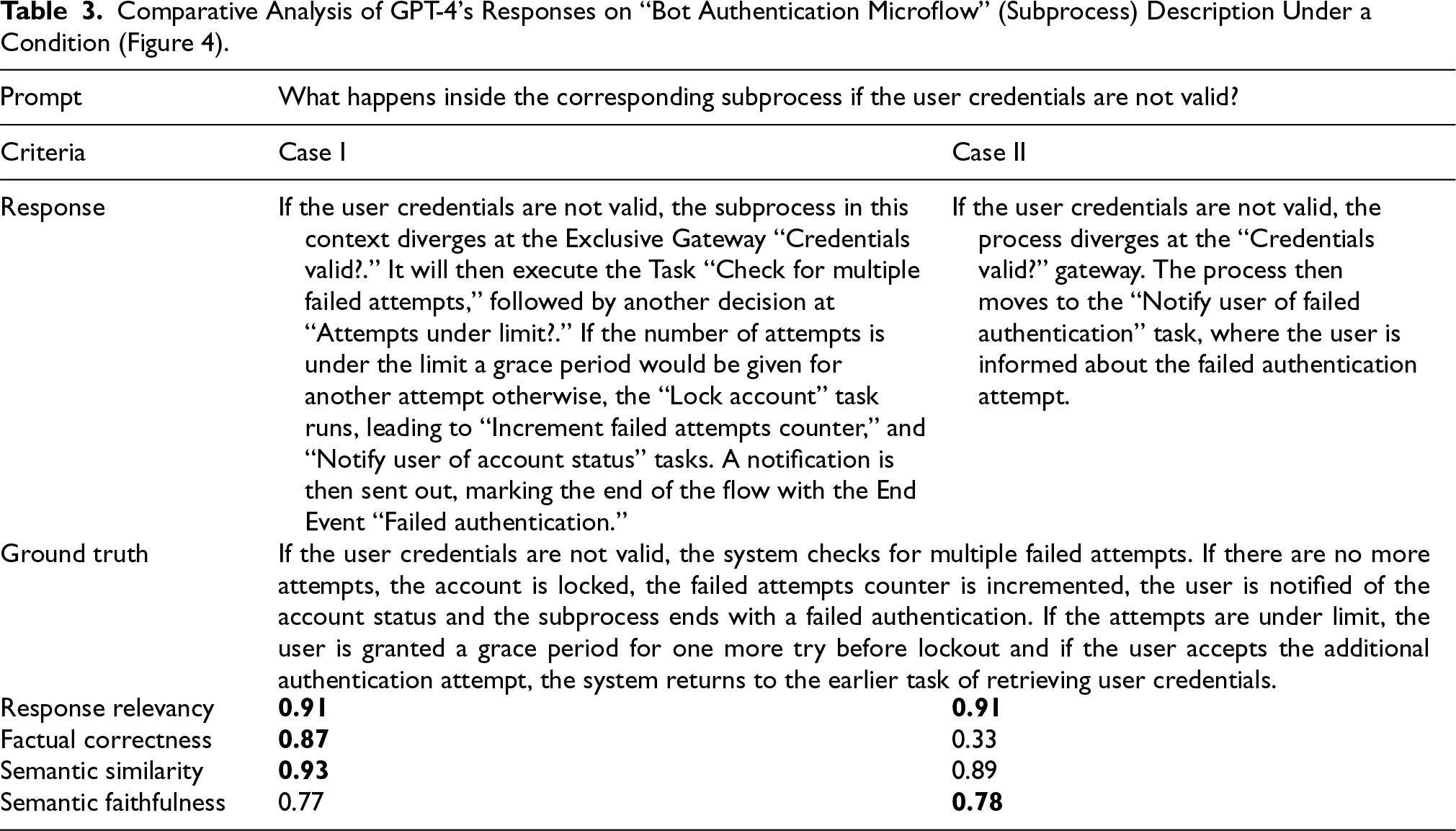
Both responses do recognize it by mentioning the exclusive gateway, “Credentials valid?,” which represents the central divergence inside the subprocess. However, while the RDF-based answer in Case I accurately goes further by elaborating upon tasks such as checking for multiple failed attempts, granting a grace period and locking the account, the XML-based answer in Case II stops prematurely at “Notify user of failed authentication” task, which is not even part of the subprocess in question, leading to a much lower factual correctness score for Case II.
Case II's high semantic similarity score may seem surprising given its factual incompleteness, but it can be explained by how the metric is calculated. Semantic similarity is determined by comparing vector embeddings of the generated answer and the ground truth, focusing on the overall meaning rather than every fine-grained detail. OpenAI's reference documentation (OpenAI, 2022) provides more insight into how embeddings convert text into dense vector representations that capture the semantic essence of the input, enabling tasks like semantic search and similarity comparisons. As mentioned before, we use OpenAI's text-embedding-ada-002 (OpenAI, 2023), which brought a significant performance boost from previous embedding models. As a result, even if the answer omitted some parts, its main semantic content remains closely aligned with the ground truth—capturing the core idea that the process diverges at the “Credentials valid?” gateway and can also follow a failure branch—thus yielding a high similarity score.
Table 4 illustrates a specific example where the GPT model is challenged to extract certain process performance metrics from the BPMN process. Both responses grasp the core idea: to detail the cost and execution time within “Bot authentication microflow.” Here, Case I accurately lists all eight tasks as specified in the ground truth, achieving perfect factual correctness. In contrast, Case II only correctly identifies four tasks and even mistakenly includes the “Activate bot” task, which does not belong to the subprocess, resulting in a much lower factual correctness score. This difference arises because the XML standard uses a closed-world schema, whereas the RDF export offers a more flexible and semantically enriched network of associations.
Comparative Analysis of GPT-4's Responses on Cost and Execution Time of the Tasks Within a Subprocess (Figure 4).

Building on the experiments outlined in Section 4.1, we now shift our focus to exploring minimalist, non-explicit patterns. Using the same setup and evaluation metrics, we examine the patterns illustrated in Figures 5 and 6 to uncover how these streamlined models—represented in RDF and BPMN XML—perform under a diversity of queries that include various perspectives, such as temporal understanding, participant involvement, interactions and associations.
The prompt “Identify the tasks in the order described in the process” from Table 5 is straightforward, asking GPT-4 to sequentially list the tasks from the BPMN model represented in Figure 5a. Both responses correctly identify the tasks A, B, and C, which accurately match the ground truth, resulting in perfect factual correctness. The semantic similarity scores are also very high in spite of minor wording differences. The semantic faithfulness scores indicate that the essential context from this pattern is well captured; the slight drop in Case II is potentially due to the additional verbosity from the prefix “Task,” which slightly alters the vector representation.
Comparative Analysis of GPT-4's Responses on Simple Task Sequence Identification (Figure 5a).

Comparative Analysis of GPT-4's Responses on Simple Task Sequence Identification (Figure 5a).
We also tested additional prompts on models from Figures 5b, 5e, and 6l, to assess whether GPT-4 can accurately handle temporal sequencing (as shown in Appendix Table 10), recognize branches (Appendix Table 11) and spatial-temporal queries (Appendix Table 12). Since the responses were correct for both data formats in all three scenarios—with scores similar to the ones in Table 5—we have grouped these findings in the Appendix.
Overall, the generated answers in both cases (Table 6) convey the same core meaning as the ground truth, given the high semantic similarity scores. However, some key aspects are either missed, misrepresented or both. In Case I, the answer correctly identifies the start event along the subsequent events X and Y, both triggered by messages (see Figure 5c), but it also includes an extra detail about the trigger of the start event that is not specified in the ground truth. Moreover, since the start event is not explicitly labeled in the provided context like the rest of the events, GPT-4 refers to it using the full generic label automatically assigned by the modeling tool (i.e., “Start Event (BPMN)-35353”), which differs from the name used in the ground truth (i.e., just “Start event”).
Comparative Analysis of GPT-4's Responses on Event Identification and Their Trigger in a Taskless Sequence, Without Exemplifying Possible Trigger Types (Figure 5c).

In contrast, Case II's XML-based response entirely disregards the start event. It also suggests that one task triggers the next. Although this interpretation makes sense to some extent, it certainly does not match what was expected in the ground truth/reference, leading to an even more significant drop in factual correctness.
We tested on the same BPMN model (in Figure 5c) with another prompt to see if a hint would boost the quality of the generated answers. In the initial prompt (see Table 6), we simply asked for the events before event Z and their triggers, while in the second prompt (see Table 7), we provided a list of possible trigger types (Cancel, Compensation, Conditional, Error, Escalation, Link, Message, Signal, Timer) as a hint. Regardless of the clue's presence, the prompt was correctly answered in Case I that scored high in both scenarios (Tables 6 and 7) regarding relevancy and semantic similarity. However, for the second case, reducing the ambiguity in what constitutes a trigger, aided GPT-4 to provide more detailed answers that are closer to the ground truth.
Comparative Analysis of GPT-4's Responses on Event Identification and Their Trigger in a Taskless Sequence, Exemplifying Possible Trigger Types (Figure 5c).

According to RAGAs, the relevancy metric is computed by generating alternative question variants from the generated answer (called reverse-engineering) and then measuring how closely these reconstructed questions match the original question/prompt using cosine similarity. In our example, the additional details (all possible trigger types) introduced in the original question may have slightly shifted the focus of the prompt, making the generated response less aligned with some of the reconstructed question variants, which could be potential factors that contribute to a slight decrease of the value of this metric—from 0.93 to 0.89.
In the experiment described in Table 8, even though the RAG pipeline successfully retrieved the complete BPMN process in XML format—as the process itself was relatively short and fell well within the model's input limits (a topic largely discussed in the scenario represented in Table 1)—GPT-4 still responded with “I do not know” when asked about the effect of a boundary message event. This outcome is consistent with the behavior specified in the prompt template, namely “If you do not know the answer to the following question, just say ‘I do not know’ or ‘The provided context does not contain enough information’ and nothing else.” While this demonstrates compliance with prompt instructions, it also highlights a deeper limitation of using XML as input: its verbose, deeply nested structure, as well as its lack of explicit semantic relationships between elements hinder GPT-4 from extracting and interpreting such nuanced process details. This contributes to the XML-based response scoring zero in both relevancy and factual correctness.
Comparative Analysis of GPT-4's Responses on Boundary Branching Effect in the Process (Figure 5g).

Despite the XML-based response being simply “I do not know,” its semantic similarity score remains around 0.70. Previous work (Krugmann & Hartmann, 2024) has shown that even minimal expressions can carry rich semantic signals, meaning that, even though “I do not know” contains almost no factual details, its vector embedding is prone to capturing a generic signal of uncertainty, as embedding models like text-embedding-ada-002 are designed to “behave.” In our case, the ground truth describes a specific conditional process (interruption at task B leading to task D), which inherently involves a notion of deviation or uncertainty about the normal flow, thus falling within a similar semantic domain as the generated answer's. This shared aspect of uncertainty, even though very broadly defined, could be the cause of a moderate similarity score of 0.70, rather than something much lower, as one would expect. Similarly, semantic faithfulness is computed using cosine similarity between the embeddings of the retrieved context and the generated answer, which means that even a minimal response can yield a moderate score if it captures enough high-level semantic features. Therefore, in similar abstention scenarios, any response with semantic similarity and faithfulness scores below 0.76 can be considered unsatisfactory.
This phenomenon is also evident in our other, more challenging text queries—those that extend beyond simple task identification or basic sequence flows. In our parallel branching tests (Appendix Table 13), for example, we asked whether a certain task could be executed if a preceding task, from a parallel branch, had not been already executed and why that might be the case—with the correct answer being that the task in question cannot be executed unless the previous task in the parallel branch has already been completed. Similarly, our event branching test (see Appendix Table 14) examined if two tasks could be executed concurrently, even if they originated from two separate branches emerging from a XOR event gateway—where only one path is typically taken. The query referring to the compensation branching model (see Appendix Table 15) evidenced in Figure 5h, challenged GPT-4 to correctly identify the cause for the compensation flow, while our task collaboration tests (Appendix Tables 16 and 17) examined whether the model could accurately depict interactions among participants in the process (marked by Message Flows in the BPMN standard). Across these five scenarios, we observe that, with the increased complexity and nuanced BPMN logic in such non-explicit models, the RDF-based approach always outperforms the XML-based one.
Our final experiments on BPMN models involving event collaboration (Figure 6k) and lane coordination with data (Figure 6m) further solidify the idea that RDF provides a more detailed and semantically rich representation of BPMN models than XML. However, these experiments also produced some rather intriguing scores that warrant some discussion.
Firstly, it is worth mentioning that Case I and Case II achieved perfect and near-perfect relevancy scores (see Appendix Tables 18 and 19, respectively), even if Case II, unlike Case I, is only partially correct. This high relevancy for Case II can be caused by the way the metric is calculated (explained in a previous example—see Table 7). Looking at the results from Appendix Table 18, the generated answer for Case II mentions only the event “E2” and does not explicitly reference the message “M1.” Keeping this in mind, the generated questions from the generated answer are inclined to align closely with the original question—specifically, “What does the start of the process executed by P2 depend on?”—which also does not directly mention M1; we believe that this might impact the relevancy score, despite the factual details being incomplete.
Secondly, the low to medium factual correctness scores, despite Case I giving fully correct answers in both scenarios, might stem from the evaluation metric's sensitivity to the granularity of the generated claims. For instance, GPT-4 provided additional details from the retrieved context—such as the “Subsequent” relationship from task B to task C or the “Data Association” linking a data object to a task (see Appendix Table 19, Case I)—that are not explicitly required by the ground truth.
In every prompt scenario, the RDF-based representation (Case I) exhibits superior performance across almost all evaluation metrics. Built on explicit subject–predicate–object triples that map out clear, interconnected relationships between BPMN elements, the RDF-represented processes aid the OpenAI's GPT-4 model in providing complete and accurate responses with high scores in relevancy, factual correctness, semantic similarity, and semantic faithfulness. In contrast, the BPMN XML-based response was occasionally deficient, particularly in factual correctness. These behaviors are observed in prompts requiring the extraction of temporal and conditional process details, where RDF consistently captures the nuanced relationships inherent in BPMN models more effectively than BPMN XML (with a more rigid format). These results underscore the importance of employing RDF as a means to serialize BPMN processes, thereby reinforcing the notion that structured, semantically rich representations can enhance natural language process querying tasks. Table 9 highlights which case achieved higher scores for each metric across all evaluation scenarios.
Evaluation Synthesis.

Evaluation Synthesis.
Broader implications of these findings extend beyond the immediate context of BPMN process analysis. Enterprises may benefit from migrating toward semantically enriched process representations, where the main purpose is not to have the process description as a closed world data structure to be leveraged only by automation or simulation engines, but as a knowledge graph that adds on top of the basic machine-readability requirement the possibility of semantic enrichment, interpretation and integration across future knowledge-based systems that leverage procedural knowledge available through established notations such as BPMN.
Both tool vendors and standardization bodies may want to consider a shift from the XML-dominated world of process interchange and serialization. In addition to tool-specific fine-tuning approaches for BPMN-AI integration, providing semantic graph export/import options for BPMN models could unlock or facilitate use cases pertaining to the BPM lifecycle. In various lifecycle phases it may be relevant to achieve traceability and reasoning through semantic networks built around process descriptions, or to semantically enrich process resources and workflow elements—for example, with domain-specific taxonomies pertaining to ESG (Environment-Social-Governance) (Osman et al., 2024) policies, building management systems (Laurenzi et al., 2024) or data access protocols (Chis & Ghiran, 2022). Graph RAG patterns 10 , where the RAG context provided to LLMs is based on knowledge graphs instead of document chunks, are thus also enabled for next-generation AI-driven modeling environments. BPMN tools can evolve beyond diagram-focused modeling environments into BPM knowledge “hubs” ready to support process-centric LLM-powered knowledge management (at design-time) as well as execution features (at run-time). Current implementations are only available as experimental artifacts, typically developed under a Design Science framework. Further implications that propagate across the entire BPM lifecycle must consider all possibilities enabled by this shift—that is, for semantics-driven enactment, monitoring, discovery, with a potential for agile domain-specificity to be added as a semantic layer over the core process or trace descriptions.
Through the comparative use of RDF-encoded semantic graphs and XML-encoded diagrams, the experiments in this paper report nuanced treatments for BPMN models subjected to OpenAI's GPT-4 as procedural knowledge. Our findings, substantiated by the scores obtained using the RAGAs framework, indicate that RDF exports provide a more open-ended and relationship-aware approach to process interpretation, compared to the standard XML export which appears to be treated as a closed-world data structure, even though the RDF version employs a non-standard, tool-specific, process description vocabulary.
The study has inherent limitations due to the fast evolution and stochastic nature of LLM services—not only variations between different versions, but also between work sessions are noticeable. Therefore, this work is not intended to be an evaluation of capabilities of a certain product, but a proposition of an interpretation and analysis protocol towards an augmented version of the BPM lifecycle as proposed by Vidgof et al. (2023). In repeated trials, response variability remains unavoidable due to the non-deterministic sampling mechanisms of LLMs. This poses limitations in terms of output distribution, making it challenging to guarantee that future executions will yield similar results. Thus, findings should be interpreted as indicative rather than exhaustive. Although this GPT model represented a strong benchmark at the time when experiments were initiated, the absence of comparisons with others (Claude, Gemini, Mistral etc.) limits the generalizability of findings across the broader LLM landscape. Finally, there is inherent bias given by the fact that the RDF and XML serializations available do not share an identical vocabulary—in our future work we aim to assess the terminological sensitivity of LLM responses, while working with the same serialization format but manipulating its metamodel wording.
We are also reluctant in stating that these are experiments on “process understanding” due to the inherent limitations of what tokenized language models “understand” as reported by recent investigations (Saba, 2023); consequently we are treating process descriptions as information structures that can be queried and navigated along explicit references by the pattern matching mechanisms of LLMs, hence our current focus on process serializations instead of computer vision or conversational modeling.
Future work will be invested in further exploration of the possible synergies between the BPM lifecycle and LLM services, specifically on prompting strategies that can generate such process serializations besides interpreting them. We also see opportunities involving domain-specific knowledge graphs, meta-models, and XML/RDF schemas that could yield process interpretations which are better contextualized in relation to the complexity of the prompt and the knowledge graph patterns that can act as process context. Pre-training and fine-tuning of public GPT services based on domain-specific knowledge is another direction to be explored towards a hybridization of model-driven engineering and prompt engineering in service of enterprise-tailored BPM.
Footnotes
Funding
The authors received no financial support for the research, authorship, and/or publication of this article.
Declaration of Conflicting Interests
The authors declared no potential conflicts of interest with respect to the research, authorship, and/or publication of this article.

Notes
Appendix
Additional test queries on non-explicit minimalist BPMN models: