



Abstract
As cities increasingly adopt ‘smart’ approaches to urban sustainability challenges, there is a growing need to understand how the related data-driven technologies can meaningfully reflect citizens’ lived experiences. This article presents a case study of Cotham Hill, a pedestrianised street in Bristol, UK, where citizen engagement and sensor-based monitoring were used to understand the socio-technical impacts of a low-traffic neighbourhood. The research combines environmental sensing via Smart Citizen Kits, a survey, and thematic analysis of lived experiences to examine the contested transformation of the shared urban space. We document how residents sought to evaluate the effects of pedestrianisation on their quality of life by engaging in data collection efforts. Our findings show that experiential plurality across demographics, perceptions of fairness, and temporal patterns of disturbance shaped both the response to the intervention and the potential for socially just redesign. We, therefore, propose a conceptual process model towards a ‘responsive smart city intervention’. The study contributes to debates on citizen-sensing and participatory approaches to smart city development, illustrating the value of multiple forms of knowing in revealing how interventions towards smart and sustainable city development are negotiated on the ground.
Keywords
Introduction
For some time, researchers and urban practitioners have collaborated with a wide range of stakeholders to create knowledge and address sustainability challenges (Caniglia et al., 2020). Still, difficulties persist in agreeing on what counts as desirable interventions in the urban realm for sustainable futures (Low and Iveson, 2016; Turnhout et al., 2020). This is especially the case in smart city developments, where the interplay of data, governance, and public space introduces tensions between technocratic and citizen-centric approaches (Kitchin, 2015).
The term ‘smart city’ is often associated with an urban development approach which centres around leveraging digital technologies to enhance the governance of urban systems (Batty, 1997; Kitchin, 2014; Meijer and Bolívar, 2016). Accordingly, many smart city programmes focus on leveraging the Internet of Things (IoT), also called the Internet of Everything (IoE) and Automation of Everything (AoE) (Kuru and Khan, 2021), big data analytics and AI (Bibri et al., 2023; Xu et al., 2025) and digital twins (Alvi et al., 2025), with a view to leveraging sensor networks, machine learning, and cyber-physical systems to continuously generate and process data and ultimately automate decision-making for city operations. This may, for instance, be pursued with a view to ‘optimising’ transportation systems through the development of fully autonomous systems (Kuru and Khan, 2021; Lee and Lee, 2015).
A central risk of such an increasingly automated and autonomous smart city is that citizens are reduced to data points, governed through aggregate indicators on dashboards (Kitchin et al., 2019). For instance, sensor networks and data analytics can register environmental parameters, but not the social meanings attached to how these are experienced. For example, they might record elevated pollution levels along a road, without revealing what this means for parents walking their children to school through smog caused by congestion (Ahmad et al., 2022; Karvonen et al., 2018; Kougias and Papadakaki, 2025). Focusing solely on technologically smart indicators risks overlooking local experiences, missing the affective relations to place (Di Masso et al., 2017), and offering little insight into the moral judgements residents make, for example, relating to perceived fairness (Andreani et al., 2019; Cugurullo, 2021; Engelbert et al., 2019).
Indeed, prior research has shown that smart city initiatives may privilege technocratic modes of governance over socially inclusive and participatory ones (Cardullo and Kitchin, 2019; Hollands, 2008; Vanolo, 2014). Scholars have also critiqued the limited inclusion of citizens in smart city decision-making, identifying both structural and epistemic asymmetries (Luo et al., 2025; Nidam et al., 2025). This is problematic because when data-informed decisions are grounded only on what digital sensors can capture, the legitimacy of those decisions is at risk (Cosgrave et al., 2014; Hartley, 2021).
It is therefore imperative to find ways to enable citizens to contribute to shaping smart cities in meaningful ways for them (Cardullo and Kitchin, 2019). Yet, questions remain about how data from citizen-sensing, that is, a form of civic monitoring driven by the intention to make an argument (Suman et al., 2020), may be discursively mobilised to influence urban change processes.
Drawing on ongoing debates in smart city research concerning citizen participation and equitable urban transitions (e.g. Cardullo and Kitchin, 2019; Joss, 1999; Mabon et al., 2022; Shelton et al., 2015), we consider the following research question: How can citizen-sensed data aid discursive engagement in urban sustainability transitions? Specifically, the study seeks to: (i) examine how sensor-generated and experiential data collected by community members can be interpreted to support decision-making; (ii) discuss implications for how such citizen-generated data can shape smart city interventions; and (iii) contribute actionable insights for a ‘responsive smart city intervention’ that connects citizen-sensed data with just and sustainable urban change.
We address this challenge empirically by focusing on how citizen-sensed data becomes integral to a real urban controversy. Here, we examine a community-led project in response to a street pedestrianisation scheme in a mid-sized UK city. The setting is ideal for exploring the intersection between sensor-based data, local narratives, and governance, all of which are key concerns in contemporary smart city research. Analytically, we focus on the interpretive and experiential dimensions of citizen-sensed data in the context of a real-world pedestrianisation initiative.
Our analysis seeks to elucidate how citizen-generated environmental information and experiential narratives interact in shaping public reasoning about fairness and legitimacy in urban change. Through inductive qualitative analysis of the data interpretation process and community feedback, we articulate the notion of experiential plurality, that is, the coexistence of conflicting perceptions and stakes, and its implications for building legitimacy around urban interventions.
First, we show how survey responses and sensor data, in practice, form discursively usable insights (Gabrys et al., 2016), thereby advancing the work on hybrid knowledge practices in citizen-sensing (Baake and Kaempf, 2011). Second, we propose that citizen-sensed data can enrich smart city development by creating the conditions for participatory sensemaking. This draws attention to smart cities being not just technical systems, but discursive arenas, where sensor-generated evidence is entangled with experiential and moral claims, such as perceptions of fairness (Hillier, 2016; Ottinger, 2017).
Our study contributes to smart city scholarship in three ways. First, by reframing citizen participation as interpretive and discursive engagement rather than mere data collection; second, by articulating a mixed-methods approach that renders citizen-sensed data publicly communicable while remaining sensitive to its interpretive dimensions; and third, by specifying the scope conditions under which experientially plural evidence can inform decision processes. In doing so, this article bridges the divide between data-driven urban management and citizen-led meaning-making (Bedessem et al., 2021; Light et al., 2017), thereby contributing to current debates on human-centric smart cities (Alizadeh and Sharifi, 2023; Cardullo and Kitchin, 2019; Kitchin et al., 2019).
The remainder of this article is organised as follows. Section 2 presents the theoretical background; Section 3 outlines the methodology; and Section 4 presents the empirical findings. Section 5 discusses the implications of these findings for smart and sustainable city development, followed by Section 6, the conclusion.
Theoretical background
Contemporary urbanisation intensifies pressures on transport and mobility systems, with challenges for air quality and noise regulation, and for the governance of contested public spaces (Hickman and Huaylla Sallo, 2022; Verlinghieri and Schwanen, 2020). These pressures are often unevenly distributed and frequently surface as conflicts over access, perceptions of safety, and what forms of behaviour are deemed appropriate (Soni and Soni, 2016). Researchers have underscored the need to engage with profoundly local perceptions in responding to global sustainability challenges (Moore, 2007; Norton, 2005), advocating for integrative and pluralistic approaches to action-oriented knowledge (Caniglia et al., 2020). On the one hand, some cities appear to develop the capacity to integrate pluralistic ways of knowing in urban change processes (Wittmayer et al., 2014), and prior work on participatory knowing (Suman et al., 2020) and epistemologies of citizen-sensing (Gabrys et al., 2016) have considered ways in which citizen-collected environmental data becomes a resource for communicating about change. On the other hand, inequity and exclusion often persist in urban decision-making and knowledge production (Newell and Mulvaney, 2013).
Smart cities in particular are characterised by their wealth of data, given the investment in sensing technologies and algorithmic systems, yet, it is often not clear how data streams from smart city technologies – say, official air quality monitoring stations – can be integrated with civic knowledge – say, in the form of lived experience (Helbing et al., 2024; Mahajan et al., 2022), so that interventions to make cities ‘smarter’ remain tightly coupled to inclusive and equitable development (Caragliu and Del Bo, 2023; Helbing et al., 2024). Hence, recent scholarship points to the ongoing need to consider ways to integrate diverse forms of knowledge, that is, scientific, experiential, and technical, to support legitimate and actionable change (Caniglia et al., 2020; Wolfram, 2016).
Citizen-sensing is a case in point. Citizen-sensing, that is, the practice of environmental monitoring using low-cost sensors and do-it-yourself (DIY) technologies (Pritchard and Gabrys, 2016), has long been presented as a potentially promising avenue for ‘democratising’ data collection, thereby disrupting centralised or technocratic smart city paradigms (Gabrys and Pritchard, 2018; Suman et al., 2020). As such, citizen-sensing is seen as much as a scientific practice as it is a political tactic for framing concerns as shared problems.
However, despite this potential, citizen-sensing initiatives often face challenges in shaping official urban policy (Lepenies et al., 2021). Specifically, issues such as concerns about data reliability, a lack of standardised measurement protocols, and, consequently, challenges to the epistemic legitimacy of such data frequently undermine the perceived value of citizen-generated evidence (Gabrys and Pritchard, 2018). This status quo is grounded in a persistent hierarchy between scientific and civic knowledge- a divide that mirrors broader struggles around expertise, trust, and power in urban development (Healey, 1997; Taylor and de Loë, 2012).
Hence, further research is needed to explore how data from locally situated practices, such as citizen-sensing, might become publicly communicable or actionable in deliberative forums, thereby serving as a counterbalance to centralised, top-down models of smart governance (Burger, 2025; Connelly et al., 2021). Importantly, we argue that citizen-sensing must be understood not only as a technical process but also as a discursive and interpretive one. The meaning and legitimacy of citizen-sensed data often depend on how it is contextualised, narrated, and made publicly relevant (Mahajan et al., 2022). This view challenges the assumption that raw data can speak for itself, and instead highlights how data interpretation, framing, and storytelling play an important role in civic engagement in smart urban contexts (Michaels, 2009).
Rather than contrasting scientific and experiential knowledge, we adopt a more integrative view where data collection and narrative insight co-evolve. In this perspective, citizen-sensing becomes a hybrid epistemic practice that combines technical-analytical skills with moral and aesthetic forms of reasoning (Baake and Kaempf, 2011; Canagarajah, 2002; Kinsella, 2004). This hybrid quality offers a distinct contribution to inclusive smart city governance, particularly where sensor deserts, infrastructural exclusions, or marginalised knowledges limit top-down visibility (Robinson and Franklin, 2021).
In sum, prior smart city research has often concentrated on the pursuit of optimisation through data-driven governance (Batty, 1997; Luo et al., 2025). Yet it has tended to pay less attention to coupling these advances with the interpretive processes through which citizens make sense of their lived experience, leading to impoverished notions of smartness in the smart city (Zandbergen and Uitermark, 2019). On the one hand, much research on citizen-sensing and volunteered geographic information has advanced bottom-up approaches to data generation that can complement ‘official’ data streams (Cao and Kang, 2024; Hemström et al., 2021). On the other hand, much of this work underexplores the processes through which citizen-generated insights acquire public meaning and become usable in deliberative or design contexts (Suman et al., 2020; Engelbert et al., 2019; Lebrument et al., 2021; Robinson and Franklin, 2021). Indeed, empirical evidence is particularly scarce on how sensor-derived observations are interpreted in relation to lived experience in ways that may expose interpersonal and distributive fairness concerns within specific, contested places, such as streetscapes (Calvillo, 2018; Enlund et al., 2022; Enlund and Harrison, 2025; Lin et al., 2025; Mahajan et al., 2022).
Taken together, the literature thus points to three gaps that this paper seeks to address: first, the lack of integrative accounts that connect abstract sensor-driven smart city decision making with the residents’ lived experience in the governance of shared urban space; second, the need for empirical demonstrations of interpretive practices that render citizen-sensed data publicly communicable, that is, usable as discursive resources rather than as raw data streams; and third, the need for analytic attention to the coexistence of divergent perceptions among citizens, as a primary input to questions of fairness, and legitimacy.
Next, we turn to the methodology to elaborate on how we sought to address these challenges empirically.
Methodology
Our approach is a single revelatory case study (Yin, 2009), focused on a community-driven citizen-sensing initiative within a smart city context. A single case study is especially suitable for examining how bottom-up sensing practices contribute to participatory governance and the epistemologies of human-centric smart urban systems, in that it allows consideration of the processes of change as they unfold (Langley et al., 2013).
We combine the deployment of environmental sensors in the Smart Citizen Kits, survey-based perception gathering, and ethnographically informed observations. This multimodal data strategy enables us to study the interpretive dynamics of smart technologies as experienced and co-constructed by residents, rather than imposed through top-down infrastructure planning.
Case setting and context
Our case study is set in a long-established neighbourhood, located close to the centre of Bristol, a mid-sized city in the UK, which is known as one of the smart city frontrunners in the country. In March 2020, after a year of business disruption due to COVID-19 lockdowns, the local city council announced that it would temporarily close a through road to traffic to allow hospitality venues to reopen, seating and serving customers in outdoor areas. Two parts of the road were closed to traffic by installing temporary barriers that created the boundaries for a zone designated as ‘shared space’. 1
While at the time, the emphasis was very much on economic recovery enabled by the scheme, the council also put the road closure in the context of more ‘liveable neighbourhood’ plans that are ‘free from traffic congestion and pollution’. Some argue that this was the council ‘seizing the moment’ to push ahead with ‘green’ plans that would otherwise have encountered much greater resistance. After the temporary measures had been in place for about half a year, the council launched a public consultation as to whether the scheme should become permanent. At roughly the same time, our project with the community group started.
Although the community group had previously engaged in questions about traffic flow, having campaigned for a one-way route rather than through traffic, pedestrianisation was a new challenge. This was in addition to broader contextual challenges stemming from the increasing student housing in a residential area, narrow pavements, and a generally limited parking space. The community group faced difficulties in bringing together diverse groups of residents, including temporary, such as students, and long-standing, as well as private and commercial actors, with a shared agenda.
The local community group contacted the authoring team, with whom they were already acquainted. The academics sustained communication with group members throughout and arranged for other researchers at the university to become involved. Our research team included researchers from engineering, psychology, data science and social sciences. After further discussions, we engaged with residents on the deployment of air quality and environmental monitoring sensors in participants’ homes and local shops. We used Smart Citizen Kits (SCK version 2.1 2 ) as part of a low-cost, distributed smart sensing infrastructure. These devices collected environmental data (including parameters of air quality such as particulate matter, humidity, temperature, ambient noise, etc.) while enabling citizen-led monitoring, interpretation, and participation in urban governance debates.
The community group welcomed us to install smart citizen sensors into homes and local shops, setting up the data connection and explaining how to interact with them. Participating residents were instructed to keep the batteries charged and the Wi-Fi connection active. Concurrently, the research team's psychologist co-designed a questionnaire survey with the group to enable them to collect open-ended qualitative data on their experience of pedestrianisation. The residents organised the distribution of the paper-based survey. One member of our team maintained communication with the community group members throughout the data collection period.
Empirical material produced in the citizen-sensing project
The empirical material collected includes sensor data, survey data, and photographs from a local walk, a report of the findings presented to residents, and the transcript of the discussion with residents regarding the findings. We chose this multi-methodological setup to capture different modalities of experiencing the shared space. We detail each data collection method in the following paragraphs.
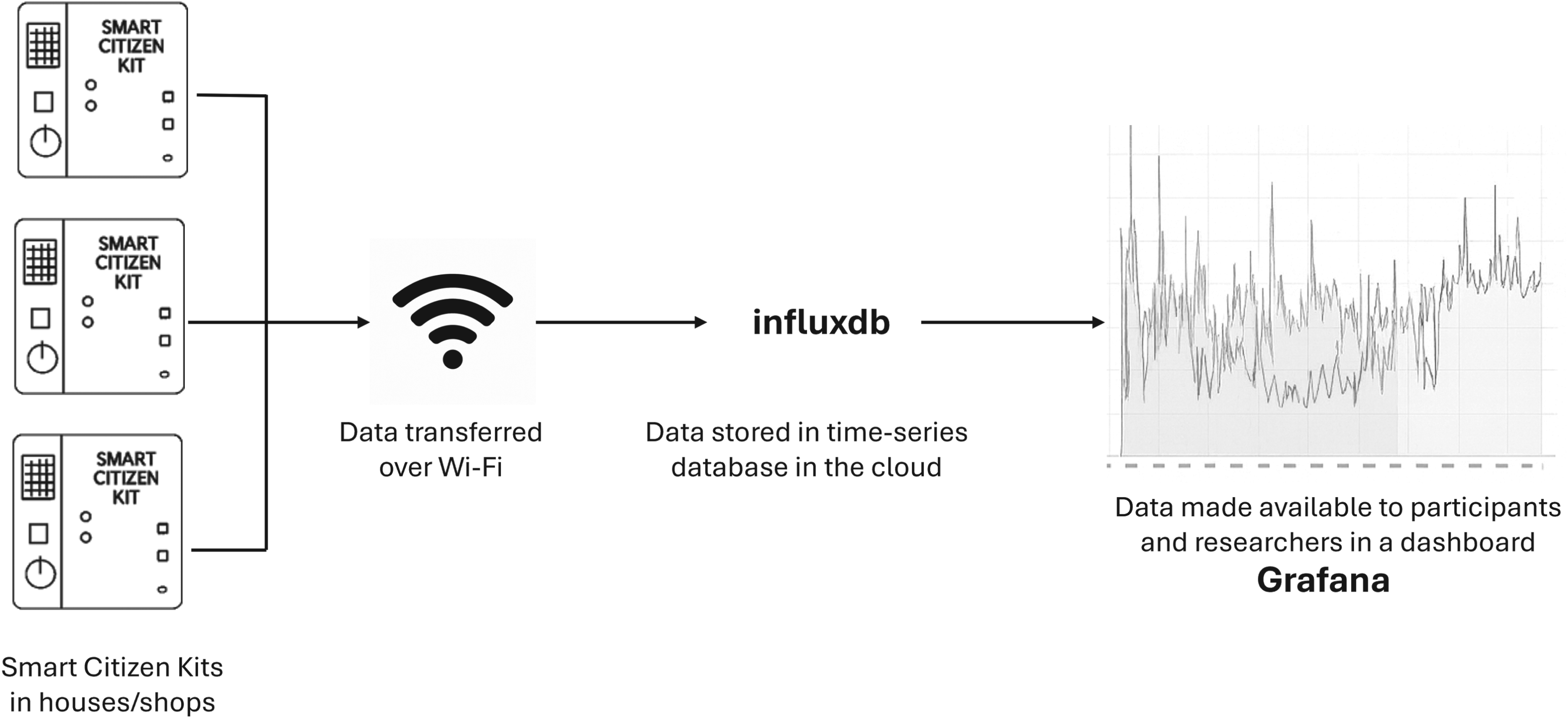
Schematic representation of the monitoring setup.
Using a qualitative coding process (Gioia et al., 2013) and keeping an open mind about any emerging themes, we read and re-read the report and meeting transcript, inductively coding them to develop a first-order list of categories. We stayed close to the phrases used by the informants and then conducted a second-order analysis, grouping these categories into fewer, more general ones. Finally, we identified additional theoretical dimensions in the data, and to enhance consistency, our coding results were refined through an iterative process (Patton, 1990), considering both the data codes and prior theory on citizen-sensing.
During this immersion in the data, we became aware of a set of themes specific to the problem situation (struggles pertaining to the shared space) that emerged from the open responses of the survey, as represented in the report to residents (Supplemental Appendix, Figure A). Next, we noticed themes emerging specifically related to the process of interpreting citizen-sensed data (see also Section 3.2) in the meeting recording transcript (Supplemental Appendix, Figure B). Since these appeared as distinct thematic areas, we present the data structures separately (Supplemental Appendix 1, Figures A and B).
Our findings reveal how citizen-sensed data, generated through lightweight smart urban IT infrastructure, interacted with diverse lived experiences to support discursive engagement around a contested pedestrianisation scheme. In doing so, the findings highlight the limits of top-down, data-centric approaches to smart city planning, and illustrate instead how experiential plurality and narrative interpretation are essential to ensuring inclusivity, legitimacy, and social justice in urban transitions.
While neither supporters nor opponents of the intervention prevailed, the data reveal three key tensions: (1) interpersonal fairness in shared space design, (2) distributive fairness of environmental externalities (noise and pollution), and (3) governance challenges linked to civic legitimacy and behavioural norms. These tensions are not anomalies, but integral to smart urban development processes that aim to be participatory and equitable.
First, focusing on context-specific insights (Supplemental Appendix, Figure A), we surfaced concerns about fairness in the data. The pedestrianisation with shared space has led to changes in community living, concerns about inclusivity, and a perceived decline in civility in terms of behaviour in the zone, as well as concerns about the distribution of noise- and air-quality-related emissions resulting from the changes in traffic flows. This points towards an important dimension for discussion in this specific case, namely, how to address concerns about interpersonal and distributive fairness to create a socially just shared space. In what follows, we will further elaborate on these issues.
Second, in focusing on the process of data interpretation (Supplemental Appendix, Figure B), we identified that the data cannot be considered to ‘speak for’ anyone else but those from whose locations the data were included. This prompted a considered reflection on how such data can be regarded as valuable. Then we noticed the importance of ‘experiential plurality’, as we became aware of the differences between the experiences of individuals in both the sensor and survey data. Considering these differences, along with the limited completeness and accuracy of the data, we suggest that citizen-sensed data should be valued for reflecting the differences experienced by those contributing to them, that is, an experiential plurality that is difficult to detect with more general and abstract means of data collection.
Interpersonal fairness: A socially-(un)just shared space?
Community atmosphere and aesthetics
The surveyed residents hold vastly different views on the impact of the shared space on the area's beauty and ambience. Proponents emphasise the vibrant and buzzing atmosphere with cafes and shops during the day and bars and pubs at night. Similarly, some thought that ‘the planters’ which block the road to car access ‘are great’ (Figure 2), while others found the pedestrianised shared space ‘messy and ugly’, an ‘unattractive ramshackle area with no focal point or sense of enclosure’, where ‘sandbags [used as weights for signage] are rubbish and always leaking’ (Figure 3).
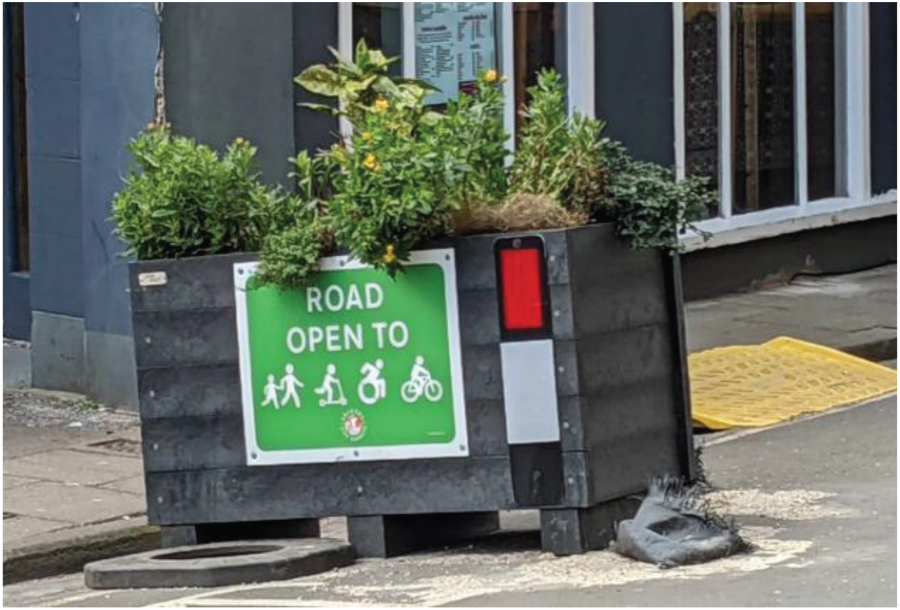
Planters in the pedestrianised vicinity.
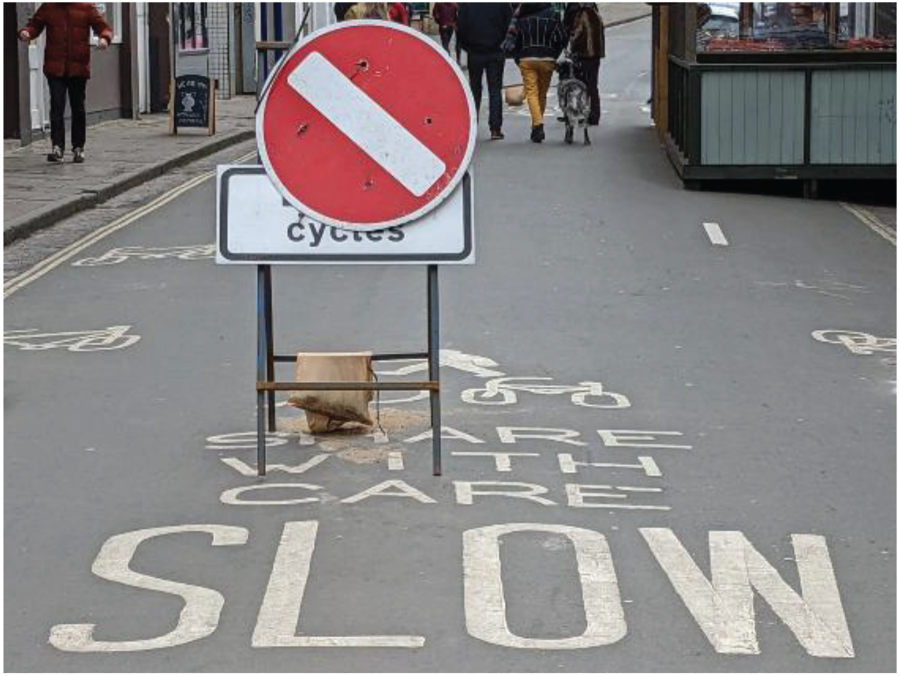
Leaky counterweight sandbags.
Proponents say that the area has a ‘friendly atmosphere’, it ‘seems convivial’ and ‘feels like living in a village’. The pedestrianised shared space, they say, makes it possible ‘to bring people together again and build community relationships’. Overall, the shared space offers a venue for community gatherings, featuring cafes and nightlife. But this is also making some residents feel that it has become a place where they no longer belong.
While some celebrate having the street for socialising, others feel that ‘their’ street ‘has been more or less taken over as a playground to the many students in the area, who far outnumber older local residents’. Lifestyles clash, and to some it seems that ‘it is now a magnet to youths and groups of teenagers who seem to think it very exciting to stand around drinking, talking very loudly’. This makes some feel out of place: ‘I wouldn't come and move here now if I was looking for somewhere to live. I've realised I've outgrown the area; the demographic is not aimed at us anymore’. So, who is the shared space for?
Although intuitively, a pedestrianised area should be safer for pedestrians than an area with cars, it does not feel that way for everyone. Cyclists and e-scooterists can ride through the shared space while pedestrians use it, which is scary and exclusionary to some: ‘If you walk in the pedestrianised area, you have to check over your shoulder before you change directions, as a scooter or cyclist may be coming up behind you. […] [it's] only suitable for those who are not troubled by the close vicinity of passing scooters and cyclists who often get too close to people and go too fast and [it's] impossible for disabled or elderly’, and for families ‘[i]t feels unsafe sometimes to walk through with my children if fast cyclists come through’. Yet other residents experience the area vastly differently: ‘It has made the area feel much safer and generally a much nicer place to live […] and I enjoy walking in the middle of the road to get to my home’. But do they know that they are ‘in danger’? ‘Pedestrians tend to walk around, often unaware that bikes, scooters, etc. are also using the road’. But it is not only other shared space users that make some residents feel excluded; it is also that pavement space is no longer available: ‘The changes have left me with less of the safe pavement area with buildouts blocking pavements’ so that ‘blockages on the pavement have changed this from an area where I have shopped almost daily to one that I actively avoid’. In summary, there are unanswered questions about the inclusivity of the shared space.
Distributive fairness
(Re)distribution of ‘emissions’: Noise and air quality
Exposure to noise and air quality seems to have ‘shifted’. Opponents highlight that ‘the night-time hospitality businesses have attracted and created noisy customers from further afield’ and that some ‘hang around in the area at all hours of the night, disturbing people sleep’. Others dispute that this is related to the pedestrianised shared space, though, in that ‘student party music = nothing to do with the pedestrianisation’. Additionally, there is no conclusive evidence regarding the impact on air quality. The sensor data suggest that some residents appear to be more negatively affected in their experience of living in the area due to the pedestrianisation programme than others. While it is evident that night-time noise disturbance diminishes the quality of life of some residents, based on the sensor data, we cannot attribute this to the pedestrianisation programme and its effects on hospitality. Accordingly, experiences differ. ‘It has improved the quality of the air to a certain extent’, and ‘The road is much quieter, and I can hear the birds’. Others, however, see little evidence of an overall decrease in car journeys: ‘The scheme has simply moved the toxic fumes to other nearby areas’ with ‘knock-on effects in [adjacent roads], which have seen a big increase in commercial vehicle traffic’. It seems that ‘much of the traffic is diverted to adjacent streets’. So, is it fair that some suffer while others party?
Governance of the area
Despite their disagreements about beauty and opportunities for socialising, the surveyed residents seem to agree that shared spaces require governance with interaction rules to promote civility in usage behaviour; these rules need to be clearly communicated with appropriate signage. The way the shared space is currently ‘operating’ is not good enough: The delivery motorbikes […] ignore the pedestrian zone and drive through to pick up on a daily basis, ‘riders ignore the rules’, and ‘the parking is a real mess’. ‘Some businesses continue to park on double yellow lines within the closed part’, and there is a ‘growing practice of cars and delivery vans parking on pavements’. Then, there is also ‘inadequate and often missing signage’ leading to ‘3-point turns and reversing vehicles at either end of the pedestrianised area’ because car drivers are unaware that there is no longer a way through. Why is interaction in and around the space not better organised – where are the ‘traffic wardens’?
Overall, our findings reveal a story of vastly different experiences among individual residents. So, what is the value of this narrative data story from the citizen-sensing project?
Maintaining richness of real-life context in analysis
Case-by-case differences
For both the sensor data and the survey data, we sought patterns within the data. While we approached it quite differently, the process of transforming data into meaningful stories followed the same principle: we needed to identify similarities to uncover patterns in the data. For the survey data, we focused on grouping statements: ‘when we try to do qualitative data analysis, we are just trying to see whether it's a positive or negative statement, and so I've got a big category in the middle that's mixed’. For the sensor data, ‘we've used computer algorithms to go through and find days that look like other days. – then we've, kind of, come up with a one – or two-words summary to say what those days were like’. By grouping and interpreting themes in the data, we became able to communicate about them. ‘So some properties, like this one, it tends to be, there are some days, where it's noisy in the afternoon. And then there were other properties at a different location where it was often, you know, you had days [that] are quiet, and then you have days with noisy mornings' and, ‘hopefully, some of the themes that we've collected; like there are some properties where it's very noisy in the morning, there are some properties where it's very noisy at, kind of, school evening, you know, post-school, but before the evening, and there are some properties where it's noisy at night. Hopefully, those themes sort of chime with people's experiences of living in the area now that the pedestrianisation has happened’.
No generalisability, no predictive validity
Past citizen-sensing projects indicate how data quality can often be an issue: ‘So, the first thing I always look at when looking at data is just to check, have we actually got data that's complete throughout the period of measurement? There are always lots of reasons why you don't get data. Often, it's things like batteries of devices or devices being moved or Wi-Fi not working, and things like that’. And we can cope with some incomplete data: ‘So, maybe, if you look at this and you've not seen sort of a picture like this before, which has light blue to indicate that there is data for a particular time and a gap to indicate there's a gap in the data, this might look like there are lots of gaps, but in my experience this is quite good. […] So the data that we've collected, you know, there are some gaps, that's kind of what you would expect; I think if there were no gaps, that would be a little bit suspicious’ (Figure 4).
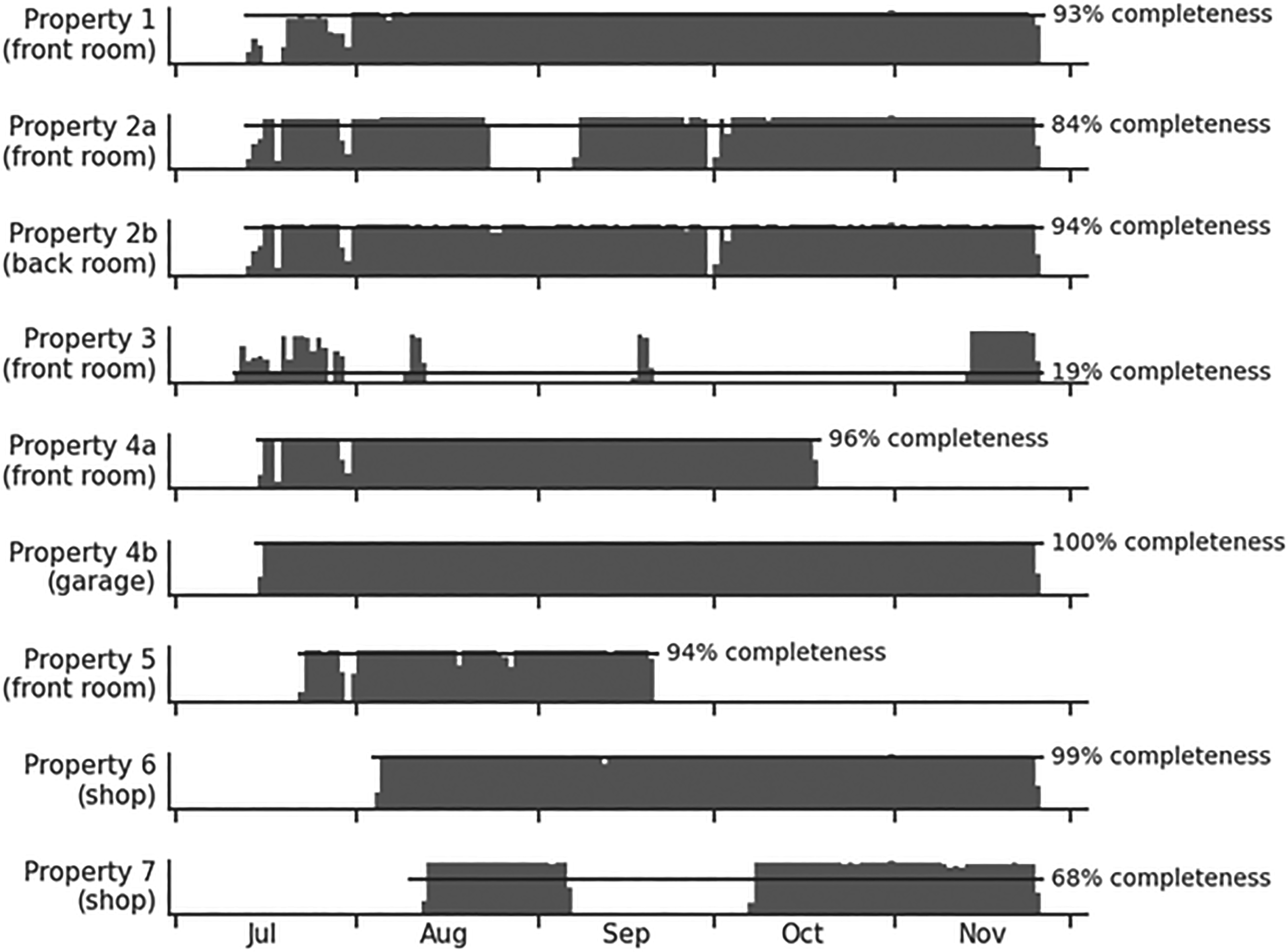
Visualisation of data completeness.
But no clear pattern emerged: ‘Different properties experience different levels of noise, but it's quite difficult to predict how one property will be affected compared with another. And how they're affected differently at different times’. Similarly, for the survey data, we can handle ‘incomplete’ data using our methods, at least to some extent. Because traditional expectations for a suitable sample size for generalizability were not met, ‘this wasn't a statistical data analysis, because there weren't sufficient responses to do a statistical data analysis’.
However, we also learned about other issues that were more problematic. First, the data quality was compromised by well-meaning interventions that were counterproductive to the scientific data quality. For example, one resident told us, after our data analysis, about the sensors that ‘sometimes I moved them to a different level of the house to get a different perspective, but "you don't know that"’. In this way, we learned that the data were inaccurate and incomplete. This was also the case for the survey data, in that during discussions with the citizen group representatives, we learned that not everyone appeared to have trusted that we kept their data confidential: ‘People talk after the project has finished. You know, people with negative comments tend to not want to say bad things; they don't want it to be documented’. So, what can we learn from this citizen-sensing experience after all?
Reflecting on the data, the themes emerging from the data appeared to be about valuing experiential plurality, taking the collected data as an indication of the very different experiences of participants, from which no clear pattern emerged. As such, they demand that further discursive engagement takes place to understand how concerns may relate to important considerations such as distributive and interpersonal fairness. This case illustrates that smart cities' governance cannot rely solely on technical sensing infrastructure or standardised metrics. Instead, insight emerges through the interweaving of distributed sensor data with community narratives, where citizens co-interpret data, reflect on fairness, and challenge dominant assumptions. Our experience confirms that data justice, experiential plurality, and discursive recontextualisation are crucial to making smart urban systems responsive to the needs of citizens. These insights underscore the need for smart city research and practice to actively consider how to create processes and spaces that allow deliberative, interpretive, and inclusive approaches to interventions in the urban realm.
This study set out to explore how citizen-sensed data might enable discursive engagement around a sustainability intervention. The contested pedestrianisation project at the centre of our research offers a setting in which Smart Citizen Kit sensor data became part of a joint interpretive process, so that abstract metrics were contextualised by concerns for fairness and legitimacy (McFarlane and Söderström, 2017). Unlike studies confined to experimental living labs, this research engages with an ongoing urban development process, observing how data practices and lived experience interact in situ. This real-world grounding moves beyond modelling toward empirical demonstration of how responsiveness and legitimacy can be co-produced through citizen participation. Engaging with long-standing critiques of smart city development (Hollands, 2008; Zandbergen and Uitermark, 2019), our findings reframe ‘becoming smart’ as cultivating responsiveness to citizens’ lived experience (Mahajan et al., 2021). In this sense, the study offers a link between critical smart city scholarship and practical challenges of governing urban change.
On this basis and extending recent debates in urban research on smart citizens, data and equitable transitions (Cardullo and Kitchin, 2019; Joss, 1999; Shelton et al., 2015), we propose the concept of a ‘responsive smart city intervention’, that is, one that couples technological sensing with social meaning-making.
Towards a responsive smart city intervention
Unlike institutionally sanctioned smart city trials or living labs, our real-world case demonstrates a situated, DIY smart urbanism practice that counters technocratic governance logics (Cardullo et al., 2018; Liu et al., 2019). The case illustrates how, when embedded in sensemaking practices (Perng and Maalsen, 2020), Smart Citizen Kit metrics may be leveraged to expand the epistemic considerations and discursive potential for communicating lived experiences, responding to research that has called for more human-centric smart city developments (Kitchin, 2019; Kitchin et al., 2019).
Indeed, our findings speak to a more pluralistic model of smart cities in which ‘smartness’ is co-produced by taking lived experience into account through local narratives and the situated interpretation of sensor data, rather than relying solely on abstract indicators (Engelbert et al., 2019; König, 2021). This also accords with prior research, which has emphasised the need for meaningful interpretation through joint sensemaking, rather than algorithmic abstraction alone (Balestrini et al., 2021; Mahajan et al., 2022).
On this basis, we propose the concept of a ‘responsive smart city intervention’ as one in which citizen-sensing methods and joint interpretive processes enable meaningful understanding and insights for the governance of change. Responsiveness here refers to the capacity to engage with diverse lived experiences of citizens, which resonates with calls for valuing human sensemaking in smart cities (Bibri and Krogstie, 2017; Hollands, 2008). Specifically, we propose the ‘responsive smart city intervention’ as one that integrates technological sensing with social sensemaking to build adaptive capacity in real-world urban development while maintaining legitimacy in decision-making processes (Fonseca et al., 2021; Mahajan et al., 2022).
Accordingly, we propose an integrative process model for enabling citizen engagement capacity that connects interpretive participation with responsive design principles linking three dimensions: (1) articulation of differences in sensed experience, (2) stakeholder recognition of experiential plurality, and (3) engagement-capacity building in discussions for change (Figure 5).
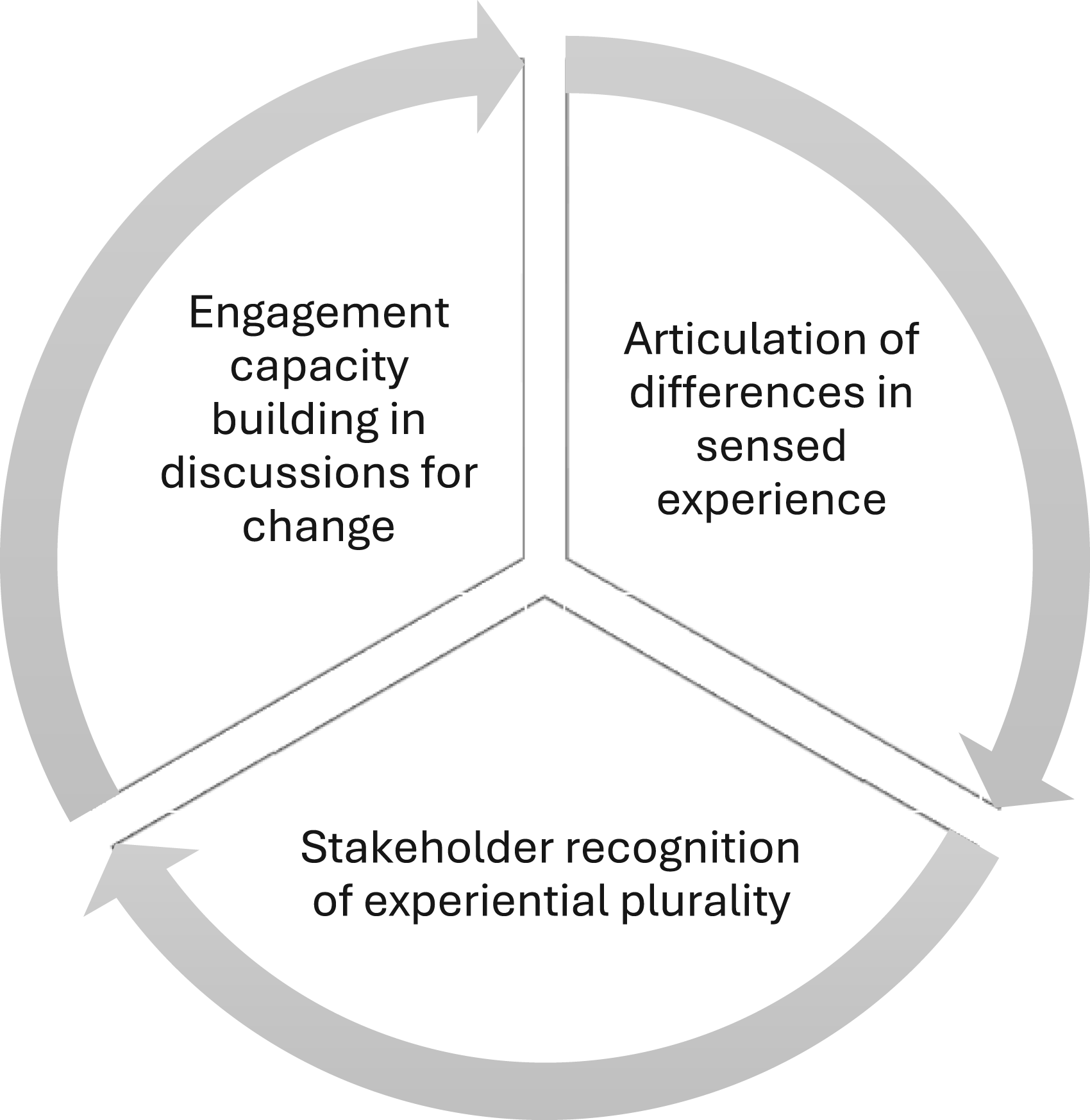
Process models for enabling citizen engagement capacity.
Together, these three dimensions in the model operationalise the ‘responsive smart city intervention’, where participatory interpretation of citizen-sensed data can foster responsiveness in practice. We discuss each in turn next.
First, in our case, citizens highlighted the differential social and emotional impacts of their lived experience of the pedestrianisation project, ranging from a perceived increase in conviviality to increased feelings of exclusion and a sense of being less safe when walking among e-scooters and cyclists. This accords with prior work that highlights the multifaceted experiential dimension of such change projects (Curl et al., 2015). Jointly with residents, we were able to build up a nuanced picture by weaving abstract sensor readings, a survey, and photographs into narratives, that surfaced concerns about fairness, accessibility, and belonging (Ottinger, 2017). Such integrative practice enabled concerns to become public and debatable, which is seen as essential for inclusive governance (Balestrini et al., 2021; Mahajan et al., 2022).
Stakeholder recognition of experiential plurality
Second, a key contribution of our study lies in maintaining ‘experiential plurality’, by which we mean the coexistence of divergent lived experiences through which residents interpret the same intervention. Prior research has highlighted the risk that aggregated sensor data may suppress diversity (Cugurullo, 2021; Kitchin and Dodge, 2011), whereas our approach treats plurality as a resource for collective sensemaking. Indeed, the data from the Smart Citizen Kits became relevant as part of a joint narrative sensemaking process. This accords with prior work, which emphasises the value of plural experiences (Gabrys and Pritchard, 2018) and epistemic plurality for adaptive governance (Hemström et al., 2021).
Engagement-capacity building in discussions for change
Third, reflecting on the case study experience in the context of prior research, we can suggest principles for building capacity for reasoning together by integrating experiential knowledge (Mahajan et al., 2022; Sieber and Haklay, 2015). These are (i) joint sensemaking, that is, coupling quantitative and qualitative data in collaborative reflection, (ii) value plurality, that is, accepting divergent experiences rather than seeking averages, and (iii) consideration of communicative design, that is, use accessible formats for ‘good-enough’ evidence (Gabrys and Pritchard, 2018).
Implications for researchers, industry, and municipalities
Considering the implications of the conceptual model, points toward actionable directions for the research community, technology developers, and municipalities.
For researchers, our findings call for methodological innovation that integrates qualitative and sensor-based data while remaining attentive to lived experience (Visvizi and Lytras, 2018). This may mean encouraging more ‘research with’, rather than ‘research about’ affected communities (Corburn, 2003; Herzog, 2023). By facilitating participatory inquiry that grounds data in context and by showing concern for the interpretive process, researchers can help with the articulation of differences in sensed experience.
For industry stakeholders, the findings call for system design that integrates sensor data with community-generated insights, thereby maintaining important contextualisation of meaning (Andreani et al., 2019). This would imply building accessible interfaces that keep feedback flowing between the people who provide the data and the people who use it, for example, focusing on socio-technical processes, rather than sensor per se, to support dialogue and contextual feedback (Gonçalves et al., 2024).
For municipalities, our findings serve as a reminder of the tension between technology-driven optimisation and citizen-supported sensemaking, and they suggest that to capture what residents feel and experience, there remains a need for procedural fairness (Herzog, 2023; Kumagai and Iorio, 2020) through a co-produced understanding that sustains trust (Siebers et al., 2019).
Limitations and future directions
The study has several limitations that point to areas for future research. First, while this study shows how citizen-sensed data can support participatory reflection, it does not trace how such insights are taken up in policy. Future research should therefore examine how diverse citizens’ lived experiences enter formal planning arenas and how the epistemic status of narratives is acknowledged alongside technical evidence, as suggested by prior research on valuing multiple forms of knowledge (Mitlin, 2021; Van Herzele, 2004).
Moreover, scaling participatory sensemaking requires time, facilitation, and trust, that is, resources municipalities may not always have (Bouzguenda et al., 2019; Visvizi and Lytras, 2018). Innovating for institutionalising these practices may call for novel ways of organising for responsiveness, for example, through qualitative observatories (Owen et al., 2023).
In the ongoing pursuit of a response smart city intervention, future work could examine how participatory interpretation interacts with emerging digital technologies, AI and IoT systems and how these might enhance or constrain interpretive feedback loops (Ahmadi Oloonabadi and Baran, 2023; Bibri et al., 2023; Cugurullo and Xu, 2025), balancing technology-informed and community-based approaches, and creating spaces for dialogue between data and governance processes.
Conclusion
This article focused on how citizen-sensed data does more than document conditions – it also shapes how residents talk about and interpret ongoing sustainability initiatives. As such, it is central to discursive citizen engagement. By integrating sensor data, survey responses, and lived-experience narratives, the research demonstrates how different data types can be embedded in socially meaningful sensemaking activities. Specifically, our findings reveal the residents’ concerns for who benefits, who is heard, and how equitable the process feels.
On this basis, we conceptualise a ‘responsive smart city intervention’ as involving (i) the articulation of sensed differences, which emphasises the value of empirical pluralism; (ii) stakeholder recognition for institutional learning from diversity; and (iii), engagement-capacity building for innovative approaches to link joint sensemaking to governance practice. Together, these dimensions bridge theory and application in real-world smart-city transformation.
The study contributes to the smart city literature in three distinctive ways. First, it contributes an empirical case to work seeking to extend the smart city paradigm from a predominantly technocratic and data-optimisation conceptualisation toward a responsive and interpretive model of urban smartness that centres inclusive citizen participation and sensemaking. Second, it develops the concept of experiential plurality, that is, the coexistence of divergent, context-dependent experiences, as an analytical lens for appreciating concerns about fairness and legitimacy in real-world smart interventions. Third, it advances an integrative methodological approach to participatory sensing by showing how residents’ contextualisation of data can serve as a resource for discursive participation.
Taken together, these elements represents a distinct contribution to smart city research, which tends to focus on ever more advanced automation, digital twins, and big data analytics. This study, by contrast, focuses on citizens’ lived experience in such ‘smart’ contexts, suggesting how citizen-sensed insights enrich both the epistemic and practical foundations of smart city governance. In other words, the real-world case illustrates that genuine responsiveness also depends fundamentally on the smart city's governance capacity to integrate plural forms of knowing into decision-making.
The significance of this study lies in showing how civic engagement, when woven into practices of sensing and joint interpretation, may help urban change initiatives become more inclusive and socially responsive. Future research may build on our conceptual process model for integrating technological data infrastructures with deliberative, fairness-oriented governance processes. Specifically, different contexts and intervention types may be useful for examining how responsive smart city governance practices in urban change interventions can evolve into institutional capacities that promote justice, legitimacy, and shared learning.
Supplemental Material
sj-docx-1-smc-10.1177_27723577251407990 - Supplemental material for Smart cities and the challenge of lived experience: Interpreting citizen-sensed data for inclusive urban futures
Supplemental material, sj-docx-1-smc-10.1177_27723577251407990 for Smart cities and the challenge of lived experience: Interpreting citizen-sensed data for inclusive urban futures by Katharina Burger, Vijay Kumar, James Thomas, Theo Tryfonas and Ute Leonards in Journal of Smart Cities and Society
Footnotes

Funding
The authors disclosed receipt of the following financial support for the research, authorship, and/or publication of this article: This work was supported by the UK Collaboratorium for Research in Infrastructure & Cities (grant number EP/P016782/1).
Declaration of conflicting interests
The authors declared no potential conflicts of interest with respect to the research, authorship, and/or publication of this article.
Supplemental material
Supplemental material for this article is available online.
Notes
References
Supplementary Material
Please find the following supplemental material available below.
For Open Access articles published under a Creative Commons License, all supplemental material carries the same license as the article it is associated with.
For non-Open Access articles published, all supplemental material carries a non-exclusive license, and permission requests for re-use of supplemental material or any part of supplemental material shall be sent directly to the copyright owner as specified in the copyright notice associated with the article.
