




Abstract
A common critique of market-based instruments is that they commodify pollution and so reduce its moral stigma. If true, the increasing use of market-based instruments could reduce concern for the environment. This project proposes theory and finds evidence largely against the anti-commodification critique. The project reports evidence from a preregistered experimental vignette study of 2,040 Americans, with an AmeriSpeak sample designed to be demographically representative on age, race/ethnicity, education, and gender. Participants randomly assigned to learn about two types of market-based regulations of a fictitious new pollutant, malzene, did not find malzene to be less morally problematic than those randomly assigned to learn about a mandate dictating pollution limits. The results were sufficiently precise to rule out any decrease in moral stigma from a pollution tax (as compared to a mandate), and to rule out a decrease larger than 4% from a cap-and-trade program. Market-based regulations can also make pollution look worse: Companies polluting in compliance with market-based instruments (and thus paying to pollute) looked morally worse than companies polluting in compliance with a mandate. This difference was statistically significant and economically meaningful. This finding suggests a new argument against market-based regulations—that they reduce reputational benefits of legal compliance.
Keywords
1. Introduction
Market-based regulations to protect the environment are becoming increasingly common. In 2009, there were just nine carbon prices (carbon taxes and cap-and-trade programs) in place around the world. Now, there are over 70 (Bank, 2023). Beyond carbon pricing, wetland banks, water quality markets, tradeable fishing quotas, and other regulatory instruments have also been designed to leverage price and market incentives to address environmental externalities (see, e.g., Weisbach, 2023).
These market-based policies are in theory more efficient than command-and-control mandates: Rather than prescribing uniform abatement levels or specific abatement technologies, market-based instruments create a pollution cost that inherently encourages cheaper abatement sources to abate more than more expensive abatement sources. 1 But one long-asserted critique of market-based instruments is that they are counterproductive because they commoditize pollution and so reduce its “moral stigma” (Goodin, 1994; Kelman, 1981; McCauley, 2006; Sandel, 2012). Allowing regulated entities to pay to pollute, critics assert, makes pollution “just another cost of doing business” and fails to “convey[] judgment that the polluter has done something wrong” (Sandel, 1997).
For both practical and epistemic reasons, we should know whether anti-commodification critics are right. Do market-based instruments reduce moral stigma—do they make it seem less morally bad to pollute or to be a polluter, or less important to reduce pollution? On a practical level, such moral stigma matters because regulation and private efforts, for the most part, inadequately internalize pollution externalities (e.g., Shapiro & Walker, 2020). If the recent growth in market-based instruments reduces the moral stigma of pollution, the public may be less likely to call for additional, welfare-enhancing action (from governments and from polluting entities directly) to curb pollution, or be less likely to abate pollution in their private decisions. 2 On an epistemic level, the anti-commodification critique has proven rhetorically powerful: It has altered political outcomes 3 and influences scholarly debate. Though some scholars dismiss the critique as irrational (see, e.g., Aldy, 2022; Nash, 2006; Weisbach, 2023), others emphasize its continued importance as a political constraint (Stiglitz, 2019), and the critique is routinely cited in discussions of market-based instruments (see, e.g., Hepburn, 2006).
This paper develops and tests two lines of reasoning for why the anti-commodification critique might be wrong as an empirical prediction. First, competing influences might neutralize reductions in moral stigma from market-based instruments. On one hand, in line with the anti-commodification critique, the government’s choice of a market-based instrument might have an expressive effect (Lessig, 1995; Sunstein, 1996) that reduces the public’s perceptions of the moral stigma of pollution. A law commanding emissions reductions signals moral disapproval (“You must reduce pollution—it is wrong”) (Sandel, 2012, p. 65), while one allowing entities to pay to pollute might suggest that pollution is no big deal (“You can pollute if you pay this price—it is not a categorical wrong”) (Kelman, 1981, p. 27; Sandel, 2012, p. 72). On the other hand, however, market-based instruments might also elicit greater moral outrage in response to pollution or feelings of regulatory inadequacy, both of which could make pollution look morally worse. Paying to pollute might look like a taboo trade-off (Tetlock et al., 2000) that then elicits moral outrage (“this whole enterprise strikes me as wrong!”) (McGraw et al., 2003; Stikvoort et al., 2016). And perceptions that market-based regulations are inadequate might inspire people to feel or express that the problem is worse—and thus that pollution is morally worse—than the government believes. And because of this “inadequacy aversion,” people might demand greater action. Taken together, these competing effects might result in little overall change in moral stigma.
Second, some formulations of the anti-commodification critique conflate regulatory stringency with regulatory type: Critics argue that taxes and cap-and-trade programs explicitly license pollution (see, e.g., Kelman, 1981; Sandel, 2012). But every mandate short of a full ban implicitly licenses some amount of pollution. Many Clean Air Act and Clean Water Act restrictions, for example, specify numeric limits below which entities may pollute. The typical comparison is thus stacked against market-based instruments, pitting a mandate that fully bans pollution (thus rendering all pollution illegal) against market-based regulations that do not (Aldy, 2022; Nash, 2006). A cleaner comparison would pit pollution allowed under a mandate against pollution allowed under market-based instruments (testing “compliance morality”), and pollution violating a mandate against pollution violating market-based instruments (testing “violation morality”). And market-based instruments could very well create more moral stigma on compliance morality measures. A typical mandate expressly grants permission to pollute within a set limit (e.g., pollution under 10 tons is allowed) with no penalty, while market-based regimes largely continue to tax such pollution. 4
In other words, the anti-commodification critique ultimately depends on empirical claims that could move public views on pollution in either direction. These claims have not been squarely tested. 5
This project tests these two lines of objections using a preregistered and demographically representative study of 2,040 Americans: How do market-based instruments, compared to a mandate, influence overall measures of moral stigma and of compliance and violation morality? Participants first learned about malzene, a fictitious newly discovered pollutant, and then were randomly assigned to one of four regulatory conditions: a no-regulation control, a command-and-control mandate that set a limit on allowable pollution, a malzene tax, or a malzene cap-and-trade program. Participants then answered questions to assess whether regulatory condition influenced the overall moral stigma of pollution, including measures of the morality of emitting malzene and the moral character of a company emitting malzene. They then answered other measures designed to explore how regulatory frame might influence their views, and finally questions regarding compliance and violation morality.
The Time-Sharing Experiments in Social Sciences (TESS) program peer reviewed and accepted the study design to run in its program. As a result, a major strength of the project is that the National Opinion Research Center (NORC) fielded the study with a probability-based panel designed to represent the U.S. population on age, race/ethnicity, education, and gender.
The study provides three sets of findings that undermine the anti-commodification critique. First, participants in the market-based conditions (the tax and cap-and-trade conditions) did not find malzene pollution less morally bad or harmful than those who learned that regulators had enacted a command-and-control mandate, nor did the market-based regulations change their overall behavioral intentions to, e.g., demand more regulation or curb their own malzene-emitting activities. 6 The results were sufficiently precise to rule out any decrease in moral stigma from the tax as compared to the mandate and to rule out a decrease larger than 4% from a cap-and-trade program. More specifically, there was an increase in moral stigma from the tax, but of small magnitude (∼4 points on a 100-point scale).
Second, participants evaluated compliance morality and violation morality by judging the morality of fictitious company Alpha Corp. emitting pollution in compliance with their assigned regulation and of fictitious company Beta Corp. emitting pollution in violation of the regulation. On these two measures, market-based instruments made pollution seem morally worse, counter to the anti-commodification critique. This difference was meaningful for compliance morality: The majority of market-based instrument participants (58% of tax and 65% of cap-and-trade participants) believed Alpha Corp. was a morally bad actor for emitting in compliance with those instruments, but only 44% of mandate participants felt that Alpha Corp. was morally bad for emitting in compliance with a mandate.
Third, exploratory mediation analyses suggested that the competing effects discussed above might be driving the overall null effects on moral stigma. Consistent with an expressive effect, mandates provided a stronger government signal that malzene was immoral, which correlated with greater moral stigma (“the government says this is bad so it must be bad”). This relationship was stronger for participants with greater trust in the government. However, consistent with an inadequacy-aversion effect, market-based regulation participants believed that the government should do more to reduce pollution, which correlated with greater moral stigma. The study also tested, but did not find evidence of, increased moral stigma from participants who view pollution markets as a taboo trade-off. But a large majority (82%) of participants believed that markets for pollution are morally wrong. While these participants appear to share the anti-commodification critique’s discomfort with pollution markets, the consequence of such discomfort may have been an increase in moral stigma: People often respond to taboo trade-offs with moral outrage. That so many participants felt this way may have meant that there was not enough variation in the measure to merit an interaction effect as tested, and that, instead, market-based regulations were a taboo trade-off for nearly all.
The project’s focus and main analyses compared the tax and the cap-and-trade groups to the command-and-control mandate. However, I also conducted non-preregistered exploratory analyses comparing the market-based regulations to the no-regulation control group. There was no significant difference in moral stigma between the tax and the control groups. But the control group felt malzene was slightly morally worse than did the cap-and-trade group, suggesting cap and trade might, in support of anti-commodification critics, reduce moral stigma as compared to a situation of no regulation. But this difference was small (around a ∼5-point reduction in moral stigma on a ∼100-point scale, comparable to the ∼4-point increase in moral stigma in the tax group compared to the mandate group in the main preregistered analyses). Moreover, the control group also found malzene slightly morally worse than did the mandate group. Taken together, these results might suggest an influence of inadequacy-aversion particular to the no-regulation control group (“This pollution is a big deal! I can’t believe the government is not regulating it”), rather than a feeling that commodification reduces the moral stigma of pollution (which would not apply to the mandate group).
Before proceeding, it is important to note limitations. First, it may be that market-based regulations do reduce the moral stigma of pollution, but that repeated exposures or longer time with the regulations are necessary. Second, this study considers only a sort of consequentialist argument—that market-based regulations could be bad if they reduce the moral stigma of pollution. Another objection could be that it is normatively bad to have a market in pollution, regardless of changes to moral stigma, because marrying markets with pollution is simply bad. 7 This project does not address this purely normative argument. Finally, there are other moral 8 and practical 9 objections to market-based regulations, but this project considers only their hypothesized effect on moral stigma.
The paper’s primary contribution is to the anti-commodification debate: market-based instruments do not, as commonly claimed, appear to reduce the moral stigma of pollution, and this may be because of competing mechanisms explored here. Two additional contributions are worth mentioning. First, companies look morally bad even when they comply with market-based instruments, reducing reputational incentives for legal compliance. This may be a new argument against the instruments that is also worth exploration. Second, there remains a surprisingly widespread discomfort with the idea of markets for pollution, despite their increasing use. Such discomfort is worth further study and normative debate.
This paper proceeds in four further parts: Section 2 lays out theory and background, Section 3 explains the research design, Section 4 discusses results, and Section 5 concludes.
2. Background, Theory, and Previous Empirical Studies
This section provides background on the different regulatory tools and the importance of moral stigma (Section 2.1), discusses why in theory market-based instruments could both reduce and increase the moral stigma of pollution (Section 2.2), and provides an overview of past empirical studies on this question (Section 2.3).
2.1. Background
2.1.1. What Are These Different Regulatory Tools?
Those making the anti-commodification critique typically point to command-and-control mandates as their preferred method of regulation (Kelman, 1981; Sandel, 2012). There are two canonical forms of command-and-control mandates: technology mandates, which require that firms use a particular technology or process (e.g., the installation of a scrubber), and performance-based mandates, which require firms to achieve a particular goal (e.g., emissions of no more than 10 units of pollutant per time period). For example, many housing codes use technology mandates (e.g., requiring sprinklers at specific intervals), while the Clean Air Act and Clean Water Act largely use performance-based mandates. 10
In contrast, market-based instruments leverage incentives to encourage behavior change. There are two canonical forms of market-based instruments: cap-and-trade markets and pollution taxes. With cap-and-trade markets, the government sets a total quantity of pollution (the cap) for a set of firms, then allocates tradeable pollution permits under the cap to the regulated firms (by auction, free allocation, or a combination). Firms can buy and sell their pollution permits to other firms (i.e., firms can trade in pollution permits). With pollution taxes, the government sets the price of pollution (the pollution tax) that firms pay for each unit of pollution they emit. Under either system, firms respond to the price of pollution (either the permit price or pollution tax) in determining how much they will pollute. If it costs less to abate pollution than to pay the permit/tax, they will abate pollution; if it costs more, they will continue to pollute and pay the permit/tax. There is significantly more nuance to both these systems and to command-and-control mandates in the real world that is not necessary to discuss here.
These instruments can operate in similar or even identical ways. There is an enormous literature devoted to distinctions between cap-and-trade and pollution taxes, which can result in identical outcomes under certain assumptions (for example, no uncertainty, no complementary policies) (Goulder & Schein, 2013; Hepburn, 2006; Stavins, 1996; Weisbach, 2011; see, e.g., Weitzman, 1974). Cap-and-trade is a quantity-based regulation—the government sets the ultimate quantity of pollution allowed—so can also be considered similar to firm-specific performance-based mandates (but without the benefits of immediate trading). And a performance-based mandate that bans pollution but then implements fines per unit of pollution above that ban can look identical to a tax (Masur & Posner, 2015).
Some of the distinctions among these tools might thus boil down, under simplifying assumptions, to distinctions in regulatory frame. Of course, regulatory frame itself could alter preferences and behavior related to these instruments (Cherry et al., 2012; Kallbekken et al., 2011; Kim & Hirsch, 2022), and it is this distinction in frame that this project attempts to study.
2.1.2. Why Does Moral Stigma Matter?
For strong consequentialists, the moral stigma of pollution matters only for its downstream effects on behavior: 11 People who find pollution morally worse might be more likely to vote for or support greater regulation of that pollution, to protest company pollution, or to otherwise use social pressure to push for greater protections or decide in their private lives to reduce their own emissions. And these effects on behavior would be normatively appealing to consequentialists only if regulation fails to perfectly internalize externalities, or if the influence of moral stigma reduces pollution more cheaply than formal regulation can. In other words, if regulation already perfectly accounts for the social cost of pollution and does so more cheaply than moral stigma could, then moral stigma would result in overprotection of the environment and be normatively bad.
In the second- (or nth-) best world we live in today, pollution regulation often falls far short of perfectly internalizing pollution externalities (e.g., Shapiro & Walker, 2020), thereby making moral stigma normatively desirable for even pure consequentialists. 12 Moral stigma could help get us closer to perfectly internalizing pollution externalities by creating moral and reputational costs that polluters would bear (e.g., Sale, 2021), or by increasing demands for stricter regulation. In other contexts, research has shown that shifts in public opinion influence political priorities (Caughey & Warshaw, 2018) and policy (Burstein, 2003; Barberá et al., 2019). Significant scholarly and institutional resources thus focus on evaluations of public opinion (e.g., Dechezlepretre et al., n.d.,; Kahan et al., 2012; Mildenberger et al., 2022; Schaeffer, 2021) and how or why it changes (e.g., Bergquist et al., 2022; Drews & Van Den Bergh, 2016). This paper thus assumes that moral stigma is useful, while acknowledging its potential irrationality in other domains. 13
This study focuses on moral stigma and not on downstream behaviors (though the study takes measures of downstream behavioral intentions) for two further reasons. First, the traditional critique is that paying to pollute reduces the moral stigma of pollution. Thus, the paper tests the direct critique, not its motivations. Second, assessing moral stigma is a more conservative test for the paper’s claim of overall null effects. If and when moral stigma does translate into downstream behaviors, those changes are likely smaller than the change to moral stigma itself and so would be harder to pick up. A null effect on moral stigma itself would thus suggest that downstream behavioral effects are similarly unlikely.
2.2. Theory
Market-based instruments can be thought to commodify pollution or more generally to allow entities to “pay to pollute.” This commodification could, as claimed, reduce the moral stigma of pollution, but it might also increase it. This section discusses potential reasons going in both directions.
2.2.1. How Might Market-Based Instruments Reduce the Moral Stigma of Pollution?
The argument is that commodification degrades the object being commodified—here, the environment—when it was otherwise sacred. 14 What has a price cannot be priceless (see, e.g., Anderson, 1995). This degradation of the sacred can happen because the fact of the market or existence of prices can move us from a more moralized frame (“pollution is morally bad”) to a more calculating, rational market frame (see, e.g., Fiske, 1992; Liberman et al., 2004). The market frame then changes what behavior is considered appropriate: Market instead of community norms apply.
To illustrate the point, many point to the oft-cited Gneezy and Rustichini (2000) daycare study, which found that late daycare pickups increased after Israeli daycares added a small fine for late pickups. (There is mixed support for the findings in attempted replication studies, but the strongest evidence against the findings appear to be from a study asking online participants to imagine how late they would be to pick up their children. 15 ) Regardless of the merits of that particular finding, the intuition the authors put forth helps motivate the anti-commodification critique. 16 Parents were more likely to pick up their children late with a fine, the authors suggest, because, instead of feeling guilty for being late, parents perceived the fine as the price (a fee) for additional childcare. In other words, it was more appropriate to be late if paying for extra time rather than trespassing on the goodwill of the daycare. Likewise, paying to pollute could license additional pollution—it is just something a firm has to pay for on the market, not look bad or guilty for doing. 17
In other words, “putting a price on an activity [can] crowd out nonmarket norms” like neighborliness or community concern (Sandel, 2012, p. 90). And, because of the market’s emphasis on individuality and self-interest, the market norms that take their place may reduce other-regarding feeling and behavior (see, e.g., Bowles, 1998; Vohs et al., 2006). 18
Moreover, the fact that policymakers have deliberately chosen this change in frame could further serve to reduce moral stigma—laws can carry expressive force (see, e.g., Lessig, 1995; Sunstein, 1996). 19 A law that commands emissions reductions signals moral disapproval of pollution (“You must reduce pollution.”) (Sandel, 2012, p. 65). In contrast, a law that allows entities to pay to pollute suggests that pollution is no big deal—just pay and be on your way (“You can pollute if you pay this price.”) (Kelman, 1981, p. 27; Sandel, 2012, p. 72). Surely, if pollution were really bad, we wouldn’t leave it up to the market. As a result, people cueing off perceived policymaker attitudes may see a market-based regulation and feel that the pollution is less harmful and less morally bad. 20 Of course, this expressive effect depends on socially constructed perceptions of markets, prices, taxes, and cap-and-trade regimes, and those perceptions can change, especially in light of the increasing use of market-based instruments.
Another reason commodification might degrade the value of the environment is mechanical. Not all values can be elicited or calculated (e.g., the spiritual utility of clean air), and those values that can’t be calculated might be lost—the actual calculated value may be too low (see, e.g., Anderson, 1995). 21 But this critique goes to the stringency of the instrument, not the type. As is oft-discussed, cost-benefit analyses of mandates suffer from the same inability to monetize some values and benefits.
2.2.2. How Might Market-Based Instruments Increase the Moral Stigma of Pollution?
Contrary to the common critique, market-based instruments might increase the moral stigma of pollution because perceptions either of a taboo trade-off or of insufficient regulation (inadequacy aversion) might encourage greater moral outrage.
Paying to pollute might look like a taboo trade-off. A taboo trade-off occurs when secular and sacred values are compared or traded against one another (Tetlock et al., 2000). Classic examples include the sale of body organs or democratic votes. Taboo trade-offs are morally offensive: People can respond with moral outrage (McGraw et al., 2003). As a result, people may think more poorly of those who engaged in the taboo trade-off and be more supportive of punishment for the trade-off.
Here, people may find the application of a market frame to a sacred value (a clean environment) to be a taboo trade-off. As a result, they might respond with moral outrage to the idea of “paying to pollute.” This sense of moral outrage could carry over to a feeling that emitting that pollution is morally worse by association. 22
Such additional outrage would likely be stronger for those who truly view a clean environment as a sacred value and/or who especially find paying to pollute offensive (Kelman, 1981, p. 29). The implication could be to exacerbate polarization: If the general expressive effect of a market-based instrument reduces the moral stigma of pollution for the general public but heightens the moral outrage related to pollution for those with the greatest care for the environment, the general public will care even less and true believers will care even more.
That said, market-based regulations might not elicit this taboo trade-off-related outrage at all. The regulatory form (tax, cap-and-trade) might obscure the “pay to pollute” structure (Krawiec, 2023; Schilke & Rossman, 2018); 23 consequentialist reasoning even with trade-offs related to human life do not always elicit moral outrage (Chen, 2021); and some people are less bothered by taboo trade-offs (e.g., kidney sales) when the trade-offs create social gains (i.e., more kidney transplants) (Elías et al., 2019), and so might applaud regulations with net social benefits.
What this paper calls “inadequacy aversion” might also increase the moral stigma of pollution under market-based instruments. Some people may feel that market-based instruments are less effective at reducing pollution and thereby dislike their use—this is the wrong type of policy to use (Evers et al., 2017). They might then feel the pollution is a more serious and morally harmful problem. Their (likely unconscious) reasoning might be: “The government isn’t taking this problem seriously! It’s much worse than they think.” As a result, they may emphasize how morally bad pollution is to demand further action. Relatedly, they may think more pollution remains and that the problem is thus greater and so motivates greater moral outrage. While perhaps surprising, others have found that characteristics of a problem’s solution can influence attitudes towards the problem itself. 24
2.3. Previous Empirical Work
The prior section considered theoretical reasons why market-based regulations might reduce or increase the moral stigma of pollution, relying on some studies on the influence of markets themselves. Prior work considering whether market-based regulations, not just markets, reduce the moral stigma of pollution have come to mixed results and do not definitively answer the question.
Strahilevitz (2000) found real-world evidence against the objection. In 1996, San Diego changed its highway Express Lanes access from a carpooling mandate (“no solo driving in carpool lanes”) to a market-based system (“pay a fee for solo driving in carpool lanes”). That year, more people began carpooling and a smaller percentage of Express Lane users violated the system (around 15% drove solo when it was forbidden and enforced by a fine, while 3% did so without paying the solo-driving fee). In other words, the market-based regulation (a price for solo driving) appeared to both encourage the positive externality (carpooling) and reduce legal violations, thereby suggesting that the shift in legal regime enhanced the perceived morality of the good act (carpooling).
But other factors could explain the changes in behavior. The increase in carpooling might be attributed to the increased salience of carpooling when San Diego changed its policy. And the drop in Express Lane-violators could be, as Strahilevitz discusses, because it was more rational to comply (pay a $2 fee to drive solo vs. risk being pulled over and paying an over $200 fine) or because of increased enforcement.
A line of literature uses experiments to control for such omitted variable bias. For example, Feldman and Perez (2009), in contrast with Strahilevitz’s project, found experimental evidence supporting the anti-commodification objection. Israeli participants responded to pollution under a tax with less moral outrage and less willingness to engage in civic enforcement than to pollution that violated more traditional command-and-control tools. But the comparison in that study was between pollution that complied with the tax (the company paid the requisite tax) and pollution that violated the legal requirements set by mandates or public agreements. That the polluters obeyed the law in the tax condition while they violated it in the mandate condition might explain the difference.
But two other studies comparing fines to fees failed to find similar distinctions. In Ockenfels et al. (2020), the frame (price or fine) did not significantly change participant decisions in setting the regulatory instrument (how high a price or fine), nor did it change other participants’ emissions decisions. Nolan (2017) similarly found that using a fee versus fine to enforce contributions to a commons did not change participant decisions to informally sanction violators. These studies would suggest that regulatory frame might not matter.
Other studies comparing regulatory instruments often do not evaluate the moral stigma of behavior under the instruments. 25 Motivational crowding studies exploring when external incentives and regulations can crowd out (and thus undermine) intrinsic motivations are also distinct from this line of inquiry. Those studies, like the Israeli daycare study, typically compare behavior with and without regulation, rather than doing a horse race between types of regulation (see, e.g., Bowles, 2016 for a review). 26 Finally, a growing number of studies compare framing effects across different payment or market types, but do not compare mandates to market-based instruments. 27
Building on this prior work, this project randomly assigns regulatory condition to run a clean horse race between mandates and market-based instruments, and it directly assesses the moral stigma of pollution.
3. Methods and Predictions
Do participants find it less morally bad to pollute under programs that use market-based instruments than under a command-and-control mandate? The study tests this question by first introducing participants to a newly discovered, fictitious pollutant, malzene, then randomly assigning participants to learn about one of four regulatory conditions: A no-regulation control, a command-and-control mandate, a pollution tax, or a cap-and-trade program. The study captured dependent measures related to the overall moral stigma of pollution (the moral stigma of malzene pollution, its perceived harm, and behavioral intentions to, e.g., demand more regulation or boycott companies emitting malzene) and evaluated the morality of emitting malzene in compliance with the regulation and in violation of the regulation.
A more detailed description of the study protocol and preregistered predictions follow. The Time-Sharing Experiments for the Social Sciences (TESS) program peer reviewed this study design, which was among the winners of the TESS Young Investigator Competition. The full survey materials are in the Appendix.
3.1. Research Design
Participants began the study with a couple moderator questions, then read the manipulation, and then answered dependent measures, mediation questions, and other moderators (that might influence dependent-measure responses) and demographic questions. I explain questionnaire order in more detail in Part 3.1.5., but discuss the manipulation and dependent measures here first, as they are the focus of the study.
3.1.1. Manipulation
All participants first learned that a newly discovered pollutant, malzene, causes asthma and chest pain and can hurt plant growth. “Malzene” is a fake chemical name designed to evoke other pollutants (e.g., benzene) to make the scenario feel more realistic. Malzene’s relatively mild consequences (asthma as opposed to cancer, for example) were meant to license participants against blanket, strong condemnation of the pollutant and so avoid ceiling effects.
Participants were then randomly assigned to one of four regulatory conditions (see Table 1 below for manipulation text): 1. A no-regulation control; 2. A command-and-control mandate limiting allowable malzene pollution; 3. A malzene tax; or 4. A malzene cap-and-trade system. Manipulation Text. Note: The table includes underlining as used in survey for emphasis.
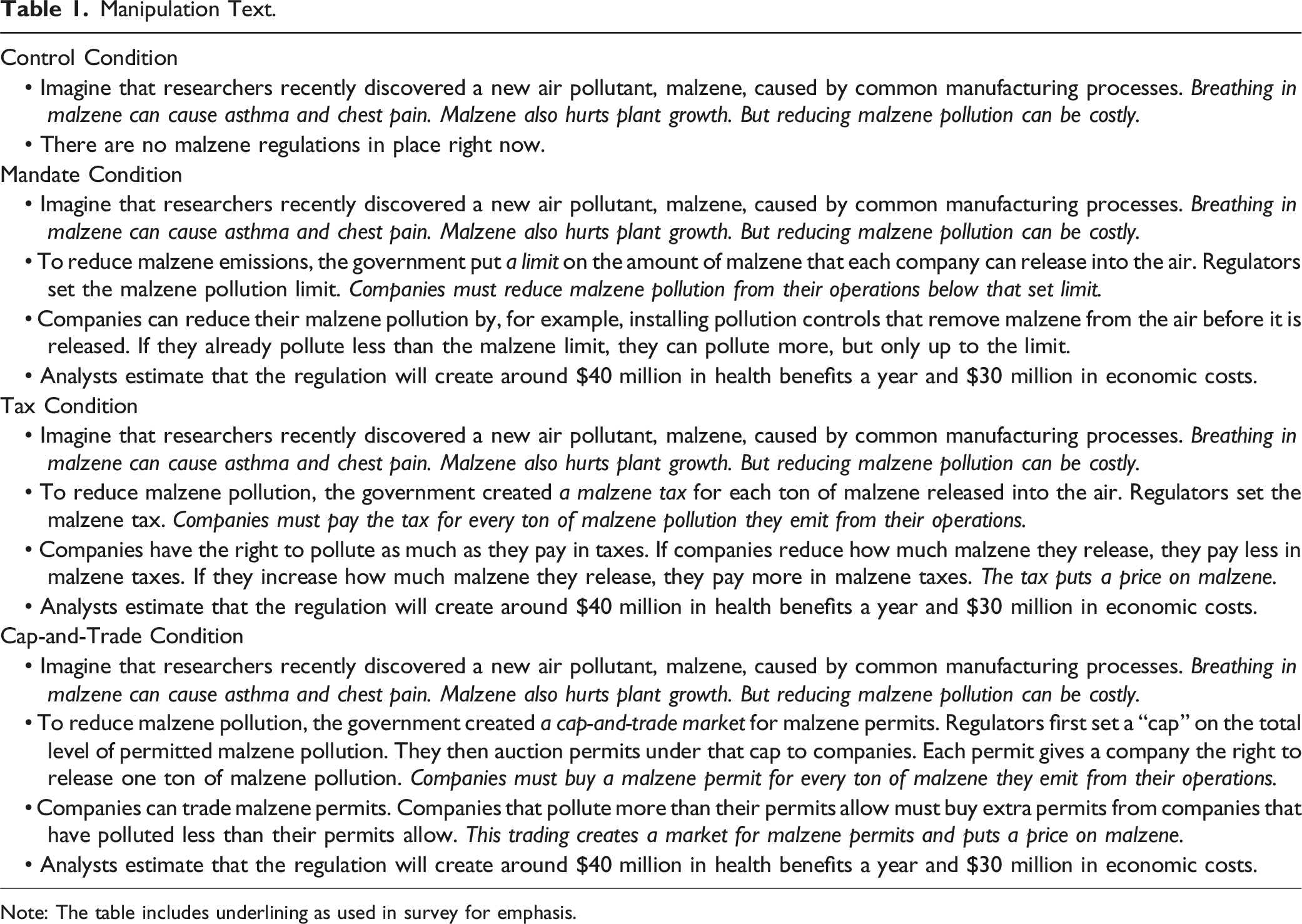
The manipulation text was based on major newspaper descriptions of these regulatory types, but was simplified and pre-tested to ensure greater participant comprehension. Each manipulation was thus at or lower than a 10th grade reading level based on the Flesch-Kincaid scale. The three treatment conditions were of similar lengths to avoid more participant fatigue in one condition versus another. In addition, to give the anti-commodification critique the best shot at finding a change in moral stigma, the manipulation used market and price language in the market-based conditions.
The manipulation does not specify numeric limits (e.g., $40/ton tax, 400-ton cap or mandate limit). Most lay people will not know what a $40/ton carbon tax really means or how it might compare to a mandate to reduce emissions below some set numerical threshold. And, importantly, the vagueness allows a plausible comparison across regulatory types without complicated calculations to demonstrate functional equivalence. Instead, to establish functional equivalence, each regulation resulted in equivalent estimated health benefits ($40 million) and economic costs ($30 million). 28
Finally, the opportunity for revenue recycling under market-based instruments was not mentioned. This distinction across instrument type is separate from the anti-commodification debate and in the real world is often used to reduce moral objections to market-based instruments (by using proceeds to, for example, allay environmental justice concerns). Emphasizing the use of government revenues, even if not to reduce moral concerns, might highlight the regulatory, rather than market-based, nature of the instruments and thus reduce the strength of the test of the anti-commodification critique.
After reading the manipulation, participants answered attention and manipulation-check questions designed to encourage engagement with the text and reinforce critical distinctions among treatments. 29 The main analyses exclude participants who failed these questions to give the cap-and-trade and tax conditions the best shot at reducing the moral stigma of pollution. (See the Appendix for robustness checks including all participants.) It could be that only the participants who sincerely engaged and fully understood the salient aspects of the treatments might be affected.
3.1.2. Dependent Measures
Participants answered two sets of dependent measures.
First, immediately following the manipulation, participants answered questions about the overall moral stigma of pollution generally. This included questions directly about the moral stigma of malzene pollution (what I’ll call “moral stigma” going forward), 30 how harmful they believed malzene to be (“harm”), 31 and their behavioral intentions with respect to malzene pollution (“behavioral intentions,” e.g., whether they would demand further regulation). 32
Second, for the treatment conditions only, participants also evaluated the morality of a firm, Alpha Corp., emitting malzene in compliance with the regulation (“compliance morality”), 33 and the morality of a firm, Beta Corp., emitting malzene in violation of the regulation (“violation morality”). 34 (The control group did not answer these questions because, without regulation, it is impossible to comply with or violate a regulation. A firm emitting “10 tons” or “13 tons” without a reference point would not have been meaningful.) To create equivalence, Alpha Corp. in all conditions emitted 10 tons of malzene (which was within its legal limit or for which it had paid the appropriate taxes or malzene permits for). Beta Corp. in all conditions emitted 13 tons, 3 tons more than allowed (based on its legal limit of 10, or for the 10 tons of malzene taxes or permits it had paid for).
To avoid confusing participants answering the mediator questions that follow, participants answered the mediator questions first, then answered these questions on the new Alpha and Beta Corp. scenarios.
3.1.3. Mediators
Participants answered mediator questions designed to explore why a shift in moral stigma might occur. 35
To test for an expressive effect, participants answered how morally bad and harmful they thought the government believed it is to emit malzene: Does the choice of a market-based instrument convey that the policymakers believed emissions to be less morally bad (“government stigma”) or harmful (“government harm”)? 36
To test for inadequacy aversion, participants answered how effective they believed the instrument was at reducing pollution (“effective”) and whether they felt the government should take the problem more seriously (“Government should do more”). 37 If they perceived market-based instruments to be less effective or a need for greater regulation, they might have been more apt to say the pollution problem is greater.
Participants also answered a set of questions designed to elicit their general beliefs about each regulation type (government motivations; how punitive, costly, and appropriate the tool was; which tool they themselves would choose; and so on). I asked these questions for a separate analysis on general lay perceptions of regulatory type and how regulatory choice affects trust in government, so do not discuss them at length here.
3.1.4. Moderators
Participants answered questions designed to identify characteristics that might make them respond differently to pollution regulations than other participants.
Participants began the study by answering two sets of moderators: how much they trust the government (Government trust) 38 and how strongly they identify as environmentalists (Environmental identity). 39 Those who trust the government more might be especially influenced by regulatory choice (the expressive effect of government tool choice might be greater). Strong environmentalists might especially be outraged by tools perceived to be ineffective or feel that market-based instruments are especially taboo.
But whether market-based instruments strike participants as engaging in a taboo trade-off might also be uncorrelated with environmental identity. Participants thus answered more direct questions about whether they felt it was wrong to have markets and prices for pollution (Norm violation). 40 Because this question could influence participants responses to the dependent measures, participants answered this question at the end of the survey, 41 with some demographic questions. 42
3.1.5. Questionnaire Order
Psychological studies often ask questions in this order: moderator questions, manipulation, mediation questions, and finally dependent measures (e.g., Wu & Zumbo, 2008). Moderators are interaction terms that distinguish how participants react to the manipulation. For example, the expressive effect of a regulation might be stronger for those who trust the government more. Moderators typically precede the manipulation to avoid influence from the treatment. For example, whether people see that the government has enacted a cap-and-trade regime or a mandate might influence how much they trust the government.
Mediation questions, in contrast, are intermediary variables meant to capture the causal cognitive path. For example, learning that the government has enacted a pollution tax might lead people to think that the government thinks the pollution is not harmful (the mediator), which might then lead people to say that they think it is less morally bad to pollute (the dependent measure). Surveys often match the order of this cognitive path, such that participants first read the manipulation, then answer mediation questions, then finally answer dependent measures.
This study deviated from this order in two ways to ensure clean measures of the main moral stigma dependent variables (as discussed above but expanded upon here). First, participants answered one moderator (how much people dislike pollution markets) at the end of the survey to avoid contaminating the dependent measures. 43 Second, participants answered the main moral stigma dependent measures immediately after the manipulation (and thus answered mediation questions after those dependent measures). Participants answered dependent measures on Alpha Corp. emissions in compliance with and Beta Corp. emissions in violation of the regulation after these mediators to ensure participant answers to the mediation questions were not keyed to these new Alpha and Beta Corp. scenarios.
The full study materials, in order of presentation to participants, are in the Appendix.
3.2. Preregistration
The study was preregistered with As Predicted. 44 The preregistration predicted that regulatory type (market-based vs. mandate) would have little effect on the overall moral stigma measures (moral stigma, harm, behavioral intentions). 45 The prediction was one of competing effects: The government’s expression of greater concern might increase the stigma of pollution under a mandate, but moral outrage in response to a perceived taboo trade-off and/or in response to the perception of a less effective instrument that necessitates a greater governmental response could increase the stigma of pollution under a tax or cap-and-trade system.
On compliance morality, the preregistration predicted that participants would find Alpha Corp. morally worse for pollution in compliance with a market-based instrument than for pollution in compliance with a mandate. This is contrary to the oft-made claim motivating the paper. That prediction was because the mandate’s expressive effect here would be to permit the pollution, and compliance with a command-and-control mandate may absolve the polluter of even more moral stigma than does compliance with a market-based instrument. The mandate may send a stronger, more categorical signal of what is approved and not approved—some pollution is legal, and other pollution is not. In a market-based system, all “allowed” pollution is still subject to a price (a tax or allowance fee) and thus less explicitly endorsed by the state. A mandate that allows pollution likely thus operates as a stronger license for that deliberately permitted pollution than a tax or cap-and-trade regime does.
On violation morality, the preregistration did not have a directional prediction. On one hand, Beta Corp.’s violation of a mandate might incur greater moral outrage—this pollution is clearly not allowed (expressive effects). In addition, market norms in the market-based instruments might also lead participants to feel they are in a more amoral context that reduces the stigma of Beta Corp.’s pollution violations. However, Beta Corp. violating a market-based instrument might also elicit more outrage because the market-based instrument might seem easier to comply with. All a firm must do to comply is pay money (Strahilevitz, 2000).
Finally, the preregistration included exploratory analysis of the potential mediation and moderation paths that might help explain the null effects on overall moral stigma. The prediction was that expressive measures might operate in conflict with inadequacy aversion, and that a feeling of taboo trade-off might act as a moderator.
3.3. Study Administration
The National Opinion Research Center (NORC), which partners with TESS, ran the study from September 14 to October 13, 2023 through its AmeriSpeak panel, a probability-based panel designed to represent the U.S. population. NORC targeted ∼2,300 participants and delivered 2,474 responses. 46 Of those, 2,040 participants passed all three attention/manipulation checks and were kept in the analysis (981 male, 1059 female participants). Appendix Table 1 provides more demographic information.
4. Results
As an overview, market-based instruments did not reduce the overall moral stigma of malzene (4.1), and companies polluting in compliance with and in violation of market-based regulations looked morally worse than those polluting in compliance with and in violation of a mandate (4.2). The data are consistent with the hypothesis that the overall economically insignificant effects on moral stigma are due to competing effects (4.3). Demographics did not moderate the relationship between regulatory condition and moral stigma (4.4).
Following the pre-registration protocol, all results exclude participants who failed attention checks to give the manipulation the best shot at finding a significant result. 47 The main analyses are unweighted (see, e.g., Franco et al., 2017; Gelman, 2007; Miratrix et al., 2018). Robustness checks with analyses including participants who failed attention checks, analyses using survey weights calculated by NORC to adjust for sampling differences and nonresponse bias, and analyses using full information maximum likelihood estimation to handle missing data are in the Appendix. None of the robustness checks changed results substantially. 48 All results include at least two analyses, comparing tax to mandate participants and cap-and-trade to mandate participants. 49 Data and code for all analyses can be found on OSF.86
4.1. Overall Moral Stigma: Moral Stigma, Harm, Behavioral Intentions
The study considered three main dependent measures: Moral stigma itself, how harmful malzene appeared, and behavioral intentions to act more on malzene emissions. As intended, participants generally found malzene pollution morally bad (∼66 on a 100-point scale, from not at all to extremely) and harmful (∼80 on a 100-point scale), and they voiced intentions to act further to reduce malzene emissions (to, e.g., support more regulation and boycott companies emitting malzene; ∼70 on a 100-point scale).
The focus in this research is on how the different treatment conditions impacted these assessments. Figure 1 illustrates the primary results—differences in perceived moral stigma, harm, and intentions to act—between the tax versus mandate and the cap-and-trade versus mandate conditions.
50
(See also Figure 2 for a plot with group means and confidence intervals for moral stigma, and Appendix Figures 2 and 3 for the same for harm and intentions to act.) In the tax v. mandate analysis, tax participants (Mtax = 67.2) found malzene emissions slightly morally worse than mandate participants did (Mmandate = 62.9).
51
This statistically significant difference is contrary to the common critique that market-based instruments reduce the moral stigma of pollution, but it amounts to only a ∼4-point difference on a 100-point scale and so is likely not economically meaningful. There were likewise no meaningful differences in perceived harm
52
or intentions to act
53
between tax and mandate participants. Differences in moral stigma, harm, and behavioral intentions between market-based regulations and mandates. Note: Plots provide means and 95% confidence intervals confidence intervals for differences between mandate and market-based regulation participants. Moral stigma: Group means. Note: Error bars are 95% confidence intervals.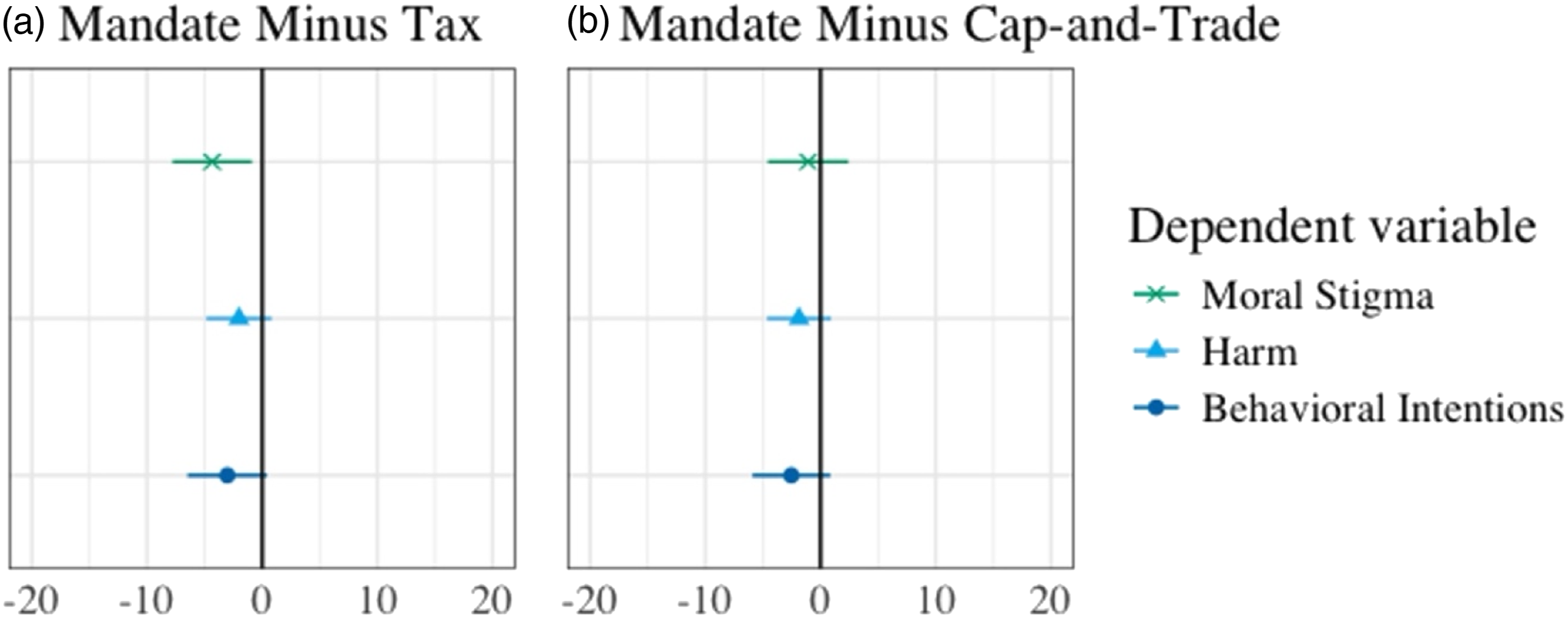
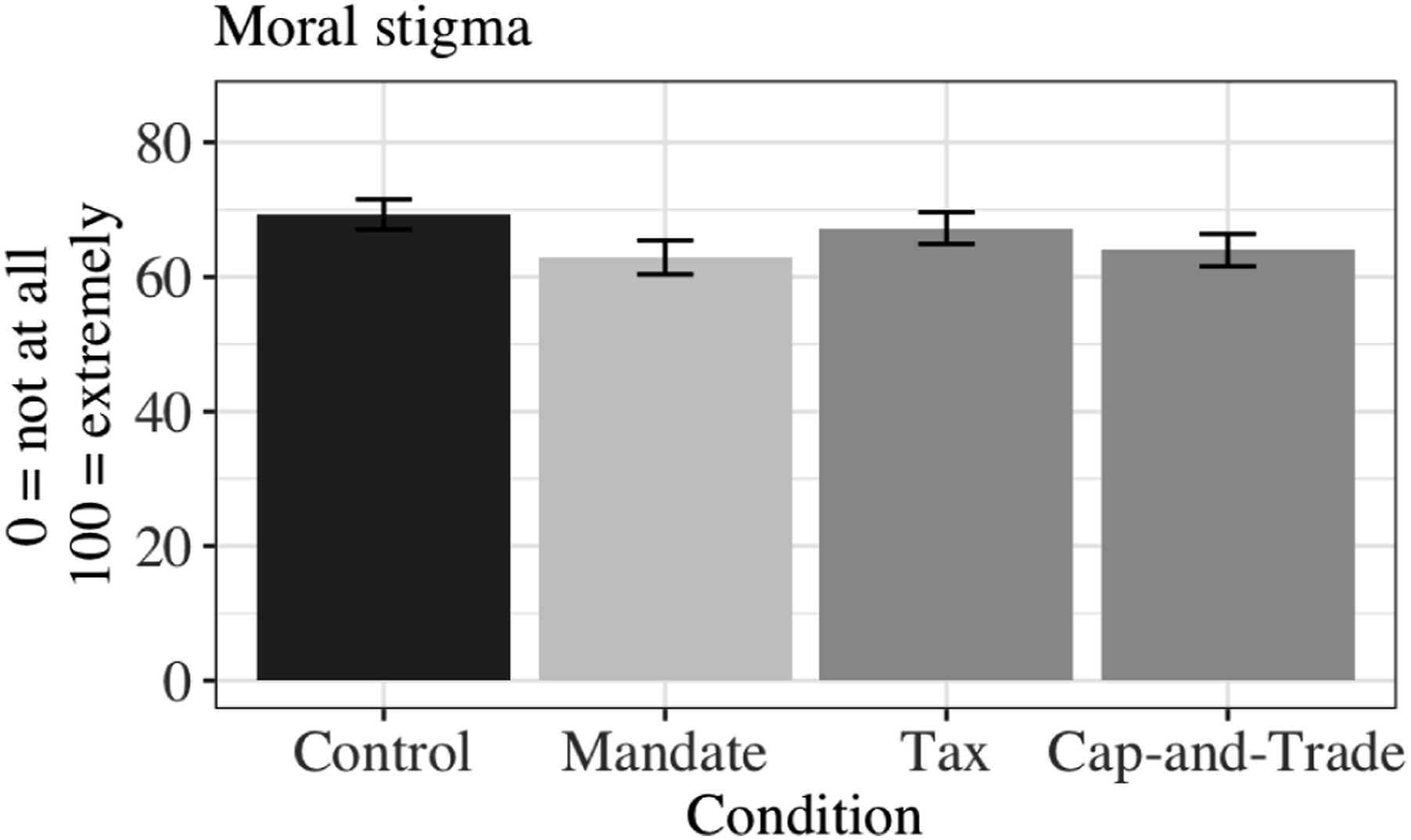
Similarly, cap-and-trade participants did not differ significantly from mandate participants in their perceptions of how morally bad 54 or harmful 55 malzene was, nor in their behavioral intentions. 56 Overall, these results were sufficiently precise to rule out any decrease in moral stigma from the tax and a decrease of more than 4% in moral stigma from the cap-and-trade program. 57
One might also question, however, whether market-based regulations nonetheless reduce moral stigma as compared to a situation of no regulation, as in the control group. This is another test of the anti-commodification theory: Perhaps pollution appears morally bad in the absence of governmental intervention, but commodifying the pollution defangs its moral stigma. As a robustness check, I thus conducted exploratory analyses comparing the market-based conditions to the control group. These analyses were not preregistered because the project’s main focus is on comparisons to the mandate. See Appendix A.4. for more detail on hypotheses and analyses.
The control group analyses found results both supportive of and counter to the anti-commodification critique. All results were of small magnitudes. Supporting anti-commodification critics, the control group felt that malzene carried more moral stigma than the cap-and-trade group did (a difference of ∼5 points out of 100 58 ), but the control group did not significantly differ from the tax group. 59 See Figure 2. And, counter to an anti-commodification effect, the control group reported malzene to be less harmful than did the cap-and-trade group (a difference of ∼4 points out of 100 60 ) and the tax group (a difference of ∼4 points out of 100 61 ). See Appendix Figure 2. On behavioral intentions, there were no statistically significant differences between the control and cap-and-trade group 62 and the tax group. 63 See Appendix Figure 3.
An additional result suggests that the finding in support of anti-commodification critics might also be due to an inadequacy-aversion effect. The control group felt that malzene was morally worse than did the cap-and-trade group, supporting anti-commodification critics, but also felt that malzene was morally worse than did the mandate group (a difference of ∼6 points out of 100 64 ). See Figure 2. Together, the results suggest not an effect of commodification (the sentiment that “pollution is no big deal because it is just another thing to be bought and sold” does not apply to the mandate), but maybe one of outrage about regulatory insufficiency in the no-regulation control (“this lack of regulation is offensive—this pollution is really bad”).
Because the motivating question is about moral stigma, and following the preregistered protocol, I focus on moral stigma (rather than harm or intention to act) going forward.
4.2. Compliance and Violation Morality
Did market-based regulations change how people judged companies complying with and violating the law? Yes. In both cases, market-based regulations made companies look morally worse—in other words, market-based regulations increased the moral stigma of pollution. Figure 3 illustrates the tax versus mandate and cap-and-trade versus mandate differences; Figure 4 plots group means for ease of interpretability. Comparing compliance and violation morality between market-based regulations and mandates. Note: Compliance morality variable created by asking participants to agree on a 0–100 scale, where 0 = strongly disagree and 100 = strongly agree, whether Alpha Corp. is a morally bad, shameful, or bad actor for polluting in compliance with its regulation. The three measures were averaged. Violation morality variable created in the same manner for Beta Corp., which was polluting in violation of its regulation. Plots provide means and 95% confidence intervals for differences between mandate and market-based regulation participants. Compliance and violation morality group means. Note: Participants were asked to agree on a 0–100 scale, where 0 = strongly disagree and 100 = strongly agree, with whether Alpha Corp. (for compliance morality) and Beta Corp. (for violation morality) are a morally bad, shameful, and a bad actor (the three measures for each were averaged). Dark grey bars help distinguish the market-based instruments (tax, cap and trade) from the command-and-control mandate. Error bars are 95% confidence intervals.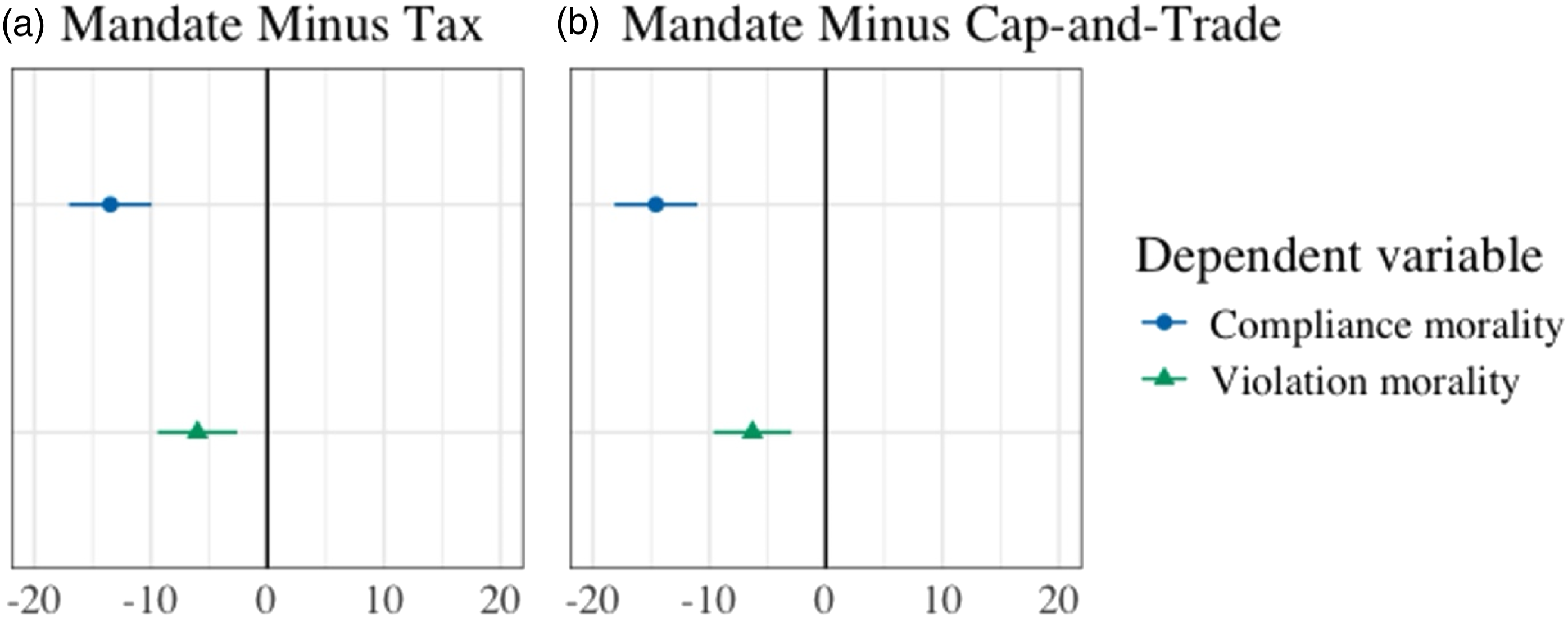
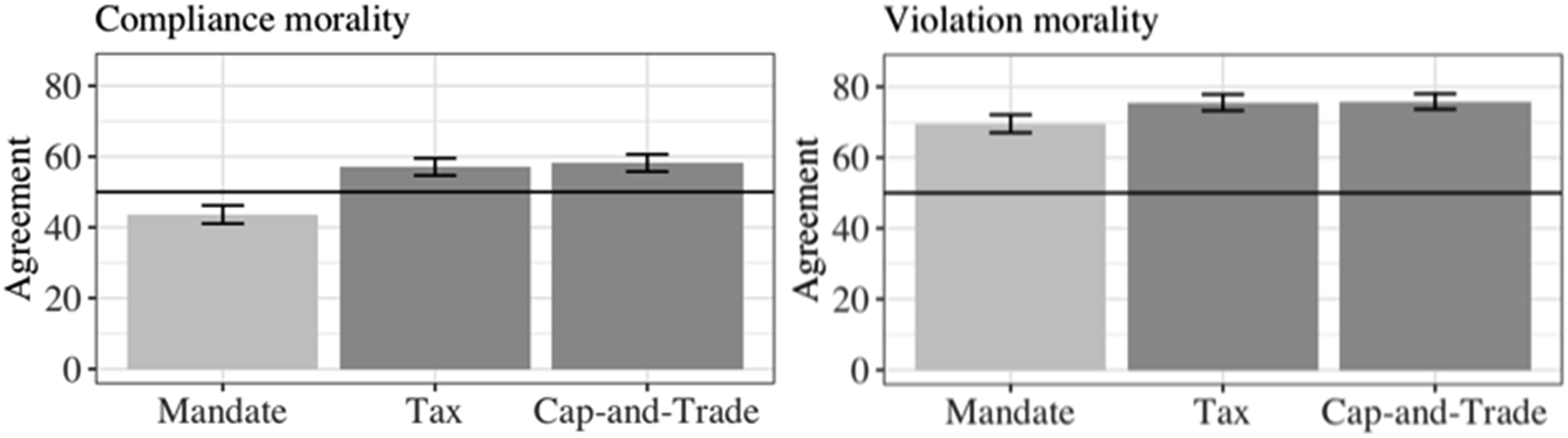
For compliance morality, as predicted, Alpha Corp. looked morally worse for polluting in compliance with the tax and cap-and-trade regulations than for polluting in compliance with the mandate. 65 The roughly 14-point difference (on a 100-point scale) in compliance morality also appears economically significant. As Figure 4 illustrates, a company polluting in compliance with a mandate did not look morally bad but one polluting in compliance with a tax or cap-and-trade regime did. (Participants in the mandate condition on average disagreed that Alpha Corp. polluting in compliance was morally bad, while those in the market-based conditions agreed that it was morally bad.). Another (not preregistered) way of looking at the data is that 44% of mandate participants agreed (>=50) that Alpha Corp. was morally bad, shameful, or a bad actor, while 58% of tax and 65% of cap-and-trade participants agreed. These results accord with the idea that a categorical mandate expresses greater permission to pollute when in compliance than do tax or cap-and-trade instruments.
For violation morality, as Figures 3 and 4 illustrate, Beta Corp. looked worse for polluting in violation of a tax or cap-and-trade regulation than for polluting in violation of the mandate. 66 But this result (with a ∼6-point spread between the market-based conditions and the mandate), for which there was no preregistered prediction on direction, appears less meaningful than the compliance morality result. 67 In all conditions, participants on average agreed that Beta Corp. was a morally bad actor.
One potentially unexpected implication of these results is that, for a reputation-conscious company, the marginal incentive to comply with the law is lower under the market-based instruments than under the mandate. Under a market-based instrument, companies look somewhat morally bad whether they comply or not; under a mandate, they look affirmatively good for compliance and bad for violating the law.
4.3. Mechanisms
The previous section found that market-based instruments, as compared to mandates, do not reduce the overall moral stigma of pollution. Why don’t they?
Appendix Section A.5 provides an in-depth discussion of an exploratory mediation analysis using structural equation modeling (SEM) to investigate potential causal paths. Here, I provide only a high-level overview.
The theory predicted that competing mechanisms explain the null or economically insignificant effects. On the one hand, an expressive effect of the market-based instrument might be to reduce the moral stigma of pollution: The government’s choice of a market-based instrument suggests that the government thinks malzene is less harmful (the “government harm” variable) and less morally bad to emit (“government stigma”), thus prompting people to themselves think malzene is less morally bad to emit (the “moral stigma” dependent variable). This expressive effect, I hypothesized, would be greater for people who trust government policymakers more (“trust in government” as a moderator).
Pushing in the opposing direction could be an inadequacy-aversion effect: People may feel that the market-based instruments are less effective (“effective”), that the government should thus do more (“government should do more”), and thus express greater moral outrage to perceptions of this greater remaining problem (captured in the “moral stigma” variable). In addition, a taboo trade-off effect might, for those who dislike the marriage of markets and pollution (higher values of the “norm violation” variable) or for whom the environment is more sacred (higher values of “environmental identity”), also result in greater moral outrage. (Here, I predicted that norm violation and environmental identity could moderate the relationship between regulatory condition and moral stigma).
On methods, I started the analysis with a two-step variable selection process for each proposed mediation path (expressive effect, inadequacy aversion): First, did the market-based regulation change the proposed mediator? Second, was the mediator associated with moral stigma in the conceptualized direction? I included predicted moderators if I found the conceptualized moderation effect in the second step.
After variable selection, a full structural equation model simultaneously estimated all remaining mediation and moderation paths to determine the significance of the proposed pathways. 68 I conducted two analyses, comparing the tax to the mandate, and comparing cap-and-trade to the mandate.
In short, the data are mostly consistent with both an expressive effect (moderated by government trust) and an inadequacy-aversion effect, though some of these indirect effects are small and not all measured variables were selected for analysis. I did not find evidence of the conceptualized taboo trade-off effects. People who expressed greater outrage to markets in pollution (norm violation variable) or stronger environmental identities (environmental identity variable) were not more likely to find pollution morally worse in the tax or cap-and-trade conditions than in the mandate condition. See Appendix Table 4. I thus excluded these moderators from the structural equation models. However, a taboo trade-off effect may have still been afoot. A large majority of participants (82%) found markets in pollution taboo (they agreed with statements like “It is wrong to have markets in pollution”), and 87% of participants suggested they had strong environmental identities (e.g., with agreement with statements like “I think of myself as an environmentally-friendly consumer”). There may not have been enough variation in these variables (norm violation, environmental identity) to capture changes in moral outrage people feel in response to a taboo trade-off because nearly everybody felt there was a taboo trade-off. 69
Figures 5 and 6 present the conceptual models tested in the full SEM analysis for the tax and cap-and-trade analyses (including, in other words, only the variables that made it past Step 1 and Step 2 of the variable selection analysis).
70
I discuss high-level results from each. SEM Path Diagram for Tax versus Mandate. Note: Path diagram representing the conceptual model tested after excluding proposed mechanisms that were unaffected by the tax, that did not correlate with moral stigma (government harm), or did not have the proposed interaction effect (norm violation, environmental identity). Single straight arrows on a straight line from one variable X to another Y represent a predicted causal relationship to the variable with the arrow (e.g., condition caused a change in government harm). Mediation paths are thus those that go from one variable to another and then to the dependent measures. Moderators are represented with arrows from the proposed moderators (trust in government, norm violation) into the causal paths they might moderate. Green text represents expressive function of law paths that might reduce the moral stigma of pollution from market-based instruments, while blue text represents countervailing paths that might increase the moral stigma of pollution. Following convention, ovals represent latent variables (constructs inferred with multiple measurements), while rectangles represent observed variables.
71
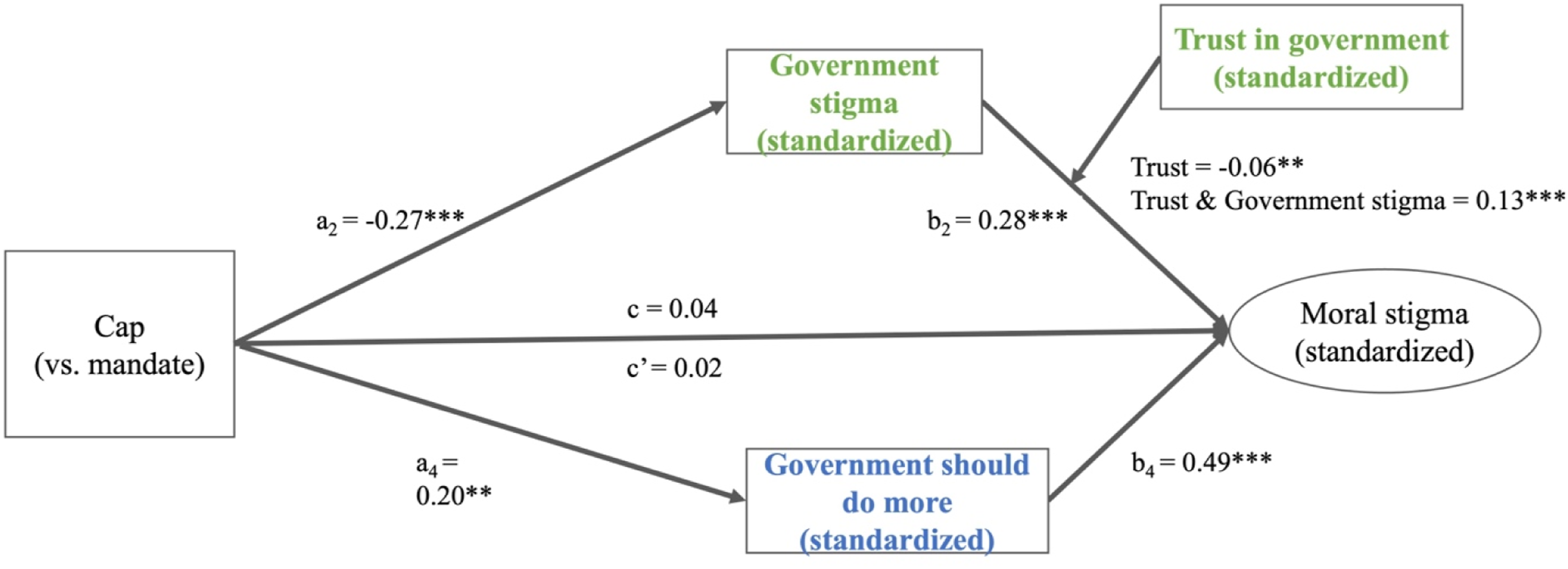
The Trust in government variable is a moderator and, per convention, is represented as an arrow pointing into the relationship it moderates (Government stigma to Moral stigma). Moderation relationships are interactions (Government stigma * Trust in government, or, equivalently, Government stigma + Trust in government + Government stigma: Trust in government). Thus, both the coefficient for Trust in government and for the interaction are reported. To reduce complexity, I omit error terms and correlations between variables. SEM: Cap and Trade versus Mandate. Note: Path diagram representing the conceptual model tested after excluding proposed mechanisms that were unaffected by the tax, that did not correlate with moral stigma (government harm, effective), or did not have the proposed interaction effect (norm violation, environmental identity). Single straight arrows on a straight line from one variable X to another Y represent a predicted causal relationship to the variable with the arrow (e.g., condition caused a change in government harm). Mediation paths are thus those that go from one variable to another and then to the dependent measures. Moderators are represented with arrows from the proposed moderators (trust in government, norm violation) into the causal paths they might moderate. Green text represents expressive function of law paths that might reduce the moral stigma of pollution from market-based instruments, while blue text represents countervailing paths that might increase the moral stigma of pollution. Following convention, ovals represent latent variables (constructs inferred with multiple measurements), while rectangles represent observed variables.
78
The Trust in government variable is a moderator and, per convention, is represented as an arrow pointing into the relationship it moderates (Government stigma to Moral stigma). Moderation relationships are interactions (Government stigma * Trust in government, or, equivalently, Government stigma + Trust in government + Government stigma:Trust in government). Thus, both the coefficient for Trust in government and for the interaction are reported. To reduce complexity, I omit error terms and correlations between variables.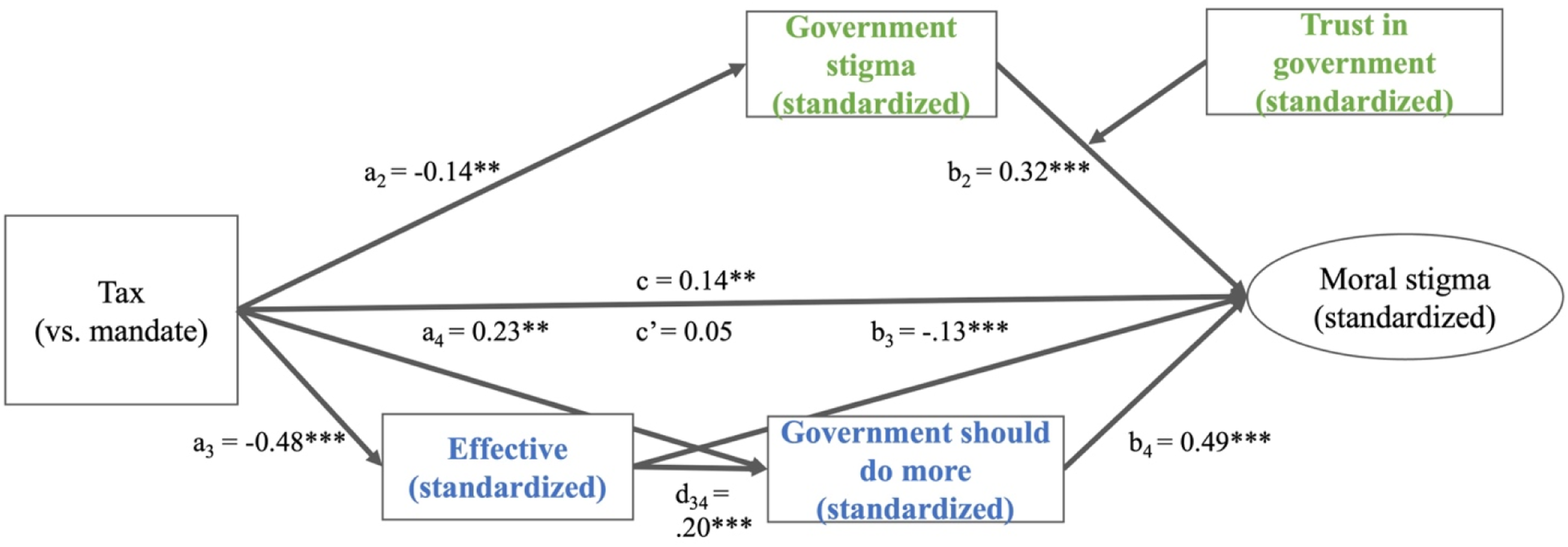
The tax SEM fit the data well on most measures, 72 and the indiriect paths were significant and in the conceptualized directions. On the expressive effect path, the data are consistent with the hypothesis that tax reduced the moral stigma of pollution by making participants believe that the government thought malzene was not as morally bad (Government stigma). The main effect is relatively small (a 1 standard deviation change in Government stigma from moving to a tax was associated with a .05 drop in standard deviation in moral stigma). 73 But there was a larger effect for those with greater trust in government: At high levels of Trust (one standard deviation above the mean), the indirect effect was −.19, closer to a large effect. 74
Both inadequacy aversion mediators also separately fit the conceptualized pattern, increasing moral stigma. The tax made the malzene regulation appear less effective, and less effective regulations correlated with greater moral stigma (but not directly stronger behavioral intentions). 75 Again, the effect was relatively small: A one standard-deviation change in effectiveness from a move to tax was associated with a 0.06 increase in standard deviation in moral stigma. Likewise, the malzene tax led participants to greater reports that the government should do more, which was associated with greater moral stigma and greater behavioral intentions. 76 This indirect path was larger, a medium effect: A one-standard deviation change in Government should do more from a move to tax was associated with a 0.11 increase in standard deviation in moral stigma. The indirect serial mediation path (from tax to effective to government should do more) was in the opposite direction as predicted. More effective regulations correlated in the model with greater reports that government should do more, resulting in a statistically significant negative serial mediation path with an effect size of −0.05. 77 This is not an implausible relationship: The more effective people believe government regulation is, the more they might believe the government should engage in more regulation.
The cap-and-trade analysis came to qualitatively similar results as the tax analysis, with the exception that regulatory effectiveness did not make it past variable selection. The model fit the data well on most measures, 79 and the indirect paths were significant and in the conceptualized directions. For greater discussion of that analysis, see Appendix.
Importantly, this mediation analysis can make causal claims for the first step: regulatory condition was randomly assigned so it is clear that the effect of condition on, for example, government stigma is causal. However, the test for the second step (the effect of the mediator on the dependent variable, e.g., the effect of government stigma on moral stigma) uses correlations, without random assignment of the mediator. It may thus be that an omitted variable explains the correlations, or even that the causal order is flipped. This is particularly plausible with the inadequacy-aversion hypothesis: People who think malzene is morally worse are likely to think the government should do more. Follow-on research should thus separately manipulate the mediators (e.g., government stigma, effectiveness of the regulation) to test their causal effects on moral stigma. Follow-on research could also devise a way to capture a generally shared taboo trade-off effect.
4.4. Demographics
Controlling for various demographic variables (age, gender, race, education, income, ideology, political party, environmental identity) did not change the overall results for the effect of regulatory type on moral stigma (tax participants continued to find malzene morally worse than mandate participants, and there was still no difference for the cap-and-trade vs. mandate comparison). See Appendix Tables 5 and 6. 80 None of the demographic variables differentially affected participant responses to regulatory condition (there were no significant interactions between condition and demographic variables). See Appendix Tables 7 and 8.
Overall (across both sets of regressions, tax vs. mandate and cap-and-trade vs. mandate), participants tended to find malzene morally worse if they were women, lower income, less conservative, more strongly Democratic, or had stronger environmental identities. Significant prior research has found that women have stronger pro-environmental attitudes (Ramstetter & Habersack, 2020), and that those on the political left and with stronger environmental identities found pollution morally worse is unsurprising.
However, the fact that lower income participants found malzene pollution morally worse is contrary to research that suggests that higher income correlates with stronger environmental concern (see, e.g., Franzen & Meyer, 2010; Franzen & Vogl, 2013). Indeed, even in this study, higher income predicted higher environmental identity measures (but lower moral stigma of malzene pollution). 81 But environmental attitude measures (as is the case in the two cited studies above) often include questions about willingness to pay to protect the environment and willingness to accept cuts in standard of living to protect the environment, both of which might conflate budget constraints with environmental attitudes. Environmental identity as measured in this study included measures on being an environmentally friendly consumer and being seen as having an environmentally friendly lifestyle, which might thus pose similar challenges.
5. Discussion & Conclusion
Contrary to the anti-commodification critique, market-based regulations do not appear to reduce the moral stigma of pollution as compared to a command-and-control mandate. There was no significant movement on measures of the overall moral stigma of pollution (moral stigma, harm, behavioral intentions). Competing influences may explain these very small or null effects. An expressive effect of the market-based regulations appears to reduce the stigma of pollution (because the government seems to express through its choice of market-based instrument that malzene is less morally bad). But the perceived inadequacy of the market-based regulations appears to encourage greater moral outrage. And, because most participants stated opposition to markets in pollution and declared themselves environmentally concerned, a taboo trade-off effect might have been in operation generally across the sample.
The finding that the no-regulation control group also found malzene slightly morally worse than the cap-and-trade group supports the anti-commodification critique. But the finding is complicated by the finding that the control group also found malzene slightly morally worse than did the mandate group. Rather than an anti-commodification effect specific to the cap-and-trade group, perhaps the no-regulation control group was subject to an inadequacy-aversion effect, increasing the moral stigma of pollution in that group overall.
One response to these results—with only null or very small effects—might be that regulatory frame just does not influence how people view the morality of pollution, or that participants here simply did not care. These possibilities seem less likely, however, given the strong distinction participants drew between complying with market-based instruments and complying with mandates.
Market-based instruments made companies polluting in compliance with or in violation of the law look morally worse than companies polluting in compliance or in violation of a mandate. The difference on violation morality was small, but it was economically significant on compliance morality: Participants on average disagreed that a company polluting in compliance with a mandate was morally bad but on average agreed that a company polluting in compliance with a tax or cap-and-trade program was morally bad. To be clear, because lay people are unlikely to think explicitly about compliance and violation morality, these results do not necessarily mean that market-based instruments increase the moral stigma of pollution. Rather, these measures provide additional support for the contention that market-based instruments are unlikely to reduce moral stigma. Moreover, the greater moral stigma on compliance morality for market-based instruments would of course likely disappear if these instruments also explicitly allowed (without requiring payment) a set limit of pollution, creating a hybrid instrument—it is the explicit permission that is likely doing this work.
Interestingly, the compliance measures generate a new and different argument against market-based regulations—they reduce reputational incentives to comply with the law. Complying with a market-based instrument does not make a firm look morally good, but complying with a mandate does. 82 The growing emphasis on corporate environmental, social, and governance (ESG) metrics, despite some backlash, has highlighted the importance of such reputational incentives. That said, the same finding could mediate in favor of market-based regulations. Alpha Corp. in the mandate condition has a greater reputational incentive to get to bare compliance—Alpha Corp. then looks like a morally good actor. But then, with less moral stigma attached to polluting (Alpha Corp. already looks morally good!), there may be smaller reputational incentives to continue reducing pollution. Moreover, the extra moral credit companies obtain for complying with a mandate might lead to moral licensing and thus greater moral or reputational transgressions. In contrast, Alpha Corp. in the market-based conditions may continue to incur moral stigma for pollution at all levels (in this study, at 10 tons, Alpha Corp. continued to look like a morally bad actor). The market-based regulations might thus operate to crowd in good behavior even at relatively lower levels of pollution. 83 Of course, these are all empirical suppositions that remain to be tested.
In reflecting on the findings here, the perhaps most surprising result was that so many people reported that markets in pollution are morally wrong despite the increasing use of (and thus, presumably, familiarity with) these regulatory instruments. This discomfort may be because of known objections—because of the potential for hot spots, regressive policies, or uncertainty about the political feasibility or efficacy of these instruments. It may also stem from taboo trade-off-like reactions. The reasons for this discomfort is worth further study—understanding the reasons for the discomfort may help policymakers better design tools that garner greater political support. This discomfort could also help explain the popularity of the common critique—whatever the reason for their discomfort, people might point to the argument that paying to pollute reduces the moral stigma of pollution to provide further support against the use of market-based instruments (cf. Haidt, 2001). 84 If the discomfort is truly persistent even in the face of correctives measures (to address hot spots, regressivity, and so on), there are difficult normative questions about if or how the discomfort should then influence policy in a democratic system of government.
A few limitations to the study are important to note. First, one might argue that the findings are not externally valid because meaning is socially constructed—any response to regulations in the real world will depend on how people in the real world discuss those regulations. But the manipulation text was based on major newspaper descriptions of these regulatory types. They thus represent how people in the real world might encounter these regulations. Of course, as those discussions change, social meaning may also change.
Second, the null effect for cap-and-trade could be because the regulatory regime is just too complicated for people to understand. But the manipulation here used simplified language and the main results included only participants who passed three validation questions. If participants did not understand simplified text based on real-world descriptions of the regulatory tools, then they might in the real world likewise not understand the regulations, blunting their impact on moral stigma.
Third, it could be that market-based regulations do reduce the moral stigma of novel harms, but that people are already relatively fixed in how they view the moral stigma of pollution, regardless of whether the pollutant (here, malzene) is new. Future research could test the moral stigma of some new, fictitious harm altogether. That said, if the moral stigma of pollution is already relatively fixed and unalterable from regulatory form, the original worry that paying to pollute will reduce the moral stigma of pollution is less concerning.
Fourth, and more importantly, market-based instruments might reduce the moral stigma of the regulated act over longer time periods and repeated exposures. Here, the study tested only a single exposure and measurement. But why would greater exposure reduce moral stigma in a way that a single exposure would not? Perhaps more familiarity with market-based instruments would reduce inadequacy aversion (because people learn that the instruments are effective) and moral outrage from a taboo trade-off (because the instruments become more normalized). But, in doing so, the expressive effect would likely also diminish: A government instituting an appropriate, effective tool is unlikely to be signaling that pollution is less morally bad.
And greater exposure to market-based instruments might instead heighten inadequacy aversion. Some scholars argue that market-based regulations are especially likely to end up being underprotective because they make so clear to regulatory entities the costs of regulation (see, e.g., Mildenberger & Stokes, 2020). If true, a sense of inadequacy aversion could be accurate because, for a given level of political power, it may be easier to pass a relatively more stringent mandate than market-based instrument. This empirical thesis is worth testing: Because of the relative efficiency and perceived lighter touch of market-based instruments, the opposite prediction is also possible. 85 And, even if true, sequencing of policies can and have brought up market-based regulatory standards after the fact (Pahle et al., 2018).
Another reason greater exposure to the market-based instruments might matter is that people might be responding with more moral outrage about pollution under a market-based instrument because they, like Sandel and others, are worried that the instrument will normalize pollution and reduce its moral stigma. This is distinct from believing the instrument is less effective—the concern would be not over the instrument’s direct effects on polluters, but rather on societal norms. If true, then greater exposure to market-based instruments that do not reduce the moral stigma of pollution might likewise ameliorate this concern and thus, ironically, lead to reductions in the moral stigma of pollution. But, if true, then this concern would in theory be revived and could itself act as a protective measure to maintain moral stigma.
A final limitation is that this study evaluated a lay population of Americans and targeted a demographically representative sample. Market-based regulations could reduce the moral stigma of pollution or change downstream behaviors for particular subsets of the population who are especially important for policy. For example, environmental activists may feel less motivated to lobby for a higher tax than to lobby for more stringent mandates. This study does not find these subpopulation effects but the population of politically active environmental activists may be too small to adequately capture in this well-powered but broad sample. In addition, future research should explore how regulated entities themselves react to different regulatory frames, a question this study does not address. The greater control asserted under mandates could prompt greater reactance and thus motivated reasoning reducing the moral stigma of pollution (“These mandates are terrible! Pollution isn’t so bad.”). But the clearly identified costs involved under market-based instruments might do the same (“These pollution taxes are so expensive! Pollution isn’t so bad.”).
Despite these limitations, the project boasts strengths that support its conclusions. The study was preregistered and well-powered, and it sought, using highly regarded sampling techniques, a demographically representative sample. While the predicted main effects were small or null, compliance morality measures validated the ability of the manipulation to move attitudes.
That said, this project addresses only one critique of the use of market-based instruments and so does not take a broader stance for or against market-based instruments—any such stance would be hopelessly naïve in any case, given that a particular tool’s success is likely to depend heavily on context. Instead, the project suggests that one oft-cited critique of these market-based tools, as a general matter, may be incorrect: Paying to pollute does not appear to reduce the moral stigma of pollution.
Supplemental Material
Supplemental Material - Does Paying to Pollute Make Pollution Seem Less Bad?
Supplemental Material for Does Paying to Pollute Make Pollution Seem Less Bad? by Hajin Kim in Journal of Law & Empirical Analysis
Footnotes
Acknowledgments
I thank the University of Chicago Law School faculty research funds for supporting pilot studies and the Time-sharing Experiments for the Social Sciences for supporting the full study.
Author Contributions
Hajin Kim, solo-authored.
Declaration of Conflicting Interests
The author(s) declared no potential conflicts of interest with respect to the research, authorship, and/or publication of this article.
Funding
The author(s) disclosed receipt of the following financial support for the research, authorship, and/or publication of this article: This work was supported by the Time-sharing Experiments for the Social Sciences and University of Chicago Law School faculty research funds.
Ethical Statement

Supplemental Material
Supplemental material for this article is available online.
Notes
References
Supplementary Material
Please find the following supplemental material available below.
For Open Access articles published under a Creative Commons License, all supplemental material carries the same license as the article it is associated with.
For non-Open Access articles published, all supplemental material carries a non-exclusive license, and permission requests for re-use of supplemental material or any part of supplemental material shall be sent directly to the copyright owner as specified in the copyright notice associated with the article.
