



Abstract
We examine dissent on the Brazilian Supremo Tribunal Federal (STF) using a novel dataset of 2.23 million individual votes in over 420,000 collegiate decisions issued between 1988 and 2023. After discussing the particularities of the Court’s processes and the individual minister characteristics and institutional features potentially influencing incentives to dissent, we examine the effects of several different elements on likelihood of individual dissenting votes. Our findings suggest that jurisdiction type, collegiate body, legal complexity, ideology, case salience and the relationship between case reporter and dissenter all play non-trivial roles. We also find that exposure to the legal academy in common law jurisdictions is correlated with an increased propensity to dissent and that two-thirds of the Court’s dissenting votes are attributable to a single member, Minister Marco Aurélio. Finally, we discuss the more nuanced impacts of several additional factors including televised hearings, virtual sessions, and gender.
Introduction
Brazil’s 1988 Constitution represented a formal return to democracy after twenty-four years of military dictatorship. Building on a negotiated transition of power, that constitution entrenched a panoply of rights, created a robust set of checks and balances intended to serve as the foundation of a renewed Brazilian democracy, and assigned the judiciary a substantial role in their oversight. At the apex of that judiciary sits the Supremo Tribunal Federal (Supreme Federal Court, or “STF”), which fulfills three separate judicial functions: constitutional, appellate, and trial. In its constitutional role, the Court hears abstract challenges to the constitutionality of laws, regulations, and other state actions. In its appellate role, it is Brazil’s court of last resort in concrete cases that involve a constitutional issue. Lastly, it acts as a court of original jurisdiction in several situations, for example in criminal proceedings in which the defendant is a member of Congress or of the President’s cabinet, as well as in Mandados de Segurança (writs of injunction) filed directly against the President of the Republic, or the President of a House of Congress. 1
There is a growing empirical literature on multiple dimensions of the STF (see Da Ros, 2017, for a review), and the role of the judiciary in Brazilian politics more generally (Ingram, 2015; Taylor, 2007). A key takeaway from this work is that, since democratization, the STF has displayed a significant level of unanimity in its decisions. For example, Oliveira (2017) found that 72% of abstract review procedures decided between 1988 and 2014 were unanimously decided by the plenary court (see also, Desposato et al. (2015); Ferreira and Mueller (2014); Jaloretto and Mueller (2011); Oliveira (2008, 2012); Silva (2018; 2022)). 2
Yet, relatively few studies have focused on explaining dissenting behavior in the STF (Desposato et al., 2015; Lopes, 2019). While some courts do not allow for dissent (Dyevre, 2010; Kelemen, 2013), there are no courts in which dissent is mandatory. Even if the outcome reached by the majority is not ideal to a judge, they always have the option of not expressing disagreement and joining the majority. Judicial behavior scholars have mostly framed dissent as the outcome of a calculus: the judge weighs the costs (such as using time and other resources which could be used for other activities; or undermining collegiality) and benefits (such as signaling to external audiences or lower courts; paving the way for jurisprudential change; or building their individual reputation) of not going with the flow instead of expressing disagreement.
These individual calculations are potentially shaped, among other factors, by institutional design and professional norms, which are variables particularly amenable to comparative analyses. The STF presents a specific confluence of those variables that invites empirical investigation on dissenting behavior: it has a massive docket, deciding dozens of thousands of cases per year; it is a multipurpose court, combining vast competences of abstract review, appellate jurisdiction, and original jurisdiction in which it acts as a trial court; it has had televised judicial deliberations in the plenary for over two decades (and, since the COVID-19 pandemic, also in its panels); reporters are randomly assigned cases for which they will be the first to present their opinion, and the other judges follow a largely fixed voting order. Moreover, in almost all those dimensions, the court has undergone reforms in the last decades.
Thus far, however, empirical work on the Court focuses almost exclusively on a single procedure, the Ação Direta de Inconstitucionalidade (ADI), 3 which triggers abstract judicial review of legislation. 4 The ADI is an important procedure, and decisions in those cases have potentially far-reaching effects. It is, however, only one of the fifty-three different kinds of lawsuits that can be heard by the Court, accounting for 1.5% of its collegiate docket. It is a highly specialized procedure, in a court that does much more than abstract review. While there are good theoretical and practical reasons for focusing on abstract review, this exclusive focus is a missed opportunity to explore the full impact, on judicial behavior, of several features of the STF’s composition, design, and decision-making procedures.
In this paper, we aim to contribute to the empirical literature on the STF by investigating the drivers of dissenting behavior through an expanded dataset, covering the 35 years from the promulgation of the current (1988) constitution through the first half of 2023 and including all types of court procedures. In so doing, we take no position on whether non-unanimous decisions are “good” or “bad” (cf. Garoupa & Santos Botelho, 2022; Grementieri & Golden, 1973; Peterson, 1981; Sanders, 1962; Simpson Jr., 1922). Rather, our focus is on why and when STF judges choose to dissent.
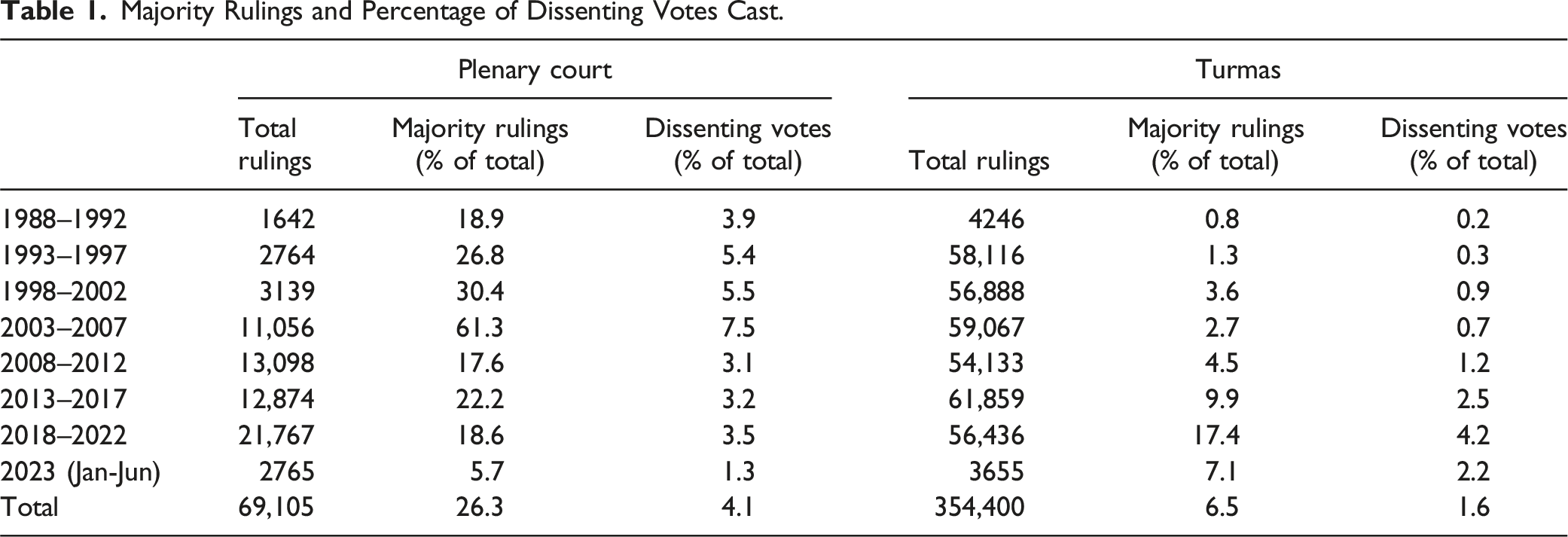
The data analyzed herein represents the universe of collegiate decisions issued by the STF’s Plenario (plenary bench) or one of its two five-member turmas between 7 October 1988 and 5 July 2023. From a comparative perspective, both the volume and unanimity of the Court’s decisions are a matter of interest. Out of over 423,000 collegiate decisions, more than 380,000 (90%) were unanimous and another 33,000 (8%) had a single dissent; roughly 8000 (2%) had more than a single dissenting vote. When only the 70,000 decisions of the plenary bench are considered, 74% were unanimous, 19% had a single dissenting vote, and only 1% were “close” votes in that a single judge changing their position could have resulted in a different outcome. Comparatively, less than half of US Supreme Court decisions have been unanimous over the past ten years and 20% have been split 5-4 since 2006 (Gou et al., 2022, pp. 13–14). The data also reveal substantial variation in levels of dissent over time. In 1994, the first year the Court’s collegiate decisions exceeded 10,000, more than 98% of the STF’s collegiate final decisions were unanimous. In 2003, less than 90% were unanimous. Since then, unanimity has been as high as 97% and as low as 74%.
Our focus, however, is not on aggregate patterns of unanimity over time, but on the likelihood that a given minister will dissent. We investigate the influence of a combination of factors on dissenting behavior: legal complexity; workload; ideology; case salience; individual characteristics of the case reporter (exposure to common law education; and, professional trajectory). We also explore how the live broadcasting of deliberations, the implementation of a weak form of binding precedent, and the more recent reliance on an asynchronous decision-making procedure (the Plenário Virtual) might affect whether individual judges decide to follow the majority opinion or dissent.
The remainder of this paper is structured as follows. Part II describes the STF’s processes and procedures, surveys existing work on the Court, describes key reforms, and provides an overview of its caseload and rate of unanimity over time. Part III discusses four constellations of factors that have the potential to impact dissenting behavior in reference to existing literature. Part IV presents and discusses the results of several logistic regression models that offer insight into individual dissenting behavior. Part V offers concluding comments and thoughts in relation to future research in this area.
Decision-Making on the STF and Our Database
The STF has served as the country’s apex court since the establishment of Brazil as a Republic in 1891. With the democratic transition and the promulgation of a new constitution in 1988, the court’s primary role theoretically shifted toward that of a constitutional court. In practice, a broad definition of what constitutes a constitutional matter, a variety of institutional factors incentivizing successive appeals, and the limited role of precedent have posed obstacles to the STF’s full transformation in a constitutional court (Ríos-Figueroa & Taylor, 2006). The Court’s full complement is eleven judges, styled as Ministros (Ministers). They are appointed by the President of the Republic, approved by the Federal Senate, and serve to the age of 75; before the mandatory retirement age, they can only be removed due to a criminal conviction or impeachment by a two-thirds majority vote of the Senate.
One of the Court’s most notable characteristics is its caseload, which has risen dramatically since Brazil’s return to democracy. The data employed herein is drawn from a database of STF cases filed between 1988 and mid-2023. Basic data for all cases, including every docket entry, was scraped from the court Web site. This process identified 2.23 million individual matters filed with the Court and 420,000 rulings of one of the Court’s collegiate bodies in just over 360,000 distinct cases. For each, the information on whether each minister voted with the majority or was absent from the trial session was extracted using a deterministic algorithm. 5
In relation to existing studies of STF decision-making, the data is novel in two primary respects. First, it encompasses the totality of the Court’s docket. While ADIs are conceptually and politically important, the potential impact of other forms of abstract review as well as the Court’s substantial appellate and original jurisdiction also warrant investigation. For example, many high-profile political conflicts inside Congress involving legislative procedures, congressional investigative committees (Comissões Parlamentares de Inquérito) and proposals to amend the constitution are brought before STF by lawsuits filed by individual members of Congress. 6 Moreover, in its capacity as Brazil’s court of final appeal, the STF is required to adjudicate a wide range of matters from federalism disputes to social policy to pension reform. (see, e.g., Dantas, 2020; Kapiszewski, 2011, 2012; Taylor, 2008).
Majority Rulings and Percentage of Dissenting Votes Cast.
When a case enters the Court’s docket, one of the Ministers is randomly assigned as that case’s reporter (relator). The reporter is responsible for moving the case through the Court’s bureaucracy. If they determine the case should be judged by a collegiate body, they must prepare both a summary of the facts, and their written opinion. The former is distributed beforehand but the latter is announced to the rest of the panel during the public session. At least formally, there is no prior or private discussion of pending cases among the judges. 8 All deliberation is theoretically public and, since 2002, all plenary deliberations have been televised; turma deliberations have been televised since 2020. The STF employs a system of seriatim (individual) opinions and, although ministers can explicitly state that they are following the opinion of a specific colleague, there is no formal aggregation of individual opinions into a collective majority opinion. 9 After the reporter has issued their opinion, the rest of the ministers vote and issue their own opinions (if any) in reverse order of seniority. These subsequent opinions vary from simply indicating agreement with the reporter to extremely detailed treatises on the subject, sometimes longer than the original reporter’s opinion. After all votes have been cast, if the reporter’s position was defeated, the first judge to have diverged from the original reporter becomes the new reporter.
The other panel members have no previous knowledge of the proposed disposition of the case, at least not formally. In most cases, this means that dissenting in any meaningful way would effectively require a pedido de vista (a procedure requesting time to analyze the case’s files) and additional work on top of an already heavy workload. 10 However, in high profile cases, and generally in the small set of cases decided by the Plenary, STF judges have been known to bring their written opinions to session, and then read them to their colleagues when voting (Silva, 2015) – or, alternatively, to adjust their original, intended opinion on the basis of the opinions and debates that took place before their turn to vote.
Since 1988 there have been three changes in the operation of the Court that are potentially relevant to the present discussion. The first occurred in 2002. Since August 11 of that year, the Court’s plenary sessions have been broadcast by TV Justiça, an official television network maintained by the STF itself. In early 2003 the online streaming began and the STF’s YouTube channel was created on November 15, 2005. 11 The second came in 2004, with the passage of the Constitutional Amendment No. 45, the Judicial Reform Amendment. 12 This amendment substantially increased powers within the STF vis-à-vis the rest of the Judiciary (Desposato et al., 2015). The Court was given two mechanisms, the súmula vinculante—the power to deem a specific understanding or interpretation of the constitution or a statute binding on lower courts—and the repercussão geral— the ability to issue guidelines for lower courts to handle a number of appeals, based on the Court’s consideration of just one or a set of representative cases. 13 Finally, the STF has recently undergone internal reforms that have already impacted its workload and internal allocation of power and are expected to affect its decision-making patterns as well. The most significant of those is the expansion of the Plenário Virtual (Virtual Plenary or “PV”). This is a digital adjudication platform that does not require (or permit) any real time interaction among the ministers. Rather, they simply vote and upload their opinion (if any) within a specified timeframe and without any specific voting order (i.e., asynchronously). A limited version of the PV has existed since 2006, but in 2016 and again in 2020 the court greatly expanded its scope: the PV now encompasses the same kinds of lawsuits as the “synchronous” Plenary. This expanded role was justified as a mechanism to adjust court proceedings to the Covid-19 pandemic. The decision-making rules we describe in this section are mostly applicable to the “synchronous,” traditional collegiate bodies, in which judges meet in person to issue their opinions and deal with their disagreements in real time. Since we have in our dataset decisions taken both synchronously (in the Plenário and turmas) and asynchronously (in the PV), we are able to investigate the impact of these different decisional settings on dissenting behavior.
Factors Shaping Dissent
In courts where dissents are allowed and individual opinions are not required (e.g., it is possible to simply sign on to the opinion of another judge), scholars have generally assumed that dissenting is costly for the judge (Epstein et al., 2011; Posner, 1993). The key task, then, is explaining why judges dissent at all, when it would be less costly for all involved to simply “go with the flow”, even if they do not necessarily agree with the outcome preferred by a majority of their colleagues (Garoupa et al., 2020).
Comparatively speaking, the costs of writing a dissenting opinion should be lower in a high volume court such as the STF than they are in a court like the U.S. Supreme Court. The number of decisions issued by the STF’s means that each individual dissent attracts much less public attention and scrutiny. It is also professionally acceptable to simply state that one is in dissent without offering a reasoned justification or rebuttal of the reporter’s opinion either verbally or by indicating that they “follow” a dissent that has already been presented. In addition, STF judges have dozens of clerks working with them to prepare opinions, and research has found that text is often copied and pasted from previous “template” decisions (Hartmann & Chada, 2017).
In contrast to typical European constitutional courts (Dyevre, 2010; Kelemen, 2013) and other courts in the region such as the Supreme Court of Argentina (Muro et al., 2020), there does not appear to be a professional aversion to issuing dissenting opinions on the STF. Although we do not exclude the possibility of collegiality costs internal to the court (Lopes, 2019), a judge who dissents often in Brazilian legal culture is not necessarily perceived as violating professional norms. Dissenting is not seen as a drastic measure that, because it potentially undermines the court’s or the decision’s legitimacy, should only be employed in case of serious disagreements. In the STF, although most decisions tend to be unanimous (Silva, 2022), judges have expressed the view that dissent is a regular part of their job (Silva, 2015). In fact, scholars have generally criticized the judges for their insufficient commitment to engaging with each other’s arguments to build a collective opinion, giving too much weight to their individual views (Silva, 2013).
Nonetheless, “dissent aversion” is still a valid assumption in the STF. We assume that dissents do have some added cost for the judge in contrast with simply following the reporter, even if that cost might not be as high as in other countries. We thus expect STF judges to follow the majority at least in some cases where they would have decided differently if they could form their own majority (Silva, 2022). The question, then, is why and when they choose to express disagreement. In this section, we discuss different factors that might make it more likely that STF judges individually overcome the expected “dissent aversion” (Epstein et al., 2011; Lopes, 2019).
Legal Complexity
From a law-centered perspective, disagreement on the disposition of a given case may well be explained by the complexity of the legal issues involved (López-Laborda et al., 2019; McCormick, 2003; Muro et al., 2020; Skiple et al., 2021; Smyth, 2004; Songer, 1986); the more complex the issue, the more trained lawyers will be able to find incompatible but reasonable positions on the underlying legal questions. Judges may well be doing their utmost to faithfully apply “the law,” but the complexity of the matter before them may lead them to disagree as to what the law requires in that specific circumstance.
Non-Unanimous Rulings and Dissenting Votes by Panel Function.
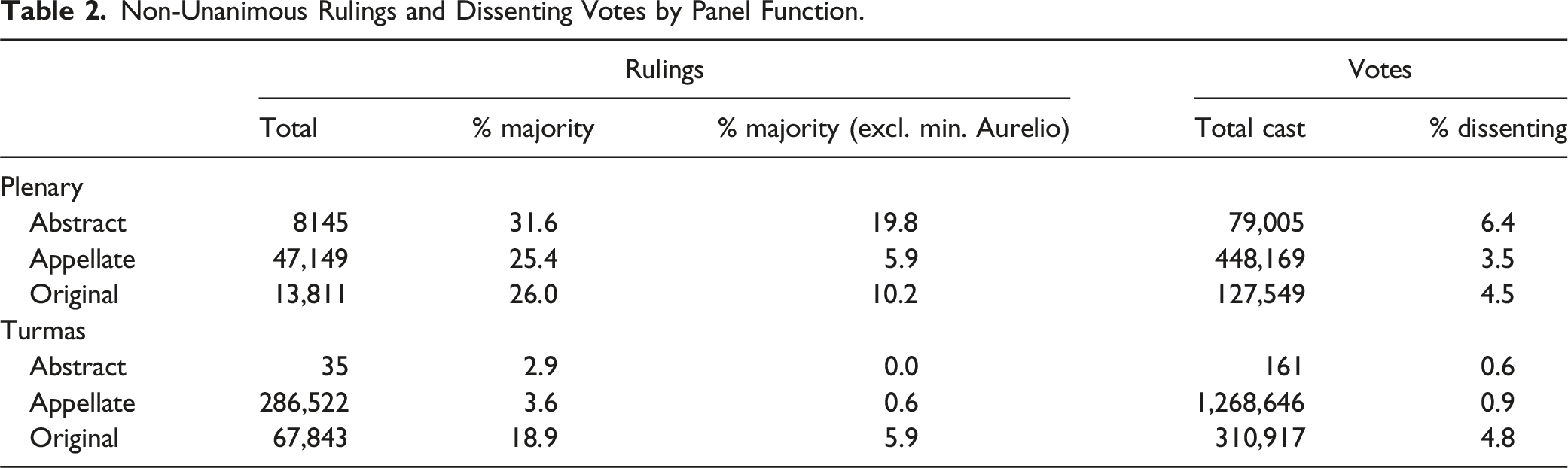
Table 2 also highlights Minister Marco Aurélio’s unique contribution to dissent in the STF between 1990 and 2021. His propensity for dissenting is well known, and a variety of anecdotal and quantitative evidence (using abstract review cases) suggests that his conception of the role of the Court and his approach to dissents are different from that of his counterparts (Desposato et al., 2015; Silva, 2022). 17 Indeed, he has elsewhere been described as someone who shows “a pathological and narcissistic attraction to dissent to distinguish themselves from their colleagues” (Garoupa & Santos Botelho, 2022, p. 5). By way of illustration, our dataset includes 2.23 million individual votes made by 36 different judges in over 420,000 decisions. Of those votes, just over 52,000 (2.3%) were dissenting votes. Of those 52,000, Minister Aurelio cast 34,384. In other words, he is responsible for two out of every three dissenting votes cast in the Court since the promulgation of the 1988 Constitution. He has also been involved in nearly 50,000 more decisions than Celso de Mello, who comes second in total decisions (204,598 and 156,605, respectively). Minister Aurélio’s votes were dissents 16.8% of the time while the next highest rate is that of Minister André Mendonça—who has dissented 301 times (2.4%) since his appointment to the STF in December of 2021 — and Minister Edson Fachin — who has dissented 1588 times (2.2%) since his appointment in June of 2015.
Ideology
In addition to an articulation of their understanding of the correct application of the law, a judge may dissent to call attention to and/or undermine the authority of an opinion with which they disagree (Cross & Tiller, 1998). A substantial body of scholarship elaborating the attitudinal approach to judicial decision-making suggests that variation in political ideology plays a significant role in dissenting behavior (Ostberg & Wetstein, 2011; Pritchett, 1948; Segal & Spaeth, 1993). To the extent that judges vote according to their sincere preferences, the rate of dissent on the Court can be reasonably expected to increase as a function of the ideological diversity of the judges on the decision-making panel. The less judges serving in the same court have varying political and ideological outlooks that impact on policy outcomes, the less likely it will be for them to find serious faults with the majority opinion (or, in the STF, the reporter’s opinion) that justify issuing a dissent. Conversely, if judges have particularly strong political views or partisan commitments, dissenting becomes even more likely (Tiede, 2016).
Partisan affiliation has been used to explain dissenting patterns on courts such as the Chilean Constitutional Court (Tiede, 2016) and Spanish Supreme Court (Garoupa et al., 2011). These studies look not only at judicial ideology, but at the intensity of the judge’s commitment to or involvement with party politics. Tiede (2016), for example, shows that Chilean Constitutional Court judges who have partisan affiliations (as identified in their pre-court trajectory) tend to dissent more often. In our analysis of the STF, we focus instead on ideology, although we do discuss professional trajectories and their potential impacts on dissenting behavior (see Judicial Characteristics below).
One standard approach to the identification of judges’ ideologies that has been applied with a good deal of success in the US is to use the political affiliation of whomever appointed the judge as a proxy for political ideology (e.g., Lindquist, 2006; Pinello, 1999). The applicability of this approach to Brazil, however, is questionable given the dynamics of “coalitional presidentialism” in the country (Arguelhes & Ribeiro, 2010; Llanos & Lemos, 2013). The identification of ideal points via the analysis of roll call voting is also of limited utility in the present context as existing research on the STF shows inconsistent findings based on a host of different datasets with varying scopes (Medina et al., 2022). Moreover, recent studies have pointed to the existence of multiple different dimensions of ideological variation on the Court (Martins, 2018; Medina et al., 2022; Silva, 2018). The multidimensional nature of STF Minister’s ideological preferences is also supported by research using an earlier version of this dataset. (Hudson & Hartmann, 2016).
While the dataset we use in this paper provides a unique opportunity to uncover ideal points, we leave this approach for future work. Existing studies have highlighted the complexity of such task when it comes to STF judges, and we believe there is still much to be gained by using, in the more comprehensive dataset presented here, approaches that have already been employed by several existing studies on this court using ADIs (e.g., Desposato et al., 2015; Martins, 2018; Oliveira, 2012). Although whether the differences in behavior between judges appointed by different presidents are relevant has been a matter of dispute in the literature (e.g., Ferreira and Mueller, 2014; Jaloretto and Mueller, 2011), findings suggest that at least some groups of Ministers appointed by the same government display a greater likelihood of voting together. Judges appointed by the PT and the PSDB (who alternated in power between 1995 and 2016) seem to vote differently from judges appointed by other parties (Martins, 2018). Moreover, Oliveira’s (2012) study of abstract constitutional review on the STF from 1999–2006 found that ministers appointed by some presidents (or appointed pre-1985, by the dictatorship) were more likely to vote together, although earlier work by the same author did not find such a relationship (Oliveira, 2008; finding some judicial coalitions formed by appointing presidents, see also Martins, 2018; Silva, 2018).
Our approach here has been to add other covariates linked to ideology. We rely on classifications of the ideological outlook of the ministers used in previous empirical work on the STF. Oliveira (2008, 2012) has coded almost all STF judges who served on the court between 1988 and 2011 as ideologically “progressive” or “conservative,” and her classification has been recently updated by Martins (2018) to include judges appointed until 2015. We complemented their work by coding the additional three ministers who appear in our dataset (Alexandre de Moraes, appointed in 2017; Nunes Marques, appointed in 2020; and André Mendonça, appointed in 2021). 18 While any classification of STF judges by ideology is still disputed (see Martins, 2018, for discussion), Oliveira’s work is a relevant resource in understanding ideological variation in the court, with the added advantage of having been used by other scholars in the field. Additionally, we believe variables related to Judicial Characteristics (see below) complement our ideology measures.
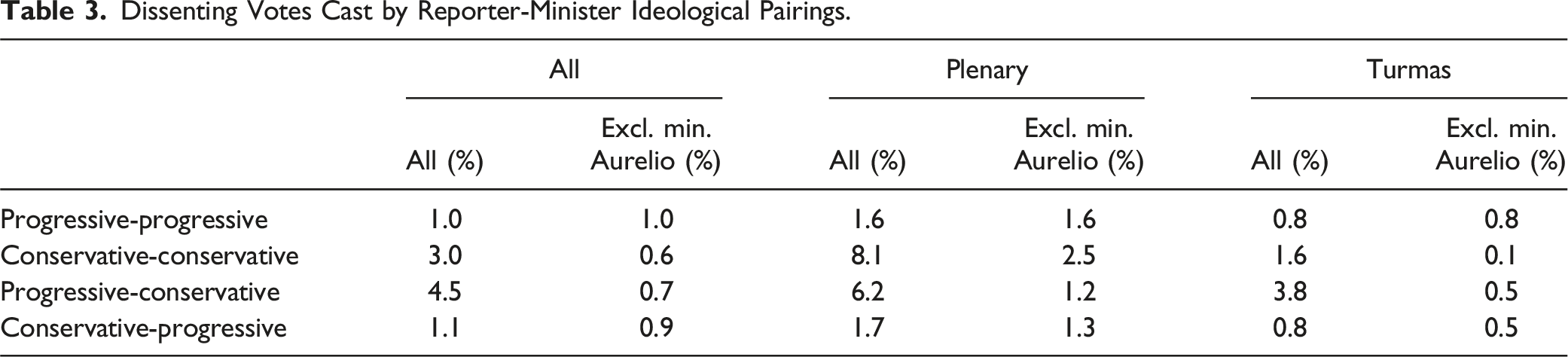
Dissenting Votes Cast by Reporter-Minister Ideological Pairings.
Salience
Cases that attract more public attention – or the attention of particularly powerful or relevant political or social actors – are plausibly expected to affect dissenting behavior (Brace & Hall, 1993; Hanretty, 2015; McCall, 2003). In the STF’s case, salience should play a particularly relevant role. Considering the court’s vast workload and its limited docket control, case salience is relevant to distinguish routine cases from more complex ones, which might shape how the judge will prepare for that case before session; in more salient cases, judges will more likely prepare substantial opinions beforehand, as discussed in Silva (2015). Case relevance might also shape the individual benefits of dissent in many ways: it might provide added public visibility or added impact on policies or on the development of the law (Muro et al., 2020). Furthermore, the STF has shown itself to be very aware of the political context of its decisions, especially those that might affect the government (Kapiszewski, 2011), and salience might signal to the judges that the institutional stakes of a particular decision are high, in terms of compliance and potential reaction by other actors (Ginsburg, 2003).
While in the last decade not a week goes by in Brazilian politics without the STF (or one of its judges) making the news, the sheer volume of cases involved precluded the creation of a measure of case salience based on press mentions. We know, however, that Justices use a prerogative to request to view a case and suspend deliberations much more often in high profile cases, than in less relevant disputes (Arguelhes & Hartmann, 2017). Thus, we believe that one or more pedidos de vista (requests to view or “vistas”) is a useful proxy for case salience. The data supports this position as 56% of decisions in cases with at least one vista were unanimous as compared to 91% in those without.
Judicial Characteristics
Starting from the position that “[a] court consisting of members with similar backgrounds may be expected to produce less internal conflict than one composed of members from different backgrounds” (Patterson & Rathjen, 1976, p. 611; Songer, 1986), several different characteristics may impact the Court’s propensity for unanimity. Herein, we consider professional background, legal education, gender, and “freshman” status. 19
Professional experience may also systematically impact judges’ attitudes toward dissent and/or their propensities to agree with one another. STF judges are appointed by the President after approval by the Senate, and therefore can have very different career paths. Formally, the only constitutional requirement beyond age (minimum 35, maximum 70) is that appointees possess “notable legal knowledge” and “spotless reputation”. However, many STF appointees were previously judges in lower courts and scholarship has investigated whether career paths help explain voting patterns (Oliveira, 2008; Martins, 2018; Arantes & Martins, 2022, focusing on criminal law adjudication), and whether the presence of career judges affects patterns of unanimity and dissent in the court (see Oliveira, 2012).
Focusing on previous judicial experience, for the purposes of this study we distinguish between three paths to the STF: a full judicial career; lateral entry into the judiciary at the appellate level via the quinto or “constitutional fifth” procedure; and direct appointment to the Court from outside the judiciary. Career judges are those who have followed the standard path of civil law judges. Shortly after finishing law school, they successfully completed a judicial entrance examination, were assigned a temporary judgeship, achieved life-tenure, were elevated to a State Supreme Court or Federal Appellate Court many years later, and subsequently appointed to the STF. 20 To the extent their professional development influences their decision-making, we would expect them to be more deferential and dissent less than their STF counterparts, for two reasons. First, career judges in Brazil are appointed as the result of concursos públicos (public examinations) that privilege awareness of and adherence to existing jurisprudence, regardless of personal ideology or beliefs. Second, the culture of consensus based on both a formalistic understanding of law that admits of “correct interpretations,” and, at least in the case of the generation of career judges who began their legal careers prior to 1988, a judicial norm of deference in the face of the then-authoritarian regime. 21
Quinto or “constitutional-fifth” judges are an interesting product of Brazilian judicial selection at the appellate level. Continuing a practice first instituted by the 1934 Constitution (Nalini, 1995), the 1988 Constitution requires that one-fifth of appellate judge appointees “shall be members with over ten years of service in the Public Ministry and be lawyers of widely acknowledged juridical understanding and unblemished reputations, with over ten years of actual professional activity” (art. 94). The career paths of these STF Ministers are somewhat varied and may involve time spent as a federal prosecutor (e.g., Ellen Gracie), government attorneys (e.g., Teori Zavascki), or political appointees (e.g., Menezes Direito), or in other occupations of varying relevance to the practice of law. As such, we do not expect that, as a group, the Quinto judges will show any specific patterns with respect to propensity to dissent or agree with one another. 22 We differentiate this group in our data simply not to confuse them with career judges; although they have been judges before joining the STF, their previous judicial positions were obtained through external political connections.
Judges who have arrived at the Court via direct appointment probably have some practice experience, typically as public attorneys at the local or state level, and often have experience in academia as well. They also tend to have held positions in government, many of them at the federal level. 23 We expect that, on balance, these judges would not display as a group a specific concern with maintaining the logical integrity and unity of the law as compared to career judges, as Oliveira (2008) has suggested is the case on the STF. While we have no specific measure of partisan attachment or affiliation in each judge’s trajectory (cf. Tiede, 2016), the distinction between career judges and non-career judges at least allows us to establish that the former group generally has non-partisan professional trajectories—they spent most of their professional life within the judicial structure, and – at least until their appointment to the STF—did not formally depend on political or partisan connections to climb up the judicial career ladder.
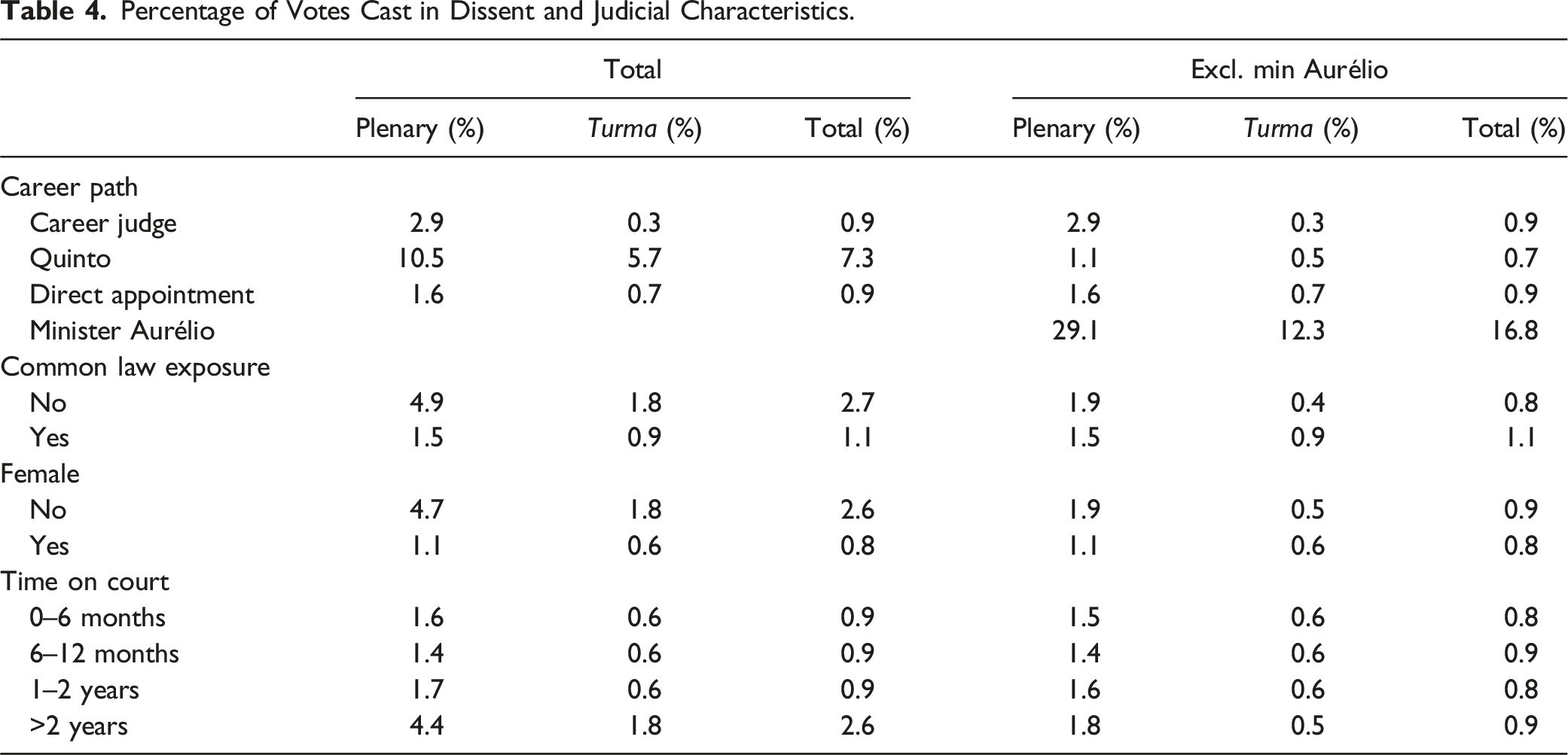
Percentage of Votes Cast in Dissent and Judicial Characteristics.
A judges’ legal education is also likely to systematically impact their willingness to dissent and/or the degree to which they are likely to agree with their colleagues. All else being equal, judges in a common law system should be more willing to publicly dissent from their colleagues as the result of internalized norms of as well as a different understanding of the role and function of a judge in the broader political community. In contrast, judges trained in the civil law tradition are expected to be more hesitant in approaching public divergence. Disagreement and debate may well occur behind the scenes, but civil law benches seem to have a greater propensity to produce unanimous decisions than their common law counterparts (Hahm, 1969; Kirby, 2007; Lasser, 2009).
While the situation in constitutional courts in civil law jurisdictions is more nuanced, the professional norms and mentality remain nonetheless more reluctant to dissent, as constitutional judges in those countries still “attach a higher value to institutional loyalty than common law judges,” so that “the classic division between civil law and common law carries some weight” in comparisons regarding this issue (Kelemen, 2013, p. 1371). There seems to be an “institutional bias against personalized judicial opinions [that] has tended to minimize published dissents” in constitutional courts in civil law jurisdictions (Kommers & Miller, 2012, p. 29; Voßkuhle, 2016). A comparison of unanimity in the US and German apex courts is illustrative. In its October 2015 Term, the U.S. Supreme Court, a common law court, was completely unanimous in 29% of its merit decisions and unanimous in case disposition in 44%. 24 Between 1971 and 2015, the two Senates of the German Federal Constitutional Court were unanimous in 93% of their decisions, issuing only 158 separate opinions. Before 1971, separate opinions were not permitted.
Although Brazil is considered a civil law jurisdiction, elements of its judicial system were directly imported from the U.S. and have had a lasting influence on the Brazilian judiciary, particularly the STF (Dolinger, 1990; Eder, 1960, p. 580). As such, we consider the possibility that judges who were exposed to legal thought or practice in common law systems in their trajectories (for example, through the completion of a graduate degree or as a visiting researcher in the U.S. or the United Kingdom) have a higher propensity to dissent than those whose legal education and experience occurred solely in civil law jurisdictions. The straightforward comparison reported in Table 4 supports this characterization, at least in the aggregate. Although ministers without any formal exposure to common law legal education are slightly more likely to dissent in the plenary court (once Minister Aurélio is excluded from the calculations), those with some common law exposure are twice as likely to dissent in turma decisions and half again as likely to do so overall.
A minister’s gender may also be relevant. Research on the Canadian Supreme Court, for example, has suggested that women may well be more likely to dissent because their perspectives and experiences lead them to conceptualize disputes differently than their male counterparts (Belleau & Johnson, 2008; Johnson & Reid, 2020). Gender may also play a role in mitigating an incentive not to dissent associated with norms of collegiality or mutual respect. A recent study of the STF suggested that the likelihood of dissent increases in the plenary court when the case reporter is female. One plausible explanation for which would be that gender stereotypes influence the behavior of the reporter’s colleagues, as they (un)consciously assume that their female colleagues are less competent(and therefore less reliable as reporters), less able to retaliate in the collegial game (and therefore the collegiality costs for dissenting against them are smaller), or both (Gomes, 2018). Arguelhes et al. (2024) also found that female STF Ministers are more likely to be interrupted by their colleagues during sessions than their male counterparts, further suggesting that (actual or perceived) power dynamics involving gender might shape interactions between STF judges. In contrast to the Canadian findings, female STF ministers appear to be less likely to dissent than their male colleagues, even after Minster Aurélio is excluded from consideration. Although only a 0.1% difference in absolute terms male ministers are about 80% more likely to dissent in plenary decisions.
The so-called “freshman” or “rookie effect” may also play a role in the propensity of a given judge to dissent. According to this theory, judges newly appointed to a court, particularly a prominent appellate court will “‘keep their heads down’ for the first few years” (McCormick, 2003, p. 104), before gradually becoming more willing to assert themselves and express disagreement with their more senior colleagues. One previous study estimating ideal points of the STF judges in abstract review cases has found that the most recently appointed members of the court “tend to always hold more central ideal points” along the two dimensions they identify, “possibly migrating to more extreme positions as they gather more experience” (Ferreira and Mueller, 2014, p. 282), which the authors interpret as a “rookie effect.”
An alternative theory relating to judicial “freshman” is that they may be more likely to dissent initially, motivated by a desire to demonstrate that they have something to contribute, a propensity that will gradually diminish as a result of either or both socialization and pragmatism (McCormick, 2003). The former theory is supported by research on the U.S. Supreme Court and Courts of Appeals (Bowen & Scheb, 1993; Hettinger et al., 2003; Maltzman, 2000), the Supreme Court of Canada (McCormick, 2003), and the High Court of Australia (Smyth, 2004). There does not appear to be any evidence supporting the latter theory. As Table 4 shows, there is no obvious support for an overall freshman effect on the STF. However, the data do suggest that there is a tendency to dissent more in plenary decisions and less in turma decisions after one’s first two years on the court.
Institutional Considerations
Accepting that dissent is costly, variation in caseload should have an impact on dissent rates. As the number of matters for which they are responsible increases, one can reasonably expect the likelihood of a minister dissenting in any given matter to decrease (Alarie and Greene, 2017; Epstein et al., 2011). Although intuitively appealing, the evidence for this relationship is mixed. Research by Hettinger et al. (2003) on the US Courts of Appeals found support for this theory, but Lindquist (2006) failed to find a statistically significant relationship. In looking at the decisions of the Australian High Court, Pierce (2008) found limited evidence to support the theory, but Smyth (2004), employing a larger dataset, found none. Narayan and Smyth (2007) did find a significant relationship but measured caseload in relation to population (cases per 100,000 people). Somewhat surprisingly, McCormick (2003), found a weak but significant association between lower caseloads and lower levels of dissent between 1990 and 2000 on the Canadian Supreme Court.
Difference in Likelihood of a Dissenting Vote.
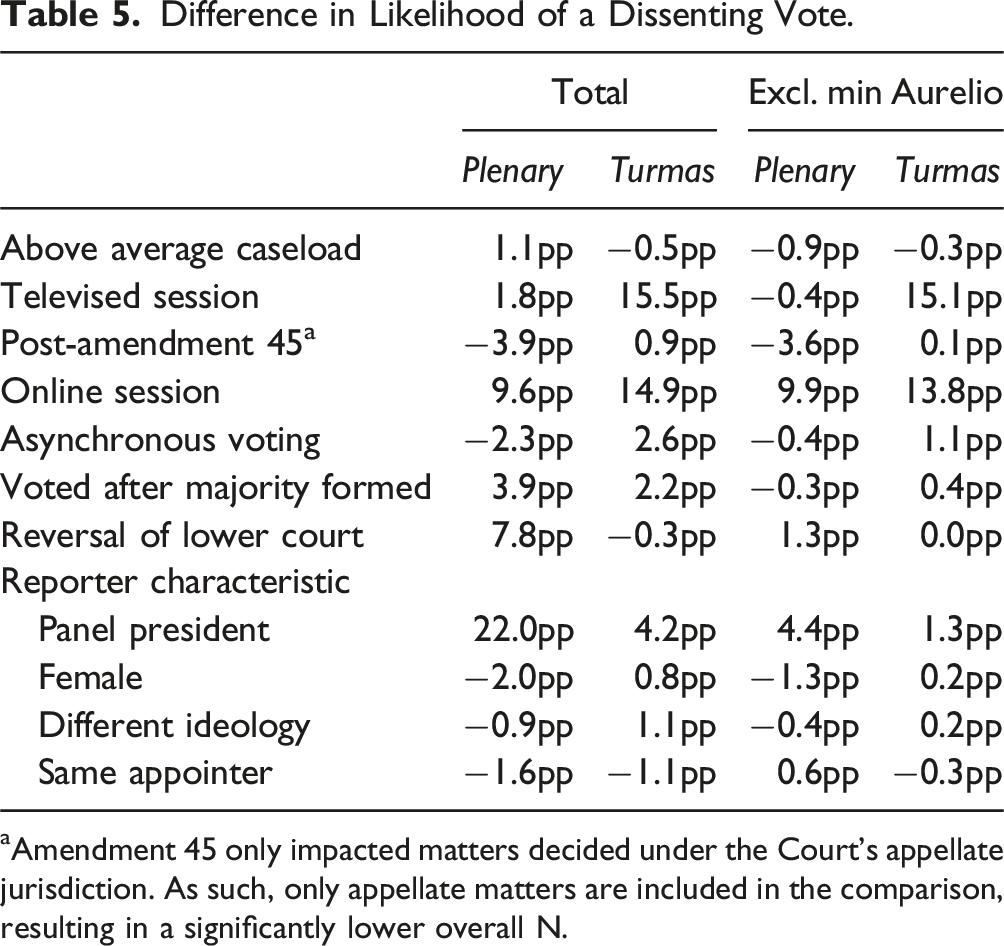
aAmendment 45 only impacted matters decided under the Court’s appellate jurisdiction. As such, only appellate matters are included in the comparison, resulting in a significantly lower overall N.
The start of televised plenary proceedings in the early 2000s is also a potential explanatory factor of dissent (Lopes, 2018). A representative sample of collegiate rulings in all types of cases between 1988 and 2013 indicates that the size of opinions and the length of debates between the Ministers during trial sessions both increased after plenary sessions started being televised (Hartmann et al., 2017). In the Brazilian context, Silva (2013) argues that ministers will avoid appearing insecure or not fully knowledgeable on TV Justiça, which will make them more prone to (i) bring a fully written opinion from their chambers, without waiting to hear their colleague’s considerations, and, once they’ve issued their opinion, (ii) sticking to their own ideas and arguments, even when a subsequent opinion by another minister could have given them reasons to change their minds. Although there are no systematic studies of the matter, there is supportive anecdotal evidence (Fontainha et al., 2015). Alternatively, Ministers might be concerned about being perceived as too passive, resulting in increased division and arguments as they strive to be seen as “earning their keep” or, perhaps, to develop a positive public image by taking strong, principled stands on issues of popular interest. 27
For a variety of reasons, then, we might expect to see an increase in the number of non-unanimous decisions and the overall number of dissenting votes in rulings which took place in televised sessions. Conversely, if Ministers are concerned about the image of the institution as a whole—particularly with respect to a reputation for doing “law” rather than “politics”—the television cameras might have resulted in a closing of the judicial ranks in order to present a unified, more compelling and legitimate front. 28 Table 5 suggests that although the slight increase in plenary dissents in the televised era is attributable to Minister Aurélio, there has been a substantial increase in the propensity to dissent in turma decisions since they began to be televised in 2022 that is not. However, the relative novelty of the latter should be borne in mind. Notably, online sessions (which are a synchronous form of deliberation by the Plenary and turmas, adopted only during the COVID-19 pandemic) are correlated with a substantial increase in the likelihood of dissent across the board.
Building on the positive relationship between dissent and “hard” cases, two institutional features have been found to increase the likelihood of dissent on U.S. state supreme courts by filtering out at least some of the more routine or “easy” cases: the existence of intermediate courts and a discretionary docket (Brace & Hall, 1990; Canon & Jaros, 1970; Hall & Brace 1989). Along similar lines, Skiple et al. (2021) find that a discretionary docket – under which the Norwegian Supreme Court and, to some extent, the Danish Supreme Court operate – is associated with higher dissent. 29 In this sense, as discussed above, repercussão geral and, in a way, súmula vinculante gave the Court some formal powers to limit the influx of “easy” or repetitive cases. All else being equal, this suggests that dissent should increase once these measures come into effect as the proportion of “hard” cases dealt with by the collegiate bodies should increase - and the impact of each decision is likely to be greater. Indeed, one study has already found evidence of such an effect on abstract constitutional review decisions by the plenary court (Desposato et al., 2015). 30 Our plenary data, however, presents a slightly different picture: the plenary court exhibits a 3.9pp lower likelihood of dissent after the implementation of Amendment 45 which is only marginally attenuated by the exclusion of Minister Aurélio. For the turmas, it is a 0.9pp increase, all else being equal. A similar patternis evident in relation to the asynchronous hearings.
The reporter’s role and gender may also influence the likelihood of dissent. There may be a degree of deference to the president of the court and, perhaps, to the presiding minister of one of the turmas. Gender dynamics and stereotypes might also shape the degree of deference to one’s colleagues within the court; as we mentioned, for example, a recent study has found that female judges tend to be interrupted more often than male ones in debates in STF sessions (Arguelhes et al., 2024). As Table 5 shows, when the Minister President is the case reporter, there is a 22.0pp increase in the likelihood of dissent although this drops to 4.4pp when Minister Aurélio is excluded. But, instead of deference, this could also be explained by the Chief Justice’s or turma president’s perfect control over agenda-setting in the court if they are also reporters: they can clear a case for judgment, as reporter, and immediately place it in the collegiate agenda, as presidents. They are in the singular position of single-handedly choosing when a case will be discussed by the plenary or turmas and can therefore seize on the ideal opportunity and court composition to secure a certain outcome. Chances of dissent are also increased, by 4.2pp, when the turma president is the case reporter in a turma ruling.
Interestingly, female case reporters are correlated with a 2.0pp decrease in the likelihood of dissent in plenary decisions. This seems counterintuitive considering gender bias found in oral arguments at the US Supreme Court (Feldman & Gill, 2019). However, the relationship reverses in the turmas, where female case reporters are correlated with a 0.8pp drop in the likelihood of a dissenting vote.
Panel size has also been identified as impacting the likelihood of dissent. The standard theory is that the greater the number of judges, the less likely a unanimous decision becomes (Lindquist, 2006). What is not entirely clear is whether this is the result of increased coordination problems stemming from diluted collegiality costs in a larger body of judges who need to interact with each other, or the simple fact that, probabilistically, dissenting opinions should be more common in courts with more judges. Moreover, it is not clear that this theory holds once appropriate controls are introduced (Hall & Brace, 1989). We do, however, include a variable reflecting the number of votes above or below average (for the relevant collegiate body) cast in a particular matter in the regression analysis below.
Finally, following previous work, we consider the possibility that voting order might shape incentives to dissent. Lopes (2019) shows that ministers voting after a majority is already formed (for example, the seventh judge to vote, after six judges have already voted towards the same outcome) are less likely to dissent. Surprisingly, to the extent the data show a pattern the reverse appears to be true, at least in turma decisions. We have also included variables indicating whether the court decided to a reverse a decision of a lower court as well as whether the reporter and the voting minister had a shared ideology or were appointed by the same president.
Explaining Variation in Dissent
Logistic Regression Models (Odds Ratios).
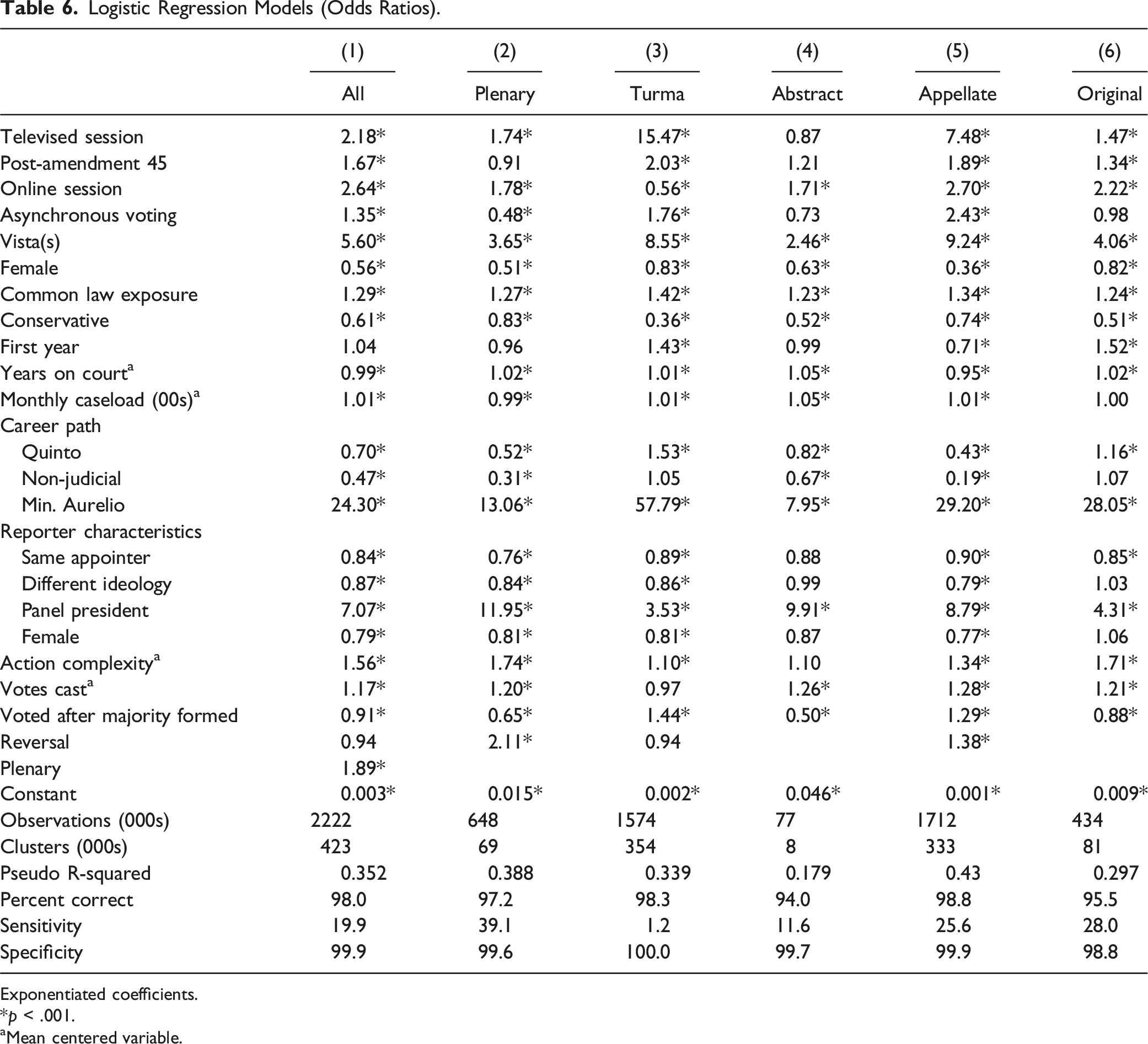
Exponentiated coefficients.
*p < .001.
aMean centered variable.
The regression results are, in many dimensions, convergent with theoretical expectations and previous empirical findings on the STF. First, the public broadcasting of sessions seems to have a positive impact on the likelihood of dissent. Even before TV Justiça, the STF had always deliberated in public sessions that, in principle, anyone could attend. But the specific element of broadcasting deliberations live— either on the court’s official channel, or on YouTube—has long been expected by scholars to change judicial behavior. Consistent with previous findings (Hartmann et al., 2017; Lopes, 2018), our results show that broadcasting sessions makes judges overall more likely to dissent. This is the case not just in the Plenary, but in the more recent televised turma sessions as well, where the effect is much stronger. 32 One possible explanation for this strong effect is that televising turma deliberations is an institutional change made in 2020 that covers only the last few years in our dataset, so that judges might be still adjusting themselves to this novel factor. However, when we look at the models accounting for the STF’s different judicial functions, we notice that the effect is much stronger when judges are deciding appeals, and is not statistically significant in abstract review cases.
Second, consistent with the findings of Lopes (2019), judges who vote when a majority is already formed in the plenary court are less likely to dissent, lending further support to “dissent aversion” in the STF. Third, as expected, case-related factors matter: as complexity of the questions or procedures involved increases, so does the likelihood of dissent. Fourth, consistent with previous studies showing that the variable “appointing president” might have some explanatory power regarding how judges form different voting groups or coalitions (Martins, 2018; Oliveira, 2012; Silva, 2018), we found that the likelihood of dissent falls 15% overall (and 25% in the plenary) when the voting judge and the case reporter were appointed by the same president. Surprisingly, however, if the voting judge and the reporter were coded as ideologically different, there is a lower likelihood of dissent. Finally, in line with studies of other apex courts, the implementation of the Judicial Reform Amendment of 2004 (EC 45/2004), allowing the STF to exercise some docket control, almost doubles the likelihood of a dissenting vote in the turmas, where the majority of appeals are tried.
Our results differ in some ways from theoretical expectations and previous findings in studies on dissent using only abstract review procedures. We find no statistically significant “freshman effect” - i.e., the most recently appointed member of the court is not less likely to dissent. More importantly, contrary to expectations, caseload does not seem relevant to explain dissenting behavior. This finding must be read into the broader context of the STF as a mass court, with thousands of cases being assigned to each of the chambers each year and the corresponding body of staff and clerks that work with the judges to follow cases and draft opinions. It is likely that these clerks, and not the judges themselves, feel the effects of increases in case load. Theories of judicial behavior must account for how the output of courts is, in certain contexts, not just the result of the behavior of judges, but of their staff as well (Arguelhes & Hartmann, 2023). The counter-intuitive finding that case load had a small effect on dissenting behavior suggests the need for different measures of workload (and conceptualizations of its effect on judicial output) in this and other courts with massive dockets. Another possible takeaway is that, in apex courts that already needed to adapt to mass litigation, workload might not affect individual judicial behavior precisely because it has already shaped institutional design and procedures to account for a massive number of cases.
We find that individual judicial characteristics also matter - both the voting judge’s, and the case reporter’s, beyond the variables of ideology (conservative judges are overall almost 40% less likely to issue a dissenting opinion) and presidential appointment discussed above. Previous studies have found that professional trajectories and its impact on the court’s composition matter for several dimensions of behavior in the STF, from the likelihood to suspend a law in judicial review cases (Oliveira, 2012) to propensity to convict in high profile criminal rulings (Arantes & Martins, 2022). Our results show that, in the plenary, STF judges who had a strictly judicial career are significantly more likely to dissent than judges who never held a judicial office, and judges that were politically appointed to a court of appeals of high court but had never been trial judges.
Even though this is reversed in the turmas, this is a counter-intuitive finding for the plenary, in two senses. First, studies on other courts have found judges with stronger political-partisan dissenting more often (Tiede, 2016; Garoupa et al., 2011). While we are interested in whether STF judges are “career judges”, not in whether they have partisan or political ties, all things considered being a career judge means that, for most of their career, (i) they were prohibited from having a formal party affiliation, according to Brazilian laws governing the duties of judges; and (ii) they were able to become court of appeal judges without necessarily relying on political connections. In this sense, the fact that STF career judges tend to dissent more might point to a different direction than these findings in other courts. Second, the fact that career judges are more likely to dissent challenges traditional expectations regarding judicial training and professional norms in civil law countries (Garoupa & Botelho, 2022; on how the STF judges’ behavior might challenge these assumptions, see also Desposato et al., 2015). But it can also be read as an expression of Brazil’s hybrid judicial tradition, since the federal structure of the judiciary, the tradition of individual opinion-writing, and the long history of judicial review in the country are more similar to the U.S. than to European civil law jurisdictions. Furthermore, our results show that STF judges who had some formal exposure to legal training in common law jurisdiction display a greater likelihood of dissent. The effect is consistent across all models.
Female judges are significantly less likely to dissent. This is consistent with recent findings that women are more interrupted than men in STF deliberations, suggesting that gender-related power dynamics and informal hierarchies might play a role in the court’s decision-making process (Arguelhes et al., 2024). However, our results differ from Gomes (2018), as judges in Plenary rulings are somewhat less likely to dissent when the reporter is female. This might also be the result of gender dynamics, since judges might be somehow adjusting their behavior when they need to disagree with a female reporter - or female judges expect to find more resistance to their opinions, and therefore adjust them ex ante before session. It should be noted, however, that, considering only three women were appointed to the court so far, results using gender as a variable in the STF decision-making procedure should be read with caution, since a more diverse composition would be needed to further investigate and differentiate gender effects, personal effects, or effects from other, omitted variables those specific female judges might share (Arguelhes et al., 2024).
We also found that the institutional setting in which judges decide affects dissenting behavior, beyond TV Justiça. Dissent is more likely in plenary online decisions, which might be explained in terms of a lower collegiality cost of disagreeing in a remote meeting, as compared to an in-person deliberation. However, plenary dissents are half as likely in the Virtual Plenary. This is a counter-intuitive result, since we would expect the costs associated with dissent in that context - with no real time interaction and overall shorter opinions - to be lower than in the online synchronous decisions. Indeed, turma rulings in the Virtual Plenary show higher likelihood of a dissenting vote. However, we should keep in mind that reporters select which cases will be sent for deliberation in the Virtual Plenary. Lower levels of dissent here might be explained by selection effects, due to the agenda setting power of the reporter. If reporters tend to send to cases they expect to be less controversial or if they select the timing to ensure that their preferred outcome will be better received by their colleagues, this might explain our results.
Additionally, it is possible that the lower dissent likelihood in the Virtual Plenary is explained by the fact that, here, judges do not need to bring to session their own opinions. They see the reporter’s opinion and have at least a week to react, perhaps informally reaching out to other colleagues. This is a very different context from the plenary and turmas, where all court members must come to the session prepared to vote without knowing what the reporter’s opinion looks like. Further studies will be necessary to investigate the extent to which lower dissent probability in the Virtual Plenary is due to agenda-setting and selection effects, or to informal interactions and deliberations between judges before they have to decide how they will vote. The PV Virtual Plenary is an especially relevant research focus given that the STF has used it for 82% of its collegiate rulings since 2016.
Average Marginal Effects, Plenary Decisions (Model 2).
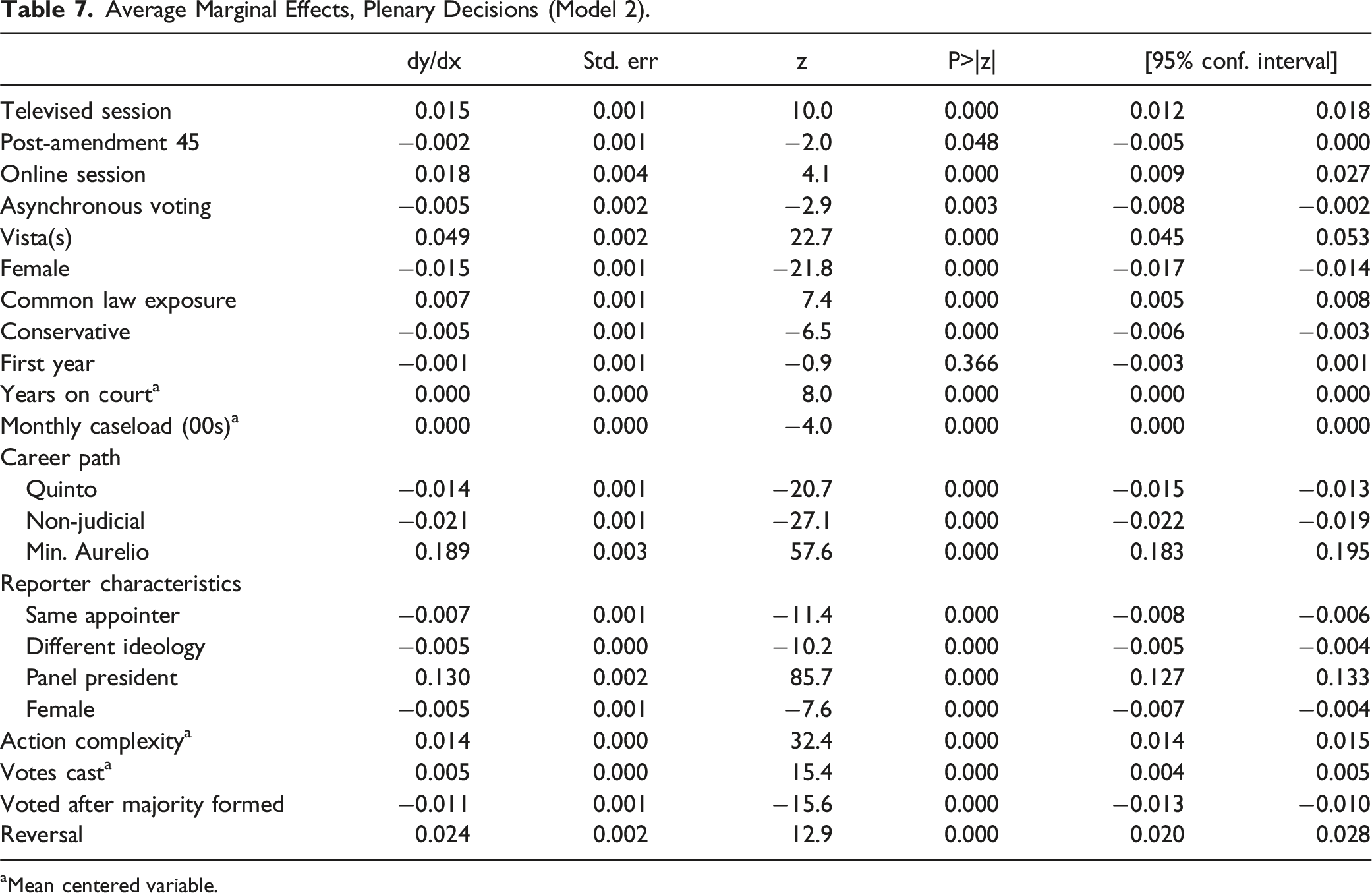
aMean centered variable.
In order to facilitate interpretation, the average marginal effects of Model 2 (Plenary) are presented in Table 7. The first column shows the average predicted percentage point change on the likelihood of a vote being a dissent of a one unit change in the variable in question. A positive value means a higher likelihood of dissent whereas a negative value reveals a lower likelihood. Interpretation is straightforward for dummy variables: on average, a vote in a televised session will be 1.48 percentage points (pp) more likely to be a dissent than a vote not in a televised session. With respect to continuous variables, a one unit increase in the complexity score (1–5) of the type of procedure means a 1.5 pp increase in the likelihood of a dissent.
Dissent is more likely, above all, when the vote is issued by Minister Marco Aurélio. It is 13.0 pp higher when the case reporter presides over the collegiate body, perhaps revealing the more sensible nature of cases the presiding minister is able to draw from their own docket and schedule for trial. A vista in the case increases the likelihood of a dissenting vote by 4.9 pp, as expected given that it operates as a proxy for case salience. In a more visible trial session, such as those televised, a dissenting vote is 1.5 pp more likely. Online synchronous sessions seem to weaken a bond of collegiality with dissent probability 1.8 pp higher.
Probability of a dissenting vote is reduced especially when the minister had a non-judicial career before joining the Court (-2.1 pp) and when they had a significant portion of their career outside of the Judiciary - decrease in 1.4 pp. As discussed previously, this contradicts the civil law apex court judge stereotype. Female ministers are 1.5 pp less likely to dissent than their male colleagues at the STF. Lastly, a minister voting after a majority has already been formed is 1.1 pp less likely to dissent. Other factors had very small or insignificant effects on individual dissent.
Conclusions
Our novel dataset, possibly the largest with individual voting data for any apex court in the world, allows the testing of several theories about individual judicial behavior while also enabling replication of empirical findings from other supreme and constitutional courts. In this section, we highlight seven dimensions in which our findings in this paper are relevant to comparative scholarship on high courts and judicial behavior.
First, the implications of different judicial culture elements. While theoretically Brazil is considered a “civil law” system, individual judicial behavior in the STF does not follow the patterns associated with judging in prototypical civil law countries when it comes to dissent. STF judges who had “judicial careers” before joining the Court are not dissent-averse - quite the contrary. Moreover, the court has counted among its number a number of judges with formal exposure to legal education in common law systems, who dissent somewhat more often than their counterparts.
In addition, while our results showing the positive impact of case complexity on the probability of dissent were in line with our theoretical expectations, they raise further questions regarding judicial culture against the backdrop of studies on other courts in the region. In the Supreme Court of Argentina, for example, Muro et al. (2020) have shown that dissenting is overall less likely in “complex and important cases”. While such contrasts on legal complexity and its effects should be explored in other, more focused studies, they lend further support to the idea that not all apex courts in “civil law” jurisdiction are alike in terms of professional norms and expectations shaping judicial behavior.
Second, publicity. In addition to enjoying frequent and profound media exposure, especially in the last 12 years, the STF, like very few other apex courts, broadcasts its open sessions on national TV and live on its YouTube channel. We demonstrate that, all else equal, this specific feature of institutional design – broadcasting judicial deliberations, beyond simply making them accessible to the public in loco - increases the likelihood of dissenting votes.
Third, fixed voting order. As STF ministers vote in reverse order of seniority after the case reporter, they are less likely to dissent once a majority has been established. The “rookie effect” on dissenting behavior, however, is negligible.
Fourth, the different jurisdictions of a multipurpose court. Our findings show that ministers are more likely to dissent as they rule on concrete constitutional review cases than on abstract review, contrary to the expectations of theoretical frameworks. More importantly, we are able to show that individual characteristics of the voting minister, the case reporter and institutional design elements do not necessarily affect the chances of dissent in a similar fashion in all three types of STF jurisdiction. For many covariates, the effects were statistically significant in rulings of one or two types of jurisdiction, but not all. Conversely, the length of the minister’s tenure at the time of the ruling increased the likelihood of them dissenting in abstract review, but decreased in concrete review. Voting after a majority was settled decreased dissent in abstract review and increased in the appellate jurisdiction. This highlights the limitations of judicial behavior theories tested solely on one type of jurisdiction and the value of studying multipurpose courts.
Fifth, ideology measures, especially when consolidated into binary variables, do not reveal simple panel dynamics in all high courts. While conservative judges in the STF tend to dissent less, and while judges and reporters appointed by the same president tend to diverge less, the court is an example of more complexity at play: progressive ministers disagree more often with progressive case reporters than with conservative case reporters. However, as we noted, we use available coding and proxies for “ideology” of STF judges that, while employed in previous studies, can still be improved in many ways (for example, by investigating the effect of “partisan ties” on judicial behavior, as in Tiede (2016)). More context on a judge’s career prior to appointment may help disentangle ideology effects and uncover more nuanced explanations of dissenting behavior.
Sixth, gender dynamics. Even as female ministers are less likely to dissent, such behavior can manifest itself in substantially different intensities according to the type of collegiate body or court jurisdiction. Female reporters cause less dissent by their peers, a phenomenon not yet adequately explained by the literature.
Finally, the effects of workload. The volume of matters handled by the STF is notoriously high and thus constitutes a prime scenario for assessing the effects of workload on dissent. Contrary to expectations for a court with such a massive docket, we have found such effect to be objectively small and less influential than most other potential predictors of individual dissent.
This last point deserves further attention for comparative studies on judicial behavior. The results might show the impact of variations in the court’s workload on judicial behavior is contingent on the internal bureaucratic structure of the STF. Variations in the number (which has consistently grown since the 1970s) and organization of clerks shape how individual judges allocate their time to deal with incoming cases, with potential impact on dissent rates (see, e.g., Grendstad et al., 2020). There is also huge variation, in the STF, in how each judge organizes and allocates the human resources made available to their chambers. Changes in these dimensions in each period can make the Ministers more or less inclined to rely on the reporter’s opinion to issue their own during deliberations, instead of investing their time in bringing their opinion from their chambers. Studies of judicial behavior on courts with massive dockets should try to account for the bureaucratic structure that mediates the relationship between the individual judge and the cases they decide.
Footnotes
Acknowledgments
We would like to thank the editor and the three reviewers for their valuable suggestions and critique, as well as Gabriela Gattulli for careful research assistance.
Declaration of Conflicting Interests
The author(s) declared no potential conflicts of interest with respect to the research, authorship, and/or publication of this article.
Funding
The author(s) disclosed receipt of the following financial support for the research, authorship, and/or publication of this article: The research for this article was funded by a grant from Insper and the Becker Friedman Institute at the University of Chicago and another from the Brazilian National Council for Scientific and Technological Development (CNPq/MCTI n. 409814/2023-7).

Notes
Appendix
Descriptive Statistics.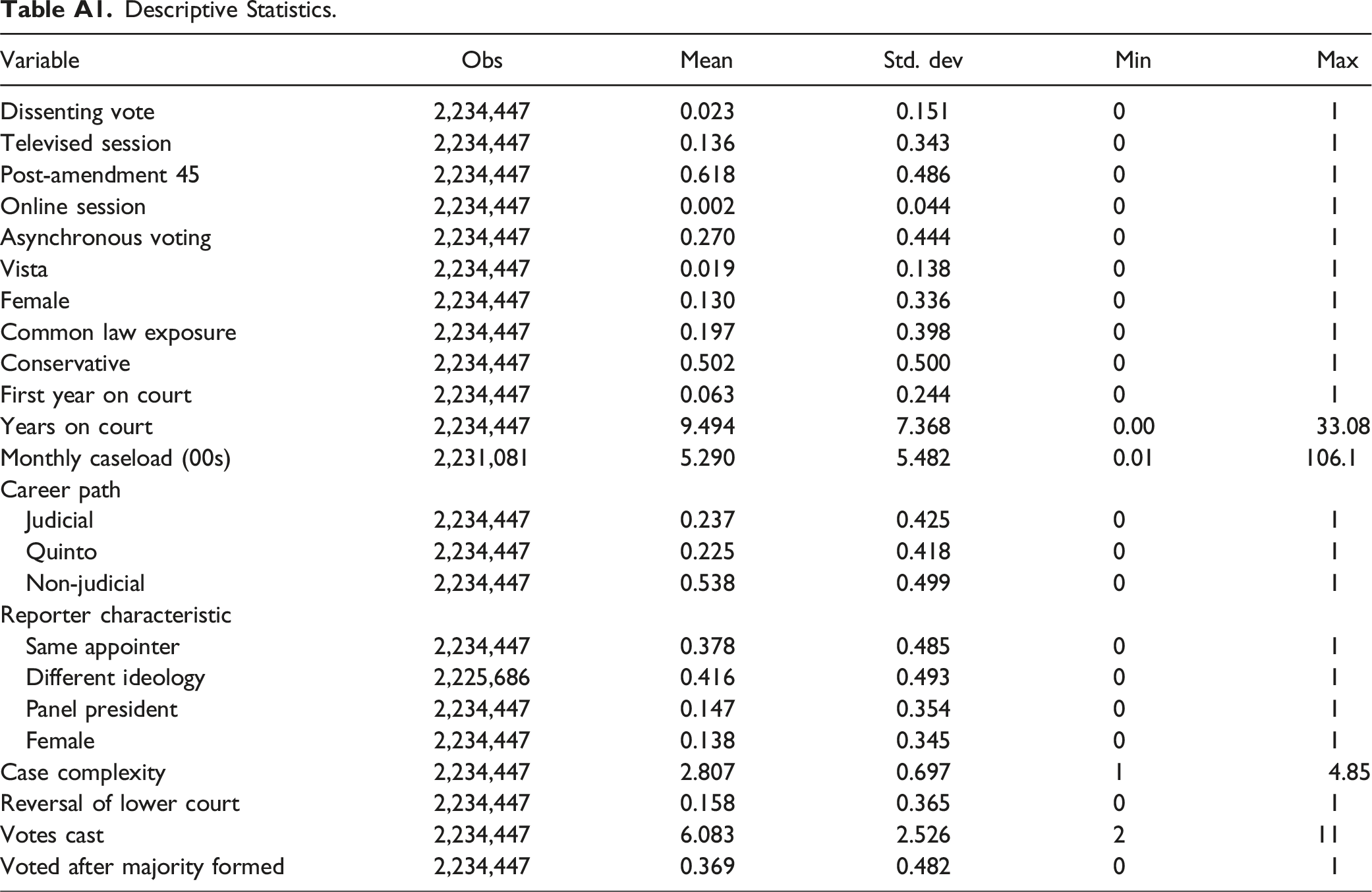
Variable
Obs
Mean
Std. dev
Min
Max
Dissenting vote
2,234,447
0.023
0.151
0
1
Televised session
2,234,447
0.136
0.343
0
1
Post-amendment 45
2,234,447
0.618
0.486
0
1
Online session
2,234,447
0.002
0.044
0
1
Asynchronous voting
2,234,447
0.270
0.444
0
1
Vista
2,234,447
0.019
0.138
0
1
Female
2,234,447
0.130
0.336
0
1
Common law exposure
2,234,447
0.197
0.398
0
1
Conservative
2,234,447
0.502
0.500
0
1
First year on court
2,234,447
0.063
0.244
0
1
Years on court
2,234,447
9.494
7.368
0.00
33.08
Monthly caseload (00s)
2,231,081
5.290
5.482
0.01
106.1
Career path
Judicial
2,234,447
0.237
0.425
0
1
Quinto
2,234,447
0.225
0.418
0
1
Non-judicial
2,234,447
0.538
0.499
0
1
Reporter characteristic
Same appointer
2,234,447
0.378
0.485
0
1
Different ideology
2,225,686
0.416
0.493
0
1
Panel president
2,234,447
0.147
0.354
0
1
Female
2,234,447
0.138
0.345
0
1
Case complexity
2,234,447
2.807
0.697
1
4.85
Reversal of lower court
2,234,447
0.158
0.365
0
1
Votes cast
2,234,447
6.083
2.526
2
11
Voted after majority formed
2,234,447
0.369
0.482
0
1
Logistic Regression Models (Odds Ratios) Excluding Minister Aurélio. Exponentiated coefficients. *p < .001. aMean centered variable.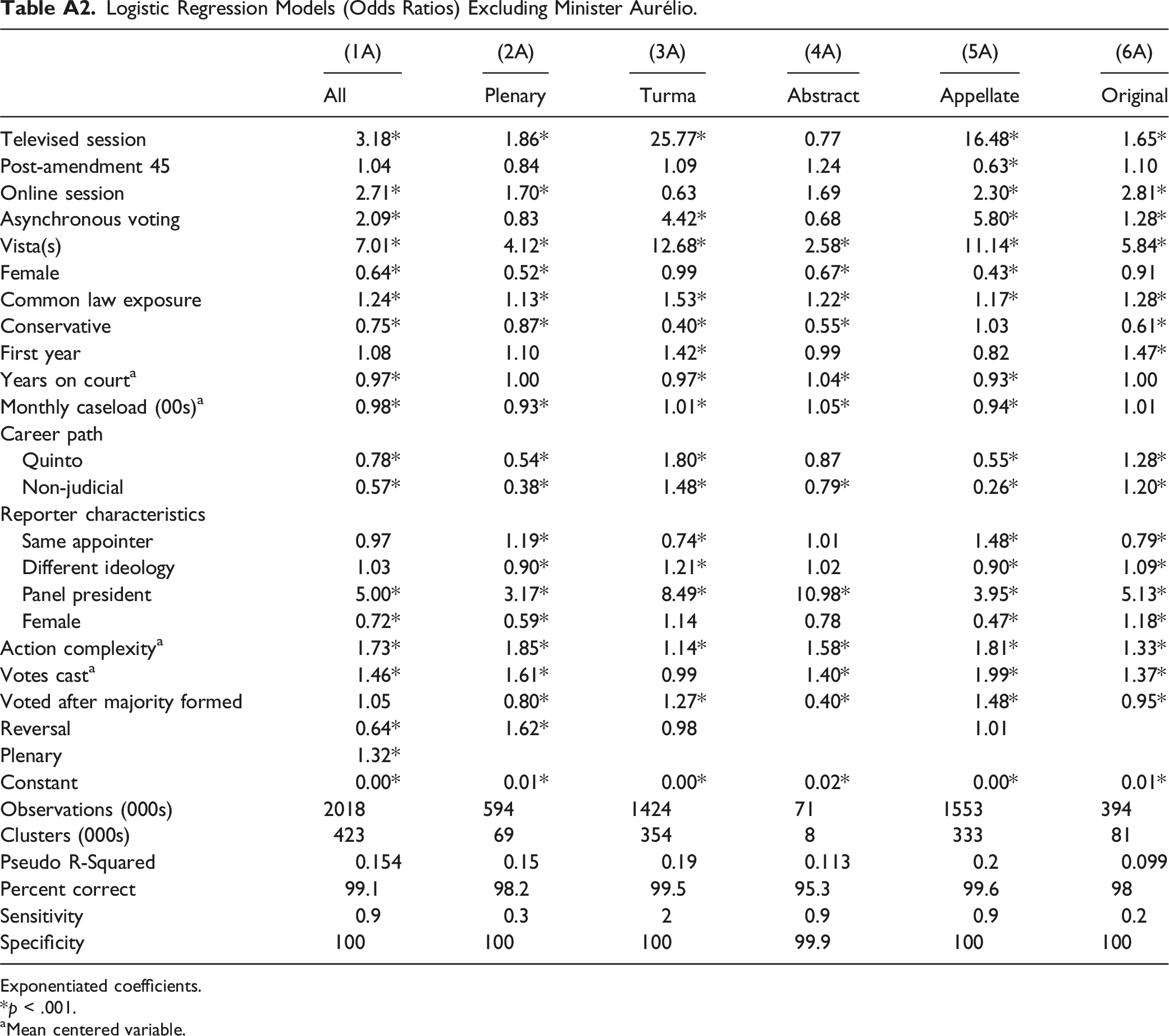
(1A)
(2A)
(3A)
(4A)
(5A)
(6A)
All
Plenary
Turma
Abstract
Appellate
Original
Televised session
3.18*
1.86*
25.77*
0.77
16.48*
1.65*
Post-amendment 45
1.04
0.84
1.09
1.24
0.63*
1.10
Online session
2.71*
1.70*
0.63
1.69
2.30*
2.81*
Asynchronous voting
2.09*
0.83
4.42*
0.68
5.80*
1.28*
Vista(s)
7.01*
4.12*
12.68*
2.58*
11.14*
5.84*
Female
0.64*
0.52*
0.99
0.67*
0.43*
0.91
Common law exposure
1.24*
1.13*
1.53*
1.22*
1.17*
1.28*
Conservative
0.75*
0.87*
0.40*
0.55*
1.03
0.61*
First year
1.08
1.10
1.42*
0.99
0.82
1.47*
Years on court
a
0.97*
1.00
0.97*
1.04*
0.93*
1.00
Monthly caseload (00s)
a
0.98*
0.93*
1.01*
1.05*
0.94*
1.01
Career path
Quinto
0.78*
0.54*
1.80*
0.87
0.55*
1.28*
Non-judicial
0.57*
0.38*
1.48*
0.79*
0.26*
1.20*
Reporter characteristics
Same appointer
0.97
1.19*
0.74*
1.01
1.48*
0.79*
Different ideology
1.03
0.90*
1.21*
1.02
0.90*
1.09*
Panel president
5.00*
3.17*
8.49*
10.98*
3.95*
5.13*
Female
0.72*
0.59*
1.14
0.78
0.47*
1.18*
Action complexity
a
1.73*
1.85*
1.14*
1.58*
1.81*
1.33*
Votes cast
a
1.46*
1.61*
0.99
1.40*
1.99*
1.37*
Voted after majority formed
1.05
0.80*
1.27*
0.40*
1.48*
0.95*
Reversal
0.64*
1.62*
0.98
1.01
Plenary
1.32*
Constant
0.00*
0.01*
0.00*
0.02*
0.00*
0.01*
Observations (000s)
2018
594
1424
71
1553
394
Clusters (000s)
423
69
354
8
333
81
Pseudo R-Squared
0.154
0.15
0.19
0.113
0.2
0.099
Percent correct
99.1
98.2
99.5
95.3
99.6
98
Sensitivity
0.9
0.3
2
0.9
0.9
0.2
Specificity
100
100
100
99.9
100
100
Average Marginal Effects, Plenary Decisions (Model 2A) Excluding Minister Aurélio. aMean centred variable.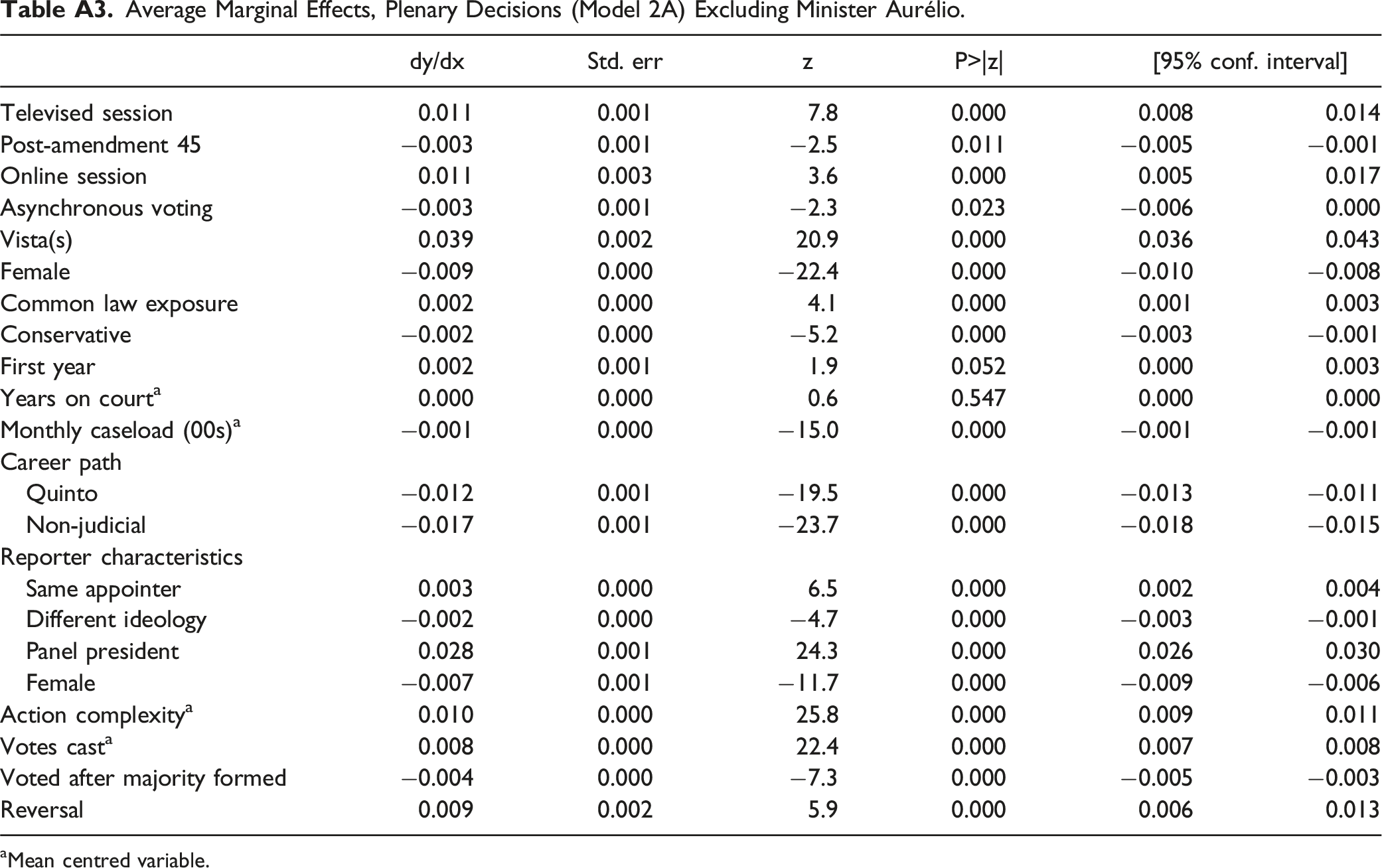
dy/dx
Std. err
z
P>|z|
[95% conf. interval]
Televised session
0.011
0.001
7.8
0.000
0.008
0.014
Post-amendment 45
−0.003
0.001
−2.5
0.011
−0.005
−0.001
Online session
0.011
0.003
3.6
0.000
0.005
0.017
Asynchronous voting
−0.003
0.001
−2.3
0.023
−0.006
0.000
Vista(s)
0.039
0.002
20.9
0.000
0.036
0.043
Female
−0.009
0.000
−22.4
0.000
−0.010
−0.008
Common law exposure
0.002
0.000
4.1
0.000
0.001
0.003
Conservative
−0.002
0.000
−5.2
0.000
−0.003
−0.001
First year
0.002
0.001
1.9
0.052
0.000
0.003
Years on court
a
0.000
0.000
0.6
0.547
0.000
0.000
Monthly caseload (00s)
a
−0.001
0.000
−15.0
0.000
−0.001
−0.001
Career path
Quinto
−0.012
0.001
−19.5
0.000
−0.013
−0.011
Non-judicial
−0.017
0.001
−23.7
0.000
−0.018
−0.015
Reporter characteristics
Same appointer
0.003
0.000
6.5
0.000
0.002
0.004
Different ideology
−0.002
0.000
−4.7
0.000
−0.003
−0.001
Panel president
0.028
0.001
24.3
0.000
0.026
0.030
Female
−0.007
0.001
−11.7
0.000
−0.009
−0.006
Action complexity
a
0.010
0.000
25.8
0.000
0.009
0.011
Votes cast
a
0.008
0.000
22.4
0.000
0.007
0.008
Voted after majority formed
−0.004
0.000
−7.3
0.000
−0.005
−0.003
Reversal
0.009
0.002
5.9
0.000
0.006
0.013