




Abstract
This article develops a behavioural approach to the principle of judicial independence. It argues that implementing the proposed approach can help to safeguard judicial independence more effectively. It addresses the question of what a behaviour-related concept of judicial independence should look like and what state obligations arise from this. It takes into account empirical findings which were not yet available when the legal principle was initially shaped by constitutional and regional human rights jurisprudence. First, the article outlines certain basic premises of a behavioural concept of judicial independence. It then takes a closer look at the factors that determine the behaviour of judges and of such third actors that might attempt to unduly influence judges. In addition, the article engages with the objective of the principle of judicial independence to inspire trust in the judiciary and outlines potential behavioural effects relevant for this trust dimension. Finally, it discusses whether certain behavioural effects that can shape judicial decision-making should be regarded as normatively undesirable in the context of judicial independence.
Keywords
Introduction 1
Judicial independence is a behavioural concept. This is a fact that is not always adequately reflected in the way the legal principle of judicial independence is addressed on the domestic and regional level. It is intuitive that judicial independence affects the behaviour of both judges and third actors who seek to influence the former in normatively undesirable ways. However, the legal principle is often not sufficiently shaped in light of this behavioural dimension. In fact, the principle of judicial independence finds itself in a conceptual tension between a legal formalist and a legal realist understanding of judicial decision-making. This has resulted in the principle of judicial independence being somewhat disconnected from the reality of judicial behaviour. However, this disconnect makes it difficult to implement this principle in a practically effective manner.
For the principle of judicial independence to be shaped in a convincing manner and, on this basis, to be implemented effectively, the behavioural nature of judicial independence must be examined more closely. One must consider whom this principle aims to protect; what determines the behaviour of judges and third actors; how these behavioural factors can be influenced to promote independence; and what should constitute normatively desirable or undesirable behaviour in the context of judicial independence.
A closer look at these questions reveals the complexity of judicial independence, which is a significant challenge to conceptualizing this principle. This becomes particularly clear when one takes into account recent empirical findings, which were not yet available when the legal principle was initially shaped especially by constitutional and regional human rights jurisprudence. Such developments concern insights into the factors that contribute to normatively undesirable behaviour as well as into human cognition in general. It also relates to the perception of judicial decision-making by the addressees of judicial decision-making. An understanding of the principle of judicial independence that is based on an oversimplified idea of judicial decision-making does not do justice to this complexity. Effective implementation requires anchoring this principle in the actual behaviour of the actors involved.
Against this background, this article develops a behavioural approach to the principle of judicial independence. It addresses the question of what a behaviour-related concept of judicial independence should look like and what state obligations arise from this.
First, the article outlines certain basic premises of a behavioural concept of judicial independence (section 2) It then takes a closer look at the factors that determine the behaviour of judges and of such third actors that might attempt to unduly influence judges, highlighting the behavioural effect of factors that have traditionally been addressed as relevant for judicial independence as well as other behavioural aspects such as psychological framework conditions that go beyond these factors (section 3). In addition, the article engages with the objective of the principle of judicial independence to inspire trust in the judiciary. This trust dimension of judicial independence addresses actors that are external to the judiciary such as those seeking justice and the general public. The article outlines potential behavioural effects relevant for this trust dimension (section 4). Finally, the article discusses whether certain behavioural effects that can shape judicial decision-making should be regarded as normatively undesirable in the context of judicial independence (section 5).
Judicial independence as a behavioural concept: Preliminary remarks
Before delving into the behavioural nature of judicial independence, a preliminary remark is in order. The term judicial independence is understood in this article in a broad manner. It includes, on the one hand, the relationship between judges and actors in the executive, legislative and judicial branch of government: judges are expected to be independent from these public actors. On the other hand, it also includes the relationship between judges and parties to the dispute: judges are expected to be independent from the parties in the case at hand to be decided by the judge. This impartiality dimension is integrated into the broad concept of judicial independence referred to in this article, rather than being separated from the notion of judicial independence. 2 This broad understanding makes sense for the present context because the behavioural factor for judges and third actors are similar in all of these settings.
On this terminological basis, this section now turns to judicial independence as a behavioural concept. The section first outlines certain terminological shortcomings that contribute to blurring the behavioural dimension of judicial independence (a). This is followed by a model of judicial decision-making that helps situating the various behavioural factors relevant for judicial independence (b).
Behavioural dimension and terminological shortcomings
The behavioural dimension of judicial independence is often not sufficiently reflected in the doctrinal and jurisprudential engagement with this topic. This is particularly apparent in the notion of ‘guarantee’, which is very widely used in constitutional and human rights law and jurisprudence in relation to judicial independence. 3 The following two aspects will highlight the shortcomings of this terminology in relation to judicial independence as a behavioural notion.
First, the term ‘guarantee’ of judicial independence contributes to obscuring the behavioural dimension of judicial independence as it does not appropriately reflect the role of the state with regard to judicial independence. In fact, the state cannot ‘guarantee’ that judges will behave in line with judicial independence. In other words, the state cannot guarantee de facto independence. The state can only influence the factors that determine the behaviour of judges and third actors. These factors can only influence the probability of the respective behaviour. 4 However, the probability can be maximized by designing the factors that determine behaviour. Accordingly, the legal obligation of the state that is at the core of the principle of judicial independence should be primarily understood as a structural obligation to maximize this positive behavioural setting. The state can design the structural framework in such a way that it makes it more likely that the judge will behave according to the expectations of judicial independence.
When we talk about ‘guarantees’ in the context of judicial independence, this terminology does not make sense for de facto independence as such. It can only be conceivable with regard to certain factors that influence judicial behaviour. The existence of some of these factors can be legally and factually guaranteed. For example, the organizational and personal separation of the judiciary and executive, and certain legal requirements regarding elections, appointments and promotions, length of office, irremovability and remuneration of judges can be guaranteed by the state. These legal requirements contribute to de jure independence. However, other structural factors cannot be guaranteed. For example, it cannot be guaranteed that the legal requirements regarding judicial status (election, appointment, etc.) are implemented in practice in all instances. Further, it is not possible to guarantee that there is no influence on judges by third actors, including the indirect and often psychological influence that regional courts, international instruments as well as domestic constitutional courts consider to be part of the judicial independence concept. 5 In sum, this means that neither de facto independence nor all the factors that determine behaviour can be guaranteed. To speak of a ‘guarantee’ of judicial independence is thus misleading in several respects.
Second, using the ‘guarantee’ terminology comes with the idea that the principle of judicial independence aims (only) to protect the judge from normatively undesirable influence by third actors. 6 Yet this understanding is not in line with the behavioural dimension of judicial independence. If one thinks of judges as subjects that are protected by the principle of judicial independence, this leads to focusing on the behaviour of third actors that potentially could unduly influence judges. The idea is that these actors’ behaviour is a danger from which judges must be protected. 7 The primary objective is then to prevent this normatively undesirable behaviour by third actors. 8 However, this approach leads to not addressing sufficiently the behaviour of judges as a point of reference. Instead of primarily focusing on the behaviour of third actors, the concept of judicial independence must aim at ensuring that judges behave in a normatively desirable manner (see section 3). The judges’ behaviour should be the primary point of reference. The behaviour of third actors of course also plays a role in this respect, but it only matters alongside the behaviour of the judge. Both groups of subjects and their respective behaviour must be considered separately with regard to the factors that determine this behaviour.
It should also be kept in mind that the principle of judicial independence ultimately aims to protect societal interests and related constitutional values. The constitutional values that are implemented through judicial independence and serve the interests of the addressees of the respective legal system include, in particular, separation of powers, the binding effect of law and procedural fairness. The broader societal interests that have been shown to correlate with judicial independence include long-term economic growth, 9 high protection of political and economic freedoms, 10 resilience of democratic systems against autocratic tendencies, 11 the acceptance of the results of democratic elections 12 as well as a related system-stabilizing effect. 13 This makes the addressees of a legal system the ultimate subjects of protection of the principle of judicial independence.
As a result of this objective, the principle of judicial independence aims at de facto independence and not merely de jure independence. 14 Only actually independent behaviour by judges serves the constitutional values mentioned. It is thus necessary to induce normatively desirable behaviour by judges in practice rather than merely creating formal legal requirements. In order to do so effectively, it is crucial to understand the behavioural factors that contribute to judges acting in an independent manner (see section 3). Secondly, it is important that the addressees of a legal system perceive the judges’ behaviour as independent in practice. These addressees should have reason to trust that judges are very likely to behave in line with judicial independence. This latter objective, its implications for the concept of judicial independence as well as potential behavioural effects related to it are outlined in more detail in section 4.
Judicial decision-making process and behavioural factors
As a reference point for the analysis in sections 3 to 5 and as a framework for better understanding and conceptualizing the factors that shape independent judicial behaviour, a closer look at the process of judicial decision-making is in order. This makes it possible to classify the factors that determine judicial behaviour and thus create a basis for assessing these factors normatively as well as for assessing how effectively certain structural conditions promote independent decision-making. The following overview thus aims to situate the various behavioural influences at the levels of judicial decision-making. It shows that behavioural factors that promote or hinder judicial independence can be relevant on two distinct levels of judicial decision-making.
At the first level, the intentional level, judges intentionally decide whether they want to act according to the normative standards set forth by the principle of judicial independence and their legal obligation that follows from this principle. For example, they decide whether to give in to a third actor’s attempt to exert undue influence on them. Judges thus intentionally choose between behavioural alternatives that are in line with judicial independence or not. If they resist an attempt by a third actor to exercise undue influence on them, they decide to act in line with judicial independence; if, in contrast, they decide to give in, they decide to act in a normatively undesirable manner from the perspective of judicial independence. Which alternative judges choose at this first level depends on a variety of behavioural factors. These factors can concern the cost-benefit assessment of behaviour that is in line with judicial independence or not; and it can also include other factors such as ethos and fairness perceptions or group practice. The details of these factors are addressed in section 3. For the present overview, it suffices to point to the fact that the totality of these factors create a behavioural setting, which, depending on how it is designed, makes it more or less likely that judges intend to behave in a manner that is in line with judicial independence. The classical (theoretical and constitutional) concept of judicial independence focuses on this first level and the factors relevant to it. The aim is to design structural conditions that minimize the risk of behaviour that is not in line with judicial independence.
This first level is, however, not the only phase of the judicial behaviour that should be taken into account for judicial independence. On a second level, the implementation level, judges translate their intention from level 1, that is, the intention to act in line with the principle of judicial independence, into concrete action. This is done by taking the actual judicial decision in the legal sense. These can be judgments, procedural decisions, decisions regarding interim measures, etc. At level 2, the judicial decision can be determined by various factors. First and foremost, of course, the legal norms applied by the judge shape the concrete content of the judicial decision. However, in addition to law as determining factor, other behavioural factors can play a role as well. These can be factors that judges do not consider normatively undesirable, that judges are not aware of and/or that are, at least in the judges’ perception, not under their control. Such factors include, inter alia, cognitive effects such as ‘heuristics and biases’ and behavioural factors related to the social perspective of the judges. An example of heuristics and biases in judicial decision-making 15 is the ‘anchoring effect’ which can influence numeric decisions by judges on damages, fines, length of prison sentences etc. 16 Examples of the social perspective include cognitive effects related to gender or ethnic background of judges. 17 The fact that such factors influence the content of judicial decision-making has been widely demonstrated by empirical research on judicial behaviour. So far, such behavioural factors are however rarely discussed as an aspect of judicial independence. Whether such factors should be included in the concept of judicial independence is discussed in section 5 for factors related to social perspectivity.
The interaction of the two decision-making levels is shown in Figure 1.
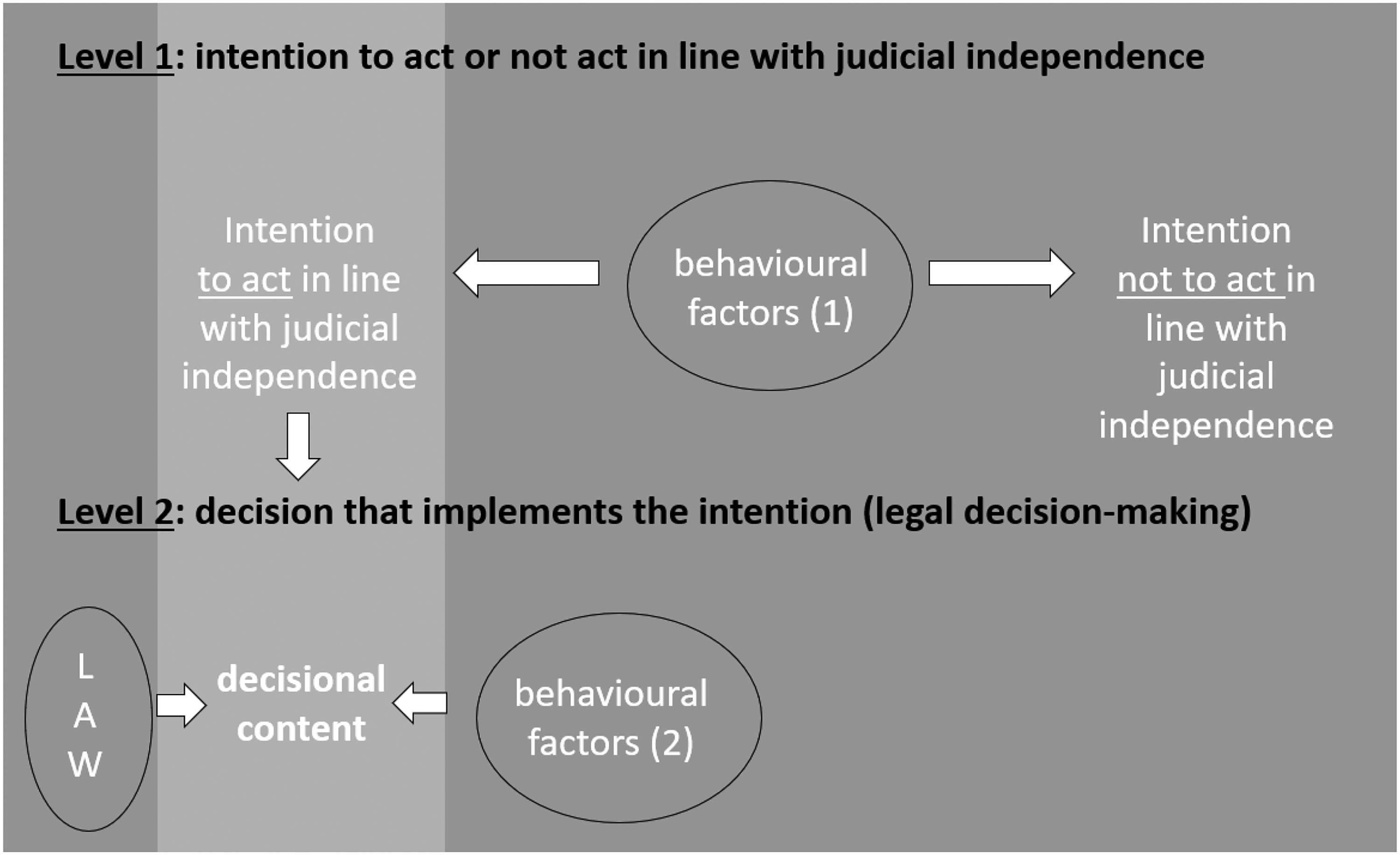
Levels of decision-making.
The behaviour of third actors is relevant at both decision-making levels. On the one hand, third actors can influence the decision for or against an independent behaviour at level 1. For example, third actors can influence the judge’s interests by promising advantages or threatening judges with disadvantages. On the other hand, third actors can also influence behavioural effects that take place on level 2 of the decision-making process. This would primarily concern behavioural factors that take place outside the judge’s control and/or perception. On this level, third actors can influence judges by taking advantage of, or even triggering, certain cognitive effects such as the anchoring effect mentioned above.
Whether third actors try to influence judges also depends on behavioural factors. These may be partly congruent with the factors that determine judicial behaviour but they can also include specific factors. Section 3 outlines these factors. The link between the factors that determine the behaviour of third actors and the factors that determine judicial behaviour can lead to a chain-like interaction. This interplay of behavioural factors is shown in Figure 2.

Interplay between the behavioural factors for judges and third actors.
After the preliminary remarks on the behavioural dimension of judicial independence, this section turns to the factors and related measures that promote behaviour that is in line with judicial independence. It shows how the state can generate structural conditions that are conducive to behaviour of judges and third actors that is in line with judicial independence. The factors addressed here are only those that can be influenced by the state and that are therefore relevant to the state obligation ensuing from the principle of judicial independence.
This overview engages with the first level of judicial decision-making as outlined in section 2.B. It highlights three points. First, the elements of the behavioural setting influence the behaviour of judges and third actors in different ways. An element can have several, sometimes even contradictory, effects. To maximize a behavioural setting that is favourable to judicial independence, it is important to understand the behavioural functioning of the respective elements. Second, in addition to the aspects that are regularly mentioned in the context of judicial independence, other factors – in particular psychological framework conditions – are also relevant for whether judges and third actors behave in line with judicial independence. Some of these factors are discussed below. Third, it is crucial to take into account the interaction of the various behavioural factors. Instead of looking at individual factors in isolation, the overall behavioural setting must be kept in mind when it comes to assessing and promoting the likelihood of normatively desirable behaviour.
Behaviour of judges
The factors that shape judicial behaviour and that can contribute to promoting independence are manifold. The following overview starts with a first set of factors that follows from a rationalist account of human behaviour; a second set of behavioural factors complements this approach. These sets of factors interact and, together, form the overall behavioural framework by which judicial behaviour is determined.
To start with, a rationalist account of human behaviour focuses on the relationship between the expected benefits and possible costs of normatively undesirable behaviour. Judges are addressed as rational actors who behave in a way that maximizes utility. From this perspective, judges are expected to behave independently if the expected benefits of this behaviour are greater than the possible costs associated with it, taking into account the probability with which these costs occur. 18 Using this utility-based lens, the state can influence the behavioural setting for judicial independence by targeting the benefits and costs of behaviour that is not in line with judicial independence as well as the probability with which, according to the expectation of the relevant actor, benefits and costs will materialize.
To promote judicial independence, the expected benefits of normatively undesirable behaviour can be minimized. The design of judicial career opportunities is particularly relevant in this regard. The following overview shows how career benefits act as behavioural factors relevant for judicial independence. This overview aims to highlight how career-related measures that states use to foster judicial independence operate from a behavioural perspective.
A first crucial interest is the judges’ interest in keeping their professional position. This interest is affected by the legal provision on the irremovability of judges from their office. When judges can be (easily) removed from office, there is a risk that the judges’ current professional existence determines the cost-benefit analysis with regard to normatively desirable or undesirable behaviour. In a setting in which actors can remove judges from office as a (de facto) sanction for decisions that do not correspond to their preferences, it is likely that judges see their interest in staying in office as threatened when taking certain decisions. To avoid this, many domestic legal systems as well as the ECtHR, the CJEU, the IACtHR and the UN Human Rights Committee require that judges can only be dismissed or transferred under strict conditions. 19
Further interests relate to the judges’ professional life after the end of their term of office. This is an interest that is different from the interest related to irremovability during the term of office, a differentiation that is often not sufficiently made. The interest in securing a position after the end of the term can be a potential benefit of normatively undesirable behaviour. Judges can be inclined to take decisions that correspond to the preferences of those actors that are important for the judges’ career after the end of their term. Possible instruments for minimizing this benefit for normatively undesirable behaviour are, on the one hand, the length of the term of office and, on the other hand, a pre-determined career opportunity after the end of the term of office. A lifetime appointment minimizes the risk of decision-making that is determined by future professional interests. For shorter terms of office, it is crucial whether another position will be definitely available for the judge at the end of the term of office. 20 The more uncertain the career prospects at the end of the term, the more interested judges will be in basing their decision-making on potential career prospects. On the other hand, if, for example, the return to a position that judges held before taking up their term of office is guaranteed, this risk is limited.
Future career interests while in office relate to promotions within the judiciary. Judges could be inclined to decide in a normatively undesirable way according to the (assumed) preferences of the actors responsible for the promotion decision. In fact, the potential influence of promotion prospects on judicial decision-making is well-documented. 21 To reduce the incentive for decision-making based on career ambitions, an effective instrument is to limit the number of higher-ranking positions for judges – that is, with an organizational design of the judiciary that minimizes hierarchical structures. A further instrument relates to the promotion criteria. An exclusively performance-based promotion aims to limit the ability of third actors to ‘reward’ the judge with promotions. From the perspective of the judge, this means that there is less incentive for deciding in accordance with the preferences of persons that are involved in the promotion decision. An exclusively performance-based promotion of judges is thus part of the international standards of judicial independence. 22
Requirements for the appointment of judges are similar to the aspect of promotions, yet they have a different temporal dimension. They are about the after-effects of the appointment. The aim is to minimize any quid pro quo behaviour, in which judges would base their decision-making on the preferences of the actors responsible for the appointment. Considering that, historically, judicial independence focused on shielding judges from the influence of the executive, the appointment of judges by the executive is viewed critically. 23 Critics of appointments by the executive see a danger in the fact that judges, motivated by the after-effects of the appointment, could align their behaviour with the preferences of executive actors. However, the appointment by the executive is not considered inadmissible by (national or European) jurisprudence. 24
In addition, appropriate remuneration aims to limit the interest of gaining financial benefits from normatively undesirable behaviour. Such undesirable behaviour could occur when actors promise financial benefits for a preferable outcome in a case at hand. But relevant financial benefits can also come from ongoing additional sources of income, especially when they create a situation of general economic dependence of the judge from this income because the judicial remuneration as such is too low. 25 Appropriate remuneration therefore is a behavioural factor both in the judge’s relationship with the parties to the dispute and with other actors. 26
Further behavioural factors relate to the occasions on which the benefits of normatively undesirable decision-making are particularly prominent. To minimize such occasions is the purpose of rules governing so-called objective impartiality. This includes, for example, the provisions relating to the rejection of a judge due to concerns about bias. These provisions generally exclude situations in which the judge would be interested in behaviour that is incompatible with judicial independence due to having a close relationship with one of the parties. 27 Further, the organizational and personal separation of the judiciary and the executive helps to minimize situations in which judges might have a specific interest in aligning their behaviour with the (known or presumed) preferences of executive actors. When there is distance between these groups of actors, it is less likely that judges expect certain benefits from behaving in accordance with perceived preferences of executive actors. Accordingly, the organizational structures of the judiciary and the executive branch of government must be separated. 28 The same applies to personal links between the judiciary and other branches of government. For example, a judge must not be simultaneously a member of parliament, the administration or the government (principle of incompatibility). 29 These legal requirements create conditions in which judges have few opportunities to act according to the preferences of executive or legislative actors.
Another strategy to induce behaviour that is in line with judicial independence is to increase the costs of a normatively undesirable behaviour. A key instrument for this purpose is legal sanctions. Legal sanction regimes generally include both disciplinary sanctions and criminal sanctions. Such sanctions constitute costs for normatively undesirable behaviour. In addition to creating legal sanctions, a further strategy is to increase not only the costs of undesirable behaviour but also the probability that such costs will materialize. 30 For example, monitoring makes it more likely that normatively undesirable behaviour will be recognized and sanctioned. This means that actors will be less likely to assume that normatively undesirable behaviour will remain undetected. Monitoring thus contributes to normatively desirable behaviour. 31 In addition, further aspects such as (feared) reputational costs can also contribute to shaping the behaviour of judges. For judges, a feared loss of reputation within certain professional or social groups can constitute possible costs of normatively undesirable behaviour. 32
Another aspect that can influence the cost-benefit analysis relates to the judges’ workload and to the binding nature of law. 33 The fact that judges are bound to apply the existing law creates an argumentative burden for judicial decisions. If judges want to deviate from an established decision-making practice, the argumentative effort is greater than if they wanted to maintain this practice. Judges might thus have to put more effort into justifying a decision for interest-based rather than independent decision-making if the former would require deviating from existing legal practice. In this respect, the principle of the binding nature of the law acts as an element of the behavioural framework in which judicial decision-making takes place. In fact, such a behaviour-related understanding of the binding nature of the law bridges the legal formalistic fiction of purely legally determined decision-making and the empirical findings on judicial behaviour. This effect is complemented by the potential impact of the decision and legal reasoning on the reputation of the judge mentioned above.
In addition to factors that influence behaviour based on a cost-benefit analysis, other behavioural factors can also promote independent behaviour. These factors are so far often not sufficiently taken into account when doctrinally or jurisprudentially shaping the principle of judicial independence. Here, one can refer to the empirical findings on the factors that increase the probability of normatively undesirable (or unethical) behaviour more generally. These findings can be used in the judicial context. For example, it has been shown that people are more likely to engage in normatively undesirable behaviour if they feel they have been treated unfairly. 34 Therefore, aspects such as the legal criteria for promotion and the actual promotion practices in the judiciary can influence whether judges behave in line with judicial independence. Whether judges perceive promotions to be performance-based has an impact on whether they feel that they are treated fairly within the judiciary. If this is the case, this can contribute to reducing the risk of normatively undesirable behaviour. Performance-related promotion criteria therefore not only reduce the specific benefits of normatively undesirable behaviour, but also contribute to the psychological framework that makes normatively undesirable behaviour less likely.
Another behavioural factor is the visibility of normative or ethical standards. When persons are explicitly or implicitly reminded of professional rules and ethos, this makes it less probable that they will behave in a normatively undesirable way. For judges, high visibility of the professional ethos, in which independence is central, can have such an effect. 35 One can also increase awareness of such ethical standards implicitly and thus lower the risk of normatively undesirable behaviour. 36 For example, monitoring is an instrument that increases awareness of the respective ethical standards. 37 In this regard, the monitoring instruments that exist for judges have a behavioural effect. Moreover, the behavioural practice within the professional group is relevant. Within a group, both normatively desirable and undesirable behaviour is self-reinforcing. 38 When individuals perceive that other group members act in normatively desirable ways, they are more likely themselves to also behave accordingly. In this respect, the behaviour of other judges that is consistent with judicial independence is a factor that influences the behaviour of a judge.
A final aspect worth mentioning here is the impact of time pressure on normatively undesirable behaviour. High time pressure seems to increase the likelihood of such behaviour. 39 With regard to judges, it is therefore possible that the time pressure associated with the case load expected of judges represents a factor for normatively undesirable behaviour. Conversely, appropriate expectations regarding the tasks to be completed can create a favourable framework for normatively desirable behaviour.
These examples – which are not listed exhaustively here – show how the state can influence the behavioural framework for judges to induce independent behaviour. We have seen that, in addition to the aspects traditionally discussed in the context of judicial independence and which primarily concern a cost-benefit analysis, other behavioural factors are also relevant. It is crucial to take into account the interaction of the various factors. Taken together, they create the framework that determines whether judicial behaviour will correspond to constitutional and regional human rights standards of judicial independence.
Behaviour of third actors
For third actors who might affect judicial independence, the behavioural factors are of a similar nature to those for judges, yet without being fully congruent. First, the behaviour of these actors is influenced by a cost-benefit analysis. As for judges, this analysis amounts to comparing the expected benefits of a normatively undesirable behaviour with the possible associated costs, taking into account the probability of these costs.
For third actors, the intended benefit is obtaining a judicial decision that corresponds to their preferences. When designing a behavioural setting that promotes normatively desirable behaviour of third actors, the starting point must thus be to reduce the third actors’ expectation that judges will behave in this way. For third actors, the expected benefit within the cost-benefit analysis for normatively undesirable behaviour depends on whether the third actors think it is likely that they can actually influence a judge according to their preferences. For this reason, the factors listed in section 3.A also have an indirect effect as behavioural factors for third actors. Actors are more likely to behave in a certain way when they consider it probable that their behaviour will have the effect that they intend it to have. 40 If the behavioural setting for judges is designed in a way that makes it less likely that judges will allow themselves to be influenced, then this fact reduces the expected benefit for third actors who attempt such influence. This will make it less likely that they will attempt to influence judges in the first place.
Whether third actors expect a benefit from normatively undesirable behaviour also depends on other structural conditions. In the relationship between a judge and other judicial actors, a highly hierarchical judiciary would increase the expectation among higher-ranking judges that they might be able to unduly influence lower ranking judges. In general, normatively undesirable behaviour is more likely within hierarchical structures. 41 Flat hierarchical structures help to reduce the expectation that influence will be successful. Moreover, whether actors expect undue influence on judges to be successful also plays a role for the parties to a legal dispute. The rules on impartiality are intended to avoid situations in which third actors, due to their proximity to the judge, believe it is likely that they can successfully influence a judge.
In addition, structures such as the institutional separation of the judicial and executive branches of government minimize the opportunities for influence. Less contact between judges and executive branch actors means less opportunity for the latter to influence judges. In particular, whether and how executive actors are involved in shaping the judicial career creates varying degrees of opportunity to influence judges in normatively undesirable ways. Further, for other (judicial or legislative) actors involved in judicial career decisions, the opportunities for exerting influence can be minimized by reducing the number of appointments through long tenure periods as well as the number of promotions.
A further aspect that can create opportunities for normatively undesirable influence by third actors concerns the transparency of judicial behaviour. For example, the rule that judicial deliberations must be confidential contributes to reducing the opportunity for third actors to unduly influence judges based on their deliberations. In this way, the voting behaviour of a judge in chamber decisions is not visible to external actors and cannot be used to influence the judge. This aspect shows that transparency has an ambivalent behavioural impact on judicial independence. On the one hand, as mentioned above, monitoring can have a positive effect on the likelihood of normatively desirable behaviour by judges because it makes sanctions for normatively undesirable behaviour more likely and ethical standards more visible. But on the other hand, transparency can also encourage normatively undesirable behaviour by third actors when it exposes the judges’ voting behaviour. A framework that promotes transparency can therefore both promote and impede judicial independence. 42
As for judges, the state can also increase costs of normatively undesirable behaviour of third actors. Here again, criminal sanctions such as relating to bribery generate such potential costs. For some actors such as actors within the executive branch of government, disciplinary sanctions are relevant. In addition, for executive actors, monitoring can increase the (perceived) costs of undue influence on judges. For other groups of actors, however, especially private actors, monitoring as a behavioural instrument does not exist.
Aspects other than sanctions can also generate costs of normatively undesirable behaviour. For example, the requirement for a performance-based promotion can increase the argumentative burden for actors involved in career decisions who want to promote judges according to normative undesirable factors. In addition, as for judges, reputational costs can also deter executive actors from engaging in undue influence on judges. External control mechanisms can create the necessary transparency.
As for judges, the behavioural setting for third actors goes beyond a cost-benefit analysis. The link between procedural fairness and ethical behaviour can play a role here as well. For the parties to the dispute, a judicial process that is perceived as procedurally fair can minimize the likelihood of normatively undesirable behaviour. For actors within the judiciary who could unduly influence another judge, a promotion practice that is perceived as fair and is based on the performance criteria is particularly relevant. If they do not consider themselves to be treated unfairly, it is less likely that they unduly influence another judge. The same applies to the visibility of normative standards within the judiciary. If professional ethical standards are kept very visible within the judiciary, this can make it less likely that judges try to unduly influence other judges. In contrast, with regard to private actors that might consider influencing judges unduly, it is rather difficult to increase the visibility of ethical standards to promote judicial independence.
In sum, the different aspects of the behavioural setting do not have the same effect for all groups of third actors that might attempt to influence judges unduly. While some of the aspects mentioned are relevant for all actors, others only shape the behavioural setting for certain groups of actors. It is thus important to consider the varying behavioural settings for each group of actors.
Trust in an independent judiciary: Observer perspective and its behavioural effects for the concept of judicial independence
So far, the focus has been on the behaviour of judges and third actors who might attempt to unduly influence these judges. However, another group of actors is also relevant to the concept of judicial independence: the actors who assess the behaviour of judges and third actors from an observer’s perspective. With regard to these actors and their role for judicial independence, a behavioural perspective is insightful as well.
The state obligation resulting from the principle of judicial independence is not only aimed at promoting behaviour on the part of judges and third actors that is in line with judicial independence. It also aims to establish and maintain the trust in the independence of the judiciary (section 4.A). This objective brings an additional behavioural dimension to the principle of judicial independence. It relates to the group of actors who perceive and evaluate the behaviour of judges and third actors who might attempt to influence these judges. This perception and evaluation are influenced by behavioural factors. These factors and their implications for the principle of judicial independence are outlined in section 4.B.
Objective: Trust of those subject to the law
Under the principle of judicial independence, the state must aim at creating structural conditions in which those subject to the law can expect the judiciary to decide the cases brought before it in an independent manner. Observing actors within a legal order should be able to trust that judges will behave in line with judicial independence. This includes the expectation that third actors do not seek to unduly influence judges. Observing actors are both those involved in court proceedings and the general public.
Promoting the trust of these actors is a requirement of the principle of judicial independence. The ECtHR has repeatedly emphasized the importance of trust in the courts. According to the ECtHR, judicial independence is about ‘confidence which the courts must inspire in a democratic society’. 43 This formulation, which was more recently also adopted by the CJEU, 44 refers to the function of an independent judiciary for the principle of democracy.
The normative requirement for trust as set out by the above courts is grounded on empirical findings. In fact, the social relevance of the trust that actors have in the independence of judges is empirically underpinned. This includes findings regarding the influence of procedural fairness on how persons perceive judicial decisions and how this shapes their subsequent behaviour. A large number of studies have investigated the question of how procedural justice affects how both parties to proceedings and members of a wider audience assess decisions; and how this assessment can influence the future behaviour of these actors towards the decision-makers. 45 Procedural fairness has been shown to be a crucial factor that can lead to a favourable evaluation of the decision maker even if the content of a decision is negatively evaluated. 46 Both for those involved in the proceedings who were unsuccessful in a legal dispute and for external actors whose preferences ran counter to a court decision, it is significant or even decisive whether the procedure that led to this decision was perceived as fair. And with regard to the future behaviour of these actors, a decision that is perceived as fair seems to increase the willingness to cooperate with judicial authorities or other institutional actors. 47
In light of these empirical findings, the objective of guaranteeing trust in courts must therefore be considered key to the principle of judicial independence. 48 Based on this understanding, the state has an obligation to maximize this trust. This is an obligation that some courts have explicitly recognized as being part of the principle of judicial independence. 49 This obligation should generally be taken into account when applying the principle of judicial independence in the legal context. The following section explains this trust dimension of judicial independence and how potential behavioural effects play a role in this regard.
Trust and the observer perspective
Although there is no standardized definition of trust, 50 there are several basic features of trust that are relevant to trust in the context of judicial independence.
First, trust is to be understood as a relationship between a trustor and a trustee. 51 In this relationship, trust can be unilateral or mutual. And trust relates to a specific behaviour of the trustee. Trust does not exist abstractly between two actors, but actor A trusts in a certain behaviour of actor B. The point of reference here is an expected (desired) future behaviour of the latter. 52 Trust is therefore defined by three elements: actor A (the trustor), actor B (the trustee) and the latter’s behaviour x. 53 In the judicial independence context: the subjects of the law (A) should trust that judges and indirectly also third actors (B) behave in line with judicial independence (x).
Second, trust is to be understood as a reaction to uncertainty. 54 The behaviour of actor B cannot be determinatively predicted. There is a risk of a negative outcome, i.e., that actor B does not behave as actor A would like them to behave. If there were no uncertainty in this respect, trust would be irrelevant because the probability of negative behaviour on the part of the trustee is zero. 55 In the context of judicial independence, this uncertainty consists in the fact that it cannot be ruled out that the decision-making of judges is determined by normatively undesirable factors and that there is normatively undesirable influence by third actors. Observers can thus merely make a prognosis regarding the behaviour of judges and third actors.
Third, trust is subjective in nature. It is not an objective risk assessment. 56 To start with, the knowledge base is subjective in a trust setting. Trustors will most likely only have knowledge of some of the available information, so that they do not know the objective probability of the trustee's behaviour. 57 In addition, the available information may be (partially) generated by the trustors themselves, for example because it is based on personal experience. Moreover, the risk assessment as such is subjective. Factors that are specific to the trustor can influence this assessment. Such factors can be of a cognitive nature, including cognitive distortions – as will be outlined below. 58 In addition, actors can link the specific risk assessment to a larger personalized trust context, for example if a binary trust relationship is embedded in a network of overlapping social relationships 59 or is part of an institutional structure. 60 In addition to cognitive and affective factors, 61 a general inclination to trust as a personality trait can also play a role in the development of trust. 62
This subjective nature of trust is also characteristic of trust in the context of judicial independence. The perception of the behaviour of judges and of third actors is subjective, as is the risk assessment regarding independent behaviour. In fact, the subjective nature of trust is of particular importance for the legal concept of judicial independence. If this is not taken seriously, the objective to ‘inspire trust’ in courts cannot be realized. In the following, the remainder of this section thus shows how the legal principle of judicial independence should integrate the subjective nature of trust, taking into account the potential behavioural effects related to it.
Not all courts that adjudicate about questions of judicial independence take the subjective nature of trust sufficiently serious. For example, the German constitutional court, although recognizing in principle that trust in the independence of courts is an important element, only engages in an objective assessment of risks for judicial independence. It does not take into account the subjective perspective of the external observers within the German legal order by asking, for example, how the general public would perceive certain situations such as public servants acting as temporary judges. 63
In comparison, the CJEU and the ECHR refer more intensely to trust and the subjective perspective of the trustees. The CJEU explicitly examines whether there are legitimate doubts about judicial independence on the part of the general public. According to the CJEU, the judiciary must be structured in a way ‘to dispel any reasonable doubt in the minds of individuals as to the imperviousness of that body to external factors and its neutrality with respect to the interests before it’. 64 The ECtHR also examines whether there is a legitimate fear or doubts by a party to a dispute. 65 This standard is used for assessing both judicial independence in the narrower sense and impartiality. 66 For the ECtHR, the ‘appearance of independence’ is a criterion when assessing whether there has been a violation of Article 6 ECHR. 67 It bases this on the legal principle ‘justice must not only be done; it must also be seen to be done’, which has been part of the ECtHR's jurisprudence for a long time. 68 In this jurisprudence, the ECtHR takes a two-step approach to assessing judicial independence – an approach that is also reflected in the present article. An objective standard of review (step one) is supplemented by a subjective dimension that reflects the perspective of the external observers (step two). For example, in Belilos v. Switzerland, the ECtHR affirmed that, with regard to certain elements of judicial independence such as the appointment of judges, their irremovability and freedom from instructions, there was no objective risk but it nevertheless rejected the independence of the court in question, referring to how an ‘ordinary citizen’ perceives the judges. 69 This example also highlights that the subjective review standard is not about the subjective perspective of an individual but rather about the subjective perspective of a group of actors.
An aspect that merits particular attention due to its potential behavioural implications is the difference between internal and external perspectives. The internal perspective refers to situations in which judges assess the independence of other judges. Judges are part of the judiciary and therefore assess the relevant behaviour of other judges from a particular perspective. This perspective not only comes with specific knowledge that is not directly available to the parties to proceedings or to the general public, but it also can generate certain cognitive effects, as outlined below. Inversely, the parties to proceedings or the general public have an external perspective on the judiciary – a perspective that comes with less knowledge about internal structures and practices as well as with cognitive effects related to the external standpoint.
This difference in perspectives is important when judges – including the judges at constitutional and supreme courts as well as regional courts – must decide whether judicial independence is affected in a case at hand. For such a decision, judges must assess the risk of normatively undesirable behaviour by other judges. If one does not take into account the difference in perspectives, it is likely that these courts’ assessment will be influenced by cognitive effects related to the internal perspective of the judges who make the assessment. To do justice to the trust dimension of judicial independence, the perspective of external observers should be considered.
Differences between internal and external perspectives can manifest themselves in various ways. One important aspect is the group affiliation of the evaluating actor. Behavioural science research has shown that people assess situations differently depending on whether they belong to a certain group or not and whether a question concerns their own group or another group. For example, there is a tendency to evaluate a person’s behaviour more positively if this person belongs to one’s own group than if the person belongs to a different group. 70 If judges are asked to assess other judges in terms of judicial independence, this phenomenon can have an impact on the assessment. 71 The effect may be that judges evaluate the independence of judges as members of their own group more favourably than they would have done for non-group members under the same circumstances.
Another relevant cognitive effect relates to the way in which people assess themselves. The perception that one has of one's own decision-making processes can be influenced by cognitive biases. When people assess themselves, they tend to see themselves as less susceptible to unconscious behavioural factors than other people. 72 In addition, there is a general tendency to evaluate one’s own actions more favourably than the actions of others. This effect has been shown to be part of a so-called self-serving bias. This bias can affect the assessment of both practical skills, which tend to be rated as above average, 73 and normative questions such as ethical or fair behaviour. 74 The normatively desirable behaviours with regard to judicial independence concern both practical and normative aspects so that these two dimensions of the self-serving bias can potentially be engaged when assessing judicial independence. Moreover, when the standard used for assessment are rather vague, this seems to cause an even more positive self-assessment. 75 This effect may also be significant in the context of judicial independence because actors can perceive the standard for ‘independent behaviour’ as relatively vague.
As a result of such effects, there is a risk that judges have a different view of judicial independence than external actors. Internal and external perspectives are not congruent. In fact, such diverging perspectives on judicial independence appear to manifest themselves in two surveys conducted by the European Network of Councils for the Judiciary in 2019. 76 In these surveys, both judges and lawyers from 25 European countries were asked about several aspects of judicial independence. 77 When one compares the answers that both groups of persons have given to identically formulated questions, it is apparent that the internal perspective of the judges and the external perspective of legal professionals outside the judiciary often differ significantly. The external perspective often is more critical than that of the judges themselves. Table 1 contains an extract from this survey. It shows the results for the judiciary in Germany, the Netherlands, the Czech Republic and Greece. For these countries, this effect is very pronounced. Although not all countries in the survey show such a clear pattern for all the relevant questions, the listed results are nonetheless indicative of an effect of the internal and external perspective.
Comparison ENCJ Survey 2019 results: judges vs lawyers81
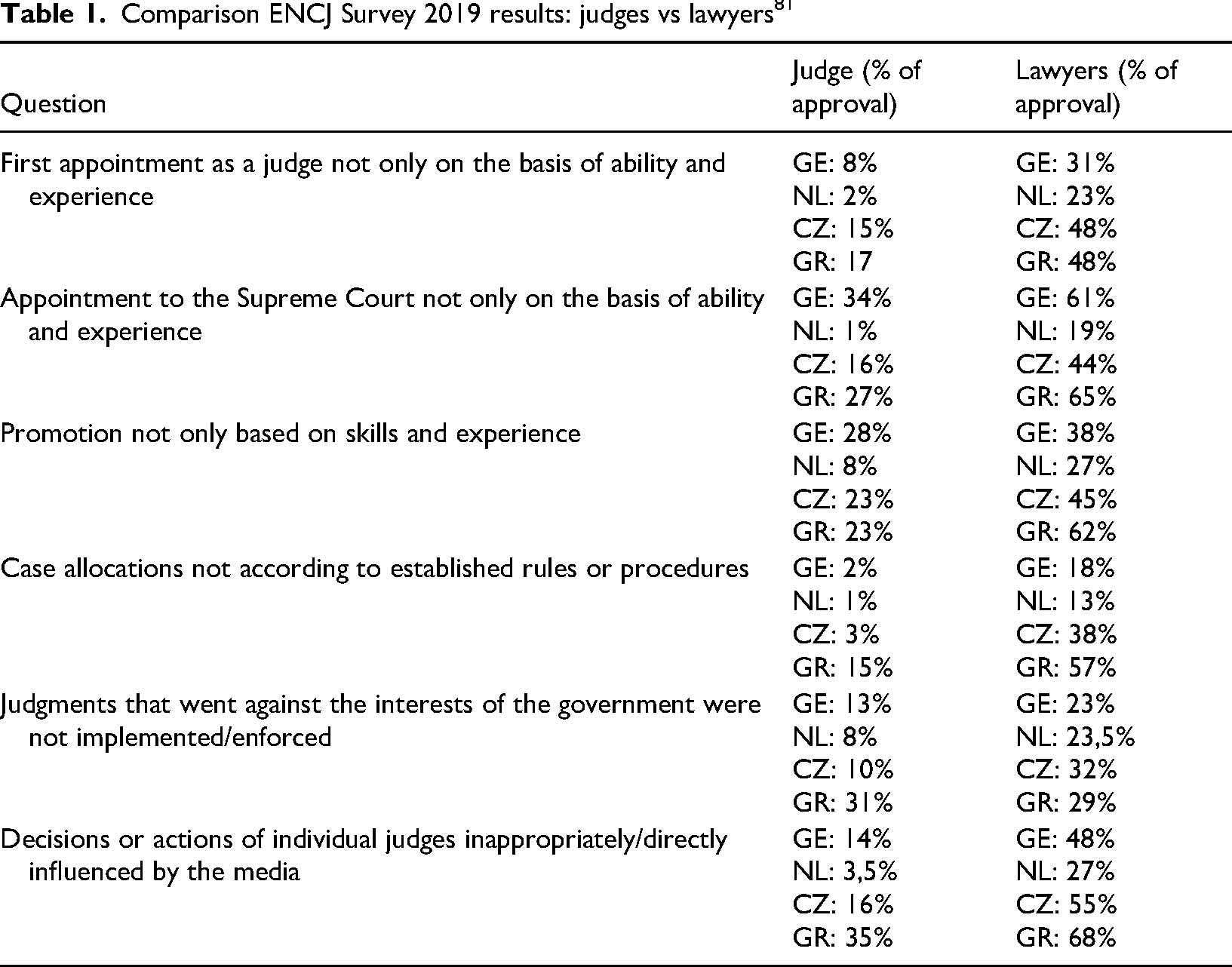
Comparison ENCJ Survey 2019 results: judges vs lawyers81
Of course, one cannot directly infer from this data set which of the possible cognitive effects and knowledge-related differences has led to the diverging evaluation of the above questions. However, this data set shows that the evaluation tends to diverge in the same manner: external observers are often more critical than judges from the internal perspective.
Yet the survey does provide an indication as to the effects that might have caused these divergent evaluations. If one also considers further data collected as part of the survey, this data indicates the relevance of the above-mentioned cognitive effects relating to a positive self-assessment. 78 It is noticeable that the judges in almost all of the 25 participating countries in 2019 rate their own personal independence higher than the independence of the judiciary in their respective country as a whole. 79 This is also the case for the 27 countries assessed in the 2022 ENCJ survey of judges. 80 These results – which are shown in Table 2 – emphasize the relevance of the subjective perspective on judicial independence.
Comparison of the assessment by judges of the overall independence in their country vs their own independence.
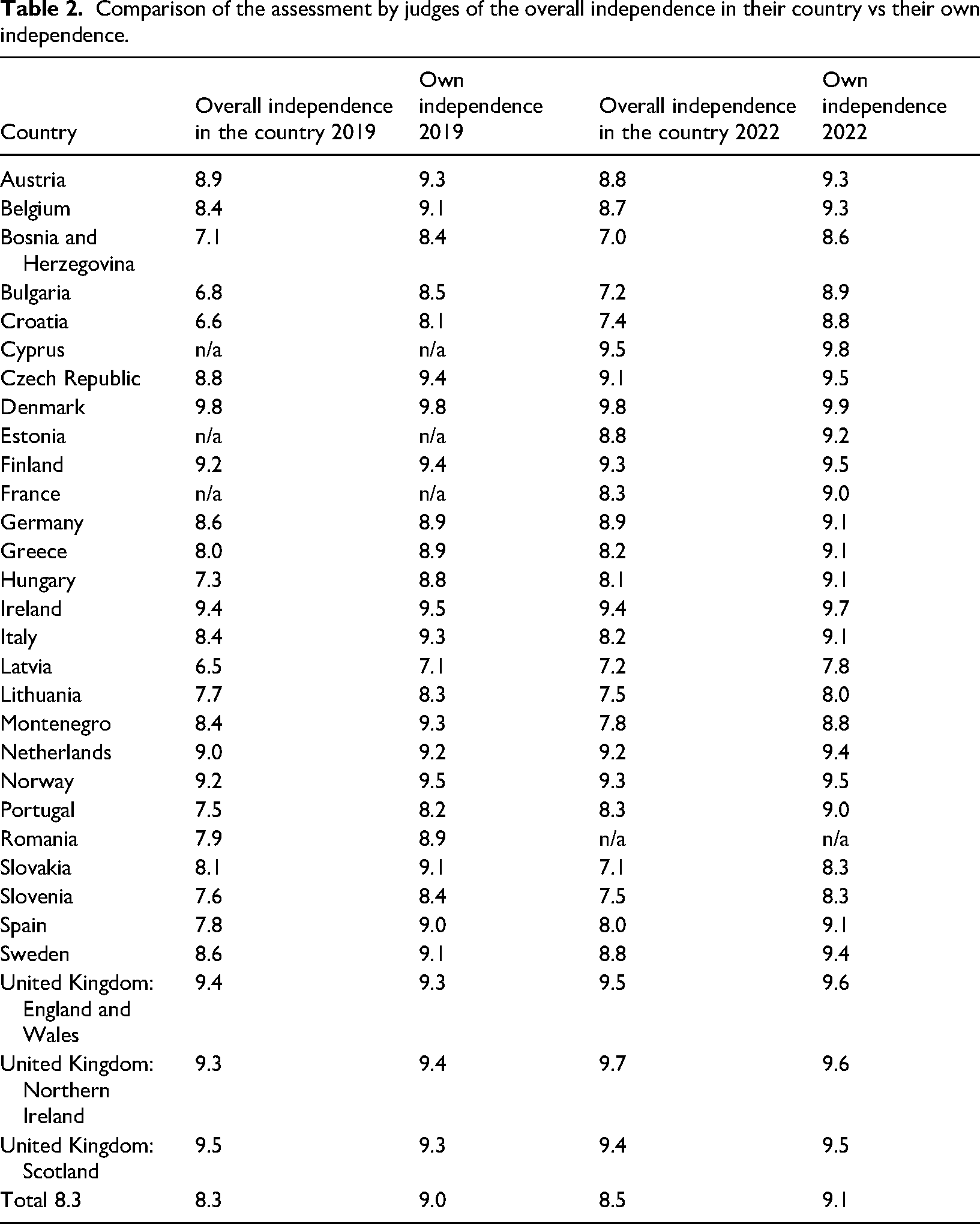
If, in addition, one takes into account surveys on the assessment of judicial independence by the general population, the tendency towards a more critical assessment from an external perspective compared to an internal perspective is also evident. For example, while the German judges in the above-mentioned ENCJ survey rate the independence of the German judiciary generally as high, with only 0.87% of the judges surveyed rating this independence as less than 5 points (on a scale of 0–10), the assessment by the general public is more differentiated. The EU Justice Scoreboard for the same year 2019 showed that a total of 18% of the respondents in Germany rated it as ‘fairly poor’ or ‘very poor’. 82 Similarly, while only 0,16% of the Dutch judges in the ENCJ survey rated the independence in the Netherlands as less than 5 points, the general perception in the Netherlands according to the EU Justice Scoreboard was 15% for ‘fairly poor’ or ‘very poor’. While only 1.24% of the Czech judges rated the independence in the Czech Republic as less than 5 points, the general perception according to the EU Justice Scoreboard was 36% for ‘fairly poor’ or ‘very poor’. And while 2.46% of the Greek judges rated the independence in Greece as less than 5 points, the general perception according to the EU Justice Scoreboard was 34% for ‘fairly poor’ or ‘very poor’. 83
With regard to the trust of external actors, it is therefore not possible to refer solely to the internal perspective of judges. As the above examples show, it is very likely that the evaluation of independence issues from an internal perspective does not fully reflect that of external observers. It is not possible to equate the judges’ perspective with the perspective of the external actors. The differences in perspective make an evaluation from the internal perspective alone an inadequate substitute. It is thus problematic when judges assess issues of judicial independence based solely on their own perspective as this perspective alone cannot do justice to the particularities of the external perspective. This problem exists both with regard to assessments of judicial independence in the narrower sense and with regard to impartiality. 84
In view of the objective of ensuring trust of those seeking justice and of the general public in judicial independence, the legal assessment of issues relating to judicial independence should take into account the perspective of this targeted group. In particular, this means considering a more critical stance than the one taken from an internal perspective. This would lead to a stricter application of the principle of judicial independence. Moreover, when taking into account the external perspective, the term ‘doubt’ must be used as a yardstick. Taking into account the more critical tendency and the limited knowledge that is structurally linked to the external perspective, doubts must suffice in this respect. In line with this observation, the CJEU has emphasized that even ‘appearances may be of a certain importance’. 85 Other courts should also embrace this approach when assessing independence issues.
To take the external perspective into account, empirical findings can be incorporated into the legal assessment of judicial independence issues. It is possible to refer, where applicable, to studies on how external actors assess specific organizational features relevant to judicial independence. 86 This applies both to courts when examining possible violations of the principle of judicial independence and to the legislator when designing behavioural settings that promote judicial independence in the first place. 87
In sum, a behaviour-related understanding of the principle of judicial independence requires a ‘double’ empirical basis: on the one hand – as set out in section 3 – with regard to the factors that promote normatively desirable behaviour by judges and third actors; and on the other hand with regard to the subjective assessment of these factors from the perspective of external observers. In this way, the behaviour of all actors involved can be taken into account when implementing the objectives of the principle of judicial independence.
This final section relates back to the two levels of judicial decision-making outlined in section 2, focusing on the second level. As mentioned above, there are several behavioural factors that can influence the concrete content of a judicial decision such as heuristics and biases and effects linked to the judges’ social perspective. Often, these are factors that judges are not aware of and/or that are not under their control. Despite their well-established impact on judicial behaviour, such factors have so far rarely been linked to the concept of judicial independence. This section discusses whether and, if so, to what extent such factors should form part of this concept, that is, whether they should be considered as normatively undesirable with regard to judicial independence.
This section focuses, by way of example, on one selected behavioural factor for judicial decision-making: the different social perspectives that judges bring to the decision-making process depending on the social group(s) to which they belong. This is a behavioural dimension of judicial decision-making that has been empirically researched for decades. 88 It bears mentioning that the influence of the judges’ social perspective as discussed here is not about interest-based or ideology-driven decision-making. 89 It is not argued that judges consciously promote the interests of the social group to which they themselves belong and therefore decide accordingly. Rather, the focus is on more subtle phenomena that are usually not consciously perceived by the judges as decision factors. These may, for example, be related to the judges’ personal experiences or to the unconscious effects of group identity. These types of effects will be addressed here.
This reference to social perspectives also corresponds to an approach in the general diversity debate. 90 This approach is about integrating different social perspectives into social and political discourse and decision-making processes. The underlying assumption is that the fact that different social groups have different experiences leads to specific social perspectives that can, inter alia, contribute to better understanding the experiences and positions of fellow group members. This is also relevant regarding diversity (or lack thereof) in the judiciary. For example, the South African Constitutional Court has emphasized the importance of diverse social perspectives in the judiciary: ‘the sound belief behind the encouragement of greater diversity in judicial appointments was that women and visible minorities would bring an important perspective to the difficult task of judging’. 91 Further, scholars also emphasize the special perspective of certain groups that judges can bring to the task of judicial decision-making for judges in specialized courts such as commercial courts and for honorary judges who often have the function of bringing relevant non-legal perspectives to the court. 92
Studies have provided empirical evidence for the relevance of social perspectives for judicial decision-making. To start with, gender is a potential factor for such diverging social perspectives. Research on the decision-making behaviour of female and male judges has shown differences, at least in certain areas. For example, a study on the gender composition of the bench has shown that decisions in sexual harassment proceedings differ depending on whether or not there were female judges on the bench. 93 Different decision-making patterns were also identified for decisions in cases that involved gender discrimination. 94 In addition to such subject-specific differences, the general decision-making and reasoning practices of female and male judges can also differ, for example with regard to the penalties in criminal proceedings. 95 Moreover, as a further social perspective, the ethnic background of judges can have an impact on the decision-making. For example, a study has shown how the fact that a judge is of African-American or Caucasian descent can influence their decision-making in criminal cases regarding either African-American or Caucasian defendants. 96 The results of this and other studies indicate that such influence seems to exist in some contexts. 97
It is also important to note that such effects cannot be considered in isolation. Rather, the interplay of different characteristics of the judges determines the social perspective, which then has an impact on decision-making. Accordingly, a study on the interaction of gender and ethnicity has shown that judges who are both female and from an ethnic minority are more likely to support the defendant’s position in criminal proceedings than other members of the bench. 98 Considering such ‘intersectional’ effects, one should consider the influence of social perspectivity as a whole rather than exclusively focusing on a specific characteristic.
The relevance of social perspectives for judicial decision-making also becomes apparent in the context of the so-called ‘panel effect’. 99 This term describes the influence that the social group to which a judge belongs can have on the other members of the bench. Even if only one of the judges on the bench has a certain social perspective, this can shape the decision-making by the other judges as well. This effect illustrates again that the phenomena discussed here are not about interest-driven decision-making, but about cognitive effects.
Behavioural effects such as social perspectivity should be incorporated into the concept of judicial independence under two conditions: (1) that these effects touch the normative core of judicial independence; and (2) that it is possible for the state to influence these effects in a manner that is conducive to judicial independence.
To start with, the above-mentioned behavioural effects of social perspectivity have normative relevance for the concept of judicial independence. If one starts from the premise that, in principle, judicial decisions should be determined by law, the social perspective might potentially qualify as a normatively undesirable factor. Further, the social perspective might be perceived as affecting the neutrality of judges, that is, the expectation that judges should be at equal distance to the parties to a dispute. A social perspective can bring a judge cognitively closer to one of the parties than to the other. Belonging to the same social group or having shared experiences can create a link between a judge and a party to a dispute. Inversely, strongly divergent social perspectives can lead to the judge being cognitively further removed from one party than from the other.
With regard to social perspectivity, the perception and assessment by external observers is particularly important. Both for the specific parties to the proceedings and for the general public, a judiciary whose composition differs significantly from society in general or in which certain social groups are not represented at all can create the impression of a structural bias towards these groups. If one takes seriously the objective of ensuring trust in courts, social perspectivity thus clearly touches the normative core of judicial independence.
As a second condition for including the behavioural effects of social perspectivity in the legal principle of judicial independence, it must be possible for the state to influence the factors that shape social perspectivity in judicial decision-making. Otherwise, any such legal obligation of the state would not be realizable. When considering whether such an obligation should be part of the principle of judicial independence, it is useful to distinguish between social perspectivity on the level of the individual judge and on the level of the judiciary in general. On the level of the individual judge, there are few possibilities for countering the influence of social perspectivity. First, any human judge will always decide cases in a way that is to some extent influenced by their characteristics and experiences. Admittedly, it is conceivable, for example, to minimize the prejudices associated with these experiences or to increase empathy for certain social perspectives with which the respective judges are not familiar from their own experience. Measures such as diversity training or cultural sensitivity training pursue this goal. However, studies have shown that the long-term effectiveness of such measures is often limited. 100 For example, when people are educated about how specific associations influence the perception of certain social groups, this information alone cannot effectively counteract these cognitive mechanisms. 101 Similarly, methods to counteract potentially problematic effects of group affiliations have also not yet been proven sufficiently effective. 102
However, the aspect of social perspectivity can be addressed on the level of the judiciary in general. If one takes such a structural approach, it will centre around shaping probabilities rather than individual decisions. A potential state obligation would involve influencing the risk that the judges’ social perspective will have a detrimental effect on one of the parties. 103 From the point of view of judicial independence, social perspectivity would be regarded as unobjectionable if the judiciary is so diverse that the above probability corresponds to the proportionate representation of a group in society. In contrast, it would be normatively undesirable according to the principle of judicial independence if, due to a lack of diversity in the judiciary, certain social groups have a significantly higher risk of the judges’ social perspective being detrimental to their case than their proportionate representation in society.
Such an understanding of social perspectivity as part of the concept of judicial independence has already been recognized by certain judicial bodies. The UN Human Rights Committee has explicitly linked judicial independence to the representation of certain social groups within the judiciary. In an observation on the judiciary in Sudan, the Committee criticized, as an aspect of judicial independence, that there were too few non-Muslim and female members of the judiciary in this country. 104 It considered it therefore necessary to take measures ‘to improve the independence…of the judiciary, including the appointment of qualified judges from among women and members of minorities’. 105 Moreover, the jurisprudence on judicial independence in certain countries whose criminal proceedings are based on a jury system is also insightful. A composition of the jury that is socially representative is considered to be an aspect of impartiality. For example, the US Supreme Court has ruled on the representation of women on juries that women must have access to juries, as an impartial jury requires ‘a fair cross-section of the community’. 106 With regard to the representation of the indigenous population in Canada, the Canadian Supreme Court has stated in connection with the requirement of an impartial jury that ‘the larger community’ should be represented in juries and that indigenous people can therefore not be excluded. 107
By diversifying the judiciary, it is thus possible for the state to shape the setting in which judicial decision-making takes place in a manner that avoids mono-perspectivity, a situation that would be normatively undesirable in terms of judicial independence. With regard to gender diversity, the necessary diversification is already implemented in many countries at least in Europe. 108 In contrast, the diversity of the social background or ethnicity of judges is often not yet specifically promoted and is also not reflected in the statistics on the structure of the judiciary. 109
In sum, the above discussion has demonstrated how to assess whether specific behavioural effects that concern judicial decision-making should be integrated in the concept of judicial independence. If they touch the normative core of judicial independence and it is possible for the state to influence the factors that contribute to these effects, such behavioural effects should be included in the principle of judicial independence. With regard to social perspectivity, the above discussion has shown that there are in fact many good arguments for considering it as relevant for judicial independence. Incorporating this aspect would result in a state obligation to promote the diversity of the judiciary. Especially for raising trust in the independence of the judiciary, this would be a valuable institutional step.
Conclusion
The behavioural dimension of judicial independence is multifaceted. This article has shown how this dimension can be taken into account when shaping the concept of judicial independence and implementing it in practice.
First, the article highlighted the factors that determine the behaviour of judges and third actors in relation to judicial independence. It showed that the behavioural setting for both these groups of actors need to be considered. It outlined how, in relation to these behavioural settings, the state can shape the structural conditions to promote independence. It showed that, in addition to the factors that have traditionally been addressed as relevant for judicial independence, other behavioural aspects such as psychological framework conditions also shape the behaviour of judges and thus should be included when optimizing the factors for judicial independence.
The article also highlighted that the trust dimension of the principle of judicial independence has a distinct behavioural dimension. This dimension concerns in particular the trust in judicial independence by actors that are external to the judiciary. The article has argued that, due to potential behavioural effects, the specific perspective of these external actors should be included when assessing whether certain features are problematic under the yardstick of judicial independence.
Finally, the article discussed whether the notion of what is considered normatively undesirable in the context of judicial independence should be extended in order to include certain behavioural factors. The article addressed this question in particular for the behavioural effect of social perspectivity on decision-making. It showed that such effects should be included in the concept of judicial independence if they touch the normative core of judicial independence and to the extent that it is possible for the state to influence the factors that lead to these behavioural effects.
Taking the various behavioural dimensions of judicial independence into account contributes to better understanding the behaviour of the actors involved and shaping the legal framework accordingly. But most importantly, it can help to strengthen de facto judicial independence more effectively.
Footnotes
Declaration of conflicting interests
The author declared no potential conflicts of interest with respect to the research, authorship, and/or publication of this article.
Funding
The author received no financial support for the research, authorship, and/or publication of this article.
