




Abstract
The adversarial legal procedure is one of the defining characteristics of Anglo-American law. Adversarialism is lauded for its capacity to discover the factual truth, which is said to be revealed by the clash between zealous advocates. This study further explores the proposition that adversarial contests trigger a bias that pervades adversarial actors’ judgments, beliefs, motivations, and emotions, and thus skews how they perceive and approach their cases. Specifically, we set out to extend prior research by testing whether the adversarial bias could spill over to skew simulated pre-trail prosecutorial tasks: the decision to seek an indictment and forming judgments in advance of the plea negotiation. In a simulation with lay people, we find that the adversarial bias does indeed skew pre-trial decisions. This result is troubling because the epistemic justification of adversarialism has little to contribute to these decisions, as indictment decisions are made unilaterally by prosecutors, and plea negotiations take place under heavily lopsided power and access to information. It follows that while adversarial zeal has little to contribute to pre-trial decisions, it can readily infest them with zeal. While ecological validity considerations abound, this study demonstrates the psychological plausibility that the adversarial bias results in heightened levels of indictment and stiffer punishments, thus highlighting prosecutors’ potential contribution to the exceptionally high rate of people sent to prison in the US.
Keywords
Introduction
Adversarial Procedure
The adversarial legal procedure is one of the defining characteristics of Anglo-American law (Damaska, 1991; Fuller, 1961; Langbein, 2003). Amongst other rationales (see Fuller, 1961; Landsman, 1984), proponents of adversarialism laud the procedure for its capacity to reveal the factual truth underlying the case at hand (see Fuller, 1961; Landsman, 1984; United States v. Nobles, 1975). The process is said to produce evidence that is both voluminous (Freedman, 1996; Landsman, 1984) and reliable (Crawford v. Washington, 2004). This truth-finding function of the adversarial trial has been espoused by scholars (Freedman, 1998; Fuller, 1961; Landsman, 1984; Uviller, 1975) and courts (see Portuondo v. Agard, 2000; James v. Illinois, 1990; United States v. Agurs, 1976) alike.
The core epistemic device that is said to enable the discovery of truth is the dialectic exchange of vigorous partisan advocacy. Proponents explain that the key to successful resolutions of legal cases lies in the “sharp clash of proofs presented by adversaries” (Landsman, 1984), and “the juxtaposition of two contrary perspectives” (Uviller, 1975. See also Herring v. New York, 1975; United States v. Cronic, 1984). Proponents explain that to enable this epistemic process, legal advocacy must be delivered with zeal. As Fuller (1961) famously explained, “before a judge can gauge the full force of an argument, it must be presented to him with partisan zeal.” Zeal has become the gold standard of American lawyering. Zealous representation constitutes an ethical duty that lawyers owe their clients (Landsman, 1984, p. 5). Indeed, the preamble to the ABA’s Model Rules of Professional Conduct instructs lawyers to “zealously assert the client’s position under the rules of the adversary system,” and the Commentary to the Rules commands lawyers to act “with zeal in advocacy upon the client’s behalf.” (comment, Rule 3.1.).
We do not seek here to join the debate over whether the adversarial process actually delivers on its epistemic promise (for critiques, see, e.g., Aviram, 2019; Babcock, 1982; Brennan, 1990; Fish, 2017; Frank, 1950; Frankel, 1975; Pound, 1904, 1978; Weinreb, 1977). Rather, we set out engage with a body of research that finds that operating within an adversarial legal procedure has unintended impacts on how legal actors come to perceive and approach their cases. Specifically, we extend that research to examine whether the adversarial posture might spill over to impact how prosecutors execute their discretion in pre-trail decision making, a context that is largely devoid of any adversarial confrontation.
The Prosecutorial Role
It is widely believed that prosecutors have an outsized impact on the American criminal legal system. The late Stuntz (2001) observed that prosecutors, not legislators or judges, are the criminal justice system’s “real lawmakers” (p. 506). Federal judge Rakoff (2017) describes prosecutors as “the real rulers of the American criminal justice system” (p. 1436). It has also been said that prosecutors are the “Leviathan” of our criminal justice system (Barkow, 2009, p. 874). As such, it is not surprising that the American exceptional punishment regime—known as mass incarceration (Garland, 2023; National Research Council, 2014; Tonry, 2013; 2016)—is deemed, to a large degree, the work product of the American prosecutor (Barkow, 2019; Crespo, 2018; Davis, 2007; Sklansky, 2018; Stuntz, 2011).
It would be tempting to propose that prosecutors contribute to mass incarceration by way of overly zealous execution of their role as advocates in the adversarial process. That supposition, however, quickly runs into problems. As mentioned, zeal is believed to do its magic through the dialectical clash of advocacy, which occurs during the litigation process and plays out within the four walls of the courtroom. Yet, it is well-established that some 95% of convictions are resolved by way of guilty pleas rather than trials, and thus never get to court (BJS, 2010; 2013; US Sentencing Commission, 2022). That largely rules out the possibility that prosecutors’ zealous advocacy is a significant contributor to mass incarceration.
Scholars have noted two ways in which prosecutors do impact rates of incarceration. First, by way of high rates of seeking indictments (Beckett & Beach, 2021; Stuntz, 2011; Zimring, 2020). For illustration, Pfaff (2017) points to the prominent decline in crime rates that has transpired since 1991 (to the tune of 36% of violent crime and 31% for property crime, over the period 1991–2008). Unsurprisingly, that reduction in criminal activity resulted in lower rates of arrests by the police. Yet, despite the drop in arrests, the number of felony cases prosecuted rose steeply, by about 40%. Thus, while fewer people were being hauled into the criminal system, a greater share of them were faced with felony charges, resulting in a doubling of the probability of a felony prosecution given an arrest (Pfaff, 2017. See also Bushway & Forst, 2013). The consequences of this propensity must not be underestimated. Aside of the fraction of charges that get dismissed—estimated by the Bureau of Justice Statistics (2010) at some 20%–25% of cases (most of them based on weak evidence)—virtually every indictment ends with a conviction. That follows from the abovementioned guilty plea rate of 95% and the conviction rate at trial of about 70%–80% of the remaining cases (BJS, 2010). Thus, some 99% of non-dismissed indictments yield convictions (Pew Research Center, 2023), which means that a prosecutor’s pre-trial decision to seek an indictment gets perilously close to sealing the defendant's fate.
A second, and interrelated, contributor to incarceration rates is the ease of obtaining convictions and lengthy prison sentences, namely, the facility of the plea-bargaining process. During the era of mass incarceration, we observe a substantial decrease in the fraction of adjudicated cases, from about 33% in 1962 (Silverstein, 1965; Stuntz, 2011) to the current rate of about 5% (BJS, 2010; 2013; US Sentencing Commission, 2022). The widely accepted contributor to this prosperous production line is the trial penalty, that is, the extra punishment facing the defendant upon losing at trial relative to a deal negotiated between the parties. The trial penalty is readily leveraged by prosecutors thanks to the ever-increasing menu of punishments, including lengthier sentences, mandatory minima, sentence enhancements, repeat offender statutes, collateral punishments, and more (Byrne-Hessick, 2021; Rakoff, 2021; Sklansky, 2018; Stuntz, 2011). Prosecutors are free to stack charges and punishments on top of one another (Pye, 2018; Stinneford, 2015), with which they can “bludgeon” defendants (Rakoff, 2021, p. 23). In short, prosecutors can effectively compel defendants to accept their plea offers (Alschuler, 1983; Bibas, 2012; Rakoff, 2021; Stuntz, 2001), with little regard to the strength of the evidence or even to the defendant’s actual guilt.
It is important to note that courts have given prosecutors virtually unfettered discretion in the exercise of these powers. In Wayte v. United States (1985), the US Supreme Court dispelled any inclination to rein in prosecutorial charging discretion, stating simply that the decision to prosecute is “ill-suited for judicial review.” And in the notorious case of Bordenkircher v. Hayes, 434 U.S. 357, 1978, the Court dispelled any inclination to limit prosecutors’ freedom to set plea settlement terms, however egregious. In that case, the appellant Hayes was charged with writing a forged check (for a whopping $88.30) and, as a repeat offender, he was eligible for an enhanced sentence. The prosecutor offered Hayes a five-year sentence if he pled guilty while threatening him with a life sentence if he were to go to trial and lose. Hayes chose to roll the dice and lost. Following the prosecutor’s recommendation, the trial judge sentenced to life in prison. The Supreme Court rejected Hayes’ contention that the threat of a life sentence amounted to coercion that violated his due process rights. In doing so, the Court handed prosecutors free reign to threaten defendants into accepting their proposed plea deals. As discussed below, the prospect of adversarial borne distortions of pre-trial decision making is normatively fraught, as these decisions should be performed in an objective and bureaucratic manner.
The Adversarial Bias
To explore the proposition that the adversarial procedure affects the behavior of legal agents, we begin with the well-established research showing that slight changes in the structure of a task can impact the way people respond to it (Beersma & De Dreu, 2002; Carnevale & Probst, 1998; De Dreu & McCusker, 1997; Polzer et al., 1998; Pruitt, 1967). Famously, the mere labeling a prisoners’ dilemma game as a “Community Game” increases the cooperation rate significantly relative to when it is labeled a “Wall Street Game” (Liberman et al., 2004; see also Engel & Rand, 2014). One line of research that falls within this body of literature is the role-induced bias, according to which the role that an actor plays in a given situation can alter their mindset towards greater congruence with the respective role. This line of research can be traced back to a study by Janis and King (1954), wherein pairs of participants were assigned to opposing positions and were asked to argue for that position in a debate. The study found that the debaters’ opinions became more aligned with their (randomly) assigned positions and were held with greater confidence, as compared to participants who only observed the debate (Janis & King, 1954. For similar results, see Schwardmann et al., 2022).
A subsequent line of research applied these findings to legal settings. In a study by Simon et al. (2004, Study 4), lay participants were asked to simulate the role of a legal intern working for an arbitrator in a labor dispute. The study found that participants’ judgments of the case were skewed towards the side to which they were randomly assigned by the arbitrator. This was true both for the global judgment which side should prevail and the interpretation of the ambiguous factual pattern. A study by Eigen and Listokin (2012) tested law students participating in moot court contests. The study found that these students came to view the side to which they were randomly assigned as having both greater legal merit and being morally superior to the opposing side. Notably, the preference for one’s position was associated with poorer performance in advocating that position at the moot trial (Eigen & Listokin, 2012). Engel and Glöckner (2013) assigned participants to play the role of a legal intern working either for the prosecution or the defense in a criminal case. The study found that the former group judged the defendant’s guilt and the probability that he committed the act to be higher than the latter (Engel & Glöckner, 2013. See also Egli-Anthonioz, 2019). Spamann (2020) introduced law students to a mock Supreme Court oral argument, assigning them to represent the petitioner, the respondent, or a neutral judge. The study found that over 50% of those assigned the role of the petitioner’s counsel expected petitioner to prevail, while fewer than 20% of those assigned the role of the respondent’s counsel reached the same judgment. Students assigned to the neutral role reported positions that were in between the adversarial conditions (Spamann, 2020).
In a study by Melnikoff and Strohminger (2020), participants were presented with overwhelming evidence that a defendant in a criminal trial was guilty and were then assigned to the role of defense attorney or prosecutor in the defendant’s trial. Participants were warned about the role-induced bias and were implored to maintain their objectivity. Notwithstanding the unambiguous evidence of guilt, over half of those playing the role of defense attorney concluded that the defendant was innocent of the crime. Jeklic (2023) assigned law students to the roles of claimants and defendants in a civil monetary suit and found that the former expected the awarded damages to be almost 70% higher than the latter. Both parties also found the arguments supporting their side to be considerably stronger than those favoring their opponent (Jeklic, 2023).
In all, this body of research has found that adversarial roles skew a wide range of judgments, including determinations of guilt (Engel & Glöckner, 2013; Melnikoff & Strohminger, 2020; Simon et al., 2004), estimations of probability of commission (Engel & Glöckner, 2013), expected verdicts (Spamann, 2020), strength of arguments (Eigen & Listokin, 2012; Jeklic, 2023), moral merits of the case (Eigen & Listokin, 2012), and damages to be paid (Jeklic, 2023).
Previous work by Simon et al. (2020) sought to extend those findings to capture biases at more intricate aspects of the task. Both studies reported therein presented participants with a quasi-legal adversarial proceeding. Study 1 concerned a labor arbitration dispute wherein a company sought to fire an employee, Jason Wells, for allegedly stealing money from its safe. Study 2 concerned an academic disciplinary hearing wherein a university charged a student, Debbie Miller, for cheating on an exam. The participants were asked to act as a “representative” (akin to a lawyer) in study 1, and an “investigator” in study 2. They were given one of three role assignments: acting in the service of the individual (Jason, Debbie), in the service of the institution (the company, the university), or a non-adversarial assignment serving accurate outcomes. Participants were compensated for their time, but no incentives were offered in relation to their performance or responses.
Consistent with the abovementioned research, Simon et al. (2020) found that the role assignment skewed participants’ global judgments of the case: namely, their proposed verdicts and estimations of the likelihood that Jason and Debbie committed the transgressions. Importantly, the studies went beyond the global level to demonstrate that adversarial borne biases run much wider and deeper, sweeping through a host of additional facets of the task. Biases were observed in the inferences that adversarial participants drew from each of the ambiguous facts that made up the evidentiary pattern, their motivation to see their respective side prevail, their affective reactions to the prospect of their side winning or losing the case, their emotional reactions towards the protagonists, and their liking of the protagonists. Crucially, in both studies, responses given by participants assigned to the non-adversarial role were close to the midpoint between the responses obtained in the adversarial conditions (see also Spamann, 2020). Adversarial participants also reported unfavorable judgments of their fictional adversary, Cooper, believing that they were more objective than Cooper, and that Cooper would be extremely biased in his judgments of the case. In sum, the role that one plays in the legal procedure has a strong impact on how the case is viewed, evaluated, experienced, and processed.
We deem zeal as a byproduct—or a manifestation—of the adversarial bias. It undeniable that legal actors might well be capable of feigning zeal in the service of attaining instrumental objectives. However, we maintain that ordinarily, the adversarial bias—with its distorted judgments, beliefs, motivation, emotions, predictions, etc.,—is the natural and authentic upshot of assigning lawyers to do battle across the adversarial divide.
A notable feature of these findings is the coalescing of so many facets around the role-assignment. We deem this coalescence as being driven by coherence-based reasoning, a general model of cognition that is credited for transforming the complexity that pervades our lives into comprehensible and sensible conclusions. Coherence-based reasoning thus enables people to engage successfully with their environment (Engel et al., 2020; Glöckner et al., 2010; Holyoak & Simon, 1999; Holyoak & Thagard, 1989; Read et al., 1997; Simon, 2004; Simon & Holyoak, 2002; Thagard, 1989). For a comprehensive review, see Simon & Read, 2023). By this account, complex judgment tasks are understood to be represented in connectionist networks (Eliasmith, 2013; Holyoak, 1991; Hummel & Holyoak, 2003; Smolensky, 1989; Thagard, 2019) wherein all of the elements of the task are connected to other elements via relational links. As articulated by Heider (1946), links will be positive when they connect elements that are deemed to “go together” and negative when they are deemed incongruous or contradictory. The framework posits that the cognitive task is processed through a neurally-inspired cross activation, governed by mechanisms of parallel constraint satisfaction (Hopfield, 1982; 1984; Rumelhart et al., 1986). These processes are driven by structural forces that transform conflict-laden representations into states of equilibrium, or coherence. Coherence is defined as the state wherein positively linked elements are similarly activated, and negatively linked elements have dissimilar activations. The imposition of coherence is attained through an alteration of the nodes—whether by way of strengthening, weakening, or morphing them—to bring them into line with the emerging conclusion (see Abelson et al., 1968; Asch, 1946; Heider, 1946; 1958; McGuire, 1968). As a result, the winning conclusion ends up being supported by highly activated attributes and the rejected conclusion by poorly activated attributes, a disparity that facilitates confident resolutions.
Coherence-based reasoning is a ubiquitous, essential, and overwhelmingly adaptive cognitive apparatus (Read et al., 1997; Simon & Holyoak, 2002; Thagard, 1989; 2019). Though, as argued by Simon and Read (2023), it is an equal opportunity process that can serve as a vehicle both for accurate and biased processing. A network will be prone to bias when it is dominated by nodes or links that are incorrect, overweighted, or otherwise nonnormative. One such case is when the person is strongly motivated to reach a particular outcome (Simon & Read, 2023). That, we propose, is what transpires when acting in an adversarial role. In all, the biasing effect of the role on judgments, beliefs, motivation, emotions, predictions, and judgments of the adversary combine to what can be characterized as an adversarial bias (see Aviram, 2019; Simon, forthcoming; Simon, in press).
The Normative Argument
The normative argument that drives this paper begins with the adversarial procedure’s heavy reliance on zealous advocacy as the epistemic devise that enables the discovery of truth. Zeal’s putative contribution is designed to operate in the context of the criminal trial, by way of providing the judge with sharp clashes of proofs presented by zealous adversaries (Fuller, 1961; Landsman, 1984). Whether or not sharp clashes of proof actually facilitate the discovery of truth at trial, there is little doubt that their role in the pre-trial phase of the process is miniscule. Decisions to indict rest well within the unilateral and largely unreviewable prosecutorial prerogative, and plea negotiations are conducted between parties vested with heavily lopsided negotiating power and access to information. Defense attorneys often describe their plea-bargaining experience as entailing begging, pleading and groveling before the prosecutor (Rakoff, 2017; Smith, 2012; Yaroshefsky, 2021), with the eventual terms being determined overwhelmingly by the prosecutors’ offers (Byrne-Hessick, 2021; Pfaff, 2017; Rakoff, 2021).
It is important to keep in mind that pre-trial decisions ought to be approached in a managerial and bureaucratic manner (Barkow, 2019; Lynch, 1998). As such, they ought to be based on unbiased case assessments that set the stage for the adversarial showdown, rather than determine its outcome. The tasks involved in pre-trail decision—such as weighing the public interest in the prosecution, affixing the correct charge, discerning the best interests of the crime victims, assessing the particularities of the offense, and deciding which witnesses to call and which evidence to disclose—require nuanced and measured judgment that is readily defeated by its infusion with the adversarial bias, or zeal. Indeed, most inquisitorial systems vest these decisions in hands of magistrates, who represent the judicial branch and perceive their role as non-adversarial in nature (Damaska, 1991; Hodgson, 2001; 2005; Weinreb, 1977).
The key question is empirical, whether zeal could indeed spill over from its intended locus—the courtroom—into the pre-trial process. We chose to approach this inquiry from a psychological perspective, setting out to examine whether the adversarial bias reaches the remote corners of the task. Specifically, we seek to extend the research by Simon et al. (2020) to test the psychological plausibility of the adversarial bias affecting decisions to initiate the disciplinary proceedings in the first place and predictions how a person of authority would decide the case. The prospect of such a spillover seems theoretically plausible in light of the connectionist nature of the underlying cognitive architecture (Read et al., 1997; Smolensky, 1989), as well as of findings of the adversarial bias persisting after participants had exited their assigned role (Engel & Glöckner, 2013; Melnikoff & Strohminger, 2020; Spamann, 2020).
The Study
Overview
The stimulus was a hybrid of the two studies reported by Simon et al. (2020). The factual pattern was a modified version of the case of Debbie Miller, whereas the role assignment was adopted from the case of Jason Wells. The vignette revolved around a fictional university disciplinary hearing conducted to adjudicate an allegation that Debbie cheated on an exam. We couched the process in a quasi-legal frame—an academic misconduct hearing—rather than in the frame of a criminal case. This was done to prevent participants from evoking schemata of lawyerly behavior and mimicking what they might believe legal actors would do. Rather, we hoped that this less familiar environment would better capture how participants are psychologically affected by the adversarial procedure itself. As the study was intended to simulate prosecutorial decision making, we omitted the role of the defense (Student Advocates), assigning participants either to the role of an adversarial prosecutor or to a non-adversarial role.
To test the intuition that the adversarial bias could skew the decision to indict, we mimicked the conventional criteria used in legal practice: that the prosecutor believe that the defendant did in fact commit the offense and believe that they will likely be found guilty by an unbiased trier of fact (DOJ, 2024). Hence, we asked our participants about the strength of the evidence, their predictions of the Chief Judicial Officer’s decision, and a summary question whether they would have initiated the disciplinary proceedings in the first place.
Next, we sought to test the impact that the adversarial bias might have on the formation of plea offers. Recent scholarship has diverged from the view that the plea bargaining process can be captured by a simple rational choice framework, as postulated by the Shadow of the Trial model (see Landes, 1971; Mnookin & Kornhauser, 1979. See Bushway et al., 2014). The process is said to be impacted also by a host of non-rational cognitive, institutional and informational factors (Bibas, 2004; Redlich et al., 2023). Still, the notion that plea terms are impacted by predictions of trial outcomes continues to prevail in both the legal literature (Alschuler, 1983; Bibas, 2012; Rakoff, 2021; Stuntz, 2001) and the empirical research (Bushway et al., 2014; Edkins, 2011; Fessinger et al., 2024; Redlich et al., 2016). It would follow that a prosecutor’s expected probability of prevailing in court and their expected punishment portend a stiffer plea offer. Hence, we relied again on participants’ estimations of the Chief Judicial Officer’s verdict and asked them to predict what punishment she would impose in case of a guilty decision.
To be sure, our methodological approach raises concerns over the study’s ecological validity in that there are undeniable differences between lay participants responding to our fictional stimulus and prosecutors operating in the real world. We will address these concerns in the paper’s Discussion.
Participants
We aimed for a final sample size of 784 subjects—sufficient for 80% power to detect a small effect (Cohen’s d = .2) of role assignment on our continuous outcome measures with a significance level of .05 (two-tailed). Anticipating an exclusion rate of ∼10%, we recruited 902 participants through the online platform Prolific. A total of 121 participants (13%) failed one or more attention check and, in line with our pre-registered protocol, were excluded from our analyses, resulting in a final sample of N = 781 (49% female; Median age = 20 years).
Materials and Procedure
Participants were asked to imagine that they worked for the Office of Student Disciplinary Affairs at a state university. The office is entrusted with investigating allegations of misconduct and, where appropriate, recommending disciplinary actions against the students involved. The disciplinary hearing was centered on an adversarial process, in which a University Representative prosecutes the case, and the student is defended by a Student Advocate. The cases are presided over and ultimately decided by the university’s Chief Judicial Officer. Our vignette involved an allegation that a student by the name of Debbie Miller cheated on an exam by copying from her notes in a closed-book exam. Participants were presented with a rich and ambiguous fact pattern, and were then asked to make a variety of judgments about the case. Participants were never actually asked to partake in a hearing or to argue the case. All participants received the same case information and instructions, with the exception of the assignment instructions.
The assignment manipulation consisted of whether participants were assigned to an adversarial or a non-adversarial role. In the adversarial condition, they were informed that they were to serve as a representative for the university (“University Rep”), and that they would be working against a fictional adversary (“Student Advocate”) by the name of Jim Cooper. In reality, participants performed the study alone, at the time and place of their convenience, and were aware that they were not matched with any other participant.
The role description given to the University Reps read as follows: As a University Rep, your job is to prosecute the cases by proving that the students did commit misconduct. The university expects that University Reps be fair and objective in the handling of cases. Yet, your supervisor frequently reminds you that the Student Advocates are very shrewd and skilled at undermining prosecutions. To beat them, she adds, “you must pursue prosecutions vigorously.” Her favorite mantra is “you know that you’re doing your job properly when you’re getting students disciplined.”
By instructing participants both to be fair and objective and to pursue prosecutions vigorously, we sought to capture the role-conflict that typifies the prosecutorial function in the American criminal system (Berger v. United States, 1935).
Participants assigned to the non-adversarial condition were informed that the Chief Judicial Officer would be assisted by a Case Coordinator and that they were randomly assigned to that role. The instructions read as follows: The university expects Case Coordinators to be fair and objective in your handling of cases. Your supervisor often reminds you that your goal is to help her decide the cases correctly. Her favorite mantra is “you know that you’re doing your job properly when you facilitate reaching correct decisions.”
As seen in these excerpts, all participants were instructed to be “fair and objective.”
To simulate the social atmosphere that often prevails in adversarial environments, participants in the adversarial condition were informed that some fellow University Reps were of the opinion that cheating at the university was on the rise. Participants assigned to the non-adversarial condition were informed of chatter on campus concerning a possible rise in cheating. Participants in the adversarial condition were told also that their (fictitious) counterpart, Jim Cooper, was an aggressive, win-at-all-costs type of person. As there was no mention of Cooper in the non-adversarial condition, no such information was presented in that condition.
Before assigning participants to their roles, we probed them which role they would prefer to play in the case. Our expectation was that the preferred role would have an independent effect on the dependent measures, and thus create a confound in our results. That expectation did not bear out and will not be discussed further.
Case Facts
The facts pertaining to the alleged cheating were presented in seven webpages. Overall, the case was intricate and based on numerous pieces of ambiguous evidence. Participants were informed that Debbie, a junior, was an “A” student, and was considered hardworking and ambitious. In high-school, Debbie was the captain of the volleyball team, which went on to win the state championship. She was awarded an athletic scholarship to play on the college volleyball team, but she quit the team in her freshman year after complaining of lower back pain. An interview with the examination room proctor revealed that during the exam, Debbie sat against a wall, close to the back corner of the room. The proctor said that Debbie sat crouched over her papers, as if she was hiding something. At the end of the exam, she noticed that Debbie stuck something into the pocket of her sweater, which later turned out to be a note with a summary of the course. A classmate who sat behind Debbie claimed to have seen her pull out the note from her sweater pocket and copy from it throughout the exam. The course professor reported that Debbie was anxious about the exam, but he did not believe that she cheated. Debbie herself denied the allegations adamantly. She stated that as an A student, she had only to lose by cheating. She explained that she crouches when sitting for long periods of time because of a back injury she sustained while playing on the college volleyball team. She also denied copying from the note during the exam and claimed that she used it only for prepping before the exam began.
Dependent Variables
After reading the factual pattern, participants were asked numerous questions about the case. Unless stated otherwise, the variables measured in this study used 7-point Likert scales, and the order of the measures presented here corresponds to the order of the items as they appeared in the materials.
Motivation and Valence
Participants were asked to report their motivation toward the outcome of the case (“Which side would you want to see win this case?”), and then probed how they would feel (from “very bad” to “very good”) seeing Debbie win the case and repeating those judgments for the eventuality of her losing.
Overall Judgments
Participants’ global assessments of the case were probed by asking how they would decide the case (a binary choice between Debbie did not cheat and Debbie did cheat), their estimate of the likelihood that Debbie cheated on the exam (on a 0–100 point scale), what disciplinary action they would recommend (by choosing from a list of seven actions ranging from no action at all, through to expulsion from the university). We also added a measure of their confidence in the recommended verdict.
Pretrial Judgments
Recall that to test the intuition that the adversarial bias could skew the decision to indict, we mimicked the conventional criteria used in legal practice, requiring a belief in the defendant’s guilt (DOJ, 2024). Hence, we probed participants for their estimation of the incriminatory evidence (labeled “Strength of Evidence”), which was in addition to the measures of interpretations of the nine pieces of evidence (labeled “How Incriminating”). We also included a secondary factor mentioned in some prosecutor manuals that concerns the seriousness of the offense (labeled “How Serious”). We then asked participants a summary question whether they would have initiated the proceeding in the first place (labeled “Initiation Decision”). Recall that to test the impact of the adversarial bias on the formation of plea offers, we assumed that prosecutors would tailor their plea offers according to their estimations of the trial outcome. Hence, we probed participants for their prediction of the decision by the University’s chief Judicial Office (labeled “Officer’s Decision”) and of the punishment that she would give Debbie (labeled “Officer’s Punishment”).
Emotions and Liking
Participants were asked how much they liked Debbie, using a “liking thermometer” on a scale of 0–100. Participants were then asked to report the extent to which they felt three positive emotions (sympathy, compassion, and sorrow) and three negative emotions (anger, scorn, and disgust) toward Debbie. Four additional items were included to measure participants’ sadness and fear of Debbie, which were predicted not to be influenced by the treatment. These measures were included to help validate that the negative and positive emotions were impacted by the experimental treatment, rather than by a general mood effect. The emotion questions were presented in a randomized order. We added a new measure to assess participants’ judgments of Debbie’s morality (“moral character”).
Evaluations of the Facts of the Case
To explore participants’ views of the case, we asked for their evaluation of 9 factual issues that bore on the question of Debbie’s cheating. The measures asked for participants’ agreement with various statements, some of which suggested that she did in fact cheat on the exam (guilt items), and others suggesting that she did not cheat (innocence items). Recall that Debbie’s crouching over her notes during of the exam was interpreted by the proctor as an attempt to conceal the notes, but Debbie insisted that she crouches because of a back injury sustained from playing on the volleyball team. Thus, one of the fact questions asked participants to state their agreement with the inculpatory inference: “The fact that Debbie crouched over her papers during the exam indicates that she was hiding something.” Conversely, participants were asked to rate their agreement with various exculpatory inferences, such as “Debbie crouched over her papers during the exam to relieve the back pain she has experienced since her volleyball injury.” Participants were next asked the extent to which they believed the three witnesses: Debbie, her classmate, and the proctor.
Judgments of Objectivity
All participants were asked to assess their own objectivity. Participants in the adversarial condition were asked also to assess Cooper’s objectivity, how Cooper would assess their objectivity in return, and how the Chief Judicial Officer would assess Cooper’s objectivity. Participants in the non-adversarial condition were asked to offer an overall objectivity assessment of University Reps and Student Advocates, and how the Chief Judicial Officer would assess the objectivity of University Reps and Student Advocates.
Judgments Imputed to Cooper
Participants in the adversarial condition were probed for their estimations of how Cooper would view the case. Specifically, they were asked to estimate Cooper’s motivation with respect to the outcome of the case, how he would decide the case, and how he would estimate the likelihood that Debbie cheated.
Interpersonal Bias
Participants in the adversarial condition were asked to rate Cooper and themselves along three criteria—aggressiveness, fairness, and competitiveness. They were also asked how they expected to be judged by Cooper in return.
Group Bias
Participants in both conditions were asked to make generalized judgments of University Reps and of Student Advocates based on the same criteria of aggressiveness, fairness, and competitiveness.
Societal Beliefs
The final set of measures amounted to an exploratory examination whether the impact of the adversarial role would affect participants’ general views about academic misconduct. The items asked about the incidence and seriousness of cheating by students, and about the appropriate punishment. The responses to these measures were mostly not significant and will not be discussed further.
Results
To test between-subject effects, we fit generalized linear regression models. To test mixed and within-subject effects, we fit generalized linear mixed effects models with subject-level random intercepts. A log link function was used to model dichotomous outcomes. Disciplinary action was modeled as a continuous outcome on a 1-to-7 scale, where 1 denotes the least punitive option (no action) and 7 denotes the most punitive action. Modeling this outcome as a categorical variable has no meaningful effect on our results. All p-values are two-tailed. Where the directionality of the measures is not self-evident, we aligned them with the university’s position, so that higher values correspond to greater support with the conclusion that Debbie did cheat on the exam.
In all, our preregistration listed 39 hypotheses about the impact of role assignment (see Supplemental Materials), 35 of which were borne out by the results—a proportion that we consider strong evidence for the general claim that adversarialism systematically biases judgement in a self-serving manner.
As seen in Figure 1, as compared to participants who were assigned to a non-adversarial role (“non-adversarial participants”), those in the adversarial assignment (“adversarial participants”) tended to view the case as providing greater support to their assigned side. Adversarial participants were more motivated to see the university win, and they felt good about that prospect and bad about seeing Debbie win. Those participants were also more likely to conclude that Debbie cheated and gave higher estimations of the probability that she cheated. Among participants who would find Debbie guilty, the adversarial participants were more confident than the non-adversarial ones. Contrary to our prediction, the assignment had no impact participant’s recommended punishment. Adversarial participants disliked Debbie marginally more than non-adversarial participants, and they reported more negative and less positive emotions towards her. They also interpreted the evidence to be more incriminating, believed the prosecution witnesses more and believed Debbie less, and held a bleaker view of Debbie’s moral character. Comparisons between adversarial and non-adversarial role assignments for measures of: Motivation & valence, overall judgments, pre-trial decisions, emotions, and assessments of the evidence.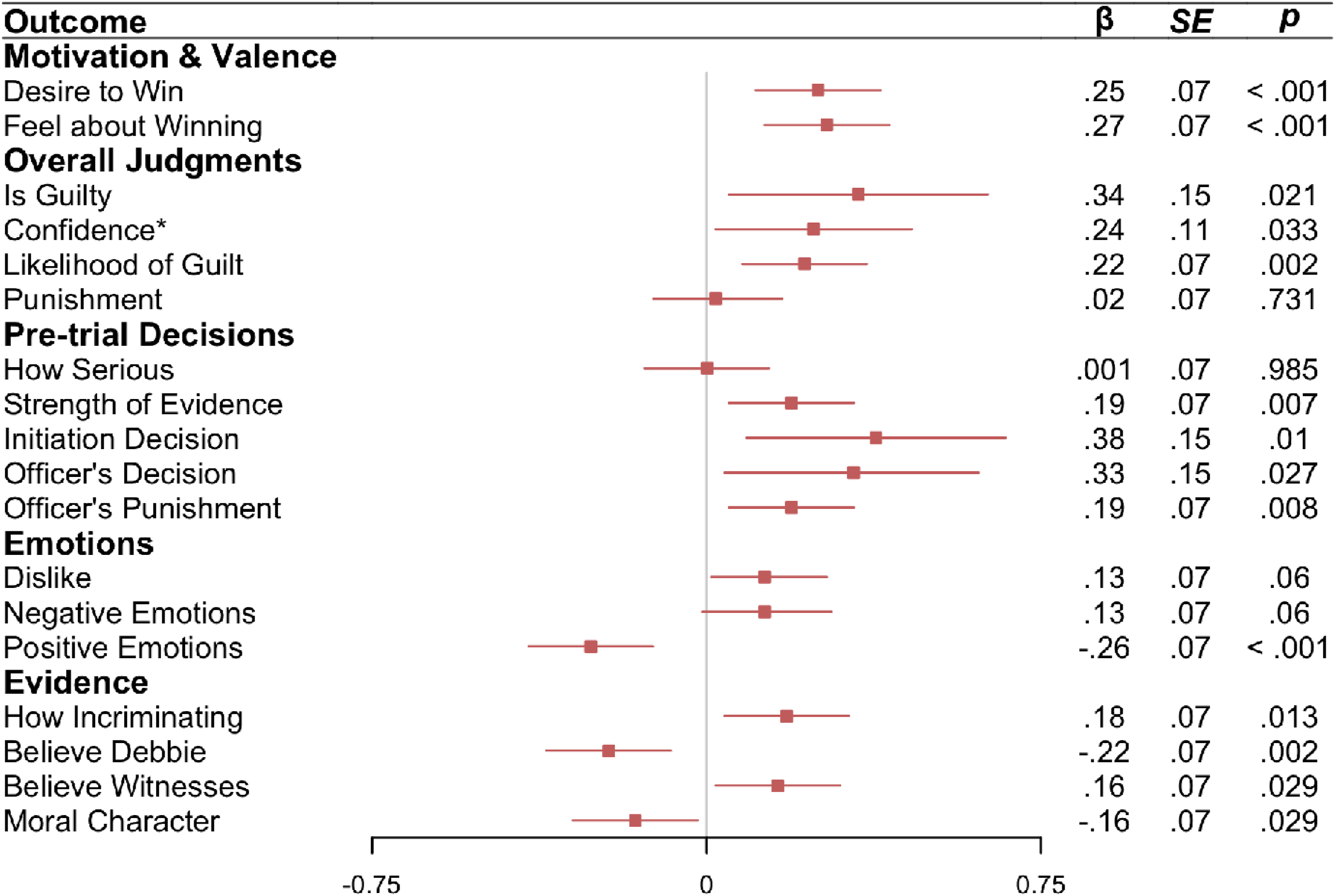
Importantly, we observe that the role assignment also impacted the pre-trial decisions. While there are no differences in judgments of the seriousness of the transgression, all other measures supported the hypotheses. Adversarial participants assessed the evidence against Debbie to be stronger (using both measures “strength of Evidence” and “How Incriminating”), and were more likely to say that they would have initiated the proceeding in the first place (45% v. 35%). Adversarial participants also provided higher estimations that the Chief Judicial Officer would find Debbie guilty (43% v. 35%) and would impose a stiffer penalty on her.
As summarized in Figure 2, adversarial participants reported strong and polarized assessments of their counterpart, consistent with the findings made by Simon et al. (2020). Relative to their judgments of themselves, Cooper was expected to be more motivated to see Debbie win, to disbelieve her guilt, and to assign a low probability to her alleged misconduct. These participants also described themselves as low in aggressiveness and competitiveness and high in fairness, while making opposite attributions to Cooper. Comparisons between participants’ judgments of cooper and judgments of themselves.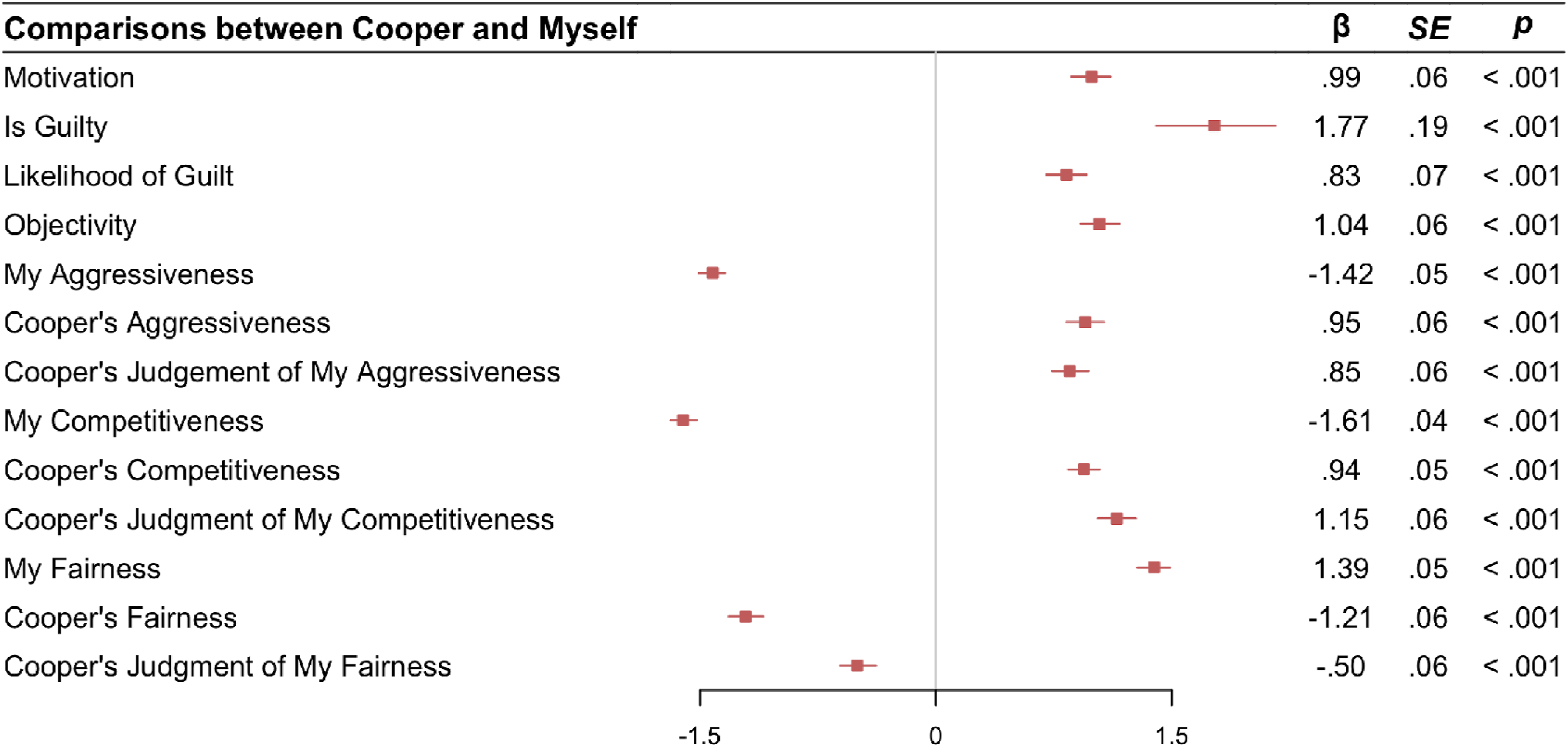
In Figure 3 we look at judgments of University Reps and Student Advocates in general, comparing the two assignment conditions. We see that relative to non-adversarial participants, adversarial participants viewed University Reps (their kin) favorably: high on objectivity and fairness, and low on aggressiveness and competitiveness. Student Advocates were viewed in an opposite light. Group judgments: comparisons between participants’ views of University Reps and Student Advocates.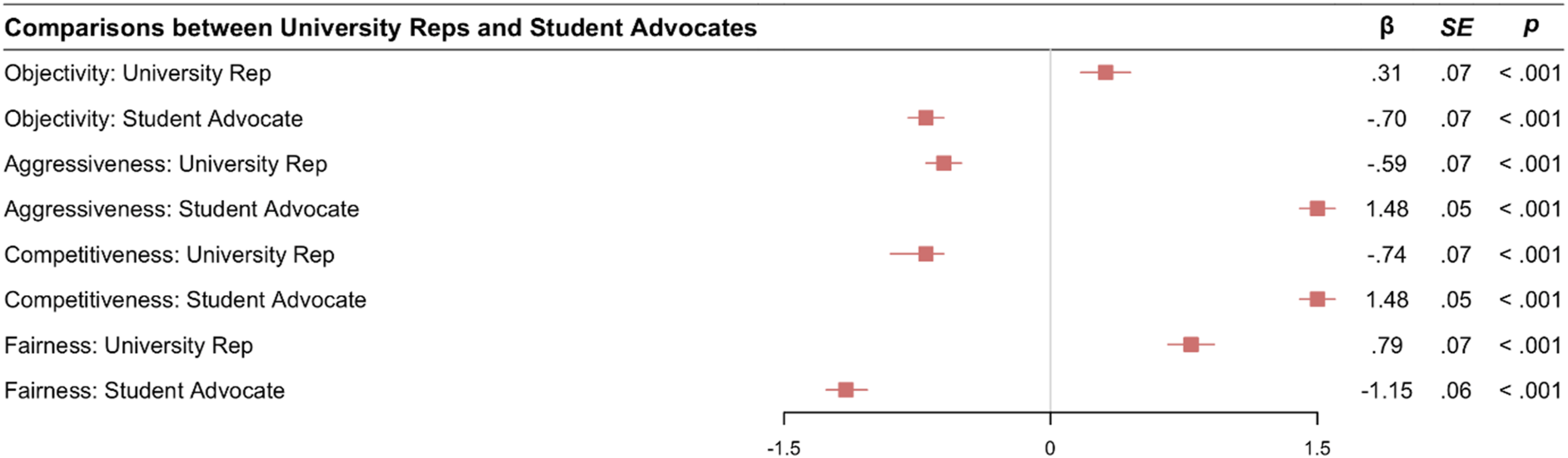
Discussion
Findings
As mentioned, the large majority of the study’s hypotheses were borne out by the results. The current findings replicated and extended the results reported by Simon et al. (2020). As compared to participants assigned to a non-adversarial role, those given an adversarial assignment viewed the case as providing greater support to their assigned side. This skew encompassed a slew of measures, including a stronger motivation to see the university win the case, a positive affective reaction to the prospect of Debbie losing and a negative reaction to the prospect of her winning, as well as unfavorable emotions towards her. Those participants were also more likely to conclude that Debbie cheated, report high probabilities that Debbie cheated, interpret the evidence as more incriminating, believe the prosecution witnesses more and Debbie less, judge Debbie’s moral character more negatively and, among those who found her guilty, also be more confident in their judgments of her guilt.
Participants in the adversarial condition reported strong and polarizing assessments of their (fictitious) adversary, Cooper. They expected Cooper to be extremely motivated to see Debbie win, to disbelieve her guilt, and to assign a low probability to her alleged misconduct. They also judged Cooper to be aggressive, competitive and unfair. True, these latter findings were likely exacerbated by the fact that our materials described Cooper in an unfavorable light, but note that we observed similarly negative judgments of Cooper in the studies reported by Simon et al. (2020), which made no mention of Cooper’s character. Judgments of the adversarial counterparts extended more broadly to group-based judgments of University Reps and Student Advocates. We see that relative to participants in the non-adversarial condition, adversarial participants viewed University Reps favorably—high on objectivity and fairness, and low on aggressiveness and competitiveness—alongside unfavorable judgments of Student Advocates.
Special attention should be paid to the focal point of this study, namely, judgments that simulate pre-trial decision making. The adversarial assignment had a significant effect on participants’ decision in favor of initiating the procedure. We also observed an effect on judgments that habitually set the terms for plea negotiations, namely, estimations that the Chief Judicial Officer would find Debbie guilty and the expected severity of her punishment. In sum, these results support the intuition that the adversarial role leads to subjecting more students to disciplinary hearings and expect them to be punished more harshly.
The Adversarial Bias
We contend that the findings provide strong support for the adversarial bias. As we do not know for sure the ground truth about Debbie’s guilt, we cannot ascertain unequivocally which group of participants judged the case more accurately. In theory, it is possible that the adversarial assignment biased the judgments towards harshness or, alternatively, the non-adversarial assignment skewed them towards leniency. But there are strong indications that the former is true. Recall that in the Simon et al. (2020) studies, we compared judgments across three different role assignments: prosecution, neutral, and defense. Those studies found that both groups of adversarial participants judged the case to be consistent with their respective sides, while the non-adversarial participants landed consistently between the two, remarkably close to the midpoint. The likely explanation was that each of the adversarial assignments drove a bias in their respective directions, whereas the non-adversarial assignment produced judgments that were devoid of any such bias. Recall also that the many studies on role-induced bias going back to Janis and King (1954), have shown that the bias is triggered by the adversarial assignment, as compared to a non-adversarial assignment or no assignment at all. Thus, it seems safe to say that the discrepancy between our two conditions is best understood to be driven by a bias borne by the adversarial assignment, not the other way round.
Consistent with Simon et al. (2020), our findings point to the strong effect of adversarial assignments on the motivation to win. But there is more than motivation to explain the competitive behavior of adversarial actors. To take strong partisan positions, actors need also to believe in their case, lest they fall into a state of incompatibility between their actions and their beliefs. Consistent with findings of coherence-based reasoning (see Simon et al., 2015; 2020), we observe that the motivation measure was strongly related to distortions in all other key measures, including judgments of the case, interpretation of the evidence, positions imputed to their counterpart, and more. In all, this widespread distortion gives one the epistemological license to effectuate their self-serving motivated bias (Simon & Read, 2023; Thagard, 2008) and thus approach the case with zeal.
Implications
Pretrial Harshness
Recall that this paper’s normative argument begins with the proposition that zealous advocacy is the epistemic devise that is said to serve the adversarial process's goal of truth discovery (Fuller, 1961; Landsman, 1984). But given the virtual absence of adversarial confrontation in the pre-trial phase of the process, we question the value of zeal at that stage. Recall that decisions to indict are made unilaterally and that plea negotiations are afflicted by the heavily lopsided negotiating power and access to information (Rakoff, 2017; Smith, 2012; Yaroshefsky, 2021). It follows then that zeal can make no appreciable beneficial contribution to pre-trial decision making, though thanks to the adversarial bias, it can wreak much havoc. But, before one can claim that any such harm is a reason for concern, it must be shown that zeal can spill over from its intended locus—the courtroom—into the peripheral pre-trial process. The psychological plausibility of this spillover was the subject of this study.
As hypothesized, we found evidence of spillovers into pre-trial decision making. Based on the same evidence, adversarial actors displayed a stronger tendency than neutral participants to initiate the disciplinary process. Adversarial actors were also more likely to predict convictions and heavier punishments which, together, portend stricter plea deals. This finding is consistent with the legal literature and empirical findings (Bibas, 2004; Pezdek & O’Brien, 2014. See Henderson, 2019). The obvious upshot of increasing indictments and negotiating longer sentences is a boost in person-years in prison. It would follow, then, that the adversarial procedure could be a contributing factor to mass incarceration.
True, as shown by Simon et al. (2020), the adversarial bias is not limited to participants assigned to play the role of University Reps (mimicking prosecutors). In that study, those assigned to the role of Student Advocates (mimicking defense lawyers) displayed similar—actually, stronger—adversarial borne biases. It is therefore reasonable to infer that criminal defense attorneys too are bound to operate in the grip of the adversarial bias. In theory, the countervailing biases on both sides of the adversarial divide would cancel each other out. That prospect, however, does not play out in real life due to the aforementioned unilaterality of indictment decisions and the immense disparity in both power and information during the negotiation context. In other words, no matter how strongly defense lawyers are gripped by the adversarial bias, their inherent powerlessness renders them incapable of countering the very real consequences of prosecutor’s adversarial bias.
The Battle Model
For all the praise poured on the truth finding capabilities of the adversarial procedure (see Freedman, 1998; Fuller, 1961; James v. Illinois, 1990; Landsman, 1984; Portuondo v. Agard, 2000), one can hardly ignore a persistent critique of this legal tradition. Scholars, practitioners, and judges have long contested that the adversarial process is more combative than epistemological in nature, and that adversarial actors are driven predominantly by the desire to win, rather than by a quest for truth. In the words of Frank (1950), the adversarial process promotes gamesmanship, rather than truth. This critique can be traced to Bentham (1843), who likened the trial to a foxhunt. Pound (1904) framed the process in terms of a “sporting theory of justice,” and Justice Brennan (1990) pointed out its “barbarous” reputation (p. 16). Similar critiques were made by Frankel (1975, 1978), Weinreb (1977), Babcock (1982), Fish (2017), Aviram (2019), and many others. The battle model theorem is exemplified in a contemporary prosecutor’s reflection on a case: “It really came down ultimately to getting a plea or winning a trial so I could go home that day and say, ‘Okay, I won today. That game is over’.” (Baker, 1999, p. 79).
There is reason to believe that this gamesmanship is driven to a large extent by the adversarial bias. As mentioned above, we find that the adversarial setting spurs a motivation to win, alongside self-serving judgments, skewed perceptions of the facts, affective preferences, emotional arousal, and judgments of their counterparts as being biased, extreme, untrustworthy, and distrusting (see also Simon et al., 2020). All of this fits neatly into a combative mindset.
The Courtroom Working Group
Hostile attributions of the sort observed here could be deemed inconsistent with the Courtroom Working Group framework. As posited by Eisenstein and Jacob (1977), this framework captures the organizational relationships that are manifested in the cooperation among the three key players: judges, prosecutors and defense lawyers. This approach is employed by criminologists to examine how these interactions contribute to the work product of courts, most prominently, to the resolution of cases (see also Bach, 2009; Natapoff, 2018). To be sure, given the steady flow of case resolutions, it is self-evident that these actors somehow manage to make matters work. Yet, despite the concept’s longevity, it has been subject to only limited empirical validation and is held with a measure of skepticism (see e.g., Heumann et al., 2021). In fact, one of the most sophisticated empirical studies (Metcalfe, 2016) found evidence that runs against the framework’s key prediction by which increased familiarity between prosecutors and defense lawyers will increase productivity. This finding is, however, easily reconcilable with the unfavorable judgments made from across the adversary divide as observed in the studies of adversarialism. The adversarial bias is also consistent with the legal literature that depicts the interpersonal relationship between prosecutors and defense lawyers as contentious and antagonistic. According to this view, legal actors operating in both roles tend to adopt a mirror image of us-versus-them mentality (Yaroshefsky, 1999; 2021), which is often laced with a sense of moral superiority and views of the adversary as unjust and hostile (see Smith, 2003; Yaroshefsky, 2021). Such perceptions tend to exacerbate the adversarial battle and stoke the call to ‘fight fire with fire’ (Berenson, 2000). As captured by one prosecutor’s reflection: “Sometimes a public defender or a defense lawyer will just try and bust your ass all the time. Frankly, you end up busting theirs back.” (Baker, 1999, p. 116).
Suggestions for Reform
To the extent that our findings are applicable to the real world (see below discussion on ecological validity), it is incumbent on us to offer pointers to measures that could mitigate the harmful effects of the adversarial bias on pre-trail decision making. To be sure, none of these ideas will be easy to implement, whether due to bona fide legal and practical difficulties or to bureaucratic and political turf battles. But this discussion has to start somewhere.
As mentioned below, the adversarial bias is a deeply entrenched psychological phenomenon. As such, it will not easily be dislodged by way of debiasing the person, that is, via instructions, implorations, or even monetary incentives (see Engel & Glöckner, 2013; Melnikoff & Strohminger, 2020; Simon et al., 2020; Spamann, 2020). One such prospect would have prosecutors and defense lawyers rotate roles. Schemes of this nature are effectively in place in the US military justice system (Luban, 1982) and the United Kingdom (see section on External Advocates in Crown Prosecution Service, 2023-2024), two criminal regimes that are known to be more temperate than the American criminal legal system. A suggestion of this sort has been advanced by Judge Rakoff (2017), and Findley (2011) has proposed a variant of it with regard to overseeing police investigations. An alternative approach would be to debias the situation that precipitates the bias. This could be done, for instance, by way of transferring the crucial pre-trial decision-making powers to non-adversarial actors. In this vein, Weinreb (1977) and Thomas III (2008) have proposed the establishment of a magistrate officer who will have the power to oversee both the police and prosecution functions. Slobogin (2014) would put judges in charge of conducting plea-bargaining, and Rakoff (2014) would have a judicial officer guide the parties in the plea negotiation towards a fair and neutral resolution of the case. Barkow (2019) has suggested to split the prosecutorial functions between two prosecutors (even if serving out of the same office), so that the prosecutor who represents the government in court will not be the one to make the charging and plea decision.
Yet another approach would set out to curb the downstream effects of the bias by way of limiting prosecutors’ charging powers. Barkow (2019) has proposed to subject prosecutorial charging discretion to oversight by judges or by an administrative oversight body, and to rescind prosecutors’ absolute immunity from civil liability for unlawful behavior in connection with their role the judicial process. Restricting these unfettered powers would have the potential to attenuate the coercive nature of the plea negotiations, and thus also to rein in the severity of the negotiated sentences. Perhaps the most effective and feasible remedy comes in the form of electing progressive prosecutors into office (see Levin, 2021). The key is that these prosecutors define their role as considerably less adversarial than conventional prosecutors. As a result, they are less likely to adopt the adversarial and be overtaken by zeal (Austen, 2018).
Ecological Validity
This study set out to provide insight into prosecutorial decision making in the real world. Due to a host of logistical and methodological constraints, we approached this question in a circuitous manner, using lay people working off a hypothetical vignette, from the unnaturalistic environment of their homes. There is no escaping the fact that our methodological detachment raises legitimate concerns regarding the ecological validity of our findings. One can point to several ecological gaps: prosecutors are legally trained, they have access to more information about the case, they operate within teams (co-council, police officers, victims), they self-select into the prosecutorial role, they have tangible stakes in the outcome, they operate within a particular office culture, and they have an interpersonal dynamic with defense attorneys.
At first blush, these vast gaps might seem to wash away the relevance of our findings. Upon closer inspection, however, such a dismissal could well be misguided. The habitual difficulty posed by ecological gaps is that the experimental findings will not hold up in the true ecology of the world, in that they will be attenuated by the naturalistic setting. While we are not suggesting that our experimental findings will hold one-to-one in the actual prosecutorial behavior, we posit that this conventional concern is largely inapplicable in this context. For one, there is no a priori reason to believe that legal training precludes the biasing effects of Adversarialism. Notwithstanding the well-known advantages of expertise, a large body of research has shown that experts are not immune from cognitive bias, and in some ways are particularly susceptible to it (Dror, 2020; Graber et al., 2005). Indeed, the abovementioned studies by Melnikoff and Strohminger (2020), Eigen and Listokin (2012), and Spamann (2020) found strong evidence of bias borne by adversarialism among legally trained participants. Next, it is true that the vignette we used is thinner than the information that is commonly available in police files. But it is unclear how thoroughly prosecutors examine the files in preparation for plea negotiations, which tend to hinge on negotiating punishments rather than on the adequacy and veracity of the evidence (much of which will never be disclosed and be subjected to any scrutiny). Moreover, research shows that when people are biased towards a certain conclusion, providing them with more neutral information can actually accentuate their bias (Darley & Gross, 1983; Lord et al., 1979).
With respect to the other ecological gaps, we remind the reader of the limitations of vignette studies to fully capture the intensity of the motivations, emotions, and interpersonal dynamics that emerge in real life. It would follow that the biases we observe could actually be accentuated in the real world. Research shows that operating within groups habitually leads to more extreme attitudes and behaviors (Insko & Schopler, 1998). Groups have been found to be more aggressive than individuals in electrocuting another person (Jaffe & Yinon, 1979), and group members tend to discount, overlook, or turn a blind eye to the misdeeds of other members of the group (Valdesolo & DeSteno, 2007). The fact that prosecutors self-select into their professional role suggests a greater inclination towards ascription of blame and punitiveness (Lidén et al., 2019; Simon & Melnikoff, under review; Tetlock et al., 2007).
Both the tangibility of the stakes and office culture are prone to increase the competitiveness and combativeness of adversarial legal actors in the real world. Research shows that compounding role assignment with financial incentives is bound to amplify the effect of the bias. Linda Babcock and colleagues have shown that assigning people to roles of disputants in an incentivized simulated civil dispute triggers a self-serving bias that hinders the prospect of settlement and thus ends up harming their own interests (Babcock & Loewenstein, 1997; Loewenstein et al., 1996). Most prosecutor offices make clear their prioritization of winning cases (Alschuler, 1968; Fish, 2017). As explained by former prosecutor and current Federal Judge Stephanos Bibas, “favorable win-loss statistics boost prosecutors’ egos, their esteem, their praise by colleagues, and their prospects for promotion and career advancement.” (Bibas, 2004, p. 2471). Some offices require prosecutors to file a report explaining why a trial ended in an acquittal, imposing no such requirement for convictions (Medwed, 2004). Cautious prosecutors risk “appear[ing] less competent to their superiors” (Zacharias, 1991, p. 108). Prosecutor offices often keep track of conviction rates and promote attorneys who gain a reputation for winning cases (Alschuler, 1968; Bresler, 1996; Medwed, 2004; 2012). Certain offices award prosecutors with bonuses for winning convictions, have them compete over conviction rates, shame them for losing cases, and joyously celebrate trial victories (Medwed, 2004). The culture of competitiveness is often fed by the expectations of police officers, victims, and other prosecutors (Richman, 2003).
We draw encouragement from the fact that our findings are consistent with a study performed with real world prosecutors and defense attorneys. Prosecutors were found to be more than twice as likely as defense attorneys to view the defendant as guilty, almost twice as likely to expect to a conviction, and almost twice as likely to offer a plea bargain (Pezdek & O’Brien, 2014. See also Redlich et al., 2016).
The risk that our findings will not hold up in the real world are further vitiated by the fact that the psychological mechanisms that underlie the adversarial bias transpire at deep levels of cognitive processing, namely, cross-activation of neural networks (Holyoak & Simon, 1999; Rumelhart et al., 1986; Simon & Read, 2023; Smolensky, 1989; Thagard, 1989; 2019). Much like processes of vision (Wagemans et al., 2012) and word recognition (Rumelhart et al., 1986), coherence-based reasoning occurs well beneath the level of conscious awareness (Holyoak & Simon, 1999; Simon & Read, 2023; Thagard, 2019. See also Cohen et al., 1992). Despite preliminary success in reducing the magnitude of the coherence effect (Simon, 2004), numerous subsequent attempts have proved the process to be impervious to debiasing (see Simon, 2012). Indeed, the adversarial bias was observed even when participants were warned about the bias and implored to resist it (Melnikoff & Strohminger, 2020, study 3), urged to be fair and objective (Simon et al., 2020), urged to offer opinions from the vantage point of “a neutral, sober observer” (Spamann, 2020), and exposed to arguments from the opposing side (Jeklic, 2022; Spamann, 2020). Strikingly, the bias has persisted even in the face of significant monetary incentives to the contrary, including a chance to win as much as 100 Euros (Engel & Glöckner, 2013) or $200 (Melnikoff & Strohminger, 2020). It follows that the adversarial bias is deeply engrained in human cognition and is thus relatively insensitive to the particulars of the situation. To propose that prosecutors (or defense attorneys for that matter) are immune to its effects would require powerful empirical proof, which is of yet non-existent.
To be sure, no single methodology—ours included—is capable of providing a definitive explanation for multi-faceted behavior in ecologically rich settings. Explanations of this nature are best resolved by way of convergent validity, which would require an integration of observations from a variety of methodological angles (Simon, 2012). In the meantime, we draw encouragement from the fact that our experimental findings both map onto the observed behavior of prosecutors and provide a plausible theoretical explanation for it.
Footnotes
Declaration of Conflicting Interests
The author(s) declared no potential conflicts of interest with respect to the research, authorship, and/or publication of this article.
Funding
The author(s) received no financial support for the research, authorship, and/or publication of this article.
