




Abstract
Dissatisfaction with the administration of justice is as old as law proclaimed the distinguished American legal scholar Roscoe Pound in 1906. The system of administration of justice has been under considerable scrutiny in Cyprus following the excessive delays in resolving disputes that are highlighted in reports such as the European Union’s Justice Scoreboard, the World Bank’s Doing Business Reports as well as European Commission papers on Cyprus, urging authorities to modernize the system in order to be able to meet the demands following the financial crisis. For this reason, various experts have been assigned with the task of identifying the problems and coming up with proposals and solutions. The discussions, though, are not new as similar problems have been presented in common law jurisdictions, in particular, but they have been tackled decades ago, with the adoption of reforms that moved the adversarial system of justice closer to civilian stereotypes.
Introduction
As a distinguished American legal scholar proclaimed in 1906: dissatisfaction with the administration of justice is as old as law. 1 The system of administration of justice in Cyprus has been under considerable scrutiny following the excessive delays in resolving disputes that are highlighted in reports such as the European Union (EU) Justice Scoreboard, 2 the Doing Business Reports 3 as well as European Commission papers on Cyprus. 4 For this reason, various experts have been assigned the task of analysing the problems and coming up with solutions to modernize the system. Similar problems have been tackled in other common law jurisdictions, with the adoption of reforms that moved the adversarial system of justice closer to civilian stereotypes. In particular, ‘efficiency mechanisms’ were introduced in common law jurisdictions, such as the reliance on documentation and the use of written briefs, leading to convergence with continental models of a continuing process of exchange of written material and in general the judge-managed civil law procedure.
The Republic of Cyprus, a former colony of the United Kingdom and a member of the Commonwealth, acceded to the EU in 2004. However, the application of the European acquis is suspended in the areas in which the Government of the Republic does not exercise effective control. 5 A third of the island has not been under the effective control of the Republic since 1974 when the Turkish invasion separated the island along ethnic lines. The latest census indicates the population living in the government-controlled area is 864,200. Previous versions estimated that 74.5% of the population are Greek and 9.8% are Turkish Cypriots. 6 Geographically, Cyprus is closer to Turkey and the Middle East rather than Greek mainland: ‘[its] favourable position within such easy reach of Syria, Turkey and Egypt has often been more of a curse than a boon’. 7
The Mycenaeans, the Phoenicians, Assyrians, Egyptians, Persians, Alexander the Great, the Romans, Byzantines, Crusaders, Lusignans, Venetians, Turks and British have exercised control and influence over the island. This still has an effect in present-day Cyprus, which is a melting pot of languages, cultures and laws. After Ottoman rule, which lasted for four centuries, the United Kingdom took control of Cyprus in 1878 as a ‘place d’armes’, 8 the product of a bargain with the weakened Ottoman Empire in return for protection against the expansionist aims of Russia. 9
The British gradually introduced the common law in Cyprus and in 1925 Cyprus formally became a British colony. The 1878 Supplementary Agreement to the Cyprus Convention stripped the Sultan of all his substantive powers over the island, invested in the Queen of England ‘full powers for making Laws and Conventions for the government of the Island in her Majesty’s name, and for the regulation of its commercial and Consular relations and affairs free from the Porte’s control’. 10 The United Kingdom introduced a series of reforms including the independent currency system, the abolition of capitulations and consular courts, the establishment of a new judicial organization and the enactment of a representative Legislative Council. 11 Until 1935, Ottoman law survived as the residual law of the island, however its interpretation was supplemented by recourse to English law to avoid manifest injustice and fill gaps in the existing law. 12
The gradual imposition of the common law over the legal system, a policy of ‘structured mixité’, 13 was based on a rule of international law that provides that the laws of a conquered country continue in force, until they are altered by the conqueror. 14 Vernon Palmer suggests that neither British nor American decision makers based their policies on this rule, rather they exercised discretion taking into account demographic, political and social factors, such as introducing a foreign language to an uncomprehending population. 15 This may be seen from the judgment of Chief Justice Hallinan in Universal Advertising and Publishing Agency v Panayiota A Vouros, 16 where it was stressed that the principles of the common law of England do not fit Cyprus in their totality. 17 Nonetheless, until 1960, the legal system of Cyprus belonged to the common law family.
From that year, which brought independence, it developed as a mixed legal system reaffirming Sir Thomas Smith’s perception of a mixed jurisdiction as a system where civil law and common law doctrines contend for supremacy. 18 This is a result of certain constitutional provisions such as Article 146, on the one hand, that established jurisdiction over petitions to annul or confirm administrative acts in the spirit of French recours en annulation. Article 188 of the Constitution, on the other hand, provides that the laws applicable until independence will continue to be in force and be interpreted in line with the Constitution. At the same time, the adoption of organic laws such as the Courts of Justice Law, 19 that provided for the common law and the doctrines of equity to be a source of law; the evolving demographics in the Cyprus bar, where the majority of new entrants in the legal profession held university degrees from Greek law schools; as well as the transplantation of certain legislative texts from Greece all contributed towards the mixed character of the legal system. Cyprus more closely resembles a common law jurisdiction than other mixed jurisdictions, but the civilian influence is constantly expanding in new areas of the law. Furthermore, much legislation has been transplanted from abroad.
Procedural law follows the English legal tradition. It serves as a vehicle for the introduction of common law ideas in areas where substantive law is oriented towards the civil legal tradition and ensures the persistence of a common law mentality. 20 Limited reforms have taken place which differentiate between English and Cypriot procedural law—since Cyprus did not follow the Woolf reforms. 21 The legal profession relied on works on English law prior its civil procedure reforms. According to Nikitas Hatzimihail, this led Cyprus litigation practice to develop inwards, with a process of precedent creation to cater for the needs of Courts and practitioners. 22 The system was further challenged, however, as a consequence of the financial crisis, with more cases requiring adjudication by courts. Changes came to Cypriot procedural rules because of the need to enforce substantive rights and in response to the system’s low scores in the Doing Business Reports and the EU Justice Scoreboard.
This article examines ongoing changes in Cyprus by reference to the international landscape in civil justice. The changes follow international trends and include the introduction of case management practices, alternative dispute resolution mechanisms, establishment of specialized courts, and enhancing online dispute resolution and court automation. The enforcing contracts indicators of the Doing Business Reports and the EU Justice Scoreboard are powerful mechanisms for purposes of modernization and reform in procedural law.
The article begins with Cyprus, its legal history, the existing court structure (‘The Cypriot court structure’ section), and Civil Procedure Rules (‘The Civil Procedure Rules’ section) and the deficiencies in the system of administration of justice. Those deficiencies were exacerbated by the financial crisis, which created an impetus for change in the administration of justice because delays in justice have an impact on the economy at large (‘The judicial system and economic development’ section).
The role of the EU, through the publication of instruments such as the EU Justice Scoreboard, as well as the provision of country-specific recommendations and funding through the Structural Reform Support Programme, is also analysed (‘The efficiency of civil justice systems and the role of the EU’ section). The deficiencies were initially dealt with by piecemeal changes, which have not produced the expected results (‘The necessity of reform’ section). As a result, plans for major reform are currently underway, the components of which are also laid out in this article (‘The first steps at reforming the system’ section). The article will argue that competition for the provision of judicial and legal services is a driving force for reform. The proposals for reform analysed in this article are based on best practice, with the eventual transplantation of institutions from other jurisdictions. However, borrowing or transplanting a legal institution from another legal system requires a comparative perspective with an in-depth understanding of the functioning of civil justice systems. 23 This article will take a comparative perspective of these proposals, drawing parallels with the critical changes introduced by the Woolf reforms in UK civil justice.
The Cypriot court structure
Cyprus has a unitary two-tier judicial system with a first instance level and an appellate one. 24 Justice at first instance is provided by six types of subordinate courts, including six District Courts (one for each administrative district of the Republic of Cyprus) which have jurisdiction over most civil and criminal matters and certain kinds of admiralty cases; and five Assize Courts (in session in the government controlled administrative districts) with unlimited jurisdiction to hear and determine at first instance any criminal case of offence exceeding 5 years’ imprisonment. This article only deals with the proposals relating to jurisdiction over civil matters and to a more limited degree changes in administrative jurisdiction, where most of the problems were presented following the financial crisis.
Most administrative cases went before the Supreme Court, and accounted for more than half of its time, and almost all the time of the Court’s legal officers (law clerks). 25 This led to the creation of a first instance Administrative Court that constitutes another type of subordinate court. 26 This subordinate Administrative Court has jurisdiction over first instance administrative cases, including tax litigation. 27 The specialized chambers of the Supreme Court for administrative cases was an original feature of the Cypriot system. This is in contrast to most other mixed jurisdictions because specialization in the civil law ‘is scarcely imaginable’. 28 The absence of separate divisions was indicative of the tension between common law institutions and substantive civil law, and did not afford civil law the pre-eminence it has in Continental legal systems. With the creation of separate administrative courts, the Cypriot legislator aimed to stabilize the system and expedite the procedure, to stave off the threat of public law cases overwhelming it.
The judiciary in Cyprus has powers similar to their common law counterparts. At the apex of the hierarchy is the Supreme Court of Cyprus, which can be described as a ‘super-court’. The Supreme Court of Cyprus considers the constitutionality of the law and of proposed legislation referred by the President of the Republic. It acts as the Highest Administrative Court with exclusive Appellate Revisional Jurisdiction and as the Electoral Court hearing election petitions.
The Supreme Court is also the Supreme Council of Judicature having powers for the appointment, promotion and transfer of Judicial Officers, also exercising disciplinary jurisdiction over them. It also acts as the Council in accordance with the Constitution with jurisdiction to impeach the Highest Officials of the Republic and has exclusive jurisdiction to issue the Prerogative Orders of Habeas Corpus, Certiorari, Mandamus, Prohibition and Quo Warranto.
It is the Criminal and Civil Appeals Court; it has jurisdiction to hear and determine admiralty cases on both first and final instance; it is the Second Instance Family Court; and, under Article 135 of the Constitution, it has the power to make rules regulating the practice and procedure in the courts and prescribing fees for court proceedings.
Certain powers were granted to the judiciary after the intercommunal crisis in 1963. This constitutional crisis of 1963 and the later invasion of 1974 led to Cyprus’ most important constitutional moment and its major contribution to comparative constitutional law. This contribution is the ‘doctrine of necessity’. The doctrine deals with the inability of the state actors and the legislative authorities to face exceptional and unforeseen circumstances that threaten the existence of the state.
The Supreme Court, through the doctrine of necessity, became the final arbiter of constitutional questions, despite the Constitution providing for a Supreme Constitutional Court performing this task. Article 82(3) of the Constitution provides that a constitutional amendment can only be made ‘by a law passed by a majority vote comprising at least two-thirds of the total number of the Representatives belonging to the Greek Community and at least two-thirds of the total number of Representatives belonging to the Turkish Community’. 29 After the withdrawal of the Turkish Cypriots from the institutions of the Republic, including the House of Representatives, at the end of 1963, it had become impossible to amend the Constitution by the Article 182(3) process. This was only made possible via the introduction of the doctrine of necessity. 30
The doctrine has been integral to the Constitution since the Supreme Court judgment Attorney General of the Republic v Mustafa Ibrahim. 31 The case concerned the new Administration of Justice Law, 32 which provided for the merger of the Constitutional Court and the High Court into the Supreme Court of Cyprus (ανώτατο Δικαστήριο). In that case, and in others which followed, the Supreme Court has consistently held that where constitutional compliance is impossible due to the exceptional and unforeseen circumstances created by the non-participation of Turkish Cypriots in the institutions of the Republic, the relevant constitutional provisions are deemed to have been amended to avoid complete paralysis of the state. 33 The Court referred to the Latin maxim salus populi suprema lex esto and necessitas non habet legem to conclude that no state is to be destroyed by its own Constitution. This introduction of a doctrine of necessity was therefore the result of the inability of the sovereign will to be exercised via constitutional amendment. 34
The Constitution provided for two supreme courts, one being the Supreme Constitutional Court based on civil law with one Greek Cypriot judge, one Turkish Cypriot and a third, ‘neutral’ judge (in practice one from overseas) who presides. Emigré judges were also appointed in other mixed jurisdictions, in which they placed a distinctive stamp upon the bench and the substantive law they interpreted. 35 The tenure of the ‘strangers in a strange land’ was short-lived leaving behind no institutional legacy, as is the case with other mixed jurisdictions.
The High Court was a continuation of the first and second instance jurisdiction of the colonial Supreme Court over civil and criminal cases. Hence, the drafters of the Constitution envisaged a mixed system right from the outset. 36 This is obvious from the fact that the Supreme Constitutional Court was endowed with first instance jurisdiction over administrative law cases. 37 Article 146 of the Constitution established jurisdiction over petitions to annul or confirm administrative acts. The powers the Constitution granted to the two highest courts were different. As the Supreme Court acknowledged in 1991, the Supreme Constitutional Court was called to apply continental law, while the High Court was to apply English common law. 38
The merger of the two Courts by Law 33/64, as a result of the departure of the foreign judges and by application of the doctrine of necessity, created a super-court, similar to a common law court and resembling all other mixed jurisdictions. 39 As Hatzimihail points out, the absorption of the Supreme Constitutional Court by the Supreme Court had an impact on doctrinal development and the influence of civil law over Cyprus’ public law. The influence of civil law persisted even after the merger that created a court with a strong common law identity. However, a specialized appellate bench would have provided a more systematic and organized character in the doctrinal development and influence of civil law. 40 Be that as it may, the merger means there is no third-tier jurisdiction, which arguably created obstacles in the smooth development of Cypriot case law, and triggered discussions as to the importance of establishing such a jurisdiction. 41
The Civil Procedure Rules
The sources of procedural law in Cyprus are the Constitution, the Civil Procedure Rules (CPR) in the form in which they existed in England and Wales in 1958 and the supporting jurisprudence as published in the White Book of 1954, 42 the Law on Civil Procedure dating back to the first period of British colonial rule (1885), 43 the Courts of Justice Law addressing matters of venue and subject matter jurisdiction, 44 the Law on Evidence, 45 the Criminal Procedure Law, 46 and other legislative measures governing the procedure before the courts, as well as the Practice Rules published by the Supreme Court under Article 163 of the Constitution. The CPR apply to all district court civil procedures, while additional procedural rules may be applicable depending on the type of procedure. 47 As a result of Article 1A of the Constitution under which supremacy is given to EU derivative law over national law, any legislative measures that stem from the institutions of the EU are qualified ipso jure as sources of Cyprus’ procedural law. 48
Cypriot civil practice places emphasis on compensation as far as remedies is concerned, while lawyers spend most of their time on purely procedural matters partly due to the great number of injunctions sought. 49 Hatzimihail points out that in most cases lawyers prefer to focus on procedural issues even if they can succeed on the merits. 50 This is, arguably, a result of the influence of the English common law, which originally consisted of procedural remedies. 51 In addition, emphasis on the procedural aspects of litigation is also influenced by the fact that relatively few cases raise serious substantive issues. 52 Settlement is a common occurrence in civil cases, but the low cost of court expenses and the relatively easy access to the appellate jurisdiction allow claimants to pursue their cases easily. 53 Court fees have recently increased substantially to disincentivize misuse of the legal process. In the absence of other measures, however, this is contrary to the right to access to justice and may potentially amount to a violation of Article 6 of the European Convention on Human Rights. 54
As Arthur von Mehren argues ‘[t]he civil procedure of a given society is the product of legal, political and social history’. 55 The CPR are comprised of 64 Orders that govern the six stages of the process (case initiation, service of process, pre-trial—preparation for hearing, trial process, appeal process, execution process). Each Order consists of one or more rules. They are identical to the procedural rules that applied before English Courts in that period and were elaborated in the White Book. 56 They are therefore largely based on an antiquated system, with few amendments. This reflects another aspect of the persisting traditionalist mentality of withholding any legal change due to the interim situation pending resolution of the Cyprus problem. 57 The CPR state the principles to be applied to the various procedures available leaving detailed principles to be worked out by the courts on a case-by-case basis. 58 Courts and legal practitioners often refer to the old English Rules of Civil Procedure (the Annual Practice of 1958) for guidance. Moreover, English case law on those old Rules of Procedure prior to Cyprus’ independence is used for the purposes of guidance and to elaborate the meaning of certain provisions.
Hence, Cypriot procedural law is English law, but ‘English law from a time vault’. 59 This is due to the overwhelming number of cases that the Supreme Court is called to adjudicate, 60 while also having exclusive jurisdiction over civil procedure and establishing procedural rules. Placing a regulatory function upon a court would be irreconcilable with the continental law tradition as it violates the separation of powers. 61 Such rule-making power is commonplace in other common law jurisdictions enabling more rapid and flexible adjustments in court practices by those involved in the day-to-day problems of the system. 62
Thus, while in continental countries a comprehensive Code of Civil Procedure constitutes the principal source of procedural law, in Cyprus legislative texts are secondary to the rules of procedure enacted by the Supreme Court. 63 Nevertheless, this means that embarking on a process of adoption of new courts rules and civil procedure will require a substantial amount of time. As a result, Cypriot litigation practice developed inwards, because the Courts’ and practitioners’ needs must be met by the creation of local precedent. Precedent plays an important role due to the relatively limited capacity for systematic legislative intervention, as a result of the political crisis, as well as the lack of experience or willingness to perform significant legislative reform. 64 The dependence on precedent has proven problematic, as shown by the creation of competing lines of precedent with regards to the rules on an application for the reinstatement of an appeal. 65
The archaic formalism is evident from the retainment of the writ system, in contrast with later English reforms, which abolished that system. 66 Behind the archaisms, and a language that preceded the shift to plain legal English, however, the practical spirit of the common law is evident in the CPR. This can be found in the rule that emphasizes the discretion of the judge to decide on what is considered fair under the circumstances of each case and to direct the procedure in an effective and efficient manner. 67 According to Hatzimihail, these discretionary powers have given the common law civil procedure the prestige that it now holds; it requires, though, necessary knowledge and education from the holders of such powers. 68 In a similar tone, Lord Woolf in his Final Report, referring to the English Rules of Civil Procedure, noted that the rules of court were often ignored by the parties and not enforced by the court. 69 Similar practices occur in Cyprus, with the eventual delays before courts putting the CPR’s emphasis on efficiency and effectiveness of the procedure under considerable scrutiny. However, since the civil justice system in Cyprus is an antiquated system, it cannot cope with the demand for efficiency in the delivery of justice. 70 The next section elaborates on the need to establish an efficient judicial system and its relationship with economic development.
The judicial system and economic development
After the financial crisis, judicial systems are called upon to provide credible enforcement of contract law, effective bankruptcy courts and the creation of procedures for out-of-court resolutions. This reflects that reforming substantive law alone does not improve the quality of legal institutions. What matters is not only reform of substantive law related to economically crucial areas but also the enforcement of law, procedural efficiency and other political and social developments that may affect the results. Hence, the consensus is that effective enforcement of law with procedural efficiency and easy access to justice all matter. Enforcement is crucial for the functioning of substantive law. 71 In the absence of a credible threat of law enforcement, the legal rules as set forth by lawmakers and judges remain inconsequential. 72 According to Gerhard Wagner, this effect is more likely where the law attempts to regulate productive behaviour, that is, behaviour that affects supply and demand in competitive markets. 73 Market forces in such situations ‘will essentially make it impossible to consistently comply with the requirements of the law if enforcement is deficient enough to make it pay not to comply with the law’ (emphasis original). 74 The situation in Cyprus, with its excessive delays, drives market forces to strategical behaviour of not complying with the law.
The fact that, in the absence of credible enforcement, substantive law will remain a dead letter lends weight to Jeremy Lever’s proposition that procedure is more important than substantive law. 75 As Bentham put it ‘the course of procedure ought to have in every instance, for its main and primary end at least, the accomplishment of the will manifested in the body of substantive laws’. 76
As the consequences of the financial crisis unfold, more cases come before the courts for adjudication, presenting challenges for the court system. The average waiting time for an appeal hearing, for example, has shifted from 5.8 years at the start of 2016 to 6.3, principally as a result of cases arising from the financial crisis. 77 Changes in Cypriot procedural rules were a reaction to the need for sufficient enforcement of substantive rights and a response to the low scores for efficiency of justice administration and the ease of contract enforcement in the Doing Business Reports and the EU Justice Scoreboard. 78 There are multiple causes of delay, including fundamental underlying weaknesses in the system. 79 Inefficiencies in the justice system still continue to impact contract enforcement and the swift resolution of civil and commercial cases.
There are clear negative repercussions for the resolution of commercial disputes. According to Matthieu Chemin, a slow judiciary correlates with more breaches of contract, discourages firms from undertaking relationship-specific investments, impedes the access of firms to formal financial institutions and favours inefficient dynasties.
80
An imperfect judiciary can allow economic agents to be unwilling to perform agreed contracts. Strategic defaults in Cyprus, according to reports, represent approximately 20% of non-performing loans.
81
If the probability of punishment in monetary or non-monetary terms would dissuade opportunistic agents to default on agreements, then the absence of punishment may lead to such opportunistic behaviour. As Marco Pagano and others contended: The key function of courts in credit relationships is to force solvent borrowers to repay when they fail to do so spontaneously. By the same token, poor judicial enforcement increases the opportunistic behaviour of borrowers: anticipating that creditors will not be able to recover their loans easily and cheaply via courts, borrowers will be more tempted to default. Creditors respond to this strategic behaviour of borrowers by reducing the availability of credit.
82
Slow processes in courts also hold back debt restructuring solutions. 85 Cumbersome civil procedures and weak enforcement of court decisions weigh on banks’ incentives to use the insolvency and foreclosure frameworks to reduce their stock of non-performing loans. 86 Such problems include the low digitalization of courts, the lack of lifelong training of judges, the underuse of Alternative Dispute Resolution methods, the unlimited right to appeal to the Supreme Court at no cost and the relatively modest courts system budget. According to European Commission proposals, 87 and European Council recommendations, 88 Cyprus should increase the efficiency of the judicial system by modernizing civil procedures, implementing appropriate information systems and increasing the specialization of courts. 89
According to institutions such as the World Bank and the International Monetary Fund, a well-functioning, independent and efficient justice system is one where decisions are taken within a reasonable time, are predictable and effectively enforced and where individual rights, including property rights are properly protected. 90 Improvements to the efficiency of the judicial system also improve the business climate, foster innovation and may increase foreign direct investment and secure tax revenues, therefore supporting economic growth. 91 The Doing Business Reports emphasize that ineffective legal institutions impair the effectiveness of general law reform. 92
The efficiency of civil justice systems and the role of the EU
In his 2016 State of the Union Speech, the then European Commission President, Jean-Claude Juncker, highlighted the role of effective justice systems in supporting economic growth and defending fundamental rights: ‘That is why Europe promotes and defends the rule of law’. 93 Despite the principle of procedural autonomy, the EU promotes certain judicial administration reforms to establish efficient and high qualitative standard procedures. 94 Article 67(4) TFEU grants the EU the power to facilitate access to justice in the area of freedom, security and justice through mutual recognition. Article 81(2)(e) TFEU provides that the Union shall ensure effective access to justice and Article 81(2)(f) TFEU the elimination of obstacles to the proper functioning of civil proceedings, if necessary by promoting the compatibility of the rules on civil procedure applicable in the Member States.
The Justice Scoreboard realizes the need for improving the effectiveness of national justice systems as one of the priorities of the EU. Independence, quality and efficiency are set as the key elements of an effective justice system. To that end, the Scoreboard assists Member States through the provision of an annual comparative overview of independence, quality and efficiency of national justice systems. The 2017 edition, in particular, examined data on how consumers access the justice system, which channels they use to submit complaints against companies, how legal aid and court fees influence access to justice, the length of court proceedings and proceedings before consumer authorities, and how many consumers are using the online dispute resolution platform, operational since 2016. 95
The EU Justice Scoreboard uses various sources of information in order to assist the EU and Member States to improve the effectiveness of their national justice systems by providing objective, reliable and comparable data on a number of indicators relevant for the assessment of the quality, independence and efficiency of justice systems in all Member States. 96 As the data of the 2018 and 2019 editions of the Scoreboard indicate Cyprus has adopted procedural reforms, while the promotion of ADR methods, digitalization, ICT development and court specialization is all under negotiation. 97
The data set out in Figures 1 to 3 prompts several observations. First, action should have been taken with regard to administrative cases since the disposition time for such cases was extremely high. Second, the increase in pending cases after 2014 reaffirms the general view that, after the financial crisis, the number of cases involving highly complex issues related to banking and contract law in general has increased. According to the International Monetary Fund in its Cyprus Country Report, 98 the major factor in the high and growing backlog of cases is the low and declining clearance rate. The 2019 Justice Scoreboard shows that the time taken to resolve civil, commercial or administrative cases has risen from 800 (2016) to 1100 (2017). 99 The clearance rate was low even before the crisis, as indicated by the Quality of Judicial Process Index in the World Bank’s Doing Business reports. 100 Cyprus performed poorly based on a cross-country comparison and is among the worst scores of EU states.
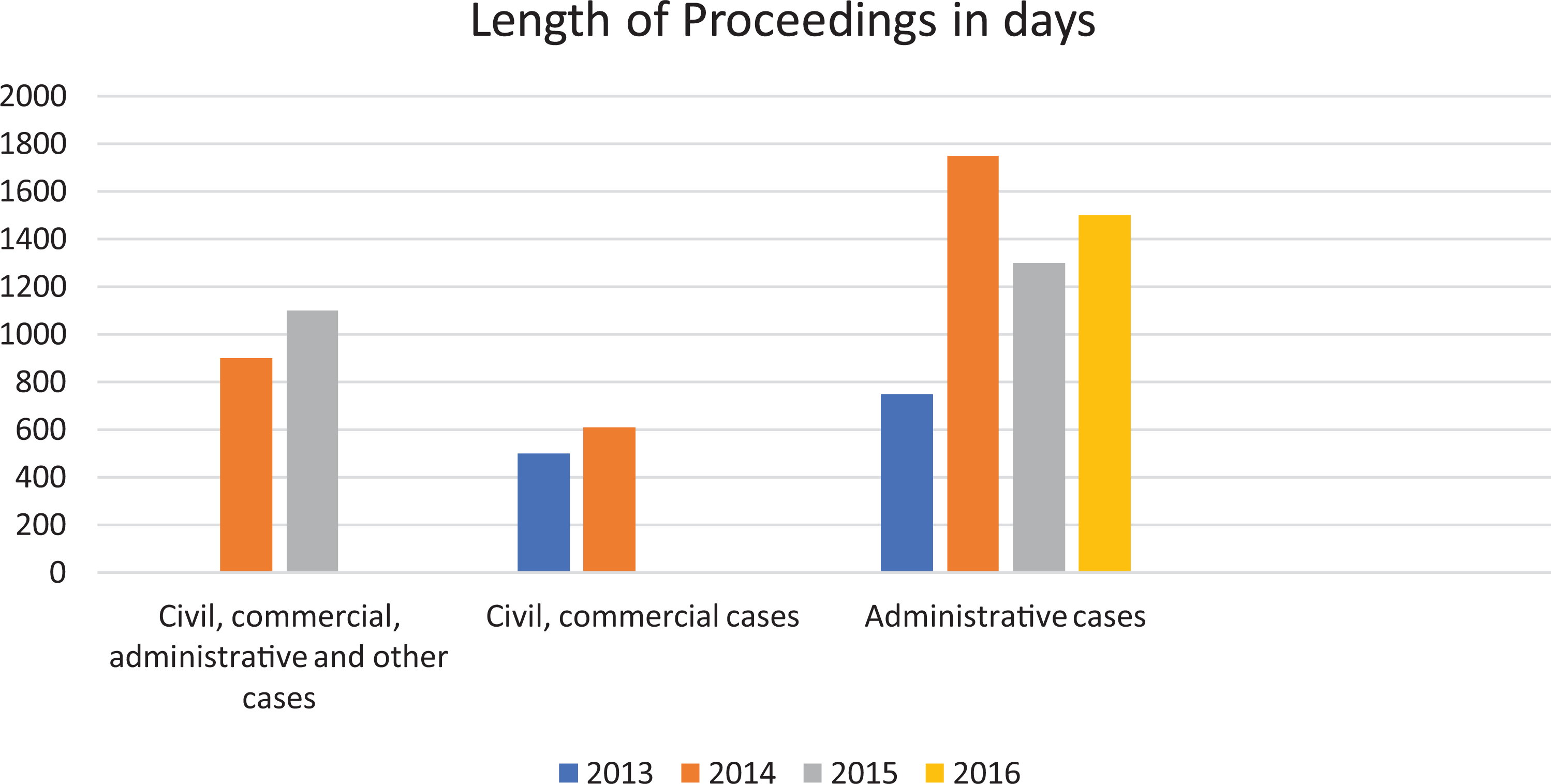
Length of Proceedings in days.
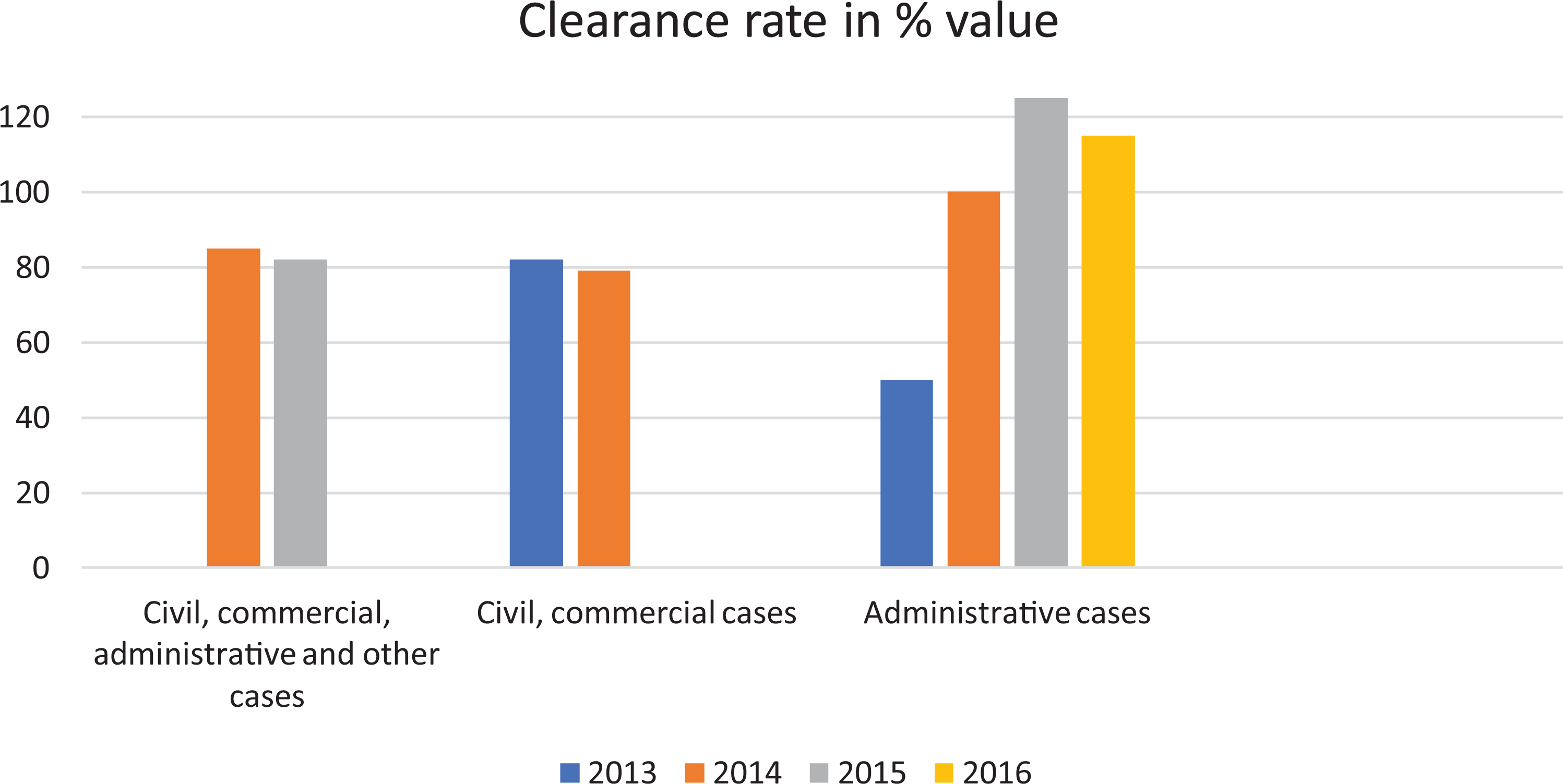
Clearance rate in % value.
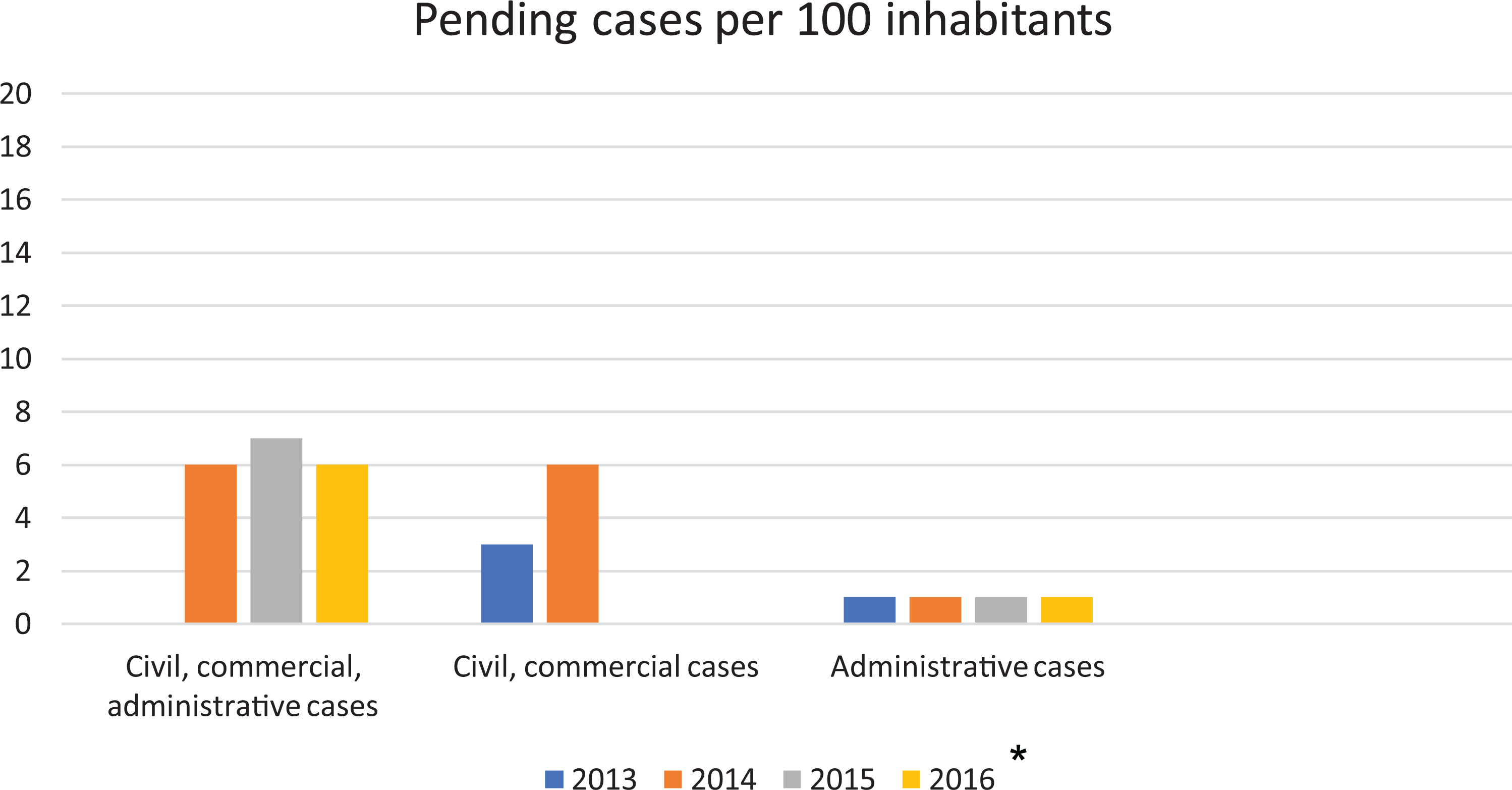
Pending cases per 100 inhabitants. Source: EU Justice Scoreboard 2017 and 2018; Initial source CEPEJ Study. *Data refer to first instance cases. Where no data are provided for a specific year, there is lack thereof.
The reasons that Cyprus’ justice system’s efficiency indicators lag significantly behind the EU average are manifold and include the relatively modest court system budget. 101 The Cyprus’ total public expenditure on law courts per inhabitant is the lowest in the EU according to Eurostat statistics. 102 According to the 2019 Scoreboard, there are 19 judges per 100,000 inhabitants, while the proportion of lawyers per 100,000 inhabitants is the highest in the EU (450 per 100,000). 103
Many Member States, following country specific Council recommendations, pursue efforts to improve the effectiveness of their national justice system. 104 Cyprus has taken a number of reform projects and adopted certain procedural reforms, methods for promotion of ADR, while ICT development, administration of courts and court specialization is under negotiation. 105 The influence of the comparative data is also evident, which along with the data from the Doing Business Reports, are used to emphasize the need for legal reform in order to meet the challenges with contract enforcement and eventually improve the economic performance of the country.
The Justice Scoreboard and the Doing Business Reports’ focus on efficiency reflects the suggestion that speed is elevated over deliberation, impartiality and fairness and case processing has become the desired goal favoring quantity over quality. 106 The quality standards provided by the EU Justice Scoreboard do not capture judicial obligations to conduct a reasoned inquiry, articulate reasons for decisions and subject those reasons to appellate review. Stephen Landsman argues that civil procedure reforms now require judges, in the name of efficiency, to encourage settlement negotiations, supervise the bargaining process and settle as many cases as possible. This approach is in conflict with the principle of passivity that limits a judge’s involvement in the compromise of a case. 107
The necessity of reform
The need for radical reform of the system of administration of justice in general, and the CPR in particular, was acknowledged decades ago. However, structural changes came only after pressure from the EU, the provision of financial assistance for reforms through the Structural Reform Support Programme, and political will from the stakeholders (government and judiciary) to implement such reforms. 108 A Committee was formed by the Supreme Court in 1988 to study the functioning of the court system and submit recommendations for the improvement and modernization of the CPR, the procedures and the system of administration of justice in general, as well as the Secretariat of the Courts (Registrar). 109 The Report, which came out in 1989, recorded the problems in the functioning of the courts and recommended certain reforms. The Report acknowledged the need for radical amendment of the CPR, which was subject to minimal revision since 1958, with the exception of amendments to Orders 25 and 30. 110
Judge Stavrinakis’ recommendations for amendments to the CPR, which were to a large extent identical to the Woolf reforms, were not accepted by the Supreme Court, which had appointed a three-member committee of judges to amend specific Orders of the CPR. The Kramvis report of 2012 resulted in several sessions aimed at the drafting and finalization of the text for reform of specific Orders. These were later discontinued. In light of the impact that delays were having on the credibility of the justice system, the Supreme Court formed another Committee in 2016. 111 The Committee, using data from the EU Justice Scoreboard, identified several issues in need of immediate and effective resolution. These included an increase in the number of judges in the district and other first instance courts, restoring the buildings where the courts are housed, and the revision of the CPR. The importance of lifelong training for judges, to ensure quality and independence and preserve integrity, was also highlighted by the Committee. Courts had been reluctant to proceed with the hearing of cases where specialized or technical matters are involved, recommending instead the appointment of an arbitrator to deal with the disputed matter.
Following the Report, and in consultation with the Structural Reform Support Service of the European Commission, the Supreme Court of Cyprus made a request for technical assistance to support an in-depth review of the CPR. The Institute of Public Administration (IPA) of Ireland was appointed to undertake this work, having already completed a number of reviews of Cypriot public authorities. 112 The IPA provided a functional review of the Courts System of Cyprus. It lists deficiencies and makes proposals for updating the system in order to meet the needs of the people of Cyprus, especially after the financial crisis. The Report was adopted in its entirety by the Supreme Court and was presented to the President of the Republic in May 2018. The President expressed his full support for the implementation of the experts’ recommendations. The IPA Report, as well as reform of the CPR, is part of the Government’s efforts, in line with the Economic Adjustment Programme, 113 to reorganize and improve the Cypriot judicial system. The program of reforms focuses on four areas: court operations, judicial training, E-justice and reform of the CPR.
A full review of the CPR was proposed by the Supreme Court in January 2017 as a distinct exercise within the wider reform project. 114 The stakeholders consulted during the scoping mission of the IPA confirmed the urgency of CPR reform, because existing rules are regarded as having a detrimental impact on litigation practice and case management. 115 They also agreed that, given the close historical legal ties, the starting point should be the existing English Civil Procedure Rules. These would be adjusted, however, to take account of local practice, culture and customs. Following the scoping mission, terms of reference for the project were agreed in December 2017, with the formation of an Expert Group under the guidance of the (English) Rt. Hon. Lord Dyson.
Among the tasks of the Expert Group is an analysis of the current English Civil Procedure Rules in order to identify at a high level the elements of the rules that would be appropriate for adoption as General Rules of Procedure for the Supreme Court of Cyprus. The tasks also include providing guidance and support to the Rules Committee in drafting a set of Rules in English for presentation to the Supreme Court. 116 Implementation of the set of Rules will be the responsibility of the Supreme Court and will involve the translation of the rules into Greek and training and implementation on a transitional basis.
The Expert Group identified targeted measures related to the CPR that impact the operations of the courts. These include strengthening of the role of the presiding judge when conducting hearings; measures aimed at reducing the abusive use of adjournments by parties; reflecting on the functioning of the system of appeals including interim appeals; and establishing fast track procedures for certain categories of cases. The overriding objective of CPR reform, which is to be given statutory force, is to enable the courts to deal with cases justly and at proportionate cost. On 12 February 2020, the Opening Meeting for the Revision of the CPR was held which marked the beginning of the 7th project of civil justice reform. 117 This project consists of three pillars, namely, the translation into Greek of the CPR as prepared and delivered by the Expert Group under the guidance of Lord Dyson. The second pillar concerns the training of judges, lawyers, the Registrar service and staff of the Supreme Court. The third pillar includes the improvement of court practices and administrative capacity and the establishment of a monitoring system as far as the implementation of reforms is concerned.
Among the plans to modernize the justice system, consistent with the international tendency for specialized courts, is the establishment of a Commercial Court that will commence operations in 2020. 118 Other plans include the introduction of an E-Justice system, 119 the establishment of an Administrative Court of International Protection 120 and the development of a Judicial Training School along with the abovementioned Review of CPR. 121 These plans further include the preparation of a comparative study that resulted in the adoption of ‘objective criteria for the appointment, evaluation and promotion of judges’. 122
The IPA also recommended the introduction of a second-tier court of appeal as a matter of urgency, along with review of all aspects of the appeals process. The authorities have approved these recommendations and decided to revert to the original constitutional solution with the separation of the Supreme Court into a Supreme Constitutional Court (with jurisdiction over serious constitutional matters and acting as a third-tier court) and a High Court. The proposals would also introduce a Court of Appeals as a second tier. The decision was influenced by IPA’s conclusion that the system would collapse without reform. Indeed, the number of appeals being filed with the Supreme Court has almost doubled between 2010 and 2016. 123 The legislative framework has been presented to the House of Representatives for deliberations and adoption. 124
All stakeholders agree on the necessity of reform because the Rules contribute to delay and to inefficient litigation practice and case management. 125 It is thought that enhancing the regulatory role of the judge, who has to take a stricter stance in the judicial process and the application of procedural rules, will lead to more efficient use of judicial time and will be a significant step. It is also thought that the judiciary and the bar need to cooperate more, especially when it comes to the rigorous application of the rules, the use of pre-action protocols similar to those introduced in the United Kingdom, allowing wider judicial discretion and reducing the range of originating processes. Nevertheless, the judiciary considers CPR reform as requiring wider structural, administrative, cultural and behavioral reforms that will include changes in judicial practice and the manner in which litigation is conducted. 126 As the EU Justice Scoreboard suggests, reforms take time—sometimes several years from their initial announcement until the adoption of legislative and regulatory measures and their actual implementation. 127
The first steps at reforming the system
Delay in disposing of cases is a significant hurdle in delivering justice and may amount to a violation of the right to a fair trial, since justice should be delivered within reasonable time. It is also widely thought that the right to a fair trial includes access to justice, 128 the right to a balanced trial between the parties 129 and the right to enforcement of judgment. 130 Chronic delays impact on trust in legal institutions, with negative implications for the rule of law, the conduct of commerce and the state’s reputation. 131 In Cyprus, declining performance and public confidence has led to the need for reform of the system of administration of justice.
Prior to the decision to proceed with a complete review of the CPR, there were piecemeal reforms. These piecemeal reforms focused on accelerating judicial processes and limiting the right of appeal. This was done because the amendment of the Courts of Justice Law in 2008, which expanded the right of appeal to all judgments dealing with civil or commercial matters, had a negative impact on the Supreme Court’s workload. 132 According to John Antony Jolowicz, if it is the general opinion that a ‘real’ decision is given only in the appellate court, then the burden on that court is increased. 133
The right of appeal came into existence in common law countries with the ‘writ of error’ in the 19th century. At later stages, an extensive right of appeal existed and was considered essential to the administration of justice. 134 Permissions to appeal to the Supreme Court are statutory in English common law. The most important restriction on the right to appeal is found in s 54(4) of the Access to Justice Act 1999. 135 This provision provides that the right of appeal is only to be exercised with permission. Interlocutory appeals are frequently used to hold up the progress of the litigation and may be introduced purely for the purpose of causing delay. 136 For that reason, many states have introduced legislation excluding altogether appeals from certain interlocutory decisions. 137 The 2008 reforms in Cyprus provide that interlocutory orders that are absolutely determinative in their effect on the rights of the parties are subject to appeal. 138 Generally, however, the appeals process in Cyprus is anomalous in that there is an unrestricted right of appeal to the Supreme Court and no second-tier court of appeal. 139
A number of other CPR amendments vested the courts with substantial powers for stricter monitoring of the proceedings, to shorten the time taken to resolve cases. These include changes to CPR Orders 25 and 30 to give judges a more active role in the conduct of the action and to introduce a simplified and more expeditious procedure for claims valued under €3000. This procedure also eliminated the need for oral testimony in such cases, which are now decided on the basis of written pleadings. Order 30 provides that the parties should submit and exchange their testimony in writing, which resembles the continental ideal of the trial as a process of exchange of written materials. 140
The adoption of simplified and informal procedures reflects a growing sense across legal systems that there is a need for cheaper solutions to legal problems than those offered by formal courts. 141 Small claims courts are considered an important component of the consumer protection landscape, because they can be quicker, cheaper, more balanced (by leveling the playing field) and more convenient for laypeople. 142 However, instances of raising the maximum amount allowed in small claims lawsuits in other jurisdictions, with a view at increasing consumers’ access to justice, resulted in the ‘crowding out’ of smaller disputes. 143 Order 30 of the Cypriot CPR follows procedures in England and Wales to encourage litigants to present their own cases in court and to encourage judges to intervene to elicit from the parties the relevant evidence. Nevertheless, and despite its importance, Order 30 was reviewed and amended three times since the manner of its implementation resulted in further complications. 144 The amended Order 30 was seen as creating more problems than it solved. 145 This was a result of the inconsistent application by District Court judges and lawyers. 146 In the absence of precedent by the Supreme Court, there was no consistency in the application of the Order. 147 This reflects the general problem in Cypriot civil litigation expressed above, namely its dependence on the process of precedent creation. 148
Finally, a new administrative court started operating in 2016, to speed up administrative justice proceedings and to free up the Supreme Court’s docket. 149 These amendments, however, do not ensure that the problem of delay will be remedied. In fact, the ranking of Cyprus in the Doing Business Reports, as far as the enforcement of contracts is concerned, has been declining since 2012 (2012—105th place, 2020—142nd place). 150 In response, the Ministry of Justice met with the Cyprus Bar Association and, ultimately, decided to employ 26 new judges 151 to take on civil cases that have been before the courts for 6–8 years. 152 The goal is to reduce the time of disposal of a claim from its initiation to its completion. The appointment process was momentarily frozen because the authorities decided that reform of the system of judicial appointments should take precedence over the appointment of new court personnel. 153
Increases in the number of judges risk diluting the quality of decision-making and, more importantly, encourages recourse to the appellate level due to the decline of public confidence in the intermediate courts. 154 As Anthony Clarke put it: ‘if history teaches us anything, it is that there are no short cuts to the elimination of long delays or excessive expense in civil litigation’. 155 Reflecting a view of various comparatists that transplants need to take into account domestic peculiarities, Clarke emphasizes that ‘[t]he most perfect system implemented imperfectly is an imperfect system’. 156
Case management
Traditionally common law countries have allowed complete freedom to the parties, subject only to Rules of Court, as regards the conduct of an appeal. 157 Now the strict enforcement of time limits and resort to an ‘interventionist’ court is seen as necessary to enforce procedural discipline. 158 Strengthening the hands of the court in controlling the parties during the preparatory stages of appellate procedure and presentation of cases has been more difficult in common law countries than in other legal tradition because of the predominant adversarial tradition. 159 However, after calls for a more active judicial role with interventions where necessary in the interests of justice, effective docket management was introduced in the majority of common law jurisdictions. 160
This pressure, exacerbated by delay, resulted in the introduction of case management proceedings and broadened the idea of ‘justice’ in order to include considerations as to cost, delay and prejudice to other users of the civil litigation system. 161 As Boniface and Legg argue, the traditional view of justice has come under sustained attack as efficiency becomes a key requirement of legal systems which are publicly funded. Thus, justice takes a different meaning, that is, not merely between the parties in a particular dispute but also as dispensed to all court users. 162 Case management requires the judge to consider delay and prejudice to other users of the civil litigation system. 163
Case management was considered the ‘jewel in the new procedural crown’ in Lord Woolf’s reforms where the idea of the ‘managerial judge’ was introduced. 164 It marked a cultural shift in civil justice in the common law of England and Wales. 165 Jurisdictional competition was also a factor in this decision since one of the concerns was that foreign litigants might cease to use London as a forum unless the excesses of English procedure were curbed by judicial control. 166 Common law as well as civil law systems adopted a mixed model which shares adversarial and inquisitorial features favouring judicial activism. 167
In general, case management schemes, according to Wolski, share the following features: (i) Stipulation by a judge of a timetable for events from the date of commencement to the time of disposition of cases; (ii) enforcement of timelines and other procedural steps through sanctions for non-compliance with the rules and directions; (iii) establishment of different tracks for different kinds of cases; (iv) pressure for early listing of cases for hearing; (v) strict control of adjournments; (vi) procedures for early exchange of documents and information; (vii) disclosure of information to clients by lawyers about costs and progress of cases; (viii) mandatory pre-trial hearings and settlement conferences with directions for the continued conduct of an action. 168
An overarching feature of such schemes is also the consideration given to ADR. Cyprus scores low in the 2019 Justice Scoreboard as far as the promotion and incentives for using ADR methods. 169 However, recently the Courts have been more willing to refer cases to arbitration when faced with issues high in complexity (especially construction disputes). This is usually done by inviting parties to mediation or recommending the appointment of an arbitrator. 170
Among the deficiencies that the IPA Report highlighted are weaknesses in the management and leadership of the courts system in areas such as a lack of forward planning, inefficient management of resources, inadequate staff management and weak internal management processes. 171 These arise because of inadequate and outmoded structures whereby the Supreme Court, in addition to its roles and responsibilities as the highest court, also has overall responsibility for the management and operations of the courts. Thus, the IPA report highlights failures to provide adequate infrastructure for the efficient and effective administration of justice. The system is characterized by inefficient procedures and processes, for example, the lack of active management of cases through the courts system, and by the lack of supporting ICT systems.
The IPA report defines case management in a courts system as the proactive process of using rules, procedures and practice to move a case from initiation to disposition within an acceptable timescale. 172 Such case management is divided into administrative case management and judicial case management. Throughout the Cypriot courts system, administrative case management is rudimentary and there is a lack of standardized criteria for judicial case management. 173 This was also clear from the 2019 Justice Scoreboard, which highlights that Cyprus has no case management systems or tools for producing courts activity statistics. 174 The lack of IT-based case filing and tracking systems results in cumbersome procedures, an inability to provide timely information to parties, and a lack of up-to-date management information. 175 The IPA report highlights that because of the lack of ICT, legal and stenography supports, judges in District Courts can spend time taking notes in longhand during hearings, conducting their own legal research, and preparing written judgments for even the most minor cases.
The changes introduced with Orders 25 and 30, as well as the IPA recommendations, are similar approaches taken in other countries that have experienced financial crises. In Malaysia, one of the first steps to reduce case backlog and procedural delay was the introduction of pre-trial case management to the Rules of the High Court in 2000.
176
The intention was to take control of the progress of a case from the hands of attorneys and give it to the courts. Furthermore, in order to reduce the backlog of cases, new commercial courts and civil courts were created. The possibility for mediation for commercial, family and other civil cases was created. These reforms reduced the number of pending cases by two-thirds.
177
However, this did not translate into shorter disposition times and higher clearance rates for newly filed cases as the Justice Scoreboard indicates.
178
The data suggest that the situation has worsened year by year a fact attributed to the emergence of more complex cases arising from the financial crisis.
179
The IPA report recommends the introduction of a case management judge in each district as is the case in comparable jurisdictions such as England and Wales, Malta and Ireland.
180
CPR Order 30 rule 9 gives the judge case management powers: The Court may, in any event, issue any additional directions, as it considers appropriate and just under the circumstances in accordance with the following criteria: (a) trying the case as soon as possible; (b) securing the equal treatment of parties; (c) saving or mitigating expenses; (d) managing the case according to (i) the subject-matter of the dispute, (ii) the importance of the dispute, (iii) the complexity of the issues raised either of fact or of law.
Judith Resnik criticized this managerial role of judges which shapes litigation and influences results, thus giving them greater power, while disregarding the restraints in judicial authority formerly placed under the adversarial system. 184 She also expressed the concern that ‘managerial judges’ work beyond the public view with no obligation to provide written, reasoned opinions, out of reach of appellate review. As stated in Abbey National Mortgages plc v Key Surveyors Nationwide Ltd, ‘to expedite the just despatch of cases is one thing; merely to expedite the despatch of cases is another’. 185 The criticism of case management processes should be taken into account when devising solutions to the problems that the administration of justice in Cyprus is facing. The introduction of case management practices in a system characterized for its flexibility and unhindered party autonomy (party disposition) will further accentuate the difficulty in properly implementing the suggested reforms.
Judge training
The introduction of a school for training judges was the first of the eight projects for reforming justice in Cyprus. The recommendations, provided within a report by Jeremy Cooper, were approved by the Supreme Court. 186 A legal framework is pending at the time of writing. 187 The absence of lifelong training of Cypriot judges was highlighted by the European Commission at a time when other common law countries have also recognized that modern economies and societies require ongoing legal education of judges. Contrary to traditional stereotypes of the common law judge as already being equipped with all necessary skills upon appointment, judicial education and training has now become commonplace. 188
According to the 2019 Justice Scoreboard, 80% of Cypriot judges undertake continuous training activities in EU law or in the law of another Member State. 189 Nonetheless, Cyprus does not provide training on judgecraft, IT skills, court management or judicial ethics. 190 Recently, amid allegations of Supreme Court judges’ conflict of interests in cases against Cyprus banks, 191 the Supreme Court adopted a judicial Code of Ethics based on the Bangalore Principles of Judicial Conduct adopted by the Judicial Group on Strengthening Judicial Integrity, 192 and on the Guide to Judicial Conduct applicable in the United Kingdom. 193
Judicial appointments in Cyprus are based on a successful career in the legal profession. Direct appointment to the higher ranks of first instance judges or even the Supreme Court is possible. 194 Nevertheless, the judicial profession in Cyprus also resembles continental models of a hierarchical, career-based judiciary. 195 The safety valve provided by the common law system was the standard of a practitioner being reputable among the Bar and the legal profession. This requirement is absent in the legal system of Cyprus. 196 The IPA’s empirical survey highlighted that a number of judges were appointed without much courtroom experience, which has a bearing on the outcome of the trial, in particular the reasoning of the judgment as well as the unnecessary delay. 197 In the common law, judicial education was traditionally regarded as a threat to judicial independence. Today, it is argued that it could enhance rather than threaten that independence. 198 In the same spirit, the government decided to introduce a school for training of judges which will be responsible for all matters of judicial training and education, as well as the production of reports on justice-related matters. 199
Specialized courts
The introduction of a Commercial Court in the model of Ireland, to deal with high value commercial cases as well as admiralty cases (currently under the jurisdiction of the District Courts), 200 reflects the mentality prevalent in the continental legal tradition of a selective resort to specialized tribunals. The same is true of proposals to establish an Administrative Court. The Commercial Court’s establishment will align with government efforts to expedite the resolution of civil and commercial disputes which suffer the greatest delays. However, the Commercial Court will only deal with claims over 2 million euros. The claim value under the Doing Business Reports standardized case is €43,624. 201 Therefore, the Commercial Court will not remedy the problem of delays in civil and commercial cases in the data of the Doing Business Reports.
The introduction of a Commercial Court rather falls within the wider trend towards keeping up with judicial competition after Brexit. Judicial competition is an important factor in the development of specialized courts, in particular commercial courts dealing with international commercial cases. This competition led to the emergence of international commercial courts in four jurisdictions in the past decade. These are the Dubai International Financial Centre Courts, the Qatar International Court and Dispute Resolution Centre, the Abu Dhabi Global Market Courts and the Singapore International Commercial Court. Others are expected. 202 In France and Germany, in particular, there is a desire to improve their national reputations as centers of commercial law and of commerce generally. 203 These courts have some unique features, when compared with international domestic courts, such as the use of English language during proceedings and tailored procedures that are deliberately flexible, 204 making them ‘particularly attuned to the needs and realities of international commerce’. 205
The introduction of a Commercial Court in Cyprus comes at a time when the European Parliament called for a debate about how commercial law competence in the EU can be increased. To that end, it has commissioned a study on ‘Building Competence in Commercial Law in the Member States’, 206 which has found that commercial law competence is unevenly distributed across the EU. 207 For example, in the United Kingdom, the London Commercial Court has become an internationally renowned forum that attracts litigants from the EU and abroad. 208 In contrast, courts in other Member States are not as popular. However, due to the high cost of litigating in England, according to the study, parties may choose their home jurisdiction or that of their contracting partner. Nevertheless, the civil justice systems of certain Member States do not live up to the expectations of commercial parties. Among the recommendations of the study was the establishment of a European Commercial Court to complement the courts of the Member States and offer commercial litigants an international forum for settling cross-border disputes. 209
Posner argues that if a common law judiciary is burdened with an unbearable caseload with significant efficiency losses, a switch to the civil law model of specialized courts is warranted. Specialization, according to Posner, ‘enables an indefinite increase in caseload to be more or less effortlessly accommodated: one can have as many courts as there are fields of law, and with each having its own exclusive domain […]’. 210
Mixed jurisdictions, in general, have unitary court structures; hence, specialization in any particular field is ‘scarcely imaginable’. 211 Therefore, the introduction of a separate administrative law court in Cyprus is novel in comparison to other mixed jurisdictions. The absence of such separate divisions or hierarchies of courts in other mixed jurisdictions is indicative of the unwillingness to grant pre-eminence to civil law. In the case of Cyprus, the creation of a separate administrative court aligns with efforts to avoid public law cases overwhelming the courts system. 212 Silvestri argues that the problem may be tackled by other strategies that are less disruptive of the established judicial organization of a given legal system. These include better geographical distribution of courts, more efficient internal organization, recruitment of law clerks and judicial assistants and extensive use of case management, or alternatively addressing the causes of administrative law litigation themselves. 213
The virtues of specialized courts include the quality of the decisions, consistency in judicial decisions contributing to legal certainty, the adoption of better solutions to individual cases and, as mentioned, efficiency in the disposition of cases. These all contribute towards better satisfaction amongst court users. 214 Specialized courts, however, pose a risk of insularity and compartmentalization of knowledge as well as a risk to judicial creativity through the production of monolithic case law. The idea, most prevalent in the common law, of decision-making by generalists (lay juries and/or generalist judges) that has been under threat in the last decade, 215 is now also affecting the legal system of Cyprus.
An unwillingness to grant a pre-eminence to civil law in Cyprus can be also inferred from the refusal to revert to the original constitutional arrangement. This is despite the fact that the creation of a separate administrative law court is a novel development. Even though the Constitution provided for the Supreme Constitutional Court as a separate court for constitutional and administrative matters, the legislature decided to create a distinct administrative court with jurisdiction over such matters. Hatzimihail suggests that if the Supreme Constitutional Court had remained intact it would have developed in the same spirit as Continental supreme courts of public law, such as the Greek Council of State. 216
The recent decision to revert to the original constitutional arrangement—without, however, giving the Supreme Constitutional Court jurisdiction over administrative matters—inevitably leads to the conclusion that the problems could have been solved by reverting to the original constitutional arrangement already from 2014, when the decision to introduce a first instance Administrative Court was taken. 217 However, government and legislature adopted the position promoted by the judicial establishment keeping the unified Supreme Court intact. 218 The justification for such a decision was said to be that the reasons for the creation of the Supreme Court did not cease to exist. This was because, under the doctrine of necessity, the original constitutional arrangement of courts could not operate normally owing to the departure of the foreign judges. Nevertheless, the legal community in Cyprus is calling for further specialization and training of judges, in part reflecting the cleavage between lawyers trained in the continental legal tradition and lawyers with a common law background. 219
Court automation
It is projected that the outsourcing of dispute resolution and the devolution to administrative entities, along with mediation and the Ombudsmen schemes, will absorb much of the small legal work in the future. This raises the need for development of other dispute resolution mechanisms to satisfy litigants’ needs. Shand Smith and Vivian argue that in the wake of changes to civil procedure, courtroom-based approaches to dispute resolution, already lengthy and costly, deter the pursuit of justice. 220 Online dispute resolution may be an alternative to regular courts that can assist in limiting the administrative frustrations of courts, simplify and humanize legal procedures, and empower people to negotiate and mediate. Unresolved issues could be submitted to courts. 221 Various other jurisdictions have introduced online courts to deal with small claims, with examples from Ireland, the Netherlands, and the United Kingdom. 222 Online filing of all court documents is also a feature of some jurisdictions, with orders being produced electronically. Some hearings employ digital case management systems.
The most notable feature of the Cypriot court administration, on the other hand, is the lack of internal IT infrastructure and facilities, and the absence of online public services. 223 This, according also to the review by the IPA, means that the courts struggle to meet the demands of an increasingly computer literate staff and clientele. 224 The recent coronavirus outbreak caused major disruptions in the operation of courts around the world. The Supreme Court of Cyprus has taken measures to ensure the continuing operation of the courts. 225 The decision was taken to adjourn the trial of cases—with certain exceptions—until 30 April. Therefore, the public health crisis will exacerbate the problem of delay. The absence of the necessary infrastructure for electronic justice to act as a tool in these exceptional circumstances has been detrimental. 226
The proposed E-Justice system aims to achieve the networked computerization of all major aspects of court administration and hearings, to be implemented in all courts and court offices. The system will provide, inter alia, for electronic submission of documents and prosecutions, which will necessitate direct interfaces with the legal profession, the police, the prosecution service and the public. 227 Cases will be recorded on an electronic register, which can be utilized for data and statistical collation, as well as for statistical analysis for the production of management information and reports. Before courts, this will translate into the collation and presentation of pleadings by reference to electronic files, rather than voluminous paper files which are currently presented to the court.
Engaging technology in dispute resolution will speed up the process dramatically and yet will require both training (for all stakeholders) and a change of culture. Along with the reduction of reliance on paper, a reduction in the need for physical hearings needs to be considered, as other jurisdictions demonstrate that technological alternatives may also assist here. 228 The system to be adopted in 2020 means that an antiquated system of civil procedure will be in place alongside more modern electronic court administration. The combination of legal reform and the introduction of court automation and digitalization increases the risk of implementing the E-Justice project in isolation from the other reform initiatives since users need to be integrated within both systems. Indeed, the complexity of implementing an IT infrastructure in a court system usually underestimates the risks since the extent of such change is dramatic.
Conclusions
A large number of EU Member States, following recommendations by the European Council, have pursued efforts to improve the effectiveness of their national justice systems. 229 Cyprus is one such state, which has undertaken several reform projects that are yet to produce any results. The influence of the comparative data is clear. It is used alongside the Doing Business Reports to promote legal reform. This reform aims to meet the challenges of contract enforcement and improve the state’s economic performance. The focus of the Justice Scoreboard and the Doing Business Reports on efficiency prioritize speed over deliberation, impartiality and fairness. Case processing has become the desired goal—arguably favouring quantity over quality. Deliberation is, hence, regarded as an obstacle to efficiency. Even the EU Justice Scoreboard quality standards do not capture obligations to conduct a reasoned inquiry, give reasons for decisions, and subject those reasons to appellate review. 230 Landsman argues that civil procedure reforms require the judge, in the name of efficiency, to pursue settlement negotiations, supervise bargaining, and settle as many cases as possible. This approach is in conflict with the notion of passivity, which limits a judge’s involvement in the case. 231
The traditional common law approach was to allow the parties freedom to conduct their litigation as they see fit, subject only to rules of court. The problem of overload, and its consequences, requires departures from that tradition by the enforcement of time limits and other measures. 232 Enforcement of procedural discipline on the parties in common law jurisdictions has been followed by attempts to improve the efficiency of appeals by reduction of the emphasis on oral argument. Efficiency mechanisms, such as reliance on documentation and the use of written briefs, have moved common law jurisdictions towards civil law models. A convergence in modern models of civil procedure challenges the adversarial approach which can be seen as inconsistent with the requirements of a bureaucratic government that requires speed, precision, certainty, and continuity. 233 The passivity of judges in the adversarial model contributes to slow proceedings. However, the adversarial model places a lot of weight on the neutrality of the decision that ensures the integrity of the deliberations. For Landsman, the adversary model sacrifices speed in order to protect the probity of the process. 234 The reform process in Cyprus should be seen as an opportunity for the system of administration of justice to chart its own course and develop novel approaches to the problems often raised under the adversarial model, taking into account the particularities of the system and the legal profession in Cyprus. In this effort, the perspective of the comparatist is valuable and ought to take into account the criticism that the Woolf reforms were subjected to. 235
Cyprus’ civil procedure needs to change in order to keep up with global judicial competition. Sir Geoffrey Vos articulated it correctly when emphasizing that it is unreasonable to expect citizens to wait years for a just outcome to a simple dispute in today’s world where ‘you can […] get everything you want in the world the same day or the next day by a few clicks on your mobile phone’. 236 The judiciary needs to modernize how we resolve disputes in an environment where Fintech, Legaltech and Regtech is developing and changing the delivery of legal services. As the integrity on the judicial system is degrading, potential court users will only wish to resolve their business disputes if they have confidence in its integrity. Improvements in the enforcement of contracts will result in a more trustworthy and reliable system not only for domestic court users but also for overseas investors. This is essential for the court system to remain relevant in a world where online dispute resolution, the ombudsman schemes and mediation will absorb much of the small work in the future.
Footnotes
Conflict of interest
The author(s) declared no potential conflicts of interest with respect to the research, authorship, and/or publication of this article.
Funding
The author(s) received no financial support for the research, authorship, and/or publication of this article.