




Abstract
The widely recognized phenomenon of federal judges retiring strategically has key implications for the composition of the judiciary, particularly given polarization between the two U.S. political parties. Using fine-grained measures of judicial ideology, we examine how ideology shapes such strategic retirements. First, we show that since Reagan’s election, Democratic appointees to lower federal courts have been more likely to retire strategically than Republican ones. Second, we find that more ideologically conservative Republican appointees are more likely to strategically retire than are moderate Republican appointees but only suggestive evidence of a similar pattern among more liberal Democratic appointees. Third, as explanation, we find that moderate Republican appointees appear to “wait out” retiring strategically under more conservative recent presidents, such as Donald Trump, opting instead to retire under Democrats such as Joe Biden. Taken together, our results offer a key insight: ideology, and not just party, can be an important factor in driving strategic retirement.
Introduction
When he was appointed by Richard Nixon in 1970, the hope was that Harry Blackmun would be a reliable conservative vote on the Supreme Court, despite the fact that he was Nixon’s third choice for the job. Nixon’s press secretary described Blackmun as a “a man of outstanding abilities” and praised “his legal skills and judicial temperament.” But perhaps the most important thing was that Nixon considered “Judge Blackmun to be a strict constructionist” (Semple Jr., 1970). Of course, as is now well-known, Blackmun did not go on to be a “strict constructionist.” Over his 24 years on the Court, he authored a number of left-leaning opinions, famously speaking out in favor of same-sex relationships (via his powerful dissent in Bowers v. Hardwick) and in support of women’s equal treatment (for example, in Stanton v. Stanton), and most famously authoring the opinion that established a constitutional right to an abortion (in Roe v. Wade).
Thus, it is meaningful that, despite being appointed by a Republican as a “strict constructionist,” Blackmun chose to time his retirement to give a Democrat, Bill Clinton, the chance to name his successor. Blackmun actually provided evidence of his careful thinking on the topic in oral argument notes when, in a case in the fall of 1992, he asked himself “What do I do now? Retire at once [or] 6/30/93 [or] 6/30/94” 1 By retiring during Clinton’s presidency in 1994, he paved the way for a reliable liberal, Stephen Breyer, to be his replacement. Blackmun was not the only Republican appointee of his era to retire under a President of a different party than the one who appointed him, as both Justices David Souter (appointed by George H. W. Bush) and John Paul Stevens (appointed by Gerald Ford) chose to retire in the early years of the Obama administration.
In this paper, we investigate this phenomenon by leveraging not just judges’ partisan information but, importantly, judges’ ideology. We do so by relying on a dataset that includes fine-grained measures of liberal-conservative ideology from Bonica and Sen (2021) for lower-court federal judges appointed from 1960 to 2020. We then link these to the judges’ retirement decisions and whether the judges retired “strategically” – i.e., under the party of the President who appointed them.
These data allow us to make several important contributions to the study of judicial retirements. First, we show that, historically, Republicans were more likely to retire strategically, but that this changed starting with the Reagan Administration. Since then, our data show that Democratic appointees are actually more likely to retire strategically than Republican appointees. Second, since Reagan, there is at most suggestive (p-value
Our findings make a key contribution to the literature on judicial behavior, which is that ideology can be highly important for retirements in federal courts. In particular, judges who are ideologically distant from a sitting President may prefer to wait out retiring, even if the current President is of the same party. Currently, this is likely to be more salient for ideologically moderate judges appointed by Republican Presidents, for whom a more right-leaning Republican President may be too ideologically distant, and for whom retiring “unstrategically” may be especially appealing if the other side appears to offer a more moderate option (e.g., Trump versus Biden).
Our findings also offer future predictions: given current trends in party polarization, as more moderate Republicans depart and are replaced, those Republicans who are newly appointed or remain will be more conservative (Bonica & Sen, 2021). This would likely reduce the ideological distance between sitting Republican-appointed judges and more right-leaning Republican Party elites, including potential White House occupants. That would make the patterns we see here temporary, as we would expect these new and more conservative judges to also eventually retire strategically, locking in Republican control of their seat. Even so, our findings underscore the fact that ideology, in addition to partisanship, is an important consideration in predicting patterns of judicial retirement.
This paper proceeds as follows. First, we survey existing scholarship on the strategic retirements of judges to situate our inquiry on the relationship between judicial ideology and these retirements. Next we introduce our data, which include biographical data on lower-court judges as well as fine-grained ideology measures from Bonica and Sen (2021). Our main results show that, starting with appointments made after Reagan's election, Democratic appointees are more likely to retire strategically than Republican appointees, and that more conservative Republican appointees are more likely to retire strategically than moderate Republican appointees. We show that one reason why may be because moderate Republican appointees sometimes “wait out” more conservative Presidents. In the discussion, we highlight that these patterns may be generated by asymmetric party polarization and that we may see a transition to a new equilibrium as more conservative Republican appointees increasingly replace moderate ones. The Appendix presents additional results.
What We Know About Strategic Retirements
Article III of the U.S. Constitution stipulates that federal judges “both of the supreme and inferior Courts, shall hold their Offices during good Behaviour” (Constitution of the United States, 1787). This, the framers believed, would help insulate the courts from the instability of public opinion, creating an important buffer for federal judges to uphold possibly unpopular positions. According to Alexander Hamilton in The Federalist Papers, this lifetime tenure would contribute significantly to “that independent spirit in the judges which must be essential to the faithful performance of so arduous a duty” (Hamilton et al., 1787, No. 78).
Functionally, although life tenure may engender these sorts of benefits for decision-making, it means that the decision to step down (and thus create a vacancy on the federal bench) is left primarily up to the individual judge and their own considerations. These could include explicit political calculations about partisan control of their newly vacant seat. Here, scholars and courts observers have noted that judges who are not promoted tend to retire under conditions that allow co-partisans to name their replacement – a practice known as strategic retirement (Spriggs & Wahlbeck, 1995). Anthony Kennedy retiring under Donald Trump is one recent Supreme Court example, but there are others. Reagan appointee and frequent swing vote Sandra Day O’Connor gave up her seat in 2006, which allowed Republican George W. Bush to replace her with fellow Republican (and more reliably conservative) Samuel Alito. Following significant public pressure, Stephen Breyer, a Clinton appointee, retired under Democrat Joe Biden in 2022, allowing Biden to name fellow liberal Ketanji Brown Jackson as his replacement. (For an exception to the scholarly consensus, see Squire (1988), which finds no evidence for partisan strategic retirement when looking at the Supreme Court).
But justices and judges do not always follow the pattern of strategic retirement and occasionally retire in ways that allow opposing-party Presidents to name their replacements, as our example of Harry Blackmun illustrates. In some of these instances, ideology may be a better predictor of retirement strategy than partisanship. For example, David Souter, appointed by Republican George H. W. Bush in 1990, frequently voted with liberals throughout his career. Instead of retiring under a Republican President, he retired under Democrat Barack Obama and was replaced with reliable liberal Sonia Sotomayor. Another Republican appointment, John Paul Stevens, was promoted to the Supreme Court in 1975 by Republican Gerald Ford (and to his initial Court of Appeals seat by Richard Nixon). Although a Republican appointment, he was a strong liberal voice on the Court, and he retired in 2010 under Obama and was replaced by fellow liberal Elena Kagan. 2
The behavior of the nine individuals on the Supreme Court can, however, be idiosyncratic and based on highly specific personal, health, and political or ideological calculations, which makes undertanding broad patterns difficult. For this reason, scholars investigating strategic retirement have often examined judges on the lower federal courts. These judges are more numerous, with 852 authorized judgeships, 673 in the District Courts and 179 in the Courts of Appeals. 3 Like the Justices, these judges are appointed for life, so a seat on the federal bench opens only when one dies, retires or takes senior status, or is promoted to a different seat (or, in a handful of occurrences, is impeached).
Scholarship has confirmed that strategic retirement is a prevalent practice in these courts. One important paper, Spriggs and Wahlbeck (1995), uses an event-counting approach to study the number of appeals court retirements from 1893 to 1991 under Democratic or Republican presidencies. Controlling for a variety of factors, the authors find that the number of retirements increases for Democratic appointees when there is a Democrat in the White House and for Republican appointees when there is a Republican in the White House. According to their modeling, the authors “expect 1.5 Democratic judges to retire each year under a Democratic President, while the expected number of retirements drops to only .5 judges under Republicans. For Republican judges, we expect 1.6 retirements under Republican rule, but only .5 departures while a Democrat is in office. Given that the average retirement rate for Democrats and Republicans is 1.3, this effect is not trivial” (p. 588). Notably, the quantity of interest in their analysis is the number of retirements per presidential administration.
These findings on same-party strategic retirement have been replicated using different approaches. Barrow and Zuk (1990) examine district and appeals court judges together. They find that the election of a President from the same party is followed by a statistically significant increase in retirements by judges initially named by Presidents of the same party (pp. 467–68), but that the election of an opposing-party President leads to no such surge. The pattern holds roughly equivalently for Democratic and Republican appointments. Nixon and Haskin (2000) fit a flexible model that takes as its quantity of interest a judge’s choice in any time period of whether to retire and includes variables such as the age of the judge, workload, pension eligibility, and party considerations, including party strength in the Senate and also party control of their own circuit. In a summary of their findings, they conclude that an average non-pension-eligible 70-year-old judge with an opposing-party President has a predicted probability of retiring or around 0.0002 in a given month, but if the President is of the same party then this doubles, to around 0.0005 (p. 478). By contrast, they do not find any evidence that Senate composition (as distinct from White House occupancy) matters.
Most recently, Stolzenberg and Lindgren (2022) used sharp regression discontinuities before and after change-in-party Presidential elections, finding evidence of strategic retirements and stronger effects for Republican-appointed judges versus Democrat-appointed judges. They speculate that a reciprocity norm – whereby judges want to return the ability to appoint back to the party that appointed them – rather than ideology, could be influencing strategic retirements. Notably, the authors argue that “effects of ideology are not distinguishable from […] effects of party identity, except, possibly, for some judges of some courts” (Stolzenberg & Lindgren, 2022, p. 679). Our study differs from this study in two ways: (1) we focus on the full range of judicial retirements, not just those closely surrounding change-in-power elections, and (2) we incorporate explicit measures of ideology, not just party of appointing Presidents, of federal judges.
There is evidence of strategic retirements in state courts as well, and this literature in some instances also incorporates ideological information as we do here. For example, Curry and Hurwitz (2016) use an event-history framework to look at state high court justices’ retirements across judicial selection systems from 1980 to 2005, showing that both elected and appointed justices engage in strategic retirement. Looking at judges who are elected, Hall (2001) finds evidence of strategic retirements in partisan and retention elections but not in nonpartisan elections. This study captures state ideology at the time of the retirement decision and suggests that ideology may be an important consideration. 4
The broad scholarly consensus would suggest that strategic retirements driven by partisan considerations are an established phenomenon, and that ideology may play a role as well (Hall, 2001). In addition, evidence from the literature on American political institutions suggests possibly important ideological divergence in the U.S. political landscape, with evidence of increasing ideological heterogeneity even within political parties (Hacker & Pierson, 2015; Grossmann & Hopkins, 2016). This could impact judicial appointments as well as judicial retirements.
As evidence of the importance of ideology, as distinct from partisanship, several papers have documented ideology’s important role in judges’ voting (Bailey, 2007; Martin & Quinn, 2002; Zorn & Bowie, 2010), in nominations and judicial selection across tiers of the judiciary (Bonica & Sen, 2021), in the content of rulings (Segal, 1986), and in the concordance between judicial rulings and public opinion (Jessee et al., 2022). Looking outside of judges, some papers – some of which use the same measures we do here – have looked at how ideology varies descriptively across the legal profession (Bonica et al., 2016), law clerks (Bonica et al., 2017), and the academy (Bonica et al., 2018), documenting important patterns that speak to the methodology we use here.
Taken together, this literature implies that ideology could be an important predictor of strategic retirements. At its simplest, we posit that judges who are more ideologically extreme (i.e., very liberal Democratic appointees, or very conservative Republican appointees) will be the ones most likely to retire strategically; after all, these are the judges who are the most ideologically distant from opposing-party Presidents. A liberal Democratic appointee should thus be very unlikely to retire under a Republican President, and, vice versa, a conservative Republican appointee should be very unlikely to retire under a Democratic President. To flip the intuition, we also posit that ideological moderates may be the ones least likely to retire strategically. A moderate Republican appointee, for example, may be skeptical or unwilling to retire under a very right-leaning Republican, especially when they believe a very moderate Democrat may soon be elected.
Research on asymmetric party polarization further suggests that Republican elected officials have moved more strongly to the right than have Democratic ones, although both have moved (Grossmann & Hopkins, 2016; McCarty, 2019). Along these lines, recent Republican Presidents (e.g., Donald Trump or George W. Bush) have been viewed by most as more conservative than their earlier Republican predecessors (George H.W. Bush or Ronald Reagan) in a way that cannot be said as easily for Democratic Presidents (e.g., comparing Barack Obama to Bill Clinton). Considering these shifts would have implications primarily for Republican appointees, which we consider in detail below.
Data on Federal Judges and Their Ideology
Data for this project come from two sources: (1) Federal Judicial Center (FJC) judge biographical data (Federal Judicial Center, 2024), and (2) ideology data from the Database on Ideology, Money in Politics, and Elections (DIME) (Bonica, 2013; Bonica & Sen, 2021). We describe both in detail.
Biographical Data
First, we obtain basic demographic data on U.S. Article III judges serving on U.S. District Courts and U.S. Courts of Appeals from 1789 through January 2024. For this, we looked to the FJC, a widely used resource among scholars of the courts. For initial appointments (i.e., prior to any promotions), we coded different types of retirements, including whether a judge (1) took senior status, 5 (2) formally terminated his or her position, (3) died, or (4) was promoted, which we treat separately in the main-text analyses. In addition to the basic party information, we also coded a judge’s age on initial confirmation, 6 gender (male or female), race (white or non-white), tier of court (District Court or Court of Appeals), and other basic information.
For each judge, we coded under which President (and also under which party) the earliest departure action took place. Correspondence in party between initial appointing President and departing President was coded as a “strategic retirement.” For example, if a judge was initially appointed by Bill Clinton, a Democrat, and took senior status under Barack Obama, another Democrat, then this judge would be coded as having retired strategically. Note that we coded senior status, terminations, and deaths separately, with the difference in coding capturing the fact that some judges died, some ended their service and went on to do different things, and others took senior status and kept hearing a reduced caseload. However, the specifications below include these together, taking the retirement date for purposes of the analyses as the earliest of the set of terminations, deaths, and senior status. Thus, we are primarily interested in the time at which a non-promotion vacancy is created.
Importantly, we are including judges who died on the bench in the main analyses. For example, if the same judge appointed by Clinton had died during Obama’s term rather than taken senior status, he or she would still be coded as having “retired” strategically. Admittedly, this, in tandem with our other coding choices, includes non-strategic behavior. Dying is not something that a judge may have agency over (although they may have some agency over whether to retire beforehand), and considering it as a strategic decision is not straightforward. 7 Including deaths allows us to capture individuals in the lower courts who made calculations similar to, e.g., Ruth Bader Ginsburg, an individual who would accurately be coded as not having retired strategically. However, to address the possibility that our results are sensitive to these this particular coding choice, in the Appendix we drop anyone who died while on the bench from the analyses; inferences are unchanged. As we further document in the Appendix, deaths are (1) rare occurrences and (2) appear randomly distributed across parties and, conditional on party, across ideology.
In the Appendix, we also replicate the main results looking not just at White House party control but Senate control as well. For this we code when the retirement date corresponds with same-party control of the Senate and same-party control of the White House – a kind of super-charged strategic retirement. For example, if the judge appointed by Bill Clinton also retired in Obama’s first term, when Democrats controlled the Senate, the judge would be considered to be “super strategic.” As we show in the Appendix, we ultimately find essentially identical patterns to the ones we present here when the outcome is “super” rather than just simply strategic. Additionally, we show in the Appendix that ideology has no relationship to this kind of superstrategic retirement within those judges who retired strategically.
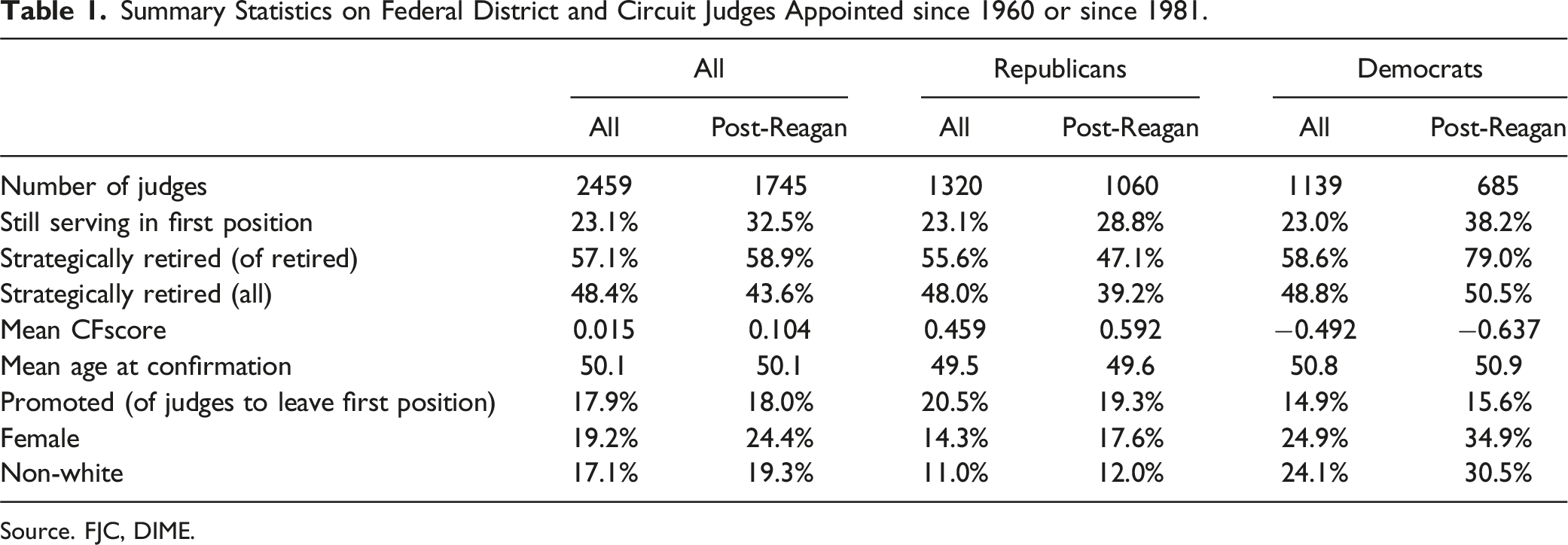
Summary Statistics on Federal District and Circuit Judges Appointed since 1960 or since 1981.
Source. FJC, DIME.
Data on Judge-Level Ideology from DIME
Our primary interest is not just in party-driven strategic retirements, but also in whether ideology (as distinct from partisanship) could be a factor in explaining retirements. To measure ideology, we turned to the data from Bonica and Sen (2017) and later extended in Bonica and Sen (2021), which adapt underlying data from the Database on Ideology, Money in Politics, and Elections (Bonica, 2013). These data rely on financial contributions made by judges before they were invested on to the courts, using the information provided by the contributions to scale judges (and other individuals also included in DIME) on the same unidimensional scale, from more liberal (−2.0) to more conservative (2.0). For example, if an individual donated primarily to liberal candidates, she would be assigned a liberal DIME “CFscore,” but if she donated to a mix of liberal and conservative candidates, she would be assigned a more moderate score. These would further be scaled by the amount of the contribution.
Importantly, DIME differs from other ideology measures, such as Martin-Quinn Scores (Martin & Quinn, 2002), Segal-Cover Scores (Segal & Cover, 1989), or Judicial Common Space (JCS) scores (Giles et al., 2001; Epstein et al., 2007). For example, Martin-Quinn scores focus on the Supreme Court and rely on Justices’ voting records in tandem with some simple assumptions to scale the Justices on a unidimensional ideological scale. For example, Samuel Alito, who frequently votes alongside Clarence Thomas, would be estimated to have an ideology similar to Thomas’s simply based on their cohesive voting. Because Martin-Quinn scores are estimated only for Supreme Court Justices, we do not use them here. JCS scores, by contrast, produce ideology estimates for lower-court federal judges; these impute judicial ideology using the estimated ideology of the appointing President in combination with the home-state senators, if they are of the same party. For example, a Trump-appointed appellate judge sitting in Texas would have an ideology that is a combination of the ideologies of Trump, Ted Cruz, and John Cornyn, while a Trump-appointed judge in California would only have Trump’s. As we discuss in the Appendix, this approach may not fully capture variation in ideology because it could plausibly fail to capture meaningful differences between the moderates appointed by each party. We also note that estimates such as JCS scores are an amalgam of two different approaches (identity of appointing official/s and their ideologies), while DIME is estimated based on the judges’ own observed behavior. 8
To further contextualize DIME CFscores, consider some well-known examples from the Supreme Court: Antonin Scalia, a longtime conservative stalwart, has a CFscore of 1.096, while Ruth Bader Ginsburg, a strong liberal, has a CFscore of −0.995. The most liberal CFscore in the dataset is −1.657, belonging to Carter appointee Arthur Alarcón of the Ninth Circuit, while the most conservative score is 1.677, belonging to Ralph Erickson, a George W. Bush appointment to the District of North Dakota who later served on the Eighth Circuit. In terms of coverage, according to Bonica and Sen (2021), around 81% of Court of Appeals judges appointed since 2001 are included in the data. This compares to a coverage rate of about 43.4% among all U.S. lawyers and a rate of about 4-5 percent among the general population (Bonica et al., 2016).
We note some caveats with these measures. First, federal judges are prevented from making financial political contributions once they become judges; this means that CFscores, like JCS scores, are measured on the basis of pre-investiture information and are a poor measure of intellectual drift, which could be important for retirement decisions. 9 Second, although judges tend to be more politically active compared to the general public and have coverage in the DIME data that is higher in comparison, there are judges for whom DIME information is missing. We therefore rely on Bonica and Sen (2017)’s imputed CFscores for those missing CFscores. As explained in that paper, their imputation takes into account a variety of factors, including jurisdiction and ideology of appointing political actors. 10 Bonica and Sen (2017) validate the imputation by showing strong correspondence between imputed CFscores, JCS scores, and Martin-Quinn scores. In the Appendix, we discuss additional differences between DIME and JCS scores, and rerun the main models using JCS scores.
Table 1 provides summary statistics, including on DIME CFscores, for all judges (including the subset of judges who have not yet retired). Figure 1 gives some context on the distribution of CFscores across Democratic appointments (blue, left side of each histogram) and Republican appointments (red, right side of each histogram) to federal judgeships since 1960 (left panel) and since Ronald Reagan became President on January 20, 1981 (right panel).
11
Both show the classic bimodal ideological distribution that characterizes the U.S. political landscape, although with decreased overlap (as indicated by the purple regions) among judges appointed since Reagan. We explore patterns both before and after Reagan’s election below. CFscore score distribution for judges appointed from 1960 to 2020. Source: FJC, DIME. (a) All judges appointed since 1960. (b) Judges appointed since Reagan.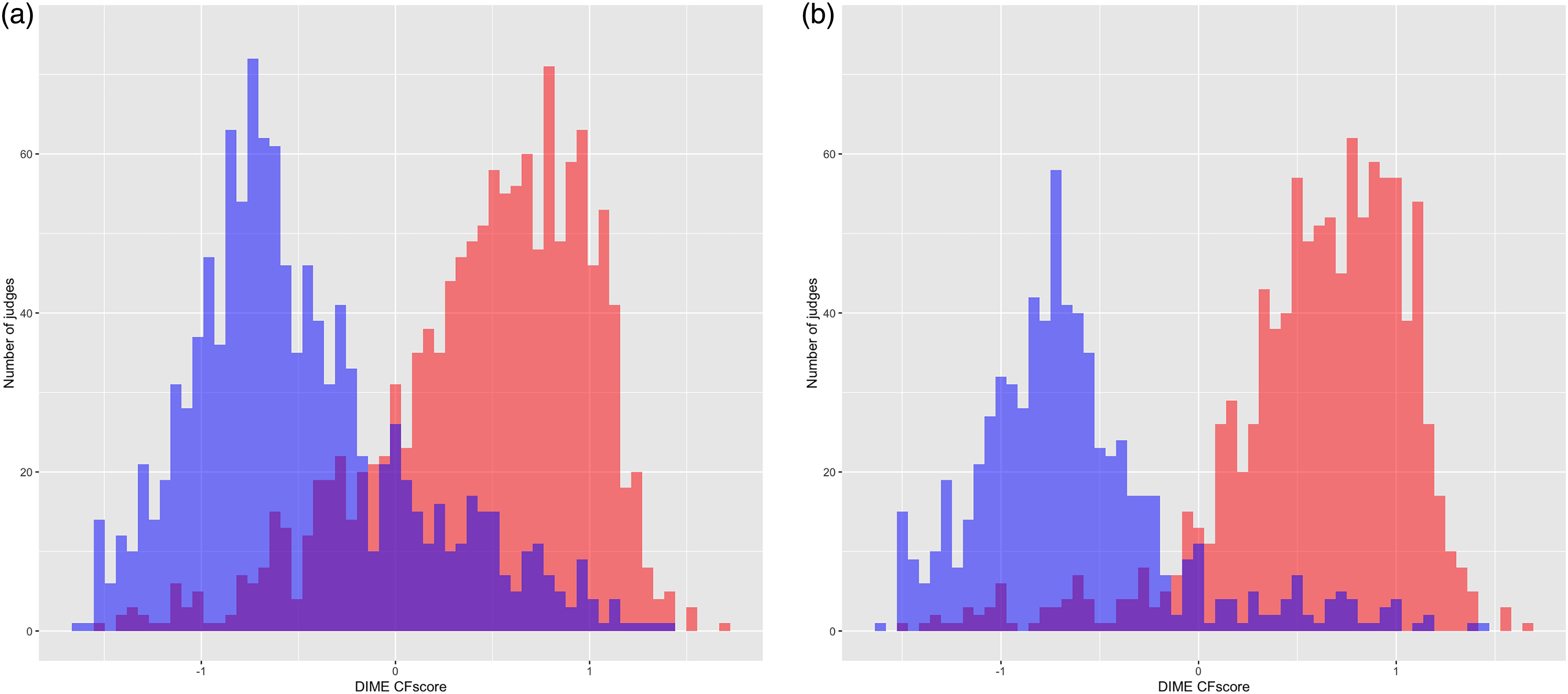
Findings on Partisan and Ideological Differences in Strategic Retirement
We now turn to our main results. For all models unless otherwise noted, the unit of analysis is the individual judge, which includes the initial appointment of all lower federal judges. 12 We drop all judges still currently serving, as they have not yet retired, strategically or un-strategically. 13 As noted above, in most analyses, we remove individuals who are promoted, but we discuss analyses that include these individuals by examining final, rather than initial judicial position below, with full results in the Appendix.
Unless otherwise noted, our main analyses include judges who took senior status, retired, or died – and thus created a vacancy somewhere on the federal bench. As our outcome, we operationalize “strategic retirement” as being whether that action (senior status, retirement, or death) took place under a President of the same party as the one who appointed the judge (0 or 1). All models are linear probability models for ease of interpretation, with logit specifications presented in the Appendix. We also include basic controls for (1) type of court (district vs appeals), (2) age at confirmation, and whether a judge is (3) female or (4) non-white.
Strategic Retirement by Party
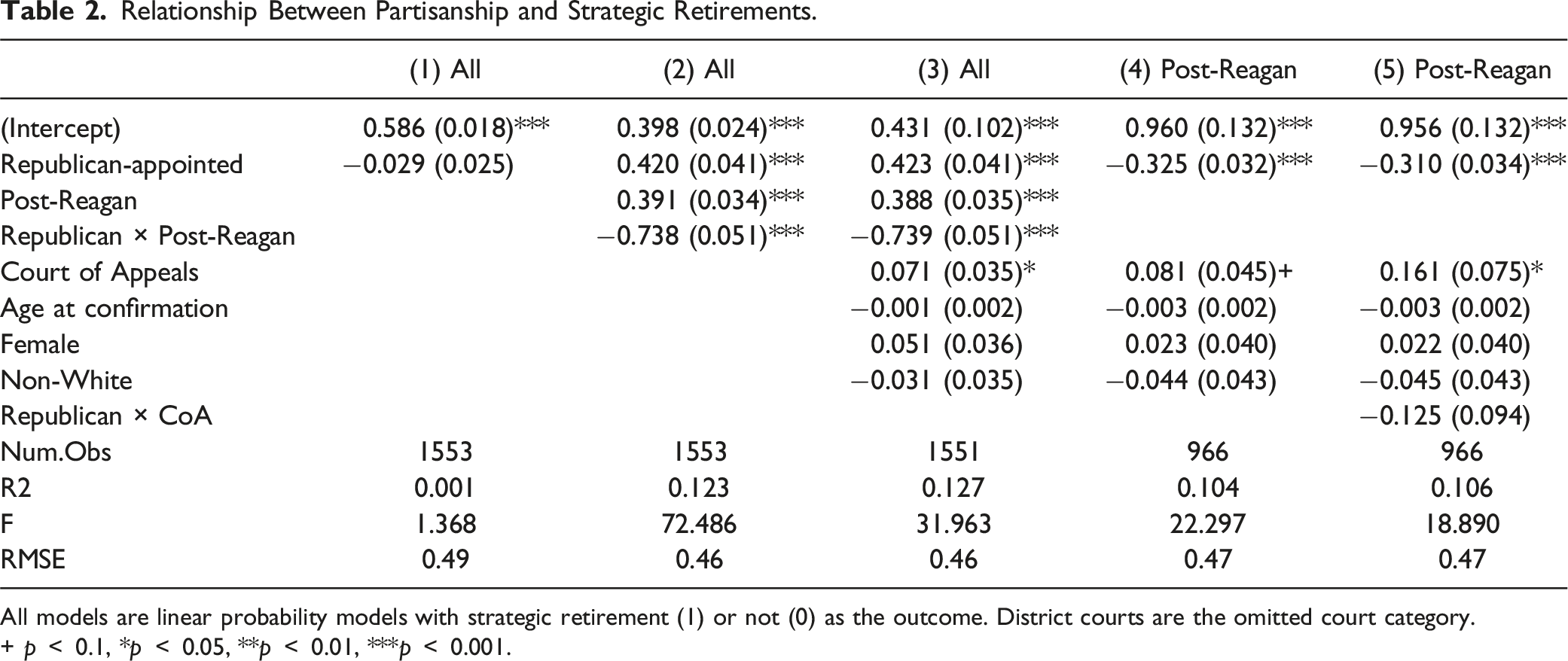
Relationship Between Partisanship and Strategic Retirements.
All models are linear probability models with strategic retirement (1) or not (0) as the outcome. District courts are the omitted court category.
+ p
In Column 2, we begin to explore time-varying trends by looking at the election of Ronald Reagan (“Post-Reagan”) as a cut point. We choose Reagan’s presidency for key reasons. First, scholars recognize Reagan as being the first modern President who considered judicial appointments as a tool to achieve policy goals (as opposed to a tool for patronage, see Goldman (1999)). Second, the Fifth Circuit Court of Appeals was split in half to form the Eleventh Circuit in 1981, giving Reagan additional appointments and setting the circuit boundaries to their modern locations. Third, political goals on the right regarding the courts crystallized into their modern form around this time; for example, the Federalist Society, the influential organization of conservative legal intellectuals, was formed in 1982. Finally, scholarship on polarization has noted that this was an important time of ideological “sorting,” in which ideological liberals began increasingly identifying with the Democratic Party and ideological conservatives with the Republican Party (e.g., Levendusky, 2009).
In contrast to the results from Column 1, the results in Column 2 do show partisan differences, with Republican appointees before Reagan being more likely to retire strategically than Democratic appointees, but appointments by Reagan and later Republican Presidents being less likely to retire strategically. We can see this with the positive and significant coefficient on the lower-order Republican variable (which corresponds to pre-Reagan Republican appointees) and the negative and significant coefficient on the post-Reagan-interacted Republican variable (which corresponds to post-Reagan Republican appointees). This result is robust to the inclusion of basic covariates (Column 3).
In Column 4, we further investigate this pattern by subsetting to only these more recent (appointed by Reagan or later) judges. Here, the results show that judges appointed by Republicans are about 32 percentage points less likely to retire strategically than judges appointed by Democrats in the same time period. As before, the results are robust to the inclusion of several key factors. In Column 5, we further interact party of appointing President with tier of court (district vs appeals court), so as to gauge whether, for example, these may be specific to higher courts. We find no significant evidence here that partisanship matters more according to tier.
In sum, the practice of strategic retirement is common for appointees of both parties, but is more common for Republican appointees pre-Reagan and more common for Democratic appointees post-Reagan. In looking at the older, pre-Reagan trends, a possible explanation might be the long stretch of Republican control of the White House in which Democrats controlled the White House only for three terms, from 1960 to 1968 (Kennedy and Johnson Administrations) and then from 1972 to 1976 (Carter Administration). Thus, a Kennedy or Johnson appointee realistically only had one four-year term in which to retire strategically, whereas Republican appointees could retire strategically at any point besides the four years of Carter’s single term. This phenomenon, more an artifact of who controlled the White House than the tendencies of judges, likely drives pre-Reagan Republican strategic retirements up and Democratic strategic retirements down. Post-Reagan, there has been a more consistent alternation between Democratic and Republican Administrations (as of our writing 6 Republican presidential terms once we include Trump’s single term compared to 5 Democratic presidential terms once we include Biden’s). The slight White House advantage in Republicans’ favor post-Reagan does mean that, if anything, Republican appointees have had slightly more temporal bandwidth to retire strategically than Democratic appointees have had. This makes the patterns we see regarding partisan differences even more interesting.
We note two important considerations. First, as mentioned above, these models count deaths as retirements. As we discuss in more detail in the Appendix, deaths on the bench are rare: only 45 of the 1745 judges appointed since Reagan’s term began died while still holding their initial position on the federal bench. Although these cannot always be considered completely un-strategic actions (as the example of Ruth Bader Ginsburg illustrates), we show in the Appendix that we cannot reject the null that deaths are distributed randomly across parties. In addition, Appendix removing judges who died from our analysis does not affect the substantive inferences.
Second, the models also drop from the analysis judges who were “promoted” to a different judicial position. Around 18% percent of judges are promoted, mostly from a district court to a court of appeals (Table 1). Although this is a smaller share than the percent who are not promoted (and thus retire, take senior status, or die), judges are overwhelmingly promoted by Presidents of the same party. This means that the vast majority of promotions would be considered “strategic” (if not necessarily “retirements”), since they allow the incumbent President the ability to fill the vacancies left behind. That said, we are mindful of biasing our results by excluding these judges. In the Appendix, we address this by considering final appointments, not initial appointments. By focusing on a judge’s final appointment, we include the judges who were promoted, while keeping all the judges who were not promoted, in our analysis (as their first and final appointments were the same). Appendix The negative post-Reagan relationship between Republican appointment and strategic retirement remains when we subset the data in this way.
Ideology and Strategic Retirement
The above results only consider the relationship between the party of appointing President, not the ideology of the judge, and a judge’s strategic retirement. We now turn to incorporating the fine-grained judicial ideology measures introduced and validated in Bonica and Sen (2017) and updated in Bonica and Sen (2021). These DIME CFscores are scaled from −2.0 (the most liberal) to +2.0 (the most conservative), with Democratic appointees mostly in the negative side and Republican ones mostly on the positive side (though not always, as shown in Figure 1(a)).
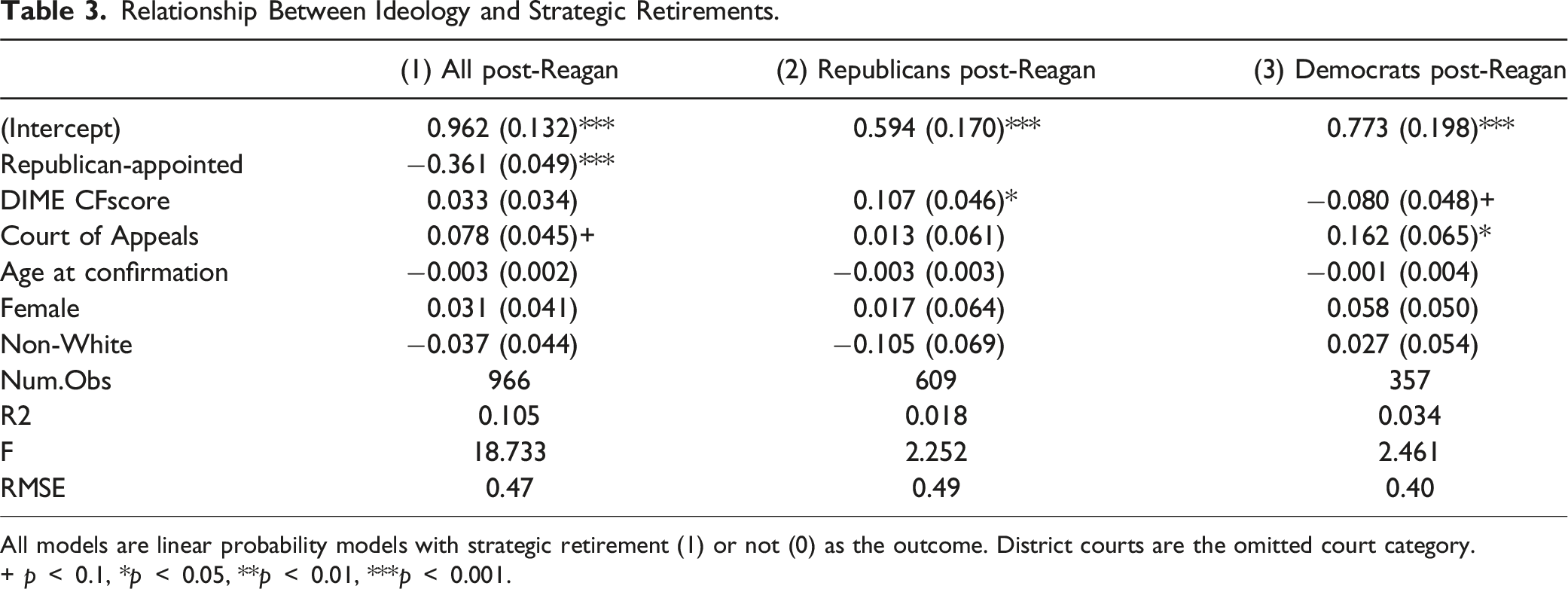
Relationship Between Ideology and Strategic Retirements.
All models are linear probability models with strategic retirement (1) or not (0) as the outcome. District courts are the omitted court category.
+ p
These analyses are confirmed visually by Figure 2, which plots simple locally estimated scatterplot smoothing charts (LOESS) of the probability of a judge retiring strategically against their DIME CFscore, separated out by party of appointing President (these do not include include any control variables). We present this graph in two ways: the left panel’s X-axis is scaled the same as DIME CFscore, with liberals to the left and conservatives to the right. In the right panel, the scores for Democrats are reflected across the vertical Y = 0 line, so moderates of both parties are to the left and extremists of both parties to the right. These plots indicate that, across all levels of ideology, Democratic appointees are more likely to retire strategically than Republican appointees: the Democratic (blue) line is always above the Republican (red) line. This is consistent with our findings in Table 2. Interestingly, Figure 2 indicates that an extremely conservative Democratic appointee, by DIME CFscore, is about as likely to retire under a Democratic President as a similarly conservative Republican is to retire under a Republican President. Probability of strategic retirement by ideology and party for all judges appointed since Reagan’s election. The left panel’s X-axis is simple DIME CFscore, on the [−2,2] scale of liberal to conservative. The right panel’s X-axis is flipped only for Democratic appointees, so moderates of both parties are on the left side of the graph, and extremists of both parties on the right. Smoothing is done via LOESS with α = 0.75.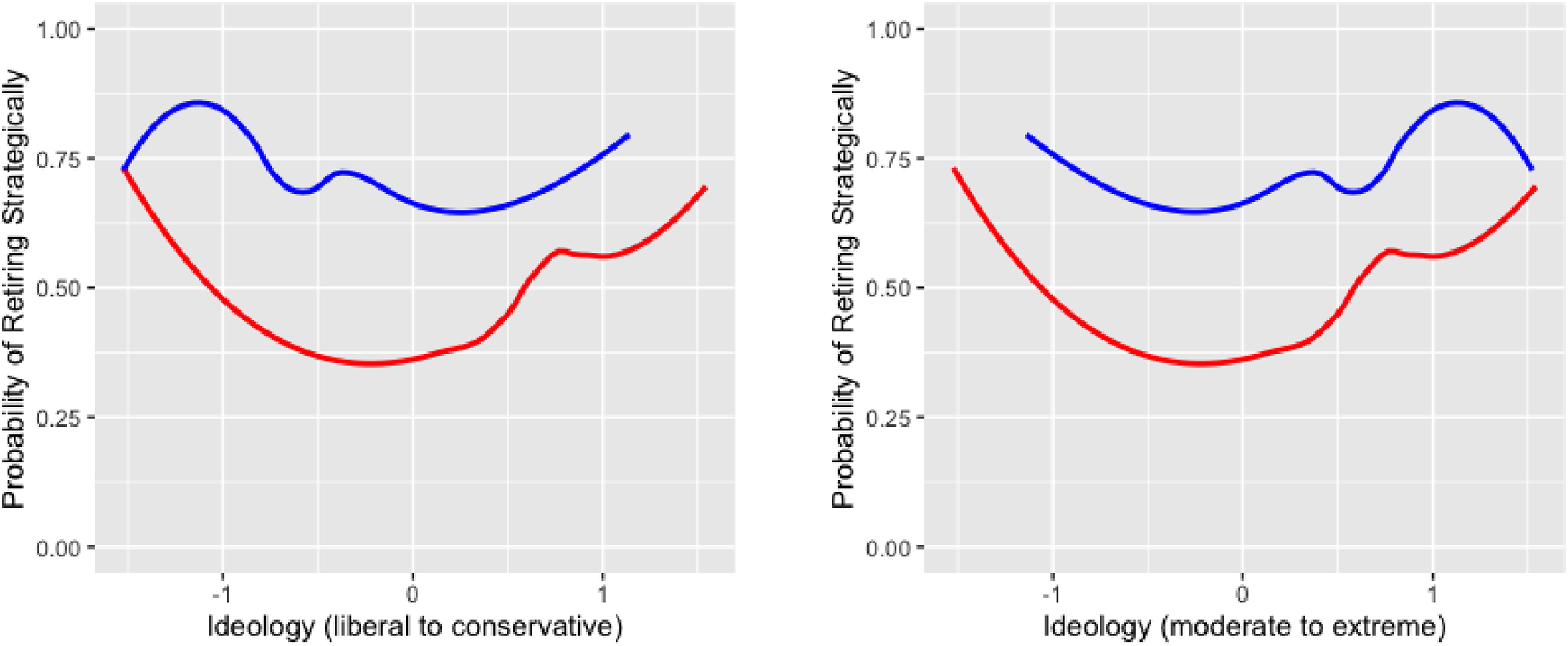
What does this mean for the relationship between ideology and strategic retirement, and how it may vary by party? To see this, note again that DIME CFscores are scaled from −2 (the most liberal) to 2 (the most conservative). If we assumed that more ideologically extreme judges (i.e., the most liberal Democrats and the most conservative Republicans) are the ones most likely to retire strategically, then we would expect to see a negative coefficient on the CFscore variable for Democratic-appointed judges and a positive coefficient for Republican-appointed judges. These analyses are presented in Table 3, Columns 2 and 3. In these columns, we repeat the analyses for Republican appointments only (Column 2) and Democratic appointments only (Column 3) to highlight the way in which more extreme ideology may influence retirements differently for appointments of each party. We again only look at appointments since Reagan’s inauguration.
For Republicans (Column 2), the coefficient on CFscore is positive and significant, which suggests that, if a Republican appointee is more conservative, he or she is more likely to retire strategically under a Republican President. Taken together, the insights from this table match Figure 2, where Republican appointees see a large increase in the probability of a strategic retirement as their DIME CFscores move from 0 towards 2 (the range in which the bulk of Republican-appointed judges fall).
For Democrats (Column 3), though the signs on the coefficients for each model match expectations, the coefficient on the CFscore variable is not statistically significant at the p < .05 level (p-value of .094). This represents at most suggestive evidence that more ideologically extreme Democrats are more likely to retire strategically. That said, comparing the coefficients on DIME CFscore in Columns 2 and 3 and their standard errors shows that we would also be unable to reject the null hypothesis that the coefficient on the ideology measure for Democratic appointees differs from the coefficient for Republican appointees. 14 As such, we can neither conclude that the relevant coefficient for Democratic appointees differs from 0, or differs from its counterpart for Republican appointees. Partly for this reason, we focus the rest of our attention on Republican appointees, for whom we are more certain that ideology plays a significant role in the decision to strategically retire.
The Case of the Missing Moderate Republicans
These results suggest that, since Reagan’s term began, Democratic appointees across the ideological spectrum have been more likely to retire strategically than their Republican counterparts (a significant difference) and that the gap suggestively is widest between the moderates appointed by each party, as shown in Figure 2. In other words, moderate Republican appointees are strategically retiring at lower rates than their more conservative Republican peers, and Republican appointees across all ideologies are strategically retiring at lower rates than Democratic ones.
Relationship Between Retiring Under Obama, Trump, and Biden, Among Initial Republican Appointments Since Reagan.
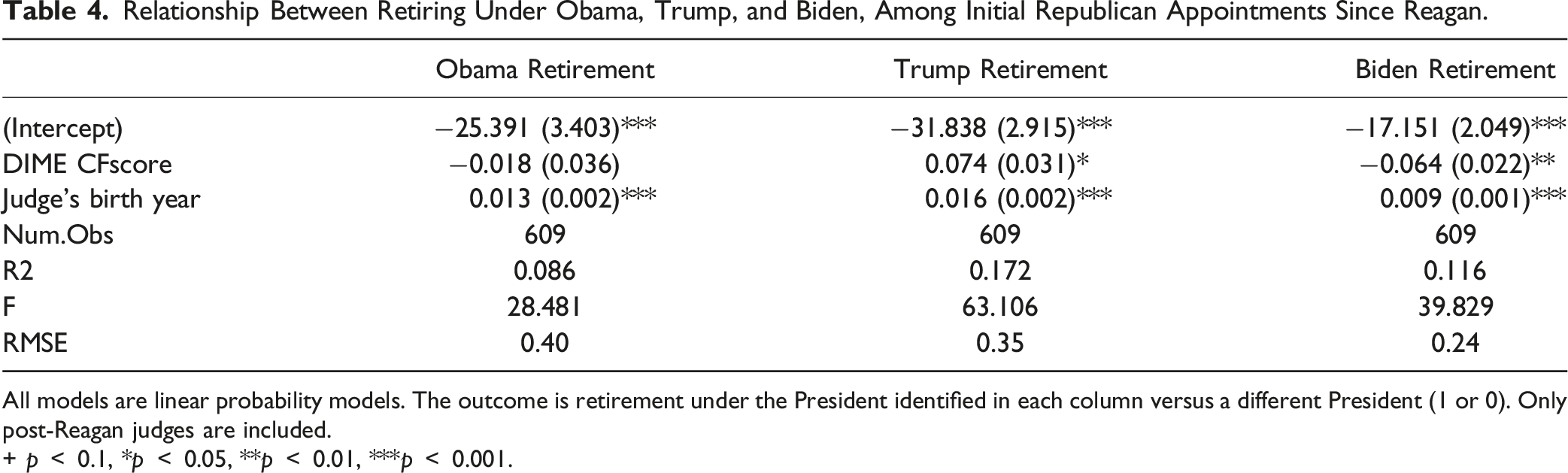
All models are linear probability models. The outcome is retirement under the President identified in each column versus a different President (1 or 0). Only post-Reagan judges are included.
+ p
As the table shows, more moderate Republican appointees were not necessarily more likely to retire under Obama: in Column 1, the coefficient on CFscore is negative but fairly close to 0 and not significant. However, they have been more likely to retire under Biden (Column 3), as shown by the negative, significant coefficient on the CFscore ideology variable. Additionally, Column 2 confirms that Republican-appointed judges who are more conservative are more likely to have retired (strategically) under Trump, with a positive and significant coefficient on the CFscore variable. Put another way, Column 2 shows that moderate Republican appointees were less likely to retire under Trump, at the same time as they appear more likely to retire under Biden. Since Trump judges are too recently appointed to be retiring under Biden (and none in the FJC dataset have), we take this evidence as consistent with the idea that more older, moderate Republican appointees made the decision to “wait out” the Trump regime and retire under Biden. This may be due to a belief that Biden would be more likely than Trump to appoint a replacement close to a moderate Republican’s ideal point.
Relationship Between DIME CFscore and Appointing President, for Democrats and Republicans Separately.
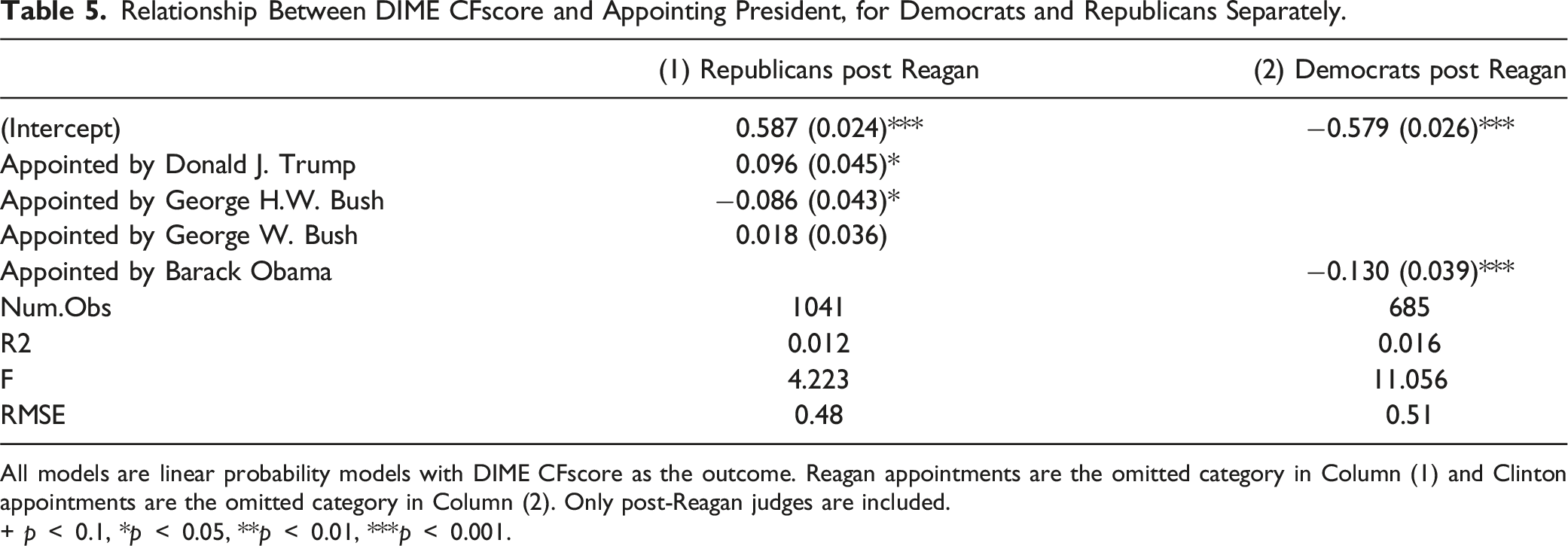
All models are linear probability models with DIME CFscore as the outcome. Reagan appointments are the omitted category in Column (1) and Clinton appointments are the omitted category in Column (2). Only post-Reagan judges are included.
+ p
Moderate and Conservative Appointments by Republican President.
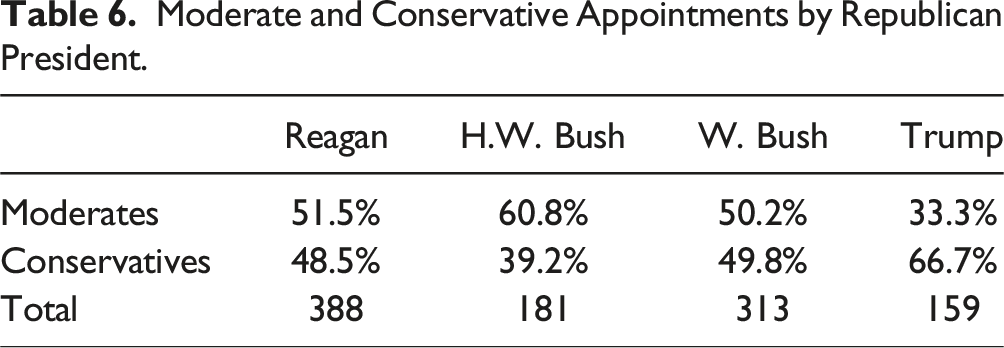
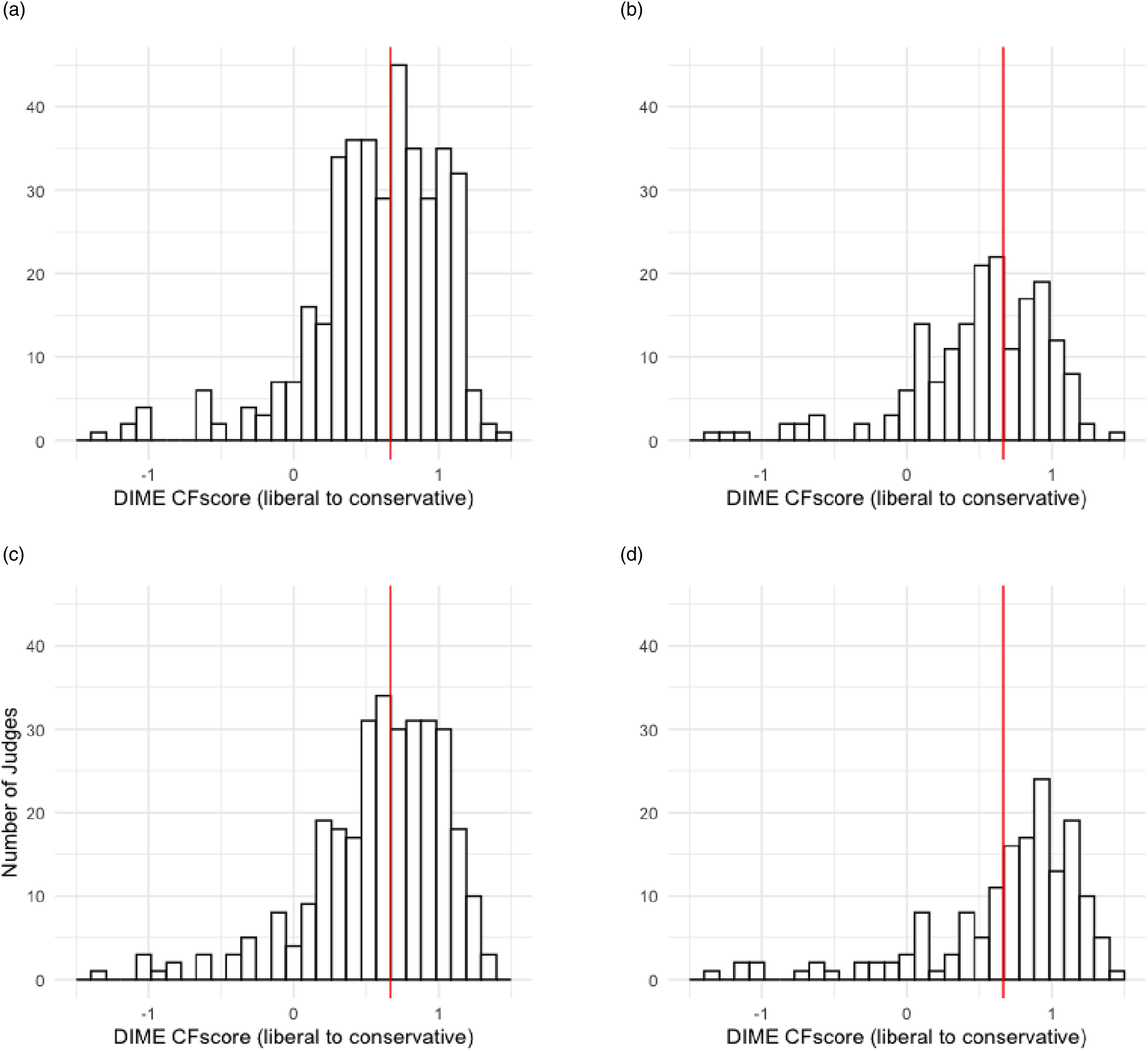
DIME CFscore distribution by appointing Republican President. The median DIME CFscore of all Republican appointees since Reagan is marked with a vertical line on each plot. (a) Ronald Reagan (b) George H. W. Bush (c) George W. Bush (d) Donald J. Trump. Source: FJC, DIME.
A closer look at the individuals involved is consistent with a general intuition that older, more moderate Republican appointees have “waited out” Trump’s term. As of our writing (in January of 2024), 44 Republican appointees have “unstrategically” left the bench during the Biden Administration, going along with the 143 who did so during the 8 years of the Obama Administration. By contrast, only 32 Democratic appointees retired during the entirety of the Trump Administration. The fact that that moderate Republican appointees have a higher probability of retiring under Biden and less so under Obama (shown in Table 4) again suggests a pattern consistent with older, more moderate appointees “waiting out” the Trump Administration.
Discussion: What Our Findings Mean for the Federal Judiciary Moving Forward
In this paper, we investigate the widespread phenomenon of strategic retirement among federal judges. We largely confirm the practice’s existence: overall, about 57% percent of judges in our sample of Article III judges appointed since 1960 retired strategically – i.e., somehow left the bench and created a vacancy for a President of the same party to fill. But we also document important partisan and ideological practices that have changed over time and that contribute to our broader understanding of judicial behavior. First, as we show, Democratic appointees are now more likely to retire strategically than Republican ones. This pattern holds even accounting for ideology, suggesting that, on average, Democratic appointees of all ideologies are more likely to retire under copartisans than are Republicans appointees.
Second, however, ideology matters in important ways for lower court appointees. For Democratic appointees, there is suggestive evidence of a relationship between ideology and the probability of retiring strategically. But for judges appointed by Republican Presidents, ideology is positively and statistically significantly predictive of strategic retirements, with more conservative Republican appointees being more likely to retire under another Republican President. We posit that a reason behind this pattern may be in increased ideological distance between older, more moderate Republican appointees and more conservative recent Republican Presidents, such as Donald Trump. As evidence for this hypothesis, we show that more moderate Republican appointees were more likely to retire under Joe Biden, even after controlling for their age, which is suggestive evidence of them “waiting out” the Trump presidency.
These results offer key insight into how judges might approach the decision to retire. While other scholars documented the important influence of political and personal considerations (Nixon & Haskin, 2000), our results offer the insight that ideology is an important motivation that may function in tandem with partisan concerns. This insight has substantive implications, given current trends in party polarization and asymmetric polarization. Take the current composition of the Republican Party, for example. As has been noted by scholars as well as by public commentators, Republican Party elites have generally moved in a more conservative direction (Grossmann & Hopkins, 2016). The shift to the right includes recent Republican Presidents and, at the time of our writing, rank-and-file Senate Republicans as well as the front runner for the 2024 Republican presidential nomination (Trump). This rightward drift creates an ideological distance between older, more moderate Republican judicial appointees and current Republican Party leadership. For these individuals, this increased ideological gap may well be a reason to retire under a perceived moderate, such as Democrat Joe Biden, and thus may help explain some of the patterns we see here.
This raises the important point that the patterns we observe in our data may not necessarily be permanent, even though they point to the underlying – and likely enduring – importance of ideology in predicting judicial retirements. As we show here, and as shown by other scholarship, Republican appointees to the federal courts have grown more conservative over time, reflecting the right-leaning trends in Republican Party politics since at least 2016 (Bonica & Sen, 2021). Should this trend continue, this will result in relatively fewer moderate Republican appointments moving forward; accordingly, over time, our findings on moderate Republicans “waiting out” more conservative Republican Presidents may attenuate as these moderate Republicans are slowly replaced. Such a phenomenon may have implications for circuit court control, as Republicans appointing more conservative judges, who then are more likely to retire strategically, could calcify the party’s supermajorities in circuits like the Fifth and Eighth Circuits.
We also consider our top-line findings that Democratic appointees are more likely to retire strategically than Republican ones, even conditional on ideology. This runs counter to some contemporary commentary, which has focused mostly on Supreme Court justices. Although this might change over time, this too appears driven in part by the current ideological landscape. While moderate Republican appointees might be ideologically proximate to a Democrat such as Joe Biden, even moderate Democratic appointees are unlikely to find much common policy ground with Donald Trump or Republican elected officials with national profiles, such as Rep. Mike Johnson (R-LA), Sen. Josh Hawley (R-MO) or Sen. Ted Cruz (R-TX). Thus, for Democratic appointees, it seems straightforward that there would be less cross-over in retirements (i.e., non-strategic retirement), while this may be an occasional pattern for Republican appointees.
We conclude by noting areas of future research. First, our results imply that the ideology of the judge should be incorporated into future studies of strategic retirement. Second, and relatedly, our measures of ideology rely on pre-investiture information (political donations), which makes estimating the influence of intellectual drift on retirement decisions challenging. Future research could analyze the relationship between ideology and retirement outcomes by incorporating vote-based measures into an analysis, for example.
Third, our study stopped short of considering the policy ramifications of these shifts, including analyses of how the composition of the federal courts could change over time or how the patterns we see here could shape judicial rulings. An implication of our work and that of others is that we may see a long-term attenuation in the proportion of center-right Republican-appointed judges, as they are more likely to retire under Democratic Presidents and, if they retire under Republicans, will be more likely to be replaced by more conservative Republican appointees. Future research could help shed light on these patterns and connect these to long-term policy outcomes.
Footnotes
Acknowledgments
We thank the editors and the reviewers for helpful and constructive feedback.
Declaration of Conflicting Interests
The author(s) declared no potential conflicts of interest with respect to the research, authorship, and/or publication of this article.
Funding
The author(s) received no financial support for the research, authorship, and/or publication of this article.
Notes
Appendix
This appendix includes additional findings and robustness checks for the paper “The Role of Judge Ideology in Strategic Retirements in the Federal Courts.”