



Abstract
A study of helium–neon laser plasma lines was done using a double grating spectrometer and a helium-neon laser with an emission wavelength of 632.8 nm (15 802 cm−1). The absolute wavenumber, measured to within
This is a visual representation of the abstract.
Introduction
Despite increasing adoption of solid state lasers, the helium-neon (He–Ne) gas laser is still one of the most commonly used light sources in research and industrial applications. Like all gas lasers, He–Ne lasers often emit so-called plasma lines arising from spontaneous emission in the laser tube in addition to the desired stimulated emission resulting from population inversion. In laser spectroscopy experiments, where precise knowledge of the wavenumbers associated with spectra features of interest are required, these plasma lines can serve as “built-in” calibration standards. It is, therefore, surprising that the literature on plasma emission lines for He–Ne lasers is scant.
Previous work by Loader
1
appears to be the only in-depth study of He–Ne laser plasma emission lines. In this study, 38 plasma lines were observed over a spectral range of 12 093–15 798 cm−1. The assignments of these lines and quoted wavenumbers, however, are questionable because the same study also includes results for Ar+ laser plasma lines which have since come under scrutiny due to the apparent misidentification of several spectral peaks as plasma emission lines and to uncertainty in measured wavenumbers resulting from use of a spectrometer with relatively low resolution.
2
There are also differences in He–Ne plasma line wavenumber assignments as reported by Loader and those in a Raman scattering study on multiferroic compounds.
3
In particular, Raman spectra of CuFeO2 and CuCrO2 yielded strong plasma lines in the vicinity of 137, 180, and 200 cm−1, the former two differing by
Motivated by the above-noted paucity of literature data and the inconsistencies in that which is available, we present in this article the results of a comprehensive study on plasma lines from a He–Ne laser with an emission wavelength of 632.8 nm. We report plasma lines with shifts of 0–1500 cm−1 from the primary emission line at 15 802.4 cm−1, a commonly probed spectral range for optical Raman scattering studies, and tabulate absolute wavenumber, measured intensity, and wavenumber shift from the primary emission line. This information is also provided for some second-order lines in the ultraviolet spectral region. In addition, the atomic species associated with each transition is identified.
Experimental Details
Figure 1 shows a schematic diagram of the apparatus used to collect the emission spectra. The experiments were done in air at room-temperature with a He–Ne laser emitting at a wavelength of 632.8 nm. The incident power was

Experimental set-up. M: Front surface mirror, P: prism, L: lens, and S: sample.
Experiments were conducted over shifts of 0–1500 cm−1 relative to the laser wavelength at 632.8 nm with crystalline silicon, aluminum, and superconductor Bi2Sr2CaCu2O
Results and Discussion
Figure 2 shows spectra collected in air of laser light scattered from each of the three materials. The spectra are very similar to one another, suggesting that our assignments of multiply-observed peaks to plasma emission lines are robust. In order to be classified as a plasma line, it was required that the line be present in spectra of all three materials at the same shift. The peak positions reported in this article are those obtained for c-Si as the scattering material because its spectrum was collected for the longest time with the smallest step size (0.15 cm−1). As shown in the top and bottom panels of Figure 2, the spectral regions between 0–300 cm−1 and 1200–1500 cm−1 contain particularly large number of plasma lines. In contrast, the center panel of Figure 2 shows that relatively few lines are present in the spectral region from 400 to 800 cm−1. Spectral peak parameters were obtained by fitting a Voigt function to each peak using the “Fityk” routine.
4
All lines were found to have a width of
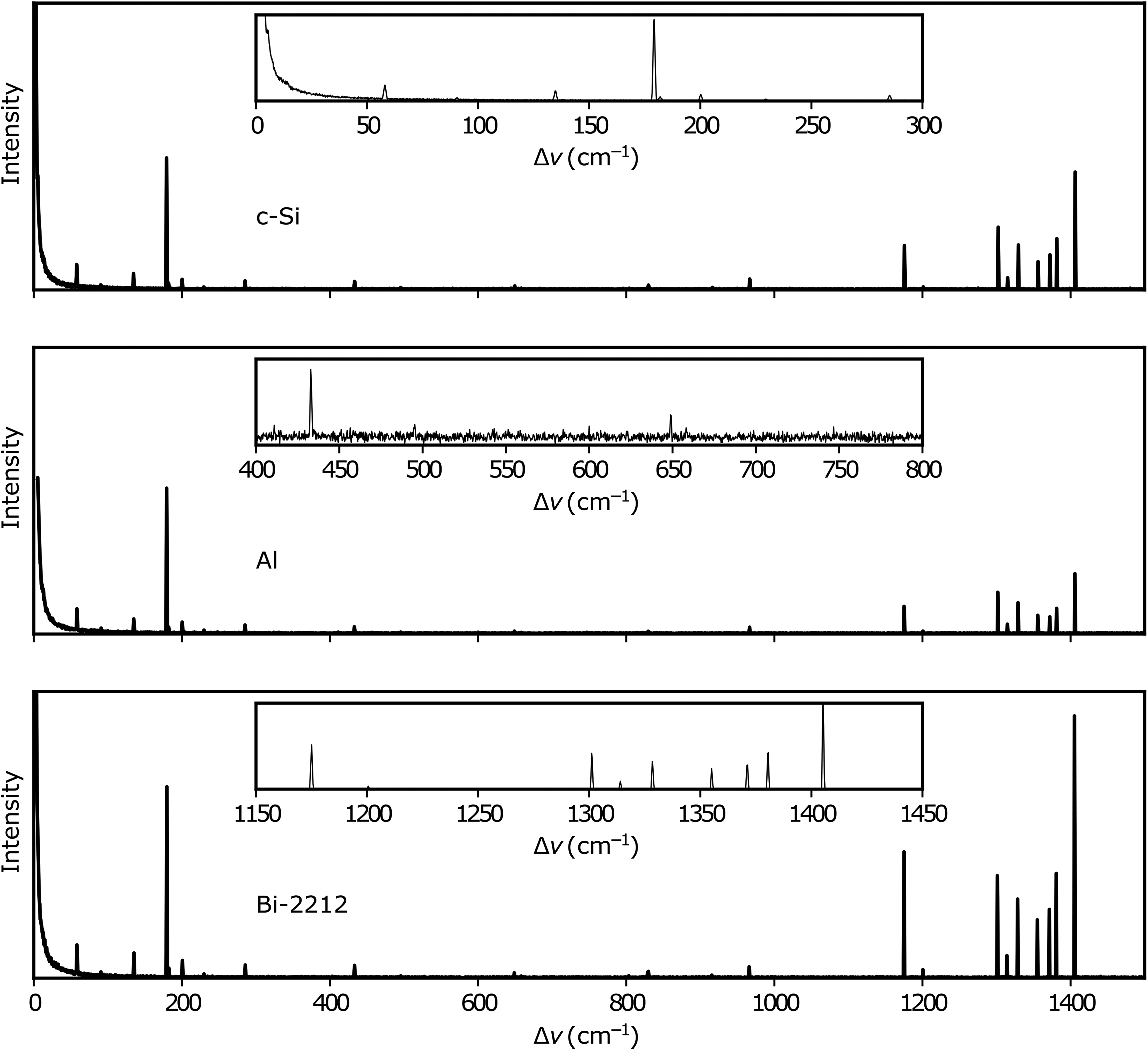
Emission spectra of a Helium-Neon (He–Ne) laser with primary emission wavelength of 632.8 nm obtained with three different scattering sources. Multiple plasma lines are present at the same shifts in all three spectra. Top panel: Crystalline silicon (c-Si); middle panel: aluminum (Al); bottom panel: Bi2Sr2CaCu2O
Comparison of our spectra to the data presented by Loader reveals multiple plasma peaks that were not observed in the latter study (the criterion for being labelled as a “different” line being that the shift differed by more than
The absence in the literature of multiple lines that appear in our spectra is surprising, especially given that our results indicate that the intensity of many of the these lines is greater than that of some previously observed.
1
This can be largely reconciled by noting that ultraviolet lines corresponding to known Ne transitions with emission wavelengths of
Wavelength in air (

Table I reveals some notable differences between the current and previously published results. Firstly, several of our measured plasma line wavenumbers differ from those of Loader’s work by
Conclusion
Plasma lines from a He–Ne laser source were investigated by probing a spectral region 0–1500 cm−1 from the primary emission wavelength of 632.8 nm (
This work complements published He–Ne laser emission line compilations and refines previously measured plasma peak shifts through use of a spectrometer with higher resolution. With an estimated uncertainty of
Footnotes
Author Contributions
All authors contributed to the process of writing this manuscript and approved the final version.
Declaration of Conflicting Interests
The author(s) declared no potential conflicts of interest with respect to the research, authorship, and/or publication of this article.
Funding
The author(s) received no financial support for the research, authorship, and/or publication of this article.
