



Abstract
Extraneous axial optical cavity modes produced by a single-mode frequency-doubled neodymium-doped yttrium orthovanadate (Nd:YVO
This is a visual representation of the abstract.
Keywords
Introduction
The “single-mode” solid-state laser has become the incident light source of choice for high-resolution laser spectroscopy. Like the traditionally-used noble gas ion laser (i.e., Ar
In this note, we report the possible presence of incompletely suppressed axial cavity modes in the output of a single-mode solid-state laser using ultrahigh-contrast Fabry–Perot interferometry. The potential for these modes to obscure or be incorrectly assigned to phonon modes in Brillouin spectra is highlighted.
Experimental Details
The Brillouin scattering apparatus used in the present work was configured for 180
Results and Discussion
Figure 1 shows a spectrum containing multiple peaks collected using the Fabry–Perot interferometer set to a free spectral range of 10 GHz and with a finesse of

Spectrum containing incompletely suppressed axial optical cavity modes from the output of a single-mode solid-state Nd:YVO
Figure 2a shows spectra obtained from interferometric analysis of diffusely reflected and scattered laser light from aluminum and crystalline silicon. As can be seen, the peak width, the frequency interval between adjacent peaks, and the overall decrease in peak intensity with increasing shift are the same for both materials and consistent with that shown in Figure 1 for porous silicon carbide, confirming that the origin of these peaks is not the material under study.
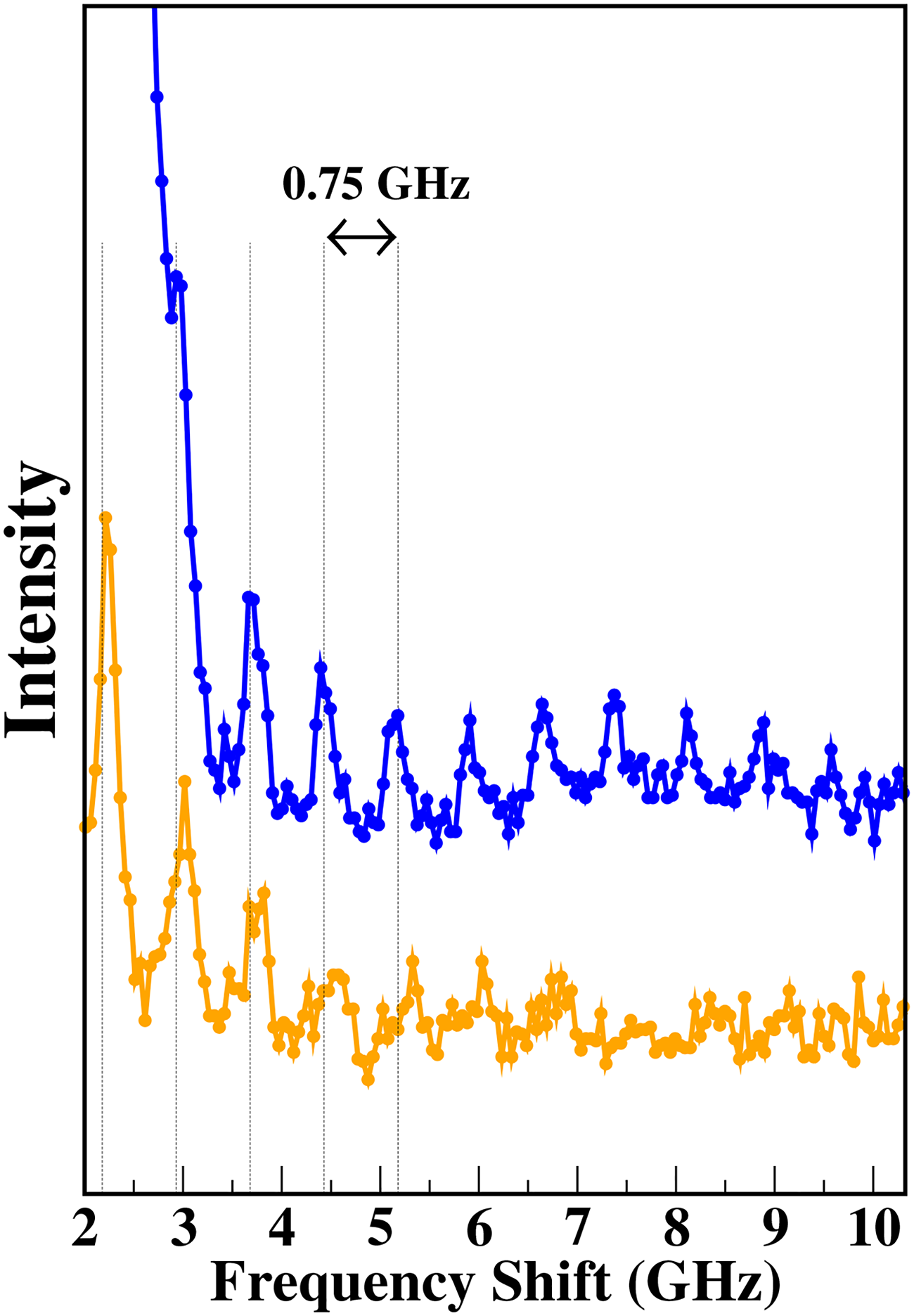
Spectra showing extraneous axial optical cavity modes produced by a single-mode frequency-doubled Nd:YVO
There are a variety of factors that affect the intensity of the extraneous modes in the spectrum. In fact, these modes are not observed at all for many samples that we have studied, especially transparent liquids and solids. Evidence from our experiments suggests that they are typically most intense in spectra obtained at lower incident angles from microscopically rough, highly reflective materials, for which considerable diffuse reflected laser light is captured by the collection optics and subsequently undergoes spectral analysis by the Fabry–Perot interferometer. The intensity of these peaks also depends on laser output power, increasing with decreasing laser power as shown in Figure 3. This trend further supports the peak assignment to cavity modes because it is opposite to that expected if the origin was the target sample under study. While we have not thoroughly investigated the reason for this trend, intuitively this behavior is anticipated as the power level approaches the threshold for lasing—the laser being less stable at power levels closer to a threshold. These characteristics provide simple and practical ways to eliminate or reduce the intensity of these peaks via careful a priori consideration of experimental conditions. For example, the use of high-output laser power with external attenuating filters to reduce beam power to the desired level and high angle of incidence would likely result in a much weaker signal from extraneous cavity modes in a sample spectrum than the use of low-output power and low incident angle.

Spectra obtained by spectroscopic analysis of diffuse reflected and scattered light from aluminum at different laser output power levels. Sharp, evenly spaced peaks due to incompletely suppressed axial laser cavity modes are clearly seen superimposed on the Brillouin spectrum. A clear decrease in extraneous peak intensity with increasing laser output power is evident.
The presence of these incompletely suppressed axial cavity modes can have a significant impact on the assignment and observation of acoustic phonon modes in a Brillouin spectrum. This is obvious when considering spectra presented in Figure 3, where the surface acoustic phonon peak of aluminum (

Collected Brillouin spectra highlighting the spectral profile similarities of a Rayleigh surface mode (from crystalline Bi
Conclusion
We have noted the possible presence of incompletely suppressed axial optical cavity modes in the output of single-mode solid-state lasers via ultrahigh-contrast Fabry–Perot interferometry. Recognition of this fact will help prevent misinterpretation of these modes as arising from the target sample in spectra obtained in high-resolution laser spectroscopy experiments (e.g., incorrect assignment as Brillouin peaks due to sample acoustic phonon modes). In revealing and facilitating the measurement of these near-imperceptible modes, this work also highlights the remarkable capabilities of Fabry–Perot interferometry in the detection of exceedingly weak spectroscopic signals.
Footnotes
Author Contributions
All authors contributed to the process of writing this manuscript and approved the final version.
Declaration of Conflicting Interests
The authors declared no potential conflicts of interest with respect to the research, authorship, and/or publication of this article.
Funding
The authors disclosed receipt of the following financial support for the research, authorship, and/or publication of this article:: This work was supported by (i) Memorial University Seed, Bridge and Multidisciplinary Fund, Grant No. 216354 46314 2000, (ii) Natural Sciences and Engineering Research Council of Canada Grant No. 261546-2003.
