



Abstract
Adopting a paradox (i.e., both-and) mindset, in contrast to a dilemma (i.e., either-or) mindset, is often presented as the approach to handling conflicting expectations. Despite societal progress, many female leaders remain confronted with such conflicting expectations toward their gender and leader role. They are expected to fulfill their (female) gender role by displaying communal behaviors while simultaneously adhering to their leader role, often associated with stereotypically male agency, potentially resulting in agency-communion tensions. This multi-study paper consists of an experimental study (
Keywords
Introduction
A paradox mindset is often portrayed as the solution to deal with tensions in the workplace—that is, “conflicting and persistent demands, interests, and perspectives” (e.g., Miron-Spektor et al., 2018, p. 26; Smith & Lewis, 2011; Zheng et al., 2018). A paradox mindset is characterized as synergizing seemingly conflictual demands, following a “both-and” approach, and contrasted with a dilemma mindset characterized by an “either-or” approach.
Despite progressive changes in societal thinking and organizational efforts, many women still face conflicting gender-based tensions in their leadership roles (Carli & Eagly, 2016; Zheng et al., 2018). Recent theorizing by Zheng and colleagues (2018) proposes that female leaders will benefit from adopting a paradox mindset to deal with these tensions. More precisely, a paradox mindset is depicted as aiding female leaders to “embrace […] tensions as opportunities, and […] craft creative […] ways to manage […] [them] and exercise their leadership” (Zheng et al., 2018, p. 585).
Why do women experience gender-based tensions in their leadership roles? Role congruity theory by Eagly and Karau (2002) addresses the origination of gender-based tensions: Women are expected to behave communal (e.g., empathetic, friendly, accommodating), whereas the image of leaders is characterized by stereotypical male agentic behavior (e.g., dominant, self-confident, assertive; Eagly & Karau, 2002; Haines et al., 2016; Koenig et al., 2011). Therefore, female leaders may experience incongruities between their roles as women and their roles as leaders, possibly resulting in experienced agency-communion tensions, particularly in contexts that highlight the conflictual potential between the role-based expectations (Eagly & Karau, 2002; Zheng et al., 2018). These tensions, in turn, may result in stress, unease, and anxiousness as well as in cognitive dissonance (Putnam et al., 2016; Zheng et al. 2018).
The present research critically examines the postulated benefits of female leaders’ paradox mindsets toward agency-communion tensions in more detail by empirically testing the core propositions of a hitherto theoretical model by Zheng et al. (2018) using an experiment and a two-wave field survey.
In their model, Zheng et al. (2018) explore processes and moderating conditions of agency-communion tensions and emerging mindsets (see Figure 1). They postulate female leaders experiencing agency-communion tensions may adopt either a paradox mindset (i.e., synergizing agency and communion) or a dilemma mindset (i.e., viewing agency and communion as mutually exclusive), dependent upon contextual (i.e., organizational learning orientation, exposure to role models) and individual (i.e., openness to experience) factors. Building on previous research, they point out a paradox (compared to a dilemma) mindset as the functional approach to managing agency-communion tensions. More specifically, they propose benefits of a paradox mindset on female leaders’ resilience, identity coexistence, and leadership effectiveness.
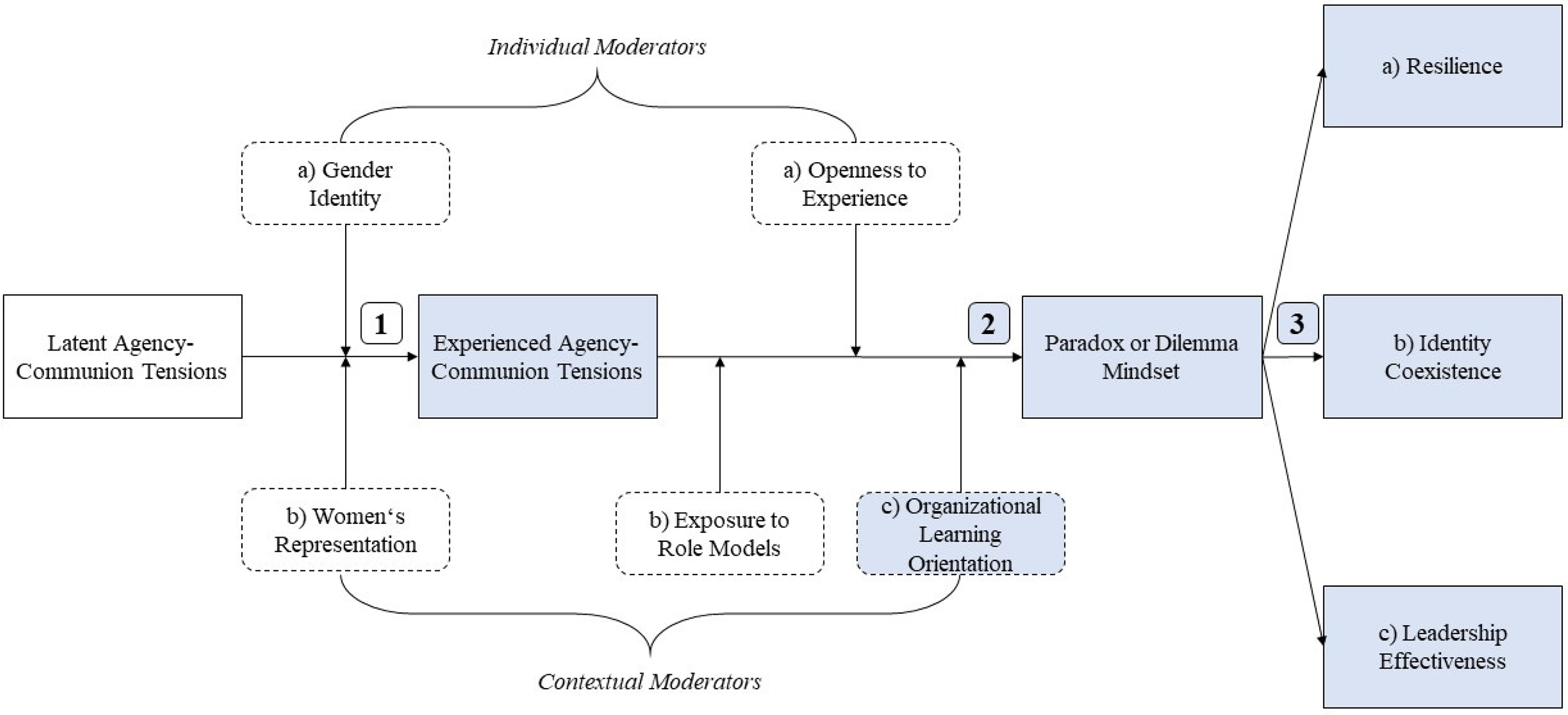
Theoretical model by Zheng et al. (2018)
In the present research, we empirically test the following core propositions of Zheng et al.'s (2018) model: (a) the influence of organizational learning orientation on adopting a paradox mindset, and (b) whether a paradox mindset results in higher resilience, identity coexistence, and leadership effectiveness.
Our research is important on several levels. First, testing and refining existing theories has been largely neglected in management research over the past decades (Kraimer et al., 2023). In order to “keep our research garden ordered, happy, and healthy, we need to engage in systematic theory pruning, which […] test[s] and weed[s] out those theories that do not really hold up under sound methodological scrutiny” (Köhler & Cortina, 2021, p. 511; see also Leavitt et al., 2010). We respond to this call by empirically examining Zheng et al.'s (2018) model. This effort may substantiate the theoretical assumptions or point to necessary refinements. To do so, we apply an experimental design, which is crucial in management research. Experiments are often referred to as “the gold standard” (e.g., Aguinis & Bradley, 2014; Podsakoff & Podsakoff, 2019, p. 12), for example, due to their potential to draw causal conclusions, reduce endogeneity bias, and heighten replicability, when performed rigorously. To complement the experimental investigation, we conduct a two-wave field survey to generalize our findings to the organizational setting.
Second, by employing the paradox lens Zheng et al. (2018) provide, we empirically focus on possible synergies between agency and communion, showing female leaders an individual way to actively navigate through experienced tensions. Previous research has mainly focused on interferences between agency and communion, thereby neglecting potential integrations (for examples, see Zheng et al., 2018). This does not exhaustively account for women's day-to-day experiences and frames them primarily as passive victims of the circumstances, hence making a more nuanced approach crucial (Billing, 2011; Zheng et al., 2018). At the same time, we acknowledge the ongoing debate on (dis-)advantages of specific mindsets. For example, there is previous work indicating that a paradox mindset might not only be beneficial (e.g., as it might elicit disorientation and/or uncertainty), which makes a careful exploration necessary (e.g., Kark et al., 2016; Smith & Lewis, 2011).
Third, agency-communion tensions are often framed as an individual female “issue”. However, we consider it a shared responsibility that all stakeholders, including organizations, must bear. Therefore, of the postulated factors influencing mindset adoption (Zheng et al., 2018), we investigate organizational learning orientation, which is defined as “giving rise to […] organizational values that influence the propensity […] to create and use knowledge” (Sinkula et al., 1997, p. 309). It stands out as a factor that can be actively developed at an organizational level and has the potential to initiate innovation (Rhee et al., 2010), thus, possibly pointing out levers for an environment that reduces or even eliminates such tensions for female leaders. Providing organizations with changeable factors contributes an important step.
Fourth, we explore the possibility that men also experience agency-communion tensions and their potential downstream effects. With this, we investigate a) whether the female-focused theorizing by Zheng and colleagues (2018) is indeed only applicable to female leaders and b) the persistence of gender-based differences in leaders’ experiences (i.e., higher agency-communion tensions) and the obstacles arising from this for female leaders. This will show whether the model's propositions uniquely apply to female leaders or can be generalized to individuals in leadership positions experiencing agency-communion tensions.
Theoretical background and hypotheses
To date, there has been limited scientific inquiry on how female leaders navigate through agency-communion tensions. Zheng and colleagues make an initial theoretical contribution to this with their “three-part conceptual model” (2018, p. 585), which is composed of the following key aspects (see Figure 1): (1) factors influencing the transformation of latent into experienced agency-communion tensions, (2) experienced agency-communion tensions resulting in either a paradox or a dilemma mindset, contingent upon individual and contextual factors, and (3) potential consequences of these mindsets.
More specifically, Zheng and colleagues (2018) postulate a paradox mindset being the more functional mindset to address agency-communion tensions for female leaders, as it results in higher resilience, identity coexistence, and leadership effectiveness. Additionally, they propose that individual factors (i.e., openness to experience) as well as organizational factors (i.e., exposure to role models, organizational learning orientation) influence the mindset with which female leaders meet agency-communion tensions.
Rationale for testing specific parts of the model
The current research poses an initial empirical investigation of Zheng et al.'s (2018) model by addressing parts (2) and (3) in an experiment and a two-wave field survey. The decision process for this selection will be described in more depth in the following.
First, agency-communion tensions are a pressing topic for many female leaders. Focusing on Zheng et al.'s (2018) postulated antecedents of those tensions (i.e., part (1); gender identity, women's representation), might not be as helpful as identifying factors that help female leaders to effectively cope with agency-communion tensions. Additionally, although limited, previous research has already started to investigate origins of agency-communion tensions (please refer to Amaro & Scheepers, 2022). Therefore, we have omitted the investigation of these antecedents from our empirical approach to the model. Second, of those potentially helpful factors, organizational learning orientation, rather than openness to experience or exposure to role models, is a variable that an organization can have a direct and influenceable effect on. Therefore, in regards to part (2) of the model, we chose to focus on the investigation of organizational learning orientation.
Paradox and dilemma mindset in response to agency-communion tensions
A mindset is a “mental frame or lens that selectively organizes and encodes information, thereby orienting an individual toward a unique way of understanding an experience and guiding one toward corresponding actions and responses” (Crum et al., 2013, p. 717). Zheng and colleagues (2018) propose that female leaders encounter and interpret experienced agency-communion tensions individually through their own mindset, yielding different outcomes. A paradox mindset is defined by believing in the coexistence of two conflicting elements (i.e., “both-and” mindset; Smith & Lewis, 2011). Female leaders with this mindset incorporate the perspective of agency and communion coexisting and mutually reinforcing each other (Zheng et al., 2018). A dilemma mindset, in contrast, is characterized by the belief that one must choose between two competing options (i.e., “either-or” mindset; Smith & Lewis, 2011). Hence, agency and communion seem incompatible and exclusive of one another (Zheng et al., 2018).
Influence of organizational learning orientation on mindset adoption
Zheng and colleagues point out the importance of “identify[ing] […] contextual factors that influence the dynamic interplay between women's experience of tension and their coping responses” (2018, p. 588), thereby introducing organizational learning orientation. Organizational learning orientation fosters proactive learning, the critical evaluation of established beliefs, and openness to innovative ideas (Sinkula et al., 1997; Zheng et al., 2018).
In organizations with a high learning orientation, members actively seek and share information, critically question assumptions, and embrace new ideas, thereby enabling nuanced engagement with (contradictory) information (Sinkula et al., 1997; Zheng et al., 2018). This may empower female leaders to address agency-communion tensions multifacetedly and foster new ways of thinking, such as discovering synergies between agency and communion.
On the contrary, a low learning orientation makes organizational members less likely to critically examine existing assumptions and engage with information in a sophisticated way (Zheng et al., 2018). Here, female leaders may face limitations in recognizing and navigating the various options related to agency and communion.
In Proposition 2c (see Figure 1), Zheng and colleagues state: “Organizational learning orientation moderates the relationship between women's experience of agency-communion tensions and their adoption of a paradox (dilemma) mindset” (2018, p. 589; emphasis added). They further specify: “[…] in organizations with a high level of learning orientation, women leaders are more likely to adopt a paradox mindset (rather than a dilemma mindset) as they experience tensions from agentic and communal demands” (p. 589; emphasis added).
This specification of the moderation needs further attention as it is not as straightforward as it may seem at first glance. Rather than describing the difference in the relation between the independent variable, “experienced agency-communion tensions”, and the dependent variable, “paradox (dilemma) mindset”, as a function of the moderator, “organizational learning orientation”, Zheng and colleagues set the actual experience of tensions as a precondition (“as [female leaders] experience tensions from agentic and communal demands”; 2018, p. 589; emphasis added); thus, restricting the independent variable. This is in line with their rationale that mindset is a coping response, which only becomes relevant when tensions are experienced, and their goal of “identify[ing] […] factors that influence the […] interplay between women's experience of tension and their coping responses” (p. 588; emphasis added).
However, rather than a moderation effect, this proposes a specific contrast/planned comparison (i.e., the comparison of a specific pair of means; Granziol et al., 2025) in the expression of a paradox (dilemma) mindset in high versus low organizational learning orientation contexts when agency-communion tensions are present. For the purposes of clarification and refinement, a reformulation of Proposition 2c is necessary that reconciles the inconsistency between the first and second part. Emphasizing the more restrictive planned contrast leads to a first version of Hypothesis 1:
However, when emphasizing the notion of a moderating effect of organizational learning orientation—that is, the first part of Proposition 2c— one needs to hypothesize on the difference in slopes for the relationship of agency-communion tensions and paradox (dilemma) mindset under the conditions of low versus high organizational learning orientation. This version of the hypothesis reads as follows:
These are not competing but nested hypotheses—both can be true at the same time. The moderation version of Hypothesis 1 is more comprehensive than the restrictive version as it covers the full range of the independent and moderator variable. Thus, enabling a test of key assumptions of the model (e.g., agency-communion tensions as a precondition for paradox mindset adoption) and, ultimately, more precise theorizing. For example, a significant difference between the level of paradox mindset adoption between high versus low organizational learning orientation when agency-communion tensions are present would be found in the data not only if there was a significant interaction but also when there was (a) only a main effect of organizational learning orientation or (b) main effects of organizational learning orientation and agency-communion tensions (without an interaction). We test both versions of Hypothesis 1 in the present research; the restrictive version in Study 1 and the moderation version in Study 2, respectively.
Consequences of a paradox mindset
Zheng and colleagues (2018) propose a paradox mindset as the functional strategy to encounter agency-communion tensions, thereby yielding beneficial individual as well as work-related outcomes.
Resilience
There is a plethora of research on psychological resilience, and at the same time, conceptual heterogeneity exists (e.g., Chmitorz et al., 2018; Kossek & Perrigino, 2016). Here, we adhere to the definition by Kossek and Perrigino (2016)—a key source for Zheng and colleagues (2018) in the chapter on resilience—who define resilience in the workplace as “the synthesis of an individual's traits, capacities or coping strategies, and processes for positively adapting to adversity and risk in ones’ occupational and organizational contexts” (p. 764). In their theorizing, Zheng and colleagues (2018) adopt a resource perspective, suggesting that a paradox mindset (rather than a dilemma mindset) is a resilience factor (i.e., predictor) that helps female leaders to cope with agency-communion tensions, an encountered stressor.
Adopting a paradox mindset helps acknowledging tensions that cannot necessarily be resolved (Smith & Lewis, 2011). Thus, female leaders who actively embrace and integrate conflicting agency-communion tensions can gradually perceive them as potential benefits rather than adversities (Miron-Spektor et al., 2018). More specifically, they might “reappraise potentially stressful situations as benign, or even valuable and beneficial” (Zheng et al., 2018, p. 590). Acknowledging agency-communion tensions as something potentially beneficial (rather than threatening) may, in turn, lead to a higher acceptance of such tensions (Zheng et al., 2018). Accepting conflicts has been shown to be a helpful strategy to deal with demands (i.e., agency-communion tensions; Lomranz & Benyamini, 2016). Thus, being able to apply a paradox mindset when experiencing agency-communion tensions may aid female leaders in getting a heightened sense of ease with the tensions, embracing conflictual demands, and seeing them as “opportunities to grow in their leadership” (Zheng et al., 2018, p. 590), ultimately enhancing their resilience (Ingram et al., 2008; Miron-Spektor et al., 2018; Zheng et al., 2018).
A dilemma mindset, on the other hand, may hinder the capacity to manage agency-communion tensions functionally (Zheng et al., 2018). Female leaders viewing agency and communion as incompatible may not recognize potential synergies or, let alone, accept their contradictions. This, in turn, may constrain female leaders’ resilience.
It is important to note that Zheng et al. (2018) focus on paradox mindset adoption as a resilience factor (i.e., a predictor of resilience); however, they do not specify how resilience manifests as an outcome. To acknowledge the multi-faceted nature of resilience (e.g., Chmitorz et al., 2018; Kossek & Perrigino, 2016; Reichel et al., 2023), we propose that resilience in the present context encompasses (a) adapting to adversity (e.g., having self-efficacy to deal with challenges at work), (b) maintaining mental and physical health and well-being (e.g., not becoming sick), and (c) enduring present job demands (e.g., not wanting to leave the current job). Therefore, the following is proposed (see Proposition 3a in Zheng et al. (2018); see Figure 1):
Identity coexistence
The conflicting expectations associated with the identification as a leader (stereotypical male agency) and as a woman (communal behaviors) can make the coexistence of both identities difficult (Eagly & Karau, 2002; Karelaia & Guillén, 2014; Koenig et al., 2011). Karelaia and Guillén (2014) propose that female leaders can mitigate this perceived conflict between their gender and leader identity by consciously developing positive cognitive frameworks (i.e., positively shaping their gender and leader identities; Zheng et al., 2018).
Picking up on this, female leaders’ mindsets may play a major role in their identity work (Zheng et al., 2018), through which “individuals create, maintain, repair, display, revise and discard social, personal and role identities” (Brown, 2017, p. 298). Hence, a paradox mindset may facilitate the compatibility and simultaneous existence of gender and leader identities, thereby significantly shaping female leaders’ identity work toward both identities (Zheng et al., 2018).
In contrast, a dilemma mindset may involve separation identity work, including female leaders to view agency and communion as incompatible forces and perceive their identities as leaders and women as mutually exclusive (Smith & Lewis, 2011; Zheng et al., 2018). Thus, the following is proposed (see Proposition 3b in Zheng et al. (2018); see Figure 1):
Leadership effectiveness
Factors contributing to female leaders’ convictions to be good and succeeding leaders can protect them from, for example, gender-related threats (Hoyt & Murphy, 2016). The combination of agency and communion seems essential for female leaders’ perceived success (e.g., Johnson et al., 2008).
Therefore, holding a paradox mindset (i.e., believing in the possibility and importance of agentic and communal leader attributes) is thought to raise perceived leadership effectiveness (Zheng et al., 2018). On a theoretical basis, Zheng and colleagues (2018) point out the close link between a paradox mindset and behavioral complexity (i.e., the “leader's ability to take on multiple roles, and to perform these leadership roles differently”; Carmeli & Halevi, 2009, p. 210). A paradox mindset may facilitate access to more complex behaviors, which in turn show positive relations with measures of leadership effectiveness (e.g., “ability to lead”; Lawrence et al., 2009; Zheng et al., 2018). Previous research substantiates this proposition as it demonstrates female leaders’ concurrent display of agency and communion yielding substantial positive influences on the perception and evaluation of their leadership (e.g., Johnson et al., 2008; Kark et al., 2012; Schock et al., 2019). For instance, leaders who were perceived as androgyn, mixing “femininity” (i.e., communion) and “masculinity” (i.e., agency), were regarded as highly effective in their leadership abilities (Kark et al., 2012). In line with that, the perception of female leaders’ effectiveness depended on them displaying both strength and sensitivity, whereas displaying only strength or sensitivity resulted in perceived leadership ineffectiveness (Johnson et al., 2008).
In contrast, the adoption of a dilemma mindset is believed to impede leadership effectiveness due to its dichotomous nature, thereby inhibiting the exploration of elaborated behaviors that could facilitate effective leadership (Zheng et al., 2018). Based on that, the following is postulated (see Proposition 3c in Zheng et al., 2018; see Figure 1):
Present research
To provide a test of causality for the proposed relation between organizational learning orientation and mindset when experiencing agency-communion tensions, we conducted an experimental study (Study 1). For the experimental design, we followed best practice recommendations on experimental vignette methodology by Aguinis and Bradley (2014; see Online Supplement A). Further, with Study 2, we conducted a two-wave survey to investigate the model in the field.
In Study 1, we applied a between-group fractional factorial experimental design with organizational learning orientation only manipulated (high vs. low) in the agency-communion tensions present condition to investigate the causal relationship between organizational learning orientation and mindset adoption. This provided a test of the restrictive version of Hypothesis 1.
In Study 2, we performed a two-wave field survey to test the full model—including the consequences of mindset adoption (i.e., resilience, identity coexistence, and leadership effectiveness)—with a sample of female and male leaders in an organizational setting. In this study, we tested the moderation version of Hypothesis 1. Both studies were preregistered on the Open Science Framework (OSF), where we also provide additional materials. 1
Study 1: Experimental effect of organizational learning orientation on mindset when experiencing agency-communion tensions
Method
Sample
We conducted an a-priori power analysis with G*Power 3.1 (Faul et al., 2009) to determine our sample size for a power of .80 and α = .05. For the power analysis, we included the exploratory analyses of the relation between mindset and several outcomes 2 as these were the most complex tests planned. For a linear regression F-test of the R2 deviation from zero with one predictor it yielded a minimum sample size of N = 395 for an effect size of f2= 0.02. For the planned t-test for independent samples between the experimental (agency-communion tensions present) and the control condition (agency-communion tensions not present) we needed N = 102 (n = 51 per condition), calculating with d = 0.5. To ensure the (pre-tested) agency-communion tension manipulation was successful, we included a control condition in Study 1 (agency-communion tensions not present). As we investigated the effects of organizational learning orientation on mindset adoption only in the agency-communion tensions present condition, we added N = 395 to the required sample size of the control condition (agency-communion tensions not present; n = 51), resulting in an estimated sample size of N = 446. To compensate for an anticipated dropout/exclusion rate of 10%, we aimed for N = 491.
Participants were contacted via the ISO-certified online panel provider Bilendi, which provides monetary compensation to participants. Each participant received 2.50€. Data collection was conducted in February 2023 in Germany.
Participants had to meet the following inclusion criteria: (a) female gender, (b) working, (c) minimum B2 level in German, and (d) at least a Bachelor's degree. After cleaning the data according to inclusion criteria, non-completion of the questionnaire, and failed attention checks, the final sample consisted of N = 454. Participants were between 20 and 68 years old (M = 41.80, SD = 12.00). They reported a mean gender identity of M = 5.85 (SD = 0.55, MIN = 1.00, MAX = 6.00). 3 For more information on the sample's demographics, see Online Supplement B.
Procedure and materials
After participants provided consent and demographic data, they were assigned to the experimental (agency-communion tensions present; n = 392) or the control condition (agency-communion tensions not present; n = 62) via randomized quotas. Respective vignettes (see Online Supplement C) were shown to the participants with attention tests in between sections of the vignettes, followed by a reflection on the vignettes and a manipulation check. For the vignette development, we followed best practice recommendations on the experimental vignette methodology by Aguinis and Bradley (2014; see Online Supplement A). To elicit agency-communion tensions, we focused on different factors to induce a communal attitude within the participants while simultaneously confronting them with agentic demands (e.g., participants immersed themselves in a situation in which they were working in a male-dominated industry and were confronted with a critical feedback situation regarding their communal behaviors). The factors were built upon previous empirical and theoretical work (Amaro & Scheepers, 2022; Heilman et al., 2019; Hentschel et al., 2021; Johnson et al., 2008). Heilman and colleagues, for example, describe that the double bind for female leaders (i.e., to behave communally to fulfill their female gender role while also behaving agentic to fulfill their leader role) is particularly prominent for women in male-dominated fields—“fields that not only are numerically dominated by men but also considered to require ‘male’ attributes for success” (2019, p. 106). Additionally, Amaro and Scheepers’ (2022) qualitative work shows that agency-communion tensions are particularly prominent for female leaders in feedback situations.
Afterwards, participants of the agency-communion tensions present condition were again randomly assigned to one of two experimental conditions: (a) low organizational learning orientation (n = 198), or (b) high organizational learning orientation (n = 194), showing them the corresponding vignettes (see Online Supplement C), followed by a manipulation check. The organizational learning orientation manipulation was built on Sinkula et al. (1997). Participants then responded to a mindset scale in relation to the situation just presented to them.
Measures
All scales were administered in German. Unless otherwise indicated, the items were rated on a six-point rating scale ranging from 1 = “strongly disagree” to 6 = “strongly agree”. Items can be found in Online Supplement D or under the respective sources.
Manipulation check: Agency-communion tensions
As manipulation check, we used three items, α = .93 (e.g., “I experience tensions between my role as a woman and my role as a leader”), which we had pre-tested with a German student sample in December 2022.
Manipulation check: Organizational learning orientation
As manipulation check, we adapted the subscale “Commitment to Learning” of the Organizational Learning Scale by Sinkula et al. (1997) to the context of our study. We focused on Commitment to Learning as this is the subdimension of organizational learning orientation, which Zheng et al. (2018) highlight in their argumentation (see for examples p. 589). It consists of four items. An example is “The basic values of this organization include learning as key to improvement”, α = .97.
Mindset
We assessed mindset using the scale “Paradox Mindset” developed by Miron-Spektor et al. (2018). It consists of nine items (e.g., “I am comfortable dealing with conflicting demands at the same time”), α = .91. High scores are indicative of a paradox mindset. In contrast, low scores are indicative of a dilemma mindset. 4
Analysis plan
To check whether both manipulations (agency-communion tensions; organizational learning orientation) were successful and to investigate Hypothesis 1 (restrictive version), we used Welch's t-tests for independent samples. The agency-communion tensions manipulation check was analyzed on the whole sample. The analysis of the organizational learning orientation manipulation check, as well as Hypothesis 1, was performed in the agency-communion tensions present condition only. We analyzed the data using R (R Core Team, 2025) with the following additional packages: car, version 3.1-3 (Fox & Weisberg, 2019), haven, version 2.5.4 (Wickham et al., 2023), lsr, version 0.5.2 (Navarro, 2015), psych, version 2.5.3 (Revelle, 2025), and tidyverse, version 2.0.0 (Wickham et al., 2019).
Results
Manipulation check: Agency-communion tensions
Women experienced significantly higher agency-communion tensions in the experimental (M = 2.99, SD = 1.54) than in the control condition (M = 2.43, SD = 1.51), t(82.37) = ‒2.72, p = .004, d = 0.37, indicating that the manipulation of agency-communion tensions was successful. 5
Manipulation check: Organizational learning orientation
Of the women in the agency-communion tensions present condition, the ones in the high organizational learning orientation condition (M = 5.07, SD = 0.82) indicated significantly higher values on the “Commitment to Learning” scale than women in the low organizational learning orientation condition (M = 1.66, SD = 1.13), t(360.27) = ‒34.17, p < .001, d = 3.44, showing that the manipulation of organizational learning orientation was successful.
Influence of organizational learning orientation on mindset adoption (Hypothesis 1—restrictive version)
Of the women in the agency-communion tensions present condition, the women in the high organizational learning orientation condition (M = 3.73, SD = 0.99) showed significantly higher values on the mindset scale, indicating a stronger paradox mindset, compared to the low organizational learning orientation condition (M = 3.36, SD = 1.04), t(389.52) = ‒3.65, p < .001, d = 0.37. Thus, the results are in line with Hypothesis 1 (restrictive version).
Brief discussion
In Study 1, we first successfully induced the experience of agency-communion tensions in our participants. Moreover, we successfully manipulated organizational learning orientation (i.e., an organization's commitment to learning). Both manipulations were necessary to investigate the hypothesized relationship between organizational learning orientation and mindset adoption when experiencing agency-communion tensions (Hypothesis 1—restrictive version).
The results demonstrate that, under the condition of present agency-communion tensions, women in the high organizational learning orientation condition showed significantly higher values on the mindset scale (i.e., indicating a stronger paradox mindset) than women in the low organizational learning condition. However, in this study, we did not test the effect of organizational learning orientation when agency-communion tensions were low. Thus, we cannot draw a comprehensive conclusion concerning the role of agency-communion tensions in the model.
To investigate the model's propositions in an organizational setting, the relationship of agency-communion tensions and mindset in a nuanced way (testing Hypothesis 1—moderation version), the relationship of mindset and relevant outcomes (i.e., Hypothesis 2-4), and examine whether the model's propositions also apply to male leaders, in Study 2, we conducted a two-wave field survey with female and male leaders.
Study 2: Field study
Method
Sample
An a-priori power analysis with G*Power 3.1 (Faul et al., 2009) for a linear regression F-test of the R2 increase with three predictors (two main effects, one interaction) revealed a minimum sample size of N = 141 to achieve a test power of .80, including f 2 = 0.08 and α = .05. As we conduct analyses separately for women and men, we doubled the required sample size, resulting in a required sample size of N = 282. To compensate for an anticipated dropout rate of 25% due to the time-lagged design, we aimed for N = 353 for the first survey.
Participants were recruited using online link distribution via social media, (female) leaders’ networks, and personal as well as professional contacts. Data collection was conducted between January and May 2024.
Inclusion criteria were: (a) working in a leadership/management position, and (b) at least B2 level in German or English, as the survey was available in both languages. After checking inclusion criteria and excluding participants with missing values, the final sample consisted of N = 321. Of the sample, 52.0% (n = 167) were female and 48.0% (n = 154) male. Participants were between 18 and 63 years old (M = 38.20, SD = 7.19). Women reported a mean gender identity of M = 5.99 (SD = 0.11, MIN = 5.00, MAX = 6.00), whereas men indicated a mean gender identity of M = 5.86 (SD = 0.67, MIN = 1.00, MAX = 6.00), respectively. 6 For more information on the demographics, see Online Supplement B.
Procedure
The study consisted of two surveys spaced one week apart. In the first survey (T1), participants chose their survey language (German or English). After providing consent and demographic data, they responded to the agency-communion tensions and organizational learning orientation scales. One week later, they were invited to the second survey (T2) and responded to the mindset, resilience, identity coexistence, and leadership effectiveness measures.
Measures
The measures were administered in German and English. If not otherwise indicated, they range from 1 = “strongly disagree” to 6 = “strongly agree”. Provided internal consistency values (= α) refer to the female sample. Items can be found under Online Supplement D or under the references provided.
Agency-communion tensions (T1)
We measured agency-communion tensions using the same three-item scale as in Study 1, α = .86.
Organizational learning orientation (T1)
We assessed organizational learning orientation using the same four-item subscale “Commitment to Learning” of the Organizational Learning Scale by Sinkula et al. (1997) as in Study 1, α = .72.
Mindset (T2)
As in Study 1, we measured mindset using the nine-item scale “Paradox Mindset” developed by Miron-Spektor et al. (2018), α = .78.
Resilience (T2)
The conceptualization of mindset adoption as a predictor of resilience necessitates the selection of outcome measures for resilience (see Chmitorz et al., 2018; Kossek & Perrigino, 2016). No established set of outcome measures exists so far. However, “resilience scales” are generally not suitable as they often solely incorporate a trait approach to resilience (for a discussion see Chmitorz et al., 2018). An alternative, state-of-the-art approach is the use of multiple surrogate measures as proxies for resilience. This pays tribute to the multi-faceted nature of the phenomenon (e.g., Chmitorz et al., 2018; Kossek & Perrigino, 2016). In the workplace, resilience may include (a) occupational self-efficacy, (b) mental and physical health, and (c) turnover intentions.
First, in line with the resource perspective on mindset adoption, it is argued that resources can help to protect and gain other resources over time (Kossek & Perrigino, 2016). Self-efficacy is often described as a resource in the context of resilience (e.g., Kossek & Perrigino, 2016; Reichel et al., 2023; Schwarzer & Warner, 2012). We used the six-item Occupational Self-Efficacy Scale Short Version by Rigotti et al. (2008) to assess this facet of resilience, α = .54.
Second, in line with the recommendation to adapt a more outcome-oriented approach to resilience (e.g., Chmitorz et al., 2018), a relevant outcome of resilience is the ability to maintain one's mental and physical health over time in the face of continuing adversity (Chmitorz et al., 2018). To assess this dimension of resilience, we asked participants how many days of sick leave they took in the past year as an objective proxy. A high score indicates low resilience.
Third, capturing a further aspect of resilience (i.e., enduring of job demands), we assessed turnover intentions as a reversed measure—a proxy suggested by Kossek and Perrigino (2016). We applied the three-item employee turnover intentions scale by Steffens et al. (2018). An example item is: “I often think about quitting my job”, α = .88. A high score indicates low resilience.
Identity coexistence (T2)
We assessed identity coexistence using the woman/leader identity conflict scale as a reversed measure by Karelaia and Guillén (2014, α = .87). An example item is: “I run into obstacles in my role as a manager/leader because I am a woman.” For the male participants, we adapted the scale. A high score indicates high identity coexistence.
Self-assessment of leader effectiveness (T2). We assessed leadership effectiveness with a six-item scale by Giessner and van Knippenberg (2008). To reduce self-report bias, which may be particularly prominent for rating one's own leadership effectiveness, we asked participants to respond to the items from their employees’ perspective. We based this approach on Miscenko et al., who describe that “empirical findings [indicate] that by asking employees to change their perspective, socially desirable responding tendencies are reduced, yielding more accurate ratings of one's performance” (2017, p. 609, citing from Schoorman and Mayer (2008)). Due to this approach, in the following, we will refer to leadership effectiveness with the term “self-assessment of leader effectiveness”. An example item is “This team leader is very effective”, α = .51.
Analysis plan
To investigate the relationship between agency-communion tensions and mindset as nuanced as possible (i.e., by including the full range of agency-communion tensions in the analyses), we conducted a full moderation analysis via a path analysis (see Figure 2).
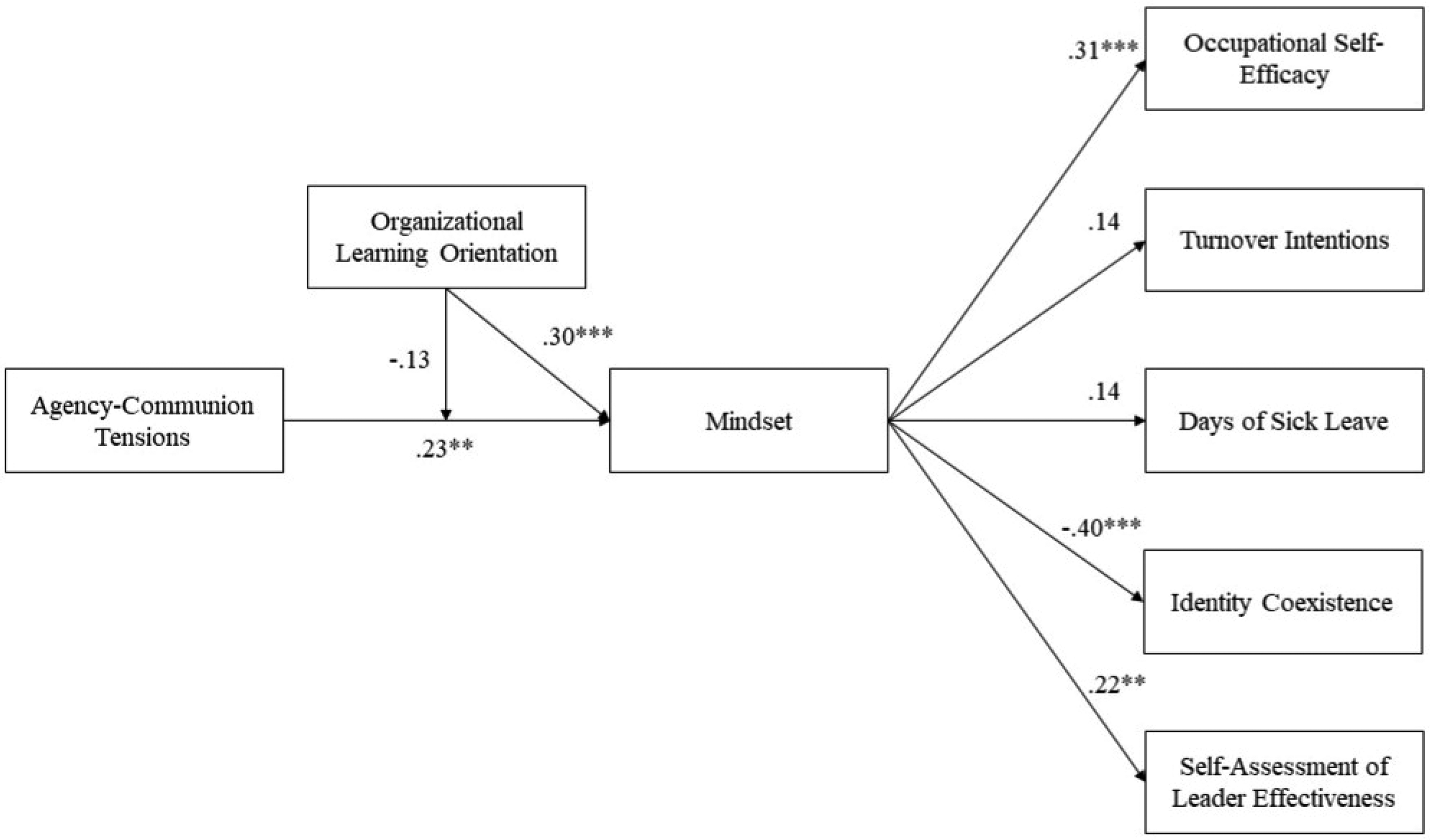
Study 2: Path analysis.
Furthermore, we examined Hypotheses 2–4 via a path analysis.
As exploratory analyses, we compared agency-communion tensions and identity coexistence between female and male leaders. Moreover, we examined Hypothesis 1-4 for male leaders.
We analyzed the data using R (R Core Team, 2025) and the following additional packages: car, version 3.1-3 (Fox & Weisberg, 2019), haven, version 2.5.4 (Wickham et al., 2023), Hmisc, version 5.2-3 (Harrell Jr., 2025), lavaan, version 0.6-19 (Rosseel, 2012), lsr, version 0.5.2 (Navarro, 2015), magrittr, version 2.0.3 (Bache & Wickham, 2022), psych, version 2.5.3 (Revelle, 2025), readxl, version 1.4.5 (Wickham & Bryan, 2025), rockchalk, version 1.8.157 (Johnson, 2022), semPlot, version 1.1.6 (Epskamp, 2022), and tidyverse, version 2.0.0 (Wickham et al., 2019).
Results
Descriptive statistics
Table 1 provides means and standard deviations for agency-communion tensions, organizational learning orientation, mindset, and outcome variables, separated by gender.
Study 2: Means and standard deviations for variables separated by gender
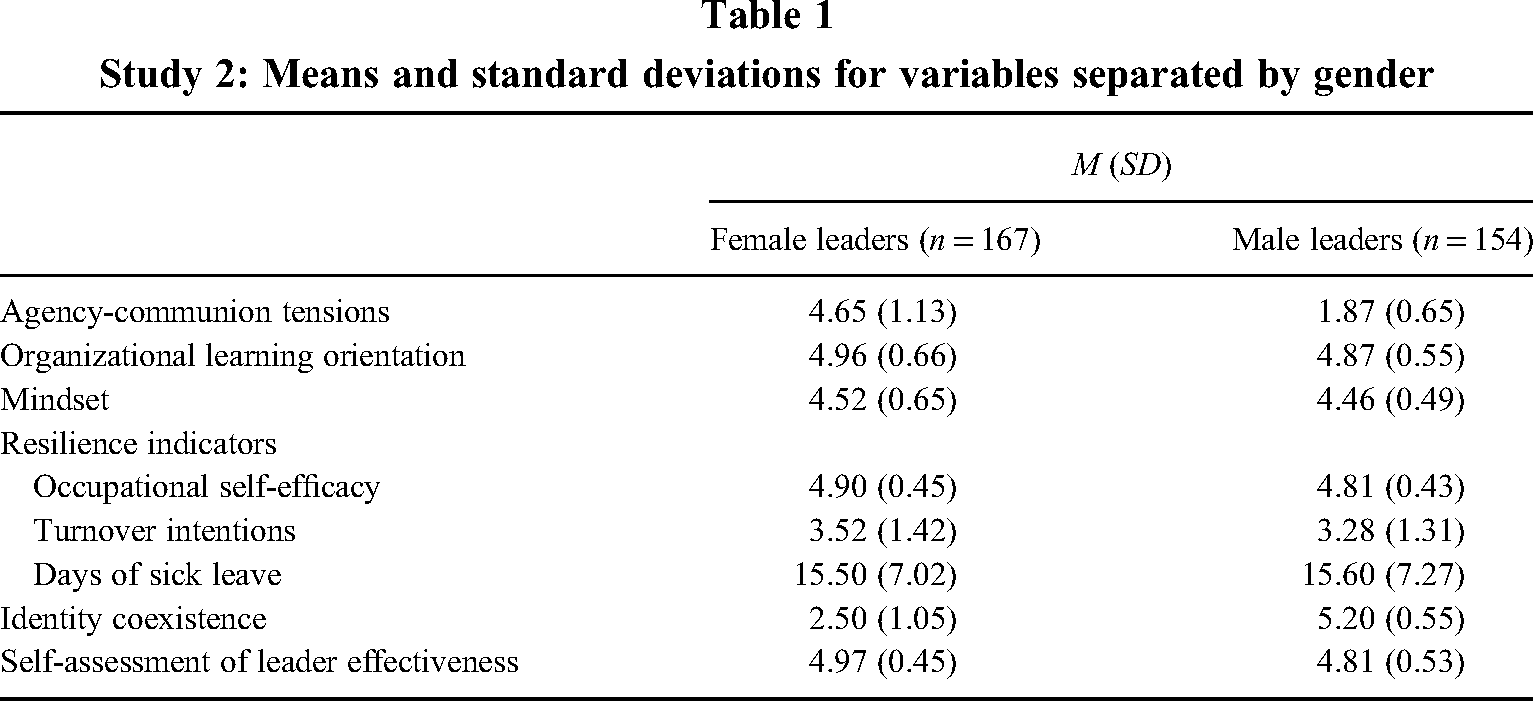
Table 2 provides bivariate correlations between outcome variables for female leaders.
Study 2: Bivariate correlations between agency-communion tensions, organizational learning orientation, mindset, and outcome variables for female leaders (n = 167)
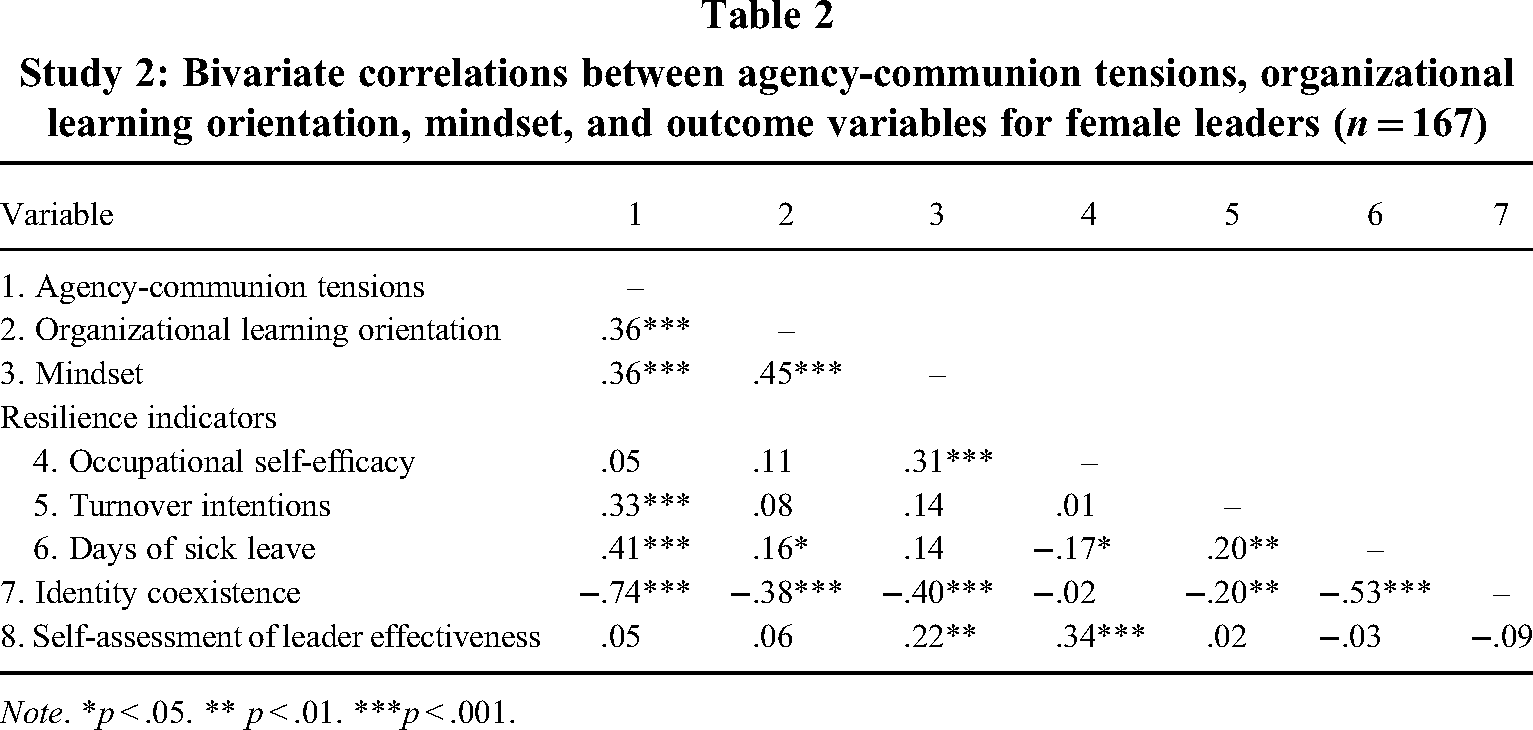
Note. *p < .05. ** p < .01. ***p < .001.
Hypothesis testing
The following analyses refer to the female subsample only. We conducted a path analysis on the proposed relationships (see Figure 2) of Study 2.
Hypothesis 1: Moderating effect of organizational learning orientation
The path analysis revealed that the relation between agency-communion tensions to mindset was not moderated by organizational learning orientation, B = ‒0.08, SE = 0.05, p = .092. However, the main effect of agency-communion tensions on mindset, B = 0.13, SE = 0.04, p = .001, as well as the main effect of organizational learning orientation on mindset, B = 0.30, SE = 0.08, p < .001 were statistically significant.
Hypotheses 2–4: Consequences of mindset adoption.
Resilience (Hypothesis 2)
Mindset was positively related to occupational self-efficacy, B = 0.22, SE = 0.05, p < .001. The paths from mindset to turnover intentions, B = 0.30, SE = 0.17, p = .077, and days of sick leave, B = 1.53, SE = 0.83, p = .065, were not statistically significant. Thus, there were mixed findings regarding Hypothesis 2.
Identity coexistence (Hypothesis 3)
Contrary to the presumed direction, mindset was negatively associated with identity coexistence, B = ‒0.65, SE = 0.12, p < .000 (i.e., the stronger the paradox mindset, the lower the identity coexistence). Thus, the results oppose Hypothesis 3.
Self-assessment of leader effectiveness (Hypothesis 4)
In line with Hypothesis 4, mindset was positively associated with the self-assessment of leader effectiveness, B = 0.16, SE = 0.05, p = .003.
Exploratory analyses.
Agency-communion tensions of female and male leaders
Female leaders experienced significantly higher agency-communion tensions (M = 4.65, SD = 1.13) than male leaders (M = 1.87, SD = 0.65), t(269.81) = 27.24, p < .001, d = 2.98.
Identity coexistence of female and male leaders
Female leaders indicated significantly lower identity coexistence for their gender and leadership roles (M = 2.50, SD = 1.05) than male leaders (M = 5.20, SD = 0.55), t(253.8) = ‒29.27, p < .001, d = 3.19.
Moderating effect of organizational learning orientation for male leaders
For male leaders, the path analysis revealed that the interaction between agency-communion tensions and organizational learning orientation was not significant, B = 0.03, SE = 0.06, p = .595, indicating no moderating effect of organizational learning orientation on the link between agency-communion tensions and mindset. However, there was a significant main effect of organizational learning orientation on mindset, B = 0.49, SE = 0.07, p < .001.
Consequences of a paradox mindset for male leaders.
Resilience
The path analysis revealed that mindset is positively related to occupational self-efficacy, B = 0.45, SE = 0.06, p < .001. The path between mindset and days of sick leave was significant, B = 4.18, SE = 1.14, p < .001, however, in the opposite direction as assumed. Mindset did not predict turnover intentions, B = 0.10, SE = 0.21, p = .647 (see Table 3).
Study 2: Summary of path analyses using mindset as predictor and resilience indicators, identity coexistence, and self-assessment of leader effectiveness as outcomes separated by gender
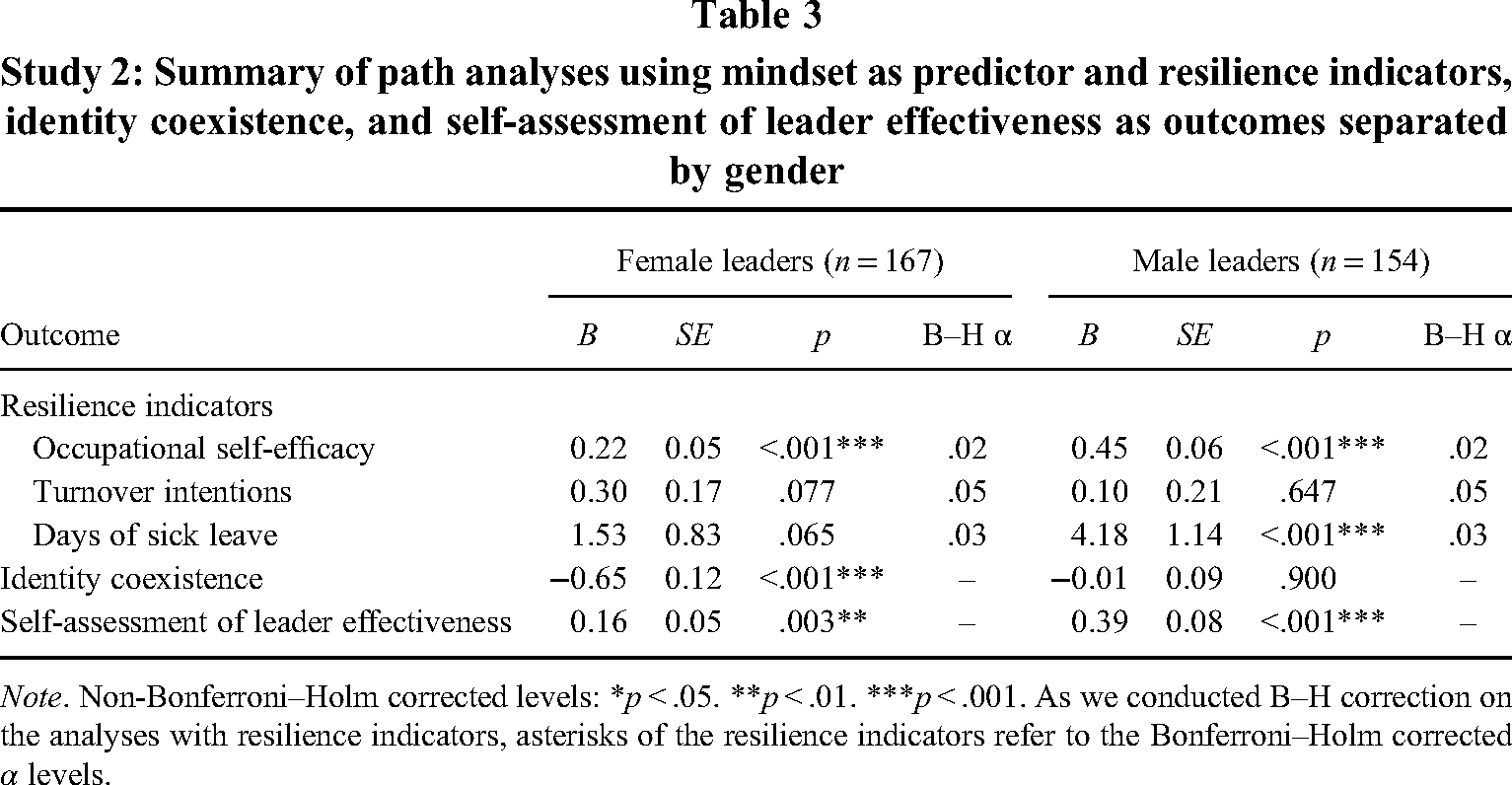
Note. Non-Bonferroni–Holm corrected levels: *p < .05. **p < .01. ***p < .001. As we conducted B–H correction on the analyses with resilience indicators, asterisks of the resilience indicators refer to the Bonferroni–Holm corrected α levels.
Identity coexistence
The relation between mindset and identity coexistence was not significant, B = -0.01, SE = 0.09, p = .900.
Self-assessment of leader effectiveness
There was a significant path between mindset and the self-assessment of leader effectiveness, B = 0.39, SE = 0.08, p < .001.
General discussion
This multi-study research, including an experimental study (Study 1) and a two-wave field survey (Study 2), provides first empirical findings as well as recommendations for further refinement of the core propositions of Zheng et al.'s (2018) theoretical model of agency-communion tensions among female leaders, their cognitive responses and the resulting consequences.
In Study 1, we identified organizational learning orientation as a supporting factor in adopting a paradox mindset when experiencing agency-communion tensions for female leaders, thereby providing support for the restrictive version of Hypothesis 1 derived from Proposition 2c (Zheng et al., 2018). However, this version of the hypothesis and, as a consequence, the research design of Study 1, did not allow us to test the main effect of agency-communion tensions or the moderation of the effect of agency-communion tensions on paradox mindset as a function of organizational learning orientation.
As these analyses were needed to draw comprehensive conclusions regarding the relationships between agency-communion tensions, organizational learning orientation, and mindset adoption, in Study 2, we investigated the proposed moderating effect of organizational learning orientation on the relationship between agency-communion tensions and mindset with the full range of tensions (i.e., Hypothesis 1—moderation version). Our data did not show the proposed moderating effect of organizational learning orientation on the relation between agency-communion tensions and mindset. However, additive main effects of agency-communion tensions and organizational learning orientation were found.
Findings on the link between mindset and resilience were mixed (Hypothesis 2): While Hypothesis 2 was supported for occupational self-efficacy, there were no significant relations between mindset and turnover intentions or sick days. There was a positive relationship between mindset and the self-assessment of leader effectiveness (supporting Hypothesis 4), but a negative relationship between mindset and identity coexistence (opposed to Hypothesis 3). This finding invites the critical reflection of the consequences, including potential downsides, of adopting a paradox mindset.
In Study 2, we additionally surveyed male leaders. For them, we also found a main (but not moderating) effect of organizational learning orientation on mindset. Looking at the consequences of adopting a paradox mindset, there were mixed findings regarding the link between mindset and resilience. Moreover, there was a positive relationship between mindset and the self-assessment of leader effectiveness, whereas there was no significant relationship between mindset and identity coexistence.
Overall, the results do not provide empirical support for several core propositions of the model by Zheng et al. (2018), which invites consideration of how to refine the model.
Refining the model
Based on our findings, we discuss four ways to refine the model by Zheng et al. (2018).
The role of agency-communion tensions
Our detailed discussion of Proposition 2c of the original model highlights the need to revisit the theorizing on the role of agency-communion tensions in the framework by Zheng and colleagues (2018). In developing two versions of Hypothesis 1, we demonstrated two possible ways to do so. Yet, we favor the moderation version as it provides a more precise formulation of the expected relationships and hence allows for a more comprehensive theorizing. In the following, we want to elaborate on this in further detail. Currently, in Proposition 2, on the one hand, Zheng and colleagues postulate moderating influences of different variables (e.g., organizational learning orientation) on “the relationship between women's experience of agency-communion tensions and their adoption of a paradox (dilemma) mindset” (2018, p. 589). On the other hand, however, when specifying these moderations, Zheng and colleagues postulate agency-communion tensions must be present in order to adopt a mindset (see for example in Proposition 2c: “[…] as they experience tensions from agentic and communal demands”; 2018, p. 589). This is in line with considerations above, stating that adopting a mindset is a coping response that is only needed when there is something to cope with (i.e., present vs. not-present agency-communion tensions; Zheng et al., 2018).
In our analyses, we addressed these inconsistencies as follows. In Study 1, through the between-group experimental fractional factorial design with organizational learning orientation only manipulated (high vs. low) in the agency-communion tension present condition, the analysis (i.e., using a t-test) straightforwardly accounted for the logic that mindset adoptions occur under the condition of existing tensions. At the same time, however, due to the fractional design, we were only able to test a restrictive version of Hypothesis 1.
In Study 2, due to the free variations of the independent (i.e., agency-communion tensions) and moderating (i.e., organizational learning orientation) variables, which was based on conducting the study in the field, we were able to investigate the moderation version of Hypothesis 1. Our findings show that when agency-communion tensions are present, female leaders are more likely to adopt a paradox (than a dilemma) mindset in an organizational context with a high learning orientation (Study 1). Study 2 revealed no significant moderating effect of organizational learning orientation on the relationship between agency-communion tensions and mindset adoption, but main effects of both agency-communion tensions and organizational learning orientation on mindset adoption. Thus, agency-communion tensions can activate a paradox mindset, but organizational learning orientation is not modulating this relationship. Organizational learning orientation appears to be a separate factor fostering paradox mindset adoption more generally (see positive finding for men).
The imprecision of the propositions in combination with our empirical findings raise an important question: Are agency-communion tensions a prerequisite (i.e., causal antecedent) of mindset adoption? 7 The present research invites a more integrated theorizing. As an individual psychological resource, (paradox) mindset is likely both activated by and shapes the coping with experienced tensions (for an empirical example, see Miron-Spektor et al., 2018). The first element (i.e., the activation) is proposed by Zheng et al. (2018) and was supported by the data of Study 2. However, the current framework neglects the second element, that is, that an individual's mindset moderates the relationship between experiencing tensions and relevant outcomes (e.g., resilience and leadership effectiveness). This integrated perspective is more likely to account for the fact that some (female) leaders effectively deal with experienced agency-communion tensions while others do not (in addition to organizational factors).
Organizational learning orientation and mindset adoption
Our data provided support for the effect of organizational learning orientation on mindset when agency-communion tensions were present (restrictive version of Hypothesis 1). More specifically, in Study 1, we found a positive effect of high (vs. low) organizational learning orientation on adopting a paradox mindset when experiencing agency-communion tensions. However, Study 2—taking into account the full range of agency-communion tensions—qualifies this finding by showing that there are main effects of organizational learning orientation and agency-communion tensions but no interaction effect. This finding does not support the model's proposition of a moderation. Interestingly, though, organizational learning orientation is identified as a contextual factor that independently of experienced tensions activates a paradox mindset as a coping strategy.
Overall, this empirical finding is not in line with Hypothesis 1 in its moderation version. However, it supports our general argument for the need to refine Proposition 2c of the original model by Zheng et al. (2018). In a broader context, this invites the reconsideration of the proposed “moderation effects” in Proposition 2c, but also 2a and 2b, which we did not test but are structured in the same way as Proposition 2c.
To tie in with the above discussed finding on the relationship between organizational learning orientation and mindset adoption (i.e., mindset being directly triggered by organizational learning orientation), mindset could also be a direct outcome of other constructs proposed in the original model (i.e., openness to experience, exposure to role models). If this is the case, and if paradox mindset is seen as a general coping strategy, then its role in the model might be as a moderator of the effect of agency-communion tensions on relevant outcomes.
Proposed consequences of mindset adoption
Our empirical investigation provides mixed findings regarding the proposed positive effects of paradox mindset on resilience, identity coexistence, and the self-assessment of leader effectiveness.
We only found positive correlations (Study 2) between a paradox mindset and measures of self-efficacy, but not the other postulated outcomes. More specifically, a paradox mindset was positively correlated to occupational self-efficacy, and self-assessment of leader effectiveness (which can be seen as a role-specific self-efficacy measure because of the way it was operationalized 8 ). We suggest that this may partly be due to the conceptual overlap between self-efficacy and paradox mindset. This becomes evident when looking at the measures used. For example, many items of the paradox mindset scale involve being comfortable or receiving energy from dealing with tough situations (e.g., “I am comfortable dealing with conflicting demands at the same time”; Miron-Spektor et al., 2018)—which is also indicative of a high self-efficacy. Therefore, we recommend further investigating the conceptual and empirical distinctiveness of paradox mindset from self-efficacy (e.g., Miron-Spektor et al. (2018) did not include self-efficacy to assess discriminant validity of their mindset scale) and in the meantime including self-efficacy as a control variable to investigate the unique effects of paradox and/or dilemma mindsets. More generally, the results show the importance of identifying specific effects of paradox/dilemma mindset on the experience and behavior of female leaders.
On a related note, contrary to the model's propositions, a paradox mindset does not relate exclusively to beneficial consequences. Specifically, there appear to be differentiated effects of mindset, sometimes a paradox mindset being superior to a dilemma mindset and vice versa. In Study 2, for example, holding a paradox mindset was related to less identity coexistence for female leaders. Interestingly, as a side note, a paradox mindset was positively linked to male leaders’ days of sick leave.
These mixed findings are also reflected in the literature. While a paradox (rather than a dilemma) mindset has often been related to beneficial outcomes and depicted as the favorable mindset (Gebert et al., 2010; Miron-Spektor et al., 2018), some work indicates that a paradox mindset might not always be superior to a dilemma mindset. For example, Zheng and colleagues discuss the possibility of a paradox mindset being not exclusively beneficial in their limitation section (e.g., “[…] there could be short-term setbacks from a paradox mindset and temporary reprieve from a dilemma mindset”; 2018, p. 593). These considerations can be embedded into recent discussions on paradox theory in general. Although there is no doubt that paradox theory has brought crucial findings to organizational research, it should be scrutinized “whether paradox theory could [be] trapped by its own successes” (Cunha & Putnam, 2019, p. 96). Kark and colleagues (2016), for example, describe a paradox mindset “may produce negative affect such as ‘stuckness', paralysis, feeling haunted, and confusion” (p. 311). Related, Smith and Lewis (2011) discuss a dilemma mindset, in contrast, might help in the short term in providing security when dealing with tensions (Zheng et al., 2018).
Possible explanations for the potentially negative effects of a paradox mindset could be as follows. A paradox mindset, through the urge to integrate both agency and communion, may entail reflecting on conflictual demands even more, eventually leading to feelings of overburdening. This aligns with previous research showing that, despite positive effects, self-reflection can also yield negative mechanisms, for example, rumination (Kross et al., 2023). Rumination, in turn, is linked to several negative outcomes (i.e., reduced performance, well-being; Baranik et al., 2017; Wang et al., 2013). Another explanation for the negative effects of a paradox mindset might be the overlooking of other (more fitting) strategies, when needed. Holding on to a paradox mindset when it should be discarded may result in negative outcomes. In addition, it is important to consider that sometimes, the most successful reaction to meeting conflicting elements might be a combination of different strategies (i.e., either-or, both-and, and more-than; Putnam et al., 2016). This also invites further investigation of the assumption that a paradox mindset is a resilience factor (i.e., a resource predicting resilience).
Female-focused nature of the model
One aim of this work was to investigate the female-focused nature of the model by Zheng et al. (2018). We raised the question of whether the model only applies to female leaders or should be expanded to include leaders of all genders who experience agency-communion tensions. To take a first step in this direction, we a) collected supplemental data on the agency-communion tension manipulation of Study 1 with a male sample, and b) included male leaders in Study 2. While the experimental design of the supplemental data demonstrates that men can indeed experience agency-communion tensions, the field data of Study 2 suggests that agency-communion tensions are much more prominent for female leaders. A substantive body of theory and evidence demonstrates why women experience more agency-communion tensions at work in general and in leadership position specifically (Eagly & Karau, 2002; Zheng et al., 2018). The stereotypical image of a leader is still congruent with what is expected of men (i.e., agency). Thus, on average, men will experience less—in the case of our study, far less—gender-based tensions in their leadership roles. However, as the understanding of leadership changes, men may be increasingly confronted with agency-communion tensions stemming from communal expectations toward them in leadership roles. Resulting from that, while agency-communion tensions are a much more pressing topic for female leaders, compared to male leaders, there is the possibility that male leaders also experience agency-communion tensions. Therefore, we recommend that the model includes leaders of all genders who experience agency-communion tensions.
Methodological reflections and limitations
Despite the insights gained from our studies, it is crucial to reflect on our methodological choices and note limitations. First, we used the mindset scale by Miron-Spektor et al. (2018) to assess paradox and dilemma mindset on a continuum. This is implied in the work by Miron-Spektor and colleagues (2018), even though the low endpoint is not explicitly defined as a dilemma mindset. At the same time, we acknowledge that the way we used the scale may not fully capture all facets of a dilemma mindset and that further research is necessary.
Second, we successfully designed an experimental manipulation of agency-communion tensions. However, the manipulation also included elements of a broader interpersonal conflict, which might have elicited additional types of tension as those between agency and communion. Moreover, in the manipulation there was not one single source but rather different factors that evoked agency-communion tensions based on the literature (e.g., Amaro & Scheepers, 2022; Heilman et al., 2019; Hentschel et al., 2021; Johnson et al. 2008). This was done to maximize the difference in agency-communion tensions between the experimental and control condition increasing internal validity. Future research could work on isolating specific sources of agency-communion tensions to analyze their distinct impact. Moreover, whereas the significant differences in experienced tensions between the experimental and the control condition demonstrate that the manipulation works, the tension values of the experimental condition are not on the high end of the tension scale. Future research may explore ways to elicit even stronger feelings of agency-communion tensions in experimental settings.
Third, in Study 1, we applied a between-subjects experimental design. Future research may also investigate the questions at hand by using a within-subjects experimental design. This could yield further findings that we were not able to assess via our research design.
Fourth, in our empirical investigation, we focused on organizational learning orientation as a potential moderator of the relationship between experienced agency-communion tensions and mindset adoption (Zheng et al., 2018). We did so because an organization's learning orientation is actively shaped by the organization. Yet, while we suggest a formal revisiting of the propositions on the other moderating factors in the original model (i.e., openness to experience, exposure to role models), we acknowledge that these may in fact be moderators of the agency-communion tensions-mindset adoption link.
Lastly, there were some differences between the samples of our studies. Whereas in Study 1, the sample was mostly German, the sample of Study 2 was more diverse in regards to nationality and, hence, cultural background (i.e., approximately half was Indian, followed by Italians, and Germans). On the one hand, this might be beneficial as it makes the findings more generalizable, and it would also be in line with the original theory, which does not speak of broader cultural influences. On the other hand, this may actually be a shortcoming of the theory, which needs further attention in the future.
Practical implications
Our findings have several implications for organizational practice. First, as Study 2 shows, female leaders experience significantly higher agency-communion tensions and significantly lower identity coexistence than male leaders. Given the goal of fostering diversity, equity, and inclusion in organizations, these findings point out that there still needs to be much individual, organizational, and systemic effort put into achieving gender equality in leadership.
Second, the direct effect of an organization's learning orientation and the adoption of a paradox mindset (generally and not only when experiencing agency-communion tensions) highlights the influence of the organizational context on female leaders’ experiences. On the one hand, this can be encouraging as it indicates that organizations have the potential to substantially improve the situation for female leaders, for example, by promoting such a culture within the organization (see for example Park & Kim, 2018). On the other hand, as our results and previous research show, a paradox mindset seems to be a double-edged sword. While it seems beneficial in some areas (i.e., self-efficacy), it may also cause unwanted results (i.e., more days of sick leave, less identity coexistence). Therefore, when considering promoting an organization's learning orientation or paradox mindset among female leaders, we recommend being considerate and carefully weighing potential benefits and threats.
Conclusion
By bridging the gap between theory and empirical investigation, we have taken an important step in advancing our understanding of the model by Zheng and colleagues (2018) and the role of agency-communion tensions for female leaders. Our research points to necessary refinements and deduces implications for further exploration of agency-communion tensions and their consequences. In addition, the empirical examination enhances the practical relevance of theoretical propositions, allowing organizations to make informed decisions and implement evidence-based strategies to support female leaders in navigating the complexities of agency-communion tensions. Our findings serve as a reminder that men and women are still facing different challenges in their leadership, which we need to address to achieve gender equality.
Supplemental Material
sj-docx-1-msr-10.1177_27550311251357944 - Supplemental material for A matter of mindset? A multi-study exploration of agency-communion tensions and emerging mindsets among female (and male) leaders
Supplemental material, sj-docx-1-msr-10.1177_27550311251357944 for A matter of mindset? A multi-study exploration of agency-communion tensions and emerging mindsets among female (and male) leaders by Stefanie Krauth, Martin P. Fladerer, Melissa M. Hehnen and Dieter Frey in Journal of Management Scientific Reports
Footnotes
Acknowledgments
We would like to express our gratitude to the Editor Scott Seibert and the Reviewers for their guidance and invaluable comments throughout the review process. Also, we would like to thank Ruchi Bhatt for supporting us in collecting data for Study 2.
Declaration of conflicting interests
The authors declared no potential conflicts of interest with respect to the research, authorship, and/or publication of this article.
Funding
The authors received no financial support for the research, authorship, and/or publication of this article.

Supplemental material
Supplemental material for this article is available online.
Notes
References
Supplementary Material
Please find the following supplemental material available below.
For Open Access articles published under a Creative Commons License, all supplemental material carries the same license as the article it is associated with.
For non-Open Access articles published, all supplemental material carries a non-exclusive license, and permission requests for re-use of supplemental material or any part of supplemental material shall be sent directly to the copyright owner as specified in the copyright notice associated with the article.
