




Abstract
For autistic people in employment, the education sector is a popular field in which to work. Given the barriers that autistic people often face when disclosing autism and seeking workplace adjustments, understanding what creates an inclusive workplace without the need to seek adjustments is important for supporting equitable employment. In this autistic-led and co-produced study, 14 autistic educators working in schools in the United Kingdom wrote online diary entries over one month detailing their ongoing experiences of inclusion and exclusion at work. Thirteen of these respondents were subsequently interviewed about their experiences and, together, the data were analysed using reflexive thematic analysis with an inductive approach. Autistic educators reported facing ongoing exclusion in the school workplace, with their inclusion often dependent on the highly variable individual views of colleagues, stigma about autism and systems of poor communication. Encouragingly, however, some educators reported working in predominantly inclusive schools where their professional expertise was valued. These school cultures were described by participants as non-hierarchical, where autistic educators had control and autonomy over their roles and environments, which created a culture of inclusion for all staff and students regardless of whether they were autistic.
Plain Language Summary or Lay Abstract
Why did we do this research?
Autistic people have highlighted that research into supporting their employment is important to them. Autistic people have low employment rates, and while the education sector is often popular among autistic graduates, little is known about feasible methods for making schools inclusive for them. Inclusion is crucial as some may not be able to disclose autistic identity to access workplace adjustments. We wanted to know how autistic educators in schools experience inclusion and exclusion in their daily working lives.
How did we do this research?
We asked autistic educators working in UK schools to complete online diary entries for one month, explaining their ongoing experiences at work. Fourteen educators from various roles and school types participated. We then invited them to an interview to discuss their diary entries. Thirteen participants agreed to be interviewed. We grouped their responses into themes.
What did we find out?
Autistic educators told us that they often experienced exclusion at work, facing negative attitudes about autism and poor communication. However, some worked in inclusive schools where their work was valued. These educators had control over their working environment and role and were respected and encouraged by leaders to share their particular knowledge and interests.
What do these findings mean?
This study shows the ways that school cultures include and exclude autistic educators. By analysing their everyday experiences, we can identify ways to make schools and other workplaces more inclusive. This can make disclosure a choice instead of a necessity to access the workplace.
Introduction
This work sits at an intersection between two employment challenges in the United Kingdom (UK): that of the autistic population and that of the education sector more broadly. On the one hand, data from the UK, the context for the current study, show that only around 30% of autistic adults are currently in full-time employment (The Department for Work and Pensions, 2024). Furthermore, autistic people have the highest pay gap between disabled and non-disabled people out of every disability group, suggesting widespread underemployment and precarious employment (Buckland, 2024). These concerning statistics have resulted in repeated calls from the autism community to prioritise research into daily life, including skills, employment and well-being, and to develop meaningful, inclusive employment and careers for autistic people (Davies et al., 2024).
On the other hand, the education sector is in an employment crisis, which is frequently at the forefront of national political discussion. More than half of teachers have actively sought other employment while teaching (Savill-Smith & Scanlan, 2022). There were 400 fewer full-time teachers in England in 2024 compared to the previous year (Department for Education, 2025), with the current government aiming to recruit 6,500 more (Phillipson, 2024). Only over two-thirds (67.6%) of teachers who qualified five years ago are still teaching (Department for Education, 2025). Furthermore, there are no national data about the disability status of teachers (let alone, specifically, what proportion are autistic) with schools not providing disability status data for 59% of teachers (Department for Education, 2025). Yet, we do know that the education sector broadly is popular for self-reporting autistic graduates to enter: 18% of autistic graduates enter the field, including schools and higher education, making it the most frequent destination, placing it above science and technical fields (Vincent & Ralston, 2024).
These intersecting challenges provided the impetus for the current research, where we sought to understand the inclusion and exclusion experiences of autistic educators working in UK schools.
Autistic educators
Predominantly, studies on autistic teachers have qualitatively explored their lived experiences, in addition to there being illuminating first-hand accounts (Wood, 2022). In some instances, a teaching career has been framed positively, with teachers mapping out their autism-specific skillsets and the benefits of diverse thinking in school settings, especially when identifying novel ways to support pupils (Lawrence et al., 2021; Wood, 2022). Monotropism has been identified as one key way that teachers not only develop deep enthusiasm in their careers but also use focused interests to cultivate empathetic relationships with similarly minded pupils (O’Neill & Kenny, 2023).
In many other instances, however, frequent employment challenges persist for autistic teachers. One survey involving 149 autistic teachers and education staff noted that respondents felt the need to mask their autistic identity and feared accidentally revealing it to those around them, with 55% of those no longer working in schools – contributing to the employment crisis in education noted above – and 35% of those still working in school saying that no one at work knew they were autistic (Wood & Happé, 2023). This continuous self-monitoring often causes anxiety, exhaustion and burnout (O’Neill & Kenny, 2023; Wood & Happé, 2023). Fast-paced environments and an absence of breaks can also lead to overwhelm, with participants in one study of four autistic teachers reporting struggling to reach the end of each working week (O’Neill & Kenny, 2023). Furthermore, sensory difficulties in the school environment were reported by all (n = 21) participants interviewed by Wood et al. (2024). Combined with difficulties in forming social connections, this sensory overload may lead to teachers leaving the profession (Wood, 2024).
The few existing studies with autistic educators have brought to light both their challenges as well as their workplace strengths. The current autistic-led and co-produced study sought to extend this understanding by focusing on the more elusive and intangible manifestations of workplace cultures by directly asking autistic educators about their ongoing experiences of inclusion and exclusion. It is situated within a broader research project that seeks to identify practicable workplace inclusion measures, drawing on the perspectives of autistic educators in addition to the school leaders and teacher-colleagues (who may or may not be autistic themselves) who cultivate the ethos and climates of their workplaces.
Inclusion in schools and workplaces
The school sector is significant in examining inclusive work cultures given longstanding focus on student inclusion practices. A ‘Quality First’ provision, which considers how strong lesson-planning for special educational needs (SEN) can support all students, has become an expected standard of practice, rolled out to schools and teacher-training programs over the last decade (Department for Education, 2015). This shift towards inclusion is by no means a comprehensive success in supporting students, with ongoing exclusion pervasive (Daniel, 2025; Keegan & Barclay, 2023; Pellicano et al., 2018), yet reflects a wider shift from differentiated instruction in classrooms to a model that expects all students to access the same curriculum.
Challenges in cultivating workplace inclusion within the education sector are mirrored across broader workforces, underscoring the need to understand inclusive cultures, particularly amid wider issues with disclosure and disability accommodations at work. Over half (53%) of participants in a neurodiversity employment survey that focused on autistic employees and jobseekers (n = 206) reported being unable to ask for adjustments, having them refused or finding them to be poorly implemented (Heasman et al., 2020). Autistic individuals often face stigma, practical challenges and difficulties identifying their own needs when requesting adjustments (Davies et al., 2022), highlighting the paradox of navigating social protocols while seeking support during a crisis (Sandland, 2024). Autistic people often disclose selectively. In one Australian questionnaire study, one third of participants (n = 129) reported disclosing only in specific circumstances, identifying particular difficulties doing so within workplaces due to fear of being perceived as less competent (Huang et al., 2022). This uncertainty about the attitudes of others at work is reflected in a systematic review, which found that the support and knowledge of co-workers and employers are factors affecting accommodation requests (Lindsay et al., 2021). In a survey on workplace disclosure experiences in the UK, Romualdez, Heasman et al. (2021a) found that, while a third of participants reported post-disclosure adjustments as positive, almost as many had negative or neutral views about these changes. Early disclosure can also carry costs: In the United States, applicants who disclosed disabilities received 26% fewer employer responses (Ameri et al., 2018). Given the challenges in formal accommodation processes, a UK government report suggests making inclusion the default practice to reduce the need for specific disclosure (Buckland, 2024).
The social model of disability in autism research (for a recent overview, see Bertilsdotter Rosqvist et al., 2025) explains that disability arises from societal barriers and does not view autistic traits as essentially pathological. Aligned with this relational and context driven view, organisational culture theory highlights the role of work cultures such as the norms, attitudes and behaviours over individual traits in shaping individual experiences and outcomes at work. Within schools, inclusion has often been framed around students. Reflecting on Schein's (2004) notion that organisational cultures are built on shared assumptions and beliefs, Ainscow and Sandill (2010) present student inclusion as dependent on forms of leadership that continuously focus on social attitudes, relationality and context, as opposed to mechanical processes. More recent work extends this contextual approach to staff, with Ainsworth and Oldfield (2019) and Oldfield and Ainsworth (2022) identifying that the resilience of UK teachers depends as much on contextual factors such as school culture, management and colleague support than individual factors such as self-esteem and self-care. In light of the social model of disability, the challenges faced by autistic teachers can be contextualised not within the traits of autistic teachers themselves but within the occupational cultures and contexts that exclude them.
The Current Study
This study, therefore, aimed to understand the views of workplace inclusion and exclusion as experienced by autistic educators, with a specific focus on inclusion as opposed to workplace adjustments given the barriers of seeking adjustments often experienced by autistic people. In particular, we focused on ongoing experiences by inviting autistic educators to complete online diary entries over one month detailing their current work lives. We sought to capture the more subtle and implicit aspects of school interactions, informal processes, norms and cultures that influenced their sense of inclusion. These elements of interaction were revealed through the ongoing reflections provided in the diary entries and subsequently elaborated on within in-depth semi-structured interviews.
Methods
Community involvement: Advisory group
An Advisory Group of four autistic adults with varied experience working in the education sector collaborated on the study design and analysis over the course of the study, aligning with inclusive research principles (Fletcher-Watson et al., 2021). This group provided expertise beyond the first author's lived experience of being an autistic teacher, encompassing a diversity of gender, race, teaching roles and types of schools worked in, developing a study design and analysis that reflected on intersecting autistic teacher identities. All were paid for their time and three have agreed to be named as authors.
Participants
Participants (Table 1) were recruited through the autism research network, Autistica, neurodivergent educators’ social media groups and personal contacts within the education sector. Most participants were women (n = 11), and all were white British (n = 14). Half were classroom teachers (n = 7) and almost a third held a post of either middle or senior leadership in their schools (n = 4).
Socio-demographic Information for Study Participants.

Special Educational Needs and Disability Coordinators (SENDCos) are qualified teachers who lead provision for children with special education needs in schools. They are part of either a school's middle or senior leadership team.
Local authority school: a state-funded school managed by the local council; Academy: a state-funded school operating independently of the local authority with greater control over curriculum and finances; Free school: a type of academy started by groups such as parents, charities or trusts, funded by the government but operating independently of the local authority; Private school: an independently funded school that charges tuition fees and is not governed or financed by the state; Special school: a school designed to support students with special educational needs.
Procedure
Ethical approval was granted by the UCL Research Ethics Committee, ID: 26315/004. All participants gave written, informed consent to take part and for publication, prior to participation. This study was divided into three parts: (1) a background questionnaire, (2) diary entries and (3) semi-structured interviews.
Background Questionnaire Participants completed a questionnaire on Qualtrics asking them about their age, gender identity, ethnicity, autism diagnosis, highest education level, the school type they work in, their role and how long they have worked as an educator. This information was sought to understand participants’ diversity, and how autistic identity may intersect with other characteristics in relation to inclusion and exclusion. All Qualtrics data were transferred weekly to a secure, password-protected university drive and then deleted from Qualtrics. Identifiable data were stored separately from non-identifiable information and pseudonyms were assigned. Diary Entries Over one month, participants used Qualtrics to diarise their workplace experiences of inclusion and exclusion online, with optionality for typed or audio-recorded entries. We prompted participants with submission links at the end of each week for four weeks, asking them to respond to at least three of these links at a time of their choosing describing events at work, including those involved, and their reflections. This diary method aimed to capture ongoing inclusion experiences within participants’ contexts (Bolger et al., 2003). Some participants chose to document various points across their week in one submission, while others described one event with each submission. We received 31 diary entries from all participants (M = 728 words per participant, across entries). Five respondents participated fully (3–4 entries), six respondents had medium participation (2 entries) and three respondents participated minimally (1 entry). Semi-structured Interviews The diary entries formed the basis for semi-structured interviews. While the diaries captured ongoing experiences, the interviews allowed deeper exploration of specific aspects of inclusion. After completing their entries, we invited all participants to interviews lasting approximately one hour, either face-to-face, live video, phone, email or messaging system according to participants’ preferences (Howard & Sedgewick, 2021). Thirteen of the 14 participants agreed to be interviewed. Two opted for email interviews, and the rest chose video interviews, which were between 35 and 80 min long (M = 55 min). We used Microsoft Teams to record and transcribe interviews. These were then pseudonymised and saved with diaries, with recordings and transcripts then deleted from Teams. The format of semi-structured interviews allowed us to elaborate both on diary entries and to focus on specific questions we had developed about their experiences of disclosure, accommodations and views on inclusive workplaces. These questions (see Supplementary Materials) were informed by extensive discussions with Advisory Group members and the broader literature on autistic employment.
Data analysis
Data were analysed using reflexive thematic analysis (Braun & Clarke, 2006, 2021), using an inductive approach within a critical realist framework, managed in NVivo version 14 (release 1.7.2). Critical realism in disability research acknowledges the reality and experience of a disability while also recognising that attitudes towards disability shape how this is then interpreted and understood (Bhaskar & Danermark, 2006). This approach allowed us to take a bottom-up approach in our coding to explore how inclusion and exclusion in the workplace might be experienced when there is no developed conceptual framework for this in relation to autistic educators. Codes and themes were developed iteratively through familiarisation, discussion and review by all authors. JS maintained a research diary to document thoughts and interpretations while reviewing diary entries, conducting interviews and transcribing and analysing data. We chose a reflexive approach, in line with critical realism, to acknowledge the inherently subjective nature of data analysis (Braun & Clarke, 2021). Reflexivity allowed us to address the data through the autistic, insider perspectives of both the Advisory Group members and the first author, as well our broader alignment with the social model of disability. Reflexivity also acknowledges historical challenges in autism research, where researchers’ views have the potential to dehumanise or objectify autistic people (Botha & Cage, 2022). All diary entries and transcripts were pseudonymised before analysis.
Results
We identified four themes in autistic teachers’ responses (see Figure 1), described in turn below. Quotations are attributed with pseudonyms chosen by participants or otherwise assigned and their school role (see Supplementary Materials for additional supporting quotes).
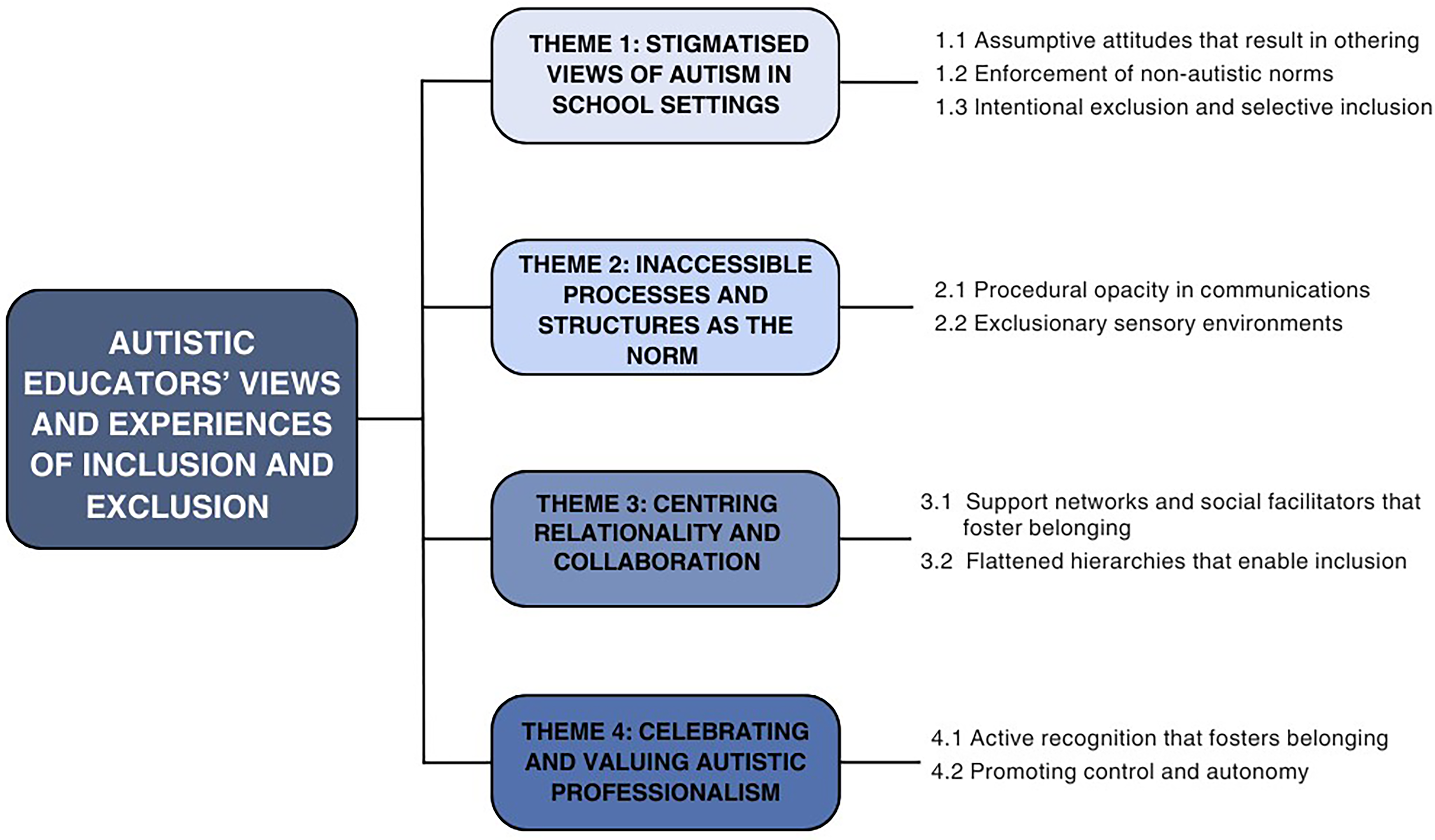
Themes and Subthemes Developed From Analysing Diaries and Interviews.
Theme 1: Stigmatised views of autism in school settings
Participants repeatedly described societal judgement about autism leading to their specific experiences of marginalisation. School settings gave this stigma specific nuance: educators felt othered both by pressures to conform to norms and by witnessing the mistreatment of neurodivergent students. Their individual professional identity was further challenged by autism's association with childhood, making their status as adult autistic professionals seem paradoxical.
Subtheme 1.1: Assumptive attitudes that result in othering
Respondents described an entrenched sense of marginalisation at work due to stigmatising assumptions held about autism. Judgement came from the false dichotomies that one can be either autistic or a professional, but that being an autistic professional were not compatible identities, with educators explaining having to ‘do twice as good a job’ (AA, classroom teacher) to demonstrate their capabilities as autistic colleagues. Misconceptions about autism in schools were perceived to be pervasive, with respondents noting the negative preconceptions of others, ‘people have described me as “cold” or “aloof”’ (AN, senior leader), and wishing they could personally alter and challenge these perceptions: ‘those sort of assumptions about me – I wish I could have raised them’ (Elena, classroom teacher). In particular, respondents noted feeling infantilised because of their autistic identity, especially in a school context where most professionals’ ‘main exposure to people with autism are children’ (AS, teaching assistant). This evoked a fear of disclosing in case respondents were then treated ‘like one of the kids’ (Freya, deputy Special Educational Needs Coordinator (SENDCo)).
Personal exclusion experienced by staff was amplified by also witnessing the exclusion of neurodivergent students. Some respondents described a staffroom culture of commenting negatively about autistic children: ‘there are, like, comments made in the staff room, they’re not jokes, but kind of like the way that they talk about some pupils, I don't think they would say it in front of their parents’ (Freya, deputy SENDCo). Another respondent reflected on working previously in a special school where the staff ‘were really rude and derogatory about the students, which was really nasty’, which meant ‘there's no way I would have told staff widely there that I was autistic’ (Nova, SENDCo).
Subtheme 1.2: Enforcement of non-autistic norms
Such deficit-based views about autistic identity within schools were felt to carry shame and, as such, respondents described self-monitoring as a response to this collective judgement and stigma: ‘I mostly internalised my worries as I felt like I would be judged if I tried to express what was happening’ (AG, trainee teacher). They were also worried about having opinions of them revised and therefore masked their autistic identity: ‘I don't really want the first thing that people know about me to be that I'm autistic because I find it often just alters the way that they treat you’ (AS, teaching assistant). Masking was depicted by multiple respondents as exhausting and further compounded their challenges at work because they could ‘mask so well, people forget’ (Kayla, classroom teacher). Respondents highlighted the profound difference between how they were in school compared to at home, with this duality having a profound impact on their home life: ‘I do that: I get up. I go to school, I come home and I have a meltdown’ (AL, SENDCo). When this marginalisation occurred over extended periods of time, participants described hypervigilance that became chronic and resulted in experiences of anxiety. Elena, a classroom teacher, explained how past workplace bullying affected current working relationships: ‘it should have no effect on my life, but it still affects my day-to-day life and it is in my thoughts during most interactions at work in particular’. Lyra (science technician) reported how past neurotypical accountability standards, ‘targets set in the past which are literally like things I can't control because I'm neurodivergent’, impact ongoing line-management relationships: ‘performance management is one of the areas that makes me most anxious’.
Subtheme 1.3: Intentional exclusion and selective inclusion
Educators reported that, within some workplace cultures, autism accommodations were treated as voluntary by others rather than essential. Within these contexts, decisions about the provision of adjustments were not systematically implemented but were often shaped by the personal attitudes of others and misconceptions. One deputy SENDCo described how a reasonable adjustment they had in place for two years was later challenged by a senior leader and Human Resources (HR) as they maintained that ‘reasonable adjustments are not forever’ (Freya). Others found their requests for work adjustments were routinely ignored, signalling to them that their inclusion was precarious and conditional. One participant working in an autism resource base explained that, despite asking for adjustments for certain school events, they had not received a response, and accommodations were still not provided even when their line manager followed up on their behalf (AQ). Others reported that the use of accommodations was shaped by interpersonal relations rather than policy: Being a part-time autistic teacher means I often find out about things after everyone else… I questioned a decision made this week, I was point-blank told ‘the decision has been made as we knew you would question lots, so the decision has been taken without your questioning’ (Hilary, middle leader).
Theme 2: Inaccessible processes and structures as the norm
Respondents found that normalised workplace practices often led to important information being channelled through inaccessible means, preventing them from carrying out their jobs effectively. This was particularly the case with entrenched, opaque communication practices and environments with sensory barriers.
Subtheme 2.1: Procedural opacity in communications
The communication challenges described by participants in accessing accommodations were pervasive in other areas. Often, this was due to communication norms that were embedded in unclear processes or unwritten rules: ‘I went into work and I had the SENDCo officer telling me one thing about a student and I have the head of the department telling me to do something else’ (AS, teaching assistant). This lack of clarity extended to external societal systems that are in place to support workplace inclusion, with one respondent explaining that in a phone call with Occupational Health about Access to Work, a UK Government scheme for disabled people to start or stay in work, ‘the lady on the phone didn't explain it like at all’, which meant that ‘in hindsight, I should have done it, but I didn't understand it’ (AL, SENDCo).
Communication characterised by hidden or implicit expectations impacted educators across experience levels, with one middle leader explaining how, when managing a new team, ‘the rest of the team have worked together for years and from my viewpoint have not been very helpful when I have asked for help about how things work and expectations’ (AT). Other challenges with communication appeared within climates marked by continuous and rapid change, ‘the information is changed, then I make a mistake and I get told off for it when I haven't been told’ (AS, teaching assistant). Being placed on last-minute cover for different classes was noted by multiple participants as a challenge specific to the school workplace. Sometimes this disruption was intensified by organisational structures, for example, a disconnect between what was known by the school and on an academy trust level: ‘the head came down to me when I was in the middle of teaching. She was like ‘HR, have just arrived’. She didn't know they were coming either’ (Nova, SENDCo).
Subtheme 2.2: Exclusionary sensory environments
Dominant and unquestioned norms about the sensory environment were described by autistic educators as exclusionary, ‘if the staff room is meant to be the place that you go to get away from your classroom, that doesn't work for me because I’m completely overwhelmed’ (AT, middle leader). This affected not only their individual work but also social interactions and connections with colleagues that support career development. For example, during professional development, ‘at lunchtime I didn’t feel I could walk into the busy, noisy lunch hall with the other staff … I therefore stayed in my workshop room by myself. I felt a bit left out’ (Hilary, middle leader). The sense of exhaustion from sensory overwhelm was often described as something that has made their jobs increasingly untenable, ‘I don't think that I'm able to work at proper capacity here because my brain's just fried’ (AS, teaching assistant), an aspect that was not felt to be understood by others, ‘I got the impression they kind of went, oh, you're a bit sensitive to sound rather than going, no, that's a full-blown issue. It's far too loud in there for me’. Physical environments were not just inaccessible from an autism perspective, but for those with additional health needs: ‘I did phrase it as a reasonable adjustment because of, not just autism. I was just like, I have a lot of medical appointments’ (Nathan, classroom teacher), and ‘I've had long COVID as well’ (Hilary, middle leader), highlighting the complex layers of marginalisation that are created when inaccessible structures are embedded in the workplace.
Sometimes, broader societal factors beyond the remit of the schools themselves impacted the sensory environment. Some educators described demographic changes in the wider community that influenced their inclusion. This was particularly significant when concerning students with SEN. One teaching assistant explained that a lot of the ‘special needs schools were closed down in the area I live’ (AS), which resulted in a ‘complete lack of resources’ to support the arrival of students with much more complex needs. One SENDCo highlighted that despite the ‘underlying SEN needs’ being high in particular classes, they ‘have 31 children in a class that should have a maximum of 25’, which lead to this respondent coming ‘home totally overstimulated’ (Nova).
Theme 3: Centring relationality and collaboration
Despite the prevalence of structural inaccessibility, this was sometimes outweighed by a sense of belonging fostered by school cultures that valued connection, trust and mutual support, and where these were privileged over strict hierarchies.
Subtheme 3.1: Support networks and social facilitators that foster belonging
Sometimes, having a trusting relationship with at least one colleague acted as a facilitator for social inclusion. For one early-years teacher, ‘for the first time since I started working at the school I feel as though I belong in a social group. This is entirely down to my nursery nurse’ (AA). These colleagues helped navigate the social terrain, which Kayla, a classroom teacher, described as ‘somebody to kind of point out this is what we're doing and this is how it's done’. Where participants lacked this connection, they describe stress, anxiety and exclusion, with one middle leader describing the desire to have the ‘opportunity to have a buddy to check in’ for specific overwhelming events (Hilary).
This relational trust was augmented by colleagues’ awareness of autistic differences or individual needs. Lyra (science technician) noted a broader culture of trust through individual understanding and connection when, in one instance, a manager had adapted a performance review deadline because ‘she could tell I was having a hard sensory day’. Similarly, one SENDCo explained how their headteacher could ‘read your face’, which would change their approach and provide a ‘soft start’ on certain days (AL).
Subtheme 3.2: Flattened hierarchies that enable inclusion
Schools that were described as less hierarchical provided the means for trust, connection and collaborations to develop, which increased a sense of shared belonging. Elena, a classroom teacher, gave an example of having the opportunity to present at an optional well-attended talk to colleagues about autism practice. Kayla, a classroom teacher, described an adjunct opportunity to mentor autistic students. Lyra, a science technician, highlighted a time of feeling ‘especially included’ when the ‘SENCO explicitly reached out to neurodivergent staff members’ to share ideas for improving the inclusion of neurodivergent students. Nova also explained how personal experience and SENDCo expertise came together when delivering staff training, ‘it's having a culture of everyone can learn from everyone. It doesn't matter who has been teaching for longer. Everyone's willing to learn the whole time. There's not this hierarchical culture’.
Theme 4: Celebrating and valuing autistic professionalism
In contrast to school cultural norms that stigmatised autism, resulting in pressure to conform, respondents described inclusive workplaces as, while still recognising different needs, celebrating staff uniqueness and strengths more broadly. This then shaped their individual trajectories of career progression and professional development.
Subtheme 4.1: Active recognition that fosters belonging
Within schools with more flattened hierarchies and relational cultures, some respondents described being able to thrive as recognised experts, with their professional perspectives, often grounded in their autistic experience, being valued. Some educators who are openly autistic at work were pleased when others asked them questions about autism directly because it provided ‘the opportunity to explain why and then for them to have the opportunity to understand’ (Elena, classroom teacher). These broader collegial attitudes sometimes intersected with positive professional identities on an individual level. Participants described autistic characteristics, such as monotropic interests and insider understanding of autism, as an important part of professional identity. Elena further described the relationships built between neurodivergent staff and students as a natural ‘affinity’. Nathan, a classroom teacher, said, ‘I put everything into my work. It's my special interest, like, I do everything all about work’. Similarly, one classroom teacher referred to their work as an intense passion, ‘I love working in early years and I do a lot of research about early years’, ‘I feel early years it's like my thing’ (AA), having also just completed a course on management for early years’ practitioners.
For some, this positive sense of self was bolstered by school cultures that actively sought to recognise successes, furthering their individual career progression. Freya described this active celebration, ‘I was praised by my line manager for the work that I have done to help the department and in my new role as Deputy SENDCo. She made me feel valued and part of the team’. Nova described the vote of confidence received when becoming the school SENDCo even though the academy trust wanted a part-time external hire, ‘at school level, it was the head who gave me the job and wanted me to have it’, describing this relationship with the headteacher as ‘amazing’ and supportive. Thus, belonging was fostered through the recognition of uniqueness, explicit celebration, as well as embedding those with unique experiences and identities within school strata.
Subtheme 4.2: Promoting control and autonomy
Central to valuing autistic professionalism was being afforded control and autonomy over roles and the working environment, with educators describing being trusted to meet their autistic needs. By being able to adjust the sensory environment of the classroom, one participant noted a ‘brilliant year’ because ‘it was a very calming classroom. That was all part of the making it like that deliberately – and getting away with it’ (AA). For others, the ability to be more flexible about where they worked when completing administrative parts of their jobs made the work more accessible. For Hilary, a middle leader, being able to complete planning at home led to ‘less sensory overwhelm’ and was ‘really productive’. Others noted that while the flexibility they experienced in their current roles made a ‘massive difference’, ‘not all heads are that flexible. So, like, in my previous school, my old head would not have accepted that whatsoever’ (AL, SENDCo).
Discussion
This study aimed to understand autistic educators’ views of their workplace inclusion by eliciting their ongoing work experiences through an in-depth diary entry writing process and reflective interview. Aligning with broader literature on challenges faced by autistic educators, participants reported inaccessible environments and processes, along with autism misconceptions, particularly regarding autistic adults. As we did not pre-define inclusion and exclusion for the diaries, participants’ entries reflected a wide range of workplace experiences, combining accommodations with broader school culture dynamics. This specific approach brought these more abstract elements of the workplace into sharper relief, such as the role of school hierarchies and the mutable attitudes of colleagues, leaders and academy trust personnel, upon which receiving requisite support often depended.
Precarious systems for those with stigmatised identities
Our respondents emphasised ongoing stigma attached to autistic identity in school workplaces, complicating decisions about disclosing autism. Misconceptions and preconceptions about autism are key considerations for autistic people when deciding to disclose (Buckley et al., 2021; Curnow et al., 2025; Sarrett, 2017), and working in a school seems to exacerbate these challenges as colleagues perceived autism from a childhood perspective, not understanding this identity as it pertains to adulthood. Not only did this create fear amongst respondents about appearing incompetent and being infantilised but alludes to a wider fallacy within the education system where the support that teachers provide to students is not extended to the staff themselves (Curnow et al., 2025; Ware et al., 2022; Wood & Happé, 2023).
Respondents reported feeling compelled to mask this stigmatised identity, resulting in unmet needs. Masking, where autistic people suppress natural behaviour, has been conceptualised as a response to marginalisation and stigma (Belcher, 2022; Pearson & Rose, 2021) and has been associated with negative mental health outcomes, including suicidality (Cassidy et al., 2020), anxiety and depression (Hull et al., 2021) and autistic burnout (Raymaker et al., 2020). This continuous self-monitoring, elsewhere associated with isolation, exhaustion and loneliness amongst autistic educators (O’Neill & Kenny, 2023), was pervasive.
Those who did disclose being autistic encountered various colleague responses, ranging from supportive adjustments being implemented, to requests being ignored or accommodations removed, to even having accommodations exploited by others to create further exclusion, as was the case with an example of flexible working. This draws attention to the implications of how both concealing and revealing a stigmatised identity like autism relies on understanding the social terrain (Johnson & Joshi, 2014). This points to the variability in disclosure experiences and implementation of workplace adjustments more broadly for autistic employees (Heasman et al., 2020; Romualdez, Heasman et al., 2021a; Romualdez, Walker et al., 2021b). Without systemic school processes to facilitate inclusion, respondents highlighted the capricious ways in which their work access changed according to the views of others. The ongoing diary entry process revealed how inclusion varied over time, depending on management both at school and academy trust levels, with fluctuating inclusion reported during the study due to management changes, affecting workplace adjustments. We sent diary links to more people (n = 20) than those who subsequently went on to participate in diary writing (n = 14), possibly excluding unknown perspectives about fluctuating inclusion.
Workplace cultures that foster belonging
Autistic educators seemed to be the indicators of broader school cultures. Those who felt included pointed to systems that foster inclusion for students and teachers alike, regardless of whether these people were autistic. For these educators who felt a sense of belonging, their autistic experience was viewed as a strength by themselves and others, enabling them to draw on their expertise to develop school provision while advancing their own career ambitions.
While disclosure and workplace accommodations often depended on colleagues’ personal attitudes, educators reporting inclusive environments pointed to a broader culture of inclusion that superseded the more volatile and individual views of others. For these educators, their schools fostered trustful colleague relationships that were responsive to autistic needs and differences, celebrated the diversity of staff and students by actively seeking to promote neurodiversity knowledge and understanding, and leveraged the strengths of differences by drawing on educators’ unique skillsets rather than enforcing uniformity. The combination of recognising individual uniqueness with a need for belonging has more broadly been used to define how optimal inclusion is achieved in diverse workplaces (Shore et al., 2011). Crucially, for educators in this study, school culture was not driven by specific attitudes towards autism, but a broader ethos where all staff could draw on their interests and share expertise outside of general school hierarchies. This reflects research into autistic employment in business settings, which suggests that good autism employment is good practice for all employees and fundamental to good management (Hayward et al., 2019; Remington & Pellicano, 2019).
Leadership, flattened hierarchies and agency
The unique structure of schools as both public services and quasi-businesses adds further dimensions to creating inclusion. High-stakes accountability in many school systems, like charter schools in the United States, Sweden's free schools and UK academy trusts, generates competition (Ball, 2017). Schools, and thereby individual students and teachers, are judged by a variety of visible metrics, such as grades and inspections. Increasingly, however, attention is being turned towards less countable measures, such as how schools can foster a sense of belonging, with political discourse drawing attention to the importance of collaborative, accepting and inclusive schools (de Souza, 2024). For our respondents, control and autonomy in their roles and over the working environment not only made the physical environment more accessible but developed trust and a sense of community. This aligns with inclusive leadership theory that highlights the role that the individual agency of staff and students plays in developing their sense of place (Riley, 2022), which is triggered by school leaders who cultivate this in others. In considering autistic educators’ during the Covid-19 pandemic, Wood and colleagues drew attention to a link between personal agency and well-being, both in terms of the physical environment and decision-making (Wood et al., 2024). For our participants, inclusive, non-hierarchical environments empowered them by advancing individual agency and unleashing their expertise. These educators noted having platforms to share knowledge (often about autism and neurodiversity), address and challenge current attitudes or provide whole-school professional development. This is reflective of inclusive school leadership theory where leaders actively develop staff to inquire and improve practice so that schools continue to negotiate teaching norms in an iterative way (Ainscow & Sandill, 2010), which is important for challenging deep-rooted and often pathologising assumptions around autism and approaches to SEN in schools generally.
While all our respondents described experiences of exclusion at work, for some, exclusionary experiences were the minority, and they described their schools as broadly inclusive workplaces. Some professed that they hoped to stay in their settings for many years to come, with some having already worked in the same setting for several years; a notable sign given a national picture of retention challenges (Long & Danechi, 2022). Unlike those who felt the need to mask their autistic identity due to stigma, these respondents used this identity to build knowledge in their schools and foster the inclusion of students. This in turn furthered their own careers, with some respondents noting they had taken on inclusion roles so that they could improve the provision for students with SEN. There was a sense of advocacy on behalf of neurodivergent students, either through formalised approaches, such as delivering talks on inclusion to the wider staff body, or more informally, for example one respondent highlighted the ability to verbalise needs in a way that children are not always able to self-advocate for, such as for her autistic son who attends the same school. This is particularly important for developing empathy towards autistic people, which non-autistic people are not predisposed to due to a lack of personal insight (Milton & Sims, 2016).
In line with the advocacy and justice-led approach of the social model of disability (Oliver, 1983), for these educators, autistic identity was not seen as a deficit. Often, their exclusion was described as a result of workplace misattunement with autistic needs that they, when able to, actively sought to rectify through their professional positions. Autistic identity was then seen as supporting their work, reinforcing the view of self-reported positive qualities by autistic people regarding workplace characteristics (Cope & Remington, 2022). Consistent with other accounts of teachers using monotropic interests to support their students (O’Neill & Kenny, 2023), some emphasised how work was a special interest of theirs, to which they dedicated much additional time, learning and training, building particular expertise around their role. Other educators used special interests and passions to connect with staff and students, especially neurodivergent students, which is important in developing this student group's engagement with school considering they so often find themselves excluded from mainstream learning environments (GOV.UK, 2024).
Limitations
This study had several limitations. First, the diary entry design allowed participants to reflect on ongoing experiences, providing insights into evolving school attitudes and cultural shifts not captured by surveys or interviews alone. However, participants could choose when to write their entries, meaning that diaries may not have been written immediately after events captured, potentially making them more retrospective accounts than records of unfolding processes. This design also excluded educators no longer working in schools, such as those who have left due to burnout, health reasons or exclusion, potentially missing more exclusionary experiences or those requiring additional support. Furthermore, diary entries are associated with high drop-out rates due to their length and emotional demands (Kaun, 2010).
Second, data collection occurred at the start and end of the academic year, periods of significant upheaval in schools. This timing may have highlighted challenges related to school organisation and may not reflect typical experiences throughout the year. Conscious of the burden of writing diary entries, we only prompted participants to submit one diary entry per week over one month and participants could choose how many entries to submit overall. Extending the process over a longer period could have drawn further attention to how inclusion may change in relation to alterations in line-management, school policy and wider community factors.
Third, while the study included gender diverse participants and different school roles and types, it lacked other forms of diversity. Most participants were women (79%), reflecting national teaching demographics but offering limited insight into autistic men's experiences. Additionally, all participants were white, preventing us from exploring intersectional experiences of those with both minoritised racial and autistic identities.
Conclusions
Notwithstanding these limitations, this study offers insights into the inclusion of autistic educators, highlighting systems and cultures that enable or hinder equitable employment. Given the challenges of disclosing autistic identity and accessing accommodations, creating inclusive environments that preclude the need for disclosure is crucial to supporting autistic workers. Positive workplace cultures benefit not only autistic staff but also promote inclusion for all, with autistic educators acting as indicators of these broader school attitudes towards staff and students.
Future research should explore the views of school leaders and colleagues to identify practical methods for fostering inclusion in challenging school contexts. Considering the impact of individual relationships on autistic educators, studies on supporting teacher mentors, particularly those working with trainees, would be valuable in a field reliant on such relationships (Department for Education, 2022). Lastly, as participants noted parallels between their own treatment and that of neurodivergent students, research that examines the experiences of autistic students and teachers within the same schools could reveal structures and cultures that support whole-school inclusion.
Supplemental Material
sj-docx-1-ndy-10.1177_27546330251406910 - Supplemental material for Autistic educators’ views and experiences of inclusion and exclusion: How workplace culture shapes belonging
Supplemental material, sj-docx-1-ndy-10.1177_27546330251406910 for Autistic educators’ views and experiences of inclusion and exclusion: How workplace culture shapes belonging by Jessica Spiegler, Kathelene Iagrossi Arhin-Acquaah, Charlie Hamilton, Amanda Timmerman, Anna Melissa Romualdez and Elizabeth Pellicano in Neurodiversity
Footnotes
Acknowledgements
The authors would like to express deep gratitude to the participants of this study for sharing their time and experiences over several weeks. Thank you to Prof. Laura Crane for insightful feedback on an early draft of this article and to the anonymous reviewers who provided supportive and helpful feedback on the manuscript.
ORCID iDs

Ethical considerations,consent to participate and for publication
Ethical approval was granted by the UCL Research Ethics Committee, ID: 26315/004. All participants gave written, informed consent to take part and have non-identifiable data published, prior to participation.
Author contributions
Jessica Spiegler: Conceptualisation, methodology, investigation, writing – original draft, writing – review & editing and visualisation. Kathelene Iagrossi Arhin-Acquaah: Conceptualisation, methodology and writing – review & editing. Charlie Hamilton: Conceptualisation, methodology and writing – review & editing. Amanda Timmerman: Conceptualisation, methodology and writing – review & editing. Anna Melissa Romualdez: Conceptualisation, methodology, writing – review & editing and supervision. Elizabeth Pellicano: Conceptualisation, methodology, writing – review & editing and supervision.
Funding
The author(s) disclosed receipt of the following financial support for the research, authorship, and/or publication of this article: This research was funded in part by the John and Lorna Wing Foundation in support of the first author’s PhD.
Declaration of conflicting interests
The author(s) declared no potential conflicts of interest with respect to the research, authorship, and/or publication of this article.
Data availability
Raw qualitative data cannot be made open access due to ethical restrictions. De-identified qualitative data are available from the corresponding author upon request.
Supplemental material
Supplemental material for this article is available online.
References
Supplementary Material
Please find the following supplemental material available below.
For Open Access articles published under a Creative Commons License, all supplemental material carries the same license as the article it is associated with.
For non-Open Access articles published, all supplemental material carries a non-exclusive license, and permission requests for re-use of supplemental material or any part of supplemental material shall be sent directly to the copyright owner as specified in the copyright notice associated with the article.
