



Abstract
Reading comprehension is widely recognized as a critical challenge for individuals with attention deficit/hyperactivity disorder (ADHD). Prior work has linked these difficulties to executive function (EF) differences, but less attention has been given to how they are represented in unstructured forums or shaped by systemic barriers. This study examined how adults diagnosed with, and parents advocating for their ADHD children, discuss reading comprehension in unstructured online discourse. Latent Dirichlet allocation (LDA), a topic modeling method, was used to analyze 6,295 Reddit posts and comments to identify recurring themes about ADHD and reading comprehension. The analysis revealed three dominant themes: (a) Cognitive Difficulties Related to Reading and ADHD, (b) Educational Experiences and Systemic Barriers, and (c) Assistance with High-Stakes Exams. These findings confirmed prior research concerning reading comprehension difficulties while also expanding the conversation to include systemic barriers, demonstrating that such difficulties in ADHD are shaped not only by internal cognitive factors, but also by these broader systemic conditions. This work highlights the value of topic modeling in amplifying real-world voices and points to the need for more inclusive educational practices, teacher training, and policies guiding the proctoring and seating of examinations that reflect the lived experiences of ADHD individuals.
Lay Abstract
For people with attention deficit/hyperactivity disorder (ADHD), reading comprehension is difficult due to differences in attention and memory. These challenges may be further impacted by the environments and systems they face at school, on college campuses, and in testing situations. To better understand these experiences, this study looked at more than 6,000 Reddit posts, where many adults with ADHD and parents of children with ADHD described their struggles. A method called topic modeling revealed that many people lose focus, forget key ideas, or reread passages without understanding, as well as developing coping strategies like taking notes, reading aloud, or using AI tools. Often, parents and students expressed frustration with schools that offer little flexibility, teachers with limited training, or noisy environments that make it difficult to concentrate. College entrance exams and professional licensing exams were described as especially stressful, with strict time limits and inconsistent accommodations that limited students’ abilities to demonstrate their skills. These accounts show that ADHD-related reading challenges are shaped both by attention and memory differences and by the environments people must navigate. By listening to lived experiences, this research points to the need for more flexible teaching, improved accommodations, and fairer testing practices that better reflect the realities faced by people with ADHD.
Introduction
Reading comprehension is a critical skill for academic and workplace success yet presents a significant challenge for individuals with attention deficit/hyperactivity disorder (ADHD) 1 (Butterfuss & Kendeou, 2018; Jacobson et al., 2011; Miller et al., 2013; Miranda et al., 2017; Segal, 2023). ADHD is a neurodevelopmental disorder characterized by inattention, impulsivity, and hyperactivity (American Psychiatric Association [APA], 2013) and has been strongly associated with executive function (EF) differences (Antshel et al., 2014). These higher-order cognitive processes—including working memory (Borella et al., 2010; Carretti et al., 2009), sustained attention (Stern & Shalev, 2013), and inhibition (Borella et al., 2010; Butterfuss & Kendeou, 2018)—underlie many of the reading difficulties in this population. As a result, individuals with ADHD often struggle to focus, manage distractions, and recall central information while reading (Jacobson et al., 2011; Miranda et al., 2017).
Reading comprehension draws on multiple cognitive and linguistic abilities including phonemic awareness, decoding (Carlson et al., 2013), word recognition (Karageorgos et al., 2020), syntactic awareness (Deacon & Kieffer, 2018), working memory (Carretti et al., 2009), and attention control (Segal, 2023). Because of EF-related differences in cognition, individuals with ADHD are far more likely to exhibit difficulties with reading comprehension and related tasks than their neurotypical peers (Borella et al., 2010; Carretti et al., 2009; Miller et al., 2013; Segal, 2023). It is important to note that, though dyslexia often co-occurs with ADHD and brings distinct decoding challenges (Germanò et al., 2010), comprehension difficulties addressed in this work frequently persist in ADHD individuals without documented dyslexia, reflecting EF-related mechanisms. ADHD also commonly co-occurs with autism spectrum disorder (ASD), which is associated with other distinct challenges and can also impact or further exacerbate reading comprehension difficulties (Beckerson et al., 2024).
Cognitive Barriers to Reading and Writing in ADHD
A consistent finding in ADHD research is the centrality deficit, the tendency to recall fewer central ideas than peers, despite good recall of peripheral details (Miller et al., 2013; Yeari et al., 2019). This gap is attributed to poor attentional regulation (Miller et al., 2013), difficulty accessing information in verbal working memory (Walczyk & Taylor, 1996), and problems establishing links or retrieving information from long-term memory (Yeari et al., 2019). Eye-tracking shows that individuals with ADHD tend to reread important content more frequently as a compensatory strategy to recall central ideas (Yeari et al., 2019). Such rereading strategies are often employed to compensate for poor sustained attention (Miller et al., 2013; Stern et al., 2024). They can also be used to manage cognitive load (Raney, 1993), which is understood as the mental effort required by working memory to process information. Cognitive load typically increases with material complexity (Sweller et al., 1998); however, rereading does not necessarily improve the recall of central information among ADHD readers (Yeari et al., 2019). These challenges often extend to writing, where planning, organization, and attentional control are also required (Mayes & Calhoun, 2007; Rodríguez et al., 2015), though writing was not the primary focus of this study.
Structural and Societal Constraints in Education
Beyond cognitive differences, systemic barriers further complicate reading comprehension for individuals with ADHD. We define systemic barriers as structural obstacles within educational systems. These barriers include policies, instructional practices, environments and cultural norms that restrict equitable access and support for diverse learners. This aligns with education and social justice frameworks that view such barriers as embedded in institutions rather than isolated individual factors (McLure & Aldridge, 2022). Such barriers arise in teacher training, policies, physical environments, and assessments.
Implicit bias and attitudinal barriers among teachers and faculty create unsupportive environments. Instructors may be ambivalent about teaching ADHD students (Anderson et al., 2012), hold stigmatizing views (Ghanizadeh et al., 2006; Metzger & Hamilton, 2021), doubt diagnoses (Akdağ, 2023), or question accommodations (Vance & Weyandt, 2008). Russell et al. (2016) found practitioners in the United Kingdom often attributed ADHD symptoms to parenting styles or environmental factors, reinforcing stigma. Russell et al. (2023) found young people with ADHD report systemic barriers like rigid structures, poor communication, and uneven accommodations. Gwernan-Jones et al. (2016) highlighted how school contexts can exacerbate ADHD symptoms through rigid demands and labeling, while environmental influences go unrecognized. Because faculty interaction is critical for both academic success and accessing accommodations at the collegiate level (Carroll et al., 2025; Perry et al., 2006), barriers in faculty attitudes can limit whether students feel comfortable asking for, or ultimately obtain, the accommodations they need.
A related, recurring issue is insufficient teacher, and by extension, faculty, preparation. Ward et al. (2022) found appropriate professional development increases teachers’ knowledge about ADHD but often does not improve student outcomes. McDougal et al. (2023) observed that teachers frequently overlook ADHD's cognitive impacts and often rely on trial-and-error interventions to support learners. Efron et al. (2008) emphasized that one-size-fits-all approaches fail to account for the variable impacts of ADHD, especially for sustained comprehension tasks. Moore et al. (2018) similarly found that school-based interventions are only effective when tailored to individual needs and contexts. Common accommodations including extended time have limited benefit in addressing reading comprehension, or other cognitive differences, as they do not address the distraction, cognitive fatigue, or working memory overload (Lovett & Nelson, 2021). The cumulative nature of these gaps and individualized challenges suggest that learners with ADHD may not consistently receive the individualized support needed to address their cognitive differences.
Within the context of high-stakes testing, Lovett and Nelson (2021) criticized rigid accommodation eligibility criteria for U.S. postsecondary and graduate entrance exams, which prioritize diagnostic thresholds over functional impacts on prospective test-takers. Lindstrom and Lindstrom (2017) noted that inconsistent rules can deny needed supports. Such accommodations are vital for addressing processing speed and attentional challenges (Lovett, 2010), yet high-stakes exams themselves present barriers by emphasizing speed under time constraints, obscuring true ability (Lovett, 2010). These exams also induce anxiety, taxing working memory for all learners and compounding ADHD difficulties (Bellinger et al., 2015). More broadly, individuals with EF differences often perform worse on standardized exams (Waber et al., 2006), and individuals with ADHD score lower than non-ADHD peers (Lu et al., 2017).
Though ADHD individuals are highly distractible, many learning environments lack noise management or quiet spaces. Ambient noise, unpredictable sounds, and crowded spaces strain working memory (Blomberg et al., 2021), disrupt cognitive processing (LaPointe et al., 2007), and impair attention (Tristán-Hernández et al., 2017). Traditionally “quiet” spaces such as academic libraries have fluctuating noise that disrupts task persistence (McCaffrey & Breen, 2016). ADHD scholars highlight the need for quiet study areas and general noise management (Franks & Asher, 2014), but this need conflicts with collaborative trends like makerspaces (Goodnight & Jeitner, 2016). These issues are especially acute in higher education, where independent study is expected and quiet spaces are scarce.
Systemic barriers—insufficient training, bias, inadequate accommodations, and distracting environments—compound ADHD-related cognitive challenges. Reviews and qualitative studies (Gwernan-Jones et al., 2016; Moore et al., 2018; Russell et al., 2016, 2023) have advanced understanding of school-based interventions and lived experiences, pushing the field toward a more holistic perspective, though mechanistic research still dominates.
A Computational Approach to Studying Unstructured Data
The rise of social media for health-related discourse (Chen & Wang, 2021) gives researchers access to firsthand accounts and peer-to-peer interactions (McKenna et al., 2017; Proferes et al., 2021). This unstructured, user-driven data offers insights into lived experiences that traditional methods, such as surveys and lab studies, may not capture. Analyzing such large-scale discourse requires a systematic approach. Topic modeling, particularly latent Dirichlet allocation (LDA), is a widely used unsupervised method that can uncover hidden thematic structures in text (Blei, Ng, & Jordan, 2003). LDA has been successfully applied across domains including public health (Xue et al., 2020), e-learning (Gurcan et al., 2021), and biochemistry (Kang et al., 2019), and its use in digital discourse research has highlighted complex social and cultural phenomena (Jacobi et al., 2016). In the present study, LDA allowed us to cluster words from thousands of Reddit posts into thematic groups, revealing recurring patterns in how ADHD and reading comprehension are discussed.
The Current Study
This study employed LDA, through which it identified key themes and patterns in discussions related to ADHD and reading comprehension. To enhance the interpretability of these findings, the research incorporated a thematic analysis approach to contextualize the emergent topics within a broader framework of lived experience and published literature. Specifically, this work aimed to address the following research questions:
What themes can be drawn from Reddit posts and comments concerning ADHD and reading comprehension? How do these contribute to our understanding of the difficulties faced by this population?
By analyzing organic, user-generated discourse, this study offers a novel perspective on a well-researched phenomenon that often overlooks the experiences of those living with it.
Methodology
Data Collection
Ethical considerations are critical when using user-generated data for research. Although Reddit posts are public, researchers must still follow ethical guidelines to protect user privacy (Townsend & Wallace, 2016). Protecting user identity is a central concern in social media research (Fiesler & Proferes, 2018; Proferes et al., 2021; Townsend & Wallace, 2016). Reddit users may not expect their posts to be used for research, raising questions about informed consent (Proferes et al., 2021). For this reason, this study took a careful and intentional approach when gathering, analyzing, and reporting findings derived from the data. No usernames were retained, posts were paraphrased in the results, and the amount of data collected was minimized. Reddit approved this work through its internal review process before data collection in November 2024. As part of this process, researchers are asked to describe their project, outline intended data sources (e.g. target subreddits), and submit this information for human review before access to the API is granted. Reddit also requires that researchers share a preprint of their work prior to formal publication, which helps ensure transparency and accountability (Reddit, 2023). Finally, because this study examined posts from neurodiverse individuals, who represent a sensitive population, we applied best practices in social media research that emphasize minimizing potential harm even when working with technically “public” data (Fiesler et al., 2024).
To examine how ADHD and reading comprehension challenges are discussed online, data was collected from Reddit using its API and the Python Reddit API Wrapper (PRAW; Boe, 2016). A search query was created using the keywords “ADHD” and “reading comprehension” to retrieve posts and associated comments of the search results when sorted by platform-defined relevance. To responsibly manage scale and noise, this study intentionally limited the dataset to the first 500 posts and their associated comments. This decision was informed by experimental evaluations of various dataset sizes: larger samples introduced topical drift and off-topic content, while smaller ones risked omitting key themes. The selected dataset struck a balance between interpretability, thematic coherence, and ethical restraint by minimizing unnecessary data collection while preserving a diverse range of user experiences.
The final dataset included 6,295 records, each with six metadata fields (see Table 1), exported as a CSV.
Metadata Fields and Descriptions for Dataset.

Data Analysis
Quantitative LDA Analysis
Building on prior applications of LDA in health and education domains, this study applied the method to Reddit data to identify emergent themes in ADHD-related discussions of reading comprehension. The LDA process followed four main stages: (a) preprocessing, (b) model tuning, (c) final model creation, and (d) visualization.
Topic modeling approaches are known to be sensitive to noise in the data which can result in unreliable topics or topics that are difficult to apply. Therefore, noise should be controlled with pre-processing (Zimmermann et al., 2024). During pre-processing, text was converted to lowercase, and specific characters and text were removed from the data, including web addresses, domains, line breaks, and numbers. The data were then tokenized, and standard English stopwords from the Natural Language Toolkit (NLTK) Python library, which include common English articles (Bird & Loper, 2004) were removed. Stopwords are high-frequency, low-meaning words and are removed because they bear little semantic meaning, and obscure more informative text in topic modeling. The list we used included custom stopwords to improve interpretability, namely the search terms themselves. These included:
Search terms and their derivatives (e.g. ADHD, reading, comprehension, read) Reddit functions (e.g. moderators, comment, post, subreddit) General low-information nouns, adjectives or adverbs (e.g. good, bad, thing)
The full custom stopword list appears in Appendix A.
Word stemming, or reducing words to their root form (e.g. testing → test), was not applied during preprocessing. Normally, this is done to improve clarity in general purpose topic models. Preliminary testing revealed that stemming frequently altered words in ways that reduced interpretability or changed meaning, which obfuscated output topic models.
Following pre-processing, model optimization involved calculating coherence values for candidate models trained on the full dataset. These measures assess topic quality and interpretability (Röder et al., 2015). For this study, a Cv coherence measure was calculated for models ranging from 1 to 15 topics. Cv was chosen for its strong correlation with human interpretability (Röder et al., 2015). This measure employs Normalized Pointwise Mutual Information (NPMI) within a cosine similarity framework, yielding coherence scores between zero and one. Higher values indicate better coherence (Röder et al., 2015). Based on the Cv calculations, a final model was selected.
After selecting the optimal number of topics according to goodness of fit statistics (the Cv calculation), the final LDA model was refit to the same preprocessed dataset to generate topics. The top 10 keywords were printed per topic and analyzed alongside posts contributing the most to each topic to identify recurring themes and their implications for understanding how ADHD and reading comprehension are discussed. These topics were visualized using bar charts displaying the top 30 words per topic. To show the relationships among topics, we created an intertopic distance map using the pyLDAvis Python package (Sievert & Shirley, 2014). Using multidimensional scaling (MDS), pyLDAvis displays topics in a two-dimensional space based on semantic distance. Each circle represents a topic. Its size reflects the topic's relative prominence in the dataset. The distance between circles indicates the distinctness of the topics from one another. Greater distance between circles reflects greater semantic difference (Sievert & Shirley, 2014). The top posts for each topic were extracted for further analysis.
Qualitative Analysis
A qualitative interpretive phase was conducted to contextualize the topics, as is typical in LDA, and to label them in an accessible and meaningful way. Each topic was evaluated by identifying and reviewing the ten posts or comments that had the strongest topic alignment, meaning those with the highest probability scores for the given topic. These documents were closely read to assess semantic coherence and to support the topic-naming process.
All three topics were retained, as they were clearly distinct and directly relevant to the research questions. Further inductive interpretation was informed by both the language and lived experiences found in Reddit posts and the scholarly literature on ADHD and reading comprehension.
In this study, recognized principles of topic validation and interpretation were applied to a smaller and more focused set of topics. This approach builds on prior methodological work (Maier et al., 2018; Quinn et al., 2010) and balances computational analysis with human interpretation. To that end, both machine learning and qualitative insight were utilized, thereby elucidating the experiences described by Reddit users.
Findings
Quantitative Results
To determine the optimal number of topics, Cv coherence was calculated for models 1 through 15 (Figure 1). There are no universally accepted benchmarks for interpreting coherence scores, but the Cv metric ranges from zero, indicating that topics are not coherent, to one, which indicates that topics are perfectly coherent (Mersha et al., 2024). Social media data, being noisy and unstructured, tends to yield lower coherence scores than structured text (Churchill & Singh, 2021). Mobin et al. (2024) suggest that Cv scores above 0.5 indicate meaningful, coherent topics in social media discourse. Therefore, a three-topic model was selected, which achieved the highest Cv score at 0.52.

Coherence Scores for LDA Models Trained with Topics Ranging From 1 to 15.
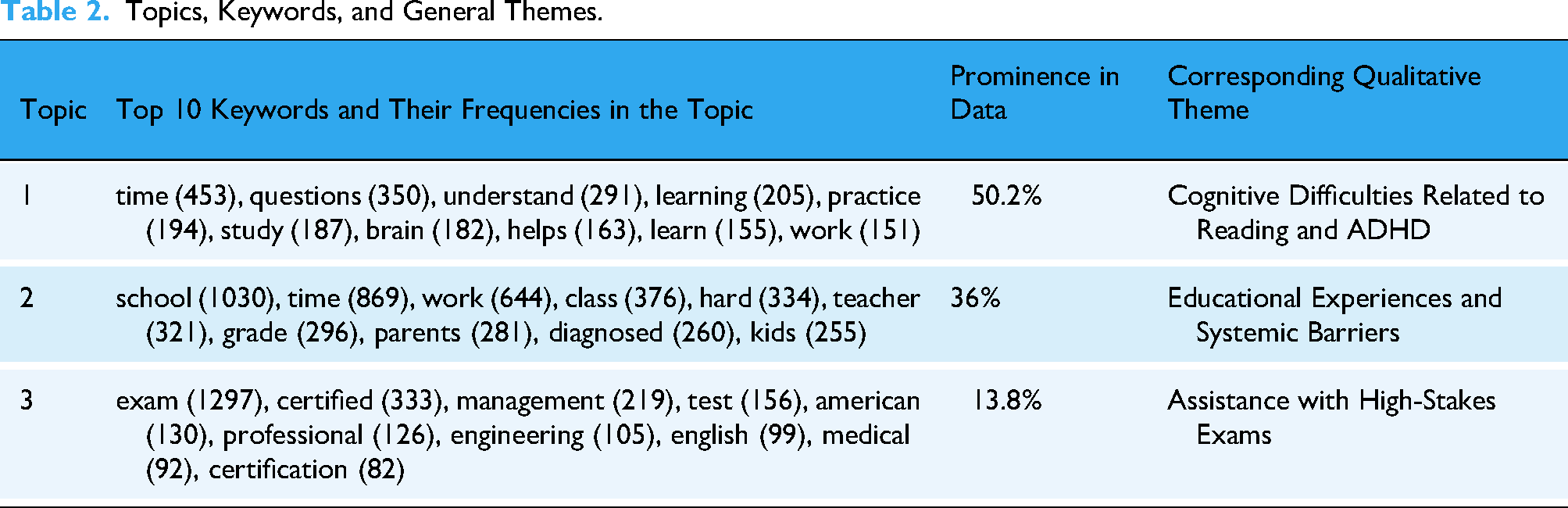
Topic 1 comprised about half the dataset (50.2%), followed by Topic 2 (36%) and Topic 3 (13.8%). An Intertopic Distance Map (Figure 2) visually depicts these topics. Topic 1 was the most prominent, while Topics 2 and 3 accounted for smaller but still substantial proportions of the dataset. The clear separation between circles indicates that the three topics are semantically distinct, supporting interpretability. In line with recommended practices, this map was considered alongside coherence values and the human interpretability of the topic word lists, which together provide evidence for the validity of the three-topic model (Barnett et al., 2023).

Intertopic Distance Map of Three Topics via Multidimensional Scaling.
The 30 most salient terms in the dataset offer an overview of those terms that most strongly influenced topic formation (Figure 3). Bar charts visualize frequencies of occurrence for the top 30 relevant terms for each of the three identified topics (Figure 4). Highly relevant terms are not only common, but also distinctive (Sievert & Shirley, 2014); thus, term relevance reflects both the frequency and exclusivity of a term in relation to a given topic. Each of these visualizations (Figures 2–4) clearly illustrates the distinct thematic content represented by each topic.

Top 30 Salient Terms Across All Topics.

Top 30 Most Relevant Terms for Each Topic.
Qualitative Results
Qualitative analysis of the three LDA topics revealed three distinct themes in Reddit discussions about ADHD and reading comprehension: (a) Cognitive Difficulties Related to Reading and ADHD, (b) Educational Experiences and Systemic Barriers, and (c) Assistance with High-Stakes Exams. Table 2 presents the topic number, the top ten keywords for each topic with their corresponding frequencies, the topic's prominence within the dataset, and the qualitative theme most closely aligned with it. Themes were developed by closely reviewing the most representative posts and keywords to align machine-generated groupings with human interpretation. Close reading of the highest-probability posts also indicated that many were written by self-identified individuals with ADHD or caregivers, based on language describing diagnoses, accommodations, and educational experiences.
Topics, Keywords, and General Themes.
Theme 1: Cognitive Difficulties Related to Reading and ADHD
Theme 1 (Topic 1) captured reading-related cognitive demands that users described in their own words, most commonly attentional drift, losing the thread of a passage, and needing to reread to reconstruct meaning.
Keywords from Topic 1 supported this theme. Among the top 10 terms were understand, learning, practice, study, and brain. Extending to the top 30 terms, focus and attention were also included. These terms are all indicative of the cognitive demands of reading and the effort required to support comprehension. Additional terms from the top 30, such as writing, text, content, language, remember, and skills, suggest that these difficulties extend to written expression and memory-dependent tasks. The presence of words like time, hard, and work reflects a sense of effort and struggle.
Across the top posts, users described behaviors that tax attention capacity and working memory constraints: advice given to struggling ADHD readers to pause and evaluate text, reliance on concept maps and other visual organizers, and, in one case, a profile containing results of two psychometric tests indicating “extremely low working memory” alongside average to high reading scores. Several posts described engaging in reading without grasping the central meaning. For example, users noted that, by the time they finish a passage, they “have no understanding of what [they] read,” or that they must pause and evaluate repeatedly to retain key ideas. According to these posts, comprehension difficulties extend beyond attention lapses to include difficulty ascertaining the main point of a text. Compounded, such difficulties are illustrative of attention and working memory limits as lived, cognitive barriers to comprehension.
Users also reported compensatory strategies, including rereading, note-taking or outlining, reading aloud, text simplification, and the use of GenAI tools for support. Notably, ChatGPT and AI appeared in the top 30 terms in Topic 1, often framed in posts discussing self-accommodation mechanisms for summarizing and clarifying reading materials. Writing appeared alongside reading as many users framed comprehension and written output as coupled tasks; difficulty extracting central meaning often co-occurred with difficulty organizing or expressing ideas in writing.
In summary, Theme 1 highlights internal differences including cognitive challenges such as attentional drift, difficulty extracting central meaning, and working memory limits, as well as self-accommodation strategies users adopt to cope with them.
Theme 2: Educational Experiences and Systemic Barriers
Emerging from Topic 2, the second theme captured the challenges ADHD individuals and their parents face when navigating academic environments fraught with systemic challenges that fail to accommodate the cognitive demands of the disorder. In many posts for this theme, parents sought advice or support after encountering schools, systems, or educators that were unable to meet the needs of their children. Their frustrations stemmed from rigid instructional models, heavy workloads, and a lack of individualized intervention. Users frequently described difficulty obtaining or using accommodations, as well as uncertainty about how to advocate for services or complete ADHD evaluations. Across university settings, students also reported trouble finding quiet study spaces and described noise and crowding as barriers to sustained reading and concentration.
Keywords in Topic 2 included school, class, teacher, parents, grade, accommodations, which suggest a focus on structured educational settings. It is evident from the frequency of the words hard and work that navigating these systems requires considerable effort. The appearance of autism, dyslexia, diagnosed/diagnosis, and anxiety indicate co-occurring conditions and diagnostic processes were commonly discussed. In several posts, parents described homework expectations (e.g. reading comprehension tasks, spelling lists, and additional research assignments) as being misaligned with their child's existing capacity, and they recounted asking educators for adjustments or clarification regarding intervention strategies.
Systemic and environmental obstacles, including policy and process constraints, workload, access to quiet spaces, and variability in accommodation practices, were reflected in Theme 2, in primary, secondary, and postsecondary education by both parents and neurodiverse individuals.
Theme 3: Assistance With High-Stakes Exams
From Topic 3, the theme of Assistance with High-Stakes Exams was identified. Analysis of the top posts revealed that many entries functioned as advertisements and promoted study services for a broad suite of high-stakes pre-collegiate, collegiate, and graduate entrance exams. Repeated phrases like ADHD exam help suggest keyword-driven advertising or automated posting. While broadly framed, such posts may still have appealed to ADHD users seeking exam preparation or accommodation guidance.
Topic 3's keywords provided additional insight, indicating a focus on high-stakes assessments, including terms like exam, certified, test, professional, and certification. Terms such as management and American referred to specific exams. Many users reported struggling with timing, pacing, and focus during verbal or reading comprehension sections, which they identified as barriers to performance. These difficulties reflect the attentional and working memory demands of exam settings.
Although some posts seemed bot-generated advertisements and tangential, additional user posts in this topic offered legitimate concerns. Removing the suspected bot posts did not diminish the coherence of the topic, so they remained in the data for analysis. Several users expressed difficulty with certification, college entrance, and licensing examinations. Many posts described running out of time, guessing answers, or rereading passages without understanding them. Additionally, users highlighted how stress and anxiety exacerbated these cognitive challenges. In one case, a user recounted problems with the verbal portion of the Graduate Management Admission Test (GMAT). Others expressed similar concerns regarding the Graduate Record Examinations (GRE). Posts and comments also referenced anxiety regarding the Medical College Admission Test (MCAT), frustration with the reading comprehension sections of the American College Testing (ACT; now simply referred to as ACT, without being treated as an acronym) and the Scholastic Aptitude Test (SAT), and difficulty completing the reading sections of the Law School Admission Test (LSAT) without accommodations. Standardized testing in primary (typically ages 5–11 in the United States) and secondary (typically ages 12–18 in the United States) schools was described as a source of academic stress and limitation. This theme illustrates how high-stakes tests amplify ADHD-related attentional and working memory challenges, and accommodations and self-employed coping strategies are often insufficient to overcome exam-related stress.
Discussion
This study's findings provide insight into how neurodiverse individuals, their parents, and caregivers discuss reading comprehension challenges in an open, unstructured forum. Although most users do not present these experiences in clinical or academic terms, their authentic language, including words such as attention, focus, understand, and hard, clearly demonstrates cognitive difficulties already extensively documented in literature (e.g. Butterfuss & Kendeou, 2018; Miller et al., 2013; Yeari et al., 2019). Through these organic discussions, not only are attentional and memory-related struggles implicitly recognized, but the compounding effects of social and environmental factors are also highlighted.
Many users described rereading as a coping strategy, often reporting that they revisited passages multiple times to ascertain meaning. Yet many still struggled to understand after rereading. This echoes Yeari et al.'s (2019) findings that rereading does not necessarily lead to improved comprehension in ADHD readers.
Findings revealed a broader ecosystem of challenges: EF challenges are exacerbated by systemic conditions that fail to accommodate neurodivergent needs. Accommodations, while intended to support, often fail to account for the nuanced and individualized nature of ADHD-related challenges as conveyed in user posts. Reading comprehension difficulties associated with ADHD are not merely internal differences; they are shaped, and sometimes exacerbated, by the context in which learning occurs. As previous research has demonstrated, school contexts can themselves amplify ADHD symptoms when rigid expectations, stigma, and labeling predominate (Gwernan-Jones et al., 2016). Likewise, Russell et al. (2023) highlighted how young people with ADHD in the UK reported systemic barriers including poor communication, inflexible structures, and uneven access to accommodations.
Findings surrounding high-stakes testing were especially striking. Reddit posts reflected acute stress, frustration, and often, despair related to tests such as the SAT, LSAT, MCAT, and GRE. These assessments, which are designed as meritocratic gatekeepers, were shown in the data to disproportionately disadvantage ADHD individuals due to structural elements that worsen attention differences, working memory differences, and processing speed differences. In addition to the literature emphasizing poor performance of ADHD individuals on these assessments (Lu et al., 2017), scholars have pointed out that the design of these tests, particularly their emphasis on speeded performance, may obscure true academic abilities (Lovett, 2010). Additionally, rigid and inconsistent accommodation criteria for college entrance exams (Lindstrom & Lindstrom, 2017; Lovett & Nelson, 2021) limit individuals’ access to support services that could mitigate these challenges. Exam anxiety has also been shown to deplete working memory resources (Bellinger et al., 2015), further compounding attentional and processing challenges. While this literature raises important structural concerns, a relatively smaller proportion of research explicitly situates these issues within the lived experiences of ADHD individuals or examines how exam structures themselves are perceived as limiting academic and professional trajectories. This study addresses that gap by demonstrating that, from the perspective of individuals with ADHD, the test format itself, alongside inaccessible or ineffective accommodations, test anxiety, and other co-occurring conditions, create barriers that go well beyond baseline cognitive challenges.
The use of GenAI tools emerged as a theme in user data, aligning with emerging research indicating that such tools may assist in improving reading comprehension among individuals with ADHD. A study conducted by Tamdjidi and Billai (2023) examined the effects of ChatGPT on reading comprehension tasks in ADHD individuals. They found, while average comprehension scores decreased when participants used ChatGPT, those with prior experience using it performed better and reported more positive attitudes. The results suggest that effectiveness may depend on user familiarity and strategic engagement than solely on technology. Users in the current study reported using ChatGPT as a way of summarizing and clarifying text, framing it as a coping mechanism. This suggests that AI tools may be able to help address problems related to centrality and retention, but their effectiveness may not be consistent, and formal research has not yet examined their effectiveness.
In contrast to existing research, which tends to isolate cognitive and behavioral aspects of ADHD, this research offers a more holistic perspective. While the centrality deficit (Miller et al., 2013; Yeari et al., 2019) and other cognitive phenomena are confirmed, this study also examined institutional barriers and user-devised coping mechanisms. These insights build on prior reviews of school-based interventions (e.g. Moore et al., 2018), which emphasize that effectiveness depends on adaptation to individual needs and delivery in specific educational contexts. This study highlights barriers and coping strategies that emerge outside of formal intervention frameworks and through organically generated discourse, allowing insights into lived experiences that are often overlooked by traditional research methods. Consequently, these narratives provide insights that can be used to inform future research and policy development.
The implications of this work are far-reaching. Policy reform regarding how educational and testing institutions accommodate ADHD-related reading difficulties emerges as a clear need. In primary, secondary, and postsecondary education, this includes the redesign of high-stakes testing protocols, rethinking the eligibility criteria for accommodation, and developing more targeted and individualized support systems. Further, teacher preparation programs should move beyond the focus on behavior management strategies and integrate more evidence-based training concerning EF and learning support for neurodiverse students. First-hand accounts reinforce these implications and illustrate how systemic factors magnify cognitive challenges in practice, adding perspectives that complement those found in traditional research.
Limitations
There are several limitations to this study that should be acknowledged. Because the dataset was drawn from Reddit, with its own norms of communication and participation, the findings may not generalize to all individuals with ADHD. Reddit has a wide user base, with over 1.2 billion visitors as of January 2024 (Semrush, 2024), but it does not represent the broader population. Nearly half of desktop traffic (48.69%) comes from the United States (SimilarWeb, 2024). Demographically, it skews young—46% of U.S. adults aged 18 to 29 and 35% aged 30 to 49 use it, compared to 11% of those 50 to 64 and 4% of those 65+ (Social Media Today, 2024)—and male, with 59.8% identifying as male and 39.1% as female (We Are Social, DataReportal & Meltwater, 2025). Based on these demographics, the dataset may disproportionately reflect the perspectives of younger, U.S.-based, and male users, potentially underrepresenting perspectives of other groups within the ADHD community. Although data was drawn from Reddit, this is a method with precedent in ADHD and mental health research (e.g. Kang et al., 2025; Low et al., 2020; Shrestha et al., 2025), which supports the viability of Reddit as a data source.
Constraints are also introduced by the methodological approach. LDA, which relies on a “bag of words” model (Blei, Ng, & Jordan, 2003), is useful for identifying broad lexical patterns but cannot capture the contextual nuance of individual posts. To address this, we complemented topic modeling with thematic analysis, allowing us to interpret user discourse in context and examine systemic and experiential dimensions of ADHD-related reading comprehension. We also spot-checked individual posts as needed for clarification. Nevertheless, some nuance is lost compared to approaches that analyze full narratives directly.
Another limitation is the unverifiable nature of user identity and diagnosis. While posts were selected based on ADHD-related keywords, contributors may not have all been diagnosed with ADHD or may have contributed from a different perspective, such as parents, caregivers, or peers. Unverifiable self-identification is not unique to Reddit, as it is shared by many studies that rely on self-reported data (e.g. Dali & Charbonneau, 2024; Eagle & Ringland, 2023; Glaser et al., 2024). Additionally, the study was limited to the first 500 posts and their associated comments. The restriction ensured thematic coherence and maintained ethical restraint but may have excluded other perspectives. Future research could examine whether larger datasets produce broader themes.
Finally, the decision to search for the phrase “reading comprehension” may have narrowed the scope of perspectives captured. While this choice reduced irrelevant results, it may also have excluded posts in which users described similar experiences using alternative terms, such as “understanding” or “making sense of text.” As a result, the dataset may underrepresent the perspectives of users who frame their reading challenges in less conventional or academic terms.
Future Work
Findings suggest several directions for future research. Further research is needed around accommodation processes and policies, as prior studies have shown inconsistent eligibility criteria and limited effectiveness of common supports (Lovett & Nelson, 2021; Lindstrom & Lindstrom, 2017). Second, additional systemic factors such as rigid curricula, inflexible instruction, and stigma (Gwernan-Jones et al., 2016; Russell et al., 2023) should be further examined for their interactions with cognitive challenges. Third, early evidence (Tamdjidi & Billai, 2023) and user accounts suggest that GenAI may support reading comprehension, but systematic evaluation of its efficacy, equity, and risks is needed. Last, methodological extensions, such as sentiment analysis and discourse analysis, may provide a deeper understanding of how ADHD and reading challenges are represented in online community discourse.
Conclusion
Our qualitatively enhanced LDA analysis of Reddit data demonstrates that the ADHD experience is influenced by systemic factors that extend beyond cognitive differences, thus enriching and contextualizing existing research into ADHD and reading comprehension challenges by confirming that institutional barriers, environmental stressors, and ineffective accommodations contribute to both perceived and measured difficulties in reading comprehension. Findings of this study emphasize the importance of designing educational and testing environments that are responsive to diverse cognitive and contextual needs of ADHD individuals. Meaningful inclusion cannot occur without addressing the broader systems in which comprehension difficulties arise. Our contribution lies in contextualizing lived experience to highlight the disconnect between formal support structures and real-world needs for ADHD individuals. It is imperative to continue addressing these gaps to develop more responsive and inclusive educational and societal systems.
Footnotes

Ethical Approval and Informed Consent Statement
Institutional Review Board (IRB) approval was not required due to the use of publicly available Reddit data. Nevertheless, the study adhered to established principles for the ethical use of social media data in research. Data were collected via Reddit's API after registering and receiving approval through Reddit's developer platform. Reddit has been notified about the intended publication, in compliance with their requirements for research use.
Funding
The authors received no financial support for the research, authorship, and/or publication of this article.
Declaration of Conflicting Interest
The authors declared no potential conflicts of interest with respect to the research, authorship, and/or publication of this article.
Data Availability Statement
In accordance with Reddit's research data principles, the raw dataset cannot be shared. However, the analysis code and methodological documentation are available upon request.