



Abstract
This article presents a framework for recording and interpreting non-verbal communication in multi-disciplinary research and practice with non-speaking autistic individuals. By focusing on non-verbal communication through ethical listening, the aim is to empower professionals to record authentic autistic voices. The framework recommends combining tools such as video recordings, behaviour checklists and autism-affirming theories as ethical listening enablers. Some theorists have proposed effective models to enhance autistic engagement in research, but there is a gap in tools for improving feedback practices among professionals working with non-speaking individuals. This article addresses that gap by offering a framework developed through case studies with non-speaking participants. It helps professionals systematically record and interpret non-verbal communication, detailing the process from initial engagement to data analysis. The framework can be applied in education, health, social care and multi-disciplinary contexts, encouraging readers to modify their practices and challenge ableist norms.
Lay Abstract
This article introduces a new way of understanding and working with nonspeaking autistic individuals in research and professional settings. Nonspeaking autistic people often communicate in nonverbal ways, such as gestures, facial expressions, or other behaviours. Unfortunately, these important forms of communication are frequently overlooked, leading to their exclusion from conversations and decisions that affect them.
The article presents a framework to help researchers and professionals better "listen" to nonspeaking individuals. This framework combines tools like video recordings, behaviour checklists, and insights from autistic perspectives to create a more inclusive and ethical approach. By focusing on nonverbal communication, it ensures that nonspeaking individuals’ thoughts and experiences are understood and valued.
The framework is based on in-depth research with nonspeaking autistic participants in an educational setting. However, it can also be used in health, social care, and other environments. The article provides guidance for professionals on how to analyse and interpret nonverbal communication systematically, helping them make more meaningful connections and improve their interactions.
Ultimately, this work challenges researchers and practitioners to reflect on their practices and consider how they can move away from ableist norms that exclude nonspeaking individuals. By adopting this framework, professionals can promote a more inclusive and respectful way of working that recognises the rich and diverse ways nonspeaking autistic individuals communicate.
Keywords
Introduction
Traditional research methods assume individuals can articulate their views through speech, resulting in underrepresented voices being silenced (Edwards & Brannelly, 2017). This is especially true for non-speaking autistic research participants, as ableist assumptions about speech perpetuate their exclusion (Lebenhagen, 2020). The term ‘voice’ as a synonym for ‘views/thoughts’ can exclude non-speaking participants. ‘Ethical listening’ (Lebenhagen, 2020, p. 128) values alternative communication forms like gestures and vocalisations. While studies report positive impacts of ethical listening, little is known about how professionals can implement it effectively.
The importance of co-production and inclusion of authentic autistic voices in research has gained significance (Whitehead, 2023) and principles of inclusive research and the importance of co-production have been discussed (Fletcher-Watson & Happé, 2019; Nind, 2019); flexible methodologies that offer autistic participants choices supporting them to communicate, authentically have also been touched upon (Ridout, 2017). Nind (2019) highlighted several key principles of inclusive research, including stakeholder engagement, addressing structural inequities, promoting intersectionality, and advocating for universal design. Despite numerous influential voices in the field of research inclusion strongly opposing the exclusion of disempowered individuals, participants who do not use speech as their primary communication method are often less likely to engage in research. For instance, some studies may fail to report how they facilitated the participation of disabled individuals or may cite a student's disability as the reason for excluding them from participating ‘fully’ in research (Daley & McCarthy, 2020). There are some notable exceptions to this, such as the study by Samways and Heslop (2025), which focused on utilising an ethnographic approach to explore the experiences of three non-speaking young people with intellectual disabilities. However, even for those studies, the focus has been on specifically gathering the views of individuals who communicate non-verbally rather than designing studies in which such adaptations are utilised to ensure both speaking and non-speaking individuals participate in research. This article aims to guide those researchers who are less familiar with this context on how to design and conduct their research with non-speaking participants in their minds.
Adopting ethical listening principles in research significantly enhances the participation of non-verbal or minimally verbal individuals (Lebenhagen, 2020). While several studies address the challenges and opportunities of inclusive research with non-speaking autistic individuals, few provide practical tools for implementing ethical listening. Most studies present fragmented aspects of the process based on their specific focus or advise researchers on what not to do, leaving them responsible for determining which tools to use to empower non-speaking participants as active contributors and co-researchers. This challenge creates a significant barrier to participation; if involving individuals with specific characteristics is perceived as complex or unfeasible, they are more likely to be excluded from research opportunities, particularly when neurotypical researchers with little experience in the field of disability are involved in those studies.
A framework based on the research process will be proposed, drawing on original research with non-speaking individuals. This framework will highlight key considerations for preparing a research project, propose tools that enable ethical listening, and outline methodological choices to enhance the robustness of any research involving non-speaking autistic participants. The real-life research project that shaped this framework will be detailed to avoid issues related to the applicability of theoretical frameworks. This approach will help make the framework more concrete and provide the reader with a detailed research process example.
In this article, the term ‘non-speaking’ is used to describe autistic participants instead of ‘non-verbal’. ‘Non-speaking’ indicates a lack of spoken language while recognising individuals’ various alternative communication methods, such as vocalisations, symbols and body language. ‘Non-verbal communication’ includes all communication forms that do not involve spoken words, like facial expressions, gestures, eye contact and visual aids. Using ‘non-verbal’ to describe non-speaking participants is misleading, as many autistic individuals who cannot or choose not to speak still effectively use non-verbal communication.
How easy is it for researchers unfamiliar with their participants or unaccustomed to alternative communication modes to employ ethical listening without guidance? ‘Tuning in’ is more than a technical skill; it requires researchers from ableist traditions to think critically about their approach and how their norms and assumptions have been exclusionary. Smith and Feinsinger (2024) note that while several interventions target improving non-speaking individuals’ communicative abilities, few focus on enhancing the communicative practices of professionals engaging with non-speaking individuals, with or without learning disabilities, while honouring autistic perspectives through a participatory and inclusive ethos. Researchers often conduct studies from etic (outsider) perspectives (Van Den Hoonard, 2016), failing to understand the true meaning of language, culture and communication as utilised by the researched population (those that possess the ‘emic’/insider perspectives). This article offers a systematic framework to guide researchers in immersing themselves in the autistic culture, observing practice as insiders and removing the invisible barrier that separates them from research participants.
To contextualise the framework's development, published research in special needs setting will be referenced (Aidonopoulou-Read, 2020). The research aimed to establish how feedback can be exchanged between non-speaking, autistic students and their teacher. At that time, the author identified no consistent methodologies supporting this type of data gathering. However, it was clear that a complex observational approach engaging multi-modal processes was needed to capture the meaning of non-verbal communication.
During the observational data gathering, a mix of tools was used to facilitate student voice and enable reciprocal communication, such as a behaviour checklist (Figure 1). Technology, including video recordings, was employed to observe and reflect on assumptions about interpreting ‘externalised behaviour’ expressed through body language and vocalisations. Since participants were autistic and non-speaking, honouring their perspective was central to the methodology. The data analysis process was adapted to capture and interpret non-verbal communication and evaluate the accuracy of the researcher's interpretations. When analysing the data, narrative portraiture was employed alongside thematic analysis.

Non-verbal communication checklist sample (Aidonopoulou-Read, 2020; p. 92).
Based on the above observations, several aspects of research practice need to be adapted concurrently as part of a broader methodological approach to ensure the authentic inclusion of non-speaking, autistic individuals in research, particularly when the research is conducted from the perspective of a neurotypical researcher who communicates verbally. The original contribution of this article is the construction of a coherent methodological framework produced by combining aspects of original research, literature and methodology, which can empower neurotypical researchers who communicate verbally to promote a more equitable research process. The framework also aims to address the balance of power between both groups, ensuring the perspective remains sensitive to the autonomy and agency of the autistic participants and that both participants and the researcher are empowered. The combined adaptations provide a systematic approach for professionals to record and interpret non-verbal communication, including:
Aligning the researcher's philosophy with neurodiversity and intersectionality principles. Building relationships with individuals before starting research. Using individual preferences to develop a research schedule. Providing a customisable observation checklist that enables ethical listening in research and practice. Utilising video to enhance understanding of body language. Outlining the data analysis process, detailing how it can be utilised to enable ethical listening.
The proposed methodology, initially designed to measure student engagement, has broader applications for researching the experiences of minoritised groups. This framework can support researchers in developing ethical listening skills and capturing authentic voices in autism research with non-speaking or minimally speaking individuals. It empowers autistic participants through fair and ethical research, promoting participant involvement and voice (Burton, Ogden & Cooper, 2019). The framework will be valuable for projects focusing on non-speaking autistic individuals and evaluating the communicative value of their intentional and unintentional externalised behaviours. Additionally, professionals working with non-speaking autistic individuals, with or without learning disabilities, can benefit from the proposed systematic observation checklists. The framework development process will be detailed, concluding with a graphical representation of the framework (Figure 2).

Methodological process graphical representation (Sketchwow template used).
This paper is a self-reflection tool for researchers focusing on non-speaking autistic participants. It aims to educate researchers about this group of participants and outline the processes followed in previous research (during the pre-research, research implementation and post-research stages) to provide a practical model for managing the process, stage by stage. This framework can assist researchers who wish to incorporate these strategies into their studies. The paper will explore theoretical concepts related to research involving non-speaking autistic individuals and discuss the practical challenges faced, serving as a model for research preparation. The pre-research phase is just as important as conducting the research itself, and key theoretical and practical components and linguistic/conceptual considerations related to this phase are detailed below.
The pre-research phase's key considerations
Terminology and key principles
Key concepts in this section explain linguistic choices and their connection to the researcher's positionality, closely linked with their research practice, aligned with point 1 of the framework. Autistic individuals may be non-speaking for reasons unrelated to a presumed ‘lack of ability’. They might be non-speaking or minimally speaking due to social anxiety, context or a concurrent cognitive disability. Non-speaking autistic individuals are often presumed unable to acquire literacy skills (Jaswal et al., 2024), and non-speaking is frequently confused with non-communicating (Smith & Feinsinger, 2024). Non-speaking individuals and their support workers often use various Augmentative and Alternative Communication (AAC) methods. While AAC training aims to enhance communicative skills, professionals rarely receive communication training to improve their ability (Peabody et al., 2024). The same applies to researchers. AACs are classified as aided and unaided. Unaided methods use one's body (e.g., signs and gestures), while aided methods use external tools (e.g., symbols, speech-generating devices and spelling boards) that are explicitly taught (Mueller, 2014). Unaided AAC forms are often ignored or misinterpreted, as they are seldom recognised as meaningful. This article proposes a systematic approach to recording and interpreting unaided AAC and using it alongside aided AAC or other tools to ensure the validity and reliability of researchers’ interpretations.
Although ‘non-speaking’ has been chosen as a term, it is crucial to recognise that such binary labels cannot fully capture an individual's abilities. These terms define people by what they ‘cannot’ do (Zangari, Lloyd & Vicker, 1994) and fail to acknowledge that communication can occur in many forms. Individuals may communicate verbally in some contexts and not in others. Multi-modality highlights that communication can involve writing, sound, objects, gestures and speech (Kress, 2009).
Valuing all forms of communication is essential for ethical listening research. As social organisms, humans respond to interactional circumstances (Streeck, 2018), allowing us to find meaning in one another's actions. The rise of the Neurodiversity Movement (Kapp, 2020) and the rejection of assumptions about autistic individuals’ lack of social intent enabled a more nuanced interpretation of communication using contextual evidence related to the individual and their environment (Solomon, 2010).
An example of undervalued communication form includes repetitive speech (echolalia), often used by autistic individuals and once considered meaningless. However, research (Xie, Pascual & Oakley, 2023) confirms that echolalia serves functions such as naming objects and describing situations, highlighting its role in topic development and conversation maintenance. Additionally, repetitive and stereotypical behaviours can serve a social function; ‘interactive stimming’ (performing repetitive behaviours as a dialogue with other autistic individuals) is a valuable form of socialisation (Bascom, 2012).
The terms ‘autistic’ and ‘neurodivergent’ are used interchangeably in this article. The author acknowledges that neurodivergence is not synonymous with autism; however, an autistic individual is neurodivergent, as their thinking differs from neurotypical individuals (i.e., ‘mainstream thinking’). Individuals are referred to as ‘autistic’ rather than ‘individuals with autism’ because autism is seen as part of identity, not a removable trait, consistent with the neurodiversity paradigm.
The issue of a minoritised group within a dominant culture is a key consideration. As the dominant group values spoken language and many researchers belong to this group, further steps are needed to enable non-speaking autistic individuals (the minoritised group) to express their authentic voices and for researchers to capture them. Little guidance on ethical listening is available, despite the emphasis on participatory research that centres on autistic individuals (Pickard, Pellicano, Den Houting & Crane, 2022; Fletcher-Watson et al., 2019; Gibson, Livingstone, Monroe, Leo, Gruson-Wood & Crockford, 2024). The term ‘minoritised’ highlights the power imbalance between dominant and non-dominant groups rather than differences in numbers implied by ‘minority’ and ‘majority’ (Selvarajah et al., 2020). It also underscores the importance of researcher accountability in employing ethical methodologies and ensuring that research benefits minoritised communities.
The philosophical intent of the researcher
O'Leary (2004) argues that the definition of research has grown complex, particularly in the social and applied sciences. Mertens (2005) suggests that a researcher's theoretical framework influences the definition of research, establishing relationships between constructs that describe or explain a phenomenon. The framework, or paradigm, affects how knowledge is studied and interpreted, revealing the research's intent and expectations.
Cohen & Manion (1994, p.38) define ‘paradigm’ as the philosophical intent behind a study. This research aligns with the transformative paradigm, as interpretivism does not adequately address issues faced by marginalised communities (Creswell, 2003). The concern is that interpreting a participant's viewpoint through the researcher's lens cannot eliminate bias linked to societal influences.
The transformative paradigm is connected to the political agenda that urges reform (Creswell, 2003). This methodology aligns with the Neurodiversity and Intersectionality Paradigms, which promote diverse forms of thinking and urge recognition of non-dominant expressions. Neurodiversity celebrates the diversity of thought and opposes the over-emphasis on individual experiences while highlighting systemic barriers (Walker, 2021). Intersectionality seeks to uncover complex relationships that contribute to the invisibility of marginalised groups (Purdie-Vaughns & Eibach, 2008). Walker (2021) asserts that a single ‘normal’ brain or ‘correct’ neurocognitive functioning is a social construct, as is the idea of a single ‘normal’ ethnicity, gender or culture. This article explores what an inclusive/intersectional/non-speaking methodology might look like.
Mac Naughton, Rolfe and Siraj-Blatchford (2001) define ‘paradigm’ as encompassing three elements: a belief about the nature of knowledge, a methodology and criteria for validity (p. 32). This article analyses the methodological elements essential for researchers working with non-speaking autistic participants:
Nature of knowledge: Understanding is needed before researching non-speaking individuals, placing participants as communication experts and researchers as learners decoding a new language. Methodology: Key considerations and tools to accurately capture participants’ experiences. Importance of justifying methodological choices. A tool for interpreting unaided AAC alongside aided AAC is proposed. Criteria for validity: How can researchers capture the authentic voices of participants with differing life experiences and communication preferences?
The researcher's perceptions of language and communication
Recognising and defining language beyond spoken words is crucial, focusing on its role in communication and ethical listening. Additionally, one must consider how communication develops and be mindful of potential biases from neurotypical expectations, which can affect researchers’ interpretations of signs as either ‘meaningful’ or ‘meaningless’.
The term ‘signs’ encompasses words, gestures, icons, cultural patterns and meanings. ‘Cultural patterns and meanings’ can include gestures seen as offensive in one culture but acceptable in another, such as keeping hands in pockets while speaking (Ford, 2010).
‘Cultural patterns and meanings’ relate to the Culture of Autism and the understanding that diverse neurotypes lead to different, but not inferior, cognitive processing styles. According to the Neurodiversity Paradigm, autistic people share a distinct way of being, thinking and communicating (De Vries, 2021). This represents a shift from the medical model of disability, which views autism as a ‘lack of’ social skills and as a deficit (Goering, 2002). The medical model often overlooks a crucial point: by viewing autistic communication as ‘wrong’, expectations have been biased toward neurotypical standards. Consequently, signs linked with autistic communication are dismissed as mannerisms or ‘idiosyncratic’ behaviours lacking meaning or expressions that must be eliminated.
Behaviours deemed ‘idiosyncratic’ – unrelated to task completion – can serve important purposes: they may act as a transitional stage before a task or reflect cognitive engagement, which is crucial for task completion (Eilam, 2015). In educational settings, professionals may overlook neurodivergent signs in students. For instance, if a teacher speaks French and a student responds in German, the teacher might dismiss the response as unintelligible without a translation tool. Similarly, vocalisations from an autistic individual expressing excitement about an upcoming activity can be seen as ‘meaningless’ if one lacks knowledge about autism and fails to interpret the meaning of the individual's unique body language cues.
Each sign has a signifier, a spoken or written word, and a signified, the concept or mental image linked to that word (Ford, 2010). For example, when someone hears the word ‘chair’, they picture a four-legged object for sitting. For non-speaking, autistic individuals, a specific utterance (the signifier) might trigger a concept (the signified) in their mind, such as ‘a cup filled with water’. This connection may not be evident to speaking individuals unless learned through interaction with the non-speaking individual.
As with spoken language, the same action or utterance can acquire different meanings in different contexts. Just as one might say ‘second’ to explain their position (e.g., I came second) in one context, they may say ‘second’ in another context to indicate time (I won’t be a second). Similarly, an autistic individual may use the same sign in different contexts with varying meanings (Bogdashina, 2022). For instance, one might smile to express contentment, while in another context, the same smile may indicate nervousness. This is crucial for researchers, as one sign rarely has a singular meaning, and it is essential to seek alternative interpretations even after an initial meaning is established. Language is fluid and continuously develops; thus, no meaning should be seen as the ‘final’ interpretation.
In communication, only the signifier can cross from one person's mind to another's. Associations between the signifier and the signified are built through interaction, as individuals construct associations independently and tie them together with perceived signifiers. The suggested methodology serves to build these associations during interactions between professionals and autistic individuals.
Participant capacity and the researcher's awareness of potential bias
Autistic individuals are often assumed to lack capacity, especially when non-speaking, despite the Mental Capacity Act (2005) stating that they should be presumed to have capacity unless proven otherwise. Non-speaking individuals are frequently thought to lack the ability to communicate, make decisions or think (Späth & Jongsma, 2020). Research stipulates that autistic individuals have greater perceptual capacity than neurotypical peers, processing more environmental information (Brinkert & Remington, 2020). The capability approach allows researchers to analyse how an individual's personal characteristics, resources and environment influence their ability to function in specific situations (Mitra, 2003). Furthermore, researchers can more accurately assess a person's capacity by examining what participants ‘could do’ rather than what they ‘did do’ in a given context (Young, Williams, Yoshida, Bombardier, Bombardier & Wright, 1996). This means that participants may be perceived as ‘unable’ to communicate or participate in certain ways simply because they have been assumed to be incapable of performing a particular task. Instead of viewing an individual's current abilities as fixed, researchers should provide opportunities for participants to enter the research environment as equals, allowing them to demonstrate what they can achieve.
The researcher's preparation as an ethical listener
According to Lebenhagen (2020, p. 129), ‘Ethical listening means respectfully attending to multiple representations of human experience with all our senses. It encourages us to avoid judging a person or their communication based on differences. For example, when communicating with a non-speaking typer, an ethical listener pays attention to body language and the individual's typed response’. To achieve this, researchers must develop self-awareness and engage in silent reflection before intervening or drawing conclusions about what an individual is attempting to communicate. They should remain open to co-creating knowledge and treat participants as equal communicative partners (Lebenhagen, 2020).
Empowering autistic individuals is an ethical imperative in research. Autism research often focuses on study outcomes while neglecting the methods used with autistic participants (Lory, 2019). This leaves participants feeling devalued and less likely to benefit from research outcomes. Questioning ableist assumptions about non-speaking individuals’ ability to communicate and shifting the responsibility to researchers is essential. As Kedar (2012) states, not speaking does not mean not thinking – a common presumption when working with non-speaking autistic individuals.
The research context example
The research concept
The research conducted by Aidonopoulou-Read (2020) aimed to create a tool that would help the researcher identify behaviours which indicate student engagement. The tool developed can be modified and transferred to different contexts (such as, e.g., enjoyment of play in an Early Years setting), but a key consideration for every researcher should be that the same behaviour exhibited in different contexts can have an entirely different meaning. The research context and the processes followed can serve as an example for researchers to utilise when developing their own behaviour checklist (Figure 1) to interpret behaviour in their environments. To contextualise the interpretative process detailed later in the article, the concept of student engagement in education will be briefly examined.
Student engagement encompasses four categories: behavioural (participation and conduct), cognitive (willingness to master challenging concepts), emotional (positive vs. negative feelings) (Fredricks, 2014), and agentic (actively influencing the learning environment) (Reeve, 2013). Behavioural engagement, often measured through on-task behaviour and adherence to rules, can mislead practitioners who equate compliance with genuine engagement (Fredericks et al., 2004; Lee, 2014). Compliant students may focus on meeting minimum requirements rather than true learning. Furthermore, behavioural engagement, being the most observable, can result in a limited understanding of individual engagement.
With autistic students, measuring behavioural engagement poses challenges since autistic behaviours may be deemed maladaptive from a neuronormative perspective, leading to misconceptions about their need for eradication (Chown, Murphy & Suckle, 2023). Suppressing these behaviours can result in masking (Sedgewick, Hull & Ellis, 2021), where individuals divert cognitive resources towards compliance instead of authentic engagement. Compliance training aimed at eliminating ‘unwanted’ behaviours can be traumatic for autistic individuals, whose behaviours, like stimming, serve critical functions that should not be eliminated (Henderson, Wayland & White, 2023).
Autistic individuals may exhaust themselves conforming to neurotypical expectations, draining their capacity for learning. While some level of compliance is essential for effective learning, as noted by English (2022), distinguishing between compliance and engagement is crucial. Many neurodivergent behaviours, viewed as non-compliant, are tools for focus. Mislabelling these behaviours can lead to inaccurate conclusions, jeopardise engagement, and hinder authentic communication.
Measuring engagement
Fletcher (2015) defined student engagement as a sustained connection between learners and aspects of their education, reflecting the success of their educators and institutions (Axelson & Flick, 2010). Engagement is a two-way relationship and an interactive process between teachers and students, aligning with the broader ethos of educational institutions. Effective schools focus students’ attention on activities that capture and maintain high levels of interest (Coates, 2007). Engagement is central to learning and is often viewed as the most significant predictor of learning and personal development (Kuh, 2003).
Many definitions and models of engagement examine different facets beyond teaching and learning (Groccia, 2018). This study specifically explored engagement as an interactive relationship between learners and teachers. It aimed to identify what the quality of these interactions reveals about student engagement. To measure engagement levels, the communication checklist (Figure 1) and the Objectives checklist (Figure 3) were developed to investigate the connection between student behaviour and performance. Body language was also analysed to measure engagement more accurately. Using ‘engagement’ as a reference point allowed the researcher to interpret behaviour by examining the relationship between a student's attention, achievement and body language.

Susan's responses to rewards for completion of mathematical tasks. Lesson objectives achievement checklist (Aidonopoulou-Read, 2020; p.93).
The importance of researcher positionality and theoretical understanding
According to Milton's (2012) double-empathy theory, understanding perspectives should involve neurotypical individuals striving to comprehend the autistic experience rather than conditioning autistic individuals to mask their authentic selves. A crucial aspect of the current methodological framework is for researchers to adopt the neurodiversity paradigm, which recognises that neurological differences among individuals lead to distinct ways of thinking and behaving (Den Houting, 2019). Aligning with this paradigm will help researchers accurately interpret gestures, facial expressions and vocalizations in non-speaking communication.
Building positive relationships with research participants should precede data collection and analysis. This is vital because knowledge and understanding are linked to relationships (Capuder, 2013). Without strong rapport, researchers may struggle to engage effectively with participants and interpret findings accurately. Given that autistic individuals exhibit diverse profiles (Chapple, Davis, Billington, Myrick, Ruddock & Corcoran, 2021), familiarity with participants can enhance the interpretation of their unique non-verbal communication.
Moreover, research in this area should benefit the individuals involved, requiring that studies be reliable and ethical (Mackay, 2017). To ensure fairness and recognise participants’ strengths and needs, researchers must understand their perspectives and apply methodologies rooted in the double-empathy theory (Chapple et al., 2021). Hence, it is essential for researchers and participants to honour neurodiversity by focusing on individuality within differing groups.
The research implementation phase's key considerations
The research context
Highland School is a state school for special needs, serving 300 students and employing 150 staff. The school has three sites, and this research took place at the Primary site, focusing on students with communication and interaction difficulties. Many students are diagnosed with autism and exhibit what are often referred to as “challenging behaviours.” The term is placed in quotation marks due to its controversial nature; it implies that the intent behind these behaviours is to be confrontational. In reality, all behaviours serve a purpose, and the intention is rarely to challenge another person. Instead, these behaviours may arise from unmet needs, attempts to communicate during a dysregulated state, or expressions of pain.
The use of the term ‘challenging behaviours’ in various educational settings often labels actions as violent, defiant, or problematic for those on the receiving end. Placing the term in quotation marks emphasises that this perception contributes to misunderstanding the individuals exhibiting these behaviours. It influences both practitioners’ and researchers’ perspectives, highlighting how we label these actions can be part of the problem.
The original research aimed to identify and evaluate methods teachers used to give feedback to non-speaking students. The second phase was to observe teachers to compare these methods and assess their effectiveness. However, interviews revealed that teachers were uncertain about how to provide feedback to non-speaking students.
This prompted a new plan involving a literature search to identify tools for measuring engagement with non-speaking autistic individuals. It became clear that no single tool could enable meaningful feedback between teachers and non-speaking students. Therefore, a combination of methodological tools was selected and adapted to capture student interactions and empower them in their learning.
To evaluate the methodology's effectiveness, the researcher applied it in their classroom, using video for data analysis. A multiple case study design (Yin, 1994) was used to assess the approach and explain non-verbal communication's significance in education, considering individual differences among students. The five participants were treated as distinct cases.
As the main aim of the project was de-centring verbal communication, choices were made related to research tools selection and analytical processes that align with what Chen (2022) classifies as valuable interactional practices: ‘ … through integrating: (1) reflexive video-based fieldwork; (2) microanalyses of embodied interaction; and (3) design and development of novel tools for communication … ’ (Chen, 2022, p. 1) These principles, as Chen remarks, can surface the multiple modalities utilised by non-speaking autistic individuals and ought to be part of one's research agenda. The following sections will describe how the proposed methodological framework achieved the above principles.
Sample
The sample included five students from various ethnic backgrounds and characteristics, reflecting the school's geographic diversity. Convenience sampling was used because the practitioner also served as the researcher, and developing a comprehensive methodology required significant time and a systematic approach that would not have been feasible without the researcher also being the classroom teacher, meaning that additional resources were not necessary. Socioeconomic status data were not collected, as they were deemed irrelevant to the study; additionally, documenting such detailed information could lead to the identification of the participants.
Piloting methods
During the Autumn Term of the school year, extensive preparation took place before the start of the research. This preparation involved experimenting with various resources and recording student reactions. Different types of equipment, including various cameras, were used to document interactions, as well as preferred teaching resources and communication styles, along with their potential interpretations. This groundwork informed the design of the checklist used in the study. Additionally, observations were made to record how participants indicated consent (yes) and non-consent (no) throughout the pre-study period. These insights were valuable for the later stages of the study when signs of non-consent might have been harder to detect due to the researchers’ focus on the research itself. An example of adaptations made due to participant feedback relates to the type of cameras chosen for recording. Initially, large cameras were placed near the students during groupwork to observe their reactions and to evaluate how well they recorded individual and group body language during the lessons. Two of the students kept standing up to push the cameras and many of their individual forms of expression were not being captured. This led to further research and experimentation with equipment, until settling for the use of an action camera, visibly attached to a hairband like a headtorch around the researcher's head and a small wide-lens camera attached to the interactive whiteboard using a Gorillapod (a flexible tripod used to mount cameras on other items). They were both rated as the most inobtrusive methods of recording, which gave the most detailed recordings possible at the time. The action camera was initially touched by all the students, some of whom smiled, but did not react to it after those initial 5 minutes.
The study design emerged from a recognised lack of understanding regarding non-verbal feedback and communication, which was highlighted during the teacher interview phase. It is important to note that this process cannot be entirely attributed to the participants, as there are limitations in the researchers’ understanding of the precise meanings behind each student's communicative expressions. Nonetheless, the approach was carefully considered and constructed to ensure that participants were actively involved in developing the research methodology.
Positionality statement
As indicated throughout the article, the researcher is aligned with the neurodiversity paradigm and is passionate about inclusive research. While she is now diagnosed as neurodivergent and is a mother of three children – two of whom are also neurodivergent – this was not the case at the time of her research.
The author is a non-native English speaker who migrated to England eight years before beginning her research. As part of her introduction to the culture, she needed to develop her skills in decoding and understanding the hidden meanings of language and non-verbal communication. Reading between the lines was a skill that needed to be learned over time, adding another layer of complexity to day-to-day communication. Although she was trained to teach within the English education system, she did not experience it as a student.
As a member of the Pontian Greek community, she is aware of the socioeconomic implications of belonging to a minoritised group and how this can affect future opportunities.
When conducting studies in this space, researchers should acknowledge their positionality at the time of the research and any changes that may have occurred between the research phase and the writing-up phase. This can make the writer more conscious of their own biases and inform the reader about the potential limitations of the research findings they refer to.
Case study research and triangulation-widening the scope, validity and reliability of case study research with non-speaking autistic participants
The case study involved five non-speaking, autistic year 5 students. Individual participant details are not provided, as this exceeds the paper's scope; further information can be found in a previous publication (Aidonopoulou-Read, 2020).
Case study research can be inductive (developing theory from observations), deductive (testing accepted theory) or abductive (refining theory from existing knowledge) (Eisenhardt, 1989; Johnston, Leach & Liu, 1999; Dubois & Gadde, 2002). Its main aim is to investigate a phenomenon from multiple perspectives within its natural context to gain insights (Woodside & Wilson, 2003). This study utilised an inductive approach, developing a methodological framework based on observations.
Triangulation, referring to methods, theories, data sources and researchers’ interpretations, is essential in research (Wolfram Cox & Hassard, 2005). In this study, triangulation involved exploratory interviews with educators on formative assessment for non-speaking students, alongside readings and informal observations, leading to the theory that non-verbal feedback via body language indicates student engagement. Video observations conducted by the researcher and other identified colleagues ensured interpretation accuracy.
To validate the case study, convergence was achieved by comparing different interpretations and sources (Stake, 1995). Observations of each student during 16 diverse lessons, corroborated by colleagues, supported this. Divergence, which explores ‘outliers’ to enhance credibility, was achieved by treating each participant as a distinct case to identify differences in non-verbal communication and engagement (Jick, 1979). Complementarity was realised through a multiple case study design, linking each participant as an independent case within their classroom and school environment (Milgrom & Roberts, 1995; Carroll & Roth, 2020).
Reflexive video-based fieldwork
Researchers studying communication among non-speaking individuals often use video to capture interactions (Chen, 2016). This approach allows them to focus on the details and understand non-verbal communication.
Observing body language in real-time within a learning environment can be challenging, so using video was deemed appropriate. It served as a lens for examining non-verbal communication related to student engagement and a mirror for evaluating practitioners’ understanding of ethical listening (Clarke & Chan, 2019).
To accurately capture non-verbal communication, a small action camera attached to the researcher recorded individual student responses, while a wide-angle camera captured group interactions. This setup enabled analysis of body language during ‘contact time’ (direct one-on-one interaction) and ‘non-contact time’ (group teaching without direct engagement with the teacher). The close-up camera recorded facial expressions, and a wide-lens camera provided an overall view of student engagement without distracting participants.
The influence of the ‘hidden curriculum’ in preparing the research environment
When preparing to research in an educational environment, one must consider the ‘hidden curriculum’ as a factor influencing authentic interactions and engagement. The researcher utilised contextual factors affecting the learning environment and student engagement (Reeve, 2013). Examples include providing lesson choices (Danley & Williams, 2020; Fredricks, 2014), designing hands-on, challenging and authentic lessons (Marks, 2000), developing strong classroom relationships (Engels et al., 2016), exposing students to relevant content (Assor, Kaplan & Roth, 2002), and offering clear directions, support and constructive feedback (Jang, Reeve & Deci, 2010).
Setting challenging objectives, using resources suited to students’ sensory and cognitive profiles, arranging seating to foster belonging (semi-circle), building positive relationships before commencing research, and employing multiple feedback modalities contributed to the hidden curriculum. Teacher behaviours significantly impact student outcomes (Efthymiou & Kington, 2017). These practices prepared students to be ‘ready for learning,’ enabling research to focus on intricate aspects of non-verbal communication. The ‘hidden curriculum’ emphasised student engagement and behaviour interpretation rather than traditional management techniques.
Introducing various approaches influenced student behaviour and its interpretation for authentic research. Teacher interviews indicated rewards encouraged engagement; thus, individualised tangible rewards, verbal praise, tone of voice and positive facial expressions were used according to the research schedule. Motivation emerged as a critical engagement factor, prompting the introduction of multi-sensory resources selected based on individual preferences.
The research schedule, based on the Highland School Curriculum (Aidonopoulou-Read, 2020), linked objectives to students’ performance in mathematics and English, focusing on active engagement (requiring student action) and passive participation (requiring attention for concept teaching). The schedule was as follows, centred on mathematics and literacy:
Week 1: no engaging resources or rewards (standard resources like paper pictures); Week 2: engaging resources (toy with flashing lights instead of pictures); Week 3: engaging resources; Week 4: engaging resources; Week 5: engaging resources, no rewards; Week 6: engaging resources with rewards; Week 7: engaging resources with rewards; Week 8: engaging resources, no rewards.
This process was repeated multiple times during the research to ensure reliability in measuring non-speaking student behaviour (English, 2022).
Narrative portraiture as a data analysis method: The example of Susan
A student case will illustrate the research process and data analysis. Susan was a 9-year-old autistic female with a learning disability. She was non-speaking and used single symbols to communicate. Susan often appeared unmotivated and engaged in self-stimulatory behaviours. At the time of the research, it was assumed that these behaviours indicated disinterest, an assumption that was challenged.
Using a behaviour checklist, the researcher analysed video clips multiple times to decode Susan's body language. To minimise researcher bias, the author employed an analytical method similar to narrative approaches. Traditionally used for text-based analysis of verbal contributions (Houltberg, Wang, Qi & Nelson, 2018), this approach was adapted to describe body language, allowing Susan to compose her narrative with the researcher's help. This method does not assume intentionality about Susan's body language, as she may not understand the outcomes of her thoughts and behaviours (Frith & Happe, 2002). However, it acknowledges that each sign has communicative meaning that should be explored.
Traditionally, narrative approaches explore how individuals make sense of their own experiences (Riessman, 2008), but in this context, they are utilised to understand communicated information (Gottschall & Wilson, 2005). An example of how video observations can be recorded in a narrative format is provided in Figure 4. In this example, Susan's behaviour was recorded by activity, and descriptions of her actions were included. The non-participatory section describes her behaviour without any attempt to record any interpretations or researcher observations: ‘At the beginning of the activity, she is fiddling with her clothes while looking down. She is sitting upright and quietly. Vocalising and rubbing her hands on her trousers and placing her hands over her ears’.
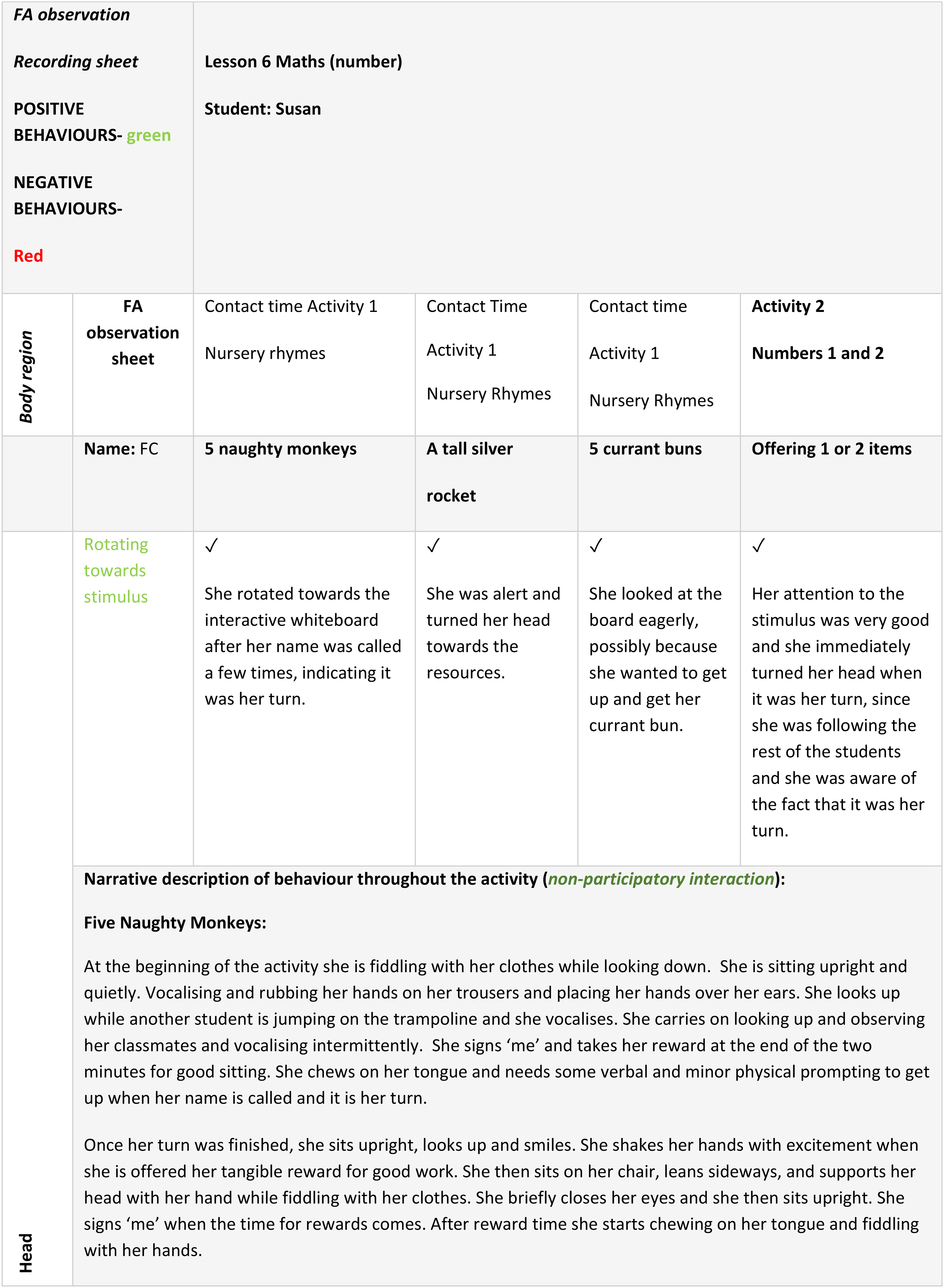
Non-verbal communication checklist completed sample-Susan (Aidonopoulou-Read, 2017; p. 314).
In the participatory section, however, the researcher offered some potential explanations after watching the clips several times. For example, during the ‘Five Currant Buns’ nursery rhyme, Susan ‘ … looked at the board eagerly, possibly because she wanted to get up and get her currant bun’.
The researcher then watched the video again to establish if each listed objective had been met. Figure 2 includes the objectives checklist, which indicates whether objectives were being met. Week 6 indicates that one objective was met and another five partially met. Comparing those results with the descriptions of Susan's body language narrative in the equivalent activity, it is evident that Susan was engaged as she met her learning objective. Looking at the narrative, Susan's body language that indicates ‘I am interested’ includes turning toward the resources, sitting upright, looking attentively, getting up spontaneously and anticipating her turn.
This and Susan's objectives checklist created a narrative portrait to capture the case. Narrative portraiture is an analytical approach that can be used in the early stages of data analysis and aims to capture processes in detail (Rodriguez-Dorans & Jacobs, 2020). Narrative portraiture as a method of analysis is used to contextualise and highlight the differences between individual accounts (or, in this case, behaviours). Narrative analysis is an empowering tool that brings participants back to the centre of the research as opposed to giving the researcher the dominant voice (Rodriguez-Dorans & Jacobs, 2020). This is an example of Susan's narrative portrait:
'Susan began lesson 1 in literacy sitting upright and being alert, expecting to discover the parcel's contents. When she opened it and established it was a picture rather than an item, she started scratching her head, vocalising loudly and leaning in different directions (idiosyncratic) behaviours that were labelled as negative and were possibly indicative of her disappointment and disengagement. Lesson 2 in literacy, when engaging resources were introduced, was a remarkable contrast to lesson 1. She sat upright, looking around the classroom and following the resources with her eyes, maintaining excellent eye focus. She needed some support to pass the parcel as she was interested in its contents, indicating her engagement rather than lack of co-operation. Positive behaviours she displayed included turning towards the resources, watching while other students were having a turn, being alert and sitting upright during her and her classmates’ turn, linked with both procedural and active engagement’ (Aidonopoulou-Read, 2020, p. 103).
The narrative portraits informed thematic analysis and drew conclusions about non-verbal communication indicating engagement or disengagement. Thematic and narrative approaches complement each other (Rodriguez-Dorans & Jacobs, 2020). Narrative portraiture helps understand individuals and their contexts, while thematic analysis reveals abstract connections. I used ‘applied thematic analysis’, which focuses on finding meaning within the data (Guest, MacQueen & Namey, 2012) and can be applied to various data types, including videos (Ryan & Bernard, 2003).
Themes included ‘Dialogue and Reciprocation of Feedback’ and ‘Evidence of Engagement’. Analysing these themes helped depersonalise ideas, allowing for general conclusions. This process provided detailed evidence about the individual, enabling the interpretation of body language through narrative analysis and formulating best practices for engaging non-speaking autistic students.
The combined components resulted in a new approach called interpretative narrative portraiture, reflecting the researcher's process of creating narrative portraits based on observation and interpreting them through thematic analysis.
Ethical tensions
Working with non-speaking students while serving as both researcher and practitioner can present ethical dilemmas. Engaging with vulnerable individuals carries significant responsibilities. This research methodology was developed to empower participants and address a gap in methodologies that lack tools for capturing non-verbal communication. Accurate interpretation depends on factors such as the researcher's familiarity with the context and the rigour of the methodology. When implemented systematically, this approach is likely to yield accurate results with low risks of harm and substantial benefits (Dawson & Fletcher-Watson, 2022).
Limitations and recommendations for future research
One needs to acknowledge that, despite any rigour applied to the approach, a researcher can never be certain about the accuracy of their conclusions. However, the same can be said for any research method. It is not rare for participants to state what they think the researcher wishes to hear. Thematic analysis is also subjective.
Technology has much scope to enrich this methodology and improve its accuracy. For example, recording brain activity while recording non-verbal communication can give a more accurate picture of the meaning of non-verbal behaviours. Kuschner, Kim, Bloy, Dipiero, Edger & Roberts (2021) suggest that neuroimaging can have promising results when used with autistic individuals with intellectual disabilities.
Video analysis can be slow if it relies on humans capturing and interpreting their observations. Artificial intelligence can be a promising tool for capturing an accurate account of behaviour and combined with brain imaging, potentially also offering a breakthrough for individuals and practitioners in the field.
Conclusion
In this article, a multi-component methodological framework has been developed as a tool for researchers working with non-speaking autistic individuals. Figure 2 illustrates the researcher's journey from theoretical conceptualisation to data analysis. The components are flexibly presented, as the tools in this article are examples; with technological innovations, more rigorous tools will become available for future research.
Before following the proposed framework, researchers and practitioners should carefully consider their discipline and critically reflect on their norms, assumptions and methodologies. They should also recognise how their practices may be unintentionally ableist and reflect on accommodating diverse non-speaking participants in their research. After considering their context, they can follow the framework principles summarised here, remembering that pre-research phase offers a unique opportunity for theoretical and practical consideration of the research process and it is the combination of the following approaches that can enable a researcher to adopt a coherent approach to meaningful participation for non-speaking, autistic individuals:
Embracing relevant theoretical frameworks such as neurodiversity, intersectionality and double empathy is an essential first step in ethical research with non-speaking autistic individuals. Adopting an appropriate paradigm, such as the transformative paradigm, that honours principles of social justice is key to ensuring that research processes and findings benefit the participants. Familiarising oneself with AACs is also essential. Honouring forms of communication other than speaking sets the right mindset for the researcher. Establishing a relationship with the participants before the commencement of the research study can help the researcher draw meaningful conclusions about non-verbal behaviour. Adopt the capability theory when assessing capacity. There can be a discrepancy between what research participants ‘do, do’ and what they ‘could do’. Assume communicative intent: Individuals are social, hence likely to respond when their behaviour is acknowledged as meaningful. Use tools that enable ethical listening. This article uses the communication checklist as an example. With time, alternative tools that are more reliable and less time-consuming to analyse may be developed. Choose an area of focus. This is so the researcher can have a reference point when interpreting a behaviour in context. For example, focusing on play helps interpret the intention behind different behaviours within that context before attempting to generalise. Use video. Video allows watching again and confirming the precision of observation and interpretation. It also allows other colleagues to confirm or offer a different interpretation of the data. Use interpretative narrative portraiture. This analytical method encourages focus on the individual. This can help draw more accurate generalised conclusions.
Footnotes

Ethical Considerations
The research was approved by the UCL ethics committee.
Consent to participate
Written parental consent was sought at the time of the study, and the participants’ non-verbal communication was considered part of the consent process.
Consent for publication
Participants consented to relevant work being published as part of the written consent process.
Funding
The author received no financial support for the research, authorship, and/or publication of this article.
Conflicting interests
The author declared no potential conflicts of interest with respect to the research, authorship, and/or publication of this article.