



Abstract
One commonly reported area of difference reported by neurodivergent individuals are sensory differences (e.g. hyper- or hypo-sensitivities and sensory processing difficulties). The objective of this pilot project was to investigate the lived experiences of current postgraduate students and staff within a university faculty who have self-identified as having sensory differences. Neurodivergent researchers interviewed 11 participants about their experiences working within the faculty's physical environments and the various enablers and barriers for inclusion. We used a combination of reflexive thematic analysis and content analysis to code the data and identified three overarching themes: (a) there are many sensory and spatial challenges to navigate within the faculty, (b) it takes a lot of time and energy to navigate the complex terrain of accommodations, and (c) neurodivergent people have many aspirations for inclusive university spaces. We also identified a series of subthemes. Overall, participants shared a series of barriers to inclusion within the faculty's existing physical spaces, including sensory challenges and difficulties working in open-plan spaces. Additionally, many participants did not have formal accommodations as they were viewed as too difficult to access and required “outing” themselves as neurodivergent. Building from participants’ suggestions, we offer several recommendations for reducing barriers to inclusion, including universal design for accommodations, the development of more sensory-friendly workspaces, and neurodiversity-affirming professional development for all staff.
Keywords
Introduction
As a reimagining of historical, deficit-laden concepts, neurodiversity is an umbrella term that reframes neurological conditions such as autism, attention-deficit hyperactivity disorder (ADHD), and specific learning disorders (SLD) as natural, diverse expressions of human neurobiology, not deficits to be fixed or deviations from a norm (Kapp et al., 2013). This shift has encouraged universities to rethink how they can best support their neurodivergent communities in more neurodiversity-affirming ways (Dwyer et al., 2021). Unfortunately, however, there is still a limited understanding of the experiences and accessibility needs of neurodivergent students and staff members (both professional and academic) working within higher education institutes (Anderson et al., 2017; Jones, 2023; O'Connor et al., 2024) Particularly students and staff members who process their sensory environments in diverse ways (Jones, 2023). Consequently, their barriers to inclusion are often poorly understood and poorly accommodated for (Cai & Richdale, 2016; Kim & Crowley, 2021).
Sensory-related differences manifesting from neurodivergence
Many neurodivergent individuals process sensory information differently to both their neurotypical (Kim & Crowley, 2021) and neurodivergent peers (Little et al., 2018). As a result, they often experience unique and sometimes hidden barriers to inclusion. For example, some autistic people and people with ADHD are hyper- and/or hypo-sensitive to a variety of sensory input (e.g. light, sound, and temperature) and can experience sensory distortions, overload, and processing difficulties across a range of different modalities (e.g. auditory, visual, and tactile; see Wada et al., 2023). These differences can sometimes lead to sensory-related joy, however, they can also lead to sensory discomfort, overwhelm, and excessive distractions (Gurbuz et al., 2019; O'Connor et al., 2024). There is also evidence to suggest that some neurodivergent peoples’ sensory profiles and sensitivities fluctuate over time and across different contexts (Spaeth & Pearson, 2021), resulting in more complex accessibility needs.
Sensory-related differences within the university context
To date, little is known about the sensory related needs and experiences of neurodivergent postgraduate students and staff members (Jones, 2023). Instead, the limited research on sensory-related differences within the university context has solely focused on the inclusion needs of autistic undergraduate students (Anderson et al., 2017; Dwyer et al., 2021; O'Connor et al., 2024). For example, autistic undergraduate students often share that many university spaces, including libraries, dining areas, and lecture theatres, are inaccessible for them due to sensory discomfort and excessive distractions (Gurbuz et al., 2019; O'Connor et al., 2024). As traditionally designed universities offer few spaces where neurodivergent people can safely stim, relieve stress, and recover from sensory-overwhelm (e.g. low-impact sensory rooms; Kim & Crowley, 2021; O'Connor et al., 2024; Sarrett, 2018), autistic undergraduate students have also shared that they cope by deliberately avoiding university spaces they find challenging (O'Connor et al., 2024) and/or excluding themselves from university spaces completely (Madriaga, 2010). Therefore, it is unsurprising that a systematic review by Anderson et al. (2017) found that autistic students’ sensory differences contributed to their overall stress and anxiety levels, as well as their social-related difficulties.
Students’ sensory-related differences may also contribute to their overall academic performance and reduced graduation rates (Gurbuz et al., 2019; Kim & Crowley, 2021). For example, without appropriate accommodations for sensory differences, such as quiet, low-sensory exam rooms, students with ADHD and autistic students often underperform (Jansen et al., 2017; Kim & Crowley, 2021; Sarrett, 2018). Unfortunately, however, most research on the efficacy of accommodations has focused on neurodivergent children (Jansen et al., 2017). There has been limited research into the efficacy of different accommodations for supporting individuals in higher-education settings (Jansen et al., 2017; Lewandowski et al., 2021) and even less into accommodating students’ sensory differences (Sarrett, 2018). As a result, some neurodivergent students have reportedly been given generic and potentially unhelpful accommodations from university administrators (Dwyer et al., 2021; Lefler et al., 2016; Sarrett, 2018), or have been left to accommodate themselves (Accardo et al., 2019).
Furthermore, though some neurodivergent undergraduate students have reported that they are generally satisfied with their formal accommodations (Anderson et al., 2017; Clouder et al., 2020), most report the application process as a huge demand on their time, finances, and executive functioning. For example, to receive accommodations, students are often made to complete extensive forms, engage with multiple different disability offices, and provide recent medical documentation (Cai & Richdale, 2016; Dwyer et al., 2021; Kim & Crowley, 2021); even if they were diagnosed as children (Kim & Crowley, 2021). They also have to disclose their diagnoses to receive support, which can lead to anxiety and stigmatization (Anderson et al., 2017; Cox et al., 2017; Van Hees et al., 2015). Finally, though rare (Anderson et al., 2017), some students have reported that their requests for reasonable accommodations have been denied, causing them considerable distress (Kim & Crowley, 2021). Therefore, many neurodivergent undergraduate students do not see the merit in seeking formal accommodations, or they wait until they are experiencing substantial academic difficulties (Kim & Crowley, 2021; Newman & Madaus, 2015).
The experiences of university staff and postgraduate students with sensory-related differences
Even though neurodivergent staff and postgraduate students share similar environments, experiences, and sensory-related concerns to undergraduate students (Dwyer et al., 2021), most research to date has focused on stigma, discrimination, and other potential negative consequences of disclosure for university staff and postgraduate students (e.g. Brown & Leigh, 2018; Burns & Green, 2019; Price et al., 2017), or the strengths and benefits of hiring neurodivergent academics (e.g. Bury et al., 2022; Hollin & Pearce, 2019; Woods & Waltz, 2019). To our extant knowledge, only one study has investigated some of their sensory-related barriers to inclusion (Jones, 2023).
Overall, like research conducted with autistic undergraduate students (Gurbuz et al., 2019; O'Connor et al., 2024), Jones (2023) found that autistic academics often struggle with sensory overload and overwhelm while working within university settings. Bright lights, excessive noise, and air-conditioning were particularly reported as barriers to inclusion, as were institutional policies regarding office assignment. Autistic academics were also frustrated by the lack of awareness about neurodivergent peoples’ sensory-related differences and the unwillingness of others within the university to accommodate them. Finally, also similar to autistic undergraduate students (Madriaga, 2010), many participants preferred to work off campus wherever possible, resulting in isolation. However, this study was only conducted with autistic academics. Therefore, it is important to investigate whether other neurodivergent postgraduate students and staff members with sensory-related differences report similar barriers to inclusion to autistic undergraduates and academics.
To address this gap in the literature, we explored the: (a) lived experiences of current postgraduate students and staff members studying and working at the faculty who have self-identified as having sensory differences; (b) environmental features that neurodivergent staff and postgraduate students experience as enablers and barriers to their wellbeing during work/study; and (c) recommendations made by neurodivergent staff and postgraduate students to improve the sensory environment.
Methods
Following recommendations by Pellicano and den Houting (2022), neurodivergent researchers were heavily involved in all aspects of the study design, implementation, and dissemination.
Participants
We invited all neurodivergent staff and postgraduate students within a single faculty the University of Melbourne to participate in this study. Because formal diagnoses can be hard to access (e.g. de Broize et al., 2022), and the self-identification/diagnostic process is accepted by the neurodivergent community (Sarrett, 2016), we also made it clear that all people self-identifying with sensory differences could participate. We primarily recruited participants through posters; however, some participants contacted us directly after hearing about our study via word of mouth.
Overall, we recruited 11 neurodivergent staff and postgraduate students with a diverse range of reported conditions (Autism, n = 4; ADHD, n = 1; Autism and ADHD; n = 6), ages of diagnoses/identifications (adult, n = 8; child, n = 1; other, n = 2), genders (female, n = 4; male, n = 3; gender diverse, n = 2; prefer not to say, n = 1; unknown, n = 1), roles (postgraduate student, n = 5; academic, n = 5; professional, n = 1), and experiences working within the faculty (less than 2 years, n = 3; 2–4 years, n = 3, 5 + years, n = 4). While we appreciate that an individual breakdown of each participant's demographic information would have provided more context to our sample, we wished to protect the anonymity of our participants.
Procedure
This study received ethics approval from the University of Melbourne Human Research Ethics Committee (HREC project ID 24925). Because the research was conducted within our own institution, we followed a strict protocol set by our ethics committee to ensure the safety of our participants. For example, the two neurodivergent members of our research team responsible for interviewing participants and analysing the data (J.R. and S.T.) were new to the university, unknown to the participants, and held no leadership positions within the faculty being studied. They also assigned participants unique pseudonyms to ensure that their anonymity was protected throughout this research project. J. R. and S. T. contacted the participants via email and invited them to complete a short Qualtrics form regarding their interview preferences (e.g. online or in person, suitable times, and accommodations for inclusion). Based on their responses, and the researchers’ availability, either J. R. or S. T. responded via email with their suggested interview times.
Interviews
J. R. and S. T. conducted one-on-one semi-structured interviews in person (n = 7) or online via Zoom (n = 4; see Appendix A for the full interview script and list of questions). To increase the comfort levels of our participants (Pellicano et al., 2022) J. R. and S. T. disclosed their own neurodivergent status at the start of the interview. They also asked questions about demographics. J. R. and S. T. asked participants about their positive and negative experiences: (a) working and studying within the department (e.g. “What specific sensory features and/or triggers within the physical environment positively impact your ability to work?”); (b) navigating departmental culture (e.g. “If you were in charge of the social environment, what changes would you make to make it more inclusive for yourself and/or other neurodivergent staff and students?”); (c) navigating university systems, processes and online spaces (e.g. “Are there aspects of the systems and processes that negatively impact your ability to work? If yes, what are these?); (d) disclosing their neurodivergence to the department and requesting accommodations (e.g. “Do you feel safe and/or supported to be open about your neurodiversity with staff and students within the faculty? Why/why not?); and (d) participating in neurodiverse-led research (e.g. Would you have participated in this research if the researchers/interviewers were all neurotypical?).
Overall, the 11 interviews ranged from 29.41 to 90.11 minutes in duration (M = 51.12, SD = 20.85). Once the interviews were complete, one member of our team transcribed the audio recordings into Microsoft Word, resulting in transcripts ranging from 8 to 28 pages long (M = 19, SD = 7). A second member of our team then double checked the transcripts for accuracy and imported the final transcripts into NVivo for ease of coding.
Data analysis
To gain a thorough understanding of participants’ experiences within the faculty, as well as to increase participant voice, we conducted both reflexive thematic analysis (Braun & Clarke, 2021) and content analysis (Cohen et al., 2017). Before coding, all members of our research team shared a statement of positionality (Braun & Clarke, 2021). Overall, our research team included a combination of neurodivergent (Autistic, ADHD, and Autistic/ADHD) and neurotypical researchers with backgrounds in psychology and/or education. As reflexive thematic analysis generates data through the lens of the researcher, the reflexive thematic analysis process was led by one Autistic/ADHDer on our team (J.R.). Similarly, the content analysis was led by an ADHDer (S.R.).
J. R. initially read the transcripts through the lens of the research questions. In line with Braun and Clarke's (2021) process, J. R. then generated tentative codes by carefully reading each transcript multiple times. They also identified potential patterns in the data that directly and indirectly related to the objectives of the study. To review these potential themes and sub-themes, and ensure they accurately represented the data and addressed the research questions, our whole research team met at regular intervals to refine the codes. Then, once our research group agreed with the themes and sub-themes, J. R. coded the entire data set. Finally, after this process was complete, our research team met two more times to reflect on J. R.'s final themes and sub-themes and make a final assessment regarding goodness-of-fit.
Next, to give additional context to the narrative coding and highlight the variability of experiences among participants, a second coder (S.T.) used content analysis to count specific environmental barriers to inclusion. This coding illustrates examples of directly reported experiences that were easily identified and interpreted (e.g. specific mentions of lighting or sound) as positive or negative features of the environment. Possible codes were initially identified in NVivo by grouping direct answers to each interview question. Categories were refined where initial categories overlapped, or there was ambiguity between different categories. Comments were then re-coded into these final categories. When one participant had seemingly contradictory answers (e.g. it is too hot and too cold) they were given both codes, as this generally occurred due to variability in the environment. Each interview was then re-read to check no codes had been missed. Higher-level themes, where significant levels of interpretation were required or there was ambiguity about which code something may receive, were left to the reflexive thematic analysis to explore and were not coded in the content analysis.
Results
We generated three themes and eight subthemes using reflexive thematic analysis (see Figure 1 for our thematic map), which we report in text below. These themes were further strengthened through content analysis, which we report solely through figures (Figures 2–4) to provide additional context.

Thematic map of themes and subthemes resulting from the reflexive thematic analysis.

Number of participants reporting features of the physical environment as a negative. Note. Lighting, acoustics, layout, and temperature were given as examples of physical features of the environment, but were not prompted as negatives. Only categories which could be consistently categorized and had n > 1 were included in this figure. Codes that seem contradictory were both assigned to one some participants due to nuances within their answers. For example, participants who mentioned the temperature being both too hot in some areas/times and too cold in others and were coded into both categories.

Number of participants reporting features of the physical environment as a positive. Note. Features were only coded as a positive if the participant had experienced the positive feature within the faculty. If they said they would like or prefer something which they had not experienced within this environment, this was coded into suggested changes.
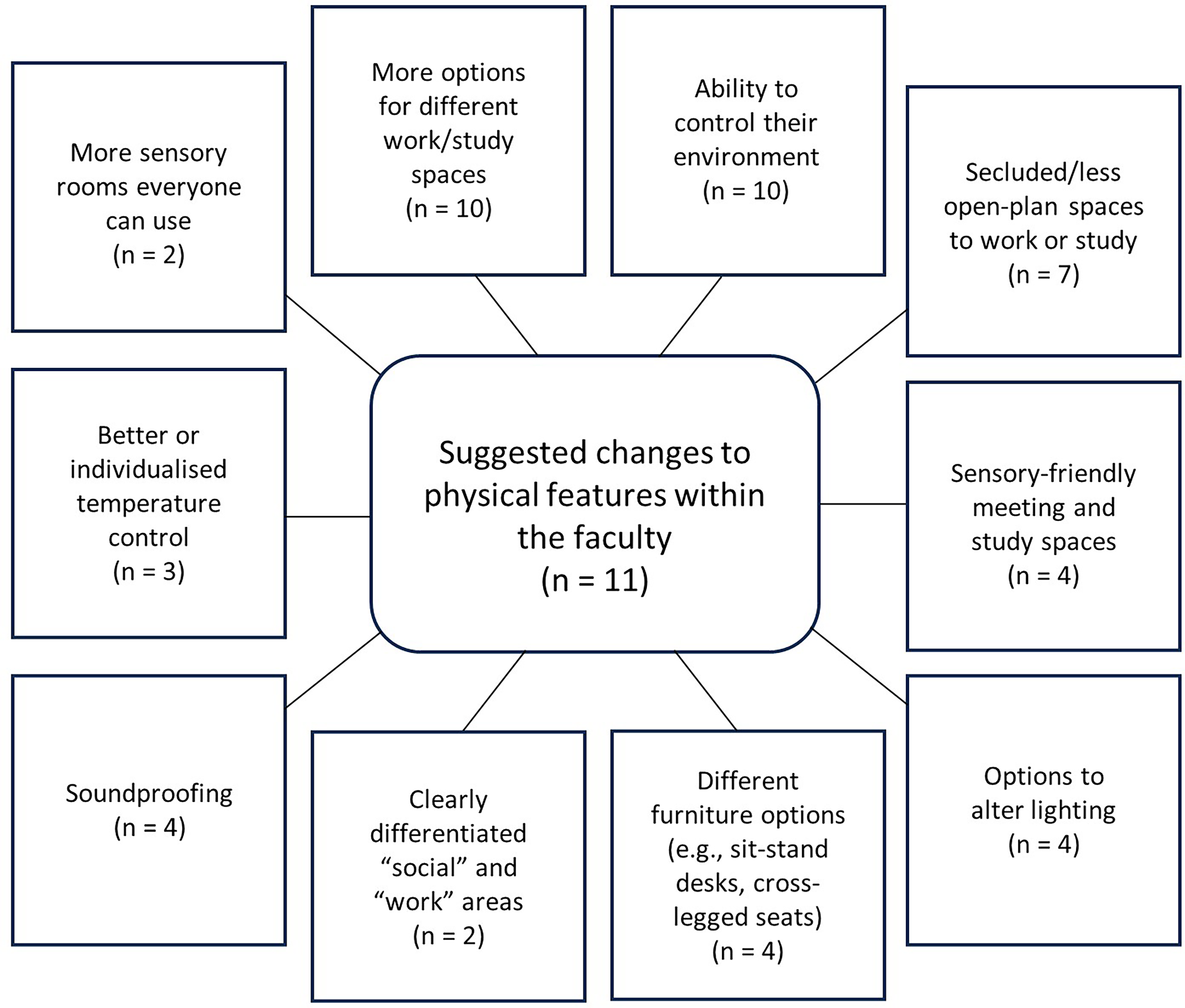
Number of participants recommending changes to the physical environment. Note. Comments were only coded as recommended changes if the participant specifically stated them as a recommended improvement. These were separate comments to the positive and negative aspects of the environment.
Theme 1: There are many sensory and spatial challenges to navigate within the faculty
This theme encompasses the various obstacles participants encountered in the physical spaces at university, particularly in relation to sensory challenges, open-plan workspaces, hotdesking, and office environments.
Subtheme 1.1: There is a lot of diversity in peoples’ sensory needs and their flexibility to meet them
Participants reported numerous sensory challenges that hindered their ability to study/work (see Figure 2). These included difficulties with: background noise (either too much or not enough), lighting (difficulties with fluorescent lights, not enough natural light, and window glare), temperature (too hot, too cold, and/or too variable), and visual distractions (clutter and movement). Air flow, emotional contagion, food smells, limited opportunities for movement, and uncomfortable furniture were also listed as barriers to inclusion, but were reported by fewer people.
Additionally, most participants reported challenges associated with sensory avoidance (see Figure 2). For example, some participants struggled with the faculty's “really harsh, cool white light [because they] get migraines really easily” (Participant 13). Other participants, however, reported difficulties in being able to meet their sensory-seeking needs, including needing “to have lots of sound and movement around [them], not stillness and quietness” (Participant 3).
Many participants also stressed that each neurodivergent person has different sensory needs and that “just because something would be better for [them] doesn’t mean it is a policy that [the department] should pursue” (Participant 7). For example, regarding temperature, one participant noted “most people have a t-shirt on and [they’ve] got a jacket… because [they’re] always freezing inside” (Participant 1). Conversely, other participants were “often a little bit too warm” (Participant 2) and “if it's too warm [they] are physically unsettled, [they] cannot focus” (Participant 7). Finally, participants also shared that the temperature within the faculty was often too variable; “sometimes even on the same floor” (Participant 7). As a result, they struggled to consistently accommodate their unique sensory needs.
Subtheme 1.2: Open-plan offices are a problem, as “there are no spaces where [people] can concentrate or work without distraction”
Most participants shared that the faculty's heavily populated, open-plan offices and study spaces amplified these sensory challenges and limited their ability to work (see Figure 2). For example, many participants noted that there were “no spaces where they [could] concentrate or work without distraction” (Participant 12) because there was simply too much “extra background stuff to filter out” (Participant 1). Specifically, there was often too much visual clutter, movement, and background noise, as well as too many clashing smells, which were perceived as “all the one volume, at once” (Participant 1). For example, Participant 9 shared that they constantly “just pick up on things. Some people will start talking, and then [they] can just trace until it sort of gets loud again.” Some participants also found “it really hard to be able to listen to what someone else is saying when there's noise going on around [them]” (Participant 11). Finally, many participants reported struggles with visual noise, because “if people are in the same building or around, [they] often get distracted by seeing them or what they’re doing” (Participant 10).
Participants were also uncomfortable about the lack of privacy afforded by the faculty's open-plan design, because “being observed is uncomfortable” (Participant 5). They also feel “quite exposed” (Participant 11) working in these spaces because they are constantly “aware of everything that's happening around [them] all the time” (Participant 1). This awareness was particularly heightened for participants if “anti-social behaviour [was] going on, because [they] often pick up on the mood of people around [them]” (Participant 3). Furthermore, because “there's no universal [way to signal] ‘do not interrupt me’, not even headphones” (Participant 11), many participants reported frequent interruptions from their peers “coming up behind [them] and breaking [them] out of focus” (Participant 1), “making [them] so distracted that [they] have clocked off for the rest of the day” (Participant 13).
Finally, some participants were “hyper aware of being naturally loud” (Participant 8) within these open-plan spaces and were concerned that their “need to move [their] body” (Participant 10) and their “loudness and quirks” (Participant 3) frequently annoy their peers and/or outs them as neurodivergent (see Figure 2 and Appendix B). As a result, many participants felt like they had to hide their stims and/or sensory challenges and maintain socially acceptable masks.
Subtheme 1.3: Most people “don’t like hotdesking at all”
Even though hotdesking allowed participants to find workspaces better suiting their sensory needs, many “don’t like hotdesking at all” (Participant 1; see Figure 2). Specifically, some participants were frustrated by the amount of time it took each day to find spaces with acceptable lighting, temperature, and noise and felt they had to “come in early to get the desk they want” (Participant 1). Participants were also frustrated by the lack of opportunities for personalizing their workspaces, as they struggle to focus within sterile work environments.
Subtheme 1.4: Enclosed offices shield people from “a lot of potential stress,” but they do very little to reduce sensory input and output
Participants with enclosed offices reported similar challenges to participants working within open-plan spaces, because “all of [their] offices have glass, and being observed is uncomfortable” (Participant 5). They also do little to reduce sensory input and output. For example, the “ambient lighting is particularly harsh” (Participant 2) and external “noise is really problematic” (Participant 3). Therefore, many participants wear “noise-cancelling headphones, even when [they’re] not usually listening to anything” (Participant 3). Similarly, participants were concerned that, “even in a box like this, [they] can annoy people next door. [They] get shushed out loud all the time” (Participant 3).
Participants with offices, however, did not “want to send the wrong message here. When it comes to sensory features, [they] just want to say first [they’re] lucky… [their offices] shield [them] from a lot of potential stress that could be, on occasion, associated with open spaces” (Participant 7; see Figure 3). They also appreciated having more autonomy over their workspaces so they could find the “accommodations [they] need, without having to explicitly detail why [they] need them” (Participant 5; see Figure 3). For example, one participant had their desk “oriented to a particular way and [they’ve] had their lights adjusted” (Participant 5).
Subtheme 1.5: Having the option to access and “work in different types of spaces” can make all the difference
Compared to staff, students had fewer negative thigs to say about the faculty's physical spaces. Specifically, students appreciated having the freedom to work “in different types of spaces with different types of furniture and lighting… If [they] wanted lots of light, [they] could go into the café area where there were the booths, and if [they] wanted less, [they] could go into the computer room or the space adjacent to that (Participant 10; see Figure 3)”.
Theme 2: It takes a lot of time and energy to navigate the complex terrain of accommodations
Participants also shared that they were reluctant to ask for formal accommodations, that there were limited formal accommodations available for overcoming these physical barriers to inclusion, and that they were often left to accommodate themselves.
Subtheme 2.1: Many neurodivergent people feel “uncomfortable asking for accommodations”
Most participants held mixed feelings about accommodations. While they believed that “accommodations are really important to help [people] work and do [their] best under the circumstances” (Participant 5), many participants “felt uncomfortable asking for them” (Participant 11). The energy it required to apply was especially considered too much; particularly if participants were “struggling a bit or their needs [were] higher than usual. [Because] it's a lot of demand, it's a lot of red tape to try and get them in the first place” (Participant 1). For example, some participants reported completing multiple forms and providing extensive reports from their healthcare providers, which caused them considerable overwhelm. Additionally, many participants were late-diagnosed and unsure of what accommodations to ask for. Until recently, they “didn’t think that [they] actually needed any accommodations” (Participant 3) and/or “it's not something [they’ve] actually allowed [themselves] to think about” (Participant 11). Finally, some participants reported starting the process without receiving any acknowledgement, understanding, or support from their supervisors (staff) or lecturers (students), causing them to give up. They “just [got] tired. [They] don’t want to always feel like [they’re] having to fight for what really should be just… It should just be accepted” (Participant 12).
Many participants were also reluctant to “out [themselves] and put [themselves] at risk of potentially getting a harder time” (Participant 1) just to get formal accommodations, as “there's a lot of judgement around [being neurodivergent] still… and you never know what someone's opinion is going to be” (Participant 5; see Appendix B for number of staff “officially out” as neurodivergent within the faculty). Participants were especially concerned about being outed to others without their consent, thought of as less capable than their neurotypical peers, bullied, and even ostracized, as some people in the department are still thought to hold “the most problematic stereotypes” (Participant 9). For example, participants reported overhearing others in the department “linking autism with stalkers” (Participant 9) and “making derogatory comments in front of someone, not knowing they were neurodivergent” (Participant 11). Therefore, to “protect [themselves] a little bit to get [their] job done and have the same access to opportunities (Participant 5),” many participants have requested “different things, based on what [they] present as [their] skills and [their] limitations” (Participant 7); reframing their accommodations as “occupational health and safety things” (Participant 5); and/or requesting “informal spontaneous accommodations” (Participant 13).
Subtheme 2.2: Workplace adjustment plans can sometimes be helpful, but they often “don’t work” because “it's not a fair system”
Participants who requested formal accommodations held mixed opinions regarding this experience. For example, some student participants “felt that the sort of systems around accommodations [were] quite good” and “very easy to navigate” (Participant 9). Similarly, staff members with workplace adjustment plans shared that they have “worked out well” (Participant 1). Participants were especially appreciative that they could take regular “breaks using the sensory room, whenever needed” (Participant 2), and “adjust their lighting, and/or request sit-stand desks” (Participant 5; see Figure 3).
However, participants expressed disappointment that they needed to disclose their neurodivergence or even get formally diagnosed just so they could “apply for formal accommodations and feel less guilty asking for what [they] needed” (Participant 11). They shared that, “for a lot of neurodivergent people, fighting to even get people to understand why you need these adjustments and why they’re important is such a drain that it's like, ‘Oh, do I just even bother?’ Which again, it's terrible and it shouldn’t be the case” (Participant 1). They would much rather “embrace [their neurodivergence] for all the strengths it provides [them] and… not further perpetuate that there's something wrong with [them]” (Participant 11).
Additionally, some participants shared that their “accommodations don’t get used because they don’t work” (Participant 13) because “it's not a fair system…” (Participant 3). For instance, Participant 13 was not sure what supports they could ask for and wanted further information, but instead was told “oh, can’t really tell you that.” Then, when they eventually received their support plan and forwarded it to their lecturers, they received “unironic feedback” such as “I wish I had an excuse for when I forget to do things and miss deadlines…[They] had absolutely no awareness of how [their] words were inappropriate.” This participant was also pulled aside by another lecturer and told to “actually pay attention instead of doing their own thing” and “not wear [their] headphones in class,” even though their plan stated they could wear noise dampening earbuds.
Subtheme 2.3: Neurodivergent people spend a lot of time and energy “planning for any risks before [they] happen and mitigating risk by having accommodations for [themselves],” impacting their ability to do their work
Influenced by these barriers to formal accommodations, participants felt they “always needed to try and think of some other solutions” (Participant 10) and “work [them] all in the background [themselves]” (Participant 5). For example, participants reported “planning for any risks before [they] happen and mitigating risk by having accommodations for [themselves]” (Participant 13) such as: making “a lot of changes to [their] work situations” (Participant 5); wearing “headphones [and] specific clothing for the tactile sensory input” (Participant 13); and seeking out private spaces to work, such as “near the window, quite literally at the far end” (Participant 9), “ tucked around the corner” (Participant 8), and in the newly developed low-impact sensory space. “Particularly if they [were] ‘aware’ of particular deadlines are coming up” (Participant 2).
However, while participants had some success in accommodating themselves, they “can only work with the constraints of the existing building, which to be honest by design is just not that conducive to [what neurodivergent people need]” (Participant 1; see Figure 2). Therefore, if participants felt like they were “close to having a bit of a moment, [they often] remove [themselves] from the environment and go sit outside for a while” (Participant 13) or seek privacy in the faculty's disabled “bathrooms where [they] can just shut [themselves] in” (Participant 10) because they “know [they’re] not going to be interrupted or walked in on” (Participant 5). Otherwise, they try to work “more remotely [to have] a bit of control” (Participant 1).
Finally, many participants were concerned about the potential consequences of always accommodating themselves. Specifically, it is now hard for some participants “to know what a trigger looks like because [they’re] just so used to adapting and changing” (Participant 11). Additionally, students were concerned about losing marks for their attendance, and the “pressure of being present and not being able to leave to just stim or just calm down makes [things] worse” (Participant 13). Staff shared similar concerns and reported asking themselves “how many meetings can I miss without being noticed? How can I dodge this? How can I sit through this and not have a panic attack? [They] spend all [their] time thinking about how [they’re] responding to the environment” (Participant 5).
Theme 3: Neurodivergent people have many aspirations for inclusive university spaces
Overall, participants reported that they were tired of “justifying why [things] need to be clearer, … or fighting for things that [they] feel could be done better to be more inclusive” (Participant 12), because “there wasn’t a willingness to update or change. And that lack of willingness, it feels dismissive because it's like ‘well, we don’t care that you have struggled with this. This is the way it is’” (Participant 12). They were also tired of feeling “like [they] have to fix the university in order for [them] to do [their] job” (Participant 7). They would much rather the faculty “recognise people's diverse needs, people with care responsibilities, the complexity in people's lives… and adopt a really strong policy towards inclusion and diversity, [where everyone] has permission to operate how [they] need to operate” (Participant 5). For example, participants felt that “it would be really amazing [for everyone] to be able to sit down and plan [their] year out based on ‘these are my needs and this is what I’m capable of’” (Participant 5). They also wanted some sort of “mechanism to be able to identify something that doesn’t fit… and be able to raise that without sort of feeling like you are putting other people out” (Participant 11). Finally, many of our participants found remote working “just life changing” (Participant 1; see Figures 3 and 4) because it allowed them “to achieve things with [their] work and take on roles that [they] wouldn’t normally have felt [they were] able to take on” (Participant 5); however, there is “this kind of pressure to come back to campus… and it's a really uncomfortable feeling” (Participant 5).
As participants preferred to have their “own space and [their] own personal things” (Participant 2) surrounding them and “consistency of knowing (Participant 8)” where they were going to be working each day, they also emphasized the removal of hotdesking (see Figure 4). They proposed that staff members should be assigned their own permanent desks within workspaces suited to their sensory profiles. That way, neurodivergent staff members could develop and request more formalized, individualized, and long-term accommodations.
Next, while many participants recognized the value of a recently constructed low-impact sensory room as a “really important resource” (Participant 2) and believed that it “should absolutely be there for people to use” (Participant 1), some participants were reluctant to use it. For example, some participants stated that it did not meet their sensory needs. Additionally, others were worried about accidentally outing themselves as neurodivergent, because “everyone knows that [the room] is there” (Participant 5) and who is it for. In response to these concerns, participants proposed that that there should be “three or four rooms that are kind of blocked out so that all staff can use [them], so [neurodivergent people] don't feel so singled out… Just to acknowledge that, not just neurodiverse people, but a lot of people could just use a space” (Participant 5; see Figure 4). Participants also suggested that these rooms be built for different sensory needs, including: “lights that are dimmable” (Participant 10), “a bit of soundproofing” (Participant 1),” “standing desks, and/or different types of [office chairs] to be able to sit on, depending on [peoples’] energy levels or just the need to move [their] bodies.”(Participant 10; see Figure 4).
Discussion
This study makes a novel contribution to the field in exploring and contrasting the lived experiences of neurodivergent postgraduate students, academics, and professional staff with sensory differences within a faculty at a higher education institution. Aligning with the findings of previous studies (Harnett, 2019; Jones, 2023), both neurodivergent students and staff reported many difficulties navigating sensory and spatial challenges, as well as navigating the complex terrain of accommodations. For example, participants highlighted common barriers to work and study such as sensory-overwhelm, limited privacy, poorly designed open-plan offices, and difficulties hotdesking. Many participants were also reluctant to ask for formal accommodations and, instead, have gone to great lengths to accommodate themselves; sometimes at great personal cost. Those with formal accommodations also found the application process extremely difficult and held mixed opinions about their efficacy of their overall plans. Therefore, to combat these problems, participants generated multiple ideas for building more inclusive university spaces for neurodivergent staff members and postgraduate students.
Difficulties navigating and accommodating sensory and spatial challenges
Similar to autistic undergraduate students (Gurbuz et al., 2019; O'Connor et al., 2024), autistic academics (Jones, 2023), and neurodivergent staff within other workplaces (Harnett, 2019; Waisman-Nitzan et al., 2021), neurodivergent staff members and postgraduate students found many university spaces inaccessible due to sensory discomfort, sensory overwhelm, and excessive distractions. The faculty's open-plan design also amplified their sensory-related challenges, further mirroring the reports of neurodivergent staff within other workplaces (Harnett, 2019; Kenyon, 2015). Also, like autistic undergraduate students (Anderson et al., 2017), many of our participants reported spending a lot of time trying to accommodate their sensory-related needs (e.g. wearing noise-cancelling headphones or specific clothing and or taking frequent breaks from sensory-intensive areas), when they would much rather be focusing on their work.
Additionally, also reflecting similar studies with autistic undergraduate students and neurodivergent staff within other workplaces (O'Connor et al., 2024; Sarrett, 2018), neurodivergent staff members and postgraduate students were also disappointed by the lack of privacy afforded by the faculty's open-plan design. For example, participants found it hard to concentrate on their work due to excessive interruptions and difficulties working while feeling watched; especially sensory-seeking participants and participants who were not yet “out” as neurodivergent, as they were worried about annoying their peers or outing themselves by openly stimming. Additionally, because of their colleagues’ and overall societies’ general lack of understanding regarding neurodivergence (Edwards et al., 2023), participants were also concerned about being stigmatized, othered, or even ostracized due to others witnessing their neurodivergent traits.
Therefore, to better accommodate neurodivergent staff and postgraduate students’ sensory-related differences, participants requested that the faculty adopt a universal design for learning (Kapp, 2017) and stronger policies regarding inclusion and diversity. Specifically, participants requested the development of multiple, sensory-friendly spaces that are fully adaptable to different sensory-related needs and accessible to everyone, including neurotypicals. Not just one low-impact sensory room, designed to accommodate sensory-avoiding, openly neurodivergent individuals. They also suggested that all staff should participate in neurodiversity-affirming professional development. That way, everyone's sensory- and privacy-related needs in the faculty would be better understood and accommodated for, and no-one would have to “out” themselves as neurodivergent or feel like they are constantly fighting for inclusion. The construction of multiple, adaptable rooms may also enable neurodivergent staff and postgraduate students to stim more freely and limit their masking, potentially lowering their stress levels and improving their mental and physical health (Sarrett, 2018).
Postgraduate students described the faculty's physical spaces more favorably than staff
While previous studies have focused on either students or staff, this research explored the perceptions of both neurodivergent students and staff. Though neurodivergent postgraduate students also shared that the faculty's open-plan design was a barrier to their success, they reported fewer concerns about the faculty's physical spaces compared to autistic undergraduate students (Gurbuz et al., 2019; O'Connor et al., 2024;) and participating staff members. One potential reason for these discrepancies is that postgraduate students reported having a lot of autonomy over where and when they worked. They also had the autonomy to move their workspaces at will if they no longer suited their sensory-related needs. Additionally, postgraduate students spend part of their time in the faculty's lecture theatres, which contain helpful technology for accommodating their sensory-related differences. Conversely, staff reported having little autonomy over where and when they worked. Therefore, to further reduce some of the barriers to inclusion for neurodivergent people, universities should consider increasing the level of autonomy their staff have over their workspaces and schedules; including the ability to work from home, when needed (Jones, 2023).
It is particularly interesting to consider these findings in light of some of the existing design guidelines outlining the “optimal” creation of sensory-inclusive spaces for neurodivergent people, such as the British Standards Institution's (2022) “Design for the mind—Neurodiversity and the built environment” guide. Though this guide notes the importance of acoustic layout, zoning, and background noise reduction, it does not situate these recommendations within cultural contexts. Nor does it focus on the accommodation needs of many sensory-seeking participants. Instead, it is a document divorced from the realities and cultural complexities of any one institution, as well as meaningful contributions from people who experience sensory differences. We believe that more research centering lived experience within unique cultural contexts and “living environments” is sorely needed, as this approach can provide a more nuanced understanding of inclusive design. For example, in this study, participants shared that some layouts were made more bearable through the support and flexibility of their supervisors or members of the teaching staff, highlighting the reciprocal relationship between cultural inclusion and physical inclusion.
Navigating the complex terrain of accommodations
Mirroring research by Lewandowski et al. (2021) and Sarrett (2018), neurodivergent staff and postgraduate students stressed that accommodations were important for helping neurodivergent people navigate university spaces. Like Jones (2023), however, most participants reported feeling ignored or marginalized when they discussed their own needs for accommodations, causing many to give up applying. Furthermore, like neurodivergent undergraduates (Cai & Richdale, 2016; Dwyer et al., 2021), neurodivergent staff and postgraduate students found the application process extremely demanding; especially the number of forms to fill out, need for disclosure, and need for current reports from doctors. Finally, also reflecting the beliefs of neurodivergent undergraduate students (Anderson et al., 2017; Cox et al., 2017; Van Hees et al., 2015) and neurodivergent people in other workplaces (Edwards et al., 2023; Lindsay et al., 2019), many participants did not feel comfortable disclosing to their peers, colleagues, and supervisors that they were neurodivergent, just to access formal accommodations. They were especially concerned that disclosure would negatively impact their relationships and/or limit their opportunities for advancement. Therefore, to better support neurodivergent staff and postgraduate students, universities should consider auditing their application processes for formal accommodations and co-create new, unified, and streamlined approaches with their respective neurodivergent communities, as many of our participants shared similar concerns.
Fortunately, however, participants who had undergone the disclosure and application process shared that they were generally satisfied with their formal accommodations. This finding supports research conducted with neurodivergent undergraduate students (Anderson et al., 2017; Clouder et al., 2020), who often attribute their academic success to the quality of their support. Staff members were particularly appreciative that they could take regular breaks whenever needed, further emphasizing the importance of increased autonomy as an accommodation for neurodivergent people at work (Bury et al., 2022; Tomczak & Kulikowski, 2024). However, reflecting the findings of Kim and Crowley (2021), some staff members and postgraduate students reported having their requests for reasonable accommodations being denied, causing some of them considerable distress. Similar to Dwyer et al. (2021), Lefler et al. (2016), and Sarrett (2018), they also described receiving generic and ineffective accommodations based on the opinions of university administrators and not their own support-needs; potentially highlighting the lack of knowledge about appropriate accommodations for people working and studying within universities (Cai & Richdale, 2016; Jansen et al., 2017). Therefore, to reduce some of these barriers to inclusion, universities should consider investing in neurodiversity-affirming professional development courses for their administrative staff. They should also prioritize listening to neurodivergent people when developing potential accommodations for people with sensory-related differences.
Strengths and limitations
Mirroring calls from the neurodivergent community (Pellicano & den Houting, 2022), we prioritized voices that are currently underrepresented in the literature. For example, we invited participation from all neurodivergent staff members and postgraduate students with sensory-related differences, not just autistic undergraduate students (Kim & Crowley, 2021; O'Connor et al., 2024; Sarrett, 2018). We also included sensory-seeking participants, as, to date, most research about sensory-related accommodations have prioritized the wants and needs of sensory-avoiders. Finally, due to the involvement of neurodivergent interviewers and trusted allied colleagues, half of our participants were not yet “out” to the university as neurodivergent. Therefore, we were able to gain valuable insights into the wants and needs of high-masking, potentially “hidden” neurodivergent staff and postgraduate students who may be more vulnerable to burn out or other mental health challenges due to being unaccommodated (Sarrett, 2018).
As this was a pilot study, however, we only interviewed a small number of neurodivergent staff and postgraduate students with lived experience of sensory-related differences. Therefore, our findings may not reflect the wants or needs of all neurodivergent individuals studying or working in higher education institutions; especially as there was high variability in participants’ responses. However, because our results heavily mirror other studies with undergraduate students and staff within other workplaces (Anderson et al., 2017; Lindsay et al., 2019), we believe further research in this area is warranted.
Conclusions
To date, there have been few investigations by researchers (Jansen et al., 2017; Jones, 2023; Lewandowski et al., 2021) and DEI administrators within universities (Le Cunff et al., 2023) about the daily experiences of neurodivergent postgraduate students, academics, and professional staff members with sensory differences in higher education. Unfortunately, our key findings highlighted prevalent environmental barriers for many neurodivergent staff and postgraduate students, like harsh lighting, noise, and open-plan layouts. Despite these commonalities, however, participants also reported a spectrum of experiences within the same spaces. Moreover, half of our participants were not openly neurodivergent, indicating potential, significant barriers in the formal disclosure and accommodation process. Therefore, we believe it is imperative that we continue to add to the growing body of literature regarding co-creation, universal design, and neurodiversity-affirming approaches for removing barriers to inclusion for neurodivergent people working and studying within universities.
Footnotes
Acknowledgments
The authors would like to acknowledge the bravery, vulnerability, and convictions of our participants and the support of Autism Spectrum Australia (Aspect).
Declaration of conflicting interests
The authors declared no potential conflicts of interest with respect to the research, authorship, and/or publication of this article.
Ethical approval
This study received ethics approval from the University of Melbourne Human Research Ethics Committee (HREC project ID 24925).
Funding
The authors disclosed receipt of the following financial support for the research, authorship, and/or publication of this article: This work was supported by a Melbourne Graduate School of Education Collaborative Research Development Grant 2022 (Grant number MGSERDS00039).
