




Abstract
People with intellectual disabilities are often excluded from participation in research, whilst research has the potential to enhance positive change in their lives. In the current study, using a guided photovoice procedure, the experiences of people with intellectual disabilities regarding participation in research are evaluated. A total of 14 participants with intellectual disabilities were interviewed using guided photovoice. Through thematical analyses the experiences of people with intellectual disabilities regarding photovoice are discussed. Benefits were taking time, visual cues and the opportunity to speak out. Challenges were abstract concepts and aftercare. Guided photovoice helps to better understand the perspective of people with intellectual disabilities and thus can help to improve their quality of life. People with intellectual disabilities were interested in taking part in the current research project and experienced participating as a positive experience. However careful planning and expertise in communication with people with intellectual disabilities is necessary to include people with intellectual disabilities in research.
Inclusion in society of people with intellectual disabilities is a permanent item on the United Nations agenda due to the convention on the rights of persons with disabilities (United Nations, 2006). People with intellectual disabilities continue to face prejudice and exclusion from society (Abbott & McConkey, 2006; Brooker et al., 2015; Carnemolla et al., 2021; Dell'Armo & Tassé, 2021; Hall, 2013). Until the 1980s people with intellectual disabilities were not involved as participants in scientific research on intellectual disabilities (Gilbert, 2004). The arguments researchers used not to include people with intellectual disabilities were often based on an ableist perspective (Hollomotz, 2018). To date, research has shown that people with intellectual disabilities are very well able to participate in research when their specific support needs are taken into account (Fujiura and RRTC Expert Panel on Health Measurement, 2012; Kooijmans et al., 2022; Moonen, 2019).
It is necessary to include the voice of people with intellectual disabilities in research practices, this is supported by the notion 'nothing about us without us’ from the international disability movement. The stories of people with intellectual disabilities have unique characteristics and therefore are of the utmost important to gain an understanding of how to facilitate access to care, services or policies regarding people with intellectual disabilities (Jen-Yi et al., 2015; Lewis & Morrissey, 2010; Lunsky & Bramston, 2006; Mileviciute & Hartley, 2015; Scott & Havercamp, 2018; Simoes & Santos, 2016). More diverse research methods are now available to include people with intellectual disabilities. However to involve people with intellectual disabilities and also meet their specific needs more research is needed on the experiences of people with intellectual disabilities as participants in research.
Guided photovoice is a variant of photovoice that fits the support needs of diverse research populations including people with intellectual disabilities (Overmars-Marx et al., 2018; Povee, et al., 2014; St. John et al., 2018; Wass & Safari, 2020). Photovoice is a visual research methodology that provides participants with a camera to document and reflect on specific experiences in their lives (Wang & Burris, 1997). During guided photovoice the process of taking photos is done by or under the supervision of a researcher who can provide direct support while taking the photos (Sigstad & Garrels, 2021). Guided photovoice proceeds in four phases: joint preparation, taking photos together, engaging in a semi-structured interview based on the photos taken and the post-interview phase (Overmars-Marx et al., 2018). In the current paper the experiences of people with intellectual disabilities on guided photovoice are presented.
As opposed to quantitative research methods, qualitative research offers people with intellectual disabilities more possibilities to be actively involved in research (Beail & Williams, 2014; Van der Weele & Bredewold, 2021). Since qualitative research methods aim at understanding the perception of a person, rather than on establishing cause and effect, participants are able to express their own experiences on events (McVilly et al., 2008). Despite that qualitative research offers a number of possibilities for researchers to include people with intellectual disabilities (Hall, 2013; Moonen, 2019), it is often criticized that traditional interviews do not fit the support needs of people with intellectual disabilities because of their limited communication skills.
People with intellectual disabilities that experience more trouble in communicative capabilities also show a lower quality of life (García et al., 2020). Ineffective communication is also a great barrier for people with intellectual disabilities to gain access to health care (Shady et al., 2022). For instance, people with intellectual disabilities can provide more socially desirable answers leading to miscommunication (Smith et al., 2020). People with intellectual disabilities will possibly conceal their true opinions and experiences in an attempt to present themselves in a manner they believe looks good to others. Researchers and practitioners will gain a false understanding of their experiences leading to inappropriate choices about the treatment and or policies regarding people with intellectual disabilities.
Research on communication with people with mild to borderline intellectual functioning shows that verbal communication often is the most preferred form of communication (Chew et al., 2009). Due to experienced limitations regarding verbal skills, people with intellectual disabilities almost always have a passive role when participating in research (Jones et al., 2020). Using only verbal communication can make it more difficult to adjust the length, rhythm and tempo of the interview. It is expected that guided photovoice has the potential for the participant with intellectual disabilities to use more nonverbal ways of communication. For instance, by pointing the camera to a specific subject and by taking their time to look at a subject.
People with intellectual disabilities have a need for guidance and structure next to their communicative support needs (Sappok et al., 2022). Furthermore, people with intellectual disabilities are often vulnerable to the experience of failure and the loss of a sense of autonomy (Petner-Arrey & Copeland, 2015). When applying a specific research method, the researcher should provide sufficient guidance and support in the direct proximity of the person with intellectual disabilities (Clegg & Lansdall-Welfare, 2023). By making a personal connection and by being continuously available during the research process the researcher is able to provide the necessary safety to enable the sharing of experiences, concerns, desires and wishes (Sappok et al., 2022).
Guided photovoice has been studied as an innovative research method among vulnerable populations such as people with intellectual disabilities (Chinn & Balota, 2023; Overmars-Marx et al., 2018; Povee, et al., 2014; St. John et al., 2018; Wass & Safari, 2020). However, little is known about the specific experiences of people with intellectual disabilities during a guided photovoice procedure. This information is needed to ensure that their experiences are empowering and not harmful. The research question of this study is: Which benefits and challenges do people with intellectual disabilities identify concerning the use of guided photovoice?
Method
Participants
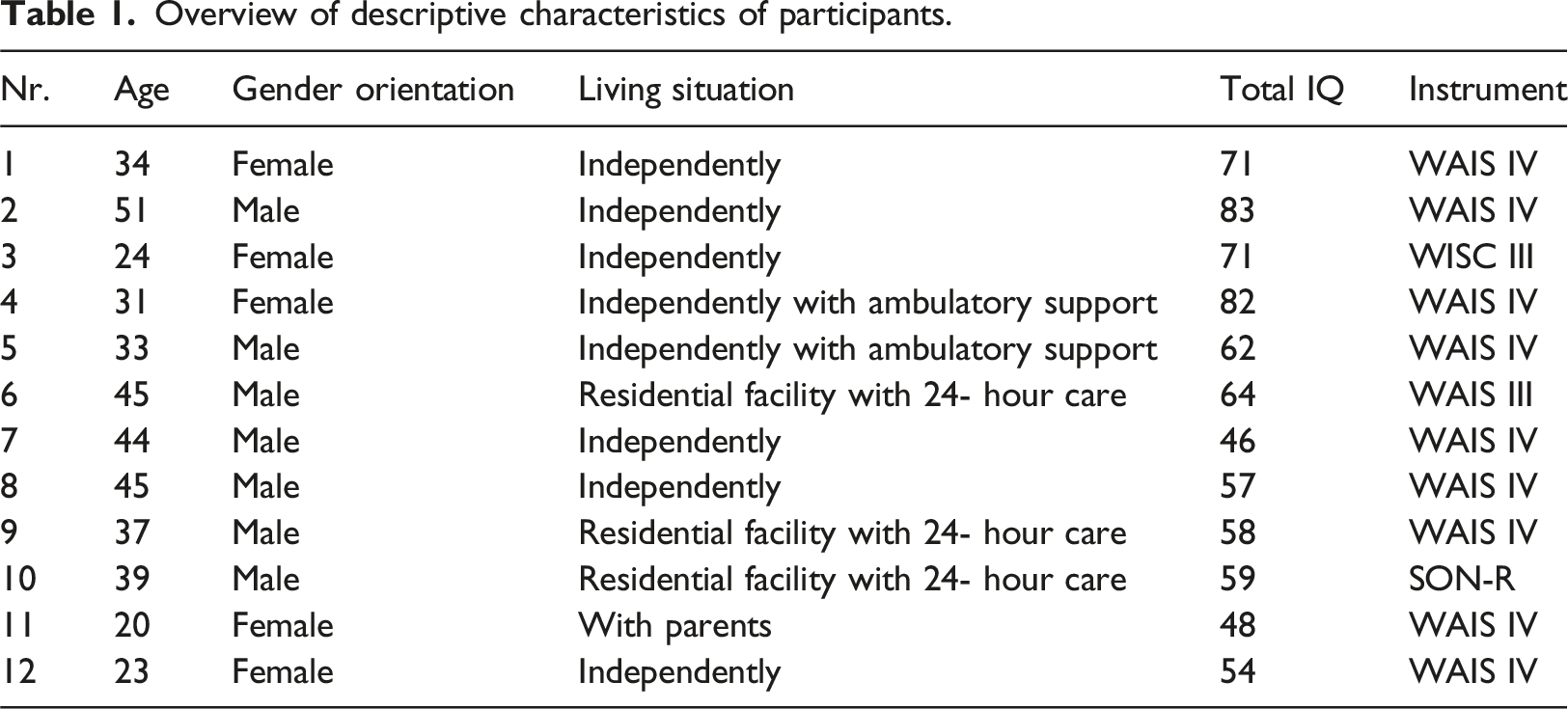
Fourteen participants with intellectual disabilities were recruited through organizations specialized in the care for people with intellectual disabilities in the Netherlands. In the Netherlands there are different types of organizations that provide care to people with intellectual disabilities. In the current study, both organizations specialized in independent client support and ambulatory support as well as residential care settings were approached. Two out of fourteen participants did not complete the full procedure as these participants made clear that they changed their mind about participation during the study. With their consent, only the preliminary notes of these two participants were used. Twelve participants completed the full procedure. In the DSM 5, as compared to the DSM IV-TR, intelligence is no more the deciding factor for the classification of the level of mild intellectual disabilities (Wieland & Zitman, 2016). The severity of intellectual disabilities is now defined by the problems in adaptive functioning. Based on this rationale both people with borderline intellectual functioning and mild intellectual disabilities cognitive level aged 18 years and older were included. The level of severity of intellectual disabilities was assessed by a trained practitioner based on the level of cognitive and adaptive functioning. Information from the personal files of the participants were used to assess the presence and severity of the intellectual disabilities. Assessment of the personal files was done by the first author and a research assistant. The personal files were only accessed after meeting with the possible participant and when consent was provided. A visual leaflet was used to explain which data would be accessed in the current research.
Procedure
General information
The current study was part of a larger research project focusing on resilience in people with intellectual disabilities. The process of effectively negotiating, adapting to, or managing significant sources of stress and trauma is called resilience (Windle, 2011). The guided photovoice procedure was conducted by the first author and a research assistant who were both trained and experienced in communication techniques used with people with intellectual disabilities (See Appendix A for a more detailed description of the procedure). The whole process was supervised by a team of researchers.
First the researcher would contact the professional carers within the organization and provide a short description of the research and a written invitation for possible participants. The professional carer would discuss the invitation with the possible participant and would respond to the researcher by marking either ‘yes’ or ‘no’, on the invitation. Next the researcher met all potential participants for a short meeting to get acquainted with him or her and to explain the purpose of the research project. The information was provided verbally using a leaflet in which the procedure was visualized, that could be read again afterwards when convenient. After they agreed to take part in the research, participants were asked to schedule an appointment to go out and take photos together with the researcher. If desired, the participant could bring a trusted person to the appointments, however none of the participants did. The researcher would encourage participants to use photo devices (such as mobile phones and photo cameras) they were already familiar with. For those who wanted to use a camera but were not familiar with a camera, the researcher demonstrated how to use the camera following a standardized instruction. The standardized instruction for taking photographs is added in Appendix B. Next, all photographs taken were printed and presented in an individual interview. At the beginning of this semi-structured interview the researcher would spread out the photos that were taken and asked the participant with which photo they wanted to start. First, the participant would talk about the properties of the photo and then the participant would talk about the adversities experienced. The participants were asked to tell what was in the photo and why they took this photo. This was to ensure that the researcher would not misinterpret the meaning behind a photo. The researcher used the same words the participant used during the interview.
A standardized procedure was described to obtain feedback about the guided photovoice procedure. During the guided photovoice procedure and the interview the researchers would record all remarks or questions that the participants mentioned regarding the research method. The researcher would motivate the participant to elaborate on their feedback on the guided photovoice procedure using standardized questions such as: ‘What do you mean by...’ and ‘Tell me more about...’. The researcher would keep motivating the participant to elaborate until no new information was provided. After the interview was completed the participants were asked to provide feedback on the research method. The researcher would emphasize on the importance of feedback, and how it is important to learn from their experiences. Next to positive feedback (what did you like) the importance of constructive feedback (what should we change) was explained to provide both space for positive and negative experiences from the research. The researcher would ask a few open-ended standardized questions such as: ‘What was it like for you to participate in this research?’, and ‘Were there things you did not like as much?’. After the open-ended questions the researcher would repeat al answers in a question to confirm the answers. All interviews were audiotaped, transcribed and analyzed.
Consent
The research project was approved by the Ethics Review Board of the University of Amsterdam (project number 2020-CDE-12405). All participants provided written informed consent prior to enrollment in the study. The invitation was provided to potential participants and subsequently discussed with them by a trusted professional carer. Potential participants who agreed to participate were then contacted by the researcher to arrange a first meeting to explain procedures and obtain consent. The interviews were administered between September 2020 to July 2021. Consent was obtained throughout the entire study. The researcher mentioned at every meeting with the participant that participation was voluntarily and could be ended at all times without negative consequences.
Output (for education and/ or publications) was anonymized to assure that individuals could not be traced back by third parties. Appropriate measures were taken regarding the prevailing COVID-19 crisis such as: doing a health-check before every appointment, using disinfectant on the hands at the start of the appointment, cleaning all materials between uses, as was proper ventilation at every location ensured and the researcher respected social distance (1,5 meter) during all appointments except while taking the photographs.
Analysis
After transcribing all interviews thematical analyses were conducted using Atlas.ti version 8. The words the participants used to describe the photos and all additional comments and remarks were analyzed. The physical photos were not analyzed. A coding scheme was constructed by reading all interviews and analyzing recurring patterns throughout all interviews (Braun & Clarke, 2019; Javadi & Zarea; 2016). The coding scheme was based on previous systematic literature reviews. After analyzing the data in the interviews the first author and research assistant would continuously discuss new themes to add or merge into the coding scheme. The coding scheme was used by the first author and a research assistant to independently analyze the first four interviews of the respondents and their informants. Results were analyzed and discussed in the research team. Based on these analyses new themes were added to or merged into the initial coding scheme. After analyzing all data the results were member checked together with the participants.
Results
Overview of descriptive characteristics of participants.
Overview of duration of taking photos, number of photos and duration of the interview.
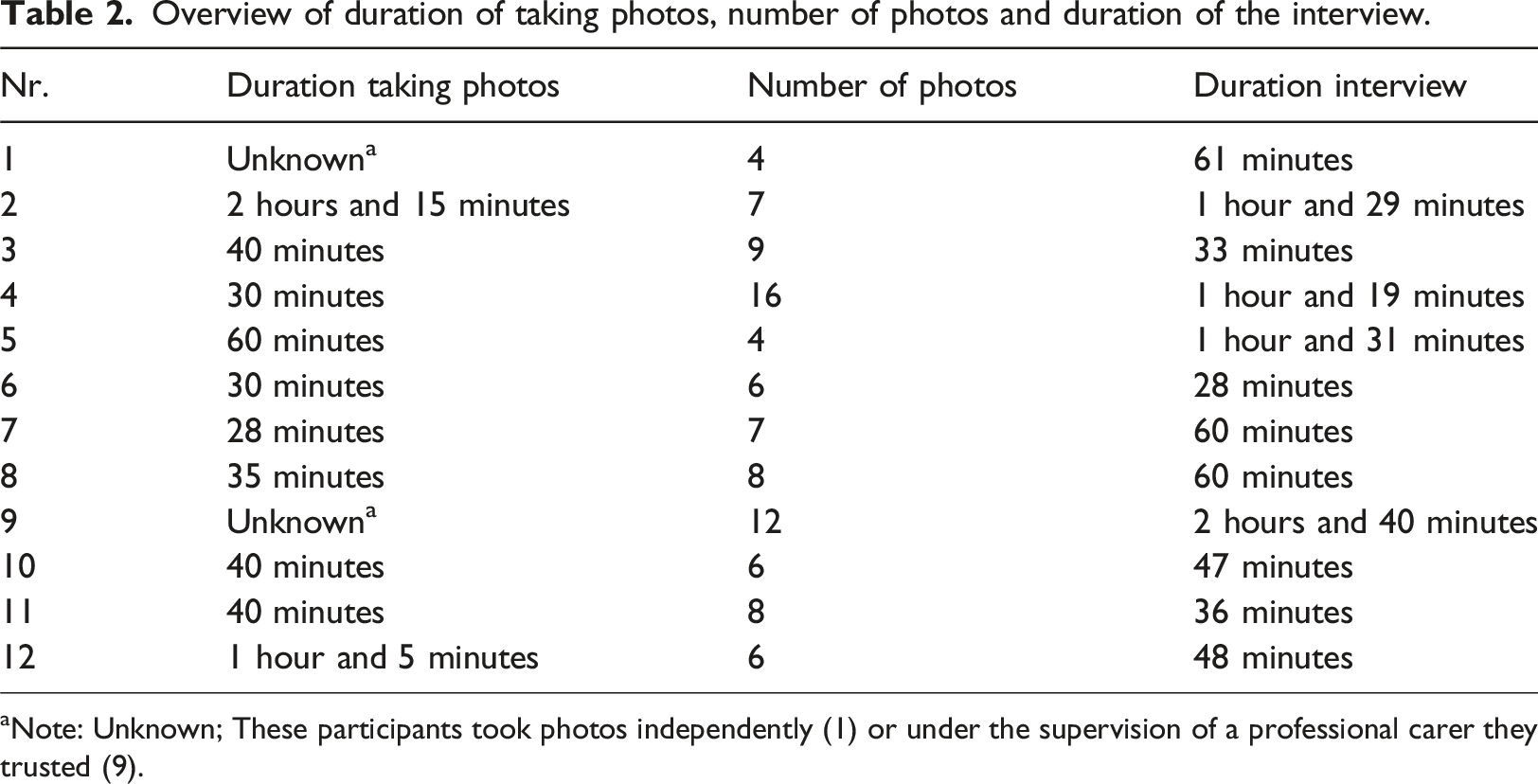
aNote: Unknown; These participants took photos independently (1) or under the supervision of a professional carer they trusted (9).
Benefits
Taking time
The majority of participants mentioned as an important benefit of the guided photovoice approach that the researcher took time to listen to them and they stated that they appreciated the patience the researcher showed. Further, participants mentioned that they appreciated the step-by-step approach so they knew what to expect of the interview. Taking time to look at the photographs during the interview resulted in small breaks. The researcher needs to be calm. And it is important that everything is explained well, researchers should not use too much difficult words. It has to go step-by-step. Not all so “boom” at once. The researcher shouldn't be a very rushed person. For example do not be like: “We only have so many minutes left ...”. A researcher really has to take the time. I know people with disabilities who have more trouble than me that can suffer from time pressure. It must be a very relaxed conversation actually. – Participant 1
Visual cues
Visual cues were available during the process of taking photos. One participant mentioned an object or place that was outside his home. After the researcher told him they could go outside this participant repeatedly asked if they really were allowed to go outside as well. Participants seemed better able to express themselves while being physically in the place or next to the object they wanted to talk about. This could lead to new information not mentioned before. For instance, one participant was able to talk with the researcher but he frequently changed the subject of the conversation. While walking around in the neighborhood the participant took more time to explain his answers and he appeared more focused. He brought the researcher to the house of an old teacher. The participant told the researcher that this person took him in his home after he became an orphan while he was still a minor. This teacher had helped him to find a place to live and to get a job.
All participants acknowledged that the use of photos during the interview was something new to them. By using photographs a visual cue next to the question was constantly available during the interview. A photo like that actually shows you. It is like you're standing there yourself. If you were standing there alone, then you look at those animals. That gives a certain peace of mind, then you start to think very differently. Look, sometimes you don't even have to explain anything. Sometimes it's basically that you just look at something. And then you don't have to speak with many words. – Participant 10
One participant explained that during conversations people usually talk fast and do not leave any room for reactions. By using the photos that she took herself she was not afraid to forget something anymore. The photos were visual reminders referring to the topics she wanted to talk about. Since the photos were taken in advance, she felt well prepared for the interview. This gave her peace of mind.
Opportunity to speak out
All participants mentioned that they enjoyed participating in the study, either to help others or to be able to tell their own story. Many participants mentioned that they felt relieved to be able to talk to someone about important aspects of their lives. As one participant said that after the interview his head felt empty and calm. Participants not only reflected on the given theme of the research but also used this opportunity to reflect on the care they (previously) received.
Challenges
Abstract concepts
Almost all participants mentioned that they found it hard to take photos of people, animals, things or places that were not present at the time. While taking the photos some participants also talked about abstract concepts that they were not able to take a photo of. How do I take a picture of something that is inside of me? My willpower is my strength. But you cannot photograph something like that. My sister is not here as well. I do not have a photograph of her… - Participant 2
The participant and researcher would then discuss other ways to create a visual image. As a solution the researcher offered to write the words down that the participant felt he could not photograph. While writing down these concepts, the researcher would use the exact words the participant used and checked with them if the written words matched their ideas and feelings. All these endeavors led to a collection of photos of written words to serve as a guide for the interview. Yes, it helps to use photographs and write words down. That way I can show what I mean. That is very nice. – Participant 1
Other participants showed photos in photo frames or in photo-albums. Participants who were more digitally skilled looked up previously made photos on their phone or on other devices and sent these photos to the researcher. The researcher adapted the procedure to the specific needs of a participant. Through the use of a mobile phone participants could take photos without the researcher. After the appointment to take photos some participants even kept sending new photos to the researcher using their mobile phones. This enabled the participants to complete the assignment at their own pace.
Aftercare
Participants mentioned that talking about adverse events was sometimes hard. One woman said she did not want to participate after the researcher explained what the study was about. She said: I do not want to talk about the past anymore, it hurts too much. With consent of this participant the researcher contacted the professional carer of the woman and shared her statements so that appropriate aftercare could be provided. Three participants mentioned that it was difficult for them to talk about the adverse events in their lives. It wasn't bad. But it was…. It does take a bit of effort to repeat the story again, what I experienced. I just found it difficult. – Participant 9
Discussion
In the current study, the experiences of people with intellectual disabilities with guided photovoice were evaluated. It was found that people with intellectual disabilities liked to share their stories and were positive about their role as a participant in research. The physical presence of the photos facilitated the participants to tell their stories. Most importantly, because of its flexibility the guided-photovoice procedure could be tailored to the specific needs of each participant. Further, the method enables the researcher to provide guidance when needed and to empower autonomy when possible in people with intellectual disabilities. Based on the adaptations to the procedure that proved to facilitate people with intellectual disabilities, guidelines concerning guided photovoice can be adapted so people with intellectual disabilities feel fully enabled to share their needs, desires and experiences. In the current guided photovoice procedure different themes were identified that are important when collaborating with people with intellectual disabilities: taking time, the importance of visual cues, the opportunity to speak out, dealing with abstract concepts and providing aftercare.
Guided photovoice allows participants to slow down the conversation and focus on what themes they find important. Participants can take the initiative to pick up photos to indicate they want to change the subject or hold on to a photo to take more time to process information. These nonverbal ways of communication give people with intellectual disabilities more control over the interview. Writing down words and photographing themes can serve as an additional facilitator in communication (Boardman et al., 2014; Overmars-Marx et al., 2018). The presence of a visual cue such as a photo, a photo-album, an object or a specific location makes it easier for people with intellectual disabilities to express themselves. This is confirmed in other research showing that visual cues can help people with intellectual disabilities to talk about their personal experiences (Boulton et al., 2018; Wass & Safari, 2020). However, analyzing a photo, drawing or video without a subsequent interview harbours the danger of misinterpretation. We found for instance that a photo of a guitar could have many different meanings, such as: music, an activity, happiness, being in a band with others or even a tribute to a deceased person.
Researchers need to be aware of both benefits and challenges of guided photovoice. Specifically challenges with the use of guided photovoice need to be addressed in order for researchers to make an assessment whether or not this method is suitable. The first challenge that was identified was how abstract concepts can be overlooked. The use of visual cues can be disadvantageous when the focus is only on physical objects. Our participants did not only talk about the themes pictured in the photos but we helped and encouraged them to talk about themes that they could not capture entirely in a photo. Again if we had focused solely on analyzing the photos we would have missed this. Participants can have problems with capturing abstract concepts such as qualities and characteristics or other objects or people that were not present at the time. A researcher can help a participant by discussing how to include themes that cannot be photographed directly. Also a researcher can take notes or use an audio recorder to make sure all words that are used to describe a specific subject can be used for the analysis.
The second challenge that was found was aftercare for people with intellectual disabilities. Participation in research on one hand provides people with intellectual disabilities the ‘opportunity to speak out’ but if sensitive topics are addressed good aftercare should be provided. In research with people with intellectual disabilities researchers need to make clear instructions on what to do when a participant explicit- or implicitly shows a need for help. In previous research, it was warned that it could be more difficult for participants to discuss sensitive topics whilst a researcher is present in their personal environment (Overmars-Marx et al., 2018). In this research project people with intellectual disabilities actually mentioned they enjoyed participation in research in their own environment. During the interview participants also talked about their own care and needs next to the those elicited by the research questions. Participation in research is important to people with intellectual disabilities as they can share their experiences and contribute to the improvement of care for themselves and others (Brooker et al., 2015; Frankena et al., 2019; Fujiura and RRTC Expert Panel on Health Measurement, 2012; Hall, 2013; Moonen, 2019; Rosner, 2015).
In the study by Folkestad (2000), two methods were discussed for photo-assisted conversations; photos either to be taken by the researcher or by the client. In the current study a third method was used in which the researcher and the client collaborated in making the photos together. The added value of making photos together is that the professional is more involved in the real world the client is living. When taking a walk together through a neighbourhood, a researcher can get a better insight into how people in the community actually help or hinder a participant (to feel included). A side effect of this study was that professionals involved in the care for the participants reported that after the research project was finished they suddenly started receiving photos from their clients. It is important when this happens that professional carers specifically mention that the research has finished and these photos will not be used for the research. However regarding their care the use of photos could provide new ways of mutual communication improving the wellbeing of clients with intellectual disabilities.
Different limitations should be taken into consideration concerning the current study. The current study focused on both people with mild intellectual disabilities and borderline intellectual functioning. Future research is needed to gain a better understanding of the use of guided photovoice with people with different levels of severity of intellectual disabilities. Also there were considerable differences between the interviews depending on the capabilities and preferences of the participants. The adaptability of guided photovoice is an important quality, simultaneously this means that researchers need to be careful when comparing results from interviews.
Conclusion
In sum, current results provide new insights into the experiences of people with intellectual disabilities participating in a guided photovoice procedure. Different themes were identified that are important when collaborating with people with intellectual disabilities: taking time, the importance of visual cues, the opportunity to speak out, dealing with abstract concepts and providing aftercare. These insights can be used to better include the perspectives of people with intellectual disabilities as active advocates in scientific research and clinical care. People with intellectual disabilities often want to share their experiences and this can contribute to a better understanding of their needs and desires which can improve their quality of life (Schalock et al., 2010). The group of people with intellectual disabilities is heterogenous thus for conducting research with people with intellectual disabilities there is no ‘one size fits all’ method (Sigstad & Garrels, 2021; Wendling & Brooks, 2020). The researcher should be a creative agent when designing adaptive research methods that fit the needs of people with intellectual disabilities. The current research shows that guided photovoice has proven to be an adequate and helpful research method in the experience of people with intellectual disabilities. Researchers should be aware of their responsibility to include people with intellectual disabilities in scientific research. These findings also support the need for future research regarding guided photovoice in people with intellectual disabilities. An individual tailor- made approach has been emphasized in the current research. In the future it would be interesting to evaluate the findings of guided photovoice in a small group compared to the individual approach. The experiences of people with intellectual disabilities in different approaches to guided photovoice need to be assessed to ensure the experience of empowerment through research. Through the use of guided photovoice it would also be important to gain a better understanding of what people with intellectual disabilities deem important topics for future research.
Footnotes
Declaration of conflicting interests
The author(s) declared no potential conflicts of interest with respect to the research, authorship, and/or publication of this article.
Funding
The author(s) disclosed receipt of the following financial support for the research, authorship, and/or publication of this article: The current research was funded by MEE ZHN (a non-governmental organization for people with disabilities) and VCVGZ (a foundation that finances research promoting mental health care).
Ethical statement

Data availability statement
The data that support the findings of this study are available from the corresponding author, [F. Scheffers], upon reasonable request.
Appendix
Guided photovoice procedure.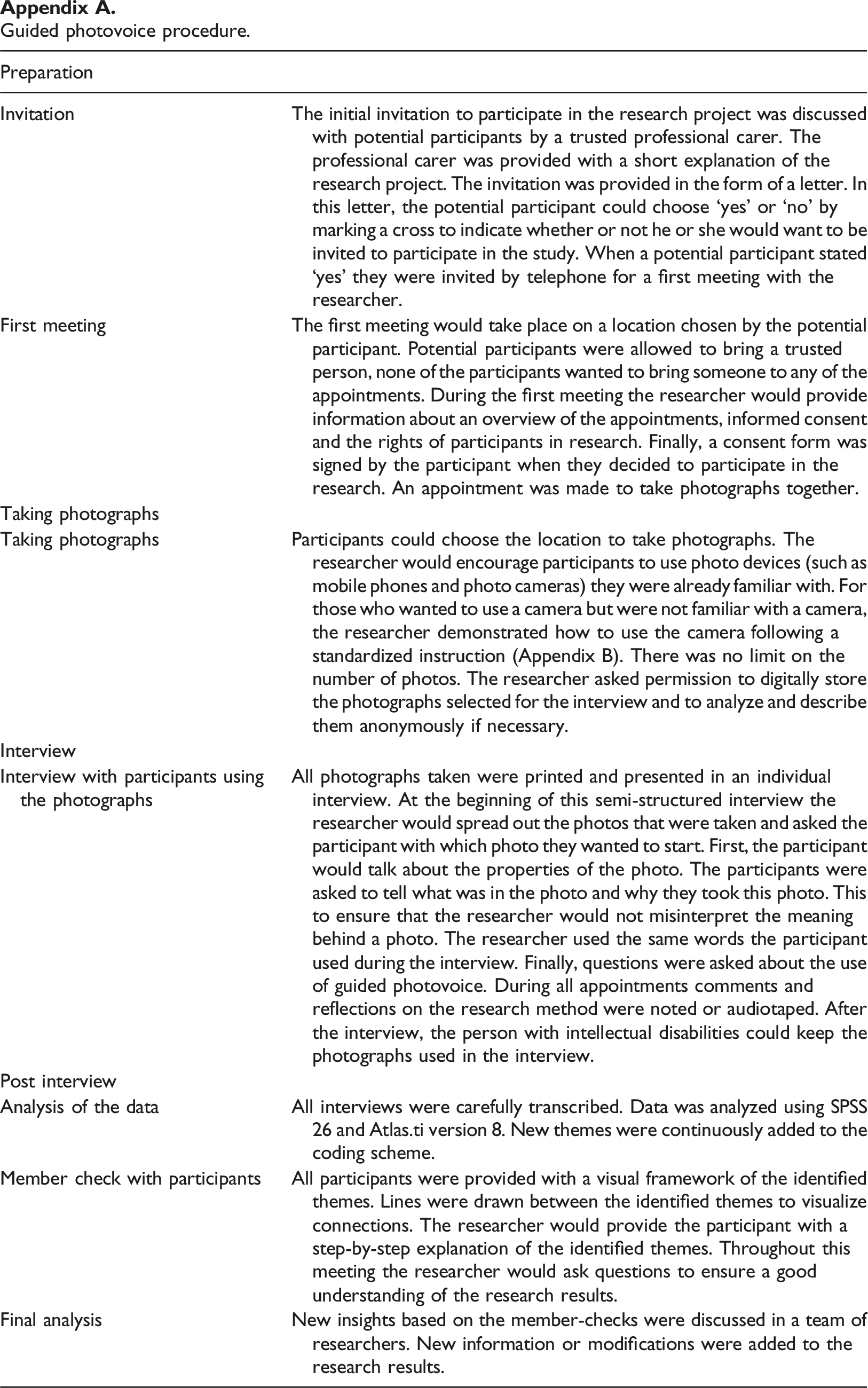
Preparation
Invitation
The initial invitation to participate in the research project was discussed with potential participants by a trusted professional carer. The professional carer was provided with a short explanation of the research project. The invitation was provided in the form of a letter. In this letter, the potential participant could choose ‘yes’ or ‘no’ by marking a cross to indicate whether or not he or she would want to be invited to participate in the study. When a potential participant stated ‘yes’ they were invited by telephone for a first meeting with the researcher.
First meeting
The first meeting would take place on a location chosen by the potential participant. Potential participants were allowed to bring a trusted person, none of the participants wanted to bring someone to any of the appointments. During the first meeting the researcher would provide information about an overview of the appointments, informed consent and the rights of participants in research. Finally, a consent form was signed by the participant when they decided to participate in the research. An appointment was made to take photographs together.
Taking photographs
Taking photographs
Participants could choose the location to take photographs. The researcher would encourage participants to use photo devices (such as mobile phones and photo cameras) they were already familiar with. For those who wanted to use a camera but were not familiar with a camera, the researcher demonstrated how to use the camera following a standardized instruction (Appendix B). There was no limit on the number of photos. The researcher asked permission to digitally store the photographs selected for the interview and to analyze and describe them anonymously if necessary.
Interview
Interview with participants using the photographs
All photographs taken were printed and presented in an individual interview. At the beginning of this semi-structured interview the researcher would spread out the photos that were taken and asked the participant with which photo they wanted to start. First, the participant would talk about the properties of the photo. The participants were asked to tell what was in the photo and why they took this photo. This to ensure that the researcher would not misinterpret the meaning behind a photo. The researcher used the same words the participant used during the interview. Finally, questions were asked about the use of guided photovoice. During all appointments comments and reflections on the research method were noted or audiotaped. After the interview, the person with intellectual disabilities could keep the photographs used in the interview.
Post interview
Analysis of the data
All interviews were carefully transcribed. Data was analyzed using SPSS 26 and Atlas.ti version 8. New themes were continuously added to the coding scheme.
Member check with participants
All participants were provided with a visual framework of the identified themes. Lines were drawn between the identified themes to visualize connections. The researcher would provide the participant with a step-by-step explanation of the identified themes. Throughout this meeting the researcher would ask questions to ensure a good understanding of the research results.
Final analysis
New insights based on the member-checks were discussed in a team of researchers. New information or modifications were added to the research results.