



Abstract
This study explored positive features and challenges in the employment and retention of autistic individuals within 12 Dutch organizations, focusing primarily on the perspectives of employers. Sixteen participants from 12 Dutch organizations were interviewed. Four researchers were involved in a thematic analysis, which revealed five themes and 13 sub-themes. The study identified five main themes around which positive features and challenges revolved: (1) employers’ primary motivations for hiring autistic individuals, (2) consideration of the needs of all employees, including those who are autistic, (3) employers’ perceptions of autistic employees, (4) the adoption of a learning-oriented mindset by employers, and (5) the alignment of human resource development practices with diversity and inclusion policies. Our findings suggest that beneficial organizational characteristics for the employment and retention of autistic individuals include valuing the skills of autistic employees, fostering an understanding of autism devoid of stereotypes and stigmatization, and taking the needs of all employees into account based on personal experiences employers have with employees. Conversely, organizations that primarily hire to fulfil diversity quotas or meet objectives set in diversity and inclusion policies without promoting destigmatizing conditions risk adversely affecting the employment and retention of autistic individuals.
Lay Abstract
This study explored positive features and challenges in the employment and retention of autistic individuals in 12 Dutch organizations. On the basis of interviews with 16 people of these organizations, primarily employers, it was analyzed what helps and hinders employment and retention of autistic individuals. Findings revolved around five main themes. Firstly, employer motivations influence outcomes. Companies valuing technical proficiency and actively seeking autistic individuals with that proficiency benefit both parties. Conversely, altruistic motives may hinder employment, especially where quotas override other hiring considerations. Secondly, acknowledgment of individuality and making accommodation foster good employment and retention practice. Employers recognizing differences and adopting flexible job designs create welcoming environments not only for neurodivergent persons. Thirdly, employer perceptions on autism significantly shape employment practices and retention. While fostering neurodiversity enhances good retention practice, it becomes problematic when misconstrued as a belief that individuals with neurodiverse traits can easily conform to all norms, leading to undesirable expectations of conformity. Fourthly, a learning mindset supports neurodivergent individuals (and others). Engaging in introspective evaluations facilitates good employment practice. Lastly, lack of fully integrated policies impedes employment and retention. Applying universal design principles in human resources management is important for normalization. Building on existing positive features and tackling the challenges highlighted in this study will be crucial for realization of equitable workplaces where autistic individuals are not stigmatized.
Employment disparities among autistic individuals
Individuals on the autism spectrum face higher rates of unemployment, underemployment, and malemployment compared to the general population (Baldwin et al., 2014). They struggle to secure and maintain competitive employment, with fewer than half retaining a job (Solomon, 2020). The elevated job turnover experienced by this group leads to fragmented work histories that contribute to stress, depression, isolation, and financial insecurity (Baldwin et al., 2014). In mainstream workplaces, the employment rate for individuals on the spectrum is significantly lower than for persons without disabilities or even individuals with other types of disabilities (Allen & Coney, 2018; Hedley et al., 2017; Jacob et al., 2015). Challenges in securing and maintaining employment often stem from social and behavioral mismatches rather than skill-related deficiencies, which could manifest, for example, during job interviews (Scott et al., 2015). Autistic individuals who do secure employment frequently encounter stereotyping and biases, and experience isolation and stigmatization (Hedley et al., 2017; Müller et al., 2003; Richards, 2012).
Perspectives on autism and their impact on disparities
The conceptualization of autism lacks universal consensus, and diverse perspectives shape interpretations of the entity. Biomedical explanations of autism have predominantly concentrated on the difficulties experienced by affected individuals measured in laboratory tasks (Solomon & Bagatell, 2010). Within this paradigm, autism falls within a diagnostic category known as autism spectrum disorder (ASD). Its diagnostic categorization has primarily relied on clinical observation rather than aetiology. Defining symptoms include impairments in social communication, repetitive and restricted behaviors and interests, and atypical sensory responses (5th ed.; DSM–5, American Psychiatric Association, 2013). Whereas the biomedical model views autism as a deficit or disorder within the individual, the social model of disability places greater emphasis on addressing the external factors that hinder full participation of autistic people in society. This model reframes the challenges faced by individuals on the autism spectrum as societal barriers rather than inherent deficits and calls for society to be more inclusive and accommodating (Whelpley et al., 2023).
A 2019 scoping review on factors affecting employment for autistic individuals revealed the predominance of the biomedical model in theory and practice, showing an emphasis on the “impairments” of autistic individuals. The review emphasized the necessity to alter strategies aimed at addressing employment disparities. The proposed interventions mainly focused on modifying ASD characteristics to improve job performance. The authors advocated for adopting a social model of disability, rather than the prevailing biomedical perspective, to better incorporate contextual factors (Scott et al., 2019).
Since the 1990s, the idea has gained ground that neurodevelopmental conditions, such as autism, ADHD, and dyslexia, are natural human variations rather than pathologies. Many authors have sympathized with the concept of neurodiversity (Baron-Cohen, 2017, Cowen, 2012; Doyle, 2020; Hamilton, 2020; Sonuga-Barke & Thapar, 2021). The concept has resulted in what we may now call “the social model of neurodiversity” (Doyle & McDowall, 2021). This model expands on the principles of the social model of disability and adds an element to it, as it critiques the pathologizing of conditions like autism and rejects the concept of a single “normal” neurological condition (Armstrong, 2015). Although the precise meaning of “neurodiversity” is still debated, in this study, we follow the concept as defined by Doyle and others, who stated that “neurodiversity” emphasizes the cognitive diversity among all humans. Individuals whose results are within statistical norms on relevant cognitive tests or behavioral assessments are termed “neurotypical,” while persons previously labelled as disordered, such as autistic individuals, may be referred to as “neurodivergent,” “neurodiverse,” or part of a “neurominority” (Doyle & McDowall, 2021).
Frequently cited enablers and challenges to employment and retention
Examples of frequently cited enablers for employment and retention include: understanding traits of autism, emphasizing strengths rather than “deficits,” avoiding stereotyping, fostering positive relationships between employers and autistic individuals, inclusive leadership, avoiding ableist language use, creating psychological safety, managers having a learning attitude, a focus on teamwork rather than on individuals’ work, formulation of strategies and policies, and implementing physical adjustments to mitigate hypersensitivities (Austin & Sonne, 2014a; 2014b; 2017; Baldwin et al., 2014; Bottema-Beutel et al., 2021; Bury et al., 2019; Hayward et al., 2019; Hedley et al., 2017; Hendricks, 2010; Hurley-Hanson et al., 2020; Khalifa et al., 2020; Vogus & Taylor, 2018; Whelpley, 2021; Whelpley & Perrault, 2021). Conversely, constraining factors would be the opposites of the enablers, with stigma standing out as a deep-seated constraint playing a pivotal role in the life outcomes of autistic individuals, including their employment. The stigma associated with autism encompasses, for the individual, elements, such as fear of disclosure, camouflaging, anxiety, and depression (Blackburn, 2023; Cage et al., 2018; Doyle et al., 2022; Hull et al., 2019; Laar et al., 2019; Turnock et al., 2022). Given the pervasive challenge posed by stigma, it becomes crucial to consider what we know about the social conditions fostering destigmatization. A 2016 study suggested, on the basis of empirical research among different stigmatized minority groups, that three social conditions are associated with the reduction of public and structural stigma: (1) the credibility of new constructions, which depends on their conclusiveness and the status of actors advocating for them; (2) the interaction of new constructions with existing ideologies; and (3) the perceived linked fate between the stigmatized group and the dominant group (Clair et al., 2016).
The need to reduce the employment disparities
Enhancing access to sustainable and inclusive employment for autistic individuals is increasingly urgent, as the number of autistic individuals seeking employment is expected to rise in the next decade (Whelpley, 2021) due to the increasing prevalence of autism (Chen et al., 2015; Geurts et al., 2014). This, combined with the tight labor market in the United States and Europe, will lead to an increase in the disparities unless successful strategies are identified and implemented.
Autistic individuals contribute significantly to organizations, bringing unique qualities, such as attention to detail, reliability, integrity, hyperfocus, and consistent accuracy (Armstrong, 2011; Austin & Pisano, 2017; Baron-Cohen et al., 2009; Hendricks, 2010). The concept of “cognitive team diversity” refers to the possibility to enhance team creativity, innovation, and productivity (Austin & Sonne, 2014b; Axbey et al., 2023; Kirby & Smith, 2021; Waisman–Nitzan et al., 2018). Societal costs associated with underutilizing the potential of autistic individuals are substantial (Buescher et al., 2014; Chen et al., 2015; Hurley-Hanson et al., 2020; Jacob et al., 2015; Leigh & Du, 2015). International, national, and local initiatives, such as the ILO convention (International Labour Organization [ILO], 2008) and the Convention on the Rights of Persons with Disabilities (United Nations, 2006), draw attention to the importance of improving access to productive employment. The legal definition of accommodation, in accordance with the United Nations Convention on the Rights of Persons with Disabilities, emphasizes the crucial need to integrate autistic individuals into the workforce to address the impending rise in employment disparities.
From a humanistic standpoint, employment is a significant factor contributing to identity and quality of life (Harmuth et al., 2018; Roux et al., 2013). Even when underemployed, individuals on the spectrum experience better quality of life and cognitive performance than when unemployed (Chen et al., 2015; Howlin et al., 2004).
Current challenges in theory and practice to reduce employment disparities
Doyle and McDowall (2021) exposed the scarcity of evidence on how to achieve job performance improvement and occupational inclusion for neurominorities, such as autistic individuals, and described a widening divide between scientific understanding and practical implementation. Ezerins et al. (2023a, 2023b) highlighted that the omission of neurodiversity from management theorizing is a barrier to representation of neurodivergent perspectives in research and practice and recommended advancing beyond the current trend of identifying isolated spaces within neurotypical systems, where neurodivergent individuals can coexist and prosper. They contend that despite increasing acceptance of the social model and progressive acknowledgment of the strengths of neurodivergent employees, there has been insufficient movement in both research and practice towards collaboration to create systems outside neurotypical boundaries. Notably, Bernick (2021) raised awareness regarding the limitation of initiatives focused on hiring individuals on the autism spectrum to remedy systemic underemployment of this group.
Szulc et al. (2021) emphasized that prevailing human capital typologies fail to consider neurodevelopmental differences in the workplace despite the substantial size of the neurodivergent segment of the population. Doyle and McDowall (2021) promoted the adoption of a universal human resources design in mainstream organizations to foster the success of diverse human typologies.
A recent large UK survey (of 127 employers and 990 neurodivergent employees) provides key insights into better understanding and supporting neurodivergent employees (McDowall et al., 2023). Four priorities to foster neuro inclusion are recommended: (1) make everyone's wellbeing and inclusion, especially neurodivergent workers, a core part of the company's plan to benefit from diverse talents; (2) evaluate and share what adjustments work best for different people, ensuring quality and effectiveness; (3) strengthen relationships, focusing on psychological safety and boosting managers’ confidence, so that everyone feels a shared responsibility; and (4) develop policies that help neurodivergent employees not just to survive but to thrive, supporting their careers and ambitions.
What this study contributes to theory and practice
A comprehensive understanding of the current state of employment and the retention of autistic employees in mainstream organizations is presently limited but holds critical importance for remediating underemployment. The existing literature focuses on the perspectives of autistic employees rather than exploring those of their employers (Hedley et al., 2017, p. 936).
Our goal is to narrow this knowledge gap by enhancing understanding of the current positive features and challenges in the Dutch landscape regarding systemic employment and retention of autistic individuals. This will be achieved through an assessment of employers’ perspectives. While our focus is on the Dutch context, we anticipate that our findings will have relevance for countries sharing similar socio-economic conditions. Our overarching goal is to grasp the current realities, laying the groundwork for further academic research and the development of practical and effective strategies.
The central question of this research is: What are the positive features and challenges in the Dutch landscape regarding employment and retention of autistic individuals?
Method
This qualitative research study employed an inductive approach, with introduction of a deductive element based on the researchers’ familiarity with the social model of neurodiversity and autism (O'Reilly, 2008). We carried out a thematic analysis of this qualitative study (Braun & Clarke, 2006).
Participant selection
A Dutch entrepreneurship facilitating employment of autistic individuals in IT, named ITvitae (Schuurmans et al., 2023), provided the researcher with a list of 106 organizations that had employed 169 of their alumni between January 2017 and mid-2019. Stakeholders of ITvitae wanted information on the long-term results of placed autistic individuals. Organizations unlikely to be hiring candidates in the future, as they had few IT vacancies, were excluded, leaving a list of 56 organizations, which had employed 100 (60%) ITvitae alumni.
We categorized organizations based on anticipated experiences in employing autistic individuals as those with positive experiences and those with more challenging experiences. To increase the possibility of obtaining a mix of these groups, we examined organizations that had recruited at least one additional candidate between mid-2019 and January 2021 and/or were actively exploring further recruitment opportunities with the social enterprise ITvitae. Conversely, organizations that did not meet these criteria were seen as potentially representing more challenging experiences.
The Head of Secondment at ITvitae proposed a convenience sample of twelve organizations, half in each group. The principal researcher invited all of them to participate. The contact persons of the six organizations selected for probable positive experiences all agreed to participate in in-depth interviews (IDI), while of the six that in the other group, one did not respond, and one replied that participation was impossible due to high staff turnover. Two additional organizations were approached and did agree to interviews. Finally, 12 organizations participated: six that were expected to have had positive experiences, and six that might have had more challenging experiences with employees on the spectrum. Once agreement was reached, the principal researcher took over further communication, arranged the signing of consent forms, and conducted telephone meetings with the designated contact person.
In most cases, the principal researcher interviewed the contact persons suggested by ITvitae, but if an alternative was proposed by the initial contact person as one they considered better positioned for the study, that person was interviewed. The reason for this selection procedure was that we wanted to keep the barrier to participate low, by giving organizations the freedom to select the person they deemed best positioned for the interview. The respondents who participated were all employed in the function of manager, coordinator, or head of a department in their organizations, and all had at least 5 years’ work experience. In one organization, we interviewed two members of the neurodiversity embassy in absence of a manager due to a misunderstanding about the appointment.
In two organizations, the principal researcher interviewed two people together and in one, she interviewed the same person a second time to obtain clarifications. In another, she spoke separately with three different persons: a human resources development (HRD) manager, an inclusion coordinator, and a person active in a “neurodiversity embassy” 1 in the organization as the respondents insisted more voices needed to be heard within their organization. Table 1 outlines details about the 16 persons finally interviewed from the 12 participating organizations, and the initial reason for their selection by ITvitae.
Research participants.
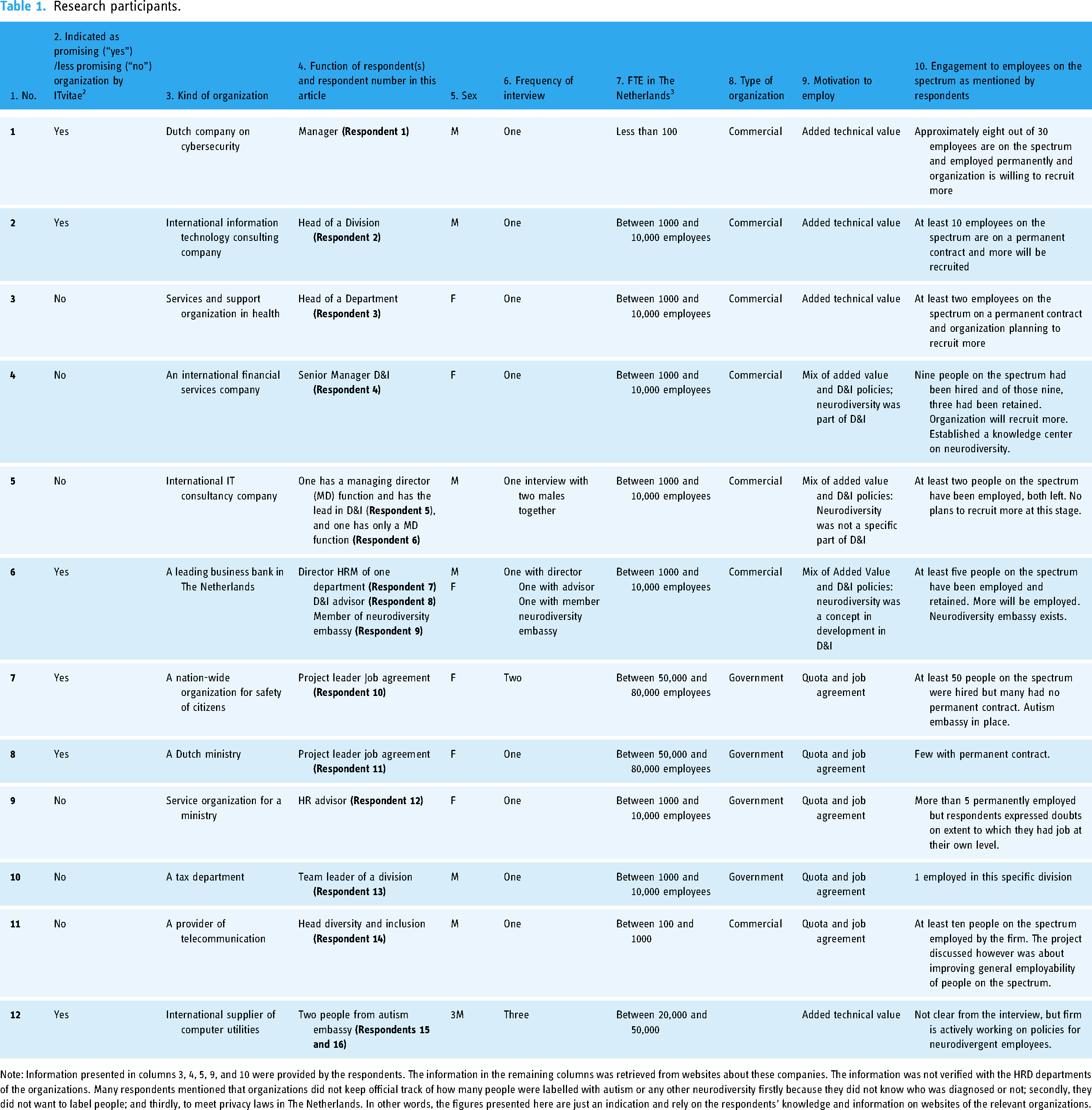
Note: Information presented in columns 3, 4, 5, 9, and 10 were provided by the respondents. The information in the remaining columns was retrieved from websites about these companies. The information was not verified with the HRD departments of the organizations. Many respondents mentioned that organizations did not keep official track of how many people were labelled with autism or any other neurodiversity firstly because they did not know who was diagnosed or not; secondly, they did not want to label people; and thirdly, to meet privacy laws in The Netherlands. In other words, the figures presented here are just an indication and rely on the respondents’ knowledge and information on websites of the relevant organizations.
Data collection, transcription, analysis, and documentation
The principal researcher interviewed the respondents on a number of themes, asking them about their initial motivation to employ people on the spectrum, their subsequent experiences with employment and retention of autistic employees, issues encountered, lessons learned, and plans for the future. The full interview guideline can be found in Appendix A. The researcher adopted the “miner approach” described by Lewis et al. (2014), which involved delving deeper into content by posing open-ended questions about the reasons behind certain stances, how ideas manifested in practice, and requesting examples to elucidate statements and ideas. The interviews were conducted within a period of five months in 2022, each lasting 45 to 90 min.
Concurrently with data collection, thematic analysis unfolded. As data collection progressed, emergent themes guided subsequent interviews, allowing for deeper exploration.
The principal researcher recorded all interviews and transcribed the recordings. Transcripts were sent to respondents for review; seven returned slightly altered texts, and nine did not respond. For confidentiality, all audio material was deleted 1 month after the transcripts were completed.
Once all interviews had been carried out, and the transcripts had been made, researchers reviewed the raw data in the transcripts and collaboratively elaborated on the further development of codes and emergent themes, manually sorting and categorizing them into coherent groups. The use of mind-maps facilitated discussions about the relationships between codes, aiding in formulation of overarching themes and sub-themes to reveal patterns related to employment and retention of autistic individuals. An iterative process ensued, involving re-coding, fine-tuning, and re-clustering into main and sub-themes. When there was consensus that additional refinements would not substantially contribute additional information, the principal researcher conducted a detailed analysis, identifying the essence of each theme. The five main themes were used to present the data. The engagement of the principal researcher with the data was characterized by a continuous self-reflexive stance, acknowledging her own background, experiences, and biases, which were consistently documented in a reflexive diary maintained throughout the research process (Korstjens & Moser, 2018). Regular meetings among the four researchers involved in this study facilitated discussions on emerging insights, addressed challenges, and strategized analysis. Patterns extracted from the data demonstrated a consistent degree of saturation, indicating a sufficiently thorough exploration of the topic (Charmaz, 2006). The researchers summarized the findings along the themes that surfaced from the analysis. The principal researcher developed detailed descriptions theme, focusing on revealing what the data indicated about participants’ experiences and exploring underlying meanings. This process involved an examination of how themes interrelated and the documentation and illustration of themes using descriptions of responses, tabulations, and quotes from participants.
Ethical considerations
Participants received detailed information on research objectives; all of them provided written consent to participate. They were explicitly informed of their right to withdraw at any point and assured of confidentiality and pseudonymization for individuals and organizations. In accordance with Dutch privacy laws (AVG), a formal agreement was signed between the relevant institutes.
Position of the principal researcher
The principal researcher, a woman in her late fifties, holds master's degrees in social anthropology and business administration. Her work with a private consulting engineering firm and several non-governmental organizations focused on organizational and social change, participatory approaches, and equitable access to services and resources for marginalized groups in Pakistan, India, Kenya, Vietnam, Georgia and a number of other countries in Asia, Africa, and Eastern Europe. The researcher grounds her work in an interpretivist and constructivist epistemological perspective, recognizing the ongoing construction of knowledge and the harmonization of inductive and deductive reasoning within the research process. Her interest in autism stems from personal connections. Motivated by a commitment to contribute to a society that embraces diversity and ensures equal consideration for autistic individuals in all aspects of life, she wishes to contribute to research inspired by the social model of neurodiversity.
Findings
The outcomes of our study are structured around five thematic categories, shedding light on positive features and challenges in the Dutch landscape regarding employment and retention of autistic individuals. The themes and subthemes we distinguished are summarized in Table 2 and subsequently described per theme. Appendix C provides a variety of quotes illustrating the themes and sub-themes depicted in this table.
Themes and sub-themes regarding positivities and persistent challenges in the employment of autistic individuals.

Theme 1: primary motives of employers to employ autistic individuals
Summary of findings
Our findings suggest that hiring individuals based on their technical skills provides the highest likelihood of successful employment and retention. There is no issue with employing individuals according to diversity and inclusion (D&I) policies if there is a fundamental understanding of autism and if it is acknowledged that bringing a person on board mainly for altruistic reasons may not be beneficial in the long term for either the individual or the organization. Ultimately, our research indicates that hiring autistic individuals primarily to fulfil quotas does not effectively suppo
Outcomes from the interviews illustrate this summary. We distinguished between the following three groups of organizations:
1. Organizations Where Autistic Individuals Were Primarily Employed to Make Use of Their Skills
Among organizations hiring employees primarily to benefit from their talents and skills (N = 4), the respondents did not raise any profound issues regarding their employment. The quote below illustrates that the natural adaption to the needs of autistic employees, as expressed by one manager: Yes. And see it [employing people on the spectrum] as an opportunity, honestly. So, it is also a chance. An opportunity to meet good people who may need a bit of guidance but who you would otherwise hardly find. To be fair, it is not always easy to find skilled people. And I would rather have someone with good capacities and knowledge and skills who may require a little more guidance than people who need it less but are also less able. (Respondent 3)
2. Organizations Where Autistic Individuals Were Primarily Employed to Meet Goals in the D&I Agenda.
All organizations that had hired employees primarily to fit their D&I policies (N = 3) not only mentioned technical advantages of employing autistic individuals, but also other advantages, such as the intrinsic value of giving people a chance, the chance to become more aware of one's assumptions on “what is normal” and the positive effects of having a “different” colleague on group cohesion and group atmosphere. For example, a Senior Manager D&I shared how one young man had sparked valuable conversations in the risk department about subjects that had never been discussed before. She told the interviewer: One person had turned out to have a brother on the autism spectrum, another had an autistic nephew. The whole team opened up and started to share personal stories which had not been shared before. (Respondent 4)
However, two cases in two organizations signaled that wishes to do good and/or to take diverse people on board could have a detrimental effect on systemic retention. Considering the D&I policy, the manager hired an autistic employee and gave him an assignment that fitted his skills and needs very well for the first 6 months. Then, his manager tasked him with acquiring new clients for additional assignments, a responsibility shared by everyone in the department. The pressure became so overwhelming that he decided to leave the organization. In a different workplace, the D&I manager hired an individual despite initial doubts about his skills. Unfortunately, in this instance as well, the autistic employee was not retained.
3. Organizations Where Autistic Individuals Were Primarily Employed to Fill a Quota
Employment and retention practice was most challenging among organizations hiring autistic individuals to meet a quota (N = 5). Dutch Active Labor Market Policies (ALMP), described in Appendix B, had prompted these organizations to hire people on the spectrum.
Two respondents highlighted the perceived unfairness of the quota system in their organizations, finding several aspects problematic. A third respondent shared a similar sentiment, emphasizing one specific aspect. The interviews revealed four main instances of perceived injustice:
Perceived Injustice 1: People are not Employed Based on What They can Contribute.
One respondent objected to the fact that potential employees were not approached for what they could contribute to the organization, but for the contribution they could make to achieving the Job Agreement Target. Respondent 12 mentioned, “In my opinion, the motivation to employ people [on the spectrum] is now mainly based on the quota. As a consequence, it is not considered what people can contribute to an organization.”
Perceived Injustice 2: People are Treated Differently Because of Bureaucratic Regulations.
Another (Respondent 11) objected to the fact that the organization treated people who were registered as Target Group members differently from others, even other people with similar characteristics. She also mentioned later in the interview that only people who were registered could access certain accommodation facilities in the organization. She knew of cases where older employees who later found out they were autistic had been fired without having been offered accommodation, while, at the same time, new autistic individuals employed through the Target Group Registration had been given access to accommodation.
Perceived Injustice 3: Jobs Contributing to Target Fulfillment are Often not Permanent Because Autistic Individuals Often Can not Meet all the Requirements of “Fixed Job Formations.”
In The Netherlands, every government organization records how many and which functions the organization has within a certain time period (Organisatie en Personeel Rijk, 2020). Job descriptions for the positions within the staffing plan are generally established and formalized beforehand and can be periodically reviewed. This is called the ‘formatie'. The way people are employed can deviate from the pre-described formation, but any deviation needs to be reported. Two respondents (10 and 12) mentioned that all job formations asked people to meet a broad spectrum of requirements. They both wished the jobs could be more shaped around individuals’ profiles. Respondent 11, also working with a government agency, noted that although she had the possibility to accommodate autistic employees in meeting job demands, she had doubts about whether the current job descriptions available to them actually aligned with their skill levels.
Perceived Injustice 4: Autistic Individuals are Only Hired if Registered in the Target Group Register.
One respondent (10) mentioned that autistic individuals often were only hired if they contributed to meeting the Job Agreement Target. This meant that they had to register as “not able to earn a minimum wage independently” to obtain a job in her organization. She felt this was unfair, as it indirectly forced autistic individuals to frame themselves in negative terms.
What might be seen in a positive light among the organizations within this group is that without the Job Agreement Target, autistic individuals might not have been employed by these organizations at all, and the organizations might not have learned anything about autism. Another advantage is that the Job Agreement Target sometimes permitted making exceptions to general rules to accommodate autistic individuals. However, although it probably helped a few individuals to be employed and retained, the price may have been a higher probability of stigmatization as persons hired in this way tended to be “othered.”
Theme 2: consideration of the needs of all employees, including autistic employees
Summary of findings
Our findings indicate that adaptation to the needs of autistic individuals occurs organically when there is a fundamental commitment of an employer to consider and adapt to the needs of all employees. Conversely, when the prevailing attitude is that “all employees should adapt to the way we do things around here,” and autistic employees are only accommodated when labelled, retention of autistic employees is at risk. Below, this summary is further detailed.
When there was a basic attitude that the needs of every employee should be taken into account, adapting to the needs of autistic individuals seemed to come naturally. An example of such “natural adaptation” was the response of one manager, Martijn, when he was asked about the way he adapted working conditions to the needs of autistic employees: It [autistic features] may have to be considered, but that is just like with any individual. That is not fundamentally different from taking into account that somebody just got divorced and can only work four days a week with flexible hours because of childcare demands. (Respondent 2)
Whereas in Martijn's practice the adaptation to the needs of autistic employees seemed to come naturally, other respondents reported negative consequences when managers and/or organizations were expected to adapt to general job demands. A Job Target coordinator mentioned: A respondent in one organization talked about managers being unwilling to adapt to the needs of people on the spectrum because “others in the team also had specific needs and they would find it unfair to accommodate only one particular group”. (Respondent 10)
Mary, a neurodivergent employee, shared how it did not make sense to her that, on the one hand, her organization employed neurodivergent persons, and on the other hand, managers often expected them to just adapt to “the way things are done around here.” She said her employer reminded her of someone trying to push a round peg into a square hole and that having to justify accommodation by labels is not a good thing. She felt that it should be standard practice to take everyone's individual needs into account. (Respondent 9)
Theme 3: perception of employers on autistic employees
Summary of findings
Another critical commitment influencing retention is the perspective on autism within the organization. All respondents agreed that autistic individuals were not significantly different from neurotypical people, but might require specific attention for certain traits that diverged from the norm. When this perspective was more widespread in their organization, it positively impacted retention. Moreover, the recognition that adapting to the needs of autistic individuals benefits not only that specific group, but also a broader range of employees with similar traits, also appeared to support retention. Conversely, some respondents reported facing resistance from managers who interpreted the idea of “autistic individuals not being significantly different” as a directive to oblige autistic employees to adapt to the norm, making retention more challenging. This summary is based on the insights gathered from the interviews outlined below.
In addition to differing attitudes about the extent to which managers are willing and able to take the individuality of employees into account, different perceptions were encountered regarding autism itself. It was remarkable that around half of the respondents mentioned spontaneously that autistic individuals were not so different from others in their organization. They said that autistic individuals had a thinking style that was also encountered among people not diagnosed as neurodivergent. This attitude meant that persons on the spectrum were approached as individuals without stereotyping or assumptions. Two respondents in particular, who had both often worked with people on the spectrum, reported that in their experience, a certain “pattern of behavior could be recognized,” yet at the same time, characteristics and traits varied per individual and no assumptions about traits should be made.
However, it also surfaced from the interviews that there could be a downside to the idea that autistic employees were not so fundamentally different from the neurotypical ones. Respondents in two large government organizations (10 and 12) mentioned that the Autism Spectrum condition was poorly understood by a few managers. They said that some managers assumed they could “just handle it,” but ran into problems later. One also said that some managers believed that autism traits would decrease over time and assumed that people could adapt as their traits became more 'normal'. One autistic member of a neurodiversity embassy reported that a manager had told him, “Your traits are not different from mine.” He had answered: “Stop, this hurts: Every day, I am confronted with my limitations, don’t downplay it now.” (Respondent 15)
A few respondents mentioned that they had realized that taking the needs of autistic colleagues into account not only helped these colleagues, but many other employees as well. First, as illustrated by the two quotes below, more employees are neurodivergent than are recorded as such by the employer.
Erik (respondent 15) tells how he had a burn-out and found out it was related to autism, which was only then diagnosed, and left the organization for a few years. After he returned, he initiated an “autism embassy,” which is currently being turned into a “neurodiversity embassy.” He contacted the HRD department and said he would like to help them to become more autism-friendly. They responded: “But we only have two or maybe three autistic employees, so there is no need!” Years later, their HRD department investigated reasons for employee burn-out; burn-out related to autism turned out to be far higher than they had expected. This was a turning point for the organization; they became aware of having a high proportion of employees on the spectrum, diagnosed or not. They now involve Erik and the members of the embassy in exploring how to better take the needs of autistic employees into account.
Mary is an active member of a neurodiversity embassy from another organization and tells me how surprised she is about the ignorance of her employer on the number of neurodivergent employees. “Lately,” she said, “I proposed organizing trainings on how to better accommodate highly intelligent colleagues because many I know are near to a burn-out. The reaction was, ‘Let's not take on something new like that, we are busy enough as it is.’.” She says, “they do not seem to realize that these highly intelligent employees are at the edge of having a falling out” (Respondent 9).
Robin, who has an autistic co-worker, realized that certain issues that are very good for or very important to his colleague would also be helpful to all employees. He gives the example of his co-worker getting annoyed about attending meetings with no agenda. It made Robin realize that there were too many unstructured meetings in his organization and that having an agenda would make all meetings more effective and help all employees to cooperate in a better way (Respondent 6).
Theme 4: a learning mindset of employers
Summary of findings
Our research revealed that experiential learning within organizations resulted in valuable adaptations that improved retention of autistic employees. These adaptations encompassed modifications in communication styles, improved accessibility to coaching, and physical adjustments such as the provision of headphones and the creation of silent rooms. Conversely, we identified a deficiency in both the ability and willingness to learn among certain managers. According to one respondent, only about one third of managers demonstrate the necessary sensitivity to foster a conducive environment for autistic employees. In some instances, managers were reported to display a reluctance to learn, insisting that autistic employees “should simply adapt.” Additionally, a concerning aspect of retention emerged when adaptations were rooted in stereotypes about autistic individuals as a group. One respondent highlighted the need to educate managers that not all autistic employees require headphones, emphasizing the importance of avoiding generalized assumptions. The following outcomes of our interviews illustrate this summary.
All, but one, of the respondents examined their own attitudes towards autistic colleagues during interviews. The integration of lessons learned led naturally to adaptations in new practices, which could include adjustments in communication, coaching, and physical modifications to accommodate sensory sensitivities. Regarding coaching, one manager (Respondent 3) noted that she estimated that only one-third of the managers in her company had the right sensitivity to coach people on the spectrum, and she wanted to emphasize that she was pretty sure most of them should not be given that task.
Whereas all, but one, respondent had personally learned from their experiences of interaction across neurotypes, not all the organizations they belonged to were willing and/or able to reflect and act upon insights gained. Three respondents complained that their insights on how to better accommodate autistic individuals were not absorbed by their organization, and that they had advocated for change with varying degrees of success. For example, a respondent who had initiated a video imaging project specifically for new autistic employees considering the job agreement target, said she often questioned the job formations in her organization and consistently asked colleagues how permanent employment could be better accommodated for the future of her autistic colleagues. An autism embassy has been established in the organization, and more people have disclosed their condition. She said that managers now sometimes consult the embassy for advice on how to manage an employee on the spectrum (Respondent 10, second interview). One respondent (11) noticed not only little understanding and many stereotypes about what autism entails among colleagues, but also an unwillingness to learn and a prevailing idea that people should adapt to the wishes of their managers. She arranged trainings/workshops for buddies, teams, and managers. She said these workshops could really help, but that the people who needed it most often failed to join. This respondent was frustrated about the lack of willingness of some managers to learn from her experience and found it difficult to make some managers understand that different people needed different approaches.
Theme 5: alignment of HRD practice with D&I policies
Summary of findings
Policies aimed at being autism-friendly did not always produce positive results. However, when HRD practice had the attitude that the needs of all employees should be considered, this was not an issue. We did not find evidence supporting the existence of a consistently autism-friendly system implemented within any of the twelve organizations. This suggests that currently, employment and retention of autistic individuals are not embedded in overall comprehensive HRD policies and structures. Key insights into the state of affairs included the following: HRM was not spontaneously mentioned by any of the respondents as an important stakeholder for improvements in employment and retention of autistic individuals. Besides, diversity and inclusion policies or quota policies were never mentioned as integral parts of an overarching HRM system—instead, they appeared to exist independently of each other. Only two respondents in two organizations said that neurodiversity was part of the D&I policies. None of the organizations had mainstream autism-friendly recruitment policies in place; instead, they relied on intermediaries, such as ITvitae, UWV, and Emma to acquire employees. Below, we illustrate the insights in more detail.
When the interviewer asked the respondents if they would recommend the hiring of autistic individuals to other organizations, they all answered affirmatively. However, when asked what the organizations should have in place to adapt to this workforce effectively, none of them mentioned the need for a specific system or policy. For example, none of them suggested implementing a neurodiversity strategy as part of the overall D&I policy, and none spontaneously mentioned anything about HRM. One (respondent 10) did mention, however, that the quota arrangement should be aligned with a D&I policy.
The current state of affairs concerning mainstream policies and structures was often confusing. For example, one organization did have a D&I policy in place that included neurodiversity, yet this policy appeared to stand apart from HRM. The respondent of this organization described a case in which an employee was gaining self-confidence as she was given a lot of appreciative feed-back on her performance, but then HRM came along with “their standard performance indicators,” and the respondent, a D&I manager, had to intervene. In another organization, the HRM manager contradicted himself. At the start of the interview, he expressed enthusiasm for a neurodiverse workforce, stating, “It's very cool to be different. In my organization, I want it to be normal that people are different.” However, later in the interview, he said that managers were sometimes not receptive to neurodivergent colleagues, and he said he understood that very well in the light of their work pressure. When questioned about his anticipation of adopting a Universal HRM design, he firmly expressed that he did not foresee any potential for such policy. It is interesting to note that this respondent was from an organization commonly known among the Dutch public as (neuro)diverse friendly and firmly presenting itself as such.
Discussion
The examination of positive features and challenges linked to the employment and retention of autistic individuals within Dutch organizations revealed findings that were categorized into the following main themes: (1) primary motives of employers to employ autistic individuals, (2) consideration of the needs of all employees, including autistic employees, (3) perception of employers on autistic employees, (4) a learning mindset of employers, and (5) alignment of HRD practice with D&I policies. Although this study was conducted among employers in The Netherlands, the five themes identified are relevant to the international literature, as demonstrated in this discussion section.
The initial theme revolves around the motivation of the employers. Companies prioritizing technical proficiency and actively seeking out autistic individuals for their unique abilities are more likely to establish a mutually beneficial scenario that enhances both employment opportunities and retention rates. Conversely, employers primarily driven by altruistic motives may unintentionally create impediments to employing and retaining autistic employees. In workplaces where meeting quotas supersedes other considerations in hiring practices, staff have witnessed injustices that are likely to undermine the establishment of a safe and inclusive work environment.
The injustices mentioned by staff of some of the organizations who primarily employed autistic individuals to meet quota requirements identify a weak point in the current demand-side “Active Labour Market Policies” (ALMP) of the Dutch government. Demand-side ALMP or “employer-oriented policies” aim to influence employers’ willingness to hire, train, and guide the unemployed who are disadvantaged with respect to the labor market (Van der Aa & Van Berkel, 2014, p. 13). As a result of these policies, described in more detail in Appendix B, some organizations only hire people on the spectrum who are registered as disabled in the Target Group Register because only then do they qualify for the benefits for employing them. One unintended negative effect of this is that people are hired not for their abilities, but for their disabilities. An even more concerning effect is that employers may ask people on the spectrum to register as disabled before they are considered for employment. There is scant literature describing such unintended effects of the Dutch ALMPs (Bouchallikht & Papaikonomou, 2021). The confidence of a new employee on the spectrum is unlikely to improve when a “proof of disability” is required for employment.
Objections against a mandatory quota as an instrument for inclusion, such as applied in the Dutch Demand Side ALMP, are well documented in a 2015 article that concludes that “the quick wins associated with legislating for mandatory quotas are outweighed by the longer-term disadvantages” (Quotas Targets: 2015, p. 3). Our results show the legitimacy of a healthy skepticism towards quotas. Yet in the literature, quotas are often assumed to have a positive influence on the employment and retention of autistic employees. For example, an article summarizing the number of EU countries using labor quotas for disabled people with a disability appears to assume that quotas will increase employment rates of people on the autism spectrum (Bunt et al., 2020). McDowall et al. (2023) advocate for integrating the well-being and inclusion of all employees, but particularly neurodivergent individuals, into the company's comprehensive human resource plan. This approach seeks to leverage the unique strengths of neurodivergent individuals and tap into their talent pool effectively. Our study findings confirm the significance of prioritizing the hiring of individuals on the autism spectrum due to their specific strengths, rather than solely focusing on meeting quotas or altruistic motivations. Silver et al. (2023) warn against recruiting neurodivergent individuals based on stereotyped “superpowers”; a concern we fully endorse. However, we would like to emphasize that hiring autistic individuals based on their strengths is not the same as hiring these individuals based on assumed stereotypical strengths.
The second theme focuses on how employers acknowledge the individuality of their employees and whether they are willing and able to accommodate the diverse needs of their employees. Neurodiversity and the demands it may bring to flexibility in job demands and accommodation find a far more fertile and welcoming ground in organizations where differences among all employees are recognized and considered and where jobs are “people-centered” than in organizations where employees are expected to adapt to rigidly pre-defined job demands and standard procedures. Van Berkel explored employer engagement in labor-market participation of jobseekers with disabilities and also found that it worked better when organizations adapted jobs to people, instead of rigidly sticking to existing job designs and job requirements (Van Berkel, 2021, p. 540). This observation is reinforced by literature highlighting the importance of organizations fostering a neurodiversity-friendly organizational climate, which should start from the premise that each employee thinks differently, rather than solely adhering to HRM practices tailored to neurotypical preferences. By making this notion central to HRM philosophy, many of the barriers faced by neurominority applicants and employees, as well as those in the general workforce, can be eliminated (Volpone et al., 2022).
The third theme highlights the effect the employer's perception on autistic employees has on employment and retainment. Some respondents noted that while autistic individuals may not be significantly different from neurotypical people, they may require specific attention for certain traits. Embracing this perspective within their organization seemed to facilitate retention, as it highlighted the broader benefits of accommodating the needs of autistic individuals, which also extended to employees with similar traits. Nevertheless, challenges were highlighted, especially by managers who argue that if neurodiverse employees are perceived as not fundamentally different, then they should adhere to workplace norms. This viewpoint resonates with Volpone et al.'s (2022) assertion that conventional neurotypical standards have historically shaped human resource policies. The authors stress the necessity of critically evaluating these norms and developing new ones that accommodate neurodivergent individuals in professional settings. The same is confirmed by Ezerins et al. (2023a, 2023b) who signal insufficient movement towards collaboration to create systems outside neurotypical boundaries.
The fourth theme emphasizes the importance of a learning mindset within organizations, highlighting how employers who use reflection and learning can facilitate meaningful adaptations. This theme resonates with the priority emphasized by McDowall et al. (2023) to identify and disseminate effective adjustments for neurodivergent individuals, aiming to enhance the quality and efficacy of inclusive practices. While we did not encounter many formal evaluation mechanisms in our findings, it is encouraging that nearly all respondents had engaged in informal introspective evaluations of their attitudes towards their autistic colleagues. Furthermore, most of them, depending on the flexibility of their organization, had successfully translated their experiential insights into tangible, positive changes in their practices. This suggests that the concept of “the learning organization” deserves more attention in the literature on the employment and retention of autistic individuals, as well as other persons. According to Briskin et al. (2009), organizational learning is an emergent process fueled by collective wisdom. It calls for active involvement from managers, team members, HRD personnel, and other stakeholders to harness their collective wisdom and cultivate new learning routines.
Lastly, Theme 5 sheds light on the absence of D&I and quota policies that are fully integrated in an overall and comprehensive HRD.
Our observations of Dutch employers suggest that, in current practical terms, the majority do not appear to be adequately prepared to develop and implement policies that genuinely promote employment and retention of autistic employees on a larger scale. Further development and refinement of diversity and inclusion policies and quota policies may obstruct, rather than support, employment and retention, as such policies run the danger of making diversity and inclusion “something special” instead of “‘something normal.” Our findings indirectly support the pleas of Doyle and McDowall (2021) and Silver et al. (2023) to adopt universal design (UD) principles in HRM to create truly inclusive workplaces. Embracing UD ensures that both neurodiverse and non-neurodiverse individuals can work in an equitable environment where accommodations are normalized rather than treated as exceptions.
As we conducted our study, the significant impact destigmatization has on the employment and retention of autistic individuals started to become obvious. Employers who embrace destigmatization create an environment conducive to employing and retaining autistic individuals on a larger scale, meeting the three conditions outlined by Clair et al. (2016) for destigmatizing minority groups, as introduced in this study.
The first condition for destigmatization involves establishing the new cultural perspective as credible. Historically, autism has been viewed as a disorder, but adopting the more positive outlook of neurodiversity replaces this notion with a destigmatizing perspective. Our findings indicate that organizations that perceive individuals on the autism spectrum as valuable assets and accommodate their strengths and skills tend to provide better support compared to those viewing them primarily as individuals with limitations.
The second condition highlights the importance of interactions with existing understandings and ideologies for destigmatization. Similarly, our study reveals that organizations embracing neurodiversity and accommodating diverse job demands experience more success in integrating individuals on the spectrum, compared to those rigidly adhering to predefined job requirements and procedures.
The third condition emphasizes the interconnectedness of non-stigmatized individuals with the stigmatized group. Organizations benefit from considering how inclusive policies not only empower marginalized groups, but also positively impact dominant group members. This insight underscores the need for greater attention to destigmatization conditions in the literature.
Thus, an approach towards improving employment and retention that may need more attention in the literature involves creating conditions that encourage grassroots initiatives and prioritize destigmatization, benefiting not only autistic individuals, but also other minority groups within organizations. Every employee, including those who do not identify as part of a minority group, should experience the benefits of such an environment. Many of the challenges and solutions considered and discussed here and elsewhere concerning neurodiversity have been encountered and assessed with regard to other issues in equality, diversity, and inclusion literature, looking at, for example, disability or gender (see for example, Gould et al., 2020; Onyeador et al., 2021), and lessons can, to a certain extent, be exchanged across these areas.
Summarizing the most important contributions of this study to theory, research, and practice, we would like to emphasize the following: As far as theory is concerned, theories about sustainable employment of people on the spectrum need to systematically consider employers’ primary motives for hiring autistic individuals. Theories should place greater emphasis on the risks of stigmatization associated with developing the popular inclusion and quota policies that segregate minorities, such as people on the spectrum.
Regarding research, grounding studies in the practices of employers provides valuable insights for guiding future policies and interventions, emphasizing context-sensitive approaches informed by real-world experiences.
In terms of practice, employers should first and foremost hire minorities, such as people on the spectrum, based on what they can contribute to the organization, rather than to meet a quota or for altruistic reasons. Cultivating destigmatized work environments is essential. Strategies include recruiting based on strengths, embracing universal design principles for accommodations, and fostering a culture of continuous learning among employees and teams. Employers should acknowledge the potential harm of stigmatization when developing D&I policies. The HRM philosophy should promote inclusivity for all employees, thereby eliminating barriers faced by neurodivergent employees.
Study strengths and limitations
The principal researcher's connection with a Dutch social enterprise supporting autistic individuals in the IT field made it easier to reach out to organizations hiring people with autism on the spectrum, even well-known large national and international companies, and significant government agencies. While our questions covered all autistic employees, not just those recruited through ITvitae, there might be a bias towards IT roles in the study. We conducted interviews with 16 individuals in divergent functions, all with experience working with autistic individuals, including three who were neurodivergent themselves. Although the number is not high, the qualitative approach permitted collection of rich data through open discussion. This allowed us to get a comprehensive view of how different roles within twelve organizations approach inclusive employment. We believe the insights from these voices offer valuable perspectives on how organizations are presently navigating employment and retention of autistic employees. Although our study focused on the Dutch landscape, it holds international relevance. Four of the 12 participating organizations operate globally. Many of the topics related to recruitment and retention resonate with the international literature, including quotas, D&I policies, the inclusion of minorities, and the importance of a learning attitude as discussed here.
Conclusion
This study explored the positive features and challenges in the Dutch landscape regarding employment and retention of autistic individuals. Given that our findings align with international literature on sustainable employment, they will be of interest and relevance for employers in many other countries. The results emphasize the enduring persistent challenge of stigma, which must be addressed. Organizations that hire autistic individuals just to meet diversity quotas or goals, only focus on the needs of labelled employees and are not prepared to adapt existing rules or policies based on lessons learned, are likely to keep on facing difficulties in creating welcoming workplaces for autistic individuals. Organizations are more successful in creating an inclusive environment when they value the skills and talents of their autistic employees and consider the needs of everyone in the workplace. Celebrating abilities without resorting to stereotypes and adapting flexible working conditions based on lessons learned proves essential in fostering practices that support a move towards a landscape that promotes the employment and retention of autistic individuals.
Authors’ note on language
There is a significant ongoing discussion on language use regarding autism. We are committed to avoiding “ableist language,” with “ableist” referring to language that assumes autistic people are inferior to non-autistic people (Bottema-Beutel et al., 2021). We strongly believe that ableist language needs to be avoided, such as “special needs,” “deficits,” or “disorder.” When people feel that we have used derogatory or ableist language, we regret any unintended offense caused.
Deciding how to refer to an autistic person in third person in plural was challenging to us. There is a debate in the literature regarding whether Identity-First Language (IFL) or Person-First Language (PFL) should be used (Kenny et al., 2016). A study conducted in The Netherlands among 500 autistic employees showed that participants who had experienced discrimination at work preferred Identity-First Language (IFL). Consequently, they more frequently identified themselves as “autist” or “autistic person.” In contrast, participants experiencing higher levels of self-stigma—having a more negative view of their own autism—preferred Person-First Language (PFL). They, therefore, preferred the expression “person with autism.” This preference for PFL applied to the majority of that particular research group (Buijsman, 2020).
We do not feel very strongly about the choice between either IFL or PFL as we think the best use depends on a person's preference and on context. We use both the term “autistic employees and/or people,” and we also use ”person/brother/individual(s) on the spectrum.” We have decided not to use “person with autism” as we feel autism is part of who a person is as a whole and cannot/should not see in isolation.
Footnotes
Declaration of conflicting interests
The authors declared no potential conflicts of interest with respect to the research, authorship, and/or publication of this article.
Funding
The authors received no financial support for the research, authorship, and/or publication of this article.
