




Abstract
Most autism research has been conducted in Western settings, which means that we know little about the lived experiences of autistic adults across a wide range of sociocultural contexts and countries. This study is, to our knowledge, the first to examine the lived experiences of autistic Japanese adults, eliciting their experiences of growing up autistic from their time at elementary school to the time of interview. We used semi-structured interviews with seven autistic Japanese adults, who had been clinically diagnosed in their 20s and 30s. Using reflexive thematic analysis, we identified four themes, including (1) people feeling different and misunderstood, (2) the books, doctors or other autistic people enabling the journey towards diagnosis, (3) the many and mixed emotions that emanated from the diagnosis and (4) a strong desire to be accepted. All interviewees experienced significant hardship throughout their lives, including a lack of acceptance of their diagnosis from their families. While this took its toll on the interviewees’ mental health, they desired to be understood by others and to address stigma. More efforts are needed to increase the knowledge, understanding and acceptance of autism in Japan through the lens of neurodiversity and with the input of the autistic community.
Lay Abstract
We know more and more about what it’s like to be autistic and autistic people’s experiences at school and at work. But most studies are from Western cultures, especially the United Kingdom and the United States, which means we know little about what it’s like to be autistic in other cultures, including East Asian cultures. In this study, for the first time, we investigated the life experiences from school to employment of Japanese autistic adults. We asked seven Japanese autistic adults, who had received their clinical diagnosis in their 20s and 30s, about their experiences from their own perspective. We found four major ideas or ‘themes’: (1) people feeling different and misunderstood, (2) the books, doctors or other autistic people enabling the journey towards diagnosis, (3) the many, mixed emotions that came from getting an autism diagnosis and (4) a strong desire to be accepted. All participants experienced bullying and felt different from others around them from an early age. Some participants were happy to receive their autism diagnosis, which made them understand themselves better, while others had mixed feelings – such as feeling hopeless because autism has no cure. Our findings are consistent with previous Western research. We also found some distinctive experiences from Japanese participants, who faced a significant amount of stigma, potentially because of negative attitudes towards autism/disability and Japanese social expectations and rules. Future research should focus on the needs of autistic people in Japan and work with them to increase understanding, awareness and acceptance of autism.
Introduction
There are mounting calls to take autistic testimony seriously in research. A large body of conventional research has been conducted without autistic people’s input, which has led to research of little relevance to people’s everyday lives (Pellicano et al., 2014), a series of ‘false leads’ (Bottema-Beutel et al., 2023) and potential misinterpretation of findings (Pellicano et al., 2022). This deeply concerning issue can be solved, at least in part, by focusing on autistic testimony – and qualitative methods are a powerful tool to do so (Bölte, 2014).
There is a growing body of research on autistic people’s subjective experiences across contexts and time points, including on relationships between autistic and neurotypical people (Crompton et al., 2020), social camouflaging (Hull et al., 2017), barriers to healthcare (Doherty et al., 2022; Mason et al., 2021) and mental health issues (Crane et al., 2019; Robertson et al., 2018). A meta-synthesis of 33 articles on the lived experience of autistic children, adolescents and adults identified four key themes, namely, perception of self, interaction with others, experiences at school and factors related to employment (DePape & Lindsay, 2016). Some participants felt pride in being autistic, whereas others expressed a negative impact of the diagnosis on their identity, such as feeling helpless due to learning that autism is a lifelong condition or wanting to be ‘normal’. Many reported their family as their main source of support, although they also recounted negative experiences, including misunderstanding or being unable to tell certain family members about their diagnosis. School experiences were also often challenging, including sensory overwhelm, increased anxiety related to changes to routines or unstructured time and bullying from their peers. These challenges continued into employment. While some autistic people found a career that matched their interests, others encountered many barriers, leaving them unemployed, underemployed or facing a lack of opportunities for career advancement. Disclosing their diagnosis to co-workers was also difficult (DePape & Lindsay, 2016).
These findings have been extended by more recent reviews focused on the lived experiences of autistic people diagnosed in adulthood. Gellini and Marczak’s (2024) meta-synthesis of nine qualitative studies identified overarching themes of (1) feeling different – and for some, ‘like an alien’ – for most of their lives and (2) the ‘not guilty’ verdict, or the feelings of relief of finally being able to make sense of their experiences. Furthermore, Wilson et al.’s (2023) meta-synthesis of 19 studies found that negotiating identity post-diagnosis elicited a range of positive and negative emotions and that these conflicting emotions were perceived to be partly due to pervasive misunderstandings about autism and autistic people, which, in turn, impacted their well-being.
While these meta-syntheses highlighted several important issues in autistic people’s lived experiences at different points in their lives, it is striking that almost all of the studies were conducted in Western societies (the exception was a South African study, Lupindo et al., 2023, included in Gellini & Marczak, 2024). The fact that most autism research has been conducted in Western settings is deeply concerning (Divan et al., 2024) – and means that we simply do not know whether the same, similar or different issues and experiences apply to autistic people in different cultures.
Cultural backgrounds are known to influence how people behave (Markus & Kitayama, 1991; Nisbett & Masuda, 2003), largely owing to cultural differences in norms, values and practices. East Asian societies tend to emphasise conformity and harmonious interdependence with others, while Western societies tend to value individuality and achievement (Markus & Kitayama, 1991). For instance, typical friendships in the United States and Japan are qualitatively different; while many US college students consider active and energetic parts of friendships as important, many Japanese college students prefer the opposite, such as comfort in their friendships. Such differences are consistent with the concept of collective, Japanese cultural norm of uncertainty avoidance (Maeda & Ritchie, 2003). Cultural differences also exist in workplaces. Berman et al. (2013) found that over 70% of East Asian senior managers agreed with the idea of obedience (i.e. following what supervisors say), while only 30% of their US counterparts agreed.
In their conceptual paper, Atherton et al. (2023) argued that various aspects of Japanese culture could lead to distinctly different lived experiences of being autistic. For instance, Atherton et al. explained that, in Japan, people are expected to ‘read between the lines’ rather than directly communicate their needs or thoughts, with the former being associated with the idea of collectivism and the latter with individualism. They further suggest that understanding the collectivistic style of communication, both verbal and non-verbal, could be problematic for those Japanese autistic people who might have difficulties with decoding implicit social communication and interaction rules or patterns. Other cultural norms, such as less eye contact (Argyle et al., 1986) and less body-touch (e.g. greeting people by bowing rather than shaking hands; Morsbach, 1988), are common practices in Japan compared to Western cultures – and therefore what might be considered ‘markedly impaired’ in Western cultures might not be considered so in Japanese culture.
While sociocultural norms can differ systematically between East Asian and Western societies, the same seems to go for attitudes towards autistic people. Only one study has compared Japanese and Western societies’ attitudes towards autistic people specifically. Someki et al. (2018) found that American students showed more willingness to engage with autistic people compared to Japanese students, while Japanese students showed greater social distance (an indicator of stigma) than American students, even after completing an online autism course. More cross-cultural evidence comes from other, less-visible disabilities or conditions; Japanese people are more likely than British people, for example, to believe that people with schizophrenia are dangerous and ‘abnormal’, are more anxious about contact with them and believe that institutionalisation is the best solution for them rather than including them in communities (Furnham & Murao, 2000). In another study, only 26% of Japanese respondents agreed that people who had delusions and hallucinations should live in the community without being hospitalised (Tanaka et al., 2003). Such stigmatising attitudes were found to be stronger in Japan than in Taiwan or Australia (Ando et al., 2013).
Despite little attention towards understanding autism stigma in Japan, there is emerging research on autistic subjective experiences, providing unique insight into autistic people’s experiences in non-Western countries. Sumiya et al. (2018) investigated emotions surrounding friendships in Japanese autistic adolescents. Those with high levels of social motivation were reportedly anxious about (not) knowing how to make friends. Internal coping strategies to manage loneliness and anxiety were in line with East Asian cultural values, such as harmonious interdependence in East Asian culture. For example, one participant said that she would lose a card game in order to preserve the friendship. This is in contrast to more external coping strategies highlighted in Western studies, such as making a list of fictional friends (Carrington et al., 2003), which is in line with Western values of independence and controlling external environments (Sumiya et al., 2018).
In another study, Sunagawa (2023) focused on the social adaptation of Japanese autistic women. Participants showed a desire to connect with others and felt that withdrawal from social relationships would result in the deterioration of their mental health and condition. They also highlighted specific difficulties managing Japanese society’s expectations for women. One interviewee said, ‘as a woman, there are some expectations to read the atmosphere and not be too disruptive in social situations or something like that. However, I do not think I can do that well enough’ (p. 6). Such ‘over-adaptation’ in external settings at the expense of internal adaptation could be exacerbated in Japanese society, which emphasises harmonious relationships and peer pressure (Sunagawa, 2023).
Finally, Hanai et al. (2021) focused on ‘the self’ in Japanese autistic participants and those with attention deficit/hyperactivity disorder (ADHD) during adolescence – a period during which one’s sense of self changes profoundly, especially through interpersonal interactions with others. Some of their participants reported starting to think about themselves in relation to other, non-autistic students when they were placed in a special support class. Most emphasised not being understood by others, having anxiety and fear of social interaction, and distrusting others and society. The authors suggested that sharing experiences through safe and trusting connections with others could support the development of self for autistic young people (Hanai et al., 2021).
These three studies provide a glimpse into the lives of autistic young people and adults in Japan, including some clues to potential cultural differences in experiences of being autistic. There is, however, a strong need to develop this literature and to understand broader life experiences of Japanese autistic people in different settings (e.g. school/university and workplaces) and at different times in their lives (e.g. getting a diagnosis). The current study is, to our knowledge, the first to address this gap by seeking to understand Japanese autistic people’s life stories from their own perspectives. To this end, we conducted semi-structured interviews with seven autistic people, focusing on their experiences from elementary school to employment, their relationships with teachers, families, and friends and their perspectives on the place of autism within society, including accessing supports and services.
Methods
Participants
Seven participants (four women and three men), aged between 34 and 46 years, were recruited through the authors’ community connections. All participants had received an independent clinical diagnosis of autism. Although not a criterion for inclusion in this study, all reported receiving their diagnosis late in adulthood, at, on average 33 years (range = 25–39). Two participants had also received an additional diagnosis of ADHD (see Table 1).
Characteristics of participants.
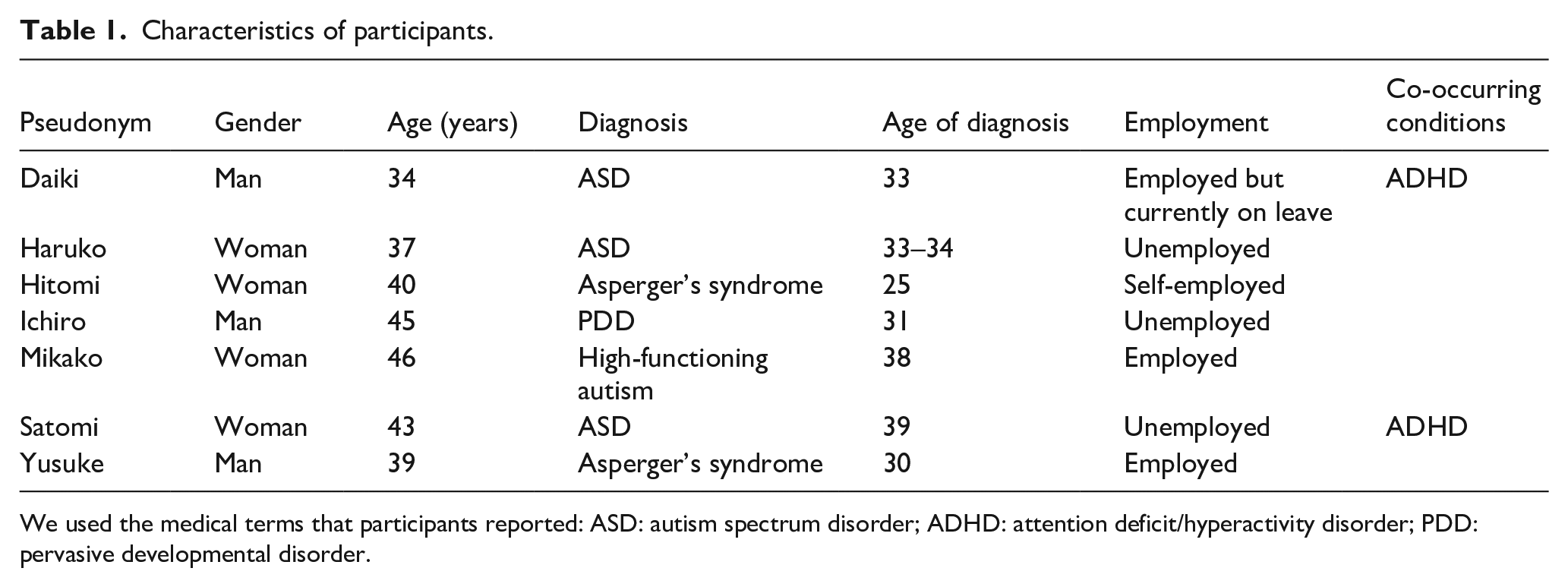
We used the medical terms that participants reported: ASD: autism spectrum disorder; ADHD: attention deficit/hyperactivity disorder; PDD: pervasive developmental disorder.
Procedure
Ethical approval was obtained from Birkbeck, University of London and The University of Tokyo, and all participants gave written, informed consent prior to the interview. They took part in an individual semi-structured interview in a quiet university laboratory, conducted in December 2016. All interviews were conducted by the first author. Interviews varied in length from 58 to 103 min (M = 70.14, SD = 17.32). The semi-structured interviews enabled the interviewer to probe for more information and clarification from the interviewees on complex and sensitive issues (Barriball & While, 1994). The interview began with initial ice-breaking questions (e.g. ‘what do you do on weekdays/weekends?’) followed by key questions about participants’ experiences at elementary school, junior high school, high school, further education and employment, as well as their perceptions of society’s understanding of autism (see Supplementary Materials for interview schedule).
Data analysis
Positionality statement
Our analysis was informed by our training in education (E.P.), psychology (N.H., E.P., K.A. and A.S.), phenomenology and participatory research (S.A.) and medicine (S.K.); also by our positionalities as non-autistic researchers (N.H., L.P., K.A., S.K. and A.S.) and autistic advocate (S.A.) and by our broad alliance with the social model of disability (Oliver, 1983; Shakespeare, 2006) and the neurodiversity paradigm (Pellicano & den Houting, 2022; Walker & Raymaker, 2021).
Analytic process
All interviews were audio-recorded, with participants’ prior permission, and later transcribed verbatim and then translated into English. We followed Braun and Clarke’s (2019) method for reflexive thematic analysis, using an inductive approach to identify patterned meanings within the data set. Our epistemological stance fits within a critical realist framework, which acknowledges that we all have subjective experiences (the empirical), that an objective reality exists outside of our experience (the actual) and that causal mechanisms lie between and within these domains (the real) (Fletcher, 2017).
Data analysis was managed using NVivo 14 (Lumivero). The first author created the interview schedule with the second author, conducted all the interviews, and led the analysis under the supervision of the second author. This included coding all transcripts line-by-line, discussing the codes with the second author, putting the codes together to identify themes, creating a thematic map and discussing the narrative structure with all other authors. The team liaised multiple times to review the themes and subthemes, focusing on the semantic features of the data, resolving discrepancies and deciding on the final descriptions. Analysis was therefore iterative and reflexive (Braun & Clarke, 2019).
Community involvement statement
The research was conducted by a neurodiverse team, which included Satsuki Ayaya, an autistic advocate, whose community connections were the main source of participant recruitment. She also worked together with non-autistic researchers to write, review and edit the resulting manuscript.
Results
We identified three themes relating to the lived experiences of our autistic interviewees, namely, (1) ‘feeling different and misunderstood’ that had been present throughout their lives, (2) ‘the search for answers yielded mixed emotions’ within and between participants and (3) a ‘strong desire to be accepted’ (see Figure 1). Pseudonyms are used to protect participants’ anonymity.
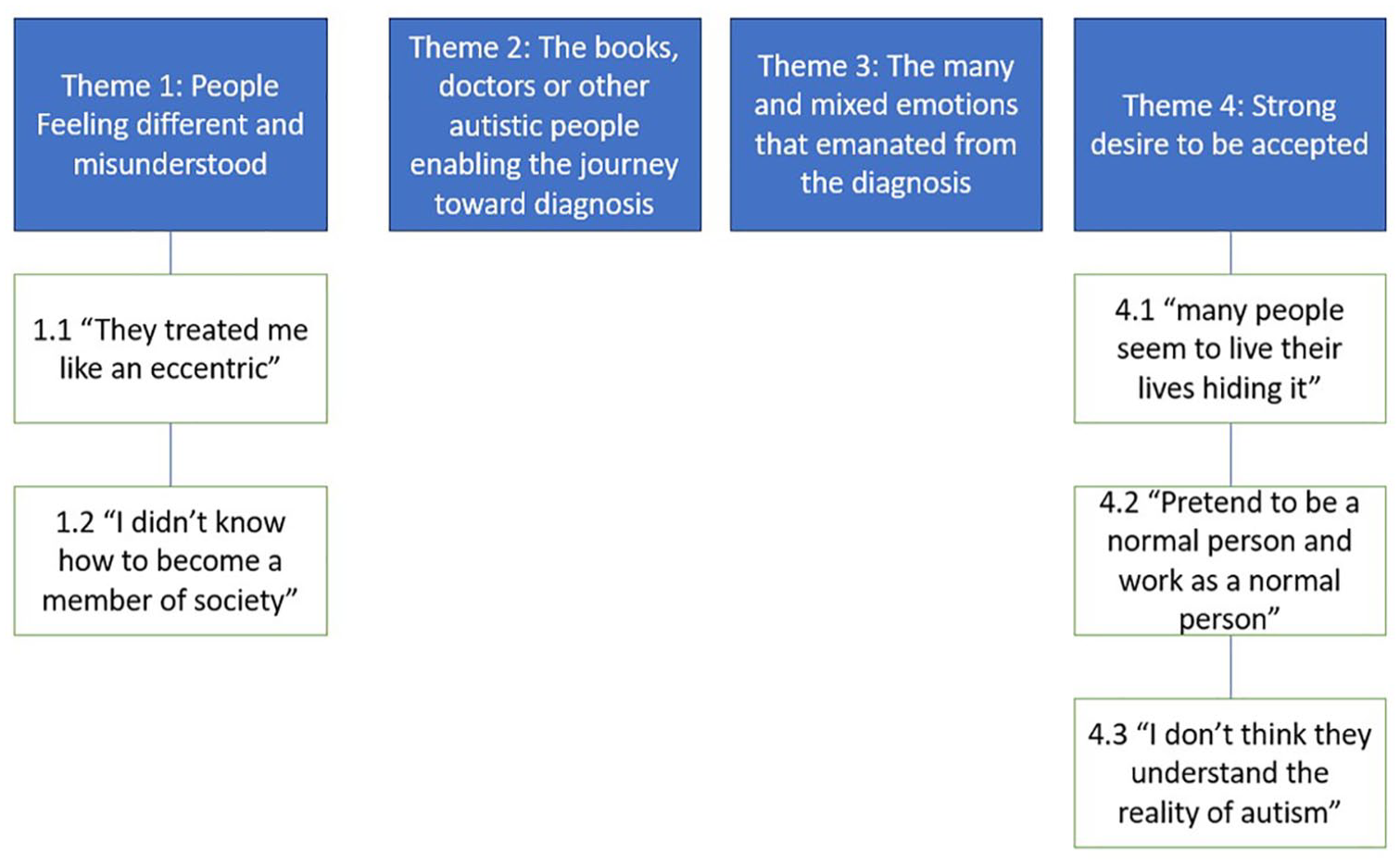
The four themes identified through analysis.
Theme 1: people feeling different and misunderstood
Subtheme 1.1: ‘They treated me like an eccentric’
Interviewees reported noticing they were different from others from an early age. Yusuke recounted that ‘there are quite a lot of things written about how I wanted to be a normal child’. Similarly, Haruko described, ‘when I was little, I was aware that I was different from everyone around me’. In Haruko’s case, this feeling was confirmed by her mother, who said, ‘[you are] just a bit different’. Yusuke reported getting on well with his fellow university students, but ‘they treated me like an eccentric’.
All our interviewees reported experiencing bullying to various degrees, but for some it was severe – supposedly owing to others’ perceiving them as different. At elementary school, Yusuke was ‘subjected to various kinds of bullying, such as being locked up on the balcony, being punched and kicked, and verbally abused’. These bullying incidents led Yusuke to move to a different elementary school in his fourth year. Hitomi had a particularly difficult time around the age of 15: ‘I was different from the people around me, and I didn’t know why’. However, her concern was dismissed by teachers and parents due to her good grades at school – ‘they thought it was a luxurious problem as my grades were good’. However, ‘[I] was bullied because of my good grades’. Similarly, Daiki spoke of trying to make friends at university, but found that challenging: ‘I was looking for something different, like study groups or mountaineering groups . . . I was in clubs where I had troubles, so I had to change’ because ‘I quarrel in interpersonal relationships’.
Subtheme 1.2: ‘I didn’t know how to become a member of society’
Despite the negative school experiences, our interviewees all started working after university/junior college. Nevertheless, they felt there was a big gap between university life and work: ‘I was allowed to do what I was interested in [as a student], but when I became a company employee, I was told to do this in an organisation like the army’ (Daiki). Mikako, too, spoke of being ‘so confused’. ‘I didn’t know how to become a member of society . . . I also didn’t know what normal society was like, and I was hikikomori for about 2 years’. Hikikomori refers to severe social and societal withdrawal and those with hikikomori typically do not leave the house for months or even years. When Mikako finally decided to re-enter society, she chose the transport industry to work as a driver because ‘it didn’t seem like it would involve much communication’ – but this choice of vocation was not consistent with Japanese expectations: ‘I was told by people this is not the kind of job a woman should do’ (Mikako).
This sense of confusion around unwritten rules and expectations was also reported by Ichiro, who explained difficulties adjusting to changes at work: ‘In school, a textbook doesn’t change for a whole year, but in work, there are quite a few things that change during the course of the year’. Interviewees also spoke of other challenges with transitioning to adulthood. Increased expectations seemed to be a factor contributing to differences between university and work. Ichiro spoke of ‘feel[ing] like I’m taking a lot of responsibility for what the other person is saying, even though they’re not saying anything very deep, and that makes it a bit difficult for me to go to work’.
Despite all these challenges, all interviewees – including those unemployed at the time – reported wanting to work. As Daiki put it, ‘I spend most of my time at home doing activities towards returning to work, adjusting my rhythm of life, studying’. Similarly, Satomi reported spending weekdays ‘staying at home and doing job searches’. Hitomi worked from home as a freelancer, which suited her well, especially because she ‘felt the burden of communication’ and ‘in web work, there are basically a lot of one-to-one meetings, so I suddenly feel fine, because it’s not multiple people’.
Theme 2: the books, doctors or other autistic people enabling the journey towards diagnosis
This persistent feeling of being different to others, alongside experiences of mental health issues, led some interviewees to search for reasons underpinning these issues. Daiki ‘browsed through a book on developmental disabilities and thought it might apply to me’. While at work, he described: ‘I had physical symptoms such as a stomach-ache . . . I couldn’t sleep at night, and I felt depressed . . . I was irritated. I was in a very bad way’ (Daiki). Daiki initially went to the company doctor for help:
The doctor told me I was not feeling well and that I should not come to the company anymore . . . and then I was instructed to go to a psychiatrist. So, I went to another clinic. There, I was told that I have a developmental disability, ASD, ADHD. (Daiki)
Similarly, Yusuke ‘had to take a leave of absence because . . . I was hospitalised in a psychiatric department’. He then received ‘a booklet about Asperger’s Syndrome . . . and I felt I had a hint of autism’. Alternatively, some interviewees started to wonder whether they are autistic through social networking sites. Haruko found a group on X (Twitter) which included autistic people either formally or self-diagnosed. ‘I went to their meeting, which was open to people who were undiagnosed, and I had a lot of fun. So, I took a chance and had a test done’ (Haruko). Hitomi, during a period of mental illness in his second year of graduate school, also saw ‘an online forum where people with Asperger’s were gathered and I realised that this was very close to what I was feeling’.
Other interviewees spoke of how they were motivated to get a diagnosis in order to access a disability certificate, which provides different job opportunities to those for non-disabled people. For example, Satomi said,
[I] went to see a doctor on my own because I read a book about autism and found many things that applied to me. I wanted to work in a job as a person with disabilities, so I decided to apply for the disability certificate. That was my first intention to take the various tests. (Satomi)
Theme 3: the many and mixed emotions that emanated from the diagnosis
Interviewees recounted many different and mixed emotions following their autism diagnosis. For instance, Daiki, who was instructed to see the workplace psychiatrist, felt ‘very uncomfortable with the fact that I have a disability, I thought I was not good enough, I thought I was inferior’. He further explained that ‘I thought I would be discriminated against and disadvantaged, so I was very resistant and felt really down’ but ‘I gradually accepted that there were good things about it . . . that ideas are special, like inspiration or originality’ (Daiki). Yusuke, too, spoke of the confusion he faced at receiving an autism diagnosis when ‘I was told there is no medicine to cure it . . . the only way was to overcome the things I was not good’ (Yusuke).
While some interviewees initially had a negative impression of their diagnoses, others felt mixed emotions. Mikako reported how her hypersensitivity was confirmed by an autism diagnosis, which she felt ambivalent about: ‘my family thought it was just my imagination, but when I was diagnosed, I found out it wasn’t just my imagination, which made me happy and sad, including shocked’ (Mikako). Others still felt relieved (‘maybe that’s why I couldn’t work until now’; Haruko) and affirmed. Satomi reported a sense of belonging: ‘it means that I can fit into that category’. Hitomi also felt the diagnosis ‘makes sense . . . it was a positive feeling. I didn’t think there were people like me before, but I felt like there were so many’.
Theme 4: strong desire to be accepted
Subtheme 4.1: ‘Many people seem to live their lives hiding it’
Interviewees’ mixed responses to their own diagnoses were compounded by the mixed reactions of their families and friends. Mikako reported that she ‘told [her family], but my youngest sister said she didn’t want to [accept the diagnosis]’ and ‘[the youngest sister] said it cannot be a developmental disability – I was in the science club and I was the head of the club’ and ‘[my mother] wants to think I’m normal’. At the time of interview, Mikako reported deciding to ‘keep my family at a distance. I have two younger sisters, but they are normal people, so communication is “intense”’. Similarly, Daiki reported disclosing his diagnosis but:
my father was not interested in that kind of thing . . . like it’s all my responsibility. But my mother is kind – it was hard for her to accept it, but after a few meetings with a psychologist, it’s like she understands, like she feels sorry for me. (Daiki)
Hitomi’s family also ‘didn’t want to understand or accept it, so I just pretended it didn’t happen, and I think they’ve forgotten about it’. In addition, Hitomi spoke of difficulties with communicating with her family: ‘I had good grades, so my mother felt like she had already done a good job raising her child and didn’t think much about it. So, I felt like I couldn’t communicate well with her’. Also, Hitomi spoke of ‘not telling my friends’ about her diagnosis because:
I felt a sense of crisis – if I said I had a developmental disability, autism or ASD, the moment I said that, any problems between the two parties would be blamed on me. I knew that even if that was not the case, it would always pop up in the person’s brain that I am the one with disability. I thought to myself, ‘I’m definitely not going to tell people’ and it was like I was in the closet. (Hitomi)
Hitomi also reported feeling ‘that the phrase “developmental disability” is an obstacle for people close to me’. Hitomi’s fears were confirmed for Yusuke, who recounted a negative story about diagnosis resulting in ‘friendships that were cut-off as a result of the Asperger’s diagnosis’. Similarly, Ichiro reported sensing that ‘many people seem to live their lives hiding it [diagnosis]’ and Mikako also mentioned some worries: ‘when I was diagnosed, I was afraid that I would be misunderstood in Japan, or people thought I couldn’t communicate at all because I had a developmental disability. I felt it was hard to be looked at strangely’.
Moreover, some interviewees were actively discouraged from disclosing their autism diagnosis. Daiki explained,
I talked to a colleague at work about whether I could go back to work and continue working after finding out that I have this disability . . . I was told even if I was disabled, I shouldn’t tell people about my disability because they would think it is strange, and they would be put off by it. (Daiki)
Overall, the results of disclosing their diagnosis to family and friends seemed to be overwhelmingly negative. None of the interviewees mentioned any positive encounters.
Subtheme 4.2: ‘Pretend to be a normal person and work as a normal person’
These negative interactions extended to colleagues at work. When diagnosed, Ichiro was told by the doctor that ‘there were no jobs or employment for people with developmental disabilities at the time. So, the doctor told me to pretend to be a normal person and work as a normal person’. Ichiro reported that ‘even when I did tell them that I have Asperger’s, I was not given any special consideration’ and reported difficulties with finding a workplace that suited him: ‘I think there are some workplaces that take this into consideration [of disabilities] and such things are done in a limited number of places. It’s like I’m still living somewhere else. It’s like I’m not included in that world’ (Ichiro).
Daiki reported trying to be open about being autistic at work but was not successful. He explained,
There is a new law that came into force in April this year (2016), Shogaisha Sabetsu Kaisho hou (the Act for Eliminating Discrimination against Persons with Disabilities) . . . I said that I should be open about my disability and apply to receive reasonable accommodation, but I was told that I was not allowed to do so. I was told to come back only after I had recovered so that I could work as a normal person. (Daiki)
Daiki reported telling the company that autism and ADHD are not curable but the company ‘wants me to train in the areas that I have trouble with and the areas that cause trouble’ (Daiki) rather than giving him appropriate adjustments at work. He also felt that these attitudes were embedded in Japanese ways of working:
Military-like, with lots of rules, you couldn’t deviate from them, you were completely controlled . . . and they didn’t like people who stood out or were unusual . . . it’s really a part of Japanese culture, or Japanese company culture . . . I think that kind of culture is not good. (Daiki)
Hitomi also reported experiencing discrimination towards autism when finding a job: ‘I met a possible client . . . but when I told them I had a developmental disability, all of a sudden, email conversation stopped from their side . . . I thought it would be dangerous to disclose my developmental disability’ (Hitomi). Interviewees reported that there seemed to be ‘a disparity and discrimination in jobs for people with disabilities, because the wages are low and the work is only as an assistant’ (Daiki). Similarly, Yusuke reported difficulties with finding a job that is meaningful and aspiring:
In terms of career paths, it is common for men of this age to be employed in a career-track position, but it is difficult for people with disabilities to get a career-track position – people are more likely to be doing supportive work, so it is a question of how to accept that. When I go to employment support centres, I am sometimes told in a rather dry way to separate work from self-esteem. (Yusuke)
However, Mikako reported wondering if companies that employ disabled people are highly selective and prefer those without overt autistic tendencies: ‘I’m employed as a person with developmental disabilities now, I was able to communicate like this, so they were reassured . . . it’s more like they only want people with developmental disabilities who are able to integrate into society’ (Mikako).
Subtheme 4.3: ‘I don’t think they understand the reality of autism’
Alongside work-related challenges, interviewees experienced distress, largely due to the toll of trying to act ‘normal’. Burnouts were also commonly mentioned by interviewees. For instance, Hitomi reported experiencing burnout several times during and after university and Yusuke during university. Satomi recounted her experience of burnout and how it led to unhealthy behaviours: ‘there was a time when I almost became an alcoholic’. She experienced burnout during ‘a course in a job training centre . . . but just when I thought I was finally able to at least pretend to be a normal person, I collapsed and had to be rushed to the emergency room’ (Satomi).
Some interviewees mentioned difficulties relating to Japanese culture and compared these experiences with other cultures. Satomi had lived abroad in Canada and felt that being herself was easier there. ‘People didn’t mind if I was a little strange, or that people didn’t watch over each other. It is normal to eat alone, even at lunchtime. In Japan, even when they work as part-time, everyone eats together’ (Satomi). Also, importantly, Satomi ‘felt that it was okay to be different’. Daiki felt, ‘my communication is unique, but I don’t think the culture is good to begin with’. Similarly, Mikako ‘felt the feeling of being forced by society, it’s like PTSD, so I feel frustrated, like I wasn’t living my true self’.
Interviewees recounted much distrust in professionals, including medical professionals and support staff at Hello Work (Job Centre). For medical professionals, Mikako noted, ‘there are doctors who overreact, so I was treated as a crazy person, that seems prejudiced, but I guess they don’t understand [autism]’.
For Hello Work, Daiki felt that low aspirations were endemic: ‘they say that you have a disability and that there must be something you can’t do, so they ask you what you can’t do . . . the support staff for people with disabilities look down on us’ (Daiki). Haruko described experiences of paternalism: ‘I have seen some supporters [at Hello Work] who surround themselves with people with disabilities and support them for their own satisfaction’ (Haruko). Interviewees emphasised how they just wanted to be understood. Hitomi mentioned a place ‘like a developmental disability-related treatment institution? I think it would have been good if there was even one place where people understood me’. Similarly, Mikako said, ‘if I had a safe zone, I would be able to relax . . . I think it’s important to have a place where you can escape to when you feel confused or tired’.
Notwithstanding, interviewees were positive about increasing public understanding. When asked about how the public could better understand autism, Satomi spoke of ‘emphasising the opinions of autistic people. I think it would be best if autistic people could tell the public what they don’t like and what they are having trouble with’. Haruko started working towards it by ‘writing about my past, so I’ve been working on it steadily’. Daiki also mentioned the need to ‘actively spread the word’ to increase public understanding. Some interviewees also wanted to be involved in helping others who are autistic, especially using their interests. Haruko wanted to use her artistic passion: ‘It would be nice if I could offer it as a service’ (Haruko).
Discussion
This is the first study, to our knowledge, to focus on the lived experiences of autistic Japanese adults, examining their experiences at elementary, junior high, high school and university alongside their experiences in the workplace. Overall, interviewees encountered a significant amount of hardship throughout their lives, including bullying, discrimination at work and negative reactions from family and friends about their diagnosis. All interviewees received their diagnosis in their 20s and 30s, and experienced mixed feelings about being autistic – some were purely happy to understand who they were, while others struggled to accept they were disabled and that autism was not curable. Some wished they had been diagnosed earlier to prepare themselves for societal expectations. In fact, many interviewees reported hiding their autism diagnosis at work or even in their relationships with friends. Moreover, they reported being actively discouraged from disclosing their autism diagnosis by professionals, to ‘pretend to be normal and work as a normal person’, which further compounded their feelings of shame.
There are some similarities between our findings and those from Western research. For instance, DePape and Lindsay (2016) found that some participants felt pride in being autistic, whereas others perceived it in a negative way, including a sense of helplessness upon learning that autism is a lifelong condition or a strong desire to be ‘normal’. These mixed feelings were also expressed by our Japanese participants. This desire to be ‘normal’ was felt from a very early age (see also DePape and Lindsay, 2016) and reflected a strong sense of feeling different from others – a sentiment that is, once again, highlighted repeatedly in Western studies (e.g. Cooper et al., 2021; Gellini & Marczak, 2024; Lilley et al., 2022). Although Lilley et al.’s (2022) interviewees often stressed the positive side of being different, it is noteworthy that, in the current study, being different was perceived almost exclusively negatively by our Japanese interviewees. These early feelings of difference in a negative way were reinforced by often-repeated experiences of bullying at school, which is known to be more prevalent in autistic than non-autistic people (Maïano et al., 2016). It could be one reason why many of our interviewees had such mixed feelings about being autistic (DePape and Lindsay, 2016; Gellini & Marczak, 2024; see also Cribb et al., 2019) – and felt unable to be their true selves and/or forced to be ‘normal’.
Another difference between existing Western literature and the current study related to interviewees’ self-esteem. Lilley et al. (2022) found that having an intellectual advantage was positively perceived by autistic adults and increased their self-esteem. In the current study, however, having good grades seemed to have a negative impact: Hitomi was bullied for her exceptionally good grades and experienced conflict with her family, who thought having good grades was the important thing. The idea of ‘a nail that stands will be hammered down’ seemed to reflect Hitomi’s school experience. This finding is in line with another East Asian study exploring the experiences of autistic university students in Singapore, where some students reported experiencing events that encompass ‘a nail that stands will be hammered down’. For example, many reported difficulties with blending in with the societal norms, made more challenging since ‘Singapore especially encourages following the norm and rejecting deviants’ (p. 11) (Lim et al., 2023). Interviewees expressed a strong desire to be understood, especially when they were struggling. Such desires are also reported among autistic university students in Western settings (Frost et al., 2019).
These negative impacts also extended to their ability to gain and retain employment. Four out of seven interviewees reported being unemployed or on a forced leave of absence from the company at the time of the interview. This aligns with previous Western studies, which report that rates of unemployment are higher in autistic than in non-autistic people (Office for National Statistics, 2021). In Japan, only 29% of people with developmental disabilities were employed in Japan around the time of this study (Takahashi, 2014), and many positions were not open to autistic people compared to those with physical disabilities (Ministry of Health, Labour and Welfare, 2017). Importantly, there was little-to-no post-diagnostic support for our interviewees, despite their difficulties with work. This gap between diagnosis and support systems is also documented in the West (Crane et al., 2018; Norris et al., 2025).
Despite the continuous effort of advocates, professionals, media and the government, public understanding of autism is still far from ideal in Japan, as our interviewees attested. One study using a vignette of an autistic person found that less than 50% of respondents correctly identified the condition as autism, and they wrongly considered the prevalence to be about 0.01%. Furthermore, the respondents considered the cause to be a person’s upbringing rather than genetics (Koyama et al., 2009). Cultural differences were also noted by Turnock et al. (2022). They suggested that collectivistic cultures may be more susceptible to stigma due to the idea that group harmony is more important than any one individual. It is not surprising, then, that the interviewees in our study were fearful of stigma. Even the label ‘disability’ has been shown to trigger stigma among Japanese parents of autistic children, which made parents more reluctant to use relevant services for their children (Kayama & Haight, 2018). Also, some Japanese parents of autistic children report negative experiences with professionals – being blamed for their children’s struggles (Kayama & Haight, 2018). In this context, it is perhaps not unexpected that all of the interviewees’ families initially rejected the diagnosis.
Furthermore, stigma is believed to be associated with masking (or camouflaging) in autistic people – the more stigma there is, the more autistic people tend to mask their autistic tendencies (Pearson & Rose, 2021; Perry et al., 2022). Our interviewees’ reports suggested that the characteristics of Japanese culture might encourage Japanese autistic people to mask more than those in the West. Masking has a significant positive association with autistic people’s mental health, including generalised anxiety, depression and social anxiety in samples in the United Kingdom and Japan (Hull et al., 2021; Tamura et al., 2024). At least one of our interviewees experienced significant distress due to acting ‘normal’ (masking or camouflaging). Others, too, noted substantial mental health issues, which led them to visit a clinic or hospital, resulting in their diagnosis, and some reported experiencing burnout during university and also employment, some multiple times. Satomi had a period of school avoidance, and Mikako was ‘hikikomori’ for 2 years. A recent study suggested, however, that the relationship between masking and mental health might be different in Japanese autistic people compared to British autistic people. Intriguingly, Oshima et al. (2024) found that too much or too little camouflaging was negatively associated with mental health scores in Japanese autistic people, while the relationship was linear in British autistic people (Hull et al., 2021).
To protect autistic people’s mental health, it is important for the public to know and accept autistic people as who they are. To increase public understanding, self-advocacy was frequently mentioned by interviewees to improve public understanding of autism. This is in line with the Western self-advocacy and neurodiversity movements (Leadbitter et al., 2021; Pellicano & den Houting, 2022), but little is known about Japanese people’s attitudes towards neurodiversity (cf. Kapp et al., 2013). Atherton et al. (2023) have predicted that, due to Japan’s collectivistic nature, which places more value on similarities within than between people, the Japanese public may be more reluctant to accept a neurodiversity approach. Future research should examine this issue directly.
Limitations
This study has several limitations. First, while our interviewees gave rich depictions of their lives, all were diagnosed in adulthood and grew up not knowing they were autistic. It remains to be seen whether the overwhelmingly negative experiences recounted by our interviewees might also be present in the experiences of those diagnosed in childhood. Second, the interviews were carried out in December 2016, and narratives reported in this study necessarily reflect the societal context at that time. During the last decade, the neurodiversity movement has grown substantially in Western contexts (Kapp, 2020; Pellicano & den Houting, 2022; Walker & Raymaker, 2021) and may have also done so in Japan (Honda, 2018; Muranaka, 2020). The neurodiversity movement is associated with perceiving autism as a positive identity, and so it is possible that diagnosis may result in more positive experiences in future cohorts (Kapp et al., 2013). Furthermore, the Japanese government enacted the law in 2016, called Shogaisha Sabetsu Kaisho Hou (the Act for Eliminating Discrimination against Persons with Disabilities), designed to reduce discrimination against disabled people and increase reasonable adjustment for them in workplaces. In the current study, Daiki’s request for reasonable adjustment at work was unlawfully rejected by his company. However, at the time of the interview, this law was only coming into effect. It is possible that this law has gained further understanding in public and acted upon since, including in clinical and support-for-work (Hello Work) contexts. Finally, while the aim of this study was to amplify Japanese autistic people’s voices in research and to understand their lived experiences, we did not include a comparison group of Western autistic people. We cannot be sure, therefore, whether the stigma and discrimination felt by our interviewees were exacerbated by the specific cultural context. That said, our interviewees reported a substantial amount of stigma towards autism and autistic people in Japan. There is surprisingly little research on stigma towards autism, or any other forms of neurodivergence, in Japan. Future research should focus on this matter – as discussed above – to protect the mental health and well-being of autistic people.
Conclusion
Our study revealed the substantial struggles that Japanese autistic people face throughout their lives – including with regard to their own and others’ acceptance of their diagnosis. Some of these struggles might be owing to the distinctive characteristics of Japanese culture. More research is needed to understand societal attitudes towards autism, and of neurodiversity more broadly, in Japan – in partnership with the autistic community (Fletcher-Watson et al., 2019; Pellicano et al., 2014, 2022).
Supplemental Material
sj-docx-1-aut-10.1177_13623613251355303 – Supplemental material for ‘I don’t think they understand the reality of autism’: The lived experiences of autistic adults in Japan
Supplemental material, sj-docx-1-aut-10.1177_13623613251355303 for ‘I don’t think they understand the reality of autism’: The lived experiences of autistic adults in Japan by Nanami Harada, Elizabeth Pellicano, Shinichiro Kumagaya, Satsuki Ayaya, Kosuke Asada and Atsushi Senju in Autism
Footnotes
Acknowledgements
The authors are extraordinarily grateful to all of our interviewees for so generously sharing their experiences.

Author contributions
Funding
The author(s) disclosed receipt of the following financial support for the research, authorship and/or publication of this article: The author(s) acknowledge the financial support from Kakenhi JP24119006 to S.K. and the Bloomsbury Colleges Scholarship to N.H. The views expressed are the views of the authors alone and do not necessarily represent the views of their organisations or funding sources.
Declaration of conflicting interests
The author(s) declared no potential conflicts of interest with respect to the research, authorship and/or publication of this article.
Supplemental material
Supplemental material for this article is available online.
References
Supplementary Material
Please find the following supplemental material available below.
For Open Access articles published under a Creative Commons License, all supplemental material carries the same license as the article it is associated with.
For non-Open Access articles published, all supplemental material carries a non-exclusive license, and permission requests for re-use of supplemental material or any part of supplemental material shall be sent directly to the copyright owner as specified in the copyright notice associated with the article.
