



Abstract
Peer support in mainstream high schools may help neurodivergent young people to thrive and navigate challenging experiences. Previous research with diagnosis-specific neurodivergent cohorts indicates that peer support can help improve wellbeing, strengthen social identity and school belonging, and may alleviate pressure to conform to neurotypical social norms. In the light of a call for peer support for all neurodivergent people, rather than diagnosis-specific support, the aim of this study was to identify key elements of a neurodivergent student-led peer support programme via a co-design process. The co-design groups included neurodivergent young people and adults who work with them. Transcripts from a series of design meetings were thematically analysed and three main themes were identified: the central role of the peer support group facilitator; inclusiveness is essential; and directly addressing negative perceptions of others. The study emphasised that a co-design methodology is crucial to ensure that the end-users’ voices and perspectives are embedded in the design. Overall, the co-design teams recommended implementing neurodivergent student-led peer support for neurodivergent young people attending mainstream schools to promote inclusivity and prioritise the expertise of neurodivergent students. This type of support may benefit neurodivergent young people by encouraging them to build community and provide and receive peer support in a space that centres neurodivergent comfort and authenticity, rather than depending on applying neurotypical social norms.
Lay Abstract
Neurodivergence is a term used to describe people who may think, feel, and process the world differently than the majority. It includes conditions such as autism, attention deficit hyperactivity disorder (ADHD), and dyslexia. Many neurodivergent young people struggle in school, and some autistic adults have shared that having support from other neurodivergent peers would have improved their school experience. Other research shows that peer support can improve wellbeing, self-advocacy skills, social identity and a sense of belonging for neurodivergent young people. In this study, the authors along with a group of neurodivergent young people and a group of adults who work with neurodivergent young people, created a peer support programme, to be led by neurodivergent students, specifically for neurodivergent young people who attend mainstream high schools. The aim of this study is to identify which elements of a peer support programme are important to neurodivergent young people themselves. We analysed the transcripts from the co-design meetings and found three main themes: the central role of the peer support group facilitator; inclusiveness is essential; and directly addressing negative perceptions of others. Overall, using co-design methods to create a peer support programme is crucial to ensure the voices and perspectives of those who will use it are integrated into the design. The co-design team felt that peer support led by neurodivergent students would be inclusive and may allow students to feel able to be themselves at school.
Introduction
Mainstream UK schools are designed to be inclusive of a range of pupils with “additional support needs” or “special educational needs and disabilities” (Department of Education (England), 2014; Department of Education (Northern Ireland), 2017; Scottish Government, 2019; Welsh Government, 2 018). Many of these pupils have diagnoses such as attention deficit hyperactivity disorder (ADHD), autism, Developmental Language Disorder, specific learning difficulties like dyscalculia or dyslexia, or more rare conditions like Tourette syndrome. Collectively, they can be described as ‘neurodivergent’, an umbrella term for people who learn, think, feel, and process the world around them differently from what is considered the norm (Kapp et al., 2013).
While some neurodivergent pupils have a positive high school experience, many report difficulties with learning, classroom participation, and maintaining peer relationships as well as feeling disconnected from their school community, and frequent victimisation by neurotypical peers (Fink et al., 2015; Hebron, 2018; Maciver et al., 2019; Symes & Humphrey, 2010; Weiss & Fardella, 2018). This contributes to neurodivergent young people having lower wellbeing, self-confidence, and higher anxiety than their neurotypical peers (Cooper et al., 2017; Manalili, 2021; Shaughnessy, 2022). Therefore, there is a pressing need to develop ways to support neurodivergent pupils to thrive at school.
Social identity is important across the lifespan (Tajfel et al., 1979), and particularly so in adolescence (Rubin & Hewstone, 1998). Some neurodivergent adolescents feel pressure to ‘fit in’ to social groups at school to reduce social stigma and bullying (Chapman et al., 2022; Radulski, 2022). The pressure to align with neurotypical social norms may be alleviated by spending time with other neurodivergent young people (Maitland et al., 2021). This perhaps occurs via the cultivation of ‘collective self-esteem’ (Luhtanen & Crocker, 1992, 1991) – positive self-concept influenced by the perceived positive attributes of a social group of which an individual is a member. People often identify with a range of social groups: whilst neurodivergence may not be a significant aspect of identity for some neurodivergent individuals (Logeswaran et al., 2019; Tanti et al., 2011), it may be important for others (Camus et al., 2023). How then can collective support among neurodivergent peers be harnessed to help neurodivergent young people develop a positive sense of social identity, and in turn enhance school experience?
Peer support, which includes befriending, mediation, mentoring, or peer-listening, is not a new concept in UK schools (Houlston et al., 2009). Peer support has been used for a variety of purposes: to resolve problems, share ideas, or change attitudes (Cowie, 2020), to support disabled students (Nalugya et al., 2023), and to promote mental health and well-being (Hart et al., 2020; Lei et al., 2021; Ross-Reed et al., 2019). Peer support schemes for neurodivergent school students have typically involved a neurodivergent student being ‘buddied’ by a neurotypical student (Carter et al., 2014, 2017; Hochman et al., 2015). This type of “peer” support is centred on the idea that engaging with neurotypical peers will result in increased understanding of social rules and norms (Bottema-Beutel et al., 2018), with neurodivergent young people learning social skills from their neurotypical peers which they can then apply to other interactions (Sperry et al., 2010). Generally, these interventions seek to use neurotypical peer engagement to reduce autism ‘symptoms’ and reduce “problem behaviours” (Strain & Bovey, 2011). By positing that neurotypical social behaviours are essential for “good” interactions, these interventions inherently stigmatise neurodivergent ways of communicating and building relationships. For neurodivergent people, maintaining a social “mask” to hide traits which are viewed as atypical or undesirable is extremely effortful (Bargiela et al., 2016; Hull et al., 2017). Masking is associated with increased stress, mental health difficulties, burnout, identity loss, and suicidality (Chapman et al., 2022; Miller et al., 2021; Pearson & Rose, 2021; Radulski, 2022). There is, therefore, a strong justification for research which focuses on neurodivergent peers supporting other neurodivergent peers, in a model which centres on neurodivergent comfort and authenticity.
A neurodivergent-peer model is supported by a growing body of research showing interactive advantages within neurodivergent interactions, such as greater rapport (Crompton et al., 2020c), closer social bonds (Crompton et al., 2020a; Crompton, Hallett et al., 2022), effective sharing of information in social interactions (Crompton et al., 2020b) and feeling able to share more personal stories (Pellicano et al., 2022). Building on this work, interviews with autistic school leavers revealed that they had felt better understood by other neurodivergent than by neurotypical students (Crompton et al., 2023). They endorsed school-based neurodivergent peer support to help reduce the stigma around autism, though they preferred a peer support model for all neurodivergent students, rather than diagnosis-specific (only for e.g., autistic students). The participants also identified a range of potential benefits of peer support at the level of the individual (i.e., reducing social isolation, increasing academic self-efficacy, self-confidence, and feelings of belonging) and the community level (i.e., community building for neurodivergent students, enhancing the connection with the wider school community).
The objective of the current study was to co-design, with neurodivergent individuals, a peer support programme for neurodivergent young people attending mainstream high school. Co-design principles aim to ensure the rights and voices of children are being respected (Davis et al., 2014; United Nations Treaty Collection, 1989), and that programmes/resources are acceptable, relevant and accessible to the end-user (Fletcher-Watson et al., 2019; Fletcher-Watson et al., 2021; McGeown et al., 2023). Through this process, we ask: what are the components of an effective neurodivergent student-led peer support programme for neurodivergent young people, in the eyes of young people themselves, and professionals who work with them?
Methods
Participants
Two co-design teams were recruited: seven neurodivergent young people and nine adults (teachers, speech and language therapists, researchers, charity workers, educational psychologists, and parents) who support neurodivergent young people. Both groups included a mix of genders and ethnicities (though mostly White British), but we do not report further detail to preserve anonymity.
Young person team
Initially, eight young people aged 13 to 15 years old were enrolled in the team, however, one team member decided not to contribute, and hence was not included in the analysis. All had experienced the Scottish high school system, with six attending at the time of the research study, and two being home-schooled. All identified as neurodivergent, though eligibility criteria for the co-design teams did not require a formal diagnosis, as there are myriad barriers to formal diagnosis of neurodivergent conditions, for example due to sociodemographic and clinical factors (Russell et al., 2019; Lockwood Estrin et al., 2021), as well as insufficient funding and resources (Harding et al., 2023). The young people reported autism, ADHD, dyslexia, stammer, and other specific learning difficulties, and many team members reported multiple conditions.
Adult team
This team was comprised of nine individuals with a wide variety of professional backgrounds and experience in working with neurodivergent young people. Five were trained teachers who were either currently or previously working in primary and high schools across the UK and Ireland. Three were engaged in research with neurodivergent young people either in addition to their job, or as their sole employment. Two were educational psychologists. Other expertise of the team members included: working in speech and language therapy, working with a charity for neurodivergent families, and being a parent to neurodivergent young people. Six disclosed they were neurodivergent themselves, reporting ADHD, autism, dyslexia, dyspraxia, and obsessive compulsive disorder – again many of the team members reported multiple conditions.
Procedure
Ethical approval was obtained from the relevant institute ethics committee (KCEB11052022). Both teams were recruited via word of mouth and social media (Twitter and Facebook) and all provided informed consent. For the young person team, parents/carers also gave signed consent. A standard operating procedure was in place in the event of any distress caused by attending the team meetings, and support group contact details were provided. All team members were thanked and compensated for their time at the same rate.
For each team, there were six meetings of 1.5–2 h each, at approximately weekly intervals. To allow for the formation of distinct perspectives and to minimise any perceived power dynamics between young people and authority figures (e.g., teachers), the young person and adult teams meetings were held separately. All meetings took place over Zoom during the school summer holidays. The meeting topics can be seen in Table 1. The topics outlined in Table 1 were defined before the co-design process started to ensure that all key topics were covered within the six meetings, and to avoid participants feeling pressure caused by a ‘blank canvas’ approach. However, these topics were introduced as the basis for a wide-ranging discussion led by the co-design group members and were used as a gentle guide rather than being overly prescriptive.
Description of topics discussed in the team meetings each week.

Team members were informed of the topic of the upcoming meeting in advance via email, as the researcher shared the discussion points listed in Table 1 in advance. Team members had the opportunity to contribute to the meeting topics as outlined in Figure 1, and a shared Google Drive folder was set up for each team to provide extra resources, such as information regarding how this programme supports Scottish education policy, and written pieces on explaining neurodiversity to parents. Only two team members (both from the adult team) uploaded resources to the Google Drive folder. Provision was also made for members to contribute by email or in a one-to-one call with the researcher; this happened on seven occasions when team members couldn’t attend a meeting due to scheduling conflicts but were still keen to be involved in the meeting discussion and share their thoughts on the weeks meeting topics. At the start of each meeting the, topic was introduced to the team members by posing the topic as a question and the researcher asking for their thoughts on the topic. Team members discussed their thoughts on each topic verbally or via that chat box, where the researcher read comments out loud to bring them into the verbal discussion. The researcher asked follow up questions and allowed the discussions to flow in direction that the team wanted.

Cycle of how the team meetings were arranged and how team members contributed to the meeting schedule.
Each meeting recording was transcribed, and the meeting transcriptions, minutes annotated by team members, and the extra notes team members provided were all included in the analysis. The young person and adult team members were involved as co-designers rather than as co-researchers and did not contribute to data analysis or identification of the final themes.
Positionality statement
The authorship comprises both neurodivergent and neurotypical individuals with an academic background. Additionally, the author who facilitated the co-design team meetings is also neurodivergent and attended a mainstream UK high school. Whilst their experiences and views were not discussed within the co-design team sessions, their diagnosis status was shared. This may have helped build rapport with the co-design team members and influenced the experiences or ideas shared by participants within the meetings (Shaw et al., 2020). It will also have impacted the framing of questions, the analysis and interpretation of the findings (Bertilsdotter et al., 2019). The research explicitly adopted a neurodiversity paradigm (see Milton, 2020 for an overview), which may have impacted who saw and who was interested in the opportunity to be involved in the co-design teams. Subsequently, this could also have impacted the experiences, perspectives, and ideas discussed by the co-design team members.
Data analysis
A reflexive thematic analysis approach (Braun & Clarke, 2021) was adopted, using to the data produced by the adult and young person co-design teams, to explore and understand the teams’ thoughts, feelings and ideas on the central components of a neurodivergent peer support model in mainstream high school. The same author facilitated the co-design teams, transcribed the team meetings, and led the thematic analysis.
The author's own identity, experiences and theoretical positionality (see above) were crucial elements of this process (Braun et al., 2022): for example, through the co-design team meetings, the researcher had a familiarity with not only the data but with the context in which those data were produced, and also had their own perspective on these contextualised data in relation to their knowledge of the field and neurodiversity theoretical stance. Whilst the phases described in Braun and Clarke (2006) were broadly followed to develop the themes, this was therefore an involved process rather than a simple set of steps followed “like a baking recipe” (Braun & Clarke, 2019: 589).
No initial plans regarding themes were made prior to the thematic analysis being done, ensuring the themes reflected the co-design teams’ voices. The lead author read and re-read the transcripts to further familiarise themselves with the content, noting aspects of interest and generating initial codes. These codes were then compared across all meeting transcripts and were developed into provisional themes. The analysis was intentionally not ‘topic summaries’ of the co-design meetings, but instead reflect commonalities that occurred during the discussions on neurodivergent-led peer support during the co-design meetings.
The adult team spoke more than the young person team, and therefore the adult team's views appear to be more prominent in the findings, however the lead author was mindful that the young people's group had been less verbose and made a conscious effort to ensure that the views of young people were still centered in the analysis, despite there being fewer of them.
The process was more inductive than deductive, though it was informed by previous literature in this field. The remaining authors reviewed the provisional themes in relation to the transcript data, and were involved in defining and naming the final themes. All authors were then involved in considering the themes in the context of the wider literature, and the themes were not changed at this point. Positivist approaches such as consensus coding were not followed, in keeping with a reflexive thematic analysis approach (Braun et al., 2022). Similarly, member checks were not conducted with the co-design teams during the analysis phase. However, both co-design teams had reviewed the minutes of each of their meetings during the co-design phase, so there was agreement on the key points raised in the data.
Results
Members of both teams were receptive to the idea of a neurodivergent student-led peer support programme for neurodivergent young people and thought it would have a positive impact on the individual. Three themes formed the core of what the co-design teams wanted from a peer support programme: (i) the central role of the team facilitator; (ii) inclusiveness is essential; and (iii) directly addressing negative perceptions of others (Figure 2).
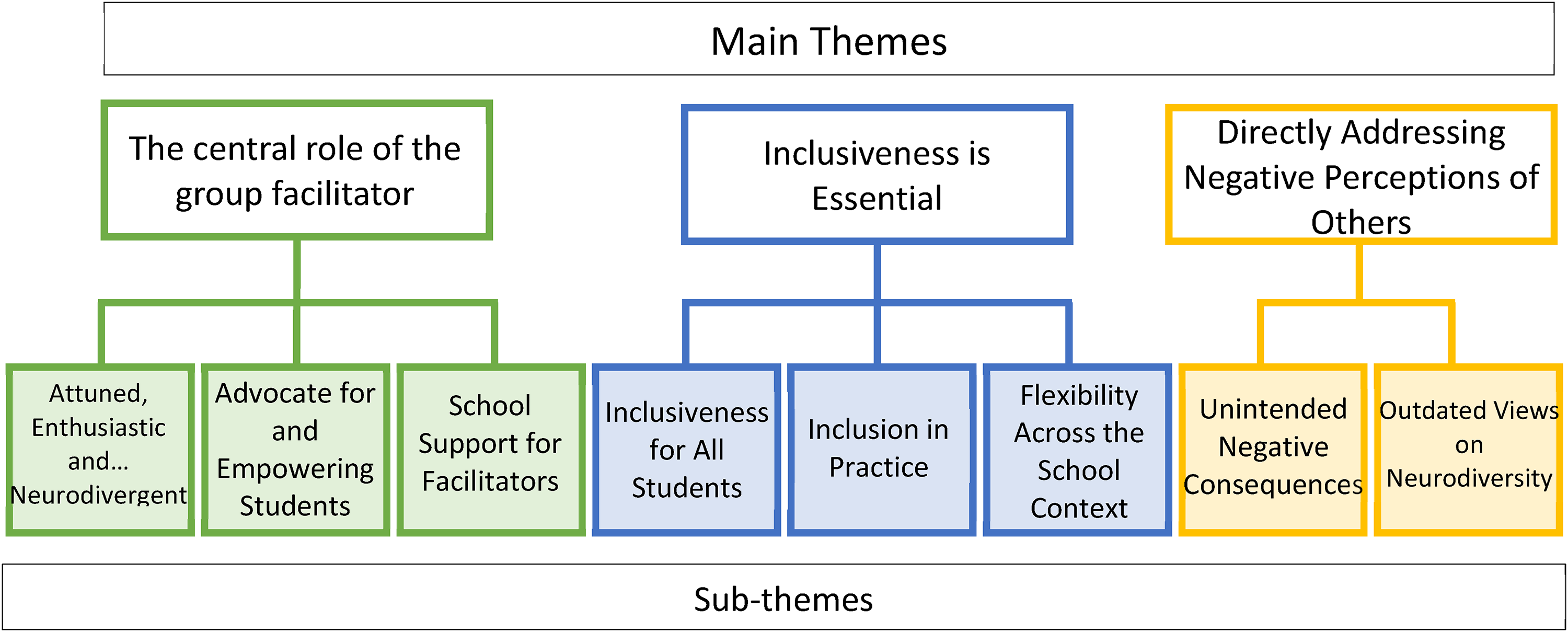
Overview of the three main themes and their sub-themes developed from the co-design meeting transcripts, minutes and notes.
Theme 1: the central role of the group facilitator
The need for a facilitator (a member of school staff) who was a good fit for the group was a recurring discussion point throughout both teams, as it was noted that if the ‘right’ facilitator was in place the peer support group would be “really impactful” (A3). 1 The role of the facilitator underpinned other discussions, with a view that the success of activities in the group: “depends on the skill and experience of the facilitator” (A3).
Several subthemes elaborated how a school might help identify and nurture the best peer support group facilitator.
Subtheme 1.1: attuned, enthusiastic and…neurodivergent?
Significant attention was paid to the personal characteristics of a good facilitator. Whilst the peer support group should be student-led, a member of staff should be present to facilitate the sessions and conduct administrative tasks, such as organising a room for the group. The teams highlighted that the facilitator should have several personality traits, such as being: “compassionate” (A1&3) “understanding” (YP2); 2 “patient” (YP2&3) and having “natural curiosity” (A1). The teams discussed the facilitator's approach to working with young people, which included being good at setting boundaries; reflective of their own practice; “comfortable being challenged” (A1) and “open to learning” (A1). A number of people raised the importance of meaningful relationships and valuing young people.
Both teams felt that the right facilitator should be carefully considered by the school, and that facilitating a peer support group should not be seen as a chore or unwanted extra assignment that the staff member has to do: “I hope that it wouldn’t be given to somebody just… as a short straw, you know you get a half hour lunch [at] this time.” (A2)
“…someone that's dedicated and passionate about the students, not just a tick box that their school can say I'm going to pass it on to a teaching assistant that might not be as passionate about that.” (A2)
The adult team went on to acknowledge that the ideal facilitator has likely made helping neurodivergent young people a key aspect of their career: “someone that has that experience and that has that level of understanding” (YP4). That could be in the form of being a special education teacher or having relevant training. Conceptual knowledge about neurodiversity was also prized: “good knowledge base of neurodiversity theories such as monotropism and double empathy” (A3). However, language relating not to formal skills but to attitude – such as ‘passion’ and ‘dedication’ and ‘good intentions’ – were frequently used when discussing the career of their ideal facilitator. Similarly, it was highlighted that relevant training might not always result in the desired attitude: “… it might be they’re the autism specialist or whatever, but they might also be the absolute most ableist person in the whole school.” (A1)
The ideal facilitator would be highly attuned to members’ feelings: “…you'd have to be very aware and very eager for realizing that there could be a young people sitting down feeling… [a] different range of feelings and being able to navigate that space and hold it in a safe way and more” (A3). A pre-existing relationship with the peer support group attendees would be an advantage: “Such careful steering you know … I would really want to know the group and have a lot of trust built up in the group before.” (A3)
A key role for the facilitator would be to guide the young people through adolescence, which can be an emotionally tumultuous period of life, especially for neurodivergent young people who may just be getting diagnosed or coming to terms with their diagnosis (DeFilippis, 2018; Hosozawa et al., 2021). The neurodivergent members of the adult team reflected back on their own experiences of getting diagnoses and discussed how difficult this was for many of them. This led to a discussion about having a neurodivergent staff member as the peer support group facilitator: “facilitated by neurodivergent people, which is obviously that would be my preference” (A2) and “the Holy Grail would be to have a neurodivergent member of staff I think” (A3). However, even being neurodivergent is no guarantee of progressive views: “They still have… that ableist view and… that could then perpetuate that and spread that even further” (A1). There was also a concern that being a group facilitator may add pressure to disclose their diagnosis, always appear happy about their diagnosis, and carry the burden of supporting young people to navigate this part of their lives: “if you’re the only autistic staff member, you know you… I don't want to have to be, it has to be you because you've got loads of other things to do” (A2). On the other hand, the young person team felt the facilitator being neurodivergent themselves was less of a priority and identified specific characteristics such as being “understanding” (YP3) and “good with kids” (YP3) as more important.
Subtheme 1.2: advocate for and empowering students
One of the key aspects of the peer support programme identified was that it should be neurodivergent student-led, however this requires a certain level of self-advocacy, organisational and planning skills. Both teams indicated that the facilitator would need to be an advocate for the students whilst also allowing the student voice to come through: “… helping the teachers facilitate that and support that learning of self-advocacy” (A3). By doing so, the staff member facilitates autonomy which in turn could help students to feel empowered and supported: “I know the exhaustion of that constantly … having to self-advocate for yourself, you know, I think, to be able to reduce the kind of emotional load … will be really important … maybe one way of doing that is that … there will be … the right person to champion this and, like obviously ideally leadership involved.” (A3)
Subtheme 1.3: school support for facilitators
Whilst there was substantial similarity in the views of the two co-design teams, the adult team also recognised that the role of peer support group facilitator could be emotionally taxing: “as I think this is going to be very emotionally laden..and there's probably going to be lots of groups and group skills involved in this.” (A3). Thus, it was suggested that the programme would need to include “guidance for the facilitator on how to find that balance” (A1) of supporting the students and looking after their own mental health and wellbeing.
To this end, it was suggested the facilitator received support from the school's senior management, via short meetings at various key touch points in the academic year in the style of “clinical supervision” (A3), to provide an opportunity for debriefing and emotional support. Embedding this structure within the peer support programme would formalise whole school support and utilise existing school structures: “in terms of senior leadership possibly and mentoring or supporting the facilitator you know so kind of bringing it back to the school and the school structures” (A3).
However, it was also noted that there may be some hierarchical/power dynamics at play. For example, some of the adults noted that school management staff may not be aware of the day-to-day difficulties experienced by the wider body of staff. The role of school leadership in the training that all school staff have received was also thought to be important. Whilst the teacher facilitating the peer support group may have the right skills, knowledge, and attitude, it is possible that senior management may inadvertently direct the group/facilitator away from the ethos of the peer support group: “that is a very variable kind of experience for people and that some schools might be really great about that and other schools, even the teachers don't know the basics of autism…” (A8).
Theme 2: inclusiveness is essential
Both co-design teams spent a significant portion of every meeting discussing the need for the peer support programme to be inclusive in terms of both content and structure to ensure any student who wanted to attend felt they could.
Subtheme 2.1: inclusiveness of all students
One of the most important aspects of inclusiveness that was identified was ensuring that the group was open for every neurodivergent student: that there was no gatekeeping around needing a formal diagnosis, and that students could self-identify as neurodivergent and “define it as they define it” (YP1). “[for students] who are questioning whether they are neurodivergent or at least they might struggle with some of the same things as me yeah people might not be identifying as neurodivergent because they don’t even know yeah and if they had more information and felt those are safe comfortable spaces for them then they might realise that oh yeah wait it's not just me that struggles with these things.” (YP1) “We can also have people and like allies that want to learn a little bit more about it or people who have family members can also come and learn a little bit more about that.” (YP5) “I think yeah allies should be like encouraged to come and learn about how they can not only accommodate their friends, but accommodate people in that class or accommodate their siblings or accommodate like anyone else in their life that they could know or have who is neurodivergent and just sometimes maybe gain a better understanding of what it's like to be autistic or dyslexic or have ADHD.” (YP1)
Another argument made by both co-design teams was that the neurodiversity paradigm posits that all brains are unique and that “it's not like there's a brain sort of model that this is a neurotypical brain” (A2), therefore, having a fully inclusive peer support group, “it really shows how you know you can be different and that's okay” (YP1).
However, there was also some concern that being inclusive of neurotypical people could foster a culture of performative sympathy, in neurotypical students ‘helping’ the neurodivergent students: “working with allies I think it's important but it doesn’t come across as like, I don’t know the best way to explain this but allies coming wouldn’t be part of their [volunteering] service” (A2). This may inadvertently reinforce power dynamics and differences between the neurodivergent and neurotypical students: “I’m concerned about the still having a ‘them versus us’, ‘minority versus majority’” (A4). One solution suggested to this challenge is to ensure that the primary focus of the group is on serving the needs of neurodivergent pupils: “if they [neurotypical peers] want to support neurodivergent people further … that'd be very secondary to the core purpose of the peer support group” (A3).
Subtheme 2.2: inclusion in practice
Inclusion was also considered in relation to the logistics of the peer support group, in particular ensuring the group was inclusive and appropriate for everyone, not just the majority: “it works for some people but it's terrible for others so, and then it can be like well why don’t you try this, this is what works…”(A1)
However, others in the adult co-design team reflected on the anxieties of online interactions and the benefits of meeting in-person: “…he's against online in that way, because actually it's more he finds it more awkward and more exposing there's no place to hide. Your name's on the screen… he would much prefer to come in and just set about doing something himself in the corner… also there's an awful lot of connection that can begin to be identified and started just by observing other people, and what you might have in common, or not.” (A4).
In addition to this, both teams discussed at length the activities of the group, with the young person team eventually recommending an alternating structure, with one week planned and the following unplanned, to provide more freedom. The adult group endorsed this model: “I think weekly split works well - guess people have freedom to choose, they might not like the social aspect they might not like the learning aspect or might want more or of one or the other so it gives them that freedom” (A3). More generally, throughout the co-design meetings, it was continually highlighted that flexibility was key: “… people should be free to choose which sessions they wish to attend” (YP1). This extended to the relaxation of school norms and narrow expectations, for example, in how students sit, or are perceived to be concentrating (and the need to avoid expectations such as sitting still, looking at the speaker, and not fidgeting with anything else): “like if it looks like it's church or school like I think that would be tricky so if there's a way for there to be like you know … places people can sit on the floor, or like different ways.” (A1)
Subtheme 2.3: flexibility across the school context
Beyond the student level, the teams were concerned to ensure this programme would be flexible for different school contexts, and therefore inclusive for all schools. For example, both teams discussed the advantages and disadvantages of holding the peer support sessions at lunch time, after school or during lesson time: “Like contextual things like whether school meals can happen relatively quickly and whether you know people are leaving quite quickly after school whether like location those are things that yeah will vary” (A1).
This flexibility also extended to how the peer support group would be advertised in the school. Both teams were keen to avoid insinuating to other students that this is a group only for those who are struggling: “all the special people go to Room One at this time on a Friday” (A2). To ensure this was avoided, it was suggested that advertising should use “universal design” (A1) and be done in the same manner as any other school clubs: “…if we send editable suggestions to the school, so they can actually … make it fit and how they advertise everything else, and so it doesn't seem like there's different club” (A1).
Theme 3: directly addressing negative perceptions of others
Both teams were attentive to the group having unintended negative consequences, especially interactions with the prejudiced views of others. However, the specific concerns raised were different in the adult team compared with the young person team.
Subtheme 3.1: unintended negative consequences
For the young people, a reoccurring concern was the potential for bullying or gossiping about things that were shared in the group. A fear of gossiping would significantly impact students desire to go to a peer support group and/or to disclose that they were neurodivergent, and therefore undermine the purpose of the group. Attendees would remain guarded and not open up about their difficulties even if they thought it could help another student: “People don’t tend generally don’t tend to share something with a large group and that's too personal.” (YP5)
“If someone at your school for they wanted to disclose anything that they would share it to like just a trusted teacher rather than to a whole big and peer support group and/or club.” (YP6)
One gossip mitigation strategy suggested was for the facilitator to work with individuals in the group – particularly those who might share information outside the group such as “the other notorious gossiper” (YP1) - to ensure that they understood that anything shared within the peer support group was private. Some of the young people distinguished between those who might make the space feel unsafe inadvertently and those who might do so more intentionally: “I don’t feel like any of them would purposefully bully someone for being autistic or for sharing a story” (YP1). Therefore, a code of conduct could help individuals to understand the need to respect privacy: “I think [a] code of conduct could be helpful at least for people who like weren’t trying to make the space unsafe just to kind of avoid bullying” (YP1). However, they also recognised that some gossiping and bullying might be more intentional: “obviously we would want to stop people who are specifically aiming to hurt people” (YP1). They concluded that students should have a say in whether they thought their school was ready for a peer support group, who was facilitating the peer support group, and in creating a unique code of conduct.
Subtheme 3.2: outdated views on neurodiversity
For the adult co-design team, the primary concern was the school or facilitator having outdated or ableist views about neurodiversity, specifically using a deficit model. As one team member pointed out: “you Google autism it comes up like deficit deficit deficit deficit” (A1).
They felt that a reactionary approach to this can also cause problems, for example, if only pointing out strengths that are marketable within a workforce or that help people navigate a neurotypical world. “I always get a bit wary similarly, when people start talking about like strengths, because generally weaknesses and strengths only exists in relation to our idea of what is good….”(A1). Rather than promoting the idea that “neurodivergent only has value if you have kind of a marketable skill that's useful to the workplace.” (A3) the teams wanted students to ask themselves “actually what strengths do they have that are important to them?” (A6).
This observation links back to our first theme, and the need to ensure that the facilitator is right for their community and school.
Discussion
We worked with co-design teams to identify key elements of a neurodivergent-led peer support programme for neurodivergent young people in mainstream high schools. Overall, the co-design team views corresponded with retrospective accounts of autistic adults (Crompton et al., 2023) that peer support for neurodivergent students would be beneficial to young people attending mainstream schools. Three themes captured the considerations of the co-design teams, showing substantial agreement across the adult and young person teams and an unwavering focus on neurodivergent pupil and staff wellbeing. These themes and the specific details of the co-design group discussions shaped the content for the creation of a peer support programme.
While the groups were aligned on many issues, there were some clear distinctions. The adults shared a preference for a neurodivergent over a neurotypical facilitator, as they hoped this would bring an enriched level of empathy to the role. This sentiment was not echoed by the young people, whose requirements focused more on personality traits. At first glance, this suggests that for the students neurodivergent to neurodivergent staff-student understanding isn’t as important, though this interpretation is complicated by the fact that many neurodivergent staff are unlikely to disclose their neurodivergence to pupils (Wood & Happé, 2023). If a school is considering creating a neurodivergent-led peer support group, it may be useful for them to initially meet with students and staff and together identify which qualities, skills and knowledge they perceive to be most important in a facilitator before considering specific candidates.
The teams also had distinctive concerns about the impact of the negative perceptions of others on the groups. The young people were particularly concerned about the potential for bullying or gossiping about personal disclosures shared in the group. If a school is considering establishing a neurodivergent-led peer support group, the creation of a student-led code of conduct may ensure that students maintain confidentiality within a group. The adult co-design group were concerned about outdated and ableist views about neurodivergence. This could be mitigated by the development of training (co-designed by neurodivergent young people) for peer support facilitators centered on a progressive neurodiversity approach and embracing difference.
The need to reconcile these differing views, as well as the call for inclusiveness and flexibility in the groups, can be met by ensuring that students are supported to become empowered leaders in the planning and delivery of peer support. This position was shared by both groups and presented as a solution to a number of dilemmas, e.g., facilitator recruitment. The emphasis on student-leadership is bolstered by research finding such opportunities reduce mental health difficulties and stress (Miller et al., 2021; Pearson & Rose, 2021; Radulski, 2022).
This research has several practical implications for schools who are considering new and inclusive ways of supporting neurodivergent students. Though there is clear demand for neurodivergent-led peer support in mainstream schools and there may be potential benefits for students, there are also many considerations in setting up and maintaining such a group. An appropriate facilitator must be identified (by students and staff) and have the knowledge, desire, time and facilities to support the group. There must be a careful consideration of how the group fits within the wider school context, from staff and students to the physical environment. There may be benefits to this type of support, but these may only be realised if it is thoughtfully embedded into the school.
Co-design often results in an improvement in the research area but can be challenging when different stakeholders have different priorities (Steel et al., 2021). In this project, even though the young people and adults met separately, their discussions often aligned with each other. This may have been aided by the project's origin in data collection with and from the autistic community (Crompton et al., 2023) and the clear communication of the project aims and philosophy during recruitment of the teams. Nonetheless, limitations included the requirement to attend meetings online. Having meetings online meant that we could recruit team members from a wide geographical range and schedule the meetings at convenient times without the requirement for travel. However, it did mean that that we may not have considered the views of people who find online meetings difficult due to the communication barriers they pose (see e.g., Howard & Sedgewick, 2021). Additionally, there may have been practical barriers, for example those with limited digital access or a home environment which was not conducive to attending regularly scheduled online meetings. These limitations could be mitigated in future research by having the option for hybrid meetings or collecting data using multiple techniques (e.g., online survey, face to face group meetings, interviews). Future work investigating an intervention using co-designed neurodivergent-led peer support programme is crucial to investigate the practical application of this and how educators and practitioners could use such a programme in their practice. Future research may also benefit from a more explicitly intersectional approach, for example exploring the functionality of a peer support programme for those who are not fluent in the predominantly spoken language at school, identify with a minority ethnicity, come from a low-income family, or also attend other peer support groups (e.g., for LGBTQIA + students).
In conclusion, the co-design teams in this study strongly advocated for the implementation of peer support for neurodivergent students in mainstream schools. This approach should prioritise inclusiveness and recognise the expertise of neurodivergent students in shaping the programme. At the same time, the concerns regarding facilitator skills, school alignment with the neurodiversity paradigm, and the possibility of bullying and gossiping should be carefully considered by each school during their planning and implementation phase.
Footnotes
Declaration of conflicting interests
The authors declared no potential conflicts of interest with respect to the research, authorship, and/or publication of this article.
Funding
The work produced in this paper was funded by the Salvesen Mindroom Research Centre: Scientific Advisory Board Research Grants.
