



Abstract
Shrub encroachment is a major land use change in global grassland, affecting productivity and multiple ecosystem services. However, its impact on ecosystems is highly debated, as it varies largely across patch, landscape and regional scale, while shrub management is usually conducted on small scales only. Such mismatches in knowledge and management result in failures of encroachment control, which call for scale-dependent strategies in future management. Our study synthesizes the differential mechanisms under shrub encroachment from patch to regional scales. We further propose a framework to conduct shrub management with a top-down approach: (1) at the regional level, areas are prioritized for protection or improvement based on ecosystem service values and trade-offs; (2) at the landscape level, the focus shifts to identifying optimal shrub cover thresholds and spatial arrangements to improve landscape connectivity; (3) and at the patch level, management aims to maximize “fertile islands” effects by controlling key biotic and abiotic factors. By integrating the scale-dependent effect in shrub management, we can maximize management effectiveness and achieve a win-win outcome in grassland productivity and ecological restoration.
Keywords
Impact of shrub encroachment depends on scales
Shrub encroachment widely occurs across grasslands
Grasslands are crucial ecosystems, covering 41% of the terrestrial land surface, supporting 30–50% of global livestock production, and providing multiple ecosystem services such as climate regulation, carbon sequestration, soil conservation, and biodiversity maintenance (Bardgett et al., 2021). However, under the impact of climate change (e.g., warming, elevated CO2) and human activities (e.g., grazing), native woody plants have a competitive advantage over herbaceous species as environments become drier, moisture becomes less available, natural fire regimes change and grazing intensifies (Eldridge et al., 2011). This results in a proliferation of woody plants across the landscape and such phenomenon is referred as “woody encroachment” or “woody thickening”, and is characterized by increases in the cover and density of woody plants at the expense of herbaceous species (Van Auken, 2009). Contrary to species invasions, encroaching woody species are native species instead of alien invasive species and the expansion of shrubs is a result of an imbalance in the competition between shrubs and herbaceous species due to the altered environmental and disturbance forces (Ding and Eldridge, 2024). Shrub encroachment occurs widely across multiple biomes and affects approximately 500 million hectares of land globally, changing the spatial distribution of water and soil resources, altering the interspecific interactions within plant and microbial communities, and the connectivity of landscape patterns, thereby exerting complex impacts on ecosystem functions (Ding and Eldridge, 2023).
The formation of shrub encroachment differs among climate zones and biomes. For example, in arid and semi-arid temperate grasslands, overgrazing and drought weaken the competitive dominance of herbaceous species, thereby substantially facilitating shrub seedling establishment and expansion (Van Auken, 2009). In alpine grassland and tundra ecosystems, climate warming increases minimum temperatures and may trigger permafrost thaw, enhancing soil moisture and nutrient availability, which promotes shrub growth and their expansion into higher altitudes (Myers-Smith et al., 2011; Silva et al., 2016). By contrast, in tropical savanna ecosystems, shifts in fire regimes are widely regarded as the primary driver, where long-term fire suppression combined with grazing reduces fire frequency and intensity, enabling shrubs to escape fire-induced mortality thresholds and rapidly proliferate (Yatat et al., 2017). Despite these differences these factors can all improve the competitive advantages for shrubs and promote encroachment.
Impact of shrub encroachment varies with scale
Although numerous studies have examined the effects of shrub encroachment on ecosystem functions, its impacts remain complex and highly debated (Eldridge and Soliveres, 2014). Whether the impact of encroachment is positive, negative or neutral is largely dependent on the scale examined (Table 1). For example, at the patch scale, most studies focus on the differences between the microenvironments under and outside shrub canopies using field experiments. It is commonly found that shrub encroachment can enhance soil nutrients, moisture, and microbial diversity (Peng et al., 2013; Xie et al., 2021), which is closely related to the “fertile island” beneath the shrub canopy. However, some studies also point out that this positive effect may vary with shrub canopy size, density, and species (Fitzpatrick et al., 2024). At the landscape scale, studies often explore the impact of shrub encroachment based on field sampling and remote sensing. Shrub encroachment often leads to landscape fragmentation, reducing herbaceous plant diversity and productivity (O’Connor et al., 2014). However, it can also enhance carbon sequestration and organic matter decomposition (Ding and Eldridge, 2024; Zhao et al., 2023), potentially leading to trade-off between productivity and ecological functions. At the regional scale, studies typically integrate remote sensing inversion and ecosystem models. Shrub encroachment is generally found to reduce regional grassland vegetation cover and evapotranspiration, exacerbate surface warming, and affect the water cycle, therefore leading to changes in ecosystem services at the broader scale such as primary productivity (Shen et al., 2022; Wang et al., 2018).
Examples of studies on the impact of shrub encroachment on ecosystem function at different scales.
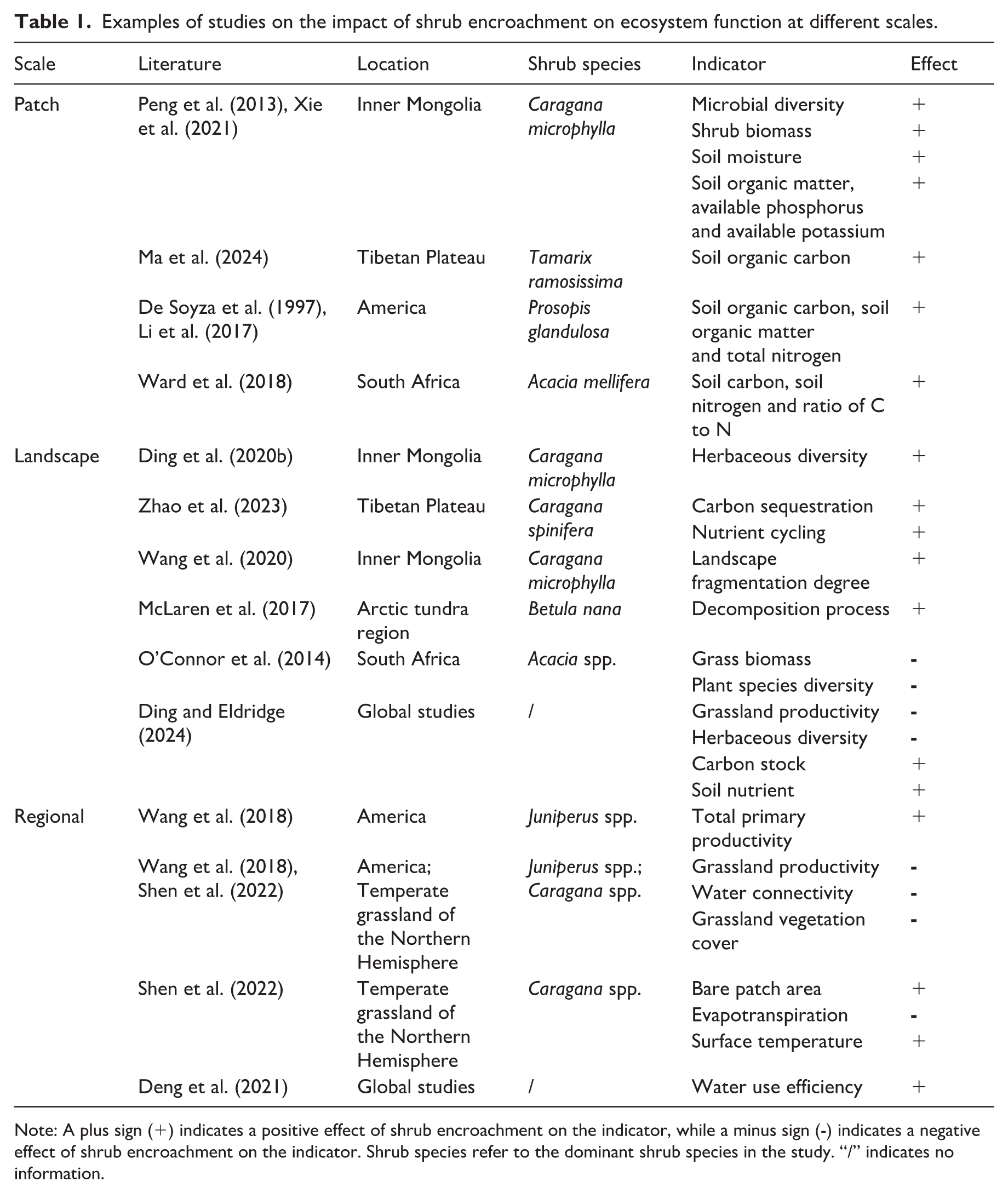
Note: A plus sign (+) indicates a positive effect of shrub encroachment on the indicator, while a minus sign (-) indicates a negative effect of shrub encroachment on the indicator. Shrub species refer to the dominant shrub species in the study. “/” indicates no information.
The impacts across scales also vary with climate conditions. For the fertile island effect, the impact was enhanced with increasing aridity, as arid environments have stronger resource redistribution due to the clustered vegetation in this type of environment (Ding and Eldridge, 2021). At the landscape scale, shrub encroachment affects ecosystem functions, such as productivity and soil carbon and nitrogen, with clear precipitation dependence. Shrub encroachment increases aboveground net primary production (ANPP) in humid regions (precipitation > 600 mm), while decreasing it in arid regions (Knapp et al., 2008). In addition, the ANPP contribution to the carbon pool in encroached grasslands shifts from a net carbon source to a net carbon sink at ~340 mm precipitation (Barger et al., 2011). At the regional scale, in warm regions, the Sahel areas may attain a self-sustaining woody cover state through positive vegetation–precipitation feedbacks (Dekker et al., 2007), whereas in cold regions, climate warming promotes shrub encroachment, triggering permafrost–carbon feedbacks (Myers-Smith et al., 2011).
Scale is the spatial or temporal dimension of a phenomenon, which is the fundamental characteristic that links the relationship between pattern and processes (Wu and Li, 2006). Different scales differ in their grain, extent, level of organization and spatial heterogeneity, which results in different explanatory mechanisms, with broader scales often embracing more complex systems. “Pattern-Process-Scale” is the core paradigm in geographical research (Fu et al., 2011). Exploring changes in ecological processes at different scales and designing the management plan from large to small scale is crucial for guiding management decisions from top to bottom and providing a scientific basis for effective grassland restoration and management.
Ecological pattern and processes differ among patch-landscape-regional scales
Shrub encroachment can affect ecosystem functions by altering ecological patterns and processes. Expansion in shrubs can change the patch-scale resource redistribution, landscape structure and the transition of ecosystem at the regional scale (Ding et al., 2026). Such a shift in ecological patterns would lead to the formation of fertile islands at the patch scale, changes in ecological cycles (e.g., hydrological cycles, biogeochemical cycles) and finally lead to ecosystem transitions at the regional scale (Eldridge and Soliveres, 2014) (Figure 1). These differential changes in patterns and processes result in the differential impact of shrub encroachment across scales.
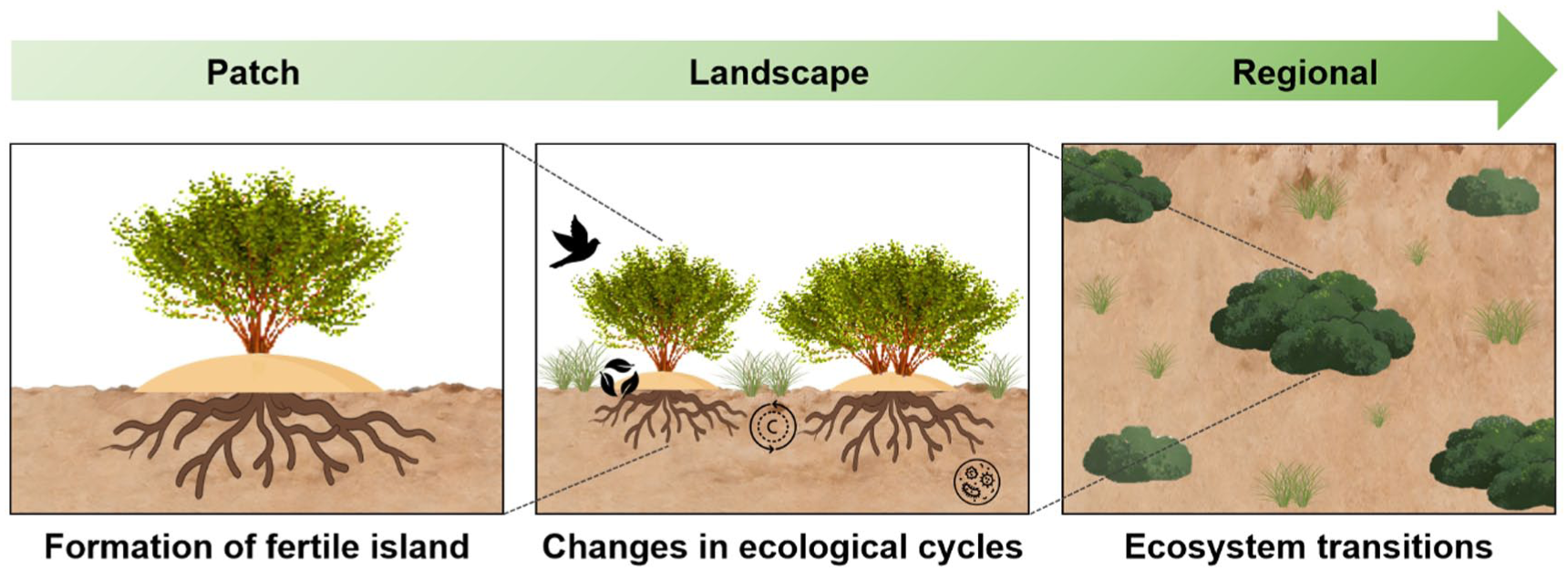
Conceptual model of how the ecological processes differ among patch-landscape-regional scales under shrub encroachment.
Ecological patterns and processes at the patch scale
At the patch scale, shrubs gain competition advantages over grasses with their functional traits and this results in the spatial redistribution of resources among patches. Shrubs, characterized by large canopies, can effectively intercept fine soil particles and rainfall, and sequestrate resources beyond their canopies with deep-rooted systems. This results in greater resources concentration beneath shrub patches and creates “fertile islands” below them (Eldridge et al., 2024), which leads to shift in spatial patterns from homogenous to heterogeneity in resources distribution. Formation of fertile island promotes ecological processes such as nutrient cycling. The fertile island effect is generally formed by a combination of both biotic (e.g., plant rhizosphere uptake, microbe activities on nutrient cycling) and abiotic processes (e.g., sediment trapping, aeolian capture, rainfall redistribution), acting as a hotspot of ecological activities and ecosystem functions (Ochoa-Hueso et al., 2018). These resource islands can further facilitate the activity of belowground soil biomes (e.g., fungi, bacteria), which accelerates aggregation of resources, promotes understory plant colonization, and subsequently forms a positive feedback loop of resource aggregation, contributing to the further expansion of shrub patches (Bestelmeyer et al., 2018).
Ecological patterns and processes at the landscape scale
At the landscape scale, shrub patches and grassland patches form a “source-sink” pattern (Chen et al., 2006), which exacerbates the brokenness of landscape structure. Such changes in landscape pattern lead to the redistribution of resources from the interspace into shrub patches, which results in reduced landscape connectivity and consequently changes in ecosystem functions (Eldridge et al., 2011). The effects of shrub encroachment varies with target function at the landscape scale. Shrub encroachment can suppress herbaceous growth and reduce forage productivity by intensifying interspecific competition (Bestelmeyer et al., 2018; Peng et al., 2013). However, the aggregated development of shrub patches promotes the formation of localized resource sinks for water and nutrients, thereby enhancing ecosystem functions such as nutrient cycling (Eldridge et al., 2011). A global review indicates that while shrub encroachment reduces herbaceous cover by 48%, it simultaneously enhances carbon sequestration (+31%) and soil fertility (+18%) (Ding and Eldridge, 2024). The impact of shrub encroachment on these functions is also determined by the extent of the shrub encroachment, with the positive effect being found to peak at intermediate shrub cover as the development of shrub patches will reduce the ability of individual shrubs to capture resources (Soliveres et al., 2014).
Ecological patterns and processes at the regional scale
At the regional scale, the formation of fertile islands and reduced landscape connectivity will further promote the encroachment of shrubs, pushing ecosystem across the threshold and finally change the ecological patterns at the regional scales, leading to ecosystem transition from grass-dominated system to shrub-dominated system (Bestelmeyer et al., 2018). Such a shift in ecosystem states will result in the fragmentation of grassland at the regional scale, which reduces grassland cover and diversity, consequently leading to a reduction in ecosystem services of grassland such as reduced livestock production and grassland-dependent biodiversity (Okin et al., 2015). Studies in Inner Mongolia demonstrate that grassland becomes more fragmented with intensifying shrub encroachment, which reduces grassland productivity, exacerbating the trade-offs between supporting services (e.g., grassland productivity) and regulation services (e.g., carbon sequestration) in this region (Han et al., 2014). Research in the Northern Hemisphere found that shrub encroachment leads to decreased vegetation cover, increased bare ground areas, and reduced evapotranspiration, contributing to warming in the semi-arid regions of Northern Hemisphere (Shen et al., 2022), thereby further affecting the ability to provide ecosystem services.
However, due to the lack of multi-scale assessment on shrub encroachment impact, the direct and indirect mechanisms through which shrub encroachment influences ecosystem across different scales remain unclear, and the key factors driving the ecological impact at these different scales have yet to be fully elucidated. This has led to management on shrubs generally being limited to small scale by focusing merely on reducing the density and cover of shrubs, overlooking broader scale optimization towards ecosystem functions.
Linking multiple-scale strategies for guiding shrub management
Mismatch between knowledge and management
Although the impact of woody encroachment on ecosystems is mixed, under land uses dominated by pastoralism, land managers often remove woody plants using a range of techniques (e.g., cutting, burning, grazing, and herbicides) in order to increase pastoral productivity. This is based on the notion that removing the dominant plants (woody) will release forbs from competition exclusion and lead to increased forage production (Archer and Predick, 2014). Removal of woody plants can alter multiple ecosystem processes and have a legacy effect on the ecosystem in the long run. For example, woody removal can alter community succession, hydrological processes and landscape connectivity which exert impacts on the ecosystem composition and functions in the long-term (> 10 years; Perkins and McDaniel, 2005). However, global synthesis demonstrates that removing woody plants cannot reverse shrub encroachment processes and more than 50% of removals are not effective due to the mismatch between knowledge and management policies across different scales (Ding and Eldridge, 2023).
A key reason for such a mismatch is that shrub removal is often conducted primarily based on site level experience. For example, removal of shrubs may destroy the benefits of fertile islands at the patch scale especially in the late encroachment stages, when the islands of fertility act as a major sink for biological activities, such as decomposition and nutrient cycling (Eldridge et al., 2024; Ward et al., 2018). Additionally, site level removal only targets increasing the forage production, with less consideration on balancing productivity and ecological function. This single-objective approach can create trade-offs at the landscape scale, where increases in provisioning services (e.g., forage production) may sacrifice the expense of supporting and regulating services (e.g., biodiversity, carbon sequestration, and hydrological regulation) (Archer and Predick, 2014; Ding and Eldridge, 2024). Furthermore, fully eradicating shrub patches would change the structure and corridor among patches within the encroached system. This would either lead to enhanced landscape connectivity upon the recovery of herbaceous communities in light encroachment sites or result in ecosystem breakdown in heavy encroachment sites where shrubs are the major plant type to maintain landscape structure, which reduces landscape conductivity and potentially leads to soil erosion.
Shrub encroachment management across scales
Current shrub management mainly stems from bottom up action from pastoralists (Ding et al., 2020a). Whether to remove or to retain shrub is based on the more subjective attitude of landlords, most people regard shrubs as pest/invasive species but some landlords value the function of shrubs in retaining soils against wind erosion (Jones et al., 2024). The effectiveness of shrub removal mainly assesses the outcomes from a site level with a target of shifting grass-shrub balance and increasing grass cover, which ignores the legacy changes on the landscape connectivity or the impact on ecosystems service at a broader scale (Eldridge and Soliveres, 2015). Although studies have begun to synthesize the management priorities from ecosystem services perspectives by forming an integrated brush management system (Archer and Predick, 2014). These large-scale management goals make it hard to guide how to manage shrubs on small scale. Such a mismatch between knowledge and management across scales leads to undesirable outcomes, with smaller-scale benefits that may deficit larger-scale ecosystem services. Therefore, it is urgent to develop top-down shrub management plans from regional to landscape to patch scale to effectively restore grassland functions.
For a shrub encroachment region, there are land managers that are involved at different scales to make decisions on how to manage shrubs. At the regional scale, governors need to decide “where to manage shrubs”, that is identify the regions that require management priority to ensure the balance between productivity and land conservation. Therefore, at the regional scale, we can first assess the impact of shrub encroachment on ecosystem services and divide the region into areas with different priorities based on the value of ecosystem services and service trade-offs (Figure 2). For example, in places with high ecosystem services and low trade-offs, these regions may be maintained for protection, while in low service and high trade-offs regions, priori ecosystem services need to be identified to improve the management goals first (Jones et al., 2024). After identifying the regions that rank with high management priority, local land governor or the community manager participates in the management at the landscape scale. Instead of implementing full eradication on the encroachment landscape, land managers need to identify “when to manage shrubs” by assessing the key threshold that initiates an ecosystem function shift and identify the optimum shrub cover needed to be controlled at the landscape scale (Soliveres et al., 2014). Besides, the structure and corridors of landscape patterns can be modeled to determine the optimum arrangement of shrub patches in the landscape. At the patch scale, landlords that implement the management practices need to know “how to manage shrubs”. By identifying the key factors that shape fertile islands throughout shrub encroachment stages, we can reveal the critical attributes limiting functional processes. This knowledge enables targeted management of shrub patches to optimize the fertile island effect. Shrub patches can be managed to maximize the magnitude of fertile islands. Such multi-scale management requires diverse data sources. In recent years, unmanned aerial vehicle (UAV) remote sensing, serving as a link between field surveys and large-scale remote sensing imagery, has been widely applied (Mao et al., 2022) and can provide methodological support for multiple-scale shrub encroachment research.
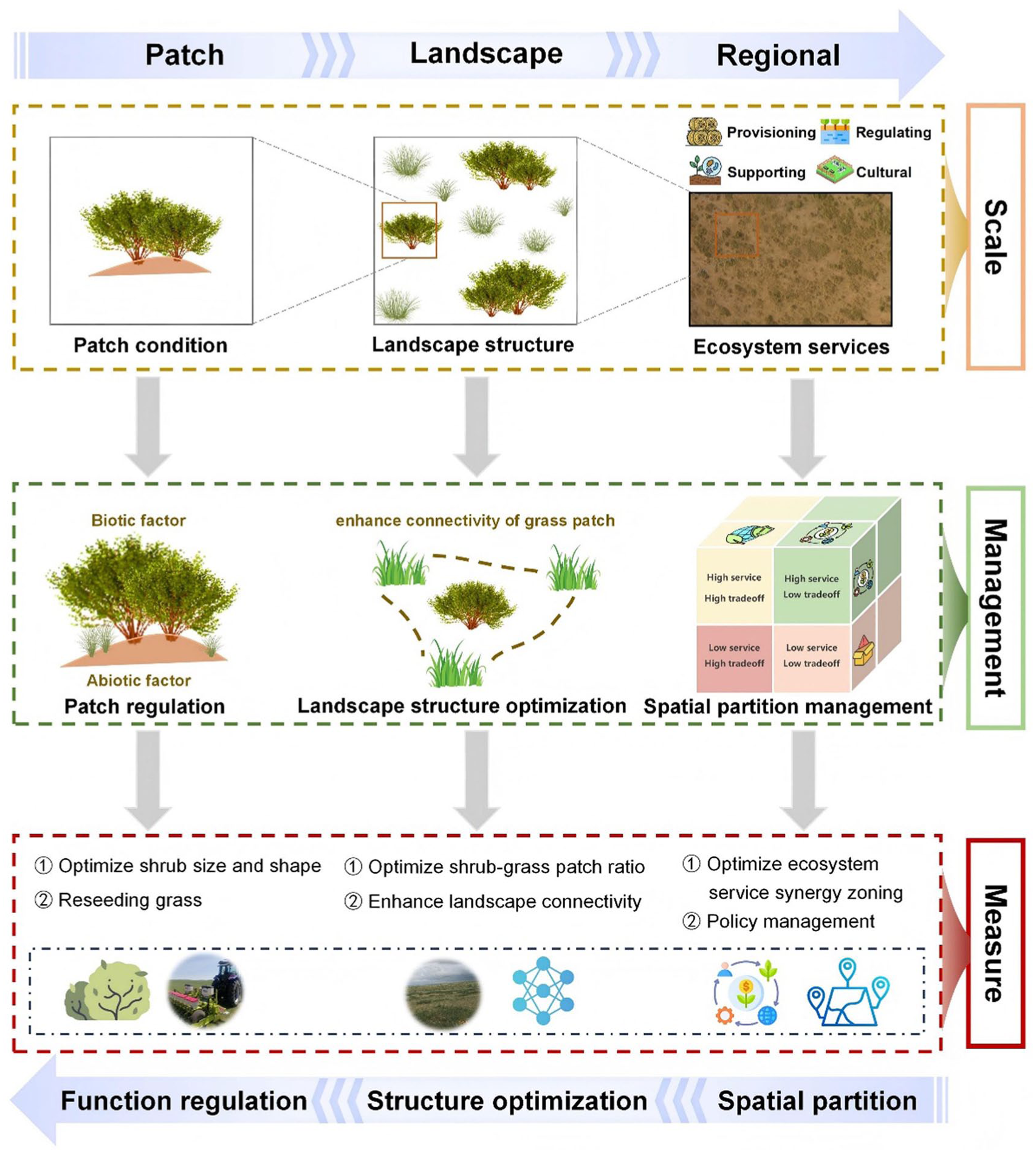
Shrub management across patch-landscape-regional scales.
Overall, this perspective highlights that the impact of shrub is scale-dependent, with the differential among patch, landscape and regional scales largely explaining the contrasting findings related to shrub encroachment. The positive feedback at small scale (e.g., fertile islands) may be masked by the negative loop of broader scale (e.g., reduced connectivity), which may potentially lead to land degradation. Despite the widely applied shrub management at site level, a multi-scale shrub management from regional division to landscape structure optimization and to the patch scale mechanisms is greatly needed for further shrub management for a sustainable management of encroached grassland.
Footnotes
Author contributions
Funding
The authors disclosed receipt of the following financial support for the research, authorship, and/or publication of this article: This work was supported by the National Natural Science Foundation of China Project (No. 42571061), the Fundamental Research Funds for the Central Universities (No. 2253200003), 111 project and the Young Elite Scientists Sponsorship Program by CAST (No. YESS20240005).
Declaration of conflicting interests
The authors declared no potential conflicts of interest with respect to the research, authorship, and/or publication of this article.
