



Abstract
This essay examines the evolution of humanism in the Anthropocene and Homogenocene, arguing that traditional anthropocentric paradigms are insufficient to confront global environmental crises. It introduces a “guardianship” model, defined as a systems-level ethic in which humans act not as masters or mere caretakers but as embedded participants responsible for sustaining the integrity of ecological and cultural systems across generations. Distinct from stewardship (managerial care), trusteeship (legal responsibility), and Earth jurisprudence (rights of nature), guardianship emphasizes interdependence, reciprocity, precaution, and long-term responsibility. The essay examines how digital technologies simultaneously exacerbate ecological homogenization while also opening up possibilities for new forms of collaborative agency. Grounded in systems thinking and eco-centric ethics, it proposes transformative pedagogies and interconnected policy pathways to realign human–nature relations toward sustainability, resilience, and plural futures.
The problem
The Anthropocene is now widely recognized as an era in which humanity’s actions have reshaped the Earth. Castree (2014: 234) notes that in the Anthropocene, “Earth’s surface [is] so transformed by human activities that the biophysical conditions of the Holocene epoch [. . .] have been compromised”. This transformation includes rapid climate change, habitat destruction, and biodiversity loss. Recent assessments of planetary boundaries demonstrate the severity of these changes: Steffen et al. (2015) identified that key Earth-system processes—such as biosphere integrity and biogeochemical cycles—had already crossed safe thresholds, and the latest analysis by Van Vuuren et al. (2025) reports that six of nine critical boundaries are now transgressed.
Biodiversity scientists warn that these trends are not merely abstract but quantifiable and measurable. Current extinction rates are estimated to be 100–1000 times higher than natural background levels, with whole genera disappearing at unprecedented speed (Ceballos and Ehrlich, 2023; Pimm et al., 2014). Species with small geographic ranges are particularly at risk, and their loss has a cascading effect on ecosystems. Crucially, these declines carry direct societal consequences. Reduced pollinator diversity has been shown to significantly lower crop yields and threaten global food security (Potts et al., 2016), while diminished phylogenetic diversity is linked to heightened risks of zoonotic spillover and infectious disease emergence (Keesing et al., 2010).
In this context, environmental philosophers ask whether traditional humanism, which historically placed humans at the center of meaning, value, and ethics, must evolve. As Castree (2014: 234) argues, the “scale, scope, and magnitude of human impacts” raise urgent questions of meaning, value, and responsibility. This article, therefore, examines how notions of humanism shift in response to ecological crises, contrasting classical humanism with the emerging concept of “environmental humanism” during the Anthropocene, and considering how the Homogenocene and the digital era further reshape its meaning. Building on these traditions, the article introduces a guardianship model—a systems-level ethic that emphasizes interdependence, reciprocity, and long-term responsibility—as a distinctive framework for rethinking human–nature relations in the 21st century.
Historical humanism
Traditional humanism emerged in the Renaissance and Enlightenment as a worldview that emphasized human reason, autonomy, and dignity. Thinkers from Montaigne to Sartre placed humans at the center of meaning and ethics, often treating nature as a backdrop or a resource. By the 20th century, critics such as Heidegger (1977) argued that this tradition remained “engrossed in beings” and “oblivious to Being,” sustaining anthropocentrism that underpinned colonial expansion and industrial development.
While later philosophical currents—including eco-feminism (Plumwood, 2005), environmental justice, and post-humanist ethics (Kopnina and Shoreman-Ouimet, 2015)—challenged this legacy, they remain fragmented. Plumwood’s critique of dualisms emphasizes interdependence but does not provide concrete governance principles, while eco-centric ethics often struggle to reconcile competing claims between human well-being and ecological integrity. Post-humanist approaches highlight entanglement but can appear abstract or culturally specific. These gaps leave room for the guardianship model, which seeks to integrate ethical responsibility with operational pathways, offering a systems-level ethic that is both eco-centric and attentive to governance.
Historical examples illustrate the roots of today’s ecological crises. The Columbian Exchange, for instance, radically reshaped ecosystems by moving species across continents, laying the groundwork for global homogenization. Quantitative analyses confirm this legacy: McKinney (2006) demonstrated that the introduction of non-native species drives biotic homogenization by reducing beta-diversity across regions, thereby diminishing ecological distinctiveness. Similarly, Olden et al. (2004) demonstrated that such processes have broad ecological and evolutionary consequences, resulting in the convergence of community composition across both aquatic and terrestrial ecosystems. This trajectory points directly toward the contemporary “Homogenocene.”
By the mid-20th century, environmental awareness began to challenge anthropocentric humanism. Works like Silent Spring (Carson, 1962) and the emergence of conservation biology in the mid-1980s (Meine et al., 2006) signaled that human welfare is deeply tied to ecological health. Modern conservation biology is often described as a “crisis discipline” (Chan, 2008), recognizing that its principles (e.g., biodiversity value) will soon necessitate action. Scholars like Dirzo et al. (2014) coined terms such as “defaunation” – the loss of animal species and populations – to describe a new era of biodiversity collapse directly caused by humans. They note that defaunation is a “pervasive component of the planet’s sixth mass extinction” (
At the same time, social thinkers began to formulate ecological ethics that expanded humanism. Kannan and James (2009) review how anthropogenic climate change, driven by fossil fuel use, has already warmed the Earth by ~0.6°C over the past century, causing shifts in species distributions, the extinction of frogs and corals, and novel disease dynamics. Such evidence underscores the close connection between human well-being and the integrity of ecosystems. Allan et al. (2015) empirically demonstrate that land-use intensification undermines ecosystem services, as biodiversity loss alone reduces multifunctionality by 32% (95% CI, 24–40%)—a reduction equivalent in magnitude to the direct effects of land conversion itself. In other words, when farms replace forests or grasslands, the ensuing loss of species causes cascading declines in soil fertility, water quality, pollination, and cultural services – all of which ultimately hurt people. These results exemplify environmental humanism in practice: humans are not separate from nature, but embedded within it, so anthropogenic environmental changes rebound to affect human well-being.
Environmental humanism thus emerged as a perspective blending humanist values with ecological awareness. It emphasizes that humans have responsibilities to other species and future generations. As Ferrando (2016: 171) passionately argues, the survival of humans “is related to the well-being of their environment”, and existence is an “entangled” process involving all life. While compelling, this claim requires careful scholarly treatment. One way to evaluate it empirically would be to ask: under what conditions does interdependence break down? For example, if biodiversity declines did not significantly alter ecosystem services such as crop yields or disease regulation, then the entanglement thesis would be challenged. To date, however, most evidence—from pollination studies (Potts et al., 2016) to zoonotic risk analyses (Keesing et al., 2010)—suggests the opposite: reductions in ecological diversity do produce tangible risks to human societies. Framing Ferrando’s assertion in these empirical terms therefore strengthens its rigor while highlighting the necessity of moving toward a guardianship ethic that explicitly links human survival to ecological integrity. Crucially, this ethic does not arise from a stance of ownership, exploitation, or mastery, but from a commitment to caring for the environment in its own right, recognizing its intrinsic value alongside its instrumental benefits.
Empirical ecology underscores the importance of this shift. Pimm et al. (2014) find that the “known” biodiversity crisis is worse than we thought: many species, especially those with small ranges, are vulnerable or already extinct; species with limited geographic ranges are disproportionately at risk or already extinct, and current extinction rates exceed natural background levels by roughly a factor of one thousand. While Crist et al. (2017) emphasize the role of human population growth and consumption in driving biodiversity loss, recent critiques caution against attributing the ecological crisis primarily to demographic expansion. Hickel (2020), for instance, argues that inequality and disproportionate consumption by affluent groups are stronger determinants of environmental overshoot than sheer population numbers. From this perspective, guardianship must address not only demographic pressures but also patterns of global injustice—ensuring that overconsumption by elites in the Global North does not mask or exacerbate vulnerabilities in the Global South. A balanced guardianship ethic, therefore, links ecological sustainability with social equity, framing both as prerequisites for long-term planetary flourishing.
Digital and Homogenocene humanism
In recent decades, a new era has emerged: the Homogenocene, a term that describes the worldwide homogenization of biota resulting from the spread of invasive species and cultural globalization. In ecology, Curnutt (2000) defines the Homogenocene as the widespread introduction of non-native species, leading to a global decline in biodiversity. This process is straightforward wherever global travel and trade have dispersed species (and pathogens) across the planet. For example, Curnutt highlights the spread of an Asian swamp eel in Florida’s Everglades, which poses a threat to native fish and amphibians. Such invasions – from zebra mussels to feral pigs – diminish regional endemism and lower the uniqueness of local ecosystems. Recent analyses confirm this trend quantitatively: Olden et al. (2018) found that taxonomic similarity among global freshwater basins has increased significantly in recent decades, with exotic species richness rising in more than 200 river systems worldwide. The Homogenocene thus signifies a leveling of Earth’s biological diversity: regions once distinct now share a similar array of cosmopolitan species.
From a philosophical standpoint, Homogenocene humanism must grapple with this uniformity. On one hand, global species pools make conservation both more complex and more urgent: protecting biodiversity requires international coordination, since ecosystems do not act in isolation. The Homogenocene also highlights the failure of anthropocentric control: even seemingly natural landscapes have been engineered into variations of one another. Castree (2014) notes that geoscientists and ecologists frequently regard concepts such as the Anthropocene and planetary boundaries as internal, scientific terms. However, they have profound implications for how society frames its future. In a homogenized world, humanism must extend beyond national or cultural borders to a planetary ethic. It is no coincidence that journals like Environmental Humanities and initiatives in digital humanities emphasize crossing disciplines and cultures.
The digital age adds another layer. Nowotny (2022) notes that we have entered a “digital Anthropocene” – a time when ecological crises coincide with unprecedented digital connectivity. Digital technology serves a dual role: it empowers environmental stewardship by providing real-time ecosystem monitoring through satellites and crowd-sourced science platforms, and it disseminates sustainable practices quickly and effectively. For instance, Tabor and Holland (2021) show that near-real-time deforestation alerts based on remote sensing significantly improved the accuracy of forest monitoring in the Brazilian Amazon, enabling earlier interventions and more effective enforcement responses. However, digital platforms also fuel cultural and consumer uniformity by broadcasting the same products, media, and lifestyle ideals worldwide. Moreover, the digital economy itself incurs measurable environmental costs, ranging from high energy consumption in data centers to increasing e-waste streams (Notley, 2019; Ozmen Garibay et al., 2023).
In this context, digital humanism emerges as a concept designed to ensure that technology aligns with human and ecological values. Nowotny (2022: 319) argues that digital humanism must confront tensions between “life and non-life” and between linear modern thinking and nonlinear complex systems thinking. In other words, designing AI and digital systems with strictly human-centered goals risks overlooking the complex ecology of the planet (see also Darwish et al., 2023; Ison, 2016). The guardianship model, however, differs from digital humanism in that it explicitly embeds technology within ecological limits. Guardianship rejects any stance of ownership or mastery, instead framing digital systems as instruments of care—serving biodiversity and ecosystem resilience in and of themselves while safeguarding interdependence, reciprocity, and precaution.
Digital humanism, therefore, inherits complex environmental concerns, but guardianship extends beyond it, proposing a vision of technological and ecological progress that is explicitly eco-centric. It emphasizes that human ingenuity alone will not guarantee a better future if Earth’s life-support systems fail; only by embedding responsibility to ecosystems into technological design can digital tools become genuine instruments of sustainability.
Figure 1 illustrates the conceptual evolution of humanism—from its traditional anthropocentric roots, through environmental and digital adaptations to the guardianship ethic proposed here. The figure clarifies how guardianship synthesizes earlier frameworks into a coherent systems-level ethic centered on reciprocity, precaution, and care for the environment per se.
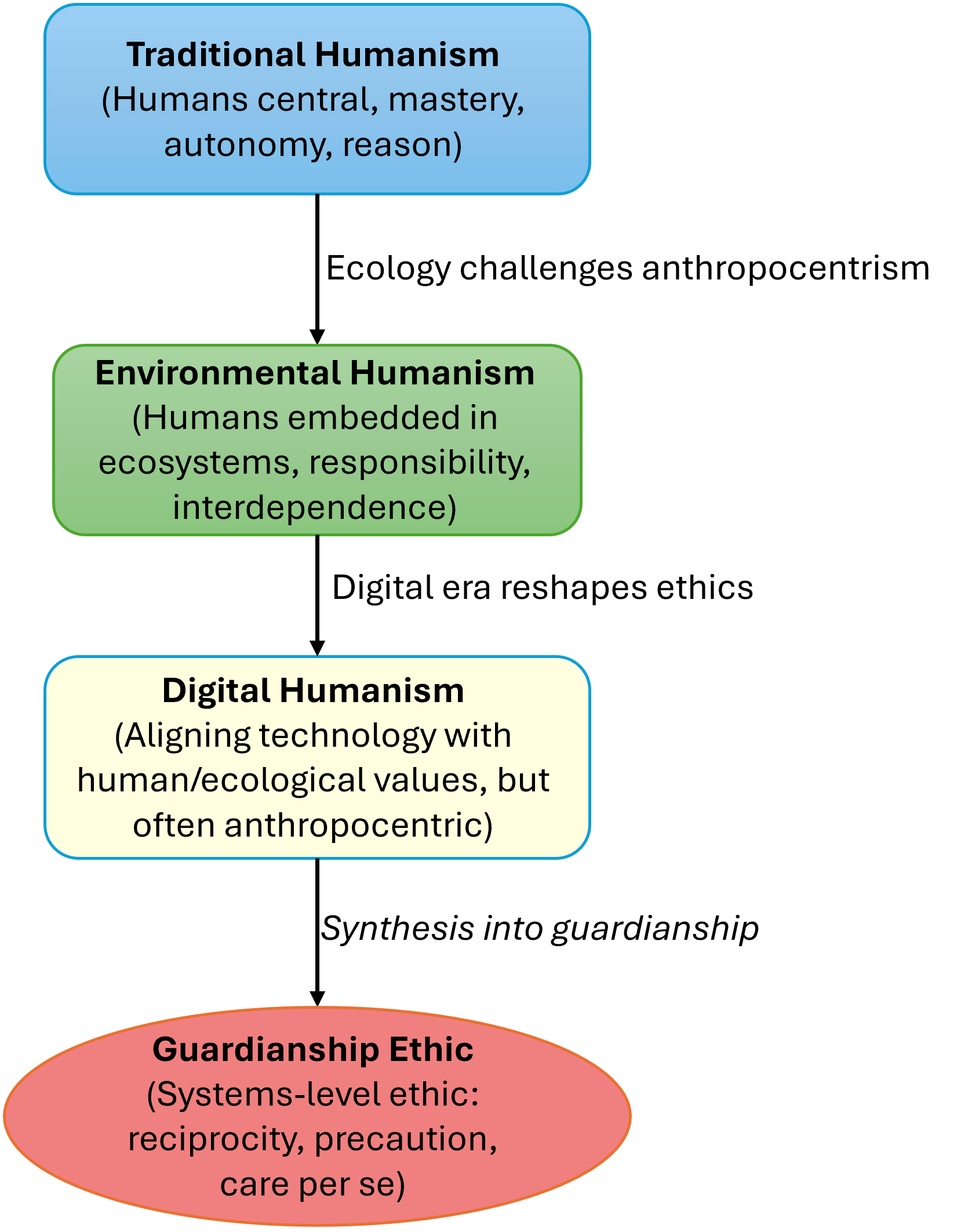
This conceptual figure illustrates the historical and philosophical trajectory from traditional humanism to guardianship. Traditional humanism positioned humans at the center of meaning and mastery. Environmental humanism expanded this view by embedding humans within ecosystems and emphasizing their interdependence. Digital humanism emerged with the rise of digital technologies, aiming to align them with human and ecological values, yet often retaining anthropocentric assumptions. The guardianship ethic synthesizes these traditions into a systems-level framework that emphasizes reciprocity, precaution, and care for the environment per se.
At the same time, digital technologies risk deepening global inequalities if applied without equity safeguards. For instance, the energy-intensive nature of Bitcoin mining and other blockchain operations in developing countries has produced ecological and social harms. At the same time, profits disproportionately accrue to actors in the Global North. Similarly, research and data extraction in biodiversity-rich regions of the Global South can be framed as “guardianship,” yet function as a new form of resource colonialism. To avoid such co-option, guardianship must be defined not only as ecological care but also as a framework of justice: who qualifies as a guardian, and under what authority, must be determined through inclusive, participatory governance that prioritizes local communities and Indigenous custodianship. In this sense, guardianship entails guarding from exploitation as much as for ecological integrity, ensuring that the ethic cannot be instrumentalized to perpetuate inequities.
From dominance to guardianship
The Anthropocene era has shown that traditional humanism, centered on human exceptionalism and control, is ill-suited to addressing today’s ecological crises. Empirical studies (Ceballos and Ehrlich, 2023; Dirzo et al., 2014; Pimm et al., 2014) have documented the rapid decline of species and ecosystems resulting from human population growth, changes in land use, and increased carbon emissions. These findings have spurred a shift toward environmental humanism, an ethical framework that places humans within, rather than above, the biosphere. As Heidegger (1977) anticipated, preserving human values today requires recognizing that humans are not isolated “subjects” but stewards of a shared world.
One distinctive contribution of the guardianship model is its call for new governance mechanisms that formally recognize obligations toward non-human entities. Whereas stewardship and trusteeship remain largely anthropocentric, guardianship can prescribe innovations such as multi-species justice audits—evaluations of policies and projects not only in terms of human benefit but also in terms of their impacts on biodiversity and ecosystem integrity. Another possibility is embedding fiduciary duties for non-humans into environmental law, requiring decision-makers to act in the best interests of ecosystems and species as legal stakeholders. These mechanisms illustrate how guardianship extends beyond existing frameworks by institutionalizing care for the environment as a primary, rather than secondary, criterion in governance.
Looking ahead, the concept of humanism must continue to evolve, considering the Anthropocene and digital revolutions. The Homogenocene highlights that both local ecological diversity and cultural diversity are under threat; therefore, humanism must value and protect this diversity. Meanwhile, digital humanism must ensure that our technological systems are aligned with ecological limits, rather than unthinkingly fueling resource extraction. In practice, this means embracing post-anthropocentric and post-humanist perspectives where the fate of humanity is seen as intertwined with the fate of all life.
Ultimately, a holistic humanism for the 21st century will integrate ethical concern for people with biocentric values, promoting justice, freedom, and dignity not only for humans but for the whole community of life. It will leverage digital and scientific knowledge to live within planetary boundaries (Van Vuuren et al., 2025) and will redefine progress in terms of sustainability and resilience. Such a transformative humanism may indeed be our best hope to navigate the converging crises of biodiversity loss, climate change, and global inequality.
Defining guardianship
The guardianship model builds on but differs from existing ethical paradigms. Stewardship emphasizes human responsibility for care but often retains a hierarchical stance of managers over nature. Trusteeship imposes legal responsibility to manage resources on behalf of beneficiaries, yet it still implies ownership and control. Earth jurisprudence aims to grant rights to nature, primarily through the establishment of legal frameworks. Guardianship, by contrast, frames humans as embedded participants within socio-ecological systems. Its distinctive features include:
Importantly, guardianship does not imply discretionary dominance over nature. Instead, it requires that when tradeoffs arise between human needs and ecological protection, decisions be guided by precautionary principles, justice-based criteria, and a commitment to sustaining long-term socio-ecological integrity. Guardianship, therefore, recognizes that specific short-term human demands must sometimes be moderated to secure ecological conditions that sustain both human and non-human life.
Moreover, the question of who acts as a guardian is critical. If left to corporate entities or state bureaucracies alone, guardianship risks reproducing inequities and reinforcing extractive power structures. A genuine guardianship ethic prioritizes plural representation, incorporating Indigenous and local communities, ecological knowledge-holders, and marginalized groups alongside scientific and legal institutions. In this way, guardianship is not a tool of ownership, but a distributed responsibility that blends ecological care with social equity.
By articulating these dimensions, guardianship moves beyond stewardship’s managerial metaphor toward a systemic ethic that integrates ecological science, human rights, and post-anthropocentric philosophy.
Toward a coherent guardianship framework
The guardianship ethic can be understood as a synthesis of three key traditions. First, systems thinking acknowledges the interconnection of humans and ecosystems through feedback loops and emergent dynamics; guardianship emphasizes the importance of precaution and adaptive responsibility in these complex systems. Second, from post-humanism, it moves beyond anthropocentrism, affirming that agency and value are distributed across human and non-human communities. Third, the planetary boundaries framework draws the empirical guardrails that define the safe operating space within which guardianship must act.
Taken together, these threads converge into a coherent theory: guardianship is a systems-level ethic that positions humans as embedded participants, obligated to sustain socio-ecological integrity across generations, while rejecting stances of ownership and mastery. This integration (Figure 2) ensures that guardianship is not a fragmented collection of ideas but a holistic conceptual framework capable of guiding both ethical reflection and practical policy.
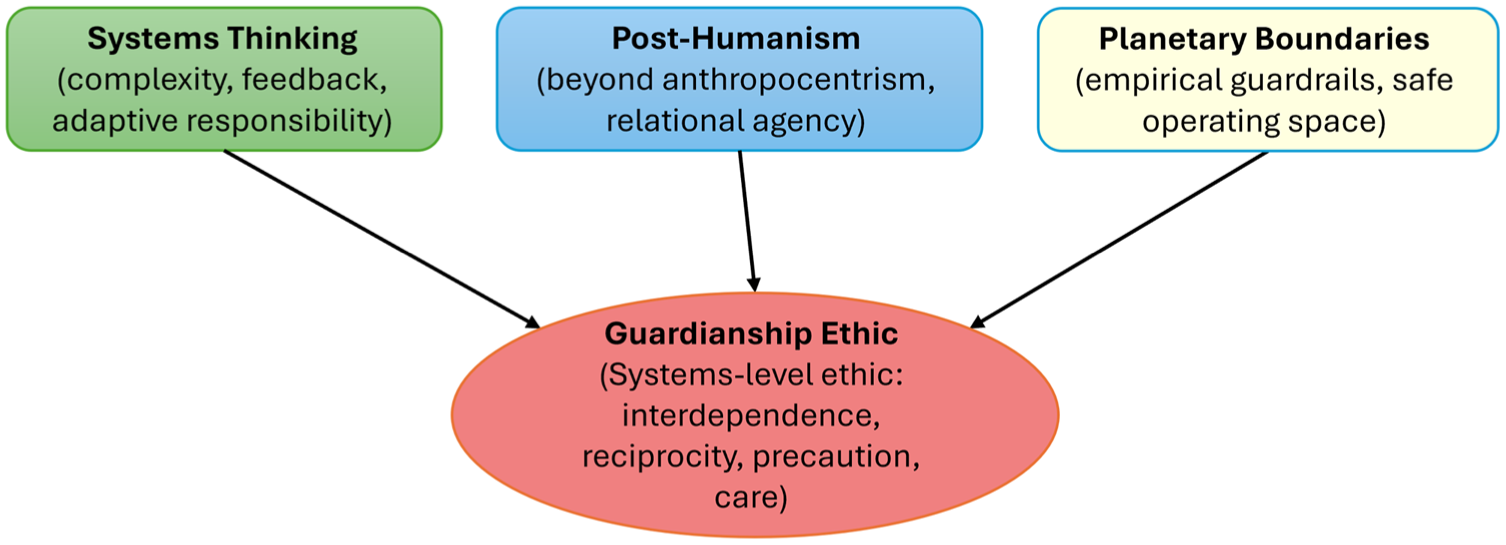
Guardianship framework synthesis.
Lessons for the future
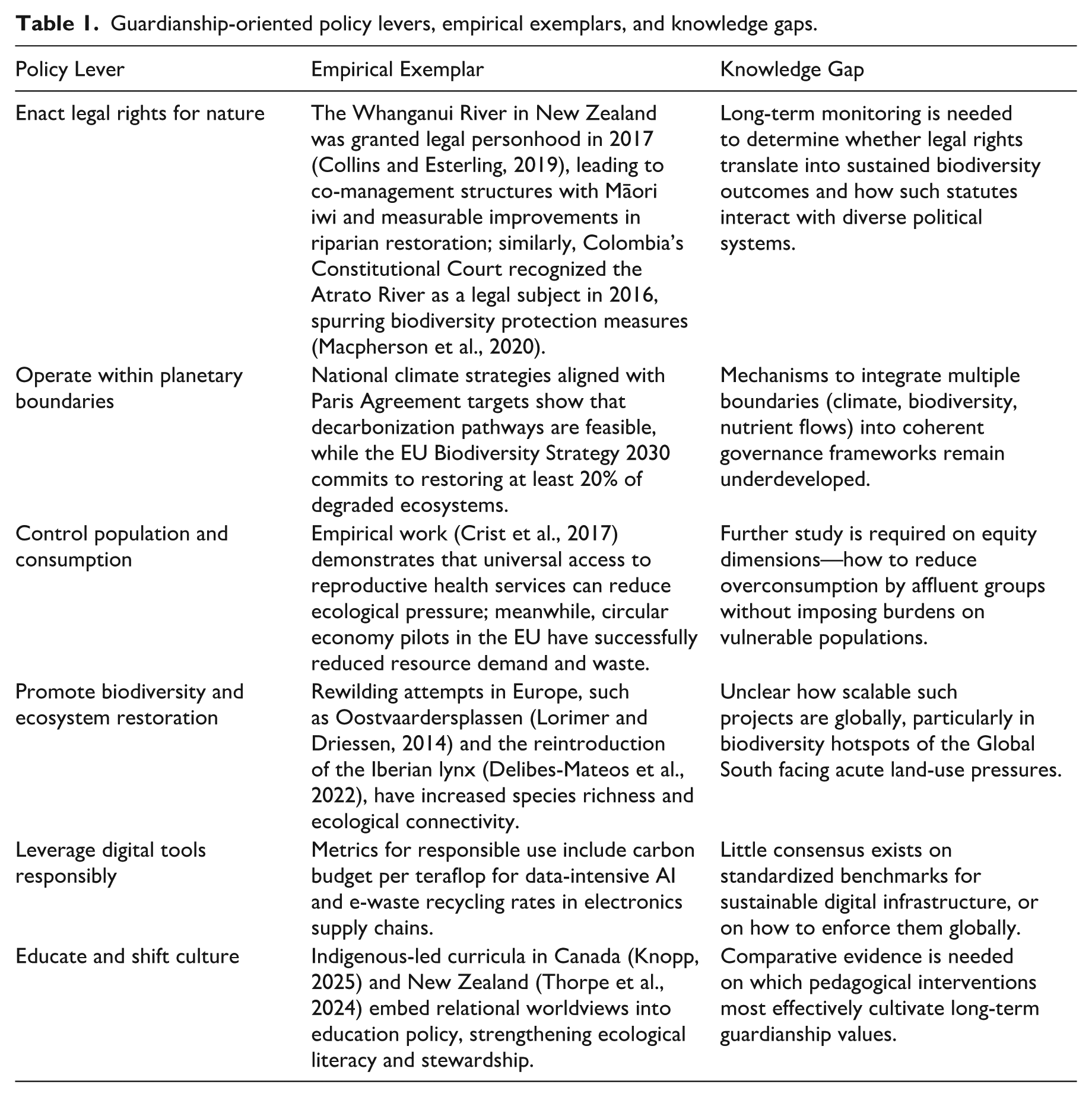
To operationalize the guardianship ethic, lessons for policy and practice can be structured as interlinked levers, each grounded in empirical evidence but with important knowledge gaps remaining (Table 1). Concerns that policy proposals may appear abstract (e.g., “rights of nature,” “sustainable technology”) are addressed by linking each lever to concrete enforcement mechanisms. For instance, legal personhood cases (e.g., Whanganui and Atrato rivers) illustrate how guardianship statutes can be enforced through judicial review and co-management, while responsible digital governance requires quantifiable benchmarks such as carbon budgets per teraflop or e-waste recycling rates.
Guardianship-oriented policy levers, empirical exemplars, and knowledge gaps.
In sum, advancing a guardianship ethic requires not only conceptual clarity but also practical commitment, ensuring that future human–nature relations are guided by reciprocity, precaution, and justice across generations.
Footnotes
Declaration of conflicting interests
The author declared no potential conflicts of interest with respect to the research, authorship, and/or publication of this article.
Funding
The author received no financial support for the research, authorship, and/or publication of this article.

Data availability
The datasets generated and/or analyzed during the current study, as well as the materials used, are available from the corresponding author on reasonable request.