




Abstract
This article examines how imaginaries of security in the Anthropocene function at the Svalbard Global Seed Vault (SGSV), otherwise known as the ‘Doomsday Vault’. Recent explorations by scholars of security have suggested that different ways of seeing, understanding, acting in, and imagining the world are necessary to adequately respond to complex crises in the Anthropocene. The dissolution of the nature/culture divide and the existential risk from planetary threats are said to require new and creative formations of security. Buried in the Norwegian high Arctic, the heavily fortified SGSV was built in 2008 as a planetary-scale, ‘deep-time organisation’ that would forever secure a wide variety of plant seeds and their genetic makeup against regional or global upheavals. The article argues that his seed ‘ark’ materialises three Anthropocene security imaginaries: apocalypse, hope and escape. The prevalence and use of these imaginaries reveal the stability of long-held security logics and challenge the widely-held belief in the innately transformative properties of the Anthropocene concept for security. Instead, the SGSV demonstrates the difficulty in overcoming a collective mindfulness that fixes security to eternal forms even in the midst of unprecedented threats, interventions and technology.
‘Our existence rests on how well we care of these seeds; and their existence depends on us. In many ways, it really is that simple’. (Noragric, 2004)
Introduction
On 25th of February 2020, as twilight descended upon the ice-covered town of Longyearbyen, Norway – one of the world's northernmost human settlements – a male choir serenaded a large gathering of seed scientists representing thirty-five seed genebanks from around the world. Together with luminaries like Norwegian Prime Minister Erna Solberg and Ghanaian President Nana Akufo-Addo, the group of over 80 experts on biological diversity and sustainable development had congregated on the icy pathway dug outside the Svalbard Global Seed Vault (SGSV), otherwise known as ‘The Doomsday Vault’, to witness the largest depositing of seeds since the vault opened in 2008. One-by-one, the depositing countries were announced – ‘Germany’, ‘Mali’, ‘Mongolia’, etc. – prompting each scientist team to begin their solemn march. They carried with them sealed seed deposits and slowly moved along a candlelit path, flanked by photographers, towards the heavy steel doors of the vault which protruded from the side of the frozen mountain, Platåberget (@IPKGatersleben, 2020). The timing of the event was meant to be auspicious. The end of February marks the ‘Return of the Light’ for the Svalbard archipelago where Longyerbyen sits; the time of year when the sun finally begins to break over the horizon and rescue the land from a seemingly perpetual darkness. As the carefully arranged presentation emphasised, the cargo brought to Svalbard was important. 65,000 seed accessions 1 from around the world would be catalogued and stored in the frozen vault for as long as necessary.
The cryopreservation of seeds in the SGSV is meant to maintain global genetic diversity and cultural heritage that is increasingly threatened by war, disease and climate change. Moroccan coriander, sesame from Thailand, corn varieties sacred to the Cherokee Nation, all were deposited, in addition to 27 wild plant varieties harvested from King Charles's private garden at Highgrove in the west of England. For the officials present from the Nordic Genetic Resource Centre (NordGen), the institute tasked with maintaining the vault, the event was a reflection of the trust the world had bestowed upon them and the Norwegian government to safely back up the invaluable genetic material. Kristen Børresen, a member of the vault's International Advisory Panel, reflected on the seriousness of the initiative in an accompanying media interview: ‘I think the Svalbard Global Seed Vault is absolutely magical because it is the starting point for all life. Without seeds – no life!’ (Nordgen, 2020).
The theatrical procession under the snow-lit sky in February 2020 was framed as an expression of global solidarity. The promotional video produced by NordGen following the event, titled ‘They came from all over the world’, made it clear that international cooperation is at the heart of the SGSV's mission. It is not a typical seed bank: it is a ‘safety net’ for smaller banks and serves as a backup for plant breeders to cultivate new types of crops. 2 This is particularly important given the increasing reliance on food monocultures 3 , which are vulnerable to devastating harvest failures. Thus, national genebanks 4 and civil society organisations were celebrated during the event for coming together to safeguard the genetic diversity of crops by 2020, a key target of the UN Sustainable Development Goal of eliminating hunger by 2030 (Vaughan, 2020). By stockpiling these seeds in one of the most remote areas of the world, free of charge, vault officials explained that they were protecting crop varieties from their destruction locally whether from conflict, changing climatic conditions, the onset of disease, or simple mismanagement. The 65,000 tightly packed and carefully labelled accessions that were slowly marched into the frozen vault represented a key commitment to secure the world's food supply, now and for the future.
However, notwithstanding the frequent declarations of improved food security and the mass of photographers and media members assembled to help market the event, the tone seemed melancholic. Faint applause accompanied the deposits (perhaps this owed to the frigid temperatures) and the choral accompaniment added a mournful quality to the proceedings. Earlier, the event's keynote speech from journalist and academic Simran Sethi vividly described how the last 100-odd years of industrial development had decimated most historical seed varieties and the recent half-century shift towards cultivating monocultures has only accelerated that loss. Yet the eradication of agrobiodiversity – the foundation of agriculture and food – had received far less attention than the ongoing extinction of plant and animal species. The vault corrected this because, according to Sethi, it offered the seeds safe harbour following the necessary ‘rescue missions’ which extracted them from the wild to save them from extinction in their vulnerable local habitats across the world (Sethi, 2020).
The small, elite community which came together at the end of the world, was performing a security act for the Anthropocene. As Folkers (2019: 5) points out, even if stockpiles are never used in an actual emergency, they can have a securing effect because they materialise anticipatory security politics. Their presence can stabilise or enable expectations. One should have no illusions that the ‘Doomsday Vault’ moniker is accidental or an organic global response to agrobiodiversity loss. The marching of the seeds of life into a perpetually frozen tomb that is closer to the North Pole than the Arctic circle is a specific manifestation of collectively held visions of security futures.
This article examines the SGSV as a security apparatus for the Anthropocene. Given the monumental challenges presented by the onset of the Anthropocene, it has been suggested that our institutions, concepts, imaginations and material interventions must transform to match this critical juncture in human history (Biermann, 2021; Du Toit and Kotzé, 2022; O’Brien, 2021). The SGSV is frequently invoked as the type of spectacular intervention that is needed to match the scale of danger currently present in the world. Specifically, the article explores how the vault acts as a material representation of three interrelated Anthropocene security imaginaries: apocalypse, hope and escape. All three of these imaginaries work to establish the SGSV as representative of the Anthropocene epoch. However, the argument presented in this article is that these imaginaries and their material manifestation in the SGSV reinscribe traditional logics of security and reposition long-contested forms of ex-situ (off-site) seed conservation. This has important effects for understanding the allure of Anthropocene security interventions, particularly ones positioned creatively as ecological, posthuman or deep-time. In this case, the high-profile security apparatus again views the world as full of emergencies both ongoing and yet to pass, but which nonetheless can be governed and redeemed (Anderson, 2017). This repeats and sustains the fragile promise of security that is so familiar. Contrary to much of the commentary surrounding it, the SGSV is not a transformative response to an unfolding set of unique cross-scalar, cross-temporal socio-ecological disasters. It is better understood as an apolitical, techno-managerial approach to environmental insecurity and disaster, one rendered intelligible and acceptable via security imaginaries of apocalypse, hope and escape.
This article contributes to growing academic interest in security stockpiles, seedbanks and other forms of cryopreservation that has emerged across disciplines such as critical humanities, heritage studies, and science and technology studies (STS) (Alpsancar, 2016; Breithoff and Harrison, 2020; Chacko, 2019; Curry, 2022; Fenzi and Bonneuil, 2016; Hartigan Jr., 2017; Lewis-Jones, 2019; Peres, 2016, 2019; Radin and Kowal, 2017; Van Dooren, 2009). It also reflects an accelerating focus on climate imaginaries and how visions of future worlds are entangled with political, cultural, scientific and technological developments (Benner et al., 2019; Harper and Specht, 2022; Milkoreit, 2017; Luke, 2015). With a few exceptions, this interest has not yet translated into geopolitical, security or broader international relations (IR) scholarship (Folkers, 2019; Wolff, 2021). This article adds to these fledgling discussions by exploring how imaginaries of security in the Anthropocene are materialised. This adds important contextualisation to the literature on Anthropocene security, which to date has mostly focused on conceptual critiques of dominant disciplinary paradigms rather than specific practices (Dalby, 2020; Harrington and Shearing, 2017; McDonald, 2018).
The article proceeds in two parts. It begins by detailing the history of the SGSV, placing it within the wider historical, cultural and political context of seed conservation. The SGSV is often presented as a benign form of global intervention, care and solidarity in the face of existential threats. However, its existence can be traced to local and global histories and political economies of extractivism as well as an increasing reliance on ex-situ conservation practices, which remove seeds from their complex local socio-ecological networks to become banked resources. The second section of the article places the SGSV as a material enactment of three influential imaginaries of security in the Anthropocene built around apocalypse, hope and escape. These three imagined futures are blended in the SGSV, demonstrating its enigmatic form – full of tensions, contradictions and contestations. The article concludes with four central conclusions and possibilities for future research direction.
The politics of the Doomsday Vault
The SGSV is a security apparatus built for the Anthropocene age. It is positioned as a refuge for ongoing and future catastrophes and is one of a small number of existing ‘deep-time organisations’, all part of an emerging trend towards new forms of Earth system governance (Hanusch and Biermann, 2020). It was built in 2008 on the outskirts of the small Norwegian mining town of Longyearbyen, which lies on the Svalbard Archipelago (Figure 1). 5 This is one of the most remote areas of the world still serviced by commercial flights, only about 1300 kilometres from the North Pole. The remoteness serves a purpose: to make the seeds largely inaccessible except to designated local authorities and thus secure them from localised climate change, natural disasters and war. This ‘subterranean Ark’ (Williams, 2006: R475) has been designed to ‘last essentially forever’ (Fowler, 2017). It has the capacity to store 4.5 million crop varieties from across the world. It is an ex-situ form of crop conservation and forms part of a global strategy that is meant to halt the worsening loss of global plant diversity. 6 Seed banks such as the one in Svalbard conserve plant genetic material and make it available to designated authorities when requested in order to improve food security. The seeds can remain viable for long and predictable time periods when properly dried, vacuum-packed and stored at low temperatures.
The preservation of genetic diversity is essential for satisfying human needs and has been a part of human history since the Neolithic revolution. 7 Ex situ plant genebanks are not new. The first modern biorepositories to preserve genetic resources were created in the 1920s by the Russian geneticist Nikolai Vavilov (Janick, 2015). According to the latest FAO report on the State of the World's Plant Genetic Resources, published in 2010, there are over 1750 individual genebanks that exist around the world with about 130 of these holding more than 10,000 accessions each (FAO, 2010). They now take various forms including in-vitro storage, cryopreservation, where plant cuttings are taken and frozen, and seedbanks, which stockpile a wide variety of seeds to satisfy long-term future needs. All genebanks store plant materials ex situ in order to conserve biodiversity and improve food and nutritional security via research, plant breeding, withdrawals and education. 8 Their existence is based on a dual rationale. First, they are intended to augment in-situ (e.g., farmers’ fields, national parks/forests/refuges, or in the ‘wild’) conservation strategies. Second, they are meant to be accessible to their users in order to repair the damaging effects from a loss of agrobiodiversity (Fowler and Hodgkin, 2004). Collectively the genebanks are overseen by a global network of international, regional and national institutes as well as by universities, botanical gardens, breeding institutes, NGOs, private entities and commercial companies (FAO, 2010: 60). As an extra security measure, international guidelines recommend that gene bank collections are duplicated elsewhere. The SGSV, while not technically a gene bank, acts as a global fail-safe for regional and other localised gene banks. It is a planetary safety net.
The SGSV emerged in 2008 after years of lobbying from influential figures and groups including the Consultative Group for International Agricultural Research (CGIAR), Center for International Environment and Development Studies (Noragric), Agricultural University of Norway, the Nordic Gene Bank and the conservationist Cary Fowler, then Executive Director of the Crop Trust, a funding agency based in Bonn, Germany established to support the International Treaty on Plant Genetic Resources for Food and Agriculture. It is owned by the Norwegian government, who funded its 45 million kr (US$8.8 million in 2008) construction and is managed through an agreement between the Norwegian Ministry for Agriculture and Food, the Crop Trust and NordGen (Hopkin, 2008). The vault's daily operations are run by NordGen, who maintains the online database of all samples stored in the vaults.
The vault was not initially proposed as a response to climate change at all. The idea for placing a global seed bank in the far northern reaches of Norway emerged from an earlier experiment in 1984 when a team of Norwegian scientists stored a small collection of seeds in one of Longyearbyen's abandoned coalmines, which maintains an ambient temperature of −2.5 and −3.5 degrees Celsius. Realising that year-after-year, and without any specialised technology, the seeds failed to germinate the scientists submitted a grant proposal to the UN FAO so that they could repurpose the mine into a fully-fledged global cryobank, with countries paying a small fee to deposit seed holdings for safekeeping. The FAO rejected the initial proposal arguing that it would lead to intellectual property disputes if one country were to store a significant amount of its germplasm in another country (Roosth, 2016). Though the original bid failed to materialise, Fowler and CGIAR returned to it after growing increasingly convinced by events such as 9/11 and Hurricane Katrina that world seed stocks faced perpetual insecurity if they continued to be held in individual gene banks. For them, no matter how robust seed samples and their protective infrastructure might have appeared in local banks they were perpetually vulnerable to rapid degradation from political strife and natural disasters. Svalbard offered an enticing locale due to its history of seed storage, its remoteness, and the fact that the International Spitspbergen Treaty of 1920 gave citizens of all signatory nations unrestricted access to Svalbard whilst also prohibiting any military fortifications from ever being erected there.
The structure itself is designed as a security device. It is made from concrete engineered to last 500 years and thick enough to withstand a plane crash. Its storage rooms (there are three, each self-contained) are located 120 metres into the mountain rock to ensure that they can survive different types of apocalypses, including catastrophic climate change and nuclear war. In a 2008 interview, Cary Fowler connected the security of the vault with doomsday scenarios: ‘if there was a huge explosion in front of the Seed Vault, for instance, or someone was really trying to attack it, shooting a projectile or missile down here, it wouldn't go into any of the Vault rooms, it would hit this solid stone concave structure and the blast force would then be directed back out of the tunnel, outside, rather than going in to the Vault’ (Fowler, quoted in CBS, 2008). In the same 2008 interview, Fowler emphasised, ‘Doomsday doesn't have to come in the form of an asteroid. Doomsday can come in the form of an equipment failure or just human mismanagement or a lack of funding or a typhoon…And those kinds of things are happening all the time’ (quoted in CBS, 2008).
Svalbard itself is not prone to earthquakes and there are no volcanoes nearby. It also lies 120m above sea level, ensuring (it is claimed) that the vault will not be affected even if the ice caps were to melt, triggering massive increases to sea levels worldwide. Given the thick layers of permafrost and rock that cover the mountain, the vault will remain naturally frozen even if the mechanical cooling system fails and external air temperatures rise due to climate change (Crop Trust, ND). As Marie Haga, the former Executive Director of the Crop Trust put it, ‘the location itself is its own security measure’ (quoted in Griffin, 2018). According to the current coordinator of the vault, Åsmund Asdal, and Luigi Guarino, placing the SGSV there is also a reflection of the geopolitical trust and affection for Norway: ‘Offering the world a safe place for seeds is in accordance with long standing Norwegian policies for supporting biodiversity conservation, and stakeholders all over the world trust that Norway will take good care of the seeds’ (Asdal and Guarino, 2018: 391). It also aligns with other narratives of the far north – and Scandinavia in particular – as the safest place on Earth (Harrington and Lecavalier, 2014; LaFauci, 2018).
Though the vault can store up to 4.5 million samples, because each seed sample contains an average count of 500 seeds, it can in fact store a maximum of 2.25 billion seeds. Since it was first founded, over 1 million seed samples have been deposited there, covering over 6000 species. In terms of where the seeds come from, the vault collects samples that are sent voluntarily and legally by depositing state agencies and research centres. 9 Two thirds of sample deposits have been by international research centres. The largest national genebank deposits have come from the developed world including the US, Canada, Germany, South Korea, Australia, the Netherlands and Switzerland (Asdal and Guarino, 2018: 391) The depositors retain ownership rights over the seeds sent to the facility and sample boxes remain sealed and are not distributed or accessed by anyone other than the depositors. Depositors can request a return of their samples if their genetic material is lost or rendered inaccessible locally. The vault does not accept all samples, as Norwegian law prohibits the importation of genetically modified seeds and their storage. Priority is given to crops that are important for food production and sustainable agriculture. (The Crop Trust, ND).
Two recent incidents have brought the SGSV considerable media attention. First, it only took seven years after its founding before the first depositing institution requested a portion of their samples back. This occurred amid the Syrian Civil War at the end of 2015 when the International Institute for Agricultural Research in Dry Areas (ICARDA) had its headquarters in Aleppo, Syria destroyed, thus losing access to its gene bank. Samples from their deposit in Svalbard, including strains of Levantine wheat and durum, which are more than ten thousand years old, were returned in order to solidify new functional gene banks at sites in Lebanon and Morocco. A further 30,000 seed samples from the Vault have been shipped back on two occasions to help rebuild the country's stocks of barley, lentils and chickpeas. As the vault authorities like to make clear, since the spring of 2017, it has redeposited seed samples in the Vault on at least three occasions (Asdal and Guarino, 2018: 391).
The second major incident occurred in May 2017 when the SGSV access tunnel flooded with meltwater after an unusually warm winter in Svalbard. This generated a torrent of media coverage which emphasised how the effects of climate change were growing so extraordinary that they were able to overwhelm a building that was designed specifically to withstand these types of challenges. Headlines like ‘The Arctic Doomsday Seed Vault Flooded. Thanks Global Warming’, rapidly spread across social and print media (Carrington, 2017). As one Norwegian official put it, ‘It was not in our plans to think that the permafrost would not be there and that it would experience extreme weather like that’ (Aschim, quoted in Carrington, 2017). A variety of modifications to the structure have since been made, including further waterproofing the 100m-long tunnel into the mountain and digging trenches into the mountainside to clear collecting water away. Some electrical equipment has been removed from the entrance tunnel and more pumps have also been installed. Finally, a stronger human monitoring system has been put in place. The aim of these measures is to eventually perfect the system so that the vault can ‘take care of itself’ (Aschim, quoted in Carrington, 2017).
Unsurprisingly, given the scope of its mission and its media profile, the vault has been a lightning rod for criticism. The critiques principally run in two parallel directions. First, on a technical level, the vault can be viewed as the poster child for an increasing reliance on ex situ conservation strategies that seek to mitigate against threats to diversity experienced in-situ. While the United Nations Convention on Biodiversity (CBD) acknowledges the importance of ex-situ conservation work, it was always meant to act as a subsidiary to preferred in-situ conservation measures (CBD, 2002). In situ strategies are essential because they help maintain the adaptive and evolutionary capacity of the material to meet both human needs and an ever-changing environment. They also ensure that users are directly involved in conservation practices and have access to material. It is generally thought that maintaining a range of traditional cultivars provides resources for poor farmers with a risk-avoidance strategy, optimises the use of different types of land and labour and provides materials with a range of different uses for varied situations. As one influential study put it, ex-situ ‘facilities cannot accommodate the full range of useful diversity in economically useful plant species, nor can they conserve the dynamic processes of crop evolution and farmers’ knowledge of crop selection and management inherent in the development and evolution of local cultivars’ (Jarvis et al., 2008: 5326).
The growing impacts of climate change on ecosystems along with the rapidly increasing extinction rates of species caused by human action mean that certain actions once thought avoidable are now considered acceptable. Vault officials argue that without human intervention to move species off site, many fragile ecosystems are in danger of disappearing or rapidly shifting in geographical range and distribution. Yet, an over-reliance on ex-situ conservation is inherently dangerous because, no matter how robust it is, it can never fully recreate the habitat and exposure to genetic variation from which the species emerge. It may not be as complex as preserving animal genetic material but placing plants and seeds in isolated, frozen conditions halts or distorts their natural evolution and processes of adaptation (Prance, 2004). It also overlooks the reality that even frozen seeds will eventually decay and die. Or, when reintroduced into ever-changing habitats, plant species that have been preserved used cryogenic methods may fail to thrive in their ‘new’ environment (Godefroid et al., 2011). Furthermore, upwards of 15% of (mainly tropical) plant species simply cannot be preserved ex-situ, because they lack seed dormancy (Briggs and Walter, 2016).
The next section shows how the vault situates biological reproduction within fixed security imaginaries of the future. Through its vastness the vault's seed collection helps sidestep criticism of zoological salvage missions that make decisions on storage based on charismatic and genetic value. Nevertheless it is emblematic of the belief that global agricultural biodiversity – a building block of human society – may be lost without this specific intervention. It assumes that the seeds, their genetic makeup, and the populations upon which they are deeply entangled must be separated from one other in order to survive. This suspension of cultural and evolutionary interaction is framed as ‘insurance’ or a ‘backup plan’ because of the potential for catastrophic loss and the perceived need to build resilience. It is legitimated, in part, through the mobilisation of Anthropocene security imaginaries and the perceived present and future state of seed collections in gene banks and crops in fields. Indeed, the spectre of doomsday is required for the securitising moves that underpin the creation and sustainability of the SGSV project.
Security imaginaries in the anthropocene: Apocalypse, hope, Escape
Though differences exist regarding the nature and implications of Earth system transformations, for many the character and the effects of Western-led industrialisation are so profound that it requires nothing less than ‘a new global political project’ (Burke et al., 2016: 502). This section outlines how imaginaries of security in the Anthropocene help define and construct the global political projects deemed necessary for the future. A significant amount of scholarly work has been produced on the power of imaginaries, yet comparatively few studies have investigated the power of security in defining visions of the Anthropocene. 10 Anthropocene security imaginaries can be defined as specific, taken-for-granted orderings of the world, built and performed around a sense of the future defined by its relationship to (in)security. The argument put forth is that, both at the SGSV and with the Anthropocene concept more generally, three core security imaginaries define the future: apocalypse, hope and escape. Each imaginary discussed here – apocalypse, hope and escape – represents an influential understanding and expectation about a security future that is collectively held, institutionally stabilised and publicly performed via security technologies. They are crucial to making the SGSV operable as a security apparatus and no doubt recognisable to those familiar with IR debates about the Anthropocene (Chandler, 2020; Lövbrand et al., 2020; Rothe, 2020; Simangan, 2020).
The formation and circulation of these Anthropocene security imaginaries differ in a few crucial respects from the accounts of sociotechnical imaginaries articulated by Jasanoff, Kim and others. Their formulations are meant to demonstrate an imaginary's relationship to nation-specific scientific and/or technological projects. In those accounts, sociotechnical imaginaries are ‘associated with active exercises of state power’ (Jasanoff and Kim, 2009: 123). In contrast, the imaginaries used for the Anthropocene and the SGSV are spatially and temporally diverse and are not necessarily in the service of narrow nation-building. To be sure, Norway's ownership of the vault represents a performance of responsible nationhood and state power, but the overriding purpose and function of the vault transcends the spatial and temporal scales of conventional state-building exercises. In order to preserve global agrobiodiversity it requires extraordinary interventions and a design meant to exist for centuries. It requires the participation of a wide range of funders, regional and local seed banks and scientists from around the world. The second difference to other formulation of sociotechnical imaginaries comes from the fact that the SGSV is primarily positioned as fulfilling logics of security. These logics have been filtered and selected by the numerous individual and organisations involved in the creation, design, funding, operation and marketing of the SGSV, and they portend new insights into the functioning and circulation of security in the Anthropocene, which transcends the nation-states and encompasses more-than-human relations. The preservation of seed life in conjunction with the stated task of protecting human civilisation project and reinscribe certain hopes, fears and risks of a wider and more complex conception of society.
Apocalypse
Security in the Anthropocene is infused with an apocalyptic imaginary. Scientists, journalists and activists frequently sound the alarm that the world is during a climate breakdown and a mass extinction event, and that human civilisation is imperiled by the transition to the Anthropocene. Dire warnings are made that the world has received its ‘final call’ to save itself from climate catastrophe (McGrath, 2018). Millenarian expectations of uninhabitable zones, rising oceans, flooded cities, vast increases in migration, widespread extinctions and wars over dwindling resources lead to calls for greater action to ensure global security (Wallace-Wells, 2019). These discourses are also found in academic literature, which has developed a nascent interest in ‘existential security’ threats and the prospect of global collapse (Sears, 2020).
The apocalyptic imaginary at the ‘Doomsday Vault’ is hard to miss. It follows a longer historical trend connecting biodiversity loss with extinction. As former Executive Director of the Crop Trust, Marie Haga once stated, ‘there are big and small doomsdays going on around the world every day. Genetic material is being lost all over the world’ (quoted in Duggan, 2017). At the opening of the vault in 2008, Cary Fowler declared that the threat to the viability of seed collections around the world constituted ‘more than an apocalypse’ (quoted in Norwegian Ministry of Agriculture and Food, 2008). The relationship between the biodiversity loss and apocalypse has a relatively modern history. The spectre of global mass extinction began in earnest in the 1970s and 1980s, fuelled by fears of nuclear winter and new evidence of the scale of environmental destruction. The discursive construction of a global biodiversity ‘crisis’ in the mid-1980s was led by high-profile scientists such as E.O. Wilson and influential institutions like the US National Academy of Sciences. It was intimately tied to visions of worldwide catastrophe (Sepkoski, 2020). This crisis, which now dominates environmental thinking, was established by comparing current extinction rates with those found in the paleontological records of previous mass extinctions in the Paleozoic and Mesozoic eras. By establishing ‘normal’ and ‘exceptional’ levels of extinction, it has paved the way for nearly all subsequent discussions around biodiversity, including the recent popular trend of classifying the current age as the ‘Sixth Mass Extinction’ (Sepkoski, 2020: 4–5).
The apocalyptic imaginary leverages fear of societal collapse and mass extinction to reinscribe conventional logics of security via the framing of the exceptional nature of the challenge. Part of this emerges from the problematic tendency in Anthropocene discourses to draw upon what Scott Hamilton calls ‘the generalised planetary humanity of anthropos’ to blame for the current predicament (Hamilton, 2019: 612 emphasis in original). Guided by new technology associated with Earth System Science, the elevation of a new planetary species-being works to dehistoricise, universalise and essentialise a mode of production unique to a specific time and place (Malm, 2015). It marks the Earth as an anthropogenic force, one driven by human nature rather than one driven by differentiated sociogenic factors (Malm and Hornborg, 2014). As Kathryn Yusoff has shown, the process of making Humanity a geological ‘Event’ (identified through the discovery of a ‘Golden Spike’ in the geologic record) elides the very real constitution of Anthropocene politics, namely capitalism, inequality, racism, colonialism and uneven energy geographies (Yusoff, 2018: 259). The universalism that underpins Anthropocenic subjectivity extends into security discourses and practices that centre the spectacular and the apocalyptic at a planetary level. The SGSV's mission to save global agrobioversity removes the human subject almost entirely, levelling differentiated forms of vulnerability and responsibility by placing seeds in a remote, hardened silo, with no permanent on-site staff and marketing a cosmopolitan outlook where seeds from North Korea sit peacefully alongside those from the United States.
Here, the Anthropocene does little to shift the balance of security culture. The (often implicit) adoption of a universal Anthropocene imaginary in this sense binds the security of human civilisation to familiar security discourses and practices focused on existential threats. This imaginary of Anthropocene security is, in the words of Erik Swyngedouw, ‘sutured by millennial fears, sustained by an apocalyptic rhetoric and representational tactics, and by a series of performative gestures signalling an over-whelming, mind-boggling danger, one that threatens to undermine the very coordinates of our everyday lives and routines, and may shake up the foundations of all we took and take for granted’ (2010: 218). Even though the disruptive context of the Anthropocene is present, the apocalyptic imaginary does not escape a conventional, universalist logic of security that renders it as a function of danger, fear, emergency and the pursuit of integrity (bodily and territorial) and survival. The doomsday that lies at the heart of the SGSV fixes the apparatus to a security politics driven by the threat and use of extraordinary interventions and dependent upon an expert-led, technocratic politics (Hagmann et al., 2018). It also simultaneously reinforces and resettles conventional security politics within the ostensibly novel Anthropocene context; a rational response to cumulative local destruction leading to future, global, common collapse. Of course, few argue that climate change or biodiversity loss could or should be countered through traditional security interventions such as military force, yet the prevailing view that environmental change represents a common existential threat, held by the Anthropocene human subject, makes it possible to construct security practices that are at their heart exclusionary and exceptional (McDonald, 2018: 157).
Hope
While the dominant trend may be to view the Anthropocene as an emergent planetary-level threat that has already brought forward or foretells apocalypse, a prominent alternative imaginary focuses on the potential for hope to fulfill the promise of security for communities around the world. 11 Imaginaries of hope are essential for building security and resilience because they can help visualise and conceptualise the (future) unknown and motivate action towards new sustainable pathways. Folke et al. write that ‘as they circulate and become more widely shared, such imagined futures have the potential to foster predictable behaviours, and stimulate the emergence of institutions, investments, new laws, and regulations’ (2021: 19). While the SGSV relies upon apocalypse to define its existence it also readily deploys imaginaries of hope. Stefan Schmitz, the Executive Director of the Crop Trust, titled his 2021 year-end address ‘A Year of Good Hope’. He concluded, ‘Greater participation, stronger alliances, and new partnerships: this is what gives me hope that we will find the right answers to the climate crisis and ensure that the foundation of our future food supply is secured, forever’ (Schmitz, 2021).
In this sense, security is tied to a general feeling of optimism. However, there are multiple forms hope can take. In the western philosophical tradition, Kant presents hope as a categorical imperative to believe that reason exists in the world. In Critique of Pure Reason, ‘What may I hope?’ is presented as one of the key questions in philosophy (Kant, 1781[1998]). As David Chandler explains, however, scholars working in the tradition of the Frankfurt School articulate forms of hope that emphasise an ‘immanent alternative way of creative being, more attuned to new possibilities’ (2019: 698). In this sense, hope does not rely upon a sense of optimism that things will be better but rather the ability to conceiving of alternative worlds even in their empirical absence (Chandler, 2019: 695).
While there are multiple forms that hope takes, these forms of security imaginaries accept the scientific consensus on global environmental change, but fundamentally oppose prevailing forms of ‘climate alarmism’, which they feel are the ‘enemy of a positive, humanistic, and rational environmentalism’ (Shellenberger, 2020). Instead the focus shifts to cultivating tipping point interventions that can have transformative impacts within linked socio-ecological systems (Westley et al., 2013: 27). In particular, imaginaries of a ‘good Anthropocene’ have achieved notoriety. Proponents, most notably those associated with eco-modernist movement, advocate for viewing the new age as portending a future of technological wonder, relative abundance and rising expectations of long, healthy and fulfilling lives (Ellis, 2011). Eco-modernists such as Michael Shellenberger reframe the science of climate change to emphasise how capitalist economic growth has been responsible for unprecedented improvements to human well-being and that innovative technological solutions can overcome any limits to future growth (Shellenberger, 2020). Environmental problems are, according to this view, products of poverty more than anything else.
Other interventions, including the Programme on Ecosystem Change and Society's ‘Seeds of a Good Anthropocene’ have sought to counter dystopic visions of the future. They emphasise the importance of fostering experimental micro-level interactions that can, under the right conditions, foster new ideas and practices that accelerate transformative pathways of change (Bennett et al., 2016; Pereira et al., 2018). Beyond their research on creative local socioecological experiments the groups focus on exploring, imagining and collecting creative visions of alternative futures - the seeds of good Anthropocenes (Seeds of Good Anthropocenes ND). As some project members have recently put it, imagining alternative futures ‘can generate positive stories about the future in ways that are empowering. Imagining the future can drive society towards change by shaping common practices, aspirations and institutions’ (Wyborn et al., 2020: 672). Employing methods of imagining (e.g., scenario analysis, strategic foresight and speculative fiction) opens up space for deliberations about the core values that should be preserved, and the trade-offs needed to build desirable futures.
Of course, eco-modernists and the Seeds of Good Anthropocenes research group differ in fundamental ways. The latter in particular offers a more nuanced and thoughtful perspective on socio-technical transitions. Yet they both direct their focus to social innovation in the Anthropocene as the pathway that fulfills the promise of security. The optimism on display is meant to counter dystopian narratives which they believe foster feelings of apathy and hopelessness within individuals. These imaginaries of hope depend upon a generalised faith that the future will be have broken free of the destructive social institutions which structure contemporary social life. This perhaps helps disassociate the hopeful proponents from their participation and culpability in the exploitative and unequal present by virtue of their promising a more secure world in the future. The focus on a promised future is telling. As Claudia Aradau has written, ‘promises presuppose a degree of control over the future, through the diminution of ignorance and the role of knowledge. To promise means to create continuity from the present to the future. Understood through the vantage point of the promise, security is primarily an epistemic endeavour which tames or displaces contingency’ (2014: 84). The SGSV promises to tame the Anthropocene by preserving the continuity of a specific form of historically contingent life against disruptive catastrophic events, ones made possible by modern societies themselves. Its promise of a good Anthropocene depends upon preserving seeds in stasis and arresting their liveliness. This, in order to ensure that a certain set of potentialities are available for the future (Folkers, 2019: 505).
Escape
Escape – the third security imaginary found at the SGSV – brings hope and apocalypse together. The SGSV imagines security as escape in different ways. Most prominently, the vault promises the preservation of agrobiodiversity through the replication and freezing of seeds as a crucial way to escape the central crisis of the Anthropocene: extinction and the end of futures. In this way it fuses conservation practices with anticipated extinctions, which fits a pattern of the modern biodiversity movement (Heise, 2016; Jørgensen, 2022).
The escape imaginary embraces – in fact it often celebrates – radical interventions in the face of catastrophe, offering hopeful forms of security that are untethered to the present reality. 12 In this regard the SGSV points to a future for human and nonhuman life that is re-secured through the freezing of seeds today, for an unspecified period. In doing so the seeds are themselves removed from circulation, their own metabolic processes arrested. It offers a form of life which is secured via its exit from participation. 13 The effects of the exit are of course not restricted to the future but have profound effects on the present day. For this reason, a number of scholars have focused on the temporal politics of escape which surround the SGSV. Andreas Folkers, channeling Heidegger, suggests, ‘the stockpile secures the continuity of a historically specific form of being against temporal contingencies and disruptions in the future…A store is a fold in the topology of time’ (Folkers, 2019: 496). Leon Wolff offers a different interpretation of how temporality influences the imaginary of escape. He argues that the SGSV depends upon a politics of reversibility, which is, ‘a particular way of time-making that attempts to counter catastrophic events by creating the possibility of reversing the effects of these events’ (2021: 80). The vault extends the temporal order of the present-day event of biodiversity loss so that it, ‘never really becomes the past but persists as a quasi-past and thus remains accessible to change’ (Wolff, 2021: 80) There are important effects that emerge when securing the possibility of change through the elongation of the present. In such a reading, the imaginary of escape being employed is less of a radical or transformative rupture of material and social relations than a way to co-opt a future where the possibility of the problem no longer exists. In such a future, material and social relations can be reinscribed once more. This follows the temporal logic of modernity, where linearity and messianic eschatologist are deployed to distort the ‘multiple social reproductions of violence and strategies of failure by submlimating them to temporal means, deploying concepts such as crises, emergencies and exceptions, and substituting adaptation for progress’ (Agathangelou, 2021: 884). The predicament of accelerating agrobiodiversity loss felt today gives way to a future world re-born in the future. The future ‘end of the world’ may not necessarily be avoided but escape can be achieved through a re-birth (or thawing) of seed life and the creation of new worlds in its wake or even the restoration of old worlds (Dekeyser, 2022; Gabrys, 2018; Tsing, 2015). This aligns with, though challenges contemporary geographers and critical IR scholars who focus on the dialectical process of world-making amid ruins.
Other influential forms of escape imaginaries in the Anthropocene hinge on its spatial components. Perhaps most notoriously, Elon Musk, perhaps the world's richest individual, founded the company SpaceX in 2002 for the expressed purpose of colonising Mars and other planets as a hedge against societal collapse, whether from World War III or other system-level existential threats including climate change. Musk has said, ‘[I]f there's a third world war we want to make sure there's enough of a seed of human civilisation somewhere else to bring it back and shorten the length of the dark ages’ (quoted in Solon, 2018). Other sensational reports have emerged recently that show how a small number of the world's ultra-wealthy are prepping for the collapse of society by investing in isolated properties that are designed to withstand the ravages of climate change and the breakdown of society (O’Connell, 2018). Here, the apocalyptic imaginary merges with utopian visions of transcending contemporary society by escaping its end. Similar libertarian forms that spatialise imagined futures of escape include the ‘seasteading’ movement, championed by PayPal founder Peter Thiel and Patri Friedman (grandson of Milton Friedman), which aims to build experimental ‘floating utopias’ – autonomous, libertarian communities that are materially built through the colonisation of marine and island spaces. The central idea is that new permanent-yet-fluid ocean communities can be built that will enable innovations in political and social systems (Quirk and Friedman, 2017). Escape is not solely tied to survival and security in the face of apocalypse. It is instead imagined as the removal from a society that places unjust restrictions on human freedom and the creation of utopias unbounded by terrestrial laws, norms and political constraints.
Though these forms of billionaire-led escape imaginaries capture a great deal of media attention, they obscure the much more impactful effects of climate change which are already forcing some communities to retreat (or plan for future retreat) – to escape from harm. Examples of ‘managed retreat’ are found across the world and are driven by a myriad of factors including major disasters, economic pressures from decreasing agricultural yields or rising insurance prices, and government policies such as forced population removal or prohibiting the return to disaster-prone areas (e.g., bans on rebuilding in flood-prone areas) (Hino et al., 2017; Siders et al., 2019). In 2019, the Indonesian government announced it was moving its capital away from the metropolis of Jakarta, home to nearly 30 million people. Land subsidence from groundwater withdrawals combined with sea level rise means that large parts of the city could be entirely submerged by 2050 (Takagi et al., 2016). But Jakarta is not alone. Entire countries are planning to relocate, (e.g., Kiribati has purchased land in Fiji), and an increasing number of communities have been forced to move and rebuild elsewhere in places as disparate as Australia, China, Fiji, India, Vietnam and the United States (Siders et al., 2019: 762). In a sign that the US government is moving away from funding the endless rebuilding of communities following disaster, its Department of the Interior has for the first time initiated a program that provides relocation funds for communities threatened by climate change (United States Department of the Interior, 2022). The legal, logistical, political, financial and architectural challenges presented by managed retreat are daunting and only beginning to be explored (Carey, 2020).
The imaginary of escape present in the SGSV operates within the same social climate as extra-territorial colonisation, doomsday prepping, or managed retreat. The imaginary of escape that is materially produced depends upon what feminist philosopher Rosi Braidotti has labelled, ‘a political economy of nostalgia and paranoia on the one hand, and euphoria or exaltation on the other’ (2012: 9). Braidotti refers to this condition as ‘manic-depressive’, something which enacts the deep-rooted fear and anticipation of an imminent apocalypse which is always just about to happen. The outcome of this ever-present state of insecurity is not any plan for societal transformation, but rather to escape these conditions through conservation, resilience and survival (Braidotti, 2012: 10). As the SGSV demonstrates, who gets to decide the terms of the escape– indeed who gets to escape at all – is a deeply political question that is imbricated with long histories of earth-bound colonial encounters. 14
Conclusion
In her keynote address to the dignitaries who gathered in Svalbard in February 2020, Simran Sethi made the stakes clear: ‘Because these seeds … they’re precious. They are our legacy – our food, our work, our past, our present. And, in the face of so many unknowns, our future’ (Sethi, 2020). Sethi's remarks offer scholars a window into the power of security imaginaries in the Anthropocene. As a material security device, the SGSV functions by drawing upon and deploying collectively held visions of a future defined by apocalypse, hope and escape. These imaginaries of the future establish the SGSV and its frozen seeds specifically, and cryo-preservation more generally, as crucial nodes in an emergent Anthropocene security architecture. In fact, several imitator heritage vaults have emerged across Svalbard recently, including the Arctic World Archive and the Global Music Vault, which use the same decommissioned coal mine as the SGSV to secure digital forms of ‘world memory’ and ‘heritage music’ (Arctic World Archive, 2022; Bloom, 2022; Global Music Vault, 2022). These new vaults are using the same material infrastructure, drawing from the existing media spotlight of the SGSV, and are deploying the same security imaginaries.
This article set out to examine the contours of security that are present in the Svalbard Global Seed Vault. It proceeded in two parts. It began by tracing the development of the SGSV within the wider historical and political contexts of seed conservation. It argued that the Vault represents an apotheosis of ex-situ conservation strategies that excavate seeds from their socio-ecological milieu to become non-locally stored resources in sites such as genebanks or botanical gardens. The stated aim of these conservation practices is to secure human and nonhuman life before seed species vanish through extinction. But, as Puig de la Bellacasa (2012) reminds us, ‘nothing comes without its world’. In the act of banking, the seeds are separated from processes of biological coevolution and their codependent relationship with pollinator and disperser species is broken (Van Dooren, 2017: 268–269). As a conservation strategy, it is strange and contradictory. It seeks to secure biological diversity for an undefined future yet views the dispersal and reproduction of that same diversity as a threat to its survival (Curry, 2022: 682). In other ways, the SGSV reinscribes the long history and politics of ex-situ seed preservation. Viewing the vault in these contexts underscores its position as a specific security apparatus that entangles seeds and geopolitical cultures of security. If, as Amitav Ghosh writes (2016: 9), ‘the climate crisis is also a crisis of culture, and thus of imagination’, the second section of the article focused on the ways that the SGSV deploys three distinct imaginaries of security in the Anthropocene: apocalypse, hope and escape. Each form of imagined future is built by, and for, the SGSV.
The case of the SGSV offers four central conclusions and directions for future research. First, by identifying the ways in which apocalypse, hope and escape circulate in Svalbard, it becomes possible to better understand how security cultures are made and remade in the Anthropocene and how they impact political behaviour. This is a crucial undertaking if one takes seriously recent arguments in favour of reimagining security for the new epoch (Harrington and Shearing, 2017; McDonald, 2018). It also points out how calls for a ‘paradigm shift’ in environmental politics for the Anthropocene (Biermann, 2021), of which the SGSV is an exemplar (Hanusch and Biermann, 2020), depend upon collectively held imaginations about security futures. Attaching food security and genetic agrobiodiversity to security imaginaries of apocalypse, hope and escape it becomes possible to marginalise other complex debates about intellectual property rights, histories of human/plant kinships, local agricultural practices, environmental peacebuilding and climate adaptation. As Sergio Fava argues, the vault (and the Crop Trust more generally), ‘recontextualises agricultural biodiversity as an issue of salvation of humanity and makes the Doomsday Vault a central global configurator of agricultural practices’ (Fava, 2008: 7). The vault's positioning as a deep-time security apparatus guaranteeing humanity's salvation through refuge can displace the threats from the ongoing incremental (yet no less violent) loss of agricultural biodiversity, which is deeply imbued with local knowledges, conditions and histories. The SGSV risks, therefore, eliding rather than supplementing ongoing efforts of in situ care for the peoples, communities and organisms still alive, present and at risk from the loss of agricultural biodiversity (Roosth, 2017: 160). The tragic present is replaced by a redeemed future. It is therefore important that critical security scholarship shift some of its focus away from questions about what security is and more fully question what it will be.
The second conclusion is that security scholars need to better understand how security imaginaries – particularly transformative ones – become materialised. While some scholars have examined the notion of security imaginaries (Campbell, 1992; Pretorius, 2008; Van Rythoven, 2015; Weldes, 1999), there is room for further research on how these imaginaries manifest in material infrastructures, technologies and practices of security (Braun, 2015; Hoijtink and Planqué-van Hardeveld, 2022; O’Grady, 2021). Further work in this area will allow for a more complete understanding of how different forms of security governance are produced through the material apparatus, influential actors and their imagined security future(s).
Similarly, the third conclusion is that a focus on the spatialisation of imagined futures can yield important insights for security scholarship. As has been discussed throughout this paper, there is a distinct spatial component to the security imaginaries of apocalypse, hope and (particularly) escape. The SGSV exists as it does through its spatial context. The construction of a massive global seed vault became politically possible due to Svalbard's geologic suitability but also because of Norway's perceived history of political non-alignment, economic stability and apparent commitment to environmental preservation (Breen, 2015: 43). It surely would not function in the same way nor have the same political, aesthetic and popular resonance were it not buried deep within a frozen mountain in one of the most remote areas of the world. The spatial imaginaries of security here are deployed via longstanding, often racialised, tropes about the safety, isolation and purity of the far north (LaFauci, 2018). The Norwegian Arctic promises security, now and long into the future, because it is imagined as cold, distant, empty and apolitical. Thus, while there exists a nascent ‘spatial turn’ across peace and conflict studies (Björkdahl and Kappler, 2017; Macaspac and Moore, 2022), and political geographers have long contended with the spatial dynamics of violence and war, security scholars, particularly those concerned with the Anthropocene, would benefit from more work unpacking the relationship between space and imagined security futures.
The fourth, and final, conclusion is that certain Holocene-bred security logics are more durable and stable than is often assumed in the security literature on the Anthropocene. The SGSV has all the hallmarks of a security technology built for the Anthropocene. It is designed as a cosmopolitan deep-time organisation that will last centuries, a time-scale necessary for dealing with temporal interdependencies. It foregrounds agrobiodiversity loss as a multi-scale security threat. Its focus on preserving humanity in the face of environmental collapse suggests extinction is a real possibility. It even offers a posthuman sensibility, attuning observers to the importance of human-seed entanglements and the care practices which mediate their intra-action (Barad, 2007; Harrington, 2017). Yet, the imaginaries present in the SGSV suggest that some traditional security logics built on risk, separation and precaution stubbornly persist through creative practices. The SGSV is seemingly created for the Anthropocene age but reinscribes familiar dreams, visions and ambitions of security. Its employment of apocalyptic, hopeful, or escapist fantasies depends upon core ideas of security that are achingly familiar. For this reason, a great deal of caution and further attention should be extended to understanding their creative persistence. The vault may yet prove to be an indispensable node in a planetary network of ecological security that holds off catastrophic agrobiodiversity loss; on that prospect this article does not comment. But one should hold no illusions that the security imaginaries which accompany the buried seeds in Svalbard, or the Anthropocene, are inherently transformative. The collected visions of security futures on display there and elsewhere just as easily mark an eternal return.
Highlights
The Svalbard Global Seed Vault is a specific security apparatus that entangles seeds with geopolitical cultures of security.
There are three influential imaginaries of security in the Anthropocene that underpin the Svalbard Global Seed Vault: Apocalypse, Hope, Escape.
Traditional, Holocene-based security logics built on risk, separation and precaution are often reinscribed in apparently novel Anthropocene interventions.
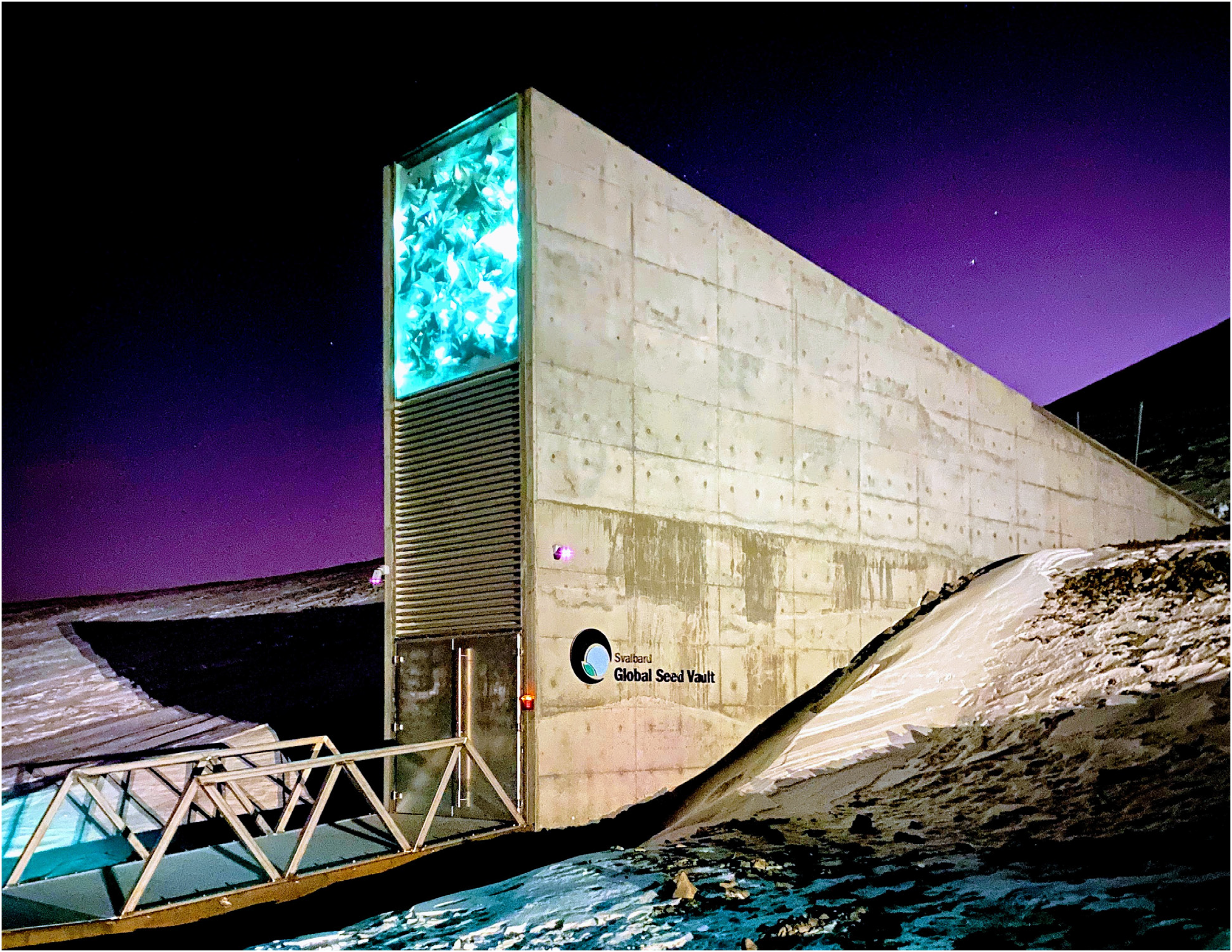
“Entrance to the seed vault (cropped)” by Subiet under license CC-By-SA 4.0.
Acknowledgements
I would like to thank the three anonymous reviewers for their insightful comments and suggestions, which strengthened the article significantly. I would also like to thank Joanne Yao, Oliver Belcher, and numerous other colleagues in the School of Government and International Affairs, Durham University for reading and engaging with earlier draft versions.
Footnotes
Declaration of conflicting interests
The author(s) declared no potential conflicts of interest with respect to the research, authorship and/or publication of this article.
Funding
The author(s) received no financial support for the research, authorship and/or publication of this article
