




Abstract
The intensifying coupling of urban heat island effect and urban pollution island effect, driven by anthropogenic heat and pollutant emissions, poses significant environmental challenges. As a nature-based solution, green spaces (GS) are widely recognized for their air purification and cooling effects, offering an effective strategy to mitigate urban heat and air pollution risks. While various methods have been developed to quantify these effects, most studies rely on a single approach, lacking comprehensive comparisons and systematic evaluations. This limitation hinders the scientific selection and optimized application of different methods in practice. Therefore, we systematically reviewed the key mechanisms underlying GS cooling and air purification effects, along with their quantification methods, applicability, and limitations. Moreover, existing reviews often focus on GS cooling and air purification effects in isolation, overlooking their intrinsic connections. Whether these effects are synergistic or involve trade-offs remains unclear, limiting a comprehensive understanding of GS ecological benefits. To address this research gap, we investigated that GS could enhance air purification through cooling and strengthen cooling through air purification. Additionally, we identified six indirect interaction pathways between these two effects, underscoring the need for integrated research. Future studies should adopt multiple approaches to analyze the direct effects of GS cooling and air purification from long-term as well as multi-scale perspectives. It should also validate their interactive mechanisms, identify key indirect pathways, and conduct objective and comprehensive evaluation of GS enhancing strategies. By deepening the understanding of the interactions between GS, temperature, and air pollutants, this review highlights the potential synergistic benefits of GS in urban cooling and air purification.
Introduction
Urbanization, the most significant manifestation of human-induced land transformation, serves as a key driver of local and regional climate change (Chakraborty and Qian, 2024). The replacement of vegetation with impervious surfaces and increased emissions from transportation and industry have led to rising urban temperatures and worsening air pollution (Ulpiani, 2021; Wu et al., 2024). This has intensified both the urban heat island (UHI) effect and the urban pollution island (UPI) effect, posing major challenges to urban sustainability (Li et al., 2024a). The UHI effect refers to higher temperatures in urban areas compared to surrounding rural areas (Yu et al., 2021), while the UPI effect denotes elevated air pollution levels in urban areas (Yao et al., 2022). Increasing air pollution and urban heat can degrade living environments (Yao et al., 2025), increase energy costs (Wang et al., 2023), and threaten public health (Yang et al., 2024). To mitigate heat-pollution risks, global governments have implemented carbon and pollutant reduction policies to curb environmental deterioration (Papanastasiou et al., 2015). Meanwhile, nature-based solutions (NbS), particularly enhancing green space (GS), have gained increasing recognition for their ecological benefits in regulating and mitigating urban environmental stressors, emerging as a crucial strategy for enhancing urban resilience and sustainability (Jay et al., 2021).
The United States Environmental Protection Agency defines green space as vegetated land, including parks, forests, urban greenery, and other natural or artificially planted green areas. These spaces play a crucial role in improving air quality, regulating climate, mitigating the UHI effect, and promoting residents’ physical and mental well-being (Lai et al., 2024; Yu et al., 2025a). Cooling and air purification effects of GS have garnered widespread attention, with scholars proposing various quantitative approaches to assessing their ecological benefits from different perspectives (Han et al., 2025; Peng et al., 2024; Wang et al., 2024). However, despite the increasing diversity of research methodologies, the applicability, advantages, and limitations of different quantitative methods have yet to be systematically reviewed. This research gap hinders the comprehensive comparison of research findings and their practical application. Although prior reviews have categorized methods for assessing GS cooling—namely field observations, remote sensing, and statistical modeling—these efforts remain primarily descriptive and lack critical comparison of their respective strengths, limitations, and applicability (Galalizadeh et al., 2024). In contrast, reviews on the air purification effect of GS have focused largely on underlying mechanisms, processes, and health outcomes, offering limited evaluation of quantitative methodologies (Diener and Mudu, 2021; Qiu et al., 2021). Addressing these research gaps, this review provides a systematic methodological synthesis of current approaches, highlighting their theoretical foundations, applicability, and limitations, which could provide methodological guidance for future research and offer a scientific basis for optimizing GS distribution and maximizing associated ecological benefits in practice.
Furthermore, although the cooling and air purification effects of GS have been extensively studied, most existing reviews examined these effects in isolation (Diener and Mudu, 2021; Li et al., 2025; Qiu et al., 2021), overlooking their complex interconnections. In reality, temperature plays a critical role in air pollutant emissions, transformation, transport, and deposition processes (Qin et al., 2025; Yu et al., 2025b), with high temperatures often exacerbating air pollution (Chen et al., 2024). Besides, air pollutants influence energy balance processes through radiative forcing, thereby exerting feedback effects on temperature (Cao et al., 2016; IPCC, 2023). This suggests that GS not only directly improve air quality and lower environmental temperature, but may also facilitate a bidirectional enhancement of cooling and air purification through the “GS–temperature–pollutant” linkage mechanism, ultimately amplifying their ecological benefits. While some reviews have discussed the linkage between UHI (temperature) and UPI (air pollution), few have further examined these interactions with green spaces, which is more aligned with the goal of improving human well-being (Ulpiani, 2021). Moreover, although existing reviews have explored the co-mitigation potential of GS on UHI and UPI effects, their focus remains on evaluating the cooling and air purification effects of different vegetation types, rather than identifying interactive mechanisms between the two effects (Wu et al., 2024). The potential interactive mechanisms between the cooling and air purification effects of GS remain underexplored. To address this research gap, this review rethinks how cooling and air purification interact—showing how each can shape the other’s mechanisms and outcomes—thus providing a more coherent framework for understanding the synergy of both effects.
Therefore, from a theoretical perspective, limited insight into how GS cooling and air purification interact leads to uncertainty in modeling their co-regulatory dynamics in Earth system models. From a practical perspective, the lack of comparative evaluation across methods constrains scientific planning for maximizing GS ecological benefits. By integrating mechanistic insights with methodological synthesis, this review can not only offer a coherent framework for understanding the synergistic functions of GS, but also lay a foundation for advancing ecological theory and informing more targeted and effective urban planning interventions. In summary, this review aimed: (1) to systematically synthesize the mechanisms and quantitative methods used to evaluate the cooling and air purification effects of GS, (2) to compare the applicability and limitations of each approach, and (3) to elucidate the interactive linkages between cooling and air purification.
Cooling effect of GS
Cooling mechanisms
The climatic effects of GS have been widely studied, with different cooling mechanisms emphasized at various spatial scales. At the global scale, forests sequester carbon through photosynthesis by absorbing CO2, thereby mitigating the greenhouse effect. Consequently, afforestation has been proposed as a globally effective strategy for alleviating climate warming (Cai et al., 2021; Chen et al., 2019a). Beyond this biogeochemical effect of carbon sequestration, the biogeophysical processes of GS play a more pronounced role in regulating local climates at regional and urban scales (Ge et al., 2023). At the regional scale, forests influence surface energy balance through competing mechanisms. On the one hand, compared to bare soil and open land, forests generally exhibit lower albedo, leading to greater absorption of solar radiation and regional warming (Weber et al., 2024). On the other hand, forests enhance cooling by converting sensible heat into latent heat through evapotranspiration, thereby lowering near-surface temperatures (Li et al., 2024b). The net climatic effect of forests thus depends on the balance between these two opposing processes—evapotranspirative cooling and albedo-induced warming (Bonan, 2008). This balance is significantly modulated by climatic factors such as solar radiation and precipitation. Specifically, in tropical low-latitude regions, abundant solar radiation and precipitation throughout the year drive strong evapotranspirative cooling, effectively counteracting albedo-induced warming, and resulting in a year-round cooling effect of tropical forests. In contrast, in temperate and boreal regions, sufficient energy and precipitation are available primarily in summer, enabling seasonal cooling effects. However, during other seasons, the dominance of albedo-induced warming leads to seasonal warming effects. Therefore, there are forests cooling in summer but warming in winter (Li et al., 2015).
At the urban scale, the cooling effect of GS primarily operates through two mechanisms: shading and evapotranspiration (Figure 1) (Yu et al., 2025a). Urban GS, particularly trees, regulate the local microclimate and enhance thermal comfort by reducing incoming shortwave radiation through shading and absorbing ambient heat via evapotranspiration (Alkama and Cescatti, 2016; Windisch et al., 2021). Background climate serves as a critical role influencing the cooling effectiveness of GS at the urban scale (Peng et al., 2021). The cooling capacity of urban trees exhibits a nonlinear response to increasing temperature and decreasing humidity, following a pattern of initial enhancement followed by suppression. As air temperature rises and humidity declines, the vapor pressure deficit between plant stomata and the surrounding atmosphere increases (Cheng et al., 2022; Wang et al., 2019a), thereby enhancing vegetation cooling efficiency. Consequently, urban trees demonstrate stronger cooling effects during heatwaves (Schwaab et al., 2021), and cities in arid climates often experience higher cooling efficiency from urban vegetation (Cheng et al., 2022). However, under prolonged extreme heat and drought conditions, once environmental stress exceeds the physiological threshold of vegetation, plants close their stomata to minimize excessive water loss (Xu et al., 2025). This physiological response reduces evapotranspiration efficiency, leading to a decline in cooling capacity.
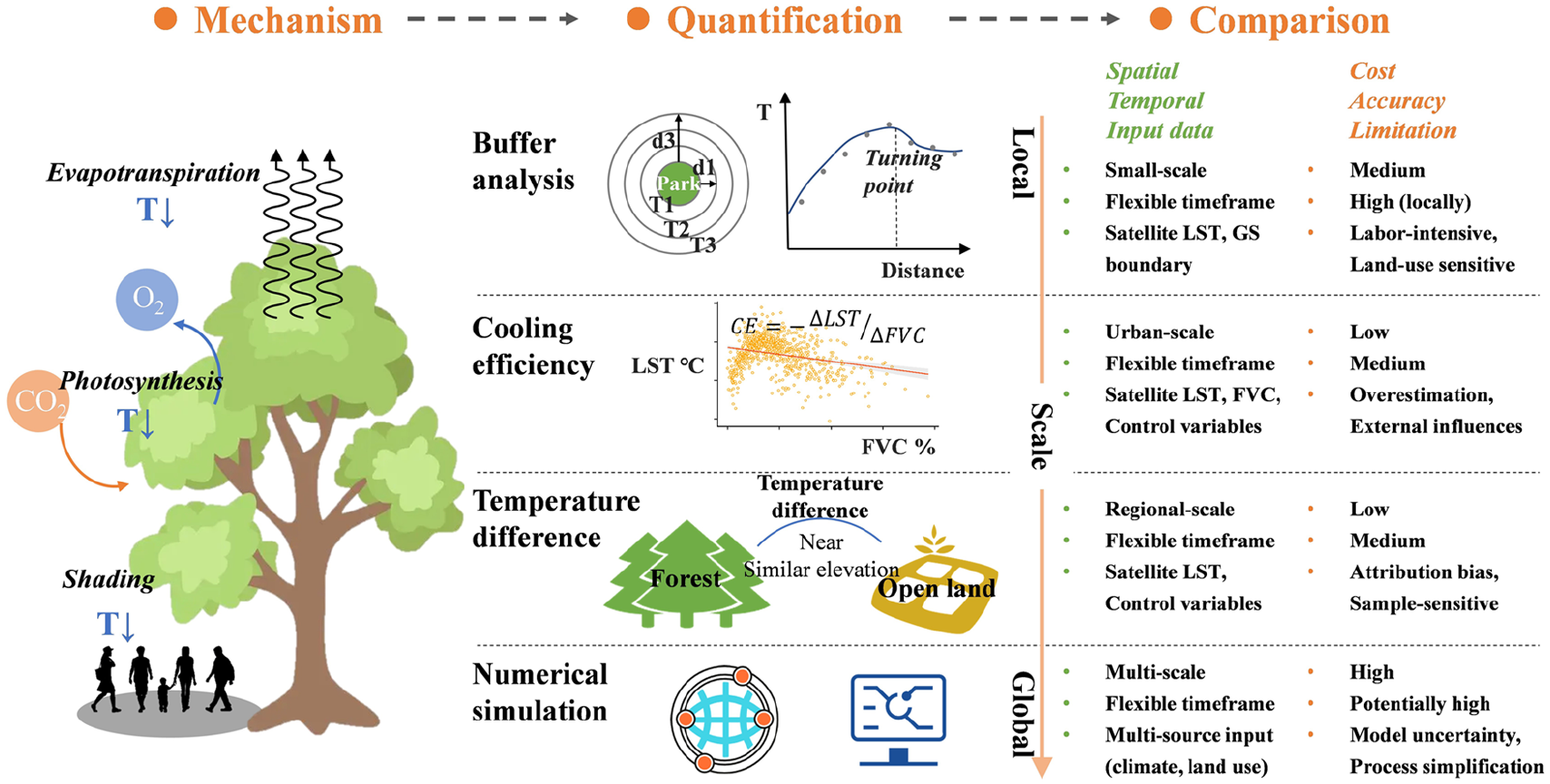
Cooling mechanisms of green spaces, methods for quantifying their cooling effect, and comparison of these methods.
Quantification of the cooling effect
Research objectives, spatial scale, and cost are key factors influencing the selection of appropriate methods for quantifying the cooling effect of GS. As the scope of investigation extends from local parks to urban, regional, and global levels, and the goals range from quantifying cooling effect to understanding mechanisms and supporting planning decisions, existing approaches can be generally classified into four categories: buffer analysis, cooling efficiency assessment, temperature difference-based quantification, and numerical simulation. Generally speaking, these methods differ in cost. Buffer analysis is moderately costly due to time-consuming spatial computations but less demanding than numerical simulation, which requires high-performance computing. The other two methods primarily rely on statistics of remote sensing data, leading to relatively low-cost.
Buffer analysis
GS not only lower land surface temperatures (LST) within their boundaries but also facilitate cooling in surrounding areas through heat exchange, thereby alleviating the UHI effect. Assessment of GS impacts on surrounding environmental temperatures is often conducted using remote sensing observations combined with multiple buffer zone analyses. This approach constructs temperature-distance curves based on temperature sequences at varying distances from the GS center or boundary. Typically, nonlinear relationships between temperature and distance are fitted using exponential or polynomial functions (Peng et al., 2024; Tan et al., 2021). In general, the cooling effect decreases with increasing distance from the GS, while ambient temperatures increase accordingly. Beyond a certain distance, the temperature stabilizes or even begins to decline. This distance threshold is defined as the turning point where ambient temperature stops increasing or where the slope of temperature-distance curve approaches zero—indicating the disappearance of the cooling effect (Peng et al., 2024). Based on this turning point, several quantitative metrics have been established to characterize the cooling effect of GS, including cooling distance (the distance from the GS boundary to the turning point), cooling range (the buffer zone between the GS boundary and the turning point), cooling intensity (the temperature difference between the turning point and the GS’s average or boundary temperature), and cooling gradient (the ratio of cooling intensity to cooling distance) (Chang and Li, 2014; Feyisa et al., 2014). Additionally, cumulative indices such as park cumulative cooling intensity and cooling gradient index provide a broader perspective on cooling effects (Peng et al., 2021). While this method effectively captures the influence of GS on surrounding temperatures, identifying turning points is time-consuming and labor-intensive, making it more suitable for small-scale studies such as urban parks and roadside greenbelts. Moreover, the quantified cooling effect is strongly influenced by surrounding land use types. A higher proportion of ecological land around the GS generally results in lower cooling intensity and gradient, whereas a higher proportion of built-up land leads to higher values (Cheng et al., 2015; Peng et al., 2024). Consequently, this approach may not always accurately reflect the intrinsic cooling capacity of GS.
Cooling efficiency assessment
The buffer zone method provides a detailed representation of the cooling effect of individual urban green spaces on their surroundings. However, it is insufficient for assessing the cooling effect of all green spaces at the city scale. Specifically, it does not address the key question of how much the citywide average temperature would decrease with a given increase in urban GS coverage. This limitation hinders its applicability in providing scientific support for urban GS planning. To quantify the impact of GS expansion on regional temperature reduction, the concept of cooling efficiency (CE) has been proposed. CE is defined as the negative ratio of air temperature or LST change to the fractional vegetation cover (FVC) change (-ΔLST/ΔFVC), representing the extent to which urban temperature decreases per 1% increase in vegetation coverage (Li et al., 2024c; Wang et al., 2019a, 2019b, 2024). However, this approach attributes all urban temperature variations solely to changes in FVC, neglecting other critical factors contributing to temperature heterogeneity. This may lead to an overestimation or underestimation of the CE (Cheng et al., 2022). To address this limitation, subsequent studies have developed multiple linear regression models with LST as the dependent variable and FVC, elevation, and nighttime light intensity as independent variables (Cheng et al., 2022, Yu et al., 2025a). The negative regression coefficient of FVC is then regarded as the adjusted cooling efficiency. By incorporating key factors affecting LST, such as topography and anthropogenic influences, these models have revealed that earlier estimates of CE tend to be overestimated (Yang et al., 2022). It is further indicated that CE is significantly influenced by both vegetation coverage levels and background climatic conditions (Cheng et al., 2022; Wang et al., 2019b, 2024). Consequently, CEs are only comparable when calculated under similar vegetation cover conditions and comparable background temperatures (Zhao et al., 2023).
Temperature difference-based quantification
GS’s cooling effect can be quantified by the average temperature difference between GS and other land use types. This method is relatively simple and easy to implement, making it suitable for large-scale analyses. For global-scale analysis, controlling for interference factors such as distance between the target and control groups, climatic background, and elevation is essential. A commonly used approach is the moving window analysis, which assumes that the climatic background is similar between target and control pixels. To further ensure comparability, control pixels are typically selected to have an elevation difference of less than 100 m from the target pixels (Li et al., 2015, 2023). Under these conditions, the observed temperature difference between target and control pixels can be attributed to the GS’s cooling effect. This method is particularly valuable for analyzing temperature effects associated with vegetation greening, degradation trends, and afforestation projects, where temporal trends are involved. It is also referred to as the “space-for-time” approach (Li et al., 2023; Peng et al., 2014; Zhu et al., 2023). Traditional time-series analyses struggle to distinguish the unidirectional impact of vegetation changes on local climate from satellite-derived vegetation indices and temperature observations due to their co-evolution (Gao et al., 2021; Li et al., 2018). In contrast, the space-for-time method enhances the ability to isolate the climatic effects of vegetation changes by controlling for spatial similarities between target and control pixels, thereby reducing the influence of complex factors such as climate variability (Li et al., 2023). At the urban scale, the temperature difference method is also widely used to assess the cooling effect of urban GS. For instance, comparative studies have demonstrated that GS exhibits significantly lower temperatures than built-up areas. Further analysis revealed that GS without trees were less effective in reducing LST, with their cooling effects being approximately two to four times weaker than those induced by urban trees (Schwaab et al., 2021). Despite efforts to minimize spatial heterogeneity between control and target groups, microclimatic factors such as slope, aspect, and urban-scale parameters like building density remain challenging to fully control. These factors can introduce biases in the assessment of cooling effect.
Numerical simulation
Advancements in observational accuracy, the accumulation of multi-source datasets, and improvements in computational technology have made it possible to simulate interactions among the atmosphere, ocean, and land surface using numerical methods. These developments have driven the evolution of comprehensive mathematical models, particularly Earth system models (ESMs) (Pan et al., 2024). In evaluating the cooling effect of forests through numerical simulations, the first step is to select an appropriate ESM and input multi-source datasets, including land use data, climate data, and forest characteristics. Various experimental scenarios, such as forest expansion or degradation, are then defined, and the model is run to simulate the impact of forest changes on temperature, thereby revealing the cooling potential of forests (Zhang et al., 2024). Due to computational constraints, global-scale numerical simulations are conducted at coarse resolutions. For urban-scale applications, high-resolution microclimate models, such as ENVI-met (Wu et al., 2025) and Computational Fluid Dynamics (CFD) (Ahn et al., 2024), have been developed. These models focus on interactions among urban elements such as GS, buildings, and roads, allowing for a detailed simulation of thermal processes at the city level. The flexibility of numerical simulation offers significant advantages in assessing the cooling effect of GS. By configuring different scenario parameters—such as GS area, spatial distribution, and vegetation types—researchers can systematically investigate the contribution of various influencing factors to cooling potential. This makes numerical simulation a valuable tool in urban planning, providing scientific evidence for decision-makers to optimize the spatial layout of GS to maximize cooling benefits. However, numerical simulations still have inherent limitations. Simplifications in the underlying physical processes, shortcomings in parameterization schemes, and uncertainties in input datasets may lead to biases in the simulation of vegetation-related surface energy distribution (Duveiller et al., 2018; Forzieri et al., 2020), affecting the accuracy of model outputs.
Air purification effect of GS
Air purification mechanisms
According to the World Health Organization, more than 90% of the global population resides in areas where air pollution levels exceed recommended thresholds. As natural self-purifying ecosystems within urban environments, GS not only provide relatively clean recreational areas for residents exposed to high pollution levels but also contribute to air quality improvement by mitigating particulate matter pollution in the surrounding environment (Liu and Russo, 2021). GS primarily alleviate air pollution through two mechanisms: physical deposition and chemical absorption (Figure 2).
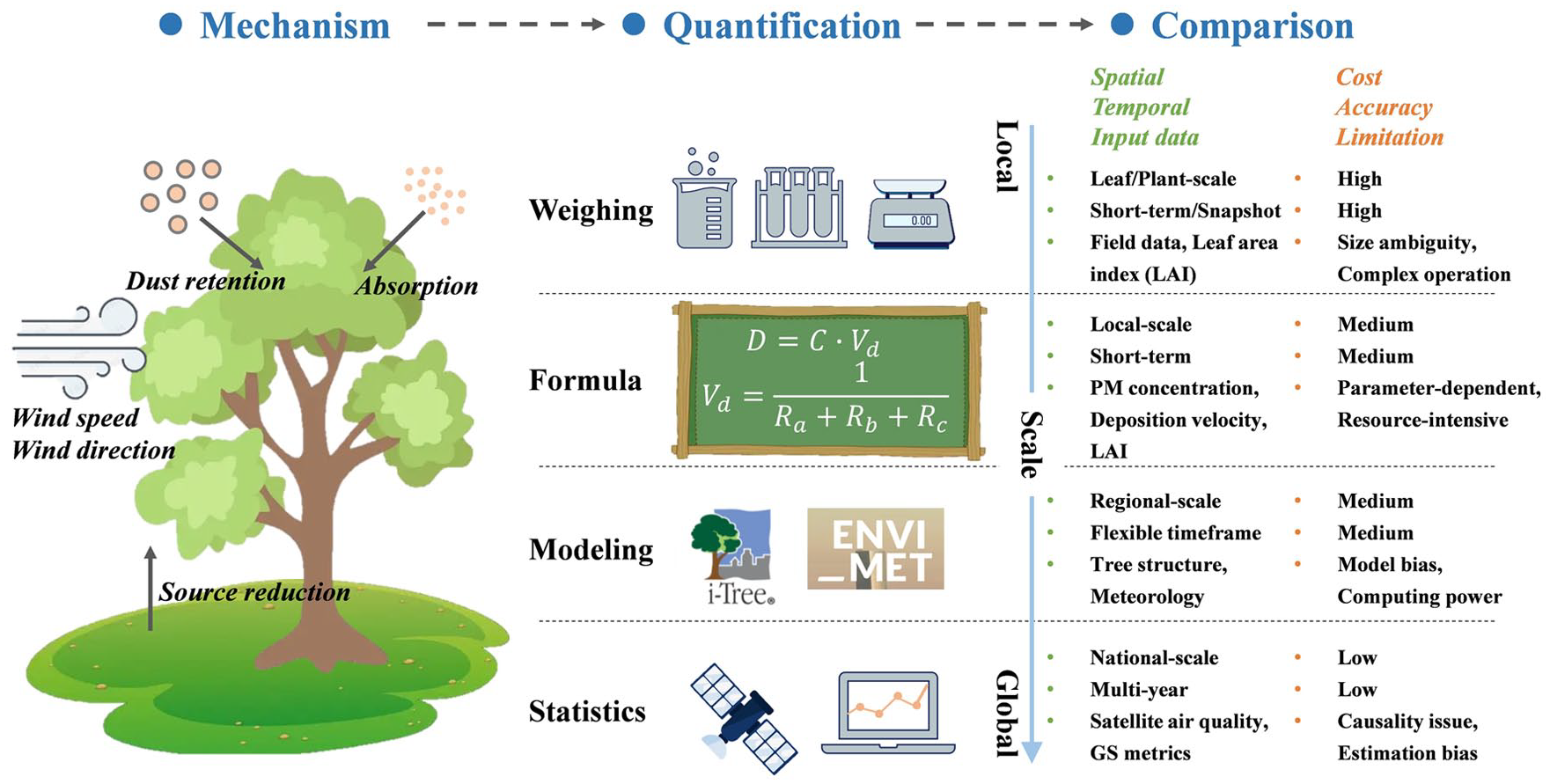
Air purification mechanisms of green spaces, methods for quantifying their air purification effect, and comparison of these methods.
For physical deposition, the air purification mechanisms of GS are manifested in three main aspects. Firstly, trees can alter wind speed and direction by obstructing airflow, thereby affecting the distance, direction, and quantity of pollutant dispersion. This effect is particularly pronounced for larger particulate matter (e.g., PM10). On the one hand, this obstruction can hinder the dilution and dispersion of pollutants, leading to elevated concentrations near emission sources (Venter et al., 2024; Vos et al., 2012). On the other hand, it can reduce the risk of air pollution in the surrounding areas by limiting the spread of pollutants. Secondly, the complex microstructure of plant leaves enhances their ability to capture and retain particulate matter through mechanisms such as impaction, adhesion, and deposition. This process, known as dry deposition, is further augmented by plant growth, which increases leaf area and promotes the replacement of older foliage with new leaves, thereby reinforcing the dust retention capacity (Yin et al., 2019). Thirdly, vegetative cover can indirectly reduce ambient particulate concentrations by minimizing dust resuspension from surfaces and reducing sources of particulate matter (Chen et al., 2019b). For chemical absorption, vegetation engages in gas exchange through stomata, directly absorbing gaseous pollutants from the atmosphere (Yang et al., 2023). However, it is important to note that vegetation can also emit volatile organic compounds (VOCs), which can contribute to the formation of secondary aerosols and ozone, potentially exerting a negative impact on air quality (Pfannerstill et al., 2024).
Quantification of the air purification effect
Quantification methods for the air purification effect of GS are classified based on differences in technical approaches and spatial scales. As the scope of research expands from localized direct measurements to formula-based assessment at the urban scale, process-based modeling at regional scale, and further to statistical analyses at the global scale, existing methods can be broadly categorized into four types: weighing, formula-based, modeling, and statistical methods.
Weighing method
Weighing method is the most direct and technically mature approach for quantifying dust retention by vegetation. This method involves a series of complex procedures, including sampling, washing, filtration, drying, and weighing, to determine the amount of particulate matter retained per unit leaf area. By extrapolating from the total leaf area of individual plants or entire plant communities, the total dust retention capacity can be estimated (Chaudhary and Rathore, 2018; Zha et al., 2018). However, this method has limitations in determining the size distribution of retained particulates (e.g., PM10, PM2.5, and PM1). Although sieving techniques or re-suspending particles for graded monitoring can be used to differentiate particle sizes, these approaches cannot fully guarantee that the original composition of dust particles remains unchanged or that their accumulation state on plant surfaces is accurately preserved (Wang and Wang, 2014).
Formula-based method
The dry deposition formula estimates the dust retention capacity of vegetation by incorporating pollutant concentration, dry deposition velocity, leaf area, and resuspension rate into an empirical equation. Among these parameters, dry deposition velocity is the most critical indicator for assessing the ability of vegetation to capture particulate matter. This velocity can be derived through wind tunnel experiments (Wu et al., 2021), artificial smoke chambers (Zhang et al., 2021), or mathematical simulations (Feng et al., 2022) under natural wind conditions, as well as through field observations. In general, larger and heavier particles exhibit higher dry deposition velocities, leading to more effective removal of these pollutants by vegetation (Zhang et al., 2020). The dry deposition formula primarily characterizes the deposition process of airborne particles on individual leaf surfaces as airflows pass through vegetation. However, obtaining more precise results at larger spatial scales requires extensive field observations and sophisticated experimental setups, which often entail significant time and financial costs.
Modeling method
The modeling method enables the assessment of vegetation’s capacity to capture particulate matter on larger spatial scales. The model serves as a simplification of real-world systems, integrating field observations with laboratory measurements to thoroughly analyze the mechanisms of vegetation-driven dust deposition. By incorporating extensive experimental data and empirical parameters, modeling provides a theoretical framework and data-driven support for large-scale assessments. The most representative and widely used models are iTree (Pace et al., 2021) and ENVI-met (Deng et al., 2019). These models require the input of site-specific and meteorological data for the study area. Site-specific data include tree species, diameter at breast height, tree height, canopy size, and health status, while meteorological data encompass precipitation, wind speed, and other climatic factors. By integrating all relevant data, these models can estimate and report the amount of particulate matter removed by trees. However, the modeling method shares similar limitations with the numerical simulation approach previously discussed for quantifying cooling effect, including process simplifications, model biases, and high computational demands.
Statistical method
With advancements in remote sensing and other geospatial technologies, macro-scale studies on the role of GS in reducing air pollution have gained increasing attention. Remote sensing data are used to track air quality and its temporal and spatial variations. This information, when combined with statistical methods such as correlation analysis, regression analysis, and machine learning, allows for an indirect assessment of the impact of GS on air quality improvement (Chen et al., 2019b; Venter et al., 2024). For example, a linear mixed model was used to evaluate the impact of GS on PM10 and PM2.5 concentrations in Zhengzhou across different spatial scales (Lei et al., 2021), which revealed that while GS did not significantly influence PM2.5 concentration, they significantly reduced PM10 concentration at nearly all scales. Additionally, increasing the contact area between GS patches and surrounding urban areas could further reduce PM10 concentration. Furthermore, statistical analysis of five major cities indicated an inverse proportional relationship between PM2.5 concentration and GS coverage (Chen et al., 2019b). Neighborhood-scale analysis also showed that the relationship between tree cover and PM10 concentrations was nonlinear. As tree cover increased, PM10 concentration decreased, but the rate of reduction slowed down, displaying a diminishing marginal effect (Yang et al., 2023).
The weighing method, formula-based method, and modeling method are essentially methods for quantifying the dust retention capacity of vegetation. Among these methods, the estimation accuracy decreases from high to low, the economic and time costs decrease from high to low, and their applicability spans from small to large spatial scales. All three methods rely on field measurements, which yield relatively accurate results. However, they are challenging to apply for continuous analysis over long time series and large spatial extents. Furthermore, these methods primarily focus on quantifying the dust retention capacity of vegetation and do not sufficiently address other GS air purification mechanisms, such as chemical absorption or the reduction of particulate matter sources. In contrast, statistical methods, by utilizing remote sensing data—characterized by large-scale coverage, long temporal durations, and high frequency—enable continuous quantification of the impact of GS on air quality over extensive areas. This method can also identify the combined effect of all purification pathways in GS on air pollutant concentrations, not just the dust retention ability of vegetation. However, statistical methods also have certain limitations. Attribution methods based on correlations face challenges in establishing causal relationships between GS and air quality improvement. They are susceptible to interference from factors such as meteorological conditions and changes in pollution sources, which may lead to biased results.
Potential interactions between GS cooling and air purification effects
Numerous studies have confirmed the cooling and air purification effects of GS. However, GS ecological benefits likely extend beyond these individual effects. Although cooling and air purification are often analyzed separately, they are not independent processes. Instead, these effects occur simultaneously and interact in complex ways. Based on a review of the literature, this study identified potential interactive mechanisms between cooling and air purification. Specifically, GS can amplify their cooling effect through air purification, and conversely, GS can enhance their air purification effect through cooling. These interactions involve six indirect pathways (Figure 3), suggesting that NbS may offer greater ecological benefits in addressing the coupled risks of high temperature and high air pollution than currently recognized.
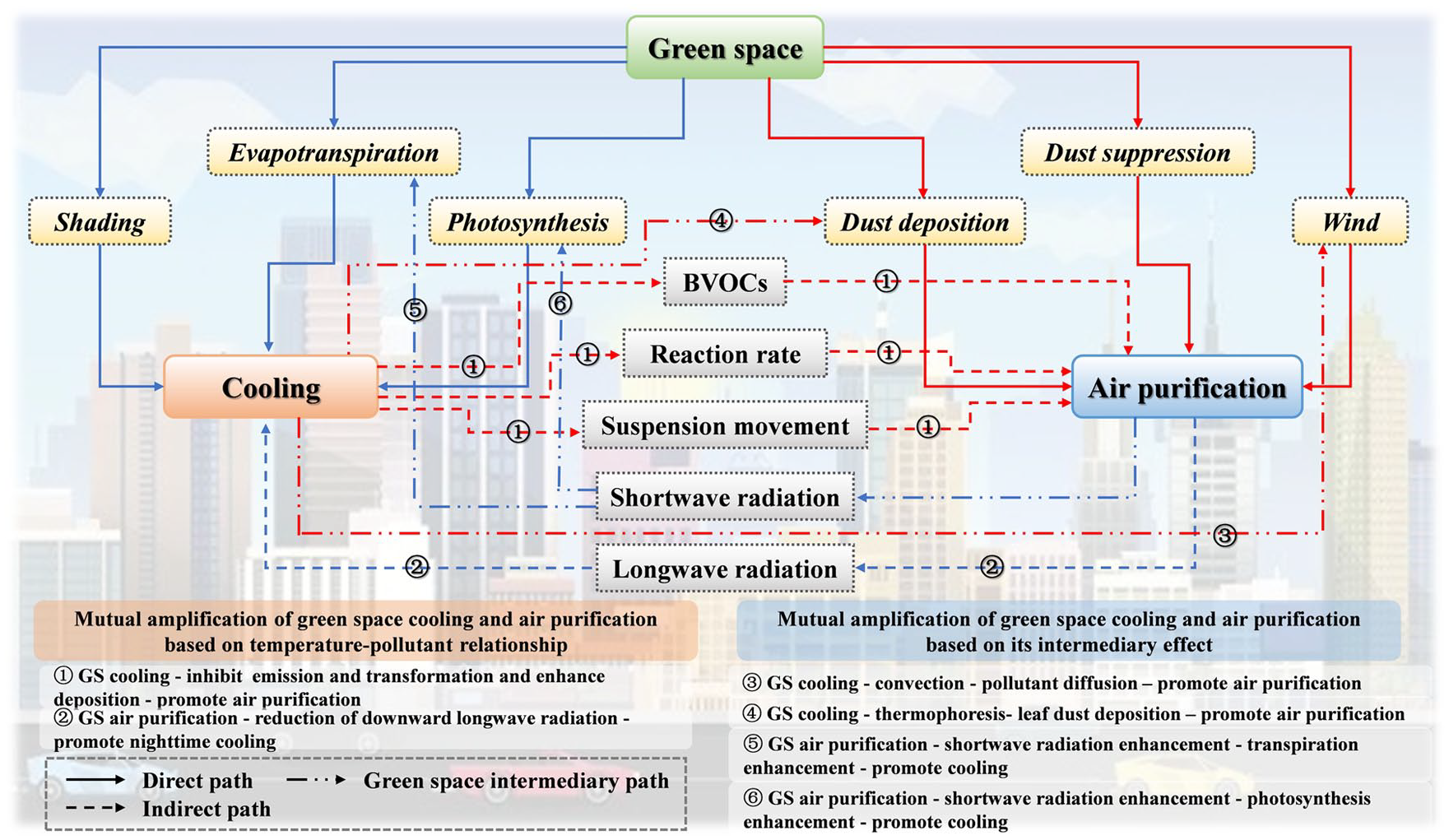
Interactive mechanisms between cooling and air purification effects of green space.
Interaction based on temperature-pollutant relationship
GS cooling reducing emission, transformation, and enhancing deposition
Temperature plays a critical role in the emission, transformation, transport, and deposition of air pollutants (Yu et al., 2025b). High temperatures often exacerbate air pollution (Chen et al., 2024), suggesting that GS cooling can contribute to air purification. This process primarily operates through three key pathways: (1) Emission reduction pathway. Lower temperatures help reduce pollutant emissions. Cooler environments decrease energy demand for air conditioning, thereby reducing anthropogenic emissions (Chen et al., 2024; Qin et al., 2025). Additionally, lower temperatures suppress the release of biogenic VOCs, which are precursors of ozone and secondary aerosols (Wu et al., 2019; Xu et al., 2023). (2) Transformation suppression pathway. Reduced temperatures slow down photochemical reactions, thereby inhibiting the formation of secondary aerosols and ozone, ultimately leading to lower pollutant concentrations (Lei et al., 2022). (3) Deposition enhancement pathway. Lower temperatures slow the movement of suspended particles, increasing their likelihood of deposition and reducing airborne pollutant concentrations (Yang et al., 2023). Thus, by lowering ambient temperatures, GS indirectly contribute to air purification by reducing pollutant emissions, suppressing their transformation, and enhancing their deposition. This process can be summarized as the “GS cooling - inhibit emission and transformation and enhance deposition - promote air purification” pathway.
Particularly in cases where the direct air pollution mitigation effects of GS remain limited (Pfannerstill et al., 2024; Venter et al., 2024), their indirect effects in improving air quality through cooling may be more significant. During summer, biogenic VOC emissions contribute up to 70% of secondary organic aerosol formation in China, far exceeding anthropogenic sources (Wu et al., 2019). As a major source of biogenic VOCs, GS exacerbate ozone and aerosol pollution to some extent (Kelly et al., 2018). Moreover, pollutant concentrations are largely influenced by dispersion conditions (Yu et al., 2022). Tall urban trees can obstruct ventilation, hinder pollutant dispersion, and thus exacerbate localized air pollution levels. A study in Shanxi has demonstrated that, compared to direct air purification mechanisms—such as dust capture and source reduction—GS are more effective in mitigating air pollution through their cooling effect, with this indirect pathway accounting for as much as 61.45% of the total air purification effect (Yu et al., 2025b).
GS air purification reducing downward longwave radiation
The decrease in pollutant concentrations caused by GS air purification alters longwave radiative forcing, thereby affecting the surface energy balance and ultimately influencing temperature. In general, a higher concentration of particulate matter enhances downward longwave radiation. Under heavy pollution conditions, this leads to increased longwave radiation reaching the urban surface, resulting in warming. This effect is particularly pronounced at night, as the absence of solar shortwave radiation eliminates counteracting influences, leading to a more significant warming effect induced by longwave radiation. A study conducted across 36 cities in China identified the biogeochemical effects of urban aerosols and haze pollution as key contributors to the nighttime UHI effect (Cao et al., 2016). In semi-arid cities, the UPI effect has been found to contribute up to 0.7 ± 0.3 K to nighttime warming, primarily due to the strong longwave radiative forcing of coarse aerosols, which increased downward longwave radiation and intensified nighttime heat retention (Cao et al., 2016). By reducing particulate matter concentrations through air purification, GS can reduce downward longwave radiation at night, leading to a cooling effect that indirectly enhances their overall temperature-regulating capacity. This process can be summarized as the pathway of GS air purification - reduction of downward longwave radiation - promote nighttime cooling.
Interaction mediated by green spaces
The synergy between the cooling and air purification effects of GS is not solely dependent on the interaction between temperature and air pollutants. GS also serves as a mediating factor, regulating the interplay between cooling and air purification mechanisms. That is, the cooling and air purification processes within green spaces are interrelated and mutually influential.
Cooling-enhanced vegetation-induced diffusion and deposition
Unfavorable atmospheric diffusion conditions are a key factor contributing to air pollutant accumulation, leading to regional-scale severe air pollution episodes. Enhancing the rapid and effective diffusion of near-surface urban air pollutants is crucial for mitigating the adverse health effects of air pollution (Yang et al., 2019). Previous studies investigating the impact of GS on urban air pollutant dispersion have primarily focused on large-scale effects, emphasizing how increased surface roughness from vegetation hinders ventilation and exacerbates air pollution (Tsoka et al., 2020). However, at the local or community scale, GS contribute to cooling, lowering the ambient temperature and creating temperature gradients between green and non-green areas. This thermal contrast can enhance airflows, promoting pollutant diffusion and dilution. Based on this mechanism, there is a potential pathway of “GS cooling - convection - pollutant diffusion - promote air purification”.
GS can also promote dust deposition by lowering leaf surface temperatures through transpiration, thereby creating favorable conditions for atmospheric pollutant deposition. According to the kinetic theory of gases, particulate matter tends to migrate from high-temperature regions to low-temperature regions in the presence of a temperature gradient. This phenomenon, known as the thermophoretic effect, arises from differences in molecular kinetic energy and particle collisions caused by temperature variations. Notably, the thermophoretic effect is also a fundamental principle in the design of air purification devices (Yang et al., 2023). Compared to other land cover types, vegetation with lower leaf surface temperatures significantly enhances pollutant deposition efficiency. Additionally, green spaces, with large leaf area, provide extensive surface area for pollutant capture. The continuous renewal of plant leaves further sustains long-term deposition capacity, making the dust-retention capacity of vegetated areas substantially higher than that of other land surfaces. This means that enhancement of deposition efficiency becomes even more critical given the extensive deposition surface provided by vegetation. Specifically, GS can reduce leaf temperatures, accelerate dust deposition through thermophoretic movement, and enhance dust-retention efficiency, forming a cascading pathway of “GS cooling - thermophoresis - leaf dust deposition - promote air purification”.
During extreme heat events, GS exhibit a stronger cooling effect (Schwaab et al., 2021). Moreover, evidence suggests that the ability of vegetation to alleviate high temperatures plays a particularly important role in reducing PM10 levels under extreme heat conditions. Specifically, the indirect cooling effect of GS was found to reduce PM10 concentrations by 27.11% under average summer conditions and by 39.76% during extreme heat events (Yang et al., 2023). These findings indicate that as the cooling effect of GS intensifies, their air purification capacity is also enhanced, providing further evidence for the effectiveness of vegetation cooling-mediated indirect pollutant removal.
Air purification-enhanced vegetation transpiration and photosynthesis
GS improve air quality by reducing atmospheric pollutant concentrations, thereby decreasing the scattering, reflection, and absorption of solar shortwave radiation by pollutants. As a result, more solar radiation is available for direct absorption by vegetation, which in turn enhances physiological processes, increases transpiration efficiency, and strengthens photosynthetic activity. This amplification of vegetation function contributes to greater evaporative cooling and carbon sequestration. Based on this mechanism, two synergistic pathways can be identified, i.e. the pathway of “GS air purification - shortwave radiation enhancement - transpiration enhancement - promote cooling”, and the pathway of “GS air purification - shortwave radiation enhancement - photosynthesis enhancement - promote cooling”.
On heavily polluted days in major industrial cities, the amount of direct solar radiation reaching the land surface can be reduced by nearly 40% compared to unpolluted conditions. Haze alters both light intensity and quality, significantly suppressing vegetation transpiration and photosynthetic efficiency, thereby affecting plant growth and the ecological benefits of GS. Studies have shown that if strict air pollution control measures were implemented to reduce anthropogenic emissions to pre-industrial levels, forests could experience an additional cooling effect of up to 0.4°C due to increased solar radiation availability (Ge et al., 2023). This finding confirms the positive impact of low-pollution environments on vegetation-induced cooling through transpiration. Similarly, regarding photosynthesis, during weekends when industrial emissions and traffic activities are reduced, lower atmospheric particulate matter concentrations improve light conditions. As a result, 64% of observed regions in Europe exhibited a significant increase in chlorophyll fluorescence—a natural signal of plant photosynthesis (He et al., 2023). This further substantiates the role of cleaner air in enhancing vegetation photosynthetic activity. These findings collectively demonstrate that the air purification of GS can indirectly enhance transpiration and photosynthesis, thereby amplifying their cooling effect.
Future directions on the cooling and air purification effects of GS
Current research primarily focuses on the direct mechanisms underlying the cooling and air purification effects of GS. While various quantitative approaches have been established across different spatial scales, differences in methodologies and scale hinder systematic comparisons of findings (Zhou et al., 2025). Furthermore, the interactions between the cooling and air purification effects of GS, as well as their indirect impact pathways, remain in the early stages of exploration, with key mechanisms yet to be fully validated. Additionally, GS regulates urban climates through complex direct and indirect pathways, but their overall effectiveness and net ecological benefits remain unclear. To address these gaps, future research should focus on three key issues: deeper investigation of the direct mechanisms of GS cooling and air purification, empirical validation of their indirectly interactive pathways, and comprehensive assessment of their overall ecological impacts (Figure 4).
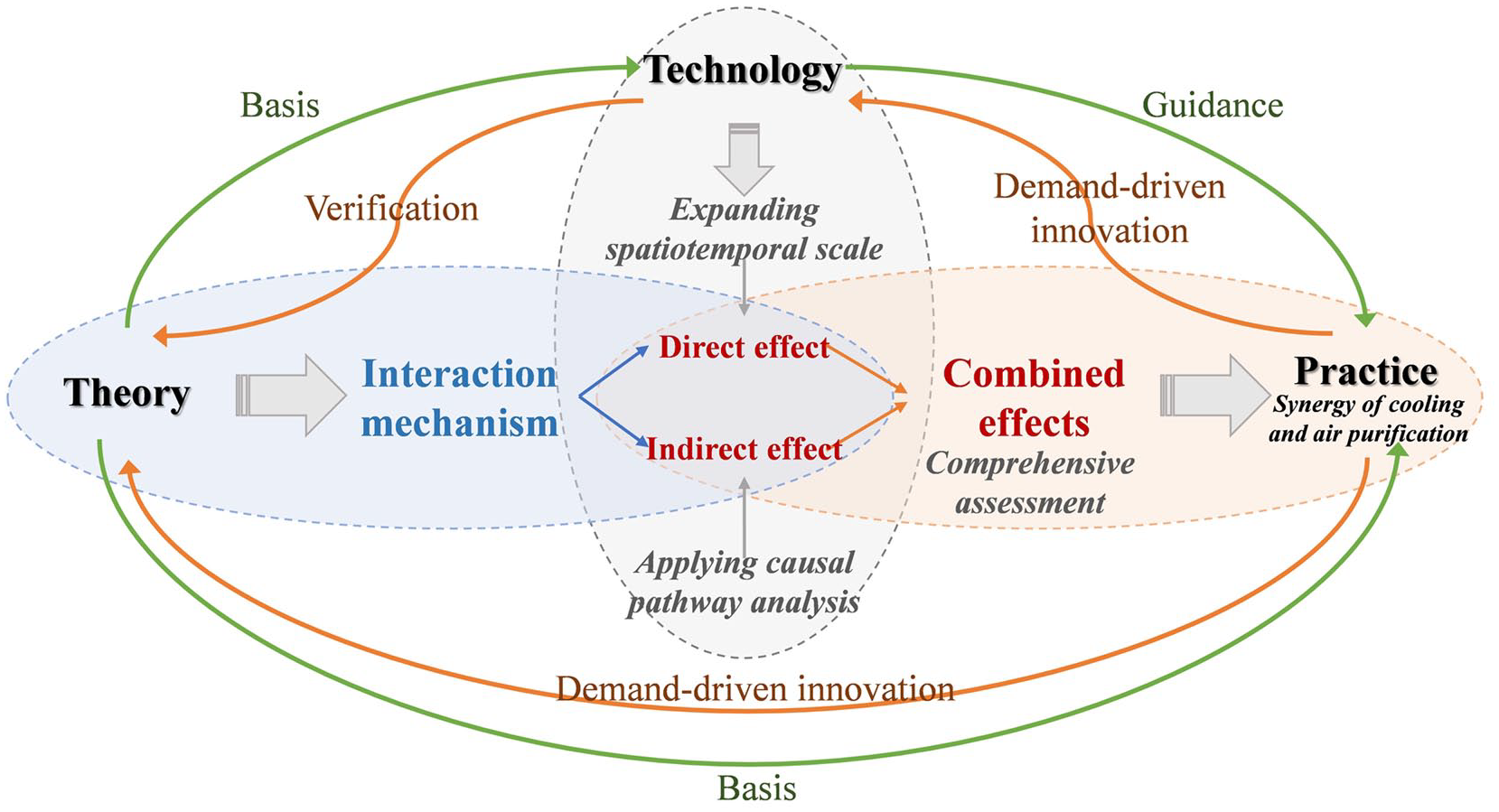
Future directions on green space cooling and air purification effects.
Deeper investigation of direct effects
With the rapid advancement of remote sensing and computational technologies, research methods and techniques for quantifying the cooling and air purification effects of GS are continuously evolving, expanding both temporal and spatial scales. From a temporal perspective, long-term continuous assessments are essential to obtain stable and reliable estimates of the cooling and air purification effects of GS. At the same time, capturing scientifically valuable information during short-term extreme events—such as heatwaves, droughts, wildfires, and severe air pollution episodes—is equally critical. From a spatial perspective, research should integrate numerical simulations and remote sensing data to quantify the cooling and air purification effects of forests at a macro scale. Simultaneously, detailed field investigations at a micro-scale are necessary, particularly in densely populated urban areas where the demand for cooling and air purification is more urgent. In such environments, studies should focus on seasonal variations in solar radiation, temperature, and precipitation, as well as phenological changes in deciduous trees and shrubs. Additionally, the functional differences among tree and shrub species—such as canopy structural parameters and biogenic emissions—should be examined to ensure that research findings effectively inform urban planning and design practices. Currently, many studies rely on single-method approaches. However, integrating multiple approaches can compensate for the limitations of each approach, allowing cross-validation, reducing uncertainties, and ultimately improving the accuracy and reliability of research outcomes.
Validation of indirect mechanisms
Current research primarily focuses on the individual effect of GS in alleviating either air pollution or urban heat island effect. Studies that simultaneously consider both the cooling and air purification effects of GS—especially those exploring their complex interactions—remain limited. The theoretical understanding of their interplay is still unclear. Through a literature review, this study has identified six potential indirect pathways linking GS cooling and air purification effects. However, the effectiveness of these pathways and their relative contributions remain uncertain, necessitating quantitative validation to determine the primary mechanisms. Given the complexity of key influencing factors and the multiple interacting mechanisms involved in the cooling–air purification interplay, path analysis offers a viable analytical framework. This approach encompasses factor analysis, path analysis, mediation effect analysis, interaction effect analysis, and causal relationship testing, enabling a systematic identification of the pathways and effect magnitudes of GS cooling and air purification based on their interrelationships. Viewed from the perspective of interactions, this causal pathway-based approach provides a scientific basis for policymakers to develop optimized intervention strategies that simultaneously address multiple urban environmental challenges while avoiding trade-offs. Moreover, it facilitates the elucidation of the complex causal chains between the cooling and air purification effects of GS, thereby advancing the limited understanding into their interactions.
Comprehensive assessment of combined effects
NbS have gained widespread attention in recent years as an innovative and environmentally friendly urban management strategy, demonstrating significant potential in addressing multiple urban environmental challenges. Given the complex interactions between GS cooling and air purification effects, systematically integrating their direct and indirect pathways to clarify the net effect of GS on urban air pollution mitigation and UHI effect alleviation is essential for an accurate assessment of its effectiveness. More importantly, the introduction of this comprehensive assessment framework contributes to expanding and refining the understanding of the “green space–temperature–pollution” nexus, further enriching and deepening the theoretical discourse on the relationship between GS air purification and cooling effects. This study aims to delineate the potential synergistic mechanisms between GS cooling and air purification, with a particular focus on their mutually reinforcing effects. However, it is equally important to acknowledge potential negative interactions. For instance, VOCs emitted by vegetation serve as key precursors to ozone pollution (Ma et al., 2021), and ozone, as a greenhouse gas, can further exacerbate warming effects (Yu et al., 2022). Therefore, urban planning should prioritize the selection of low-emission tree species to minimize unintended environmental trade-offs. From an adaptive perspective, native species should be favored to maximize standalone cooling and air purification effects, thereby amplifying their synergy. In addition, as dense and tall vegetation may impede urban ventilation, strategically managing greening density and spatial distribution is critical. Establishing green ventilation corridors can enhance air circulation, facilitating the dispersion of heat and air pollutants while avoiding tree’s adverse effects. Ultimately, while GS provide substantial ecological benefits in mitigating summer heat and air pollution, they cannot replace more fundamental mitigation measures, such as controlling anthropogenic emissions of greenhouse gases and air pollutants at the source. A strategy that prioritizes emission reduction while complementing it with NbS-based interventions is crucial for achieving the dual objectives of cleaner air and global warming mitigation.
Footnotes
Contribution list
Original conceptualization and draft – Xiaoyu Yu, Jian Peng
Writing – Xiaoyu Yu
Review and Editing – Xiaoyu Yu, Jian Peng
All authors have read and approved the final manuscript.
Declaration of conflicting interests
The authors declared no potential conflicts of interest with respect to the research, authorship, and/or publication of this article.
Funding
The authors disclosed receipt of the following financial support for the research, authorship, and/or publication of this article: This study was financially supported by the National Natural Science Foundation of China (42130505).
