




Abstract
This paper analyses a potentially path shaping moment for the UK’s public parks by analysing a pivotal case study of park neoliberalisation. Like many municipal parks, Gunnersbury Park in West London is experiencing the effects of local government budget cuts. Governance, policy and physical changes have been introduced to reduce dependence on public funding and the result is a more commercially oriented park. This case is used to better understand how the period of neoliberal austerity 2010–2019 reshaped municipal parks. The paper highlights concerns over the transparency and accountability of the social enterprise that now manages Gunnersbury Park. It also shows how neoliberalisation and commercialisation are manifested in the park landscape: free events are replaced with ticketed ones, spaces for sport are transformed into bookable facilities, cafes are taken over by corporate chains and playgrounds are supplemented with paid entry alternatives. One of the main consequences is the financial and symbolic exclusion of those unable or unwilling to pay. The paper explores who has contested the recent changes, and why. Opponents are dismissed as idealistic NIMBYs but, by refusing to accept the post-political inevitability of park neoliberalisation, they are helping to ensure Gunnersbury Park remains a public and open space. The case is contextualised by situating it within a review of new park governance arrangements across London, and by comparing neoliberalisation processes here with those affecting New York parks. Ultimately, the research highlights the pitfalls of shifting away from the public funding and public management of municipal parks.
Introduction
Municipal parks in the UK are currently experiencing their latest existential crisis, instigated by cuts to local authority funding. A sustained period of austerity imposed by the national government post 2010 has accelerated the introduction of new modes of governance and financing. In this context, there is pressure to raise commercial revenue to help pay for parks and to introduce new governance arrangements that facilitate commercialisation. As a result, responsibility for parks is shifting away from public authorities, with civil society and private actors allocated significant roles. These changes are commonly associated with neoliberalism, and this paper explores the process of park neoliberalisation and its implications through a detailed case study of a London park that has recently been taken out of local authority control and handed to a social enterprise. The case study is contextualised within a wider review of the contemporary funding and management of London’s parks. Through this analysis, and by comparing neoliberalisation processes with those reported from New York City, the paper examines how neoliberalism is reshaping urban parks.
The main aims of this study are to analyse the shift towards self-financing parks and to examine the governance changes and processes of commercialisation that accompany it. These aims are principally addressed through an in-depth analysis of Gunnersbury Park, a large (75 hectare) park in suburban West London. A Community Interest Company was established in 2018 to create a mode of governance that would allow this historic park to pay for itself. The case exemplifies a controversial way of sustaining a municipal park which other UK local authorities may decide to follow. Gunnersbury Park is not a typical case, but it is a potentially pivotal one that represents the neoliberal shift towards entrepreneurial governance. The implications of moving away from public sector management can be better understood by analysing this pioneering example. The research presented here focuses mainly on changes to Gunnersbury Park’s funding and governance arrangements, to understand who shapes what happens here. This includes the roles of individuals and groups that have contested changes. The paper also analyses how the new commercial orientation has changed the physical character and accessibility of the park. How these changes affect park use is outlined too, but this is a secondary consideration, and further work is required to understand how neoliberal park landscapes are used, interpreted and subverted.
The paper is framed by a series of research questions: in what ways has Gunnersbury Park been commercialised and how has this affected the park? How, why, and by whom has the new commercial agenda has been resisted? A set of interviews and observations were conducted 2018–2019 to address these questions. This was a critical period that coincided with the first year of new management arrangements. The research focused on the organisations and people responsible for managing Gunnersbury Park, but also the organisations and people that represent park users. Key stakeholders were interviewed face to face and in depth, with each interview lasting over an hour (and several lasting over two hours). Interviews were carried out in the park (with one exception), which helped participants to feel at ease and provided reference points for discussion. Ten people were interviewed in this part of the research including: an official from the new Community Interest Company (hereafter CIC); a prominent member of the Friends of Gunnersbury Park and Museum; and the Labour Councillor who represents a nearby constituency. Given the research focuses on opposition and resistance, the views of people who had actively campaigned to protect Gunnersbury Park were also sought. Five prominent individuals involved in the local Neighbours Association were interviewed along with two Conservative Councillors who have been vocal opponents of the CIC’s work. These interviews were recorded, then transcribed and analysed. Interviews were complemented by a series of observation exercises undertaken in Gunnersbury Park July 2018-July 2019. These were used to help understand the effects of new commercial installations, and to better appreciate the various sites mentioned by interviewees.
The Gunnersbury Park case is discussed within the wider context of London parks and their governance. To better understand the city-wide picture, interviews were also undertaken with stakeholders at the London level; including representatives from Parks for London, the London branch of the Campaign for the Protection of Rural England (CPRE), Heritage Lottery Fund (HLF), London Friends of Parks and Green Spaces Network, plus officials from two other Friends Groups involved in disputes over park commercialisation.
Neoliberal parks
There is a growing recognition that parks are fundamental pieces of green infrastructure that make our cities more sustainable and liveable. However, research also acknowledges the inequity of urban green space provision and the roles parks play in wider urban processes of gentrification and revitalisation. As Loughran (2020: 2325) recognises, ‘parks have started to encounter the questions of capital accumulation, urban growth strategies and social exclusion that researchers often reserve for other sites’. Urban parks are integrated into regimes of accumulation: supporting place marketing, real estate speculation, and the other ambitions of contemporary urbanism (Millington, 2015). The reconstitution of urban spaces (as sites of consumption) and of the public (as consumers) ‘situates commerce in what was previously the non-commercial domain of the municipal park’ (Madden, 2010: 188). City parks thus provide examples of neoliberalisation: a process through which the scope and reach of capital is extended via the enclosure and privatisation of public space (Mayer, 2013). This is not the local state being overpowered by corporate interests. As Newman (2014) argues, rather than seeing local authorities as bystanders watching helplessly as private interests take over parks, they should be regarded as crucial actors in producing, reproducing, reworking and reconstituting neoliberalism.
Several authors have written about the rise of neoliberal parks, with reference to new parks that aim to be self-financing (Davidson, 2013), or which add value to nearby real estate (Lang and Rothenberg, 2017). Neoliberalisation has also affected existing parks which are increasingly managed as commodities rather than amenities, with exchange value prioritised over use value (Mitchell, 2017). New York City’s parks have been subjected to particularly detailed consideration. Osman (2017) reminds us that here parks were privatised not via some neo-conservative masterplan, but via localised processes where, in the absence of government funds, parks were adopted by public-private hybrids involving activists, non-profits, local businesses and government. Zukin (1995) and Madden (2010) have both written about Bryant Park in New York City which is run by a private management company and funded through commercial revenues generated by sponsorship, events, and catering licenses. This is an example of extending controversial new urban governance into park settings. There are also multiple accounts of Central Park which is often described as a privatised space as it is strictly controlled to protect the corporate sponsors and private donors that now help to fund it (Perkins, 2010). The most famous example was the refusal to allow protests here during the 2004 Republican Convention (Low, 2006).
Beyond New York City, understanding how neoliberalisation has affected municipal parks in the US has been advanced by Mitchell (2003, 2017). His analysis of People’s Park in Berkeley, California highlights that parks are inherently spaces of politics and struggle, rather than merely leisure spaces. Mitchell (2017: 502) suggests the rise of conservancies, trusts and Business Improvement Districts to run parks is linked directly to the fiscal crisis which ‘reduced governments’ capacities to order and regulate, much less maintain, public space’. But, as Perkins (2010) argues, the neoliberal shift is less about reduced state power, and more about rearticulating power by involving market mechanisms and civil society. Perkins (2010) examines how ‘shared governance’ or ‘governance beyond the state’ – the increased involvement of business interests and non-profits – has affected US parks, concluding that, whilst a market logic might help to revive park fortunes, there are knock-on effects for the inclusivity of park spaces. This is also a theme addressed by Joassart-Marcelli et al. (2011) who examine the role of non-profits in the management and funding of parks in Southern California. Their work recognises that ‘non-profitization can be a step towards privatization’, rather than a partnership with government (Joassart-Marcelli et al., 2011: 684). For example, the tendency of non-profits to charge for facilities and lease out space for events can exclude lower income residents.
In the UK, a whole series of new governance models have been proposed to address the crisis currently affecting parks which are suffering as local authorities divert funds into front line statutory services (Penny, 2017). Policy discourse is now framed negatively, with the main objective to avoid losing parks, rather than providing more generous or more equitable provision (Churchill et al., 2018). Parks have been taken out of local authority control and handed to trusts or social enterprises that can diversify and expand sources of income. In 2019, Newcastle upon Tyne became the first major UK city to transfer its parks to an independent charitable trust. In the absence of government leadership, the Heritage Lottery Fund in partnership with Nesta have provided direction by funding a series of ‘Rethinking Parks’ projects which encourage a more entrepreneurial approach (Interview with HLF official). Parks have long earned income from concessions, parking and charges for sports facilities, but new governance models have been suggested to increase revenues and expand income streams. Hiring out parks to event companies is a lucrative option (Smith, 2019b), but parks can also generate income from sponsorship, filming and visitor attractions. There has been understandable concern about whether the result is the privatisation and commercialisation of park space which excludes those unwilling or unable to pay (Hancox, 2019; Hunt, 2018). However, some suggest that such fears have been exaggerated, especially as ‘commercialisation activities are typically small-scale’ (Carmona et al., 2019: 14).
London’s parks: New approaches to governance in an era of neoliberal austerity
Most of London’s parks are owned and managed by one of the city’s 32 Borough Councils which have had to absorb significant budgets cuts since 2010. Central government funding for local authorities in London fell by 33% between 2009/10 and 2013/14, reducing their spending power by 17% (Fitzgerald and Lupton, 2015). The response of many London Boroughs has been efficiency savings rather than service cuts, but there has been retrenchment, particularly in areas like parks provision which are discretionary (Hastings et al., 2017). Following the logic that resilience is not just about ‘bouncing back’, but ‘bouncing forward’ (Fitzgerald and Lupton, 2015), some Boroughs have tried to reduce the need for, or costs of, providing services. Examples relevant to parks include sharing services between Boroughs (e.g. Richmond and Wandsworth collaborating on public realm improvements), establishing charitable trusts to supplement funding (e.g. Ealing Parks Foundation) or delegating park facilities to social enterprises (e.g. Greenwich Leisure Limited).
The severity of budget cuts experienced by London Boroughs means they have been forced to increase income derived from sources other than central government, business rates and local taxation (Interview with Parks for London). In this context, local authorities view parks as ‘assets–or under-exploited commodities in the vernacular of the market–that might be sold off or leased for commercial use’ (Churchill et al., 2018: 534). Some London Boroughs have sold off parks (for example Bexley and Tower Hamlets) or used parkland to develop leisure centres as they have done in Hackney (Interview with CPRE official), but a more common response has been to offset maintenance costs by increasing revenue earned from parks or by delegating responsibility to a social enterprise (Parks for London, 2019).
Funding shortfalls and neoliberal agendas have encouraged London Boroughs to involve corporations, non-profits and citizens in park governance. However, unlike neoliberalisation processes in New York and other US cities, London’s parks are not reliant on funding from sponsors and private donations. Instead they have absorbed public sector cuts by reducing costs and generating more commercial income (Interview with London Friends Network official). Costs have been reduced by relying more heavily on volunteers (Whitten, 2019). There are now over 600 Friends groups representing parks and green spaces in London and these play an increasingly active role in managing and maintaining parks (Interview with London Friends Network official). In New York, park neoliberalisation has involved sourcing labour from ‘workfare’ schemes and using private contractors (Krinsky and Simonet, 2011), whereas in London, private sector involvement is much lower. Only half of London Boroughs contract parks services from the private sector (Parks for London, 2019) and, reflecting a wider trend in London’s governance, some Boroughs (e.g. Newham and Croydon) have recently brought parks work back in-house. This reduces the inflexibilities and cost pressures associated with contracting (Lowndes and Gardener, 2016) and highlights a new phase of neoliberalisation in which local authority budgets are so low that outsourcing is less viable. Nevertheless, private companies still play a key role. IdVerde is particularly significant because of the scale and scope of this company’s involvement in London’s parks. Its role has been extended from basic maintenance functions into managerial domains – formulating events strategies and income generation plans (e.g. in Bromley).
Rather than contracting out management responsibility, some London Boroughs have created separate social enterprises to manage their parks. In 2015, Wandsworth established a not for profit company (Enable Leisure and Culture) to manage and develop the Borough’s parks (and other cultural and leisure services) which is more oriented to earning and retaining commercial income (Smith, 2019a). Redbridge has set up a similar organisation (Vision Redbridge Leisure and Culture) which now manages all the Borough’s parks. Other new management models include placing individual parks into the ownership of a trust funded either through an endowment or commercial income (London Assembly, 2017). Potters Fields Park in Southwark is now run by a Management Trust (De Magalhães and Freire Trigo, 2017). This park is entirely self-financed, with income generated mainly via events and the rest through grants and donations. In 2018 the Trust made a surplus of £215, 699 which, according to the terms of the (30 year) lease agreement, was paid back to Southwark Council ‘for use in the development of other open spaces in the area’ (Potters Fields Park Management Trust, 2019). This arrangement reaffirms Joassart-Marcelli et al.’s (2011) view that park privatisation is rarely fully realised as ownership and finances tend to remain integrated with public authorities.
Gunnersbury Park
Gunnersbury Park is in West London, occupying 75 hectares between Acton Town, Ealing, Brentford and Chiswick. The park is on the boundary of two London Boroughs which are amongst the UK’s ten most ethnically diverse local authorities (Office for National Statistics, 2018). The surrounding neighbourhoods are typically suburban, dominated by semi-detached housing to the north and east, interspersed with high- and low-rise housing estates to the west and south west. Two major roads (the M4 and North Circular) and two large cemeteries separate Gunnersbury Park from residential communities on its southern and eastern boundaries. Observations suggest the park hosts everyday leisure: dog walking, jogging, cycling and various sports activities (Field notes, 2018). A large-scale survey of 4,304 local people commissioned by Hounslow and Ealing Councils in 2009 found the majority use Gunnersbury Park for walking, exercise and relaxing; with taking children to play and the desire to see nature also popular reasons to visit (Jura Consultants, 2009). The museum and historic landscapes mean Gunnersbury Park is also visited as a heritage site and tourism attraction. It has also hosted various events including the London Mela which was staged here from 2003–2015.
Like many of London’s most famous parks, Gunnersbury Park was converted from a private estate. The London Boroughs of Ealing and Acton bought the land from the Rothschild family and officially opened it as a public park in 1926. Playing fields, a miniature golf course and bowling greens were added producing diverse parklands comprising formal gardens near to the Mansion Houses and recreational areas further west. The park is listed as a landscape of national significance and contains 22 historic buildings, including Gunnersbury Park House which has been used as a local history museum since 1929. After it was opened to the public, Gunnersbury Park was managed by a Joint Committee involving two London Boroughs. This led to conflict and under-funding as each Borough (since 1965, Ealing and Hounslow) felt their neighbour should be contributing more. Although both Councils are currently controlled by the Labour Party, at various times Ealing has been Conservative-led, making cross-Borough management even harder (Interview with Labour Councillor). By the start of the new Millennium, poor maintenance meant Gunnersbury Park and the historic buildings within it were in a very dilapidated state (Bott and Wisdom, 2018). Grants awarded by the Heritage Lottery Fund in 2014 were used to help restore parts of the park, but in the absence of sufficient local authority funding, new governance and funding arrangements were deemed necessary to help maintain it.
The Gunnersbury Estate CIC: A new funding and management model
On the 1st April 2018, the Gunnersbury Park Community Interest Company began operating. A new way of managing this West London Park had been envisaged for some time, with a report published in 2004 recommending that Gunnersbury Park be relaunched as a social enterprise. The main stimulus for a new governance model was the award of a £4.6million Heritage Lottery Fund grant in 2014 to restore and improve the park in advance of its 100th anniversary (2026). A 2014 report suggested that ‘the size and complexity of the 2026 project demands a new structure’ (Lillicrap, 2014: 5). The related difficulties involved in running a park jointly by two local authorities also provided a reason to alter the established modus operandi. Various alternatives were considered, including transferring responsibility to a single Borough or a private sector operation; or establishing a charitable trust or a partnership with a non-profit. Eventually, a Community Interest Company (CIC) was chosen as the preferred option. The need to generate funding at a time where London Boroughs were absorbing significant budget cuts was a key factor in selecting that mode of governance (Interview with Labour Councillor, Interview with Friends official). CICs are limited liability companies that exist to serve community goals whilst enabling access to grants, donations and other forms of finance. Compared to conventional charities they offer the advantages of comparatively light touch governance and greater flexibility. A Development Trust was established alongside the CIC to provide a vehicle to generate charitable donations.
There is insufficient room here to provide a full account of the legal and administrative complexities of transferring Gunnersbury Park from two local authorities to the CIC, but the basic agreement involved a 25 year lease of the estate at a nominal rate, alongside the promise of guaranteed local authority funding for ten years, albeit at levels that would diminish by over £200,000 during the first ten years of operations. The CIC would be required to make up the shortfall and generate new funding that would increase the budget from the combined £710,000 that was spent on the park each year by Ealing and Hounslow Borough Councils. In 2013/4 these Boroughs had spent £826,038 and generated £115,090 in income, but under the CIC the park is expected to generate an additional £1million per annum. These ambitious income targets have raised suspicions amongst local people: “The Community Interest Company is known amongst the residents as the Commercial Interest Company because that is what it is” (Campaigner A). Even though the Councils initially promised to provide funding for at least ten years, stakeholders felt that the aim “was for the councils to quit funding the park” (Friends official).
One of the key justifications for the CIC was that money generated by the park could be ring fenced and spent on maintaining it. Many UK local authorities are unable or unwilling to hypothecate revenue in this way so creating a separate, more commercially minded organisation made sense. However, as the park is still reliant on council funding and as the council have only provided a 25 year lease, there are doubts surrounding fiscal autonomy. The Friends official felt “this whole business of it being the park’s money in my view is a fiction”, because as soon as the park starts generating large sums, the “amount from the two councils will diminish accordingly”. The more commercially successful Gunnersbury Park is, the more quickly and more substantially grant income will be cut. This is the lose-lose scenario facing parks that are required to generate more of their own funding.
The ongoing relationship between the CIC and the two local councils has also caused controversy. Whilst some worry that a CIC is inherently less accountable than a local authority, there is also concern that the local councils are still driving decision making. This creates the possibility of the worst of both worlds: local authority style management without the transparency or democratic accountability of council control. Although the CIC was created, and is closely monitored, by the two local authorities, it was criticised by several interviewees for its lack of transparency. Campaigners also felt the CIC was hamstrung by the (over) involvement of Council officers on its board.
Most stakeholders supported the formation of the CIC because it helped to resolve long standing problems of insufficient funding and negligent management. According to the Friends official: “I thought, we all thought, the councils have failed. That’s it. What right have the councils got to carry on obstructing the chance to rescue this park? And the Heritage Lottery Fund were saying, “We’re not giving you the money if you carry on managing it in the old way. You’ve got to come up with something new”.
Alongside financial transparency, the biggest complaint from local people was the lack of local involvement in the CIC. When it was established, the local Boroughs stipulated they wanted new investment and commercial acumen, but also engagement with and involvement from local communities. However, the CIC official felt: “we are not constituted to permit or facilitate open democratic governance. That’s not what we were set up to do”. According to local campaigners, their attempts to get representation on the CIC were thwarted: “we struggled as hard as we could to get some sort of community representation on the board, even just as an observer, they wouldn’t have any of it” (Campaigner A). Efforts to get local people on to the board were rebuffed because of their lack of expertise: one campaigner was told “you don’t have the special skills we need – we need business people, we need accountants” (Campaigner C).
Some interviewees suggested the early problems with the CIC were gradually disappearing “they’ve got some decent staff, they’re established and it seems to me to be working” (Labour Councillor) and so were deemed teething problems rather than more substantial concerns. The CIC official promised to try and consult more, and build better relationships with neighbours, and pointed to the complex range of stakeholder relationships they have to manage. The CIC was set up to simplify the institutional landscape, but the CIC official described the new governance arrangements as ‘chaotic’ as they work with two Councils, the Friends, a Development Trust and various other community groups. Prioritising users is also complicated as the CIC officer feels Gunnersbury Park should serve local residents but also people from further afield who may want to visit. Attempts to include potential users in decision making are interpreted by local stakeholders as “the people on the doorstep don’t matter” (Conservative Councillor).
Although the CIC was set up to address the funding problems caused by austerity, it has already been hampered by budget shortfalls. Once the CIC was operational it was immediately clear that the money available was insufficient to sustain operations. The budget was barely enough to cover basic maintenance and there was no money to pay for new staff or development activities. Although the CIC had been set up to provide commercial acumen, it was difficult to raise additional finance because the CIC had no track record and a 25 year lease. As the CIC official highlighted: “You can’t borrow on that basis. You’ve even got a real problem with Heritage Lottery funding because actually they would not normally fund you if you got such a short lease”. This meant immediate pressure to generate additional revenue through commercial activities: “unless we landed some large ticket item events in the current financial year, we would be broke by the end of the first year” (CIC official). This meant the new management model was seen by campaigners as “a mad dash for cash” (Campaigner A) with the urgent need to deliver commercial revenue contributing to the mistrust between local people and the CIC. Even those who supported the new commercial mission felt there was a lack of strategic thinking underpinning key decisions: “where is the strategy beyond money, money, money?” (Conservative Councillor).
The commercialisation of Gunnersbury Park
During the first year of the CIC’s operations, the most obvious manifestations of the new commercial mission foisted on Gunnersbury Park were several new events. These included a weekend of large-scale music festivals (Lovebox and Citadel) in July and a month-long residence for Secret Cinema in August, with multiple film screenings for 5,000 people. The Park had been used previously for events, including the London Mela, which also caused controversy. But the new events were different – they were ticketed and involved installations and 12 feet fences that restricted access to park space over an extended period. This [temporary] privatisation was controversial, generating media publicity locally and nationally (Hunt, 2018; McGinty, 2018). The Lovebox and Citadel festivals were particularly contentious because of their spatial and temporal footprints: “I don’t think anyone is that comfortable with Lovebox – it was a 3 day event, but actually it turns out to be a 3 week event when you think about the set up” (Labour Councillor). These festivals had been scheduled to take place in Brockwell Park in South London, but opposition there had forced organisers to switch locations (Gillet, 2018). Various temporal factors heightened the impact of the new festivals in Gunnersbury Park: they happened in midsummer; they were followed by several weeks of other ticketed events; and interrupted access coincided with the upgrading of sports pitches. The net outcome was significant disruption to park availability for a whole summer. Alongside the restricted accessibility, stakeholders didn’t like the symbolic and aesthetic impact of the fences that surrounded the festival site: “I’m really, really uncomfortable when I see the fencing coming in” (Friends official). These views were reinforced by field observations before, during and after the music festivals, with the unnerving impact of high security fencing prominent in field notes (see Figure 1).
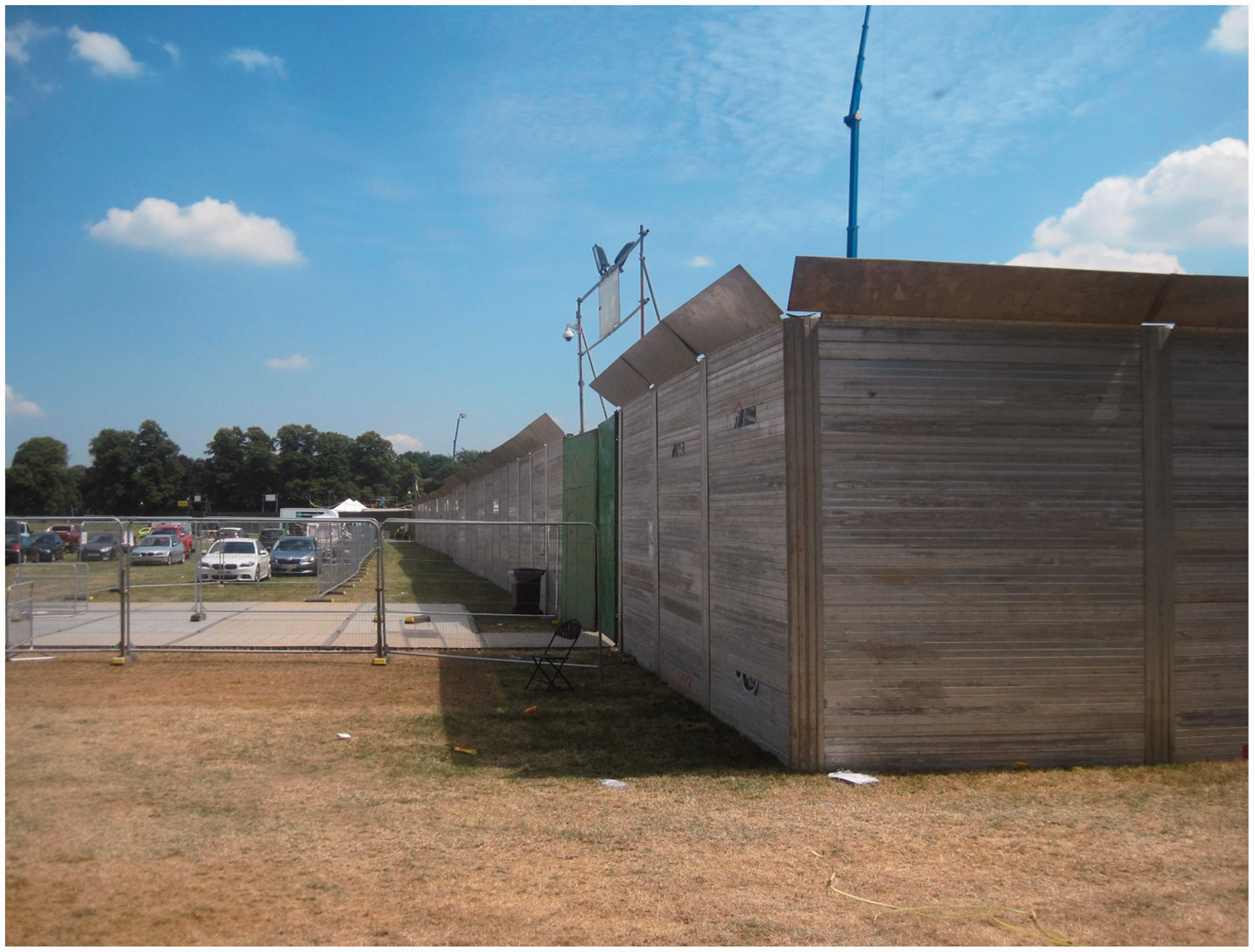
The ‘Super Fortress' fences used to secure the Lovebox music festival in Gunnersbury Park.
The timing of the Lovebox Festival so early in the lifecyle of the CIC caused problems. The CIC official recognised that this contributed to the mistrust and poor relationship between the CIC and locals. The Friends suggested that the problem with Lovebox was not necessarily the event itself, but its timing: “it might have been wiser to have waited for a year”. These comments highlight the rather weak bargaining position of the CIC which was desperate for cash and inexperienced in handling negotiations with global entertainment companies. The idea that the new governance arrangements facilitated a more commercially savvy approach to park management seems farfetched.
Objections to Lovebox extended beyond complaints of poor consultation and disrupted access. Campaigners were also worried that the event set a dangerous precedent “opening the floodgates” to bigger incursions (Campaigner D). Others were even more pessimistic: “this is the beginning of the end because I can see in 10 years, this park is not going to be a park” (Campaigner B). Objections to the music festivals also included complaints about anti-social behaviour. One campaigner said: “We have spent years and years fighting the scourges of drink and drugs at this park and now we’re facilitating them. It’s just bonkers” (Campaigner A). Complaints were not confined to what was happening inside the park, but also disruption on the perimeter. This was the first time Gunnersbury Park had staged the events and several stakeholders (including all 3 local councillors interviewed) suggested problems would be better managed in future. But some issues were not caused by inexperience, they were the inevitable consequences of hiring the park out to cost-conscious organisers unwilling to fund the personnel required to manage a smooth egress (Friends official).
Aside from Lovebox, the commercial proposal that perhaps caused most controversy in the early days of the CIC’s operations was the plan to install a Go Ape attraction in the centre of Gunnersbury Park. Go Ape is a new breed of adventure playground with zip wires and rope walks installed in tree top settings. These installations have been castigated as unwelcome incursions by some, including Paddison (2010: 20) who regarded Glasgow’s as ‘another proposal that privatized public space’. Go Ape is notoriously expensive, with children (even those under 6) charged £21. In 2016, a new facility opened in London’s Battersea Park which caused controversy as it created a two-tier playground separating those who could afford to pay from those who could not (Smith, 2019a). The proposals for a Gunnersbury Go Ape and the half-hearted consultation that accompanied it were also heavily criticised by campaigners and plans were eventually shelved. Objectors cited the divisions it would create, with several stakeholders arguing it would put unwelcome pressure on parents and dissuade low income families from using the park. The Go Ape proposal was something driven by the two Councils and shelving it could be interpreted as a sign that the CIC were listening to concerns. However, the meagre financial offer, inappropriate location and opposition from the Heritage Lottery Fund were more influential than ideological concerns about monetising play (Interview with Friends official; Interview with Labour Councillor).
Other commercial operations have opened in Gunnersbury Park. A new café was built and handed to a chain that operates concessions in other London parks. Benugo outlets are not always welcomed: the company was forced to withdraw plans to take over two family run cafés on Hampstead Heath after a community backlash (Marshall, 2016). In Gunnersbury Park the new café has generally been well received, although there are concerns about gentrification: “The old café was very ramshackle, you could get a cup of tea for a quid, they had ice cream cones, you could get scoops of ice cream for the kids. Now, I have to pay £2.20 for a cup of tea, they no longer have ice cream cones for kids. If you want your sandwiches, £5, if you want fish and chips, it’s £12” (Campaigner A).
Overall attitudes towards commercialisation
Attitudes toward Gunnersbury Park’s new commercial orientation were mixed. Some stakeholders, including a long-standing campaigner, suggested the effects were positive: “I like to see the park being used” (Campaigner C). Similarly, the Labour Councillor felt that, whilst s/he may be expected to oppose commercialisation, s/he didn’t: “actually my experience of parks is that in the absence of activities they are actually not used very much”. These positive interpretations of the effects of commercial activities were underpinned by awareness of the likely alternatives. Both interviewees quoted above mentioned the fear of future housing development when justifying their qualified support for events and other commercial installations. However, others were far more concerned about the effects of commercialisation, with social exclusion frequently cited: “it’s just widening the gap between the haves and the have-nots. This park was not meant to be a playground for the rich. It was meant to be a park for everybody” (Campaigner A). Most stakeholders accepted the need for some commercial activities and recognised there was a long history of entertainment and sport provision in Gunnersbury Park, but there were concerns that recent projects threatened its status as a public park. Even though Gunnersbury Park remains essentially free to use, campaigners feel that expensive events, formal sports facilities and a posh café are essentially exclusive.
Resisting commercialisation
To evaluate the complaints above it is important to understand who was complaining, how they were organised and what they did to resist the new commercial mission. The main fulcrum of opposition is the Gunnersbury Neighbours Association – a group that coalesced around concerns over a license issued in 2017 permitting 28 days of events in the park every year. However, the origins of this group go back further, with many members working together to prevent previous development proposals, including plans to build houses on part of Gunnersbury Park. In other London parks, campaigns against commercialisation have been led by Friends groups, but in Gunnersbury Park, the Friends perform a different role: they are more interested in conserving the heritage of the park and its buildings, and their members are drawn from further afield. As the Friends official admitted: “one of the curious things about our Friends group is that we are not the park neighbours group”.
The Friends of Gunnersbury Park have adopted different positions from the Neighbours Association on key issues; the Neighbours thought the Friends had backed plans to sell off part of the park for housing and, more recently, the Friends have supported plans to raise income by staging events. This has led to a poor relationship, with interviewees suggesting that the Friends are actively hostile towards the Neighbours, and the Neighbours regarding the Friends as traitorous for backing the commercial plans. This split and the lack of co-ordinated action has complicated efforts to get park users better represented within new governance arrangements.
Local efforts to resist commercialisation of Gunnersbury Park are hindered by other contextual factors. One experienced campaigner suggested that the Neighbours lack experience of activism and tend to get too obsessed with their own personal perspective. S/he argued that the suburban context, with lots of middle-aged home owners living near to the Park, meant the community were less likely to put together successful campaigns compared to areas “where there is a history of community organisation, with tenant associations, [and where] people see the benefit of collective action” (Campaigner C). Campaign groups representing other London parks have had more success in opposing music festivals (Smith, 2019b). Brockwell Park benefits from strong community organisations, and their influence, plus the dense housing on its perimeter, helps explain why its users successfully resisted plans to stage Lovebox there (Interview with Friends of Brockwell Park official). When Brockwell Park was earmarked as the venue, public meetings were packed with opponents, but these were noticeably less well-attended when organisers announced plans to move Lovebox to Gunnersbury (Field notes, 2018; Interview with Labour Councillor). The Neighbours Association relies heavily on their Facebook site to voice their complaints, but there was a feeling that this type of campaigning functioned as a replacement for activism rather than actual activism (Campaigner C). Campaigners are now trying to address this by pursuing higher profile media communications and by exploring the possibility of legal action (Campaigner B).
The people who have campaigned against commercialisation have also been subjected to criticism. These campaigners are often dismissed as a small group of NIMBYs who are unrepresentative of local people. The Labour Councillor felt “there’s a hell a lot of noise but how many people are generating that noise?” S/he was keen not to sound dismissive, but felt some neighbours were governed by a NIMBYist disposition: “it’s my back garden. I don’t want it to change”. The demographic profiles of those complaining about commercialisation were also used to question their legitimacy: “I haven’t met anyone who isn’t middle aged, white. They are not young, mixed race families or people from the estates” (Labour Councillor). The Neighbours were also accused of being rather idealistic and closed minded about what Gunnersbury Park should be like. One campaigner, who felt they were more pragmatic, suggested: “they think the park should be a quiet open space for solitude” (Campaigner C) and were unprepared to think realistically about sustainable funding. Several stakeholders mentioned attitudes toward events as evidence of this naivety, with requests for theatre or opera instead of loud music festivals ignoring the need for income. As the Labour Councillor put it: “we’d all love to have concerts of chamber music, but that is not going to get the £1.7 million needed to run the park”. S/he also questioned the validity of the Neighbours’ complaints: “there’s real disruption, but there’s also a lot of imagined disruption” and felt that the amount of park space lost to events had been exaggerated: “it’s a massive park, it’s not as big a problem as people make out”, as had the effects of the other commercial installations: “The tennis courts are 100 m from people’s gardens, but people said our lives are going to be ruined by the floodlights. They are not minded to be realistic about it”.
The concerns voiced by the Neighbours do not seem to represent those of wider communities who live on the Park’s perimeter. According to the Labour Councillor who represents many less affluent residents: “there is nobody from Brentford Towers who is concerned about commercialisation, or even from Clayponds Estate – the people who would be most affected”. When campaigners were asked who else was concerned about the new festivals, other than members of their group, they admitted “no one” (Campaigner E). In the most extensive consultation exercise carried out in recent years, many respondents suggested that ticketed events should be used to help fund park improvements and maintenance (Jura Consultants, 2009). And when locals were consulted about the Go Ape proposal, 64% supported the project with over 46% strongly agreeing it should go ahead (Ealing Today, 2018). These consultations need to be regarded sceptically given they were relatively crude exercises commissioned by proponents. However, the available evidence suggests that the attitudes and profiles of the Neighbours do not represent those of wider communities. But that does not mean they should be dismissed. Their concerns are genuine and the individuals involved have an impressive track record of seeing off previous threats to Gunnersbury Park. Although their success may have been limited, and whilst they do not necessarily represent the wider community, campaigning by the Neighbours holds the CIC to account and helps open space become public space (Harvey, 2013). As Mitchell (2017: 507) argues, although there is a tendency for public spaces to be closed down, they are simultaneously opened up through the ‘concerted struggle of new social movements’.
Discussion and conclusions
Heynen and Robbins (2005) suggest that neoliberalisation can be understood as comprising four dominant relations: institutionalised political compromises or hybrid governance, turning over state resources to firms and individuals or privatisation, the capture of common resources and exclusion of their communities or enclosure, and reducing complex ecosystems to commodities or valuation. This paper explains how this ‘neoliberalisation of nature’ applies in the context of London’s municipal parks. The case analysed here is significant because it demonstrates how these processes work and how they are accelerated in an era when local authorities are deprived of adequate public funding. The push for commercial revenue drives the enclosure, monetisation and gentrification of park spaces but also changes to park governance. New organisations are created to meet ambitious income generation targets and there are justified concerns about the implications, including worries over transparency, accountability and reduced access to park space. Public parks have never been fully accessible to the public and have always hosted commercial activity but, in an era of austerity, processes of commercialisation have intensified with ticketed festivals the most obvious example of incursions that interrupt the provision of public space (Smith, 2019b). The most troubling outcome of this trend is the potential exclusion of people unwilling or unable to consume. These exclusions are caused by new financial and physical barriers, but also symbolic exclusions from commercially oriented space (Joassart-Marcelli et al., 2011). At present, Gunnersbury Park remains an essentially public space, albeit one where more exclusive uses are now integral to the ways the Park is managed and operated. However, what concerns objectors is not merely what is happening now, but what will happen in the future. Recent incursions do not just restrict access to Gunnersbury Park, they represent a turning point in the park’s history, pushing it towards a new commercial orientation that undermines the ethos of a public park.
The commercialisation of Gunnersbury Park has been contested, with the Gunnersbury Park Neighbours Association leading attempts to oppose the new funding and management arrangements. There are interesting parallels between the case analysed here and Haughton et al.’s (2016) study of tree felling protests in Manchester’s Alexandra Park. Their work highlights the need to analyse ‘ordinary protests’ that do not necessarily scale up into major challenges to authority. As in the Gunnersbury Park case, protestors were dismissed as a small, noisy group of ‘trouble makers’ whose views were deemed unrepresentative of the silent majority, partly because they were white and well educated. In their critique of the ‘post-political condition’, Haughton et al. (2016) point out that those who disagree with the fundamental assumptions of a project are dismissed, whereas those who are happy to play the role of stakeholder are incorporated into the techno-managerial process. By refusing to accept the notion that Gunnersbury Park had to choose between commercialising the park or losing it, prominent members of the Neighbours Association were dismissed as deluded idealists who were exaggerating the threat posed by commercialisation. As a result, their protests were relegated to extra-political trouble making and they were explicitly excluded from decision making processes. Commercialisation was deemed to be the only viable response to funding cuts, and new governance arrangements were justified as expedient ways to achieve this, despite their questionable transparency and accountability. The new approach was initiated by two Labour-led councils which highlights both the role of the local state in neoliberalisation and the way entrepreneurial governance is accepted as the only alternative in an era of austerity, even by progressive politicians. The Labour Councillor justified creating a social enterprise to manage Gunnersbury Park by saying “it takes it out of the politics of the councils”. Attempts to de-politicise park governance and the dismissal of alternatives to commercialisation highlight the prevailing influence of the ‘post-political condition built around the inevitability of neoliberal capitalism’ (Paddison, 2010: 20).
The Gunnersbury Park Neighbours have played a significant role in protecting the Park in the past and they see the current commercialisation as the latest development threat. Therefore, whilst it is easy to dismiss them as self-interested NIMBYs, this group are better understood as part of a wider movement campaigning for the right to the city, and for forms of urbanism that prioritise people, not profit (Mayer, 2013). Following Mitchell (2017), the right to city parks not only refers to the right to visit, but also the right to use space and to decide how it is used. Renting out parks or requiring entry fees not only reduces access, it controls and abstracts spaces, turning what might be liminal, representative space into ordered, capitalist space (Mitchell, 2017). Mitchell sees programming as the antithesis of free space, and Gunnersbury Park is now a heavily programmed park, and one that is set to host even more events. In 2019, the CIC confirmed that there would be a second edition of Lovebox in July, and announced another 3 day music festival in September.
The capacity of the Neighbours to resist the new commercial mission of the CIC was hamstrung by several factors, including the suburban context and an over-reliance on social media, but also conflicts with the official Friends group and internal battles over key priorities. Perhaps the most significant of these was the split within the Neighbours Association between those who felt that that commercialisation had to be reluctantly accepted (to avoid more damaging outcomes) and those who felt there was still possibility of maintaining a public park using public funds. This dilemma highlights the ways the contestation of neoliberalism is ‘inevitably reshaped and potentially compromised by having to come to terms with neoliberal norms’ (Leitner et al., 2007: 10).
The Gunnersbury Park case highlights a series of issues that are relevant to many public parks. It exemplifies how new ‘experimental’ forms of governance are often adopted in periods of crisis (Oosterlynck and González, 2013), with the period of austerity post 2010 used to justify a long-held ambition to take this park out of local authority control. Ambitious income generation targets put pressure on those tasked with managing parks, and the result is decision making driven by finances. These issues are compounded by a lack of transparency in the new arrangements. If park users have to accept commercial incursions to ensure the financial sustainability of their park, then they are entitled to know more about income targets and revenues earned. At present, the example analysed here remains a pioneering outlier, rather than a typical case, but it seems likely that other parks will follow this lead, particularly as politicians across the mainstream political spectrum and leading national agencies advocate more entrepreneurial funding and management as the way to sustain municipal parks (Interview with HLF official; Interview with Parks for London official).
The case analysed here highlights that there are not merely problems associated with adopting new governance models, or with sticking to traditional modes, but also problems caused by hybrid arrangements. Critics of the new arrangements in Gunnersbury Park suggested that the CIC was neither free from local authority interference, nor bound by the democratic accountability of a public authority. Continued Council control, but with a lesser requirement for transparency, undermines the rationale for new park authorities and invites suspicion. The case also highlights the way that new commercially oriented governance models distance park users from involvement in decision making. One potentially positive outcome of neoliberalisation is community empowerment (Keil, 2009), but this isn’t applicable here. In Gunnersbury, local residents are less involved than they were under the previous regime, and this is exacerbated by the revised spatial focus of the CIC. Ambitious income generation targets mean parks need to be made more attractive to those living further afield, and locals are regarded as potential obstacles to this new mission, rather than potential contributors.
The Gunnersbury Park case also helps us understand how space is commercialised. This process is often associated with sponsorship (Mowen et al., 2016) or corporate involvement in management (Perkins, 2010), but the case here highlights that park space is commercialised through the monetisation of established activities. Parks have long hosted events, sport activities, cafes and playgrounds, but pressure to generate commercial revenue means transforming these amenities into revenue generating opportunities. Spaces for sport are transformed into bookable facilities, free events are replaced with ticketed ones, cafes are handed to corporate chains and playgrounds are supplemented with paid entry alternatives. These new initiatives are justified as appropriate park activities and, whilst they do not necessarily contradict established notions of what a park is for, these money-making ventures do disrupt the idea that parks are for everyone. Indeed, the most significant effect of park commercialisation is social exclusion – through the installation of new financial, physical and symbolic barriers. Ambitious income targets inevitably mean that using park facilities and park space is increasingly influenced by a person’s ability (and willingness) to pay. Large urban parks are thus reimagined as visitor attractions or pleasure gardens, distancing them from their traditional roles as amenities for local users. In this context, park space becomes valued for its (financial) productivity and there are few incentives to maintain openly accessible green space. This was evident in Gunnersbury Park: campaigners felt that the CIC now regarded open spaces as unproductive “green desert” (Campaigner A).
This paper also highlights some of the distinct features of park neoliberalisation in London, which differ from processes affecting US parks. The London model is oriented towards generating income by hiring out park spaces to global entertainment corporations like Live Nation (who own Lovebox, plus many other festivals) and AEG (who operate festivals in Hyde Park and Victoria Park). This is reaffirmed by key stakeholders: “most of the London Boroughs – that’s my remit – they’re looking at their larger assets and thinking, we should do the same, why not?” (Interview with Parks for London official). Delegating parks to social enterprises is currently limited to a few pioneering cases but concerns over the proliferation of commercial festivals are widespread (Smith, 2019b). London parks are experiencing neoliberalisation via festivalisation, with events used to realise the exchange value of large open spaces. Although we might assume that a drive for event income would also typify park neoliberalisation in New York, authorities there seem reluctant to go down this route. For example, in 2016 the Parks Department rejected applications from Live Nation and AEG to stage music festivals in Corona Park and wrote to each explaining their decision: ‘Given the proposed duration of your three-day festival and the large amount of the Park that would be occupied for an extensive period of time, including the load in, loud out and the actual event, the Department has determined that the Park is not a viable venue’. Cited in Honan (2016)
Final comments
Fifteen years ago, Jones and Wills (2005) suggested that the municipal park might become a victim of a broader war between public and private use, class and moneyed interests. The analysis here suggests this is now not merely a possibility, but the reality. A prolonged period of government austerity combined with ongoing neoliberalisation is changing the management, use and character of municipal parks (Smith, 2019a). Creating new organisations to run parks which are driven by an entrepreneurial rationale is arguably a ‘path shaping moment’ that will have long lasting consequences (Oosterlynck and González, 2013). As with other forms of neoliberalisation, gains in efficiency are achieved at the expense of accountability, as it is democracy – including the involvement of users in decision making – that tends to be the inefficiency resolved by new forms of governance (Stormann, 2000). Even if new park enterprises are successful in generating enough revenue to sustain parks, by separating their funding and management from other parks, they increase the chances that smaller, less profitable green spaces will be denigrated or lost (Millington, 2015).
Whilst it may be impossible to wholly protect public parks from the commercialisation, monetisation and privatisation that pervades the contemporary city, that does not mean we shouldn’t try to. Even within the context of neoliberal austerity, there are measures that can be taken. In an era when management authorities are pressurised to generate income, there is a case for introducing or tightening regulations that prevent commercial over-exploitation and protect free access. These might include city-wide limits on the amount of time and space commercial events can occupy. In light of ideas relating to different manifestations of neoliberalisation (Keil, 2009), it is also worth considering how rolling back the state, and rolling in more market-oriented models, might be substituted or supplemented by new approaches that encourage greater citizen participation, rather than ones that distance and antagonise park users.
Postscript
The Coronavirus pandemic in 2020 further highlighted problems associated with Gunnersbury Park’s new reliance on commercial funding. With events cancelled and facilities closed, the Community Interest Company incurred significant reductions in income and now faces massive budget shortfalls. Financial problems were compounded by the loss of income from the park’s café which burned down in suspicious circumstances in May 2020.
Footnotes
Declaration of conflicting interests
The author(s) declared no potential conflicts of interest with respect to the research, authorship, and/or publication of this article.
Funding
The author(s) received no financial support for the research, authorship, and/or publication of this article.