



Abstract
This paper is a systematic review of the contemporary research progresses of urban vitality in China. Through examining the most related and advanced Chinese academic literatures, this paper introduces the core definitions and concepts and summarizes the methodology and findings of current Chinese urban vitality research. The data sources and quantitative research methods and paradigms such as vitality index frameworks are listed and discussed in detail regarding their strengths and limitations. From studies in multiple Chinese cities, we synthesize the effects and the influence mechanisms of multi-faceted factors on different types of urban vitality. Finally, we not only summarize and extrapolate the policy implications of these literatures for improving urban vitality but also propose recommendations for future research.
Introduction
In 2015, the United Nations officially initiated 17 Sustainable Development Goals (SDGs). The SDGs aim to turn the global development into a sustainable path and offer complete solutions to development problems in an integrated manner in the social, economic, and environmental dimensions during the period of 2015–2030. The aims of the 11th indicator of the SDGs are to build inclusive, safe, resilient, and sustainable living spaces. As urban spaces are the carriers of most human activities, the quality of development of the city is crucially related to the future of human beings. The definition of word “vitality” has two meanings. The first refers to the vigorous bioenergy. The second refers to the ability of the living body to maintain its survival and development (Yang, 2019). In 1961, Jacobs (1961) first proposed the concept of urban vitality, which pointed out that urban vitality generally refers to the ability to induce active commercial and human activities. Early in 1985, Zhou and Yang (1985) proposed that the scope of urban vitality is viewing the city as a living dynamic and organic body that is a complicated and gigantic system of economy, society, technology, and culture where the people constitute the main body. Urban vitality refers to the objectively existing and multi-aspect quality of the complex organic system, and the subsequential behaviors and the abilities of self-transformation, development, and improvement regulated by this quality (Zhou and Yang, 1985). Liu et al. (2010) proposed that urban vitality refers to a city’s degree of support for the comprehensive goals of economic and social development and the improvement of ecological environment and human capabilities. Corresponding to the urban structural system, the urban vitality system includes economic, social, environmental, and cultural vitality, which are closely related to each other and jointly function together. Urban vitality reflects the activeness, openness, resources, and rationality of related constraints of various elements of the city, thus comprehensively expressing the efficiency of urban operation and development.
With the rapid expansion of China’s economy and urbanization process, how to guarantee sustainability during such high-speed development has become a key issue, attracting substantial attention from Chinese scholars. Urban vitality, with its meanings gradually refined by academic discussions, has been regarded as fundamental for achieving the goal of high-quality urban development. Consequently, research on the field of urban vitality has been growing in Chinese academic circles, and the main framework is summarized in Figure 1. How to measure and evaluate the strength of urban vitality has always been the main topic in Chinese urban vitality research. Existing studies have already made comprehensive attempts from different data perspectives: some employed traditional indicators from statistical yearbooks (Hu and Lan, 2021; Jin, 2007; Wang and Chen, 2020) while many others measured urban vitality in a finer-grained manner from the big data perspective (Liu et al., 2021; Zhong and Wang, 2019; Zhou and Zhang, 2020; Zhu et al., 2020). Nevertheless, the current evaluation framework for urban vitality is not yet sophisticated, leaving many spaces for further improvements. On the other hand, many Chinese scholars have conducted different explorations on the influence mechanism of urban vitality, which can mainly be attributed to two aspects: built environment (Jia and Song, 2020; Wang et al., 2021b) and urban morphology (Ye et al., 2016). Scholars have summarized the different effects of various factors on urban vitality in different scales and have put forward effective policies to improve urban vitality (Tong, 2014; Zheng and Sun, 2019). In addition, some scholars discussed the coupling relationship between urban vitality and other urban development issues including urban expansion and land use efficiency. (Lei et al., 2022; Zhao et al., 2021). In this paper, we go through several Chinese literatures studying urban vitality and generally summarize their methodology and findings. Based on these existing studies, we propose recommendations and outlooks for future urban vitality research.
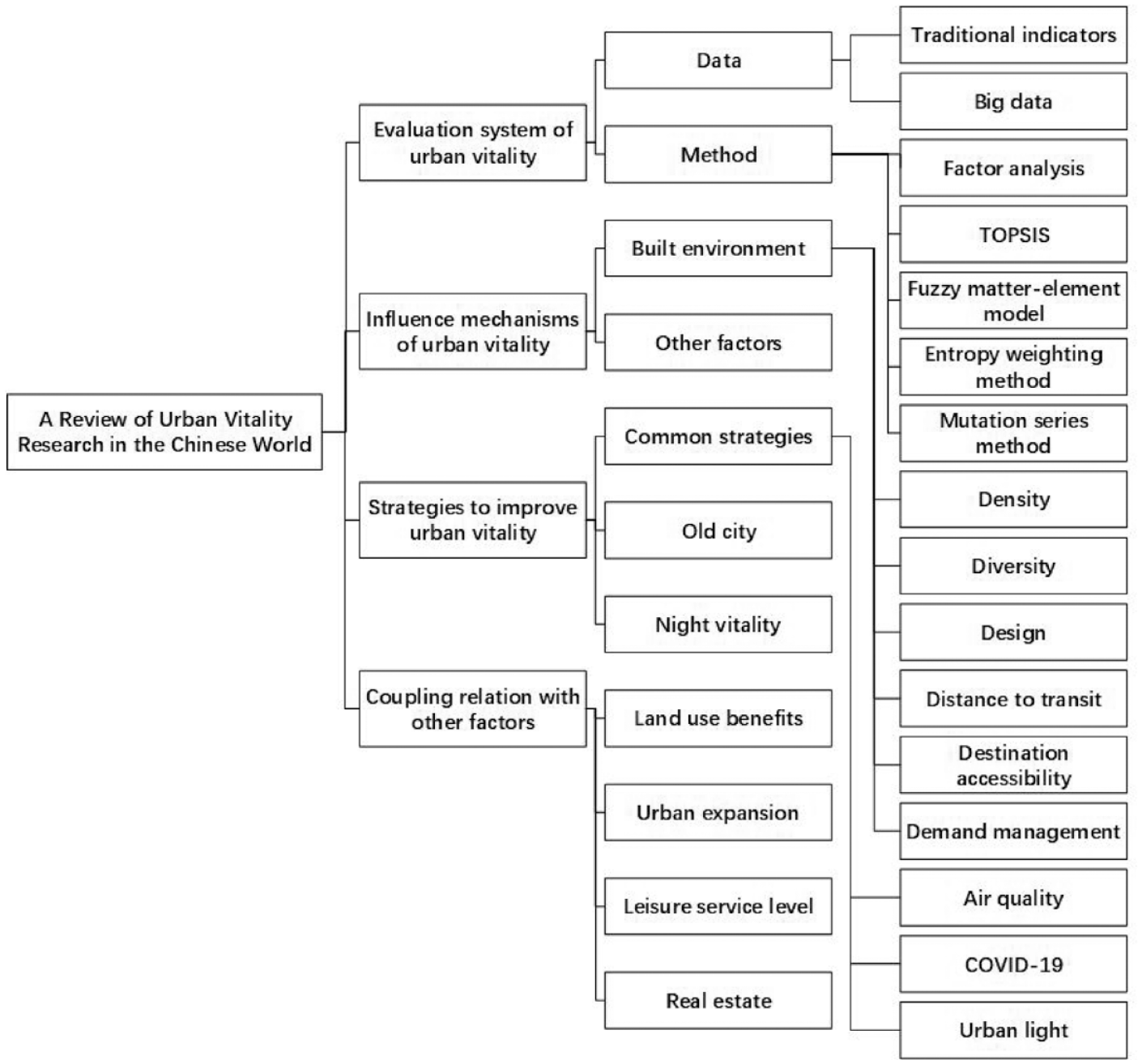
Overview framework of urban vitality research.
Evaluation system of urban vitality
Urban vitality is a dynamical process which exerts long-term effects on the overall competitiveness of the city. It contains several aspects, including but not limited to the economic vitality, social vitality, environmental vitality, and cultural vitality of the urban area. Urban economic vitality refers to the capability and potential of cities to achieve economic prosperity during the processes of urban development (Jin, 2007). At present, China’s cities are in a period of rapid growth whose economic vitality is mainly reflected in their capabilities in promoting economic growth through practices such as introducing capital and attracting high-quality labor. Social vitality is the social aspect of urban vitality that focuses on the pattern and intensity of social activities and interactions within the urban space (Ta et al., 2020). Social vitality is often measured by the human mobility and activity density through technology such as mobile GPS data. Environmental vitality, as another aspect of urban vitality, is defined as to what degree the environmental space can meet the physiological and psychological needs of users and promote the diversity and intensity of the human activities within the space (Zheng et al., 2011). One of the common indicators of environmental vitality, for instance, is the quantity and quality of vegetation in the urban space (Zheng et al., 2011). Finally, cultural vitality is defined as the total aggregate of expression and creativity of the historical and cultural elements and contexts of the urban space vitality (Bao et al., 2019). Studies investigating such type of vitality often evaluate the role of urban space as the carrier of human activity and to what extent it meets the cultural needs of the people (Bao et al., 2019). How to measure the urban vitality index scientifically and comprehensively has always been the focus of Chinese studies on urban vitality. Scholars usually choose statistical yearbook data, a form of census data collected by Chinese central and local governments, to evaluate the vitality indicators of the city. Alternatively, many other studies applied multi-source big data to explore the degree of vitality of local areas within a city. Although with different highlights and characteristics, both kinds of studies contributed to further understanding of urban vitality and development.
Evaluating urban vitality through traditional indicators
As previously mentioned, it is typical for many urban vitality studies to use traditional statistic data to measure and evaluate the degree of urban vitality. Particularly in the context of China, the statistical yearbooks issued by central or local government were frequently used as the main data source, which covers several statistical indicators on social, economic, and demographic perspectives of the city. Studies evaluating urban vitality with traditional data often implemented different modelling methods to determine the weights of vitality indicators and select the most reasonable indicators.
Common indicators and data
Among the studies that explored indicator selections in urban vitality, agreement has been achieved in the general principles for the indicator selecting process. The first is the principle of scientificness and representativeness (Wang et al., 2013; Ye et al., 2020). The design of indicators must follow this principle as it is the only way that the rationality of the evaluation results can be ensured and that the selected indicators are comprehensive and fair. For instance, many researchers tended to choose Gross Domestic Product (GDP) as the most representative indicator for economic vitality (Li et al., 2021; Wang et al., 2021c). The second is the principle of comparability and operability (Hu and Lan, 2021). Since the catalogues of statistical yearbooks vary among places, the nomenclatures of indicators used could be different, which may bring additional difficulty in the data collection and analysis. For example, statistical yearbooks of different provinces might count population in different ways (e.g., permanent population versus total population). Hence, indicators with clear and consistent meaning should be chosen to avoid potential confusions. Meanwhile, the calculation caliber and selection timing of the data also should be identical. Otherwise, without the consistency of name, timing, and calibers, the evaluation would be incomparable and meaningless. The selected indicators should also be easy to obtain and maneuverable (Jin, 2007). If some individual indicators were missing, they can be deduced by using mathematical methods. For example, when the population data of one year in a chosen city is unavailable, it is plausible to apply linear interpolation on the population data of the adjacent years to make an approximation. Lastly is the principle of relevance and flexibility. Since urban vitality is a relatively abstract concept that is difficult for direct manifestation and is influenced by numerous factors in all aspects of society of the city, it is necessary to judge whether the indicators are clearly related to the actual vitality of the city during selections (Wang et al., 2021c).
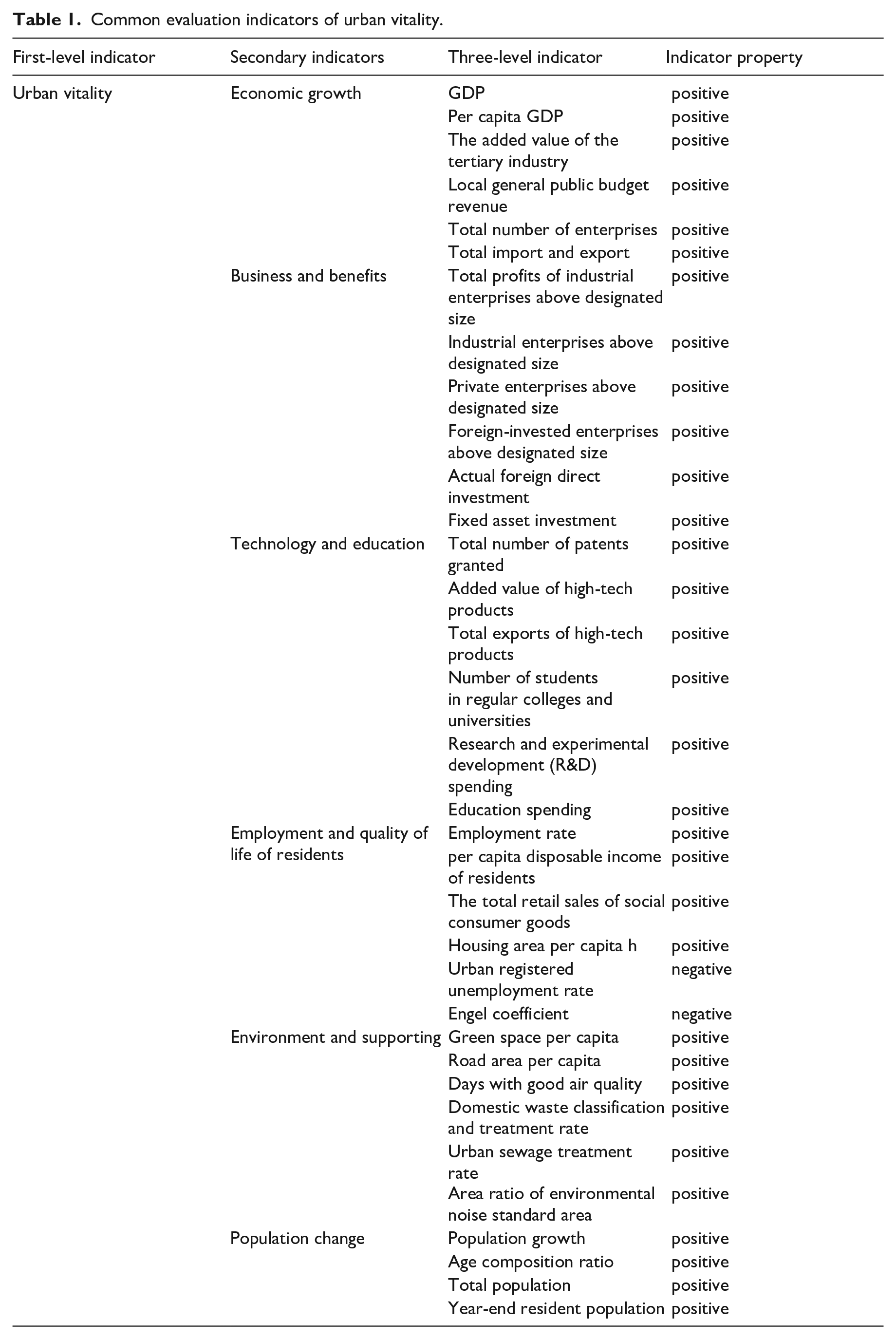
After selecting the indicators that follow the selection principles, the urban vitality index system can be established as a multi-level framework. Vitality is the first-level indicator. The second-level indicators include some general categories such as economic strength, population size, level of science and technology, employment, and quality of life. The third-level indicators include specific statistical values such as Gross Domestic Product (GDP), per capita GDP, and total import and export.
Economic vitality is perceived as the most important indicator (Li et al., 2021). Economic development GDP is the sum of the added value of various industries and has been perceived as a convincing indicator to reflect regional macroeconomic development level. With the current background of globalization economic system, foreign economy and trade can also substantially drive a city’s economy. Therefore, total import and export volume can be used as evaluation indicators for measuring cities’ economic vitality. Furthermore, fixed asset investment and per capita disposable income are also plausible economic vitality indicators that comprehensively reflect the economic condition of a region (Wang et al., 2021c).
The operation of enterprises contributes to the development of the city as not only the economic cell of the city’s vitality, but also the basis for the city to expand investment and scale of productivity development (Jin, 2007). Greater sizes of industries and enterprises and higher financial liquidities tend to stimulate the city’s economy. Usually, indicators such as the number of industrial enterprises above designated size and the total output value of industrial enterprises above designated size are used as indicators for evaluating urban vitality (Zhao, 2020).
The level of technology and of education also provide support for urban vitality (Li et al., 2021; Pan et al., 2020; Wang et al., 2021c). Technology drives economic development as better technology and innovation capabilities bring more attractiveness to cities, thus promoting better vitality and further development. Higher education level can improve the quality and the talents of labor force, which subsequently leads to stronger productivity and innovation capability for the city.
Employment is the foundation of people’s livelihood and the fundamental premise for people to improve their lives (Hu and Lan, 2021; Zhang and Qin, 2011). The quality of employment and the income of the residents directly affect the attractiveness of a city to migration. To a certain extent, residents’ income reflects the quantity and quality of the labor force of the region, which are important driving forces for urban vitality (Li et al., 2021).
Environmental indicators reflect the environmental aspect of urban vitality (Liu et al., 2010; Wang, 2019). The urban environment not only includes natural landscapes but also the social environment. A good urban environment is important for improving people’s quality of life and attracting foreign visitors and investments. Hence, the environmental aspect should be considered in the urban vitality evaluation system.
Individuals are the basic units of a city whose consumptions and other behaviors directly play a key role in the city’s economic development (Ye et al., 2020). Generally, the number of permanent residents can accurately reflect the population size of a city because economic development affects population flow as some people will choose other cities rather than their place of residence for career development purposes. Cities with influxes of population flows tend to receive benefits in developments because the consumer demand of the growing population contributes to the growth of the local economy and the talent and innovation brought by growing human resources are important positive factors driving regional economic and social development. Therefore, the indicators associated with population sizes and flows can reflect the vitality of a city.
According to the above-mentioned principles and facets of urban vitality evaluations, the commonly used urban vitality indicators of several Chinese literatures are summarized in Table 1. Overall, the evaluation of urban vitality based on traditional data has several advantages: the statistical yearbook data are publicly available and easy to access; the urban vitality evaluation method is relatively simple to operate; and the statistical units of the yearbook data are usually counties and districts, which are more suitable for comparison between cities and to explore the relationship between the development patterns and urban vitality of different cities. There are also some disadvantages: too strong dependence on statistical yearbook data as the only data source; the late release time of statistical yearbook data causes hysteresis as the indicators lag behind the temporal dynamics; the statistical yearbook has less refined granularities which is not conducive to more fine-grained exploration on vitality, adding difficulty for intra-city research.
Common evaluation indicators of urban vitality.
Common modelling methods for assessing urban vitality
The commonly used models for constructing urban vitality index system from traditional data mainly include factor analysis, weighted TOPSIS, entropy weighting, Fuzzy matter-element model, hierarchical method, and mutation series method.
The most widely used method for assessing urban vitality is factor analysis (Hu and Lan, 2021; Jin, 2007; Wang and Chen, 2020; Wang et al., 2021c). The factor analysis method can reduce the dimension of the urban vitality indicators to form a more comprehensive index. Since the selected urban vitality indicators can be mutually dependent on each other, their impact on urban vitality cannot be determined. This method is used to conduct correlation analysis to integrate indicators to analyze the impact of individual indicator on urban vitality and obtain the most important factors affecting urban vitality. The total scores of the factors are calculated using the variance contribution rate as the weight to sort the vitality of multiple cities.
The TOPSIS method can be used to rank a limited number of evaluation objects according to their proximity to idealized goals and evaluate relative merits among existing objects (Pan et al., 2020; Wang et al., 2021c; Zhou et al., 2020). It can avoid data subjectivity and is suitable as a framework method for evaluating multiple indicators of urban vitality.
The fuzzy matter-element model is a relatively new method for evaluating urban vitality (Liu et al., 2010; Wang et al., 2013). The establishment of an entropy weight fuzzy matter-element model based on the systematic evaluation of urban vitality can not only compare the vitality status of different cities horizontally, but also measure the vitality development trend of a certain city vertically. Furthermore, it has advantages of calculation simplicity and the ability to avoid the subjectivity of human judgement of vitality standards to affect the evaluation results.
When the entropy weighting method is used to evaluate urban vitality, the weight of the indicator can be determined according to the influence of the relative change degree of the urban vitality index on the system. Hence, it can also overcome the influence of human subjective factors caused by the subjective weighting methods (Lei et al., 2017; Li et al., 2021). However, the final evaluation of urban vitality will also change with the selection of indicators, and there is a possibility of weight distortion.
Some scholars have also used Analytic Hierarchy Process (AHP) to quantify urban vitality (Wang et al., 2021c). This method can compare the proposed urban vitality indicators, determine the relative importance of each urban vitality index, and finally obtain the importance of all indicators relative to urban vitality.
Ye et al. (2020) used the mutation series method for modeling. This method scientifically evaluates the relative importance of each urban vitality indicators and avoids the subjectivity of artificially assigning weights. It is very suitable for the situation where there are many indicators of the urban vitality system and each indicator has different attributes.
Evaluate urban vitality through big data
The studies on urban vitality summarized above were based on traditional data sources and methods which have apparent shortcomings such as limited resolutions and hysteresis. With the emergence of big data, data sources suitable for assessing urban vitality has been proliferating. At present, the most frequently used geospatial big data sources for urban vitality studies in China include mobile phone GPS data, transportation data (e.g., bus and taxi), social media data, and point of interest (POI) data (Liu, 2016). Apart from these social sensing data, remote sensing data has also been implemented for drawing new insights in evaluating urban vitality.
Traditional census data can only reflect static social vitality, while mobile phone signaling big data can record individuals’ spatial and temporal movement trajectories thus more accurately reflecting the spatial-temporal distribution of social vitality. Usually, the research selects the population density at a fixed time (e.g., weekends or afternoon) to indicate social vitality which takes the influence of the working population on the indicated city vitality into account (Wang et al., 2021b)
Data collected by social media can also measure the social vitality in the urban space. Social media check-in data can express people’s preferences of activity types and locations and capture patterns of people’s daily routines (Peng et al., 2020; Sun et al., 2019; Wu et al., 2018). For example, Zhu et al. (2020) used social media check-in data (Sina Weibo) to compute the visiting density in the Traffic Analysis Zone (TAZ) to characterize the vitality of the city.
Transportation trajectory data can record and depict the travel information of urban residents accurately with wide coverage, all-weather operation, and precise spatiotemporal characteristics of arrivals (Ta et al., 2020). Based on the locational data of taxi arrivals in a week in Shanghai in 2016, Ta et al. (2020) measured social vitality by the weekly average taxi arrival density per hour in the areal unit of studied area.
POI data have been used as a typical indicator to measure the cultural vitality of a city by reflecting the activeness of density cultural activities and events. As a kind of point data representing geographic entities, POI data contain spatial information including latitudes, longitudes, addresses, and attribute information such as names and categories of different types of facilities (Bao et al., 2021; Feng et al., 2021). The POI data have several advantages such as abundance, high accuracy, and real-time characteristics, which can effectively improve performance of data analysis while saving considerable costs. (Zhang et al., 2017).
Baidu heat map data is a data source that provides information on “what people do with their phone in different places”. When users access the services and products of Baidu such as maps, weather, music, and search engine, their locations are recorded by the dataset, which can reflect spatial and temporal patterns of people and is thus suitable for measuring urban vitality. This data source has the characteristics of being dynamic, continuous, and easy to identify. Based on POI and Baidu heat map data, Zhang et al. (2017) established an urban space vitality research method based on space usage intensity. Focusing on the central urban area of Hangzhou, they analyzed the temporal and spatial characteristics and relative dynamic changes of residents’ activities, which further lead to the establishment of evaluation indicators that define and analyze different types of urban space vitality.
The above social sensing big data have brought many opportunities for urban vitality evaluation research. On the other hand, remote sensing data have also provided many ideas and insights. Urban night light data, in the form of remote sensing imagery, are appropriate for studying multi-scale social and economic data gridding (Bao et al., 2023; Huang et al., 2020). The brightness of urban night lights represents the degree of local economy activities, whose positive relationships with GDP has been found with statistical significance at several spatial scales such as provinces and counties (Wang et al., 2021b). Therefore, it can be used for measuring economic vitality of the urban areas. With the advantages in high spatial resolutions, night-time light data can reflect the urban economic vitality in small spatial scales such as streets and communities (Wang et al., 2021b).
From the literature using big data for evaluating urban vitality, it can be found that the data granularity of big data is sufficient to allow comparison among internal parts within the city, providing more perspectives on urban vitality with higher spatial and temporal resolutions. However, the data processing procedures of big data are relatively laborious, with increasingl redundant and extraneous data. Moreover, the big data in urban analytics suffer from limitations such as selection bias and low precision (Liu et al., 2018). Those studies using social sensing big data including mobile geo-location data, Baidu heatmap, and social media check-in data are particularly affected in terms of precision and representativeness. Considering that young people use location-based services much more frequently (Pan et al., 2022), the forementioned sources of big data could be highly biased in age groups where young people dominate the user demography. Subsequently, the mapped social vitality may only depict the “vitality” of the young rather than a comprehensive manifestation of the vitality of the whole society in the city. A few Chinese urban vitality studies pointed out the risk of unrepresentativeness due to selection bias (Ta et al., 2020; Zhang et al., 2017). Big data sources such as Baidu heatmap only contain information of the user group of the app and can only generate approximate results of population distribution (Zhang et al., 2017). Ta et al. (2020) stated that in-depth dynamic population composition of the big data is impossible for urban vitality evaluation due to the lack of individual attribute tags in the data. Another important issue in the implementation of big data in urban analytics that affects vitality studies is accuracy. The accuracy of data sources such as mobile geo-location derived by location-based services is dependent on the density and locations of the towers and signal strengths which suffers from spatial variations within urban areas (Liu et al., 2016), limiting the reliability of the estimated social vitality distribution.
Influence mechanisms of urban vitality
Using the methods and data sources introduced in the previous section, urban vitality on different spatial scales can be quantified, measured, and evaluated. Subsequently comes the question of what factors affect and cause the different degrees and distributions of urban vitality. To gain deeper understanding of urban vitality, Chinese scholars have conducted much research on the influence mechanism of urban vitality. The research on the influence mechanism mostly adopts statistical models such as regression models, for which vitality is used as the dependent variable to be modelled and explained by other factors. To build the theoretical framework for factor and variable selections, scholars have made hypotheses as to the influence mechanism of urban vitality from different perspectives. The most common ones are the built environment. Apart from those, several other factors were found to influence the degree and distribution of urban vitality.
The topic of influence mechanism of urban vitality has interested Chinese scholars from various academic backgrounds and research fields, including urban planning, architectural environment, economic geography, public health, politics and sociology, and finance and public management. For urban planning and architectural environment researchers, their main focus is how the built environment and urban forms affect urban vitality (Jia and Song, 2020; Ye et al., 2016). They often measure characteristics such as density, design, and accessibility of the urban built environment and model the dependency of urban vitality on these characteristics. On the other hand, researchers in other fields may investigate how an event or phenomenon related to their disciplines exert an effect on the vitality of urban systems. For example, there are public health studies exploring how Covid-19 regulations in Chinese cities affect their vitality (Ma et al., 2020). Scholars from a sociology background may choose to investigate the impact of a social phenomenon such as immigration on urban vitality (Zhou, 2018). Studies from the domain of economics and finance usually emphasize the economic aspect of urban vitality and tend to more concerned with economic indicators such as GDP (Mao and Zhong, 2020; Pan et al., 2020). Overall, as the urban system has complex nature, it is reasonable to speculate that it would continue to draw research interest from multiple academic backgrounds in the Chinese world. Collaboration among the different domains would benefit the deeper interdisciplinary understanding of the urban vitality influence mechanism.
Influence of the built environment on urban vitality
The D variable of the built environment can be used to modulate urban vitality. Cervero and Kockelman’s original “three D” for the built environment includes density, variety, and design (Cervero and Kockelman, 1997). Later research gradually expanded the dimensions into 6D indicators from the original 3D indicators, namely density, diversity, design, destination accessibility, distance to transit, and demand management (Ma et al., 2017). The impact of built environment on urban vitality can be divided into macro level (i.e., the entire city), meso level (e.g., city blocks), and micro level (e.g., streets and buildings), with different focuses and highlights (Lu and Tan, 2015).
Jia and Song (2020) used POI and land use data to describe the characteristics of the built environment from the three dimensions of density, diversity and design. They applied Luojia No. 1 night-time remote sensing data to represent the spatial distribution of urban vitality in Wuhan. Spatial analysis techniques including linear regression and spatial regression models were implemented to explore the relationship between urban vitality and the “3D” characteristics of the built environment. Their results indicated that there is a significant spatial relationship between urban vitality and the “3D” characteristics of the built environment. From their results, increasing the density of urban infrastructures, enriching the mix of land functions, and optimizing the distribution of public facilities can improve urban vitality.
On the basis of the “3D”, Wang et al. (2021b) expanded the paradigm by adding another two dimensions and constructed a “5D” index system – density, design, diversity, distance to transportation, and destination accessibility – to measure the urban built environment. They then investigated the association between urban vitality and the built environment characteristics measured by the 5D system. They found that higher POI density, building density, average number of building floors, and mixing land use have significant contributions to higher urban vitality. They implemented the bivariate factor interaction to explore the interactive effects among the built environment indicators and discovered that population density and land use mixing have a very strong interactive effect with the road network density. Higher population density and land use mixing can considerably strengthen the urban vitality of a place when convenient transportation is available. They also found that when the overall quality of urban environment is good, increasing the building floor and density can enhance urban vitality.
There are studies on the impact of urban form in the built environment on urban vitality. Liu et al. (2021) also selected urban form indicators to explore the impact of urban vitality. Urban vitality was discussed according to working days and rest days. The geographic detector model was used to rank the influence of each influencing factor. Among them, the mixed function degree affects waterfront. Neighborhood vitality has the greatest impact, followed by floor area ratio, open degree, public transport frequency, facility completeness degree, and format diversity index. And when different factors act together, the impact on urban vitality is more significant.
The effects of built environment on urban vitality were found to have spatiotemporal heterogeneity, which was rarely explored. Using a spatiotemporal geographic weighted regression model (GTWR), Wang et al. (2022) examined the spatiotemporal variations of impacts of location, functional mixture, and density on urban vitality. The study found that distributions of urban vitality experienced large spatiotemporal changes in the city within a period of 24 hours. The marginal effects (i.e., regression coefficients) of location, functional mixing, and functional density on urban vitality not only vary geographically but also have a large variation between weekdays and weekends. This study entails the necessity for considering temporality in urban vitality research whereas most of the studies focused on the geographic distribution of urban vitality.
Influence mechanism of other factors on urban vitality
Apart from the perspectives of built environment, many scholars have combined various other factors to explore the mechanism of urban vitality. Those studies found that functional characteristics (Qiu et al., 2022; Yang et al., 2020), transportation facilities and public transportation service level (Qiu et al., 2022; Yang et al., 2020), building layout (Yang et al., 2020), permanent population (Gao et al., 2018; Liu et al., 2018; Qiu et al., 2022), and facility supply density (Gao et al., 2018; Mao and Zhong, 2020; Qiu et al., 2022) have significant impacts on urban vitality. On the other hand, location characteristics (Yang et al., 2020), urban characteristics (Yang et al., 2020), block road network characteristics and scale effects (Gao et al., 2018), and building age indicators (Gao et al., 2018) have very weak impact on urban vitality. However, there are also studies showing that road network density (Liu et al., 2018) has considerable impacts on urban vitality. Furthermore, different cities and blocks presented different strengths of the factors, indicating that the urban vitality influence mechanism is spatially heterogeneous (Mao and Zhong, 2020). Taking streets as the main research object, Long and Zhou (2016) first classified streets into three types: Type A (public management and public services), Type B (commercial service facilities), and Type R (residential) streets. The research shows that the most significant influence factors vary among different street types. The vitality of A-type streets is negatively influenced by the distance from Tianfu Square. The vitality of B-type streets are closely related to subway entrances. The vitality of R-type streets are more affected by functional mixing. Therefore, the influence mechanism of urban vitality not only varies spatially but is also decided by the main functionality of the street.
Air quality affects residents’ activities in urban spaces. Notwithstanding the intensifying trend of air pollutions in Chinese cities, very few studies have examined the quantitative relationship between air pollution and urban vitality. One of these is Wang et al. (2021a), which constructed panel data with streets as spatial units and days as time units based on a variety of datasets including social media check-in record data in Guangzhou in 2019, daily meteorological and air quality data, and built environment data. Through standard deviation ellipse (SDE) and panel regression model, Wang et al. (2021a) measured the inhibitory effect of air pollution on urban vitality and the heterogeneity of such effect on different built environments. The found that the air quality index has significant negative impacts on urban vitality. This inhibitory effect on urban vitality was identified as heterogeneous in different built environments. Factors such as POI density and distance from the city center were found to strengthen the inhibitory effect while factors such as subway station density, road intersection density, and land use mix degree tended to weaken the inhibitory effect of air pollution on urban vitality.
COVID-19, as a global public health event that largely affect people’s mobility and economic activities, has impacted the vitality of cities in China as well. Ma et al. (2020) and Li et al. (2022) used travel intensity data and migration data to analyze urban vitality recovery of over 300 cities in China. Ma et al. (2020) discovered that the regional centrality of the city, the disease control intensity, and the risk of external infection input were the most important factors in influencing urban vitality recovery. While these factors continued to have significant effects, Li et al. (2022) later found that the administration hierarchy of city had the strongest impacts on urban vitality in China in 2022.
While most studies on the influence mechanism of urban vitality only looked at the vitality of daytime, some scholars have discussed the influence mechanism of night-time vitality. Pei et al. (2018) found that the three explanatory variables of street scale, intersection density, and street function mixture which are often regarded as significant factors in explaining urban vitality in daytime were not significantly correlated with street vitality at night. Meanwhile, the continuity of street interface and functional density are positively correlated with night-time street vitality while street morphological richness were negatively correlated. Qin and Long (2022) found that the density of catering, accommodation, shopping, and bar facilities have strong influences on night-time economic vitality, while the influence of permanent population density is the weakest. The interactions of influencing factor can further enhance the vitality of the city, among which the interaction between the density of resident population and the density of catering facilities has the strongest influence (Qin and Long, 2022). Zhong and Wang (2019) found that the large-scale agglomeration of public facilities has strong positive effects on night-time vitality, while the surrounding agglomeration of industrial land has negative effects. Gao et al. (2020) investigated the influence mechanism on both daytime and night-time urban vitality based on the physical and spatial elements of the built environment. They discovered that the spatial development intensity and spatial functionality are the strongest positive, influencing both daytime and night-time vitality. They also found that the spatial accessibility factor has stronger impacts on night-time vitality than spatial environment quality. To summarize, these studies identified the heterogeneity of the influence mechanism of urban vitality between day and night. At night-time, the accessibility and the density of facilities for night life tend to strengthen urban vitality while other built-environment characteristics have relatively weaker influences compared to the daytime.
Influence mechanism: limitations, challenges, and future
There are still deficiencies and challenges in the current research on the influence mechanism of urban vitality. From the contemporary Chinese urban vitality studies, we consider the single data source reliance and the lack of consistent conceptual framework for variable selection as the biggest issues. Many studies only adopted night light data or other single data sources as urban vitality indicators, which caused issues in representativeness in capturing urban vitality. For urban vitality studies, integrating data from multiple sources is essential. Practices such as solely rely on POI data of an application would limit the scope only on the audience group of the software and inevitably bring risks of ignoring activity characteristics of other groups (Zhao et al., 2019). Furthermore, there are still considerable disagreements among the independent variable selection and the boundary between the independent and dependent variables in urban vitality studies. As there is no consensus on the paradigm for variable selection, different studies on different cities turned out to adopt highly heterogenous factors. Consequently, the correlations and causalities of urban vitality can hardly be compared. Furthermore, urban vitality influence mechanism studies have not yet reached agreement on the definition of urban vitality and its boundary with other variables. For example, some studies used POI data as the representation of urban vitality (Zhao et al., 2019) while some others use POI data as an explanatory variable for modelling urban vitality that has been defined and measured in different ways. (Liu et al., 2021; Yang et al., 2020; Zhou and Zhang, 2020). These two issues not only weaken the robustness of vitality research but also limit the comparability for obtaining further insights. Therefore, it is plausible for future studies to develop a comprehensive and converged conceptual framework for defining and measuring urban vitality with multiple types of data.
As the availability of individual spatiotemporal big data keeps increasing, more in-depth research can be accurately conducted in combination with individual data such as mobile phone signaling and WeChat (a real-time communication application) (Tu et al., 2020). The use of multi-source data would effectively reduce the sampling bias to and strengthen the robustness of findings on urban vitality. Another trend is that the data incorporated in urban studies are changing from static data (e.g., census data) to dynamic data. Dynamic data can be more intuitive and reflect comprehensive urban vitality with immediate responses. Therefore, spatiotemporal and dynamic big data have paved the way for future progress on urban vitality. Future studies are also recommended to go beyond the previous geographic limitation and investigate vitality in different cities and regions.
In terms of methodology, OLS regression model (Jia and Song, 2020; Ta et al., 2020; Yang et al., 2020), geographical detectors (Liu et al., 2021; Wang et al., 2021b), and spatial autoregressions model (Cao et al., 2021; Zhu et al., 2020) are the most common methods for analyzing the influence mechanism of urban vitality. These methods have limitations respectively. The geographic detector can only handle categorized data for explanatory variable. The OLS model is aspatial, thus overlooking the effect of adjacent areas in urban vitality distribution. The spatial autoregressive models consider the influence of adjacencies beyond the global intercept of the region. However, it still can only depict the linear relationships among variables, overlooking the complex non-linear relationships which are often concealed within the complex social processes and mechanisms. For future studies, it is plausible to borrow tools from advances in machine learning and deep learning and use methods such as convolutional neural network and graph convolutional neural networks to model the non-linear relationships in urban vitality. For example, convolutional neural networks can be implemented to extract features from the visual information of the urban environment from aerial or street view imagery. The features extracted can be used as explanatory variables in urban vitality influence mechanism studies. As many of the studies reviewed discovered that the distribution of urban vitality tends to have significant spatial autocorrelation, it is plausible for future studies to use the graph convolutional neural network to replace the classic spatial regression to better capture the spatial dependencies.
The existing urban vitality was also limited in spatial and temporal scales. For temporality, urban vitality varies across different periods. At present, most research on the influence mechanism uses data from a chosen period as a representation, while exploration on the influence mechanism of long-term series is missing. For spatial scales, research on the influence mechanism of urban vitality mostly focuses on one single city in China and investigates the influence mechanisms of urban vitality within the city. However, only a very few studies have investigated the differences of urban vitality influence mechanism between different cities. These studies usually explored the vitality on macro-level by treating each city as basic spatial units where the internal urban vitality distributions are omitted. The findings of these studies indicated that there are substantial disparities in urban vitality among Chinese cities (Jin, 2007; Wang et al., 2021b). Such inequality not only exists on a national level, where cities in eastern regions have much higher vitality than those in western regions, (Ma et al., 2020) but also at the province scale, as vitality of different cities was found to be highly uneven within a province (Lei et al., 2017; Wang, 2019; Wang et al., 2013). Considering that the macro-level studies illustrated influence mechanism disparity among Chinese cities, it is plausible for future research to investigate and compare the vitality differences among cities at finer granularities by choosing more than one city as research subject.
Research on urban vitality improvement strategies
“How to improve urban vitality” has been a spotlight for discussions in China not only for scholars but also the policy makers for a long time. With the knowledges and insights extrapolated from the urban vitality influence mechanism research, several strategies for urban vitality improvement have been proposed.
The improvement of urban vitality is of substantial significance particularly in the context of contemporary and future Chinese urban developments. During the previous rapid urbanization and urban sprawl processes, some unprecedented problems such as “ghost city”, “urban decline”, and “land-dominated urbanization” occurred (Zeng et al., 2018). Many urban areas, particularly the core urban areas, have found their vibrancy diminished and require revitalization. Meanwhile, with the development of urban economics and the changing lifestyles and values of the urban residents, the people’s demands for high-quality living experiences in the urban environment also increase (Xia et al., 2020). Therefore, improving urban vitality that actually satisfies people’s multi-dimensional needs from the urban environment is essential for addressing the problems that have occurred during the urbanization processes, revitalizing the urban areas with declined vibrancy, and achieving the goal of sustainable urban developments (Long and Zhou, 2016; Zeng et al., 2018; Xia et al., 2020).
Through examining various literatures, we summarized the three most common urban vitality improvement strategies recommended by scholars. The first is improving functional density and diversity of the urban environment (Jia and Song, 2020; Liu et al., 2021; Qiu and Peng, 2006; Qiu et al., 2022; Tong, 2014; Wang and Ma, 2020; Ye et al., 2016; Zhu et al., 2020). To create a vibrant urban living environment, constructing a fully functional social network is essential, which requires sufficient land use mixing and the integration of living, working, leisure, and shopping functionalities and cultural facilities. Increasing the quantity and diversity of the facilities can significantly improve urban vitality. Additionally, higher building density with well-designed green spaces would further improve the vitality. However, this approach of enhancing functional diversity is not universal and cannot be applied on industrial land as studies have found that increasing the degree of land use mixing can inhibit urban vitality (Zhu et al., 2020). The second strategy is facilitating spatial interactions. For pedestrians, improving the continuity, openness, and publicity of the street and block can lead to better vitality. In terms of public transportation, increasing the amount and accessibility of public transport services and facilities can enhance the local environments’ connections to other areas and promote better urban vitality (Jia and Song, 2020; Liu et al., 2021; Qiu and Peng, 2006; Qiu et al., 2022; Ye et al., 2016b; Zhu et al., 2020). The third strategy is creating a human-scale neighborhood; designing blocks on a people-oriented scale and developing on a small scale (Jia and Song, 2020; Qiu et al., 2022; Tong, 2014).
Most of the literature on improving urban vitality generally considered the concept of urban vitality in its entirety. However, some studies found that different types of urban vitality need different improvement approaches, which can even contradict with each other (Ta et al., 2020). For instance, they found that increasing the density of building and population can improve economic vitality while negatively impacting social and cultural vitality. Similarly, the agglomeration effect of urban centers is beneficial to economic vitality but has negative effects on social vitality while being neutral for cultural vitality. Therefore, caution should be paid to different kinds of urban vitality and their heterogenous processes and mechanisms when making and practicing urban vitality improvement.
Some urban vitality studies have particularly focused on the old city blocks of Chinese cities (Yang et al., 2020; Zheng and Sun, 2019). At present, scholars have realized the importance and necessity of revitalizing the old city blocks from the perspective of urban vitality and considering the specific environmental and cultural urban contexts and have put forward several related vitality improvement strategies. Like other urban areas, places with higher building and functional densities tend to have better vitality (Chen and Wang, 2021; Guo et al., 2020; Yang et al., 2020). However, in many cases the old city areas have too high building density, which can cause overcrowding in the roads and streets, negatively influencing urban vitality (Zheng and Sun, 2019). To overcome this issue, scholars have suggested in changing the building forms to semi-open structures (Zheng and Sun, 2019) and increase the space for public activities on the first floor of buildings (Yang et al., 2020). Contrary to the common urban vitality improvement approaches, some studies identified that increasing the functional diversity may lower the vitality in some areas of old city blocks because some streets were specialized into specific services and functions and would have their special cultural context damaged if additional types of functions were added (Chen and Wang, 2021). Chen and Wang (2021) also found that higher building engenders worse urban vitality in the old city blocks and suggested limiting the building heights for reconstruction and renewal planning in the old city. During the reconstruction and renewal processes, local people’s habit should be respected, and a wider social participation of the residents are higher encouraged to boost the urban vitality of the old city blocks (Zheng and Sun, 2019). Studies also proposed that the further development of scenic spots and historical sites with additions of more facilities to their surrounding can enhance urban vitality (Yang et al., 2020) .
Night life is a critical element of living experiences in modern cities. The urban environment at night has very different characteristics than the day. Lighting is one of the a few of modifiable factors that can affect urban social life in terms of perception, behavior, time, and culture and stimulate the vitality of the city at night. Improving urban lighting can start from the functional needs of the urban space environment, which brings benefits in encouraging positive behavior in public space, improving public safety and social experience (Li et al., 2018). It would also promote the frequency and duration of urban space usage in night-time (Guo and Lin, 2021). Apart from the functionality, changing urban lighting should also consider cultural and aesthetical values as constructing a night-time urban space that responds to the diverse social and cultural needs of the people would have positive effects on supporting sustainable urban development and renewal(Guo and Lin, 2021). Aside from the lighting, providing richer cultural facilities and services specifically for night life is another approach for improving night-time urban vitality. The authority can consider arrange non-profit projects and activities catering the entertainment and leisure demands of urban residents (Cui, 2010).
Exploration of the coupling relationship between urban vitality and urban development issues
The coupling relationship refers to the mutually dependent relationships among subsystems. It has been widely adopted in the form of coupling coordination degree model in econometric and urban development studies to investigate the interaction among different development processes. The previous influence mechanism studies mentioned above treat urban vitality as only dependent on other explanatory variables and overlooked urban vitality’s impacts on the explanatory factors and other urban social and economic processes. To explore how urban vitality interacts with other urban development issues, processes, and attributes, scholars have investigated its coupling relationship to land use benefit, urban expansion, night leisure services, and estate markets.
In the study of the coupling relationship between urban vitality and land use benefit, Zhao et al. (2021) selected 28 indicators covering economic, social, ecological, and cultural aspects to construct an evaluation system by establishing a coupling coordination model. The study found that during 2009–2018, the two subsystems of land use benefit and urban vitality in Anhui Province were overall highly coupled with minor fluctuations. However, during the whole period, urban vitality index was greater and more advanced than the land use benefit index, indicating lag of land use during the development process. Therefore, it is suggested to strengthen the efficacy in land use for a more coordinated and stable urban development.
Lei et al. (2022) used DMSP-OLS and NPP-VIIRS night-time light data to extract the urban built-up areas of the urban agglomeration from 1992 to 2017. They used the urban expansion rate index to analyze the dynamics of urban expansion and its evolutionary characteristics. The entropy method was used to evaluate and measure urban vitality and explore the coupling relationship between urban vitality and urban expansion. During the study period, urban vitality showed a gradual increase annually. The coupling and coordination of urban vitality and urban expansion have been accordingly strengthened. Factors such as economic development, urban planning, and geographic location advantages were also found to have impacts on the dynamics of urban vitality and urban expansion as well as their coupling and coordination.
Sun and Zhang (2021) measured the urban social vitality at night in Nanjing by Baidu Heatmap and explored its coupling relationship to the level of night-time leisure services. They discovered that the degrees of coupling and coordination have very spatial variation where central city areas have a high level of coupling and coordination which gradually decreases toward the periphery areas. They also noticed that the hotspots of night-time urban vitality in the periphery areas of Nanjing are concentrated at subway stations and suggested further development of night-time leisure services in those areas (Sun and Zhang, 2021).
In a case study in Shenzhen, the urban economic vitality was found to be highly coupled with the real industry during 1999–2019 (Li, 2021). The degree of coupling coordination between economic vitality and the real-estate industry has been growing overall from low coordination to high coordination. Based on the results, Li (2021) indicated that the real-estate industry’s development has lagged behind economic vitality in Shenzhen despite their high level of coupling and coordination, suggesting more regulations and encouragements in the real-estate market.
Currently, the studies on the coupling relationships associated with urban vitality are still relatively scarce. From the studies discussed above, we found that the current explorations of the coupling relationship between urban vitality and other factors mostly evaluated urban vitality through statistical yearbooks. Attempts that implemented big data techniques were rarely made. Therefore, inclusion of more comprehensive data is strongly recommended in future research. These studies only included two subsystems in the coupling coordination model. It is plausible to add more subsystems in the urban development processes to better evaluate the feedback mechanisms of urban vitality, thus aiding further understanding of the urban environment. The scopes of these research mostly focus on single cities. For future research, it is plausible to apply coupling coordination models on multiple proximate cities to monitor the degree of coordinated progress and interactions in regional urban vitality.
Summary
For decades, urban vitality has been the one of the key topics in multiple disciplines in China. The concept and definition of “vitality” are becoming more and more polished and developed while various research methods being implemented on different perspectives. How to express the vitality of a city more comprehensively is still the focus of the research. The future technological progress in big data will provide novel insights and possibilities for vitality research. There have been many studies on urban vitality evaluation through social perception data while the potentials brought by remote sensing images have not yet been fully explored. The combination of the social perception data and remote sensing is a highly plausible research focus for future studies. While studies have also been shifting from using single factor to multi-factor, most findings were regional rather than universal. Overall, the empirical studies on urban vitality are still scarce. Many scholars have discussed on how to improve urban vitality and put forward practical suggestions for decision-makers in urban development which enhanced the significance of the research and practice in urban vitality.
Footnotes
Acknowledgements
We appreciate the detailed comments from the Editor and the anonymous reviewers.
Declaration of conflicting interests
The author(s) declared no potential conflicts of interest with respect to the research, authorship, and/or publication of this article.
Funding
The author(s) disclosed receipt of the following financial support for the research, authorship, and/or publication of this article: We acknowledge the financial support from the National Natural Science Foundation of China (42271471, 42201454, 41971331,41830645), and China Postdoctoral Science Foundation (2022M710193).
Author biographies
Yanxiao Jiang received her bachelor’s degree from China University of Mining and Technology (Beijing) in 2014 and received her master’s from Beijing Normal University. She is currently pursuing a PhD at the Institute of Remote Sensing and Geographic Information Systems, School of Earth and Space Sciences, Peking University.
Yuyang Zhang received a BSc degree in Geography from University of Bristol, United Kingdom in 2021 and the MSc degree in Social and Geographic Data Science from University College London, United Kingdom in 2022. He is currently a prospective student for a PhD at Peking University, China.
Yu Liu received a BSc, MSc, and PhD from Peking University, Beijing, China, in 1994, 1997, and 2003, respectively. He is currently a Professor with the Institute of Remote Sensing and Geographical Information Systems, Peking University. His research interest concentrates on humanities and social science based on big geo-data.