



Abstract
The debate about how Mobility as a Service (MaaS) will revolutionize individual and collective mobility is gaining increasing attention from researchers, industries, and public sectors. MaaS is expected to create a techno-utopia with a new organization and operation of transport systems where residents have equal access to instant and ubiquitous mobility services. However, transport service is an artifact that is highly dependent on the construction of urban infrastructure. The success of MaaS requires the support of urban infrastructure that we categorize as (1) transport-flow infrastructure, (2) information-flow infrastructure, and (3) computing-flow infrastructure. The connotation of urban infrastructure here includes not only conventional concepts, such as transportation infrastructure, but also intelligent transportation concepts, such as high-speed communication networks and autonomous fleets. Moreover, travel behavior data collected by city sensors, communication networks, and intelligent vehicles require appropriate infrastructures to dynamically compute for fleet dispatch and demand-supply match. Based on the degree of integration of these infrastructures, MaaS projects will have different results in varying cities. From concept to practice, given that a vast disparity in infrastructure exists between cities, we need an inclusive, mobile, and global understanding of the MaaS concept to make it successful in different parts of the world.
Introduction
The basic concept of Mobility as a Service (MaaS) is to provide an integrated system where traditional services, such as public transport (e.g., metro, bus, and ferry), can be integrated with other on-demand and shared mobility services (e.g., ride-hailing, shared bikes, shared e-scooters, and car-sharing) in a single online platform (typically a mobile application) for trip planning and unified online payment. Users plan their trips in advance, book trips based on a range of available travel modes, and then pay from a single account or subscribe to a monthly bundle (Heikkilä, 2014). The earlier trial of the Whim App adopted in Helsinki, Finland, in 2016 allowed the MaaS concept to receive international attention (Audouin et al., 2018; Jokinen et al., 2019). From these encouraging reports and early trials, MaaS has been shown to make accessing multiple public transits and on-demand mobility services easier for citizens. Advocates emphasize the potential of MaaS to reduce private car ownership and transport costs and facilitate less resource-intensive modes of transport. The transition from a private car ownership mode to a shared travel mode with MaaS is expected to bring significant benefits, including reductions in vehicle-kilometers traveled, CO2, traffic accidents, congestion, and parking spaces (Jittrapirom et al., 2017; Utriainen et al., 2018).
However, MaaS does not represent direct technological innovation to the transport industry but signifies an innovative way of providing transport services to users. MaaS is designed to facilitate the integration of a wide range of mobility providers and improve the efficiency of transport networks by treating the system as a whole rather than individual elements working in isolation. Based on this, the types of services and the functions provided by MaaS vary highly depending on the infrastructure conditions of the implemented city and the needs of society. For instance, scholars raised widespread concerns about MaaS implementations in rural areas (Barreto et al., 2018a; Eckhardt et al., 2018; Liu et al., 2020) and explored substantial obstacles faced by developing countries (Hasselwander et al., 2022).
However, a vast disparity in infrastructure exists between cities in the global South and North (Cervero, 2014) and developed and underdeveloped regions (Yu et al., 2012) and thereafter makes the success and failure of MaaS implementation vary between cities. Thus, this study aims to contribute to existing discussions by reviewing the advantages and barriers of infrastructure that cities encounter in adopting MaaS. We attempt to identify potential risks associated with these pros and cons and highlight the infrastructure readiness at different levels and possible stages of MaaS implementation in cities. The expected outcomes of MaaS highly depend on the city’s infrastructure resources and should be carefully examined before implementing MaaS projects. Then, we provide a checklist as a handy toolkit for policymakers and transport experts to evaluate the infrastructure conditions of a city in implementing MaaS. Based on this checklist, three case studies from different regions were investigated in depth to analyze their success or failure experiences.
The research objective of this study is to investigate how to move MaaS from concept to practice through two aspects:
(1) Explore how urban infrastructure could support or affect the potential implementation of MaaS across cities.
(2) Evaluate the challenges and opportunities in urban infrastructure construction that could help to implement MaaS more effectively.
The remaining parts of this study are organized as follows. Section 2 concludes the mainstream research fields of MaaS and proposes an infrastructure-based conceptual framework for this review to evaluate the readiness of a city to implement MaaS from three main urban infrastructure components: (1) transport-flow infrastructure, (2) information-flow infrastructure, and (3) computing-flow infrastructure. Section 3 examines the current situations and potential barriers to implementing MaaS from the urban infrastructure perspective. Then, this section presents a checklist. After reviewing these experiences, Section 4 investigates three representative MaaS pilot projects that have been trialed in different cities: Whim in Helsinki, Finland; Move PGH in Pittsburgh, USA; and Beijing MaaS in Beijing, China. Section 5 concludes on how to evaluate the readiness of the urban infrastructure for MaaS for policymakers and transport experts to review the urban infrastructure conditions and set expectations for implementing MaaS projects in their cities.
Conceptual framework
MaaS is a nascent phenomenon. Operational pilot projects are still limited, and analysis is scarce. Instead, to date, journal articles, comments, news, technical reports, and other types of literature have dominated the evolving MaaS writings. Thus, we also consider utilizing these materials related to MaaS implementation in cities to enrich our evidence from papers published at academic conferences or in peer-reviewed journals and books. Notable streams of existing research topics include the following:
- Discussion on MaaS concepts and related definitions (Giesecke et al., 2016; He et al., 2020; Jittrapirom et al., 2017).
- Discussion on MaaS integratable business models and possible service portfolios (Kong et al., 2020a; Smith et al., 2018a).
- Potential customers and willingness to pay for MaaS (Aberle, 2020; Alyavina et al., 2020; Kramer et al., 2014; Matyas and Kamargianni, 2017; Polydoropoulou et al., 2020).
- Assessment of the current state and potential impacts of MaaS (Katsuki et al., 2017; Li et al., 2017; Nikitas et al., 2017; Rantasila, 2015; Smith et al., 2018a).
- Research on public sector engagement and governance models for MaaS (Audouin et al., 2018; Curtis et al., 2019; Heikkilä, 2014; Pangbourne et al., 2020).
- Barriers to MaaS implementation (Butler et al., 2021; Matyas, 2020; Smith et al., 2019).
Based on the MaaS studies and pilot projects that have been implemented, we review and examine MaaS-related materials from two aspects: the current situation of the implementation of urban MaaS services and the support of smart transport-related infrastructure. Thereafter, we propose a framework to assess the necessary urban infrastructure for supporting MaaS implementation from three aspects (Figure 1).
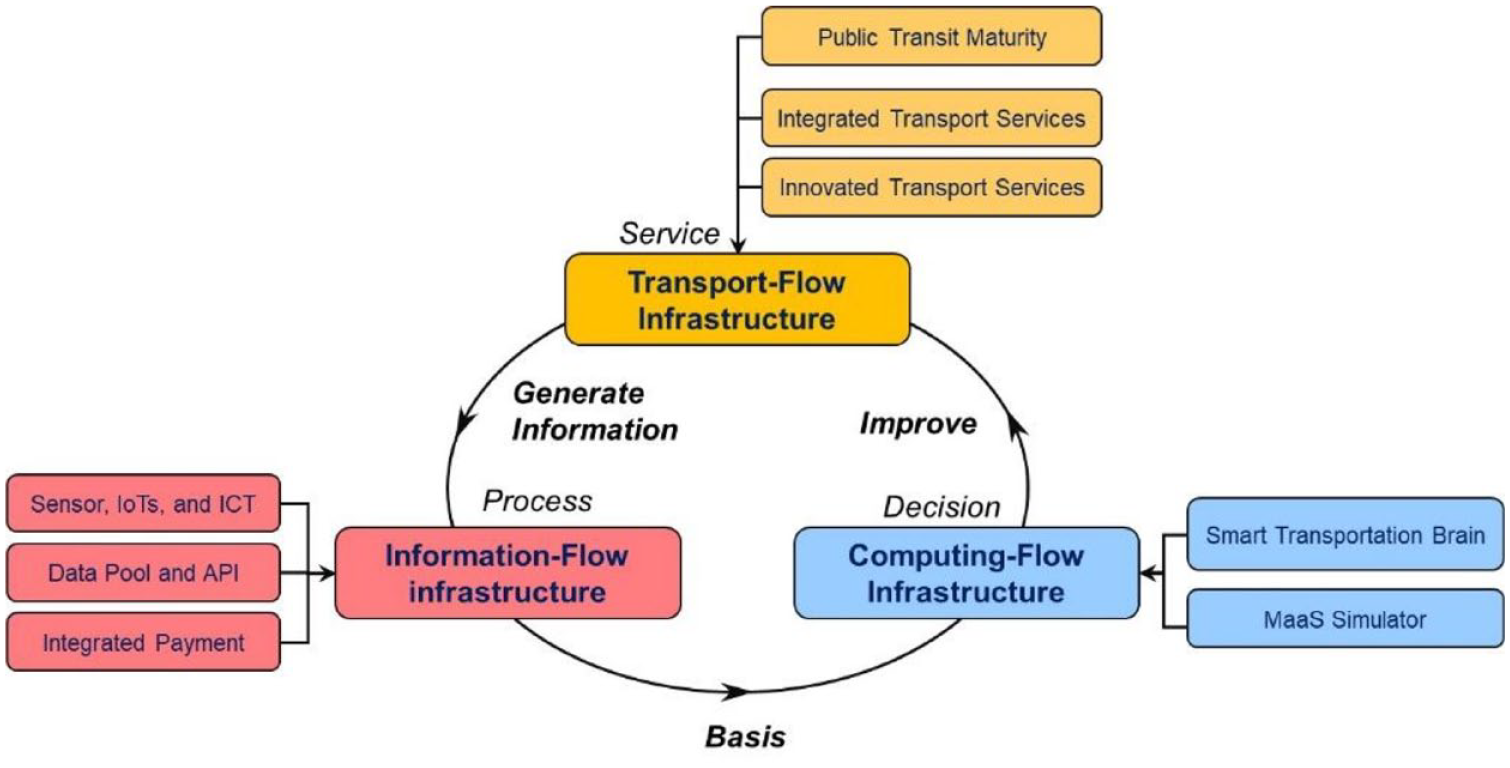
Infrastructure-based conceptual framework of MaaS implementation.
This MaaS infrastructure-based conceptual framework is applied to evaluate the readiness of a city to implement MaaS projects from the urban infrastructure perspective. Such urban infrastructure consists of three main components: (1) transport-flow infrastructure, (2) information-flow infrastructure, and (3) computing-flow infrastructure.
In this conceptual framework, physical and virtual infrastructures are combined to form an integral MaaS infrastructure system (Pieriegud et al., 2019; Stopka et al., 2018). Transport-flow infrastructure illustrates the physical infrastructure to provide mobility and related services, such as public transit, car-sharing, bike-sharing, and the innovated autonomous vehicle services. These real-world service providers undertake the transportation work and form the transport flow in MaaS. With the flow of transport services, sophisticated and multi-source information is continuously generated. Information-flow infrastructure is required to facilitate the efficient collection, management, and utilization of the generated information and provide the information service at the backend. It acts as the pivot of MaaS between the physical and virtual infrastructures, which pools the information from various basic services, and authorizes their access for further usage (Lundqvist et al., 2020). Computer-flow infrastructure, which includes the intelligent computation of route planning and transportation management, is the virtual infrastructural part of MaaS. It works based on the information-flow to empower and intelligently combine the transport-flow infrastructure for improved efficiency of MaaS (Spickermann et al., 2014). Finally, three major MaaS pilot projects and a total of 102 papers related to MaaS pilots have been reviewed.
Overview of the infrastructure
The industry and academia express interest in the MaaS system to facilitate sustainable transport in the future. In this section, we review relative papers and studies according to three urban infrastructure categories to investigate the current situations and potential barriers that cities would face when practicing MaaS.
Transport-flow infrastructure for MaaS
Public transit maturity
The blueprint of MaaS in the world was first proposed in 2014 (Heikkilä, 2014; Hietanen, 2014) and later became prevalent in policy, industry, and academy. Its stated concept is to palliate and overcome car ownership and other negative externalities for a sustainable future urban mobility by conducting a modal shift from private cars to public transit (Labee et al., 2022; Smith et al., 2018a). First, from the original concept, public transit was positioned as the backbone of MaaS (Arias-Molinares et al., 2020b; Kamargianni and Melinda, 2018; Smith et al., 2018a) to alleviate private car usage and contribute to sustainable mobility. Second, from the experience and statement of end-users, the only consensus essential transport modal in MaaS is public transit for daily commuting purposes (Matyas, 2020). Research showed that the current users of public transport are the most likely adopters of MaaS (Jittrapirom et al., 2020; Zijlstra et al., 2020). Meanwhile, among these adopters, the majority of them are expected to use public transit more often (Hasselwander et al., 2022). Apart from the urban area, the suburban and rural areas have a great potential in adopting MaaS (Barreto et al., 2018a; Eckhardt et al., 2018; Hasselwander et al., 2022; Jittrapirom et al., 2020; Qiao and Yeh, 2021) for better access to public transit. Third, in the real-world practice and stakeholder’s opinion, a city with a highly developed public transit system is more likely to have the modal shift to MaaS (Roumboutsos et al., 2021). In Sweden, which is the early adopter of this concept, MaaS was discussed as a tool for enhancing the attractiveness of public transit to meet growth goals for sustainable transport modes (Smith et al., 2018b). In Finland, one of the high consensuses of stakeholders is that public transit should be the backbone of MaaS. Thus, Yanying Li et al. (2017) proposed a flow chart of considering the feasibility of a city to implement MaaS and put “whether has an adequate public transit” as the first condition.
Compared with door-to-door taxi or the newly emerged ride-sourcing service, although less flexible, public transit is more sustainable. The reason is that the impacts of these services on the urban transportation system, for example, congestion, management control, and emission, are still debatable (Shi et al., 2021; Yang et al., 2022). In contrast, for bikes, the capacity and efficiency of public transit are far ahead. Therefore, the maturity of the public transit system should be the prerequisite for evaluating a city’s readiness for MaaS. To have a successful implementation, the practicable criteria are to evaluate its current market share, the spatial coverage of service area, connectivity, accessibility, and the capability of seamless transfer to cater to the majority of trips other than the first-last mile (Biehl et al., 2020; Iravani, 2019). This process can ensure its relative advantages among the equilibrium of users’ cost-effectiveness trade-off against other transportation modes.
Integrated transport services
In view of the backbone role of public transit in MaaS, studies suggested extending the inclusion of public transit from the inner urban area to outer areas where the population density is relatively low (Iravani, 2019). However, economic profitability and the system upgrade in these areas are the main barriers (Jittrapirom et al., 2020). In the scheme of MaaS, integrated transport services, such as taxi, car-sharing, ride-hailing, ride-splitting, bike-sharing, scooters, and trams, take over the roles as the feeder to the public transit. Alternatively, they aim to enrich the customized ability of MaaS, which ensures that mobility services are provided to citizens (Anthony et al., 2020). Among these services, car-sharing, ride-hailing, and bike-sharing are the newly prevailing transport modes in recent years, benefiting from the advancement of mobile phone and information communication technology (ICT) (Fishman et al., 2013; Rayle et al., 2016). Car-sharing exempts the ownership of a private car, improving the utilization rate of cars rather than leaving them most of the time at the car park and reducing the private car ownership. Ride-hailing is an on-demand transport service to match drivers and passengers intelligently through a platform or pp, which is believed to power up public transit in MaaS (Campisi et al., 2021). Ride-splitting allows passengers to share a common route within one car and is examined to reduce the fleet size of operated vehicles (Chan et al., 2012; Yan et al., 2020). Bike-sharing, even in a city without implementing MaaS, is naturally used to be a complementary transportation mode for public transit to solve the first/last mile problem (Kong et al., 2020a; Martin et al., 2014; Qiao et al., 2021).
To successfully implement MaaS, three questions should be considered on the integrated transport services in advance. First, is the city able to offer enough transport services in the integrated MaaS (Li et al., 2017)? Considering the heterogeneous mobility patterns and preferences of varied socio-demographic user groups (Chakrabarti, 2017; Huang et al., 2021; Matyas and Kamargianni, 2019; Zhou et al., 2019), MaaS should try to integrate more services to provide more options for the end-users. The reason is that, by excepting the consensus that public transit should be the “essential mode” in MaaS, users may have different preferences on “considered modes” and “excluded modes” owing to the safety, service characteristics uncertainty, and loss trust concerns. The diversity of integrated transport services also contributes to the complementary of them. For instance, in the real-world MaaS practice, on-demand service, such as the community transport service (Mulley et al., 2018), is found to improve the travel convenience of suburban and rural areas where regular bus service is not considered as economically profitable (Campisi et al., 2021; Qiao and Yeh, 2021), and can provide services for particular categories of users, such as those with disabilities (Campisi et al., 2021) and the elderly (Aberle, 2020). That is, these, to some degree, avoid the social exclusion (Hawkins et al., 2020) and the tech-gentrification (Pangbourne et al., 2020) problem of MaaS.
Apart from the complementary effect of integrated modes, the second problem to be considered is their substitution. For instance, ride-hailing is found to substitute for public transit in the city center or the service area of the subway and complement public transit in suburban areas (Kong et al., 2020b). Thus, different services must be collaborated and cooperated, customized to the specific city context (Barreto et al., 2020). Otherwise, MaaS operators may compel occasional public transit users toward the use of less sustainable but more expensive transport modes, particularly under a private pushed MaaS development (Hasselwander et al., 2022), which violates the original intention of MaaS.
Finally, to support the efficient operation of integrated services, auxiliary infrastructures are required to be constructed or previously planned, such as the bike lanes and bike docks for bike-sharing, charging stations for electric vehicles, and convenient parking space. The reason is that the parking service is suggested to be integrated into the MaaS project (Arias-Molinares et al., 2020a; Rosenblum et al., 2020).
Innovated transport services
The public transit and diverse transport services carry the mainstream mobility of MaaS and enrich its mobility features and flexibility. However, some have not entirely implemented innovative transport services. For instance, the electric vehicle and autonomous vehicle are believed to have promising potential to bring substantial impact and development leap to MaaS (Cruz et al., 2020; Pieriegud et al., 2019). Electric vehicles, including electric cars, Segway, and electric bicycles, play a key role in improving sustainable transportation and reduction of carbon dioxide in MaaS (Anthony et al., 2020). In Berlin’s pilot project, shared electric cars have been integrated into the city public transit system and this is perceived as sensible by the users (Kramer et al., 2014). Shared electric bicycles show different user preferences, service patterns, and positions in the urban transportation system from bike-sharing owing to their being free of human power. Shared electric bicycles are found to compete with public transit and car mobility and are suggested to be deployed in hilly regions (Bieliński et al., 2021; Campbell et al., 2016). The MaaS project that incorporates the autonomous vehicle is quite limited. The practices are limited to exploration (Nikitas et al., 2017), concept design (He and Csiszár et al., 2020), and the small-scale level pilot experiment, such as the MaaS Testbed project on the campus of Nanyang Technological University, Singapore (Jin et al., 2019).
Implementation barrier for transport-flow infrastructure
Transport-flow infrastructure is the foundation of MaaS. The implementation barriers of its transport services can also be the challenges hindering the implementation of MaaS. These barriers can be, for example, the low or insufficient development level of public transit with regard to its market share, spatial coverage, connectivity, accessibility, especially in the suburban area due to the profitability (Iravani, 2019; Jittrapirom et al., 2020), the potential negative externality of ride-hailing on traffic congestion and emission (Shi et al., 2021; Yang et al., 2022), and excessive shared bikes that lead to waste of resources and parking problems (Yu and Shang, 2017). Besides the challenges extended from the original transport modes, one main barrier to the implementation of transport flow is how to handle the competition problem between them. Without the emergence of MaaS, there is a mode equilibrium between these transport services as a result of user’s mode choice determined by user’s habit and services’ cost-effectiveness (Susilo et al., 2014). Their position, role, and the cooperation and competition relationship in the urban transportation system are determined by the market. However, with the implementation of MaaS, the invisible and spontaneous mode choice in the market can be influenced by the MaaS. In the expected developed stage of MaaS with public transit as the backbone and other services as the feeder to pursue sustainability (Arias-Molinares et al., 2020a; Arias-Molinares et al., 2020b; Kamargianni et al., 2018), the position and role of these transport modes are not only determined by the market but are also influenced by the MaaS manager and operator through their designed travel scheme. The artificial intervention will inevitably lead to a new equilibrium, which may adjust the profitability of some service operators, such as private transport service operators, and decrease their interest in joining MaaS.
Information-flow infrastructure for MaaS
Sensor, IoTs, and ICT
All transport services already existed before the proposal of MaaS. Without the invisible information behind them to connect them from individuals to integration, they just perform what they performed. In the practice of MaaS, every service, vehicle, trip, and even every user becomes an infrastructural node in the Internet of things (IoTs) in the network of urban mobility system as a sensor (Tavmen, 2020). The activities of these sensors will generate substantial valuable information that MaaS relies on sensing urban mobility. Ubiquitous sensors and IoTs that generate the information and the low-latency ICT that guarantees the real-time transmission are of substantial impact on MaaS (Cruz and Sarmento, 2020; Giesecke et al., 2016). Through an investigation from the stakeholders of the project in Greater Manchester and Budapest, low ICT availability is identified as the fifth and third barrier out of eight factors to MaaS implementation (Polydoropoulou et al., 2020). In an interview with the American and European academia and stakeholder, the “condition of ICT” is ranked as the first barrier for the local authority to implement MaaS. In addition, “Improve the digital infrastructure and data collection and handling conditions” is chosen as one of the most important policies of central or local authorities to ensure successful implementation (Jittrapirom et al., 2020). Koźlak et al. (2019) conducted a comparative analysis among several cities. They found that cities having high indexes of “smartness” are more likely to implement technologically advanced ICT solutions in transport systems.
In terms of the sensor and IoTs, apart from the coil, camera, and radar at the intersection and roadside at the city level that had already been deployed, individual-level sensors are also quite essential. In MaaS, owing to the concept of “public transit as the backbone, other integrated services as the feeders,” transfer activity during the trip chain is inevitable. Thus, obtaining an accurate arrival time for the next service is quite important for a seamless transfer, which relies highly on the precise sensing of the spatial location reported by the GPS terminal (Arias-Molinares et al., 2020b).
Apart from continuously acquiring the real-time location, a GPS terminal is also used for asset management for the car-sharing and station-based bike-sharing in MaaS to detect whether the vehicle is returned within the designated virtual geofencing, which is also possible via Bluetooth or Wi-Fi transmitter (Symeonidis et al., 2016). In addition, a camera can be deployed on the service vehicle, such as the ride-hailing car and taxi, to detect abnormal in-car activity, such as risk and fatigue (Cao et al., 2021), sense the traffic condition (Carvalho et al., 2019), and efficiently update the digital map of the city (Noda et al., 2011). For ICT, one key issue is to provide enough and reliable infrastructure, such as 3G/4G/5G, to ensure a high level of connectivity and real-time travel information communication (Stopka et al., 2018), particularly 5G considering the implementation of the autonomous vehicle (Arias-Molinares et al., 2020b). Meanwhile, communication protocols, such as Bluetooth, Zigbee, near-field communication (NFC), and Wi-Fi, are applied in accordingly suitable scenarios (Anthony et al., 2020).
Data pool and API
Data generated by MaaS have the typical “5V” characteristics of big data that have a high degree of volume, velocity, variety, and low value and veracity (Anthony et al., 2020). Data collection and aggregation are the prerequisites for opening and utilizing these big data to facilitate the intelligent implementation of MaaS (Cruz and Sarmento, 2020). To realize the data collection and aggregation, a centralized data pool concept is proposed. Lundqvist and Murati (2020) emphasized the importance of industry-wide pooling of data that allows data sharing, trading, or pooling.
Similarly, Anthony et al. (2020) proposed a multi-tier architecture of MaaS, in which the data layer is defined as a middle layer between the backend infrastructure layer and frontend service layer. In this layer, the data and metadata are stored and accessed. The open and access to these data will be through a well-defined application programming interface (API) (Stopka et al., 2018).
However, despite the great importance of the data pool, two main barriers prevent it from implementation. The first one is the complicity of data format and standard (Arias-Molinares et al., 2020b). In some operational MaaS projects, the standardization of the data from multiple service providers is identified as one of the top challenges (Mladenović and Haavisto, 2021; Polydoropoulou et al., 2020). During the operation process of MaaS, unstructured data, such as video and voice, or structured data that comprise user, order, trajectory record, and others, which can be in JSON, CSV, XML, or TXT format (Anthony et al., 2020), will be continuously generated. Therefore, the definition of the metadata, the API, and support of physical storage facilities should be well prepared to facilitate the pooling.
After the aggregation preparation of the data, however, another more severe barrier is the willingness of multiple service providers to allow open access (Li et al., 2017). On the one hand, owing to the inevitable substitution relationship between each transport mode and the competition of the same mode from different service providers, firms with pool business data may use the data not only to advance their services or products but also to collude to exclude competitors or abuse their market position (Lundqvist and Murati, 2020). Thus, the sharing of data may induce the risk of business information leakage and interest conflicts (Curtis et al., 2019). On the other hand, these data are highly private and confidential. Although some of them are intended from the point of collection, others opportunistically draw on relevant populations and attributes to enhance the overall available information (Cottrill, 2020). This case requires guaranteeing their protection, confidentiality, and privacy without conditioning the operational efficiency of the system once they are pooled (Barreto et al., 2018b; Barreto et al., 2020).
One practical solution to these barriers is to implement MaaS based on the open data or the public authority API at the initial stage (Pangbourne et al., 2020). The objective is to prevent conflict between private service providers, such as the Citymapper London project that is based on the Greater London Authority’s data opening strategy. Thus, the readiness of a city to smartly sense, efficiently store, safely protect, and legally access such big data should be considered, before the implementation of MaaS.
Integrated payment and travel package
In the original and ideal concept of MaaS, payment for all trips is solved by a subscribed prepaid mobility package (Hietanen, 2014). Thus, while the integration of multiple services forms the supply side, the integration of payment indicates the anticipated demand from a certain perspective. Therefore, although payment does not involve mobility itself, it is a substantial information component of MaaS. On the one hand, it represents a kind of integration development level in MaaS (Kamargianni et al., 2016), and on the other hand, it connects all the service providers under MaaS by profit (Li et al., 2017).
Currently, MaaS offers two types of payment options: subscription and pay-as-you-go (Daniela et al., 2022; Polydoropoulou et al., 2020). Subscription is the initial concept of MaaS. It anticipates that users can conveniently enjoy their mobility with low or zero marginal cost for a fixed upfront cost (Kamargianni et al., 2016). For instance, in Whim, the most widely focused project founded in Helsinki, two types of packages are provided. One is Whim Basic (€89 ($98)), which contains unlimited access to public transit and a maximum of €39 car-sharing or taxi service within certain zones. Another is Whim Go (€149 ($164)), which extends the maximum car-sharing or taxi service expenditure to €129 (Hensher et al., 2020).
In addition to the mobility-related service in the package, studies also discussed putting auxiliary services into the MaaS package, such as the parking services (Rosenblum et al., 2020) and road usage rights (Beheshtian et al., 2020; Wong et al., 2020). The subscription-based payment is a top-down, artificially designated service. Thus, to realize the subscription-based payment integration, the city should be able to capture the diverse mobility profiles of different user groups in advanced and provided tailored packages (Corazza and Carassiti, 2021; Liu et al., 2020). Otherwise, it will be harmful to the user’s willingness to adopt MaaS (Ho et al., 2021).
The scenarios of the subscription service package are promising. However, for those price-sensitive users or people with varying travel needs, pay-as-you-go can be a preferable way, owing to the contractual nature of mobility packages with mandatory payment in advance, which has the risk of losing money and flexibility (Ho et al., 2021; Stopka et al., 2018) and is witnessed in a nationwide investigation in Australia (Vij et al., 2020), and the local market at Sydney (Ho et al., 2021). To realize pay-as-you-go, two options have been adopted in current MaaS projects: e-tickets, such as the Octopus card in Hong Kong and the Oyster card in London (Kamargianni et al., 2016). Alternatively, online third-party payment can be integrated into the MaaS platform, such as the Alipay, Wechat pay, Apple Pay, and PayPal that have already be prevailed with the popularization of smartphone, which has been ready in most of the developed cities.
Implementation barrier for information-flow infrastructure
The implementation of MaaS is not the loosely integration of existing transport services. The generation, collection, and utilization of the information of the integrated services is the prerequisite for the smart MaaS to pursue a sustainable and efficient integration. The first realistic information-flow infrastructure barrier that prevents it from implementation is low ICT availability (Jittrapirom et al., 2020; Polydoropoulou et al., 2020). However, the development of such infrastructure requires a long-term consistent investment and construction by the public authority, such as the “New Infrastructure Construction” in China. Following the barrier of information generation and transmission, another key challenge is the information privacy and sharing problem (Li et al., 2017). Due to the lack of a leader to formulate the information sharing standard, coordinate the information sharing issue, and mitigate the information sharing conflict, it is hard to expect the service operators who have a potential conflict of interest to spontaneously give data access to others (Anthony et al., 2020; Curtis et al., 2019; Lundqvist and Murati, 2020). Finally, the original proposed subscribed mobility package may also prevent the user from adopting MaaS given the potential for losing money and flexibility (Ho et al., 2021; Stopka et al., 2018). The solution is to adopt subscription and pay-as-you-go payments together.
MaaS-related computing-flow infrastructure
Smart transportation brain
The integration of transport-flow infrastructure and information-flow infrastructure has already been discussed above in the whole process of MaaS. It is able to provide the service of MaaS. However, for optimal operation efficiency, MaaS should provide intelligent services powered by a centralized smart transportation brain on the basis of the big data aggregated by information-flow infrastructure, which contains big data analytics, artificial intelligence (AI) algorithm, and city-level transportation optimization (Arias-Molinares et al., 2020b; Barreto et al., 2018b; Cruz and Sarmento, 2020; Shang et al., 2022).
The first type of service is directly provided to the user, such as route planning and arrival time estimation. Route planning is the basic “pre-trip” service (Esztergár-Kiss et al., 2020) that helps the user to plan their personalized itinerary. It has been implemented on many map navigation apps, such as Google Maps and Baidu map, and successfully integrated into the MaaS platform, such as Citymapper, Moovit, Whim, and SMILE. Arrival time estimation is an “en-route” service that provides the arrival time information for the user to reduce their uncertainty and anxiety in waiting for the consequential services, particularly bus and ride-hailing (Yu et al., 2011), which may give confidence to the user in intermodal mobility (Barreto et al., 2020). It can be decomposed into the estimation of the arrival time of each component mode based on the location information collected by the GPS terminal and AI algorithm (Chen, 2018; Wang et al., 2018; Yu et al., 2011). These smart services have already been well studied and will not be a barrier for a city to implement MaaS (Ansari Esfeh et al., 2021).
Another type of service is a service that is not directly provided to the user but can support the efficient operation of MaaS at the backend, such as demand prediction and dispatching optimization. Although the subscriber mobility package provides part of the demand anticipation, pay-as-you-go also accounts for considerable demand preference, particularly those irregular services (Ho et al., 2021). Demand prediction can also be decomposed to the prediction of each component mode, through the historical demand data aggregated by certain spatial units and time periods. Extensive studies have been done on subway, bus, taxi, ride-hailing, and bike by the state-of-the-art deep neuron network models (Yang Li et al., 2017; Li et al., 2019; Ma et al., 2014; Yao et al., 2018). Some studies have also been done on an integration prediction that utilized the intermodal dependencies (Liang et al., 2022; Xu et al., 2022). On the basis of accurate demand prediction, dispatching optimization rationally assigns each service mode to its suitable service area to avoid unnecessary competition and conflict between modes, such as public transit and ride-hailing, public and shared electric bikes (Campbell et al., 2016; Kong et al., 2020b), to ensure the backbone role of public transit and balance the interest of each mode (Arias-Molinares et al., 2020b). Although the dispatching optimization of each solo service has been well explored, considering their integration in MaaS, a dispatching optimization framework has to be developed in the smart transportation brain of a city.
MaaS simulation
The urban transportation system is a sophisticated system where different service modes complement or compete with each other, and different user groups hold varied mobility patterns and mode choice preferences. A subtle change of service mode, such as the price, schedule, or route and change of the user group, such as preferred mode and travel habit, may lead to the shift of the equilibrium of the urban transportation system to a new place (Yang et al., 2012; Zhang and Hang, 2015). MaaS integrates these service modes together under the support of information and payment and can be regarded as a special subset of the urban transportation system. Thus, the ability to forecast MaaS is crucial because any new feature introduced or adjustment made to the MaaS system may also cause disequilibrium in MaaS.
A prior prediction may avoid shifting to an equilibrium position that may deviate from the original sustainable initiative or harm the willingness of the user to adopt MaaS. In the practice of MaaS, to capture such prior information, the stakeholders have a high consensus that a pilot project to experiment and enable learning is required (Jittrapirom et al., 2020). The implementation of a pilot project is considered the most preferred policy and can provide a certain insight into its adoption and performance (Arias-Molinares et al., 2020b). However, it only provides experience at limited scales and scenarios and may take a long time to get the result, which may not be able to provide constructive policy adaptation for the future operation. Thus, developing a MaaS simulator can be quite helpful to reduce the uncertainties of project adjustment of different scenarios, which does not have the cost, time, and policy constraints from the real world.
Jittrapirom et al. (2018) proposed a dynamic adaptive policymaking approach, which is currently being developed for implementing MaaS for the Dutch city of Nijmegen. Song et al. (2021) utilized a dynamic discrete choice model and expectation-maximization algorithm to consider the dynamic mode choice behavior and generate a set of feasible mode chains. This was verified by the household travel survey data and multimodal network data in Nanjing, China. Djavadian et al. (2017) treated the MaaS as a two-sided market and worked out the day-to-day adjustment process for every service operator at the social optimum using an agent-based modeling approach and the real data from Oakville, Ontario. Considering the support from the big order, trajectory, and payment data collected from the real-world operation, with a well-developed simulation algorithm, the result and recommendation of the simulator can be quite accurate and meaningful. Muller et al. (2021) systematically reviewed the simulation methodologies for assessing MaaS from social, technical, economic, environmental, and political perspectives.
However, a major barrier is the difficulty of collecting large and reliable data for involving a wider range of participants in the prior prediction or effectiveness evaluation of MaaS projects in advance. The data availability challenge comes from two aspects. First, it is difficult to obtain such a huge travel demand from traditional survey data to meet the requirements of accurate simulation. As a new travel mode, it is necessary to estimate people’s attitudes towards MaaS through surveys. Second, emerging big data involves the challenge of personal data privacy. In Europe in particular, data generated by relying on geolocation-based applications must respond to the requirements related to issues of privacy, consent and protection. This is discussed in detail in section 3.2.2 on data standards. Even so, some large-scale simulation experiments on MaaS have been made. Simulation carried out in Helsinki, Auckland, Dublin, and Lyon, combined the large dataset of public transit from Household Travel Survey and a conventional small travel survey to generate “synthetic mobility sets” and expand to the total population (International Transport Forum, 2017a, 2017b, 2018, 2020).
Implementation barrier for computing-flow infrastructure
Computing-flow infrastructure utilizes the information generated by the transport service and provides a supportive travel service to users and optimizes the operation of MaaS. Compared to the physical feature of transport-flow and information-flow infrastructure, computation-flow is more like the virtual infrastructure whose key point is the analytic method and intelligent algorithm, which does not determine whether a city can implement MaaS or not, but how efficient and smart MaaS will be. With the development of big data, cloud computing, and artificial intelligence in recent years, corresponding algorithms for demand prediction, arrival time estimation, and traffic optimization have been well developed (Arias-Molinares et al., 2020b; Shang et al., 2022). Thus, it is hard to consider the algorithm and model of computing-flow infrastructure to be a barrier, but it is still crucial to consider the compatibility, adaptability, and sensitivity of the algorithm and model to a particular city’s context. The implementation barriers for computing-flow infrastructure, as mentioned above, are the collection and utilization of a large and reliable enough data to support the computation.
Checklist for evaluating the potential of infrastructure
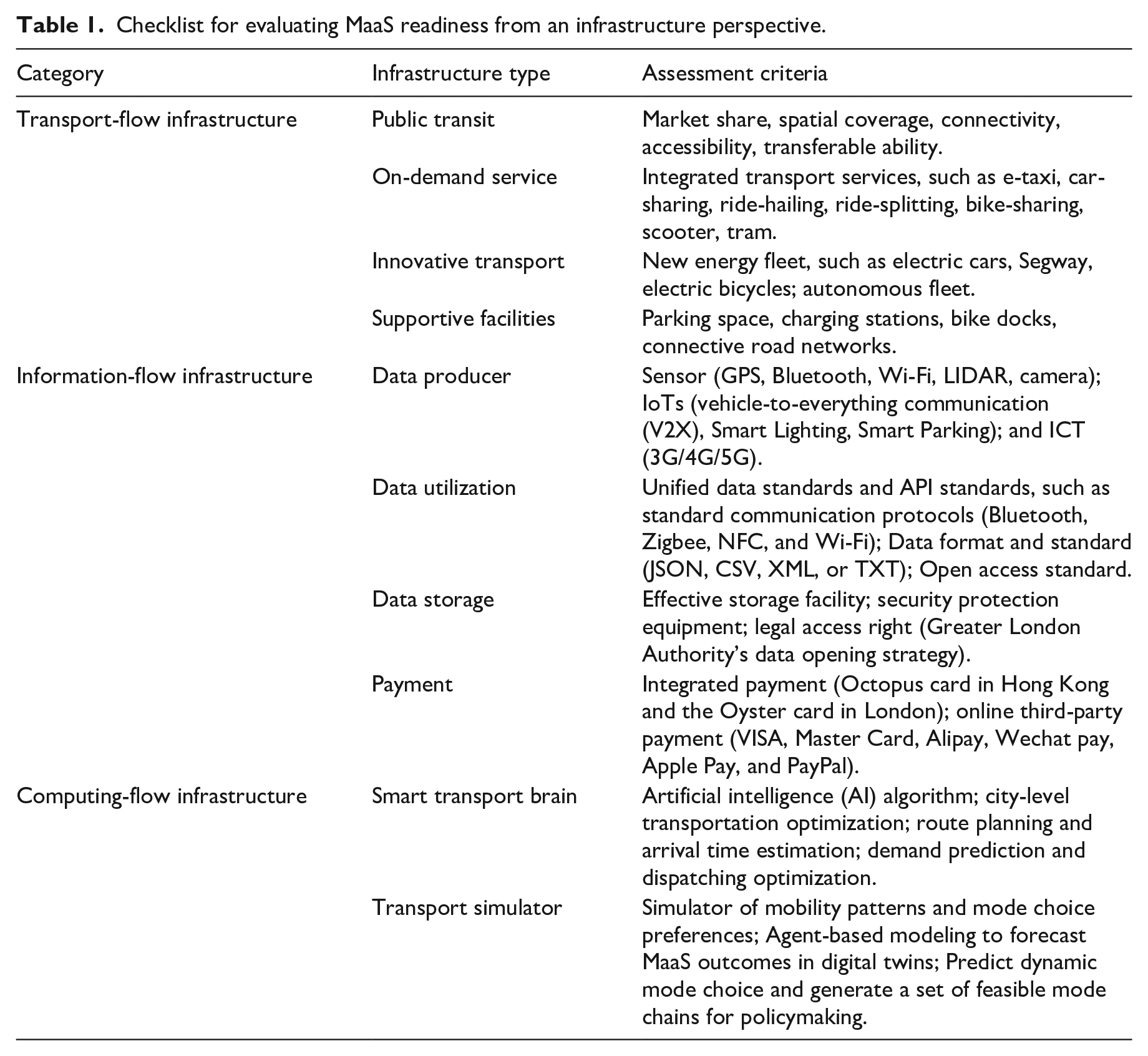
To examine the commonality of failure and success when implementing the MaaS project, we draw some lessons and conclude a checklist from previous experiences. Table 1 shows the list of items that a city may attach importance to before acting on a MaaS practice. The three most critical introspective questions for a city are as follows: Is there sufficient transportation coverage to provide a diverse and seamless travel plan? Is there sufficient access to digital data to support third-party information integration and unified payments? Is there enough computing power to integrate information and provide decision support?
Checklist for evaluating MaaS readiness from an infrastructure perspective.
Case study
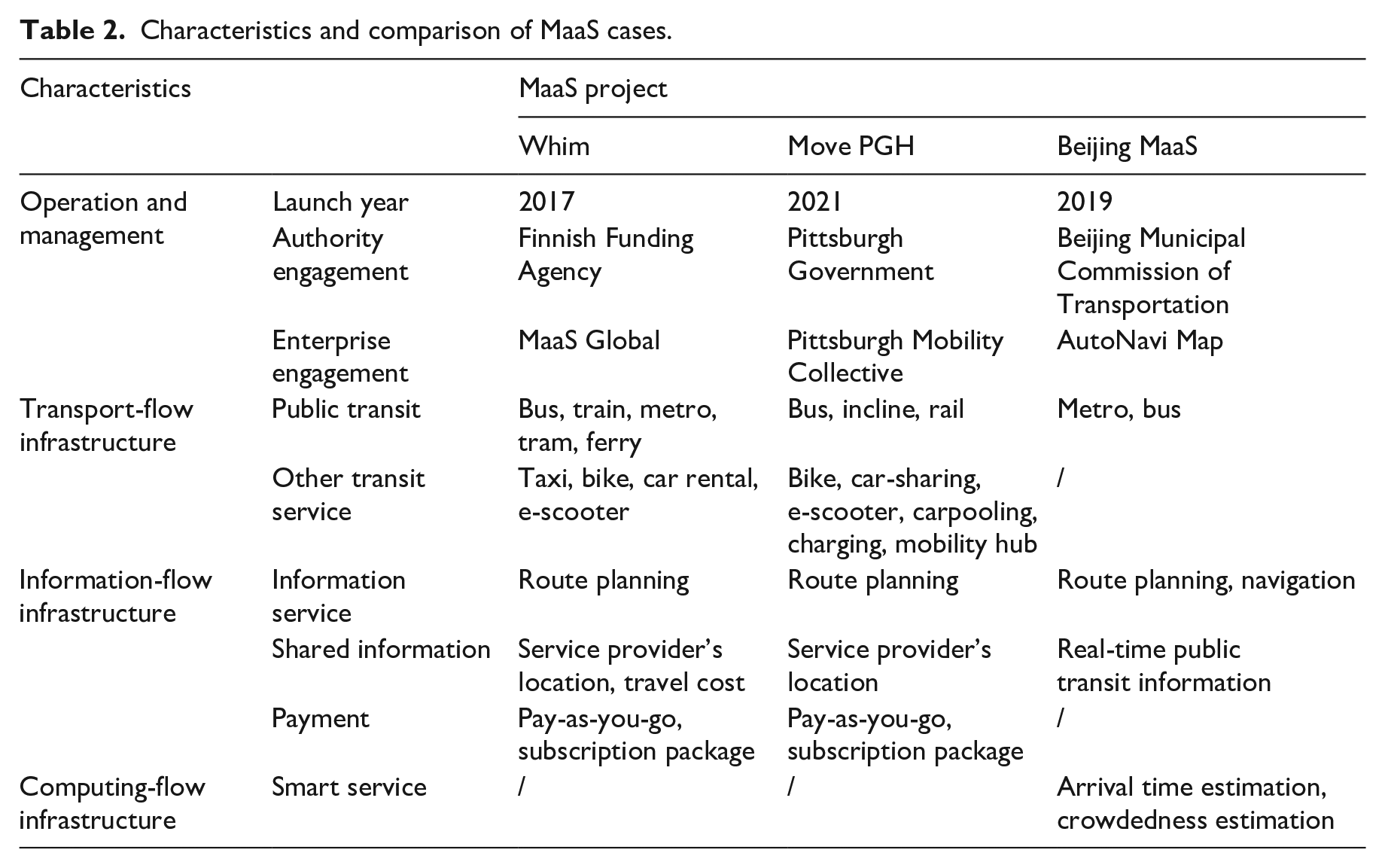
In this section, three MaaS pilot projects in different cities are reviewed based on a previous checklist to determine the success and failure experiences from an infrastructure-based perspective, including Whim in Helsinki, Finland; Move PGH in Pittsburgh, USA; and Beijing MaaS in Beijing, China. Whim is one of the most well-developed exemplar MaaS projects around the world (Audouin et al., 2018). Move PGH and Beijing MaaS represent MaaS projects in the city with good livability in the developed country and megacities in the developing country, respectively (Neumann, 2018). Table 2 illustrates and compares the characteristics of these three MaaS projects.
Characteristics and comparison of MaaS cases.
Whim, Helsinki, Finland
Whim was first tested in 2016 and commercially launched in 2017 in Helsinki. It is still in operation today with extended service to Turku, Vienna, Switzerland, Greater Tokyo, Belgium, and West Midlands. Whim was funded by the Finnish Funding Agency, a Finnish authority, and managed by MaaS Global. In 2017, there were 290 bus lines, 14 commuter train lines, 11 tram lines, 2 metro lines, and 2 ferry lines in the metropolitan area of Helsinki. The city bike had been operated for two years at that time, with well-developed bike infrastructure (Weinreich et al., 2019).
In terms of the transport-flow infrastructure aspect, Helsinki has plenty of travel choices prepared. Whim incorporates public transport, taxi, car rental, e-scooter, city bikes, and shared bike (see https://whimapp.com/helsinki/en/) in one app platform. For public transport, various public transport services are included, such as buses, trains, metro, trams, and the Suomenlinna ferry. Users can either buy an individual ticket or an all-pass ticket with a different validation period. Other services are provided by the cooperation service operation, such as Taksi Helsinki, Lähitaksi and Menevä (taxi), Hertz, Sixt & Toyota (car rental), TIER (e-scooter), and JURO (shared bike). Although some of them have their own Apps, they integrate together to provide a one-stop mobility service. To realize this function, service providers’ APIs are opened to Whim to easily acquire the location of the available transportation around, unlock the shared bike with phone-smart lock communication, estimate the travel time, calculate transit cost, submit a taxi request, and others.
Owing to the technically accomplished information-flow infrastructure in the city, Whim offers abundant payment options. Pay-as-you-go, the most traditional and flexible payment, is reserved. Users can choose to use any transportation they want with the same cost as their providers, with no extra cost or discount. In this case, Whim just acts as a unified entrance to the integrated services. To prompt the usage of public transit or public city bike, Whim provides special benefits for another payment, the subscription package. For instance, a 30-day season public transit ticket (€62.7–€142.7) or city bike season pass can have the following: (1) an unlimited amount of up to 35% cheaper taxi journeys, (2) a cheaper car rental fee, and (3) 1 free 30-minute shared bike. To be suitable for more user groups, the package is designed in three types, 30-day season ticket, 10 tickets, and day ticket, whose prices within each type are also dependent on the service region covered. Apart from these, Whim provides Whim Unlimited (€699.0–€799.0 ($769–$879)), which includes the 30-day season public transit ticket, 80 free trips for a max 5-km taxi, and unlimited car rental. All the payments are paid by a bound credit card.
In 2019, a research report based on Whim’s first-year operation trip data was released (Weinreich et al., 2019). Compared with the result of the Helsinki travel survey that public transit accounts for 48% of metropolitan trips, the counterpart number for Whim is 63%. In addition, the modal share of public transit within the trips made by Whim is 95.2%, showing the improvement and the backbone role of public transit in Whim. Moreover, 68% of Whim trips are seen to occur in areas with the highest public transport access. The subscription mobility package managed the demand for bike and taxi as a feeder well, as 97% of bike and 87% of taxi trips were found to be less than 30 minutes and 5 km, as appointed by the package. Finally, the sustainable modal share of Helsinki metropolitan residents was witnessed shifting from 25% public transit and 37% bicycle and walking to 63% public transit and 29% bicycle and walking. With infrastructure support and government ambitions, Helsinki has become a benchmark city in the MaaS test field.
Move PGH, Pittsburgh, USA
Move PGH was proposed by the city government of Pittsburgh in 2021, and was a collaboration between many different groups called the Pittsburgh Mobility Collective (PMC). Unlike Whim, the project does not specifically create an app for the city. Instead, the services are technically powered by another mature trip planner app called Transit, which is operated in more than 200 cities. Through this service hosting collaboration, Pittsburgh likely deploys its public transit market and opens its public transit APIs to Transit to match a MaaS project.
PMC contains three types of cooperators. The first one is the government agencies which consist of the Pittsburgh Department of Mobility & Infrastructure, the Port Authority of Allegheny County, and the Pittsburgh Parking Authority, which are the operation manager, public transit service provider, and parking manager, respectively. The second type of cooperator is the independent service provider which has already had its own product and app, such as Transit, Healthy Ride, Zipcar, Spin, Masabi, Swiftmile, Waze Carpool, which provides app integration, bike-sharing, car-sharing, e-scooter, payment, charging infrastructure, and carpooling services. The last type is mainly the tech company or agency that provides the technical support to improve the performance of Move PGH, such as InnovatePGH and New Urban Mobility Alliance. In exchange for their cooperation in Move PGH is the exclusive city operation permit in Pittsburgh (David, 2021).
On transport-flow infrastructure, although multiple mobility services joined the Move PGH project, they are just loosely integrated into its app. The reason is that except for the public transit provided by the authority, all other services that the user chooses will be redirected to the app of the service operator or the download page of that app. This disobeys the initial concept that all mobility services are served on one app platform. Owing to the loose integration of services, a user should pay-as-they-go on different platforms, and the only provided mobility package is the bus and incline ticket for different days. Thus the ability of Move PGH to attract users to adopt public transit and its performance is questionable (David, 2021).
The support from the information-flow and computing infrastructure is limited. The only shared information from the cooperators’ APIs is the location information of their bike, scooter, and car, for their service access purpose. Owing to the limited information sharing, intelligent computing based on this to improve the city’s transport efficiency is impossible. Its only information service is the basic route planning service. Users have to download many mobility Apps and access more detailed information about their services and payment there.
Although the immature infrastructure support of Move PGH, one innovation is that it proposed to create 50 mobility hubs around the city. A mobility hub is a physical infrastructure that integrates the transport-flow, information-flow, and computing-flow together. A mobility hub is planned to be deployed near the bus or rail stop, which is equipped with charging stations for e-scooter, shared bike (e-bike), and an information screen of real-time transit arrival information. With this infrastructure, Move PGH hopes to bring users a seamless transportation experience of the plan, pay, and play.
Beijing MaaS, Beijing, China
Beijing MaaS was proposed in 2019 through government-enterprise cooperation between the Beijing Municipal Commission of Transportation and the AutoNavi map of Alibaba group. Instead of developing a specific app, Beijing MaaS is also implemented on the mature platform, AutoNavi map. AutoNavi map is a navigation app that provides route planning for driving, public transit, cycling, and walking. However, currently, integrated mobility on this platform only contains public transit and ride-hailing.
The most highlighted infrastructure of Beijing MaaS is the powerful navigation and real-time public transit information powered by its detailed digital transport infrastructure data and well-developed city transport sensing and communication network. With the support of these infrastructures, Beijing MaaS can provide seamless real-time door-to-door navigation information with public transit first, less walking, less transfer, and less time consumption route recommendations. The detailed real-time transport information shared by the transport authority and the arrival time estimation algorithm developed by AutoNavi map allow Beijing MaaS to provide accurate arrival information. For example, with the on/off, enter/exit data, and the calculation of the intelligent algorithm, Beijing MaaS can tell users the crowdedness of the arrival subway to make better travel decisions. Moreover, the real-time bus arrival data cover more than 95% of the city’s bus routes (a total of 1,266 bus routes in Beijing), and the matching accuracy of real-time information exceeds 97%.
Although Beijing MaaS is impressive in its information-flow and computing-flow infrastructure, its transport-flow infrastructure is weak. First, this project has limited transport services integrated or displayed, where most of which are for navigation purposes. Second, although Beijing’s mobility market has many stakeholders, such as ride-hailing, taxi, shared bike, and other service operators, it does not incorporate them. Thus, the data being shared is limited to public transit. Finally, for the payment, no mobility package subscription is provided. Beijing MaaS is advertised for its powerful navigation and information service but is also limited to information providing. No measurement or action that can attract the user to adopt more sustainable transport is seen from it. Thus, without strong support from the physical transport-flow infrastructure, the implementation of MaaS can be very difficult because of the lack of solid acting and practice point. Thus, Beijing MaaS is still at its initial stage of development after years of operation (Zhang and Zhang, 2021).
Conclusions
Drawing on concepts from the smart city and smart infrastructure literature, this study attempts to understand and conceptualize the implementation of MaaS. The key point is that MaaS is neither a new travel mode nor a new transport paradigm. Rather, it is an ultimate stage of transport integration and optimization. Therefore, the implementation of MaaS relies on a series of supports from physical to cyber urban infrastructure, which varies across cities. Three types of urban infrastructure are important in the successful implementation of MaaS in Section 3: (1) transport-flow infrastructure, (2) information-flow infrastructure, and (3) computing-flow infrastructure.
In terms of transport-flow infrastructure, the most challenging for MaaS is to integrate public and private transport. A prerequisite for a city’s readiness for MaaS is the coverage of its public transport infrastructure. Actionable criteria are to assess its current market share, spatial coverage of service area, connectivity, accessibility, and ability to transfer seamlessly to other transport means. In addition, MaaS aims to integrate a wide range of mobility services to provide more choices for end-users. On-demand mobility services, such as ride-hailing, shared bikes, and e-scooters, could make up the “last mile” of a public transport journey, making a possible seamless mobility network for users. In addition, whether it is physical public transport infrastructure (metro, ferry, bus stops) or cyber transport infrastructures like Uber and Lyft, the mobility service operation is inseparable from the supporting facilities of the city. Examples include the bike lane and bike docks for bike-sharing, charging stations for the electric vehicle, and convenient parking space linked to metro lines. All these transport-flow infrastructures simultaneously form the basic framework for the implementation of MaaS.
In the practice of MaaS, every order, vehicle, trip, sensor, and even every user becomes an infrastructure node in the mobility network to generate a wealth of valuable data and information that MaaS relies on to sense urban mobility. Thereafter, MaaS keeps optimizing the fleet dispatch algorithm and route planning through deep learning and prediction from the sensed data. In addition to the requirement for a series of unified data standards and interface standards to maximize the utilization of such data and information, cities also need to construct infrastructure for effective storage, security protection, and legal access right. The data privacy protection and online payment facilities are particularly essential for the unified payment of multiple services in MaaS. Assessing the readiness of information-flow infrastructure is a basic condition to start up smart transport pilots for a city.
To operate smartly, MaaS should be powered by a centralized smart-computing brain of a city to dynamically analyze the big data aggregated by information-flow infrastructure and optimize the transport-flow infrastructure-based public and private services. This new infrastructure primarily focuses on two forms. One is to forecast existing running services based on demand and supply data to optimize service operation. For instance, in China, a successful construction of City Brain system is committed to improve urban management through the use of big data, cloud computing, and AI (Government, 2020). An integrated optimization framework including a wide range of transport means is needed for MaaS pilot projects to provide seamless mobility service. The second is the transport simulator. For MaaS pilot projects, the simulation of different MaaS scenarios is needed for predicting the potential outcomes and uncertainty of projects. It should have the advantages of low time cost, low risk, controllable conditions, and flexible policies compared with the implementation in the real world.
It is worth noting that MaaS may bring potential social consequences, just as many other smart mobility revolutions do. Users who regularly traveled by Uber are younger and richer (Young et al., 2019). This concern opens up the question of whether MaaS is available to all? Or will it only increase convenience for those who can afford it? Then, if the prosperity of MaaS leads to a cut in regular transit, it may worsen the transport-induced social exclusion. Some cities attempt to minimize the disparities in travel costs between Uber and public transit with a subsidy before implementing the pilot MaaS projects (Cane, 2017). But similar cases are often suitable for small cities that have better local finance and low demand for traveling. At present, it is still hard to tell whether the implementation of MaaS could increase the equality of accessibility among distinct populations and fundamentally disrupt long-term transport disadvantages. There is a need for further studies on possible impacts brought by MaaS, not only on its effectiveness, but also on its social-spatial consequences.
Each city has its own unique geographic, cultural, and stakeholder profile—the unique infrastructural advantages and barriers that each city faces are different. Policymakers need to address them, and the implementation of MaaS pilot projects needs to consider local specifics. It is unlikely to have a “one-size-for-all” MaaS criterion to answer what kind of infrastructure conditions could definitely make MaaS successful. Even at the city-wide level, the difference in individual needs at city-center, suburban, rural areas, and household levels should be considered to ensure that MaaS does not lead to further social or geographic inequality. In the process of seeking transport integration and smart transport construction, urban infrastructure has also evolved along with MaaS projects. After reviewing the literature and analyzing three pilot cities, we have developed a checklist of physical and cyber urban infrastructure that can be a handy toolkit for policymakers and transport managers and planners to screen in advance when they attempt to implement any MaaS projects.
Footnotes
Declaration of conflicting interests
The author(s) declared no potential conflicts of interest with respect to the research, authorship, and/or publication of this article.
Funding
The author(s) received no financial support for the research, authorship, and/or publication of this article.