



Abstract
Neighborhood governance efficacy is of significance to enhance residents’ well-being. One of the main challenges in neighborhood governance lies in overcoming the dilemma of “weak participation,” cultivating social capital within communities, and thereby improving governance effectiveness, including fostering neighborhood development and increasing residents’ sense of happiness. Taking Beijing as a case study, this paper analyzes the impact of different neighborhood governance modes on residents’ happiness and their variations across typical communities, based on survey data, spatiotemporal big data from online platforms, and remote sensing imagery. It also examines the indirect effects of various dimensions of neighborhood social capital. The study finds that in high-income communities, a bottom-up governance mode centered on residents’ self-organized activities significantly enhances residents’ subjective well-being. In contrast, in low-income and mixed-income communities, a top-down governance mode led by grassroots government intervention exerts a more positive effect on residents’ subjective well-being. Neighborhood participation and social networks play important mediating roles in the relationship between governance modes and happiness. Neighborhood governance should be designed with a targeted mode with full consideration of neighborhood heterogeneity in order to enhance governance efficacy. In the process of cultivating and building neighborhood social capital, particular emphasis should be placed on promoting residents’ neighborhood participation and the development of social networks.
Introduction
China has proposed to establish a social governance structure featuring co-governance and shared benefits. It serves as one of the important goals of promoting the modernization of the governance system and governance capacity. It also reflects a broader trend in contemporary state governance—a return to people-centered rationality. In this paradigm, subjective well-being (SWB) has surpassed traditional economic indicators to become a critical dimension for assessing the effectiveness of social governance (Diener et al., 2018). In recent years, the enhancement of residents’ SWB has increasingly been recognized as a fundamental goal of governance modernization, reflecting governments’ transition from an efficiency-oriented to a people-oriented logic of development (Zhao et al., 2024). Therefore, understanding the determinants of SWB and the ways in which governance institutions influence it has profound implications for achieving inclusive and sustainable urban development.
As the basic units of grassroots social governance, neighborhoods have therefore evolved from serving solely as residential spaces to becoming key platforms for delivering public services and promoting social integration. Effective neighborhood governance is essential for establishing social order within neighborhoods, fostering harmonious interpersonal relationships, and enhancing residents’ SWB (Cárcaba et al., 2022; Fu, 2018). However, with the rapid urbanization and the significant impact of the disintegration of the work-unit system (danwei) on traditional residential patterns, the complexity and heterogeneity within neighborhoods have become increasingly prominent, making neighborhood governance more challenging (He, 2015; Wu, 2002). On one hand, the collapse of the danwei system has led to the decline of traditional governance models, resulting in fragmented public service delivery and the dissipation of social capital. On the other hand, growing demographic heterogeneity and the diversification of residents’ interests have further intensified governance complexity.
In response to these transformations, scholars have increasingly emphasized social capital as an effective and inclusive mechanism for addressing challenges in neighborhood governance (Han and Chung, 2022). By accumulating social capital through the construction of social networks, the building of trust, and the enforcement of norms, neighborhood governance can overcome the dilemma of “weak participation”, foster a sense of belonging and social vitality within communities, and thereby enhance governance outcomes such as social development and residents’ SWB (Liu et al., 2024). Nevertheless, the extent to which governance modes influence SWB—directly or indirectly through social capital—remains underexplored, even though it holds theoretical and policy significance for building people-centered governance systems.
Given the social transformation in urban China, multiple modes of the neighborhood governance have emerged (Wang and Clarke, 2021). Two primary modes are commonly observed: a top-down governance mode emphasizing administrative leadership, and a bottom-up mode advocating for resident autonomy. The former relies on the embedding of a bureaucratic structure, where the state intervenes in community affairs through vertical administrative control mechanisms, with community residents’ committees serving as the main agents of governance. This mode, to some extent, inherits characteristics of the “danwei” system from the planned economy era, often resulting in residents’ “weak participation” and a lack of societal forces, thereby revealing certain governance dilemmas. By contrast, the bottom-up mode highlights the active role of residents and social organizations in driving neighborhood governance. These include, but are not limited to, homeowners’ committees and various bottom-up organizations. Research on this bottom-up mode focuses on how to enhance the collaborative effectiveness among diverse social organizations—such as interest-based and professional organizations—by building a flat, cooperative network where they collectively serve as key actors in neighborhood governance to achieve more effective outcomes (Fu, 2018; He, 2015; Wang and Clarke, 2021).
While the two modes are conceptually distinct, they are not mutually exclusive in practice. In many Chinese neighborhoods, governance often takes the form of a hybrid system, where state-led administrative control coexists and interacts with resident-led initiatives. The relationship between these two modes can be both complementary and competitive: top-down governance provides institutional resources, legitimacy, and stability, whereas bottom-up participation brings flexibility, responsiveness, and local knowledge. Effective neighborhood governance thus depends on achieving a dynamic balance between state authority and community autonomy. Understanding how these two governance modes affect residents’ well-being and how their relative dominance varies across neighborhoods is crucial, as governance is not only about administrative efficiency but also about the quality of everyday life. Differences in governance modes may generate unequal opportunities for participation, trust, and support—key social resources that shape residents’ perceptions of happiness.
Despite the growing literature on the role of social capital in neighborhood governance and residents’ SWB, existing studies remain largely confined to analyses of typical case neighborhoods and lacks systematic classification and comparative discussion across different types of neighborhoods. Moreover, given the complexity of neighborhood governance models, current research still lacks in-depth exploration of how the two main neighborhood governance modes—namely, top-down governance mode and the bottom-up mode centered on neighborhood autonomy and resident participation—affect residents’ SWB, as well as how these effects vary across different types of neighborhoods.
Understanding how different neighborhood governance modes affect residents’ SWB is of both theoretical and practical importance. Theoretically, it contributes to the broader discussion on the “governance–well-being nexus,” expanding the analytical focus of urban governance research from institutional efficiency to human-centered outcomes. By incorporating social capital as a mediating mechanism, this study bridges macro-level governance structures with micro-level well-being, filling a key gap in governance theory. In practice, as China and many other countries are undergoing rapid urban transformation and decentralization, improving residents’ well-being has become a core objective of social governance modernization. Exploring how different governance modes and social capital jointly shape SWB can inform the design of more effective, participatory, and people-centered neighborhood governance systems.
Moreover, urban neighborhoods are highly heterogeneous in their physical, social, and institutional characteristics, which can lead to substantial variations in how governance practices influence residents’ SWB. Distinguishing between different neighborhood types allows researchers to account for these contextual differences and uncover potential interaction effects. For instance, governance strategies that effectively enhance social capital and well-being in traditional, tightly knit communities may not yield the same outcomes in large-scale, modern residential compounds where social interactions are weaker and residents’ needs are more diverse. In addition, neighborhood typologies often reflect underlying socio-spatial inequalities—such as disparities in socioeconomic status, infrastructure, or governance capacity—that shape residents’ opportunities for participation and access to collective resources. Therefore, differentiating neighborhood types provides a more nuanced understanding of how neighborhood governance modes operate across diverse urban settings, and why their impacts on SWB may vary.
This study aims to analyze the impact of different neighborhood governance modes on residents’ SWB and to examine how these effects vary across typical neighborhoods. Furthermore, it investigates the indirect effects of various dimensions of neighborhood social capital—such as participation, norms of reciprocity, trust, and social networks. The research contributes to the understanding of the mechanisms through which neighborhood governance influences SWB and offers policy insights for formulating governance models that effectively stimulate neighborhood social capital, thereby enhancing residents’ SWB.
Literature review
Neighborhood governance and subjective well-being
SWB has become a central concern in urban studies, reflecting individuals’ cognitive and affective evaluations of their urban lives (Diener et al., 2018). Beyond material living conditions, urban residents’ happiness and life satisfaction are shaped by their social environments, local institutions, and governance practices (Okulicz-Kozaryn, 2013). The neighborhood serves as a spatial and social context where residents’ daily interactions occur, and where governance structures shape collective experiences of safety, belonging, and participation (Forrest and Kearns, 2001). In this regard, understanding how neighborhood governance affects residents’ SWB provides valuable insights into the social foundations of urban well-being.
Neighborhood governance refers to the coordination of state, market, and community actors in managing local affairs and public services (Pierre and Peters, 2020). Effective governance can enhance residents’ SWB through multiple pathways: by improving service delivery and environmental quality, increasing residents’ sense of procedural fairness and trust, and fostering opportunities for social participation (Kim et al., 2012). Participatory governance models, for instance, have been found to improve individuals’ life satisfaction by enhancing civic engagement and feelings of empowerment (Frey and Stutzer, 2002).
In many developed countries, research has demonstrated that local governance—including citizen participation, transparency, and collective efficacy—can enhance subjective well-being by promoting trust and perceived control (Benz and Frey, 2008; Bjørnskov, 2010). However, these findings are largely derived from Western contexts characterized by high levels of civic autonomy. In transitional societies such as China, neighborhood governance operates within a distinct institutional framework where community committees act as semi-state entities mediating between government directives and residents’ needs (He, 2015). Consequently, the mechanisms linking governance to SWB may differ significantly and deserve empirical examination.
In the Chinese context, the institutional structure of neighborhood governance exhibits both top-down and bottom-up characteristics. On one hand, grassroots governance is embedded in the state-led administrative hierarchy, emphasizing stability and policy implementation (Zhao et al., 2024). On the other hand, the decentralization of social management has encouraged community self-organization and resident participation in recent years (Liu et al., 2024). These hybrid governance forms may shape SWB through distinct mechanisms: state-led interventions can enhance residents’ sense of security and access to welfare resources, whereas participatory practices strengthen their sense of belonging and self-efficacy (Wang and Clarke, 2021).
Empirical evidence from Chinese cities suggests that well-functioning neighborhood committees and active community engagement are associated with higher levels of residents’ happiness and trust (He, 2015; Liu et al., 2020). However, these relationships may be mediated by social capital—the networks, norms, and trust that facilitate coordination and cooperation among residents (Putnam, 2000). The following section discusses how social capital operates as a psychological and social mechanism linking neighborhood governance to SWB.
Social capital and subjective well-being
Social capital, broadly defined as the resources embedded in the social networks and social relationships, plays a crucial role in promoting individual and collective well-being (Bourdieu, 1986; Coleman, 1988). The quantity and quality of this capital depend on the size, diversity, and resource richness of the networks an individual can mobilize, and are closely tied to one’s social group membership. Unlike the individual-centered approach to social capital, Robert Putnam expanded the study of social capital to the collective level. He defined collective social capital as features of social organization—such as trust, norms, and networks—that facilitate cooperative behavior and enhance social efficiency. Creating social capital at the group or societal level is beneficial to the development of both communities and society as a whole (Putnam, 2000).
Numerous studies have found that individuals with stronger social networks and higher levels of interpersonal trust tend to report greater life satisfaction and lower levels of psychological distress (Helliwell and Putnam, 2004). Moreover, collective social capital can have a positive impact on group outcomes such as career development, income, SWB, and socioeconomic progress (Halpern, 2005; Yip et al., 2007). At the neighborhood level, social capital manifests through dimensions such as mutual trust, shared norms, and civic participation, all of which are conducive to emotional support and social integration (Forrest and Kearns, 2001).
In China, where urban neighborhoods often retain close-knit social structures and collective traditions, social capital remains an essential determinant of subjective well-being (Chen and Meng, 2015; Huang, 2018; Liu et al., 2017; Yip et al., 2007). Bonding social capital—characterized by strong ties among familiar neighbors—provides emotional comfort and informal care. Bridging social capital—connections across diverse social groups—enhances access to information, collective efficacy, and community participation. Both forms contribute to residents’ life satisfaction, particularly in rapidly urbanizing environments where institutional changes can otherwise weaken social ties (Xu et al., 2023).
The mediating role of social capital between neighborhood governance and SWB
Robert Putnam’s pioneering work laid the foundation for subsequent studies. In his case study of regions in Italy, Putnam explored how key dimensions of social capital—such as public participation, norms of reciprocity, and social trust—affect the performance of local government governance. His research found that northern Italy, with its abundant social capital, achieved strong governance performance, while the southern regions, lacking social capital, fell into governance difficulties (Putnam et al., 1994). However, the assertion that low levels of social capital lead to poor governance performance and government ineffectiveness has faced considerable criticism (Coleman, 1988; Fukuyama, 2001; Lowndes and Wilson, 2001). Critics argue that this bottom-up perspective, which treats social capital as a prerequisite for good governance, oversimplifies the role of state institutions and overlooks the critical influence of political structures and institutional environments in building social capital.
The rise of institutionalist perspectives has provided a new theoretical framework for the study of social capital. Moving beyond the notion of a vicious cycle in which low social capital leads to poor governance performance, this perspective emphasizes the active role of the state and institutional design in shaping and “investing in” social capital (Fukuyama, 2001; Ostrom and Ahn, 2003). From this viewpoint, neighborhood governance provides the institutional conditions under which social capital is generated and sustained. Warner (2001) explored the constructability of social capital, particularly the role of formal state support agencies in building social capital through community-level interventions. She argued that local governments can effectively build social capital by decentralizing power, encouraging community participation, and fostering interpersonal trust and reciprocal norms among residents, promoting generalized reciprocity. In sum, social capital can be fostered during the governance process through effective institutional design and strong collaboration between government and society (Evans, 1996). The formation of social capital, in turn, contributes to residents’ SWB by providing emotional support, reducing stress, and fostering a sense of belonging and purpose. This suggests that social capital can be regarded as a mediating variable that links institutions with developmental outcomes. Emerging empirical evidence has supported this mediating framework. For example, Pfeiffer and Cloutier (2016) found that participatory neighborhood planning and governance increases residents’ happiness indirectly through enhanced social cohesion and participation. Similarly, in urban China, Miao et al. (2019) reported that social cohesion is a mechanism of neighborhood effect on depression among the Shanghai elderly. These findings suggest that governance does not affect SWB solely through material or service-based channels but also through its capacity to build and sustain social capital.
A critique
Despite growing interest in SWB and social capital, existing research often treats them as independent outcomes rather than interconnected processes shaped by neighborhood governance. In addition, most studies on neighborhood social capital do not delve deeply into its different dimensions. Furthermore, most evidence originates from Western democracies, while studies on governance–SWB linkages in China remain limited. Given China’s distinctive state–society relations and ongoing community governance reforms, it is crucial to examine how different governance modes influence residents’ well-being through social mechanisms.
By integrating neighborhood governance, social capital, and SWB into a unified analytical framework, this study contributes to both theoretical and empirical understanding. It extends the literature by (1) conceptualizing social capital as a key mediating mechanism linking governance and well-being, and (2) examining which dimension of social capital serve as indirect pathway through which neighborhood governance influences residents’ SWB, and (3) situating this relationship within China’s evolving neighborhood governance system.
Data and methods
Data
This study is based on the 2023 Resident Population Survey conducted in Beijing. A multi-stage probability proportional to size (PPS) sampling method was employed, combined with implicit stratification techniques to ensure the representativeness of the sample. The targeted individual sample size is approximately 4,000. The sampling design is based on data from the Seventh National Population Census (2020), and follows the Beijing Master Urban Plan, which divides the city into four major functional zones: the Core Zone for Capital Functions, the Urban Functional Expansion Zone, the New Urban Development Zone, and the Ecological Conservation Zone. The sample size was allocated according to the proportion of the resident population in each zone. Within each zone, township-level units (i.e., towns, subdistricts/jiedao) were stratified in descending order based on the proportion of migrant population, and then selected using the PPS method. Two neighborhood committees or village committees were randomly selected within each township-level unit. 1 In each selected committee, 20 residents were randomly selected using the map-based sampling method to complete the individual questionnaire. Additionally, the head of each neighborhood or village committee was invited to complete a community-level questionnaire (neighborhood and village committees are hereafter referred to as “neighborhoods” for convenience). A total of 200 neighborhoods were surveyed, yielding 4,008 individual responses. After data cleaning to exclude invalid responses with missing information, the final analytic sample consists of 196 communities and 3,895 individuals.
In addition to the survey data, this study incorporates spatiotemporal big data from online sources and remote sensing imagery to supplement the measurement of population and social structure characteristics at the neighborhood level. The spatiotemporal big data primarily come from anonymized Location-Based Service (LBS) data provided by Baidu company—a leading domestic internet mapping service provider in China. These data include information on population locations and users’ socioeconomic attributes, including income and consumption levels, industry sector, occupation, and life stage. The data have been validated to be highly representative (Mu et al., 2024). Additionally, remote sensing imagery from the Gaofen-2 satellite was used to delineate the boundaries of the 200 surveyed neighborhoods. Based on the identified boundaries, we calculated the number of resident population for each neighborhood and corresponding population socioeconomic attributes.
Variables
The dependent variable in this study is SWB. A widely accepted approach is to measure individuals’ SWB through self-assessment, thereby capturing a comprehensive understanding and evaluation of their quality of life (Kahneman and Krueger, 2006). Traditional global SWB scales typically consist of a single item, asking respondents directly whether they feel happy or requesting that they rate their level of happiness. Although such single-item scales are structurally simple, their measurement validity has been widely validated (Clark et al., 2019; Zhang et al., 2019). Following this established approach, this study quantifies SWB by asking respondents the question: “Overall, how would you rate your current level of happiness?” Responses are recorded on a continuous scale from 1 to 10, where 1 indicates “very unhappy” and 10 indicates “very happy.” In terms of scale treatment, existing research has variously treated the happiness score as either a continuous or an ordinal variable, with no significant differences observed in the results (Zhang et al., 2019). For the sake of interpretability, this study treats the 10-point happiness scale as a continuous variable in the analysis.
The key explanatory variable in this study is the mode of neighborhood governance. We focus on two neighborhood governance modes: top-down and bottom-up. We measure top-down community governance by assessing the extent to which governmental authority intervenes in community affairs. The measurement is based on four survey questions, and dimensionality reduction is performed using factor analysis. The primary factor extracted from this analysis is used as the measurement indicator. Table 1 presents the survey items and details of the factor analysis. For the bottom-up governance mode, measurement is based on the number of various types of social organizations present within each surveyed community. These include: public service-oriented organizations (e.g., volunteer fire brigades, neighborhood patrol teams); interest-based groups (e.g., dance teams, photography clubs, choirs); comprehensive neighborhood organizations (e.g., homeowners’ associations, community self-governance committees). The total number of these three types of social organizations is aggregated to construct the measurement variable for bottom-up governance.
Factor analysis of the top-down governance mode.
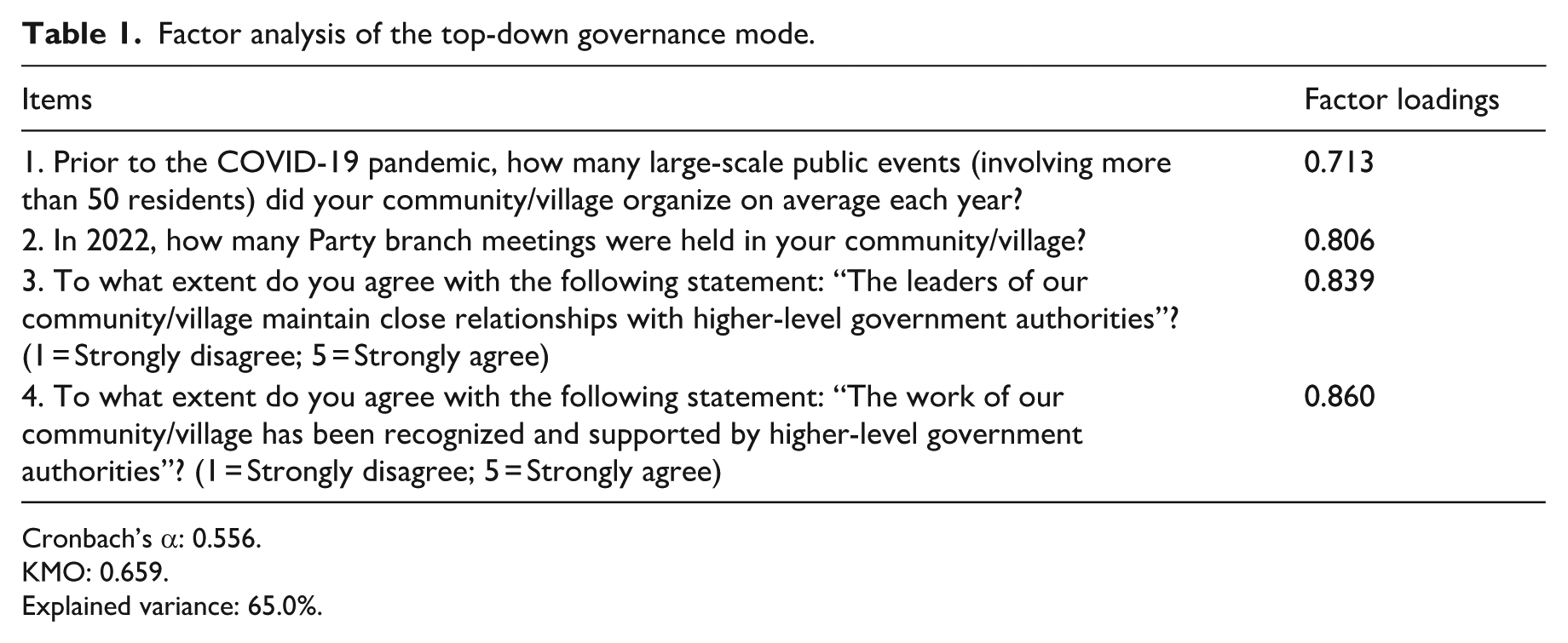
Cronbach’s α: 0.556.
KMO: 0.659.
Explained variance: 65.0%.
Neighborhood social capital serves as the mediating variable in this study. Neighborhood social capital is a multidimensional construct, with widely recognized dimensions in the literature including community participation, norms of reciprocity, trust, and social networks. Neighborhood participation refers to the extent of residents’ involvement in community activities. By engaging in everyday activities such as volunteering, cultural and sports events, science education for families, and participation in neighborhood governance, residents build social capital through sustained interactions and relationships, thereby forming closely-knit social networks. Norms of reciprocity reflect the willingness of residents to help one another, their recognition of community rules and regulations, and their sense of responsibility—key to balancing individual and collective interests. Trust, as the foundation of social cohesion and cooperation, enhances residents’ confidence in neighborhood committees, homeowners’ associations, and fellow community members, making it an indispensable component of effective neighborhood governance. Social networks, as the structural basis of collective social capital, directly influence both the stock and accumulation of social capital. Larger and stronger networks facilitate the dissemination of information, the allocation of resources, and the development of support mechanisms.
Based on existing literature, we designed survey questions corresponding to the four dimensions mentioned above and conducted a factor analysis. After multiple iterations, and using methods such as the covariance matrix, the Kaiser-Meyer-Olkin (KMO) measure, and Bartlett’s test of sphericity, a total of 16 items were retained. In the final factor analysis model, the KMO value was 0.854, and the chi-square value for Bartlett’s test was 36,950.9, with a significance level of less than 0.001—indicating that the data were suitable for factor analysis. Reliability testing showed that the measurement scale for community social capital had good internal consistency. The standardized Cronbach’s alpha coefficient was 0.876, suggesting that the 16 items exhibited strong internal reliability. Following the criterion of eigenvalues greater than 1, four factors were extracted, accounting for 73.2% of the total variance. To clarify the factor loading structure, we applied the varimax rotation method, which maintains orthogonality among factors. Table 2 presents the rotated factor loadings. The resulting factor loading matrix exhibits a clear structure, with interpretable theoretical meanings. Based on the distribution of item loadings, the four factors were named as follows: Neighborhood participation, Norms of reciprocity, Trust, and Social networks.
Factor analysis for the neighborhood social capital.
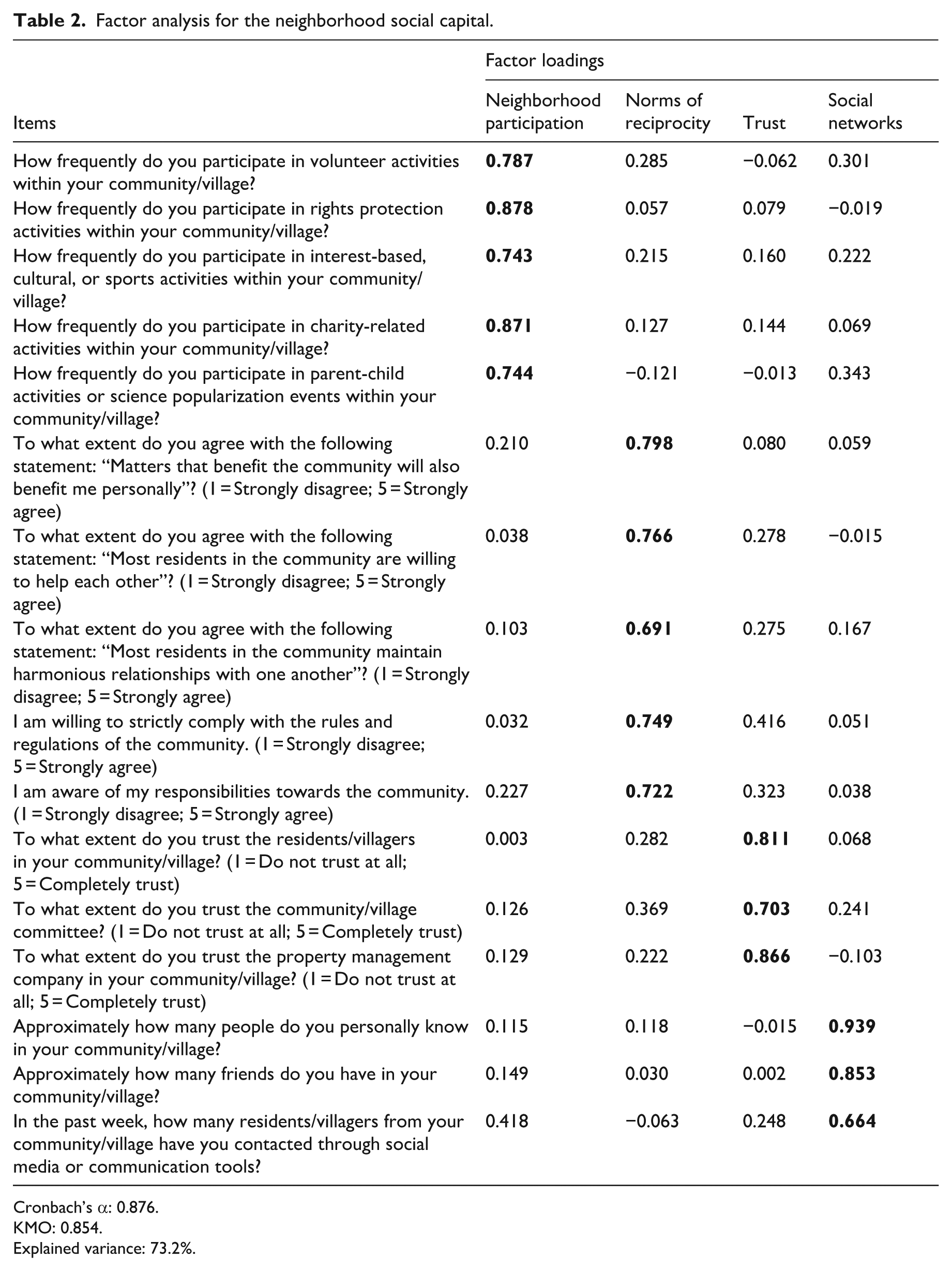
Cronbach’s α: 0.876.
KMO: 0.854.
Explained variance: 73.2%.
Both individual socioeconomic attributes and the built environment of the neighborhood are two major factors influencing residents’ SWB. In this study, these factors are controlled for in the regression models. Drawing on previous research (Liu et al., 2017; Zhang et al., 2019), we include key demographic characteristics as control variables, such as gender, age, educational attainment, marital status, political affiliation, and employment status. Under the unique socio-institutional context of China, the household registration (hukou) system exerts a significant impact on residents’ SWB. To further examine this factor, we categorize respondents into three groups: “native Beijingers” who have held Beijing hukou since birth, “new Beijing citizens” who have acquired Beijing hukou later in life, and migrants without Beijing hukou. In addition, individual health conditions play a crucial role in shaping SWB. Therefore, we incorporate both self-rated health status and Body Mass Index (BMI) as control variables to accurately account for the influence of health factors. Considering that the relationship between BMI and SWB may not be strictly linear, we further categorize BMI into three groups to construct a categorical variable for analysis. Regarding household attributes, we focus on household income and housing conditions. To quantify the degree of housing crowding, we adopt a measurement approach proposed by previous studies (Wang and Liu, 2023), using the number of people per room (bedroom) as an indicator.
The built environments of neighborhood also play a significant role in shaping residents’ SWB. We categorize neighborhoods into two main types: urban neighborhoods and rural neighborhoods. Specifically, communities governed by neighborhood committees are defined as urban neighborhoods, while those under the jurisdiction of village committees are classified as rural neighborhoods. Following prior research (Florida et al., 2013; Liu et al., 2017), key variables such as community population density, total population size, and the proportion of migrant residents are included in the regression models. In terms of methodology, we first utilize high-resolution imagery from the Gaofen-2 satellite to accurately delineate community boundaries. Subsequently, leveraging spatiotemporal big data from a major domestic internet mapping service, we extract the number of permanent residents within each community boundary to calculate population density. Data on the proportion of migrant residents are obtained directly from survey responses. The level of greening in the vicinity of a neighborhood also has a notable impact on residents’ SWB. To measure this factor, we employ the Normalized Difference Vegetation Index (NDVI), a widely recognized indicator in the literature, to assess neighborhood-level greening. Specifically, NDVI values are calculated within a 1-km buffer zone centered on each neighborhood using Gaofen-2 satellite imagery.
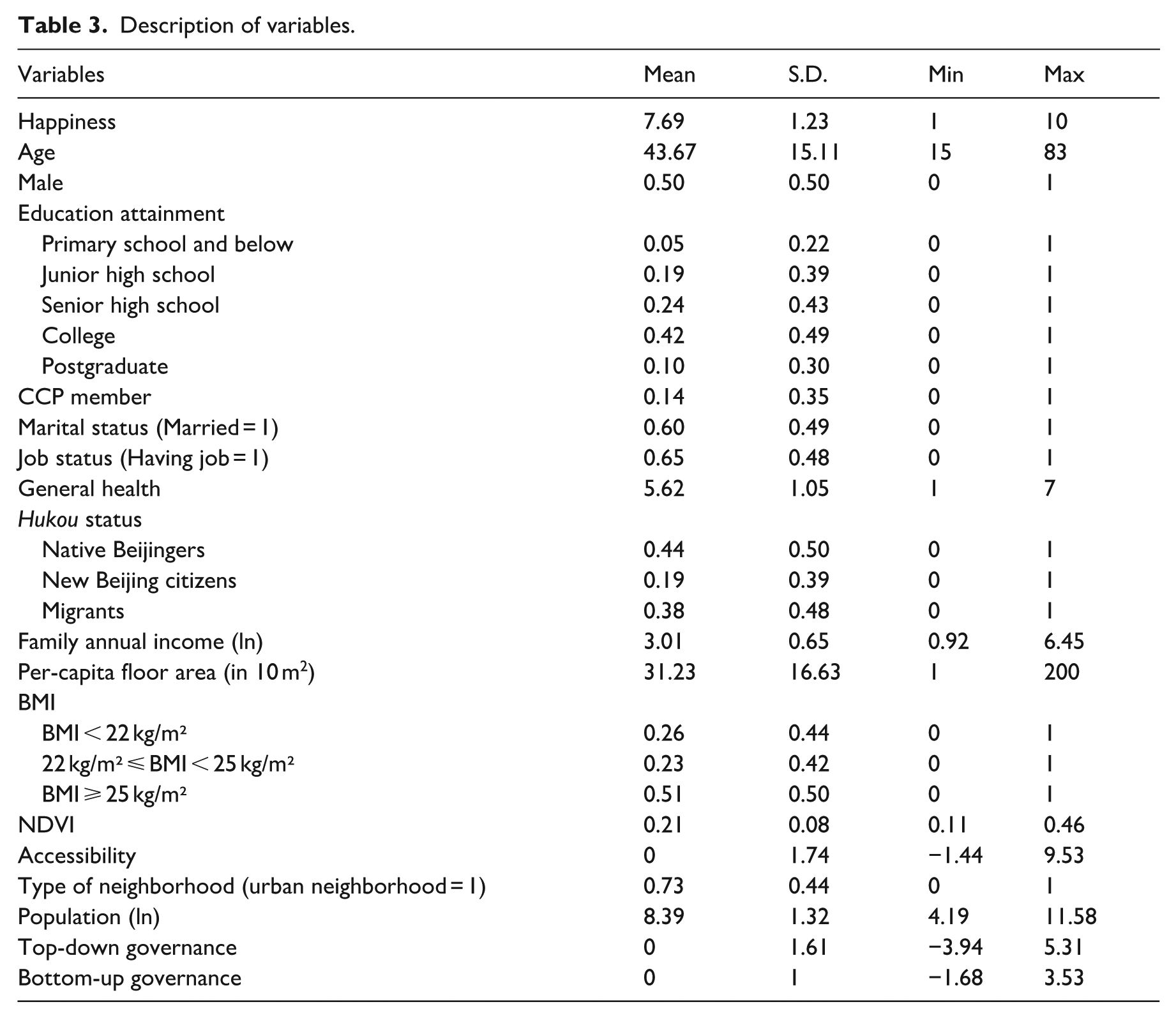
Similarly, we compute road density, medical facility density, and educational facility density within the same buffer zone to capture the accessibility of daily services and amenities in the neighborhoods. Road network data are sourced from OpenStreetMap, while information on medical and educational facilities is derived from Point-of-Interest (POI) data provided by a major domestic map service provider. The definitions, measurement methods, and descriptive statistics of all variables are detailed in Table 3.
Description of variables.
The socioeconomic characteristics of neighborhoods play a critical role in shaping modes and effectiveness of neighborhood governance, the construction of social capital, and residents’ SWB. Therefore, this study classifies neighborhoods based on their socioeconomic profiles and further analyzes the heterogeneous effects of neighborhood governance across different types of neighborhoods. Among various indicators, residents’ income is considered the most appropriate variable for measuring the socioeconomic status of a neighborhood. In this study, residents’ income data are derived from neighborhood-level population portraits constructed using spatiotemporal big data. Income levels are categorized into five groups based on monthly earnings: below 2,500 yuan, 2,500–4,000 yuan, 4,000–8,000 yuan, 8,000–20,000 yuan, and above 20,000 yuan. Based on the distribution of residents across these income categories, we classify neighborhoods into three types: high-income neighborhoods, low-income neighborhoods, and mixed-income neighborhoods. Specifically, we utilize the segregation index to identify high- and low-income neighborhoods. The segregation index, formally introduced by Duncan and Duncan (Duncan and Duncan, 1955), is a widely used metric to quantify residential spatial segregation. The segregation index can be computed at both global and local levels. In this study, we adopt the Local Dissimilarity Index (LD), which measures the extent to which a particular group dominates within a given spatial unit. The calculation formula is as follows:

In the above formula,
Model specification
To examine the relationship between neighborhood governance and residents’ SWB, this study constructs the following baseline econometric model:

where
One of the main objectives of this study is to examine the mediating effects of various dimensions of neighborhood social capital in the relationship between neighborhood governance and residents’ SWB. Drawing on the procedure to analyze mediating effects proposed by Wen and Ye (Wen and Ye, 2014), the following econometric models are specified in conjunction with Equation (1):


In these models,
In Equation (2), the coefficient
The commonly used approach for mediation analysis is the stepwise regression method proposed by Baron and Kenny (1986). According to this method, if both
Another possible scenario is that the total effect
Results
Neighborhood governance mode and residents’ SWB
The regression results presented in Table 4 illustrate the effects of two types of neighborhood governance mode on residents’ SWB. Firstly, we reported the regression results of all the neighborhoods (Table 4, Model 1 and 2). After controlling for individual, household, and neighborhood-level characteristics, the top-down governance mode is positively associated with residents’ SWB. However, the bottom-up governance mode is not statistically significant in all neighborhoods. It is possible that the relationship between bottom-up governance mode and SWB may be different across different types of neighborhoods. Therefore, we performed the regression models by neighborhood types. Results indicate that the top-down governance mode significantly enhances residents’ SWB in low-income and mixed-income neighborhoods, while its impact on residents in high-income neighborhoods is not statistically significant (Table 4, Models 4 and 5). In contrast, the bottom-up governance mode effectively improves SWB among residents in high-income neighborhoods, but shows no significant effect in the other two types of neighborhoods (Table 4, Model 6). These findings suggest that the influence of governance modes on residents’ SWB varies depending on the type of neighborhood.
The effects of two types of neighborhood governance mode on residents’ SWB.
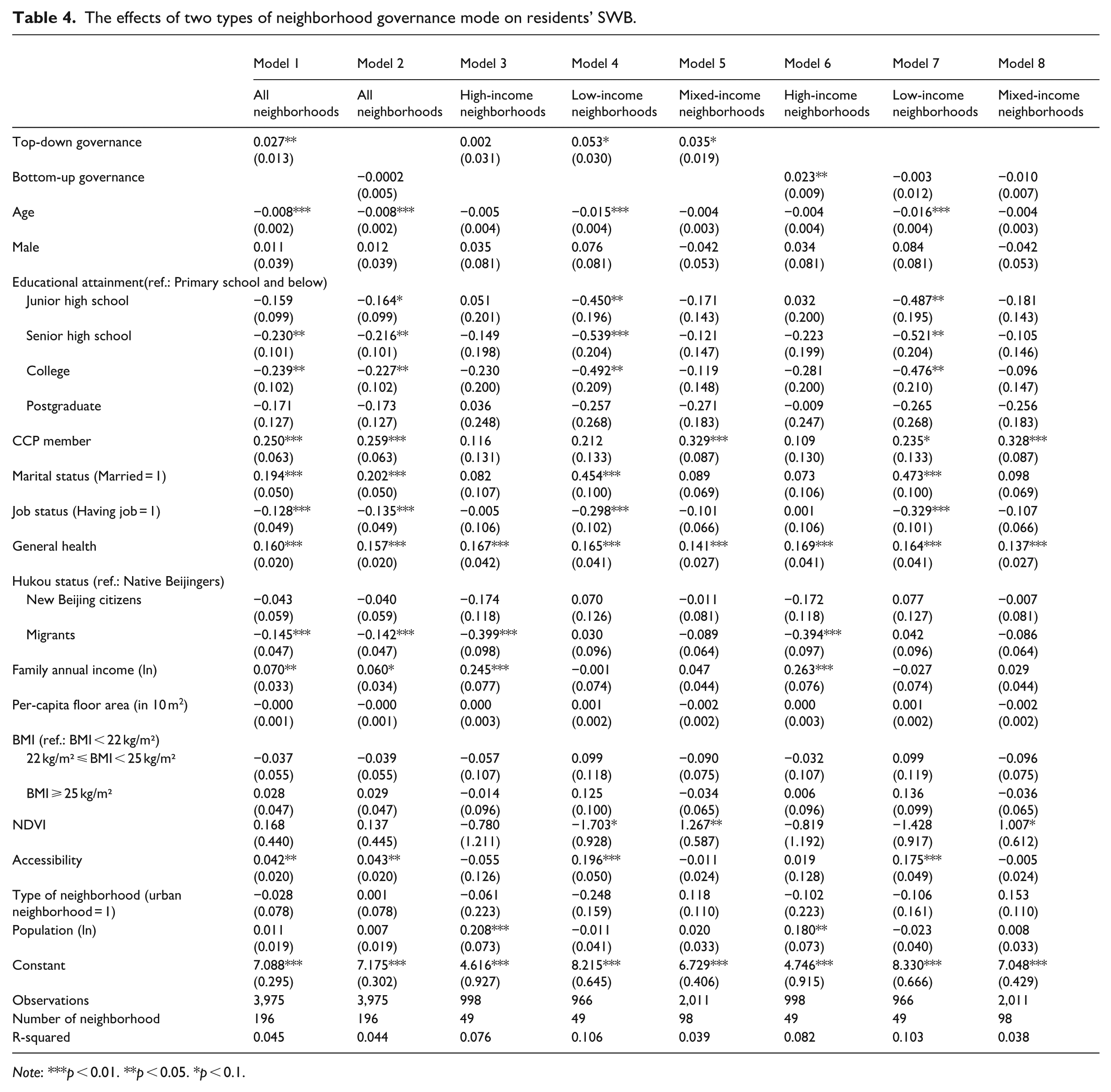
Note: ***p < 0.01. **p < 0.05. *p < 0.1.
The traditional top-down neighborhood governance mode emphasizes government leadership and functions as an integrative governance mechanism. Through an embedded governance model, grassroots governments extend their authority into the neighborhood governance process, integrating the roles of social organizations and other actors in community affairs. From sub-district offices, neighborhood party organizations, and residents’ committees to community service stations, state administrative resources are embedded within neighborhood spaces, completing a hierarchical system of governance. This embedded bureaucratic structure has long been the mainstay of neighborhood governance in China and serves as a direct means of resource allocation.
In mixed-income neighborhoods, where residents differ significantly in their socioeconomic status, this direct resource allocation mechanism is better suited to balancing the diverse needs and preferences of various groups, thereby enhancing governance effectiveness. In low-income neighborhoods, although residents generally share a more homogeneous socioeconomic background, their capacity for self-governance tends to be weaker. As a result, the top-down governance mode also plays an important integrative role, contributing to improvements in SWB in these neighborhoods.
In contrast, the bottom-up governance mode relies on the horizontal collaboration of social organizations within the neighborhood. Supported by, but not fully integrated into, hierarchical bureaucratic structures, these organizations facilitate the allocation, circulation, and delivery of community-related resources. The organizational networks within this governance structure are relatively loosely connected, lacking strong internal binding mechanisms, and do not establish institutionalized and robust interactions with residents’ committees. Instead, their effectiveness largely depends on the resource mobilization and coordination capabilities of social organization members. Residents in high-income neighborhoods generally possess higher socioeconomic status, along with greater resources and capacities. They are better positioned to convert personal resources into organizational resources, thereby fostering self-organized neighborhood governance. Consequently, the bottom-up mode is more effective in enhancing the collective efficacy of high-income neighborhoods, which in turn contributes to improvements in residents’ SWB.
Mediating effects of neighborhood social capital
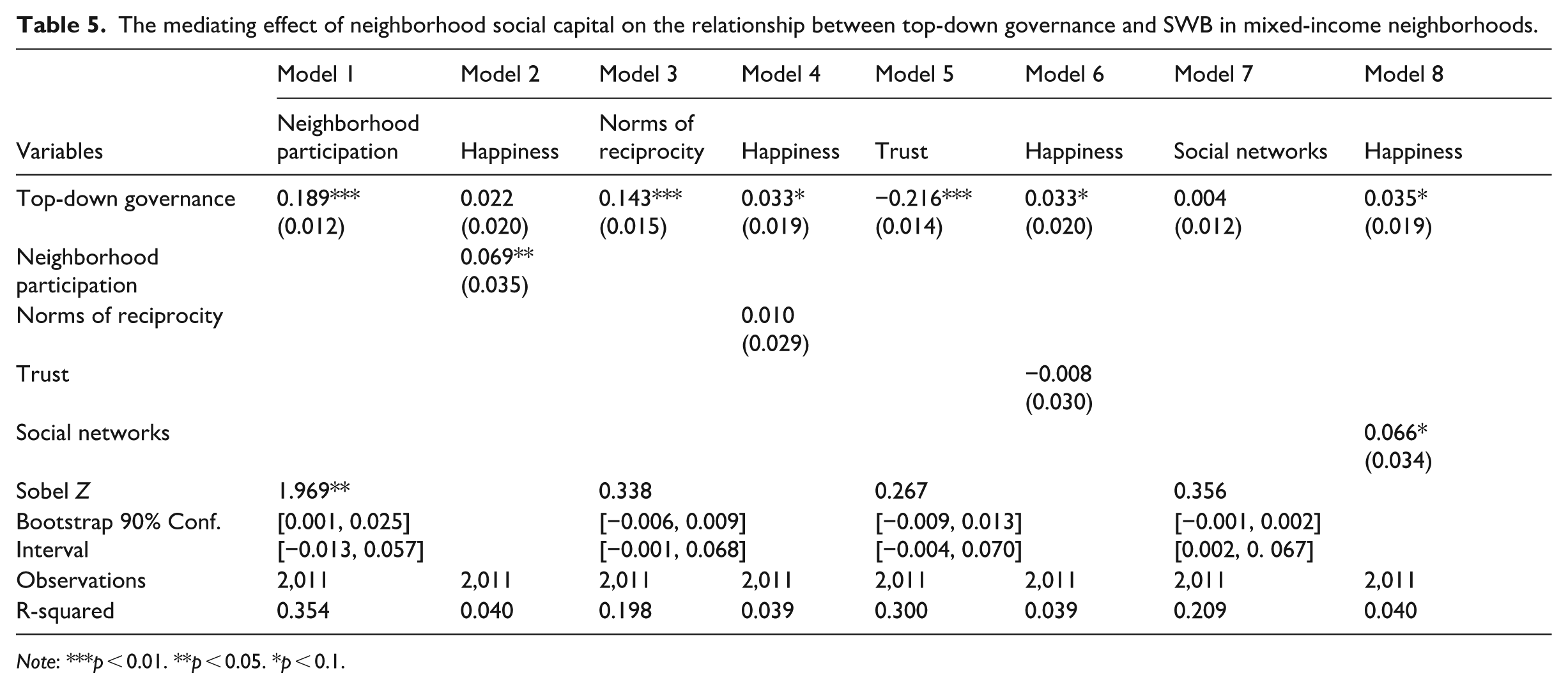
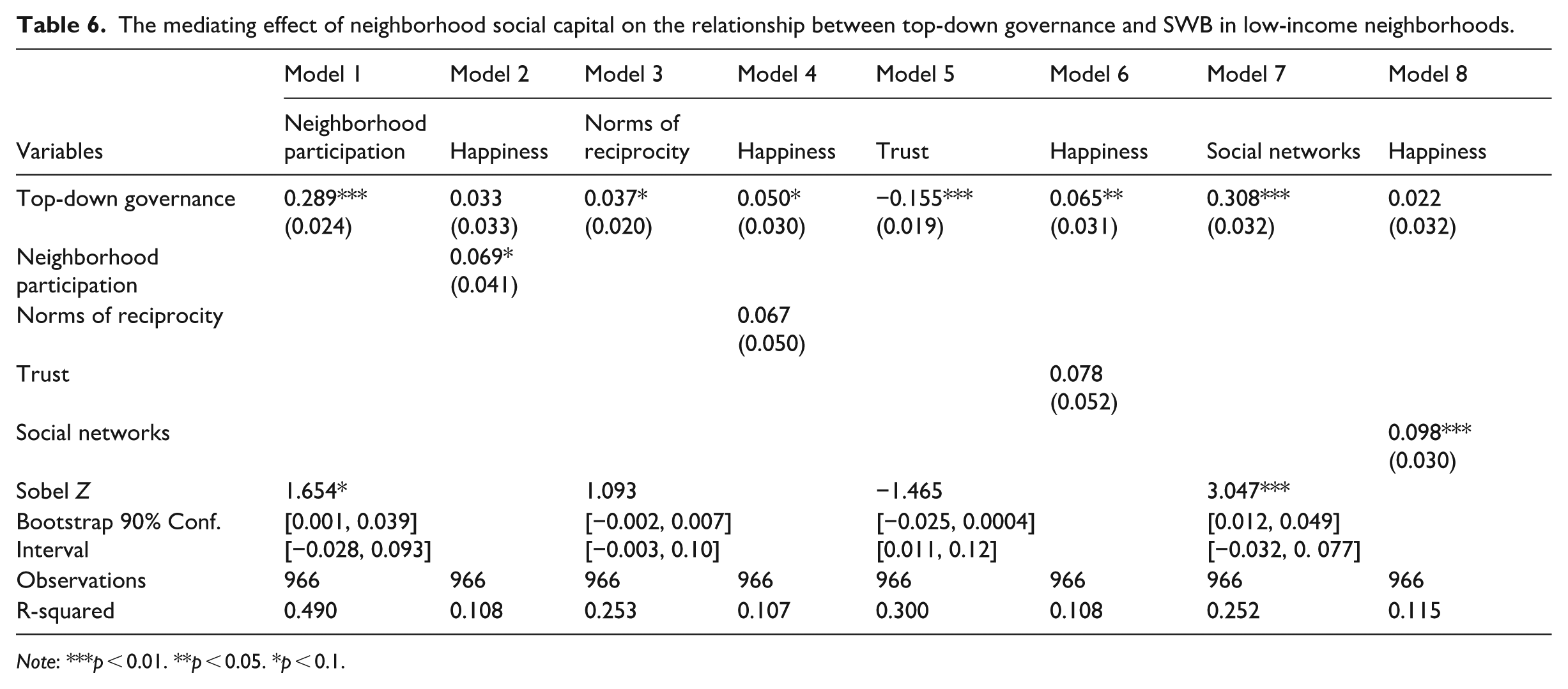
To investigate the mediating effects of neighborhood social capital on the relationship between neighborhood governance and residents’ SWB, this section employs the three-step mediation testing procedure summarized by Wen and Ye (Wen and Ye, 2014), the Bootstrap method, and the Sobel test to examine the mediating effects. First, we test the mediating effect of neighborhood social capital on the relationship between top-down governance and residents’ SWB. The results from the previous section indicate that top-down governance has a significant impact on residents’ SWB in both mixed-income neighborhoods and low-income neighborhoods (Table 4, Models 4 and 5). Therefore, the mediating effect test focuses on these two types of neighborhoods, with the results presented in Tables 5 and 6.
The mediating effect of neighborhood social capital on the relationship between top-down governance and SWB in mixed-income neighborhoods.
Note: ***p < 0.01. **p < 0.05. *p < 0.1.
The mediating effect of neighborhood social capital on the relationship between top-down governance and SWB in low-income neighborhoods.
Note: ***p < 0.01. **p < 0.05. *p < 0.1.
The results in Table 5 indicate that, in mixed-income neighborhoods, top-down governance is significantly associated with the three dimensions of neighborhood social capital—namely, neighborhood participation, norms of reciprocity, and trust. However, it is negatively associated with the trust dimension. Subsequently, the mediating effects of these three dimensions on the relationship between top-down governance and SWB are further examined. The results reveal that only neighborhood participation exhibits a significant mediating effect (Table 5, Model 2). Specifically, the Sobel test yields a z-value of 1.969, which is significant at the 90% confidence level, and the bootstrap-generated confidence interval does not contain zero. In contrast, while both top-down governance and social networks demonstrate significantly positive regression coefficients with SWB (Table 5, Model 8), the Sobel test z-value for the mediation effect is not significant, and the bootstrap confidence interval includes zero. Therefore, the mediating effect of social networks is not supported in mixed-income neighborhoods.
Table 6 presents the results of the mediation analysis of the top-down governance mode on residents’ subjective well-being in low-income neighborhoods. The findings similarly indicate that both neighborhood participation and social networks exert significant mediating effects (Table 6, Models 2 and 8). The Sobel test yields z-values of 1.654 and 3.047, which are significant at the 10% level, and the confidence intervals of the bootstrapped mediation effects do not include zero. The other two dimensions of neighborhood social capital, however, do not exhibit significant mediating effects. In addition, for high-income neighborhoods, the total effect of the top-down governance mode on residents’ subjective well-being is not significant. It is therefore necessary to further examine whether neighborhood social capital exerts a suppressing effect in this relationship. Using the same analytical approach, the results show that neighborhood social capital does not exhibit a suppressing effect in high-income neighborhoods.
Based on the above analysis, we can conclude that top-down governance modes can significantly enhance residents’ SWB in both low-income and mixed-income neighborhoods. In mixed-income neighborhoods, top-down governance exerts a positive influence on SWB primarily by promoting residents’ neighborhood participation. In low-income neighborhoods, this positive effect is fully realized through the dual mediating mechanisms of neighborhood participation and social networks.
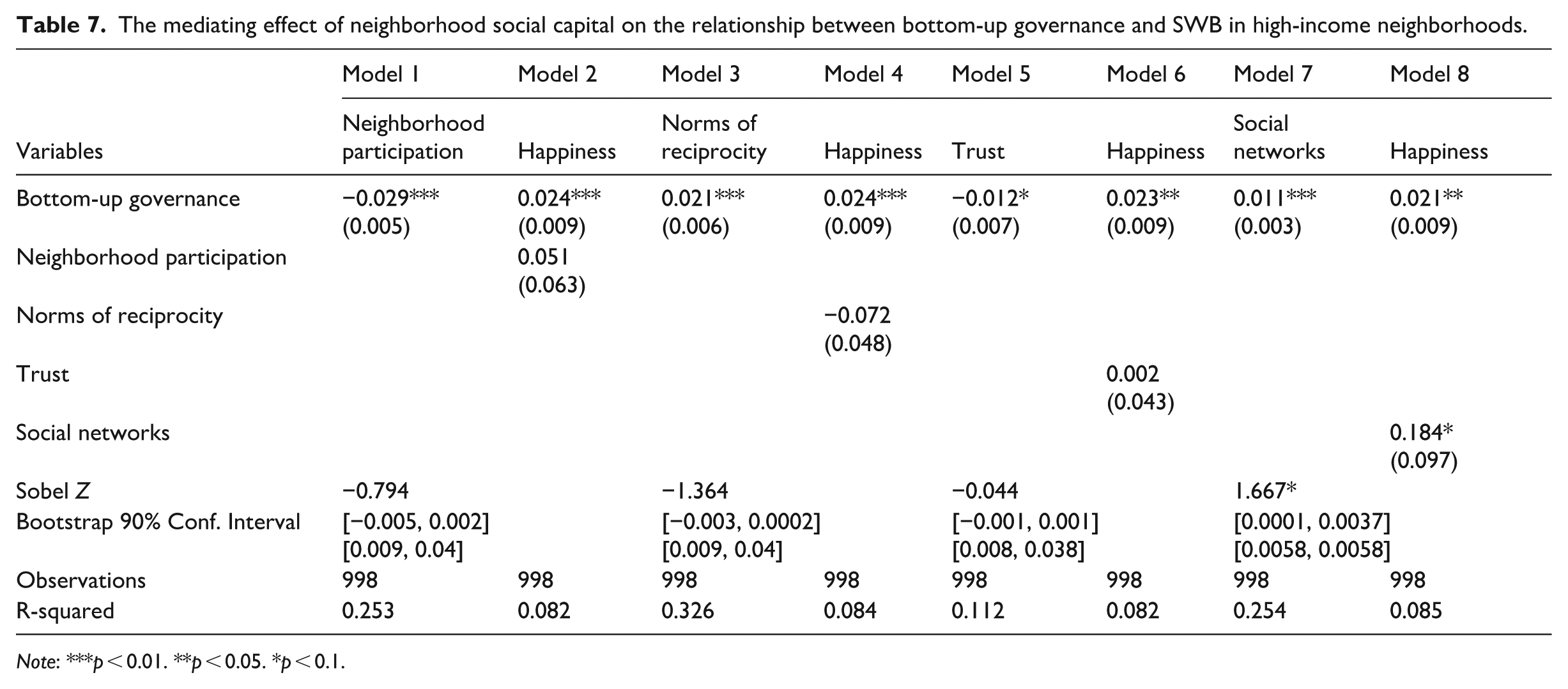
The same analytical approach was employed to examine whether neighborhood social capital mediates the relationship between the bottom-up governance mode and residents’ subjective well-being. According to the previous analysis, the bottom-up governance mode has a significant positive effect on residents’ subjective well-being only in high-income neighborhoods. Therefore, the mediation analysis of neighborhood social capital was conducted specifically for this type of neighborhood. The results in Table 7 show that in high-income neighborhoods, the bottom-up governance mode is significantly associated with all four dimensions of neighborhood social capital. Specifically, it is negatively related to neighborhood participation and trust (Table 7, Models 1 and 5), but positively related to reciprocity norms and social networks (Table 7, Models 3 and 7). Further examination of the mediating effects of the four dimensions indicates that, according to both the Sobel and Bootstrap tests, only the mediating effect of social networks is statistically significant (Table 7, Model 8). The Sobel test yields a z-value of 1.667, which is significant at the 10% level, and the Bootstrap results confirm this finding. Since the direct effect of the bottom-up governance mode remains significant (γ2 = 0.027, p < 0.01), social networks play a partial mediating role. Specifically, the results suggest that bottom-up neighborhood governance significantly enhances residents’ subjective well-being in high-income communities, and that this effect operates partly through the strengthening of social networks among residents.
The mediating effect of neighborhood social capital on the relationship between bottom-up governance and SWB in high-income neighborhoods.
Note: ***p < 0.01. **p < 0.05. *p < 0.1.
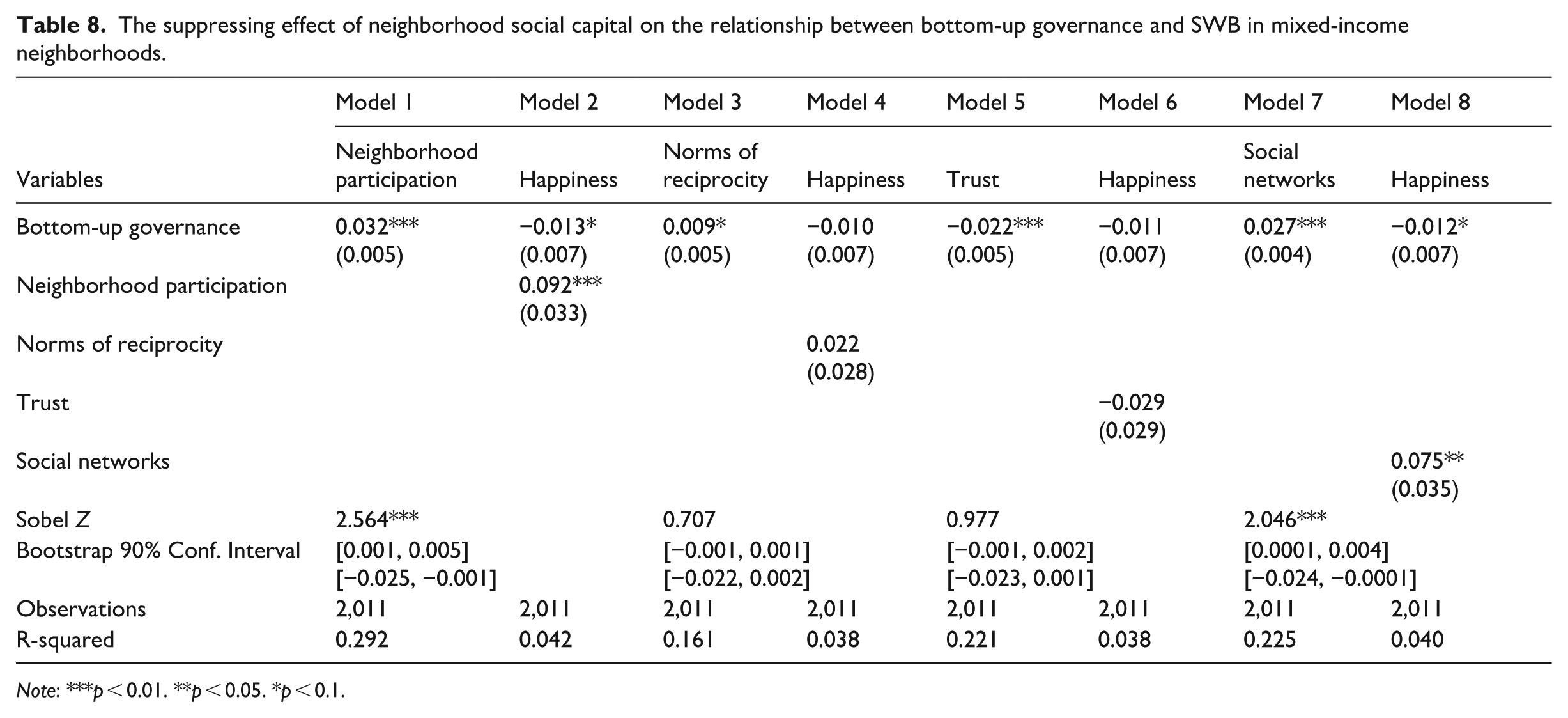
For low-income neighborhoods and mixed-income neighborhoods, the overall effect of bottom-up governance on residents’ SWB is not statistically significant. This necessitates further examination of whether neighborhood social capital serves as a suppressor variable in this relationship. Applying the same analytical approach, it is found that in mixed-income neighborhoods, social capital exhibits a significant suppression effect, as shown in Table 8. Although bottom-up governance does not exert a significant direct impact on residents’ SWB (Table 5, Model 8), it significantly enhances neighborhood participation and social networks (Table 8, Model 1 and Model 7). When considering the indirect benefits through these two dimensions, the direct effect of bottom-up governance on residents’ SWB becomes significantly negative, with indirect effects of 0.001 and 0.004, respectively (Table 8, Model 2 and Model 8). Sobel tests confirm the significance of these indirect effects, with z-values of 2.564 and 2.046. Given that both the direct and indirect effects are significant but in opposite directions, this indicates the presence of a suppression effect. Specifically, in mixed-income neighborhoods, bottom-up governance has a negative direct effect on residents’ SWB. However, since it significantly promotes community participation and social networks—both of which have a positive impact on SWB—the negative effect of bottom-up governance on residents’ SWB is mitigated.
The suppressing effect of neighborhood social capital on the relationship between bottom-up governance and SWB in mixed-income neighborhoods.
Note: ***p < 0.01. **p < 0.05. *p < 0.1.
Table 9 summarizes the indirect effects of neighborhood social capital in the relationship between governance modes and residents’ subjective well-being (SWB). Overall, the effects of neighborhood governance on SWB are more evident in low-income neighborhoods, particularly under the top-down governance mode. This mode influences residents’ SWB through two main mechanisms—enhancing neighborhood participation and strengthening social networks—with the latter exerting a full mediating effect. In high-income neighborhoods, the pattern differs. The effect of top-down governance on SWB is not significant, whereas bottom-up governance enhances residents’ SWB primarily by reinforcing social networks. However, this mediating effect is partial, indicating that bottom-up governance may also improve residents’ well-being through additional mechanisms beyond the enhancement of social networks. The situation in mixed-income neighborhoods is more complex. Both top-down and bottom-up governance exhibit intricate pathways in influencing SWB. Specifically, top-down governance promotes SWB by fostering neighborhood participation. Although the direct effect of bottom-up governance on SWB is negative and statistically insignificant, further examination reveals that this negative effect is suppressed by the positive influences of neighborhood participation and social networks. This suggests that, in mixed-income neighborhoods, factors beyond social capital may also mitigate the potential negative impacts of bottom-up governance on residents’ well-being.
Pathways of the indirect effects of neighborhood social capital.
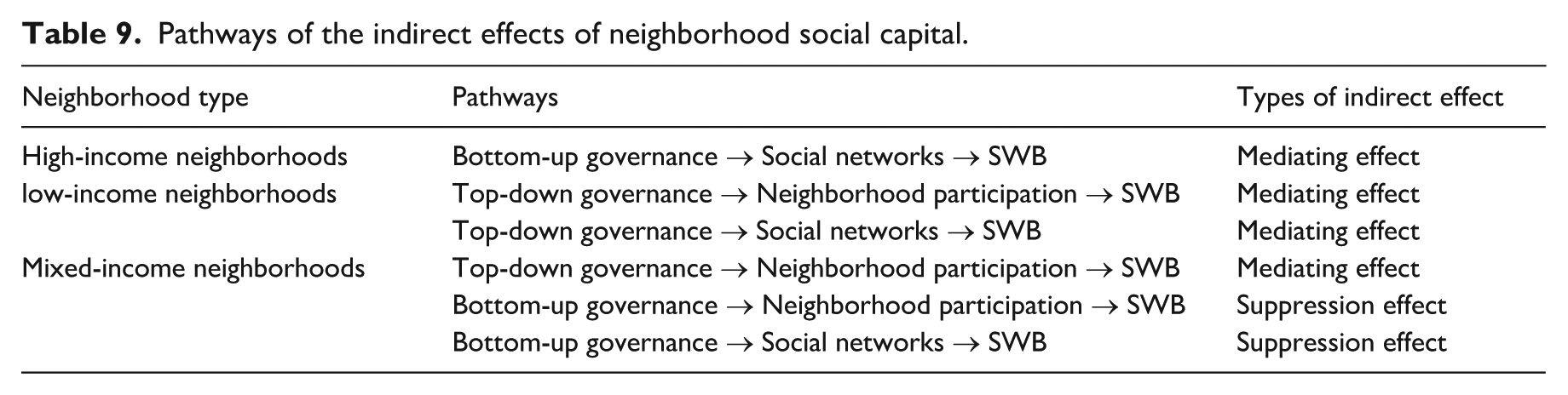
In summary, among the four dimensions of neighborhood social capital, neighborhood participation and social networks play a more substantial role in mediating the relationship between neighborhood governance and residents’ SWB. These dimensions should therefore be prioritized in efforts to cultivate social capital through neighborhood governance. In contrast, reciprocity norms and trust are less amenable to direct enhancement through governance interventions, limiting their capacity to function as immediate mediating factors.
Moreover, the effects of governance mode on residents’ SWB vary significantly across different types of neighborhoods. Bottom-up governance is more effective in enhancing SWB in high-income neighborhoods, primarily because residents in these neighborhoods possess dual advantages of personal resources and organizational capacity, making self-governance more feasible. In mixed-income neighborhoods, however, the high degree of resident heterogeneity often leads to reciprocal distrust, increasing the likelihood of conflicts and tensions, and thus complicating governance efforts. As such, top-down governance proves more effective in integrating diverse resident characteristics and enhancing SWB by fostering neighborhood participation. Conversely, in mixed-income neighborhoods, bottom-up governance tends to face greater challenges due to group segregation and the pursuit of narrow group interests, which exacerbate governance difficulties and may negatively affect residents’ SWB. Nevertheless, these negative impacts can be mitigated by the positive effects of neighborhood participation and social networks, thereby attenuating the adverse influence of bottom-up governance on SWB.
Conclusion and discussion
Taking Beijing as a case study, this study investigates the impact of different neighborhood governance mode on residents’ SWB by integrating data from questionnaire surveys. Furthermore, the study examines the mediating effects of neighborhood social capital in this relationship, as well as the variations across different types of neighborhoods. The findings reveal significant differences in how governance models affect residents’ SWB, depending on the neighborhood type. Specifically, in high-income neighborhoods, bottom-up governance—characterized by residents’ self-organizing behaviors—significantly enhances SWB. In contrast, in low-income and mixed-income neighborhoods, top-down governance, led by grassroots government involvement, exerts a more positive influence on residents’ SWB. These results suggest that the effectiveness of governance modes largely depends on the socioeconomic structure of the neighborhood.
Various dimensions of neighborhood social capital exhibit differentiated pathways in mediating the effects of governance modes on SWB. Specifically, neighborhood participation and social networks function as mediating or suppressing factors in this relationship. On the one hand, bottom-up governance significantly enhances the SWB of residents in high-income neighborhoods by strengthening social network ties among residents. On the other hand, in mixed-income neighborhoods, bottom-up governance mitigates its potential negative effects on SWB through its positive influence on neighborhood participation and social networks, thereby indirectly enhancing residents’ SWB. In contrast, traditional top-down governance in low-income neighborhoods primarily improves SWB by fostering neighborhood participation and expanding residents’ social networks. In mixed-income neighborhoods, neighborhood participation continues to demonstrate a significant mediating effect in the relationship between governance and SWB. However, this study finds no statistically significant evidence that the trust and reciprocity norms dimensions of neighborhood social capital are directly associated with the relationship between neighborhood governance and residents’ SWB.
This study addresses an important debate in existing research regarding the relationship between neighborhood governance and social capital: whether it is possible to build and enhance social capital through institutional interventions and governance practices in neighborhoods with initially low levels of social capital. Classical perspectives, represented by Putnam, have long argued that social capital accumulation is a slow, path-dependent process of self-replication and reinforcement. According to this view, when a neighborhood’s initial stock of social capital is low, government interventions are unlikely to be effective. However, critics contend that this perspective underestimates the potential agency of administrative power and institutional arrangements in shaping the environment for collective action and associational behavior, thereby facilitating the generation of social capital. The empirical evidence presented in this study supports the latter view, demonstrating that neighborhood governance can effectively stimulate and cultivate neighborhood social capital. Both traditional top-down governance, led by government initiatives, and emerging bottom-up governance, centered on resident self-organization, exert positive influences on different dimensions of social capital across various types of neighborhoods. These findings not only confirm the theoretical proposition that social capital is constructible but also highlight the critical role of institutional design and administrative organization in the reproduction of social capital.
Our findings also validate the governance effectiveness of multiple governance modes across different types of urban neighborhoods. With the dismantling of the work-unit (danwei) system, urban residential spaces in China have become increasingly diversified, posing new challenges for grassroots governance models. Although current discourse emphasizes neighborhood governance led by resident self-organization, the state’s embedded interventions in neighborhood self-governance and the dependence of neighborhood organizations on government resources remain defining features of China’s neighborhood governance landscape. Consequently, urban neighborhoods in China generally exhibit a coexistence of top-down and bottom-up governance modes.
Both governance modes can effectively enhance residents’ SWB, yet their impacts vary significantly across different types of neighborhoods. Specifically, in neighborhoods characterized by high levels of resident heterogeneity, such as mixed-income neighborhoods, top-down governance—relying on hierarchical administrative coordination—proves more effective. Similarly, in neighborhoods with a higher proportion of low-income residents, top-down governance, with its superior capacity for resource integration and mobilization of neighborhood participation, plays a particularly vital role. This is because such neighborhoods often require substantial external support and resource input to compensate for deficiencies in internal social capital and social networks. In contrast, in high-income neighborhoods, bottom-up governance led by resident self-organization demonstrates greater efficiency. Residents in these neighborhoods typically possess abundant personal resources and stronger self-organizing capacities, enabling social organizations to coordinate more effectively and play a proactive role in neighborhood governance. Consequently, these neighborhoods can enhance overall SWB by strengthening social network ties among residents.
The findings of this study offer important policy implications for current neighborhood governance practices in China. First, the design and implementation of neighborhood governance models should fully consider the socioeconomic characteristics of different neighborhoods. It is essential to develop targeted governance modes that respect neighborhood heterogeneity in order to enhance governance effectiveness. Traditional government-led governance modes are increasingly inadequate to meet the diverse needs of contemporary urban neighborhoods. Second, fostering and building neighborhood social capital should be a central objective of neighborhood governance. Social capital not only strengthens neighborhood cohesion but also plays an active role in promoting collective action and improving residents’ SWB. Therefore, in advancing the modernization of neighborhood governance, it is crucial to focus on the mechanisms of social capital accumulation. In the process of cultivating neighborhood social capital, particular emphasis should be placed on enhancing community participation and fostering social networks among residents, as these two dimensions constitute key pathways for generating high-quality social capital. In this regard, the government’s role should go beyond mere resource provision to function as a “procedural facilitator,” actively guiding participation through institutional design, platform development, and rule-making to stimulate and sustain resident engagement. Meanwhile, social organizations, as vital intermediaries connecting government and residents, should be empowered to fulfill their roles in organizational coordination and service delivery within neighborhood governance. Special attention should be given to supporting weaker public-interest neighborhood-based organizations, promoting the diversification and structural optimization of neighborhood social organizations. Such efforts would provide a sustainable foundation of social capital for neighborhood governance.
Footnotes

Ethical considerations
The research was undertaken in accordance with requirements relating to research ethics of China’s the National Natural Science Foundation of China (Grant No. 72204004), and ethical guidelines established by the Ethics Committee, Renmin University of China.
Consent to participate
Not applicable. No personal data was used for this manuscript, and all interviews are fully anonymized. Informed consent was obtained verbally before participation from the participants.
Consent for publication
Not applicable. No personal data was used for this manuscript, and all interviews are fully anonymized. Informed consent was obtained verbally before participation from the participants.
Funding
The authors disclosed receipt of the following financial support for the research, authorship, and/or publication of this article: This paper was supported by the National Natural Science Foundation of China (Grant No. 72204004).
Declaration of conflicting interests
The authors declared no potential conflicts of interest with respect to the research, authorship, and/or publication of this article.
Data availability statement
The data used in this study are confidential.
Trial registration number/date
Not applicable. This study did not involve a clinical trial.