



Abstract
Strategies for revitalizing marginalized neighborhoods often include participatory innovations. According to the participatory bias argument, however, participatory governance arrangements benefit the privileged rather than the poor. In the present article, the validity of this argument is examined by analyzing how individual resources and social positions relates to recruitment to, participation within, and outcomes derived from participation in a most-likely case of bias in participatory neighborhood governance. Although the privileged were overrepresented in recruitment, the pattern was less clear regarding influence within the processes, and quite the opposite regarding certain outcomes of participation. Also in a most-likely case for bias, participatory neighborhood governance may induce empowerment among poor. Based on the observation that participants that differ with regard to available resources and social positions also have different motives for participation, a mechanism-based account regarding why and how bias in early phases under certain conditions may produce empowering outcomes is proposed.
Keywords
Introduction
The arguments for participation in revitalization of poor neighborhoods are not only long-lasting, but also many and different. For decades (Wilson 1963), advocates of participation have claimed that citizen engagement not only deepens democracy, increases legitimacy, and harmonizes conflicts, but also makes implementation more effective and increases problem-solving capacity (Fung 2004; Wagenaar 2007; Farrelly 2009; Durose and Lowndes 2010; Parés, Bonet-Martí and Martí-Costa 2012; Skelcher, Sullivan and Jeffares 2013; De Graaf, Van Hulst and Michels 2015).
However, despite repeated efforts to realize such promises, criticism of participatory governance in general and neighborhood participatory governance in particular is persistent (Taylor 2007; Walker, McQuarrie and Lee 2015; Poletta 2016; Glimmerveen, Ybema and Nies 2022). In the present article, I focus on one of the issues critics point to: Winners in local participatory governance are the privileged, those who already have resources and have access to power, and neighborhood participatory mechanisms therefore increase differences between citizens who have opportunities to affect their living situation and those who do not (e.g., Theiss-Morse and Hibbing 2005; Fiorina 1999). In the article, I refer to this position as the participatory bias argument.
According to the most radical version of the participatory bias argument, participatory arrangements are not only insufficient for redistribution of power, but also intentional instruments meant to give a human face to policies that disadvantage the poor (Baiocchi and Ganuza 2015; Walker, McQuarrie and Lee 2015; Taylor 2007). Even though residents are occasionally capable of affecting minor issues, according to this version of the argument they are intentionally kept at a distance from any real impact. Participatory governance, it is suggested, is an instrument of “de-politicization” (Boussaguet 2016; Sørensen and Torfing 2017) and serves elitist purposes by design (Parkins and Sinclair 2014).
A less cynical, yet still skeptical, argument claims that participatory neighborhood governance is captured by the privileged, not by intentional design, but by virtue of its process. According to this version of the argument, participatory governance is a demanding form of participation (Fiorina 1999), which unintentionally creates bias in contexts of unequal distribution of the resources needed to participate effectively, that is, time, knowledge, and status (Navarro and Font 2013; Theiss-Morse and Hibbing 2005; Verba, Schlozman and Brady 2002; Melo and Baiocchi 2006; Parvin 2021).
In the present article, I will not examine the actual intentions of governmental invitations to participatory neighborhood governance, but the effects in relation to bias in recruitment, participation and outputs. The article re-analyzes a survey-based case study of neighborhood revitalization in Stockholm, Sweden (Danielsson, Gustafsson and Hertting 2016), the aim being to test the participatory bias argument in a most-likely case (Gerring 2007; Eckstein 1975), to suggest a mechanism-based account of the somewhat paradoxical pattern of bias and empowerment observed in the case, and to contribute to the recent literature on the paradoxes and ambivalences of participatory governance (Bobbio 2019; Poletta 2016; Ganuza, Baiocchi and Summers 2016).
The case of the Stockholm Neighborhood Renewal Program (SNRP) was characterized by self-selected participation and demanding face-to-face discussions under ambiguous rules-in-use in a local context of social inequality. In light of previous literature and theory, it therefore belongs to a category of cases in which one would expect strong bias-inducing mechanisms to play out. While it is incorrect to state that no bias was found, it is fair to state that the case nuances the participatory bias argument and provides opportunities for theory development (Levy 2008). Hence, by scrutinizing a most-likely case for bias, the article suggests how and why, under certain conditions, initial bias may actually render empowering outcomes in terms of increased political impact, capacity, and efficacy among the poor. 1
In the two following sections, I discuss the existing literature on participatory bias, develop theoretical expectations about the conditions that induce bias in participatory governance more specifically, and make analytical distinctions for a more elaborated analysis of participatory governance bias. I then present the most-likely case study design and the survey data it is based on. Drawing on the conceptual framework, the empirical part of the article is structured according to a process-oriented template related to: (1) recruitment to; (2) activities and opportunities in; and (3) impact, civil skills, and efficacy derived from participation. The empirical analysis is concluded in a fourth section, demonstrating that tendencies toward empowerment of the marginalized in relation to civic capacity and efficacy become visible over time, despite conditions of a most-likely case for bias. Relating to arguments on “spill-over effects” (Altschuler and Corrales 2012) and “concentric circles” (Fagotto and Fung 2006), the final section draws on the process-oriented design and suggests how participatory bias in the early phases may actually produce empowering outcomes in later stages. Hence, the article contributes to a growing body of literature that aims to understand the paradoxes and ambivalences of participatory governance (Koch 2013; Poletta 2016; Ganuza, Baiocchi and Summers 2016; Bobbio 2019).
Participatory Neighborhood Governance and the Participatory Bias Argument
At the heart of the participatory bias argument is the claim that direct forms of participation are procedurally demanding (Fiorina 1999). From the perspective of the individual participant, the costs of involvement are expected to be higher than those of involvement in, for instance, electoral participation (Verba, Schlozman and Brady 2002, 166). When costs, broadly defined, are high, the initial distribution of relevant resources and opportunities—education, social networks, time, etc.—matters more. In particular, when participation is open to all, critics argue, bias in favor of the privileged is induced and reflected not only in the participation process as such, but eventually also in the policies, implementation, and outcomes linked to participation (Smith 2009, 22; see also Phillips 1998).
Drawing on the work of urban scholars, such as, Melo and Baiocchi (2006), Fagotto and Fung (2006), Taylor (2007), Denters and Klok (2010), and Navarro and Font (2013), I suggest that there are three more specific mechanisms in local participatory governance that make the risk of participatory bias even more accentuated. First, local participatory governance is rarely an either–or question. It allows for variation in degree of participation, from being a passive spectator to a more active articulator (Fung 2006). Compared to voting, for instance, participatory arrangements in neighborhood renewal therefore often induce role hierarchies, distinguishing more demanding but also more rewarding roles from less demanding and less rewarding roles within the same participatory arrangement (Fagotto and Fung 2006). In contexts where the resources needed to take on the more rewarding roles are unequally distributed, such role hierarchies induce bias (Fischer 2012, 461).
Second, unlike voluntary engagement in political parties, public demonstrations or many civil society associations (Knoke 2019), participants in local participatory governance will meet not only people with conflicting interests, beliefs, identities, etc. (Forester 2009), but also professionals with more technically advanced knowledge or discursive resources and vocabularies foreign to or even off-putting for marginalized people (Fischer 2006; Lowndes and Sullivan 2004, 61). Compared to many other forms of participation, we should therefore expect that more resources, such as, time, knowledge and efficacy, are required for effective participation in participatory governance and, as a result, that participatory bias should be a major concern in contexts of unequal distribution of such capacities.
Third, participatory governance arrangements are often characterized by ambiguity concerning procedures, positions, mandates, etc. (Fung 2015; Torfing et al. 2012; Danielsson, Hertting and Klijn 2017). As a route to impact, vaguely defined mandates and procedures do not only make the political gains uncertain, but also neighborhood participatory governance difficult and demanding. It seems reasonable to expect such institutional obscurity (Röcke 2014) implies high information costs (Ostrom 1990), in particular for marginalized outsiders in comparison to privileged insiders (Knoke 1990, 54). Hence, because of institutional ambiguity, we should expect participation in participatory governance more vulnerable to bias than most other types of political participation.
Based on the arguments above, I suggest selecting crucial cases (Eckstein 1975) for studying participatory governance bias should pay attention to factors such as degree of openness and self-selection to participation, degree of obscurity of rules and procedures, procedural demands and existence of role hierarchies. In relation to these factors, in the section on case study design below, I argue that the SNRP case qualifies as a most-likely case for bias.
Phases and Dimensions of Participatory Governance Bias
Previous research on participatory governance bias tends to focus on recruitment of participants, empirically (e.g., Navarro and Font 2013; Denters and Klok 2010) as well as theoretically (Smith 2009; Khoban 2021). Democracy theorists, however, often attribute empowering values to the process of participation as such (Pateman 1970). In order to better understand participatory bias, we should therefore move beyond simply describing the characteristics of recruited participants and also try to grasp how different categories of recruited participants are affected by the participation process. In this article, I therefore distinguish between (1) bias in relation to recruitment to participation, (2) bias in relation to opportunities in participation, and (3) bias in relation to outcomes derived from participation—hereafter referred to as input, throughput and output bias.
Second, the participatory governance bias is often conceptualized in relation to influence (Denters and Klok 2010; Taylor 2007). Rather than counteracting political inequality through redistribution of impact opportunities, participatory governance arrangements give the privileged another arena to voice their interests. Moreover, critics argue, if the poor are allowed to have a say within the participatory arrangements as such, they are effectively decoupled from any real impact on policy, implementation or outcomes (Walker, McQuarrie and Lee 2015; Poletta 2016). However, participation theorists also point to effects from participation other than influence (Teorell 2006). As schools of politics, participation offers an arena for generating (objective) civic skills as well as (subjective) political efficacy (Verba, Schlozman and Brady 2002). That is, bias in input, throughput or output phases of participatory governance may not only create inequalities in relation to political influence, but also in opportunities to develop civic capacities and efficacy of future political relevance (e.g., Pateman 1970; Fung and Olin Wright 2003; Bengtsson 2010). Focusing too narrowly on either effect limits our understanding of how participatory mechanisms may work, be it through the reproduction of political inequality or not (Bherer et al. 2016; Parvin 2021).
Finally, regarding the characterization of privileged or poor participants, the literature points to the importance of individual resources, such as time, money and civic capacity, as well as social positions, such as class, ethnicity, etc. (Verba, Schlozman and Brady 2002, 270ff.; Milbrath 1981). Education is often considered individual human capital related to civic skills such as “the ability to speak and write, the knowledge of how to cope in an organizational setting” (Verba, Schlozman and Brady 2002, 305). Ethnicity, gender, and class, on the other hand, are examples of social positions related to participation (Milbrath 1981; Djupe and Gilbert 2006). As intersectional analysis suggests, however, in practice not only is social position empirically related to individual resources, but also different social positions, such as race and gender, tend to work interactively and dynamically rather than independently and statically (Brown 2014). In the present article, bias is measured in relation to both the individual resources and social positions.
Based on the arguments above, below I study bias by (a) following the process from input and throughput to output of participation, (b) considering the distribution of influence over the process as well as the generation of political capacity and political efficacy, and (c) with respect to individual resources as well as the structural positions of participants.
Case Study Design: The Stockholm Neighborhood Renewal Program as a Most-Likely Case for Participatory Bias
Over the past decades, participatory arrangements have been an integral part of attempts to regenerate poor neighborhoods in Sweden. In the capital of Stockholm, several large-scale participatory initiatives have been launched over the years (Gustafson and Hertting 2017; Tahvilzadeh 2015), and the SNRP is one example. It was carried out between 2003 and 2006 in nine districts in Stockholm that were characterized by poverty, low election turnout and, for most districts, a high proportion of residents with a non-Swedish background. While the specific issues that were dealt with concerned, that is, safety, social issues, traffic and the local environment, housing, the labor market, the overall ambition of the majority at the time was to initiate a long-term development toward inclusion and democratic renewal: “This is about ensuring that the (…) opportunities for citizens to participate in planning and decision processes and to have direct influence over collective concerns will increase, among other things through the development of open and transparent meetings” (City of Stockholm, 2003, 72–73, own translation).
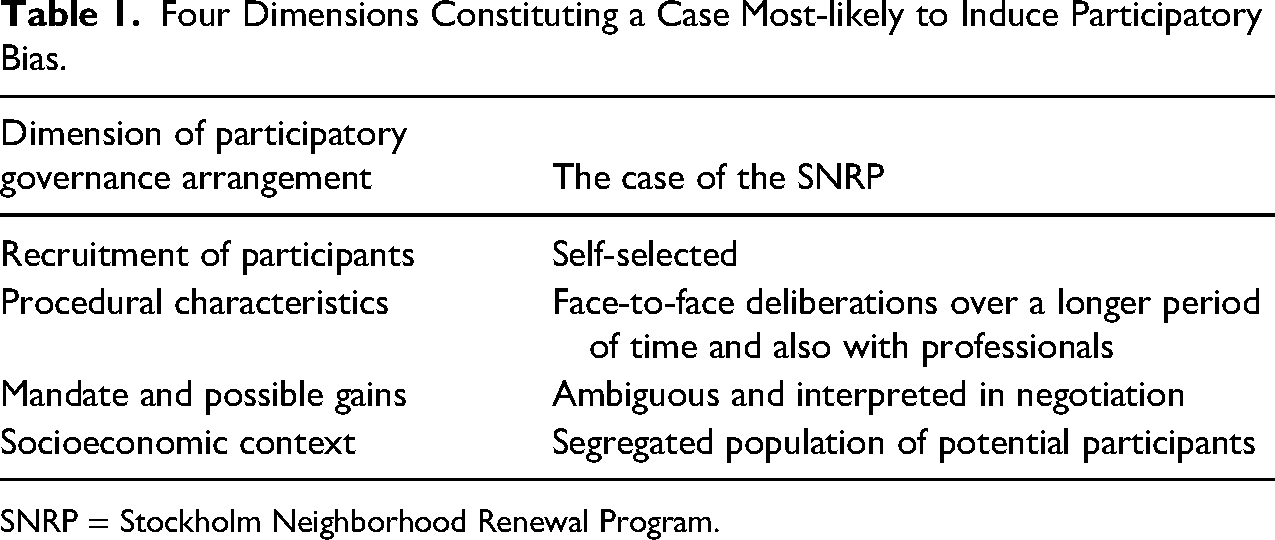
However, drawing on the theoretical arguments developed above, a number of institutional characteristics of the SNRP seem to increase the costs of participation. Because of this, it provides a crucial case for testing and developing theoretical propositions concerning participatory governance bias. 2 More precisely, in the rest of this section, I will argue that the SNRP case should be considered a most-likely case (Eckstein 1975; Gerring 2007; Levy 2008) for inducing participatory bias, presenting four different reasons for this:
First, the SNRP depended on the voluntary participation of self-selected inhabitants, as opposed to randomly selected or selectively recruited ones (cf. Smith 2009). The participatory initiative was announced on websites, at information meetings, on posters, etc. In some neighborhoods, there were also active “process leaders” making efforts to reach out to groups often absent from local politics. However, in the end, the process was open to all inhabitants and to everyone active in the neighborhood.
Second, the program was procedurally demanding. It was designed to collectively formulate and prioritize among local renewal projects through repeated participation in face-to-face discussions, as opposed to attending one-off meetings with purely advisory or consultative mandates. The institutional basis of the SNRP was a large number of “working groups,” in which not only residents but also civil servants participated. Residents, professionals, and other local stakeholders were invited to present preliminary ideas at monthly open meetings. If approved for further elaboration and deliberation, participants and professionals were invited to further develop the proposal in more issue-specific, but nonetheless open, working groups. After a couple of months and several additional meetings, the working group returned with a full proposal to the larger open meeting, which decided whether or not to support the proposal. Hence, in comparison with many other instances of participatory governance, in Sweden and elsewhere, the SNRP was demanding, not only regarding time but also regarding having knowledge about neighborhood problems and having confidence in one's own ability to take part in such discussions.
Third, though the link between participation and political decision making was quite strong in the SNRP, the specific institutional rules were nevertheless ambiguous and open to interpretation and negotiation. They changed over time, differed from one district to another and were regarded differently among different stakeholders (Danielsson and Hertting 2007; Sørensen et al. 2020). Moreover, the broad set of specific policy issues covered implied the involvement of different branches of local government, with different traditions and experiences of involving residents in local governance. That is, apart from being demanding, the gains of participation were uncertain and dependent on negotiations. Hence, it seems reasonable to assume that participants with political ability and experience from similar types of participation would have better opportunities than those lacking in such resources.
Finally, as a response to criticism of area-based policies in Sweden (Andersson 2006), the SNRP was deliberately designed not to only include exclusively disadvantaged districts. The participatory governance units bridged poor and rich neighborhoods. One consequence of this strategy was that the population of possible participants was socioeconomically segregated, a condition for biased participation. In the most extreme case, two different worlds in Stockholm were united—the affluent suburb of Spånga, totally dominated by homeowners, and the modern suburb of Tensta, dominated by rentals and where the vast majority of people have a foreign background (Danielsson and Hertting 2007, 32; Table 1).
Four Dimensions Constituting a Case Most-likely to Induce Participatory Bias.
SNRP = Stockholm Neighborhood Renewal Program.
Against this background, we should expect that the participatory bias mechanisms suggested above should be at work in the SNRP as a most-likely case. That is, if the bias argument is valid, it should be valid here. If not, we should strive to develop a better understanding of the conditions and consequences suggested above. 3
Measuring Participatory Governance Bias
Although the research design is based on a most-likely case study logic, patterns of participation and bias is observed through a survey and correlational statistics. The survey was carried out in three out of nine districts (Farsta, Rinkeby, and Spånga-Tensta) included in the SNRP. The three cases within the overall SNRP case were selected after a pilot study of all included districts, based on the criterion that they were most ambitious in their attempts to link participation to decision making. 4 Postal surveys were distributed to everyone who had participated in some type of meeting or working group, as participants were asked by local officials for their name and e-mail address when entering a meeting. This documentation included 583 persons and forms the basis for sending out the questionnaire. And 389 (or 67%) completed the questionnaire; 243 of respondents participated in the SNRP as residents/private individuals or local association representatives. The present article builds on an analysis of the responses from these 243 participants. 5
Participatory governance bias is, by definition, a ratio: the correlation between being privileged and having access to political opportunities. Here it is measured as the correlation between indicators of either (a) individual capacities or (b) social positions, on the one hand, and degree of participation in relation to (1) recruitment to, (2) opportunities in, and (3) outcomes derived from participation, on the other. The indicators on social status included in the analysis are well-documented in the previous participation literature and in the bias-model correlated to roles within the participatory process as well as experienced outcomes from participation. 6
More specifically, three individual capacity variables and three structural position variables are used in measuring bias. Education is perhaps the most important. It is a well-established fact that education provides resources and civic skills, such as ability to speak and write, that are crucially conducive for political participation. Moreover, previous studies show that education is also strongly related to other resources of political importance, such as income (Verba, Schlozman and Brady 2002, 305ff.). Based on the survey question “What school education do you have?,” education is measured on a three-step scale: primary school, high school, and university degree. Second, a large body of recent research stresses that involvement in civil society associations facilitates not only political competence and a sense of political efficacy, but also social networks and information that enhance the capacities needed for political participation (Warren 2001, LeRaux 2007). In measuring bias, we therefore use the survey's distinction between participation “in the role of association representative” and “participation in my private capacity” as an indicator (“Have you participated in the SNRP as an association representative or as a resident/private citizen?”). Third, with reference to a similar argument about the benefits of participatory governance experiences (Talpin 2012; cf. Dekker 2009), we also treat a survey question on participation in two previous participatory neighborhood governance initiatives as an indicator of political resources (“Have you previously participated in the Metropolitan Initiative or the Suburb Initiative?”).
In relation to social positions, three structural positions frequently suggested as dimensions of marginalization are measured (Brown 2014). First, although gender equality has in industrialized democracies over the past fifty years, in many political situations women still seem to be facing restrictive norms (Coffé and Bolzendahl 2010; Karpowitz, Mendelberg and Shaker 2012). In the survey, gender is measured binary through the respondent's self-identification as male or female (“Are you a man or a woman?”). Second, empirical research has shown that, independent of their individual resources, migrants seem to have poorer political opportunities than natives have (Bloemraad and Schönwälder 2013; Dancygier et al. 2015; Folke and Rickne 2016). In the present article, foreign background is defined as having been born outside Sweden or having at least one foreign-born parent (“Where did you mainly grow up?”, “Where did your father mainly grow up?”, “Where did your mother mainly grow up?”). The third structural position taken into account is age. There is strong empirical evidence showing that conventional political participation increases with age (often interpreted as resources such as time, money, and civic skills increase over time). On the other hand, recent research suggests that this relation is reversed when it comes to unconventional forms of participation, such as demonstrations and petitions (Melo and Stockemer 2014). Age is measured in three categories, below 39, between 40 and 64, and above 65, in the survey based on self-reported year of birth (“What year were you born?”) (Table 2).
Three Phases of Participatory Bias Observation.
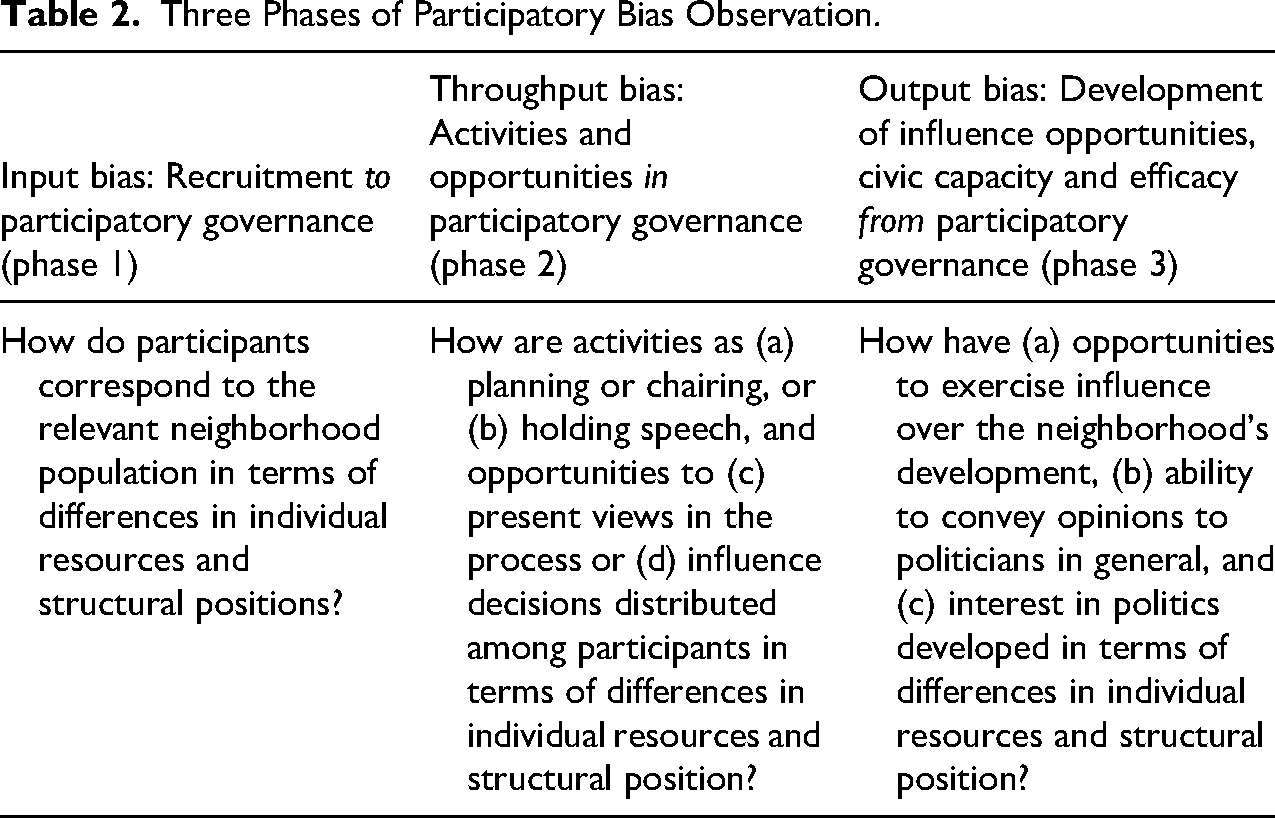
Input bias refers to bias in relation to recruitment to participation. In this article, it is measured by comparing register data on the relevant neighborhood population, on the one hand, and survey data on participants in the SNRP, on the other, with respect to differences in education, foreign background, gender, and age. 7
Throughput bias refers to the distribution of opportunities to participate within a specific participatory arrangement among the recruited participants. It is measured as the correlation between participants’ individual resources and social positions, as described above, and their activities and opportunities within the SNRP processes. More specifically, four different process-related survey questions are used to measure throughput bias:
“As a participant in the SNRP, have you ever planned, or chaired, a meeting?” “As a participant in the SNRP, have you ever prepared or delivered a speech at a meeting?” “What opportunities to put forward your points of view do you experience you have had in the working group?” “What influence on the working group's proposal do you feel you yourself have had?”
The first two items were answered dichotomously (“yes or no”) and the two latter on a four-level scale (“very small,” “quite small,” “quite large,” and “very large” opportunities/influence).
Outcome bias refers to the distribution of positive consequences deriving from participation. To measure the outcome bias ratio, we use the same variables on individual resource and social position as for throughput bias, but now estimate their correlation with three outcome-related survey questions:
“Has the SNRP reduced or increased your opportunities to exercise influence over the district's development?” “Has the SNRP reduced or increased your opportunities to put forward your opinions to the politicians?” “Has the SNRP reduced or increased your interest in politics in general?”
In this case, the responses were given on a five-step scale (from “decreased a lot,” “decreased somewhat,” “no changes,” “increased somewhat,” and “increased a lot”).
Hence, some of the throughput and outcome-related survey questions were answered on a four-point or five-point Likert scale, while other items had binary response options. 8 To avoid having too few observations and to be able to estimate differences between several different categories of participants on the outcome variables, we have merged response options to broader binary categories, such that the neutral “no changes” option in the outcome-oriented questions is considered negative (0). For control purposes, linear regressions have been run for the continuous variables. They show the same direction as logistic regressions, and for all except two (presented below), the significances remain. Because the coefficients go in the same direction, we assume the lack of significance in these two measures is primarily due to low numbers (below 10) for some of the continuous variables’ values.
The results from the logistic regression analyses are reported as odds ratio, where values above one indicate a higher probability and values below one a lower probability, compared to the reference category (denoted as “ref.”). Statistical significance is reported at the 5% and 10% level.
Input Bias and Recruitment to Participation
It is often claimed that participatory arrangements based on self-selection contributes to bias among recruited participants (Smith 2009; Khoban 2021). This was also the case in the SNRP. The SNRP did not only rely on self-selection through invitations by mail, websites, posters and leaflets, but the invitation was also to a demanding form of participation. Indicative of the expectations, in one of the districts, the startup meeting was referred to as a “seminar,” and participants were expected to participate over time in a sequence of discussions in different groups: The seminar evening is to be seen as a starting point for the newly started district renewal. The goal is to develop a vision of how Farsta can become an even more attractive district. You are expected to participate in working groups and collaborative groups in the sub-districts of Farsta. Welcome to the future!
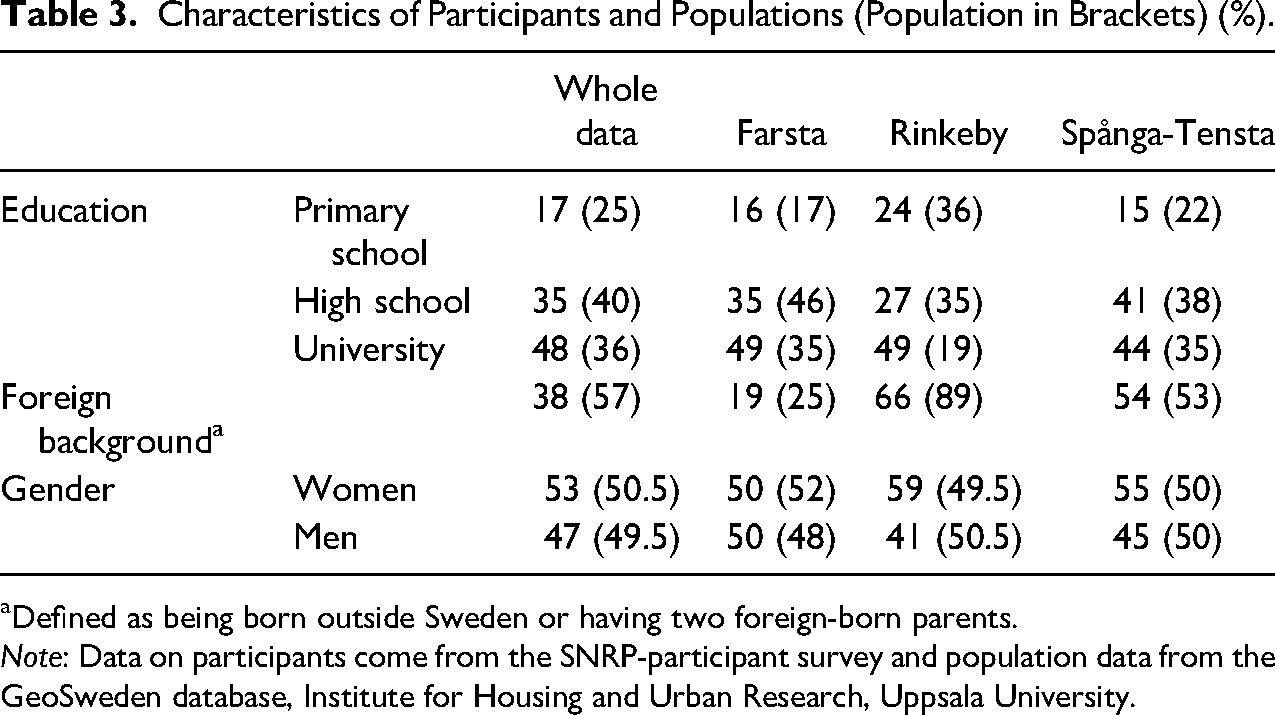
As presented in Table 3, the level of education, as a key individual resource, was significantly higher among recruited compared to the neighborhood populations. This is true for the three districts individually and together. Corresponding population data on civil society activity or experiences of participatory governance are not available. However, regarding social position, participants with a foreign background are underrepresented, overall and in two out of three districts; the percentage of participants with a foreign background is clearly lower than the corresponding percentage in the resident populations. 9
Characteristics of Participants and Populations (Population in Brackets) (%).
Defined as being born outside Sweden or having two foreign-born parents.
Note: Data on participants come from the SNRP-participant survey and population data from the GeoSweden database, Institute for Housing and Urban Research, Uppsala University.
As shown in Table 3, women were slightly overrepresented in the SNRP, and in relation to age, more than 80% of participants who voluntarily chose to take part in the SNRP processes were over forty years of age. According to public statistics, 34% of the populations in the three neighborhoods were over forty-five years, and 64% over twenty-five years, indicating a strong age bias in the recruitment of participants. In relation to previous literature, however, in nontraditional modes of participation we would have expected a bias in favor of younger participants.
Hence, concerning recruitment, the bias argument is confirmed in the SNRP case. The open invitation to demanding forms of participation mobilized participants who had more individual resources and more privileged positions than the average in the districts under study.
Throughput Bias and Opportunities in Participation
Compared to participation in elections, participation in participatory governance is not a simple either–or question. Participants may take part as a passive listener and spectator or a more active negotiator and proposer (Fung 2006). In the SNRP, participants were invited not only to discuss but also to develop and propose projects in “seminar-like” fora, not only together with fellow neighbors but also in interaction with professionals—and to do so over time. Several hundred working groups were organized around issues such as safety, cultural activities, social sustainability, labor market, housing, traffic, and local environment. The number of participants in each group varied considerably, but the most common group size was quite small (nine participants). Most participants participated in four or more meetings with each working group, and more than 30% participated in two or more working groups. Twenty-five percent of participants had planned or chaired a meeting, and 43% had prepared or held a speech (Danielsson and Hertting 2007).
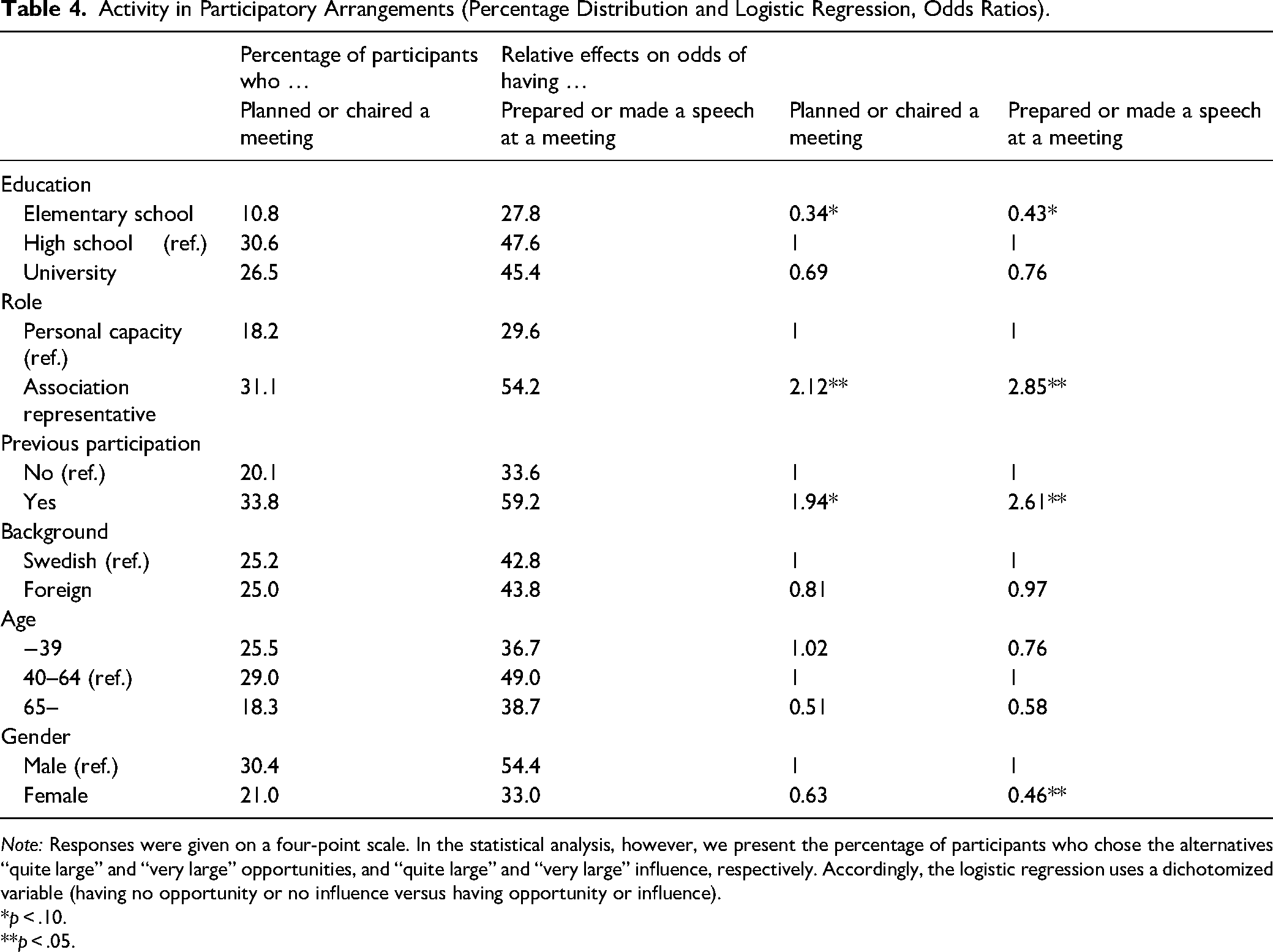
As shown in Table 4 below, low level of education correlates negatively with both chairing a meeting and holding a speech. These patterns appear both in the bivariate analysis and in the regression analysis when controlling for being an association representative, previous participation experience, foreign background, age, and gender. However, the effects of education are not very strong, and the odds ratios are significant only at the 90% level.
Activity in Participatory Arrangements (Percentage Distribution and Logistic Regression, Odds Ratios).
Note: Responses were given on a four-point scale. In the statistical analysis, however, we present the percentage of participants who chose the alternatives “quite large” and “very large” opportunities, and “quite large” and “very large” influence, respectively. Accordingly, the logistic regression uses a dichotomized variable (having no opportunity or no influence versus having opportunity or influence).
*p < .10.
**p < .05.
Participants who represented civil society associations or had experience from previous participation, on the other hand, were significantly more active in chairing meetings and giving speeches than were those who participated as private citizens/residents (although only at the 90% level for previous experience and “planned or chaired a meeting”).
When turning from individual resources to structural positions, however, a different picture emerges. There is no correlation between foreign background and activity in the participation process. Moreover, there are no significant effects of age, while there is a small but significant effect of being male with regard to preparing or holding speeches.
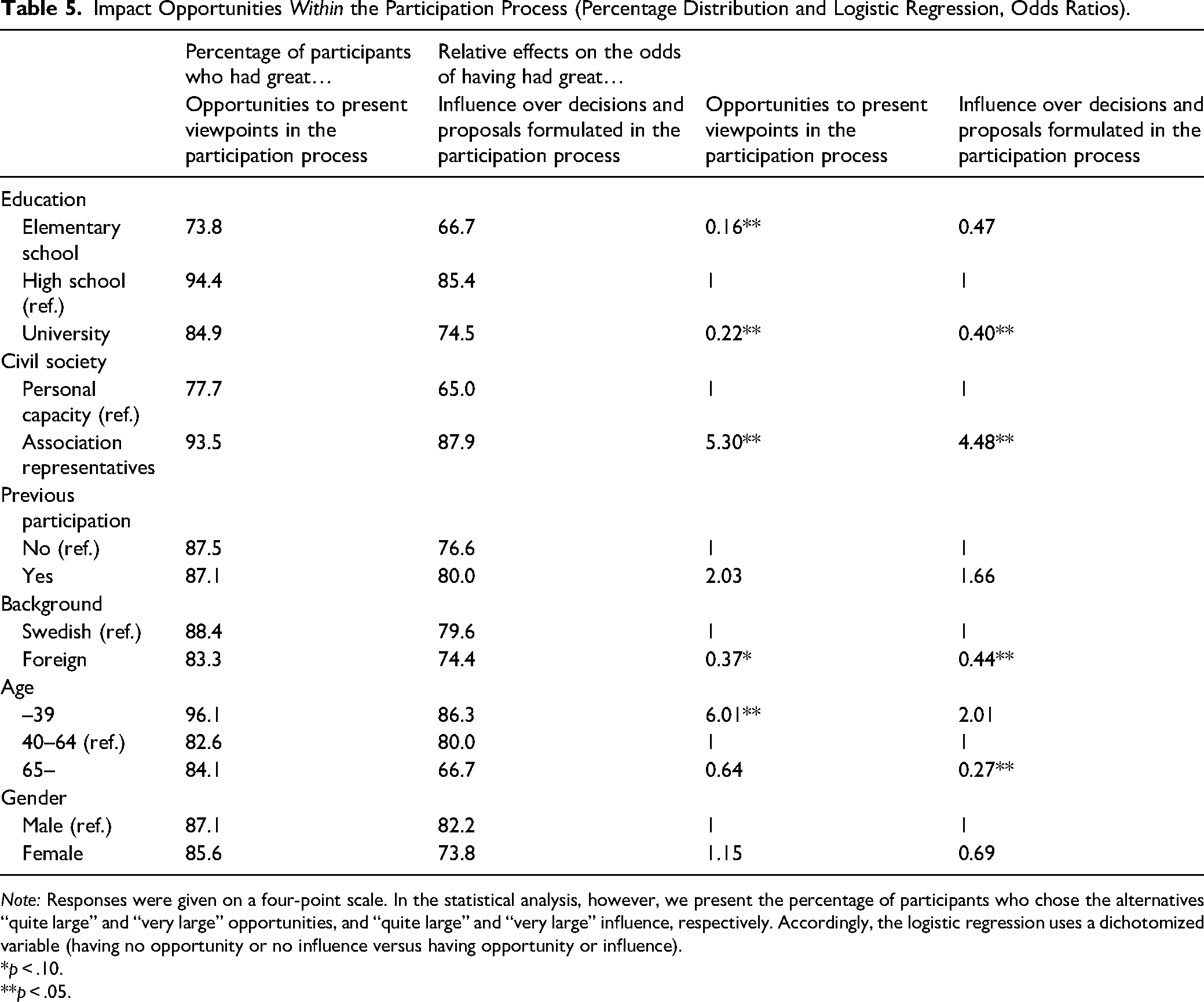
Moving from activities to impact within the process, most participants claimed they had good opportunities to influence decisions within the SNRP (Table 5). Starting again with education, the odds ratio is significant at the 95% level, but the substantial effect is low and also somewhat ambivalent. In line with the bias argument, participants with the lowest level of education (primary school) estimated a somewhat lower impact than did those who graduated from upper secondary school (“reference”), but so did also participants with the highest level of education (university degree). Hence, the most important observation concerns the low or even negative substantial effects (odds) of increased level of education.
Impact Opportunities Within the Participation Process (Percentage Distribution and Logistic Regression, Odds Ratios).
Note: Responses were given on a four-point scale. In the statistical analysis, however, we present the percentage of participants who chose the alternatives “quite large” and “very large” opportunities, and “quite large” and “very large” influence, respectively. Accordingly, the logistic regression uses a dichotomized variable (having no opportunity or no influence versus having opportunity or influence).
*p < .10.
**p < .05.
As expected, the analysis shows that association representatives had significantly greater opportunities for influence than did residents who participated in their personal capacity. While the actual change in odds quota may be somewhat difficult to interpret, within the dataset the effect of being a representative of a voluntary association is not only significant (95%), but also among the most substantive, with regard to both opportunities to present ideas and experienced influence over decisions within the process. Interestingly, experience from previous participatory neighborhood programs did not have a significant effect. Representatives of associations seem to assume roles in the process, and are asked to assume these roles, which creates opportunities for making an impact (Danielsson and Hertting 2007).
There is a significant correlation at the 95% level between having a Swedish background and reporting greater opportunities to have influence than did participants with a foreign background. Although the substantial effects are small, the correlation remains when controlling for other variables in the regression analyses. 10 The negative effect of having a foreign background is even smaller in relation to opportunities to present ideas and only statistically significant at the 90% level (Table 5).
The small but significant negative effect of being a female and having prepared or made a speech reported above (Table 4) is not repeated in relation to opportunities to present ideas or having influence within the process. There are no such significant relations between gender and influence within the processes (Table 5). However, age shows a different pattern than for the activity dimension in Table 4 above: in accordance with some recent research on nontraditional types of participation, young participants had not only significantly but also substantively better opportunities to have an influence within the process compared to middle-age people, while the elderly felt, to a lesser extent than others did, that they had influence within the SNRP processes (Table 5).
The description above is interesting as such. Different aspects of participation demonstrate different patterns of bias. Bias in perceived opportunities for influence differs from bias in activity. In some respects, the pattern confirms that participants with more initial individual resources had more influence. In other respects, it does not.
Output Bias and Influence, Civic Capacity and Efficacy from Participation
Participation has been associated with several different outcomes, including capacity to articulate and protect interests, development of civic capacities, and political legitimacy (Teorell 2006; Carpini, Cook and Jacobs 2004). In the survey, the participants were asked how they perceived changes in their (1) capacity to exert influence over the neighborhood's development, (2) ability to convey their opinions to politicians, and (3) interest in politics in general due to their participation in the SNRP. Hence, the outputs could be interpreted in relation to change in actual opportunities to influence, civic capacity, and political efficacy acquired through participation. 11
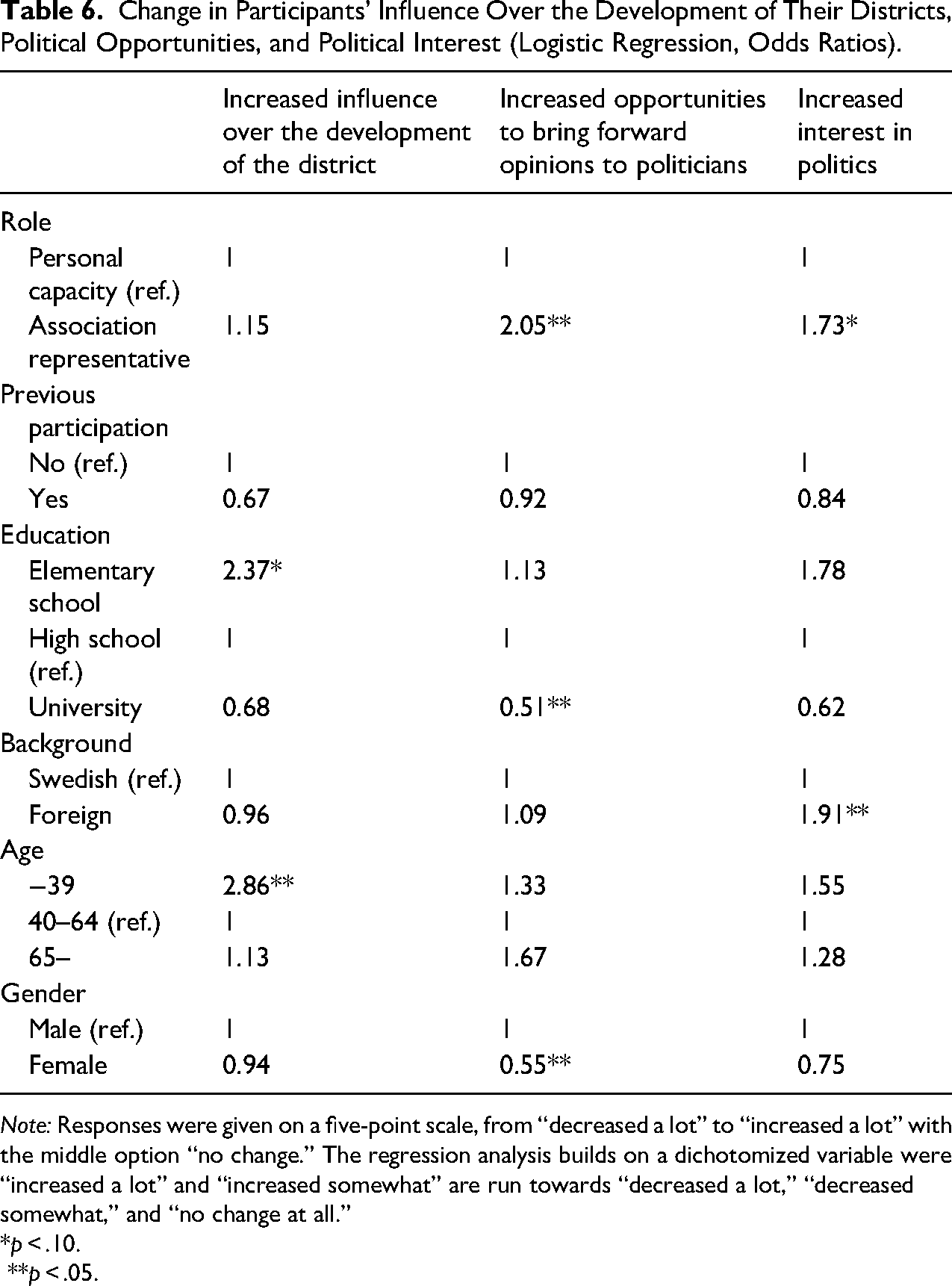
Starting with influence over the development of the neighborhood, 67% of participants gave positive responses. When we look at the details, however, we find some interesting and somewhat unexpected correlations. Although only statically significant on the 90% level, participants with low levels of education experienced quite a substantively larger influence over the district because of participation in the SNRP than did participants with higher levels of education (see Table 6). While the previous analysis indicated that association representatives had significantly greater opportunities to have a say within the process, regarding actual influence over the district through their participation, we find no such correlation. Furthermore, there are only small and nonsignificant differences between participants with a Swedish and those with a foreign background as well as between women and men. Younger participants, on the other hand, experienced increased influence to a significantly larger extent than older participants did (see Table 6, column 1).
Change in Participants’ Influence Over the Development of Their Districts, Political Opportunities, and Political Interest (Logistic Regression, Odds Ratios).
Note: Responses were given on a five-point scale, from “decreased a lot” to “increased a lot” with the middle option “no change.” The regression analysis builds on a dichotomized variable were “increased a lot” and “increased somewhat” are run towards “decreased a lot,” “decreased somewhat,” and “no change at all.”
*p < .10.
**p < .05.
Regarding opportunities to present opinions to politicians as an outcome of the SNRP, 52% experienced improvement. Once again, when controlling for the other included variables, participants with lower levels of education were significantly more likely than were university graduates to find that such opportunities had improved. However, the odds ratio is low and the substantive effect quite small. In contrast, there is quite a substantive positive correlation at the 95% level between being an association representative and the experience of increased opportunities to put forward opinions to politicians, while such a correlation is lacking for experiences from previous participation (Table 6, column 1). Again, the differences between participants with a Swedish and a foreign background and between different age groups are small and nonsignificant. However, men were significantly more positive than women, although the substantive effect is quite small (see Table 6, column 2).
Finally, in relation to political interest as an indication of efficacy, a lower number of participants reported a positive outcome (42%). As Table 6, column 3, shows, no statistically significant correlation between level of education and change in political interest is found. Being an association representative correlates positively but only at the 90% level, while change in political interest among participants with previous experiences of participatory neighborhood governance did not differ significantly from that of other participants. Increased political interest was, however, significantly and quite substantively more common among those with a foreign background. 12 As concerns gender and age, the differences in relation to change in political interest as output are small and not statistically significant.
Participatory Bias and the Most-Likely SNRP Case
Above I have described the degree of input, throughput and output bias in the process from (a) recruitment to, (b) activities and opportunities in, to (c) outcomes derived from participation in the SNRP case. Voluntary selection within a diverse population regarding social backgrounds and individual resources, continuing and demanding face-to-face dialogs, and vague rules and procedures qualify SNRP as a most-likely case for bias. That is, if skeptics are right about participatory governance as mechanisms for bias, it should be seen here.
Concerning recruitment to the SNRP, the proportion of participants with a foreign background was lower than the same proportion in the districts, while high education, experience of similar programs, and electoral participation were disproportionally higher. That is, in relation to input bias, this most-likely case supports the participatory bias argument.
In relation to throughput bias, different aspects provide different pictures. Regarding activities such as having planned or chaired a meeting or prepared or delivered a speech, the most significant observation is that participants with civil society resources were considerably more active. In relation to giving speeches, participants with experience of previous participatory neighborhood governance were also considerably more active. Low level of education correlated negatively with activity in the processes, but contrary to what might be expected in a most-likely case of bias, the substantive effect is small (and only statistically significant at the 90% level). With regard to opportunities to present points of view and have influence within the processes, association representatives experienced considerably greater opportunities compared to people who participated as private citizens. The same bias was to some extent found in relation to education, but not in relation to people with a university degree. Compared to participants with a Swedish background, participants with a foreign background had significantly poorer opportunities, but the substantive differences were small.
Regarding outputs from participation, the expectations on a most-likely case for bias are challenged even more. Although the civil society resource as such has a significant correlation with improvement of opportunities to approach politicians and increase in political interest as an indicator of efficacy, in several respects marginalized individuals gained more in relation to development of political resources than the more privileged did: Participants with low education experienced a substantially—though statically significant only at the 90% level—more positive change in their own capacity to influence the development of the neighborhood. Furthermore, no negative correlations between having a foreign background and developing capacity or gaining contacts with politicians were observed. Instead, we could record a significant and quite substantive positive correlation between having a foreign background and experiencing increased political interest and efficacy from participating in the SNRP (see Table 7).
The Participatory Bias Argument and the Most-Likely Case of the Stockholm City District Renewal: Summary of Findings.
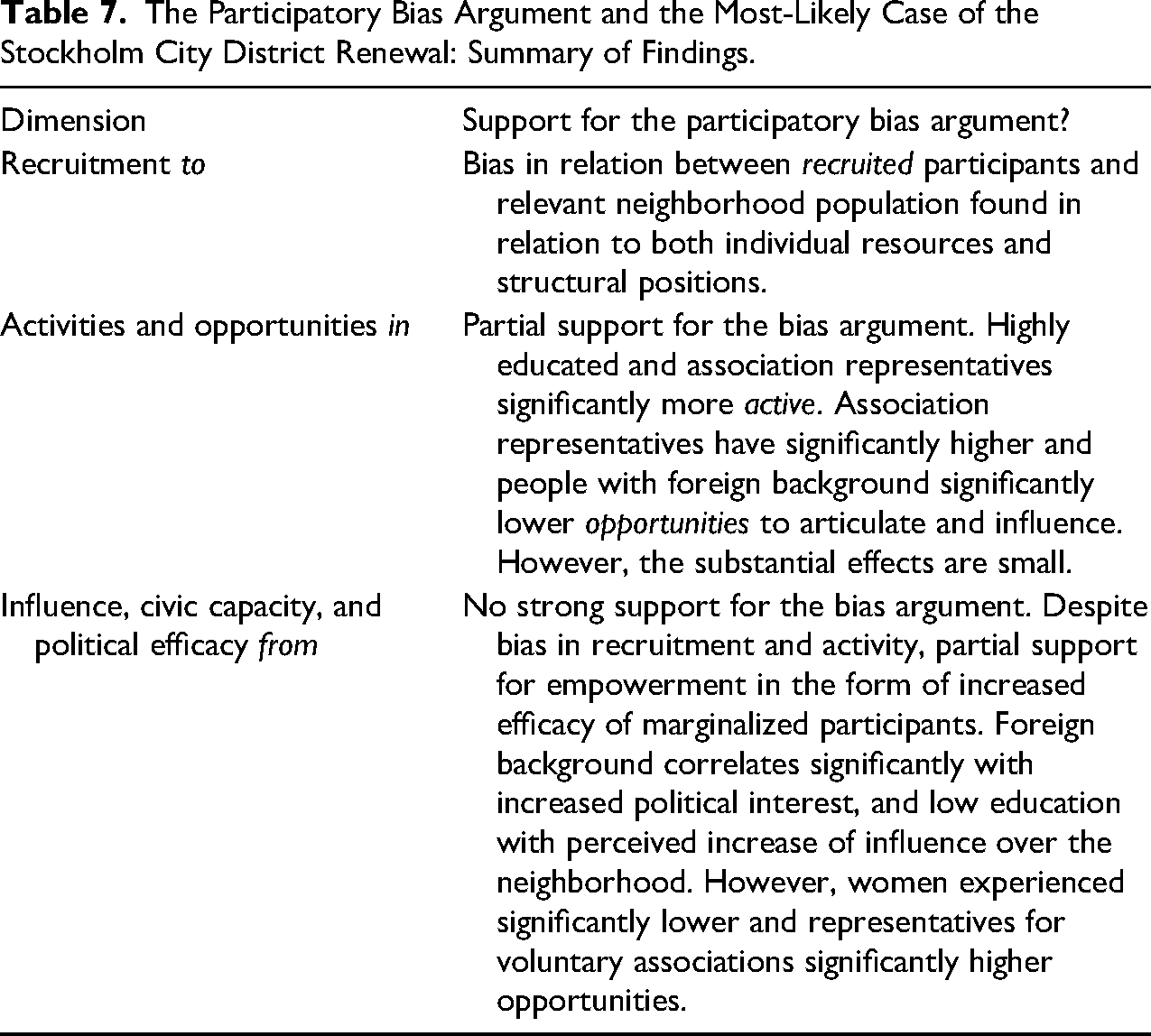
Hence, given the character of the SNRP case, the most striking finding is that input biases in recruitment did not accumulate into output biases in relation to impact, capacity or efficacy. Although the dataset have its limits and some correlations are significant only at the 90% level, there are signs to the contrary. Although the privileged were overrepresented and more active, regarding influence within the processes the pattern was less clear, and regarding acquired capacity, efficacy and external impact as outcomes deriving from participation, the pattern was to some extent the opposite. Participants with less resources and representing less privileged social groups in some respects gained more from participating in the SNRP. The obvious deviation from this observation is related to with being an association representative. The organized civil society and voluntary associations bring resources of importance to neighborhood participatory governance. 13
Hence, although the findings support the participatory bias argument in some respects, the multidimensional notion of participatory bias that structures this article enables a more elaborated analysis and nuanced conclusion. Moreover, given the theoretical expectations on a most-likely case for bias, the deviating empirical observations in some respects calls for theoretical refinement. Apparently, the causal relation between factors assumed to be conducive to bias and the marginalization of poor, sometimes does not rule out certain types of empowerment.
Suggesting a Mechanism-Based Account: Empowerment of the Poor Through Participation Perceived as Powerless by the Privileged
Due to their demands, participatory arrangements induce rather than reduce bias in local governance. This is the core of the participatory bias argument. The implicit assumption seems to be that all participants, privileged, or marginalized, are guided by self-interests in a zero-sum game. Their gains are expected to be in conflict; if one group wins, another loses (Narvarro and Font 2013; Walker, McQuarrrie and Lee 2015). However, recent research has shown that the motives for participation in housing and neighborhood governance may be very different among different groups, and that such differences in motives may have crucial implications for collective action, participation processes, and empowerment (Bengtsson 1998; Fagotto and Fung 2006; Jun and Musso 2013; Holdo 2015). Admittedly somewhat speculative, in this final section of the article, I draw on the patterns described above and data on the participants’ motives for participation in the SNRP case to account for the somewhat puzzling observation of partly empowering outcomes within a most-likely case for bias. As the implications of the constitutive dimensions of the case study are re-interpreted, an alternative account on the social mechanisms in the pathway between demanding participation and empowerment is suggested.
Previous research on the SNRP case (Gustafson and Hertting 2017), found that privileged participants participated to a significantly greater extent for the purpose of promoting “common neighborhood good,” while marginalized participants participated to promote “individual or group interests.” Motives such as “give voice to a certain group,” “improve things for me and my family,” “acquire useful contacts,” and “learn more about politics” were positively associated with low education and foreign background, while motives such as “improve things in the neighborhood,” “participate in discussions,” and “contribute knowledge” were positively related to high education and Swedish background. 14
At first, this might seem provocative. 15 However, if we interpret this not as group characteristics, but as reflections of perceived institutional logics, it seems quite reasonable. As long as the participatory arrangement is vaguely institutionalized and not clearly linked to effective impact, it is not rational for inhabitants who already have the economic, social, and political capital needed to affect their living situation to participate out of self-interest. This is not because privileged individuals are more altruistic. It is because their interests are secured through other means. If they voluntarily decide to participate in arrangements such as the SNRP, their reason for doing so is likely something else. Rather than promoting a specific self-interest or group interest, they may participate to promote the common good of the neighborhood and/or for self-realization.
For poor inhabitants who lack access to more direct and probably more efficient measures, the calculation is different. For them, participatory initiatives such as the SNRP might quite rationally be perceived as an instrument to promote their interests, or to develop the capacity to do so on other political arenas. Low prospects for influence are perceived as better than no prospects at all.
In a case as demanding for the participants as the SNRP, I suggest that the combination of the two participant orientations appears to have created an empowering dynamic. Drawing on observations summarized above, the contours of a rationalistic mechanism (Bengtsson and Hertting 2014) that may account for the empowering potential of participatory governance arrangements being perceived as powerless by the privileged are proposed in three interrelated steps:
When participatory initiatives are launched across the borders of socioeconomically segregated neighborhoods, are based on self-recruitment, and have vaguely defined purposes and procedures, participants with different types of motives and different types of understandings of neighborhood participatory governance may be mobilized. For privileged inhabitants, participation in vaguely and weakly institutionalized participatory arrangements is not rational based on self-interest. They have access to more effective ways of improving their life. The motives of those who voluntarily decided to participate may concern promoting the common good. For more marginalized participants, the situation looks different. Lacking other opportunities, it might be rational for them to enter such participatory arrangements based on self-interest or group interest. Engaged in the neighborhood's common good and their own self-realization, privileged participants take on the costs of administrating the demanding procedures, intentionally or unintentionally sharing their experiences and knowledge with participants who have fewer resources, less experience, and different reasons for participating (Fagotto and Fung 2006). Demanding participation allows for effective schooling of the marginalized, as long as more privileged individuals have an incentive to assume the role of keeping the process running.
This is not all that can be said about the SNRP-case and bias in participatory neighborhood governance. However, the argument above point to the need for a more nuanced understanding of the risks for bias, and it point to a possible empowering dynamic when participants with different resources and different motives voluntary choose to participate in demanding processes within loosely institutionalized participatory arrangements.
Footnotes
Acknowledgments
I would especially like to thank Marianne Danielsson and Per Gustafson for collaboration on a previous study (Danielsson, Gustafsson and Hertting 2016) of which this article is a reanalysis. I would also like to thank Roger Andersson, Bo Bengtsson, Kristina Boréus, Zohreh Khoban and Alexander Hellquist at Uppsala University and the three anonymous reviewers for important comments and help to improve the article.
Declaration of Conflicting Interests
The author declared no potential conflicts of interest with respect to the research, authorship, and/or publication of this article.
Funding
The author received no financial support for the research, authorship, and/or publication of this article.
