



Abstract
Public facilities are essential components of urban villages in large cities in China, playing a key role in the quality of life for residents. However, our understanding of these public facilities is limited. There is an urgent need to upgrade them in the context of a new wave of urban redevelopment in China. To address this gap, we first identify Wuhan’s urban villages by correlating the proportion of construction land with the percentage of migrants. Next, we employ kernel density estimation and fishnet analysis methods to examine the characteristics of public facilities in urban villages. We then develop a new research framework, characterized by “upgrade sequence – upgrade mode”, for strategically arranging the upgrading of these facilities. Our findings indicate that: (1) the upgrade of public facilities in Wuhan’s urban villages should focus on the suburban districts; (2) it is essential to balance supply and demand when addressing issues related to public facilities, avoiding indiscriminate large-scale demolition and reconstruction, as in-situ upgrades may become the new trend; and (3) different upgrade approaches should be adopted based on the specific features of each urban village. Overall, this study fills a gap in the systematic examination of public facilities in urban villages and proposes a new strategy for in-situ upgrades. We contribute to a nuanced understanding of the dynamics of urban villages in China and the broader context of planetary urban redevelopment.
Introduction
Urban villages refer to rural areas that become surrounded by cities during rapid urban expansion and are often misaligned with urban development (Liu et al., 2010). They represent both social challenges in the urbanization process and key areas for urban redevelopment. As a distinctive form of communities in China, urban villages are frequently regarded as symbols of chaos, filth, and danger due to factors such as complicated property rights, high building density, outdated infrastructure, and poor environmental sanitation. Urban villages in China are often associated with such issues as disorganized land use, severe shortages of infrastructure and public spaces, and even a strong correlation with disease and crime (Chung, 2010; Gong, 2016; Ren et al., 2019; Xu et al., 2024). Consequently, they have long faced widespread criticism. In response to the “Cities Without Slums” agenda proposed by UN-Habitat (2003), urban villages – often referred to as “China’s slums” – have become primary targets of urban encroachment (Jiang et al., 2018; Liu et al., 2010; Zhang, 2018). However, while extensive and forceful demolition methods have accelerated the urbanization process, they have also resulted in the displacement of impoverished communities and social unrest (Janoschka and Sequera, 2016; Li and Wu, 2013). Moreover, the recent economic downturn has made it challenging for the government to afford the substantial investment required for large-scale demolition and new construction (Zhao and Sun, 2017). In light of these severe social issues, we must reconsider a crucial question: Do urban villages truly need to be completely demolished?
Some studies suggest that urban villages are not entirely undesirable. Research indicates that, from a developmental perspective, urban villages have made many positive contributions during the rapid processes of industrialization and urbanization (Wu, 2016). They provide affordable housing for low-income migrants (Yan and Wei, 2004) and generate economic income for original villagers (He et al., 2009), thereby narrowing the wealth gap between urban and rural residents. In 2015, China introduced a micro-renewal approach characterized by the “retention of original residences”. This method aims to reduce social discontent by avoiding large-scale demolitions (Shih, 2017; Wang and Wu, 2019; Wu et al., 2021). The “14th Five-Year Plan for National Economic and Social Development and the Long-Term Goals for 2035” explicitly states the need to “redevelop and upgrade old residential areas, old industrial zones, old streets, and old urban villages” (Zhang and Ye, 2022), indicating an increasing emphasis on in-situ redevelopment. Moreover, research has found that the most significant factor affecting urban village residents’ satisfaction is not socioeconomic status or living conditions, but rather whether residents feel socially excluded (Li and Wu, 2013). In other words, addressing the issues of urban villages should not rely solely on demolition and reconstruction; future trends may focus on more human-centered approaches, such as upgrading and optimizing existing built environments and reducing social disparities (Zhang and Ye, 2022).
Existing research on urban villages often explores macro-level aspects such as their socioeconomic profiles (Liu et al., 2010; Wu, 2016), institutional characteristics (He et al., 2009; Wang et al., 2021; Wu et al., 2021), economic constraints (Fan, 2002), and resident welfare (Li and Wu, 2013; Liu et al., 2017b; Wang and Fan, 2012; Zhang, 2012). However, there is relatively little micro-level assessment and analysis of specific issues within urban villages. One key problem that urban villages need to address is the issue of public facilities, yet this is often overlooked. While research has explored the transformation of urban villages from reconstruction to in-situ upgrading (Gan et al., 2019), studies specifically focusing on public facilities in these areas remain limited. Given the potential consequences of forceful and indiscriminate demolitions, this study also focuses on the strategies for the in-situ upgrading of public facilities, which could or should be distributed evenly across different areas and populations (Wang and Nie, 2011). In 2012, China’s “12th Five-Year Plan for National Basic Public Service System” elevated the equalization of public services to be a national strategy (Ren and Bu, 2013). By improving and reasonably allocating public facilities in urban villages, we can enhance the quality of living spaces and promote equitable access to public service access for their residents. This, in turn, fosters social harmony and sustainable urban development. Therefore, in light of the aforementioned policies and practices, researching the strategies for enhancing public facilities in Chinese urban villages is of great significance, which may also help to explore “non-demolition” solutions for addressing the challenges faced by these communities.
Therefore, this study primarily covers three objectives:
(1) Examine the profile of urban villages in Wuhan. First, we will identify urban villages in Wuhan, defining them as areas where the proportion of construction land to total land area exceeds 40% and the proportion of migrants exceeds 30% (Ye et al., 2020).
(2) Analyze the characteristics of public facilities in various urban villages in Wuhan. We will utilize kernel density analysis and fishnet analysis methods to assess the per capita ownership and density of public facilities in urban villages.
(3) Analyze the public facility upgrading strategies for urban villages in Wuhan. By constructing a framework of “upgrade sequence – upgrade mode”, this study will provide a comprehensive overview of the upgrading strategies for public facilities in these urban villages.
This study focuses on both the current status and upgrading of public facilities in urban villages, aiming to enhance both the physical and social environments of these areas. The main contributions are threefold: First, it addresses the gap in the existing literature by providing a new upgrading strategy for public facilities in urban villages. Second, by proposing in-situ upgrading strategies, it explores a “non-demolition” approach to addressing the issues faced by public facilities in urban villages. Third, it presents targeted strategies for public facilities in different types of urban villages to enhance the effectiveness of the upgrades. This study seeks to improve residents’ access to public services and promote social equity, and it aims to provide insights and guidance for urban planners in addressing the challenges of urban villages, thereby contributing to the urban redevelopment of recent China in general.
Literature review
Research on urban villages
In most Chinese cities, urban villages have become the primary residence for non-registered residents due to their relatively advantageous locations and low rents (Chan et al., 2003). The proportion of the floating population in these areas ranges from approximately between 45% and 70% (Ye, 2015), resulting in high population density. For a long time, urban villages in China have been characterized by images of poverty, backwardness, and disorder (see Figure 1). Due to irregular land use, extremely high building density, narrow skylines, and consistently insufficient natural light, they are humorously referred to as “areas where sunlight is not free”. As an important aspect of urban redevelopment and a focal point for the interests of low-income urban residents, urban villages in China have attracted considerable academic attention. To date, four main research phases can be identified:
Despite extensive research on urban village issues (Wu, 2016), a significant problem has emerged: many objectives have become overly grand and idealistic, making them difficult to achieve. So in recent several years there has been a new trend toward exploring more human-centered methods based on the existing built environment of urban villages, advocating for “micro-redevelopment” (upgrading). In this context. upgrading public facilities is a key focal point. However, to date, research specifically targeting public facilities in urban villages remains relatively limited, and there is a lack of systematic studies on the current state, features, and upgrading of these facilities.
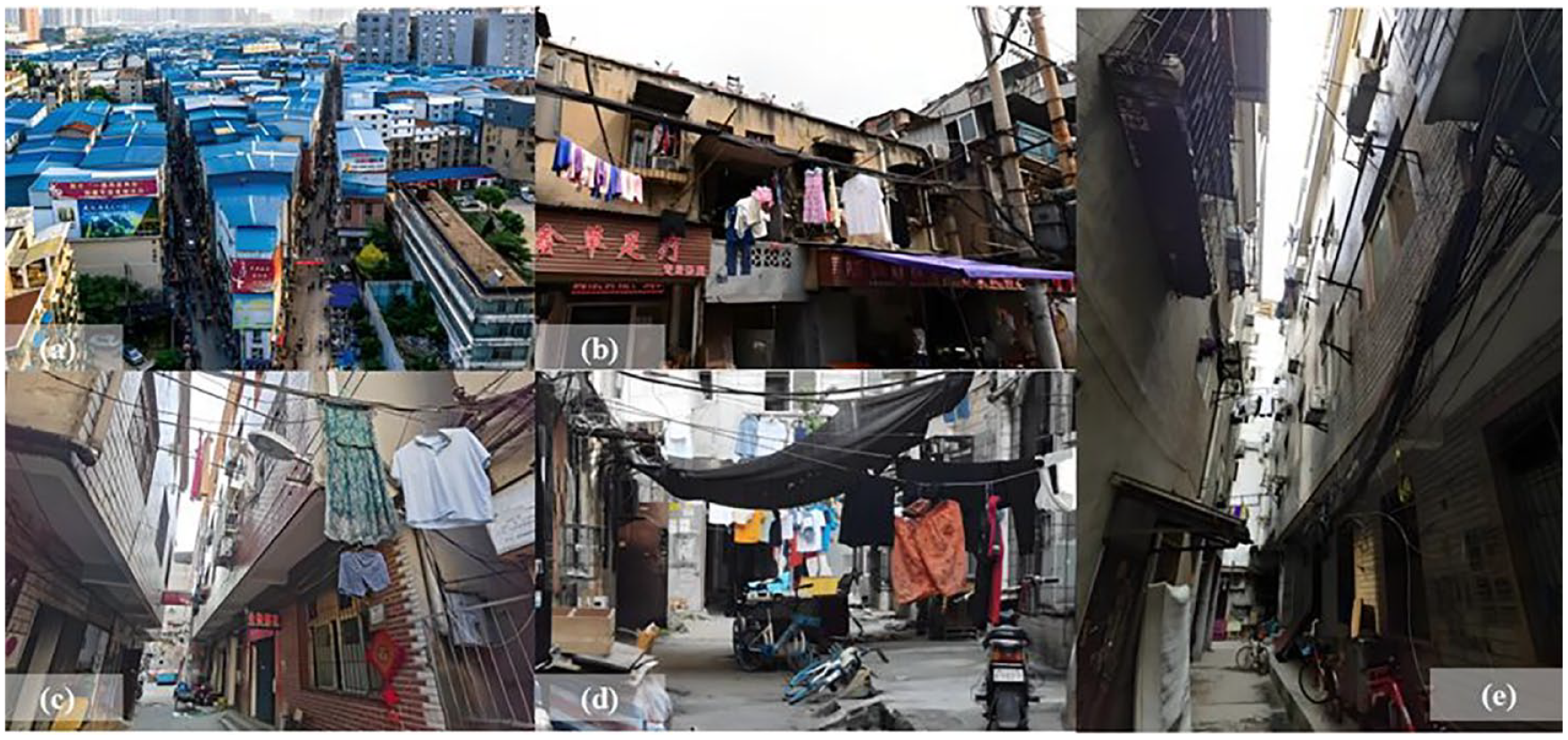
Images of urban villages in China 1 .
Research on public facilities in urban villages
Existing research on public facilities predominantly focuses on urban or community settings, addressing such themes as equity (Tahmasbi et al., 2019; Taleai et al., 2014), accessibility (Ibem, 2012; Li et al., 2021), public facility planning (Baek and Kwon, 2020), and the health impacts of public facilities (Cook and Fiedler, 2018). However, there is a scarcity of studies on public facilities within urban villages. Public facilities, as a crucial material component of urban villages, play significant roles in improving the living environment and quality of life in these areas, promoting social integration, and narrowing the wealth gap. Research indicates that public facilities can provide essential services and enhance social cohesion and stability; conversely, a lack of public facilities can negatively impact residents’ life satisfaction and sense of social integration, leading to increased social inequality problems (Amankwaa and Gough, 2022; Lin, 2020). Some scholars argue that, given the fiscal pressures in China, the primary focus of urban village redevelopment should shift towards addressing the gaps in public facilities (Wu et al., 2023). As such, exploring public facilities in urban villages is of particular importance.
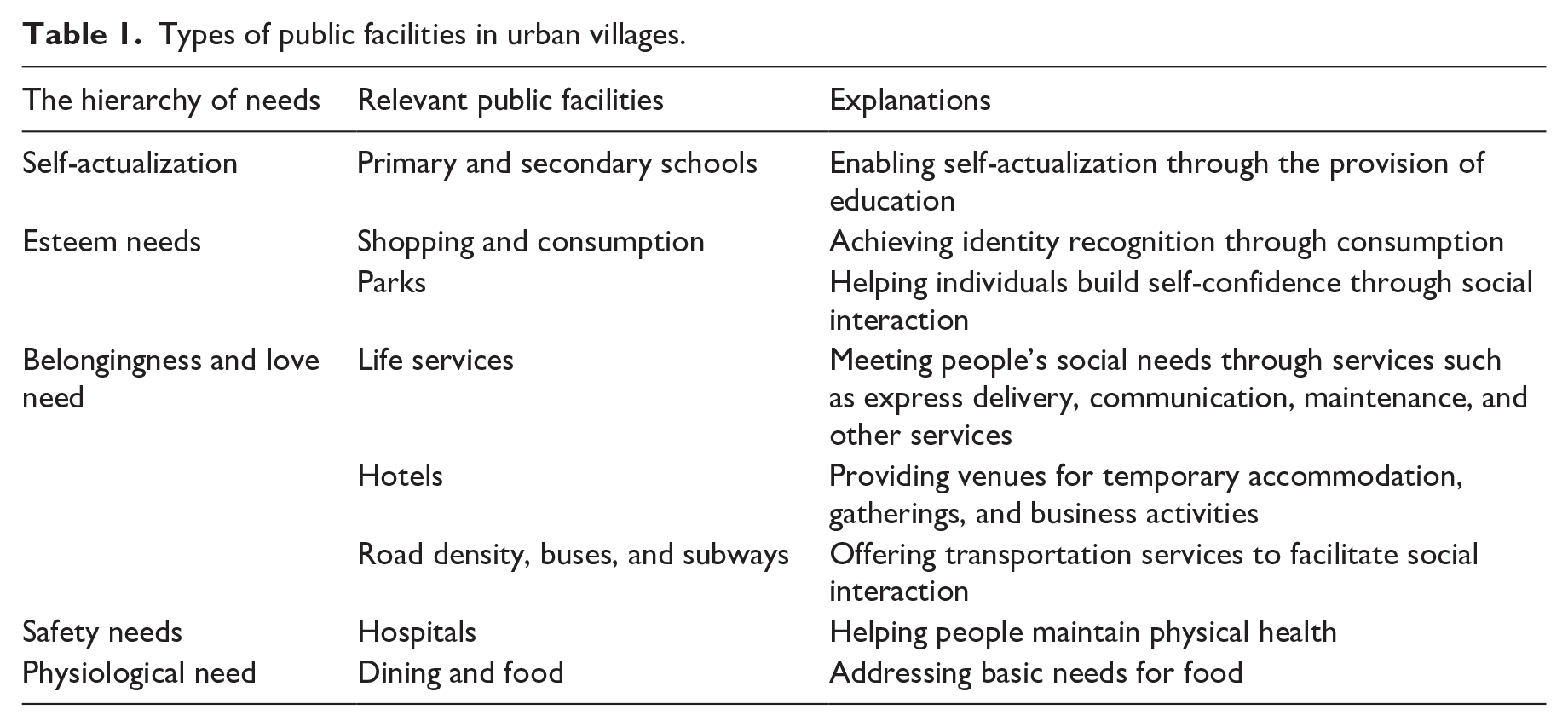
The configuration of urban villages poses significant challenges for the placement of basic public facilities, making it difficult to fully meet residents’ service needs. This exacerbates the imbalance between the development of urban villages and formal urban areas. Public facilities in urban villages refer to various basic infrastructures built within or around these communities to address the living needs of residents. These facilities are a crucial component of the spatial structure of urban villages, encompassing both material infrastructure and intangible socio-cultural environments (Cai, 2023). This study, based on Maslow’s hierarchy of needs, groups the public facilities into ten types: dining and food services, shopping and consumption, life services, hospitals, hotels, road density, buses, subways, parks, and primary and secondary schools (see Table 1). Based on existing research findings, we summarize the problems exiting in the public facilities of urban villages:
Types of public facilities in urban villages.
First, there is a severe shortage of public facilities resources, resulting in an imbalance between supply and demand. Many urban villages lack basic public facilities such as healthcare, education, entertainment, underground drainage, public transportation, and green spaces and so on (Dai, 2002; Xiao, 2015). The mismatch between the supply of public facilities and the growing demands exacerbates the imbalance, making it difficult for residents to access high-quality basic services. Second, many public facilities are ageing and pose significant safety hazards. The public facilities in urban villages (such as electrical facilities) have long suffered from insufficient maintenance and updates, leading to deterioration and damage. In the event of a fire, the densely packed buildings and narrow roads make rescue operations extremely challenging (Lan, 2002; Li and Chang, 2002). Moreover, incomplete lighting and surveillance systems heighten travel risks and increase crime rates, leaving residents’ safety inadequately protected (Xiang, 2005). Thirdly, poor sanitation is also a major concern. This is reflected in the insufficient number of basic facilities such as garbage collection stations, trash bins, and public toilets, as well as inadequate public health management. These issues contribute to unpleasant odors, the breeding of mosquitoes and flies, and negatively impact residents’ quality of life and health (Xiao, 2015).
Currently, research on public facilities in urban villages mostly focuses on identifying existing issues, with few studies proposing grounded solutions. Research on urban village issues (including problems with public facilities) in China has primarily focused on traditional demolition and compensation measures. For example, some studies highlight features of urban issues in China, such as violent demolition and urban deprivation (Shih, 2017; Wu et al., 2013), and propose a series of spatial standards for the demolition of informal settlements (Li and Wu, 2013). Some studies advocate for a “demolition and reconstruction” mode, guided by a “growth-first” approach, which comprehensively considers the interests of three main stakeholders: the government, developers, and village collectives (Chen, 2004). Some studies indicate that the key to successfully addressing urban village issues lies in balancing the economic interests of all stakeholders, including village collectives and residents. This balance involves economic compensation and profit distribution related to land, housing, and post-reconstruction (Lin, 2019; Pan and Wei, 2009). This approach has also led to social unrest and affordability issues (Li and Wu, 2013; Zhao and Sun, 2017). Public facilities are one of the key issues in urban villages, which also prompts us to consider another question: Do the public facilities in urban villages really also need to be completely demolished and rebuilt? As the development of public facilities often comes with complex political and economic challenges (Addie, 2016), in the context of prominent public facility issues in urban villages and an economic downturn (Monstadt and Schramm, 2017), we believe that researching the upgrade, especially in-situ upgrade strategies of public facilities in urban villages is crucial.
Moreover, the public facilities of urban villages are mainly maintained by village committees rather than the city government, and the potential possibility of demolition weakens the motivation of the village committee for upgrade. This structure highlights the tension between top-down government dominance and bottom-up community governance. Henri Lefebvre’s theory of the “right to the city” explores the possibilities for residents to participate in, use, and produce urban space within the process of spatial production (Lefebvre, 1996). Public facilities, especially in informal urban areas, are closely related to the exercise of urban rights and the social conflicts among different groups. The semi-autonomous nature of village committees makes it challenging for them to fully integrate into the formal urban governance system, resulting in delays in the equalization of public services. David Harvey’s theory of “spatial justice” emphasizes the importance of fairly and equitably distributing space and resources, arguing that “inequality” is shaped by social relations and power mechanisms (Harvey, 1973, 1996). However, due to the lack of formal planning and direct investment from urban governments, the configuration of public facilities in China’s urban villages remains persistently unequal, often resulting in strong demands for and challenges to spatial justice. The “Just City” theory, which advocates for promoting fairness, diversity, and democracy in urban environments (Fainstein, 2014), is also relevant. Considering the equity of public facility access for disadvantaged areas is a practical application of the “Just City” theory. Furthermore, the so-called “People’s City” proposes the goal of “creating a better life for the people” 2 , while the disparities in the allocation of public facilities in urban villages exacerbate social inequities and challenge the vision of a “People’s City”.
In conclusion, public facilities in urban villages are key for improving the living environment (Zhou and Li, 2021) and social relations (Schmid, 2008). Given the unique importance of public facilities in urban villages and the gaps in existing research, it is essential to move beyond the limitations of traditional studies and adopt practical measures to address the issues in urban villages. When addressing the issue of public facilities in urban villages, the government should play a leading role by formulating relevant policies and providing financial support to help village committees realize their “right to the city” and improve the public service supply system. At the same time, the government should, based on the actual conditions of urban villages and their significance in urban development, adopt a phased and hierarchical approach to systematically promote the upgrade of public facilities. These measures not only contribute to enhancing the equitable distribution of spatial resources and promoting spatial justice but also lay the foundation for building a “just city” and a “people’s city”, supporting the long-term goals of urban-rural integration and social equity.
Research framework
Our study aims to explore the strategies for upgrading public facilities in urban villages by identifying these villages and examining the characteristics of their public facilities. The research framework is divided into three parts: identification of urban villages, profiling the characteristics of public facilities in these villages, and developing the strategies for upgrading these facilities (see Figure 2). Firstly, urban villages are identified through a coupling analysis of the proportion of built-up land within each village (>40%) and the proportion of the floating population (>30%). Secondly, the number of various public facilities is analyzed using kernel density analysis. A grid of 800 m × 800 m is defined within the study area, and the average kernel density values of public facilities are assigned to each grid cell using zonal statistics. These values are then attributed to the urban village points within the grid to determine the quantity of each type of public facility in each urban village. By combining population data, the per capita ownership of public facilities is calculated for each village. Additionally, using the area of urban villages, the density of public facilities can be measured. Finally, the strategies for upgrading public facilities in urban villages are explored from two aspects: upgrade sequence and upgrade mode:
(1) For upgrade sequence: Construct social networks with each urban villages as nodes and determine the overall importance level based on the total amount of public facilities in each village and the number of connections a village has with each other. The upgrade sequence of urban villages is then determined according to the level of importance (Cai, 2023).
(2) For upgrade mode: Use the per capita ownership of public facilities as the horizontal axis and building density as the vertical axis to divide the urban villages into four different quadrants, and determine four specific upgrade modes (I, II, III, IV) for villages from the first quadrant to the fourth quadrant.
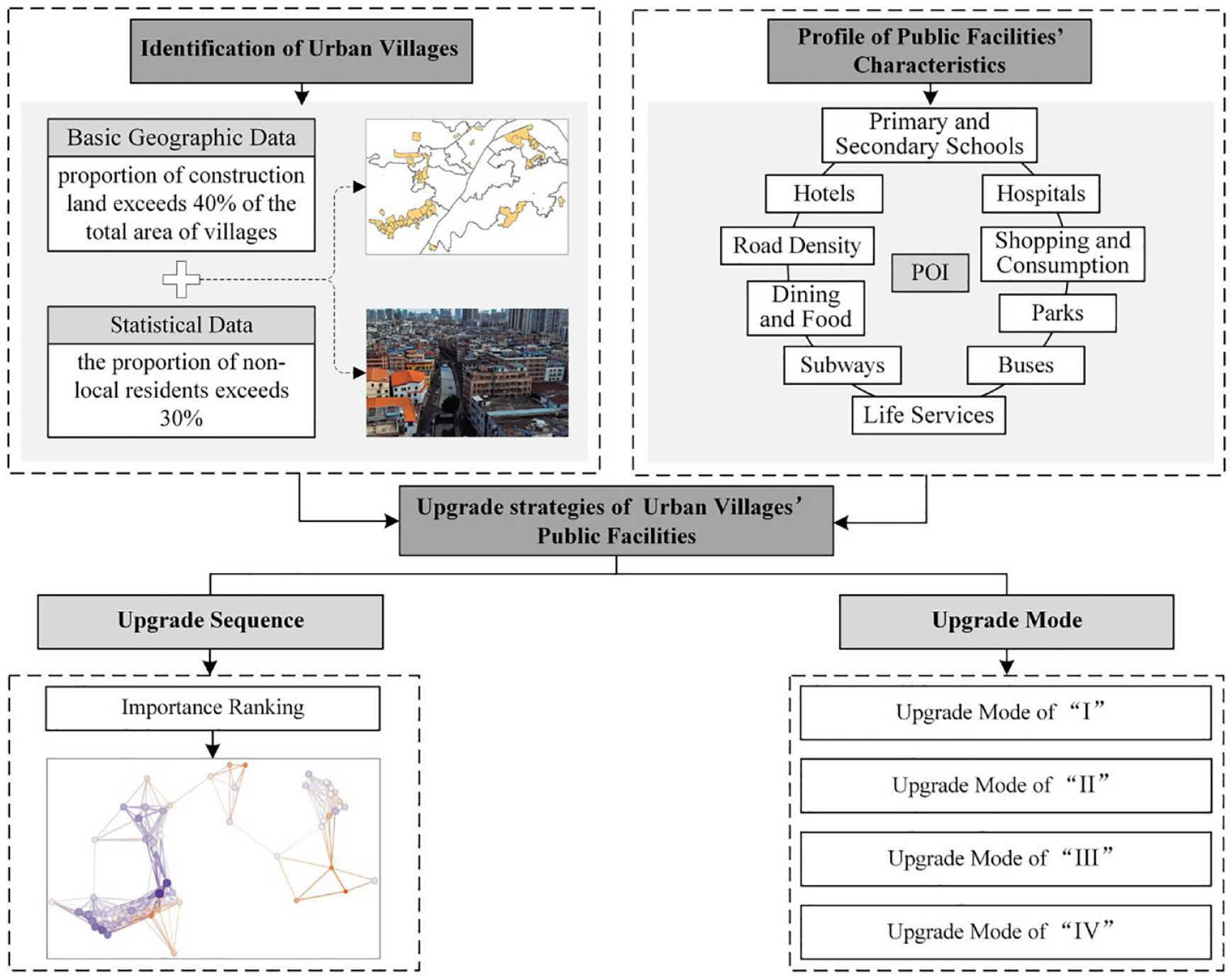
Research framework
Materials and methods
Study area
This study focuses on Wuhan as the research area. (1) Geographically, Wuhan is in central China and serves as a transportation hub for the region. Its unique geographic position gives Wuhan a crucial role in national economic development and urban construction. As one of China’s major central cities, Wuhan faces significant challenges with its urban villages. Studying the public facilities in these urban areas not only impacts the quality of life for residents but also has significant implications for regional development. (2) From the perspective of urban village redevelopment, Wuhan has many urban villages. The city officially began its urban village redevelopment efforts in 2003 and has since undergone a long transformation process, including an exploratory phase from 2003 to 2008, an accelerated phase from 2009 to 2015, and a bottleneck phase from 2016 to 2022 (Wang, 2023), establishing a solid practical foundation. (3) From a policy perspective, the Wuhan municipal government places great emphasis on addressing the issues related to public facilities in urban villages. In 2020, the General Office of the Wuhan Municipal Government issued a notice regarding the “Three-Year Action Plan for the Redevelopment of Old Residential Areas in Wuhan (2019–2021)”. The notice prioritises the redevelopment of infrastructure and public service facilities 3 , elevating the issue of public facilities in urban villages to a policy level. In summary, focusing on Wuhan as the research area to identify the status of public facilities in urban villages and explore targeted upgraded solutions not only supplements and deepens ongoing urban village redevelopment efforts but also responds actively to current policies. This research holds significant practical importance and research value. Through this study, a scientifically sound and reasonable approach to addressing public facility issues in urban villages can be developed, providing a reference for other cities.
Data sources and methods
The data in this study includes four categories: basic geographic data, community/urban village data, various infrastructure data, and population data. The sources of these data are:
(1) Basic geographic data: The 2023 land use change data (LUCC, 30 m × 30 m) comes from the Resource and Environmental Science Data Center of the Chinese Academy of Sciences (www.resdc.cn/). Wuhan administrative division data is sourced from the Geospatial Data Cloud.
(2) Community/urban village fata: This includes the names, coordinates, and boundaries of communities/urban villages. The AOI data was scraped using Python from Anjuke (https://wuhan.anjuke.com/community/).
(3) Infrastructure data, including the names and coordinates of various infrastructure facilities, was collected using Python through the POI data from the Web API of Baidu Maps (http://lbsyun.baidu.com/).
(4) Population data was obtained by analyzing the street-level statistics from the Seventh National Census of Wuhan through a grid (800 m × 800 m) analysis, which provided information on the total population and the proportion of non-local residents in communities/urban villages.
We employ two research methods: First, the Multiple Coupling Method (MCM) reveals the intrinsic mechanisms and interactions within the system by analyzing the coupling relationships between different variables or elements. This method is currently widely applied in various fields. Based on existing research (Fu, 2023), this paper employs MCM to identify urban villages and determine the upgrade mode. In identifying urban villages, two criteria must be comprehensively considered: the proportion of construction land exceeding 40% of the village area, and the proportion of migrants exceeding 30% of the total village population. When determining the upgrade mode, analysis is conducted by constructing a binary coupling evaluation model of “per capita ownership of public facilities – building density”. Second, Social Network Analysis (SNA) is a method used to study social structures by analyzing nodes (usually representing individuals or organizations) and edges (representing the relationships between nodes) within a social network. It reveals the relationships and influences within the social system and systematically analyzes node characteristics, connections between nodes, and spatial patterns (Cai, 2023). This paper uses SNA to determine the upgrade sequence of urban villages. We treat urban villages as nodes and consider both the strength of connections between urban villages and the total amount of public facilities within each urban village. The greater influence of a node on the surrounding nodes and a greater total amount of public facilities indicate a stronger influence and development potential of that urban village within the network, meaning the importance is higher and the upgrade sequence is prioritized.
Results
Urban villages in Wuhan
According to the principle that “the proportion of construction land area to the village area is greater than 40% and the proportion of non-local residents to the total village population is greater than 30%”, this study has identified a total of 61 urban villages (see Figure 3). Firstly, in terms of numbers, there are 29 urban villages in the central districts and 32 in the suburban districts, with the suburban districts having more urban villages than the central districts. Among them, Caidian District in the suburban districts and Qingshan District in the central districts have the most urban villages, with 27 and 14 respectively. However, there are no urban villages in Jianghan District, Hannan District, Xinzhou District, and Huangpi District. Secondly, in terms of distribution characteristics, most of Wuhan’s urban villages are located at the junction of the central districts and the suburban districts and are distributed in a ring-like pattern along the boundary of the central districts. Then, in terms of construction land and population characteristics, according to our further statistics, the total area of Wuhan’s urban villages is 147.627 square kilometers, of which the construction land area is 120.024 square kilometers, accounting for 81.30%. The total permanent resident population is 3.0733 million, of which the non-household registered permanent resident population is 2.0689 million, accounting for about 67.3%. Finally, we found that, except for the Caidian District, the population of urban villages in the central districts is generally higher than that in the suburban districts. Except for Hanyang District, the population density of urban villages in other districts is higher than the population density of the respective districts, and the population density of urban villages in the central districts is higher than that in the suburban districts. Overall, the buildings and living forms of urban villages are dense, and there are many migrants, resulting in high building density and population density.
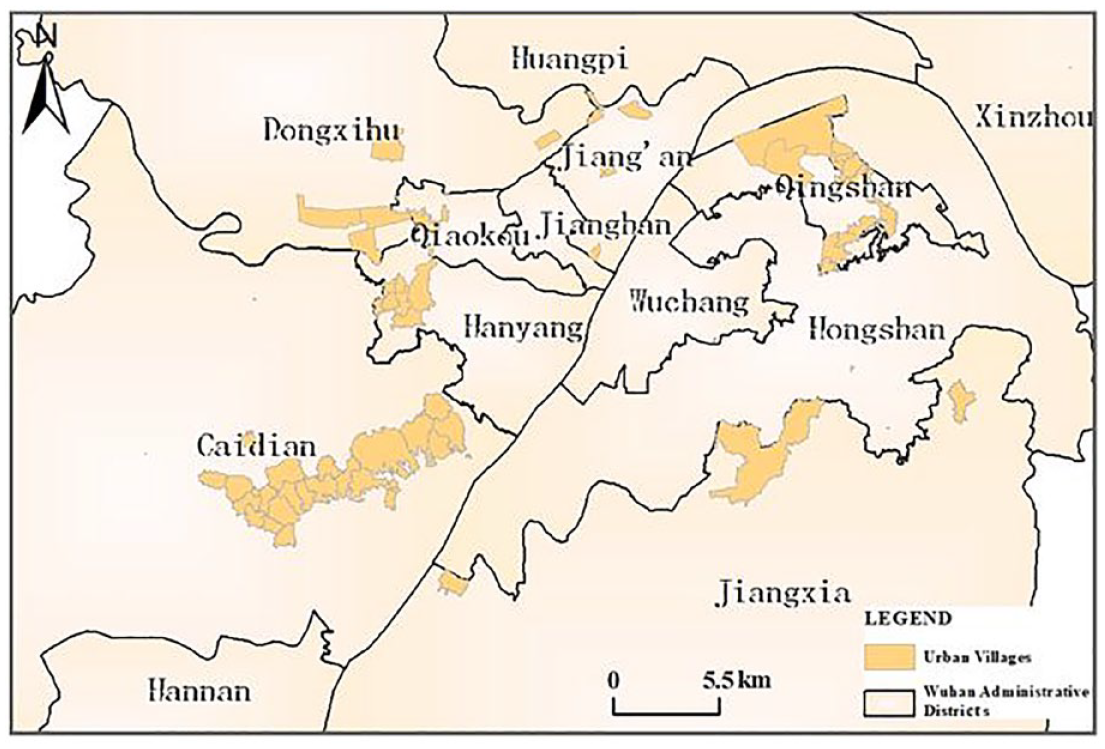
Urban villages in Wuhan.
Profiling public facilities for urban villages
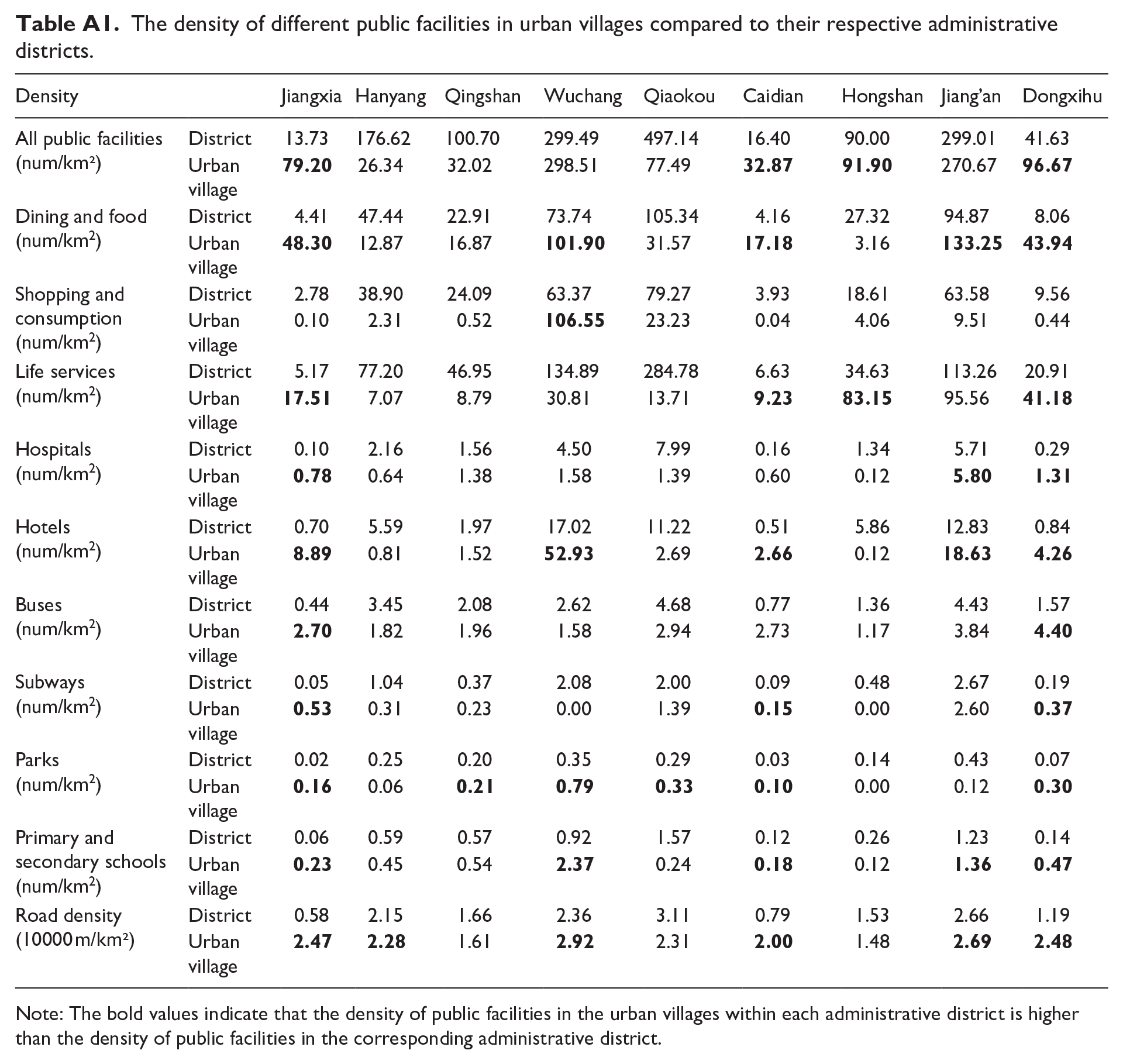
Through further analysis, we obtained the spatial distribution characteristics of the per capita ownership of all public facilities in urban villages in Wuhan (Figure 4). It can be observed that urban villages with lower per capita ownership of public facilities are mainly located in Hanyang District and Qingshan District (Figure 4(a)). In most urban villages, the per capita ownership of public facilities is lower than that of their respective districts; only in Hongshan, Dongxihu, Jiangxia, and Caidian Districts do urban villages have a higher per capita ownership of public facilities compared to their respective districts (Figure 4(b)). Additionally, we also compared the density of different public facilities in each urban village with those in their respective administrative districts (see Appendix Table A1). Regarding specific public facilities, there are significant differences in the distribution of various types of public facilities. For example, the density of primary and secondary schools in urban villages in the central districts is generally lower than the indicators of the suburban districts; urban villages are often located away from areas with high concentrations of parks, resulting in very low park density; the density of hospitals in urban villages is unevenly distributed, with Jiangxia District and Jiang’an District having a higher density of hospitals in their urban villages; the density of metro stations is generally low in urban villages, while those with a higher density of bus stops compared to their respective districts are mostly located in suburban districts. Overall, the density of various public facilities in urban villages is relatively low, and in most cases, it is lower than the public facilities density of their respective administrative districts.
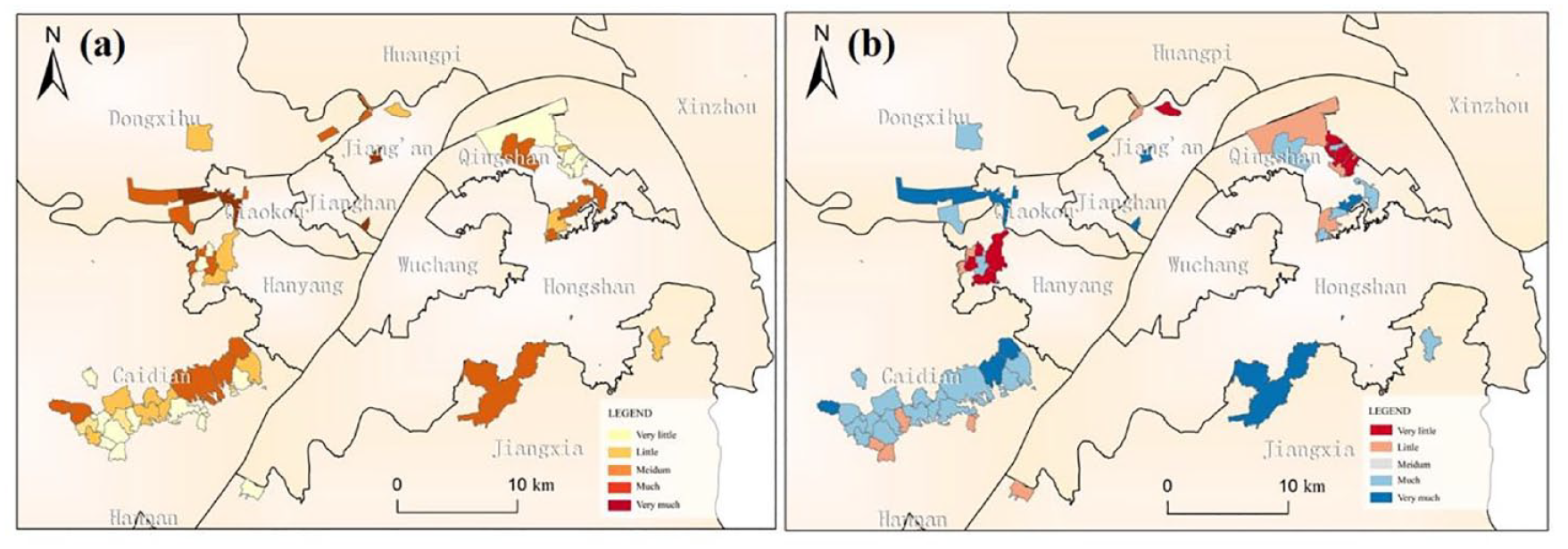
Per capita ownership of public facilities in urban villages (a), per capita ownership of public facilities in urban villages compared to their respective districts (b).
The upgrading strategies of public facilities
Upgrade sequence
The upgrade sequence is the order of upgrading public facilities in urban villages by considering both social and material dimensions of public facilities and using social network analysis (SNA) (see Figure 5). In this study, the social dimension refers to the influence of a certain urban village on the surrounding urban villages, expressed by the number of connecting edges between a node and other nodes, which is called the “degree” of a node in SNA, and the material dimension is expressed by the total number of public facilities in the urban village.
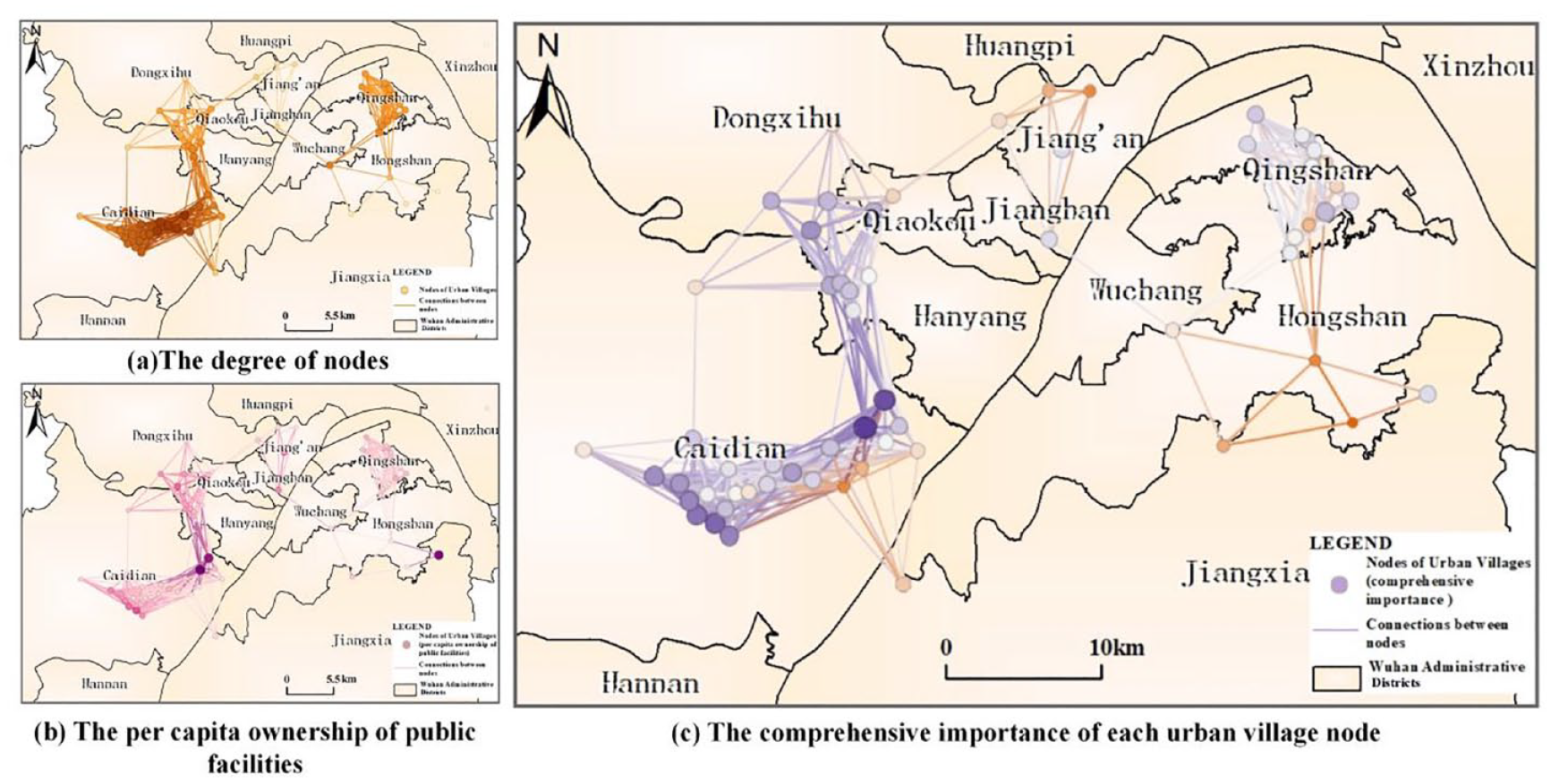
Upgrade sequence.
Figure 5(a) shows the “degree” of urban village nodes. Larger nodes indicate a higher “degree”, meaning that the node is more closely connected with surrounding nodes. Upgrading these nodes will have a greater impact and radiation effect on the surrounding nodes. It can be observed that urban villages with higher “degree” are mostly located in the Caidian District, followed by the Qingshan District. Urban villages with lower “degree” are concentrated in the Jiang’an District and the Hongshan District. According to statistics, urban village upgrading in Wuhan, which has lasted over 20 years, has mainly taken place in the central districts (Wang, 2023). As a result, the number of remaining urban villages in the central district is relatively small, and the connections between them are sparse. In contrast, the Caidian District has the highest number of existing urban villages, which are near each other. This facilitates the formation of a densely interconnected social network, resulting in a higher “degree”.
Figure 5(b) represents the total amount of public facilities in each urban village. Larger nodes indicate a greater number of public facilities, reflecting the higher importance of those urban villages. It can be observed that urban villages with a higher number of public facilities are in Caidian District and Jiangxia District. In contrast, urban villages with a lower number of public facilities are mainly distributed in Jiang’an District, Hongshan District, and Qingshan District.
By combining the “degree” of urban villages and the ownership of public facilities with equal weights, the comprehensive importance of each node is obtained (Figure 5(c)). Larger nodes indicate that the urban village has a stronger influence on surrounding urban villages and greater inherent strength, reflecting a higher comprehensive importance and an earlier position in the upgrading sequence. From Figure 5(c), urban villages with higher upgrading priorities are primarily distributed in the suburban districts, with the Caidian District being the main area, followed by the Dongxihu District. In contrast, urban villages with later upgrading sequences are mostly located in the central districts, particularly in Jiang’an District and Hongshan District. A possible reason is that there are many densely clustered urban villages in suburban districts. Upgrading these urban villages can also benefit the residents of nearby urban villages through the results of the upgrades. Additionally, compared to the central districts, the suburban districts have weaker economic development and underdeveloped public facilities. This results in poorer compensation effects from external public facilities for urban villages in suburban districts, increasing the urgency of upgrading their internal public facilities.
Upgrade mode
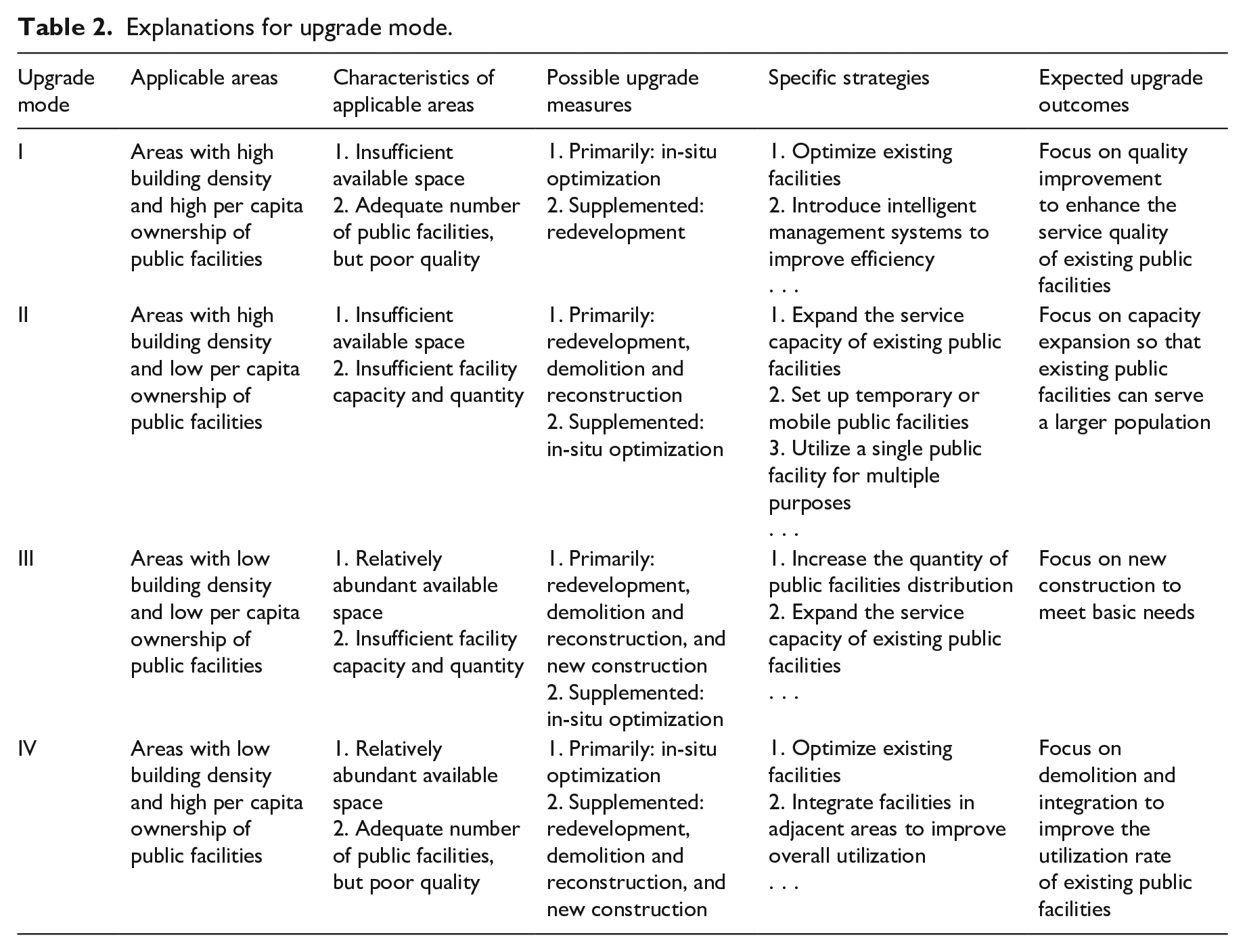
The specific upgrade mode for urban villages needs to balance the existing built environment with new constructions, considering both the supply and demand of existing public facilities and the constraints of land use. The per capita ownership of existing public facilities encompasses both supply and demand aspects, which is a key factor in upgrading facilities, while the amount of available and developable land directly impacts the feasibility of the upgrades. To reduce the blind addition of public facilities or the mismatch of public facilities, this study establishes a coordinate system for the upgrade mode of public facilities in urban villages, with per capita ownership of public facilities as the x-axis and building density as the y-axis. Values greater than the median are considered high on the axis, while values less than or equal to the median are considered low; the resulting first to fourth quadrants correspond to four main upgrade modes (I, II, III, IV), the specific explanations for each upgrade mode can be found in Table 2. We further used ArcGIS 10.4 for analysis, and the visualization of the different upgrade modes can be seen in Figure 6.
Explanations for upgrade mode.
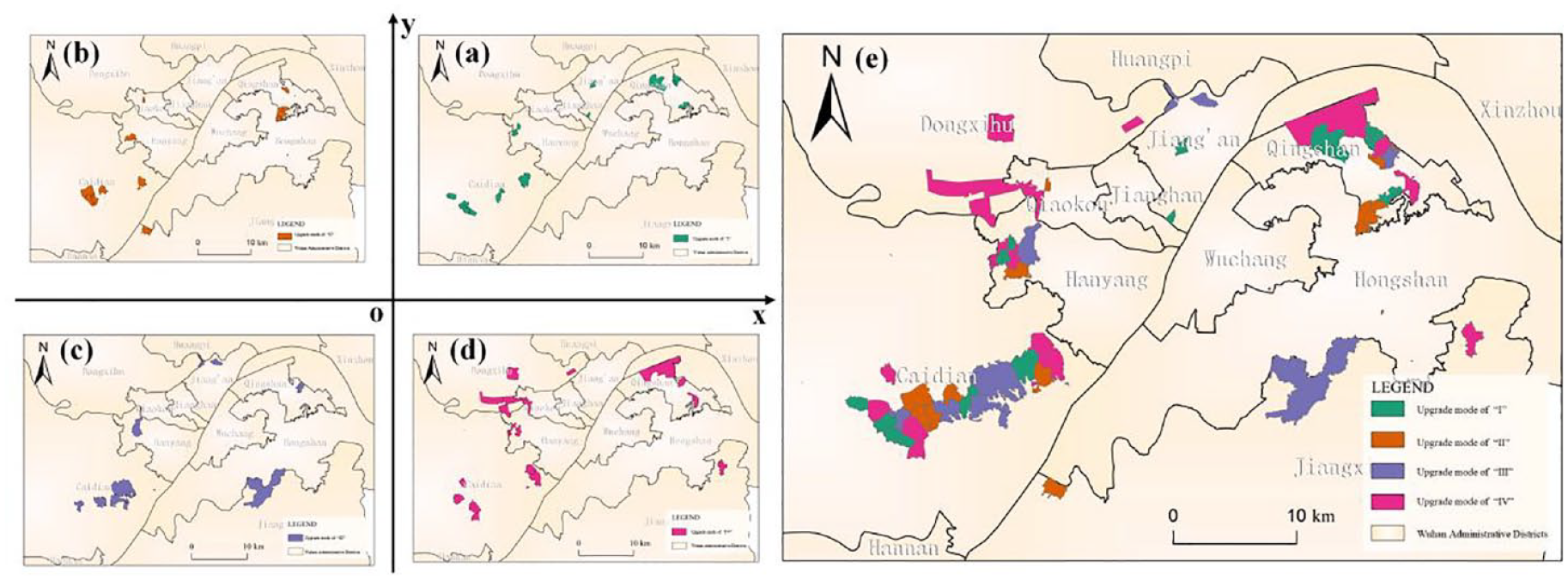
Upgrade mode.
The results indicate that in the first quadrant (Figure 6(a) – 13 urban villages) and the fourth quadrant (Figure 6(d) – 19 urban villages), where the per capita ownership of public facilities is relatively high, fewer additional public facilities are needed. Therefore, upgrading public facilities in these urban villages should primarily focus on improving quality. Given that urban villages in the first quadrant have higher building densities, new construction is not recommended. Considering residents’ needs, land feasibility, and redevelopment costs, we believe that urban villages can adopt an upgrade mode of “I”, primarily focused on “in-situ optimization” and supplemented by “redevelopment”. These villages are mainly distributed in Caidian District, Hanyang District, Jiang’an District, and Qingshan District. In contrast, urban villages in the fourth quadrant have lower building densities and can accommodate some new construction. Therefore, we believe that based on the existing funding situation, an upgrade mode of “IV”, which is primarily based on “in-situ optimization” and supplemented by “redevelopment, demolition and reconstruction, and new construction”, can be adopted. This quadrant contains the largest number of urban villages, which are arranged in a ring-shaped distribution across the Caidian District, Hongshan District, Hanyang District, Qingshan District, and Dongxihu District.
In the second quadrant (Figure 6(b) – 17 urban villages) and the third quadrant (Figure 6(c) – 12 urban villages), the per capita ownership of public facilities is relatively low. Therefore, upgrades should focus on increasing the quantity of public facilities. In the second quadrant, the urban villages are dispersed across seven districts, excluding Jiang’an District and Dongxihu District. These villages have high building densities, and the feasibility of new construction is limited. We recommend adopting an upgrade mode of “II”, which is mainly based on “redevelopment, demolition and reconstruction” and supplemented by “in-situ optimization”. In the third quadrant, the urban villages have lower building densities and are suitable for new construction. Therefore, an upgrade model of “III”, which is mainly based on “redevelopment, demolition and reconstruction, and new construction” and supplemented by “in-situ optimization”. Urban villages in this quadrant are distributed across Jiangxia District, Qiaokou District, Jiang’an District, Hanyang District, Dongxihu District, and Caidian District, with a particularly noticeable contiguous distribution in Caidian District.
Conclusions and discussions
Public facilities in urban villages are comprehensive carriers for multiple needs, including environmental, cultural, and service requirements. This study uses Wuhan as a case study, focusing on upgrading public facilities in urban villages. It involves identifying existing urban villages, analyzing the characteristics of their public facilities, and systematically exploring the upgrade sequence and mode for these facilities. This approach provides a unique solution to the challenges faced by urban villages. First, existing urban villages were identified through a coupled analysis of the construction land ratio and the proportion of migrants in each village. Next, kernel density and grid analysis methods were used to determine the per capita ownership and density of public facilities within the urban villages. Finally, a framework for upgrading public facilities in urban villages was constructed, including the “upgrade sequence and upgrade mode”. The upgrade sequence is determined based on the comprehensive importance of urban villages assessed through social network analysis. The upgrade mode is established by constructing a coordinate system using per capita ownership of public facilities and building density.
Our conclusions include: First, this study explored a “non-demolition” path for urban villages from the perspective of public facilities, offering a new perspective on addressing the complex issues of urban villages. As various social issues arising from forcible demolitions become increasingly apparent, some scholars recognize that the redevelopment of urban villages should not resort to simplistic or violent approaches of annexation or eradication (Xi et al., 2023). They have started to focus on the positive aspects of urban villages, recognizing that as low-cost shelters with advantageous locations, urban villages provide unique social functions by accommodating migrants (Yan and Wei, 2004). This perspective is also supported by a case study from Dongguan (Chan et al., 2003). With the introduction of the “stock development” mode, China’s approach to addressing urban village issues has shifted from “large-scale demolition and redevelopment” to “comprehensive remediation” and “organic renewal” (Luo and Wang, 2023). China’s 14th Five-Year Plan (2021) proposes “promoting the optimisation and improvement of urban spatial structure” 4 , indicating that the importance of urban spatial characteristics has reached the policy level. Subsequently, research such as land potential assessment for urban villages (Che et al., 2023) and identification of micro-level public space network structural characteristics (Cai, 2023) has emerged, providing detailed analysis of public space features in urban villages. In other words, when addressing urban village issues, it is essential not only to consider the violent physical renewal characterized by “large-scale demolition and construction of high-rise buildings” but also to adopt a “human-centered” approach. This approach should take into account deeper concerns for culture, living environment, residents’ sense of belonging, and convenience of daily life (Wang and Fang, 2024). This study focuses on public facilities in urban villages by proposing a framework for upgrading strategies, including “upgrade sequence – upgrade mode”, to explore feasible ways for on-site optimization of urban villages. This approach breaks through the limitations of traditional research, fills the gap in systematic studies of public facilities in urban villages, and expands the research paths and directions for addressing urban village issues, thereby contributing to harmonious urban development.
Interestingly, the results regarding the upgrade sequence indicate that urban villages prioritized for public facility upgrades are predominantly located in the suburban districts, particularly in Caidian District. This suggests that Wuhan should concentrate on enhancing the public facilities of urban villages in the suburban districts in the future. Historically, however, the redevelopment of urban villages in Wuhan has primarily focused on the central districts. In 2009, Wuhan proposed to “complete the demolition of 56 urban villages within the Second Ring Road within three years and to essentially complete the demolition and redevelopment of 94 urban villages outside the Second Ring Road by the end of 2012.” In April 2023, Wuhan City released the “Wuhan Urban Renewal Action Plan,” identifying 32 key update units. To further implement this action plan, in June of the same year, the Wuhan Municipal Government Office issued the “Notice on Planning for Urban Renewal and Property Expropriation for 2023,” which emphasized the comprehensive advancement of land expropriation and relocation for 41 sites with inadequate infrastructure and the redevelopment of urban villages. After years of redevelopment, the number of remaining urban villages in Wuhan’s central districts is relatively small, characterized by smaller scales and dispersed locations. Additionally, the relatively developed public facilities in the central districts provide adequate compensation for the urban villages. In contrast, the suburban districts exhibit the opposite situation – numerous urban villages with larger areas and a more concentrated distribution. Most existing literature focuses on the central districts (Luo, 2021; Ou, 2022; Wei, 2023), and this neglect of the suburban districts may lead to more severe issues in the urban villages there. In other words, future research on urban village issues needs to shift from the central districts to the suburban districts.
Moreover, existing research predominantly proposes generic strategies for addressing urban village issues, whereas this study offers a different perspective. Previous studies generally explore common issues in urban villages and discuss them from the perspectives of various stakeholders, such as the government, the public, and developers, often applying the same strategies to all urban villages within a city (Yang, 2023; Zhuang, 2023). These strategies often remain at the policy and theoretical level, making them difficult to apply to specific urban villages. In contrast, we argue that a uniform upgrade scheme is unsuitable for addressing the diverse issues related to public facilities in various urban villages. Implementing targeted strategies is more likely to yield effective upgrades, which aligns with the views of some researchers. For example, one study attempts to use graph theory and network perspectives to combine spatial attributes with vitality attributes, exploring the optimization and enhancement of micro-level public spaces in different urban villages. This approach improves the accuracy of research strategies (Cai, 2023). Another study proposed three modes for urban village redevelopment from the perspective of the complementarity between urban living and industrial development (Fu, 2023). Additionally, some studies guide planning decisions by selecting different redevelopment modes, such as preservation, demolition, reconstruction, or redevelopment, based on the characteristics of the spatial conditions of urban villages (Che et al., 2023). Although it is challenging to find studies with the same theme to support and validate our conclusions, the results of existing research indirectly confirm the validity of our findings. By developing targeted upgrade plans for public facilities in different urban villages, more scientific and effective improvements can be achieved.
It should be noted that this study also has some limitations. Firstly, this study is exploratory research on upgrading public facilities in urban villages, aimed at analyzing specific enhancement strategies centered around the most fundamental material and cultural carriers of urban villages. However, the upgrade of public facilities in urban villages also involves issues such as planning before upgrades, compensation post-upgrade, and sustained revitalization. This study only considers the upgrade process. Future research could conduct comprehensive, whole-process analyses of public facilities upgrades in urban villages from a time-series perspective to develop more scientific redevelopment plans. Additionally, the upgrade of public facilities in this study relies on open-source data and statistical data, lacking a foundation of field research and residents’ subjective intentions. Future research could incorporate survey and interview data to better understand the real needs of urban village residents regarding public facilities.
The results of this study can provide valuable recommendations for upgrading public facilities in urban villages in Wuhan. Specifically, (1) contrary to traditional views, this study suggests that future upgrades to public facilities in urban villages in Wuhan should shift focus from the central districts to the suburban districts. The urban villages in the suburban districts have a large number, extensive areas, and high concentration, with both the quantity and quality of public facilities requiring improvement. (2) Avoid blind large-scale demolition and construction. It is recommended that the government and planners comprehensively consider the supply and demand characteristics when addressing public facility issues in urban villages. In urban villages with high building density or low demand, both from a practical and economic perspective, the primary measures for upgrading public facilities should be redevelopment, repair, and remediation. For urban villages with low building density or high demand, a combination of demolition and redevelopment or new construction modes can be employed. (3) Planners should recognize that a unified upgrade strategy could lead to greater inequality, potentially resulting in diminishing returns for urban villages that already have good public facilities, as well as capital misallocation and waste. It is important to adopt different upgrade strategies tailored to the specific conditions of each urban village. It is recommended to refer to the results of this study and apply different upgrade modes sequentially for various urban villages to achieve better upgrade outcomes.
Footnotes
Appendix
The density of different public facilities in urban villages compared to their respective administrative districts.
| Density | Jiangxia | Hanyang | Qingshan | Wuchang | Qiaokou | Caidian | Hongshan | Jiang’an | Dongxihu | |
|---|---|---|---|---|---|---|---|---|---|---|
| All public facilities (num/km²) |
District | 13.73 | 176.62 | 100.70 | 299.49 | 497.14 | 16.40 | 90.00 | 299.01 | 41.63 |
| Urban village |
|
26.34 | 32.02 | 298.51 | 77.49 |
|
|
270.67 |
|
|
| Dining and food (num/km2) |
District | 4.41 | 47.44 | 22.91 | 73.74 | 105.34 | 4.16 | 27.32 | 94.87 | 8.06 |
| Urban village |
|
12.87 | 16.87 |
|
31.57 |
|
3.16 |
|
|
|
| Shopping and consumption (num/km2) |
District | 2.78 | 38.90 | 24.09 | 63.37 | 79.27 | 3.93 | 18.61 | 63.58 | 9.56 |
| Urban village | 0.10 | 2.31 | 0.52 |
|
23.23 | 0.04 | 4.06 | 9.51 | 0.44 | |
| Life services (num/km2) |
District | 5.17 | 77.20 | 46.95 | 134.89 | 284.78 | 6.63 | 34.63 | 113.26 | 20.91 |
| Urban village |
|
7.07 | 8.79 | 30.81 | 13.71 |
|
|
95.56 |
|
|
| Hospitals (num/km2) |
District | 0.10 | 2.16 | 1.56 | 4.50 | 7.99 | 0.16 | 1.34 | 5.71 | 0.29 |
| Urban village |
|
0.64 | 1.38 | 1.58 | 1.39 | 0.60 | 0.12 |
|
|
|
| Hotels (num/km2) |
District | 0.70 | 5.59 | 1.97 | 17.02 | 11.22 | 0.51 | 5.86 | 12.83 | 0.84 |
| Urban village |
|
0.81 | 1.52 |
|
2.69 |
|
0.12 |
|
|
|
| Buses (num/km2) |
District | 0.44 | 3.45 | 2.08 | 2.62 | 4.68 | 0.77 | 1.36 | 4.43 | 1.57 |
| Urban village |
|
1.82 | 1.96 | 1.58 | 2.94 | 2.73 | 1.17 | 3.84 |
|
|
| Subways (num/km2) |
District | 0.05 | 1.04 | 0.37 | 2.08 | 2.00 | 0.09 | 0.48 | 2.67 | 0.19 |
| Urban village |
|
0.31 | 0.23 | 0.00 | 1.39 |
|
0.00 | 2.60 |
|
|
| Parks (num/km2) |
District | 0.02 | 0.25 | 0.20 | 0.35 | 0.29 | 0.03 | 0.14 | 0.43 | 0.07 |
| Urban village |
|
0.06 |
|
|
|
|
0.00 | 0.12 |
|
|
| Primary and secondary schools (num/km2) |
District | 0.06 | 0.59 | 0.57 | 0.92 | 1.57 | 0.12 | 0.26 | 1.23 | 0.14 |
| Urban village |
|
0.45 | 0.54 |
|
0.24 |
|
0.12 |
|
|
|
| Road density (10000 m/km²) |
District | 0.58 | 2.15 | 1.66 | 2.36 | 3.11 | 0.79 | 1.53 | 2.66 | 1.19 |
| Urban village |
|
|
1.61 |
|
2.31 |
|
1.48 |
|
|
|
Note: The bold values indicate that the density of public facilities in the urban villages within each administrative district is higher than the density of public facilities in the corresponding administrative district.
Declaration of conflicting interests
The author(s) declared no potential conflicts of interest with respect to the research, authorship, and/or publication of this article.
Funding
The author disclosed receipt of the following financial support for the research, authorship, and/or publication of this article: NSFC funder (42171203).

1.
“The Landscape of Urban Villages in China” ((a) www.sohu.com/a/420665818_120263571; (b) https://baijiahao.baidu.com/s?id=1776688289909661295&wfr=spider&for=pc; (c) (d) https://baijiahao.baidu.com/s?id=1676370989290014370&wfr=spider&for=pc; (e) https://baijiahao.baidu.com/s?id=1676451394516054734&wfr=spider&for=pc).
3.
“Wuhan: Actively and steadily promote the transformation of urban villages” (https://baijiahao.baidu.com/s?id=1773006122156128998&wfr=spider&for=pc).