



Abstract
This paper revisits China’s city-regionalism based on a multi-scalar reading of state entrepreneurialism, with a special focus on the transition from the Pearl River Delta (PRD) to the Greater Bay Area (GBA). We first propose a multi-scalar theoretical framework of state entrepreneurialism to comprehend China’s city-regional development. At the national scale, the central state maintains planning centrality by establishing normative goals through national political mandates and orchestrating socio-spatial reconfiguration of city-regions using various planning techniques (e.g., zoning, annexation, connectivity, and place-making), which demonstrates state spatial selectivity. At the local scale, city-regional development, led by the local state, pivots on the mandates and resorts to market instruments. Place-specific contexts and development trajectories give rise to distinctive ‘regional models’ and contingent socio-spatial processes. From a historical-geographical perspective, these contingent socio-spatial processes represent both the outcome of and the precondition for successive waves of state spatial selectivity in city-regional development. Building upon the dynamic interplay between state spatial selectivity and contingent socio-spatial processes, we present a periodised analysis to delve into the ongoing transformation from the PRD to the GBA. Amidst evolving global-local conjunctures and shifting national political mandates, state spatial selectivity within the PRD-to-GBA transformation is categorised into three periods: (1) 1980s to early 1990s: exploiting zoning technologies to institutionalise exceptionality within delimited areas for undertaking market-oriented experiments; (2) mid-1990s to 2000s: empowering entrepreneurial cities to drive market-oriented development while managing their size, internal hierarchy, and external connections; and (3) 2010s onwards: an intensified planning centrality at the national scale and the reinvention of zoning technologies to emphasise relationality, reshaping the urban-regional and cross-border dynamics of the GBA within an ‘integration’ framework. In conclusion, this paper reflects on the variegated geographies of China’s city-regionalism – the socio-spatially distinctive, temporally evolving and ultimately polymorphic, multi-scalar construction of Chinese city-regions.
Keywords
In 2019, the central state promulgated a development outline for the ‘Guangdong-Hong Kong-Macao Greater Bay Area’ (GBA), redefining the widely acknowledged ‘Greater’ Pearl River Delta (PRD) with a new political identity. Concurrently, the central state has also formulated the development plans for other city-regions around the same time, such as the Yangtze River Delta, Hainan Free Trade Port, and Xiong’an New Area. These endeavours reveal the central state’s prominent role in city-region governance, driven by various geopolitical agendas. Yet the GBA project does not constitute an entirely novel undertaking that dismantles the inherited territorial-institutional structures of the PRD era. Instead, it maintains the territorial framework encompassing nine mainland cities and two special administrative regions. The implementation of the GBA project continues to hinge significantly on local initiatives and geoeconomic dynamics at the urban-regional scale. Within this context, some commentators view the GBA project as ‘old wine in a new bottle’, suggesting continuity with existing strategies in a fresh guise, while others argue that it signifies a transition from decentralisation to recentralisation in China’s city-regional development.
This paper contends that the evolving GBA project is neither a mere semantic rebranding nor a unidirectional shift towards recentralisation. Drawing on the insights of Fulong Wu and his co-authors (Wu, 2016, 2018, 2020, 2023; Wu and Zhang, 2022; Wu et al., 2022), it argues that the GBA project – or more broadly, China’s city-regionalism – is a multi-scalar endeavour propelled by state entrepreneurialism. The state maintains its centrality at the national scale by formulating political mandates and employing various planning techniques, while simultaneously fostering diverse regional models at the urban-regional scale by leveraging market instruments, social agency, and local contingencies. To substantiate this argument, the paper conducts a conjunctural analysis of China’s city-regionalism, unfolding in two stages. First, it engages in a mid-level theoretical formulation of China’s city-regional development, synthesising insights from extant literature and integrating ‘different (but related) sites into the same analytical frame’ (Peck, 2023: 15). Thus China’s city-regional development is understood as a multi-scalar process shaped by the dynamic interplay between state spatial selectivity and contingent socio-spatial processes. Second, building upon such dynamic interplay, the paper traces the transformation from the PRD to the GBA through a historicised and multi-scalar analysis (Peck, 2023). The GBA project is socio-spatially distinct from other Chinese city-regions. Nonetheless, it also shares consanguinity with its counterparts, as they are all governed by the state with consistent national political mandates and planning techniques. Overall, through a conjunctural analysis, this paper aims to illustrate the variegated geographies of China’s city-regionalism – the socio-spatially distinctive, temporally evolving, and ultimately polymorphic, multi-scalar construction of Chinese city-regions.
Locating China’s city-regionalism in the global debate: Reinterpreting the geopolitics/geoeconomics divide into a multi-scalar process
The rise of city-regions in the late 20th and early 21st centuries has afforded a great deal of scrutiny in academia, with different (and often competing) lines of analysis unfolding. Amidst neoliberal globalisation, Allen Scott and Michael Storper, among other economic geographers, refer to city-regions as ever-growing urban behemoths via agglomeration and specialisation processes, within which the emerging global/world cities act as locomotives for the regional economies (Scott, 2019). The concentration of multinational corporate headquarters has turned world cities into bustling hubs that command the global economy. Since the 1980s, global cities have been riding the wave of globalising financialisation by developing state-of-the-art commercial and financial infrastructure, thereby hanging on to their lead in the world urban hierarchy (Sassen, 1991). Additionally, global cities establish diverse forms of industrial clusters with their peripheral cities, generating economic synergy through proximity-induced sharing, matching, and learning mechanisms (Scott and Storper, 2015). Global city-regions have assuredly developed into economic powerhouses alongside intensified globalisation (Scott, 2019). In light of this fact, some geoeconomic accounts suggest the declining power of territorial states, exemplified by Kenichi Ohmae’s bold assertion: ‘the end of the nation-state’ (Ohmae, 1995).
Such claims, however, have been called into question by geopolitical scholars. Following a rebuttal of the assumption that state territoriality is on the wane, Neil Brenner articulates the notion of ‘globalisation as reterritorialisation’ to unravel the process of state rescaling in the formation of global city-regions (Brenner, 1999). The territorial state designates specific city-regions as ‘development areas’, and inject ‘industrial capacities, infrastructural investments and public resources’ into these spaces to secure competitive advantages and create conditions for sustained growth in the post-Fordist era (Brenner, 2004: 142–143). Hence, the ongoing trend of ‘glocalisation’ fundamentally entails state spatial selectivity, which inevitably intensifies uneven geographical development (Brenner, 2004). Yet the territorial state is by no means a monolithic whole. It consists of intricate territorial-institutional structures interlaced with fragmented and multi-tiered jurisdictional boundaries, and thus ineluctably provokes inter-territorial or inter-scalar conflicts and contradictions (Cox, 2010; Harrison, 2010). Therefore, city-regionalism is not only a process of state rescaling to restore competitiveness. Beyond economic imperatives, city-region governance is also associated with struggles around collective provision, citizenship, sustainability, and other forms of social reproduction and (re)distribution (Jonas and Ward, 2007). In this context, a growing body of research attends to variegated geopolitical processes of city-regionalism, expatiating upon the reorganisation of political institutions and territorial structures, the refashioning of regulatory arrangements and policy discourse, as well as the negotiation between state and non-state actors (Harrison, 2010; Zhang and Wu, 2006). In many cases, state orchestration/mediation runs through the geopolitical process, which reveals a sustained effort of the state to territorialise its political power in the city-region formations (Jonas and Moisio, 2018).
State-orchestrated city-region governance is writ large in the Chinese context (Wu, 2016). In the post-reform era, China has been undergoing successive waves of city-regional restructuring (Yeh and Chen, 2020). The Chinese state strives to pursue both economic competitiveness and territorial-political stability through ‘scale building’ and ‘spatial fix’ (Wu, 2016). Such endeavours, however, come along with unremitting global-local interactions, enduring localisms and inter-city competitions, as well as spontaneous horizontal collaborations (Luo and Shen, 2009; Xu and Yeh, 2005). In this sense, China’s city-regionalism remains hybrid in character, which is driven not only by top-down interventions (or, geopolitical projects) but also by bottom-up initiatives (or, geoeconomic dynamics). The hybridity is manifest in the (Greater) PRD. According to the existing literature, foreign direct investment, agglomeration economies, urban entrepreneurialism, and state orchestration have played their part in the development of this megaregion (Wu and Zhang, 2022). Under this circumstance, variegated geographies of city-regionalism have taken shape in and around the PRD, which include a long-established global city (Hong Kong), two globalising metropolitan cities (Guangzhou and Shenzhen), two special economic zones (Shenzhen and Zhuhai), the developing twin cities (the Guangzhou-Foshan metropolitan area), and a variety of administrative annexations, city networks and institutional enclaves (e.g., Hengqin and Qianhai) on the move. In 2019, the PRD cities, together with Hong Kong and Macao, were mutated into a national project – the GBA project. The nascent GBA project exactly substantiates the state-orchestrated tendency and its reinforcement. This does not mean, however, that the geoeconomic dynamics at the urban-regional scale has become trivial in the analysis of China’s city-regionalism.
Rather than appraising China’s city-regionalism within the geopolitics/geoeconomics divide, this paper employs the conceptual framework of ‘state entrepreneurialism’ (Wu, 2018), and offers a multi-scalar interpretation to disentangle the complexities between geopolitics and geoeconomics, as well as the interplay between state-orchestrated rescaling and market-like regionalisation (Wu and Zhang, 2022). Specifically, we contend that China’s city-regional development is primarily framed by national political mandates (Li et al., 2023; Wu et al., 2022). The national political mandates, subsequently, are inscribed in local-level planning discourse and crystallised throughout the market-like geoeconomic practices and interactions among (trans)local actors (the local state included). The journey from the formulation of national political mandates to their implementation at the urban-regional scale is fraught with uncertainty, rendering the actually existing geography of city-regionalism socio-spatially contingent. Through a historical-geographical lens, the contingent and evolving socio-spatial processes emerge both as an outcome of and a condition for successive waves of state spatial selectivity in city-regional development. Building upon the dynamic interplay between state spatial selectivity and contingent socio-spatial processes, this paper aims to review the vicissitudes of the PRD, and to understand the political economy of the GBA from a historical-geographical perspective. Next, we will elucidate the multi-scalar framework of state entrepreneurialism before probing into the evolution of the PRD (currently known as the GBA).
Governing China’s city-regionalism: State entrepreneurialism in action, a multi-scalar endeavour
State entrepreneurialism serves as a catalyst for the restructuring of Chinese cities and city-regions in the post-reform era (Wu, 2018; Zhang et al., 2023a). This notion denotes that the state strategically ‘combines planning centrality, market instruments and observable social agencies’, with the intention of maintaining ‘economic growth, stability and capital accumulation and in turn its governance capacity’ (Wu, 2023: 2; Wu and Zhang, 2022: 775).
Exercising state spatial selectivity via diverse planning techniques
Planning centrality, though is partly inherited from the socialist legacies, works in a very different manner under an entrepreneurial regime (Wu, 2015). More specifically, planning used to be a form of economic command during the planned economy. The whole state apparatus with an ensemble of bureaucratic organisations and state-owned enterprises (SOEs) strictly adhered to the planning directives and made every effort to meet the macro-economic indicators, regardless of the socio-economic foundations at the local level. In the wake of China’s endeavour to implement market-oriented reforms and its subsequent integration into the global economy, planning discourse promulgated by the central state has become more like a projection of the shifting state ethos and geopolitical imaginary in response to changing conjunctures within global capitalism. Wu et al. (2022: 615) define such planning discourse in the post-reform era as ‘national political mandates’, which are marked by ‘campaign-style guidelines’ in general terms and ‘without detailed implementation commands’ – in sharp contrast to the planning directives of a centrally planned economy. To implement the mandates at the local level and mobilise (trans)local actors and resources for economic development, the central state and its provincial and municipal subordinates utilise various planning techniques for city-regional restructuring, which exhibit state spatial selectivity.
There are four planning techniques that have garnered much scholarly attention, namely: zoning, annexation, connectivity, and place-making. Each of these planning techniques represents a state-orchestrated (re)configuration of socio-spatial relations within, between, and around the urban-regional formations in order to accomplish specific political-economic goals. In what follows, we sketch the underlying strategic selectivity of the state in each planning technique.
The geoeconomic dynamics and socio-spatial contingencies at the urban-regional scale
The central state wields its power over city-regional development by setting normative goals through national political mandates, and by reconfiguring socio-spatial relations through diverse planning techniques. While these manoeuvres carry significant weight, they are not expected to completely determine the trajectories or outcomes of city-regional development. In reality, national political mandates do not specify implementation directives; instead, they are translated into localised and diversified development agendas, empowering the local state to animate these mandates based on place-specific conditions and through policy innovation (Lim, 2017). The local state, in this context, has assumed greater responsibility for local economic affairs and has been granted considerable autonomy to leverage market mechanisms and attract foreign investment. Within this framework, the local state has been ‘transformed into an entrepreneurial market agency’ (Wu, 2020: 327). The primary objective of local state entrepreneurialism is to sustain economic growth within its jurisdiction, which significantly influences the political careers of local officials (Wu, 2018). Hence, substantial local efforts are directed towards employing market instruments, fostering a favourable business climate, luring capital investment, forging pro-growth coalitions, and initiating urban (re)development projects (Liu and Yau, 2020; Shen et al., 2020; Wu, 2003). Thus the local state has ushered its urban territory into an ‘entrepreneurial city’ (Wu, 2003), while a constellation of entrepreneurial cities is inevitably enmeshed in manifold geoeconomic relations, which are a mixture of inter-city competition and cooperation calibrated by cost-benefit calculations (Li et al., 2023).
The central state consistently intervenes in urban-regional spaces, utilising planning techniques such as zoning, annexation, connectivity, and place-making to reconfigure the geoeconomic landscapes within city-regions. Yet both Chinese cities and local states retain an entrepreneurial character. In this context, planning techniques function as ‘institutional stimuli’ rather than ‘totalitarian commands’, incentivising (trans)local stakeholders – such as local officials, market forces, and other social actors – to actively participate in city-regional development and leverage the reconfigured urban-regional spaces for their own benefit. This leads to contingent socio-spatial outcomes at the urban-regional scale that may diverge from the state’s expectation. Here, we illustrate some contingent socio-spatial outcomes alongside the state-orchestrated restructuring of city-regions.
In sum, the notion of state entrepreneurialism sheds new light on China’s economic and urban restructuring in the post-reform era, illustrating a multi-scalar endeavour within the political system (see Table 1) that transcends the de-/re-centralisation dichotomy: (1) At the national scale, political mandates serve to maintain structural coherence (Lim, 2017; Wu et al., 2022), selectively defining geopolitical imperatives and projecting urban-regional imaginaries (Harrison and Gu, 2021; Li et al., 2023). (2) At the urban-regional scale, economic/urban development, led by the local state, pivots on these mandates and resorts to market instruments (Liu and Yau, 2020; Shen et al., 2020). Various place-specific assemblages of public-private partnerships, industrial clusters, transnational networks, and regulatory arrangements create distinctive ‘regional models’ and contingent socio-spatial outcomes (Zhang and Peck, 2016). (3) Over time, the contingent socio-spatial outcomes at the urban-regional scale become an integral part of the emerging conjuncture, propelling a new wave of state spatial selectivity in city-region governance. Within the new wave, the state maintains planning centrality, seeking to (re)embed itself in and entrench its dominance over the contingent and evolving socio-spatial processes at the urban-regional scale. Thus, viewed diachronically, economic and urban restructuring in China is both a path-dependent and path-shaping process, driven by the recursive interaction between state spatial selectivity and contingent socio-spatial processes.
A mid-level and multi-scalar framework for analysing China’s city-regionalism.
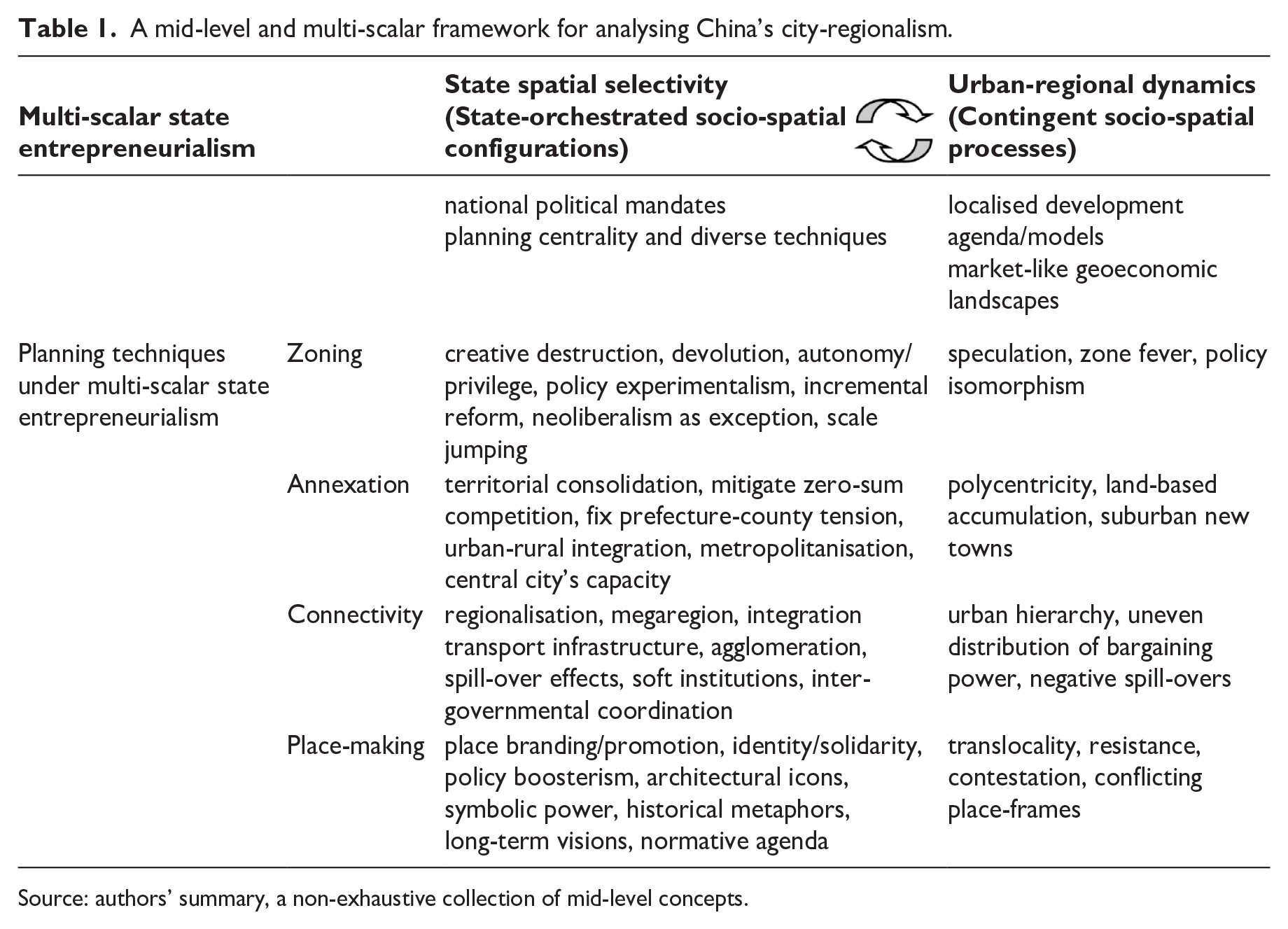

Source: authors’ summary, a non-exhaustive collection of mid-level concepts.
From regional experiments at the local scale: Recounting the past ‘stones’ laid in the Pearl River Delta
This paper conducts a conjunctural analysis of China’s city-regionalism. In the first half, the authors have presented a mid-level theorisation of city-regionalism within the Chinese context, based on a multi-scalar interpretation of state entrepreneurialism (see Table 1). Building upon the mid-level concepts, the subsequent sections aim to historicise the regional evolution from the PRD to the GBA, synthesising different historical threads across multiple scales to weave a more comprehensive narrative about the development of this megaregion. These threads include (1) the historical drift at the global scale, (2) national political mandates, and (3) urban-regional dynamics (state spatial selectivity vis-à-vis contingent socio-spatial processes).
When reflecting on the 1980s and 1990s, a pivotal period during which the Chinese state inaugurated the ‘reform and opening-up’ policy, we often invoke a well-known Chinese saying: ‘crossing the river by feeling the stones’. The PRD is indeed the epicentre of reforms due to its geographical proximity to Hong Kong and Macao. In this section, we review the regional evolution by recounting the past ‘stones’ laid in the PRD, with a special focus on its linkage with Hong Kong.
Inaugurating reforms through zoning technologies (Hong Kong as a conduit to access the global economy)
Between the 1960s and 1970s, Singapore, South Korea, Hong Kong, and Taiwan – known globally as the ‘Four Asian Tigers’ (FATs) – competed to develop labour-intensive industries transferred from developed economies, achieving remarkable economic growth through export-oriented industrialisation. In stark contrast, China underwent the Cultural Revolution during the same period, resulting in a prolonged impasse in the national economy. The pronounced socio-economic disparity across the border prompted a considerable number of refugees to flee from the mainland to Hong Kong. Official archives indicate that between 1954 and 1980, an estimated 565,000 refugees fled their homes, with a notable proportion originating from Bao’an County, a locality situated in close proximity to Hong Kong. 1
In 1978, the organisation of the 3rd Plenary Session of the 11th Central Committee of the Chinese Communist Party (CCP) marked a turning point in China’s domestic situation. From this meeting, Deng Xiaoping virtually became the paramount leader of China and unequivocally put forward two national political mandates: (1) shifting the central task of the Party and the state from class struggle to economic development, and (2) implementing reform and opening-up. Deng expressed his desire for China’s economy to catch up with the FATs. This epochal shift in state ethos coincided with significant international events, including the restoration of China’s lawful seat in the United Nations in 1971, the establishment of Sino-US diplomatic relations in 1979, and the Sino-British negotiations in the 1980s regarding the handover of Hong Kong’s sovereignty. The policy of ‘One Country, Two Systems’ was formulated during this process. Overall, the confluence of these events fostered a propitious international environment for China to implement its ‘reform and opening-up’ policy.
To instigate reforms, the central state had been contemplating Hong Kong’s strategic positioning, considering its rapid rise as a member of the FATs, its alignment with the global capitalist economic system, and the persistent cross-border instability between Bao’an County and Hong Kong. The year 1979 marked a significant milestone when Bao’an County was officially transformed into Shenzhen City, a newly established prefecture-level city. In the same year, Zhuhai was also elevated from a county to a city. Subsequently, in 1980, Shenzhen and Zhuhai were officially designated as SEZs, alongside Shantou and Xiamen. In 1984, Guangzhou was also listed as one of the 14 ‘Coastal Open Cities’. In 1985, to expedite the development of an export-oriented economy, the central state took a further step by designating the entire PRD as an open economic area, thereby greatly facilitating the establishment of economic ties between this region and Hong Kong.
The use of zoning technologies indeed featured decentralisation and neoliberalisation, as Deng Xiaoping mentioned in 1979: ‘The central government has no money, but it can provide some policy support. You [The SEZs] can take the initiative and fight your way out’. The creation of SEZs, however, does not signify a retreat of the central state; rather, it is inherently rooted in an authoritarian political system (Ong, 2006). Our focus here is on how the central state manipulates the SEZs to maintain its dominance and governance capacity:
First, the development of SEZs involves an upscaling of state power. Both Shenzhen and Zhuhai were elevated from county to city status, and underwent territorial expansion. In 1981, Shenzhen was promoted to a sub-provincial city and later, in 1988, designated as a city under separate state planning (ji’hua dan’lie shi), following Guangzhou’s designation in 1984. These upscaling arrangements facilitated the implementation of national political mandates in the SEZs, with the central state closely monitoring market-oriented experiments.
Second, zoning technologies function as a spatial strategy for policy experimentation in three key ways. (1) Task-oriented practices: During the 1980s, reforms in agricultural production, rural industrialisation, and urban economic systems were implemented through pilot zones for policy experimentation. (2) Multi-scalar operations: For instance, Shenzhen and Zhuhai have become hubs for numerous state-orchestrated experiments. Within these SEZs, there are further subdivisions into discrete zones dedicated to high-tech industries, free-trade arrangements, and other specialised functions. This structured approach distinguishes SEZs from laissez-faire market spaces. (3) Authoritarian measures: Until 2010, Shenzhen’s municipal territory was divided into SEZ areas (Luohu, Futian, and Nanshan Districts) and non-SEZ areas (Bao’an and Longgang Districts), marked by barbed-wire fences and checkpoints.
Third, national political mandates evolve alongside the ebbs and flows of reform experiments. During the 1980s, concurrent with the introduction of SEZ projects, Deng Xiaoping proposed additional political mandates: ‘building a moderately prosperous society’ and ‘the three-step development strategy’, encapsulating the vision and mission of economic reforms. In 1992, to reaffirm market-oriented reforms disrupted by the late 1980s turmoil, Deng toured Southern China, visiting Shenzhen, Zhuhai, Guangzhou, and Shanghai. His speeches boosted confidence among (trans)local actors involved in the reforms.
The shifting state ethos towards developing a market-oriented and outward-looking economic system, along with the implementation of zoning technologies, has significantly transformed the PRD into a thriving economic region. In the 1980s, the entire PRD opened up, prompting the relocation of manufacturing from Hong Kong to this region due to cheaper labour and land costs. Simultaneously, Hong Kong ascended to a higher echelon in the industrial economy by placing greater emphasis on commercial domains such as ‘marketing, design, purchase of raw materials, inventory control, management and technical supervision, financial arrangements and controls’ (Sit and Yang, 1997: 656). This symbiotic relationship between Hong Kong and the PRD, commonly known as the ‘front shop, back factory’ model, extended beyond major cities (i.e., Guangzhou, Shenzhen, and Zhuhai) to smaller-sized counties under the trend of rural industrialisation.
As a result of its dramatic growth in export-oriented industrialisation, the PRD experienced rapid urbanisation in the 1980s, termed ‘exo-urbanisation’ (Sit and Yang, 1997). In contrast to the major cities, where state-sponsored industrialisation and urbanisation prevailed, smaller-sized counties primarily relied on township and village enterprises (TVEs) for their industrialisation, leading to spontaneous urbanisation (Shen et al., 2002). Intriguingly, foreign investment did not gravitate towards Guangzhou or the two SEZs. Instead, counties emerged as preferred destinations, epitomised by the meteoric rise of ‘Guangdong’s Four Little Tigers’ – Nanhai, Shunde, Dongguan, and Zhongshan (Lin, 1997). This preference was largely due to pre-existing kinship ties between overseas investors and local communities. Additionally, officials in these counties were more flexible and willing to accommodate investors’ needs (Sit and Yang, 1997).
Despite being governed by the same political mandates and endowed with similar privileges and autonomy, the SEZs have followed divergent development paths. Shenzhen has been a triumph due to ‘its sustained high growth, penchant for innovation, and capitalization on geographical proximity to Hong Kong’. In contrast, ‘Zhuhai has overbuilt its infrastructure beyond sustainable demand, and the symbiotic relationship with Macao has not blossomed’ (Yeung et al., 2009: 225).
The ambidextrous state in harnessing the entrepreneurial cities (Hong Kong as a partner city in the regional economy)
Deng Xiaoping’s tour of Southern China spurred economic reforms. In 1993, during the 3rd Plenary Session of the 14th Central Committee of the CCP, the central state unveiled a new national political mandate: ‘establishing a socialist market economy’. This mandate signalled a fundamental shift in China’s market-oriented reforms, transitioning from adopting ‘neoliberalism as exception’ to embracing systemic neoliberalisation. This transformation was evident in the commodification of land and housing, extensive privatisation of SOEs and TVEs, and the integration of market mechanisms into urban development and other domains (He and Wu, 2009). The introduction of systemic neoliberalisation coincided with state rescaling. The tax-sharing reform in 1994 acted as a catalyst, leaving the local state with substantial administrative power while consolidating fiscal control for the central state by retaining the lion’s share of tax revenue. Consequently, the local state adopted entrepreneurial roles, spearheading market-oriented urban development to generate land-based fiscal revenue and stimulate local economic growth (Liu and Yau, 2020). Yet the analysis of Chinese urban entrepreneurialism cannot be oversimplified by the ‘decentralisation’ thesis. The development of entrepreneurial cities in China actually represents a state-orchestrated spatial project. The evolution of the PRD city-region stands as an epitome, which can be divided into three historical arcs.
To unleash the entrepreneurship of PRD cities, the state has implemented several planning strategies. First, it bolstered the municipal power through territorial annexations. In 2000, Panyu and Huadu were reclassified as urban districts, becoming part of Guangzhou’s jurisdiction. In 2001, Doumen County was bifurcated into Doumen and Jinwan districts under Zhuhai’s administration. Foshan expanded its territory in 2002 by integrating the former county-level cities of Nanhai, Shunde, Sanshui, and Gaoming as its constituent districts. Simultaneously, Xinhui merged into Jiangmen, shifting from a county-level city to an urban district, while Huiyang joined Huizhou in 2003 through a similar process. These annexation efforts persisted until the mid-2010s, consolidating the PRD into a city-region comprising nine major cities.
The second planning strategy involves establishing an urban hierarchy and foregrounding core-city status. In 1995, the Guangdong provincial government unveiled the ‘Plan for Urban Agglomerations in the PRD Economic Zone’, emphasising Guangzhou’s role as a core city in the PRD. This plan proposed three metropolitan areas within the city-region, delineated by two primary axes: one from Guangzhou to Zhuhai, and the other from Guangzhou to Shenzhen. A decade later, the ‘Coordinated Development Plan for the PRD Urban Agglomerations (2004–2020)’ was enacted, elevating Shenzhen to another core city within the region. Thus the PRD city-region transformed into a polycentric structure, with Guangzhou and Shenzhen leading the regional economy. Given their top ranks in the urban hierarchy, Guangzhou and Shenzhen benefit from substantial policy privileges and financial support from the central and provincial authorities.
The third planning strategy focuses on place-making to showcase urban competitiveness. Guangzhou embarked on an ambitious venture to create a new central business district (CBD) through extensive infrastructure development. The primary objective was to craft a modern and international cityscape to attract transnational investment (Xu and Yeh, 2005). This decade-long effort culminated in the establishment of Zhujiang New Town, emerging as Guangzhou’s latest CBD since the 2000s. It features newly constructed landmarks, including the Guangzhou Opera House, the new Guangzhou Library, and the Guangdong Museum. Adjacent to these structures stand the iconic Twin Towers – the Guangzhou International Finance Centre and the Guangzhou Chow Tai Fook Finance Centre – while across the river looms the Canton Tower, Guangzhou’s tallest skyscraper. Zhujiang New Town’s prominence was amplified by Guangzhou’s hosting of the 2010 Asian Games. Amidst fierce inter-urban competition, other entrepreneurial cities within and beyond the PRD, such as Shenzhen, Hong Kong, and Shanghai, have also actively pursued infrastructure-led development to craft a ‘world-city’ image (Jessop and Sum, 2000; Wu, 2000).
These place-making endeavours, however, have subsequently expanded into the suburbs (previously known as counties) in the name of building ‘subcentres’ or ‘new towns/areas’. The making of suburbs was catalysed by the aftermath of the 2008 global financial crisis (GFC), prompting the state to instigate financialised land and urban development. Guangzhou and its counterparts have built homogeneous sets of new towns/areas within their suburban districts – an approach termed ‘modular urbanism’ (Chien and Woodworth, 2022).
At the turn of the millennium, new challenges arose in the PRD. Although Hong Kong’s sovereignty was returned to China in 1997, the Asian financial crisis disrupted its economic ties with PRD cities. Coupled with China’s accession to the WTO, it was imperative to reconstruct cross-border connections under the ‘One Country, Two Systems’ mandate. Additionally, entrepreneurial and neoliberal urban development is embedded in the established urban hierarchy, exacerbating uneven geographical development. Capital investments and political privileges have leant towards central cities and districts, leaving suburban/rural areas and peripheral cities lagging. Guangzhou and Shenzhen emerge as globalising metropolises, surpassing their counterparts within the PRD city-region. The PRD overshadows less developed areas within Guangdong Province and neighbouring hinterland provinces. Indeed, uneven geographical development was not unique to the PRD but prevalent across various Chinese city-regions. When Hu Jintao assumed office, he introduced two national political mandates: the ‘Scientific Outlook on Development’ and the creation of ‘a Socialist Harmonious Society’. These mandates aimed to address social issues stemming from growth-oriented development and systemic neoliberalisation, and emphasise coordinated development between urban and rural areas and among different regions.
The Guangdong provincial government tackled these challenges and adhered to new national mandates by stretching the ‘territorial reach’ of the PRD city-region. This territorial stretch unfolds in three dimensions: including Hong Kong and Macao to create a ‘Greater PRD’ region; underlining the catalytic role of PRD cities in stimulating development in less developed areas within Guangdong; and, proposing the ‘Pan-PRD’ project to foster regional cooperation among nine mainland provinces and two SARs. Thus the ‘PRD region’ has been appropriated as a symbolic representation, enabling the state to facilitate the circulation of capital and labour on a broader regional expanse. This discursive strategy aims to moderate the uneven geoeconomic landscapes and cultivate regional solidarity by fostering stronger socio-economic connections.
To crystallise the stretched notion of ‘PRD region’, the state has undertaken several policy endeavours, focusing on two pivotal domains: trade reciprocity and industrial transfer. Regarding trade reciprocity, the central government ratified trade agreements with Hong Kong and Macao SAR, known as the ‘Closer Economic Partnership Arrangement’ (CEPA) in 2003. In practice, bilateral exchanges occur at the urban scale. Hong Kong establishes collaborative networks with PRD cities like Guangzhou, Shenzhen, and Zhuhai. The central government acts as a supervisor, while the Guangdong provincial government serves as a coordinator (Zhong and Su, 2019). Building on the CEPA, both Hong Kong and Macao have been integrated into the ‘Pan-PRD’ community, with members taking turns hosting the ‘Regional Cooperation and Development Forum’ to enhance mutual trade and investment connections. As of 2023, this forum has convened 14 sessions.
In terms of industrial transfer, the Guangdong provincial government introduced the ‘vacating-cage-to-change-bird’ (‘teng-long-huan-niao’) scheme in 2008, coinciding with the onset of the GFC. This scheme aimed to relocate labour-intensive industries from PRD cities to less developed areas in northern, western, and eastern Guangdong, aligning with a paradigm shift in the PRD’s industries towards knowledge-based and eco-friendly approaches. The provincial government also called for inter-city cooperation between Shenzhen and Shanwei, launching the Shenzhen-Shanwei Special Cooperation Zone (SSSCZ) in 2011. This project envisioned a mutually beneficial scenario: Shenzhen leverages its SEZ status to attract investments for industrial development within the SSSCZ, while Shanwei provides land resources to facilitate the SSSCZ and accommodate industries transferred from Shenzhen (Wang and Zheng, 2024; Zhang et al., 2023b).
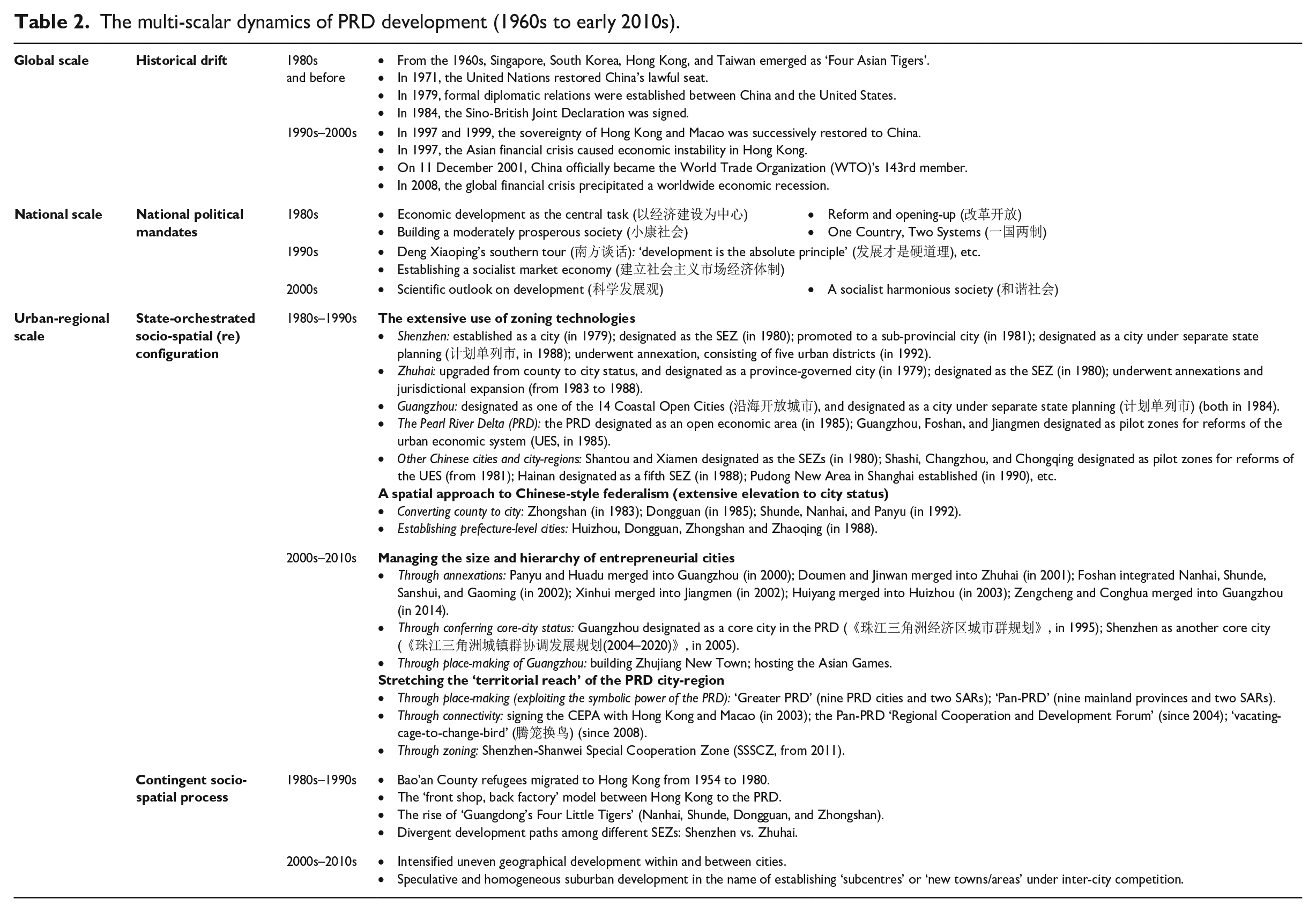
In summary, the evolution of PRD cities in the post-reform era is not merely a process of decentralisation, but reflects deliberate orchestration by the state (see Table 2). The state employs diverse planning techniques, demonstrating an ambidextrous approach to city-region governance: it empowers entrepreneurial cities to drive market-oriented developments while managing their size, internal structures, and external connections to harness ‘entrepreneurial’ urban practices. Amidst this transformation, Hong Kong’s role has been recast as ‘a partner city’ within the regional economy, despite its political status as a provincial-level SAR.
The multi-scalar dynamics of PRD development (1960s to early 2010s).
Towards spatial fixes at the national scale: Reinventing zoning technologies from exceptionality to relationality in the Greater Bay Area project
The GBA project, officially announced by the central state in 2019, explicitly signifies its dominant role in orchestrating cross-border development within the Greater PRD city-region. The outline development plan for the GBA highlights the central state’s diverse entrepreneurial aspirations, incorporating all nine PRD cities and two SARs into this development agenda aimed at fostering an entrepreneurial city-region. This intervention in city-region governance has been an incremental process rather than an abrupt shift. The development of the PRD, tracing back to 2009, was elevated to a national strategy following the publication of the ‘Outline Development Plan for the PRD Reforms (2008–2020)’ by the National Development and Reform Commission (NDRC). This document outlined the challenges faced by the PRD, notably the impacts of the GFC on the regional economy. The GFC laid bare the sustainable challenges inherent in China’s ‘world-factory’ model, including excessive dependence on overseas markets, severe environmental pollution, limited innovation capabilities, and a widening urban-rural gap. As foreign investment and export demand dwindled, the PRD economy, emblematic of China’s export-oriented industrialisation, found itself trapped in overcapacity crises. In response, the central state promulgated this development plan to upgrade the region’s industrial structure. Thus, the inception of central state intervention in PRD development was primarily driven by economic imperatives.
Despite its structural flaws, the ‘world-factory’ model has facilitated China’s unprecedented economic growth and elevated its international standing. Since 2010, China has surpassed Japan to become the world’s second-largest economy – a milestone exemplifying China’s rise as an economic powerhouse. Within this context, China has taken a more proactive stance in global affairs and regional cooperation. In addition to its accession to the WTO, China also actively engages in various international organisations, networks, and events, such as the Olympic Games, APEC, and G20, and plays a pivotal role in the Shanghai Cooperation Organisation, BRICS, and Asian Infrastructure Investment Bank. The most prominent outward-looking endeavour is the Belt and Road Initiative (BRI), which represents the entrepreneurial gesture of the central state in response to new domestic and international circumstances – addressing overcapacity crises and extending transnational influence through transcontinental infrastructure development projects (Sun et al., 2024). However, in the late 2010s, the Chinese state encountered additional geopolitical challenges, including trade disputes with the United States since 2018 and socio-political unrest in the Hong Kong SAR in 2019.
Amidst the emerging conjunctures, President Xi Jinping assumed the role of paramount leader at the CCP’s 18th National Congress in 2012. Under Xi’s leadership, the national state increasingly asserts its presence in political-economic dynamics across various scales, articulating a wider array of national political mandates. In particular, the long-established mandates of ‘One Country, Two Systems’ (1C2S) and ‘reform and opening-up’ have been substantially reformulated. Against this backdrop, the novel conception of the GBA has emerged to address both new geopolitical issues and deep-seated economic imperatives.
At the CCP’s 20th National Congress, President Xi reiterated the party-state’s commitment to the 1C2S mandate, and reaffirmed the guidelines for the development of the Hong Kong and Macao SARs. These guidelines include: (1) safeguarding national sovereignty, security, and development interests as the highest principle; (2) ensuring both the central government’s overall jurisdiction and a high degree of autonomy in the SARs; and (3) supporting Hong Kong and Macao in better integrating themselves into China’s overall development. These guidelines signify a nuanced shift in the focus of the mandate from ‘two systems’ to ‘one country’. When the notion of 1C2S was proposed, the emphasis was initially placed on the division and communication between the ‘two systems’, coordinated by the Chinese state. In the 1980s, Shenzhen, Zhuhai, and the entire PRD region were designated as ‘zones of exception’, where the ‘front shop, back factory’ model gained traction. Hong Kong served as a conduit for the PRD region to access the global economy. Since the early 2000s, amidst China’s emergence as the world’s factory, cross-border connections have evolved into inter-city economic cooperation and trade reciprocity, facilitated by the state-ratified CEPA. In contrast, the recently formulated guidelines on 1C2S reveal the central state’s ongoing efforts to reintegrate the bifurcated development of ‘two systems’ into the ‘one country’ framework, thus asserting national sovereignty and state territoriality.
The shifting focus of state politics is reflected in evolving state spatial selectivity. Within the recombinant GBA project, zoning technologies remain a prominent planning strategy, yet their underlying rationale has been revamped. Previously, the state established ‘special zones’ to institutionalise exceptionality, with the intention of fostering market-oriented and outward-looking economic development within delimited areas. In contrast, there is now a concerted effort by the multi-scalar state to develop ‘demonstration zones’ that emphasise relationality, seeking to redefine the dynamics between the ‘two systems’ within the overarching ‘one country’ framework. According to the planning documents within the unfolding GBA project, three distinct approaches to the relational zoning strategy can be identified.
‘Hengqin-Macao integration’: Semi-annexation zoning initiatives
In 2021, the party-state proposed designating Hengqin as the ‘Guangdong-Macao In-depth Cooperation Zone’ (HCZ). Prior to this designation, Hengqin had undergone successive zoning initiatives over three decades. Initially established as an ‘economic development zone’ under Zhuhai’s administration in 1992, it later served as a ‘bridgehead’ for Zhuhai-Macao cooperation in the early 2000s following the construction of the Lotus Bridge and Hengqin Bridge. In 2009, it was elevated to a National New Area and subsequently became part of Guangdong’s Pilot Free Trade Zone in 2015. The zoning trajectory of Hengqin reveals a consistent consolidation of state power, particularly evident in the recently restructured HCZ project. In 2023, the NDRC unveiled an overall development plan for the HCZ, articulating the state’s vision of achieving ‘Hengqin-Macao integration’ (National Development and Reform Commission [NDRC], 2023a).
Aligned with this geopolitical agenda, the planning document sets forth a series of semi-annexation arrangements. First, the integration is built upon a model of ‘first-line loosening with second-line tightening’ (Anguelov et al., 2024), aimed at reducing territorial-institutional barriers between Hengqin and Macao, thereby facilitating the smoother flow of population, capital, and information across the HCZ. The ‘tightening of the second-line’ suggests that the HCZ is exempt from national-level tariff regulations, making it more geared towards Macao’s trade arrangements. In the long run, the state aims to develop the HCZ into a ‘new home’ for Macao residents, accommodating an estimated 40,000 working population from Macao by 2029 (NDRC, 2023a). Second, governance of the HCZ is led by a ‘management board’, where the governor of Guangdong Province and Macao’s chief executive share equal and coordinated leadership. Under the management board, an executive committee and nine subordinated bureaus are responsible for implementing government affairs. Through these organisational structures, the state aims to establish a ‘new governing regime’ characterised by ‘extensive consultation, joint contribution, coordinated governance, and shared prospects’ (NDRC, 2023a). Third, the HCZ project has seen an upscaling of cross-border cooperation from the inter-city to the provincial level, with the HCZ’s territory falling under the jurisdiction of the provincial-level state. In this context, the Guangdong provincial government has established an ‘Office Agency’ for territorial management, overseeing party building, national security, judicial affairs, and public order within the HCZ.
Shenzhen-Hong Kong connectivity: interactive zoning dynamics
In contrast to the Hengqin-Macao integration, which has been upscaled to provincial-level collaboration, Shenzhen-Hong Kong cooperation remains primarily inter-city. However, significant shifts have occurred in their interactive dynamics. Historically, Shenzhen was catapulted into a SEZ in the 1980s, serving as a ‘back factory’ for Hong Kong’s manufacturing industries due to its low land and labour costs and preferential policies. During this period, Shenzhen-Hong Kong cooperation was characterised by complementary synergy, with Hong Kong in the lead. Four decades later, Shenzhen was designated as a ‘Pilot Demonstration Zone of Socialism with Chinese Characteristics’ in 2019, aimed at elevating its status to a global city with heightened international competitiveness and influence. Given Hong Kong’s established position as a global city, Shenzhen’s recent designation serves as a benchmarking effort. The Chinese state aims to fortify Shenzhen’s political and economic standing, thereby fostering a more balanced relationship in Shenzhen-Hong Kong cooperation.
In this context, Qianhai, established in 2010 as the ‘Shenzhen-Hong Kong Modern Service Industry Cooperation Zone’ (QCZ), has gained political heft following the release of the party-state’s new proposal in 2021 and the NDRC’s overall development plan in 2023. Recognised as a ‘special zone within the SEZ’, the current QCZ echoes some planning initiatives akin to the embryonic Shenzhen SEZ of the 1980s. For instance, the QCZ underwent annexation in 2021, expanding its jurisdiction substantially from 14.92 km2 to 120.56 km2. Additionally, in 2024, power devolution took effect, with 81 provincial-level administrative functions delegated to the QCZ’s authority. 2 However, unlike the SEZs, which were established with undefined paths, the central state has outlined explicit goals, missions, and strategies for the QCZ’s development, underscoring its role in advancing modern service industries (e.g., financial, legal, sci-tech, and logistics services) through collaboration with Hong Kong. Furthermore, preliminary ideas have been devised within the QCZ project to strengthen cross-border socio-economic ties, including supporting start-ups and employment opportunities for young people from Hong Kong, and engaging stakeholders from Hong Kong in the governance of the QCZ (NDRC, 2023b).
Another zoning project – the ‘Shenzhen-Hong Kong Science and Technology Innovation Cooperation Zone’ (STICZ) around the Lok Ma Chau Loop – has also gained momentum. Initially an inter-city partnership for developing the Loop with science and technology industries, it has been elevated to a national strategy following the State Council’s 2023 development plan. This plan outlines strategies for enhancing infrastructural connectivity across the border at the intra-zone scale, including relaxed regulation on cross-border flows of researchers, goods, capital, and information, supported by the ‘first-line/second-line divide’, as well as institutional convergence in terms of intellectual property and tax incidence (State Council, 2023). This makes the STICZ a porous and hybrid structure, moderately resembling Hengqin.
Simultaneously, in 2021, the Hong Kong SAR unveiled a strategic plan for developing a ‘northern metropolis’ (NM) over the next two decades. The document of this plan begins with the introduction of national political mandates and historical connections between Hong Kong and Shenzhen. Following these narratives, the development of the NM underscores inter-city connectivity with Shenzhen, encapsulating its strategies within the spatial framework of ‘Twin Cities, Three Circles’. Specifically, the development of the ‘Shenzhen Bay Quality Development Circle’ (SBQD Circle), the ‘Hong Kong-Shenzhen Close Interaction Circle’ (HSCI Circle), and the ‘Mirs Bay/Yan Chau Tong Eco-recreation/tourism Circle’, from west to east, will facilitate a higher intensity of cross-boundary interactions (Hong Kong Special Administrative Region [HKSAR], 2021). Under this spatial framework, the NM development strategy unpacks two action plans in response to Shenzhen’s QCZ and STICZ projects. Firstly, the SAR government plans to develop the SBQD Circle by expanding the Hung Shui Kiu/Ha Tsuen New Development Area, upgrading it to the ‘New Territories North Central Business District’, and connecting it to the QCZ within Shenzhen’s territory via the construction of the Hong Kong-Shenzhen Western Rail Link. Secondly, the HSCI Circle encompasses the Lok Ma Chau Loop, prompting the SAR government to intensify land development around the Loop and establish the ‘San Tin Technopole’ as Hong Kong’s Silicon Valley, in coordination with the STICZ project on Shenzhen’s side.
In summary, the cross-border planning dynamics of the QCZ, STICZ, and NM projects reveal an interactive and synchronised zoning process between Shenzhen and Hong Kong. Both sides articulate the common goal of enhancing inter-city interaction and connectivity, with planning strategies among the three zoning projects resonating through reciprocal reference.
Building the Greater Bay Area: Zoning as place-making strategies
The PRD city-region stands as a testament not only to the evolution of the 1C2S mandate but also to China’s triumph in its reform and opening-up policy. Over the past four decades, the social landscape for promoting reforms has undergone significant changes. At the CCP’s 19th National Congress in 2017, President Xi declared the commencement of a ‘new era’ for the Chinese socialist cause, identifying the primary contradiction in Chinese society as the disparity between ‘uneven and inadequate development’ and ‘the growing demand for an enhanced quality of life among the people’. Against this backdrop, the central state has called for a deepening of ‘reform and opening-up’ to address the challenges of uneven and inadequate development, introducing a series of new development agendas under the banner of constructing ‘China’s new development paradigm’ at the CCP’s 20th National Congress. This new paradigm is underpinned by the ‘dual-circulation’ strategy, which emphasises the synergy between domestic and international circulations, with the city-region designated as a pivotal scale for its implementation (Yu, 2023). In this context, the GBA, a restructured city-region evolving from its precursor – the ‘Greater’ PRD, now serves as one of the frontiers for implementing the ‘dual-circulation’ strategy and materialising the new development paradigm.
The transformation from the PRD to the GBA is both path-dependent and path-shaping. The GBA, on one hand, establishes itself as a distinct regional identity grounded in the historical development of cross-border interactions within the ‘Greater’ PRD during the post-reform era. However, unlike a simple case of ‘old wine in a new bottle’, the GBA represents a deliberate effort by the Chinese state to implement place-making strategies that pave the way for a ‘new development paradigm’ and facilitate central state reterritorialisation. These place-making strategies operate across three dimensions:
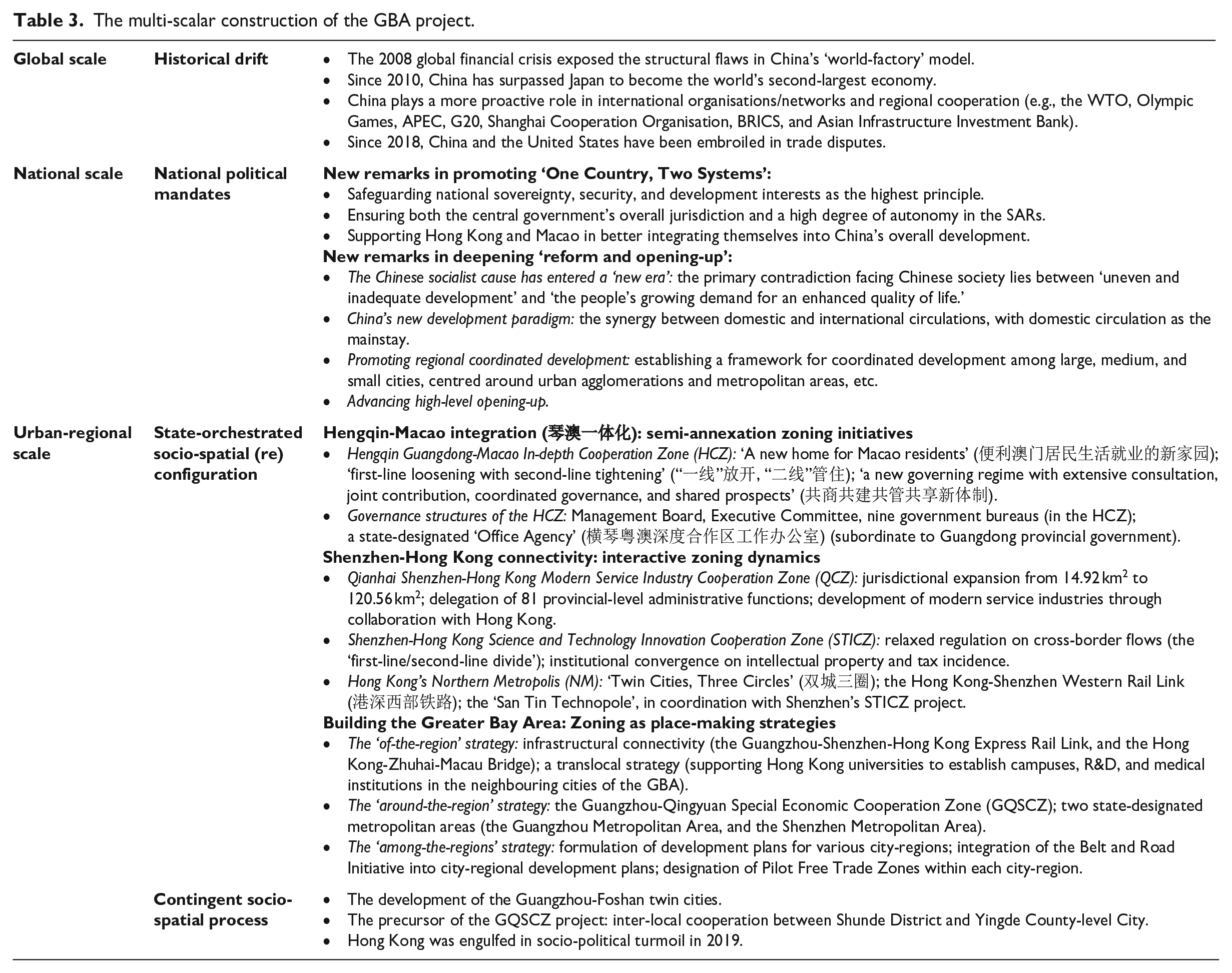
Overall, the GBA project reflects a shift in the repertoire of state rescaling in China’s city-region governance. As elaborated in the previous section titled ‘The ambidextrous state in harnessing the entrepreneurial cities’ (also see Table 2), during the first decade of the 21st century, central and provincial authorities governed city-regions through managerial approaches. This involved empowering entrepreneurial cities to maintain economic competitiveness while managing their size, internal hierarchy, and external connections for crisis management (Wu, 2016). In contrast, this section illustrates that current city-regional development relies on an intensified form of state entrepreneurialism, with a greater emphasis on planning centrality at the national scale (see Table 3).
The multi-scalar construction of the GBA project.
Concluding reflections: Variegated geographies of China’s city-regionalism
This paper, in its first half, conducts a mid-level theorisation of China’s city-regionalism based on a multi-scalar interpretation of state entrepreneurialism. The aim is to elucidate the dynamic interplay between state spatial selectivity and contingent socio-spatial processes in China’s city-regional development. In the second half, this paper further examines this dynamic interplay through a historical-geographical lens, focusing on the transformation from the PRD to the GBA. Ultimately, the GBA emerges as a politically charged and historically embedded project, inheriting reform legacies from prior regional experiments while undertaking new geopolitical agendas based on reformulated national political mandates. Drawing from the development trajectories of the PRD-to-GBA transformation, we conclude with reflections on the variegated geographies of China’s city-regionalism.
Firstly, the Chinese state intervenes in city-region governance through various planning techniques, showcasing diverse forms of state spatial selectivity. Taking Shenzhen as a prime example, in the 1980s, zoning technologies catapulted Shenzhen from its previous status as a peripheral county to that of a SEZ, pioneering market-oriented developments. Subsequently, as a prefecture-level city, Shenzhen underwent successive annexations from the 1990s to the 2010s, consolidating its municipal power. By 2018, it comprised a total of nine districts. With territorial consolidation and rapid economic growth, Shenzhen has evolved into one of China’s first-tier cities. In 2005, the provincial government designated it as another core city in the PRD city-region, alongside Guangzhou. In recent years, the state has leveraged Shenzhen’s core city status to enhance its connectivity with other peripheral cities, aiming to stimulate the regional economy through agglomeration and spill-over effects. Examples include the establishment of the SSSCZ, the delineation of the Shenzhen Metropolitan Area, and the construction of inter-city infrastructure projects such as the Shenzhen-Zhongshan Corridor and the Shenzhen-Maoming Railway. In 2019, Shenzhen was officially designated as a ‘demonstration zone’. Shenzhen’s transformative shift from an ‘exception’ to an ‘exemplar’ signifies the (re)territorialisation of the central state in city-region governance. Throughout these decades, the intersection of various planning techniques – ranging from zoning, annexation, connectivity, to place-making – has polymorphically recast Shenzhen as an experimental ground (an SEZ), a municipal entity (a prefecture-level city), a geoeconomic engine (through metropolitanisation), a geopolitical gateway (for the cross-border megaregion), and an ideological symbol (at the national level). In this light, Shenzhen has served as a vantage point for reshaping the geographies of city-regionalism in the PRD and beyond.
Secondly, state spatial selectivity operates not on a blank slate but within inherited territorial-institutional contexts. Each city-region is grounded in unique socio-spatial landscapes shaped by historical-cultural legacies, socio-economic matrices, and territorial-institutional configurations. For instance, both Shenzhen and Shanghai were designated for open-door policies, yet within different contexts. Shenzhen’s SEZ status arose from its proximity to Hong Kong and its origin as an underdeveloped agricultural county, facilitating relatively seamless reforms. In contrast, Shanghai, already a major industrial hub pre-reform, faced economic stagnation in the 1980s compared to emerging southern SEZs. The establishment of the Pudong New Area aimed to rejuvenate Shanghai’s economy and symbolise China’s commitment to opening-up in the early 1990s (Wu, 2003). Despite shared objectives and similar strategies of building special zones, their divergent contexts have led to distinct development trajectories. By the same token, the central state has recently issued development plans for both the GBA and the YRD, with a consistent intention of pursuing ‘regional coordinated development’. However, due to different territorial-institutional structures and divergent historical trajectories, contextually specific strategies are required for the socio-spatial reconfiguration of each respective city-region (for a more detailed examination of the case of the YRD, see Li et al., 2023).
Lastly, the notion of ‘variegated’ (but not ‘varied’) geographies of China’s city-regionalism extends beyond merely illustrating varied governance patterns across different Chinese city-regions. The heterogeneous patterns of city-regional development are fundamentally rooted in an entrenched state territoriality, wherein national political mandates formulated by the central state delineate geopolitical agendas, project urban-regional imaginaries, mobilise local initiatives, and ultimately maintain structural coherence across multiple scales. From a diachronic perspective, China’s city-regionalism represents a ‘layering’ process, as the state consistently seeks to (re)embed itself in, and reinforce its dominance over, the contingent and evolving socio-spatial processes at the urban-regional scale by upholding planning centrality. Recent years have witnessed a nuanced shift in the central state’s role in city-region governance. Whereas in the 2000s, city-regional planning from the central state primarily took managerial forms to harness entrepreneurial cities, in the present stage, the central state adopts a more entrepreneurial approach in city-region governance, with national-level planning on city-regional development taking precedence. In this context, the inherited territorial-institutional structures and socio-spatial landscapes at the urban-regional scale are reframed into an integrated state project, serving manifold geopolitical agendas of the national state.
Footnotes
Declaration of conflicting interests
The author(s) declared no potential conflicts of interest with respect to the research, authorship, and/or publication of this article.
Funding
The author(s) disclosed receipt of the following financial support for the research, authorship, and/or publication of this article: This research is supported by the Strategic Public Policy Research Funding Scheme, Chief Executive’s Policy Unit, Hong Kong SAR Government, China [Grant No.: S2021.A8.027.21S].
