



Abstract
China’s urbanization has led to massive demolition and resettlement projects on the edge of the expanding cities, moving affected villagers into resettlement housing. This study examines the consequent changes in family property structures, focusing on how resettlement housing was redistributed between sons and daughters. This study draws on fieldwork in the suburban area of an expanding city in Shandong, Eastern China, and analyzes in-depth interviews about how resettlement housing was divided in families that had (1) both sons and daughters, (2) sons only, and (3) daughters only. The findings suggest that the sons’ privilege in receiving housing properties was more salient in families with more children (three children or above) and with both sons and daughters. In small families (with one or two children) or daughter-only families, it was more likely for siblings’ needs and daughters’ contributions to be mentioned in the division of properties; when daughters adjusted their family roles, such as assuming the role of the ‘heir,’ their negotiation for inheritance rights changed. Built on studies about how local governments and rural communities have ignored or reproduced gender inequality in property structures in urbanization, this study illustrates how gendered access to housing varies across family structures.
Introduction
China’s cities have experienced rapid development under market reforms since the 1980s and their built areas have expanded rapidly in recent decades (Wang et al., 2023). To make way for urban land use, local governments need to expropriate farmland, demolish rural buildings, and relocate affected villagers (Zhang et al., 2017). The conversion of rural land into urban use has led to the development of “resettlement housing”—urban homes that are developed specifically for housing displaced villagers, usually in designated neighborhoods—in exchange for their demolished rural homes (Zhang et al., 2022). Nevertheless, the related changes in family property structures have been an understudied topic in China’s urbanization research, especially from a gender perspective (Sargeson, 2012).
This study builds on the longstanding recognition of patriarchal property structures in rural families (Lin and Zhang, 2006) and explores how villagers’ families might decide on the ownership of resettlement housing in a new era of urbanization. The patriarchal traditions can be traced back to premodern China; though once dismissed in the Maoist era, these traditions have persisted and revived in post-Mao China (Song and Jackson, 2024). Such traditional norms have been influential in shaping village customs regarding collective and joint ownership of rural properties (Song, 2017). In distributing compensation and resettlement assets, local governments and rural communities have largely followed gendered social expectations embedded in the male-dominated rural property system, reinforcing wealth inequality between genders (Po, 2020; Sargeson, 2012). In the compensation and resettlement processes, rural families have been regarded as similarly patrilineal, and it is yet to be studied whether different families may vary in the management of compensated properties. Given the decreasing family size and the rising emphasis on family harmony, urban parents may increase their investment in daughters and their recognition of daughters’ contributions (Song and Ji, 2020), but it is not clear if rural families experiencing urbanization are evolving in a similar direction.
This study draws on in-depth interviews in a village that has been demolished and relocated into their resettlement neighborhoods in the urbanizing Shandong, Eastern China, an area characterized by longstanding influences of Confucian and patriarchal traditions (Fan, 2016). The study categorizes the interviewed families based on their family structures and analyzes their variations in property structures. The findings illustrate how rural families divided resettlement properties between sons and daughters and the related perceptions and reactions of family members.
The article is organized in the following way. The next section reviews research about rural property structures and changes under urbanization, and highlights the importance of incorporating family dynamics, including the interaction of individual and family interests in contemporary China. This section is followed by the description of data and method, and the data analysis section for: (1) big mixed families; (2) small mixed families; (3) son-only families; (4) daughter-only families. The final section concludes about how gender inequalities were reproduced or adjusted in different kinds of families; parents had different motivations and strategies of property management given their family structures, and sons and daughters reacted to the gendered access to resettlement homes in different ways, by normalizing their rights, emphasizing their needs and contributions, or adjusting their family roles.
Literature review
Rural property structures and changes under urbanization
Market reforms have made the family a basic unit of economic organization in rural China (Hare et al., 2007). Since the establishment of the Household Responsibility System in China in 1978, rural communities have allocated and contracted collective agricultural land to households. As rural households are often represented by male heads, a woman’s access to land is dependent on her family role as a daughter, wife, or mother (Zhang, 2012). Although villages may periodically reallocate farm and residential land when new brides marry into the communities, such adjustments may be denied by collective decisions of villagers (Zhang, 2012). Meanwhile, given that land contracts have been extended by legal amendments, such grassroots adjustments have become minimal (Rural Land Contracting Law (RLCL), 2002). The stabilization of land tenures—although serving to enhance productivity—makes it difficult for women to claim their rights as temporary family members in natal families and newly arrived spouses under patrilocal customs (Judd, 2007; Tian and Chen, 2013).
Women’s vulnerable positions in rural property systems are in contrast with the state’s emphasis on gender equality and women’s equal rights to inheritance and marital property (Marriage Law, 1980; Property Law, 2007). To protect women’s rights, legal amendments have allowed women to hold land in their natal village if they do not receive land in the marital village (RLCL, 2002) and requested women’s names to be included in land contracts and property documents (RLCL, 2018). However, these legal remedies have encountered difficulties in being fully realized in grassroots implementation (Li, 2020; Li and Xi, 2006). The resistance arises from not only patriarchal traditions but also interest groups and lineage organizations (Po, 2020).
Inequality in villagers’ access to resources can be reinforced when rural properties are expropriated and compensated with money and urban assets (Song et al., 2020). For expropriated land (and crops), rural communities would receive monetary compensation as the collective owner and redistribute it to rural families; demolished housing and constructions are often calculated and compensated at the family level, with the coordination of collective authorities who manage the standards and options of compensation (e.g., money, housing, etc., see Du et al., 2021). As local governments have increasingly relied on land development to generate economic revenues, their neoliberal developmental agenda frequently leads to gender-blind compensation packages that allow rural collectives to redistribute them following local customs (Sargeson, 2012). Village collectives and rural families have been eager to expand and formalize their informal entitlements (Song, 2014) but are rarely motivated to establish women’s share in the collective or joint ownership. As local governments have treated rural communities and families as the two basic units of compensation, women’s rights have been buried in collective or family interests and have been represented by male elites or male family members. As the village “self-government” is assumed to represent the interests of all villagers (Organic Law of the Villagers’ Committees, 1998), there has been a lack of public inspection of how local governments and rural collectives define who are qualified for receiving compensation and properties redistributed.
Urbanization has given rise to various patterns of compensation and resettlement and allowed discretion in response to grassroots demands (Song, 2015). At the collective level, some communities have argued for more favorable treatments: some retained part of their land for self-development, and others transformed village assets into shareholding entities (Kan, 2016). At the family level, some well-resourced families obtained better opportunities of investment given their better self-financing capabilities and converted their compensation into more valuable properties (Song et al., 2020). However, such grassroots efforts have been rarely mobilized for enhancing women’s interests. Instead, village leaders often use the opportunity of urbanization to normalize the hidden forms of gender inequality and formalize village customs that prioritize local men and marginalize female villagers (Po, 2020). Quite often, daughters, especially married daughters, are excluded from being considered permanent villagers in the distribution of compensation and properties (Li, 2020; Sargeson and Song, 2010; Zhang, 2012).
Some studies have paid attention to property disputes in urbanization, which are more concerned about grassroots dissatisfaction with governments and developers and less about family conflicts (Chuang, 2014; Guo, 2001). Not only have the latter received less public attention compared with community petitions against local governments or developers, but the tensions between family members are also often not taken seriously as domestic issues. Under the control of male elites and lineage groups, village customs have made it difficult for governments to hold village cadres accountable for women’s infringed rights (Li, 2020). Governments and courts may be reluctant to accept and process cases of family disputes, and for those who ask for help from Women’s Federations or People’s Congresses, there is also a lack of powerful legal support (He, 2007). Previous studies have focused more on the inconsistent government policies and persisting village customs that have interacted with each other in reinforcing gender inequalities in accessing rural properties—not only do women receive less compensation, but they are also marginalized in decision-making processes in their communities.
This study moves attention from the collective to the family level and investigates the intrafamily dynamics of property management. This study suggests the importance of bringing back the family perspective to examine the shifting rural property structures, by contextualizing the issues of property rights in debates in family studies about the declining family sizes, the shifting roles of sons and daughters, and the rising importance of family solidarity in dealing with market risks (Song and Ji, 2020). The different factors may interact with each other in diverse ways across families.
Patriarchal families, daughters’ roles, and neo-familism
The patrilineal property systems in China can be traced back to patriarchal traditions and Confucian heritage in the imperial times (Fei et al., 1992). Once suppressed in the Maoist era, patriarchal practices have persisted and have been incorporated into the grassroots practices in China’s family-based farming system under market reforms, in which male laborers are valued and daughters are expected to leave upon marriage (Sargeson and Song, 2010). Under such traditions, parents invest more in sons’ education, employment, and family formation, in exchange for sons’ support in their elder years (Cong and Silverstein, 2012; Song, 2008; Whyte, 2003). In contrast to sons’ privilege in inheritance, daughters are expected to access family resources through male kinship or via marriage (Jackson, 2003; Sargeson, 2008). In cases of marital breakdown, women risk losing family attachment and failing to prove their contributions to either natal or marital families (Bélanger and Li, 2009). Given the difficulty to define and claim their individual entitlements, women could also face moral pressures of maintaining family harmony while seeking justice (Davis and Lu, 2003).
China’s marketization, however, has witnessed some withering away of patriarchal norms in rural China, given the growing earning power among young women (Yan, 2016; Zhang, 2007). In urban China, where the one-child policy was more strictly enforced than in rural China, young women may have received considerable investment from parents in education, career development and childcare given their close connections with their parents (Deutsch, 2006; Lee, 2012; Xiao, 2016). Meanwhile, Chinese parents often find daughters more reliable than sons in providing financial support and emotional care (Gruijters, 2018; Xie and Zhu, 2009). The shifting perceptions of daughters may also be witnessed in rural families who have migrated to big cities; their parent-child relations may shift away from the traditional focus on sons (Ling, 2017). Daughters’ economic contribution and care support to their natal families, to some extent, have challenged the male-centered inheritance system in urban contexts (Ho, 2022). In rural China, most families continue to comply with patriarchal customs of inheritance and property management, and it is to be studied whether such customs can be negotiated and adjusted at the family level during the process of urbanization.
As family members have adapted their understanding of rights and responsibilities over time, young women may become aware of their individual interests and strive for more gender-equal treatments (Abrahamson, 2016; Wu, 2019). Some young women relied more on their status as cherished daughters in natal families and provided emotional support for their parents, allowing them to benefit from the distribution of family properties (Gan, 2022). For married women, some used divorce documents to separate their hukou (registered residence) status from their husbands’ and to benefit from future land acquisition without fear of obstruction from their ex-husbands (Li, 2020), but these women also faced social penalties for deviating from women’s expected altruistic and selfless virtues (Sargeson, 2012). Depending on family dynamics, women face different opportunities to claim their individual rights, and this study examines how the situations may vary across families.
Some studies, however, have questioned the dichotomy of familism vs. individual interests and found new ways to understand their interactions under neo-familism (Yan, 2018). Unlike traditional familism, under which family members would compromise individual interests for family interests, neo-familism refers to the new trends in which the whole family mobilizes resources to enhance the well-being of young generations (Kang, 2012; Yan, 2016, 2018). Instead of claiming independence from families, people can pursue their well-being based on family support and family belonging (Barbalet, 2014; Sargeson, 2008). Intergenerational connections are rediscovered not to reinforce children’s subordination but to help them to deal with market risks and seek a sense of security (Qi, 2016). In this process, the cultivation of family relations is accompanied by the increasing importance of economic and emotional needs, rather than the fixed ideological gender scripts (Jankowiak, 2008). Such family dynamics may have different gendered implications in family property structures.
In summary, this study examines how patriarchal families may have evolved and diversified under the shifting understanding of rights and obligations of family members. Given the shrinking family size and the varying family structures, patriarchal traditions may have been adjusted in smaller and daughter-only families, although not all women can benefit from such changes in family dynamics. Unlike urban families, where daughters’ values and contributions are increasingly recognized (Fong, 2002), rural families may lag in both demographic and ideational changes. Furthermore, families may vary in their strategies in handling property structures, given their different structures and needs (Shen, 2020). This study will take into consideration both changes in family life and various family structures and investigate how sons and daughters in rural families may fare differently in their access to resettlement housing, and how such situations are perceived and received.
Data and method
Previous studies on land development have been conducted in developed areas or southern provinces such as Zhejiang, Jiangsu, Shanghai, and Guangdong (He et al., 2011; Sargeson, 2008; Wu and Phelps, 2008; Zhu and Tang, 2013), or inland areas of Sichuan, Ningxia, and Inner Mongolia (Song, 2015; Yin et al., 2018; Zhang and Wu, 2017). This study focuses on a more intermediate region—Shandong—with moderate paces of land development and longstanding Confucian traditions. This field site is in the suburban area of a second-tier city, Y City, which has been expanding its boundary since the 2000s. The field site of L Village is one of the villages that were recently absorbed into the expanding city; the affected villagers had moved into resettlement neighborhoods near their original community by 2017. During this process, villagers became exposed to the expanding urban markets. Some villagers started to run small businesses, became market vendors, or lived on rental incomes, but non-farm employment opportunities were limited. Middle-aged or older villagers usually could only find low-end or part-time factory or service work. Career prospects were better for the younger and better educated generation, but stratification also rose between white-collar, skilled workers and those who became unemployed urbanites.
In L Village, rural land was expropriated to make way for urban sprawl and rural houses were demolished in exchange for resettlement housing and monetary compensation. For rural homes that were categorized as residential housing, villagers were eligible to be compensated with resettlement housing of equivalent floor space. Some housing, however, was defined as non-residential housing (e.g., for rental or storage uses) and only qualified for monetary compensation. In addition to housing construction self-financed by villagers, there were some community-planned residential houses that were built based on both collective and individual investments. To claim full property rights, villagers needed to pay around 600 RMB per square meter for these houses and then they could be counted as villagers’ own properties to be compensated after being demolished.
Most rural families received multiple resettlement housing units (one housing unit refers to an independent apartment in the resettlement neighborhood, characterized by standardized size, structure, and design like urban commercial housing assets), because rural homes were usually significantly more spacious than urban apartments; a 2- or 3-storied rural house may have a floor space ranging from 200 to 400 square meters, while a resettlement housing unit typically has a floor space of around 80–100 square meters. Multiple apartments are an unusual fortune for ordinary urban families, therefore relocated villagers are sometimes the target of envy for becoming rich overnight (Du et al., 2021).
Villagers could also opt for monetary compensation instead of resettlement housing in exchange for their demolished residential housing, but many believed that it was “wiser” to choose housing over money. When their old homes could be converted into 2.5 or 3.5 urban apartments, villagers could pay for the gap of 0.5 apartment to get the whole units—the first 10 m2 at a discounted price of 2,300 RMB/m2 and the remaining floor space at a level of 90% of the market price of 5,300 RMB/m2, which was still lower than the market price. Villagers could also opt for monetary compensation by giving up the extra 0.5 apartment, but the compensation price would be around 1,000 RMB/m2 only, because their self-built housing was assumed to be of lower quality than commercial housing. The price gap contributed to a common preference among villagers to convert their demolished houses into apartments instead of money, as long as the construction was qualified as residential homes.
For nonresidential housing, villagers could not be compensated by resettlement housing but in monetary terms only, at an even lower price—ranging from 300 to 850 RMB/m2, depending on the construction materials. Together with the compensation for their other rural properties, including the expropriated farming land, orchard, garden, etc., each family could receive tens of thousands of RMB or more. Like resettlement housing, monetary compensation was also distributed to rural families (based on household registration), which was usually received by the household head (often the father). Regarding the intrahousehold division of housing and monetary compensation, it was common to observe a tendency to favor sons over daughters in both situations, but the sons’ privilege was more salient regarding housing properties. Compared with housing that was typically reserved for sons, monetary compensation was considered a kind of more inclusive family wealth that everyone should benefit from. For example, a father used part of the monetary compensation as a wedding gift to his daughter, serving as her dowry and bringing “face” to her family. In such cases, daughters received monetary compensation as an expression of the care and affection of their parents, but resettlement housing was far more precious—too important to be a gift for daughters. Moreover, interviewees tended to report more ambiguously about monetary compensation; it was difficult to track the family’s spending for different purposes and people might provide different accounts about how the money was used. Given the ambiguity in money-related memories, we chose to focus on housing properties that are usually clearly defined as someone’s belongings. Although the growth in family wealth was reflected in both housing and monetary terms, villagers put a greater emphasis on and cared more about housing titles.
This is especially true when urbanization jacks up housing prices, as apartments can be considered an investment or savings, whereas monetary compensation can be used up quickly and is not protected from inflation. In an urban environment, housing has become one of the limited resources villagers could mobilize when they plan for family formation, child rearing, and elderly care, and remained the most important factor in marriage markets for men seeking wives. Governments also use resettlement properties to provide some basic economic security for affected villagers, especially those in need. Meanwhile, governments set limits for maximum housing unit quotas and floor space for resettlement housing to avoid compensation policies being abused. For every residential plot (Zhaijidi, the basic unit of land for housing construction to be approved by rural communities when a family is to be formed or expanded), a maximum of two resettlement housing units could be compensated. This is because a rural family may have accumulated several residential plots via intergenerational transmission or internal transaction between villagers. Setting such a policy helps to curb intensive construction and limit the number of apartments to be compensated from each residential plot. However, favorable consideration could be given to families who are in desperate need of an additional home given their elderly care or family formation/expansion demand. In summary, the distribution of resettlement housing is based on original housing conditions and family structures. To be well compensated in resettlement housing, rural families must have had spacious and good-quality houses in the first place, or their family size is big (hence more needs for space).
Since the 1980s, L Village has implemented birth control measures, albeit loosely. Most families have two or three children. Given the importance of diverse family structures in shaping family relations and property structures, this study adopted a purposive sampling process and selectively recruited villagers who were introduced via snowball sampling, aiming to cover a variety of families: son-only families, daughter-only families, and mixed families. The in-depth interviews were carried out in 2022 with 23 families, when the Covid-related restriction policies were in place. Given the limited availability of potential interviewees under health-related restrictions, some interviews were conducted virtually. In each family, while the first author aimed at talking to different family members, it was usually the fathers or the household heads who were more ready and willing to talk about family situations; they also provided more detailed information about the distribution of the family’s housing properties. Mothers were less vocal when they were approached but expected their husbands to provide more details. Other family members, whenever possible, were also approached and asked about their perceptions and thoughts about how the properties were distributed, and some of them agreed to be interviewed (Table 1 shows who were interviewed in each family). In total, 37 interviewees were carried out in 23 families. Interviews were conducted once for each interviewee, and each interview lasted around 30–60 minutes.
How interviewed families distributed resettlement housing.
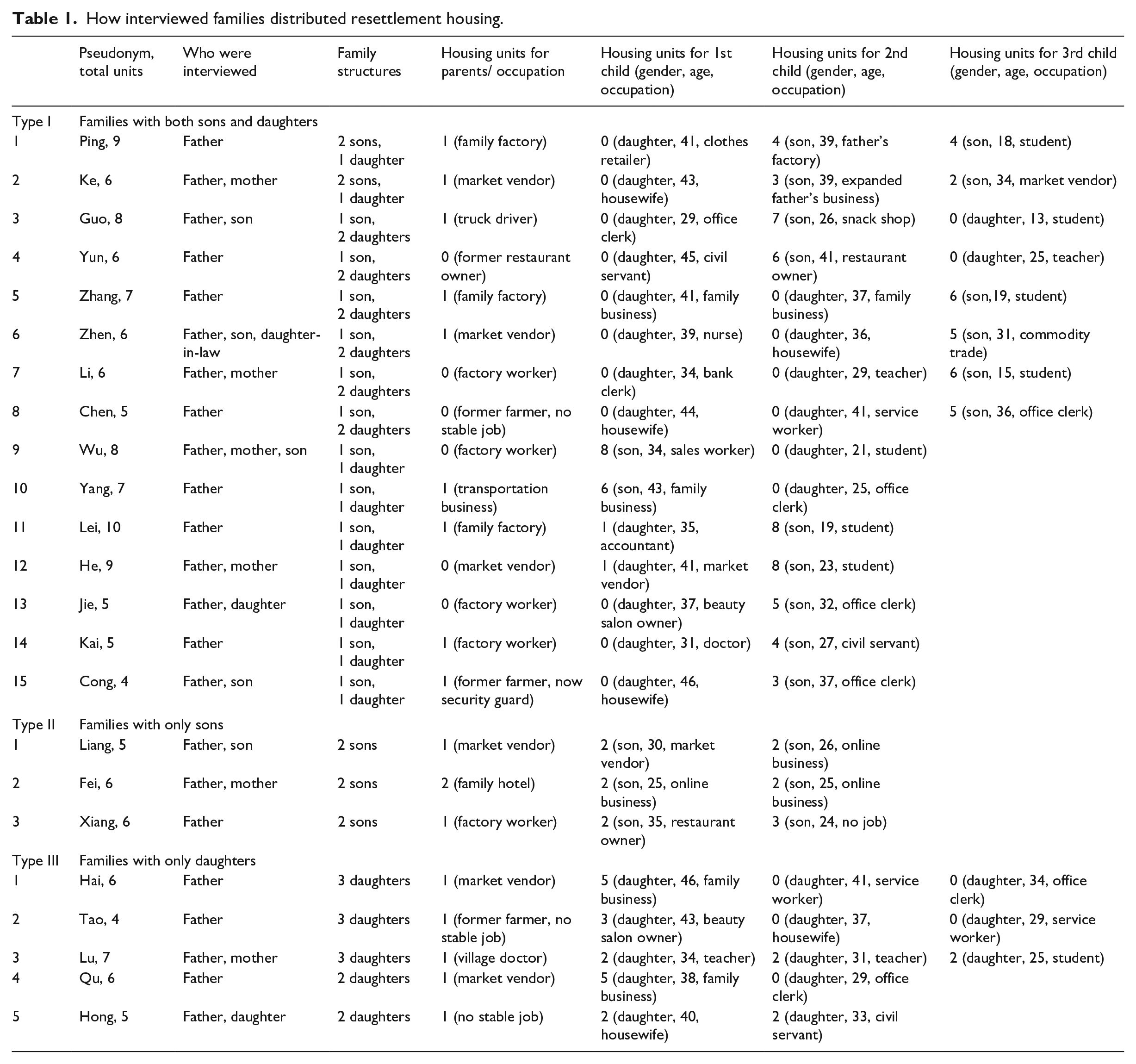
Table 1 summarizes the distribution of resettlement housing units at the family level. The sample is categorized into big families (three children or above) and small families (one or two children). In addition to family size, the gender composition of children is also found to be an important factor; son-only families, daughter-only families, and mixed families illustrate different strategies, motivations, and explanations underlying their division of housing properties. The following data analysis is carried out following this sequence: (1) big mixed families; (2) small mixed families; (3) son-only families; (4) daughter-only families.
Results
Big mixed families: “Filial daughters are considerate and will not make us worry”
In big families that had both sons and daughters, parents usually took it for granted that they needed to prioritize the needs of their sons. Ke, a 62-year-old man, had one elder daughter and two younger sons. The family received six resettlement housing units, each with a similar floor space of 80–100 square meters, the typical size of urban apartments. The couple kept one unit for themselves, three units for the elder son, and two for the younger son. The elder son gained one more housing unit than the younger son because of their different self-financing capabilities.
“My elder son paid for the extra floor space beyond the ‘deserved space’ for one of the housing units, so surely that extra housing unit belongs to him. My younger son understands it and regards it as fair that he has no rights to the housing unit that his elder brother invested a lot in. . . We had a limited amount of housing for sons. How can daughters ask to take a share?. . . My daughter is filial and considerate. She would not want properties that should belong to her brothers.”
Ke felt it necessary to explain why housing units were not equally divided between sons but did not feel a need to explain why there were no housing units reserved for the daughter. Stating his belief that filial and considerate daughters would not claim entitlements from their natal families, he cited a woman who married out from L Village and wanted a share of housing as “deviated” and a “bad” example. “Just because her parents did not give her (resettlement) housing, she petitioned to the higher authorities,” he scoffed. Ke blamed this woman as “hurting parents’ heart”, and argued that her request was illegal, because “she has no rights to intervene in how her parents deal with their housing. . .and she has no rights to claim her brother’s properties.” Ke emphasized the parents’ control over family properties but failed to explain why parents felt the pressure to pass most of the family’s properties to their adult sons and not adult daughters. While referring to daughters, especially married daughters, as “outsiders” of the family, Ke tended to lump together what belonged to parents and what belonged to sons, by framing sons as the assumed heirs.
Such cases seem to lend support to the persistence of patriarchal norms, but they have called attention to parents explaining their decision rather than relying solely on their authority. For example, parents mobilized moral frameworks, expected daughters to be filial, and praised them for being considerate to maintain family harmony. Parents tended to rely on cultivating and rediscovering women’s “virtues” to strengthen family solidarity, which might be threatened under the increasing awareness of individual interests.
Some families had more daughters than sons, but that did not make parents care more about the well-being of their daughters. Zhen, a 58-year-old man, explained how the family divided their six resettlement housing units between two elder daughters and one youngest son. “I will surely give the housing units to my son. Actually, we also thought about giving some to our daughters. But if we old couple lived in one unit and we gave each daughter one unit, that would leave my son with only three units, too few. He would be angry for losing so many housing units. . . If we had only one daughter, it would be okay to give her one unit, and my son still had four units. But we have two daughters, so we would rather give them nothing.”
Zhen mentioned he also cared about their daughters’ interests, but he insisted on prioritizing the feelings of their son, because “ultimately we will rely on our son for the elderly care”. “We have to be practical. If we are not nice to our son, he would not take care of us when we cannot walk anymore. . . Having a son means our family lineage is continued and our elderly care is guaranteed. . . Our two daughters are filial, and they invited us to live with them for a while. But I declined because they also need to take care of their parents-in-law.”
Zhen’s explanation suggests that the male-centered system of inheritance and elder care has remained powerful. People still believe that the exclusive right to inherit family property belongs to sons due to both ideological and practical reasons, and parents tend to avoid annoying their sons rather than making their daughters upset. Parents’ emotional connections with daughters are often overridden by the pressure under village customs that favor sons to maintain family lineage and the practical concerns of elderly support. Fearing family conflicts and tensions due to sons’ negative reactions, many parents turn to emphasize family harmony and use moral appraisals to comfort their filial daughters who may have taken up considerable caregiving duties but are not rewarded financially or with housing.
Small mixed families: “We want to help them as much as we can”
Unlike big mixed families where daughters suffered gender inequalities because they had too many brothers (so they would obtain most housing properties) or sisters (so parents hesitated to give anything to daughters fearing that too little was left for sons), daughters in small mixed families had some limited chance to get a share. Lei, a 53-year-old man, had one son and one daughter. He “generously” gave one out of 10 resettlement housing units to his daughter. Lei stated, “It is the parents’ responsibility to give most housing to their son. Although my son has not reached the age to find a wife, we parents must think ahead. We must leave enough (housing) properties for our son, so it would not be too difficult for him to get married. . .”
Lei described favoring sons as the parents’ responsibility while caring for daughters as a gesture based more on emotion than responsibility. “My daughter has helped a lot in family matters for many years. When my wife’s leg was broken, it was my daughter who took care of her. Now we are better off, so we give her some compensation as much as we can. All parents wish the best for their children.”
Although Lei gave only one unit to his daughter, he felt that he was already being fair to his children, and he mentioned that he and his wife also helped their daughter in childcare as another kind of compensation. The parents admitted they had benefited more from the caregiving and emotional support from their elder daughter than their younger son, and they wished to show their appreciation via property, though still far from being egalitarian.
But in small families, when daughters’ requests to share housing properties were turned down, they might feel more disappointed and might appeal to higher authorities or take legal action. Jie, a 37-year-old woman, was the elder daughter in her natal family and felt her parents favored her younger brother and mistreated her in housing relocation. Jie had worked in local shops after completing high school and contributed most of her income to the construction of self-built housing for her natal family. Based on her savings from local wage work, around 2008, Jie started running a small beauty salon business after marrying into a nearby village, so she could work on a more flexible schedule and take good care of both her natal and marital families. That was why Jie was shocked to realize that her parents would not give her any properties when they were relocated and received five housing units in 2017.
“The self-built housing that my natal family lived in was mostly built with my money. At that time, we did not know it would be demolished and relocated. I only wanted to fulfill my duty to take care of my parents by building a bigger and better house for them. . .I paid to build the house—it is okay that my parents lived in it—but why did they give all the resettlement units to my brother? I don’t understand. In this family, I am the most filial. I cover most of my parents’ daily expenses. Why did they do this to me?. . .I later proposed another solution. As they did not give me resettlement housing, my brother should repay me the money that I spent to build the old house. My brother started earning money anyway (so he can afford to do so). But he said he needed to pay to furbish the new housing units and had no extra money.”
Jie was hurt for realizing how “biased and unfair” her parents were. As her parents and her brother did not acknowledge her economic contribution, Jie appealed to the township government, but government officials denied her request because “the redistribution of resettlement housing is the family’s internal affairs.” Jie turned to the county’s Women’s Federation for help, where officials said that they had no power to intervene and referred Jie to a legal aid hotline run by the county’s court. “I called the number, but the court also had ambiguous attitudes about my case, as ‘it is difficult to have such cases of family affairs processed as lawsuits’.” Jie was disappointed that there was little external help she could seek, and she had to accept the unfair division of properties with resentment.
In small families like that of Jie, who had only a younger brother, daughters could decide to provide considerable economic contributions and emotional support to their natal families, but their contributions were usually praised yet not rewarded. The mismatch of daughters’ contributions and their property entitlements may give rise to family disputes, especially when the market value of properties continues to increase. Women’s ambiguous entitlements in family property structures used to be loosely regulated by moral codes and emotional concerns; given the lack of legal enforcement, women’s individual claims could be compromised at the family level, often to maximize the interests of the “insiders”. Here the insiders refer to the more permanent members in rural families, usually parents and sons, as daughters are expected to marry out and join their husbands’ families. Such definitions of insiders have become crucial in defining who are qualified for receiving compensation and properties.
Son-only families: “We have to be fair and take care of the weak”
Among the 23 interviewed families, there were three families that had only sons, and these families tended to emphasize the principle of being egalitarian between siblings. In two out of three son-only families, parents divided resettlement housing units evenly to show fairness. Fei, a 49-year-old man, had two unmarried sons. The family already prepared sufficient self-built housing and after it was demolished, the family received six housing units.
“If we divide all six units between the two sons, where will we live? With sons? If the housing units are under their names, they belong to my sons, not me. We have nothing to rely on if they are not happy living with us. We have to have something for ourselves. But if we keep one unit, it will not be easy to divide the remaining five units evenly between the two sons. One son will have an extra unit and the other son will be mad. I cannot let this happen, to let them fight with each other. In the end, I decide to give two units to each of my sons, so they have no complaints. For the remaining two units, we live in one of them, and after we pass away, they can divide the remaining as they wish, which is out of our control.”
Some parents, like Fei, realized that they could not rely entirely on their sons’ mercy for a living if they passed on everything to their sons. Rather than expecting children’s submission to parents’ authorities, some parents hope for some basic caregiving obligations from sons and reserve some housing properties for themselves; they try to avoid family disputes by being “fair” between children. Unlike daughters, who are expected to be “considerate”, as discussed in the previous section, sons often feel more entitled to defend their “rightful” shares, and accordingly parents may be worried about their sons going into fights when being treated “unfairly”.
Only one of the son-only families failed to divide housing properties evenly, because the parents wanted to help the less well-off son. Xiang, a 57-year-old man, had two sons. The family received six housing units, divided as follows: one for the couple, two for the elder son, and three for the younger son. “My elder son was good at business. My younger son still has not found a formal job, so we were really worried. We thought we should take extra care of the younger one. . . It would not help a lot to give my elder son an extra housing unit, but it would make a big difference for my younger son. We should help the weak, not the strong.”
Xiang’s elder son ran a restaurant in the town, which made him one of the most successful businessmen in the locality. Xiang’s younger son, in contrast, had failed to secure a stable job after leaving high school. He tried out different jobs, but none lasted long; he then began to rely on his parents for a living. Given his poor earning capability and marriage prospect, his parents hoped that an extra housing unit would add to his economic security and “narrow the financial gap” between the two sons. Nevertheless, Xiang’s elder son was annoyed by the uneven division of housing properties. After some quarrels and negotiations, the parents made compromises and added the elder son’s name to the property certificate of the parents’ only housing unit and promised that this property would eventually be passed on to him.
The stress on “being fair” in son-only families suggests that sons feel entitled to claim their assumed shares in family properties and there is limited room for parents’ discretion. Unlike daughters’ claims, which are often ignored and muted under moral pressures, sons tend to be more assertive about their interests and want to normalize their de jure rights of inheritance. Admittedly, urbanization has created an opportunity for property rights to be re-defined, and these sons’ “inheritance rights” are sometimes threatened because of parents’ desire or siblings’ needs, which might lead to backlash. What is more, the increase of the market value of properties involved might escalate family conflicts. On the other hand, when fewer people have vested interests in maintaining the existing order, such as in daughter-only families, new spaces for negotiating family contracts may be possible.
Daughter-only families: “It is natural to bias toward the female ‘heir’”
Of the 23 interviewed families, five families had daughters only. Among them, two families allocated housing units equally between daughters. Hong, a 62-year-old man, had two daughters. The family received five housing units in the relocation process: the couple lived in one unit, and the remaining four units were divided evenly between the two daughters. Although Hong mentioned that “they are both happy”, Hong’s elder daughter, Juan, emphasized that she was the one who made more economic and caregiving contributions.
“I married in my natal village, and I live close enough to take care of my parents. My younger sister married into the city. She lives too far away and cannot visit us frequently. Although I am the main caregiver, I would not complain because taking care of my parents is the right thing to do and there is no need to give me another housing unit. . . I do not want to have disputes with my parents and my sister over housing properties. Family harmony is the most important.”
Juan mentioned how she suppressed individual desires to meet moral expectations and maintain family harmony. Possibly to address Juan’s feelings, Hong echoed that the division of housing properties could not be rationally calculated based on “how filial the daughters are”, because “housing floor space can be counted but emotion and heart. . .cannot be quantified.” The denial of rational and instrumental calculation in the management of family affairs served to highlight the importance of selfless and altruistic mores in family life. Family members generally agreed to allow other family members to access resources based on needs rather than contributions, and the equal division seemed to be the easiest solution to maintain family harmony. In these daughter-only families, it also seems to be easier to avoid family disputes, possibly because daughters are expected to prioritize family harmony over their own interests. Meanwhile, daughters might be more content because it is more likely for them to have a bigger share (or an equal share) in daughter-only families than in other families; parents feel a need to appreciate their daughters’ contributions to the natal families rather than feeling pressured by the responsibility of passing on properties to sons.
Although some daughter-only families emphasized family harmony and emotional ties, some other families (three out of five daughter-only families) used practical concerns to justify why they favored the daughter who adopted matrilocal marriage. Hai, a 65-year-old man, had three daughters. The family received six housing units and gave five of them to the eldest daughter.
“All these housing units will belong to my eldest daughter. . .We have planned for this since she agreed to stay and find a husband who would marry into our family. We will rely on her for the elderly care in the future. We raised her as our son, and she will have all the housing, and her children use our surname. That’s why she found a married-in husband. The other two daughters could marry in other ways, as long as we have one daughter staying with us.”
Hai’s family framed the unequal division of properties as a way to compensate the eldest daughter, because “normally woman could find a matching-door husband and marry into his family, whose family conditions are good enough”, and matrilocal marriage might have limited her marital choices. In return, the eldest daughter could obtain most family resources and parental support. This unequal division of family properties is justified by the need to invest in the female heir, as a substitute for the absent son. Unlike sons, who would usually voice their dissatisfaction of any “unfair” division of family properties, daughters tended to accept such unequal treatment. Young women might have expected little from their natal families, and they were aware of the intensified filial responsibilities and moral expectations of daughters in exchange for favorable treatments.
Discussion
Previous studies have illustrated how the development-oriented local governments and the male-dominated collective politics in rural communities have ignored or reproduced the hidden forms of gender inequality during China’s urbanization (Po, 2020; Sargeson, 2012). Building on research of the urbanizing rural property structures, this study focuses on the variations at the family level regarding how resettlement housing properties are distributed and how the distribution patterns are perceived and received. The findings lend support to previous research about the persisting male privilege in accessing housing properties, but illustrates how situations may vary in mixed families, son-only families, and daughter-only families. The diverse property allocation strategies across families speak to urbanization studies in China that have witnessed tensions and negotiations in the redistribution of resources, as well as family research about the shifting family relations, daughters’ roles, and intergenerational contracts of needs, contributions, and entitlements.
For mixed families, the son’s privilege is often taken for granted. Some families with limited resources would feel justified giving properties only to sons and not daughters. Some better-off families might give a small share to their daughters when this would not result in a significant reduction in the sons’ shares. Some other parents mentioned being fearful of upsetting their sons, which prevented them from giving any property to their daughters, especially when they had more than one daughter. As such, parents tended to treat the sons equally, but the daughters’ entitlements were more contingent on family structures and resources. For daughters who argued for a fair share in housing properties, especially married daughters, they were often accused of violating village customs and disrupting family harmony.
For son-only families, it is more common to observe family members mentioning being fair and egalitarian, when daughters’ rights are irrelevant. Parents would face tremendous pressures from sons if they did not divide properties equally, which might lead to family disputes. For daughter-only families, some adopted egalitarian principles, but some others chose to reserve all their properties for one daughter who was regarded as the heir and who had a married-in husband. In daughter-only families, egalitarian principles could be easily overridden by practical concerns about elderly care and the continuation of the family line. Compared with son-only families, where sons tend to be assertive in obtaining their “entitled” share of properties, family disputes regarding property division seem to be less common in daughter-only families.
The findings suggest that among rural Chinese urbanization has not reduced the male privilege in inheritance in most cases, especially when the family is big and when both sons and daughters are present. Parents have tried to justify their decisions by normalizing sons’ rights or emphasizing the children’s needs or contributions. In reaction, young men and women have responded to their gendered access to housing properties in different ways. For sons, they feel entitled to claim their fair share and might argue and fight for it. For daughters, they face the moral expectations of being “considerate” and are likely to accept how their natal families divided housing properties.
Nevertheless, not all women are compliant and passive receivers of gendered expectations; they face different opportunities to voice their claims across families and some may have decided to defend their entitlements. Some women emphasized their contributions as the elder daughters in the family and tried to persuade their parents to make some adjustments in property allocation (such as Jie). As sons’ major responsibility in continuing the family line and providing elderly support was often used to justify their privilege in inheritance, some women have adjusted their family roles and became the female “heir” of the family (such as in Hai’s case). This echoes family studies in China about how singleton daughters may become the main caregiver of their parents and make their children adopt maternal surnames, in line with their enhanced inheritance rights (Qi, 2018).
In summary, this study illustrates how access to properties is negotiated at the family level, and how allocation of resettlement properties is gendered in different ways across diverse family structures. Given the shifts in property structures, the decrease of family size, and the rise of new family contracts (Jankowiak, 2008), parents have shifted from using parental authority to relying more on instrumental and emotional leverages to manage family life and deal with expectations from their children. Parents’ motivations and strategies may vary given their available resources, family structures, and practical needs. For the younger generation, men and women also face different opportunities and challenges given their situated family dynamics. Young men have regarded their pursuit of individual interests as being in line with family well-being and face little pressures in voicing their needs, but they may adopt different narratives in defense of their rights when negotiating with brothers or sisters; for women, their pursuit of individual interests continues to be suspected and stigmatized, but they are less disadvantaged if they have no brothers. The uneven pressures on men and women given their positions in the gender, sibling, generation, and socioeconomic hierarchies have added to women’s vulnerable property rights. However, some women have managed to negotiate some control over family properties by emphasizing their contributions and adjusting their family roles. But in many other cases, women’s requests have been ignored or suppressed as violating village customs and undermining family harmony. Such mixed findings call for more future research on women’s conditioned access to family resources along with the urbanizing property structures and the evolving family relations.
Footnotes
Declaration of conflicting interests
The author(s) declared no potential conflicts of interest with respect to the research, authorship, and/or publication of this article.
Funding
The author(s) disclosed receipt of the following financial support for the research, authorship, and/or publication of this article: This study was supported by the Research Grants Council of Hong Kong Special Administrative Region, China (General Research Fund, CUHK14609219), the National Natural Science Foundation of China (41901140), and The Chinese University of Hong Kong.