



Abstract
This paper uses marriage as a lens to highlight norms, customs, identities and shared values that shape livelihoods and give meaning to intergenerational and gendered practices at the individual and household level. Drawing on feminist contributions to understanding power differences between women and men and between generations, this paper shows that while livelihood may be seen as involving mainly the economic and material aspects of living, it is equally a matter of how people pursue important goals in life such as marital formation, and how these goals are situated in social, cultural, historical and locational contexts. Based on interviews in Anhui and Sichuan provinces, I highlight how intergenerational livelihoods are influenced by gendered ideology and practice, in particular transactional marriage, parents’ and children’s responsibilities in enabling marital formation and lineage, and the pursuit of rural-urban migration to enhance men’s competitiveness in the marriage market. I foreground the voices and narratives of rural Chinese and rural-urban migrants, who share how they live their lives, resources that they have access to, strategies that they pursue, and their goals and desired outcomes that are situated in relevant social, cultural and spatial contexts. Quotes from interviewees underscore the deep-rooted patriarchy that has manifested itself through marriage, especially the traditions of patrilocal exogamy and transactional matchmaking. Specifically, I draw attention to the roles of house-building and bride price in marital formation, and their implications for rural-urban migration as a long-term household strategy and a way of life. By doing so, this paper emphasizes the social and cultural contexts, in particular gender and intergenerational relations, for research on rural-urban migration.
Introduction
Livelihood approaches have provided a people-centered perspective that analyzes people’s resources (what they have), strategies (what they do) and outcomes (the goals they pursue) at the individual and household level (Oberhauser et al., 2004; Rakodi and Lloyd-Jones, 2002). In essence, “livelihood” is about how people create their living. While livelihood may be seen as involving mainly the economic and material aspects of living such as work and income, it is equally a matter of how people pursue other important goals in life and how these goals are situated in social, cultural, historical and locational contexts. Much of the research using livelihood approaches has focused on development, poverty, sustainable living and survival strategies. Recent scholarship by feminist researchers also highlights the role of gender and generation in influencing differential access to resources within households, especially in the Global South (e.g., Choithani, 2020; Keahey, 2018; Langill, 2021; Oberhauser and Yeboah, 2011; Resurreccion and Van Khanh, 2007; Silvey, 2006; Tsikata and Yaro, 2014). One of the critiques of livelihood approaches is the relatively limited attention to cultural and contextual factors, such as shared values and understandings, customs, norms and identities that give meaning to one’s endeavors and define one’s sense of belonging to the community (e.g., Daskon and Binns, 2009; Forsyth and Michaud, 2011; Po et al., 2020). Against this backdrop, this paper seeks to highlight the role of social and cultural contexts in livelihood approaches via the lens of marriage.
The household continues to be the fundamental site of production and livelihood in China, and marriage is one of the most important and fundamental life-events. Despite considerable changes of family life in China (e.g., Song and Ji, 2020), marriage continues to be a matter of the entire household, prescribed by gender norms and ideology and often involving multiple generations. Like research on other countries, studies on China that use livelihood approaches tend to focus on economic and material aspects of development (e.g., Liu and Xu, 2016; Yang et al., 2021; Zhang, 2015), though some researchers have drawn attention to intra-household relations and dynamics including gender and generation (e.g., Lund et al., 2014; Yu, 2020).
By showing how gendered ideology and practice shape intergenerational livelihoods before and related to marriage, this paper also highlights how marital formation necessitates and motivates rural Chinese to seek migrant work and embrace it as a way of life. In other words, this paper is about the intersection between gender and generation, drawing attention to intergenerational responsibilities and norms, and how men and women and parents and children create meanings and practice their shared values through marriage and marital formation.
Research on the unprecedented and massive rural-urban migration in China since the 1980s has highlighted the role of the hukou (户口) system (e.g., Chan, 2015; Fan, 2008), a registration system that gives urban Chinese entitlements to state subsidies and support while allowing rural Chinese access to farmland. However, access to farmland alone without other state support has left rural families perpetually poor. Since the 1980s, China’s rapid industrialization and urbanization have offered a lifeline, as new job opportunities have attracted hundreds of millions of migrant workers from rural areas. By 2015, approximately 61% of all rural workers in China had left their home village or town to seek work elsewhere (Su et al., 2018). While much research on rural-urban migration in China has focused on migrants’ experiences in cities, split households, gender division of labor, left-behind women and children and intergenerational arrangement of care (e.g., Fan and Chen, 2020; Jacka, 2012; Wu et al., 2014; Zhou et al., 2015), this paper seeks to shed light on how intergenerational livelihoods related to marital formation drive the decision to pursue migrant work. It is more than poverty, but it is also the social institution of marriage that motivates rural-urban migration and explains why it has become a long-term strategy.
The next section outlines how deep-rooted patriarchy in China has manifested itself through marriage, especially the traditions of patrilocal exogamy and transactional mate-selection. This is followed by a brief section describing the fieldwork in Anhui and Sichuan provinces on which the research is based. Then, three sections discuss different ways in which marriage shapes intergenerational livelihoods, focusing on respectively parents’ and children’s responsibilities, transactional matchmaking and marriage and rural-urban migration. The paper’s conclusion emphasizes the importance of social and cultural contexts to livelihood approaches, and highlights the resources, strategies and desired outcomes from intergenerational and gendered perspectives in rural China.
Gender and marriage in China
The Confucian ideology that has guided social relations in China for over five thousand years prescribes individuals’ roles according to their positions relative to other members of society. In particular, the roles of women and girls are relative and subordinate to those of men and boys in their lives, as described by the “three obediences:” a daughter is subordinate to her father before marriage (zaijia congfu 在家从父); a wife is subordinate to her husband (chujia congfu 出嫁从夫); and an elderly mother or a widow is subordinate to her sons (laolai congzi 老来从子 or fusi congzi夫死从子) (Dorros, 1978; Fan, 2018).
While Mao’s notion of women shouldering “half the sky” has increased their labor force participation since the 1960s, patriarchy continues to shape the everyday life of women, men and their households such that it is in essence a determining cultural and contextual factor in Chinese society (e.g., Hannum, 2005; Ji et al., 2017). For example, China’s high sex ratio at birth, due to sex-selective abortions, female infanticide and underreporting of female births, reflects the persistence of male preference. In particular, patriarchal culture is manifested in multiple ways through marriage (e.g., Fan, 2018). First, under the patrilocal exogamy tradition, the wife leaves her natal family and moves to join the husband’s family. By extension, her labor and fertility are then also considered a property of the husband’s family (Croll, 1981). For thousands of years, China was overwhelmingly agrarian, and the loss of daughters’ agricultural labor through marriage has undermined girls’ value and discouraged parents’ investment in their education. Patrilocal exogamy also underlies the prevalence of early marriage, because parents of sons are eager to recruit a daughter-in-law not only for her labor but also her reproduction, in order to sustain both lineage and labor supply. Despite the fact that China has urbanized rapidly since the 1980s, the age-old belief that daughters are less valued than sons persists. For example, although girls now have greater access to education than their mothers and grandmothers, parents continue to prioritize the education of sons over that of daughters (e.g., Fan and Chen, 2020).
Second, the mate-selection process in China tends to be pragmatic and transactional, typically involving evaluation of a potential spouse’s attributes (tiaojian 条件) (e.g., Fan and Li, 2002). The gendered hypergamy principle is widely used, stipulating that husbands should be “superior” to wives in terms of age (older), height (taller), education (higher), occupation (more prestigious), income (higher) and geographic location (better). Attributes can also be functions of specific political economic contexts. During the Maoist collective period, for example, landlords connoted bad class origins for marriage, and Communist Party membership was considered a good attribute. At the household level, it is strongly and widely believed that marriages that connect households with similar socioeconomic statuses (“matching doors” or mendang hudui 门当户对) are more likely to be stable and successful than those that do not (Hu, 2016). While the “matching doors” principle is prevalent, for women who have few options other than marriage to improve their economic wellbeing, the socioeconomic status and potential of the prospective husband’s family are important factors in their marriage decision-making.
In short, the desired result of the mate-selection process, from the point of view of a rural woman, is as follows: her natal family and the husband’s family are from similar socioeconomic backgrounds and origins, but the husband has positive and promising attributes and his family has demonstratable evidence to offer her economic betterment. From the prospective husband’s point of view, a wife’s educational attainment is much less important than her health, labor and potential to produce offspring. The calculus behind marriage decision-making necessitates matchmaking, largely considered by parents their responsibility. Parents of sons, in particular, are expected to demonstrate reasonable economic capacity in order to boost the sons’ competitiveness in the marriage market. What’s more, China’s one-child policy that was enforced between 1980 and 2015 has exacerbated an already skewed sex ratio in favor of boys, further worsening the imbalance between women and men of marriageable ages, especially in rural areas. Facing stiff competition in the rural marriage market, the preparation for a son’s marriage may begin as early as he is at a young age, including parents’ migrant work that generates remittances and facilitates the building, renovation and expansion of the rural home, a prominent factor in matchmaking. In other words, mate-selection and matchmaking constitute a significant dimension of intergenerational livelihoods and an important motivation for rural-urban migration.
Over the years, marital practices in China have evolved. In particular, the age at first marriage has been gradually postponed, divorce rates have increased and nonmarital sex and cohabitation have been on the rise in both rural and urban areas (Song and Ji, 2020). Still, patriarchy – and accompanying gendered norms and ideology – is far from weakening. In rural areas, not only is marital formation transactional, but women across generations continue to be designated and primary caregivers for other household members such that their access to education and off-farm work, including migrant work, remains much more constrained than that of men (Fan and Chen, 2020; Li et al., 2020). In urban areas, women have greater access to educational and occupational opportunities, but in the marriage market their economic and professional achievements tend not to be as valued as their young age and good physical appearance and may in fact disadvantage them (Fincher, 2014; Gui, 2016). In both rural and urban areas, parents’ involvement in their children’s mate-selection and marital formation remains strong, despite differences in matchmaking practices. In the following, fieldwork and villagers’ narratives will be used to highlight intergenerational responsibilities in marriage, transactional matchmaking and the relationship between matchmaking and migration in rural China.
Fieldwork and villagers’ narratives
The fieldwork that underlies this research involved 300 rural households in 12 villages in Anhui and Sichuan, major sending provinces of rural migrant workers. The field project was first launched in 1995 by the Research Center for Rural Economy of China’s Ministry of Agriculture, in partnership with Renmin University. All the villages selected have little per capita farmland and limited non-farm activities. Their standards of living have remained below average among rural villagers in China, a key reason for large numbers of villagers pursuing migrant work, mostly in coastal provinces like Shanghai, Jiangsu, Zhejiang and Guangdong and in low-end jobs such as construction and factory work. The villages average approximately 500 households, and the villagers are virtually all of Han ethnicity except a very small number of marriage migrants from origins like southwestern China.
The research team’s composition has evolved over time, but has centered on the late Renmin University Professor Nansheng Bai’s students, associates and collaborators, including me who joined the team in the mid-2000s. The fieldwork involved in-depth interviews of villagers, obtaining information about their demographic characteristics and migration histories, important household events such as marriage, birth and death, and other migration-related topics. Interviews with the same households in 1995 and 2005, supplemented by further interviews in 2009, 2014 and 2019, allowed the interviewers to ask detailed and probing questions on what may be considered sensitive topics, such as finances and matchmaking.
While some of the interview data have been coded to facilitate quantitative analysis (e.g., Chen and Fan, 2018), in this paper I rely on what the villagers actually said, reporting selected quotes directly. I chose this approach because first, the quotes represent first-person voices of villagers, from interviews that were conducted largely in a conversational manner, which may be completely lost in aggregate treatments such as quantitative analysis. Second, these quotes are selected to reflect my understanding and observations of people’s livelihoods that are based on multiple visits and a large number of interviews. Third, behind the quotes are many stories and narratives, too voluminous to report in a paper. Narratives and storytelling as research tools have seen a growing interest, as they provide a framework through which researchers can investigate the ways in which people understand and experience the world (e.g., Rapport, 1999; Webster and Mertova, 2007). Indeed, the qualitative and intensive interviews in this research have illustrated the power of narratives and storytelling, reinforcing for me the centrality of gender and intergenerational perspectives for understanding livelihoods of the villagers. In order to protect villagers’ identities, only the province and year of fieldwork associated with their quotes are reported.
Drawing on the fieldwork, the following sections focus on three aspects of marital formation: intergenerational responsibilities in marriages, transactional matchmaking and marriage and rural-urban migration.
Intergenerational responsibilities in marriages
Although “arranged marriages” have been officially outlawed in China since the 1950 Marriage Law, the age-old tradition that parents are responsible to see to it that their sons establish their own households, and that their daughters have left the natal family to join the husbands’ family, persists. Tian and Davis (2019) argue that an intergenerational perspective is useful “to capture the search context in which marriages are created.” For example, the phenomenon of “matchmaking corners” (xiangqinjiao相亲角) in urban parks exemplifies how Chinese parents take this responsibility seriously, to the extent that they would “advertise” their children’s attributes publicly, sometimes even against their children’s will (Gui, 2016).
Parents in rural China, likewise, consider it their responsibility to find a spouse for their children. A villager described this intergenerational perspective: As the old saying goes, parents are responsible for their children’s getting married, whereas the children are responsible for their parents’ funeral. (Anhui Province, 2005)
Helping one’s adult children marry is by no means a simple matter. Often this involves a go-between (meiren or 媒人) who facilitates the matchmaking process, a practice that has had a long tradition in Chinese society and that reflects the transactional nature of marriage. The imbalanced sex ratio, mentioned earlier, is another reason for the use of go-betweens. Shortage of women of marriageable age, particularly pronounced in rural areas and exacerbated by the birth-control policy (Chen, 2019), makes the marriage market very competitive for men, as described by this villager: The biggest problem is that there are more men than women in the village. It is hard to find a wife. We all need help from go-betweens. (Anhui Province, 2009)
The patriarchal culture is expressed also through patrilineal inheritance, in particular, through the tradition of fenjia (分家), loosely translated into “household division” or “family division” (Jacka, 2012; Wakefield, 1998), when the father divides his assets among the sons. This is a process of transmission of economic control from one generation to the next, thus allowing adult sons to establish their independence and their own households (Fan, 2018). Household division may take place at any time after a son becomes adult and is quite typically decided or implemented when a son marries. Getting married also means the beginning of producing offspring, and in this social and cultural context male offspring are especially welcome as they will continue the family’s lineage and name into the future.
It is widely and culturally accepted that marriage signals a son’s attaining adulthood and independence, as described by this villager: After a son gets married and fenjia, he becomes economically independent and lives separately from the parents. (Anhui Province, 2005)
Among rural households, inheritance primarily includes farmland, a house or portions of a house, and other assets and properties. It is common that parents plan to build, expand and/or renovate houses in anticipation of a son’s marriage and the subsequent household division. They may even give up their own space, as described by a mother: After our son got married, we gave him the house. Now the house belongs to him. We don’t have a house any more. We are now staying in his house. (Anhui Province, 2009)
In addition to being a marker of economic status, a good house – well built, recently built, big, with many rooms – will also benefit married sons as they will eventually inherit the house from the parents. The role of the house in the matchmaking process will be further elaborated in the next section.
Daughters, on the other hand, are traditionally excluded from inheritance, an extension of the patrilocal practice under which married daughters are no longer members of their natal families and are not expected to help their natal families financially. Sons, on the other hand, have the responsibility of supporting their parents, as summarized by this villager, a 28-year-old mother of a young son at the time of the interview: A daughter married out is like water spilled out. You do not expect her to give her natal family money. If she gives you money, that is from her heart. A son is different. He has the responsibility to financially support the family. (Sichuan Province, 2005)
Transactional matchmaking
As long as mate-selection is based on the pragmatic and transactional nature of marriage, the matchmaking process known as xiangqin (相亲) is likely to persist, in both rural and urban areas. As mentioned earlier, parents who are eager to find mates for their children gave rise to “matchmaking corners” – xiangqinjiao (相亲角) – in cities, where information about their children of and beyond marriageable age is exchanged with other parents. With or without a formal go-between, it is customary for a prospective bride and a prospective groom to go through xiangqin before the two would seriously consider and pursue the other for marriage.
Interviews with villagers suggest that the beginning of the xiangqin process often involves two tests. First, the prospective wife and husband would have a chance to meet briefly, often in public, allowing them to have a first impression of each other, as described by this man: After the go-between persuaded a woman to xiangqin, I would meet her in the streets and chat briefly. (Sichuan Province, 2005)
After this brief meet, the two prospective mates may agree to advance to the next step of the process: If both sides are happy with each other (after the brief meet), then the prospective bride would come to the prospective husband’s home to take a look at his family’s conditions. (Sichuan Province, 2005)
The visit is essentially a test of the material and economic status of a woman’s potential future family. Male villagers may fail the test more than once, signaling that their unsatisfactory economic status is a stumbling block of attracting a wife. This is also a reason for parents of sons as well as men of marriageable age to pursue rural-urban migration in order to earn remittances that would improve their economic status, as will be discussed in the next section. Two men described their initial failures in attracting wives: Most women I met this way were satisfied with me personally but were not happy with my home. I was rejected by four women, and was finally able to marry the fifth woman that was introduced by the go-between. (Sichuan Province, 2005) I need to go out to earn money in order to get married. . . . I have been introduced to a few women. They came to take a look, and were not happy because first, there wasn’t a (separate) house for the newlyweds; second, there were no paved roads to the village; and third, the amount of farmland per person was small. (Sichuan Province, 1995)
Clearly, the economic status of the prospective husband’s family matters. The village as a whole may also be part of the consideration, including its geography, accessibility and farmland. While traditionally rural Chinese brides do not move a long distance to join their husbands’ families (Bossen, 2007), and it is quite common for the wife and husband to come from the same village or adjacent villages, it is expected that the husband’s location is better than or at least comparable to the wife’s. This young woman, who got married at 22 years old, described one aspect of location during xiangqin: When it comes to finding a spouse, rural people tend to be practical. . . . The tiaojian of the location must be good, e.g., not in the hills so it’s easily accessible. . . . One of my classmates asked a go-between to approach me, but his location was quite poor. It was in the hills, so it didn’t work out. Then I was introduced to my husband from an adjacent village, and we got married after a few months. (Sichuan Province, 2005)
My fieldwork suggests that xiangqin is heavily driven by a prospective wife’s assessment of the economic status and potential of her future husband’s family, in addition to the husband’s attributes, representing resources that she will be married “into” for the rest of her life. Indeed, matchmaking is one of the most important opportunities for rural women to shape their future livelihoods, possibly choosing among options that could determine their wellbeing for many decades to come. Nevertheless, the rural marriage market is still highly constrained, such that women’s choices of mates are largely limited to a small geographic area and to households of relatively similar socioeconomic backgrounds.
In almost all aspects of matchmaking, moreover, it is often not just about the two people that are getting married but is about intergenerational responsibilities and inter-household negotiation. While housing is a key marker of economic status, the monetary and material transactions between the wife’s and husband’s families are an equally important component of matchmaking. To the wife’s natal family, it is the loss of the daughter as well as her labor and financial support that justifies the traditional practice of bride price (caili 彩礼) or betrothal gift, a sum of money from the husband’s family to the wife’s family at marriage. While dowry (jiazhuang 嫁妆) – the gift from the wife’s family to the newlyweds – is also common and expected, it is usually of a much lower monetary value than the bride price, can be in kind, and is seen as part of the ritual more so than a compensation. This villager described the dowry from the daughter-in-law: The 21” color TV, and the VCD, were both from the daughter-in-law’s family as dowry when my son got married. (Anhui Province, 2009)
The bride price, on the other hand, is a unique opportunity for the wife’s natal family to be compensated for raising a daughter just to give her away to another family. This is another big-ticket item, after housing, for a son’s wedding. The wife’s family may decide to transfer part or all of the bride price to the newlyweds, but again this is considered a voluntary ritual more than a responsibility. This parent spoke about how much bride price to give to the daughter (and the son-in-law): If the wife’s family is nice, then they may give more of the bride price to the daughter. Otherwise, the wife’s family will keep more of the bride price. Usually the daughter will take half of the bride price with her. (Anhui Province, 2009)
Over the years, with the improvement of economic wellbeing in China and intense compensation for wives due to sex-ratio imbalances, especially in rural areas, weddings are increasingly accompanied by hefty bride price and large expenses (Jiang et al., 2015). Financing housing expenditure and bride price is extremely costly to many rural households, necessitating parents and other household members to pursue migrant work and send back remittances, as described by this father: Nowadays, making money is mostly to prepare for a son to get married. Bride price has now risen to about 70,000–80,000 Yuan (USD 10,249–11,713).
1
(Anhui Province, 2009)
While most of the interviewees – villagers, parents, wives and husbands – who commented on rural marriages emphasized the economic factor in matchmaking, there are exceptions. This 23-year-old woman who was engaged in 1995 shared her view: My fiancé’s family is very poor, but he is nice and kind-hearted and loves to study. . . . My older sister introduced me to over ten men for matchmaking. One of them was from a family that was worth more than one million Yuan (USD 120,192). But I was not happy with any of them in terms of their character. (Anhui Province, 1995)
Ten years later, she spoke about her decision to marry her husband despite his poor background: Although his family is poor, . . ., he has good character, and he takes good care of his parents. . . . For the wedding, his family spent about 3,000 Yuan (USD 362). The bed and furniture were all purchased using my savings from migrant work; I spent about 5,000 Yuan (USD 603) on the wedding. (Anhui Province, 2005)
While the above quotes illustrate women’s agency in choosing a mate, this appears to be the exception rather than the rule, judging from the interviews which frequently reveal parents’ heavy involvement in their children’s matchmaking.
Marriage and rural-urban migration
Marriage as intergenerational livelihoods is reflected by parents’ involvement in not only helping their children, especially sons, to find a spouse but also helping them to be competitive in the marriage market. As a marker of economic status, the housing condition – such as how recently the house was built or renovated, its size, what materials were used and whether there is a separate house or at least separate space or floor for the newlyweds and their future children – represents a major factor of men’s competitiveness during the matchmaking process. The importance of having a good house cannot be overemphasized, as commented by this villager: Having a good house is a necessary condition for a son to get married. (Anhui Province, 2005)
Rural Chinese are entitled access to “residential land” (zhaijidi 宅基地) in their home village where they can build houses for their own use (Chen and Fan, 2016). However, the cost of building a house, including construction materials and labor, can still be prohibitive, especially if villagers desire big and multistoried houses built of brick and concrete in order to increase their sons’ marriageability and to enable two or more generations to co-reside (Chen, 2019). Often, therefore, villagers who decide to build a house would find themselves in debt. One parent describes this situation: Our house [built in 1992] . . . cost more than 10,000 Yuan (USD 1,825) to build, all of which was borrowed from family and friends. Despite the debt, it was necessary because . . . our son was reaching marriageable age and we ought to build a new house to prepare for his wedding. (Anhui Province, 2005)
Not only is a new house or renovated house considered a must for a son’s marriage, there is often an expectation that the house be big. Indeed, over time more and more big and newer houses are found in our field sites (e.g., Plate 1), replacing smaller and older houses (e.g., Plate 2) as the norm. Ironically, many of the big houses are scantly occupied, as migrant workers are away most of the year. Chen (2019) provides two explanations for the phenomenon of building big houses. First, women in marriageable age may be encouraged by their parents to consider the size of a house as her “price.” In other words, if a woman is hotly sought after in the marriage market, she should demand a big house from the prospective husband. Second, a big, multistoried house with many rooms motivates multi-generational living while also providing privacy, which facilitates the caregiving of children by grandparents and of the elderly by adult sons and their wives. For example, this father expected his married sons to live under one roof: I built a two-storied house in 1997. . . . Planning for my two sons’ getting married, I built a house with four rooms. (Anhui Province, 2010)
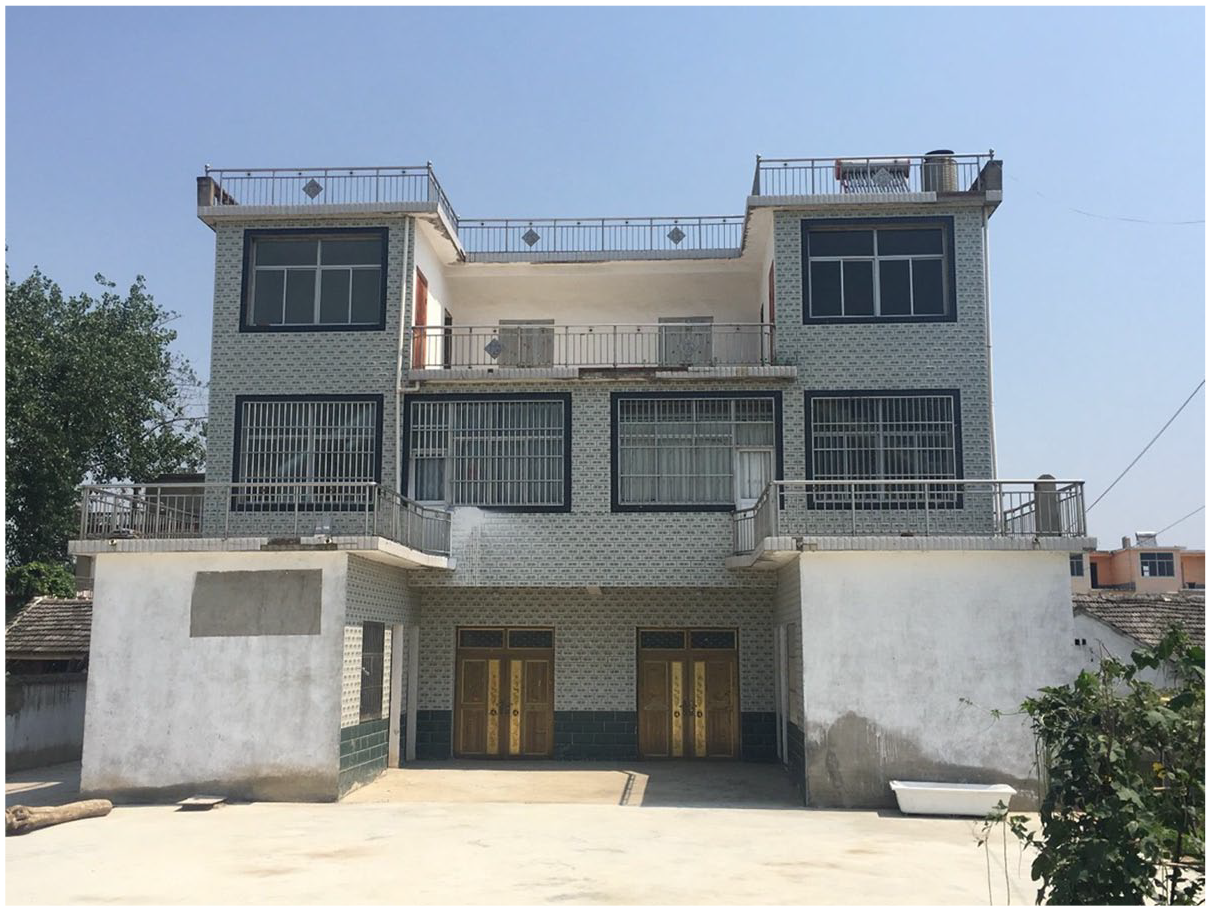
Example of a big and newer rural house (source: author, 2019).
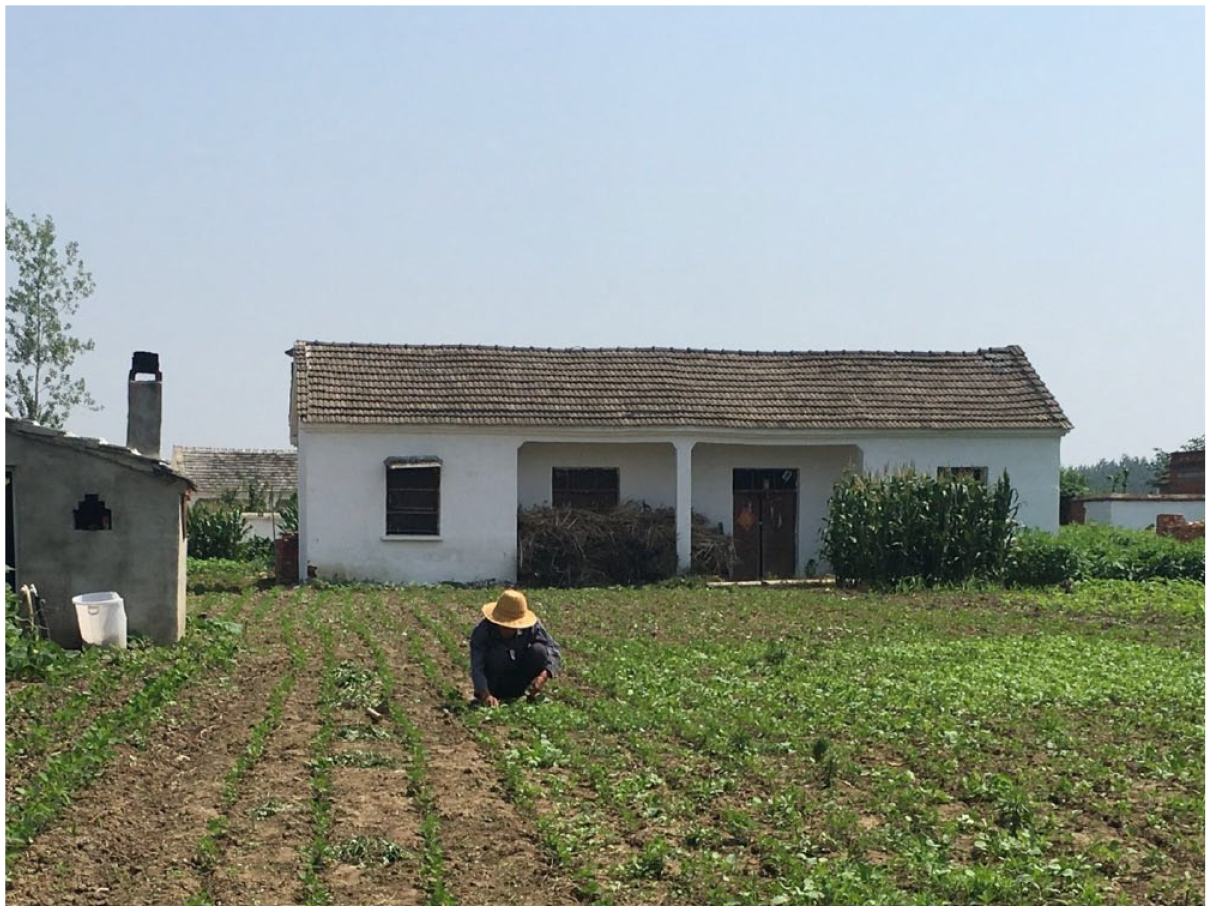
Example of a small and older rural house (source: author, 2019).
Similarly, two married brothers plan to continue to live with their parents: We plan to demolish the old house and build a new one that has five rooms. After our sister gets married, my brother and I will each occupy two rooms, and our parents will occupy one room. (Anhui Province, 1995)
Interviews over the past decades also indicate that the standard of bride price has increased over time, from tens of thousands of Yuan (thousands of USD) in the 2000s to easily over 100,000 Yuan (over USD 14,556) in the late 2010s. Two villagers described the change: Our son just got married; we gave the daughter-in-law’s family a bride price of 100,000 Yuan (USD 14,641). (Anhui Province, 2009) The bride price nowadays ranges from 50,000 to 100,000 Yuan (USD 7,321 to 14,641). Last year, the standard all of a sudden increased. (Anhui Province, 2009)
For many rural Chinese whose farming activities provide subsistence at best and very little cash income if any, house construction or renovation plus the bride price mean that they would be in debt or left penniless, as experienced by this father: In 2003, I spent 33,000 Yuan (USD 3,986) to build this single-storied brick house. It has three main rooms and two side rooms. My son is getting married this year, which will cost me 40,000 Yuan (USD 4,831). After that, I will not have any money left. (Anhui Province, 2005)
The large housing and bride price expenditures are not easily met by short-term income-generating activities. Rather, parents talk about years of migrant work in cities in order to yield sufficient remittances and savings to fund these expenses. Many interviewees noted that most of the remittances from migrant work were spent on these two big-ticket items. In this light, a son’s marriageability and marriage are a major determinant of his parents’ livelihood strategies, typically involving the father engaging in long-term circular migration between rural and urban areas. While sometimes the mother may also participate in rural-urban migration, the burden largely falls on the male parent, as was the case for this father: Over the past years . . . all of my savings [from migrant work] are to build a house for my son and for him to get married. (Anhui Province, 2005)
If there is more than one son in the family, then the expenditures and pressure for rural-urban migration multiply accordingly, as experienced by this father: All my earnings from migrant work were spent on building the house and getting our sons married. I have never tried to invest any money and have no plans to. In 1992 I built a house for my first son, costing more than 10,000 Yuan (USD 1,825). In 2002 I built another house for my second son, a brick house that has three main rooms and two side rooms, and spent more than 30,000 Yuan (USD 3,623). All of the money was from my migrant work. We also spent quite a bit on bride price. . . . Nowadays, it costs 60,000 to 70,000 Yuan (USD 7,426 to 8,454) for a son to get married. Even after housing cost, you’ll still have to spend at least 20,000-30,000 Yuan (USD 2,415-3,623). (Anhui Province, 2005)
To be sure, remittances also improve rural households’ standard of living, help lift them out of poverty, and pay for children’s education. For example, interviewees talked about their expenditures on appliances, agricultural input and school fees. Nonetheless, it is clear that housing and bride price are the biggest expenditures for parents who have sons. The practice of pursuing rural-urban migration in order to garner sufficient resources for important life-events like marriage and to make ends meet is passed down from one generation to the next. Without migrant work, villagers doubt if their sons would ever get married and if they would ever pay back their debts. This villager commented on how essential migrant work is: Going out (to do migrant work) is the only way to have a future. Some young people are too lazy; they won’t go out, and they don’t even have enough to eat, not even during the Spring Festival, unless they borrow from others. Those who don’t go out, no one will lend you money, and you won’t be able to find a wife. To have a future, you have to go out. (Anhui Province, 2005)
The lopsided sex ratio in the Chinese countryside and the stiff competition in the rural marriage market mean that some men are not able to find wives locally. Research has shown that some men have resorted to marrying wives from poorer regions or from other countries, though it is often difficult to tell if such activities might have involved smuggling or human trafficking (e.g., Chu, 2011; Fan and Li, 2002). The recent story of a wife and mother who is chained to a wall, which went viral on social media and in the news, is a reminder of the continued prevalence of human trafficking (Cao and Feng, 2022). While I have not observed during my fieldwork any direct evidence of human trafficking, villagers did hint at the fact that wives from other regions might run away, implying that some of these women might not have arrived voluntarily. For example, this villager recalled: My uncle’s wife ran away several years ago, back to Yunnan. She is from Yunnan and was introduced to my uncle. (Sichuan Province, 2009)
Research has shown that over time livelihoods in Chinese villages have changed dramatically as a result of rural-urban migration. Migrant work has become a way of life for so many rural Chinese across the generations that many rural villages now consist of primarily left-behind family members living in big but largely empty houses (Chen, 2019; Fan, 2018). Migrants and left-behind family members constitute split households spread across urban and rural locations (e.g., Fan, 2016). Farming is left to left-behind wives and elderly, migrants circulate between the village and urban work locations, and villagers may develop diversified livelihood strategies by engaging in multiple farm and non-farm activities (e.g., Ye, 2017). While research has highlighted the negative impact of split households on intra-household relations and child development (e.g., Wang and Mesman, 2015), there is evidence that family members tend to stick together as a safety net. For example, older women whose children have taken up migrant work may take care of the grandchildren, making their caregiving a multi-generational and multi-decade responsibility (e.g., Fan and Chen, 2020).
Decades of rural-urban migration have improved the economic wellbeing of many rural households, such that over time their aspirations have expanded. The new-generation migrants, in particular, who have had little or no farming experience and who began migrant work at a young age, are less attached to the home village but have a stronger urban orientation (e.g., Zhao et al., 2018). This may even translate into their eventually moving to towns or small cities near the home village and even purchasing homes there. Fan and Chen (2020) found that the availability of daycare in urban areas near the home village may constitute a reason for rural women with young children to desire an urban home. This young mother of a two-year-old and a new-born baby, who provided full-time care for the children, explained: I hope that my children can go to school in the city. . . . If my children go to daycare there, then I can work and make some money. (Anhui Province, 2019)
Indeed, my interviews have indicated that some villagers aspire to move to small cities near the home village. However, purchasing an urban home is much costlier than building a rural house, and would add significantly to marriage-related expenditures if that is expected of the prospective groom, as described recently by this villager: To get married, building a rural house costs about 200,000–300,000 Yuan (USD 29,112–43,668). Purchasing an urban home would cost at least 400,000–500,000 Yuan (USD 58,224–72,780). If it is in a big city, then the minimum is at least one million Yuan (USD 145,560). (Anhui Province, 2019)
In other words, expenditures associated with a son getting married have continued to rise, a potential source of hardship for families with more than one son, as illustrated by this popular saying among villagers: If you have three daughters, you will be able to afford a plane ticket. If you have three sons, you’d better hide in a cow’s stomach (you’ll be chased by your sons and your debtors). (Anhui Province, 2019)
Conclusion: social and cultural contexts of livelihoods
Using marriage as a lens, I have sought to highlight norms, customs, identities and shared values that shape intergenerational and gendered livelihoods at the individual and household level. In other words, this paper focuses on the role of social and cultural contexts of livelihoods – an essential backdrop for how people find meaning through how they live their lives. While the livelihoods literature tends to focus on the economic and material aspects of living, I have underscored that livelihood is equally a matter of how people pursue important goals in life – in this case marital formation – and how these goals are situated in social, cultural, historical and locational contexts. This was done by drawing on feminist contributions to understanding power differences between women and men and between generations, and by foregrounding the first-person voices of villagers, parents, migrants, and men and women who are creating intergenerational gendered livelihoods.
Interviews with rural Chinese in Anhui and Sichuan provinces demonstrate that resources, strategies and outcomes – three key components of a livelihood approach (Oberhauser et al., 2004; Rakodi and Lloyd-Jones, 2002) – must be understood as part and parcel of intergenerational responsibilities that are conditioned by gendered ideology. What are the resources that rural Chinese of different generations and different genders have access to and what are their livelihood strategies? In a context where per capita farmland is meagre and income sources are limited, access to rural land for house-building is a resource that can be passed down from parents to sons under the patrilineal inheritance tradition. This is also a resource that facilitates house construction or renovation, a strategy to improve the son’s (or sons’) competitiveness in the marriage market, as parents are responsible for their sons’ getting married. In order to fund house projects and the increasingly hefty bride price, as well as to make ends meet, rural-urban migration has become an essential strategy. As migrant work becomes a way of life for rural Chinese and is passed down as a means of livelihood from one generation to the next, villages tend to consist of left-behind family members, while ironically big houses continue to be built.
To rural women and girls who are disadvantaged by a patriarchal culture and patrilocal exogamy tradition, there is little resource to speak of. Under the patrilineal tradition, women do not inherit assets from their natal family or the husband’s family. The matchmaking process is one of the most important opportunities in a woman’s life for economic betterment, at least the promise of it. The sex-ratio imbalances that led to shortage of women in marriageable age have further enabled some rural women to expect not only a rural house but a new and big one, as well as a handsome bride price to their natal family. Ironically, however, this strategy has further reinforced the transactional nature of marriage.
What are the desired outcomes for those involved in the dynamic cultural and economic dimensions of marriage? To parents of sons, their desired outcomes are for the sons to get married, arrival of a daughter-in-law who adds to the family’ labor resources, and continuation of the family lineage through offspring. Their ability to build a big house not only is conducive to these outcomes but also enables multi-generational living that facilitates caregiving for the young and the elderly. To parents of daughters, marrying them out to a promising family signals a satisfactory completion of their responsibility as parents. While bride price traditionally represents compensation for losing a daughter, it is also a symbolic end of her membership in the natal family and is a marker of the economic status of the son-in-law’s family. To a rural woman, who is no longer responsible for her natal family after getting married, one of the desired outcomes from marital formation is economic wellbeing. While a new and big house and bride price are not exactly resources that can generate long-term economic return, they do signify economic status and security for which rural women have few other opportunities to seek, and they connote the “price” of a woman of marriageable age. While the pursuit of economic betterment may not be universal among rural women who are seeking mates, it is certainly expected. To a rural man, getting married signals the beginning of their economic and social independence, their access to inheritance and also their responsibility to take care of the elderly.
This paper has underscored gender, gendered ideology and gendered power difference as drivers of intergenerational livelihoods. By using an intergenerational approach, I have shown that livelihoods are made up of resources and responsibilities that are spread across generations. I have also highlighted strategies that are gendered and collective at the household level, as well as outcomes that both have economic impacts and preserve ideology, norms and the cultural and social fabric of families and rural communities. By focusing on and revealing intra-household and inter-household processes in relation to marriage, this paper contributes to the existing literature on livelihoods by demonstrating the centrality of social and cultural contexts for understanding decision-making and longstanding practices (e.g., Daskon and Binns, 2009; Forsyth and Michaud, 2011; Po et al., 2020).
Over the years, the economic and material livelihoods in rural China have changed. Marital expenses have become heftier, new houses are bigger and better, rural-urban migration is no longer a short-term strategy but a long-term way of life, and the younger generation who lacks farming experience may have a stronger aspiration for urban living, just to name a few. Nonetheless, it appears that the norms and values that govern gendered and intergenerational roles and responsibilities related to marriage have persisted. If they do change – which does not seem likely in the foreseeable future – then that may signal the weakening of one of the major drivers of rural-urban migration. As long as marriages are transactional, sex-ratio imbalances are significant and rural-urban inequality continues to be large, it is likely that large volumes of rural-urban migration will continue in China.
Footnotes
Acknowledgements
I would like to thank the late Professor Nansheng Bai for his vision in initiating the interview project, Chuanbo Chen and Chen Chen for their tremendous help in fieldwork, and Youqin Huang, Penn Ip, Yingchun Ji, Jennifer Langill, Ann Oberhauser, Linda Peake and three anonymous referees for their comments and suggestions on earlier versions of the paper. I am deeply grateful to all the interviewees for sharing their stories.
Declaration of conflicting interests
The author declared no potential conflicts of interest with respect to the research, authorship, and/or publication of this article.
Funding
The author disclosed receipt of the following financial support for the research, authorship, and/or publication of this article: The author would like to acknowledge UCLA’s Office of the Chancellor for research support.