




Abstract
Public facilities capitalization of formal housing has been widely discussed. However, how residents of informal housing value facilities and how they differ from formal housing remain unclear. We employ hedonic model and the gradient boosting decision trees approach to address the gap by identifying the differences between small property rights housing (SPRH) and commercial housing in Shenzhen, China. Empirical modeling results reveal that the capitalization effects of public facilities in SPRH are significantly lower than in commercial housing. SPRH buyers are significantly less willing than those commercial housing buyers to pay for public facilities, and the gap in willingness to pay between these two types of housing buyers is greater for public middle schools with access related to housing tenure than for metro stations and hospitals. After accounting for how the poor public facility provision of SPRH affects capitalization effects, we further find that informal tenure weakens SPRH capitalization effects. These findings help planners and policymakers better understand the housing market so they can take reasonable initiatives to make urban public facilities more accessible and urban housing systems more affordable, further improving the sustainability of urban areas.
Introduction
Since Tiebout’s landmark study on people voting with their feet (Tiebout, 1956), public facilities such as public transit (Connolly et al., 2019), schools (Chan et al., 2020; Orford, 2018), and public parks (Grilli et al., 2020) have been regarded as significant factors in shaping housing prices, which is known as the capitalization effect of public facilities. A growing body of literature has stressed that the capitalization effect of the same public facility within the same city varies across housing submarkets and time (Fernandez and Bucaram, 2019), and this heterogeneity stems from the varied housing demand among homebuyers and the regional supply structure. The bundle of housing property rights (e.g., occupancy, use, sublet, access to public services, etc.) represents a combined set of housing demands (Khemro and Payne, 2004). However, few studies have observed the heterogeneous characteristics of public facilities capitalization through the perspective of property rights.
The informal housing market offers a compelling case for identifying and examining the heterogeneity of public facilities capitalization arising from property rights. However, existing studies exploring the implied pricing of public facilities based on hedonic theory typically discuss formal and informal housing markets separately (Kuminoff and Pope, 2014; Wen et al., 2019). Along with the flourishing of the informal housing markets (Webster et al., 2016), growing attention has focused on the pricing mechanism of informal property. Empirical evidence from many cities in developing countries demonstrates the critical role of the presence of legal title and the form of property rights in determining housing prices (Monkkonen, 2016; Nakamura, 2017). Generally, informal settlements are perceived to be excluded from urban infrastructure and basic services (McGranahan, 2015; Shrestha et al., 2021), and therefore the impact of public facilities on informal housing prices is under-discussed. However, it is important to study how dwellers in informal settlements choose and price public facilities through public facilities capitalization. This will offer insights for the design or improvement of affordable housing products to reduce illegal transactions in informal housing.
In China, informal settlements mainly stem from the dual land management system, under which urban land is owned by the state and rural land belongs to rural collectives. In 1999, General Office of the State Council of China issued a document strictly prohibiting the illegal occupation of rural land for real estate development (the General Office of the State Council, 1999). However, during the past phase of rapid urbanization, rural collectives and villagers, driven by substantial land rental income, constructed numerous informal settlements on rural land. As cities expanded, these informal settlements have gradually been encircled within the built-up urban areas. Two predominant forms of informal housing have emerged in China’s large cities: urbanizing villages (chengzhongcun) (Tong et al., 2021) and small property rights housing (SPRH) (Wang and Sun, 2014). Both have contributed to addressing the failure of the commercial and social housing to meet the housing needs created by the large influx of migrants. However, significant distinctions exist between the two in terms of appearance, building structure and quality, and the surrounding neighborhood environment. Urbanizing villages typically consist of unauthorized additional floors constructed on top of indigenous farmers’ houses, characterized by narrow streets and substandard sanitary conditions. SPRH resembles conventional formal housing in China, manifesting as mid- to high-rise apartment buildings with infrastructure and green space. Despite SPRH not being officially registered and facing risks of enforcement actions under national laws and regulations (He et al., 2019; Lin and Lin, 2023), its affordability have also been favored by low- and middle-income groups. The SPRH market has flourished in the urbanization of China’s mega cities (Sun and Ho, 2018). Recognizing SPRH’s role in providing affordable housing in large cities, it becomes essential to comprehend the consumption behavior and preferences of its residents. Such understanding is crucial for the effective governance of informal settlements and the development of future housing affordability policies.
The public facility is an important aspect of residents’ housing consumption preferences. This study goes further to discuss the capitalization effects of public facilities in informal housing and how the effect differs compared to formal housing. Both aspects contribute to understanding how people living in SPRH value public facilities and make trade-offs between different types of public facilities (Bishop et al., 2020). More importantly, this paper seeks to identify the housing demand characteristics within the informal housing sector (i.e., how the price that households in SPRH are willing to pay for public facilities differs from the households in FPRH and why this gap arises). This study can identify group behaviors among residents of informal settlements and help in the pre-evaluation of public facilities planning. Moreover, we explore housing inequality related to public facilities by examining the differences in willingness to pay (Xiao et al., 2022; Zhang, 2023). Therefore, this study offers valuable guidance for cities in developing countries with the similar housing market structure, helping them identify and address inequalities in public facilities provision between formal and informal housing. This is key to improving housing equality and develop social housing policies in urban areas of the global South.
To achieve the above, we first employ the semi-logarithmic model—the embedded linear model—to identify the significant differences in public facilities capitalization between the SPRH market and the FPRH market. To clarify the existence of such significant differences, we apply the gradient boosting decision tree (GBDT) model—the nonlinear model of undefined form—to control distribution differences in public facilities between the two housing markets. The GBDT results allow us to test whether the tenure type moderates informal housing households’ willingness to pay for public facilities and whether the change in willingness varies across public facilities.
As SPRH has similar property characteristics with commercial housing, we selected SPRH to represent informal property rights housing and commercial housing to represent FPRH, which can minimize the model biases and reasonably compare model results. In terms of the selection of public facilities, we chose two categories based on whether property rights would affect access to such public facilities. One category is education facilities whose accessibility would be affected by both property rights and proximity, and the other category includes metro stations and hospitals, which are only affected by proximity. With a focus on public facilities capitalization, this study was designed to answer the following two questions: (1) What are the differences between the willingness to pay for various types of public facilities between households living in SPRH and those living in FPRH? (2) How can the heterogeneity of capitalization effects derived from the tenure type be explained? To address these questions, we selected Shenzhen as the study area because the city has the largest stock of SPRH in China and supports active trading under a well-developed SPRH market (Qiao, 2015; Sun and Ho, 2018).
Literature review
Property rights and property values
Previous studies elucidate the implicit price of property rights in informal housing. The price differences among various housing tenure types are rooted in the bundle of property rights attached to that tenure. In practice, property rights are held by degree (Alchian and Demsetz, 1973; Demsetz, 1964) and are regarded as an important part of property values in certain socio-economic contexts (Kim, 2004). A property with a formal title generally has more value than that without a legal title since a formal legal title reduces the uncertainty regarding ownership and protects property rights from infringement (van Gelder, 2010; van Gelder and Luciano, 2015).
As a major part of informal housing in China, SPRH prices have attracted widespread scholarly attention through the lens of tenure type or property rights. Significant discount on SPRH prices compared to FPRH is observed and considered to be the uncertainty and risk borne by the SPRH buyers (Lai et al., 2017; Li and Xia, 2022). To decipher why SPRH prices are lower than FPRH, scholars began to explore the origins of such uncertainties and risks (He et al., 2019; Qiao, 2015). Existing studies unpack the uncertainties in stages of production, transaction, and consumption (property management) of SPRH, but ignore that informality may increase uncertainty in access to public facilities (Andreasen and Møller-Jensen, 2016). In this paper, we argue that the uncertainty when accessing public facilities also serves as an influential factor in reducing SPRH prices.
Heterogeneity of public facilities capitalization effects
Sustained scholarly attention has focused on examining and explaining the heterogeneity of public facilities capitalization. The heterogeneity may stem from the interaction of the heterogeneous demand function with the inelastic short-run supply function (Goodman, 1981). On the demand side, people who are willing to pay high housing prices, for example, may be willing to pay higher prices for various types of public facilities (Melichar and Kaprová, 2013; Wen et al., 2019). On the supply side, the capitalization effects of public goods are greater in local markets with a less elastic housing supply than in those with a more elastic housing (land) supply (Sun et al., 2017). Research has gradually advanced from those arguments to discuss the factors that differentiate homebuyers’ demand. A recent study highlighted that geographic and locational particularities, as well as legal regulations, will influence homebuyers’ perceptions of public facilities and the relative demand for different attributes (Fernandez and Bucaram, 2019). Namely, legal restrictions on the bundle of property rights could influence the value people to assign while bidding for public facilities.
Previous studies have not provided conclusive evidence regarding how informal property rights affect the capitalization of public facilities. However, the distance-decaying characteristics tied to how public facilities impact housing prices and the institutional barriers faced by informal property rights in using public facilities suggest that such informal tenure is likely to reduce homebuyers’ marginal willingness to pay for public facilities. A growing body of literature has identified that further distance or poorer quality public facilities have less of an effect on housing prices (Diao et al., 2017; Lieske et al., 2021). Informal housing is typically located in peripheral urban areas without adequate infrastructure and facilities compared with formal housing areas (Durst and Wegmann, 2017). Moreover, owners of informal housing may face institutional barriers as well when accessing public facilities (Wagle, 2022). Therefore, the two downsides of the SPRH—the poor provision of public facilities and the uncertainties in access public facilities borne by SPRH buyers—may lead to a decrease in public facilities capitalization of the SPRH.
By examining the capitalization effects in the Chinese context, we provide a valuable comparative perspective for international researchers. Our findings can inform discussions about housing market variations in different cultural and economic settings, offering insights into how housing tenure shapes consumer behavior and policy responses. Our study illuminates the challenges faced by informal housing residents in accessing public facilities and highlights the need for more inclusive urban planning globally.
Small property rights housing and its public goods capitalization
Small property rights housing in Shenzhen, China
During the first two decades of the 21st century, attracted by the huge benefits, rural collectives (village shareholding cooperative companies) and villagers, either independently or in collaboration with developers, initiated the construction of housing on land under their control. SPRH was built to resemble commercial housing, offering a living environment and lifestyle much like in commercial housing (Lai et al., 2017). SPRH buyers typically obtain a title certificate issued either by the developer or the rural community, or attested by a third party (lawyer) (He et al., 2019). According to data released by the Shenzhen Municipal Government (2021), legally tradable commercial housing represents approximately 17% of Shenzhen’s total housing stock. In contrast, SPRH, as investigated in this study, has reached about 10% of the housing stock.
Shenzhen has already recorded the highest housing prices in China (National Bureau of Statistics of the People’s Republic of China, 2020), and the housing unaffordability has squeezed middle- and low-income residents out of the FPRH market. Moreover, Shenzhen 2021 housing purchase restriction policy states that families with Shenzhen citizenship (hukou) are limited to purchasing two sets of FPRH, and others are limited to purchasing one set. Soaring housing prices and restrictions on the formal housing market are driving the lower-income group with housing needs and the higher-income group with investment needs toward the SPRH market. Unlike urbanizing villages where residents are mainly low-income rural-to-urban migrants (Li and Zhu, 2014), the majority of households in SPRH, especially the owners, are local hukou holders because most SPRH in Shenzhen is currently only available for full payment delivery, making SPRH unaffordable for rural migrants, especially in circumstances where SPRH does not have access to credit. This is consistent with the result of the China Household Financial Survey for the year 2015, showing that both SPRH for basic needs and SPRH for investment have high ratios of local hukou holders, at 86.1% and 77.5%, respectively (Liu et al., 2018).
With the increase in SPRH transactions, a large number of SPRH trading platforms and agency services have emerged and the pricing mechanism of SPRH has gradually matured. This pragmatic informal institution and similar pricing mechanism provide us with enough observations of informal housing transactions.
Public facilities capitalization in SPRH
SPRH owners face uncertainty in the acquisition of public resources. Due to the disadvantage of the location distribution of SPRH, the availability, accessibility, and quality of public facilities for SPRH are relatively poor compared to formal housing. More importantly, SPRH owners face uncertainties when acquiring specific public resources regulated by policies. In terms of education facilities, owners of SPRH are not entitled to the school attendance zone policy of their district in most cities as access to public schools is highly related to formal tenure. However, given the huge proportion of SPRH in Shenzhen’s housing stock, Shenzhen’s enrolment policy for SPRH is not as strict as other cities due to the large demand for schooling. For instance, the rules of compulsory education admission points in Longhua District in 2020 offer a good example. The rules state that purchasing SPRH and renting formal housing are equal and both qualify for admission, but the bonus point policy based on the length of residency when purchasing formal housing does not exist for SPRH. Thus, when competing for enrolment positions, children of households purchasing SPRH face greater uncertainty than children of formal homeowners, given the limited number of students that can be accommodated in quality schools in the corresponding school district. These uncertainties will inevitably affect the willingness of SPRH buyers to pay for educational facilities. In this study, public middle schools are selected as the metric for evaluating educational facilities in Shenzhen. Recent initiatives in Shenzhen aimed at equalizing basic public services have resulted in minimal variation in the spatial distribution of primary schools regarding proximity and quality. Moreover, with the transition rate from middle school to senior high school being around 50% (the Guangdong Provincial Department of Education, 2020), parents are increasingly considering the quality of middle school education when deciding where to live.
For metro stations and hospitals, apparent factors associated with tenure type have not yet been observed to cause the decline of public facilities capitalization in SRPH; the locational features of public facilities distribution remain the main reason. Yet this effect is minor compared to the decrease in willingness to pay that comes from directly blocking access to educational facilities. Based on the institutional background of SPRH, we argue that the capitalization effect of public facilities in the SPRH market differs from that of commercial housing, probably appearing significantly weaker than in formal housing.
Data collection and methods
Data collection
We collected the average price of posted listings and structural characteristics for 3,358 commercial housing communities and 372 SPRH units in Shenzhen to perform an empirical analysis from sz.58.com (accessed in November 2021), a major trading platform for housing in mainland China. These data hold information about the list prices, tenure types, and planning and service characteristics of residential compounds, which are used to represent the independent variable and control for the tenure type, age, plot ratio, greening rate, property fee, the total number of parking spots, and the total number of housing units in the community. Figure 1 shows the spatial distribution of housing samples. This study uses listing prices to make SPRH and FPRH comparable. Listing prices have been used to conduct housing pricing studies in China (Li and Xia, 2022; Yang et al., 2020), with findings indicating their better reliability (Wang et al., 2020). In addition, listing price can avoid the pitfalls of transaction prices, which arise from the potential tendency of buyers and sellers of formal housing to report lower transaction prices to avoid taxes (Li and Xia, 2022).
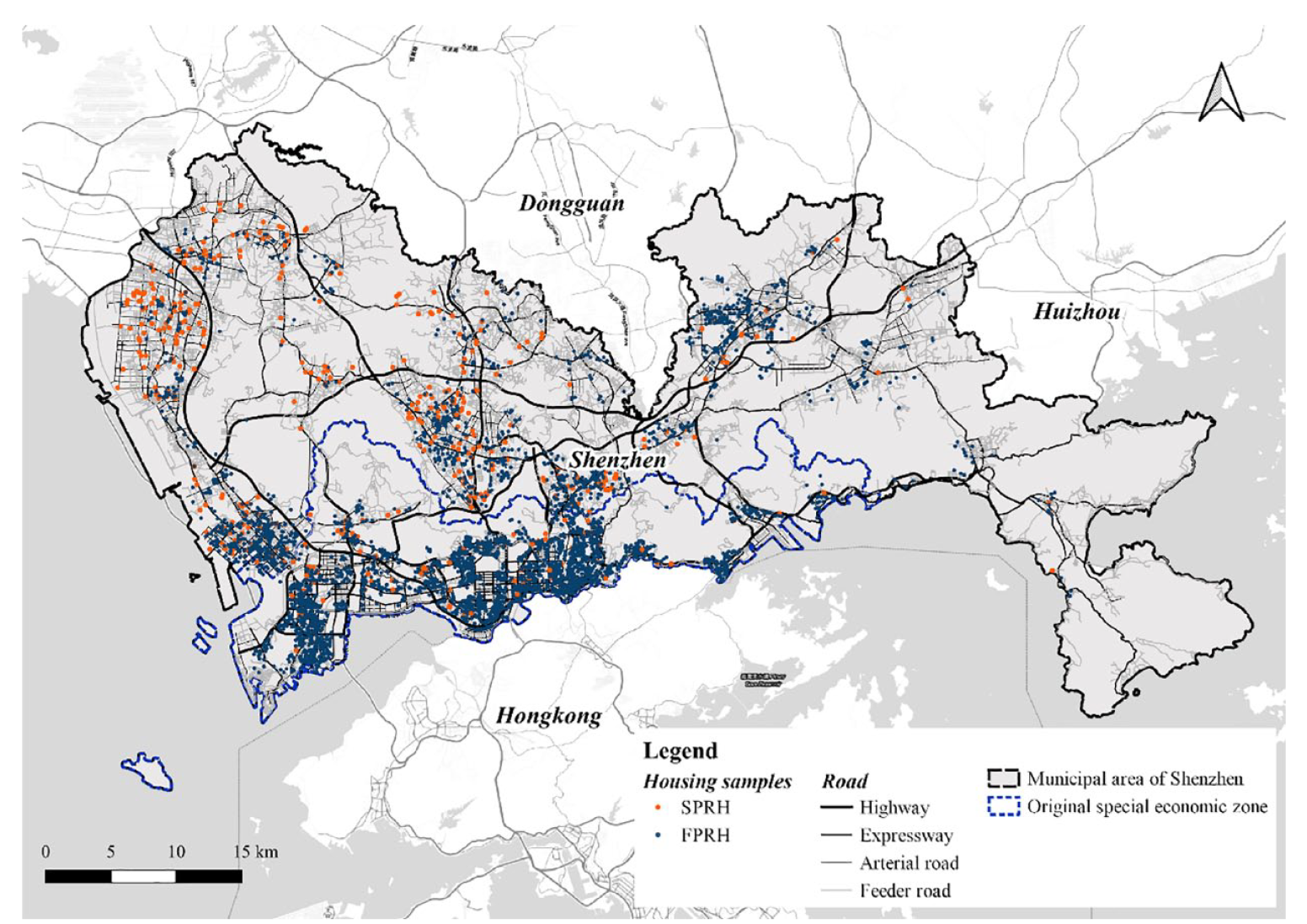
Distribution of the residential compound samples.
The following data were used to measure the public facilities provision. Metro station and hospital location data were extracted from the point of interest data of Shenzhen in 2021 by AMap. Based on the geographical coordinates of public facilities, we collected the walking distance from the residential compounds to all public middle schools, metro stations, and hospitals with the AMap route planning application programming interface (API) and then filtered out the distance to the nearest public facility. As for the education facilities, since the student enrolment policy in Shenzhen during the compulsory education years is based on the “school attendance zone”, we collected the boundary information of the public middle school attendance zone from the official website of the Shenzhen Education Bureau. For measuring education quality, the 2019 Shenzhen high school enrolment rate of every public middle school was obtained from the educational consulting website (https://sz.shengxue101.com/). We calculated the average enrolment rate of every school in the school attendance zone to measure education quality following the previous studies (Chan et al., 2020; Gibbons et al., 2013).
Regarding locational variables, we selected 10 urban centers based on Shenzhen’s urban development characteristics, including four landmark locations and six district governments. The walking distance from each residential compound to the nearest city center was collected from AMap route API.
Model specification
Hedonic model
According to the hedonic price theory, housing is a heterogeneous commodity composed of the pricing of a bundle of various characteristics in the implied market (Rosen, 1974). This paper aims to fit the property price through the following attributes:

where P indicates the dependent variable representing the property price, S contains a series of variables describing the accessibility of public facilities, B is a set of variables describing the planning characteristics of the residential compounds, L describes the property location, and R represents the tenure type. The hedonic model takes the following form:

where lnUnitPricei represents the natural logarithm of the average listing price of the sample residential communities. Informal indicates whether the property is SPRH. PublicFacilitiesi is the proximity or quality of public facilities for the SPRH. The coefficient of PublicFacilitiesi can reflect the residents’ marginal willingness to pay (the marginal willingness to pay at the mean housing price
To examine whether the capitalization of public facilities differs significantly between formal and informal housing markets, we introduced the interaction terms of public facilities and the form of property rights (i.e., tenure type) into Eq. (2). This step produces Eq. (3):

According to Eq. (1), this study employs the average price of properties for sale in the residential compound as the dependent variable, and the independent variables include the form of property rights, the proximity or quality of public facilities, locational factors, and the planning of the residential compound. We employ a dummy variable, “Informal”, indicating whether the residential compound is SPRH. For public facilities, this study selects three proximity variables (the distance to the nearest middle school, the distance to the nearest metro station, and the distance to the nearest hospital) and one quality variable (education quality).
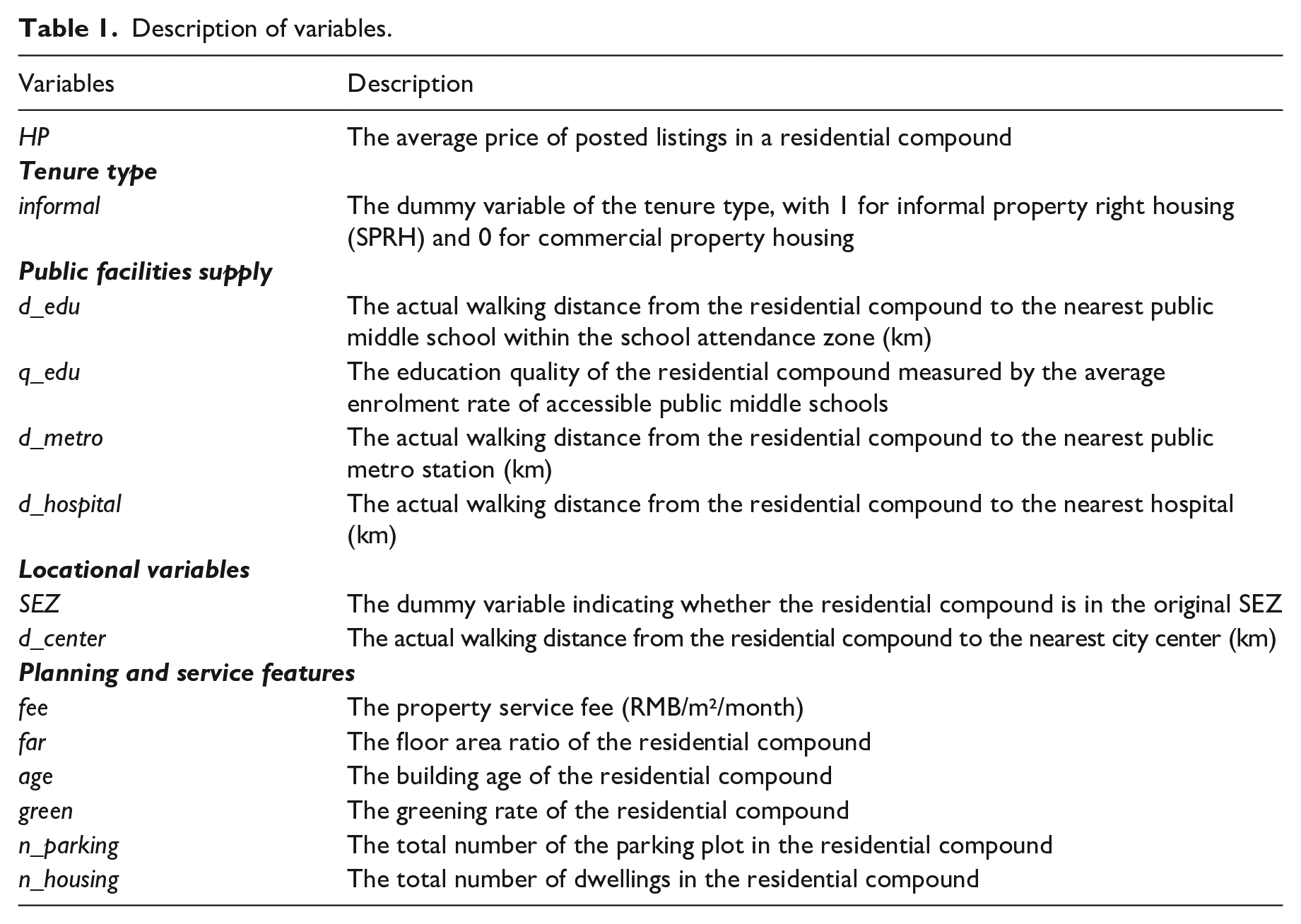
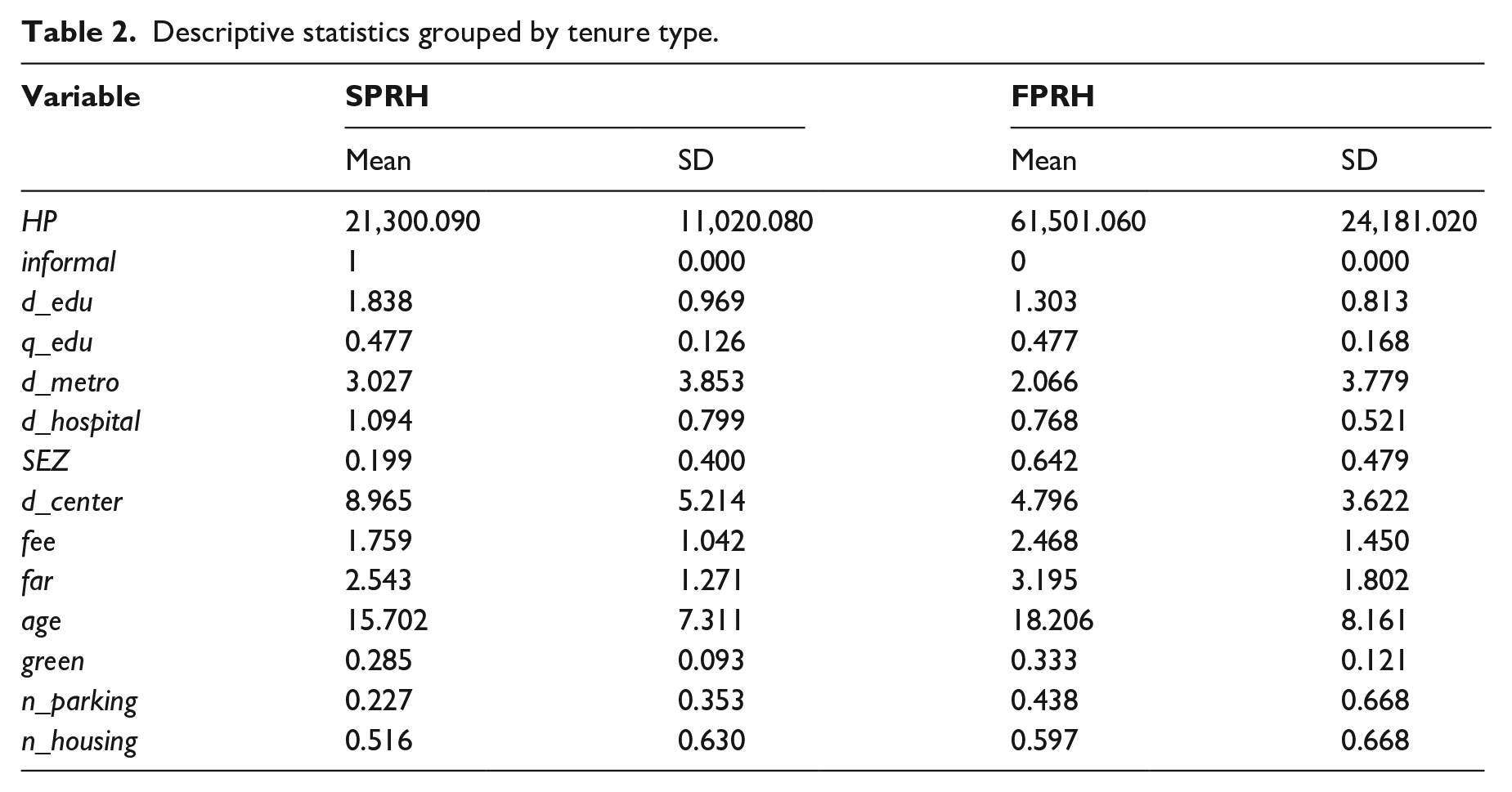
For locational factors, we chose two variables: the distance to the nearest urban center and whether the housing is located in the Special Economic Zone (SEZ). In 1980, the SEZ established in Shenzhen accounted for 16% of the municipal area. As a result of better locations and higher building densities, massive public investments than outside the SEZ were poured into the area inside the original SEZ, while the districts outside the SEZ were overlooked (Hao et al., 2013). The Chinese national government added six more districts outside the original SEZ in 2010, but development path dependence remains (Li et al., 2021). Therefore, besides the proximity to the city center, we also included the dummy variable for whether the residential compound was within the original SEZ to control for locational factors. To control the planning and service features of the residential compound, we added property service fee, floor area ratio, age of the residential compound, greening rate, number of parking plots, and the total number of housing units based on existing studies (Huang et al., 2020). Descriptions and statistics for variables are presented in Tables 1 and 2, respectively.
Description of variables.
Descriptive statistics grouped by tenure type.
Gradient boosting decision tree model
The possible reasons for the difference in willingness to pay between residents of SPRH and those of commercial housing could be categorized into two aspects: the uncertainty of access to public facilities due to policies related to informal tenure; and the physical distance from SPRH to public facilities compared to that of commercial housing. The hedonic model provides a comprehensive assessment to determine if there are differences in willingness to pay between buyers of SPRH and commercial housing, while the GBDT’s recognition of nonlinear features of the variables can control for the effect of distance on willingness to pay by identifying only whether uncertainty associated with informal tenure. According to Table 2, SPRH is generally situated further from various public facilities than FPRH, potentially reducing the willingness to pay among SPRH owners. Previous studies have shown that the capitalization effect of public facilities is characterized by distance decay (Diao et al., 2017; Lieske et al., 2021; Tong et al., 2023). Specifically, the reduction in the capitalization effects of public facilities of SPRH estimated by the semi-logarithm regression has two parts: one is the poor supply of public facilities around SPRH itself, and the second is the uncertainties in accessing public facilities borne by SPRH owners related to informal tenure. We use a nonlinear model of undefined form—GBDT—to examine whether the uncertainties from informal tenure result in a decrease in willingness to pay of SPRH homebuyers after controlling for systematic differences in public facilities supply between SPRH and FPRH. On the one hand, the GBDT model allows public facilities capitalization rates to vary across housing to public facilities distance or public facilities quality, which is the key to addressing the poor supply of public facilities for SPRH compared to FPRH. On the other hand, the GBDT model presents predicted housing prices with public facilities variables through partial dependence plots for identifying differences in the public goods capitalization effects of the two housing types.
The GBDT method belongs to the boosting class of methods in ensemble learning, which can significantly improve model performance and reduce individual model prediction bias and variance. By building a decision tree and performing multiple iterations, the GBDT model minimizes the loss function, with each step gradually reducing the residual fit to finally predict the value of the response variable (Friedman, 2001). The approximation function is estimated as follows:

where y and x represent the response and explanatory variables, respectively, and F(x) is the approximation function defined in the additive form:

where M is the number of decision trees, am is the mean of split locations, h(x;am) denotes the terminal nodes in each individual tree, and βm is a coefficient estimated by minimizing the loss function. The specific algorithm can be found in the literature (Ding et al., 2018; Friedman, 2001).
Compared to the semi-logarithmic model’s linear relationship assumption between dependent and independent variables, GBDT can achieve a higher prediction accuracy and better visualization. We use the same independent and dependent variables in the semi-logarithmic and GBDT models and set a maximum of 10,000 trees. To avoid overfitting and reduce the generalization error in the GBDT model, a tenfold cross-validation procedure was used to train the model. Based on the grid search for hyperparameter tuning, we set the shrinkage parameter to 0.01 and chose a ten-way interaction. After 3,598 iterations, the model obtained its best results.
Empirical results
Heterogeneity of the capitalization effects in two types of housing
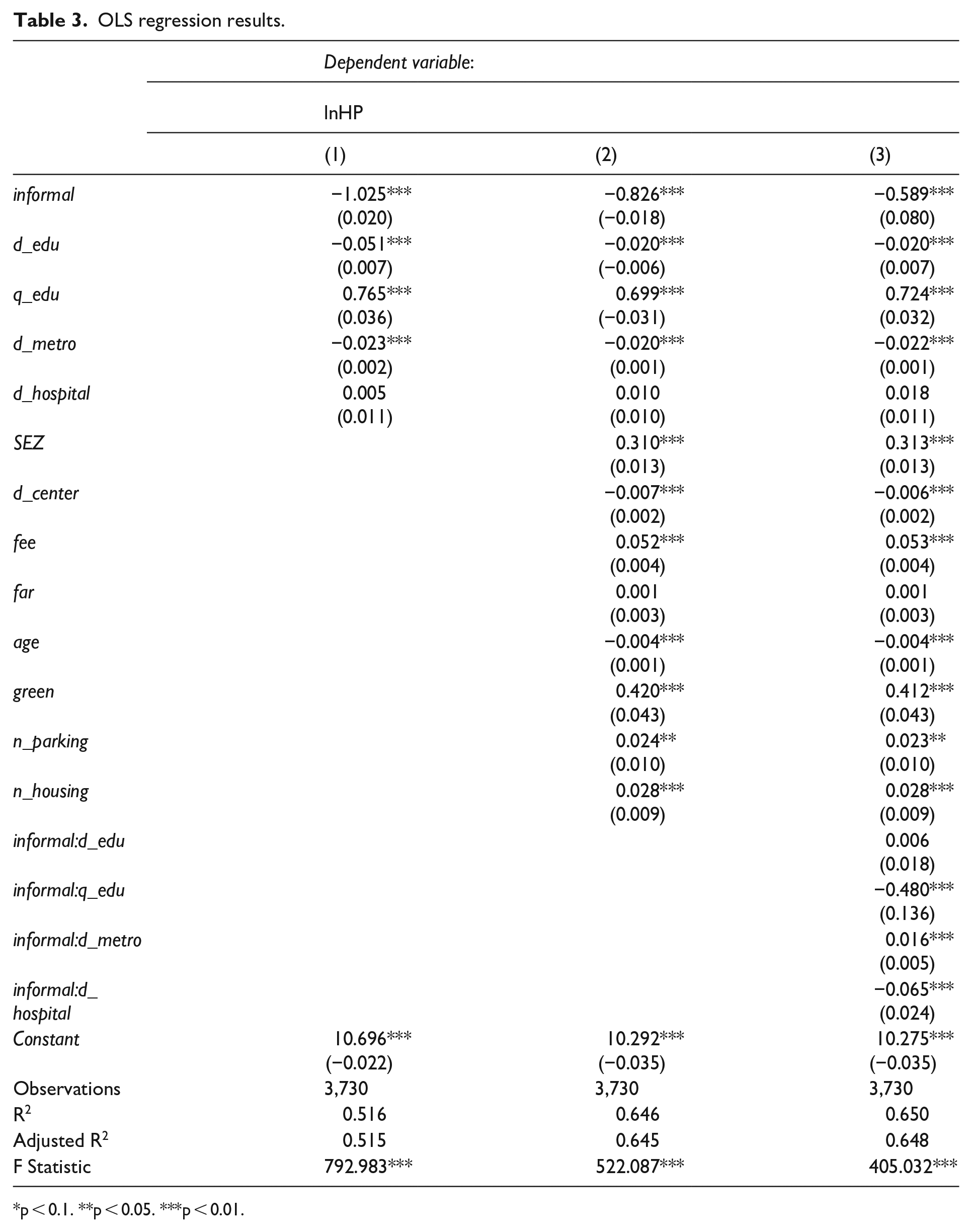
The results from estimating the semi-logarithmic model in Eq. (3) are represented in Table 3, with column 1 including only public facilities variables and column 2 including all the control variables. To observe whether informal tenure induces changes in the capitalization effects of public facilities, we introduced interaction terms of tenure types and the supply of public facilities in column 3.
OLS regression results.
p < 0.1. **p < 0.05. ***p < 0.01.
As shown in column 2, the coefficients of the key independent variables are reduced, and the goodness-of-fit R2 (0.646) is significantly increased compared to column 1, indicating that the introduction of control variables effectively reduces the interference of control factors. The significant negative coefficient of informal in column 2 indicates that the average price of SPRH is about 56.22% lower than that of commercial housing, which is considered to be the risk faced by investing in SPRH compared to FPRH (He et al., 2019).
In terms of public facilities, according to Column 2, the coefficients of both d_edu and d_metro are significantly negative, indicating that housing prices decrease by 1.98% and 1.98%, respectively, for every increase of 1 km of distance from the residential compound to the nearest public middle school and nearest metro station. The variable q_edu which represents the quality of the school attendance zone for the residential unit is significantly positive and indicates that when the admission rate increases by 0.1, the housing price rises by around 10.11%. However, the proximity to the nearest hospital is not significant.
For locational variables, the coefficient of SEZ is significantly positive. This result indicates that when in the original SEZ, the housing price is 36.34% higher than that of the residential compound located outside the original SEZ. The coefficient of d_CBD is significantly negative, which indicates that every additional km away from the nearest city center is expected to cause a decrease in housing prices. Except for the floor area ratio, other control variables are significant at the 0.01 level, and their effects on housing prices are consistent with existing studies (Choi et al., 2021; Li et al., 2019). The coefficient of the fee is also significantly positive, indicating that the housing price rises by approximately 5.34% when the property service fee increases by 1 RMB per square meter per month.
To examine significant differences in public facilities capitalization and identify the specific differences between SPRH and FPRH, we introduced interaction terms of the dummy variable, informal, and the public facilities proximity or quality. As listed in column 3, controlling for all other factors, the coefficients of q_edu and informal:q_edu are significantly positive and negative at the 0.01 level, respectively. This finding suggests that for SPRH, the uncertainty in accessing a quality public middle school could be capitalized into the housing prices, resulting in a lower capitalization effect in SPRH. For FPRH, the housing price increases by 10.63% for every 0.1 increase in enrolment rate, while for SPRH the housing price increases by only 2.76% for every 0.1 increase. Thus, the marginal willingness to pay for education quality is significantly lower for households living in SPRH than for those living in FPRH. The coefficients of informal:d_edu are insignificant, meaning that the proximity to the nearest public middle school does not seem to have different capitalization effects in SPRH and FPRH prices.
A significant interaction is observed between the variables informal and d_metro as well, which means that, for SPRH, the proximity to the nearest metro station has a different effect on housing prices compared to FPRH. Combining the coefficient of informal:d_metro with the coefficient of d_metro, for every 1 km reduction in the distance to a metro station, the price increases by 0.6 % for SPRH and by 2.18 % for FPRH. The marginal willingness to pay for metro stations for households living in FPRH also decreases, but this gap in marginal willingness to pay is significantly smaller than the gap for education quality. Overall, except for the insignificant interaction term between informal and d_edu, all other interaction terms indicate that those living in SPRH are significantly less willing to pay for public facilities than those living in FPRH.
Explanations for the heterogeneity of the capitalization effects
The above regression results show that public facilities have lower capitalization effects in SPRH. This phenomenon can be attributed to two reasons: First, the uncertainties associated with SPRH transactions, especially the institutional barriers imposed on SPRH owners in accessing public facilities, lead to lower capitalization effects of public facilities in SPRH prices than in FPRH prices. Second, there is spatial inequality in public infrastructure (Talen and Anselin, 1998) and SPRH may be further away from public infrastructure or of poorer quality. The impact of public facilities on housing prices being characterized by distance or quality decay and public facilities being generally better in formal housing areas (Table 2) result in lower capitalization effects for SPRH than FPRH. Therefore, to control for systematic differences in the spatial distribution of public facilities around the two housing types and to examine the capitalization differences derived from property rights, we employed the GBDT model to compare the capitalization effects of SPRH and FPRH.
To make the GBDT regressions more interpretable, we used the accumulated local effects (ALE) plots to illustrate how features affect the prediction of a machine learning model on average (Molnar, 2018). The ALE value can be interpreted as the main effect of the feature at a certain value compared to the average prediction of the feature, and the ALE plot depicts the trend of the response variable in the prediction. In addition, ALE plots can show the interaction effect between two features by visualizing second-order effects, which are the additional interaction effect and do not include the main effects (Apley and Zhu, 2020). The ALE plot of the interaction effect can thus be analogous to the value of the interaction term in Eq. (3).
The ALE main effect plots are shown in Figure 2 for distance to the nearest public middle school (d_edu), quality of school attendance zone (q_edu), distance to the nearest metro station (d_metro), and distance to the nearest hospital (d_hospital). For the ALE plots of d_edu, housing prices rise significantly with decreasing distances starting at approximately 1.5 km, with a proximity discount at 0.5 km due to possible traffic congestion, noise, or other factors (Kuehnel and Moeckel, 2020; Tong et al., 2023). The 1.5 km distance is close to the Shenzhen Urban Planning Standards and Guidelines (Shenzhen Municipal Government, 2013), which suggest that the service radius of public middle school should be approximately 1 km. In terms of education quality, the housing prices increase until they first peak at admission rates of around 0.75, and after 0.75, its ALE plot for education quality becomes less reliable due to the smaller sample size. The ALE plots for the four variables of public facilities show that the slope of the ALE curve is greater than the other feature values just before the housing prices are about to reach their maximum (i.e., where the supply condition of public facilities is better). Therefore, the capitalization effect of public facilities on housing prices is subject to the law of diminishing marginal effects. Accordingly, the poor proximity and quality of public facilities surrounding SPRH are responsible for weakening their capitalization effects.
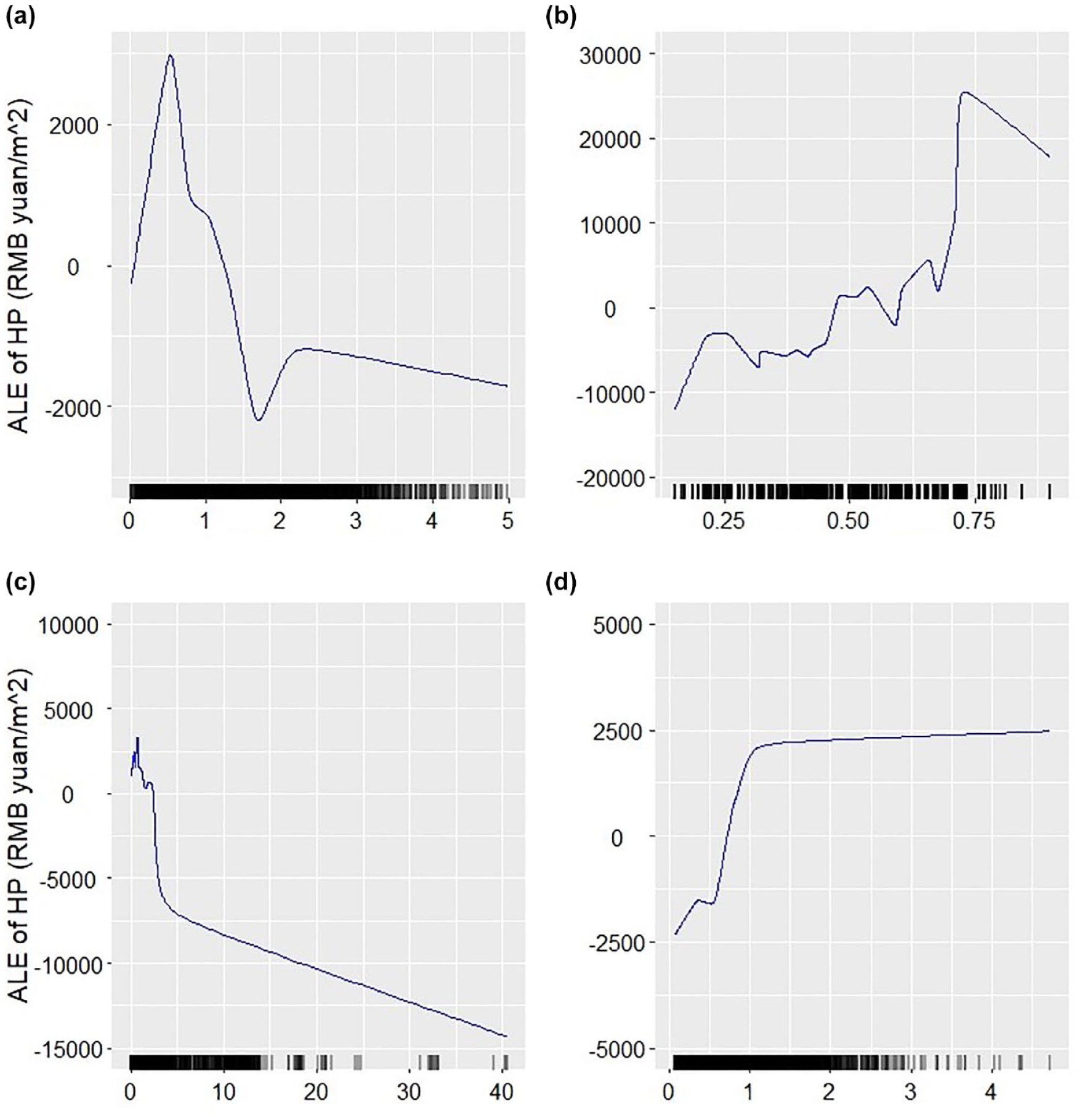
ALE main effects for public facilities. (a) d_edu (km). (b) q_edu (ratio). (c) d_metro (km). (d) d_hospital (km).
After controlling for the possible weakening of the effect caused by the distance or quality-decaying characteristics of the public goods capitalization, this study observes the heterogeneity of the public goods capitalization produced by tenure categories. The interaction effect in the ALE plot is the additional interaction effect of the features after we account for their main effects (Apley and Zhu, 2020). We obtained the interaction effect plots for the public facilities variables and the dummy variable of informal tenure, which has the same connotation as the interaction term in Model 3. Since the informal variable is dichotomous, this study uses line plots (Figure 3) to present the differences visually for capitalization effects of SPRH and FPRH prices, with the yellow and blue graph lines indicating trends for interaction effects value for SPRH and FPRH respectively.
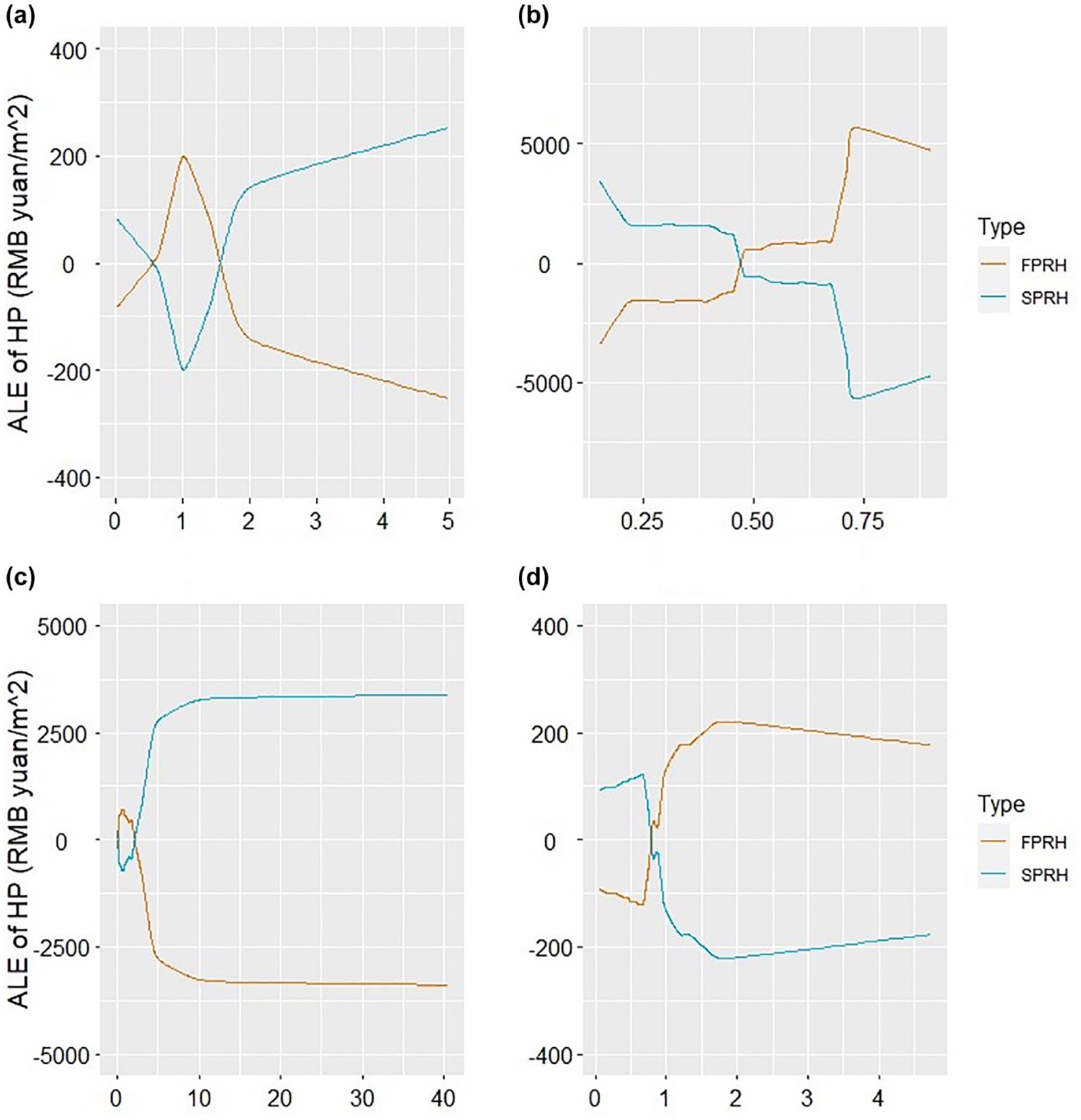
ALE plots for the interaction effects of public facilities and tenure type. (a) d_edu (km). (b) q_edu (ratio). (c) d_metro (km). (d) d_hospital (km).
If there are no interaction effects between housing prices and distances to public middle schools after 0.5 km, the decrease in housing prices would be the same regardless of tenure type. However, Figure 3a indicates an interaction between the proximity to public middle schools and informal tenure since the value of the interaction varies for the different tenure categories. After about 0.5 km, the main effect of the distance to public middle schools decreases housing prices as the distance increases, and the interaction effect for the SPRH increases with distance, which means the main effect of d_edu is discounted in informal housing. As for the education quality variable, the interaction effect for commercial housing increases as quality grows, in line with the main effect trend of education quality, while the opposite occurs with SPRH. For the metro station, the main effect tends to decrease with the increasing distance after ignoring the proximity discount (Figure 2c). The interaction effect of the metro station and tenure type exhibits an incremental tendency in SPRH, which suggests that the capitalization effects of metro stations are reduced in SPRH. By similar logic, the capitalization effect of hospitals is also weakened in SPRH.
As shown in Figure 4, the main effect of public facilities combined with the interaction effect between public facilities and tenure types helps better visualize how public facilities capitalization rates differ between the two housing types. It clearly shows that, for all types of public facilities, SPRH has a smaller slope than FPRH due to the attenuation of the main effect by the interaction effect of tenure type. Thus, based on the GBDT results, we find that the capitalization effect of various types of public facilities in SPRH is weakened not simply due to the poor provision of public facilities around SPRH, but the uncertainty of property rights, therefore, leads to a decrease in residents’ willingness to pay.
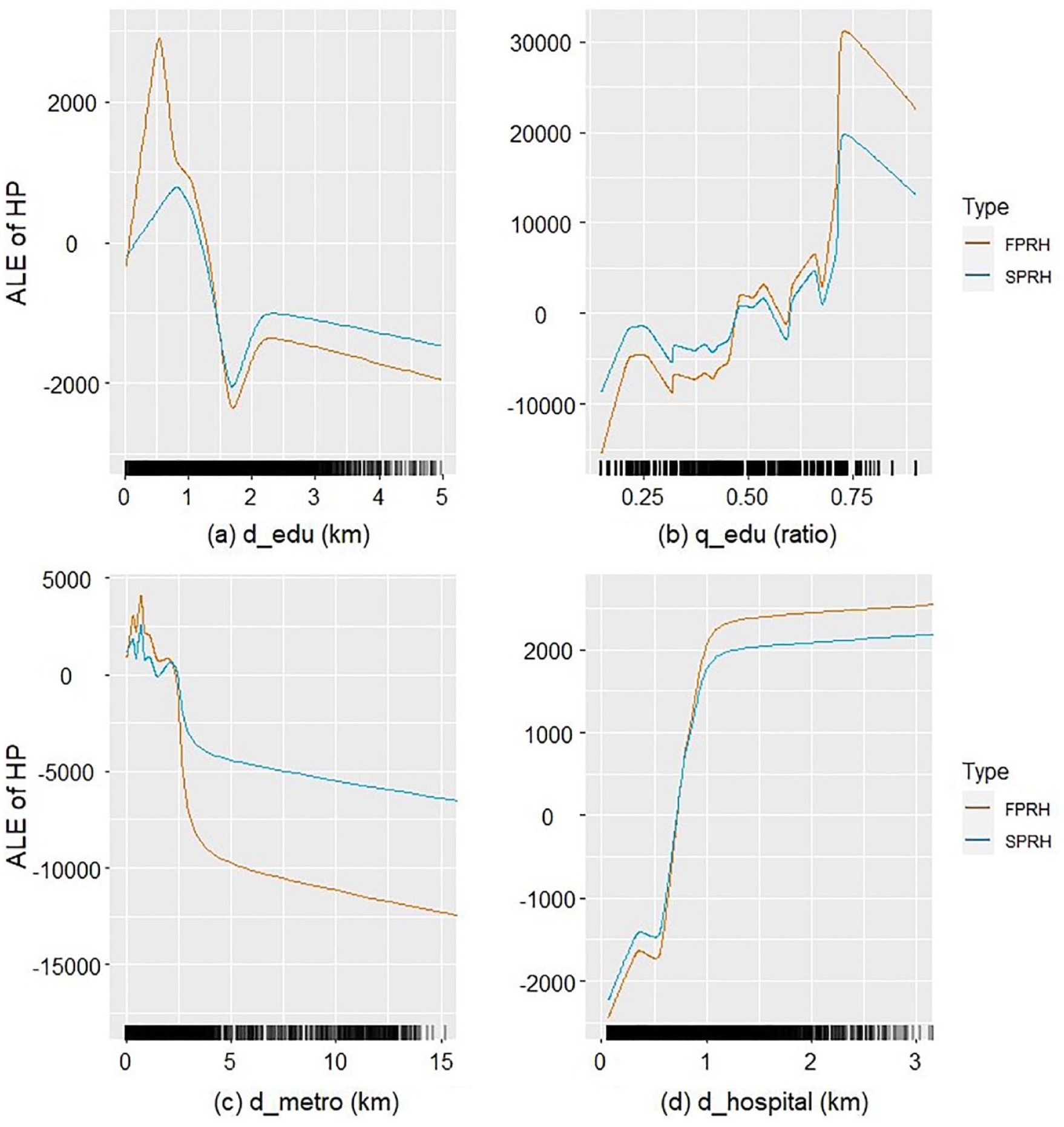
ALE plot for the total effect of the public facilities and the interaction effect of tenure types and public facilities.
Discussion and conclusion
As urbanization progresses, housing inequalities within China’s large cities are becoming more pronounced (Li and Wei, 2020; Wang et al., 2021). The inequality between formal and informal settlements has also been gradually emphasized (Lai et al., 2017; Liu et al., 2018; Webster et al., 2016). However, there remains a limited understanding of the mechanism and actor within the informal housing market. Using evidence from Shenzhen, China, we explore the disparities of willingness to pay for public facilities between commercial housing and SPRH markets to identify the neglected utility usage needs of people living in informal settlements. We enrich the understanding of the SPRH market by analyzing the characteristics and behaviors of its homeowners from public facilities perspective.
First, housing tenure can be capitalized into housing prices, and incomplete property rights lead to significant decreases in housing prices. Second, this study not only reveals that the tenure-induced heterogeneity of public facilities capitalization exists between SPRH and FPRH but also distinguishes the differential willingness to pay among homebuyers in these two housing markets. Public facilities, such as the quality of public middle schools and the proximity to the nearest metro stations, tend to show significantly greater impacts on housing prices for FPRH than for SPRH in the semi-logarithmic model. For public middle schools whose access is tied to housing tenure, the difference in marginal willingness to pay between households in SPRH and FPRH is greater than for public facilities not tied to tenure, such as metro stations. Using the GBDT model, this study finds that the informal tenure still attenuates the capitalization effects of SPRH by estimating the interaction term of informal tenure and public facilities after controlling for the systematic differences in public facilities provision between the two housing types. People living in informal settlements are less willing to pay for public facilities whose accessibility is undermined by the institution.
This study reveals that residents of informal settlements claim their rights to the city through the informal housing market with a lower marginal willingness to pay for public facilities. The housing demand characteristics for homebuyers of informal housing identified in this study are useful for planners and policymakers to understand housing market behavior. Given the current function of informal housing in large cities and the high demolition costs of these illegal buildings (Lin and Lin, 2023), our findings suggest that the quantity and quality of public facilities provision near informal settlements should be improved to achieve the sustainable development in informal settlements and a win-win situation for both formal and informal housing (Wang, 2023). The absence of adequate infrastructure and public facilities in informal settlements is widely recognized as a prevalent issue in cities of developing countries with substantial informal settlement populations (Snyder et al., 2014; Wagle, 2022). Therefore, it is important to dismantle the institutional barriers that prevent owners of informal housing from accessing public facilities, instead of directly denying them these choices through institutional instrument (Chen and Yeh, 2019; Huang and Yao, 2023). Given the strain that informal housing places on municipal infrastructure and urban fiscal system, municipal finances could be subsidized by charging informal housing students more than the study tuition of students living in formal housing. Therefore, in order to avoid aggravating inequalities at the institutional level, the needs of both formal and informal settlements should be integrated in the planning of public facilities and the design of public facilities policies.
Despite the above findings, this research also has limitations in the following aspects. As a result of the interplay between government regulation and spontaneous action, Shenzhen’s informal housing has developed various types based on tenure, which goes beyond the formal-informal dichotomy based on the presence/absence of full property rights (Webster et al., 2016). However, due to data limitations, this study ignores the continuum concept of the form of property rights. Second, due to the challenges in obtaining transaction prices for SPRH, this study relies on listing prices. It’s notable that listing prices often diverge from actual transaction prices, a variation largely stemming from bargaining strategies that the seller may take into account when establishing the listing price. However, since these deviations are systematic, their effect on the model estimates is essentially negligible. Future attempts could observe differences in the capitalization effects in rent on the continuum concepts of property rights.
Footnotes
Declaration of conflicting interests
The author(s) declared no potential conflicts of interest with respect to the research, authorship, and/or publication of this article.
Funding
This research received funding from National Social Science Foundation of China (grant number 17BJY224), National Natural Science Foundation of China (grant number 41971205), as well as the Fundamental Research Funds for the Central Universities, and Techand Open Fund of Laboratory for Urban Future, Peking University (Shenzhen) (grant number: 201901).