



Abstract
The transformation of urban sanitation is critical to achieving sustainable development. However, recent research challenges the assumption that the networked sanitation systems of the industrialized world are universally desirable. Instead, there is a growing call for practice-oriented scholarship and policy-making that start with an analysis of what people actually do in their everyday lives as they interact with differentiated, decentralized, or alternative sanitation infrastructures. This paper explores the relationship between sanitation infrastructures and socio-political urban geographies, and investigates how sanitation practices are shaped by and, in turn, shape human ecosystems in rapidly urbanizing contexts. We propose a refined human ecosystem framework (HEF) that foregrounds the role of embodied practices in mediating between material and social domains within the unequal, politicized, and contentious processes of urban metabolism. Using contemporary Shanghai as a case study, we examine the socio-material-temporal characteristics of existing sanitation practices and their connections to heterogeneous sanitation infrastructures. Through this, we demonstrate how cultural beliefs and social norms shape infrastructure functionality and the broader sustainability of sanitation systems. This paper contributes to the ongoing debate on the politics of sanitation infrastructure and highlights the need for context-specific approaches to sanitation planning and implementation that center on local practices.
Keywords
Introduction
Urban sanitation transformation is a critical component of sustainable development. In the Global South, dysfunctional sanitation infrastructures exacerbate negative socio-environmental impacts when coupled with rapid urbanization. Recent scholarship, however, acknowledges that networked sanitation in the minority industrialized world may not be as unquestionable, reproducible, and universally desirable as previously assumed (Coutard and Rutherford, 2016; Lawhon et al., 2018; van Vliet et al., 2010). Instead, human waste can be treated in differentiated, decentralized, or alternative ways. For example, in Kampala, latrines are part of urban infrastructures that connect multiple actors and provide pathways towards a more affordable and sustainable sanitation system (Lawhon et al., 2022). In Hanoi, variegated ways of waste recycling exist beyond, and entangle with, centralized waste technologies prioritized by state-led planning (Schramm and Mai, 2019). In Shanghai, night pots are used and emptied in gutters or excrement collection stations where access to a household flush toilet is unavailable (Iossifova, 2015).
The diversified artefacts, relations, and operations involved in delivering sanitation services point to the concept of ‘heterogenous infrastructure configurations’ as parts of geographically spread, and unevenly distributed, socio-technological configurations (Lawhon et al., 2018: 722). These configurations foreground the interdependent relationships between social and material structures in cities, opening up new possibilities for use, maintenance, and innovation. As dynamic socio-material configurations, various ‘informal’ sanitation infrastructures in Southern cities also raise questions about how different sets of artefacts, actors, and social relations are connected with each other in everyday life, through which the politics of sanitation systems is produced, sustained, or transformed (McFarlane and Silver, 2017; McFarlane et al., 2014).
Acknowledging the everyday realities of heterogeneous sanitation configurations, a growing body of research in urban studies seeks to gain a more intricate understanding of the complex social, material, and political aspects of sanitation by examining everyday sanitation practices of marginalized groups, such as women (Dombroski, 2015; Truelove, 2011), the urban poor (Iossifova, 2015), and rural-urban migrants (Huang and Yi, 2015; Pow, 2017). Among these studies, how sanitation and hygiene are experienced, perceived, sensed, (re-)evaluated, and (alternatively) achieved in everyday life are examined to unravel the ‘socio-eco-technical entanglements’ of sanitation (with ‘eco’ referring to both ecological and economic characteristics and processes, Iossifova, 2020: 111) and their implications for broader urban socio-political problems (socio-spatial differentiation, stigmatization, poverty, and gender inequality).
Practice-oriented scholarship urges research and policy-making communities to start from what people actually do, rather than any preconceived standards of what they should do, for a better understanding and planning of water, sanitation, and hygiene in the Global South (Alda-Vidal and Browne, 2022; Dombroski, 2015; Iossifova, 2020; Liu et al., 2022). In this paper, we respond to such calls by bringing together ideas from urban metabolism (Kennedy et al., 2007; Swyngedouw, 2006) and practice theories (Maller, 2019; Shove, 2016; Shove et al., 2012) to examine the interplay between sanitation practices and human ecosystems in rapidly urbanizing contexts. By critically examining how the multiplicity of sanitation practices relates to the contested processes of metabolic urbanization, we also seek to contribute to ongoing debates about metabolic inequalities and politics of urban sanitation infrastructure in the Global South (Lawhon et al., 2018; McFarlane, 2013; McFarlane and Silver, 2017; McFarlane et al., 2014; Truelove, 2011). While sanitation provides a potential site for reconceptualizing the materiality of urban space, our study alerts urban planners and geographers to move beyond legitimizing the modernist ideal of sanitation and attend to how existing metabolic practices are interwoven with wider socio-material (re-)configurations, which may lead to multiple and sometimes unexpected social, political, and ecological consequences.
In the following sections, we introduce the theoretical approaches upon which our work draws and provide a concise overview of how sanitation practices differ and are experienced in urban China. We then describe the methodology and present a typology of sanitation practices in contemporary Shanghai, where networked and decentralized infrastructures continue to coexist (in contrast to networked, water-borne sanitation in Global North cities). By analyzing their material, cultural, and temporal characteristics, we explore how sanitation practices sustain, produce (and are reproduced by) essential components of urban social systems, including social institutions, cycles, and orders. We conclude by calling for increased attention to embodied metabolic practices to identify sanitation systems that are more sustainable, adaptive, and resilient to environmental, demographic, and resource pressures in the Global South and elsewhere.
Situating socio-metabolic practices within human ecosystems
This section provides an overview of various approaches to understanding complex urban processes and their interdependence with social, economic, ecological, technological, and cultural systems. We briefly introduce the human ecosystem framework (HEF), urban metabolism, and practice-theoretical approaches that acknowledge the interconnectedness of bodily practices and materiality within socio-material landscapes.
The HEF (Machlis et al., 1997) is a useful tool for the comprehensive analysis of human-environment relationships across multiple scales (such as the household, the regional, and the global). It acknowledges three kinds of critical resources that support social systems: natural resources (e.g., energy, fauna and flora, wood, and water); socioeconomic resources (e.g., information, population, and capital); and cultural resources (e.g., myths and beliefs). Human social systems, in turn, regulate the flow and use of critical resources. They consist of three subsystems: social institutions (solutions to universal social issues such as health and hygiene), social cycles (temporal patterns for allocating human activity), and social order (sets of cultural patterns for organizing human interaction). Human ecosystems continue to exist, endure, and function through the dynamic interconnection, interdependence, and interaction of their ecological and social components. Although the framework overlooks human bodies – which often constitute infrastructure (Andueza et al., 2021; Truelove and Ruszczyk, 2022) in addition to carrying out the metabolic practices that sanitation systems are designed to support – we rely on it here as a useful starting point for our investigation of interactions between sanitation and broader social, technical, and otherwise defined systems.
While HEF illustrates the resources (inputs) of the social system, we draw on the notion of urban metabolism to underline human bodily wastes and other outputs of cities. Urban metabolism is used metaphorically to analyze ‘material exchanges between organisms and the environment’ and the ‘bio-physical processes within living (and non-living or decaying) entities’ (Swyngedouw, 2006: 22). The concept of urban metabolism is exemplified by the bacteriological city of the nineteenth century which views cities as self-regulating systems of material flows (Gandy, 2004). Assuming that metabolic flows can be traced and measured, the urban-metabolic perspective forms the basis of a technocratic and rational approach to managing municipalities. However, the approach fails to fully capture the complicated interweaving of social, technical, and ecological systems rooted in wider processes of change (e.g., messy and invisible forms of water infrastructure in marginal urban spaces, see McFarlane, 2013; McFarlane et al., 2014; van Vliet et al., 2010).
This paper considers practice as the central component of bio-social life and the fundamental unit of analysis (Maller, 2019; Shove et al., 2012). A practice refers to a routinized type of activity that involves the active integration of various bodily, material, and cultural elements (Reckwitz, 2002; Shove et al., 2012). As material and institutional arrangements, infrastructures relate to the existence, persistence, and diffusion of everyday practices, so they are outcomes of everyday life (Shove, 2016). Time and space are integral parts of practices, intertwined into their trajectories and affecting the temporal and spatial characters of everyday life (Shove et al., 2012). Practice-theoretical approaches acknowledge that metabolic activities of human bodies (such as eating, sweating, defecating) are not only physiological but also bio-social processes. These processes (1) require both biological and social components; (2) shape and modify other practices (such as feeding and waste treatment); and (3) have implications for political questions related to health, wellbeing, and justice (Maller, 2019). In considering the interconnectedness of bodily practices, materiality, and urban metabolism within socio-material landscapes, practice-theoretical approaches can provide new opportunities for researchers and policy makers to foster positive socio-environmental change.
We place embodied practices at the intersection of critical resources and human social systems, indicating that the interactions between resources and social systems inherently lie in what people do in everyday life (Figure 1). Embodied practices enable the use, regulation, or transformation of resources, as well as the mobilization, reproduction, or alteration of social systems. The role of human bodies in relation to larger socio-metabolic systems is also highlighted (cf. Andueza et al., 2021). The outputs of urban metabolism, including bodily waste products (excrement, urine, vomit), are generated by embodied practices, regulated through technical measures (e.g., purification, compost, or fermentation), or repurposed in other practices (e.g., fertilization or construction). To what extent they could be reused as resources or have significant impacts on ecological and social systems also depends on how practices that deal with bodily waste are performed and interwoven into the nexus of wider social practices.
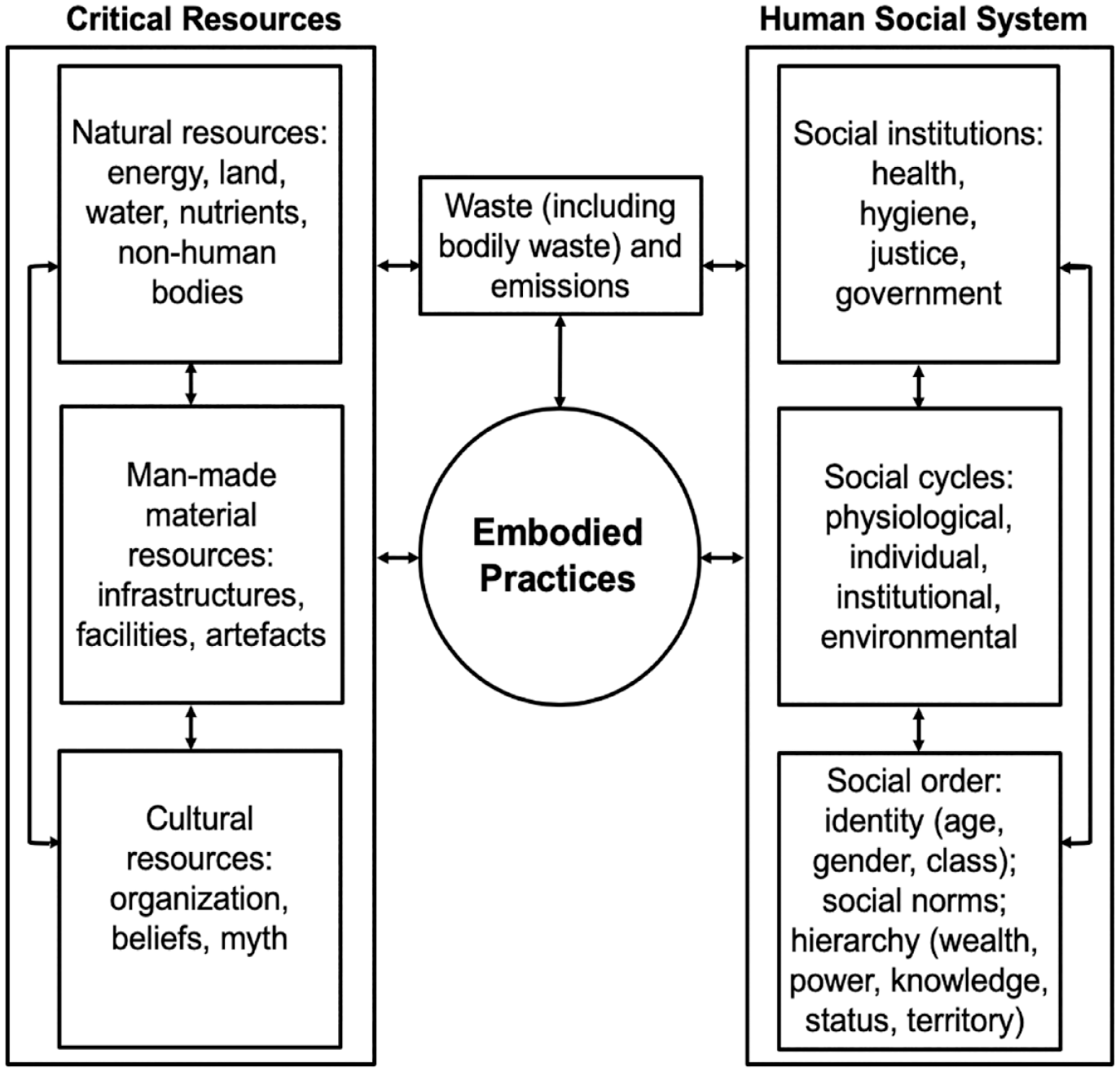
A refined human ecosystem framework (adapted from Machlis et al., 1997).
In cities, the human metabolic bodies and their waste (dirt, smell, and solid waste) are judged and disciplined through moral discourse (Douglas, 1991; Miller, 1997). This reflects the metabolic circulatory process of cities, i.e. ‘an implosion of socio-natural relations’ that are inevitably infused with power configurations that permeate material, symbolic, and imagined practices (Swyngedouw, 2006: 33). We focus on the socio-physiological practices involved in the creation and disposal of human waste, including urination, defecation, and cleansing, which forefront the politics of sensory experiences that shape urban life through socio-metabolic processes. By examining how bodily senses contribute to, and are impacted by, specific, interactive, and unequal metabolic exchanges between individuals and their environment, we can move beyond merely measuring metabolic flows, storage, and networks, and develop a better understanding of the power dynamics inherent in sanitation systems production and reconfiguration (cf. Iossifova, 2015; Pow, 2017). The complexity of embodied practices also reminds policy makers to appreciate existing socio-material contexts and the creativity of local communities, rather than solely promoting the paradigm of networked infrastructures in planning densely populated and fragmented cities (Coutard and Rutherford, 2016; Dombroski, 2015; Lawhon et al., 2018; Ren et al., 2022; Schramm and Mai, 2019).
Sanitation infrastructure and practices in urban China
Sanitation in urban China is undergoing a transformation from closed-loop, service-networked sanitation, which allowed night soil produced by urban households to be composted and used as fertilizer in the countryside, to sewage-based, water-borne sanitation that is resource-intensive, wasteful, and potentially harmful to the environment due to the indiscriminate discharge of fecal sludge (Iossifova, 2020). Such sanitation transitions have been identified to correlate with rapid urbanization in older neighborhoods in Chinese cities (Ren et al., 2022). Urban sanitation standards have improved due to significant events, such as the Shanghai Expo and Beijing Olympic Games, resulting in intended advances to urban landscapes and hygiene. These include a considerable increase in the number of public lavatories and sanitation facilities (e.g., blocks of public water taps) and upgrading existing facilities. However, many low-income inner-city neighborhoods, which are part of urban heritage preservation programs, continue to rely on service-based sanitation systems. These neighborhoods cannot be connected to the municipal sewerage system without reconstruction.
Since 2015, President Xi’s Toilet Revolution has launched several provincial and municipal programs to improve sanitation throughout China, including toilet retrofitting in rural areas and expanding public toilets surrounding tourist attractions (Cheng et al., 2018). Attempting to enhance the country’s image and people’s hygiene and health, these projects tend to reinforce a modernist ideal of networked cities with large, centralized technical systems that are not easily transferred to diverse urban contexts in the Global South (Coutard and Rutherford, 2016; McFarlane, 2008; McFarlane et al., 2014). Where it is impossible to implement large-scale, water-borne, and sewer-based sanitation systems, multiple hygiene and sanitation infrastructures and practices continue to coexist, deconstructing normalized and standardized ideas derived from developed countries (see Dombroski (2015) for the conventional sanitation practices in Northwest China that are environmentally friendly alternatives to those of the minority world).
The unequal distribution of sanitation facilities and infrastructure in Chinese cities has led to varying sanitation practices across different neighborhoods and urban villages, creating disparities in access (Iossifova, 2015). In Shanghai, differences in socio-metabolic practices result in processes of differentiation, marginalization, and exclusion, perpetuating socio-material inequalities for low-income urban residents who are not entitled to, or cannot afford, ‘modern’ sanitation services (Iossifova, 2015, see also Pow, 2017). This is particularly evident for migrant workers whose bodily practices are often devalued by locals, as we will demonstrate in the following sections.
Methodology
This research aims to examine the interplay between sanitation practices and socio-eco-technical systems to improve sustainability outcomes. We conducted fieldwork in six neighborhoods in Shanghai between 2019 and 2022, selected for their diverse socioeconomic characteristics and infrastructural attributes. Due to the ongoing COVID-19 pandemic and frequently changing local conditions and regulations, we made multiple adjustments to our methodology to ensure the safety of participants and the research team.
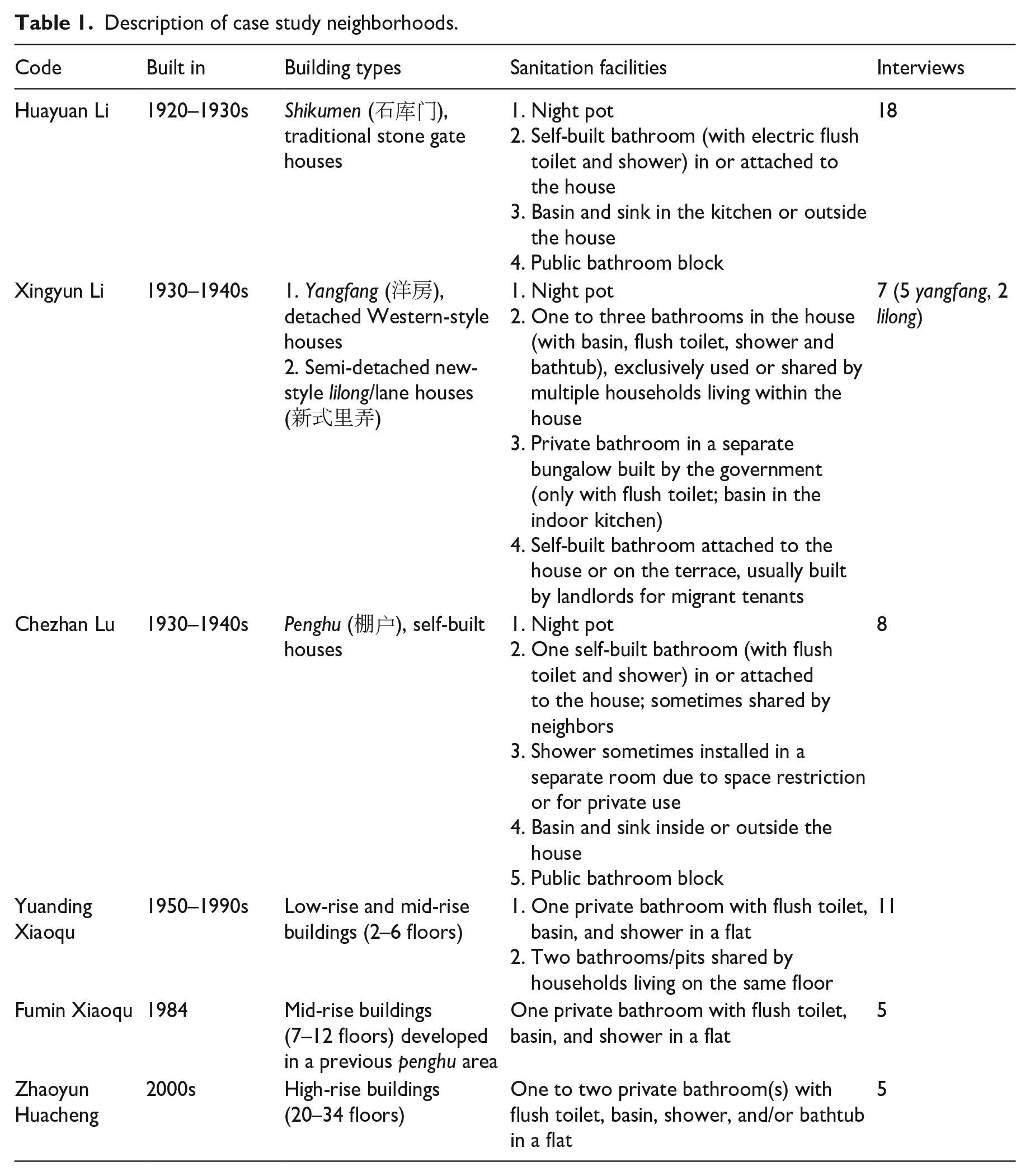
To gather data, we conducted open-ended interviews to elicit insights into everyday practices of sanitation and personal hygiene and their relations and interactions with components of the HEF. We did not attempt to recruit a representative sample but used snowball and convenience sampling to select participants in the six case study areas (Table 1).
Description of case study neighborhoods.
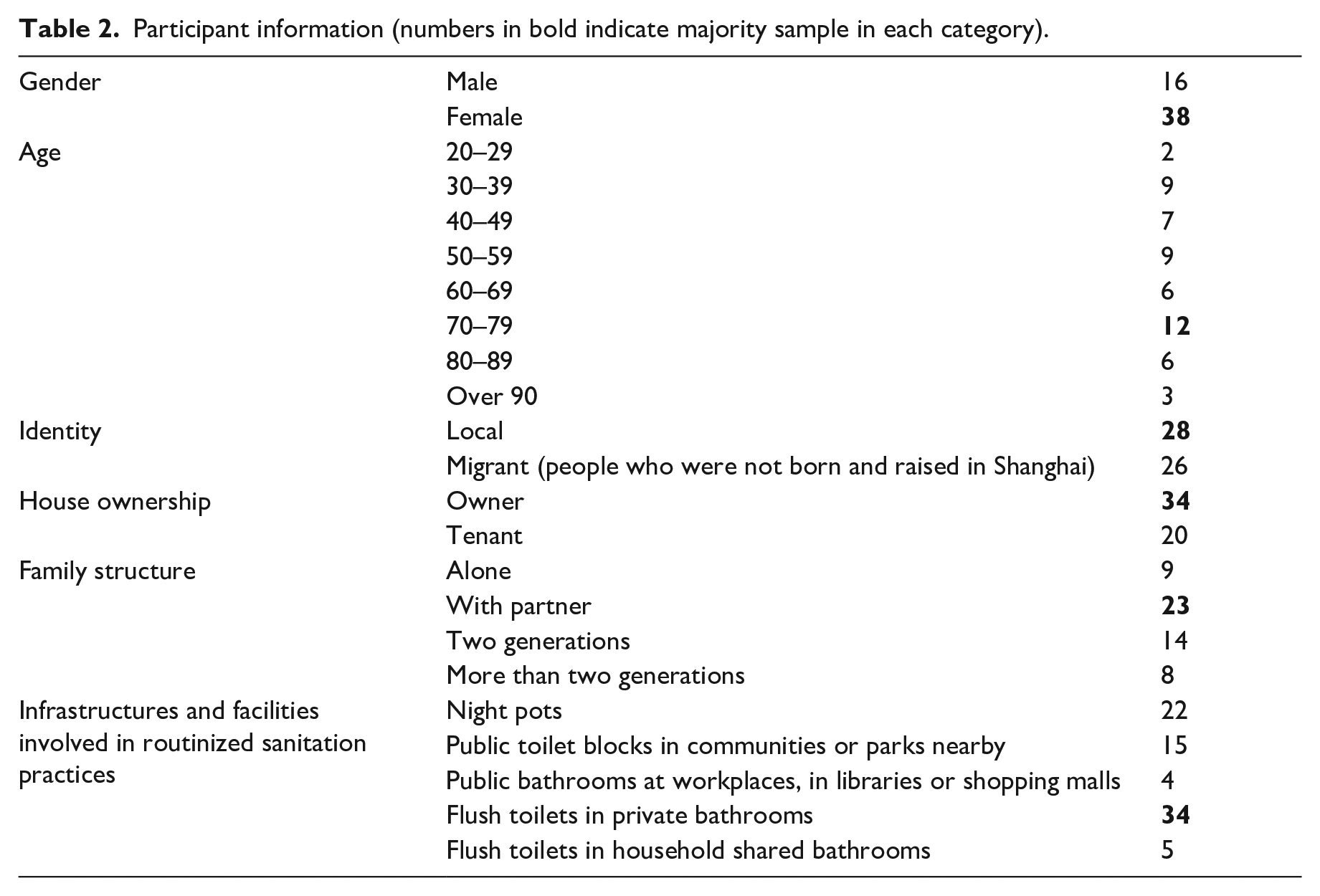
We included individuals from different categories of gender, age, and socioeconomic/hukou status to capture diverse experiences and perspectives (Table 2). A total of 54 participants were interviewed, with interviews lasting between 45 to 90 minutes. We also conducted walk-along interviews to gain insights into participants’ views on planned, ongoing, or completed sanitation transitions in locations where sanitation-related activities or interventions took place. The disparity in gender was an outcome of snowball sampling. From our fieldwork experience, women seemed to be more interested and engaged. Compared to migrant men, migrant women usually work flexibly or part time, which increased the likelihood of encountering and recruiting migrant women in the daytime. As discussed in the following section, the gender disparity in our sampling enabled us to discern the inherent gender inequality in urban sanitation systems.
Participant information (numbers in bold indicate majority sample in each category).
To analyze the data, we used the constant comparative method, a grounded theory approach (Glaser and Strauss, 1967). This involved comparing data points to identify patterns and themes in the data. We replaced all identifying information to ensure anonymity and protect participants’ privacy.
Sanitation infrastructures and practices in Shanghai
In this section, we explore (1) how people use infrastructures to manage bodily waste in their everyday lives; and (2) whether and how these practices are interconnected with other everyday practices (such as going to work). Our analysis identifies three key types of infrastructure that shape sanitation practices in Shanghai: night pots, public bathrooms, and household flush toilets. Depending on their circumstances, individuals may use any one of these resources or a combination thereof. Our aim is not to provide an exhaustive overview of all sanitation infrastructures and practices in the city, but rather to highlight distinct material, cultural, and temporal characteristics of sanitation practices and their interconnections with the city’s socio-metabolic fabric.
Using night pots
Before the introduction of piped sewerage services in Shanghai, it was customary to use night pots for excretion needs. Family members shared a wooden bucket (matong), which had to be cleaned by older female family members. The collected human excreta was transported to suburban areas for use in farming. Contemporary versions of the wooden bucket are still used by households in many shikumen, yangfang, and penghu communities (see Table 1 for definitions). Night pots are typically emptied at excrement collection stations within the neighborhood before going to work or before bedtime. Subsequently, the pots are rinsed under running water and dried in the sun (Figure 2). Most households reported disposing of the fecal matter immediately after use to avoid unpleasant odors.
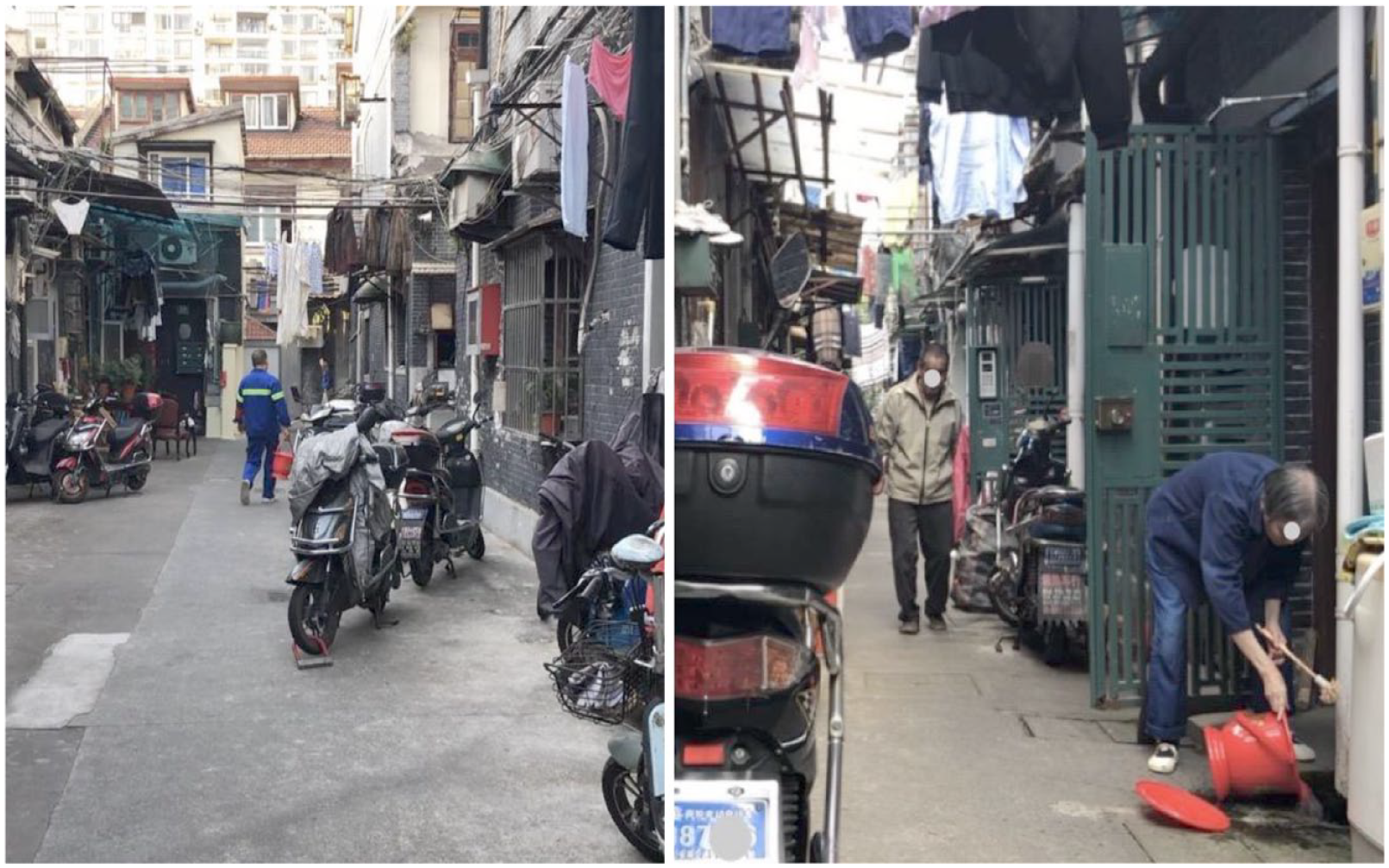
Emptying a night pot at the excrement collection station (the red roofed small building, left) and washing it outside of the house (right).
Various techniques have been developed to maintain the cleanliness and hygiene of night pots. One effective approach is to choose enamel-coated night pots to prevent corrosion and rust. Another option is to use surfactants, such as soap, laundry detergent, or disinfectants, to clean the night pot thoroughly. Leaving a small amount of water in the night pot after cleaning can also prevent the build-up of dirty and smelly sediment at the bottom. Xu, a 55-year-old woman, used wastewater from washing vegetables and clothes to clean the night pot. However, local participants lamented that to save time, migrant tenants were covering their night pots with plastic bags and then disposing of their excrement, along with the bags, into the collection station (Wang; Lu). This led to frequent blockages and the overflowing of fecal sludge, creating a public health hazard.
It was customary for women to be responsible for cleaning night pots. When asked about this convention, both male and female participants would cite a superstitious belief – as Jiang You (62, female local) put it: ‘If a male household member washes the night pot, the household will have bad luck. . .that’s the consensus’. The gendered division of household labor is exacerbated by nearby public bathroom blocks that feature only urinals and have no female seats and facilities for menstrual waste. Such masculinist public bathroom design increases women’s reliance on night pots at home and associated housework. Resonating with women’s sanitation practices elsewhere in the Global South (Alda-Vidal and Browne, 2022; Truelove, 2011), this example highlights how gendered experiences of sanitation intersect with cultural and infrastructural legacies that devalue women’s metabolic and sanitation needs, rights, and labor within households and communities.
Using public bathrooms
The use of public bathrooms is common where residents do not have access to sewered facilities. Participants expressed a preference for public bathrooms that are clean, located in proximity to their residence, and do not require waiting in long queues. Visiting family members and friends also preferred using a public bathroom instead of night pots inside the participants’ homes. Participants mentioned that younger family members who had moved out of the community barely stayed overnight due to the inconvenience of using public bathrooms (Jiang Ye; Xu).
Unequal sanitation infrastructural legacies in the city leave women in underserved communities with no choice but to use night pots or walk longer distances to find public toilets that suit their metabolic and physiological needs. When Zhu (25, female migrant) was pregnant and needed to pee, she felt helpless when finding that the public bathroom in the community contained only urinals. This experience confirmed her husband’s desire to build a private flush toilet in their rented penghu house (see Section 6.1). Zhuang Yu, a female migrant worker living in the shikumen community, had to walk across a busy road several times a day to reach public bathrooms in parks or local markets (Figure 3). She, and many other migrant women, would deliberately drink less water and go to bed earlier especially during their periods to avoid using public toilets at night.
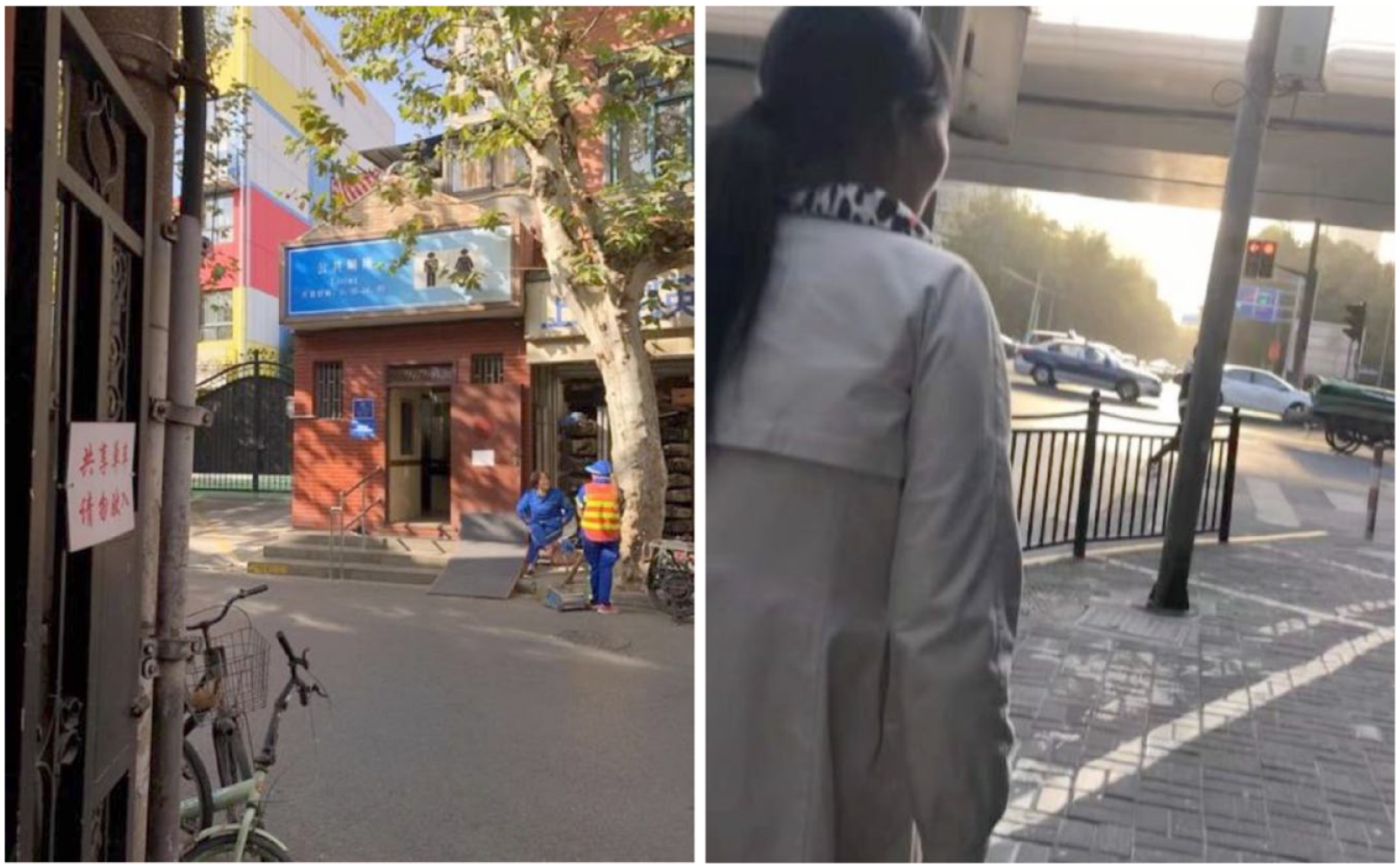
A public bathroom block adjacent to a shikumen community (left) and a female migrant worker on her way to a public bathroom (right).
Participants reported remarkable changes in the availability of public bathrooms in Shanghai over the past decade. While middle-class participants take advantage of clean public bathrooms (run by enterprises and public institutions) at work as part of their routine (Li Ye, 32, female researcher; Miao, 25, female office clerk), retired participants who have access to flush toilets at home also enjoy using modern sanitation facilities open to the public. For instance, Gao (60, male) washes his hands with hot tap water in public bathrooms on his way home. Zhang Jian (an 80-year-old male) frequents public restrooms in libraries, museums, and shopping malls with good sanitary facilities and free tissue dispensers: Flush toilets automatically provide disposable paper toilet seat covers. It comes out every time you press the button on the toilet. Very clean. . . . These public toilets are managed by special personnel, so the sanitary conditions are relatively refreshing. They also ask people to stop smoking in the toilet.
The insights from the interviews indicate that using public bathrooms is intricately linked with personal beliefs about hygiene and cleanliness. The sensory system plays a critical role in shaping these perceptions, especially the haptic, olfactory, and visual senses. Most participants expressed a preference for squat over sitting toilets (which has become the mainstream in public bathrooms in recently constructed buildings) to avoid physical contact with the toilet surface, an object that they perceived to be contaminated by other users’ bodily waste. For instance, Zhu and Tang’s husband assumed the ‘horse stance’ (squatting above the toilet bowl) instead of sitting when using non-private Western-style toilets. The texture of sanitary products also appeared to influence participants’ evaluation of sanitary conditions. Like Ji Ye (76, male) mentioned, the foam-like hand sanitizer in public bathrooms implies its hygienic standards. Conversely, olfactory experiences do not only affect people’s willingness to use a public bathroom but even may exert an influence on the local management of sanitation infrastructure. Some older public restrooms were locked to prevent the stench from spreading in the neighborhood (Gu; Lu Yu).
Using household flush toilets
In yangfang and gated communities, participants usually have flush toilets at home. A routinized sanitation practice includes washing hands before using the toilet, using toilet paper after excretion, pressing the flush button, and washing hands with soap or hand sanitizer. Participants from affluent households reported that their use of flush toilets is accompanied by an expanding array of social norms and hygiene techniques. For example, it is considered impolite to touch or greet others with unsanitary hands after using the toilet (Qin, 80, male). Male family members are expected to put the toilet seat down after urination for the convenience of females (Chang Ye, 75, male). An emerging technique among participants with young family members is to put down the toilet seat cover to prevent the transmission of bacteria through children’s direct contact with water or droplets from flushing.
Participants reported using a range of hygiene products to clean and dry their bodies after a visit to the toilet. Wipes, tissues, and other hygiene products are common among households with infants, who require more careful attention to personal hygiene. For instance, Qiu (33, male) acknowledged that his awareness of personal hygiene grew with his wife’s careful selection of hygiene products for their baby. The young couple also tried to prevent his father from smoking in the bathroom for the sake of their infant’s health. Chang Yu (35, female), who had a pre-school daughter, dubbed their family ‘a tissue store’ (Figure 4): We have four kinds of tissues at home: napkins, tissues, toilet paper, and wipes. There are several wipes: one exclusive for kids to wipe bottoms, one for mouth and hands, one for adults after pooping, taking small packages out and using larger ones at home. . . . I use rolls of paper towels to dry my hands and face and clean hairs on the ground instead of using cloth. Anyway, we consume a large amount of paper.
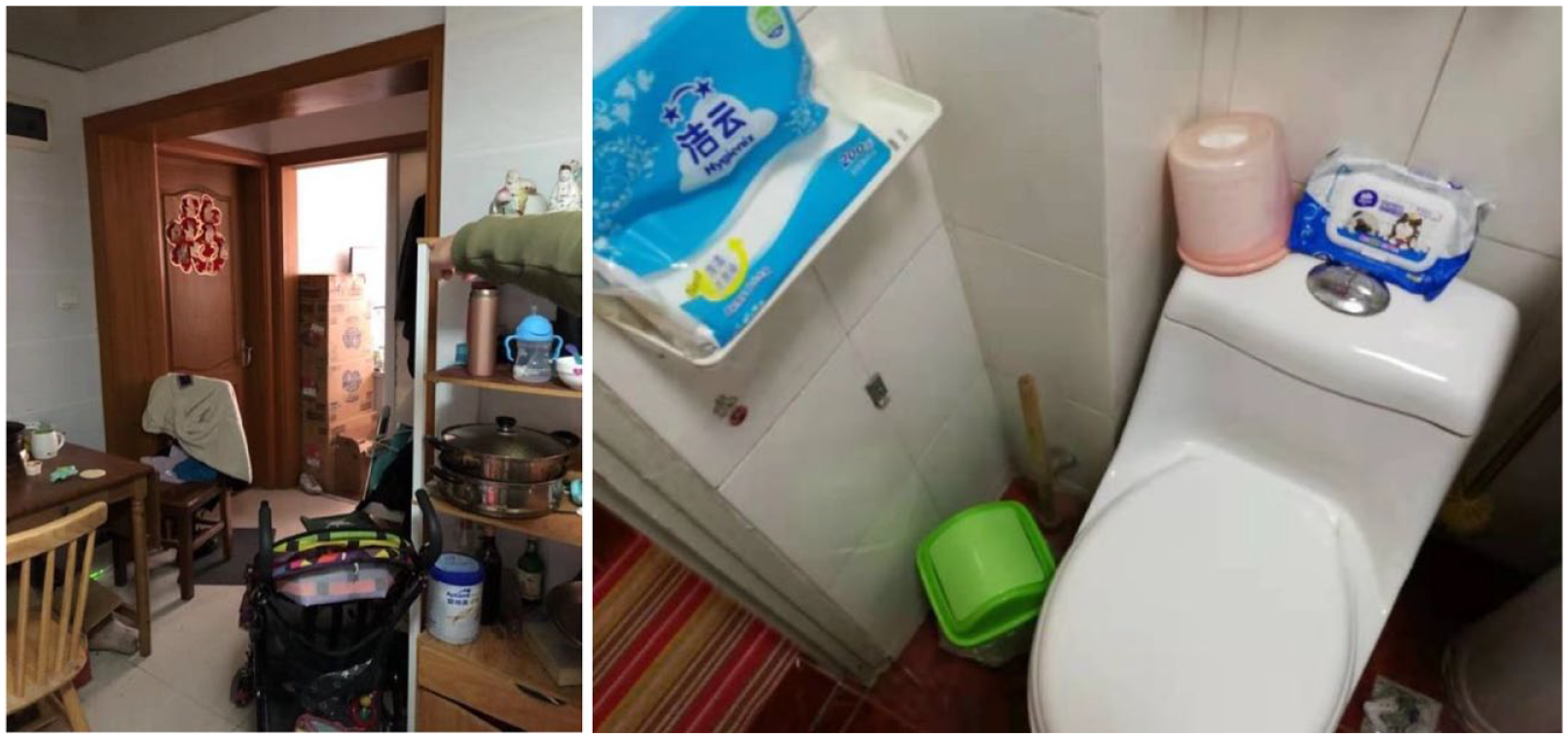
Hygiene products consumed by households in gated communities. (Left: Boxes of diapers stacked for Qiu’s two-year old son. Right: Four types of tissues in Chang Yu’s bathroom.)
In yangfang and new-style lilong neighborhoods where houses were built in the 1930s, households living in one building often have to share bathrooms. This can have a significant impact on the temporality of toileting (using the bathroom at a specific time to avoid waiting in line), social life (the potential embarrassment of asking guests to use a shared bathroom), and even physical health (due to limited access to the bathroom). Since 2015, the government has carried out renovation projects in these neighborhoods to supply each household with a private bathroom. Private bathrooms with up-to-date flush toilets and showers were either increasingly built within the house or accommodated in a separate bungalow nearby. Participants usually did not care about the increased water and energy bills associated with the use of private flush toilets because ‘it doesn’t cost much in a month’ (Ji Yu, 70, female). 1 However, despite access to a private flush toilet, older locals tend to continue using night pots for urination by their bedside, especially at night.
Sanitation practices and urban social systems
This section examines how sanitation practices interact with socio-cultural and political-ecological environments. In China, the ‘community’ (shequ) is the basic urban administrative unit that delivers public services (including sanitation) within clearly demarcated geographical boundaries at the neighborhood scale (Wan, 2016). Community social systems, therefore, represent valuable sites for exploring the intersection between metabolic bodies and wider socio-metabolic change in Shanghai’s fragmented urban fabric. Drawing from the HEF, critical dimensions of social systems, i.e., the social institution of sanitation, social cycles of everyday life, and various overlapping hierarchies, are (re)produced, contested, and negotiated.
Sanitation as a social institution
Echoing the emphasis on the blurred informal/formal binary in the literature on Southern urbanism (Coutard and Rutherford, 2016), the transformation of sanitation infrastructure and practices challenges ‘formal’ material arrangements. In Shanghai today, networked and on-site sanitation coexist, serving different segments of society.
In underserved communities and informal settlements, the desire for private flush toilets has led to a rise in self-built bathrooms (Figure 5). Depending on the drainage system, electric flush toilets may be installed to macerate excrement before it is flushed down into small-bore drainpipes. Participants pointed out two on-site infrastructures connected to self-built bathrooms: stormwater sewers (in areas where stormwater sewers and sewage pipes are not separated) or on-site septic tanks. Participants acknowledged that the flow of sewage into stormwater sewers would cause unpleasant odors and sewage overflow. Hou (60, male) stipulated that it may contaminate the Huangpu River, their drinking water source. Self-built toilets connected to septic tanks accelerate effluent and sludge accumulation. In the absence of proper management and decontamination, septic tanks are also at risk of stinking and overflowing with excrement, particularly during heavy rainfall, leading to the closure and abandonment of some self-built bathrooms attached to houses.
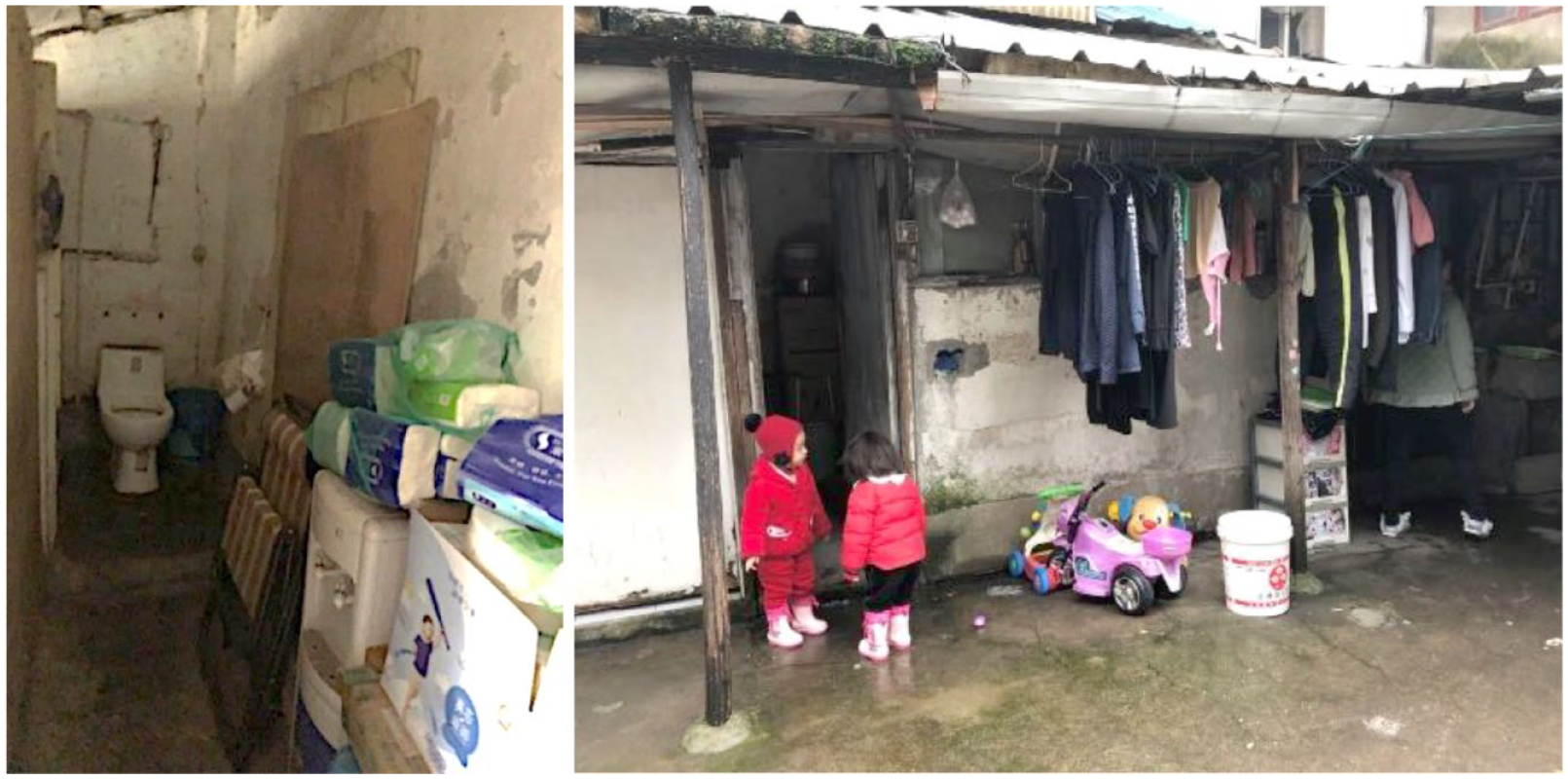
Self-built bathrooms in penghu communities.
Interviewees reported further challenges associated with septic tanks, which, in the past, played a significant role in Shanghai’s sanitation. Waste extracted from septic tanks was repurposed as manure to fertilize crops in rural areas, highlighting their importance in the region’s agricultural industry. The shift to water-based sanitation and increased use of chemical fertilizers resulted in the decreased value of human waste (Iossifova, 2020), impacting how septic tanks are managed in cities. Ji Yu noticed that sanitation workers no longer feel incentivized to empty septic tanks fully, leaving some excrement behind: In this way, the septic tank would fill up faster, then they could come more frequently and make more money. . . . It’s because things extracted can no longer make a profit.
The company in charge only stipulates that waste must be collected regularly or as required (without providing specific guidelines on frequency or process). While no large-scale evidence indicates the relations between inadequate septic tank maintenance and broader sanitation system transformations, such reflections highlight the potential value of considering on-site sanitation infrastructure management in relation to the normalization of, and rising demand for, using (private) flush toilets in urban Shanghai. The transformation of sanitation institutions thus goes beyond technological innovation and is embedded in different conjunctions of infrastructures and practices (Shove, 2016). Capturing how infrastructures and practices mutually shape each other may cast new light on the broader socio-material transformations of sanitation institutions.
Sanitation practices and social cycles
Urination and defecation follow physiological cycles that require everyone to use toilets daily. However, sanitation practices do not depend exclusively on biological rhythms. The temporal patterns of using the toilet are also shaped by the social cycles of everyday life.
For households without a flush toilet, using a public bathroom is aligned with other daily activities, such as strolling, going grocery shopping, and doing outdoor exercise. Chen Yan (40, female) usually used the toilet in her employer’s house when working as a part-time housekeeper. Jiang Ye (50, female) explained that she usually goes to the public toilet in the morning: ‘In this way I can exercise after defecation, which is effective. It takes a long time to go to the public toilet’ (see Figure 3).
The timing of sanitation practices may be influenced by collective rhythms, especially when sharing bathrooms with others. Participants who shared a toilet with their neighbors reported using it (for toileting, taking showers, and doing laundry) during the daytime to avoid peak times before and after work (Lang, Yu). Chang Ye’s father-in-law serves as an extreme example. At over 90 years old, he was diagnosed with rectal cancer, which Chang Ye believed was partly caused by frequently holding back on using the toilet to ensure that younger tenants would have access to it before heading to work.
In private bathrooms, sanitation practices are typically synchronized with an array of routinized practices related to work (e.g., checking emails on phones), leisure (e.g., reading books, online shopping and playing mobile games), and health (e.g., smoking). The coordination and synchronization of sanitation and other mundane practices, woven into the temporal patterns of everyday life, subtly influence when, how often, and for how long excretion activities occur.
Overlapping metabolic inequalities and hierarchies
Despite an emerging urban redevelopment pattern that features incremental, in situ, and micro-scale redevelopment (Li, 2022), Chinese metropolises have long been observed indiscriminate demolition projects to ‘purify’, clean, and sanitize urban space (Huang and Yi, 2015), preparing enclaves for networked sanitation systems. The centralized supply-driven planning is fed by Western imaginations of hygiene and modernity that undermine the multiplicity of varying sanitation practices and privilege high-end residential and commercial sites over social welfare (McFarlane et al., 2014, 2008). Sensory and metabolic practices among marginalized groups in urban areas are often devalued to justify urban differentiation, segregation, and exclusion (Iossifova, 2015; McFarlane, 2008, 2013; Pow, 2017).
Building on these discussions, this research reveals how metabolic inequalities intersect with pre-existing hierarchical structures that reinforce discrimination, reproduce social order, and may ferment conflicts in Shanghai. First, the intersection of everyday metabolic inequalities and the hierarchical housing market that institutionalizes exclusion and marginalization in Chinese cities forces migrant workers to repress their metabolic needs. Despite having had access to in-home flush toilets in their hometowns for years, migrant participants have to endure precarious living conditions due to the hukou system 2 and the high cost of flats with flush toilets. This transforms their metabolic practices, leaving this group physically vulnerable 3 and marginalized. When, where and how migrant workers deal with their metabolic needs is (reluctantly) aligned with unequal infrastructural and institutional arrangements. As we will demonstrate later, failure to align may lead to accusations, expressions of repulsion, or even intimidation.
Second, metabolic inequalities in Shanghai come to light through the impact of landlord interests on settlement upgrade projects. Despite recent government-led efforts to provide each household with new, private bathrooms, local participants seemed discontent because they had expected ‘demolition and resettlement’, associated with compensation and the move to recently constructed resettlement housing (equipped with ‘modern’ infrastructure). Such an urban redevelopment approach is used to purify and control urban spaces without regard to the wellbeing of migrant workers (Huang and Yi, 2015). In Yuanding Xiaoqu, we encountered a residential building with two shared bathrooms at either end of the corridor on the same floor. In stark contrast to the one renovated by a metro development company in 2017 (following the construction of a new metro station nearby), the other remained in a state of disrepair due to the rejection by the local landlords living downstairs. They feared that the chances of demolition and resettlement would decrease after the renovation of the bathroom. This revanchist response to conditions of precarity provokes antagonism in reinforcing the exclusion of migrant tenants from improved sanitation services. Lang, a migrant worker using the unrenovated bathroom, expressed their powerlessness, saying: We (tenants) can’t do anything if they (owners) disagree. They are Shanghainese. It’s their own property. They are more powerful than us. We hate them.
Finally, this research highlights a two-way sensorial hierarchization in sharing bathrooms and the wider living environment. On the one hand, local participants attribute poor sanitary conditions in public spaces to the influx of migrant populations and their ‘unsanitary’, ‘uncivilized’ metabolic practices. Yu (74, female local) believed that ‘people migrating from outside Shanghai have bad sanitary habits; they are dirty and make the environment messy’. Lu Ye, a 60-year-old female local living in a shikumen community, complained that migrant workers were ‘slobs’ because they dumped plastic bags (filled with bodily waste) and food waste in excretion collection stations. Liang, Chang Ye, Dong, and Yu differentiated their own from the practices of migrant workers on the example of throwing used toilet paper in the bin, rather than flushing it down the toilet – which bears the potential to block thin, old pipes. Locals tend to ‘educate’ migrant tenants, sometimes intimidating them in insinuating that they would be evicted if they kept ‘wrong’ sanitation habits. Yu particularly expressed resentment for the lack of concern for the functionality of infrastructures among female migrant workers: They get dressed up when going outside but don’t care about the bathroom’s sanitary condition at all. They leave garbage and sanitary napkins in the toilet, so it will be clogged and that stinks.
On the other hand, migrant participants were acutely aware of the devaluation of their metabolic bodies in the metropolis. Lou Yu (50, female migrant worker) found that urbanites blamed migrant workers for making public toilets dirty, saying: ‘if they see a migrant worker walking into the public toilet, they will not use it’. The judgment of bodily metabolic practices is not one-sided, as migrant workers also judge and criticize the conventional use of night pots. A male migrant worker (Zhuang Ye, 54) in the penghu community said the practice of using night pots was typical in Shanghai’s slums and was strange and unhygienic. Many female migrant workers living in rented houses without flush toilets found night pots disgusting. Lu Yu (40, female) stated that she would rather hold it back at night when the public bathroom blocks nearby were closed: Shanghainese don’t care. We Guizhou people never have to buy such a room where people eat, poop, and pee in the same place. Too disgusting!
Claims from both sides of the identity division based on hukou system point to what Pow (2017: 266–267) calls “the socially constructed distinction between clean, hygienic, secure, and well-educated middle-class neighborhoods (as inside) and dirty, insanitary, errant, uncivilized ‘plebianized’ margins (as outside) filled with ‘sensory-metabolic transgressions’”. While the locals tend to view migrant workers and their metabolic bodies as a source of contamination that has to be disciplined, sanitized, or eradicated, migrant workers’ visceral aversion to defecating and urinating in the place where other everyday practices occur highlights an inverted sensorial hierarchization. The sanitation-related practices of migrant women, such as menstruation management, are particularly de-valued to discursively produce gendered and classed social differences (Alda-Vidal and Browne, 2022; Truelove, 2011). The intersections of metabolic inequalities and hierarchies of hukou, gender, and power reinforce othering, mutual discrimination, sanitation struggles, and the precarity experienced by marginalized groups in the city.
Conclusions
Geographical scholarship challenges the artificial separation of nature and the city by focusing on how (sanitation) infrastructures relate to socio-political urban geographies (McFarlane, 2008; Schramm and Mai, 2019; Swyngedouw, 2006). In contrast, the refined HEF foregrounds the role of embodied practices in mediating between material and social domains within unequal, politicized, and contentious processes of urban metabolism. The study conforms with the urban metabolism perspective that appreciates the input-output mechanism of cities (Kennedy et al., 2007; Swyngedouw, 2006) and practice theories that frame material and institutional arrangements enmeshed in ongoing dynamics of practices (Shove, 2016; Shove et al., 2012). It reinstates everyday life as a key arena where sanitation processes are produced, experienced, negotiated, and contested (Iossifova, 2015; McFarlane et al., 2014; Truelove, 2011).
The co-existing heterogeneous sanitation practices in Shanghai display diverse configurations of infrastructural objects and facilities (night pots, flush toilets, sewer pipes, septic tanks, and a range of personal hygiene products) and cultural resources (beliefs of hygiene, health, modernity, and civilization). Sanitation practices such as defecation and urination are thus never merely biological metabolic activities but implicated in sets of changing social codes related to gender roles and social interactions in cities (Dombroski, 2015; Iossifova, 2015; McFarlane et al., 2014). Echoing Maller (2019), this research argues that the dynamics of bio-physical practices are implicated in the co-evolution of infrastructures and conventions.
While sanitation practices are influenced by the availability of infrastructural objects and facilities, how materials, cultural beliefs, and social norms interact with each other through the enactment of practices has significant implications for the functionality, sustainability, and politics of infrastructure (Shove, 2016). One illustrative instance is the blockage of sewer pipes due to the disposal of plastic bags, sanitary pads, and other personal care items. The risk of sewage dysfunction seems to be amplified by the escalating demand for disposable hygiene products, often perceived as ‘modern’ health promotion methods. Moreover, the provision of heterogenous sanitation infrastructures that cater to the metabolic needs of marginalized populations (e.g., public toilets, self-built bathrooms, and septic tanks) may be limited by shared sensory experiences and the practices of other stakeholders (the middle class and sanitation workers). In this sense, we argue that the politics of infrastructure can be captured by considering how divergent social practices interact with, or exist as parts of, ‘geographically spread socio-technical configurations’ (Lawhon et al., 2018).
We also acknowledge how sanitation practices are anchored in everyday life via their coordination and synchronization with other routinized practices. Timing, duration, and rhythm of sanitation practices are the consequence of physiological cycles, collectively determined (as in the cases of sharing bathrooms with others) and unevenly mediated (such as migrant workers who hold their urine for prolonged periods during work). In fact, the metabolisms of urban modernity expose overlapping and interwoven social inequalities, ranging from sharp housing divisions to derived power asymmetries, that privilege specific bodily metabolisms (local landlords, middle class, men) over others (migrant tenants, poor people, women) (Huang and Yi, 2015; Iossifova, 2015; McFarlane, 2013; Pow, 2017; Truelove, 2011). The reflections on migrant workers’ passive alteration of their metabolic needs, locals’ suppression of immigrants’ rights to better sanitation, and the bidirectional construction of sanitation sensorial hierarchies contribute to the emerging discussion on the visceral micro-politics of everyday life and revanchist urbanism (Pow, 2017).
Comprehending the unfolding of human ecosystems through embodied practices is crucial to demand-driven planning of sanitation provision. This planning approach prioritizes understanding what people do and need to maintain hygiene and health (Alda-Vidal and Browne, 2022; Dombroski, 2015), enabling urban planners to reconsider what hygienic, modern, and appropriate sanitation systems are, and how they can be realized in the Global South. Metabolic and sanitation practices, rather than being purely private and bio-chemically determined, are sustained by and impact heterogeneous infrastructure configurations as part of the politically laden urban metabolism. They are also calibrated by various imaginations and discourses of hygiene and health, constructed by and contributing to social differentiation, coordinated with other everyday practices which create the temporalities of everyday life, and profoundly impact environmental consequences of urban sanitation systems. Therefore, metabolic and sanitation practices should be considered as a possible starting point for justice-oriented planning and intervention (cf. Rodenbiker, 2022) to ensure distributed deliberation on natural and social components of the human ecosystem and their interconnections.
The co-existence of sanitation practices in Shanghai suggests that policy makers may need to revalue urban streams of organic material from sanitation sources, which may draw more public attention and capital inflow into the management of decentralized waste disposal infrastructures (e.g., septic tanks, excrement collection stations) that sustain the sanitation practices of the city’s impoverished inhabitants. Exploring the possibilities of on-site ecological sanitation (Dombroski, 2015), rather than legitimizing the increased use of freshwater resources for private sanitation, is especially critical in cities experiencing water stress and scarcity. This approach is also helpful for minimizing the potential conflicts and social exclusion entrenched in the embodied experiences of uneven metabolic urbanization, shifting public debates on sanitation from ‘urban poverty to be sanitized’ to ‘urban neighborhoods to be provided with sanitation’ (McFarlane et al., 2014: 1008). The persistence of, and innovation in, sanitation systems indicate that their sustainability is an ongoing challenge that requires flexible, tailored measures based on contextual scenarios (Ren et al., 2022) and moving beyond dichotomies along the lines of ‘small and appropriate’ versus ‘modern and advanced sanitation solutions’ (van Vliet et al., 2010: 5).
Several key questions can be posed to guide future research in this area. For example, to what extent do the social exclusion and marginalization of migrant workers crystallize in deliberate differentiation of everyday sanitation practices, and are these practices institutionalized or legitimized at larger scales? How do the already alarming disparities in access to sanitation between privileged and marginalized groups relate to other socio-ecological problems? With increasing bodily mobilities across different human ecosystems (studying abroad, outbound tourism, and rural-to-urban migration), how do sanitation practices change, and what are the implications for sustainability outcomes? To address these questions, scholars from various fields, such as engineering, urban ecology, and social sciences, must collaborate to develop mixed methods that combine quantitative measures and modelling of material flows with qualitative methods that consider the wider terrain of socio-metabolic realities and possibilities constituted by sanitation practices. By doing so, we can gain a deeper understanding of the complex interactions between sanitation systems and sustainable human ecosystems.
Footnotes
Acknowledgements
We would like to thank Dr Youcao Ren (University of Sheffield) for her substantial contribution to research design and fieldwork. We are thankful to Prof Feng Luan, Dr Nannan Dong, Prof Hongbin Chen (Tongji University), Dr Eric Cheung (independent), and Prof Alexandros Gasparatos (University of Tokyo) for their support. Thanks also to Jaye Shen. We thank Prof Chunguang Wang, Prof Chenyang Xiao, and Dr Yechao Fan for their helpful comments. This paper has benefited from the constructive suggestions made by the editor and anonymous reviewers.
Declaration of conflicting interests
The author(s) declared no potential conflicts of interest with respect to the research, authorship, and/or publication of this article.
Funding
The author(s) disclosed receipt of the following financial support for the research, authorship, and/or publication of this article: Funding was received from the Towards a Sustainable Earth (TaSE) scheme, a collaboration between UK Research & Innovation’s Natural Environment Research Council (NERC), Japan Science and Technology Agency, and National Natural Science Foundation of China for the project SASSI (A Systems Approach to Sustainable Sanitation Challenges in Urbanising China, grant reference NE/S012354/1).