



Abstract
Measuring and explaining sociospatial segregation is essential in urban and social geography. Recent advances in activity space-based segregation provide new opportunities to study sociospatial segregation. This paper provides a comprehensive review of the emerging activity space-based segregation research in terms of measurements, dimensions, and influential factors. We highlight the trend toward integrating spatial, temporal, and social dimensions in activity space-based segregation measurement. Then, a multidimensional framework is constructed to cover the spatial form, opportunity exposure, spatiotemporal interaction, and social relationship of activity space-based segregation research. This paper ends with challenges and future directions for activity space-based segregation research, highlighting the importance of the temporal dimension, social interaction, influential mechanisms, and social effects.
Introduction
The pattern of sociospatial segregation can directly and indirectly affect quality of life, urban inequality, and sustainable social development. Segregation is defined as the lack of interaction between different social groups. How to measure and explain sociospatial segregation is an essential topic in urban geography and social geography (Browning et al., 2017; Dixon et al., 2020; Park and Kwan, 2018; Wang et al., 2012).
Research on residential segregation has been the mainstream of sociospatial segregation research. Residential segregation is believed to exacerbate social isolation between disadvantaged groups from other social classes (Clark, 1986; Li and Wu, 2008; Liu et al., 2018; Massey and Denton, 1988). Existing research has suggested that high levels of residential segregation can produce negative consequences, such as poverty agglomeration, employment difficulties, and reduced life satisfaction (Buck, 2001; Lin and Gaubatz, 2017; Liu et al., 2018).
However, individuals may experience different sociospatial environments in residential and nonresidential contexts. Individuals may participate in activities, visit different places and build social relationships beyond the neighborhood. Thus, using residential areas to assess sociospatial issues does not accurately assess the social interactions and social relationships of individuals in their daily lives (Farber et al., 2012; Wang et al., 2012; Wong and Shaw, 2011), leading to the uncertain geographic context problem (Kwan, 2012; Kwan and Schwanen, 2018). The sociospatial segregation faced in nonresidential spaces may mitigate, eliminate, or exacerbate individuals’ degree of sociospatial segregation. Meanwhile, residential segregation cannot portray the temporal dynamics of social-spatial segregation under the rhythm of daily urban life (Park and Kwan, 2018; Wissink et al., 2016; Zhang et al., 2022). An analysis based on residential neighborhoods oversimplifies the complex interaction process between individuals and urban space.
To overcome these challenges, new conceptualizations of sociospatial segregation need a more dynamic and comprehensive perspective for analysis, expanding from residential space to activity space (Park and Kwan, 2018; Wang et al., 2012; Wong and Shaw, 2011). Under the paradigm of time geography and behavioral geography, activity space refers to the collection of locations that individuals are directly in contact with in their daily lives (Golledge and Stimson, 1997). Scholars believe that activity space-based segregation research can help analyze sociospatial interactions in different geographical contexts (Wong and Shaw, 2011), reveal the social isolation that disadvantaged groups suffer from in their daily lives (Schönfelder and Axhausen, 2003), and understand the mechanism of urban spatial patterns on the availability of social resources to individuals (Li and Wang, 2017; Ta et al., 2021a). Activity space-based segregation research forms a people-based sociospatial segregation measure, which helps expand the framework of mainstream theories. However, this research is still in the exploratory stage and needs much theoretical and empirical research.
Since the 1980s, Chinese cities have experienced rapid urbanization and urban spatial reconstruction with increasing mobility. This is reflected not only in residential differentiation and neighborhood changes caused by massive rural‒urban migration and inner-city residential relocation (Fan, 2007; Li and Wu, 2008; Li et al., 2019; Wu et al., 2013) but also in activity space-based segregation due to residents’ daily mobility, such as commuting, leisure, and traveling (Kwan et al., 2014; Zhang et al., 2018). Thus, individual sociospatial segregation occurs in different spaces and at different scales, from residential areas to other life spheres (Lin and Gaubatz, 2017; Liu et al., 2020; Ta et al., 2021a). In this context, urban sociospatial studies in China have gradually expanded from residential space to activity space, with the aim of trying to explain how urban social space has changed in multiple scales and dimensions in the context of rapid urban changes.
This paper overviews activity space-based segregation, focusing on measurement, dimensions, and influential factors. Based on this review, we propose a multidimensional framework for examining segregation from spatial, temporal, and social aspects. Then, the challenges and future studies are discussed. This review contributes to the theoretical debates on activity space-based segregation, improving our understanding of sociospatial segregation.
Progress in activity space-based segregation studies
In the context of rapid mobility, sociospatial segregation studies should shift from residential neighborhoods to activity spaces and from place-based to people-based analysis (Dorman et al., 2020; Park and Kwan, 2018). Activity space consists of all locations where an individual is in direct contact with day-to-day activities (Golledge and Stimson, 1997; Schönfelder and Axhausen, 2003). Time geography indicates that activity space is a spatial projection of the space-time prism onto a two-dimensional space (Hägerstrand, 1970), representing the potential locations of an individual’s activities and travel behavior under space-time constraints (Kwan, 2000). Differences in individuals’ socioeconomic attributes, subjective preferences, and space-time constraints result in various daily activity patterns and shape activity space-based segregation.
From spatial structure to social-spatial interaction
The spatial characteristics of people’s activity spaces have been used as measures of segregation (Järv et al., 2015; Schönfelder and Axhausen, 2003; Wang et al., 2012). These studies have indicated that the constrained activity space may reflect disadvantaged groups’ constrained ability to travel and participate in social life, focusing on the structural features of activity space. Initially, studies focused on describing the activity space size among different groups (Schönfelder and Axhausen, 2003; Tana et al., 2016). Some studies have found that women, low-income people, immigrant minority groups, or residents in public housing are more likely to have smaller activity spaces (Järv et al., 2015; Kwan, 2012; Tana et al., 2016). While Jones and Pebley (2014) indicate that African Americans have larger activity spaces than whites due to spatial mismatch in the job market.
However, there are some limitations to measuring segregation as a single indicator. In particular, the activity space size may not be sufficient to illustrate variations in opportunity accessibility and social contact (Li et al., 2022). In general, small activity spaces manifest constrained mobility with regard to participating in daily activities (Järv et al., 2015; Ta et al., 2021a; Tao et al., 2020). However, small activity space may also be due to the abundance of amenities around residential neighborhoods, resulting in residents unnecessarily making long-distance trips (Jones and Pebley, 2014).
To obtain a more comprehensive understanding of activity space-based segregation, a growing number of studies seek to combine various activity and travel attributes (Ta et al., 2021a; Wang et al., 2012; Zhang et al., 2019). For example, Wang et al. (2012) proposed establishing four-dimensional activity space-based segregation indices, including extensity, intensity, diversity, and exclusivity. In addition, Zhang et al. (2018) introduced the concept of potential activity space to measure activity space-based segregation under space-time constraints. These indices reflect the segregated level experienced in daily life by combining the size of activity spaces and the temporal attributes of activity participation.
Recent studies have considered the social environment to which individuals are exposed in their activity space (Li and Wang, 2017), which is called social exposure. The underlying assumption is that opportunities for cross-group interactions depend on population composition in an individual’s social environment (Hägerstrand, 1970). Scholars have compared the social exposure differences in activity spaces among individuals with different socioeconomic attributes by integrating individual spatiotemporal behavioral data and census data and have indicated that people tend to be exposed to similar social groups (Silm and Ahas, 2014a; Wang and Li, 2016; Wong and Shaw, 2011; Yip et al., 2016). For example, Li and Wang (2017) constructed a regression model to calculate the similarity between the socioeconomic attributes of individuals and their residential groups in activity spaces. By examining the ethnic composition of individuals’ residential and activity spaces, Tan et al. (2019) found that different social groups living in ethnically similar neighborhoods may be exposed to various ethnic environments in activity spaces. These studies highlight the importance of exposure to different geographic contexts in activity space-based segregation measurement. The methods used are highly operational and closely linked with the traditional measure of residential segregation. However, the existing studies used static social composition features based on census data, which cannot portray the dynamic social environment within the real activity space.
With the widespread use of big data and new technologies, an increasing number of studies have begun to analyze activity space-based segregation from the perspective of spatiotemporal interaction. These studies have indicated that individuals coexisting within the same time-space have the potential for social interaction. Scholars have constructed metrics such as eco-network, social interaction potential, and multicontextual segregation to measure the degree of spatiotemporal interaction (Browning et al., 2017; Farber et al., 2015; Park and Kwan, 2018; Soller et al., 2018). For example, Park and Kwan (2018) constructed a spatiotemporal proximity index to measure multicontextual segregation and found that people in the greater Atlanta region experience different segregation levels over the course of a day. These studies aimed to analyze the spatiotemporal interactions of individuals at a micro scale while incorporating a temporal dimension, thereby making the interaction analysis more dynamic and closer to the actual situation. However, it is worth noting that these studies focused on the spatiotemporal interaction potential but not actual social contact or social relationships between individuals.
From spatial segregation to spatiotemporal interaction
Although activity space-based segregation takes an individual’s daily life into account, most studies have focused on the static spatial dimension. Some studies have focused on segregation in essential life anchors (Tammaru et al., 2021), such as workplaces, leisure spaces, and shopping spaces (Hu et al., 2020; Silm and Ahas, 2014a; Zhou et al., 2021). It has been found that interactions in these life anchors may relieve individuals’ high segregation experienced in residential neighborhoods (Tammaru et al., 2016; Zhou et al., 2021). For example, in a study of native-born white and Mexican immigrants in the United States, Ellis et al. (2004) found significantly less sociospatial segregation in the workplace than at residences. Another study in Tallinn showed that Estonians and Russian-speaking minority groups are more integrated into leisure space than into neighborhoods (Toomet et al., 2015).
Other studies have focused on the overall activity space to cover the segregation status in all life domains (Ta et al., 2021a; Zhang et al., 2022) and investigated whether there is a correlation between residential segregation and activity space-based segregation. Some studies have confirmed that daily mobility could relieve segregation experiences (Jones and Pebley, 2014; Shelton et al., 2015). For example, residentially segregated minorities may conduct routine activities in affluent areas and white neighborhoods (Shelton et al., 2015). In contrast, other studies have found that isolation in activity spaces and residential segregation are highly correlated (Athey et al., 2021). On the one hand, people tend to visit a place that matches their socioeconomic status (Krivo et al., 2013; Yip et al., 2016). On the other hand, low mobility makes it more difficult for disadvantaged groups to be exposed to other groups in various spaces (Ta et al., 2021a; Wang and Li, 2016).
Although these studies have explored the spatial manifestations of activity space-based segregation from different perspectives, little attention has been given to the temporal dynamics of activity spaces (Kwan and Schwanen, 2018). Time geography proposes that the timing of individual behavior is essential for organizing activities. There may be significant temporal differences for the same location when different people reach, perform activities, and leave. Therefore, many studies have used time-weighted exposures or spatiotemporal structure to measure activity space-based segregation (Atkinson and Flint, 2004; Park and Kwan, 2018; Tan et al., 2019; Zhang et al., 2019). Time-space trajectories of segregation are introduced to measure the dynamic segregation pattern during a person’s daily mobility (Atkinson and Flint, 2004). Multicontextual segregation examines personal interaction in both spatial and temporal contexts (Park and Kwan, 2018). Time-weighted exposures incorporate individuals’ time use in different locations (Tan et al., 2019).
Studies have shown that there are temporal dynamics of activity space-based segregation. On the one hand, there is a difference between daytime and nighttime levels of social exposure (Le Roux et al., 2017; Park and Kwan, 2018; Zhang et al., 2022). For example, in Beijing, Hong Kong, and Paris, people experience less sociospatial segregation during the day than at night (Le Roux et al., 2017; Xian et al., 2022; Zhang et al., 2022). These studies confirm that segregation is lower in nonresidential spaces than in residential areas and that nonwork activities play a role in sociospatial integration (Silm and Ahas, 2014a). Meanwhile, there is a difference in activity space-based segregation between workdays and weekends (Zhang et al., 2022). Generally, segregation on weekends is more significant than that on weekdays (Silm and Ahas, 2014b), and changes in the hourly segregation level are much more significant on weekdays than on weekend days (Zhang et al., 2022).
Factors influencing activity space-based segregation
Empirical studies on the influencing factors of activity space-based segregation are still insufficient. Most existing studies have focused on the influence of individual socioeconomic factors on activity space-based segregation. Socioeconomic disadvantages restrict individuals’ daily activities, leading to systematically different activity spaces among social groups (Lin and Gaubatz, 2017; Wang and Li, 2016). For example, low-income individuals, ethnic minorities, migrants, and residents of public housing may have smaller activity spaces and face a disadvantaged social environment in their daily life (Ta et al., 2021a; Tan et al., 2019, 2022; Wang and Li, 2016; Zhou et al., 2021). The presence of children in the household may influence activity interaction between individuals (Browning et al., 2017). Individual mobility has been identified as an essential factor that individuals with low mobility may suffer from segregation in daily life (Tan et al., 2019; Tao et al., 2020). Personal preferences and attitudes toward culturally familiar settings and activities also influence individuals’ activity spaces (Browning et al., 2017; Silm et al., 2018).
Neighborhood factors also influence activity space-based segregation. Neighborhood location may affect the locations of individuals’ daily activities (Tan et al., 2022; Tana et al., 2016; Wang and Li, 2016; Xian et al., 2022). Some studies have also considered the effect of urban facilities around neighborhoods, such as public spaces and retail businesses, on activity space-based segregation (Ta et al., 2021a; Zhang et al., 2019). Additionally, socioeconomic status, community social mixing, and population density differences may relate to inequality in the social environment in other life domains (Browning et al., 2017; Tammaru et al., 2021).
Activity-space segregation studies in urban China
Since the 21st century, Chinese scholars have conducted a series of activity space-based segregation studies, which have enormously contributed to the development of international studies. First, Wang et al. (2012) was one of the pioneer efforts to use the concept of “activity space-based segregation” to measure the segregation level. Since then, scholars have measured activity space-based segregation levels in different Chinese cities (Tan et al., 2022; Wang and Li, 2016; Zhang et al., 2019), which has promoted the development of activity space-based segregation measures. These studies are based on both small data, such as questionnaires, and big data (Li and Wang, 2017; Zhang et al., 2022), enriching the data applications in related fields. Second, scholars have analyzed the diurnal and day-to-day changes in activity space-based segregation in Chinese cities (Xian et al., 2022; Zhang et al., 2019), addressing the temporal dynamics in activity space-based segregation studies. Third, scholars have analyzed the influence of the spatial environment and institutional factors on activity space-based segregation in Chinese cities, which has vigorously promoted the analysis of influencing factors of sociospatial segregation.
Meanwhile, these studies try to explain how social transformation and spatial reconfiguration in urban China affect different scales of sociospatial segregation and to build an explanation of Chinese urban social problems. However, due to data and methodological limitations, these studies usually take a single city in a certain period as a case study; relatively few studies have examined intercity comparisons and longitudinal changes in segregation levels. At the same time, international comparison studies have rarely been conducted in the past.
A multi-dimensional framework for activity space‑based segregation
As an essential component of sociospatial segregation, activity space-based segregation is gaining more attention due to its advantages in understanding the overall and dynamic segregation status in daily life. Activity space-based segregation research focuses on the social environment and social interaction in residential areas and other life domains. However, activity space-based segregation research is an emerging field that faces fundamental challenges in measurement methods and influence mechanisms. It is difficult to accurately measure the differences in activity patterns of different groups by a single-dimensional measure (Park and Kwan, 2018; Wang et al., 2012). Additionally, it is a challenge to integrate the temporal, spatial, and social dimensions of activity space-based segregation (Li et al., 2022).
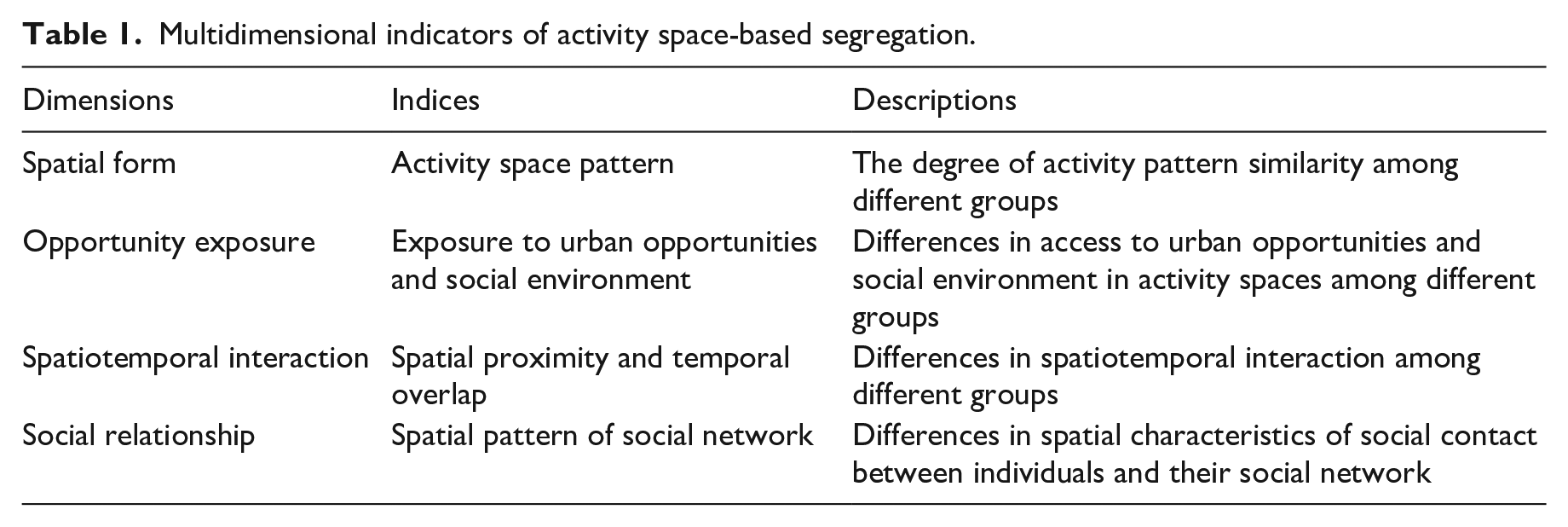
This study proposes a multidimensional activity space-based segregation measurement framework based on existing studies, including spatial form, opportunity exposure, spatiotemporal interaction, and social relationships (Table 1). This framework measures activity space-based segregation by combining activity patterns and social contact. The spatial form dimension represents the attributes of activity space and shows the degree of activity pattern similarity between different groups. Opportunity exposure refers to the differences in access to urban opportunities and social environment, indicating the social and spatial consequences of segregation. The spatiotemporal interaction dimension represents the potential for individuals to interact with other social groups at a fine-grained spatiotemporal scale through spatial proximity and temporal overlap. The social relationship dimension refers to the spatial characteristics of social contact between individuals and their social network, representing deep social interactions. This dimension reflects individuals’ social activity needs and the spatial range of social network spaces.
Multidimensional indicators of activity space-based segregation.
These four dimensions are not independent of each other, but they are interrelated (Figure 1). The spatial form is the base indicator that affects not only access to urban opportunities and social environment among different groups but also the possibility of spatiotemporal interaction among different groups. There is also a mutual influence between opportunity exposure and spatiotemporal interaction. Opportunity exposure provides potential resources and facilities for individual interaction, and individual interaction creates conditions for different groups to access different urban opportunities and social environments. Social relationships are influenced by both opportunity exposure and spatiotemporal interaction. Shared access to urban facilities and coexistence in the same space-time may enhance the possibility of different groups forming social relationships. Social relationships, in turn, have a countervailing effect on spatial behavior through joint activities or social activities that feed back into spatial forms of activity space.
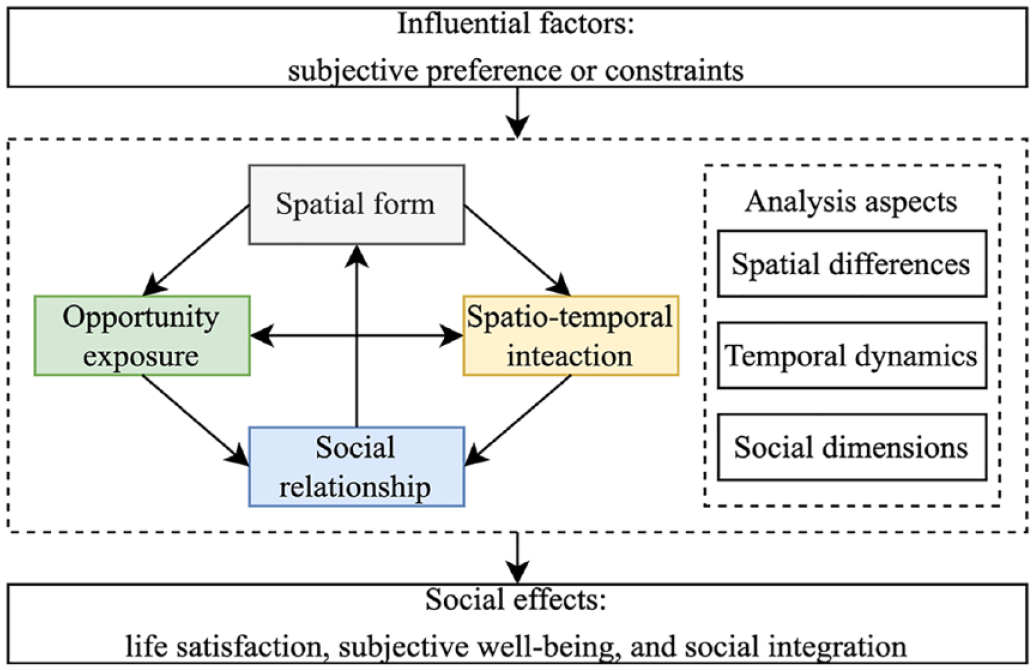
Framework of activity space-based segregation.
Challenges and future studies
Based on the multidimensional framework of activity space-based segregation measurement, some challenges and directions for future studies can be addressed (Figure 1).
Temporal dynamics
As previously mentioned, studies have examined the temporal dimension of activity space-based segregation, providing new perspectives for future research. However, existing studies have only focused on short-term changes and are insufficient for exploring the temporal mechanisms of segregation in depth.
On the one hand, attention needs to be paid to temporal rhythms of activity space-based segregation and its social mechanisms. At the individual level, temporal differences in activity space-based segregation reflect how isolation in one life domain correlates to other life domains (Tammaru et al., 2021). There is a need to explore the differences in the temporal dimension of activity space-based segregation among individuals with different activity patterns to gain a deeper understanding of individuals’ daily life experiences. At the city or regional scale, differences in the aggerated level of activity space-based segregation across time express social rhythms (Xian et al., 2022; Zhang et al., 2022). The analysis of temporal dimensions can provide a more comprehensive measure of the extent to which different groups are affected by structural factors (e.g., institutional discrimination, cultural context, or urban rhythms) to uncover the underlying social and cultural mechanisms.
On the other hand, the long-term dynamics of activity space-based segregation need to be studied. Although studies have examined changes in activity space-based segregation over the course of a day or a week, few studies have examined shifts in activity space segregation over long periods (Tao et al., 2020). Time geography proposes that a person’s early life experiences may impact their subsequent daily life (Hägerstrand, 1970). Therefore, conducting a long time-series analysis of activity space-based segregation is beneficial for understanding the changes in inequality and segregation experienced by individuals during their life course (Scheiner, 2014; van Ham and Tammaru, 2016). Meanwhile, increasing income inequality, the solidification of social mobility, information technology development, and the COVID-19 pandemic may lead to shifts in individuals’ daily lives, which in turn change activity space-based segregation (Tammaru et al., 2021).
Social dimensions of spatiotemporal interaction
Activity space-based segregation enhances our understanding of how individuals interact with others or are segregated in their daily lives. However, the social dimensions of individuals’ spatiotemporal interactions still need to be examined. On the one hand, spatiotemporal interaction does not necessarily reduce social segregation among different social groups. There may be differences in activity types, social roles, and purposes even if individuals are in the same space-time (Ta et al., 2021a). Therefore, multiple dimensions, such as social roles, activity purposes, and activity peers, need to be incorporated into sociospatial segregation analysis to further understand the meaning of spatiotemporal interaction.
On the other hand, the spatial distribution of social networks can serve as an essential measure of activity space-based segregation (Lee and Kwan, 2011; Silm et al., 2021). In classical sociospatial segregation studies, attention has been given to the influence of social networks on the formation of ethnic ghettos, which in turn leads to a segregated urban spatial structure (van Kempen and Özüekren, 1998). As sociospatial segregation research has shifted toward a people-based paradigm, some scholars have further emphasized the importance of individual social networks in measuring segregation (Silm et al., 2021; Verdier and Zenou, 2017). An individual’s social network and activity patterns are closely linked in space and time (Kwan, 2007). The establishment of a person’s social network mainly comes from frequent interactions in daily activities. A rich social network may facilitate individuals’ sociospatial interaction needs and expand their activity space (Silm et al., 2021). Constrained social networks may limit people’s activities in space and time, thus exacerbating their sociospatial isolation (Lee and Kwan, 2011). Some prior studies have examined the spatial pattern of social networks in activity space-based segregation research. Lee and Kwan (2011) combined individual activity patterns and social networks to portray the sociospatial segregation of Koreans in Columbus, USA, showing that social, spatial, or temporal aspects of social segregation are connected. Silm et al. (2021) indicated that the extent of activity space is related to the ethnolinguistic composition of the social networks in Estonia. These studies measured activity space-based segregation by combining social and spatial dimensions of segregation, which better reflects the paradigm of people-based research. However, more discussion is still needed on measuring the spatial structure of social networks and integrating social network and activity space indicators.
Subjective preference or constraints
Activity space-based segregation varies significantly across social groups, cities, and sociocultural backgrounds. Analyzing the mechanisms of activity space-based segregation is essential for understanding these variations and solving the social issues caused by segregation. However, as mentioned before, existing studies have mainly focused on the influence of socioeconomic attributes and objective environment and need more analysis of deep social mechanisms.
Previous studies have highlighted the effect of racial discrimination, institutional factors, socioeconomic disadvantages, and individual preferences on sociospatial segregation (Allen and Turner, 2012; Logan, 2013), which are underexamined in activity space-based segregation studies. On the one hand, job market discrimination, the availability of urban opportunities, and mobility may bring about differences in individuals’ activity and travel patterns, leading to constraints in access to employment opportunities, leisure participation, and social visits for disadvantaged groups (Hu, 2015; Lin and Gaubatz, 2017; Zhou et al., 2021). Meanwhile, institutional factors (e.g., public housing policies, immigration policies, etc.) may also shape differences in activity space. On the other hand, individual lifestyle choices or subjective preferences can alter spatial constraints on behavior, leading to differences in individual behavioral choices (Browning et al., 2017; Silm et al., 2018; Walker and Li, 2007). Therefore, how objective constraints and subjective preferences play a role in shaping activity space-based segregation needs to be further explored. In particular, more research is required to understand the complex social process behind sociospatial segregation in different sociocultural contexts.
Social effects of activity space-based segregation
Beyond spatial configurations, activity space-based segregation may have social effects on urban residents; however, this relationship is underinvestigated. In residential segregation studies, scholars have found that residential segregation may lead to lower levels of life satisfaction, lower quality of life, and an insufficient sense of belonging (Liu et al., 2018; Musterd and Ostendorf, 2009; Zhu, 2016). Recently, some studies have indicated that these effects may expand to activity space. On the one hand, neighborhood studies have found that not only the built and social environment inside neighborhoods but also the public space and living facilities around neighborhoods have an impact on individuals’ residential satisfaction and neighborhood belonging (Lin et al., 2021; Liu et al., 2020). On the other hand, some spatial behavior studies have noted that green space and air pollution exposure in individual activity-travel space can affect individual travel satisfaction and life satisfaction (Ma et al., 2021; Ta et al., 2021b; Tao et al., 2021). All these studies have indicated that social effects of segregation not only occur in residential areas but may also occur in a wider range of life domains due to individuals’ daily space-time behavior.
Thus, as activity space-based segregation may also affect individuals’ life satisfaction, subjective well-being, and social integration, these issues need to be analyzed in depth (Lin and Ta, 2023; Wang et al., 2019). Based on a study conducted in Hong Kong, Wang et al. (2019) found that social comparisons in both residential areas and daily activity spaces may contribute to individual life satisfaction. Another study in Shanghai found that rural migrants’ city attachment is significantly influenced by the social environment within their activity space (Lin and Ta, 2023). The mechanisms of these activity space effects may arise from accessibility to various facilities and resources in the activity space, spatiotemporal contact with different groups, and so on. However, further research is needed to answer these questions, including examining the differences between the effects of sociospatial segregation in residential areas and activity spaces and determining in which ways activity space-based segregation functions.
Conclusions
This paper provides a comprehensive review of the emerging activity space-based segregation research and constructs a multidimensional activity space-based segregation framework. It highlights the valuable perspectives of activity space-based segregation research to capture the whole picture of segregation in daily life. Based on a comprehensive literature review of international studies, this paper highlights the trend toward integrating spatial, temporal, and social dimensions in activity space-based segregation measurement. It also indicates the essential contribution of Chinese studies in this field. Finally, this paper proposes a multidimensional framework consisting of spatial form, opportunity exposure, spatiotemporal interaction, and social relationships.
Based on the framework, some directions for future studies are discussed. First, it is expected that more evidence regarding the temporal dynamics of activity space-based segregation in both the short term and long term can be provided to better understand complex social progress. Second, the social dimensions (especially social networks) and spatial-temporal dimensions should be linked more closely to examine people-based segregation in physical spaces and social spaces. Third, the mechanism of activity space-based segregation is still lagging in current studies. More empirical studies in different sociocultural contexts should examine the subjective and objective factors of segregation. Finally, the social effects of activity space-based segregation should be given more attention.
Footnotes
Declaration of conflicting interests
The author declared no potential conflicts of interest with respect to the research, authorship, and/or publication of this article.
Funding
The author disclosed receipt of the following financial support for the research, authorship, and/or publication of this article: This work was supported by National Natural Science Foundation of China (NO. 41971200).