



Abstract
This study lies in the burgeoning literature on the contextual effects of the adoption of mobile applications (apps) on the everyday lives and integration of older migrants into a host society, taking the Guangdong-Hong Kong-Macao Greater Bay Area (GBA) in South China as a case. Despite recent advocacy of healthy ageing and regional integration, most GBA studies related to cross-border ageing have focused on welfare portability instead of the everyday life adaptation of older migrants through use of digital technologies. This article investigates and compares how mobile apps have facilitated/hindered the integration of Hong Kong older migrants in Shenzhen, through a comparative investigation of mobile app adoption between Hong Kong older migrants and local Shenzhen older adults. A mixed-method approach is adopted including focus group meetings with Hong Kong older migrants living in Shenzhen, and questionnaire surveys with Shenzhen local older adults between September 2021 and March 2022. The study sheds light on two major findings. First, facing the highly digitalized Shenzhen, Hong Kong older migrants have caught up more with using instrumental apps (e.g. mobile payment), as compared with recreational, informational, and open (one-to-many) communication apps. Second, Hong Kong older migrants have emphasized the use of apps for cross-border interactions. The digital gaps in terms of different using patterns of mobile apps highlight Hong Kong older migrants’ lack of socio-cultural integration and feeling of separation from the host society. This study advocates for more active involvement of older migrants’ specific needs in designing mobile apps. Multi-scalar cooperation among various localities in the GBA region is deemed important for older migrants to further integrate into the host society with the widespread use of digital technologies in everyday life.
Keywords
Introduction
Cross-border interaction between Hong Kong and Guangdong Province, particularly the Pearl River Delta (PRD), has upsurged over the past decades, particularly with the construction and operation of profound cross-border infrastructures, such as the Hong Kong-Zhuhai-Macao Bridge, which became effective in 2016. The improved cross-border connectivity has promoted Hong Kong retirees in migrating cross-border for ageing lives in the neighbouring localities in Guangdong, especially with the upscaled regional development plan for the Guangdong-Hong Kong-Macao Greater Bay Area (GBA) promulgated by the State Council in early 2019. By mid-2019, around 90,000 (or 17%) of Hong Kong-based Guangdong migrants were aged 65 or above, as compared to 67,600 in mid-2013 (Census & Statistics Department, 2022a). The cross-border ageing of older adults migrating from Hong Kong to Guangdong has shed light on the increasing importance of post-migration adaptation of everyday lives in Guangdong, especially when taking into account the gaps in digital technology applications between Hong Kong and other GBA cities.
The process of cross-border connection and adaptation engaged by Hong Kong older migrants involves the unprecedented need of digitalization of everyday lives. This is particularly reflected by the widespread adoption of mobile applications (“mobile apps” hereafter) on digital mobile devices (e.g., mobile phones) for everyday activities in Shenzhen. The different digitalization context poses both opportunities and challenges to older migrants in the cross-border regional context of the GBA. While it becomes more common for Hong Kong older people to own a smartphone, daily usage is generally limited to simple functions such as instant communication (Yang et al., 2022). In comparison, the use of mobile apps is more advanced in mainland China, which has entered into a “cashless society” (Lu, 2018). However, little is known about the adoption of mobile apps by Hong Kong older migrants (reliant on their attitude of adaptation to the digitalization of everyday activities), along with its subsequent impacts on their cross-border ageing life in the destination GBA cities. The question is of particular importance when taking into account that one of the GBA initiatives focuses on the development of healthy ageing in the regional context (State Council, 2019).
Existing literature demonstrates the context-specific responses of older migrants to the digital gap, their patterns of use in the host region, as well as how digital use impacts their integration and everyday lives in the host region. Previous research found that mobile app adoption in host region is dependent on older migrants’ socio-demographics, reasons for migration, and host- and home-region characteristics such as digitalization level (Baldassar et al., 2022; Goodall et al., 2010; Hunter, 2015; Nguyen et al., 2022). In the context of the GBA, existing research on cross-border ageing engaged by Hong Kong older adults in the GBA has mainly focused on cross-border portability of welfare (Cao, 2020), while social inclusion and the way their everyday lives are influenced by the digital gaps in terms of mobile app adoption lack comprehensive investigation. Against this backdrop, this article investigates how mobile apps can affect the integration of Hong Kong older migrants into the everyday lives in Shenzhen, the intimate neighbouring city to Hong Kong for cross-border ageing in the GBA. Shenzhen is selected as an area for study since it is the most popular city for cross-border ageing in the GBA chosen by Hong Kong residents (Lung, 2021). To this end, the article seeks to examine the trends/patterns of app use, along with opportunities and challenges in mobile app adoption. This research uses a comparative approach with mixed methods by comparing Hong Kong older migrants in Shenzhen with local Shenzhen older adults. Specifically, focus group interviews were conducted with Hong Kong older migrants while a questionnaire survey was conducted with Shenzhen older adults between September 2021 and March 2022. The comparative study approach helps emphasize how the use of various mobile apps has influenced Hong Kong older migrants’ everyday lives in Shenzhen and subsequent social integration with local society.
The remainder of the article is organized as follows. Following this introduction, the next section reviews the opportunities and challenges of old-age migration, and how the use of digital technologies may impact on cross-border ageing life. The third section presents the methods of data collection and analysis. The fourth section presents the results of the surveys on the mobile app use by Hong Kong older migrants in Shenzhen, and local older adults in Shenzhen, as well as the comparison results. The article concludes with a summary of the main findings and implications for future research on cross-border ageing in various city-regions in the digital age.
Cross-border ageing by older migrants in the digital age
Cross-border migration of older adults
The decision on migrating in later life is the result of continuous evaluation of residential satisfaction, where various push-and-pull factors (i.e., opportunities and challenges) are weighed up (Wiseman, 1980). Although old-age migration is at all points less common than in other cohorts, the retirement age (60–69 years old) and beyond the age of 75 are times of higher likelihood (Wiseman, 1980). A concurrent rise in intra-national retirement migration has been observed in different countries, such as the Hong Kong-Pearl River Detla region in China (Cao, 2020) and within France (Christel, 2006). Furthermore, empirical studies on the flow of migration demonstrate that older migrants tend to relocate away from the city centre, with recent examples from China (Liu et al., 2020), United States (Jurjevich and Plane, 2009) and Germany (Schaffar et al., 2019). Upon ageing, the change in life course that subsequently alters the desired outcomes of migration has prompted different reasons (not to) migrate, which is undergoing intensive debates.
A rich body of research has been conducted to explore what opportunities and benefits are desired that trigger migration in (different stages of) old age. A recent review by Zhang et al. (2021) has summarized six categories of destination characteristics that affect older adults’ migration decisions, which signified the convergence of natural (e.g., green space coverage and climatic environment) and human-associated amenities (e.g., healthcare, recreational and cultural environment; residential environment such as cost of living). In such classification, Wiseman (1980) emphasized the role of older adults’ socio-demographic and cultural characteristics in affecting how the six categories were considered to different extents by the potential migrant. He argued for three long-distance migration motivations: amenity (desire for recreation-oriented lifestyle), assistance (migrating near kins for assistance in which the migration destination is often within metropolitan areas) and return migration (return to the place of birth). Local movements could be of amenity-seeking but with challenges of residing in their original neighbourhood more emphasized. He suggested amenity moves are more likely at retirement age, whereas assistance moves are more likely at older ages (e.g., 75+ years old). Supporting studies found that short vs long-distance/younger vs older migrants have various aspirations statistically (Champion et al., 1998; Jensen and Deller, 2007; Zhang et al., 2021). To this end, there could hardly be a common theoretical explanation for the geographies of migration flows observable in different regions. In addition, there is a complex interrelation between the heterogenous personal background/socio-demographics of older migrants and destination characteristics (Schaffar et al., 2019; Walters, 2002). Deliberate empirical investigations are needed in order to take socio-demographic and cultural factors, as well as destination (and home-region characteristics), into account.
Apart from the potential upsides, attention has been paid to the corresponding challenges associated with old-age migration. The combination of old age and migration background, as described by Dowd and Bengtson (1978), is a “double jeopardy” that has long been recognized as deteriorating physical conditions and breaking long-lasting social ties (Rowles, 1986; Uhlenberg, 2006). Older labour migrants who return to their place of origin are barely exceptional. For instance, King et al. (2017) argued for potential difficulties in accessing health and welfare services such as portable pensions after returning. More importantly, studies have argued for social challenges, apart from the financial aspect. In particular, King et al. (2017) concluded that re-integration into the home community after many years of working abroad is challenging. The nostalgic images of what it will be like “back home” often do not match the real experience of return. On the other hand, major life events such as the birth of children would mentally anchor return migrants to the host region (King et al., 2017), leading to the potential weakening of original host-region networks while failing to re-establish home-region networks. Barrett and Mosca (2013) in their empirical study found that migrants returning from London/Birmingham of England back to their source of origin suffer from loneliness and social isolation. Since the early 2010s, digital technological innovation such as smartphones, in particular mobile apps, have been witnessed that offer dramatic changes to the everyday lives of older adults, particularly older migrants. What remains under-explored is whether digital technologies such as mobile apps may affect (whether positively or negatively) the aforementioned opportunities and challenges older migrants face in their host society, and their integration.
Digital technologies and social inclusion of older migrants
Migration in later life are substantially different from earlier ages (Wiseman, 1979). Older adults’ use patterns of digital technologies also differ from the younger generations (Berenguer et al., 2016). Thus, distinctive effects of digital use on older migrants, in particular social inclusion, were explored. Findings were mixed across studies of older migrants with a different source of origin and destinations. On the positive side, He et al.’s (2022) study on older migrants in China found that WeChat Interest-based group chats are effective supplements to offline activities, which serve the role of a gateway to an acquaintance community in older migrants’ lives. Hunter’s (2015) research on older North/West African men in France suggests that digital communication facilitates networking in the host region, while communicating with members in their home region increases their anxiety and social pressures. The study implies that the way that older migrants use digital technologies may also determine the positive or negative impact of use. Furthermore, Nguyen et al.’s (2022) study on Vietnamese migrant grandparents in Australia suggests that digital use can support older migrants’ identities and belongings, through maintaining social support networks, social integration, consuming culturally relevant media, and navigation. Apart from the solely social aspect of integration, Millard et al.’s (2018) study in West Australia argues that digital literacy and subsequent use of digital technologies enable older migrants to enjoy greater autonomy in everyday lives and participation into the society. These studies suggest digital use by older migrants may facilitate their social and other aspects of integration (such as reaching different destinations in the neighbourhood), depending on their way and purpose of usage, with social integration receiving more scholarly attention.
While social integration is often cited as a benefit of older migrants’ digital use, the drawbacks are often referred to digital gaps that older migrants are not adaptive to the level of digitalization in the host region. For example, Safarov (2021) argues that the forced usage of online services generates negative emotions such as stress and anxiety in older migrants whose mobile app usage was limited to simple tasks such as messaging. Chen et al. (2020) argue that the digital gap between older migrants will widen the inequalities between the “haves” and “have-nots” and endanger the situation of older migrants who fail to adapt. The articles suggest older migrants’ inadaptability to digital use in the host region may obstruct construction of identity and sense of belonging (i.e. the social perspective of integration) to the host region, in addition to integration to other aspects of everyday lives (e.g. getting welfare services).
The drawbacks based on inadaptability largely lie in the digital gap (Berenguer et al., 2016; Yang et al., 2022) between host and home regions, which is particularly prominent in migration from the global South to the global North. Regarding the digital gap, findings were mixed for older migrants’ attitudes towards digital adaptation in studies of different host and home regions. For example, Baldassar et al.’s (2022) study on Chinese grandparent migrants in Australia found that older migrants become more motivated and active in learning to use digital technologies after migration. However, Goodall et al.’s (2010) study on Italian/Greek older migrants in Australia (i.e. the same destination) found the older migrants perceived digital use as dangerous, or with no interest in using. Existing literature demonstrates that the impact of digital technologies, such as mobile apps, on older migrants’ integration into the host society is highly contextual and complex. Host- and home-region characteristics, socio-demographics of older migrants, as well as how they use digital technologies all constitute the effect of digital use. An empirical study on particular migration flows and migrants with specific socio-demographics can offer invaluable insights, particularly on policy implementation.
Research area and methods
Research context
The GBA as a salient cross-border city-region in China could exemplify the distinctive effects of mobile app adoption on Hong Kong older migrants adapting to everyday life in Shenzhen. First, a wide digital gap is observed between Hong Kong and the mainland cities of GBA, where the mainland is identified as a cashless society (Lu, 2018) while most Hong Kong older adults are only using mobile apps offering simple functions such as instant communication (Yang et al., 2022). Second, it is worth noting the distinctive institutional contexts in which some mobile apps frequently adopted in Hong Kong, e.g. Facebook, Google, cannot be used on the mainland, offering additional barriers to digital adaptation. The third factor is related to the distinctive combination of geographical proximity but differential development patterns, lifestyles, and culture under the salient framework of “One Country Two Systems” (Yang, 2005, 2006). In other cities and countries, rigid border control often occurs between cities/countries of large differences (e.g., the US-Mexico border) so that cross-border integration is limited. However, the case of Hong Kong-mainland GBA cities is distinctive for the geographical proximity, differential lifestyle and culture, as well as, most importantly, government-facilitated cross-border integration including facilitating the migration of older adults. The everyday life integration of Hong Kong-based older migrants in Guangdong, particularly in terms of different patterns of mobile app adoption compared to the local adults, remains under-explored in the literature.
The administrative sphere of the GBA covers the Hong Kong and Macao SARs, and nine municipalities in the Guangdong Province near the Pearl River Delta (PRD), including for example Shenzhen, Guangzhou, and Dongguan (Figure 1). According to chapter six of the Outline Development Plan of the GBA (The State Council of the People’s Republic of China, 2022), the GBA aims to allow SAR residents in Guangdong to enjoy the same treatment as local mainland residents in areas such as medical care, elderly care, housing, and transport. It also aims to develop regional demonstration bases for healthy ageing, such as through mobilizing the unevenly distributed older adult population (Table 1). With a major focus of research and policy implementation on welfare portability from Hong Kong to the GBA (Cao, 2020), the number of Hong Kong-based older migrants in Guangdong is constantly increasing. In mid-2019, around 90,000 Hong Kong-based older adults aged 65 or above were residing in Guangdong. As such, the post-migration experience of older migrants, such as social and other aspects of (re-)integration to the host society, is of vital importance for investigation.
Age structures among the cities in the GBA (2020).
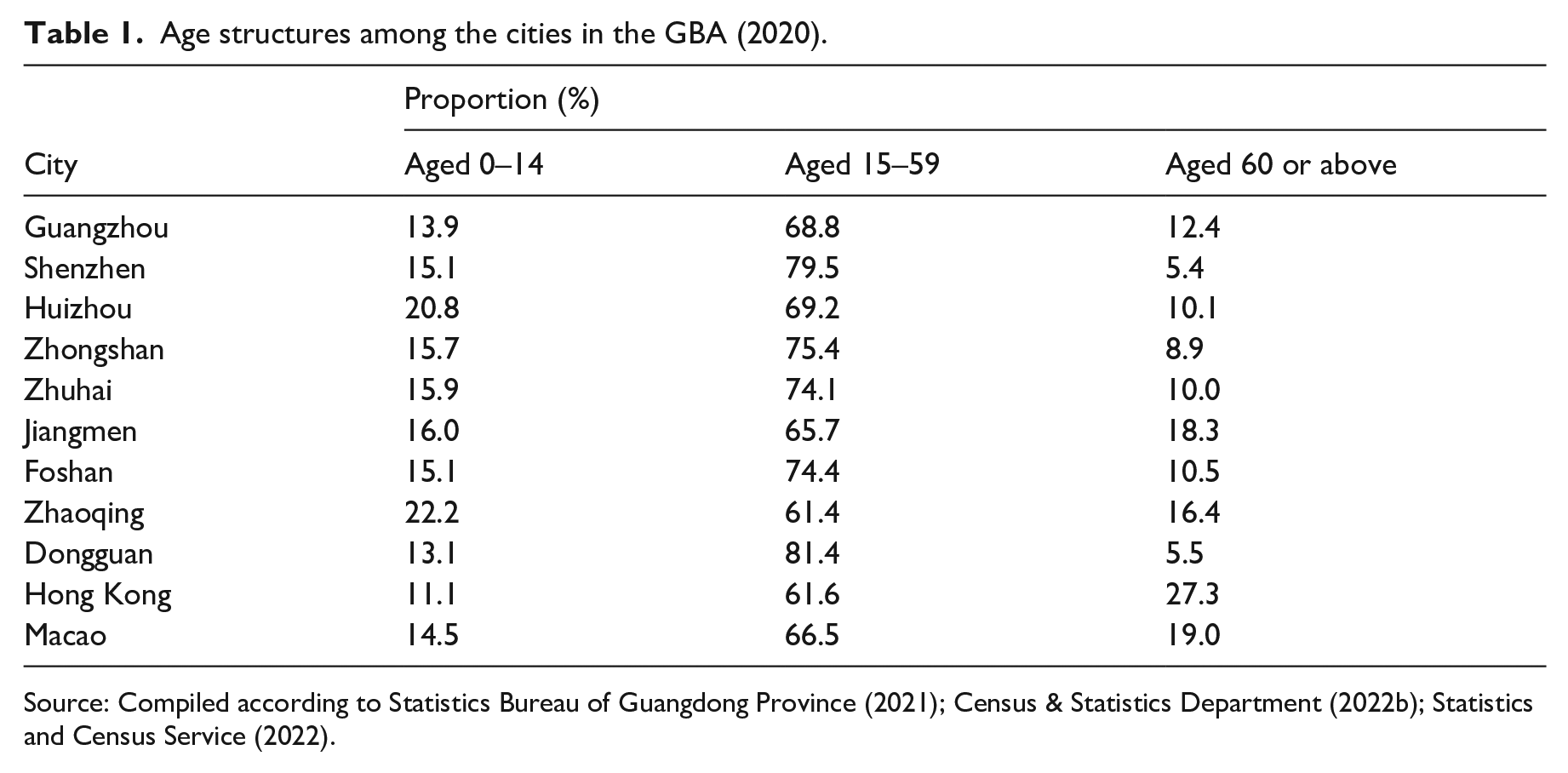
Source: Compiled according to Statistics Bureau of Guangdong Province (2021); Census & Statistics Department (2022b); Statistics and Census Service (2022).
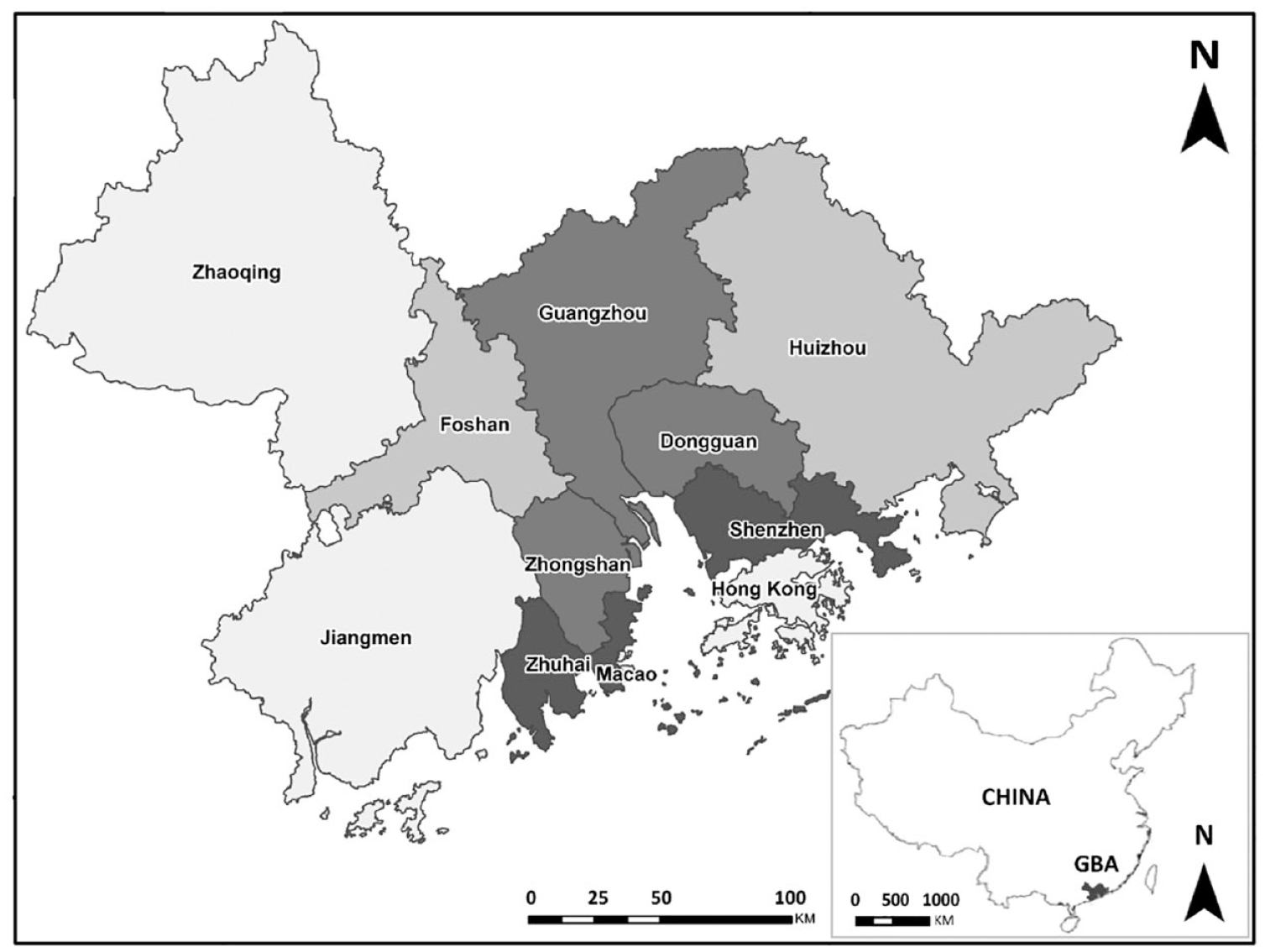
Location and administrative sphere of the Guangdong-Hong Kong-Macao Greater Bay Area.
Research methods
To reflect the distinctive effects of mobile app use on older migrants’ everyday lives and integration into the host region, this research adopts a comparative approach with two groups of older adults—Hong Kong older migrants in Shenzhen, and local Shenzhen older adults. In particular, the use of a mobile app, defined as “a software application developed specifically for use on small and wireless computing devices such as smartphones” (IBM, 2021), is selected for investigation in view of the rise of mobile device use within the older adult population in Hong Kong and mainland China (Census & Statistics Department, 2021; Quest Mobile, 2021). The above two groups of older adults provide a solid foundation for comparison, considering the digital gap between Hong Kong and the mainland (Lu, 2018; Yang et al., 2022), along with Shenzhen being the most popular mainland city for cross-border ageing in the GBA chosen by Hong Kong residents (Lung, 2021).
A mixed-method approach was adopted, taking into consideration the relatively small number of Hong Kong older migrants in Shenzhen, compared with the larger population size of local older adults in Shenzhen. Furthermore, it is difficult to access Hong Kong older migrants residing in Shenzhen. The third author of the article, who is affiliated with a local college engaging in healthy ageing services in Shenzhen, has established long-term networks with Hong Kong older migrants. Focus group interviews were employed with the older migrants, whereas questionnaire surveys were conducted with local Shenzhen older adults. Three focus group interviews were conducted with a total of 18 cross-border migrants from Hong Kong to Shenzhen. Following the local standard, all interviewed migrants have at least lived in Shenzhen for six months or longer in the past year (Census & Statistics Department, 2022a). All respondents were aged 55–62 who arrived in Hong Kong at 10–20 years of age, during the mass migration from mainland China to Hong Kong in the 1950s to 70s (Burns, 1987). All respondents obtain the right of permanent residence in Hong Kong, and return migrate to Shenzhen after retirement. The highest education level obtained of all respondents was primary level. Despite the low sample size, the background and socio-demographics of focus group participants are expected to be representative of other Hong Kong-based older migrants in Shenzhen/GBA. While no detailed socio-demographic statistics were found on Hong Kong-based older migrants in Shenzhen, other migrants of a similar age, and of the same host and home region, should share the same background of mass migration. Furthermore, the obtained education level of respondents (i.e., primary school) is the most common among Hong Kong and mainland China residents of the same cohort (Census & Statistics Department, 2017; Liang, 2013). Two themes were discussed in the focus group. First, mobile app use in Hong Kong and Shenzhen, including use intensity, the purpose of use (e.g. cross-border/local communication), difficulties encountered and solution, were discussed. Second, participants discussed and compared everyday lives and lifestyles in Hong Kong and Shenzhen. The information from focus group meetings helped explore changes in, for instance, social, economic, and mobility perspectives of everyday lives that illuminate the potential roles of mobile apps for migrants in the cross-border regional context. All focus group discussions were taped and transcribed verbatim by the interviewers for coding purposes. A thematic approach was adopted by grouping the codes into themes based on inductive analysis using NVivo 1.6.1. The same approach was utilized for qualitative comments from survey respondents. For quantitative data retrieved from questionnaire surveys, descriptive analysis was conducted. The quantitative data adds understandings of how the mobile app affects local older adults’ everyday lives. The themes retrieved from focus groups and questionnaire surveys were compared to identify similarities and differences between the samples of Hong Kong older migrants and local Shenzhen older adults. This analysis explores how crossing the border and migrating to a host society with a different institutional, social, and cultural context may influence the role of mobile apps on older adults’ everyday lives and integration into the host society.
Forty-seven local older adults in Shenzhen were interviewed, with questionnaire surveys conducted by the fourth author who has developed a long-term collaboration with local community centres for older people. All participants were aged 55 or above, and independently living in Shenzhen regularly. All data were collected in community workstations in Shenzhen between September 2021 and March 2022. Convenience and snowball sampling were used to recruit participants, starting with researchers inviting potential participants on social media platforms such as WeChat, and then encouraging participants to invite other older adults. Use frequency and duration of different types of mobile apps were explored, with scales of 0–4 and 0–5 respectively, where 0 signifies non-use and a higher value indicates more frequent/longer use. Combined with open and closed-ended questions, purposes, reasons, and difficulties of mobile app use were investigated. For example, the quantity of family members/friends connected via mobile apps and the associated experience was explored. Respondents were encouraged to elaborate on their mobile app use and how they are connected to their everyday lives, which were then written down by the interviewer. The mean age of survey respondents was 63.2. This group of respondents help to identify the roles of mobile apps in older adults’ everyday lives in a local context. Despite the fact that the raw data may not be directly compared, the interpreted quantitative data which were transformed into qualitative descriptions can be thus compared with the information collected through focus group meetings to investigate the distinctive impact of mobile app adoption on older migrants’ integration and everyday lives.
Cross-border digital aging in the GBA: A comparative investigation of mobile apps adoption by Hong Kong older migrants and local older adults in Shenzhen
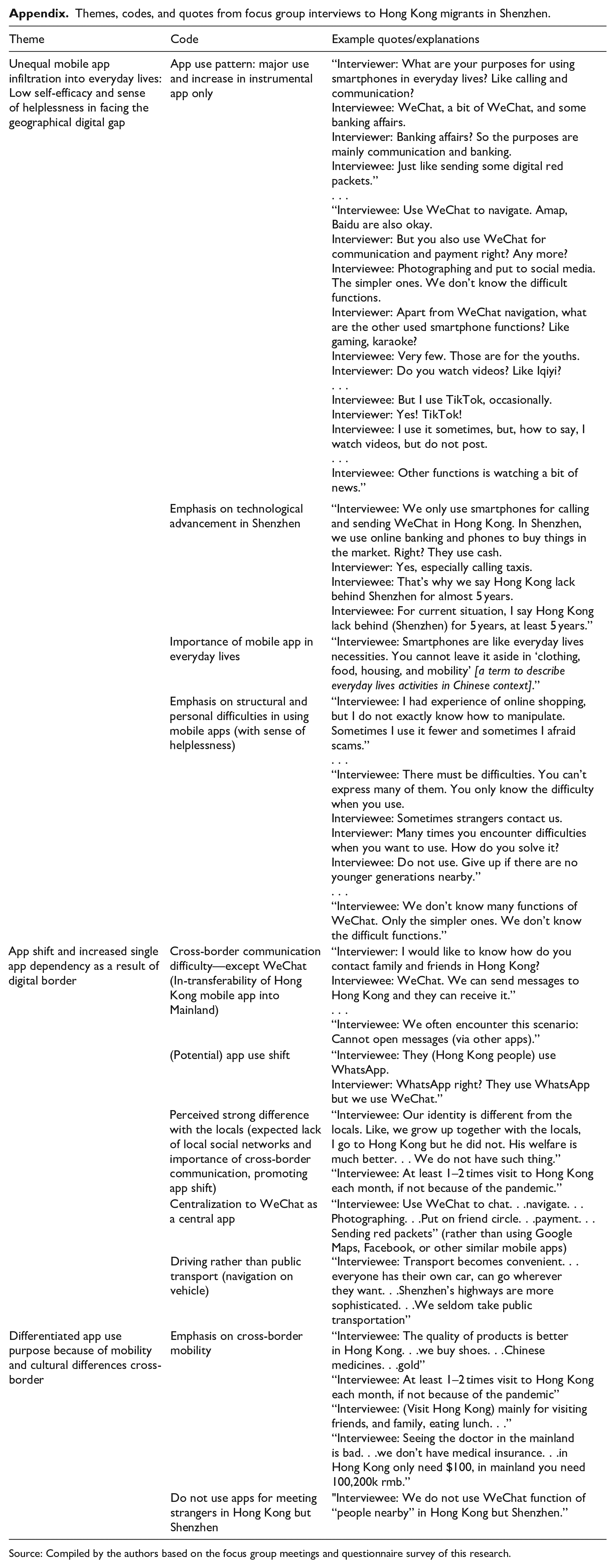
This section presents the usage patterns of mobile apps by Hong Kong older migrants living in Shenzhen, and how it affects their everyday lives through a comparative analysis with local Shenzhen older adults. All related themes, codes, and quotes from the focus group interviews are shown in the Appendix.
Mobile application adoption by cross-border older migrants from Hong Kong to Shenzhen
Unequal mobile app infiltration into everyday lives: Combined results of digital push, lack of digital self-efficacy, and support networks on mobile app use
Compared to Hong Kong local older adults (Yang et. al., 2022), mobile app use of Hong Kong older migrants in Shenzhen is more prominent, particularly reported in the rise of instrumental app use such as mobile payment. The rise in recreational, informational, and open communication (i.e. one-to-many communications) apps like social media are less emphasized. The wide use of instrumental apps may relate to respondents’ emphasis on the high penetration of mobile apps in everyday lives of Shenzhen by describing mobile apps as “necessities”, reflecting a sense of digital push that everyday activities are “digital-by-default” (Pirhonen et al., 2020; Schou and Pors, 2019). Results suggest that Hong Kong older migrants try to catch up with the geographical digital gap in terms of instrumental uses.
The lifestyle that an older adult pursues should be reflective of their patterns of digital use, as long as they fully exploit the variety of functions provided by mobile apps. However, in our case, the major increase in instrumental uses does not fully reflect older migrants’ intention of migrating to Shenzhen, implying that mobile apps may not be fully utilized in their everyday lives. As reflected, one of the reasons for migration is to pursue a slower pace of life, apart from a lower cost of living and wider living space that resonate with Wiseman’s (1980) amenity migration. However, the discussion reflected a limited increase in recreational, informational, and open communication app use, which are expected to be used more under a slow pace of life. This reflects the fact that mobile apps still may not play a substantial role for older migrants to pursue their desired lifestyle and everyday lives.
The lack of completeness in the rise of mobile app use by Hong Kong older migrants in Shenzhen is supported by perceived negativities towards mobile apps, and the feeling of being left behind and pressurized in the digitalized society, reflecting Safarov’s (2021) statement of generating negative emotions upon forced instrumental uses. When asked about difficulties using mobile apps, migrant respondents showed frustrations and avoidance of using mobile apps. Apart from being afraid of scams, they referred to the digital border between Hong Kong and Shenzhen, elaborating that WeChat is the only app that allows cross-border communication with Hong Kong. Simultaneously, they reflected a low level of digital self-efficacy, stating that they do not know the complex functions and often encounter unexpected difficulties when using mobile apps. Respondents reflected relatively negative and passive attitudes towards mobile app use, similar to results from Goodall et al.’s (2010) study.
In addition, respondents expressed helplessness in app use. When asked how to deal with app use difficulties, they referred to the younger generations, particularly those with close relations. However, some respondents explained that their younger generations continued living in Hong Kong. While older migrants may receive assistance through digital communications, the lack of their physical presence may present stronger difficulties for their app use and adaptation to the digitalized society of Shenzhen. Most of the information above suggests that Hong Kong older migrants are required to adapt to the increased digitalization of everyday activities. With the lack of help from the younger generations, older migrants appear to feel left behind and pressurized. They might not be able to fully exploit the benefits of using mobile apps. Thus, the rise in mobile app use mainly focused on instrumental usages, rather than on other aspects of daily lives that their use is considered more optional (e.g. entertainment).
Additional challenge: Transition from Hong Kong to mainland mobile apps
Respondents commonly described using alternative mobile apps for the same function, particularly for the communication domain. Specifically, the transformation from WhatsApp to WeChat for instant communication was frequently mentioned. With most respondents’ families remaining in Hong Kong, participants referred WeChat as the only app that allows digital communications between Hong Kong and Shenzhen. The cross-border communication functionality has high importance in recent border lockdowns due to COVID, with migrants originally visiting Hong Kong to check out their friends and family members on a monthly or weekly basis. We expect the use of alternative apps to be a result of differential institutional and political arrangements between Hong Kong and mainland China. Google Play store, etc. are unavailable in Shenzhen so they cannot download apps such as WhatsApp and Google that are available in Hong Kong. The transformation was primarily not based on self-initiatives but institutional arrangements that have restricted the permeability of digital borders. This arrangement simultaneously poses additional challenges to older migrants’ app use due to the need for re-adaptation.
The transition of mobile apps in cross-border ageing is reflected in cross-border migrants’ dependence on cross-border social networks, with a lack of local social embeddedness. In the interview, respondents emphasized their differences with local residents in Shenzhen, identifying themselves as the “minority group”. For example, they described themselves to be different such as in terms of welfare and social security. They also reflected a lack of desire to interact locally, such as the use patterns of TikTok that they were unwilling to post videos to the mainland community. The strong perceived difference between migrants and locals was consistent with Du et al.’s (2018) study that emphasized the disintegration of inner Chinese migrants with locals. From another perspective, the need to shift from Hong Kong to mainland apps reflects a lack of social connections in the mainland when they were residing in Hong Kong. The observation echoes the saying that cross-border connections from Hong Kong to the mainland are weakening, from the perspective of retiring migrant labours from the mainland (Law, 2020). To this extent we suggest that the migration move is mainly based on place identity rather than existing social relations.
Mobile application adoption by older adults in Shenzhen
The use of open communication apps for digital social networking
Local Shenzhen older adults demonstrated more frequent use of apps particularly favoured for open communication (i.e. “one-to-many” group discussion on digital platforms) (Table 2). When asked about their extent of using different communication app types, respondents expressed their wide use of social media (e.g. Weibo) and online conference apps (e.g. Tencent conference). In particular, almost all respondents (96%) shared experience of posting feeds on social media platforms. Observations of the phenomenon suggested the more likely involvement of bilateral communication rather than simply for receiving information. In addition, it reflects a sense of openness to peers on digital platforms, resonating with Hong Kong migrants’ statements that Shenzhen citizens are less concerned about personal information security. On average respondents expressed communicating with five friends and family members respectively via communication mobile apps, emphasizing its role in further consolidating and building local social networks for local Shenzhen older adults. Local older adults also stressed the convenience of using mobile apps in everyday communications, which has made communication more frequent and flexible.
Mobile app use frequency and duration of local OAs in Shenzhen.
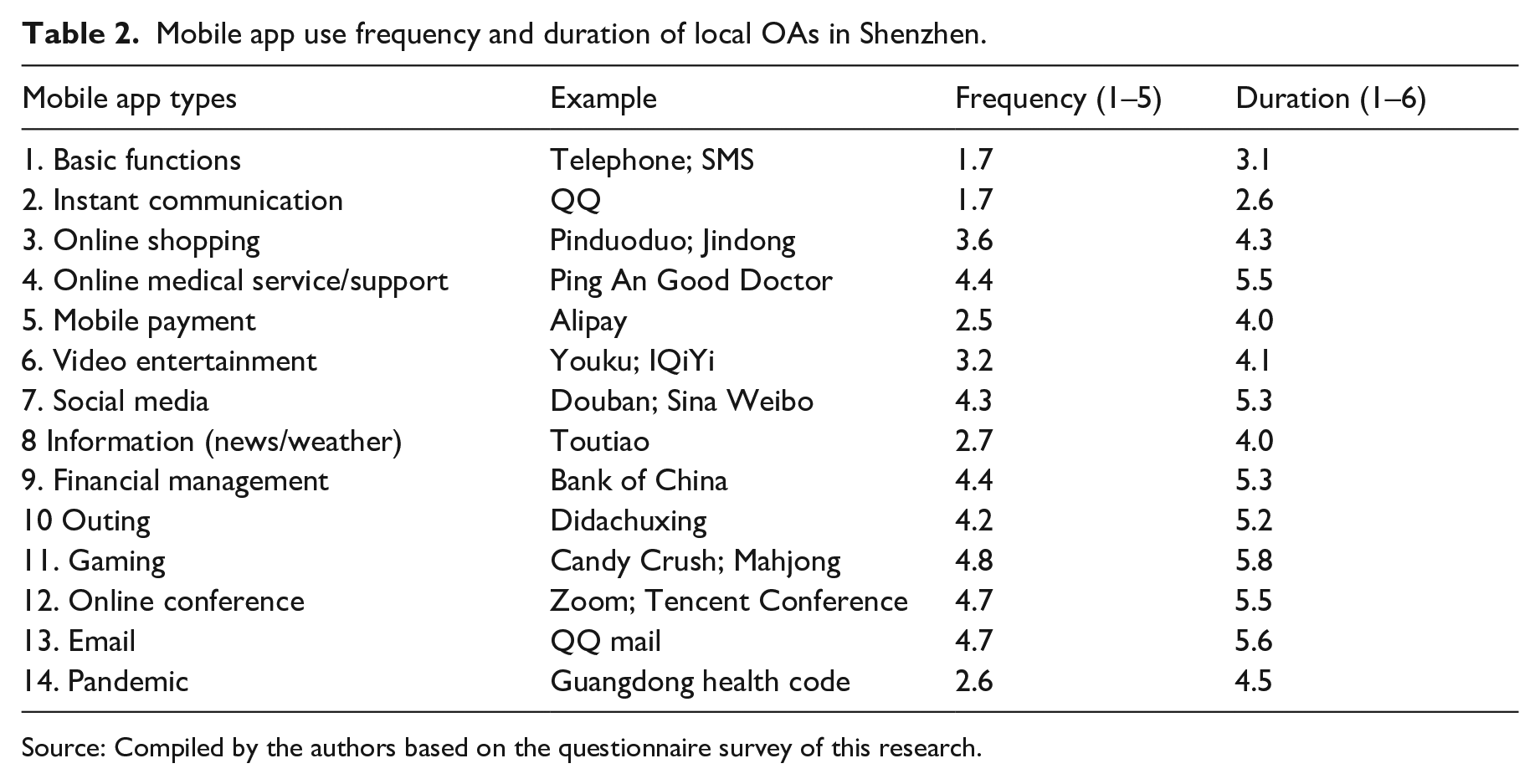
Source: Compiled by the authors based on the questionnaire survey of this research.
The use of open communication apps appears more like a transformation from traditional closed, “one-to-one” communication app use. In particular, app types such as telephone and instant communication, more similar to functions offered by feature phones, were reported as the least used mobile apps. Observing a lower level of reliance on functions similar to those provided by feature phones, it suggests a higher extent of voluntary use of mobile apps, as not using such mobile apps may not disable them from communicating with multiple peers. In addition, respondents expressed a low level of perceived difficulties in adapting to new mobile apps, stating only a short time was needed for learning new mobile applications. These perceptions are reflected in the transformation in the mobile app types used, from closed to open communications. More frequent use of open communication methods would enable more gatherings in local older migrants’ everyday lives especially in the pre-pandemic period, further improving their local community embeddedness.
Mobile apps infiltrated into various aspects of everyday lives
Local Shenzhen older adults demonstrated the infiltration of mobile apps on instrumental activities such as using online medical services, and communication functions as mentioned above. In addition, recreational usages, specifically gaming, were identified as the most used app type, suggesting the role of mobile apps to fill excessive time in old age. As suggested by older migrants, local older adults can benefit from various social welfares. Hong Kong older adults have to “work in restaurants to earn a living” because of the weak pension system. In comparison, local Shenzhen older adults said their “amount of pension is higher than what they earned during employment” so that they have spare time for recreational activities. The effect of social welfare programs could also be reflected in their wide use of online medical services, where local older adults can enjoy local medical insurance. It appears that the ways that mobile apps infiltrate into locals’ daily lives are associated with their ways of living, contributed to by the underlying institutional arrangements, especially on welfare programs. Going back to the basis, it is also promoted by higher technological literacy and better perceptions than mobile apps.
Comparing the role of mobile apps in Hong Kong old migrants and local Shenzhen older adults’ everyday lives
Narrowed, but still substantial digital gap between older migrants and local older adults in Shenzhen
Local Shenzhen older adults demonstrated intensive use of instrumental (e.g., Alipay/WeChat Pay), recreational, informational, and open communication apps (Table 2). In comparison, the use of all app types was not emphasized by older migrants apart from instrumental uses. Thus, there is a narrowed but still substantial gap between the two groups, echoing that migrant older adults tend to use more mobile apps in their daily lives after migrating to a more digitalized region (Merisalo and Jauhiainen, 2020).
Unlike local Shenzhen older adults’ higher voluntariness in using digital technologies, the increased use of instrumental mobile apps by Hong Kong older migrants appears to be related to the macro-environment that has led to digital push, with older migrants expressing difficulties in using mobile apps. Hong Kong older migrants could still be in the adaptation stage of mobile app infiltration, as everyday activities in Hong Kong were less dependent on technology. The perceived difficulty pushes older migrants not to use app types they consider not necessary in everyday lives. The discrepancies may further relate to the digital border that Hong Kong older migrants must readapt to mainland apps, when some of the older migrants did not utilize mainland apps in Hong Kong originally.
Moreover, migrants’ distinctive values, and perceptions of the quality of mobile apps also contributed to app use differences. For example, there are discrepancies as regards information security between the two groups, where open communication could be considered less secure. Hong Kong migrants in the interview described the news received from information apps as “fake news”, echoing Bronstein’s (2019) statement on mistrust of local information. Such a tendency is expected to impede information app use. It subsequently impedes the role of apps in their social integration progress. Furthermore, the geographical proximity downplays the value of local information apps. If Hong Kong migrants are to continue to be dependent on Hong Kong’s resources, they are expected to have a lower motivation to use mobile apps to search for availability of local resources.
App use pattern: A certain level of instrumental integration, socio-cultural integration lags behind
Conceptually, differential functions offered by mobile apps help older migrants to integrate locally in different aspects of everyday lives, including but not limited to cultural, social, and instrumental integration (e.g., payment methods). As mentioned above, migrant respondents only emphasized the rise in instrumental use, rather than the use of recreational (e.g. video entertainment (e.g. TikTok)), information, and open communication apps. With instrumental integration in a city with highly digitalized everyday life activities, Hong Kong migrants in Shenzhen could build up fundamentals for independent living abilities such as using mobile payment to buy daily necessities in the market, as mentioned by respondents. As such, instrumental integration has helped older migrants to build up the fundamentals for living in the digitalized Shenzhen.
In contrast, limited usage of recreational, informational, and open communication apps could have hindered migrants’ local integration, particularly from a social and cultural perspective, thus potentially hindering migrants’ quality of life. For example, video entertainment apps such as TikTok could also help communicate recent hot topics and transfer local culture and values. Compared to traditional media, informational app use also allows further autonomy in getting to know the local news, and therefore achieving further local integration. Furthermore, Hong Kong migrants’ major use of closed communication apps may assist to build up better quality social relationships, whereas the development of social networks in the local community in terms of quantity could lack behind. The above usage differences between the two groups highlight the risk of social marginalization of migrants, when local Shenzhen older adults have their social networks maintained or expended at a much faster pace. In this way, Hong Kong migrants in Shenzhen could be prompted to be more of an independent and separate social group rather than social inclusion with local older adults.
App use purpose: dependence of app use for cross-border interactions
Hong Kong older migrants provided stronger emphasis and implications on using mobile apps for facilitating cross-border activities in their everyday lives, including but not limited to digital communication, physical visits for medical service, and buying Chinese medicine. In comparison, local Shenzhen older adults did not mention the use of mobile apps for cross-border connections. Several local activities that help with migrants’ integration into the everyday lives of Shenzhen were reflected. For instance, the use of digital payments, knowing others through WeChat’s “people nearby”, and driving to Longhua district for dining. However, the interview also suggests the importance of mobile apps in the facilitation of cross-border activities, highlighted by the frequency of border crossing. As mentioned, respondents travelled to Hong Kong on a weekly/monthly basis for shopping or visiting friends and family. Intensive cross-border communication is expected to perform. Navigation apps could also be used for route navigation in cross-border trips. Higher dependence on cross-border interactions (and low reliance on local activities) reduces mobile app use for local connections and thus their functions in local integration. This is based on geographical proximity between the host and home society, and migrants’ regional knowledge/advantages of Hong Kong.
From a social perspective, communication apps can help social integration when used for communication with the locals. However, migrants demonstrated perceived discrimination and a lack of mental connections to local institutions and society. This is expected to discourage local communications and the effect of communication app use on local integration. When asked about the sufficiency of local community support, respondents showed hesitation, stating they are “not dare enough” to ask for anything because they are only migrants. The perceived exclusion, as mentioned, is similar to Du et al.’s (2018) findings for Chinese internal migrants. When asked how they tackle problems encountered in everyday lives, they preferred solving them by themselves or at most seeking help from residential committees, otherwise leaving the issue unsolved. They described not seeking community assistance, or help from the regional government, Townsmen Association, or sub-district office. They referred themselves as a “disadvantaged group” that local organizations might not be willing to help. They expressed themselves as “largely different from the locals” such as in terms of welfare, reflecting a sense of marginalization in the host society. At such a background, we expect an unwillingness to communicate with the locals, which subsequently impedes their local integration via mobile apps from a social perspective. Instead, mobile apps may help to maintain instrumental or social integration with Hong Kong, so that older migrants are willing to continue to stay in Shenzhen for potential integration in the future. Compared to migrants of South-North migration that encounter more significant cross-border communication difficulties (e.g. Myanmar-Australia (Schweitzer et al., 2011; UNESCO, 2016)), Hong Kong migrants in Shenzhen have an advantage with cross-border digital communications, even with the invisible digital border.
To this extent, we suggest that mobile apps help migrants facilitate cross-border interactions through digital cross-border activities. Since migrants do not need to cut off cross-border connections after migration, migrants are encouraged to move or continue to reside in Shenzhen. It enables the potential for deeper local integration. However, as cross-border rather than local activities are more emphasized, concurrent mobile app use by migrants could help their local integration to a relatively small extent in an indirect way.
Conclusion and discussion
This study intends to explore whether digital technologies, such as mobile apps help or hinder Hong Kong older adults in pursuing the desired healthy ageing lifestyle by crossing the border to the GBA cities, e.g. Shenzhen. This article investigates the effect of mobile apps use by Hong Kong older migrants on their everyday lives in Shenzhen through a comparative invetigation with Shenzhen local older adults. The comparative investigation demonstrates salient digital gaps between Hong Kong older migrants and local Shenzhen older adults, in which Hong Kong older migrants in Shenzhen have tried to catch up by widely using instrumental apps in daily activities. Furthermore, they use mobile apps for cross-border purposes in addition to local activities, such as digital communication and cross-border travelling. The digital gaps in mobile app use may lead to risks of Hong Kong older migrants’ to be marginalized in the local society, the daily life of which has been rapidly digitalized. This could be particularly prominent for older migrants in the COVID pandemic, when older migrants may feel reluctant or have difficulties in scanning health codes to access different venues in the communities of the GBA cities.
The GBA aims to foster regional integration and cooperation between the Hong Kong and Macao SARs and Pearl River Delta in various aspects including healthy ageing. The findings of this study have profound policy implications for the regions’ digitally (mediated) connection and integration, particularly through mobile app use by Hong Kong older migrants. To reduce the digital gaps among older adults in use of mobile apps in daily activites and services for cross-border ageing in the GBA, this paper suggests more active involvement of Hong Kong older adults in the design of mobile apps, particularly for cross-border activities and services. In particular, mobile app design and development should have taken into more account of the specific needs of Hong Kong older adults, particularly Hong Kong older migrants in cross-border living and retiring in the GBA. Furthermore, more dialogues are needed between mobile app GBA developers and older migrants so that their needs can be more appropriately addressed using a bottom-up approach. It may also improve older migrants’ mental connectiveness and embeddedness to the designation localities for cross-border ageing life through digital interaction with local residents via mobile apps widely used in the GBA cities. To emphasize, multi-scalar government cooperation on both vertical and horizontal levels is deemed important for Hong Kong older migrants to further integrate into the host society with digital technologies, particularly mobile apps.
This article advances the developing literature on the digital divide of older adults particularly in the regional context with digital borders where a unidirectional flow of information is strongly promoted (e.g., Hong Kong-Shenzhen borders). Amidst the COVID-19 pandemic, the complementary role of the digital border is evident in supplementing the rigidity of physical borders that obstruct physical flows of people and information, leading to further cross-border regionalization and integration. Although there is progress in cross-border portability of welfare, Hong Kong older migrants’ integration into local everyday lives in the neighbouring GBA cities has been insufficiently studied. While this research has taken Shenzhen as a case study, the use of mobile apps for cross-border activities could vary when Hong Kong migrants move into GBA cities that are more distant from Hong Kong. Social and cultural contexts among GBA cities may also vary, influencing their app use patterns. Demographics that affect mobile app use may also vary across migrants migrating to different parts of GBA. When Hong Kong older migrants in Shenzhen tend to use more actively mobile apps and particularly for cross-border activities and services, it would be meaningful to conduct a comparative study of the second- or third-tier cities in the mainland China, with lower technology and more geographically distant from Hong Kong.
Footnotes
Appendix
Themes, codes, and quotes from focus group interviews to Hong Kong migrants in Shenzhen.
| Theme | Code | Example quotes/explanations |
|---|---|---|
| Unequal mobile app infiltration into everyday lives: Low self-efficacy and sense of helplessness in facing the geographical digital gap | App use pattern: major use and increase in instrumental app only | “Interviewer: What are your purposes for using smartphones in everyday lives? Like calling and communication? Interviewee: WeChat, a bit of WeChat, and some banking affairs. Interviewer: Banking affairs? So the purposes are mainly communication and banking. Interviewee: Just like sending some digital red packets.” . . . “Interviewee: Use WeChat to navigate. Amap, Baidu are also okay. Interviewer: But you also use WeChat for communication and payment right? Any more? Interviewee: Photographing and put to social media. The simpler ones. We don’t know the difficult functions. Interviewer: Apart from WeChat navigation, what are the other used smartphone functions? Like gaming, karaoke? Interviewee: Very few. Those are for the youths. Interviewer: Do you watch videos? Like Iqiyi? . . . Interviewee: But I use TikTok, occasionally. Interviewer: Yes! TikTok! Interviewee: I use it sometimes, but, how to say, I watch videos, but do not post. . . . Interviewee: Other functions is watching a bit of news.” |
| Emphasis on technological advancement in Shenzhen | “Interviewee: We only use smartphones for calling and sending WeChat in Hong Kong. In Shenzhen, we use online banking and phones to buy things in the market. Right? They use cash. |
|
| Importance of mobile app in everyday lives | “Interviewee: Smartphones are like everyday lives necessities. You cannot leave it aside in ‘clothing, food, housing, and mobility’ [a term to describe everyday lives activities in Chinese context].” | |
| Emphasis on structural and personal difficulties in using mobile apps (with sense of helplessness) | “Interviewee: I had experience of online shopping, but I do not exactly know how to manipulate. Sometimes I use it fewer and sometimes I afraid scams.” |
|
| App shift and increased single app dependency as a result of digital border | Cross-border communication difficulty—except WeChat (In-transferability of Hong Kong mobile app into Mainland) | “Interviewer: I would like to know how do you contact family and friends in Hong Kong? |
| (Potential) app use shift | “Interviewee: They (Hong Kong people) use WhatsApp. |
|
| Perceived strong difference with the locals (expected lack of local social networks and importance of cross-border communication, promoting app shift) | “Interviewee: Our identity is different from the locals. Like, we grow up together with the locals, I go to Hong Kong but he did not. His welfare is much better. . . We do not have such thing.” |
|
| Centralization to WeChat as a central app | “Interviewee: Use WeChat to chat. . .navigate. . . Photographing. . .Put on friend circle. . .payment. . .Sending red packets” (rather than using Google Maps, Facebook, or other similar mobile apps) | |
| Driving rather than public transport (navigation on vehicle) | “Interviewee: Transport becomes convenient. . .everyone has their own car, can go wherever they want. . .Shenzhen’s highways are more sophisticated. . .We seldom take public transportation” | |
| Differentiated app use purpose because of mobility and cultural differences cross-border | Emphasis on cross-border mobility | “Interviewee: The quality of products is better in Hong Kong. . .we buy shoes. . .Chinese medicines. . .gold” |
| Do not use apps for meeting strangers in Hong Kong but Shenzhen | "Interviewee: We do not use WeChat function of “people nearby” in Hong Kong but Shenzhen.” |
Source: Compiled by the authors based on the focus group meetings and questionnaire survey of this research.
Acknowledgements
The authors are indebted to the constructive comments and suggestions of the anonymous reviewers and Editor which have helped improve the article. An earlier version of the article was presented at the 2022 annual conference of the Asian Association of the Public Administration (AAPA), 2–3 December 2022.
Declaration of conflicting interests
The author(s) declared no potential conflicts of interest with respect to the research, authorship, and/or publication of this article.
Funding
The author(s) disclosed receipt of the following financial support for the research, authorship, and/or publication of this article: This research is gratefully funded by the Hong Kong Baptist University Research Development Fund (RNHA202105), Hong Kong Research Grant Council General Research Fund (GRF) grant (12600120) and National Natural Science Foundation of China (NSFC) grant (42071149).
Author biographies
Chun Yang is Professor in the Department of Geography, Hong Kong Baptist University, where she serves as the Associate Dean (Research) at the Faculty of Social Sciences. Her research interests include economic geography, urban and regional development, geographies of technologies and innovation, cross-border regions and governance, and so on.
Chun Yin Ma is PhD student in the Department of Geography at Hong Kong Baptist University.
Juan Wang is currently Lecturer at Shenzhen Polytech and a registered social worker in Shenzhen, China. She got her PhD in Social Work from Hong Kong Polytech University. Her research interests include mental health and social capital of older people, as well as policies and services for older people in China.
Yuqiong Zhou is Professor at School of Media and Communication at Shenzhen University. She got a PhD in Communication from the City University of Hong Kong in 2005. Her research interests include communication and ageing, health communication, and social impacts of new media in China.