



Abstract
The growth of regional plans in China since the new millennium has raised debates regarding the recentralization of the state in response to the crisis of urban entrepreneurialism. The Yangtze River Delta (YRD) region is a case in point for exploration. As the first regional plan of its kind, orchestrated over the YRD, two additional plans have been formulated for this region in the subsequent years. By analyzing the recurrent regional plan experiments in the YRD, this study identified two dominant features that characterized the current regional plan trend in China. The first is the special attention paid to the positioning of the regional territory in the national and international context. The second is the importance attached to the national policy delivery in multilevel government systems. This case study illustrates that the rise of regional plans made by the state does not indicate a departure from entrepreneurial governance. Instead, it represents a “nationalized” YRD entrepreneurial strategy, whereby the national aspirations are regionalized around the YRD. In addition, it manifests recurrent experiments for a governance fix by the state to regulate municipal developments via regional plans without fundamental structural reforms. Through regional plans, the state manages to govern the cities with strategic significance.
Keywords
Introduction
Regional planning has witnessed highs and lows in Western European countries over the past decades (Healey, 2006). The great transformation takes place due to political and economic changes, from spatial Keynesianism, characterized with a redistributive and welfarist character, to neoliberalist planning, justified by competitiveness (Galland, 2012). In other words, the power of regional planning to guide spatial development to narrow down socioeconomic unevenness is withering (Harrison et al., 2020). Instead, the regional planning turns to be more strategic, proactive, and growth-oriented (Faludi, 2000; Healey et al., 1997). Apart from the existing levels of sub-national and sub-regional planning, several new plans are initiated by actors outside the public sector that do not correspond with the boundaries of administrative divisions (Allmendinger and Haughton, 2007, 2009). It indicates that regional planning is no longer regulative and allocative. Instead, it seeks to stimulate effective bottom-up initiatives, involving public and business players, across policy sectors and administrative levels to “get things done” (Galland, 2012). It does not manifest a simple retreat of the state but rather signals toward the governing of the state through its dependency upon the private sectors (i.e., “metagovernance,” as defined by Jessop (2004: 65). The changing conceptions and forms of planning governance and practices have salient and far-reaching outcomes. A prominent concern relates to the formation of a post-political form of governance that may lead to the erosion of democracy and transparency (Deas, 2014). In principle, the planning agenda shifted its rationale from a “space of politics” to a “space of economics” (Galland, 2012: 544; Jensen and Jørgensen, 2000). The priority of planning is no longer to arrange resource distribution to meet social objectives but to meet business demands (i.e., cater to the needs of the market).
China has witnessed a rise and fall of regional plans over the last four decades (Wu and Zhang, 2008). Scholars have attempted to interpret the phenomenon, in reference to the theoretical account developed from the Western European experiences, based on the changing forms of state governance. For example, Xu (2008) approached the rise of regional plans from the wider context of economic and administrative decentralization since the 1978 economic reform. The regional plans initiated by the higher level of government represented a counter-trend of decentralization to reassert certain top-down regulations (Xu and Wang, 2012). According to Wong et al. (2008), the regional plan is developed as a functional and spatial coordination device to pursue environmental sustainability and social coherence. In other words, the new regional agenda, to a certain extent, represents the top-down policy response to the problem of economic dominant governance and an increasing emphasis on the integration of social, economic, and environmental objectives within planning practices. Drawing upon the conceptualization of the state theory, the rapid growth of regional plans is supposedly a response to the internal regulatory crisis of urban entrepreneurialism, including environmental degradation, blind competition, exacerbated fragmentation, and uncommitted local discretion (Wu, 2016). Overall, the shift signals that the state is exercising stronger guidance on an otherwise largely locally-led and market-oriented economy (Naughton, 2011, 2013). Yet, the transformation is at its early stage. For example, some scholars argued that the regional plan implementation could be challenging (Li and Wu, 2013). Questions, therefore, remain regarding the extent to which the new regional planning initiatives departs from previous entrepreneurial rationale (i.e., priority of economic growth over social and environmental issues), and are, in reality, rescaled governmental intervention.
This study conducts a follow-up analysis to examine the development of Chinese regional plans ever since. In this context, it intends to understand how the Chinese central state is steadily adjusting and adapting its governance in the growing complexity of local and regional development, characterized by globalization, marketization, and decentralization (Yeh and Chen, 2020). A plethora of studies have documented the transformation of the local state (Wu, 2002, 2003, 2007). The economic development is highly decentralized to the local governments to stimulate them to take an active part in economic growth (Chen et al., 2017; Chien, 2007). Parallel to the neoliberalism debate in Western literature, whereby it does not indicate the retreat of the state with reference to the market (Jonas and Moisio, 2018), decentralization in China does not mean the retreat of the central state with respect to the local state. Instead, it adjusts and readjusts its path to governmental intervention in the midst of changing circumstances.
This study draws upon an investigation of the Yangtze River Delta (YRD) mega city-region around Shanghai. Together with the coordinated development of Beijing-Tianjin-Hebei region (surrounding the national capital of Beijing), the development of the Yangtze River Economic Belt, the construction of the Guangdong-Hong Kong-Macao Greater Bay Area (centered on Guangzhou, Shenzhen, and Hong Kong), and the ecological protection and high-quality development of the Yellow River Basin, these regions are national economic engines in the making and constitute the platform of China’s further reform and opening-up in the coming years (Hui et al., 2020; Wen and Thill, 2016). Against this backdrop, the governance and planning for these regions has attracted wide policy interests and scholarly attention (Dong and Kübler, 2020; Li and Wu, 2018; Xu and Yeh, 2008; Zou, 2022). Thus, the YRD region is an adequate representative case as the area has witnessed the roll-out of three regional plans within 10 years. The YRD regional plan, released in 2010, was the first regional plan to be overseen by the central state, which started the chain of regional plans across the country. Two more regional plans were formulated and issued for the YRD region in 2016 and 2019. An examination of the evolution of the plans, thus, would help to understand the manner in which the regional planning in China has been adjusted and readjusted by the national state for its purposes. It is suggested that the development of the YRD regional plans represents the manner in which the national state governs the local development, led by the cities, through regions.
Research for this study was built upon the authors’ long involvement with the three rounds of the YRD regional plan consultancy and theoretical reflections. The analysis of the YRD regional planning is informed by authors’ engagement in the planning preparations, which provided the opportunities for observational fieldwork and first-hand experience of prioritized planning tasks. Further empirical data was derived from the examination of regional planning documents and reports. Interpretation was conducted with respect to explaining how the regional planning focus has evolved and transformed in the Chinese context.
The paper is, hence, organized as follows. First, a historical account of the transformation of regional planning in China is outlined, based on the transition from central planning to a more market-oriented economy. Subsequently, an analysis of the recent recurrence of regional plan making is provided with a case study of the YRD region. Finally, the nature of regional planning is concluded, based on the analyses delivered in the previous sections.
Contextualizing regional planning for China: From economic regulation to economic governance
Regional planning is a broad category in China, including national strategies and economic and social development plans initiated by the National Development and Reform Committee (NDRC), successor to the National Planning Commission (NPC) (in-charge of the economic system during the planned economy era), land use plans led by the Ministry of Natural Resources, successor to the Ministry of Land Resources (with a focus on rural land and cultivated land protection in particular), and spatial plans led by the Ministry of Housing and Urban and Rural Development (MHURD), successor to the Ministry of Construction (profoundly attending to city plans and urban development). 1 Moreover, it can be orchestrated by both the central government and the various levels of local government. The complex web of regional planning has been addressed from varied perspectives (Li and Wu, 2013; Wong et al., 2008). For the purpose of this study, regional plans refer to the plans launched by the NDRC. The analysis was embedded in the rise and fall of the regional plans under the NDRC. As a successor of the NPC, the backbone of the Chinese planned economy, the NDRC is the most powerful public sector body, a half-level higher than other ministries under the State Council and known as the cabinet of Chinese central state. Therefore, the study of the NDRC-led regional plan offers an insightful lens to disclose the transformation of the central state governance alongside globalization, marketization, and decentralization.
According to Galland (2012), regional planning in Western Europe is closely associated with its formation of the post-war welfare state. As such, a regional plan is considered an instrument to redistribute economic activities and public resources to address social issues, such as reducing socioeconomic disparities between regions and tackling environmental deterioration in growing areas (Friedmann, 1963; Friedmann and Weaver, 1979). However, China’s regional planning history is very different from that of the Western countries. Regional planning in China originated from its socialist legacy, influenced by the Soviet Union, to implement a top-down planned economy. At that time, regional plans were formulated by the NPC, the backbone of the central state, for economic development. Its plans were formulated in response to two major tasks: (1) to analyze the national physical and economic conditions; and (2) to segregate zones appropriate for various economic activities such as agriculture and industrial manufacturing. The underpinnings of regional planning in Chinese textbooks continue to follow the economic planning rationale inherited from the socialist period (Li, 2018): The mission of regional planning deals with the territorial system of economic activities in a given region, including the location of economic activities and the arrangement of spatial distribution.
Hence, whilst Western regional planning is marked by a transition to neoliberalism, which is characterized by shifting from dominant social concerns to economic and growth-oriented plans, regional planning in China is profoundly economic-oriented. The governance of economic development for the central state is the core of Chinese regional planning.
In a planned economy, the central government, as the sole investor, lead to the lack of vitality in the economy and the slowing down of economic commands to actual needs (Solinger, 1978). The launch of economic reforms represented a reconsideration for the central state regarding its measures of economic planning, including transforming state regulations focused on microeconomic affairs (regulation of concrete investment and sales) to state governance in a macroeconomic system (governance of the market and local governments). Under the circumstances, post-reform regional planning was once marginalized due to the retreat of the central state in direct allocation of resources and downscaling of power to the municipal government. However, NDRC changed the name of the conventional “five-year economic plan” (wunian jihua) to the “five-year development plan” (wunian guihua) in 2002. The tendency marks the resurgence of regional plan as well as a spatial approach to regional economic development. According to the “Several Opinions of The State Council on Strengthening the formulation of Plans for National Economic and Social Development” (State Council [2005] No. 33), the national economic and social development planning led by the NDRC is adopted as an important means for the state to strengthen and improve macro-control and perform its duties of economic governance, market supervision, social management, and public service provision. The recent rise in regional planning by the NDRC, thus, provides a critical opportunity to examine the changing governance of the central state. With the case study of the YRD regional plan development, the empirical analysis is organized around two questions. What are the main planning tasks in formulating a “new” round of regional plans? What can be said about the direction of intervention by the central state?
Evolution of regional plans since the 2000s: A case study of the YRD mega city-region
YRD is located in the eastern coastal area and centered around Shanghai. It developed into a mega city-region after Shanghai was opened up to the world in 1990. The vibrant regional economy is well captured in the literature as an emergent global city-region with agglomerated urban settlements, large population inflow, and salient international trade linkages and production networks (Zhao and Zhang, 2007). In addition to its economic dynamism, the YRD region represents an ideal case study to investigate the evolution of China’s regional plans in the contemporary era. Due to the region’s economic significance to the national economy, three rounds of regional plans have been formulated for the YRD region under the guidance of the NDRC since the 2000s. The first was called the “YRD Regional Plan,” which was prepared since 2005 and got approved in 2010. The second was named the “Development Plan of the YRD urban agglomeration” and was released in 2016. The latest has been the “Outline Plan for Integrated Regional Development of the YRD region”, issued in 2019. The proliferation of regional plans upon the regional territory reflects the shifting state spatial selectivity from the urban towards the city-regional scale (Wu, 2016). The roll of three plans within a decade manifests the adjustment and readjustment of central intervention. For one thing, it relates to the volatile economic context incurred by 2008 global financial crisis. For the other, it indicates repeated policy experiments in the process of transformation from economic regulation to economic governance. Some key features along the changing trajectories are summarized in Table 1 and more details are explained in the following subsections.
Adjustment and readjustment of YRD regional plans since the 2000s.
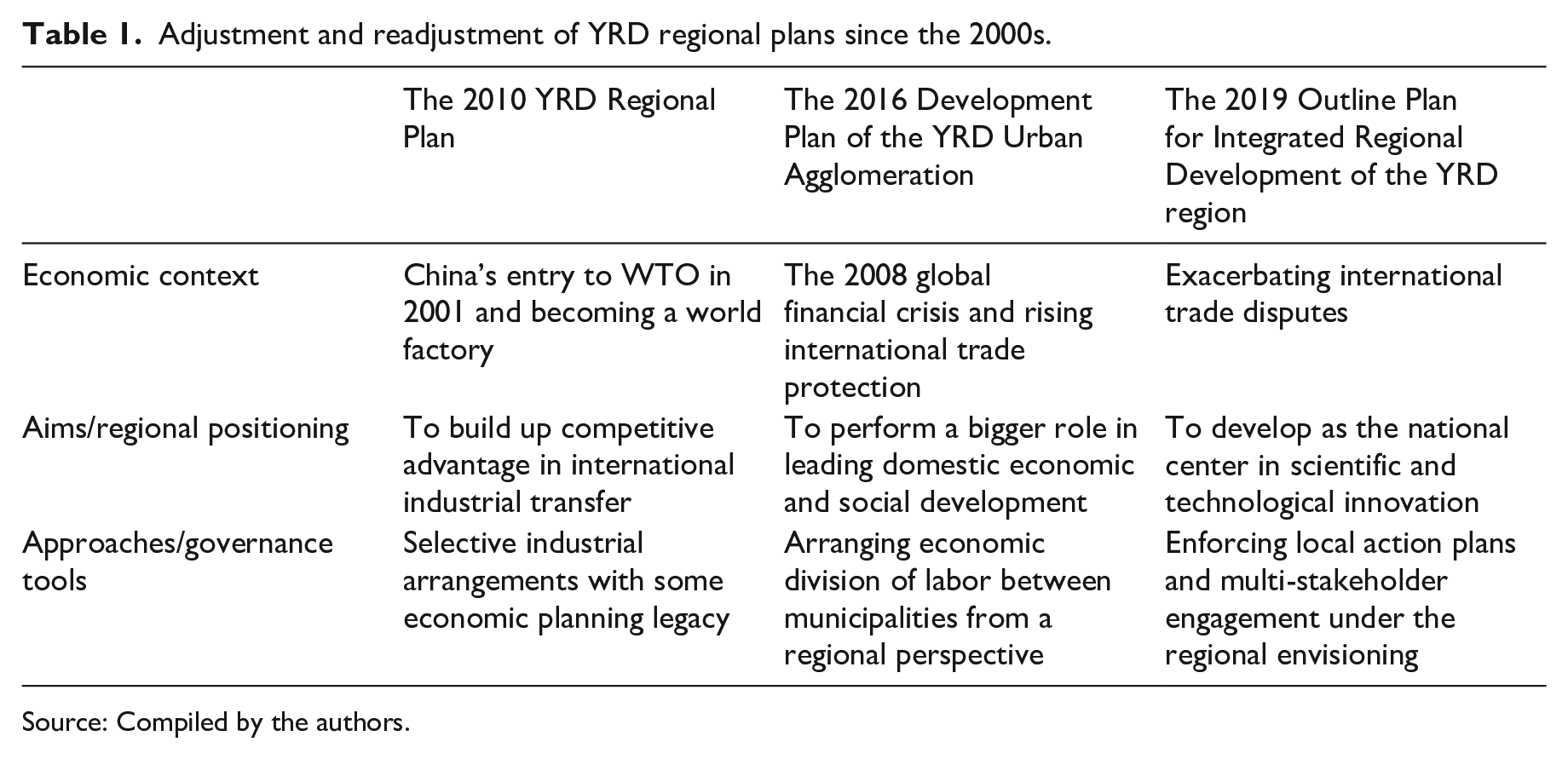
Source: Compiled by the authors.
The 2010 YRD Regional Plan
At the time, the world economy showed a multi-polar development trend with constant and deepening development of economic globalization and regional economic integration. Hence, regional plans were made to locate the positioning of regional development in context of the overall international and domestic situation. The YRD region was given a high functional positioning as an important international gateway into the Asia-Pacific region, a modern service and advanced manufacturing center of global importance, and a world-class city cluster with strong international competitiveness. Thus, the region was set to seize the rare opportunity of undertaking further international industrial transfer to achieve large-scale development. Furthermore, the region was envisioned to build a comprehensive competitive advantage to undertake international industrial transfer through regional integration. Given China’s increasingly close economic relationship with the global economy, the regional plan was oriented to pay attention to effective preventive measures for unintended risks caused by fluctuations in the international economy. Consequently, the priority of the YRD Regional Plan was to rationalize the use of government regulation and control instruments, and give full play to market allocation and resource integration to gradually develop the YRD region into a modern region with a reasonable spatial structure, a clear division of labor between cities and industries, significantly improved economic strength, coordinated socioeconomic development, resources, and environment, and an important base for China to participate in international competitions and regional cooperation.
It was agreed that the content of regional planning was not all-inclusive. Rather, it was a spatial layout plan with policy measures to address specific problems and goals in a particular region. The planning was to address the relationship between the government and the market, and propose relevant government actions. In addition, it would assist with solving cross-regional problems that could not be solved by one place or province alone. The planning addressed major resource development and utilization, ecological and environmental protection, industrial development and layout, infrastructure construction, population and urbanization, and other issues. Based on the introduction of the main functional area plan (c.f. Wei et al., 2016), which comprehensively considered the trade-off of economic development and the coping capacity of the environment, a regional spatial development structure was envisioned with “one core and nine belts” (Figure 1, left).
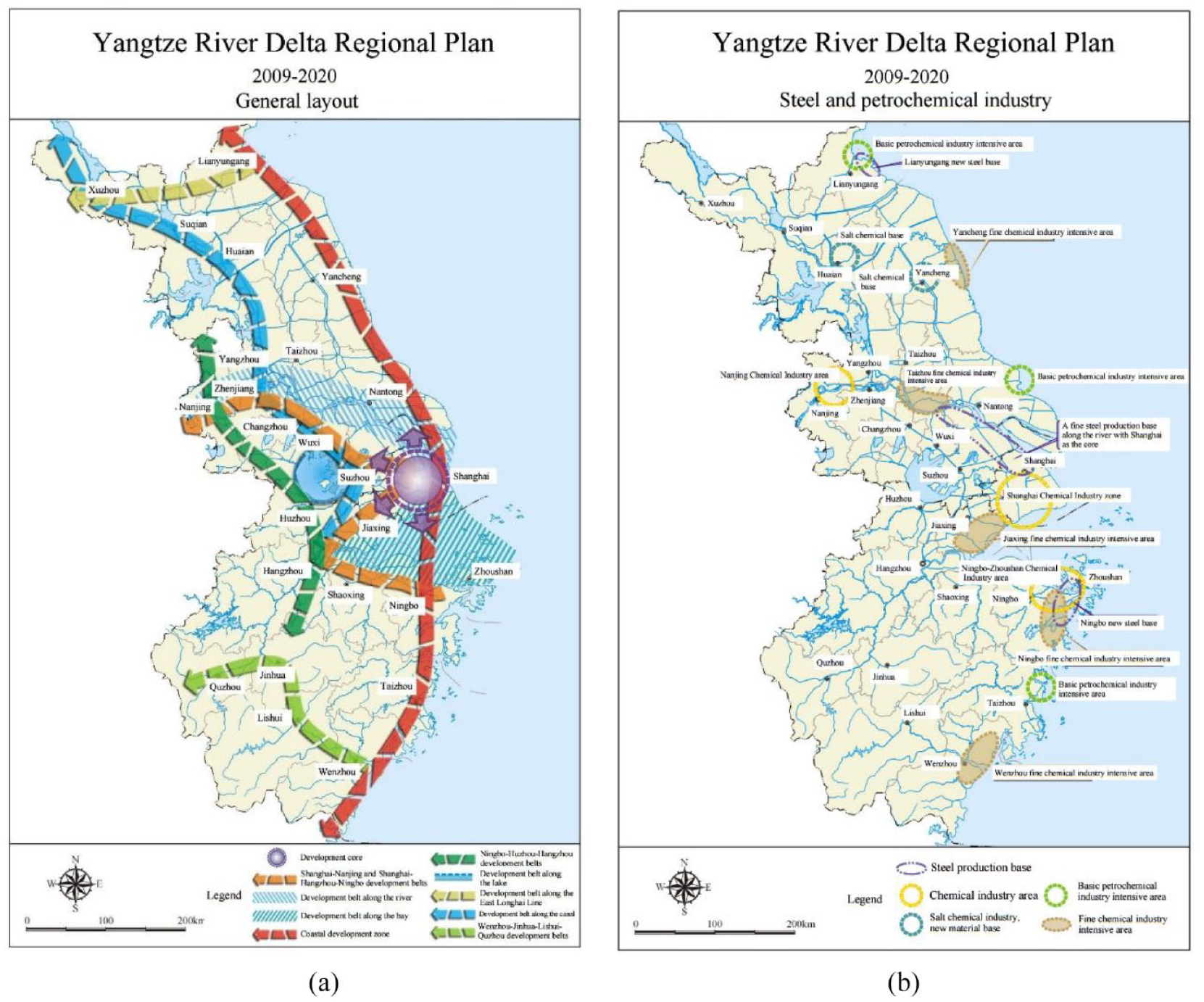
Spatial layout of 2010 YRD Regional Plan. (a) Regional spatial development structure of YRD. (b) Spatial layout for heavy industry.
Under the general layout, specific policy interventions were formulated on the basis of prefecture-level cities. During the period, arrangements for major ports, airports, railroads, and other mega infrastructures and heavy industries were the major themes for the 2010 regional planning discussions. This is because all municipalities were in fierce competition with each other to build more infrastructures so as to attract larger amount of investment. Coordination was hence required from a regional perspective. For example, the agenda to build the Sunan International Airport (located in southern Jiangsu province, which witnessed a foreign investment boom in the 1990s) was proposed after a detailed study of the need for an additional airport between Shanghai and Nanjing. Furthermore, the layout of high-speed railway in this plan was proposed from a regional development perspective rather than following the policy appeals from some municipalities. Above all, the plan made negotiations on regional access of steel and petrochemical industries, considering its high investment precipitation cost and environmental impact, and was cautious about adding new steel and petrochemical industry locations (Figure 1, right). For example, it only provided the petrochemical access permit for Xuwei Port in Lianyungang, northern Jiangsu province. The spatial restriction on steel and petrochemical plants in the region, through the plan, proved to be effective. It protected the environment, eliminated output over-capacity, promoted the concentration of steel and petrochemical industries, and avoided duplication of construction and wasteful investment around the region. China experienced excessive capacity reduction in the steel and petrochemical industries in the following years due to the over-investment by the localities. However, the YRD region was not affected since the regional plan controlled the layout of the steel and petrochemical industries in the region.
To summarize, the 2010 YRD Regional Plan played a strong role in urban development by laying out a series of major infrastructures, such as airports, high-speed rail network, and steel and petrochemical plants. The spatial layout was based on a strategic calculation of the economic positioning of the region in a global and domestic context and was a trade-off between the ecological environment and industrial development. The 2010 YRD Regional Plan showed some legacy of socialist economic plan of top-down allocation of productive forces (shengchanli buju). Yet it innovated its way of planning to align with market-oriented reform. The top-down arrangement of infrastructures and resources were no longer exhaustive as in the centrally planned economy, which suffocated the market initiatives and economic vibrancy. It became more selective and only governed some large-scale infrastructures and capital-intensive industries. By this means, it shaped the pathways of industrial development of various municipalities.
The 2016 Development Plan of the YRD Urban Agglomeration
After the 2010 regional plan, China had rapidly integrated into the world economy and became a world factory. The functional positioning of the region was led by globalization and integrated into the global division of labor. Yet, at the time of preparing the 2016 Development Plan of the YRD Urban Agglomeration (the 2016 Development Plan, thereafter), the international economic environment had undergone significant changes. Affected by the 2008 global financial crisis, the world economy showed a slow recovery, characterized by heavy indebtedness, low growth, and high unemployment. China’s economic growth, driven by its function as the world factory, too, was affected by the anti-dumping policies for international trade protection and other similar policies. As a result, in the 12th Five-Year Plan (2011–2015), the nation-state proposed the economic entry into a new normal of “medium and high speed economic growth, continuous optimization of industrial structure, and transformation of economic growth momentum” (China Daily, 2014).
In response to the changing situation, China proposed the Belt and Road Initiative, the Yangtze River Economic Belt, and other major strategic deployments. The YRD, as the bridge between the Yangtze River Economic Belt and the Belt and Road, was imposed with greater historical responsibility. The thrust of the 2016 Development Plan, therefore, was to build up the YRD mega city-region. The functional positioning of YRD was adjusted from participating in international trade and higher-level competitions to playing a supporting and leading role in the domestic economic and social development. Against this backdrop, the 2016 Development Plan extended the boundary beyond Shanghai, Jiangsu, Zhejiang, and included Anhui province (Figure 2, left). That is, the plan strategically expanded the original regional boundary towards neighboring areas with lower land and labor costs. It was anticipated that certain manufacturing industries might move towards Anhui, thus to experiment with the pathways for the more developed area to lead the development of less developed places (Figure 2, right).
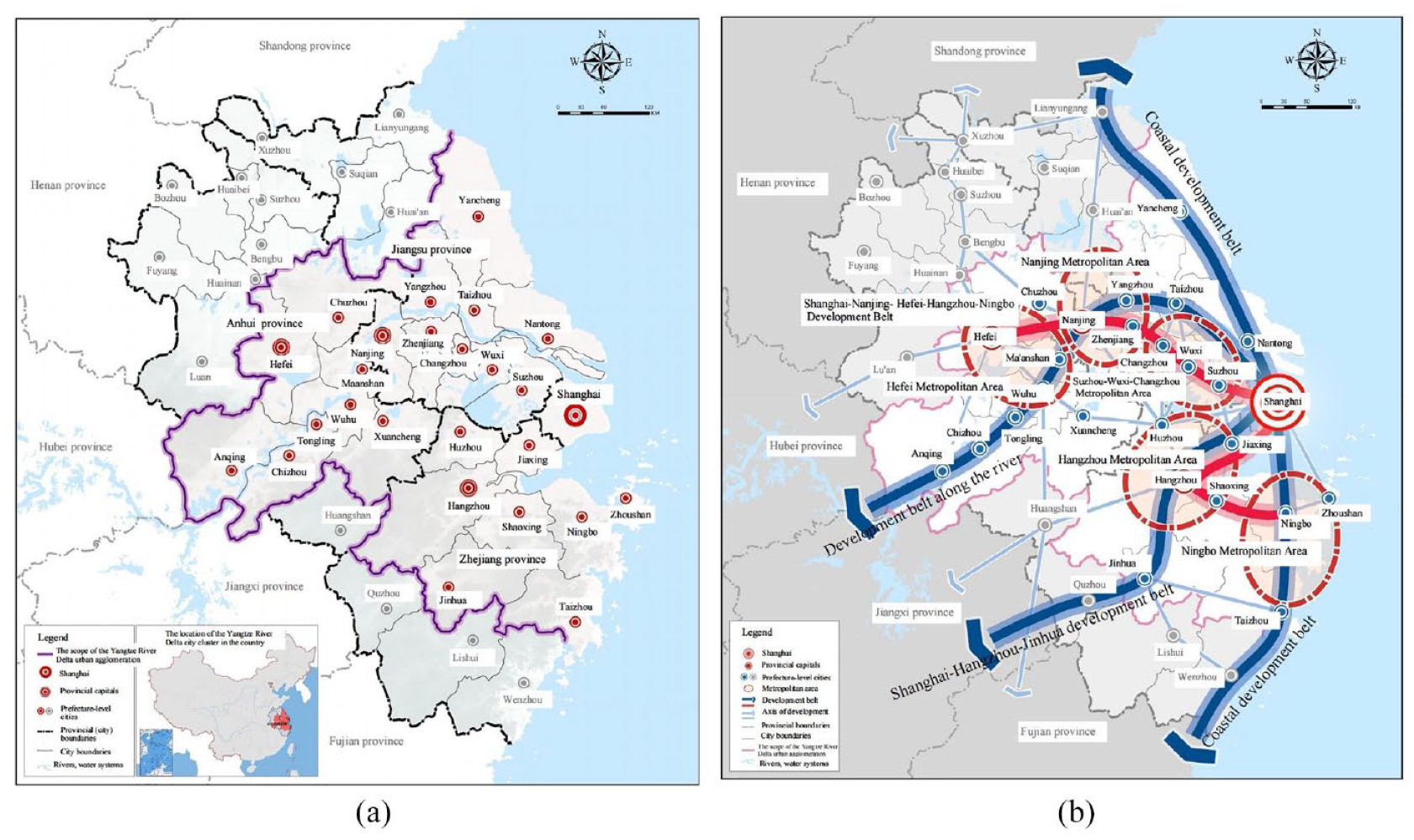
Spatial layout of 2016 Development Plan of the YRD Urban Agglomeration. (a) Regional boundary of the 2016 plan. (b) Urbanization development structure of YRD.
While the 2010 YRD Regional Plan focused on mega infrastructural and project layouts, the 2016 Development Plan shifted the focus to the division of labor for individual municipality and promotion of inter-city cooperation from the standpoint of mega city-region building. The concept of integrated development was advocated to highlight the importance of overall regional interests. In order to form a synergistic regional development pattern, the comparative advantages of each municipality were taken into account when preparing the 2016 Development Plan. Emphasis was put on coordinating the economic functions between different groups of cities, such as between Shanghai and other cities, coastal and hinterland cities, large and small to medium-sized cities. As a consequence, the plan called for enhancing Shanghai’s global city functions, accelerating the construction of a globally influential science and technology innovation center, stimulating the leading role of Pudong New Area, and, last but not least, promoting the decentralization of non-core economic functions. These policy measures aimed to intervene the economic division of labor between Shanghai and neighboring cities, such as Suzhou, Wuxi, Nantong, Ningbo, Jiaxing, and Zhoushan, to stimulate a more complementary rather than a competitive inter-city relationship.
In order to achieve the inter-city coordination, the plan paid great attention to the innovation of institutional mechanisms. In particular, it proposed to develop a cost-benefit-sharing mechanism, establish a YRD urban agglomeration integrated development investment fund, build a horizontal ecological protection compensation system, and set up a financial transfer institution. All these procedures were put forward for the first time in China’s regional planning, and laid a foundation for preventing all municipalities matching their economic growth under GDP evaluation and fiscal pressure, disregarding their comparative advantages and environmental conditions. For example, the ecological protection compensation system and financial transfer institution were designed to make up compensatory fiscal policies for those municipalities shouldering more ecological protection functions and hence with more constraints over economic growth. By this means, it attempted to equalize public services and living conditions between developed and less developed municipalities.
In short, the global economic circumstances had greatly transformed in the 2010s. The 2016 Development Plan henceforth saw a salient change of strategic positioning of YRD region. The region was required to upgrade its industry and transfer lower-end manufacturing to the wider region to lead the overall national economic development. In addition, new experiments on policy delivery were proposed to stimulate regional coordinated development. All in all, the gist of the 2016 Development Plan was to construct the YRD mega city-region. The urban agglomeration is not only conceived as a pattern of urbanization and hence a new space of accumulation, but also imagined as a sort of spatial economic entity to withstand the regional impact from global economic downturn. Built on the overall consideration of regional integrated development, the plan draws up guidelines on urbanization and spatial development for individual municipal jurisdictions.
The 2019 Outline Plan for Integrated Regional Development of the YRD region
The backdrop of the 2019 Outline of the Yangtze River Delta Regional Integrated Development Plan (the 2019 Outline Plan, thereafter) was very different from the previous two rounds of planning, and makes some major changes to the foci of planning. First and foremost, the new round of planning had a higher level of authority. It was initiated by President Xi Jinping and was proposed as a national-level regional development strategy. In May 2019, the Political Bureau of the Central Committee of the Communist Party of China (CPC) reviewed the plan, which was later issued jointly by the CPC Central Committee and the State Council in November 2019. Considering the authority of China’s central government in national and regional governance, the influence of this plan at the governmental and social levels exceeded that of the previous two plans.
Second, there was a relatively large shift in the positioning of the plan. On the one hand, as trade disputes between China and the United States intensified, this plan prominently highlighted the role of the YRD in leading and driving the country, i.e., to gradually amplify the spill-over effects and replicate advanced experiences at the national level. The Sino-US trade war also made the central government realize the importance of supply chain security and technological innovation. Therefore, in addition to reiterating the importance of reform and opening-up, the focus gradually shifted to nurturing strategic emerging industries and promoting scientific and technological innovation. Under the general change of regional positioning, the strategic functioning for some key municipalities was consequently modified. For example, the 2019 Outline Plan imposed on Shanghai, Nanjing, Hangzhou, Hefei, and other central cities greater responsibility in scientific and technological innovations. The central government endowed Shanghai with two major strategic platforms to promote intra-national and international opening-up, namely the Lingang New Area of the China (Shanghai) Pilot Free Trade Zone and the Hongqiao International Opening Hub. Their specific implementation plans were issued by the relevant state ministries, making Shanghai a focal city to cope with reverse globalization.
On the other hand, with increased industrialization and urbanization in China, the government gradually adjusted its focus from merely pursuing economic growth to achieving comprehensive and sustainable development of the economy, society, and environment. As early as 2015, Chinese President Xi Jinping put forward five major development philosophies – innovation, coordination, green, openness, and sharing – which became the basic principles and requirements for the preparation and implementation of the 2019 Outline Plan. “High quality” and “integration” were hence summarized as the kernel of the 2019 Outline Plan, reflecting the general requirements of the central government on social equity and ecological safety in addition to economic growth. More weight was hence given to environment and social provision in this round of planning, advocating attempts by municipalities to share public services, ecological co-protection, and joint management of environmental issues.
Last but not least, the 2019 Outline plan was more than just proposing institutional innovations, placing extreme emphasis on establishing concrete institutional mechanisms for governance. To strengthen top-down implementation, a Leading Group for promoting the integrated development of YRD was set up at the central level, with the Chinese Vice-Premier Han Zheng assigned to be the group leader. In response, a formal YRD Regional Cooperation Office was established at the local level, constituted by officials from Shanghai, Jiangsu, Zhejiang, and Anhui. In addition, Shanghai, Jiangsu, Zhejiang, and Anhui as well as cities and counties under them were required to formulate their own implementation plans to clarify the timetable, mission, and roadmap for promoting the integrated development after the 2019 Outline Plan. Meanwhile, the relevant ministries and departments under both central and local state prepared sectoral or departmental specific plans for key concerns and key regions on coordination issues. For example, a number of special plans were issued, such as the “Higher Quality Integrated Development Plan for Transportation in the Yangtze River Delta Region” and the “Joint Protection Plan for the Ecological Environment in the Yangtze River Delta Region”. These sectoral plans were in effect the action plans for the major tasks identified in the 2019 Outline Plan, and provided practical guidelines on orderly implementation of major projects and coordinated tackling of major issues.
Among the implementation programs, one bold step was the set-up of “The Demonstration Zone for the Eco-friendly and Integrated Development of the YRD”. The zone was carved at the cross-border area of the three provincial units of Shanghai, Jiangsu, and Zhejiang. It was to experiment with a council-like institution to make joint plans and coordinate cross-jurisdictional development. In addition to the high-profile regional project, other inter-municipal cooperation projects were also initiated in the plan, including Dingshan-Chahe, Pukou-Nanqiao, and Jiangning-Bowang, which were at the border between Jiangsu and Anhui, to facilitate the development of economic cooperation. Moreover, the plan began to encourage the role of non-government organizations to engage in regional governance building. For instance, several business alliances were established, such as the Strategic Alliance for Standardization of Domestic Service Industry, the Alliance of Public Service Organizations in Integrated Circuit Industry, the Alliance of Digital Economy Industry, the Alliance of Science and Technology Innovation Think Tanks, and the Alliance of Entrepreneurs, to guide various enterprises and think tanks to participate in promoting the YRD’s integrated development. Industrial alliance conferences are held by these organizations to facilitate business networking and industrial chain building within the region. Additionally, several special funds were set up, such as Yangtze River Delta Synergistic Advantage Industrial Fund and Huitianfu Yangtze River Delta Integration Fund, to guide financial institutions and social capital investors to jointly support and explore the establishment of a market-oriented mechanism for technological innovation. For example, the Yangtze River Delta Synergistic Advantage Industrial Fund is signed by nine local government affiliated investment groups, including Shanghai International Group, Pacific Insurance, Anhui Investment Group, Shaoxing Municipal Government Investment Platform, Shanghai Junyao Group, Lingang Group, Shanghai City Investment Group, Shanghai Airport Investment, and Shanghai Jing’an Investment to nurture innovative industrial clusters such as artificial intelligence technology.
In brief, strategic positioning of YRD region had been further modified in the 2019 Outline Plan and profound emphasis was laid upon high-quality integrated development. In other words, the YRD region was envisioned to be one of the innovation centers of the country to guide China’s economy to transform from “made in China” to “designed in China”. The urban positioning of municipalities within the region was correspondingly changed, with Shanghai as the prime example imposed to perform a stronger role in research and development. Compared with the 2016 Development Plan which guided the municipal development under rational economic division of labor between municipalities, the 2019 Outline Plan developed concrete regional projects and institutions, requiring the local municipalities to engage with them. In other words, municipal development strategies are increasingly influenced by central guidelines.
The regional plan reinvented: Entrepreneurial thrust and governance fix
The regional plans under the charge of the NDRC have been reinvented over the years to better align its role as the instrument for facilitative economic intervention and top-down governance. By tracing the regional plans for the YRD, it was understood that planning has two major tasks. One is refining the functional positioning in line with the changing context and the other is developing mechanisms for policy delivery.
The focus on functional positioning indicates the transformation of economic intervention of the central state. In the planned economy, under the pre-reform regime, regional planning focused on concrete conditional analysis and detailed land use planning. It reflected the nature of regional planning as a technical job under linear logic, following economic-natural investigations. Regional planning is prescribed by direct intervention and allocation of economic resources. Since the economic reforms, economic development has more freedom from direct central state control. The central state has taken a strategic role in envisioning the regional economy in a global and domestic context, which represents the entrepreneurial and competitive turn of the state governance (Healey et al., 1997). The analysis is calculated for competitive advantages with an international perspective. The entrepreneurial rationale does not necessarily equate to putting capital interest to the fore, rather serves to achieve the geopolitical interests of the nation-state in the context of economic globalization (Li and Jonas, 2019; Li and Wu, 2020). Even though more attention is paid to environmental and social issues, it is addressed under the pressure of international economic negotiations. Thus, it is fundamentally underpinned by an economic logic rather than the value of environmental and social reproduction. By imposing the regional strategic positioning, the development pathways for municipalities are influenced.
Furthermore, the regional plan represents policy experiments of top-down economic governance alongside globalization, marketization, and decentralization. In the planned economy, regional plan is implemented by commands from the supervisory government departments. Since the economic reform, the local governments and private sectors have become active agencies on their own. The issue at stake for the central government is how to guide local development in accordance with national interests. To this end, continuous attempts have been undertaken to experiment with the governance toolkits. The 2010 plan focused on imposing spatial guidance for big manufacturing projects, such as steel and petrochemical industry. In the 2016 plan, a so-called rational economic division of labor based on cost-benefit sharing institutional framework was proposed to reduce barriers of spatial coordination among the localities. In the 2019 plan, specific sectoral plans were formulated under the guidance of the regional plan and localities were required to formulate individual implementation plans. The empirical evidence proves the intention of the central state to reassert its top-down governance (c.f. Xu and Wang, 2012). However, these initiatives do not entail the fundamental institutional reforms of the state. For example, the structure of government responsibilities and expenditure continue to be decentralized. Thus, the central state is still reliant upon the localities to take charge of the local issues (such as to impel economic growth). Hence, these programs are similar to the governance fix initiated by the central state to reinforce top-down economic governance without changing the decentralized state structure .
Overall, the regional plans led by the NDRC reinvented the instrument of the central state to facilitative economic intervention and strengthen its top-down governance. The state governance was achieved via the regional plans without substantial restructuring of the state. City governance was strengthened by imposing regional plans over the localities, through the influence of functional positioning and top-down instructions.
Conclusion
This study examined the emergence and reinvention of the regional plans in China with a case study of the YRD. The region witnessed a roll-out of three regional plans since 2010. By reviewing their planning tasks, we found that dominant attention was paid to functional positioning and implementation measures. The three plans continuously refined the functional positioning of the YRD region, in line with the changing global and domestic context, and strengthened the implementation measures for policy delivery. The recurrence of regional plans represented the continuous efforts of the central state to reinvent the social and economic development plan under the NDRC to a central instrument for facilitative economic governance through strategic regional positioning, and oversee urban governance by imposing a higher level of regional plans.
The wave of regional plans originated from the “five-year economic plan” (wunian jihua) overseen by the NDRC. By changing its name to “five-year development plan” (wunian guihua) in 2002, the dimensions of planning were broadened, including the layout of the economic activities and the constraints based on ecological and social concerns. Efforts were made for environmental protection and social equality. Nonetheless, the weight attached to social and environmental concerns was not the same as that attached to economic development. They were addressed after the overall strategic positioning of the region to achieve a niche and competitiveness in the global economic division of labor.
Earlier studies read the reassertion of regional plans by the central state as attempts to build “new state space” at the regional level (Li and Wu, 2013). However, the findings of this study indicate that the efforts do not amount to a substantial restructuring of the state power across all levels of the government. Although the planning initiatives do not entail a reorganization of the institutional reform, they manifest as recurrent experiments of a governance fix to re-regulate local development via regional plans without fundamental structural reforms. Through the regional plans, the national state manages to govern the cities with strategic significance.
To sum up, the emergence of regional plans in China has certain common as well as distinguishing features with the Western European countries, which are well documented in the literature. The plans indicate an entrepreneurial turn towards competitiveness and growth. However, the entrepreneurial transition does not necessarily mean the retreat of the state with respect to the market and businesses, as documented in the Western literature (Deas, 2014; Galland, 2012). Instead, it demonstrates the tensions within the state, i.e., the restructuring and readaptation of state governance between the central and various levels of the local state. Rather than decentralizing economic governance to the localities, the central state strives to restrain local discretions by rolling out regional plans. By imposing a level of regional plan over the localities, the central state intends to govern urban development from overall regional interests.
Footnotes
Acknowledgements
We thank Dr Di Wu and Dr Weiye Xiao for their contribution to the earlier drafts of this paper.
Declaration of conflicting interests
The author(s) declared no potential conflicts of interest with respect to the research, authorship, and/or publication of this article.
Funding
The author(s) disclosed receipt of the following financial support for the research, authorship, and/or publication of this article: This work was supported by Strategic Priority Research Program of Chinese Academy of Sciences (A) (No. XDA23020102), the National Natural Science Foundation of China (Grant Number: 42071206), and Fundamental Research Funds for the Central Universities of China (B220207009).
1
The latter two types of plans, namely the land use plan and spatial plan, have now been combined into a new “territorial plan” under the charge of Ministry of Natural Resources to overcome urban-rural dualism. Generally speaking, land use plan and spatial plan (and the new “territorial plan”) is more land-based (regulation and zoning of land development and protection) whereas the NDRC-led plan is more about economic governance. For more details, please see  : 140).
Author biographies
Wen Chen is Distinguished Research Fellow of Nanjing Institute of Geography and Limnology and Professor of School of Resources and Environment, Chinese Academy of Sciences. She is the chief research expert for the preparation of the Yangtze River Delta Regional Integrated Development Plan conducted by the National Development and Reform Commission. Her main research interests lie in urban-rural and regional development as well as regional planning methods.
Feng Yuan is Associate Professor at the Nanjing Institute of Geography and Limnology, Chinese Academy of Sciences. His current research interests include economic transition, land and housing markets, and urban and regional development in China.
Wei Sun is Research Fellow of Nanjing Institute of Geography and Limnology, Chinese Academy of Sciences. He is engaged in research on urban development and planning as well as regional sustainable development, with recent focus on the spatial evolution of the Yangtze River Delta integration and its ecological and environmental effects.
Yi Li’s research interests lie in the formation and governance of city-regions. Her work has covered the three dominant mega city-regions in China, including the Yangtze River Delta, Pearl River Delta, and Beijing-Tianjin-Hebei. She approaches different aspects of Chinese regional governance from planning and cooperation towards provision of infrastructures and housing.